Category: consciousness

Faithful dog Masha.

Another wonderful dog story, courtesy of Chris Snuggs.

Over four years ago, I published a post under the title of Faithful dog Hachikō. It was the heart-wrenching story of a Japanese Akita dog called Hachi, Hachikō in Japanese, that continued to wait for his master’s return, Hidesaburō Ueno, for years after the professor’s death.  Here’s an extract from that post:

In 1924, Hidesaburō Ueno, a professor in the agriculture department at the University of Tokyo took in Hachikō as a pet. During his owner’s life Hachikō saw him out from the front door and greeted him at the end of the day at the nearby Shibuya Station. The pair continued their daily routine until May 1925, when Professor Ueno did not return on the usual train one evening. The professor had suffered from a cerebral hemorrhage at the university that day. He died and never returned to the train station where his friend was waiting. Hachikō was loyal and every day for the next nine years he waited sitting there amongst the town’s folk.

Hachikō was given away after his master’s death, but he routinely escaped, showing up again and again at his old home. Eventually, Hachikō apparently realized that Professor Ueno no longer lived at the house. So he went to look for his master at the train station where he had accompanied him so many times before. Each day, Hachikō waited for Professor Ueno to return. And each day he did not see his friend among the commuters at the station.

The permanent fixture at the train station that was Hachikō attracted the attention of other commuters. Many of the people who frequented the Shibuya train station had seen Hachikō and Professor Ueno together each day. They brought Hachikō treats and food to nourish him during his wait.

This continued for nine years with Hachikō appearing precisely when the train was due at the station

A few days ago, Chris sent me details of a faithful dog story that appeared in the English Daily Telegraph newspaper on the 26th November. The story was headed: Loyal dog waits for owner who will never return at hospital for two years. It opened, thus:

A loyal dog has shown up every day for two years at a hospital where her master passed away.

Masha appears at the Siberian hospital’s reception area every morning, the Siberian Times reports.

Her owner was admitted to the hospital in Novosibirsk region, south western Siberia, two years ago after falling ill.

Masha is well cared for by staff who make sure she has a warm bed and food every night. The faithful canine was the elderly man’s only visitor, staff say, and used to run home every night to stand guard before returning the next morning.

If we then go across to that Siberian Times story, we see that the wonderful Masha is linked to Hachikō.

Heartbroken little dog becomes Siberia’s own ‘Hachiko’

By Kate Baklitskaya and Derek Lambie – 24 November 2014

For past year devoted Masha has been waiting in a hospital for the beloved owner who will never return.

'One day, and we very much want this day to come soon, our Masha will trust somebody.' Picture: Svyatoslav Odarenko
‘One day, and we very much want this day to come soon, our Masha will trust somebody.’ Picture: Svyatoslav Odarenko

A little dog that waits in vain at a Siberian hospital for the owner who has already died has been dubbed Russia’s own Hachiko. Heartbroken Masha has been turning up looking for her beloved master every day since he passed away at the facility in Novosibirsk last year.

It is a tale mirroring that of the famously loyal Akita dog Hachiko in Japan, who arrived at a train station every evening for 10 years to greet its owner even though he had died.

Masha has become a well-known, and much loved, figure at the Novosibirsk District Hospital Number One, where patients and workers ensure she has a warm bed and food to eat.

But, aware of her obvious sadness at being unable to find her owner, staff are hoping an animal lover will come forward to adopt her and give her a new home.

Chief doctor Vladimir Bespalov told Novosibirsk Vesti TV: ‘You see her eyes, how sad they are – it’s not the usual shiny eyes for when a dog is happy. You can see this in animals in the same way as with people.

‘There is nothing medicine can do for her here, but we are still hoping that Masha will be able to find another owner. One day, and we very much want this day to come soon, our Masha will trust somebody.’

Masha, who looks like a dachshund with short legs, has been coming into the reception at the hospital in Koltsovo every day for the past two years since her owner was admitted. The man, a pensioner from the village of Dvurechie several kilometres away, had fallen ill and had turned up with his pet.

There are three heart-rending photographs of Masha that you really must look at. The article then concludes:

Whilst he was staying on the ward, Masha was his only visitor and she even trotted off home to guard the house before returning to the hospital in the morning.

Sadly he died a year ago but the loyal dog has continued to turn up every day, perhaps because she has nowhere to live, or because she believes her master is still there.

Nurse Alla Vorontsova said: ‘She is waiting for him, for her owner. Just recently a family tried to adopt her, but Masha ran away and returned to the hospital. She was taken on Friday evening, and at 3am on Saturday she was back here.’

Masha’s story is similar to that of the famous Japanese dog Hachiko, who used to greet his master on his return from work at the Shibuya train station in Tokyo.

When his owner, agricultural science professor Hidesaburo Ueno, died in 1925 he continued to visit the station every night for 10 years still expecting to meet him off his 4pm train.

In 1935 the dog’s body was found in a Tokyo street and his remains were stuffed, mounted and put on display in Japan’s National Science Museum, while a bronze statue was erected outside Shibuya. A Hollywood movie of the sad story, starring Richard Gere, was released in cinemas in 2010.

There are also similarities to Greyfriars Bobby, a little Scottish terrier who was unwilling to leave his dead master’s grave in Edinburgh, Scotland, for 14 years in the 19th century.

What wonderful, loyal, loving friends dogs are to us humans.

A Vision for Nature

Another powerful essay from George Monbiot.

Despite this now being December and NaNoWriMo is behind me, all 53,376 words of it, the next few weeks are still going to be demanding.

I have three more chapters to write plus adding a guest preface and an overhaul of Part One of the book.  In other words, December is still a busy book month, albeit without the word-count pressures of NaNoWriMo.

All a long-winded way of me saying that I will present articles seen elsewhere if I think they are of interest to all of you readers.

Which brings me to another powerful essay from George Monbiot that he published a few days ago and is republished here with George’s very kind permission.

ooOOoo

A Vision for Nature

November 27, 2014

As governments tear down the rules that defend our wildlife from extinction, here’s a positive attempt to stop the wreckage.

By George Monbiot. posted on the Guardian’s website, 21st November 2014

One of the fears of those who seek to defend the natural world is that people won’t act until it is too late. Only when disasters strike will we understand how much damage we have done, and what the consequences might be.

I have some bad news: it’s worse than that. For his fascinating and transformative book, Don’t Even Think About It: why our brains are wired to ignore climate change, George Marshall visited Bastrop in Texas, which had suffered from a record drought followed by a record wildfire, and Sea Bright in New Jersey, which was devastated by Hurricane Sandy. These disasters are likely to have been caused or exacerbated by climate change. He interviewed plenty of people in both places, and in neither case – Republican Texas or Democratic New Jersey – could he find anyone who could recall a conversation about climate change as a potential cause of the catastrophe they had suffered. It simply had not arisen.

The editor of the Bastrop Advertiser told him “Sure, if climate change had a direct impact on us, we would definitely bring it in, but we are more centred around Bastrop County.” The mayor of Sea Bright told him “We just want to go home, and we will deal with all that lofty stuff some other day.” Marshall found that when people are dealing with the damage and rebuilding their lives they are even less inclined than they might otherwise be to talk about the underlying issues.

In his lectures, he makes another important point that – in retrospect – also seems obvious: people often react to crises in perverse and destructive ways. For example, immigrants, Jews, old women and other scapegoats have been blamed for scores of disasters they did not create. And sometimes people respond with behaviour that makes the disaster even worse: think, for instance, of the swing to UKIP, a party run by a former City broker and funded by a gruesome collection of tycoons and financiers, in response to an economic crisis caused by the banks.

I have seen many examples of this reactive denial at work, and I wonder now whether we are encountering another one.

The world’s wild creatures are in crisis. In the past 40 years the world has lost over 50% of its vertebrate wildlife. Hardly anywhere is spared this catastrophe. In the UK, for example, 60% of the 3,000 species whose fate has been studied have declined over the past 50 years. Our living wonders, which have persisted for millions of years, are disappearing in the course of decades.

You might expect governments and officials, faced with a bonfire of this magnitude, to rush to the scene with water and douse it. Instead they have rushed to the scene with cans of petrol.

Critical to the protection of the natural world are regulations: laws which restrain certain activities for the greater public good. Legal restrictions on destruction and pollution are often the only things that stand between species and their extinction.

Industrial interests often hate these laws, as they restrict their profits. The corporate media denigrates and demonises the very concept of regulation. Much of the effort of those who fund political parties is to remove the regulations that protect us and the living planet. Politicians and officials who seek to defend regulation will be taken down, through campaigns of unrelenting viciousness in the media. Everywhere the message has been received.

The European Commission has now ordered a “review” of the two main pillars of the protection of our wildlife: the Birds Directive and the Habitats Directive. It’s likely to be the kind of review conducted by a large tracked vehicle with a steel ball on the end of a chain. The problem, the Commission says, is that these directives could impede the “fitness” of business in Europe.

But do they? Not even Edmund Stoiber, the conservative former president of Bavaria who was appointed by the Commission to wage war on regulation, thinks so. He discovered that European environmental laws account for less than 1% of the costs of regulation to business: the lowest cost of any of the regulations he investigated. “However, businesses perceive the burden to be much higher in this area.” So if these crucial directives are vitiated or scrapped, it will not be because they impede business, but because they are wrongly perceived to impose much greater costs than they do.

The UK chancellor, George Osborne, claimed in 2011 that wildlife regulations were placing ridiculous costs on business. But a review by the environment secretary, Caroline Spelman, concluded the claim was unfounded.

In the United Kingdom, whose leading politicians, like those of Australia and Canada, appear to be little more than channels for corporate power, we are facing a full-spectrum assault on the laws protecting our living treasures.

The Small Business, Enterprise and Employment Bill, now passing through the House of Commons, would oblige future governments to keep deregulating on behalf of business, regardless of the cost to the rest of society. The government’s Red Tape Challenge at first insisted that no new regulation could be introduced unless an existing one is scrapped. Now two must be scrapped in exchange for any new one.

Cameron’s government has set up what it calls a “Star Chamber”, composed of corporate executives and officials from the business department, before which other government departments must appear. They must justify, in front of the sector they regulate, any of the rules these business people don’t like. If they are deemed insufficiently convincing, the rules are junked.

Usually, governments go to some lengths to disguise their intent, and to invent benign names for destructive policies. Not in this case. A Star Chamber perfectly captures the spirt of this enterprise. Here’s how a website about the history of the Tudors describes the original version (my emphasis):

“The power of the court of Star Chamber grew considerably under the Stuarts, and by the time of Charles I it had become a byword for misuse and abuse of power by the king and his circle. … Court sessions were held in secret, with no right of appeal, and punishment was swift and severe to any enemy of the crown. Charles I used the Court of Star Chamber as a sort of Parliamentary substitute during the years 1628-40, when he refused to call Parliament. Finally, in 1641 the Long Parliament abolished the hated Star Chamber, though its name survives still to designate arbitrary, secretive proceedings in opposition to personal rights and liberty.”

Yes, that is exactly what we’re looking at. I suspect the government gave its kangaroo court this name to signal its intent to its corporate funders: we are prepared to be perfectly unreasonable on your behalf, trampling justice, democracy and rational policy-making to give you what you want. We are putting you in charge. So please keep funding us, and please, dear owners of the corporate press, don’t destroy our chances of winning the next election by backing UKIP instead.

Then there’s the Deregulation Bill, which has now almost run its parliamentary course. Among the many ways in which it tilts the balance even further against defending the natural world is Clause 83, which states this:

“A person exercising a regulatory function to which this section applies must, in the exercise of the function, have regard to the desirability of promoting economic growth.”

So bodies such as the Environment Agency or Natural England must promote economic growth, even if it directly threatens the natural wonders they are charged with protecting. For example, companies could save money by tipping pollutants into a river, rather than processing them or disposing of them safely. That means more funds for investment, which could translate into more economic growth. So what should an agency do if it is supposed to prevent pollution and promote economic growth?

Not that the government needs to bother, for it has already stuffed the committees that oversee these bodies.

Look, for example, at the board of Natural England. Its chairman, Andrew Sells, is a housebuilder and major donor to the Conservative Party, who was treasurer of the thinktank Policy Exchange, which inveighs against regulation at every opportunity. Its deputy chairman, David Hill, is also chairman of a private company called the Environment Bank, whose purpose is ”to broker biodiversity offsetting agreements for both developers and landowners.” Biodiversity offsetting is a new means of making the destruction of precious natural places seem acceptable.

The government has recently appointed to this small board not one but two Cumbrian sheep farmers – Will Cockbain and Julia Aglionby – who, my encounters with them suggest, both appear to be fanatically devoted to keeping the uplands sheepwrecked and bare. There’s also a place for the chief executive of a group that I see as a greenwashing facility for the shooting industry, the Game and Wildlife Conservation Trust. And one for a former vice-president of Citibank. The board members with current or former interests in industries that often damage the natural world outnumber those who have devoted their lives to conservation and ecology.

So what do we do about this? You cannot fight assaults of this kind without producing a positive vision of your own.

This is what the RSPB and the Wildlife Trusts have done with the publication of their Nature and Wellbeing Green Paper. It’s a proposal for a new act of parliament modelled on the Climate Change Act 2008. It obliges future governments to protect and restore the living world. It proposes targets for the recovery of species and places, a government agency (the Office for Environmental Responsibility) whose role is to ensure that all departments help to defend wildlife, and Local Ecological Networks, which devolve power to communities to protect the places they love most.

I have problems with some aspects of this proposal, not least its enthusiastic embrace of the Natural Capital Agenda, which seeks to persuade us to value nature by putting a price on it. This strategy is, I believe, astonishingly naïve. To be effective, you must open up political space, not help to close it down by accepting the premises, the values and the framing of your opponents. But I can see what drove them to do it. If the government accepts only policies or regulations that contribute to economic growth, it’s tempting to try to prove that the financial value of wildlife and habits is greater than the financial value to be gained by destroying them, foolish and self-defeating as this exercise may be.

But I’ll put this aside, because their proposal is the most comprehensive attempt yet to douse the bonfire of destruction on which the government is toasting our wildlife like marshmallows. The Climate Change Act and its lasting commitments are just about the only measures that oblige this government to restrict greenhouse gases. It remains a yardstick against which the efforts of all governments can be judged. Should we not also have similar, sustained protection for wildlife and habitats? Only lasting safeguards, not subject to the whims and fads of passing governments, can defend them against extinction.

The Nature and Wellbeing Act is a good example of positive environmentalism, setting the agenda, rather than merely responding to the policies we don’t like. We must do both, but while those who love wildlife have often been effective opponents, we have tended to be less effective proponents.

It will be a struggle, as the times have changed radically. In 2008 the Climate Change Act was supported by the three main political parties. So far the Nature and Wellbeing Act has received the support of the Liberal Democrats (so after the election both their MPs will promote it in parliament) and the Green Party. The Conservatives, despite the green paper’s desperate attempts to speak their language, are unreachable. And where on earth is Labour? So far it has shown no interest at all.

If you care about what is happening to the living world, if you care about the assault on the enthralling and bewitching outcome of millions of years of evolution for the sake of immediate and ephemeral corporate profits, join the campaign and lobby your MPs. The Nature and Wellbeing Act will succeed only through a movement as big as the one that brought the Climate Change Act into existence. Please join it.

www.monbiot.com

ooOOoo

Sometimes, I wonder if such essays, as powerful and well-written as they are, are not just too terrible a commentary on how things are just now.  My justification for republishing them is simply from the point of view that the more the awareness of good ordinary people is enhanced as to these present times, the better the odds that there will be a sufficient social and political reaction to bring this madness to a halt.

Removing the fear of the unknown

This was a post from Jon Lavin back in 2011.

I thought it would be nice to republish it today.

oooo

Removing the fear of the unknown

Seeing the light

I’ve been working with most of my clients recently through painful transformations brought about by the economic downturn.

An interesting metaphor really because since the first wave of uncertainty triggered panic, first noticed in the UK banking system, I have been picking up on that uncertainty that feels like it’s stalking the globe and has been for some time. Recent stock market crashes have simply exacerbated this and that, coupled with the riots taking place in major cities in the UK, make for pretty disturbing reading.

Interestingly, I, too, have been aware of an underlying fear that was difficult either to name or source.

It has been rather like a deep river in that whilst the surface feels slow-moving, currents are moving things powerfully below.

So this ‘fear’ has caused a few household changes.

1) We now are the proud owners of 12 chickens. Our youngest son and I have dug up the back lawn and planted vegetables and built a poly tunnel.

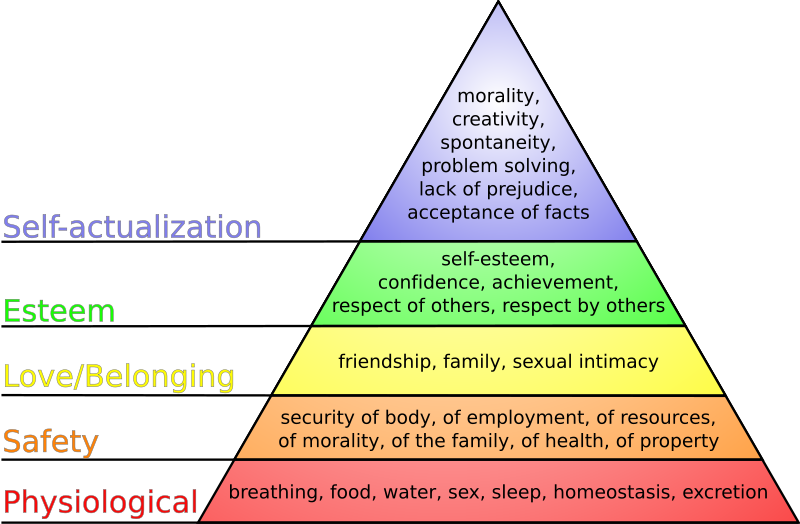
2) We have also installed a wood burning cooker. Right back down to the base of Maslow’s triangle really!

Maslow’s triangle of needs

These feelings have brought about such change everywhere and I wonder seriously whether we will ever return to what was; indeed would we want to?

I might not have mentioned it in previous blogs but as well as an engineering background, in latter years, I have focused on how success in business is linked directly to aspects of relationships and how we are in our relationships with others, so things like integrity, self-awareness and the ability to see the point of view of others, and modify our approach appropriately.

To inform this, some 7 years ago, I embarked on an MA in Core Process Psychotherapy, primarily to work on myself so that I could be the best I could be in my relationships, in and out of work.

The point I’m trying to make is that the same panic I notice in many of the companies I work in, and in me, is based on fear of the unknown and on a lack of trust in all its forms.  I’ve deliberately underlined that last phrase because it is so incredibly important.

The truth is that we get more of what we focus on.

So we can choose to focus on the constant news of more difficulties, hardship and redundancies, or we can focus on what is working.

In the workplace this positive focus has been pulling people together across functions and sites and pooling resources and ideas.

When we realise we’re not doing this alone it’s amazing how much lighter a load can feel and how much more inspired we all feel.

I also notice how humour begins to flow and what a powerful antidote for doom and gloom that is.

Transformation is never easy but the rewards far exceed the effort put in ten fold.

So what is it going to be? Are we all going to bow down to the god of Doom & Gloom, fear and anxiety, heaping more and more gifts around it, or are we going to start noticing and focusing on the other neglected god – that of relationship, joy, trust, abundance and lightness?

Whatever the future holds for us all a belief in our inherent ability to adapt and change and focus on the greater good rather than fear, anxiety, greed and selfishness is the only sustainable way forward.

By Jon Lavin

The book! Part Four: The process of change.

They didn’t bring us here to change the past!

That opening quote to this chapter comes from the blockbuster film Interstellar that was drawing in the crowds when I was up to my neck in the first draft of the book. Jean and I had taken an afternoon off, together with neighbours, Dordie and Bill, to go and watch it. It was the middle of November, 2014.

I’ll resist the temptation to include a review of the film in this place; this is meant to be a book about what we can learn from dogs! But there were two spoken lines that really jumped off the screen at me; one of them being the opening quote to this chapter.

Why did that opening quote strike me so forcibly?

Simply because when it comes to making deep, fundamental changes in who we are, how we see ourselves and, flowing from that, how we behave, or better put, how we wish to change how we behave, we have to change the past.

Sorry, I was being ‘tricky’; we can’t change the past in any real sense! But what we can change is our understanding of our past and how it made us the person we are; at this present moment in our life. That self-understanding is paramount before we set out along any journey of personal change. That was my motivation in recounting, in the opening chapter of Part Four, my discovery of my fear of rejection that for so many years had remained out of sight; albeit not quietly so within me.

Before continuing, I am minded to issue a ‘health’ warning. My writings and my conclusions are purely and solely my personal view of my life and the world as I see and experience it. Don’t empower me with talents and skills that I don’t have! Phew!

Moving on.

Anyone who has attempted a change in their behaviour, from a New Year’s Resolution, to a metaphorically large slap on the wrist for being dumb about some aspect of their life, will appreciate the difficulty of achieving a lasting change in behaviour. Changing our behaviour is rarely simple, straightforward or even, surprisingly, logical. Very often it requires a major commitment of time, effort and, perhaps most importantly of all, an emotional commitment.

The other vital thing to appreciate is that what works for one person, in all likelihood, will not work for another. Even trickier than that; what worked for you one time, may not work another time! That, just for the avoidance of doubt, is not me downgrading the need for change, when your intuition is saying to you that a change or two wouldn’t do any harm at all! Not at all!

So don’t worry about it not ‘speaking’ to you clearly in the first instance, in the sense of you not being clear as to how it is that you need to change, just embrace the fact that it is a process of trial-and-error, and keep reminding yourself why it is that you wish to change an aspect or two of your behaviour.

This important aspect of being relaxed about achieving change for yourself is more easily understood, as in understood rationally, when one takes an overview of the models (note the use of the plural) of change as used by therapists, physicians, and teachers. The researchers, that therapists and others base their knowledge and understanding upon, have multiple theories to explain how change occurs.
One of these theories, a popular one known as the Stages of Change model, demonstrates that change is rarely easy and often requires a gradual progression of small steps toward a larger goal.
In other words, only through understanding the elements of change, the stages of change, and the ways to work through each stage, can help one achieve a lasting behavioural change.

I’m not going to go much further because I’m conscious of potentially over-stepping boundaries. This is a book about learning from dogs, not an amateur self-help manual on change!

But I do want round off with the following; the product of my research and from speaking to a couple of professionals in the field of change.

Apparently, about 20 years ago, two researchers into alcoholism, Carlo C. DiClemente and J. O. Prochaska, proposed a multi-stage model of change. Their aim was to help professional ’change consultants’ understand their clients who had problems of addiction and how to motivate those clients to change. It was a model that was not based on theories but on the observations by DiClemente and Prochaska into how people tackled problem behaviours such as smoking, overeating and excessive drinking.

The multiple stages of the model were called: precontemplation; contemplation; determination; action; maintenance and termination. Six stages in all.

I’m only going to dip into that first stage: Precontemplation.

Precontemplation

Individuals in the precontemplation stage of change are not even thinking about changing their drinking behavior. They may not see it as a problem, or they think that others who point out the problem are exaggerating.

There are many reasons to be in precontemplation, and Dr. DiClemente has referred to them as “the Four Rs” —reluctance, rebellion, resignation and rationalization:

Right that’s enough from me. But for anyone that would like to read the full article by M. Gold (2006) Stages of Change, there’s a footnote [APA Reference Gold, M. (2006). Stages of Change. Psych Central.] that includes a link to a website that can offer you more detailed information about this multi-stage approach to change; indeed has the full article from Mark Gold, MD.

It’s never too late to change.

Oh, nearly forgot! I noted that the film Interstellar offered “two spoken lines that really jumped off the screen at me”, using one, “They didn’t bring us here to change the past!”, as the opening line of this chapter. The second spoken line couldn’t be more appropriate to close a chapter entitled: The process of change.

We all want to protect the world, but we don’t want to change.”

999 words. Copyright © 2014 Paul Handover

The book! Part Four: Of change in thoughts and deeds

Setting the scene

Well done for getting through Part Three: Mankind in the 21st century, and a number of the challenges of our present times! I don’t mean that to come over in a flippant manner but it must have been tough reading; it certainly was tough writing for this scribe! Then again, from way back yonder from my days of selling during the 70s and 80s, comes that old saw about not being able to embrace a new idea if one doesn’t really understand the issues, as in the strengths and weaknesses, of the existing situation.

Change is a fascinating subject and one that even the briefest trawl through the internet reveals a wealth of material. But the theme of change here in Part Four is about change at an individual level and not anything to do with organisations; let alone countries. And as such, in terms of how we understand the need for change as individuals, it seemed pertinent to offer this personal anecdote as a way of setting the scene.

You will recall that in Part One – Man and Dog, there was a chapter headed Unsettled times. In that chapter I wrote about learning that my previous wife informed me that she was having an affair with another man, this revelation taking place on December 20th, 2006, fifty years to the day of my father’s death on December 20th, 1956.
I also mentioned that earlier on in 2006 I had started mentoring a Jon Lavin as he was going through a major transition in his counselling practice. Jon was living a few miles from where I was living in South Devon and was, and still is, a psychotherapist, or to put it more accurately, a UKCP accredited therapist and NLP Practitioner.

Thus in a state of some emotional turmoil, I rang Jon early on in 2007 and asked if I might be his client! Jon was initially reluctant to agree to that, simply because he and I had started developing a relationship in another context, within a completely different perspective, as in me coaching him in the ways of developing his own business. As Jon made clear, he was worried that our existing relationship might get in the way of a very different relationship; one where I was trying to understand the catastrophe that had just taken place in my private life.

I was pretty insistent on wanting, needing, to see Jon; as you might imagine. Thankfully, Jon did agree after giving it some thought but on the strict understanding that if he was concerned about how the counselling relationship was progressing that I had to agree, agree before we started our sessions, that he had the right to terminate the relationship. Of course, I agreed. Without a moment’s hesitation.

Thus Jon and I started my personal counselling relationship soon after.

Naturally, Jon wanted to learn more about my emotional background and gently, when it felt right, asked me to explain the circumstances of my father’s death back in 1956. That was easy for me for the memories of that time had never dimmed.

That I had turned twelve back in November, 1956 and had started that previous September at my new secondary school; Preston Manor Grammar School. At the time of my birthday in November, 1956, I was only vaguely conscious of my father having been ill for a while. Not ill for months and months but bedridden for a few weeks. My father was fifty-five years old and had always been a gentle, caring father to me and my younger sister, Elizabeth.

Then just a few weeks further on, on the evening of the 19th December, when I was tucked up in bed, next door to my parent’s bedroom, my mother came into my bedroom to say goodnight to me; a perfectly ordinary and routine event. But on this particular evening, there was an unmistakeable sadness about her and rather than promptly coming up to me and kissing me goodnight, she sat down on the edge of my bed, just where my knees were under the sheet and bedspread.

I could still recall so clearly Mum giving a deep sigh, a sigh that seemed to confirm what I feared and, somehow, knew in my heart: that his illness might be serious. Mum turning and reaching out with her right hand so that she could hold my right arm that lay on top of the bedspread. “Paul, you do know that your father is not very well, not very well at all. I’m sorry to tell you that he may not live for very much longer.” Words that have never left me.

Mum then leaning forward, kissing me goodnight, and leaving my bedroom, turning the light out as she closed the door. Me falling asleep within moments of the closing of that bedroom door.

My father died that same night: my mother calling the doctor who attended, confirmed the death, issued the death certificate and arranged for my father’s body to be removed from our home.

It all taking place before daybreak. It all taking place as I slept on.

In the morning, my father was no longer part of my life.

As one could easily imagine, the following days were surreal, yet all of my life I have had no recollection of any emotions at all.

Going back to the death of my father, it was thought that my father’s funeral, a cremation, would be too upsetting for me and my sister so we didn’t attend the funeral.

The only other recollection from those times was being teased and bullied at my new school, the one that I had started a few months previously, because I was prone to bouts of crying. I also recall that one day in the playground, surrounded by a group of jeering and taunting boys, I had snapped and gone for the ring leader in a wild frenzied physical attack. Both he and I receive the cane from the headmaster but at least the teasing was brought to an end.

So all of this was spoken of to Jon in those early days of 2007!

Jon gently explored my feelings, wondering what were my emotional echoes from over fifty years ago. I’m not sure I voiced anything particularly revealing.

Then, in a change of tack, he asked me how my own son might have felt if he, my son, had endured the same tragedy at the same age and experienced the death of me, his father, in a similar fashion, and, in addition, not been able to go to the funeral.

It was a straightforward question but one that had me disappearing into my own inner thoughts for some time, Jon sitting quietly in his armchair just next to me, me only half aware that time seemed to have come to a halt. As if for the first time in my life since that dreadful day in 1956 I had the courage to listen to my deep inner voice, to sense my most inner feelings.

I stuttered, “My son would be angry, angry that one of the key events in the life of any person, the death of a parent, no more than that, the death of a son’s father, no that’s still not right; the death of his father, had been denied him.

Jon looked at me, in a way that seemed to connect with me very strongly. Then he quietly asked, “What other feelings might you expect your son possibly to have?

Again, another long silence, and then I said, feeling strongly that something very important was about to happen: “He would feel left out. Overlooked. Denied the experience of something irreplaceably important. He would feel emotional rejection; in spades!

As those last words, quietly and clearly, left my lips, the most incredible sensation overtook me, both without and within me, encompassing me totally, the awareness that for the first time in my life, with me now sixty-three-years old, something that had been emotionally and psychologically hidden from me for fifty-one years, was now out in the open.

The clear knowledge that the circumstances surrounding my father’s death and my subsequent decline in my school performance had left me with a long-term psychological ‘dysfunction’; a certainty that I had been emotionally rejected way back in the Winter of 1956-57. A certainty, for sure, yet an understanding of myself that, hitherto, had been out of sight of my conscious mind, hidden deep inside of me, until this moment, this precious moment, in time.

Jon remained still and quiet as I continued to turn over in my mind this inner discovery. The realisation that, incredibly, for fifty years, my emotional response to my father’s death had remained totally out of my consciousness yet, nonetheless, had influenced me in very real and tangible ways; ways both negatively and positively that came to me almost immediately.

That the negative influence was that I was drawn to any woman who offered me love and affection and, therefore, I was emotionally unable to understand, to judge as it were, whether she had the potential to be a match as a life-long partner, however good a person she might be. I was doing anything to avoid emotional rejection!

The positive influence was that I tried very hard to please others (still do) so as to avoid their rejection, and had successful careers in selling for IBM UK, later starting and building a successful business in the early days of personal computing and, then, when my company was sold in 1986 becoming a freelance journalist and business coach.

So it took a chance association with Jon in those early weeks of 2007 to make me understand a fundamental lesson, one that had its roots fifty years previously, back in those early weeks of 1957. The lesson that we may only fully embrace change when we fully know just who we are. In other words, if there’s the tiniest voice inside you telling you that there may be some hidden nooks and crannies within you, psychologically and emotionally speaking, then some time spent with the appropriate ‘mentor’ will be the best investment you ever made.

There was a second reward from that self-awareness that arose in 2007. Namely, that in the December of that year, while the guest of dear Californian friends, enjoying a Christmas vacation in their holiday home in San Carlos, Mexico, I met Jean. Jean had been married to an American, Ben, for many years, latterly the two of them living permanently in San Carlos. Ben had died in 2005. Jean was born an Englishwoman, born in Dagenham in Essex. I had been born in Acton, North London. As the crow flies, the distance from Dagenham to Acton is twenty-three miles.

Jean and I met on December 15th, 2007. I was now emotionally unencumbered and able to give my full love to her and receive her full love for me. Jean and I were married in Payson, Arizona on November 20th, 2010. Now we live in a rural part of Oregon with our dogs and horses. It is a life together that is everything that any man could ever dream of.

The power of change!

1877 words Copyright © 2014 Paul Handover

oooo

It is only right for me to mention that the above is entirely my own work and while it is my best recollection of a series of true events, the chapter has not been previously seen or endorsed by Jon.
The book! Part Three: Materialism

Money has never made man happy, nor will it, there is nothing in its nature to produce happiness. The more of it one has the more one wants.” Thus, it is reputed, spoke Benjamin Franklin, one of the Founding Fathers of the United States and who in many ways could be regarded as “the First American”.

In my previous chapter on short-termism, I quoted from an article by Larry Elliot, Economics Editor of The Guardian newspaper. The closing paragraphs of that article read:

“The premise of the Global Commission on the Economy and Climate is that nothing will be done unless finance ministers are convinced of the need for action, especially given the damage caused by a deep recession and sluggish recovery.

Instead of preaching to the choir the plan is to show how to achieve key economic objectives – growth, investment, secure public finances, fairer distribution of income – while at the same time protecting the planet. The pitch to finance ministers will be that tackling climate change will require plenty of upfront investment that will boost growth rather than harm it.”

“ …. the plan is to show how to achieve key economic objectives ……. while at the same time protecting the planet.” [My italics]

That those two paragraphs and the phrase “key economic objectives” seem perfectly reasonable statements to me and, I don’t doubt, many, many others, illustrates how deeply we are entrenched in the money, or materialistic, world.

I have spent my whole life hearing the term ‘Gross Domestic Product’, or GDP as it is commonly described, and never ever stopped to wonder about the history of this well-known measure. Thus I was genuinely surprised to learn that the term is not yet one hundred years old, by some years. On the website Foreign Policy one finds a brief history of GDP: “One stat to rule them all.” It offers the following:

Out of the carnage of the Great Depression and World War II rose the idea of gross domestic product, or GDP: the ultimate measure of a country’s overall welfare, a window into an economy’s soul, the statistic to end all statistics. Its use spread rapidly, becoming the defining indicator of the last century. But in today’s globalized world, it’s increasingly apparent that this Nobel-winning metric is too narrow for these troubled economic times.

1937: Simon Kuznets, an economist at the National Bureau of Economic Research, presents the original formulation of gross domestic product in his report to the U.S. Congress, “National Income, 1929-35.” His idea is to capture all economic production by individuals, companies, and the government in a single measure, which should rise in good times and fall in bad. GDP is born.

1944: Following the Bretton Woods conference that established international financial institutions such as the World Bank and the International Monetary Fund, GDP becomes the standard tool for sizing up a country’s economy.

1959: Economist Moses Abramovitz becomes one of the first to question whether GDP accurately measures a society’s overall well-being. He cautions that “we must be highly skeptical of the view that long-term changes in the rate of growth of welfare can be gauged even roughly from changes in the rate of growth of output.”

1962: But GDP evangelists reign. Arthur Okun, staff economist for U.S. President John F. Kennedy’s Council of Economic Advisers, coins Okun’s Law, which holds that for every 3-point rise in GDP, unemployment will fall 1 percentage point. The theory informs monetary policy: Keep growing the economy, and everything will be just fine. [My italics]

Keep growing the economy and everything will be fine! Thank goodness we have unlimited resources on this planet! Please forgive my irony!

Management thinker Peter Drucker is often quoted as saying that “you can’t manage what you can’t measure” but my understanding was that the saying came from William Edwards Deming; October 1900- December 1993. Deming was fundamentally an American statistician although his bio reveals many other talents: engineer; professor; author; lecturer; and management consultant.

Irrespective of the origins of the saying, it misses one fundamental point! That is of being certain that what you wish to manage is being measured appropriately. Not measuring pears if you wish to manage apples!

Stay with this idea for a while longer.

There is an organisation known as the Social Progress Imperative. The organisation is described on their website, as follows:

THE IMPERATIVE
Numerous studies have found a high correlation between economic growth and a wide variety of social indicators, yet there is growing awareness that economic measures alone do not fully capture social progress.

The Social Progress Imperative’s mission is to improve the quality of lives of people around the world, particularly the least well off, by advancing global social progress. The Social Progress Index provides a robust, holistic and innovative measurement tool to guide countries’ choices to enable greater social progress and foster research and knowledge-sharing on the policies and investments that will best achieve that goal. Social progress is defined as the capacity of a society to meet the basic human needs of its citizens, establish the building blocks that allow citizens and communities to enhance and sustain the quality of their lives, and create the conditions for all individuals to reach their full potential.

The Social Progress Index is a tool that we hope will be widely used to inform and influence policies and institutions around the world. The Index is founded on the principle that what we measure guides the choices we make. By measuring the things that really matter to people — their basic needs, their food, shelter and security; their access to healthcare, education, and a healthy environment; their opportunity to improve their lives — the Social Progress Index is an attempt to reshape the debate about development.

…. what we measure guides the choices we make.” Pretty flippin’ obvious when you think about it! As is understanding the “things that really matter to people”!

Michael Green is the Chief Executive Office (CEO) of the Social Progress Imperative. He gave a TED Talk in November, 2014 that is introduced:

The term Gross Domestic Product is often talked about as if it were “handed down from god on tablets of stone.” But this concept was invented by an economist in the 1920s. We need a more effective measurement tool to match 21st century needs, says Michael Green: the Social Progress Index. With charm and wit, he shows how this tool measures societies across the three dimensions that actually matter. And reveals the dramatic reordering of nations that occurs when you use it.

As Michael Green said at the October, 2014 TED Global conference: “GDP is imperfect and incomplete: The world urgently needs a measurement revolution.”

If now writing about the BBC radio show, The Goon Show, suggests I have lost the plot, just hang in with me for a few more moments.

The Goon Show ran from 1951 to 1960 and was broadcast by what was then known as the BBC Home Service. It was hilariously funny and became a comedy legend. It starred Spike Milligan, Peter Sellers and Harry Secombe, not forgetting the wonderful narratives from Wallace Greenslade. The Goon Show was an integral part of my ‘education’ during my formative years; I was seven in November of 1951 and the radio was the source of news, current affairs, education, and humour. Spike Milligan was an outstanding actor in The Goon Show and became a comedy legend in his own right.

A quotation from dear, dear Spike seems a very fitting way to round off this chapter on materialism. Namely: “All I ask is the chance to prove that money can’t make me happy.

1,272 words. Copyright © 2014 Paul Handover

oooo

Now although it is not part of the book, I was so impressed by Michael Green’s TED Talk, that it now follows. You will love it!

Published on Nov 11, 2014
The term Gross Domestic Product is often talked about as if it were “handed down from god on tablets of stone.” But this concept was invented by an economist in the 1920s. We need a more effective measurement tool to match 21st century needs, says Michael Green: the Social Progress Index. With charm and wit, he shows how this tool measures societies across the three dimensions that actually matter. And reveals the dramatic reordering of nations that occurs when you use it.

Seventy years – Just like that!

1944 to 2014 in what seems like the blink of an eye.

At 7:30am UTC on November 8th, 1944 in the antenatal ward of Hampstead Heath General Hospital,  North-West London, yours truly took his first lung-full of air.

It would be impossible to list all the memorable things that have happened in these last seventy years and, anyway, it would bore your pants off!

So all I want to reflect upon were those first six months, despite me not remembering any moment of them.

For on May 8th, 1945 World War II ended.

Here’s the historic announcement by Sir Winston Churchill.

http://www.youtube.com/watch?v=lq-zjE1yfDM

The Allies accepted the unconditional surrender of the defeated Third Reich on May 8, 1945. This brought an end to the Second World War in Europe after 2074 days.

My mother, still very much alive at the age of 94, recalls that on hearing that announcement from Churchill she looked down at me and knew her young baby boy wasn’t going to be killed by a German bomb.

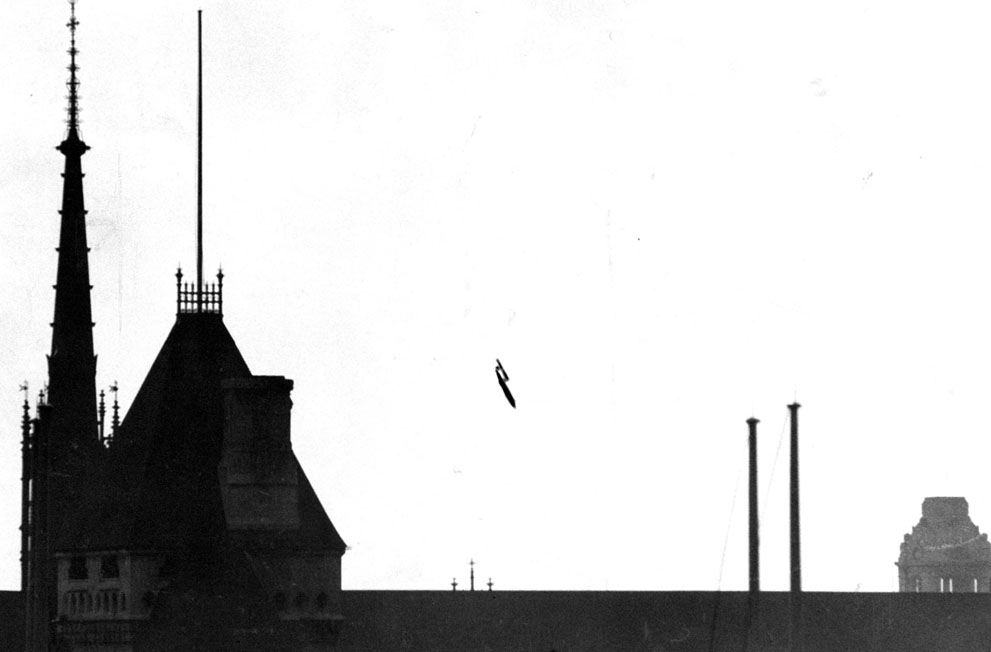
By no means was this a theoretical concern of hers. For in much of the preceding months the Germans had been hammering London with their V-1 “Buzz Bombs”. As this historic photograph shows.

A V-1, “buzz bomb”, plunging toward central London, 1945.


This bomb landed on a side road off Drury Lane blasted several buildings, including the office of the Daily Herald. Known as the Flying bomb, Buzz bomb or Doodlebug, V-1 was the first modern guided missile used in wartime and the forerunner of today’s cruise missile. The V-1 (and later V-2 ) added a new terror to an already terrible war – robot missiles. Once launched, these weapons flew without human intervention to strike distant targets.

Circumstances meant that my mother was living in North-West London when I was born and that’s where I was brought up for the first two years of my life.  Still remember the address: 17 Burnside Crescent, Alperton, North-West London.

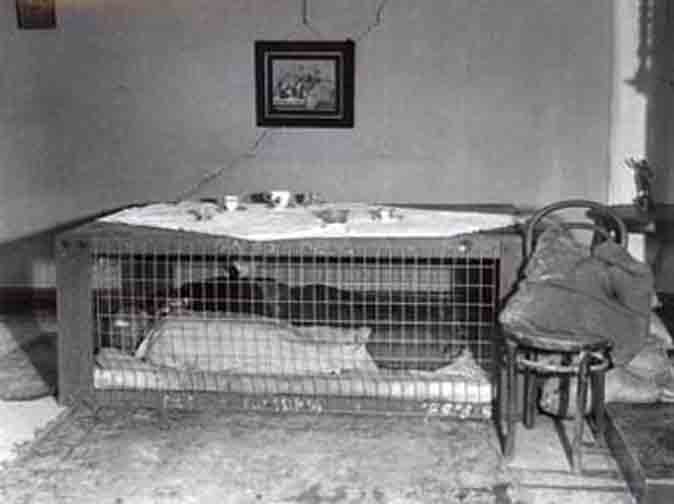
Burnside Crescent was close to factories that were being targeted by the Germans.  That meant that at night my mother and I slept in what was called a Morrison shelter.

An indoor Morrison shelter.

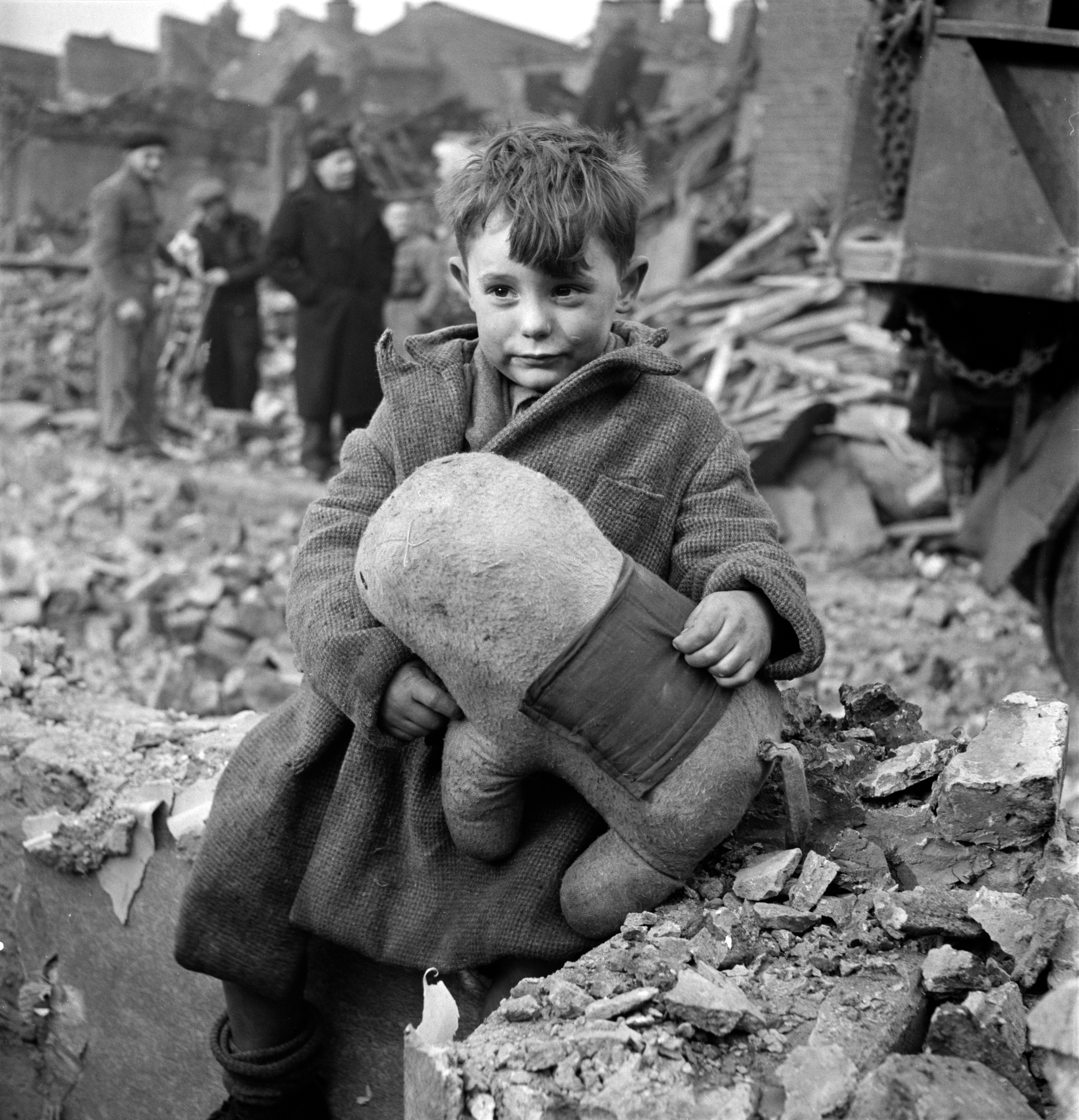
As if to underscore the hazards of early-1945 London, the photograph below is of a young boy, Toni Frisell, the sole family survivor from a V-1 bombing in 1945.

Toni Frissell London bombing 1945 wonder where he is now?
Toni Frissell – wonder where he is now?

So here I am still a living being and still loving my life.

How to close?

By coming all the way forward to modern times and the incredible technology that enables so much. Not just the world of blogging but such things as NASA’s Scientific Visualization Studio from where this compelling video was taken.

http://www.youtube.com/watch?v=T66tLRR9drY

I wrote about my first six months that were not remembered one jot!

This quote, therefore, seems an apt statement for the end of today’s post.

“Time moves in one direction, memory in another.”

Quote from the author William Gibson

Returning to the land – a guest essay.

A question of a possible catastrophe

Note: As tomorrow’s post will explain, the next few weeks will be encroaching seriously on my blogging time. So it was very timely to receive this guest essay from John in the last couple of days and even more generous of him to give me permission to republish it.

It will make an interesting comparison to an item from Dan Gomez being published on Thursday.

ooOOoo

Notes on Dealing With Imminent Catastrophe

We know that our world economy is leveraged at least twenty-five times beyond any earthly material foundation. Regardless of this reality, we have made an artificial global economy more real than our physical world. This situation only makes sense when we recognize that we’re being encouraged to re-establish our awareness of reality. It’s a final exam time for a leading edge species of clever monkeys.

Nature has tolerated human activities for millions of years. Now that our demographics ravenously swarm the globe, belch poisons into the five mile band of air that sustains surface life on earth, dumps wastes and toxins into streams, rivers, lakes and oceans, and arrogantly refuses to understand obvious warnings; Nature is reacting.

For those who are inclined to either or choices, in accordance with the physical Law of Entropy, the decision is between pursuing constructive or destructive actions. For those who are more spiritually oriented, there is no question. In either case, we know what needs to be done.

Our first order of business is to stabilize our inclusive global economy through green initiatives that are operated for profit without damage to the eco-system. Yes, this sounds impossible the first time we think about it. Can we come up with a better plan? Not really, when we stop and honestly consider our situation. We’re poised on the brink of a material, economic and cultural collapse created by human beings.

Wars continue to be waged world wide over territory and rapidly diminishing fossil fuel resources. We have essentially lost trust in each other as equal members of a common community we call Earth. And, we are rapidly losing faith in the unsustainably inflated symbol of trust we call Money.

A green economy is our best solution for the multiple problems that plague us. Here’s why and a few suggestions about how we go about the process. Essentially, our critical need for renaissance is a process of education, formation and transformation.

When we return to the land as a global priority, the use of solar energy can replace massive industrial electrical generators running on fossil fuel derivatives. Most industrial generators may be easily converted to bio-diesel fuel. Industrial diesel generators worldwide can be converted to bio-fuel overnight. No mechanical adaptation is required.

Electric cars already set speed records at Europe’s classic racetracks. Solar electric cars are on the horizon. A bio-diesel engine to power a golf cart costs about $500 today and is available from Amazon.

There’s a natural need for co-operation when we return to the land and collectively re-establish our financial roots. First, we recognize that each of our actions affects the well being of the earth and its inhabitants. Second we realize that we are responsible for the well being of the Earth which sustains our being.

Third, we re-establish our natural connection with the unity of a living universe. We begin with the community gardens and farmer’s markets that are already operational, and rebuild accordingly.

When we are foolish, we act independently for our personal well being. When we are wise, we act together for the well being of the earth and each other. Growing our own food not only assures that what we eat will be free of chemical by-products; it also makes us aware of how fragile our consumer supply lines have become. Recycling our food waste as fertilizer completes a natural growth cycle.

By the way, a back yard greenhouse can produce enough bio-fuel to operate a diesel vehicle and a solar panel array can generate enough energy to charge your electric car. How much money does this save each year?

We don’t need nuclear reactors that sometimes melt down and sicken us with a continual stream of radiation carried by the tides and the winds of an integrated planet. We don’t need the wastes of nuclear reactors that poison the earth for millennium.

We don’t need nuclear weapons capable of destroying most, if not all, of the life on earth in an all out suicidal war. The only creatures to survive the holocaust of nuclear war would need to be radiation resistant; shielded deep underground or deep under the sea.

Harnessing wind, water and geothermal energy are wiser ways to keep our world energized in a green economy. A combination of habitats and communities powered by solar and geothermal energy will produce a new building boom as we shed the skin of our former infrastructure and a green architectural industry emerges.

Recycling the components of our technological world not only reduces our industrial waste, it decreases the cost of manufacture. Similarly, adapting and reusing what we already have decreases our personal expenses and reduces our demands on the earth.

These are only a few of the ideas which are already possible. Many more are already in the process of becoming our greater reality.

Still think such a massive transformation is impossible? If so, please know that you remain in our prayers.

There is hope for tomorrow. Science consistently opens new doors. Faith in the Nature of God of which we are each an infinitesimal part makes us unified and strong as a consciously aware biological species.

John Hurlburt

an old lamplighter

ooOOoo

Saturday special!

Enough of the world of spying and whistleblowing and back to stuff that is really important!

Many will recall that on the 10th October, under the heading of Utterly beyond words!, I wrote about a deer befriending us to the point that Jean was able to stroke its neck as it was feeding.  The post included this photograph.

Then, unbelievably, the wild deer continues feeding as Jean fondles the deer's ear.
Then, unbelievably, the wild deer continues feeding as Jean fondles the deer’s ear.

Inevitably, being the softies that we are, we have continued to put out feed, in the form of cob or cracked corn, most days.

The word among the local deer population clearly has been passed around!

For here’s a photograph taken automatically on the night of the 19th October.

Time of the shot was a little before 5am.

Then on the 22nd, just three days ago, these photographs were taken shortly after 10am.

Party time!
More food and it isn’t even supper time!

oooo

Come on ladies, eat up! You never know when a dog will charge around the corner!

oooo

P1150220
That’s more like it!

One fear that Jean and I had was that they would become vulnerable to an attack by our dogs.  But the deer have quickly wised up to when dogs are being let out of the front or kitchen doors and are off like darts into the forest just a few yards away.

We treasure seeing them each day.

A small step to inner peace.

That journey towards stillness.

I didn’t intend this to be a theme for the week but sometimes one gives in to the forces of fate!

For after Monday’s post about making that inner journey to better know oneself, itself prompted by Rick Hanson’s Power of Stillness, came yesterday’s post on the power of love between a dog and his elderly owner.

So I was wondering what to write for today and wandering around the web looking for inspiration and, serendipitously, came across the blogsite The Commoner Princess.  I had never heard of it before but there on the home page was a post published on the 21st October: Unlocking inner peace: forgiveness.

Here’s a flavour of that post.

Unlocking inner peace: forgiveness

POSTED ON 21 OCTOBER 2014

What hurts the most in life? Trying to make everybody happy. I think this is one of the ultimate life lessons. I remember having a specific unease when someone close to me wasn’t happy for some reason. Things got even more dramatic when I knew I was the cause in one way or another. Time taught me that this perspective wasn’t exactly the healthier approach to life. It is more than normal to care for the wellbeing of your loved ones, to stand by them in need or to try to have a zen relationship with them at all times. But oh boy, this is one of the hardest things to achieve. Detachment is hard enough when you are not directly involved, but when there are emotional ties, becoming the observer takes a lot of mindfulness, awareness, compassion and most importantly, a loooooot of restraint.

Even better, the post concluded like this:

Here is a beautiful meditation to send love and peace to the entire world. Sit in easy pose or any comfortable position of your choosing. Place your arms against your ribs, forearms in horizontal position, palms facing upwards. Start by taking long deep breaths. Breath in through the nose, exhale through your mouth. You can try the 5-5-5 technique as I call in. 5 seconds breathing in, 5 seconds holding, 5 seconds breathing out. Keep this cycle of breath for as long as you feel comfortable with it or until the end of the meditation.Thank you gabbyb.tv for your teachings.

May this be of service to you all!

Then closed with this video that you have to play in the background as you just think of stillness.

http://www.youtube.com/watch?v=QuUszAzp4GU

Wonder what tomorrow will bring?