Category: consciousness

Diya’s story

With thanks to Michelle Orcutt.

I am not a great Facebook user. I have nothing against the app just prefer not to be active in terms of my comings and goings. However, I do automatically send posts from this blog across to Facebook. Some of my followers come from FB.

As was the case with Michelle Orcutt.

I went across to her FB ‘page’ to leave my thanks for her follow and read a wonderful account of Diya.

Michelle kindly gave me permission to republish the article in this place. Here it is.

ooOOoo

Diya’s Story

By Michelle Orcutt

Most of my friends know I adopted Diya, originally a street puppy from India (aka a desi dog, an Indie, a native Indian dog, pariah dog, or a streetie), almost 4 years ago. I wrote this for her rescue’s private Facebook group a year ago, in hopes of encouraging a better understanding of street dogs, and have had some requests to make it public, so here it is:

What follows are my own musings, not anything coming from ISDF. I think about dogs a lot!😁 Through Diya’s rescuer’s visit to the Twin Cities, I was able to meet and observe 7 other Indian-Minnesotan dogs. Thinking about some common difficulties voiced by these dogs’ people, and also about some of the worries and frustrations recently expressed in group and my own challenges with Diya, I feel like sharing my perspective.

To a person, the Desi adopters I met here have been patient and accommodating towards their dogs, yet most of the dogs continue to have difficulty in certain situations. These are dogs, working from what their DNA and experience gives them to go on, in a wholly other environment from where they emerged into the world. Especially with random-bred, pariah type dogs like many from India, Oman, and Thailand, these dogs’ lives center around finding food and water, protecting themselves and their territory, avoiding harm, and successfully breeding, bearing, and raising pups. Certainly the pursuit of pleasure and comfortable resting spots plays into their lives too.

We ask these dogs, who are dogs as dogs are truly meant to be—to become “ours” when they arrive in America. We subject them to foreign constraints like crates and leashes, and saddle them with our own expectations. We spend a lot of time telling dogs they are good and that they are bad. But bottom line, they’re dogs, not just our fur babies, or our charges, but entities deserving of respect in their own right. This isn’t to minimize the difficulty and emotional toll of trying to change worrisome behaviors.

Our dogs think hard to get a handle on us; they interpret and build their own sense of the meanings behind our facial expressions, movements, words, tone, touch, habits, clothing, and smells. Their language is far broader than English, Hindi, Arabic, or Thai. They are another form of intelligent life in our midst, in our cars, on our sofas, under the covers and curled into the bend of our knees. Yet they can also be incredibly distressing as they bark at our friends, growl at our guests, lung at terriers, chase cats, and destroy door frames.

Dogs are incredibly adaptable; this is one of the reasons for their success as a species. A terrified dog rescued from meat trade smugglers in Thailand can transform into a remarkable beauty at ease in a Chanel boutique (😉😉Sparkle Stern); a dog from torrid Muscat can thrive in snow (you Omani pups know who you are). A Delhi puppy fated to starve in the same spot her mother died, can instead run miles through the Michigan woods and “go to work” in an air-conditioned office with her human mom and other people with their own dogs (yes, that’s you, Miss Lily). These changes don’t happen magically or automatically (except in the case of snow), but through initial acts of grace followed by steady and hope-fueled progression.

The things that come easiest to most of these former street puppies and dogs, are the ones that overlap with their natural instincts. Bonding with people who treat them well and provide their food, comfort, and positive mental stimulation is relatively straightforward, though many of our dogs retain more of a capacity for independence than common American companion breeds. Diya is always watching for suspicious people and crows; I live in a part of St. Paul where it’s not uncommon for neighborhood Facebook group posts to start out, “Was that gunshots or fireworks?” so I appreciate her sharp eyes and formidable-sounding bark (I love my city neighborhood, by the way. I love crows too—this is one of the points at which Diya and I differ).

It’s the things that are really weird for street dogs that are hard: being expected to be outgoing, friendly, and trusting of all people and other dogs…always having to stifle your growl…tolerating being left in a wire or plastic box for hours…not being able to run away when you get nervous or to sniff as many spots as you think you need to gather information…to have people decide what you need…going to the vet, going to dog parks, etc. Dogs are social animals, but their idea of social life is different from ours (and also very different from wolves’), and each has their own unique relationship with their person or people, and to the other animals in the household.

So when you are flustered and upset by your dog’s behavior, step back, and think of all we are expecting them to learn and all we are asking them to put aside. Learning new things can be very uncomfortable and anxiety-provoking, especially when going against strong instincts. Living alone with my dogs and cats, and being an introvert by nature, I’ve tended to avoid some trying situations that other families have to work through, but Diya and I have still come a long way. I look forward to finding out where all we’ll go and what we’ll teach each other.

ooOOoo

If you just glanced at this post then make a note, a firm note, to come back and read it fully and carefully.

For Michelle captures precisely what it is to be a dog, especially a street dog.

It is a profoundly wise article and it is a great honour to be able to republish it in this place.

Picture Parade Two Hundred and Ninety-Nine

Dear Pharaoh.

For some reason I have found myself thinking of you dear dog in the last couple of days so please forgive the indulgence.

First published on June 4th, 2017.

ooOOoo

 In celebration of Pharaoh’s 14th birthday yesterday.

(Long-term followers of this place will have seen many of these photos before.)

Just being a dog!

oooo

Luckily the training paid off! Pharaoh was fabulous around sheep!

oooo

Pharaoh riding the back of the Piper Super Cub

oooo

Pharaoh enjoying Bummer Creek.

oooo

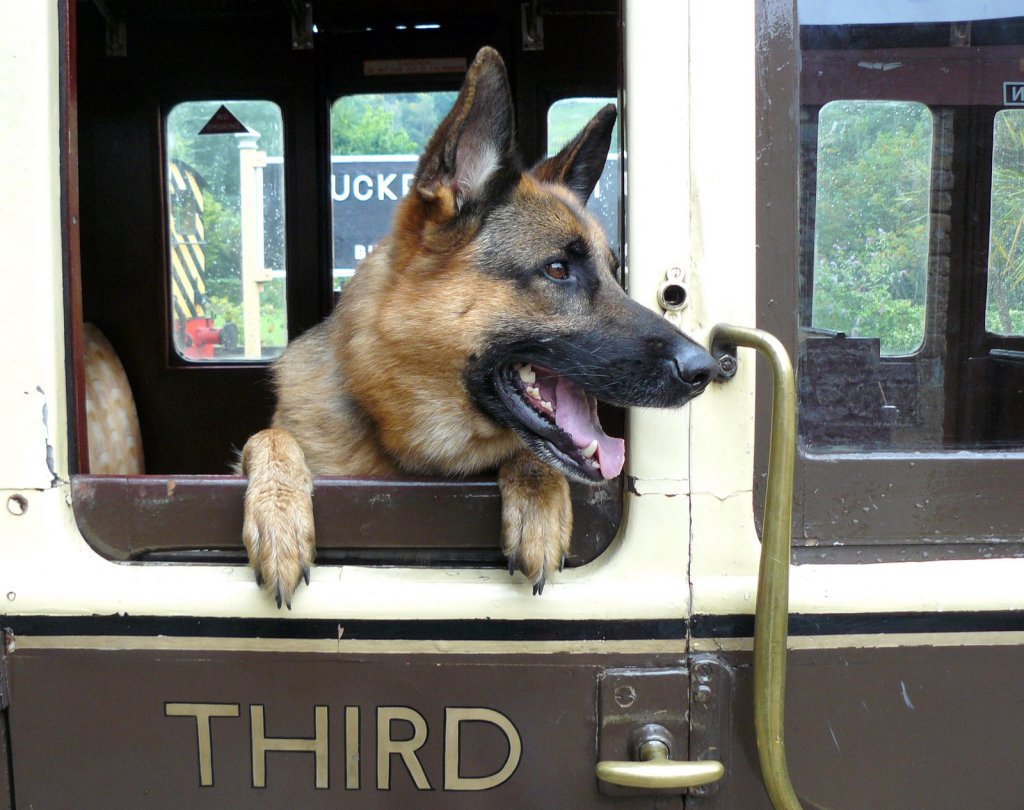
On board the Dart Valley Steam Railway stopped at Buckfastleigh Station.

oooo

Pharaoh, relaxing in a Devon garden.

oooo

First meeting between Pharaoh and Cleo; April 7th, 2012.

oooo

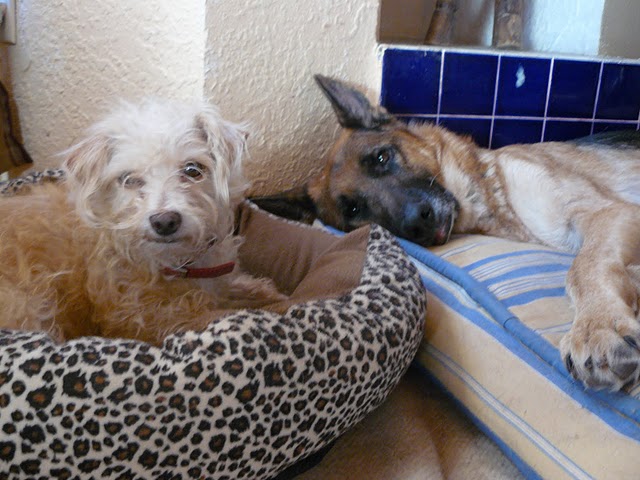
Pharaoh with little Poppy, a stray found on a Mexican building site

oooo

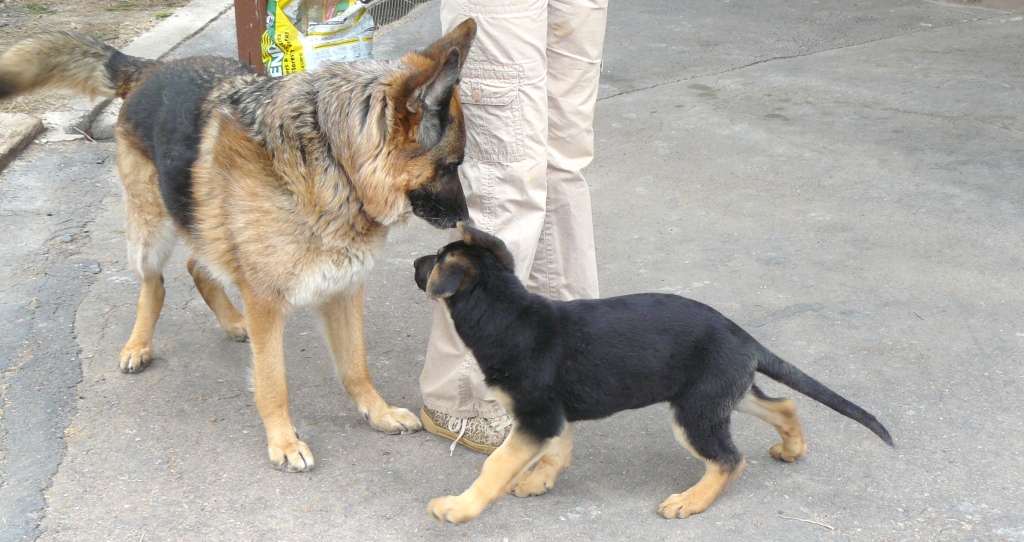
Hi Pedy, I’m the bossman around here. Name’s Pharaoh and you’ll be OK.

oooo

Taken on the afternoon of Pharaoh’s birthday, June 3rd 2017.

oooo

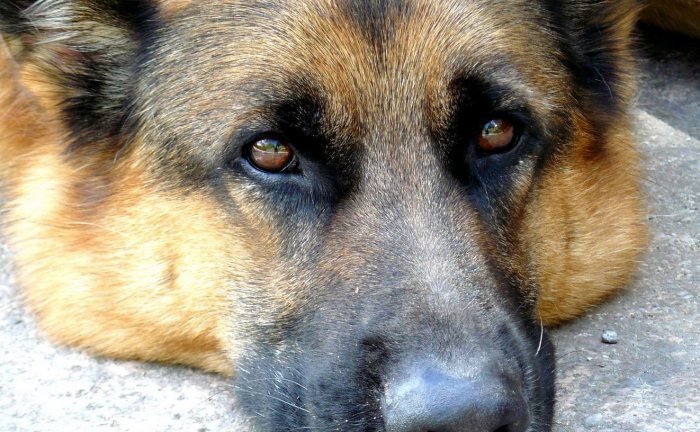
The face of a King of dogs!

ooOOoo

Dear Pharaoh!

Another wonderful example of dog nurturing!

I take my hat off to The Dodo.

It’s a brilliant site and one that has reams of good stories about dogs.

Plus it’s OK to republish them which makes a huge difference to so many of you. For I get the impression that you love what they publish as much as I do.

Take this latest example of a dog nurturing an infant.

ooOOoo

Dog Gets Up During The Night To Help Put Crying Toddler Back To Sleep

When he walks in the room, we know she is in good paws and we can all get some more rest.

By 

PUBLISHED ON 07/12/2019

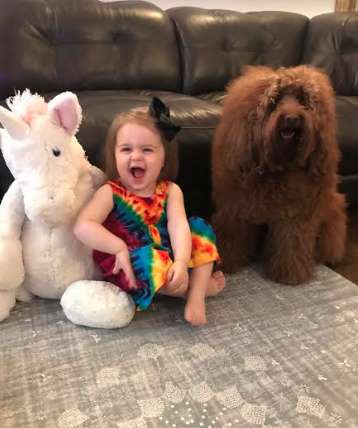
Almost 2 years ago, the lives of Sara Lebwohl and her husband Zach changed forever. That was when the first-time parents welcomed into the world their newborn daughter Halle.

But as the couple embarked on the journey of parenthood, they soon discovered there was someone eager to help them along the way.

That someone, of course, was their adorable dog Prince.

Sara Lebwohl

Even before Halle was born, Prince seemed to understand their family was about to grow. In fact, he rarely left Sara’s side, already devoted to the little one on the way.

Then the big day arrived.

Sara Lebwohl

“When she first came home, he went right up to her and sniffed her,” Sara told The Dodo. “He knew she was little and fragile. But he always stayed close and kept a very close eye on her. He was truly a nanny dog from the first day.”

Sara Lebwohl

Since then, Prince’s dedication to Halle has only grown deeper.

Sara Lebwohl

The two of them are simply inseparable — but although they always have a great time together, Prince still clearly sees himself as both playful companion and caretaker.
And it shows.

Sara Lebwohl

Halle is now nearly 2 years old, and has begun sleeping in her own room. But, as is often the case for youngsters her age, she still requires some comfort and reassurance in the early morning.

Prince, who usually sleeps in Mom and Dad’s room, has always been the first to notice when Halle is seemingly restless. And, without fail, he’d accompany whichever of them got up to attend to Halle during those inconvenient wake-up calls.

Recently, however, Sara and her husband had an idea: What if they left both their bedroom door and Halle’s open throughout the night? Would Prince put a fussy Halle back to sleep on his own?

Yes, is the answer — and here’s some sweet video to prove it:

“Surprisingly it has worked out well,” Sara said. “We crack the door open for him when she gets up, and he walks in to greet her. He has a little routine he does, including rolling around on the ground. Then he will look at her and lay down. The amazing thing is that this calms her, and she goes back to sleep.”

The dog’s stellar nannying skills have made life better for Halle — and her parents, too.

“Prince has been an unexpected savior, allowing us a bit more precious minutes to hours of sleep. When he walks in the room, we know she is in good paws and we can all get some more rest,” Sara said.

Now, everyone’s morning is that much happier.

Sara Lebwohl

This is just one of the ways that Prince has made life better. Every waking moment is improved by having him around, a faithful companion to those who love him the most. And as Halle grows, there’s no doubt he’ll continue to share in the joys and challenges that lie ahead.

His favorite little girl wouldn’t have it any other way.

“He takes his job as protective big brother very seriously,” Sara said. “Our family feels so fortunate to have a dog that is so loving and good-hearted. We are also thankful that Halle adores Prince.”

ooOOoo

See what I mean!

It’s a beautiful story of Prince being so attentive to the needs of Halle and Halle in turn adoring Prince.

Long after Prince has died, indeed for the rest of Halle’s days, she will love dogs.

This is so beautiful!

Another gorgeous story from The Dodo.

I make no apologies for featuring so quickly another article from The Dodo.

It’s just so beautiful and another example of the special characteristics of dogs.

Just see for yourself.

ooOOoo

Rescue Dog Won’t Let Orphaned Foal Sleep Alone

The foal knew that the dog was trying to help him.

BY
PUBLISHED ON 06/27/2019

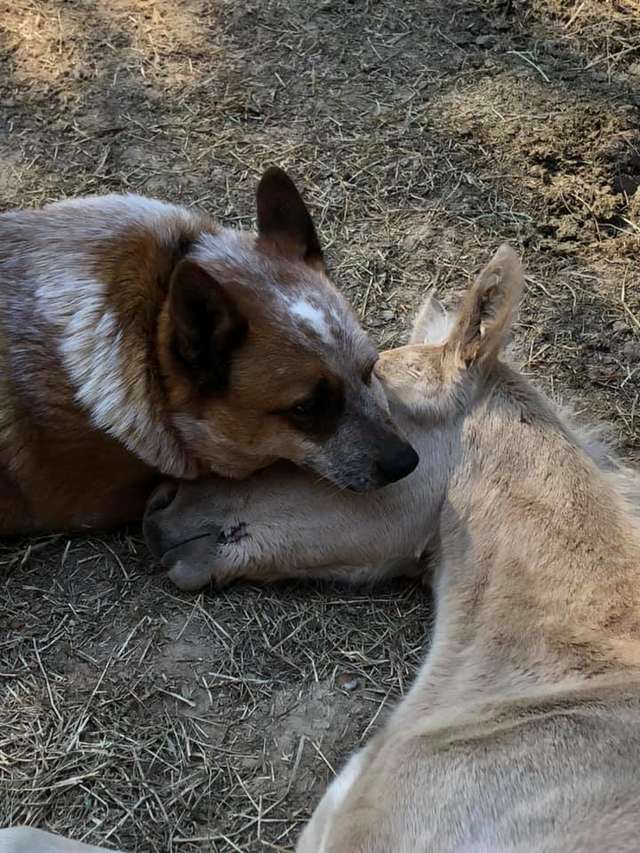
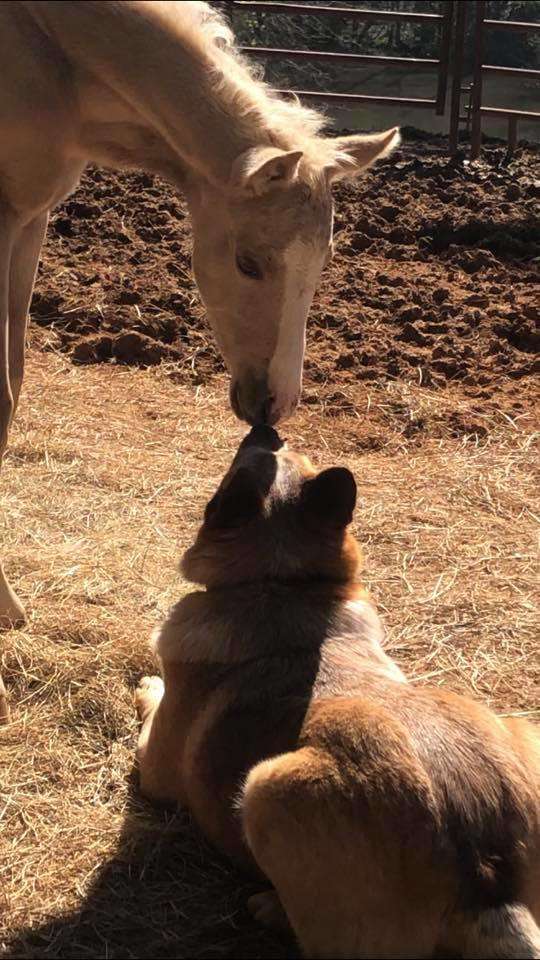
At only 9 days old, a foal named Tye lost his mother. But that same night he gained an unexpected friend — an Australian cattle dog named Zip.
Zip had never shown much interest in his horse siblings. “We raise foals every year, and he would kind of look in the door and just look at them,” Karla Swindle, Zip’s mom, told The Dodo.

But on that fateful night in March, it was as if the 5-year-old rescue dog could tell he was needed.

Facebook/Karla Swindle

Tye’s mother became sick days after giving birth, and despite treatment, quickly went downhill. When things looked their bleakest for the mother and baby, Swindle stayed by their side. As always, Zip tagged along after his owner.

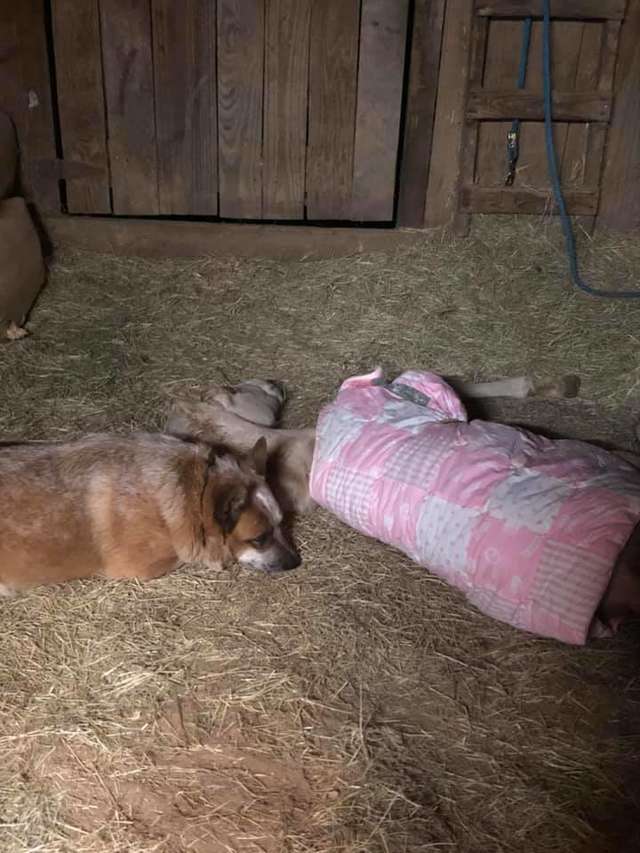
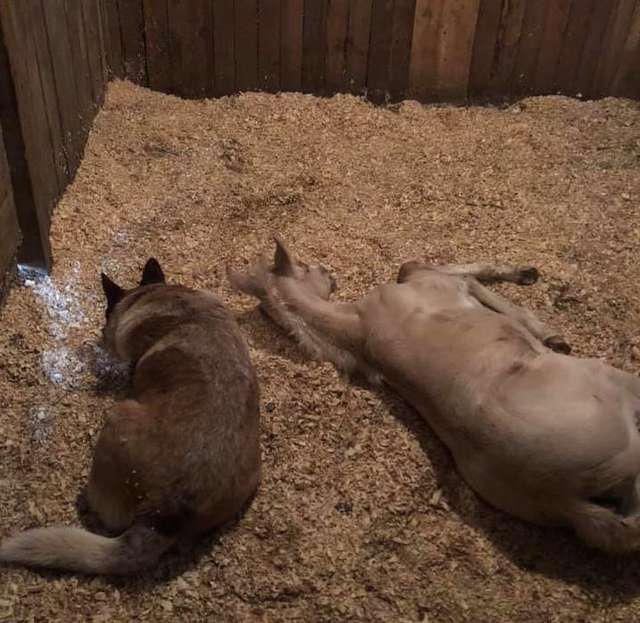
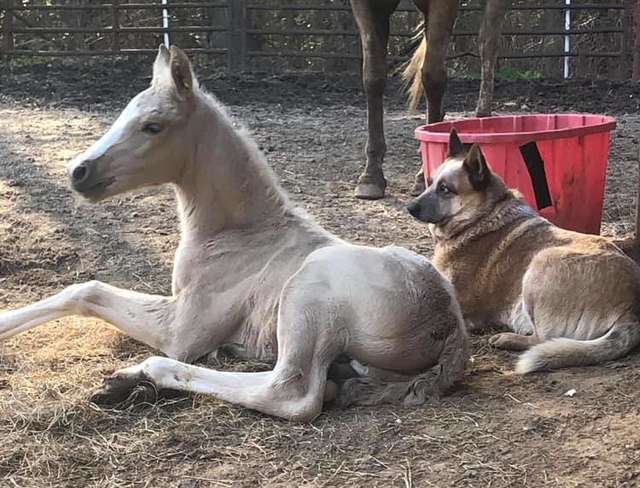
“I spent the night at the barn taking care of the mama horse, hoping that I could pull her through,” Swindle said. “Zip stayed with me in the alley of the barn all night — the foal was laying in the alley, and he just lay there beside the foal.”
“He was whining,” Swindle added. “You could tell that Zip knew something was wrong that night.”

The next morning, Tye lost his mother, but he wasn’t alone.

Zip insisted on keeping the newborn horse company, comforting the little animal with his presence. When Zip was around, Tye was relaxed and happy. “It seemed to me that the foal knew that the dog was trying to help him,” Swindle said, “which is so sweet.”

Facebook/Karla Swindle

For six weeks, Zip wouldn’t let Tye out of his sight. Whenever Swindle went to feed the foal, Zip was first in line to greet the little horse. “Every time I would take off to the barn, Zip would run to the stall, and stand in front of the stall and wait for me to get there,” Swindle said. “He would beat me to the barn every time.”

“As soon as I opened the door, he would about knock me down before I could get in there,” she added. “If the foal was laying down, he would go over there and lay his head on him.”

Facebook/Karla Swindle

As months passed, Tye quickly put on weight, growing into a healthy young horse — in part, thanks to his adoptive dad.

Now, Tye spends most days out in the pasture with his older sister, who is teaching him the ins and outs of being a horse. And while Zip still accompanies Swindle to the barn, he doesn’t beg to go in the stall with Tye anymore.

Facebook/Karla Swindle

“The foal is a little rough now,” Swindle said, “raring up, trying to play, so Zip kind of stays away from him now.”

The proud dad understands that Tye needs to test his independence, and it doesn’t make their relationship any less special.

“You could tell that when the foal needed Zip, Zip was there for him,” Swindle said. “And now Zip knows that the foal is OK, so they kind of went their separate ways.”

Facebook/Karla Swindle

But it seems the little horse has opened up room in the older dog’s heart — space that he has since filled with another baby.

“He loves my granddaughter,” Swindle said. “Whenever she comes over here, he goes directly to her. He treats her like he did the foal. He just loves to be around her.”

ooOOoo

We have mentioned it time and time before. That dogs are so special. And then one comes across an account of something that is even more special.

All of the photographs are delightful but that third one shows the intimacy that is in the relationship. The caring that is being shown by Zip!

I have said it before and no doubt will say it many times more: Dogs are incredibly wonderful.

Dogs are so, so special!

A lovely item on BBC News is being republished.

Sean Coughlan wrote a most delightful piece on the BBC News website the other day.

No matter how many times dogs are referred to it always cheers me up to read about them, especially on a major news website.

ooOOoo

Dogs ‘prevent stressed students dropping out’

By Sean Coughlan, BBC News family and education correspondent

July 2nd, 2019

Therapy dogs are used in more than 1,000 universities and colleges in the US – Getty Images

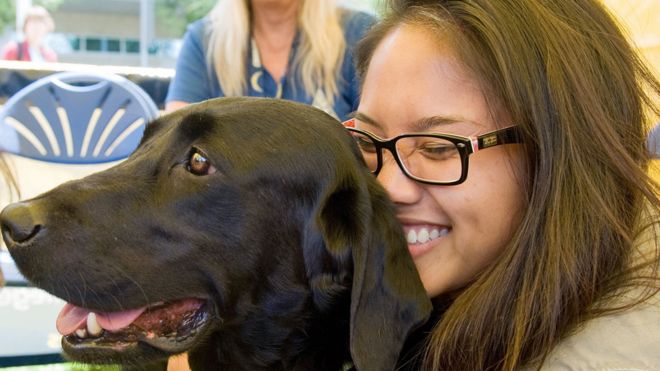
Stress among students really can be reduced by spending time with animals, according to research from the US.

It has become increasingly common for universities to bring “therapy dogs” on to campus – but claims about their benefits have often been anecdotal.

Now, scientists say they have objective evidence to support the use of dogs.

Patricia Pendry, from Washington State University, said her study showed “soothing” sessions with dogs could lessen the negative impact of stress.

Dogs are also used to help people with post-traumatic stress disorder – Getty Images

The study of more than 300 undergraduates had found weekly hour-long sessions with dogs brought to the university by professional handlers had made stressed students at “high risk of academic failure” or dropping out “feel relaxed and accepted”, helping them to concentrate, learn and remember information, she said.

A children’s hospital in California got its first therapy dog this year – Getty Images

“Students most at risk, such as those with mental health issues, showed the most benefit,” said Dr Pendry.

The dog therapy research team at Washington State University

It has also become more common in the UK, with Buckingham, University College London, Cambridge, Nottingham Trent, London Metropolitan and Swansea among those deploying dogs.

The University of Middlesex has even put “canine teaching assistants” on to the staff, to stop lonely students dropping out.

The university study involved 300 undergraduates at Washington State

Previous research has suggested stroking pets can reduce stress hormone levels.

Students spent an hour with dogs, brought to the university by professional handlers

“There does seem to be something specific about the reducing of anxiety from the petting of animals,” said Dr Pendry.

Middlesex University has put dogs on the staff as “canine teaching assistants”

“Do we fully understand the mechanism? No,” said Prof Nancy Gee, a psychologist at the State University of New York and researcher from the Waltham Centre for Pet Nutrition, also part of the project.

But students appeared to “feel calmer and more socially supported”, giving them more confidence in their studies.

Even just looking at animals could sometimes lighten the mood, Prof Gee added.

ooOOoo

This is such a lovely piece. Professor Nancy Gee sums up what we feel when we are close to a dog and yet ponders on the precise science of it.

It’s true! Even just looking at a dog, or more in our case, definitely lightens the mood.

Just look at the exchange of softness in that third photograph from the top. The one about a children’s hospital in California that took on its first therapy dog.

The power of a photograph

No words to say how I feel!

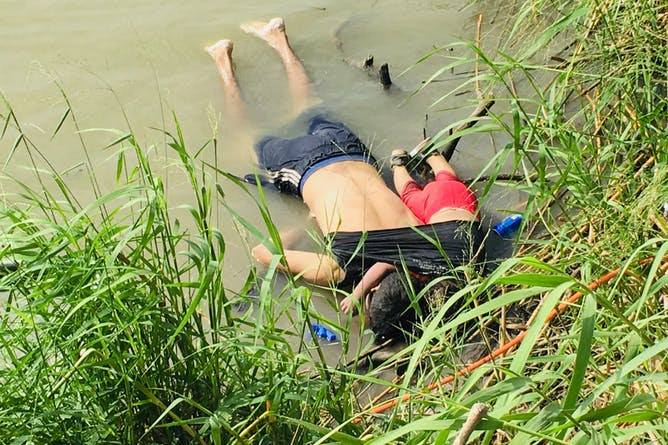
The bodies of Salvadoran migrant Oscar Alberto Martínez Ramírez and his daughter lie on the bank of the Rio Grande in Matamoros, Mexico. AP Photo/Julia Le Duc

This is a terrible photograph. It has been widely shown but that doesn’t make it any less terrible.

Patrice Ayme recently wrote about the tragedy but for today I am republishing the article in The Conversation.

ooOOoo

How much power can one image actually have?

By

Associate Professor, School of Journalism and Communication, University of Oregon

Professor of Psychology, University of Oregon

When the Associated Press published Julia Le Duc’s photograph of a drowned Salvadoran man, Óscar Alberto Martínez Ramírez, and his 23-month old daughter Valeria, it sparked outrage on social media. According to Le Duc, Ramírez had attempted to cross the Rio Grande after realizing he couldn’t present himself to U.S. authorities to request asylum.

But beyond raising awareness via Twitter and Facebook feeds, does an image like this one have the power to sway public opinion or spur politicians to take action?

As journalism and psychology scholars interested in the effects of imagery, we study the ability of jarring photos and videos to move people from complacency to action. While graphic imagery can have an immediate impact, the window of action – and caring – is smaller than you’d think.

A political catalyst?

Photographs and videos – through their perceived authenticity – can have an effect on people.

Research suggests that the graphic photo of slain Emmett Till in his open casket served as a “political catalyst” in mobilizing Americans to action in the civil rights movement. Similarly, news images have been credited as playing an important role in ending the Vietnam War.

But not all scholars agree. A recent article argued that it was a “myth” that the iconic “napalm girl” photo swayed public opinion and hastened the end of the Vietnam War.

Did the ‘napalm girl’ significantly shift public opinion on the Vietnam War? manhhai/flickr, CC BY

We must also look to psychology to understand the impacts of emotional news content. Research demonstrates that audiences need an emotional connection – and not merely a “just-the-facts” reporting approach – as “prerequisite for political action” when it comes to appreciating the importance of distant mass suffering. And imagery can trigger this emotional connection by overcoming the psychic numbing that occurs when casualties mount, images blur and lost lives become merely dry statistics.

Images from Syria

In April 2017, gut-wrenching images seem to have awakened the world to the human atrocities happening in Syria. Following a chemical bomb attack in the town of Khan Sheikhoun, graphic photos and videos documented the horrific effects of the banned nerve agent sarin. Millions bore witness to excruciating human suffering: gasping, choking, writhing and dying. More than 500 people were injured, with at least 86 deaths, including 28 children.

The vivid, closeup images of sarin attack victims were resonant enough to break through the complacency of people and politicians accustomed to bad news emerging from the war-torn nation. In President Trump’s response – which included a retaliatory missile strike – he seemed to recognize the value of the Syrian lives depicted in the horrific photos and videos.

Syrian doctors treat a child following a suspected chemical attack in the town of Khan Sheikhoun, northern Idlib province, Syria. Edlib Media Center, via AP, File

“When you kill innocent children,” he said during a news conference, “that crosses many, many lines, beyond a red line – many, many lines.”

The limits of an image

Nonetheless, even though the attacks may have briefly heightened U.S. concerns over the wars in Syria, the photographic documentation of the suffering in Syria wasn’t new.

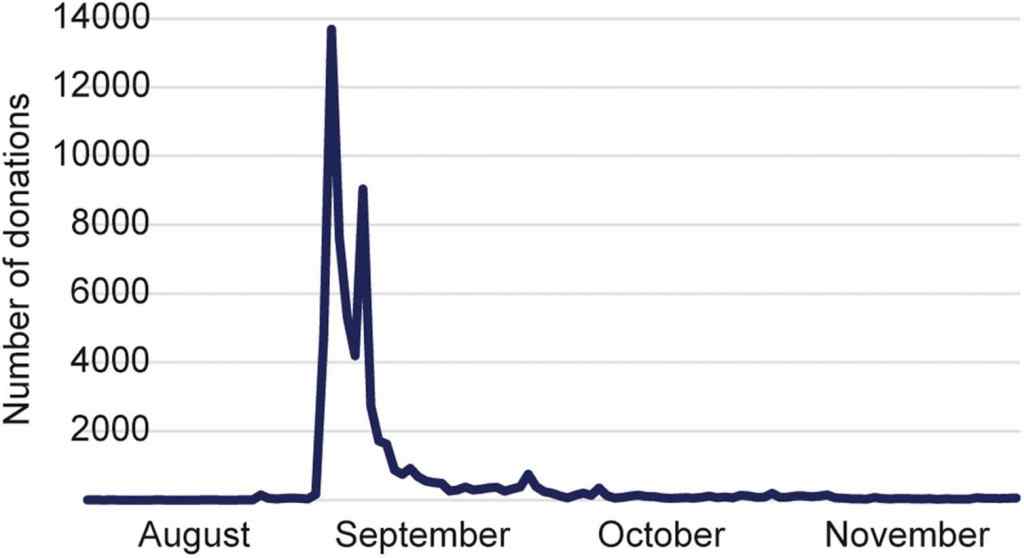
The 2015 photos of a tiny Syrian boy’s lifeless body resting face down in the sand similarly stirred the world’s collective consciousness. Within hours of its release, the photo had reached 20 million people through Twitter, with many more millions seeing it on the front pages of newspapers the next day. Afterwards, government restrictions on accepting refugees were loosened while private donations to organizations like the Red Cross spiked dramatically.

A year later haunting images of a young boy in the back of an ambulance, caked in dirt and blood, galvanized the world.

But the emotional and compassionate responses to both photographs were short-lived. The bombing of civilians in Syria continued. Refugees continued risking their lives to escape the war zone.

After a photograph of a dead Syrian boy went viral in 2015, the number of daily donations to a Swedish Red Cross campaign designated specifically for aiding Syrian refugees spiked dramatically – but only for a brief window. Proceedings of the National Academy of Sciences of the United States of America, CC BY-SA

Since the publication of Le Duc’s photo of the dead migrants, supportive politicians may feel emboldened to sound the alarm on the plight of Central American migrants. Donations to immigrant aid organizations might briefly spike.

But it seems that a photograph, no matter how emotionally devastating, can only do so much.

Yes, it can create a window of time when we’re motivated to act, and we’ll usually do so if we have effective options to pursue. This could mean a charitable donation at the individual level or, collectively, a surge of political will. However, psychology research from the “arithmetic of compassion” suggests that sympathy for distant human suffering declines when we’re presented with rising body counts. Sometimes we’re discouraged by the scope of the problem and this stops us from doing things that actually make a difference – even if partial solutions can save lives. Other times, if the options for helping others seem too narrow or ineffective, we’ll turn away and stop caring.

Images can alert us to the horrors of violence, mass migration and poverty. But as we have seen time and again, photographs and news footage of human suffering generally precipitate a short-term emotional reaction, rather than a sustained humanitarian response.

ooOOoo

As one reads the article it is much more than a comment on a single image despite how terrible that photograph may be.

The two scientists set out to show that the period that we are alarmed or terrified or just plain sad at the state of nations is rather short.

Maybe it’s the self-protective nature of our species that does this.

But it still doesn’t diminish the horror of that top photograph.

Reflections on the future

Father’s Day ….

….. was OK in the morning but for some reason I was in a dark mood in the afternoon.

(And if you want to skip today’s post I don’t blame you at all. This is not my usual style albeit it is important.)

I was reflecting on the state of the world. Global population was well in excess of seven billion people. The longevity of those people was increasing. That’s good news. The health standards were increasing. That’s also good news.

However, the pressure on farming is intense. More and more land is required. The natural world is under supreme pressure. Extinction rates of many natural species are soaring.

Planet Earth has far too many people!

OK, maybe in time the population level will come down but right now it is too high.

Then in came Tom Engelhardt’s latest essay. I read it and reflected. Is it too dark to post? Then Jeannie said that if you really want to share it then publish it.

Here it is, published with Tom’s kind permission.

ooOOoo

Tomgram: Engelhardt, Trump Change

Posted by Tom Engelhardt at 4:23pm, June 16, 2019.
Follow TomDispatch on Twitter @TomDispatch.

If Donald Trump Is the Symptom…
Then What’s the Disease?

By Tom Engelhardt
Don’t try to deny it! The political temperature of this country is rising fast. Call it Trump change or Trump warming, if you want, but grasp one thing: increasingly, you’re in a different land and, whatever happens to Donald Trump, the results down the line are likely to be ever less pretty. Trump change isn’t just an American phenomenon, it’s distinctly global. After all, from Australia to India, the Philippines to Hungary, Donald Trumps and their supporters keep getting elected or reelected and, according to a recent CNN poll, a majority of Americans think Trump himself will win again in 2020 (though, at the moment, battleground-state polls look grim for him).

Still, whether or not he gets a second term in the White House, he only seems like the problem, partially because no president, no politician, no one in history has ever gotten such 24/7 media coverage of every twitch, tweet, bizarre statement, falsehood, or fantasy he expresses (or even the clothes he wears). Think of it this way: we’re in a moment in which the only thing the media can’t imagine saying about Donald Trump is: “You’re fired!” And believe me, that’s just one sign of a media — and a country — with a temperature that’s anything but 98.6.

Since you-know-who is always there, always being discussed, always @(un)realdonaldtrump, it’s easy enough to imagine that everything that’s going wrong — or, if you happen to be part of his famed base, right (even if that right isn’t so damned hot for you) — is due to him. When we’re gripped by such thinking and the temperature’s rising, it hardly matters that just about everything he’s “done” actually preceded him. That includes favoring the 1%, deporting record numbers of illegal immigrants, and making war (unsuccessfully) or threatening to do so across significant parts of the planet.

Here, then, is the question of the day, the sort you’d ask about any patient with a rising temperature: If Donald Trump is only the symptom, what’s the disease?

Blowback Central

Let me say that the late Chalmers Johnson would have understood President Trump perfectly. The Donald clearly arrived on the scene as blowback — the CIA term of tradecraft Johnson first put into our everyday vocabulary — from at least two things: an American imperium gone wrong with its never-ending wars, ever-rising military budgets, and ever-expanding national security state, and a new “gilded age” in which three men (Bill Gates, Jeff Bezos, and Warren Buffett) have more wealth than the bottom half of society and the .01% have one of their own, a billionaire, in the Oval Office. (If you want to add a third blowback factor, try a media turned upside down by new ways of communicating and increasingly desperate to glue eyes to screens as ad revenues, budgets, and staffs shrank and the talking heads of cable news multiplied.)

Now, I don’t mean to sell Donald Trump short in any way. Give that former reality TV star credit. Unlike either Hillary Clinton or any of his Republican opponents in the 2016 election campaign, he sensed that there were voters in profusion in the American heartland who felt that things were not going well and were eager for a candidate just like the one he was ready to become. (There were, of course, other natural audiences for a disruptive, self-promoting billionaire as well, including various millionaires and billionaires ready to support him, the Russians, the Saudis… well, you know the list). His skill, however, never lay in what he could actually do (mainly, in these years, cut taxes for the wealthy, impose tariffs, and tweet his head off). It lay in his ability to catch the blowback mood of that moment in a single slogan — Make America Great Again, or MAGA — that he trademarked in November 2012, only days after Mitt Romney lost his bid for the presidency to Barack Obama.

Yes, four years later in the 2016 election, others began to notice the impact of that slogan. You couldn’t miss the multiplying MAGA hats, after all. Hillary Clinton’s advisers even briefly came up with the lamest response imaginable to it: Make America Whole Again, or MAWA. But what few at the time really noted was the crucial word in that phrase: “again.” Politically speaking, that single blowback word might then have been the most daring in the English language. In 2016, Donald Trump functionally said what no other candidate or politician of any significance in America dared to say: that the United States was no longer the greatest, most indispensable, most exceptionable nation or superpower or hyper-power ever to exist on Planet Earth.

That represented a groundbreaking recognition of reality. At the time, it didn’t matter whether you were Barack Obama, Hillary Clinton, or Marco Rubio, you had to acknowledge some version of that formula of exceptionalism. Trump didn’t and, believe me, that rang a bell in the American heartland, where lots of people had felt, however indirectly, the blowback from all those years of taxpayer-funded fruitless war, while not benefitting from infrastructure building or much of anything else. They experienced blowback from a country in which new billionaires were constantly being created, while the financial distance between CEO salaries and those of workers grew exponentially vaster by the year, and the financing of the political system became a 1% affair.

With that slogan, The Donald caught the spirit of a moment in which both imperial and economic decline, however unacknowledged by the Washington political elite, had indeed begun. In the process, as I wrote at that time, he crossed a psychologically taboo line and became America’s first declinist candidate for president. MAGA captured a feeling already at large that tomorrow would be worse than today, which was already worse than yesterday. As it turned out, it mattered not at all that the billionaire conman spouting that trademarked phrase had long been part of the problem, not the solution.

He caught the essence of the moment, in other words, but certainly didn’t faintly cause it in the years when he financed Trump Tower, watched his five Atlantic City casinos go bankrupt, and hosted The Apprentice. In that election campaign, he captured a previously forbidden reality of the twenty-first century. For example, I was already writing this in June 2016, five months before he was elected president:

“In its halcyon days, Washington could overthrow governments, install Shahs or other rulers, do more or less what it wanted across significant parts of the globe and reap rewards, while (as in the case of Iran) not paying any price, blowback-style, for decades, if at all. That was imperial power in the blaze of the noonday sun. These days, in case you hadn’t noticed, blowback for our imperial actions seems to arrive as if by high-speed rail (of which by the way, the greatest power on the planet has yet to build a single mile, if you want a quick measure of decline).

“Despite having a more massive, technologically advanced, and better funded military than any other power or even group of powers on the planet, in the last decade and a half of constant war across the Greater Middle East and parts of Africa, the U.S. has won nothing, nada, zilch. Its unending wars have, in fact, led nowhere in a world growing more chaotic by the second.”

Mind you, three years later the United States remains a staggeringly powerful imperial force, with hundreds of military bases still scattered across the globe, while its economic clout — its corporations control about half the planet’s wealth — similarly remains beyond compare. Yet, even in 2016, it shouldn’t have been hard to see that the American Century was indeed ending well before its 100 years were up. It shouldn’t have been hard to grasp, as Donald Trump intuitively did, that this country, however powerful, was already both a declining empire — thank you, George W. Bush for invading Iraq! Mission Accomplished! — and a declining economic system (both of which still looked great indeed, if you happened to be profiting from them). That intuition and that slogan gave Trump his moment in… well, dare I call it “the afternoon sun”? They made him president.

MTPGA

In a sense, all of this should have been expectable enough. Despite the oddity of Donald Trump himself, there was little new in it, even for the imperial power that its enthusiasts once thought stood at “the end of history.” You don’t need to look far, after all, for evidence of the decline of empires. You don’t even have to think back to the implosion of the Soviet Union in 1991, almost three decades ago in what now seems like the Stone Age. (Admittedly, Russian President Vladimir Putin, a brilliant imagineer, has brought back a facsimile of the old Soviet Union, even if, in reality, Russia is now a rickety, fraying petro-state.)

Just take a glance across the Atlantic at Great Britain at this moment. And imagine that three-quarters of a century ago, that modest-sized island nation still controlled all of India, colonies across the planet, and an impressive military and colonial service. Go back even further and you’ll find yourself in a time when it was the true superpower of planet Earth. What a force it was — industrially, militarily, colonially — until, of course, it wasn’t.

If you happen to be looking for imperial lessons, you could perhaps say that some empires end not with a bang but with a Brexit. Despite all the pomp and circumstance (tweeting and insults) during the visit of the Trump royal family (Donald, Melania, Ivanka, Jared, Donald Jr., Eric, and Tiffany) to the British royals, led by a queen who, at 93, can remember better days, here’s something hard to deny: with Brexit (no matter how it turns out), the Earth’s former superpower has landed in the sub-basement of history. Great Britain? Obviously that adjective has to change.

In the meantime, across the planet, China, another once great imperial power, perhaps the greatest in the long history of this planet, is clearly on the rise again from another kind of sub-basement. That, in turn, is deeply worrying the leadership, civilian and military, of the planet’s “lone superpower.” Its president, in response, is wielding his weapon of choice — tariffs — while the U.S. military prepares for an almost unimaginable future war with that upstart nation, possibly starting in the South China Sea.

Meanwhile, the still-dominant power on the planet is, however incrementally, heading down. It’s nowhere near that sub-basement, of course — anything but. It’s still a rich, immensely powerful land. Its unsuccessful wars, however, go on without surcease, the political temperature rises, and democratic institutions continue to fray — all of which began well before Donald Trump entered the Oval Office and, in fact, helped ensure that he would make it there in the first place.

And yet none of this, not even imperial decline itself, quite captures the “disease” of which The Donald is now such an obvious symptom. After all, while the rise and fall of imperial powers has been an essential part of history, the planetary context for that process is now changing in an unprecedented way. And that’s not just because, since the 1945 atomic bombings of Hiroshima and Nagasaki, growing numbers of countries have come to possess the power to take the planet down in a cataclysm of fire and ice (as in nuclear winter). It’s also because history, as we’ve known it, including the rise and fall of empires, is now, in a sense, melting away.

Trump change, the rising political temperature stirred by the growing populist right, is taking place in the context of (and, worse yet, aiding and abetting) record global temperatures, the melting of ice across the planet, the rise of sea levels and the future drowning of coastlines (and cities), the creation of yet more refugees, the increasing fierceness of fires and droughts, and the intensification of storms. In the midst of it all, an almost unimaginable wave of extinctions is occurring, with a possible million plant and animal species, some crucial to human existence, already on the verge of departure.

Never before in history has the rise and decline of imperial powers taken place in the context of the decline of the planet itself. Try, for instance, to imagine what a “risen” China will look like in an age in which one of its most populous regions, the north China plain, may by century’s end be next to uninhabitable, given the killing heat waves of the future.

In the context of both Trump change and climate change, we’re obviously still awaiting our true transformative president, the one who is not a symptom of decline, but a factor in trying to right this country and the Earth before it’s too late. You know, the one who will take as his or her slogan, MTPGA (Make The Planet Great Again).

Tom Engelhardt is a co-founder of the American Empire Project and the author of a history of the Cold War, The End of Victory Culture. He runs TomDispatch.com and is a fellow of the Type Media Center. His sixth and latest book is A Nation Unmade by War (Dispatch Books).

Follow TomDispatch on Twitter and join us on Facebook. Check out the newest Dispatch Books, John Feffer’s new dystopian novel (the second in the Splinterlands series) Frostlands,Beverly Gologorsky’s novel Every Body Has a Story, and Tom Engelhardt’s A Nation Unmade by War, as well as Alfred McCoy’s In the Shadows of the American Century: The Rise and Decline of U.S. Global Power and John Dower’s The Violent American Century: War and Terror Since World War II.

Copyright 2019 Tom Engelhardt

ooOOoo

I’m 74. I don’t know how long I’ve got.

Part of me wants to live for a long time. That’s why I am vegan and trying to stay as fit as I can. (I’m also aware that Jeannie’s Parkinson’s Disease is a terminal disease and that in the latter stages she will need me to look after her.)

But then again I’m not sure I want to live in a world that continues to degrade especially continues to degrade in natural ways.

What’s the answer?

What do others who are on or around my age think about it?

What is the disease?

That relationship!

Dogs and humans go back a long, long way!

We like to think of our relationship with dogs as a moderately recent affair. Not the time since dogs and humans have mixed together, that was a very long time ago, but having a dog as a pet.

But even that view needs to be updated.

Try 4,000 years ago!

ooOOoo

New Study Looks at Why Neolithic Humans Buried Their Dogs With Them 4,000 Years Ago

Analysis of the remains of 26 dogs found near Barcelona suggest the dogs had a close relationship with ancient humans

Specimen of a dog skull ( Wagner Souza e Silva / Museum of Veterinary Anatomy FMVZ USP via Wikicommons under Creative Commons Attribution-Share Alike 4.0 International )

By Marissa Fessenden

SMITHSONIAN.COM
FEBRUARY 14, 2019

Humans have enjoyed a long history of canine companions. Even if it’s unclear exactly when dogs were first domesticated (and it may have happened more than once), archaeology offers some clues as to the nature of their relationship with humans.

The latest clue suggests that humans living in Southern Europe between 3,600 to 4,200 years ago cared for dogs enough to regularly share their gravesites with them. Barcelona-based researchers studied the remains of 26 dogs from four different archaeological sites on the northeastern Iberian Peninsula.

The dogs ranged in age from one month to six years old. Nearly all were buried in graves with or nearby humans. “The fact that these were buried near humans suggests there was an intention and a direct relation with death and the funerary ritual”, says lead author Silvia Albizuri, a zooarchaeologist with the University of Barcelona, in a press release.

To better understand the dogs’ relationship with the humans they joined in the grave, Albizuri and her colleagues analyzed isotopes in the bones. Studying isotopes—variants of the same chemical element with different numbers of neutrons, one of the building blocks of atoms—can reveal clues about diet because molecules from plants and animals come with different ratios of various isotopes. The analysis showed that very few of the dogs ate primarily meat-based diets. Most enjoyed a diet similar to humans, consuming grains like wheat as well as animal protein. Only in two puppies and two adult dogs did the samples suggest the diet was mainly vegetarian.

This indicates that the dogs lived on food fed to them by humans, the team reports in the Journal of Archaeological Science. “These data show a close coexistence between dogs and humans, and probably, a specific preparation of their nutrition, which is clear in the cases of a diet based on vegetables,” says study co-author Eulàlia Subirà, a biological anthropologist at the Autonomous University of Barcelona.

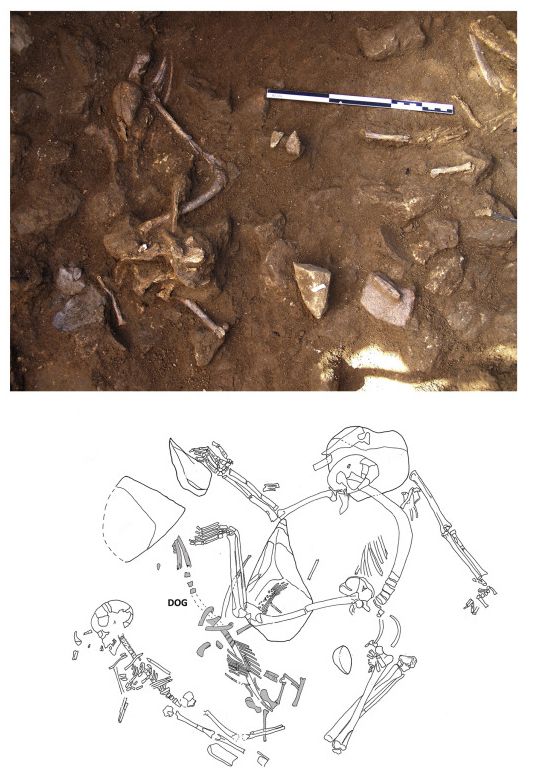
Top: remains of a dog found at the archeological site called La Serreta. Bottom: drawing of dog skeleton found between human skeletons in the necropolis Bòbila Madurell. (UB-UAB)


The archaeological sites all belong to people of the Yamnaya Culture, or Pit Grave Culture. These nomadic people swept into Europe from the steppes north of the Black and Caspian Seas. They kept cattle for milk production and sheep and spoke a language that linguists suspect gave rise to most of the languages spoken today in Europe and Asia as far as northern India.

The buried dogs aren’t the oldest found in a human grave. That distinction belongs to a puppy found in a 14,000-year-old grave in modern-day Germany. The care given to that puppy to nurse it through illness was particularly intriguing to the researchers who discovered it. “At least some Paleolithic humans regarded some of their dogs not merely materialistically, in terms of their utilitarian value, but already had a strong emotional bond with these animals,” Liane Giemsch, co-author on a paper about the discovery and curator at the Archäologisches Museum Frankfurt, told Mary Bates at National Geographic in 2018.

The fact that the researchers in the new study found so many dogs in the region they studied indicates that the practice of burying dogs with humans was common at the time, the late Copper Age through the early Bronze Age. Perhaps the canine companions helped herd or guard livestock. What is certain is that ancient humans found the animals to be important enough to stay close to even in death.

ooOOoo

That last sentence is precious. “What is certain is that ancient humans found the animals to be important enough to stay close to even in death.

As far back as 14,000 years!

It’s time to change our habits.

Funny how things evolve!

A week ago I was casually reading a copy of our local newspaper, the Grants Pass Daily Courier, and inside was a piece by Kathleen Parker, a syndicated columnist, entitled It’s the end of everything – or not.

I found it particularly interesting especially a quotation in her piece by Robert Watson, a British chemist who served as the chair of the panel of the Intergovernmental Science-Policy Platform on Biodiversity and Ecosystem Services (IPBES). The IPBES had recently published the results of the three-year study by 145 authors from 50 countries.

So I wrote to Kathleen Parker asking if I might have permission to quote that excerpt and, in turn, received her permission to so do.

Here it is:

Robert Watson wrote in a statement that:

“the health of ecosystems on which we and all species depend is deteriorating more rapidly than ever. We are eroding the very foundation of our economies, livelihoods, food security, health and quality of life worldwide.”

But, Watson also said, it’s not too late to repair and sustain nature – if we act now in transformative ways.

It is time to change our habits both at an individual level and the level of countries working together.

Moreover we haven’t got decades. We have got to do it now!

How close are you to your dog?

A reflection on our dogs.

I was sorting out some stuff the other day and came across the following. It is the record of a talk I gave some time ago in connection with the publication of my book Learning from Dogs.

As much as I would have expected to have previously published this on the blog I cannot find an entry. So here you are!

ooOOoo

The concept of attributing dogs with human traits is nothing new. In fact the ancient Greeks came up with a fancy word for it around two thousand years ago: anthropomorphism.

As ever, the truth of the matter is not a case of black and white but subtle shades of grey. No doubt in another two thousand years as science advances and we discover more about DNA and the mysteries of the human and canine brains the picture will develop into sharper focus. In the meantime, we must satisfy ourselves with some basic observations.

Let’s start off on common ground. One thing that we all seem to agree on is that humans are at the top of the pile in terms of evolutionary sophistication. For obvious reasons we view ourselves as the being the highest life form (although there is increasing alarm that we have totally lost touch with our basic instincts, if not totally lost the plot, by endangering the very planet that sustains life as we know it).

But I digress – back to common ground. We agree that as children our mental capacity is not fully developed. We survive by our instincts and the basic needs to be fed, watered, sheltered and bonded in a family group where we defer to a natural hierarchy. When you think about it this is precisely how dogs survive.

Like children, dogs display the most basic instincts to rough and tumble, compete for toys and establish a natural pecking order. Inherent in this is the need for a parent or pack leader to set down boundaries and create order and stability out of chaos. Without this both child and dog feel insecure and may well grow to display anti-social behaviour.

You would responsibly bring a child up with love and discipline, have consistent boundaries, teach them what is safe and what is dangerous, what is sociable and what is unsociable.

Dogs too need love and discipline, consistent boundaries, and to learn what is safe and what is dangerous, what is sociable and what is unsociable.

Communicating with a child is not so very different from communicating with a dog. Young children, like dogs, do not have the power of speech so you have to work out alternative strategies to speech in order to get through to them. You will find that if you approach a dog in much the same way as you approach a child, life will be a whole lot easier for you. And the dog! Hopefully you will have realised that praise is a far stronger motivator that punishment.

A positive approach.

Take the example of the puppy that makes a puddle on the floor and the child that wets its bed. Each one of them have not learnt control of their bladder and are simply responding to the call of nature. Neither are being naughty nor are in the wrong.

Yelling at the child will only make it more stressed and, therefore, more likely to continue wetting the bed. In exactly the same way if a puppy has an accident on the carpet being harsh will make matters worse.

How many human ‘sports’ involve chasing a moving object? How many of these games also involve people working as a team to ‘catch’ these objects? Football, rugby, basketball, tennis, badminton, etc. I could go on but you get the idea.

Why do we enjoy these games? Is it not because we too are instinctively striving for a pecking order within the pack and following our predatory instincts.

“No, no no!’ I hear you say. ‘We are a civilised, sophisticated race who have created these games for our enjoyment. They are so different to the throw and fetch games our canine friends mindlessly enjoy.’

Don’t kid yourself. Look also how football supporters revert to uninhibited childlike behaviour. At worst becoming hooligans and behaving, almost literally, like savage animals when they find themselves challenged or threatened by an opposing pack.

Or on a much more positive note how hundreds of fans, unrehearsed, suddenly find one voice and break into a prefect, heart-stopping rendition of “You’ll Never Walk Alone”. Now that’s a perfect example of the ‘pack call’.

We all enjoy the close relationship we have with our dogs. Maybe sometimes we don’t realise quite how close we are.

ooOOoo

I can’t imagine life without our dogs.

They mean everything to Jeannie and me.

A photo of Pharaoh when he was quite an old fella!