Category: consciousness

The power of a photograph

No words to say how I feel!

The bodies of Salvadoran migrant Oscar Alberto Martínez Ramírez and his daughter lie on the bank of the Rio Grande in Matamoros, Mexico. AP Photo/Julia Le Duc

This is a terrible photograph. It has been widely shown but that doesn’t make it any less terrible.

Patrice Ayme recently wrote about the tragedy but for today I am republishing the article in The Conversation.

ooOOoo

How much power can one image actually have?

By

Associate Professor, School of Journalism and Communication, University of Oregon

Professor of Psychology, University of Oregon

When the Associated Press published Julia Le Duc’s photograph of a drowned Salvadoran man, Óscar Alberto Martínez Ramírez, and his 23-month old daughter Valeria, it sparked outrage on social media. According to Le Duc, Ramírez had attempted to cross the Rio Grande after realizing he couldn’t present himself to U.S. authorities to request asylum.

But beyond raising awareness via Twitter and Facebook feeds, does an image like this one have the power to sway public opinion or spur politicians to take action?

As journalism and psychology scholars interested in the effects of imagery, we study the ability of jarring photos and videos to move people from complacency to action. While graphic imagery can have an immediate impact, the window of action – and caring – is smaller than you’d think.

A political catalyst?

Photographs and videos – through their perceived authenticity – can have an effect on people.

Research suggests that the graphic photo of slain Emmett Till in his open casket served as a “political catalyst” in mobilizing Americans to action in the civil rights movement. Similarly, news images have been credited as playing an important role in ending the Vietnam War.

But not all scholars agree. A recent article argued that it was a “myth” that the iconic “napalm girl” photo swayed public opinion and hastened the end of the Vietnam War.

Did the ‘napalm girl’ significantly shift public opinion on the Vietnam War? manhhai/flickr, CC BY

We must also look to psychology to understand the impacts of emotional news content. Research demonstrates that audiences need an emotional connection – and not merely a “just-the-facts” reporting approach – as “prerequisite for political action” when it comes to appreciating the importance of distant mass suffering. And imagery can trigger this emotional connection by overcoming the psychic numbing that occurs when casualties mount, images blur and lost lives become merely dry statistics.

Images from Syria

In April 2017, gut-wrenching images seem to have awakened the world to the human atrocities happening in Syria. Following a chemical bomb attack in the town of Khan Sheikhoun, graphic photos and videos documented the horrific effects of the banned nerve agent sarin. Millions bore witness to excruciating human suffering: gasping, choking, writhing and dying. More than 500 people were injured, with at least 86 deaths, including 28 children.

The vivid, closeup images of sarin attack victims were resonant enough to break through the complacency of people and politicians accustomed to bad news emerging from the war-torn nation. In President Trump’s response – which included a retaliatory missile strike – he seemed to recognize the value of the Syrian lives depicted in the horrific photos and videos.

Syrian doctors treat a child following a suspected chemical attack in the town of Khan Sheikhoun, northern Idlib province, Syria. Edlib Media Center, via AP, File

“When you kill innocent children,” he said during a news conference, “that crosses many, many lines, beyond a red line – many, many lines.”

The limits of an image

Nonetheless, even though the attacks may have briefly heightened U.S. concerns over the wars in Syria, the photographic documentation of the suffering in Syria wasn’t new.

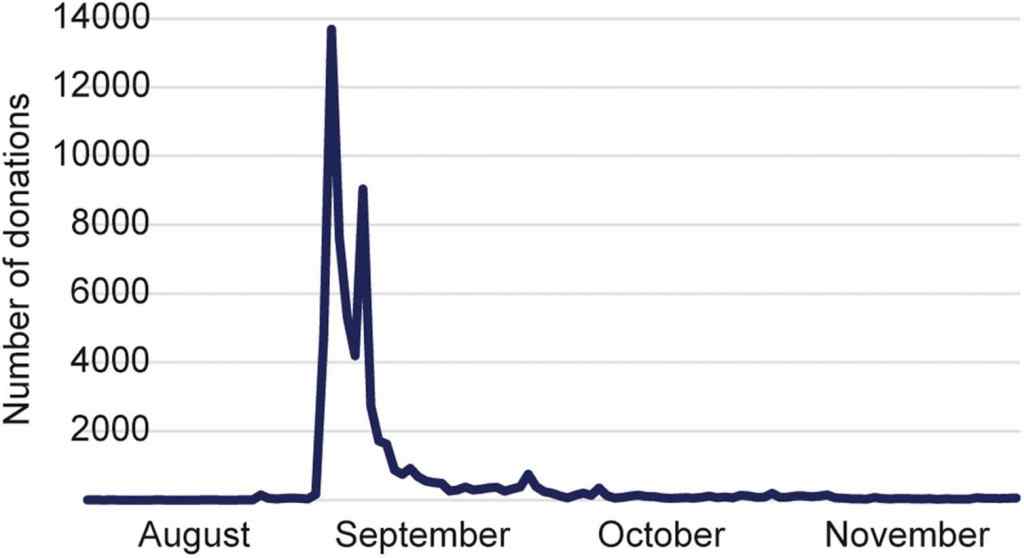
The 2015 photos of a tiny Syrian boy’s lifeless body resting face down in the sand similarly stirred the world’s collective consciousness. Within hours of its release, the photo had reached 20 million people through Twitter, with many more millions seeing it on the front pages of newspapers the next day. Afterwards, government restrictions on accepting refugees were loosened while private donations to organizations like the Red Cross spiked dramatically.

A year later haunting images of a young boy in the back of an ambulance, caked in dirt and blood, galvanized the world.

But the emotional and compassionate responses to both photographs were short-lived. The bombing of civilians in Syria continued. Refugees continued risking their lives to escape the war zone.

After a photograph of a dead Syrian boy went viral in 2015, the number of daily donations to a Swedish Red Cross campaign designated specifically for aiding Syrian refugees spiked dramatically – but only for a brief window. Proceedings of the National Academy of Sciences of the United States of America, CC BY-SA

Since the publication of Le Duc’s photo of the dead migrants, supportive politicians may feel emboldened to sound the alarm on the plight of Central American migrants. Donations to immigrant aid organizations might briefly spike.

But it seems that a photograph, no matter how emotionally devastating, can only do so much.

Yes, it can create a window of time when we’re motivated to act, and we’ll usually do so if we have effective options to pursue. This could mean a charitable donation at the individual level or, collectively, a surge of political will. However, psychology research from the “arithmetic of compassion” suggests that sympathy for distant human suffering declines when we’re presented with rising body counts. Sometimes we’re discouraged by the scope of the problem and this stops us from doing things that actually make a difference – even if partial solutions can save lives. Other times, if the options for helping others seem too narrow or ineffective, we’ll turn away and stop caring.

Images can alert us to the horrors of violence, mass migration and poverty. But as we have seen time and again, photographs and news footage of human suffering generally precipitate a short-term emotional reaction, rather than a sustained humanitarian response.

ooOOoo

As one reads the article it is much more than a comment on a single image despite how terrible that photograph may be.

The two scientists set out to show that the period that we are alarmed or terrified or just plain sad at the state of nations is rather short.

Maybe it’s the self-protective nature of our species that does this.

But it still doesn’t diminish the horror of that top photograph.

Reflections on the future

Father’s Day ….

….. was OK in the morning but for some reason I was in a dark mood in the afternoon.

(And if you want to skip today’s post I don’t blame you at all. This is not my usual style albeit it is important.)

I was reflecting on the state of the world. Global population was well in excess of seven billion people. The longevity of those people was increasing. That’s good news. The health standards were increasing. That’s also good news.

However, the pressure on farming is intense. More and more land is required. The natural world is under supreme pressure. Extinction rates of many natural species are soaring.

Planet Earth has far too many people!

OK, maybe in time the population level will come down but right now it is too high.

Then in came Tom Engelhardt’s latest essay. I read it and reflected. Is it too dark to post? Then Jeannie said that if you really want to share it then publish it.

Here it is, published with Tom’s kind permission.

ooOOoo

Tomgram: Engelhardt, Trump Change

Posted by Tom Engelhardt at 4:23pm, June 16, 2019.
Follow TomDispatch on Twitter @TomDispatch.

If Donald Trump Is the Symptom…
Then What’s the Disease?

By Tom Engelhardt
Don’t try to deny it! The political temperature of this country is rising fast. Call it Trump change or Trump warming, if you want, but grasp one thing: increasingly, you’re in a different land and, whatever happens to Donald Trump, the results down the line are likely to be ever less pretty. Trump change isn’t just an American phenomenon, it’s distinctly global. After all, from Australia to India, the Philippines to Hungary, Donald Trumps and their supporters keep getting elected or reelected and, according to a recent CNN poll, a majority of Americans think Trump himself will win again in 2020 (though, at the moment, battleground-state polls look grim for him).

Still, whether or not he gets a second term in the White House, he only seems like the problem, partially because no president, no politician, no one in history has ever gotten such 24/7 media coverage of every twitch, tweet, bizarre statement, falsehood, or fantasy he expresses (or even the clothes he wears). Think of it this way: we’re in a moment in which the only thing the media can’t imagine saying about Donald Trump is: “You’re fired!” And believe me, that’s just one sign of a media — and a country — with a temperature that’s anything but 98.6.

Since you-know-who is always there, always being discussed, always @(un)realdonaldtrump, it’s easy enough to imagine that everything that’s going wrong — or, if you happen to be part of his famed base, right (even if that right isn’t so damned hot for you) — is due to him. When we’re gripped by such thinking and the temperature’s rising, it hardly matters that just about everything he’s “done” actually preceded him. That includes favoring the 1%, deporting record numbers of illegal immigrants, and making war (unsuccessfully) or threatening to do so across significant parts of the planet.

Here, then, is the question of the day, the sort you’d ask about any patient with a rising temperature: If Donald Trump is only the symptom, what’s the disease?

Blowback Central

Let me say that the late Chalmers Johnson would have understood President Trump perfectly. The Donald clearly arrived on the scene as blowback — the CIA term of tradecraft Johnson first put into our everyday vocabulary — from at least two things: an American imperium gone wrong with its never-ending wars, ever-rising military budgets, and ever-expanding national security state, and a new “gilded age” in which three men (Bill Gates, Jeff Bezos, and Warren Buffett) have more wealth than the bottom half of society and the .01% have one of their own, a billionaire, in the Oval Office. (If you want to add a third blowback factor, try a media turned upside down by new ways of communicating and increasingly desperate to glue eyes to screens as ad revenues, budgets, and staffs shrank and the talking heads of cable news multiplied.)

Now, I don’t mean to sell Donald Trump short in any way. Give that former reality TV star credit. Unlike either Hillary Clinton or any of his Republican opponents in the 2016 election campaign, he sensed that there were voters in profusion in the American heartland who felt that things were not going well and were eager for a candidate just like the one he was ready to become. (There were, of course, other natural audiences for a disruptive, self-promoting billionaire as well, including various millionaires and billionaires ready to support him, the Russians, the Saudis… well, you know the list). His skill, however, never lay in what he could actually do (mainly, in these years, cut taxes for the wealthy, impose tariffs, and tweet his head off). It lay in his ability to catch the blowback mood of that moment in a single slogan — Make America Great Again, or MAGA — that he trademarked in November 2012, only days after Mitt Romney lost his bid for the presidency to Barack Obama.

Yes, four years later in the 2016 election, others began to notice the impact of that slogan. You couldn’t miss the multiplying MAGA hats, after all. Hillary Clinton’s advisers even briefly came up with the lamest response imaginable to it: Make America Whole Again, or MAWA. But what few at the time really noted was the crucial word in that phrase: “again.” Politically speaking, that single blowback word might then have been the most daring in the English language. In 2016, Donald Trump functionally said what no other candidate or politician of any significance in America dared to say: that the United States was no longer the greatest, most indispensable, most exceptionable nation or superpower or hyper-power ever to exist on Planet Earth.

That represented a groundbreaking recognition of reality. At the time, it didn’t matter whether you were Barack Obama, Hillary Clinton, or Marco Rubio, you had to acknowledge some version of that formula of exceptionalism. Trump didn’t and, believe me, that rang a bell in the American heartland, where lots of people had felt, however indirectly, the blowback from all those years of taxpayer-funded fruitless war, while not benefitting from infrastructure building or much of anything else. They experienced blowback from a country in which new billionaires were constantly being created, while the financial distance between CEO salaries and those of workers grew exponentially vaster by the year, and the financing of the political system became a 1% affair.

With that slogan, The Donald caught the spirit of a moment in which both imperial and economic decline, however unacknowledged by the Washington political elite, had indeed begun. In the process, as I wrote at that time, he crossed a psychologically taboo line and became America’s first declinist candidate for president. MAGA captured a feeling already at large that tomorrow would be worse than today, which was already worse than yesterday. As it turned out, it mattered not at all that the billionaire conman spouting that trademarked phrase had long been part of the problem, not the solution.

He caught the essence of the moment, in other words, but certainly didn’t faintly cause it in the years when he financed Trump Tower, watched his five Atlantic City casinos go bankrupt, and hosted The Apprentice. In that election campaign, he captured a previously forbidden reality of the twenty-first century. For example, I was already writing this in June 2016, five months before he was elected president:

“In its halcyon days, Washington could overthrow governments, install Shahs or other rulers, do more or less what it wanted across significant parts of the globe and reap rewards, while (as in the case of Iran) not paying any price, blowback-style, for decades, if at all. That was imperial power in the blaze of the noonday sun. These days, in case you hadn’t noticed, blowback for our imperial actions seems to arrive as if by high-speed rail (of which by the way, the greatest power on the planet has yet to build a single mile, if you want a quick measure of decline).

“Despite having a more massive, technologically advanced, and better funded military than any other power or even group of powers on the planet, in the last decade and a half of constant war across the Greater Middle East and parts of Africa, the U.S. has won nothing, nada, zilch. Its unending wars have, in fact, led nowhere in a world growing more chaotic by the second.”

Mind you, three years later the United States remains a staggeringly powerful imperial force, with hundreds of military bases still scattered across the globe, while its economic clout — its corporations control about half the planet’s wealth — similarly remains beyond compare. Yet, even in 2016, it shouldn’t have been hard to see that the American Century was indeed ending well before its 100 years were up. It shouldn’t have been hard to grasp, as Donald Trump intuitively did, that this country, however powerful, was already both a declining empire — thank you, George W. Bush for invading Iraq! Mission Accomplished! — and a declining economic system (both of which still looked great indeed, if you happened to be profiting from them). That intuition and that slogan gave Trump his moment in… well, dare I call it “the afternoon sun”? They made him president.

MTPGA

In a sense, all of this should have been expectable enough. Despite the oddity of Donald Trump himself, there was little new in it, even for the imperial power that its enthusiasts once thought stood at “the end of history.” You don’t need to look far, after all, for evidence of the decline of empires. You don’t even have to think back to the implosion of the Soviet Union in 1991, almost three decades ago in what now seems like the Stone Age. (Admittedly, Russian President Vladimir Putin, a brilliant imagineer, has brought back a facsimile of the old Soviet Union, even if, in reality, Russia is now a rickety, fraying petro-state.)

Just take a glance across the Atlantic at Great Britain at this moment. And imagine that three-quarters of a century ago, that modest-sized island nation still controlled all of India, colonies across the planet, and an impressive military and colonial service. Go back even further and you’ll find yourself in a time when it was the true superpower of planet Earth. What a force it was — industrially, militarily, colonially — until, of course, it wasn’t.

If you happen to be looking for imperial lessons, you could perhaps say that some empires end not with a bang but with a Brexit. Despite all the pomp and circumstance (tweeting and insults) during the visit of the Trump royal family (Donald, Melania, Ivanka, Jared, Donald Jr., Eric, and Tiffany) to the British royals, led by a queen who, at 93, can remember better days, here’s something hard to deny: with Brexit (no matter how it turns out), the Earth’s former superpower has landed in the sub-basement of history. Great Britain? Obviously that adjective has to change.

In the meantime, across the planet, China, another once great imperial power, perhaps the greatest in the long history of this planet, is clearly on the rise again from another kind of sub-basement. That, in turn, is deeply worrying the leadership, civilian and military, of the planet’s “lone superpower.” Its president, in response, is wielding his weapon of choice — tariffs — while the U.S. military prepares for an almost unimaginable future war with that upstart nation, possibly starting in the South China Sea.

Meanwhile, the still-dominant power on the planet is, however incrementally, heading down. It’s nowhere near that sub-basement, of course — anything but. It’s still a rich, immensely powerful land. Its unsuccessful wars, however, go on without surcease, the political temperature rises, and democratic institutions continue to fray — all of which began well before Donald Trump entered the Oval Office and, in fact, helped ensure that he would make it there in the first place.

And yet none of this, not even imperial decline itself, quite captures the “disease” of which The Donald is now such an obvious symptom. After all, while the rise and fall of imperial powers has been an essential part of history, the planetary context for that process is now changing in an unprecedented way. And that’s not just because, since the 1945 atomic bombings of Hiroshima and Nagasaki, growing numbers of countries have come to possess the power to take the planet down in a cataclysm of fire and ice (as in nuclear winter). It’s also because history, as we’ve known it, including the rise and fall of empires, is now, in a sense, melting away.

Trump change, the rising political temperature stirred by the growing populist right, is taking place in the context of (and, worse yet, aiding and abetting) record global temperatures, the melting of ice across the planet, the rise of sea levels and the future drowning of coastlines (and cities), the creation of yet more refugees, the increasing fierceness of fires and droughts, and the intensification of storms. In the midst of it all, an almost unimaginable wave of extinctions is occurring, with a possible million plant and animal species, some crucial to human existence, already on the verge of departure.

Never before in history has the rise and decline of imperial powers taken place in the context of the decline of the planet itself. Try, for instance, to imagine what a “risen” China will look like in an age in which one of its most populous regions, the north China plain, may by century’s end be next to uninhabitable, given the killing heat waves of the future.

In the context of both Trump change and climate change, we’re obviously still awaiting our true transformative president, the one who is not a symptom of decline, but a factor in trying to right this country and the Earth before it’s too late. You know, the one who will take as his or her slogan, MTPGA (Make The Planet Great Again).

Tom Engelhardt is a co-founder of the American Empire Project and the author of a history of the Cold War, The End of Victory Culture. He runs TomDispatch.com and is a fellow of the Type Media Center. His sixth and latest book is A Nation Unmade by War (Dispatch Books).

Follow TomDispatch on Twitter and join us on Facebook. Check out the newest Dispatch Books, John Feffer’s new dystopian novel (the second in the Splinterlands series) Frostlands,Beverly Gologorsky’s novel Every Body Has a Story, and Tom Engelhardt’s A Nation Unmade by War, as well as Alfred McCoy’s In the Shadows of the American Century: The Rise and Decline of U.S. Global Power and John Dower’s The Violent American Century: War and Terror Since World War II.

Copyright 2019 Tom Engelhardt

ooOOoo

I’m 74. I don’t know how long I’ve got.

Part of me wants to live for a long time. That’s why I am vegan and trying to stay as fit as I can. (I’m also aware that Jeannie’s Parkinson’s Disease is a terminal disease and that in the latter stages she will need me to look after her.)

But then again I’m not sure I want to live in a world that continues to degrade especially continues to degrade in natural ways.

What’s the answer?

What do others who are on or around my age think about it?

What is the disease?
That relationship!

Dogs and humans go back a long, long way!

We like to think of our relationship with dogs as a moderately recent affair. Not the time since dogs and humans have mixed together, that was a very long time ago, but having a dog as a pet.

But even that view needs to be updated.

Try 4,000 years ago!

ooOOoo

New Study Looks at Why Neolithic Humans Buried Their Dogs With Them 4,000 Years Ago

Analysis of the remains of 26 dogs found near Barcelona suggest the dogs had a close relationship with ancient humans

Specimen of a dog skull ( Wagner Souza e Silva / Museum of Veterinary Anatomy FMVZ USP via Wikicommons under Creative Commons Attribution-Share Alike 4.0 International )

By Marissa Fessenden

SMITHSONIAN.COM
FEBRUARY 14, 2019

Humans have enjoyed a long history of canine companions. Even if it’s unclear exactly when dogs were first domesticated (and it may have happened more than once), archaeology offers some clues as to the nature of their relationship with humans.

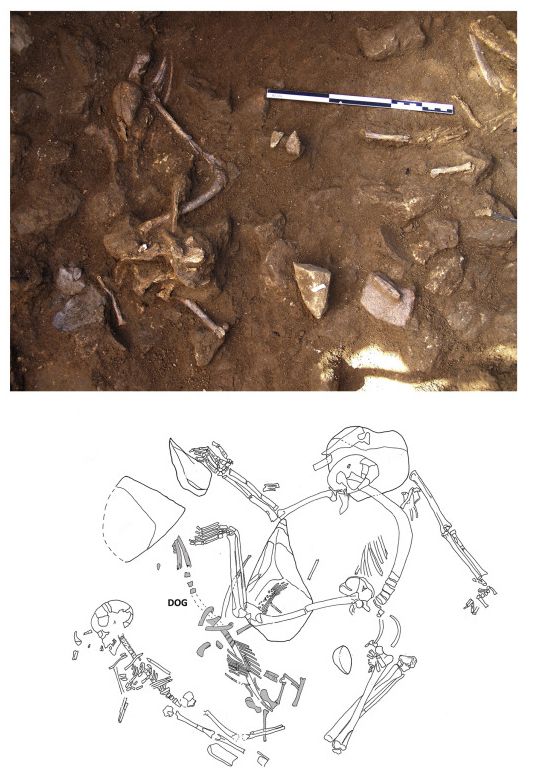
The latest clue suggests that humans living in Southern Europe between 3,600 to 4,200 years ago cared for dogs enough to regularly share their gravesites with them. Barcelona-based researchers studied the remains of 26 dogs from four different archaeological sites on the northeastern Iberian Peninsula.

The dogs ranged in age from one month to six years old. Nearly all were buried in graves with or nearby humans. “The fact that these were buried near humans suggests there was an intention and a direct relation with death and the funerary ritual”, says lead author Silvia Albizuri, a zooarchaeologist with the University of Barcelona, in a press release.

To better understand the dogs’ relationship with the humans they joined in the grave, Albizuri and her colleagues analyzed isotopes in the bones. Studying isotopes—variants of the same chemical element with different numbers of neutrons, one of the building blocks of atoms—can reveal clues about diet because molecules from plants and animals come with different ratios of various isotopes. The analysis showed that very few of the dogs ate primarily meat-based diets. Most enjoyed a diet similar to humans, consuming grains like wheat as well as animal protein. Only in two puppies and two adult dogs did the samples suggest the diet was mainly vegetarian.

This indicates that the dogs lived on food fed to them by humans, the team reports in the Journal of Archaeological Science. “These data show a close coexistence between dogs and humans, and probably, a specific preparation of their nutrition, which is clear in the cases of a diet based on vegetables,” says study co-author Eulàlia Subirà, a biological anthropologist at the Autonomous University of Barcelona.

Top: remains of a dog found at the archeological site called La Serreta. Bottom: drawing of dog skeleton found between human skeletons in the necropolis Bòbila Madurell. (UB-UAB)


The archaeological sites all belong to people of the Yamnaya Culture, or Pit Grave Culture. These nomadic people swept into Europe from the steppes north of the Black and Caspian Seas. They kept cattle for milk production and sheep and spoke a language that linguists suspect gave rise to most of the languages spoken today in Europe and Asia as far as northern India.

The buried dogs aren’t the oldest found in a human grave. That distinction belongs to a puppy found in a 14,000-year-old grave in modern-day Germany. The care given to that puppy to nurse it through illness was particularly intriguing to the researchers who discovered it. “At least some Paleolithic humans regarded some of their dogs not merely materialistically, in terms of their utilitarian value, but already had a strong emotional bond with these animals,” Liane Giemsch, co-author on a paper about the discovery and curator at the Archäologisches Museum Frankfurt, told Mary Bates at National Geographic in 2018.

The fact that the researchers in the new study found so many dogs in the region they studied indicates that the practice of burying dogs with humans was common at the time, the late Copper Age through the early Bronze Age. Perhaps the canine companions helped herd or guard livestock. What is certain is that ancient humans found the animals to be important enough to stay close to even in death.

ooOOoo

That last sentence is precious. “What is certain is that ancient humans found the animals to be important enough to stay close to even in death.

As far back as 14,000 years!

It’s time to change our habits.

Funny how things evolve!

A week ago I was casually reading a copy of our local newspaper, the Grants Pass Daily Courier, and inside was a piece by Kathleen Parker, a syndicated columnist, entitled It’s the end of everything – or not.

I found it particularly interesting especially a quotation in her piece by Robert Watson, a British chemist who served as the chair of the panel of the Intergovernmental Science-Policy Platform on Biodiversity and Ecosystem Services (IPBES). The IPBES had recently published the results of the three-year study by 145 authors from 50 countries.

So I wrote to Kathleen Parker asking if I might have permission to quote that excerpt and, in turn, received her permission to so do.

Here it is:

Robert Watson wrote in a statement that:

“the health of ecosystems on which we and all species depend is deteriorating more rapidly than ever. We are eroding the very foundation of our economies, livelihoods, food security, health and quality of life worldwide.”

But, Watson also said, it’s not too late to repair and sustain nature – if we act now in transformative ways.

It is time to change our habits both at an individual level and the level of countries working together.

Moreover we haven’t got decades. We have got to do it now!

How close are you to your dog?

A reflection on our dogs.

I was sorting out some stuff the other day and came across the following. It is the record of a talk I gave some time ago in connection with the publication of my book Learning from Dogs.

As much as I would have expected to have previously published this on the blog I cannot find an entry. So here you are!

ooOOoo

The concept of attributing dogs with human traits is nothing new. In fact the ancient Greeks came up with a fancy word for it around two thousand years ago: anthropomorphism.

As ever, the truth of the matter is not a case of black and white but subtle shades of grey. No doubt in another two thousand years as science advances and we discover more about DNA and the mysteries of the human and canine brains the picture will develop into sharper focus. In the meantime, we must satisfy ourselves with some basic observations.

Let’s start off on common ground. One thing that we all seem to agree on is that humans are at the top of the pile in terms of evolutionary sophistication. For obvious reasons we view ourselves as the being the highest life form (although there is increasing alarm that we have totally lost touch with our basic instincts, if not totally lost the plot, by endangering the very planet that sustains life as we know it).

But I digress – back to common ground. We agree that as children our mental capacity is not fully developed. We survive by our instincts and the basic needs to be fed, watered, sheltered and bonded in a family group where we defer to a natural hierarchy. When you think about it this is precisely how dogs survive.

Like children, dogs display the most basic instincts to rough and tumble, compete for toys and establish a natural pecking order. Inherent in this is the need for a parent or pack leader to set down boundaries and create order and stability out of chaos. Without this both child and dog feel insecure and may well grow to display anti-social behaviour.

You would responsibly bring a child up with love and discipline, have consistent boundaries, teach them what is safe and what is dangerous, what is sociable and what is unsociable.

Dogs too need love and discipline, consistent boundaries, and to learn what is safe and what is dangerous, what is sociable and what is unsociable.

Communicating with a child is not so very different from communicating with a dog. Young children, like dogs, do not have the power of speech so you have to work out alternative strategies to speech in order to get through to them. You will find that if you approach a dog in much the same way as you approach a child, life will be a whole lot easier for you. And the dog! Hopefully you will have realised that praise is a far stronger motivator that punishment.

A positive approach.

Take the example of the puppy that makes a puddle on the floor and the child that wets its bed. Each one of them have not learnt control of their bladder and are simply responding to the call of nature. Neither are being naughty nor are in the wrong.

Yelling at the child will only make it more stressed and, therefore, more likely to continue wetting the bed. In exactly the same way if a puppy has an accident on the carpet being harsh will make matters worse.

How many human ‘sports’ involve chasing a moving object? How many of these games also involve people working as a team to ‘catch’ these objects? Football, rugby, basketball, tennis, badminton, etc. I could go on but you get the idea.

Why do we enjoy these games? Is it not because we too are instinctively striving for a pecking order within the pack and following our predatory instincts.

“No, no no!’ I hear you say. ‘We are a civilised, sophisticated race who have created these games for our enjoyment. They are so different to the throw and fetch games our canine friends mindlessly enjoy.’

Don’t kid yourself. Look also how football supporters revert to uninhibited childlike behaviour. At worst becoming hooligans and behaving, almost literally, like savage animals when they find themselves challenged or threatened by an opposing pack.

Or on a much more positive note how hundreds of fans, unrehearsed, suddenly find one voice and break into a prefect, heart-stopping rendition of “You’ll Never Walk Alone”. Now that’s a perfect example of the ‘pack call’.

We all enjoy the close relationship we have with our dogs. Maybe sometimes we don’t realise quite how close we are.

ooOOoo

I can’t imagine life without our dogs.

They mean everything to Jeannie and me.

A photo of Pharaoh when he was quite an old fella!

How much time do we have left?

A post from Patrice Ayme.

I have subscribed to Patrice Ayme for some time now. I don’t know who he is because he writes under a pseudonym, or a nom-de-plume. (And, indeed, I may have the gender incorrect but I’m pretty sure it’s a male.)

Patrice writes frequently and doesn’t mince his words.

But then he writes about really serious matters and often has criticism for the ‘ruling classes’.

Such as he has in the post that was published on the 6th May. I left a comment:

It’s extremely worrying and not something that can be put off. The clock is at 5 minutes to midnight. In Britain Extreme Resistance are pursuing a campaign that may just produce a political outcome. And, indeed, the English Government have come up with goals to combat climate change.

So keep banging your drum, Patrice, and hope that urgent action across the world isn’t too far away.

To which Patrice replied:

Dear Paul:
thanks! Here I am fighting with my daughter’s school, which has decided to install artificial, plastic grass. It’s horrendous for the environment, and it endangers the lives of children (in many ways, including a disease called “SUBEROSIS” caused by organic cork.) Here real ecologist take it hard, and have started to burn artificial plastic flame retardant fields: 13,000 were recently installed in the USA, a proof of mass corruption…
Feel free to use my essay on your site, BTW, of course…
And thanks again…
P

Now I hadn’t heard of Suberosis before, but no problem, a quick web search brought up Wikipedia and this:

Suberosis is a type of hypersensitivity pneumonitis usually caused by the fungus Penicillium glabrum (formerly called Penicillum frequentans) from exposure to moldy cork dust.[1][2] Chrysonilia sitophilia, Aspergillus fumigatus, uncontaminated cork dust, and Mucor macedo may also have significant roles in the pathogenesis of the disease.[1]

Cause

Cork is often harvested from the cork oak (Quercus suber) and stored in slabs in a hot and humid environment until covered in mold.[1] Cork workers may be exposed to organic dusts in this process, leading to this disease.[1]

I don’t fully understand how the laying of artificial grass leads to possible Suberosis.

But I have decided to republish even though it has nothing to do with dogs! (Well, not directly.)

ooOOoo

Nature Collapsing, Plutocracy Thriving

Both phenomena are related. The more nature collapses, the more plutocracy thrives (see the multi-centennial fall of Rome, for reference). Small people and other losers have no interest to see nature collapse. However, plutocracy does. Because Pluto-Kratia, Evil-Power, is best expressed and justified during war-like states, and civilizational collapse sure qualifies.

Plutocracy survived the collapse of the Roman and Carolingian empires with flying colors. In the Roman case, most noble families had a bishop in their midst. The collapse of the Renovated Empire of the Romans (Renovatio Imperii Romanorum) and its renewal by the Ottos and Capets brought the feudal order, another plutocratic success.

Now is no different: we have a terminal CO2 crisis bringing in extreme, sudden temperature, acidification and ocean rises: 1% of US CO2 is from state subsidized private jets. Nobody notices, because media have made sure to create entire generations just preoccupied by celebrities, not by what is going on, which is really most significant.

Nor has the media been keen to notice the likes of Biden annihilated the Banking Act of 1933, in the 1990s, bringing in the age of the financial plutocracy… itself a heavy financier of fossil fuels. So all what some schools are thinking of is installing “Apps”, and plastic grass, instead of teaching sustainable global citizenship. We are cruising towards an apocalypse, at an increasing pace: the Sixth Mass Extinction. The United Nations just came up (May 6, 2019) with an analysis made by 132 countries and 455 scientists: one million species are disappearing. For example, nearly all amphibians.

https://www.cnn.com/2019/05/06/world/one-million-species-threatened-extinction-humans-scn-intl/index.html

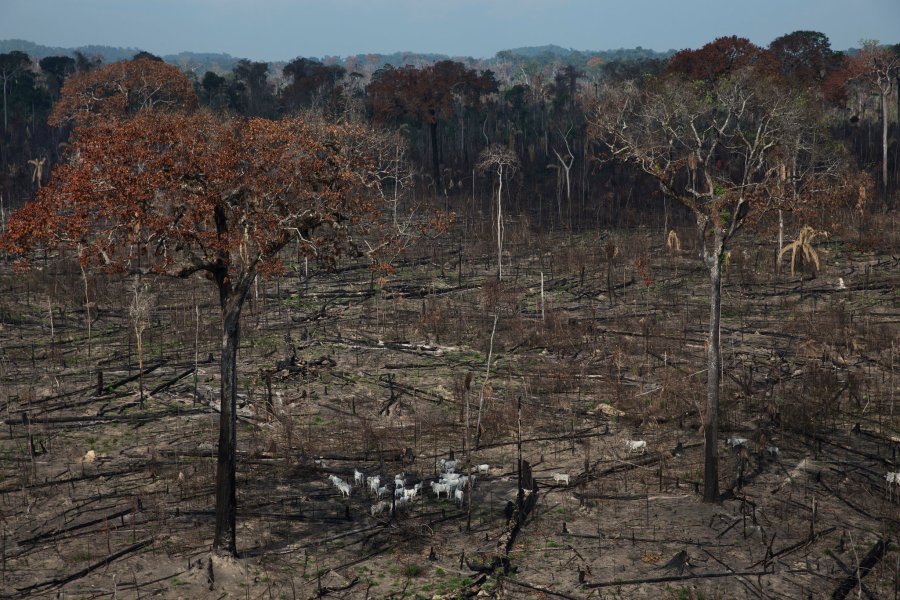
One problem with burning forests in the tropics is that what is left are often extremely poor soils (differently from northern European soils, which are very forgiving, explaining in great part why north west Europe replaced the Greco-Roman world…) Cattle grazing on a tract of illegally cleared Amazon forest in Pará State, Brazil. In most major land habitats, the average abundance of native plant and animal life has fallen by 20 percent or more, mainly over the past century,,, [Credit Lalo de Almeida for The New York Times]

In Africa, burned forest is often replaced by lateritis, a soil which is red, baked, hard… for the good reason that it is full of Aluminum.

It is the Sixth Mass Extinction, but this time the dinosaurs have thermonuclear weapons.

What to do? Get involved, get aware, protest. Protests can become unbearable to the powers that be.

This is the way the fascist government of Brunei on the island of Borneo was just dealt with. It drew powerful international condemnation when it rolled out its interpretation of sharia laws on April 3. Now, the Sultan of Brunei, Hassanal Bolkiah, reverted his decision: after all, the country won’t enforce Islamic laws that include stoning to death for rape, adultery and gay sex.

Killing all the people who got killed in World War Two was atrocious. However, what is now unfolding has the potential to be way way worse. Einstein said he didn’t know which weapons will be used to fight World War Three, but next it would be sticks and stones. That was naively optimistic. If we acidify further the ocean with acid from CO2, we may kill the Earth’s oxygen making mechanism. Not really news, as this was clear five years ago already:

https://patriceayme.wordpress.com/2014/05/30/global-hypoxia/ 

Many behave as if there will be no tomorrow, because they feel that way! It’s a self-fulfilling prophecy, it has to be resisted.

What’s needed, beyond recording what’s going on, is interpreting it, going beyond, building ideas, and moods meant to last. Only deeper thinking can do this, and ensure a planet capable of lasting. Because we are not at the regional level anymore. When climate change, plus nefarious human impact, forced the Harappan civilization to abandon its homeland, the Indus valley, it was dealing with forces it had no idea existed. Maybe there are such forces out there. But there are also plenty of forces we can see, and which are plenty lethal enough, at civilizational scale, and the scale of the entire biosphere. Stop. And think. One million species are marching towards extinction, among the plants and animals we know.

Patrice Ayme

***

***

From NYT:

WASHINGTON — Humans are transforming Earth’s natural landscapes so dramatically that as many as one million plant and animal species are now at risk of extinction, posing a dire threat to ecosystems that people all over the world depend on for their survival, a sweeping new United Nations assessment has concluded.

The 1,500-page report, compiled by hundreds of international experts and based on thousands of scientific studies, is the most exhaustive look yet at the decline in biodiversity across the globe and the dangers that creates for human civilization. A summary of its findings, which was approved by representatives from the United States and 131 other countries, was released Monday [May 6, 2019] in Paris. The full report is set to be published this year.

Its conclusions are stark. In most major land habitats, from the savannas of Africa to the rain forests of South America, the average abundance of native plant and animal life has fallen by 20 percent or more, mainly over the past century. With the human population passing 7 billion, activities like farming, logging, poaching, fishing and mining are altering the natural world at a rate “unprecedented in human history.”

At the same time, a new threat has emerged: Global warming has become a major driver of wildlife decline, the assessment found, by shifting or shrinking the local climates that many mammals, birds, insects, fish and plants evolved to survive in. When combined with the other ways humans are damaging the environment, climate change is now pushing a growing number of species, such as the Bengal tiger, closer to extinction.

As a result, biodiversity loss is projected to accelerate through 2050, particularly in the tropics, unless countries drastically step up their conservation efforts.

ooOOoo

I’m in the autumn of my life and may not live to see the consequences of what we are doing to Nature and to the Planet.

Then again, if some of the predictions bear true, I won’t have to live an awful lot longer to experience real change.

It’s time for a complete re-analysis of our relationship with the natural world.

And another dog saved!

Another example of that man-dog relationship.

So many people put their dog before anything else.

Take Randy Etter and his dog Gemini.

Or rather take The Dodo‘s description of Randy and Gemini.

ooOOoo

Man Immediately Puts His Car Up For Sale To Save His Dog’s Life

“I would be devastated if I lost my best friend.”

BY

PUBLISHED ON 04/24/2019

Randy Etter and his dog Gemini have been together since Gemini was just a little puppy. It’s been around two years now, and the pair are the absolute best of friends. They love each other so much and brighten each other’s lives every single day — so when Etter found out he might lose Gemini, he vowed to do absolutely everything he could to save his life.

Randy Etter.

Gemini was playing with Etter’s girlfriend’s daughter one day four weeks ago, and the baby thought it was hilarious to continuously throw her bottle out of her playpen at Gemini. Gemini would pick it up every time and his dad would quickly grab it from him, wash it off, and give it back to the baby — but at some point, Gemini got ahold of the bottle without his dad realizing and ended up eating the top off of it.

No one had any idea that Gemini had swallowed something he wasn’t supposed to — until he started getting very, very sick.

“He just started to slow down and I didn’t think that was normal, just laying beside me and following me everywhere,” Etter told The Dodo. “I just felt like he was saying, ‘Help me.’”

Randy Etter.

When Gemini started vomiting uncontrollably, his dad knew something was very, very wrong, and immediately rushed him to the vet. Unfortunately, at first, no one could tell him for sure what was wrong with Gemini.

“I lost my job driving vet to vet to vet and it just seemed like I wasn’t gonna get anywhere or get him the help he needed in time,” Etter said. “It was truly one of the scariest things I had to deal with.”

Randy Etter.

Finally, a vet was able to confirm that Gemini had a blockage inside of him and would need surgery — which would cost $4,500, money that Etter definitely did not have. Losing Gemini was not an option, though, and so he decided to put his car up for sale to try and raise at least part of the money to save his best friend’s life.

“I was gonna spend every dollar made from the car sale on his surgery,” Etter said. “I would be devastated if I lost my best friend.”

Gemini is now recovering well, safe in the arms of his dad and best friend. Etter is so grateful to everyone who helped him keep Gemini alive, and can’t imagine what he would have done without everyone’s support.

Randy Etter.

“It means the world to me,” Etter said. “He’s my best friend. He’s always there for me, I just wanted to be able to return the favor and be there for him.”

ooOOoo

Randy puts it perfectly; “He’s my best friend. He’s always there for me, I just wanted to be able to return the favor and be there for him.

Thousands upon thousands of people feel exactly the same way.

Thank goodness for dogs!

Being in charge.

“Dogs have masters, cats have staff.”

That’s a well-known saying that, nonetheless, has a certain element of truth about it.

So what is the truth?

Well read the following and see for yourself.

ooOOoo

Pet owners want to be masters, not servants – which is why we value dogs more than cats

By

Assistant Professor of Marketing, New York Institute of Technology

Cat videos may rule the internet, but dogs possess mastery of their owners’ hearts – at least if spending is any guide.

Dog owners spend US$240 a month caring for their pets, compared with $193 for cats, according to the 2017-2018 National Pet Owners Survey from the American Pet Products Association. The extra money goes primarily toward vet visits and kennel boarding, but dog owners also spend more lavishly on treats, grooming and toys.

My new paper, “Dogs Have Masters, Cats Have Staff,” shines some light on why.

A cat would never let its owner do this. Reuters/Andrew Wong

A growing market

Americans are spending more on pet care as an increasing share of U.S. households own an animal.

A little over two-thirds of all U.S. households own at least one pet, up from 56 percent in 1988, the first year of the National Pet Owners Survey.

And almost half of households own a dog, while just 38 percent have a cat. Generational trends suggest this divergence is likely to grow, as millennials are more likely to adopt a canine, while baby boomers tend to be cat lovers.

This is resulting in a growing market for pet-related products and services, which hit an estimated $72 billion in 2018, up from $46 billion a decade earlier.

A willingness to pay

My study builds on earlier research showing that dog owners are willing to spend more on their pets than cat owners – including to save their lives.

One reason suggested was that dog owners had stronger bonds to their pets, which prompted them to spend more on things like veterinary care.

My research uncovered a key factor indicating why dog owners feel more attached to their pets: Dogs are famously more compliant than cats. When owners feel in control of their pets, strong feelings of psychological ownership and emotional attachment develop. And pet owners want to be masters – not servants.

Like other marketing researchers, my work uses “willingness to pay” as an indicator of the economic, rather than emotional, value owners place on their pets. It shows – and compares – how much pet owners would pay to save their animal’s life.

Dog owners are willing to pay twice as much as cat owners for a life-saving surgery. AP Photo/Angie Wang

Who’s in control?

So I carried out three online experiments to explore the role of psychological ownership in these valuations.

In the first experiment, I asked dog or cat owners to write about their pet’s behavior so I could measure their feelings of control and psychological ownership. Participants then imagined their pet became ill and indicated the most they would be willing to pay for a life-saving surgery.

Dog owners, on average, said they would pay $10,689 to save the life of their pet, whereas cat owners offered less than half that. At the same time, dog owners tended to perceive more control and psychological ownership over their pets, suggesting this might be the reason for the difference in spending.

Of course, correlation is not causation. So in a second experiment, I asked participants how much they would be willing to pay to save their animal’s life after I had disturbed their sense of ownership. I did this by asking participants to imagine their pet’s behavior was a result of training it received from a previous owner.

As expected, disrupting their feelings of ownership eliminated the difference in valuation between dogs and cats.

Since pet owners like to control their animals, and since cats are less controllable than dogs, the third experiment went straight to the point: Does the owner value the dog or cat for its own sake or for its compliant behavior?

To find out, I again asked survey respondents to describe how much they’d be willing to pay to save their pet’s life, but this time I randomly assigned one of four scenarios: Participants were told they either own a dog, a cat, a dog that behaves like a cat, or a cat that behaves like a dog.

Participants reported they would pay $4,270 to save the life of their dog, but only $2,462 for their cat. However, this pattern was reversed when the pet’s behavior changed, with dog-behaving cats valued at $3,636, but cat-behaving dogs only $2,372.

These results clearly show that the animal’s behavior is what makes people willing to pay.

When cats act more like dogs, people say they’d spend more money on them. pixfix/shutterstock.com

Master or servant

These findings establish that psychological ownership is a driving factor in dog owners’ higher valuations.

People feel ownership because they perceive that they can control their pets’ behavior. This research even distinguishes the type of control that probably most stimulates ownership feelings: It’s not just physical control, such as being able to pick up an animal or drag it by a leash. Rather, it’s the animal’s voluntary compliance with its owner’s wishes.

No matter how cute and cuddly your kitties may be, they can’t compete with dogs when it comes to giving pet owners the sense of mastery they seek.

ooOOoo

Taken from here.

What I find amazing are the figures for the US in terms of dog ownership. As in over half of households own a dog.

I suspect it will continue to grow.

Because the bond between a human and a dog is unique as well as being very beautiful!

It stretches the mind beyond imagination!

The most incredible story of all!

I first read the story early yesterday morning in The Guardian Newspaper.

But then I saw another version of the same story on the BBC News site, from which I republish it in its entirety.

ooOOoo

First ever black hole image released

By Pallab Ghosh
Science correspondent, BBC News

The first ever picture of a black hole: It’s surrounded by a halo of bright gas.

Astronomers have taken the first ever image of a black hole, which is located in a distant galaxy.

It measures 40 billion km across – three million times the size of the Earth – and has been described by scientists as “a monster”.

The black hole is 500 million trillion km away and was photographed by a network of eight telescopes across the world.

Details have been published today in Astrophysical Journal Letters.

Prof Heino Falcke, of Radboud University in the Netherlands, who proposed the experiment, told BBC News that the black hole was found in a galaxy called M87.

“What we see is larger than the size of our entire Solar System,” he said.

“It has a mass 6.5 billion times that of the Sun. And it is one of the heaviest black holes that we think exists. It is an absolute monster, the heavyweight champion of black holes in the Universe.”

The image shows an intensely bright “ring of fire”, as Prof Falcke describes it, surrounding a perfectly circular dark hole. The bright halo is caused by superheated gas falling into the hole. The light is brighter than all the billions of other stars in the galaxy combined – which is why it can be seen at such distance from Earth.

The edge of the dark circle at the centre is the point at which the gas enters the black hole, which is an object that has such a large gravitational pull, not even light can escape.

Taking the temperature of black holes

Hawking: Black holes store information

Dozen black holes at galactic centre

DR JEAN LORRE/SCIENCE PHOTO LIBRARY I have suspected that the M87 galaxy has a supermassive black hole at its heart from false colour images such as this one. The dark centre is not a black hole but indicates that stars are densely packed and fast moving.

The image matches what theoretical physicists and indeed, Hollywood directors, imagined black holes would look like, according to Dr Ziri Younsi, of University College London – who is part of the collaboration.

“Although they are relatively simple objects, black holes raise some of the most complex questions about the nature of space and time, and ultimately of our existence,” he said.

“It is remarkable that the image we observe is so similar to that which we obtain from our theoretical calculations. So far, it looks like Einstein is correct once again.”

But having the first image will enable researchers to learn more about these mysterious objects. They will be keen to look out for ways in which the black hole departs from what’s expected in physics. No-one really knows how the bright ring around the hole is created. Even more intriguing is the question of what happens when an object falls into a black hole.

What is a black hole?

  • A black hole is a region of space from which nothing, not even light, can escape
  • Despite the name, they are not empty but instead consist of a huge amount of matter packed densely into a small area, giving it an immense gravitational pull
  • There is a region of space beyond the black hole called the event horizon. This is a “point of no return”, beyond which it is impossible to escape the gravitational effects of the black hole
Presentational white space

Prof Falcke had the idea for the project when he was a PhD student in 1993. At the time, no-one thought it was possible. But he was the first to realise that a certain type of radio emission would be generated close to and all around the black hole, which would be powerful enough to be detected by telescopes on Earth.

He also recalled reading a scientific paper from 1973 that suggested that because of their enormous gravity, black holes appear 2.5 times larger than they actually are.

These two previously unknown factors suddenly made the seemingly impossible, possible. After arguing his case for 20 years, Prof Falcke persuaded the European Research Council to fund the project. The National Science Foundation and agencies in East Asia then joined in to bankroll the project to the tune of more than £40m.

The eventual EHT array will have 12 widely spaced participating radio facilities

It is an investment that has been vindicated with the publication of the image. Prof Falcke told me that he felt that “it’s mission accomplished”.

He said: “It has been a long journey, but this is what I wanted to see with my own eyes. I wanted to know is this real?”

No single telescope is powerful enough to image the black hole. So, in the biggest experiment of its kind, Prof Sheperd Doeleman of the Harvard-Smithsonian Centre for Astrophysics, led a project to set up a network of eight linked telescopes. Together, they form the Event Horizon Telescope and can be thought of as a planet-sized array of dishes.

KATIE BOUMAN Information gathered is too much to be sent across the internet. Instead the data was stored on hundreds of hard drives which were flown to a central processing centre.
JASON GALLICCHIO

Each is located high up at a variety of exotic sites, including on volcanoes in Hawaii and Mexico, mountains in Arizona and the Spanish Sierra Nevada, in the Atacama Desert of Chile, and in Antarctica.

A team of 200 scientists pointed the networked telescopes towards M87 and scanned its heart over a period of 10 days.

The information they gathered was too much to be sent across the internet. Instead, the data was stored on hundreds of hard drives that were flown to a central processing centres in Boston, US, and Bonn, Germany, to assemble the information. Prof Doeleman described the achievement as “an extraordinary scientific feat”.

“We have achieved something presumed to be impossible just a generation ago,” he said.

“Breakthroughs in technology, connections between the world’s best radio observatories, and innovative algorithms all came together to open an entirely new window on black holes.”

The team is also imaging the supermassive black hole at the centre of our own galaxy, the Milky Way.

Odd though it may sound, that is harder than getting an image from a distant galaxy 55 million light-years away. This is because, for some unknown reason, the “ring of fire” around the black hole at the heart of the Milky Way is smaller and dimmer.

Follow Pallab on Twitter

ooOOoo

One of the most remarkable things about this story is that it continues to validate the theories of Albert Einstein (1879-1955). That is doubly impressive.

The film, How to see a Black Hole: The Universe’s Greatest Mystery,    is a most interesting account of the skills that were utilised by the team, and the luck of that same group in pulling it all together.

This is clearly the start of a new journey in astronomy.

I will leave you by repeating the image of the black hole.

The first ever picture of a black hole: It’s surrounded by a halo of bright gas.

Dr. Dog!

The truth of having a dog in your life.

I really should have written having a pet in your life because the following story is about cats and dogs. Plus, it’s been copied from The Guardian Newspaper so I fully expect that it will be taken down fairly soon.

But here goes!

ooOOoo

Sometimes a dog can be better for a patient than hospital

Suffering patients may need to just be asked ‘tell me about your pet’

Photograph: IJdema/Getty Images/iStockphoto

‘I wonder how often doctors are cognisant of the silent distress of patients who are separated from their pets?’

An elderly patient is admitted to hospital after a fall at home. He is stunned after the fall but, thankfully, uninjured. It takes him a few days to recover but as soon as he is able, he wants to go home. The physiotherapist wants to work with him, the social worker wants to examine his support system, but all he wants to do is go home. We feel he is not yet safe. He acknowledges that a worse event could happen but still, he wants to go home. Theories are posited as to why.

Maybe the concussion is worse than we first thought. Maybe he is cognitively impaired and unable to make decisions about his safety, in which case a state-appointed guardian may be needed. Maybe he doesn’t like the other patients, in which case he could be placated by moving him to another room. It is the beginning of a month of medical rounds for me and he is the handover without a plan.

He is sitting out of bed, dressed and sipping his tea. He looks up at a new face with interest.

“I am the specialist taking over your care,” I say.

“Look, love, please just let me go home. I’m begging you.”

Something about his desperation moves me and I am struck by the imbalance of power between me and my patient twice my age.

“I really want to, but help me understand why you’re so eager.”

I expect to hear about the incessant noise in the hospital, the bad food or the lack of clear communication but instead, to my complete surprise, tears start rolling down his face.

“It’s my cat. I want to see my cat.”

The cat is a link to the years he shared with his late wife. Now it snoozes in his wife’s chair and responds to his reminiscences, as if to say it knows he is hurting. In the twilight of his life, when his children are too busy to visit and the residents in his retirement village keep falling sick, his cat is the constant in his life.

“You can’t fix an old man,” he pleads. “But send me back to my cat.”

“I am going to do just that,” I say.

Outside, his story touches a nerve. People band together, set up community services and get him home quickly. In the end, he turns out to be a simple discharge. Reuniting an old man with his cat turns out to be the best medicine, which leaves me wondering how often doctors are cognisant of the silent distress of patients who are separated from their pets. Not often, I suspect.

The very next week, the distress of another patient announces itself loudly and heartbreakingly. She is 50, her dog was 18. She was divorced and lonely. He was old and slow. When her work turned her out and her friends moved on, the dog proved her anchor.

Amid all the shifting circumstances of her life, he never stopped loving her and greeting her with delight every morning. He needed nothing more than a walk and a few biscuits to send him into raptures of delight. Suddenly he fell very ill and the vet suggested the kindest thing to do was to let him go. So she did. Then she came home and took an overdose. How could she face life without her dog?

The postman spotted her through the window and called an ambulance. She was successfully resuscitated and now she is on the medical ward, awaiting psychiatric intervention. When I meet her she is pleasant and remorseful, particularly for being a burden on the overstretched mental-healthcare system.

A psych consult won’t help her, she pleads, another dog will. In fact, she has found just the right one and even thought of a name. She just hopes it won’t be gone before she is cleared. I tell her that all my sympathies still won’t add up to a hasty discharge because she really does need to see the psychiatrist. She begins to sob.

I have an insightful resident with me.

“Tell me about your dog,” she asks brightly. “I love dogs.”

The patient pulls out a photo from under her pillow.

“He is so happy,” I remark as I start jotting some notes.

“He was all I had. I went months without talking to people.”

Her loneliness will need attention but that’s a topic for another day, easy to identify but difficult to fix.

“What was his favourite thing to do?” the resident smiles, leaning forward.

“He loved to walk, even as an old thing.”

We go back and forth, the standard questions about headache, pain and immobility replaced by an interest in a departed dog that was the life of his owner.

It feels intuitively right but somehow misplaced, as if we are breaking some established protocol that says we should be asking about the number of pills she took and whether there was alcohol involved and what she would do if her new dog got sick. We should be checking her vitals, ensuring her bloods are fine, that the drug screen is clear. And watching our every word in case something inopportune brings her grief crashing back and we are to blame.

Except, in that moment, it is clear that while the medical questions have merit, the most important thing for this patient at this time is to cast them all aside and create a common understanding to make her feel less lonely in her experience. I count 10 minutes spent at her bedside. In those 10 minutes, we watch her mood lift and fresh hope enter her tone. There are people who love dogs, she thinks. There are people who understand my grief. Why, they are even interested in my old dog.

Our time is limited, and we must move on apologetically. With dry eyes and genuine gratitude, she says, “Thank you for asking about my dog. It’s the nicest thing anyone has done.”

Really? Could it be this simple?

Amid the trappings of modern medicine, it’s hard to believe that the inexpensive 10 minutes spent at her bedside might have proved to be the most useful and cathartic treatment of all. All her tests turned out fine. A day later, she is deemed safe for discharge and is overjoyed at the reprieve.

The next time we meet an upset patient, I suspect we will be tempted to ask the same question as always, “What’s the problem?”

But with a better history and a little luck, these experiences will shape a more nuanced approach to the suffering of patients. For many of them, the best question may be a request. “Tell me about your pet.”

ooOOoo

It’s both a beautiful story and a powerful one. It explains how for many people having a pet in their lives is more than a nice thing, it’s the reason for living.

Wonderful.

Thank you Margaret for sending me the link to this news item.