Category: Communication

The deafening roar of … silence!

Why is something so obvious almost beyond reach?

Like many others, I saw the first episode of the BBC2 television programme, The Big Silence. It clearly touched many people. (Useful links at the very end of this article.)

I wanted to throw a bit of light on this fascinating subject.  As the five people in the TV programme all readily admit, real silence is rather scary to them.

Why would something so wished for by so many – an hour doing absolutely nothing – be sufficiently scary that, in reality, the majority will do everything in their power to avoid silence?

Let’s go to a video recorded by Abbot Christopher Jamison a couple of years ago in connection with the BBC Programme Finding Happiness.  Here it is:

The points made by Abbot Jamison in that video apply just as much to the task finding peace through silence.  Around the 3 minute mark, the Abbott says,

If we come to terms with our demons then we will find that we are not unhappy ….. face the unhappy demons.

We all have unhappy demons, OK some more than others.  We start to hear them when we gift our bodies and minds the grace of real silence.  I deliberately included the word ‘bodies’ even though silence is a ‘mind’ thing because resting our bodies with regular silence will also be very therapeutic for us.

What does coming to terms mean?  It means giving space to those inner thoughts so that one can clearly hear them.  You probably won’t make sense of them, indeed they may have a great unsettling effect, but they won’t hurt you.

Indeed, it’s when we try and stop those inner demons that they manifest themselves in many other ways: fidgeting, funny little unexplained aches, itchy skin, short-tempers, constant feeding of the ego, and on and on and on.

A good indication of what’s going on ‘under the bonnet’, so to speak, is to see if you can sit still in a relaxed manner for just 15 minutes.

Let’s go back to the website where you can buy the booklet on Growing into Silence.  Here’s what is written there:

The Big Silence is a BBC TWO series about five men and women all of whom believed that they would benefit from finding more time for silence in their lives. They all felt that they needed to slow down and attend more to some of the deeper issues in life. They had little or no outward religious practice but all said that they were open to religious guidance. The result is a journey that took them into a deep silence and in that silence they discovered some powerful dynamics working in their own lives. – All of them were profoundly changed by the experience.

This 44-page booklet, Growing into Silence, offers you the chance to enter into that silence in your own life. You can undertake similar spiritual exercises to those which the volunteers undertook. To help you deepen some of the insights expressed in the series, there are also details of further resources, including a booklist and websites which you can explore.

Each of the exercises in this booklet is presented as a prayerful reflection. They assume that you are not alone as you reflect on your life. You carry out this process in the company of a loving God who looks over you, supports you, and who may well have something to add to your reflections. This is not a hidden way of persuading you to go to church, or sign up to any particular belief-system. Even if you have no idea about God, you can look at whatever most brings you to life or fills you with energy. That is always the most appropriate starting point.

Look at this sentence again, “The result is a journey that took them into a deep silence and in that silence they discovered some powerful dynamics working in their own lives.”

Self-awareness cannot come from outside, it has to come from inside, it has to come from what, in a spiritual sense, we call the soul.  If you saw the BBC2 programme, you may recall the Abbot saying, “Silence is the route to the soul, the soul is the route to God.”

And now is not the time to have any form of reaction to the word, God.  God, as it is said, works in mysterious ways and if those mysterious ways enable you to move towards your soul then don’t analyse it, just accept it as it is.

My co-author, Paul, wrote an article about Thinking about Truth on the 11th September. He wrote about Dr David Hawkins, another great-standing advocate of the importance of consciousness. Paul wrote in that article,

Think about what Hawkins is saying. He is saying that we intuitively know, without the need of intellectual argument or ‘proof’, the rightness, the beauty, the perfection of some deeply fundamental concepts.

It’s as if from the earliest moments of human awareness, gravity, sunlight, night and day, for example, were obvious despite eons of time needing to pass before science could ’explain’ these aspects of life.

In that blog article, Paul quotes Hawkins, “True power, then, emanates from consciousness itself; what we see is a visible manifestation of the invisible.”

It’s a simple step to connect what the Abbot is saying with that sentence from Hawkins.  Silence is the way to hear our consciousness, and those sounds, those inner voices, are the manifestation of what, otherwise, we don’t ‘see’.

Here are the last three paragraphs from the article on truth:

A very well-known magical attribute of the human brain is what goes on in the sub-conscious, our ‘back-office’. Give the brain some space to process a dilemma such as deciding what to do for the best and it does come up with what is best for us. Often the best space we can provide for our brain is a good night’s sleep. It’s common folklore to ‘sleep’ on a problem.

My co-founder of Learning from Dogs, Paul, says that often in sleep we find the truth. I think the same could be said for meditation and prayer, as in a spiritual sense more than in a religious sense.

Just reflect again on the power of what comes out from those two paragraphs. Truth is not something external to us; it is within us, all the time. Our level of consciousness is the key to this truth. Our self-awareness is the tool by which we understand our level of consciousness – our mirror to our soul.

I completely agree.

By Jon Lavin

Want more information?

The Big Silence

Growing into Silence

The Way

Growing into Silence booklet

Dr David Hawkins

The earlier article from Learning about Dogs, Thinking about Truth

Chilean miners – the end game

Fingers very tightly crossed!

I’m sure the vast majority of Learning from Dogs readers will be on top of the news that is spreading around the globe reporting that the Chilean miners have been reached.  Here’s the BBC:

Rescuers have drilled through to the underground chamber where 33 Chilean miners have been trapped since August.

The breakthrough at the San Jose mine came shortly after 0800 local time (1200 GMT).

It means efforts to remove the miners through the tunnel should begin within days. Tim Willcox was at the mine when the breakthrough happened.

Here’s the UK Daily Mail:

Rescuer workers have broken through to the 33 Chilean miners trapped half a mile underground.

Engineers and relatives of the men began celebrating on Saturday morning after the escape shaft reached the point where the miners have been stuck now for over two months.

Mining minister Laurence Golborne warned though it could take days before attempts start to remove the men from the San Jose mine.

All fabulous news.

Picture from the Daily Mail online.


Contact: Rescue workers broke through to the 33 trapped Chilean miners earlier on Saturday morning


Fabulous!

By Paul Handover

Chilean miners – further update

Two months today

Nice to see the BBC maintaining a news stream on the Chilean miners who were trapped underground two months ago – the 5th August.

Here’s the page on the BBC website that has a very good summary of progress to date.

Workers pump water through a tube to miners trapped at the San Jose mine in Copiapo, Chile. AP photo.

By Paul Handover

Happy Birthday WordPress!

What a fabulous gift to openness!

Wordpress Logo

I subscribe to a Blog that comes with the rather intriguing name of The Gospel According to Rhys.  It’s a bit ‘geeky’ for my tastes but it offers sufficiently good advice on Blogging and other Social Media systems that it is a worthwhile entry in to my email in-box.

Anyway, in today’s in-box was a piece from Rhys about WordPress turning 7 years old.

Learning from Dogs is, of course, a WordPress driven Blog and thus is an example of the power of this wonderful software.  I trust that Rhys will forgive me if I quote at length from his article – I can’t better it.

Recently it was WordPress’ 7th Birthday. On the 27th of May in 2003, Matt Mullenweg released a fork of b2/cafelog, called WordPress. From the 0.72 release, it’s become the defacto blogging solution for thousands of publishers.I love it, I think it’s great, and although I’m probably preaching to the converted, here’s 7 reasons why I think your blog should be on WordPress.

It’s Free

For what it does, and for amount it costs, it is amazing that it costs nothing. Sure there’s hosting costs & domain names, but there’s nothing stopping you playing with the software for nothing.

It’s Open Source

Fancy yourself as a bit of a coder? Well WordPress is entirely free to see the code. In fact, I recommend playing with WordPress to learn the basics of PHP. There is great documentation (again, open source wiki) to help you with the WordPress framework, itself a great introduction into advanced PHP programming & working with API’s & frameworks.

Furthermore, with it being open source, if a bug is discovered, it’s fixed relatively quickly.

It Is Quick & Easy To Use

WordPress is famous for it’s five minute installation, and when you get good, it should take you half of that time. Logging in you can write a post within a minute, and it’s ridiculously easy to use. Changing design & adding plugins is easy as well.

As CMS’s Goes, It’s Pretty Good for SEO

Out of the box, f0r search engine optimisation, it’s okay. However, with a few tweaks, WordPress becomes a solid SEO platform. It’s certainly one of the better CMS’ out there.

It’s Well Supported

I’m not sure if there’s been a “state of the wordpress community” post ever done, but WordPress itself hosts nearly 10,000 plugins, and there must be tens of thousands of themes available online (WordPress itself only holds about 1 and a half thousand). Each one has a programmer or designer behind it, and although support varies (the official wordpress forum is average at best), enough people know what they are doing, both paid or free, to help you out.

It Can Make You A Rich Man (or Woman)

Whilst I’m not a rich man, running this blog & a few websites on WordPress have allowed me to make some money, and anybody can do this. As well as ebooks, adsense, affiliate marketing & god knows what else, you can make a fortune carrying out WordPress related services for other people.

It’s Never Going To Disappear Overnight

WordPress has some huge sites supporting it, a company fully dedicated to it’s production, and a thriving community. It’s not here today, and gone tomorrow.

So happy birthday WordPress, here’s to the next 7 years!

Well said, Rhys.

By Paul Handover

On being … well, honest!

Conscientiousness isn’t all it’s cracked out to be!

(Foreword from Paul.)

Jon is one of those rare individuals who not only has been committed to a path of self-awareness for more than 30 years but who has also studied incredibly hard so as to be able to help others and do so from a base of real competence, as his own Blog describes.  I can speak as a current ‘client’ of Jon who is assisting me in my own journey.

But then I realised the great strength in what Jon has written.  It is this.

There are many notable teachers out there who thousands upon thousands have turned to for a deeper understanding of what life is all about.  As far back as time itself teachers have surfaced and given spiritual guidance to those that come in need.  But it’s very difficult to read or listen to these great teachers and connect with the fact that they were born, as we are all born, with nothing.  And all of them, like many of us, went through Hell on wheels to come out the other side with a greater self-awareness and a deeper understanding of the real truths in nature.  Like all of us who wish to rise above our present place they first acknowledged their own frailties. It is the starting point.

So, let me get to the point.  Jon has the awareness and understanding to offer real help to those that seek answers that are currently beyond reach.  Jon’s article is an wonderful illustration that he experiences the same fears and feelings of helplessness that you and I feel.  You and I and Jon and all of humanity are much more closely connected than we realise.

Paul H.

—————————————–

To see in is to see out!

I’ve been running my own business for about 12 years now. In the beginning it started because I had a thirst for wanting to make a difference in small business in our local area and a passion for wanting to do it through working with people directly, on their behaviours. Still have, really.

I think this came as a form of acknowledgement to the few exceptional people managers I experienced while I was employed, and the all too common, terrible ones.

I was also mentored by a group of people to whom no developmental tool was barred. My eyes were well and truly opened to how a change of view could change outcomes.

The final boot up the backside was redundancy in the late 90s. I was all ready to go and just needed a kick.

My work ethic, trained at home and then through an engineering apprenticeship, was to conscientiously work hard and try hard and to treat people the way you want to be treated. Nothing wrong with that. I assumed automatic reward would follow as long as I did those things.

Over time I wised up and became a bit less idealistic and a little more politically aware but carried on in much the same way.

Much later I found myself embarking on a whole new adventure, with a lovely wife and family, all dependent on me, with a few contacts to start getting work from!

It took a year before the first jobs came in that didn’t necessitate robbing the almost non-existent savings and redundancy payment just to keep food on the table. Then, work slowly picked up and it started to get quite good for a one-man band. We were able to go on holiday once a year, camping, but still great, and then abroad.

All the time, I beavered away, trying hard, being very conscientious, as I’d been brought up to be, but slowly getting very stressed.

Time was when it took Friday night to de-stress, then 3 days, then 10 days and recently, not at all.

So faced with this present downturn, which is likely to go on for much longer than any of the others I’ve seen and survived, I’m wondering just what new strategy to adopt. Money is already getting very tight and everything is feeling very ‘hand to mouth’. Can’t really see one month in front of the other.

I notice our local farmer who I went to school with but didn’t really know.

I’ve got degrees, lived abroad, can speak Finnish fluently, (what use is that, I hear you say!), and can turn my hand to most things, but I still feel quite dis-empowered and at a bit of a loss.

My farmer friend is always smiling, he’s got a flock of geese he’s fattening up, the same with his beef cattle, does livery for half a dozen horses or so, has fields planted with various cereal crops, and has his finger in lots of different pies – and definitely does not look stressed. He is also renting his land plus another farm.

I honestly don’t know what to make of this all except for a few really important things – the importance of diversification, relationships and appreciating what you’ve got, especially people things, here, in the now.

I have also come to the realisation that I still haven’t cracked the main thing with being self-employed, and that is replacing fear with trust.

It’s been said by various enlightened people that we see a reflection of the world we hold in mind. Going forward into this brave new world I would like to see opportunities rather than fear, I will diversify into things which make more use of my wide range of talents, and I will swap fear for trust.

By Jon Lavin

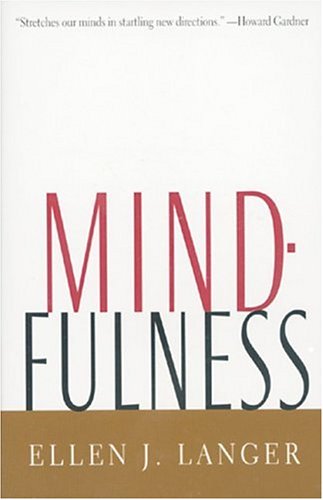
Mindfulness – a book review

In the laboratory of the hermits, no one noticed that the monkeys could talk.

Mindfulness

When a book ends with the above line, you know it’s going to be interesting.

When the inside front page carries a short review from Prof Alan Dershowitz of Havard Law School that reads, “One simply can’t finish this book and see the world in the same way”, you know the book is important.

Yes to both.

On Page 2, Ellen writes,

Unlike the exotic “altered states of conciousness” that we read so much about, mindfulness and mindlessness are so common that few of us appreciate their importance or make use of their power to change our lives.

This is a book for so many different aspects of life.  From fields like aviation where mindlessness can, literally, kill to mindful new perspectives for people looking to explore new horizons for the soul.

Langer demonstrates a rare capacity both to see what is extraordinary about human events and to envision even more enlivening human possibilities. – Lee Ross, Stanford University.

By Paul Handover

Whither the Internet?

A Force for Good may be becoming less good?

The Internet is clearly an extraordinary revolution, one almost as big as the invention of the printing press by Gutenberg. Amazingly, it also started out FREE and totally democratic – a fantastic boon to humanity.

However – as with everything else – it has inevitably become abused by the selfish minority that we seem unable or unwilling to deal with effectively, and for this we all must suffer.

So, because of this minority abuse the majority can expect more and more controls and bureaucratization and no doubt in the end it will be taxed as well. Indeed, I am astonished that greedy, incompetent, reckless governments haven’t already got their nasty paws on it as the next milch-cow to satisfy their insane rapaciousness.

But it is the potty EU (another giant institution that is currently sowing the seeds of its own demise through its arrogant grasping for power and control) where the most control-freakery is being displayed.

Firstly, we are apparently to have a new EU organism to “oversee” the Internet, and Estonia and France are currently vying for this lucrative (for its staff – not the EU taxpayer) little gravy-train.

Secondly, it seems that the EU now wants to log everyone’s Google searches for two years in a bid to ensnare paedophiles. Thankyou EU, but much as I hate paedophiles to be honest I do not want my Google searches logged, not even actually by Google. I have no faith whatsoever that someone, somewhere, sometime will not exploit this data even though I am completely innocent.

And anyway, as is pointed out in the above-mentioned article, this bit of overkill bureaucratization (no doubt another EU organism will have to be set up to actually do this – not of course in some run-down bit of Sicily but some posh and extremely expensive suburb of Brussels with loads of staff, secretaries, expenses and all the rest) will be totally ineffective anyway since paedophiles are far too cunning to use Google.

As for Google, is this yet another example of an organism overreaching itself? Have they gone too far for their own good with their street-level photography – amazing technology but one snoop too many nonetheless?

And returning to search monitoring, I am not sure I want to be the constant victim of oh so-clever targeted marketing all the time.  There comes a point when I simply want to be left alone and unmonitored. Sometime this data juggernaut has to be stopped, or where will it all end?

PS Is the Internet changing our brains? It is claimed people are losing the ability to concentrate. I certainly notice this in schoolkids I teach. This poses me three questions. If anyone out there is clever enough to provide answers I’d be most grateful.

A) Is it TRUE or another urban myth?

B) Does it MATTER?

C) If it does, can we DO ANYTHING about it?

By Chris Snuggs

A Way Forward?

Removing the fear of the unknown

I’ve been working with most of my clients recently through painful transformations brought about by the economic downturn.

An interesting metaphor really because since the first wave of uncertainty triggered panic, first noticed in the UK banking system, I have been picking up on that uncertainty that feels like it’s stalking the globe at the moment.

Interestingly, I, too, have been aware of an underlying fear that was difficult either to name or source.

It has been rather like a deep river in that whilst the surface feels slow moving, currents are moving things powerfully below.

So this ‘fear’ has caused a few household changes.

We now are the proud owners of 9 chickens. Our youngest son, Sami, and I have dug up the back lawn and planted vegetables and built a poly-tunnel.

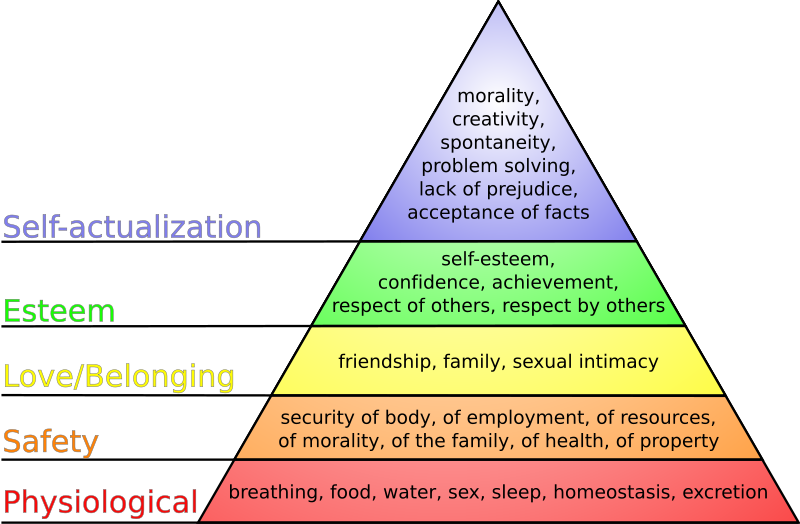
We have also installed a wood burning cooker. Right back down to the base of Maslow’s triangle really!

Maslow’s triangle of needs

These feelings have brought about such change everywhere and I wonder seriously whether we will ever return to what was; indeed would we want to?

I might not have mentioned it in previous blogs but as well as an engineering background, in latter years, I have focused on how interpersonal success in business is linked directly to relationships, integrity and vitally, self-awareness.

To inform this, some 7 years ago, I embarked on an MA in Core Process Psychotherapy, primarily to work on myself so that I could be the best I could be in my relationships, in and out of work.

The point I’m trying to make is that the same panic I notice in many of the companies I work in, and in me, is based on fear of the unknown and on a lack of trust in all its forms.  I’ve deliberately underlined that last phrase because it is so incredibly important.

The truth is that we get more of what we focus on.

So we can choose to focus on the constant news of more difficulties, hardship and redundancies, or we can focus on what is working.

In the workplace this positive focus has been pulling people together across functions and sites and pooling resources and ideas.

A farm evening

When we realise we’re not doing this alone it’s amazing how much lighter a load can feel and how much more inspired we feel.

I also notice how humour begins to flow and what a powerful antidote for doom and gloom that is.

Transformation is never easy but the rewards far exceed the effort put in ten fold.

So what is it going to be? Are we all going to bow down to the god of Doom & Gloom, fear and anxiety, heaping more and more gifts around it, or are we going to start noticing and focusing on the other neglected god – that of relationship, joy, trust, abundance and lightness?

Whatever the future holds for us all a belief in our inherent ability to adapt and change and focus on the greater good rather than fear, anxiety, greed and selfishness is the only sustainable way forward.

By Jon Lavin

[If you have been affected by this Post and would like to contact Jon, he would be delighted to hear from you. Ed.]

Radio Caroline

A real blast from the past!

Recently we rented the film, Pirate Radio, a somewhat ‘true’ story about the days of broadcasting rock and roll from a ship moored just outside British waters.  Here’s the official trailer of the film (somewhat glitzy as is the manner of Hollywood):

Anyone of my sort of vintage living in England during the 1960s will recall the fun and excitement of Radio Caroline, the name of the radio station that started up in 1964.

Here’s a good extract from the WikiPedia entry:

Radio Caroline is an English radio station founded in 1964 by Ronan O’Rahilly, to circumvent the tight hold the record companies had on the broadcast of popular music in the UK. It originally commenced transmissions as an offshore radio station broadcasting from a ship anchored in international waters off the coast of South East England. Originally unlicensed by any government, for the majority of its early life, it was labelled as a pirate radio station.

Radio Caroline

Amazingly, at its peak Radio Caroline had an audience of 23 million listeners.  In a very real way Radio Caroline was another symbol of what became known as the Swinging Sixties, a transformation period for post-war Britain.

Tony Blackburn was just one of many famous disk jockeys who started life out on Radio Caroline, with Tony being the first presenter of the BBC’s Radio 1 station, broadcasting popular music, when it came on air on the 30th September, 1967.

Tony Blackburn, some while ago!

Anyway, if you are nostalgic towards the ‘good’ old days of the sixties, do watch the film.

By Paul Handover

The aroma of British politics!

Such a shame that British electioneering couldn’t be honest.

Well, the British General Election Campaign meanders along towards the final week before we are put out of our misery on May 6th.

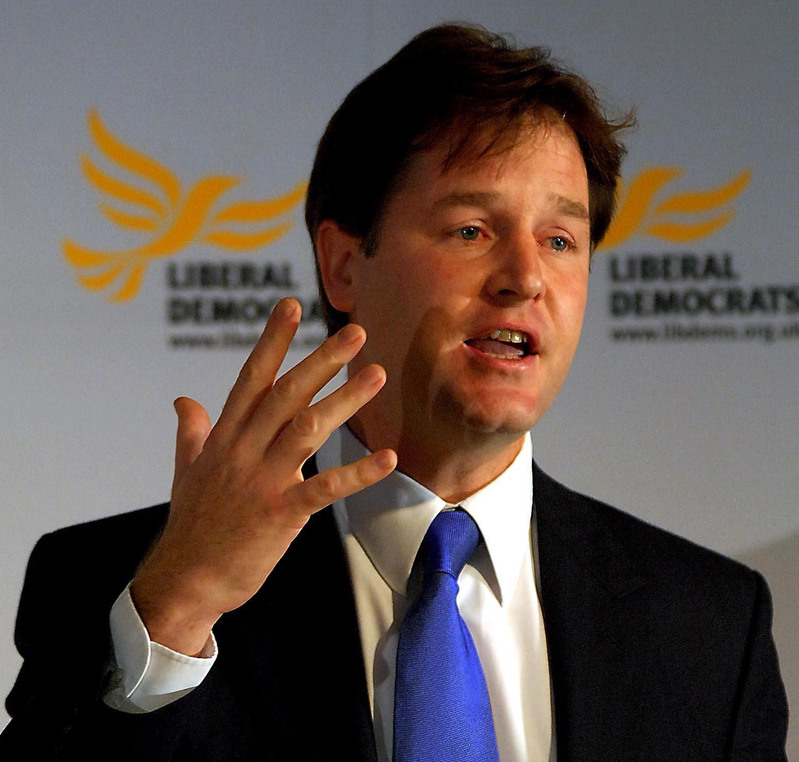
Sadly, the main topic of interest has been the success of Nick Clegg in the Leaders’ TV debates. The new young face on

Nick Clegg

the block has proved once and for all the huge power of television. Not one single Lib-Dem policy or personnel changed during the debate, yet the mere appearance on the telly of a new, personable kid on the block has rocketed his party up the ratings.

Well, not exactly rocket science, but sobering all the same. However, more importantly, most policy discussion seems mired in a series of scare-mongering ploys along the lines of, “Don’t vote for that lot or this terrible thing will happen.”

Yes, perhaps this is the stuff of all elections, but this one should have been a bit different since

A) it comes after a long period of power held by the Labour Party and whichever way it goes will mark a historic change and,

B) the stakes are so high as Britain hovers on the edge of joining the economically-challenged PIIGS [Portugal, Italy, Ireland, Greece, Spain, Ed.] of Europe.

We desperately need a government that can take us safely away from that particular event horizon, but to choose one rationally, we need the “truth” about what really needs to be done to reduce debt.

But sadly, we seem infected by the Greek syndrome, an ability to see the bleedin’ obvious, which is that nobody can live beyond their means for ever, much as they might like to.

So, we’re having to look for “the truth” further afield, to the Institute for Fiscal Studies (IFS), for example. According to them, the cuts in public costs will have to be as deep as any made since World War II. (Oh, and thank you to Labour and the banks for jointly getting us into this sorry mess.)

Here’s a brief quote from that BBC link:

The UK faces the deepest spending cuts since the late 1970s if the three main parties are to meet their budget commitments, new analysis suggests.

The years between 2011 and 2015 must see the largest cuts since 1976-80, according to a report from the Institute for Fiscal Studies (IFS).

Here’s Stephanie Flanders, the BBC’s Economics Editor writing in her blog:

They may disagree in public, but privately they couldn’t agree more. On the single most important issue facing the country after this election, our politicians think it’s better to keep us in the dark.

WHERE is the party explaining this clearly and unambiguously to the people? In other words, TELLING THE TRUTH?

I don’t see it. Neither of the big, old dinosaur parties are being straight with us. The Tories are proposing to spend even MORE on the NHS, (National Health Service) that sacred cow that nobody dare speak any ill of, while Labour seem to be promising to spend more on just about everything despite our £163 billion borrowing this year.

Why is this? It can – I submit – only be because they don’t think the public will understand and accept “the truth”.

If party A tells the truth and admits the cuts in public services will be deep and involve some pain and party B LIES and says it will “preserve frontline services” (the Labour line) then they (Party A) fears the public will not buy their version and opt for whoever promises them a fantasy instead, or in other words a gradual recovery without too much pain and in particular for themselves.

So, there is deep cynicism and an extreme economy with the truth from all parties who fear a voter backlash if they tell it. This is rather a sad reflection on the Labour Party’s proud boast of “education, education, education” of 1997.

Apparently, the British public is so stupid that they can’t be trusted to believe the truth when they get it. Of course, this could possibly be because they are so UNUSED to getting it and moreover because this policy of spinning smoke and mirrors worked so well in previous Labour victories.

Clear as mud!

By Chris Snuggs