I see LG have recognised that many people the wrong side of 60 now use a mobile phone and have recently launched …..
Cell phone for seniors
and from John L. from Devon, England this lovely story.
Several men are in the changing room of a golf club. A mobile phone on a
bench rings and a man engages the hands-free speaker function and begins to
talk. Everyone else in the room stops to listen.
MAN: “Hello”
WOMAN: “Hi Honey, it’s me. Are you at the club?”
MAN: “Yes.”
WOMAN: “I’m at the shops now and found this beautiful leather coat. It’s
only £2,000. Is it OK if I buy it?”
MAN: “Sure, go ahead if you like it that much.”
WOMAN: “I also stopped by the Lexus dealership and saw the new models.
I saw one I really liked..”
MAN: “How much?”
WOMAN: “£60,000.”
MAN: “OK, but for that price I want it with all the options.”
WOMAN: “Great! Oh, and one more thing. I was just talking to Janie and
found out that the house I wanted last year is back on the market. They’re
asking £980,000 for it.”
MAN: “Well, then go ahead and make an offer of £900,000. They’ll probably
take it. If not, we can go the extra eighty-thousand if it’s what you really
want.”
WOMAN: “OK. I’ll see you later! I love you so much!”
MAN: “Bye! I love you, too.”
The man hangs up. The other men in the locker room are staring at him in
astonishment, mouths wide open.
He turns and asks, “Anyone know whose phone this is?”
The technology of the Internet will prove to be of huge democratic value.
Those who know me know a disquieted man. Someone, who despite being more at peace with himself than ever before, nonetheless senses that we, as in the mankind of Planet Earth, are already deep in the ‘no mans land’ of change between the last, say, forty years and a very different future just around the corner.
In the past opinion and commentary has been in the hands, more or less, of the giant media moguls. But technology has changed that. Now more than ever a huge people have access to the Internet. Indeed, a quick Google search reveals that of a world population of 6.85 billion people, just under 2 billion (29%) have internet access. In North America that percentage is 77.4% (226 million) and in Europe the percentage is 58.4% (475 million). I.e. nearly a billion people in just North America and Europe!
My point is that, in a manner never before experienced in human history, the vast majority of us have the ability to read, learn and muse about the critically important issues facing us today, coming to conclusions that carry political weight. We have almost infinite choice as to where and how we form opinions.
Thus having access, via the internet, to the scribblings of so many wise people may end up giving democracy the boost it really needs in the face of overwhelming powerful plutocratic forces.
Here are just a couple of those wise voices.
Simon Johnson
I first came across him in an article in The Atlantic Magazine back in May 2009. That article was called The Quiet Coup. If you haven’t read it, go here. It is introduced thus:
The crash has laid bare many unpleasant truths about the United States. One of the most alarming, says a former chief economist of the International Monetary Fund, is that the finance industry has effectively captured our government—a state of affairs that more typically describes emerging markets, and is at the center of many emerging-market crises. If the IMF’s staff could speak freely about the U.S., it would tell us what it tells all countries in this situation: recovery will fail unless we break the financial oligarchy that is blocking essential reform. And if we are to prevent a true depression, we’re running out of time.
Simon is also one of the lead writers for the Blog Baseline Scenario. Have a read of a recent article about the appointment of Bill Daley as President Obama’s new chief of staff. That article concludes thus:
Top executives at big U.S. banks want to be left alone during relatively good times – allowed to take whatever excessive risks they want, to juice their return on equity through massive leverage, to thus boost their pay and enhance their status around the world. But at a moment of severe financial crisis, they also want someone in the White House who will whisper at just the right moment: “Mr. President, if you let this bank fail, it will trigger a worldwide financial panic and another Great Depression. This will be worse than what happened after Lehman Brothers failed.”
Let’s be honest. With the appointment of Bill Daley, the big banks have won completely this round of boom-bust-bailout. The risk inherent to our financial system is now higher than it was in the early/mid-2000s. We are set up for another illusory financial expansion and another debilitating crisis.
Bill Daley will get it done.
Now let’s turn to that other writer, Patrice Ayme.
That name is a nom-de-plume but so what! Having read Patrice for some time now and corresponded via email from time to time, I have to tell you this is one giant of an intellectual thinker. Take this Post from example: Pluto Lie #1: Glass Beads Matter More It’s a beautifully written article but not something that you should try a skim read through; it deserves a really focussed mind on the words and the meanings expressed. Here’s a flavour:
Abstract: An American historian paid by the hyper rich, exhumed again the old fallacy that material riches matter more than anything else. He points at recent electronic gadgetry, and attributes it to Reagan. This article of faith in Reagan and American plutocracy amusingly gives, obviously without knowing, prominence to recent French and German governmental research, which allowed to make such gadgets.
I skewer this lamentable, not to say corrupt, piece of dismal propaganda which was published all over the American media, for Christmas. I use the occasion to give a new metric to evaluate riches over the last 100,000 years, explain why the USA does not use the metric system, and what European kings were really about.
Too great a disparity of riches is another name for plutocracy. Indeed, money is power, and thus, too much money is too much power.
Here is how Patrice’s article closes (but it would be so much better if you read the article in its entirety):
Morality? Europeans Kings of old could live long, and lived strong.The best of them were working relentlessly, brandishing whatever it took to stabilize the situation ethically, politically, and civilizationally. They were incredibly brutal. They would die, and kill, just over the length of hair (kings and prospective kings wore it long, religious wore it nought). Even small children, if viewed as potential kings, would be presented with the scissors and the sword (if they did not go for the former, they would get the later).
So of course, kings of old would have made it to today’s highest class. Kings were often the richest people around, and they got there, or stayed there, by killing, in the name of new, and higher principles. This only happened because their subordinates agreed to strive towards the same new and higher principles. Hanson misses completely the spiritual dimension of the kings of old. Kings of old led an ethical revolution, which was their reason for being in power, and why people elected them (or elected to follow them).
Kings of old lived very comfortably by their metrics, with residences all around Europe, and wives, concubines, nobles under oaths to serve them (to death). Some, such as Charlemagne, were very healthy into old age. What’s more fun than to make war for decades, mostly winning, as Charlemagne did?
Dr. Victor Davis Hanson, a classicist and military historian, is a senior fellow at the Hoover Institution and a recipient of the 2007 National Humanities Medal.
That appurtenance, too, tells volumes. Hanson has tales to tell, and they sing of American plutocracy. It remains to be seen if history will sing along. Two things, though: history does not tell lies, and human beings are not reducible to gadget loving midgets.
So to repeat my point. Whether or not one choses to agree with the likes of Simon Johnson and Patrice Ayme there is no doubt that in my mind it will be writers like these that, through the better education of millions of citizens, will not only preserve democracy in so many countries but will ensure that the age before us will be fairer and more just.
Change can be achieved by the threat of tomorrow being the same
even quicker than by the hope of tomorrow being different!C. Graham-Leigh.
This Blog has been running since July 15th 2009. As of yesterday, there had been 777 posts – a nicely rounded number if nothing else. It has been and continues to be a great way of communicating with the wider world.
However, both Jon and I are facing a number of challenges that make it very difficult to maintain a Post a day as it has been, more or less, since the start in 2009.
Jon is in the last few months of completing a Master’s degree with huge demands on his creative time. I have volunteered to take a full US Pilot’s Licence and Instrument Rating with a great school down in Scottsdale, Phoenix, essentially building on my UK private flying experience that goes back to 1981. This is going to keep me pretty well occupied until the end of February, 2011. Both of us have private family lives that mustn’t be encroached upon (Jon does a much better job at this than me!).
On reflecting on this Blog, I have realised that the old salesman in me has tripped me up. In the sense that we have developed a virtual relationship with many hundreds of readers that, I think, includes the expectation of a new Post every day. But the reality is that any Blog that is written without a commercial angle, as with Learning from Dogs, should be more a reflection of what stimulates the Blog authors than trying to ‘serve’ a market – that’s the old salesman mistake!
So on the basis that this Blog is about integrity and why dogs set such a wonderful example of integrous behaviour, there is going to be a change of emphasis.
The Blog will continue to publish articles focussed close to the theme as expressed here.
We will continue to publish other pieces, including humorous items, if they are worth sharing (agreed a subjective measure).
We will continue to publish articles from Guest authors.
If pressures or circumstances conspire to mean that a Blog article isn’t published every single day, then that will be just the way it is – Jon and I are not going to beat ourselves up about it!
In the next few days, the Blog is going to pass the 100,000 readers mark since it started. You have to realise how much that means to all the people who have written for Learning from Dogs. Thank you!
Any ideas, comments or feedback to the above? Please let us know.
A guest post from Chris Snuggs, a long-term supporter and author on Learning from Dogs.
Chris Snuggs
EU QUESTIONNAIRE – C Snuggs, 26 November, 2010
This questionnaire is designed to test your knowledge and opinions of the EU. Your answers will be collated and go towards the production of a report to present to your MEP (Member of the European Parliament)– if you can find him or her. Please give your opinion by ticking either T (true) or F (false) for each proposition.
a
THE EURO
1 Greece falsified its statistics in order to “qualify” for entry to the euro.
2 EU leaders KNEW this (like almost everyone else), but ignored it.
3 The EU’s OWN economists had told them that Greece and others could not live in the Eurozone alongside Germany.
4 Ergo, the EU elite connived in a LIE about the finances of Greece and the future of the euro..
5 Once Greece was in the Eurozone it spent money wildly and wastefully with many people retiring at 50, a bloated and overpaid civil service, civil servants who often didn’t bother to turn up, pensions bequeathed to relatives and so on.
6 The EU elite knew all this but DID NOTHING EFFECTIVE about it.
7 Now European taxpayers are having to pay BILLIONS to bail out feckless countries that vastly overspent.
8 The EU elite that lied and ignored these deep problems have been utterly incompetent guardians’ of EU taxpayers’ money. More than incompetent, they have been party to DEFRAUDING many millions of taxpayers for their own ambitions and political ends.
9 The VAST payouts of taxpayers’ money to bail out Greece, Ireland and soon Belgium, Portugal, Spain and Italy DO NOTHING TO FIX THE UNDERLYING PROBLEMS as highlighted in 3 above. This policy therefore represents an appalling further waste of money and merely postpones difficult decisions that EU leaders must make, and should in fact have made YEARS ago.
10 According to the EU’s OWN RULES it is ILLEGAL to “bail out” a bankrupt country. Despite this, the EU countries have bailed out Greece and now Ireland. Mr Van Rompuy was charged with finding a way that this could be done legally. Frau Merkel has suggested that the Lisbon Treaty be amended to allow bailouts to be done legally. How she proposes to amend this Treaty without the consent of member countries is a mystery.
11 The EU elite, knowingly having illegally bailed out Greece and now Ireland should be arrested en masse for illegal use of public money. The EU is very strong on law, except apparently for itself when it suits it.
EU FINANCE, SPENDING & REMUNERATION
12 The EU has failed to get its accounts signed off for the nth year in succession; NO PRIVATE CONCERN COULD GET AWAY WITH THIS.
13 At this time of economic crisis the EU wants to spend SIX BILLION EUROS on a new diplomatic service, including the placing of FORTY-SIX “diplomats” on Barbados and over FIFTY on Madagascar.
14 The number of EU citizens demanding this vast expenditure must be microscopic; though nobody knows for sure since the EU would never dream of asking its paymasters their opinion.
15 Europe is going through the worst period of financial chaos since WWII. Jobs are being lost almost everywhere; many EU countries are technically bankrupt; people’s living standards and public services are being drastically cut, except it seems in the EU in Brussels.
16 The EU has just won a court case against the people that finance it, the national governments. As a consequence, EU workers will receive a payrise backdated to last year with interest of 3.7% at a time of desperate economic hardship for many millions of EU citizens.
17 The head of the vast new “diplomatic” organisation is a Brit who has NEVER BEEN ELECTED to any post of significance and earns more than TWICE as much as ANY European leader, plus very considerable expenses. She is far from unique in the EU circle of the elite.
18 EU workers receive extraordinary perks (benefits) and also pay around 8% income tax. Very few of their electors (who pay their wages) benefit from anything like this sort of remuneration.
19 Peter Mandelson RESIGNED from his post as Commissioner to become an English Lord. Since his ludicrous remuneration for this was LOWER than his EU income the EU is paying him around £62,000 of taxpayers’ money for FOUR years to make up the difference, EVEN THOUGH HE RESIGNED.
20 The above-mentioned practice amounts to institutionalised THEFT of taxpayers’ money.
21 The EU has just created an English-language website to inform us of how wonderful they are. In other words, WE are paying to have EU PROPAGANDA shoved down our throats.
22 The EU paying some 300,000€ for a dogs’ home in Poland at a time when millions of people in Europe are suffering real economic hardship is just one example of frivelous use of taxpayers’ money.
THE RATIONALE OF THE EU
23 Mr van Rompuy, unelected “President” from a failing and disintegrating state (is this the reason for his obsession?), has said that “The nation states are dead.”He and the EU elite seek the creation of a European “superstate” controlled from Brussels.
24 Mr Van Rompuy has presumably informed President Sarkozy, Chancellor Merkel and other EU leaders personally that their states “are dead”. Their reactions have not been published so far.
25 This agenda was denied by the EU elite for many decades, which of course represents yet another LIE.
26 This unelected “President” earns more than any national leader in the EU. This is to give the impression that he is more important, since clearly the more money you are paid the more important you must be.
MEPs & DEMOCRACY
27 MEPs have just demanded a near 6% increase in the EU budget.
28 In this they are certainly not reflecting the wishes of the majority of their electors.
29 Many turn up in Brussels, sign on to qualify for their attendance allowance and then go away.
30 I do not know of any other profession where you get paid a vast salary and expenses and then EXTRA MONEY just for attending a meeting.
31 Most people haven’t got the foggiest idea who is supposed to be “representing” them in Brussels.
32 The EU as it stands is a top-down decision-making organisation whose leaders have a degree of self-righteousness (“Only we know what is good for you.”) that has to be suffered to be believed.
33 MEPs do not take their electors wishes into account.
34 The EU hates referendums since they give an opportunity to the people to express their opinion and actually make a decision. Naturally they can’t be trusted with decisions.
35 When a referendum goes against the EU the usual reaction is to oblige the country involved to do it again and again till the “right” answer is produced. In this the EU is a laughing stock, but the elite do not care as long as they get their way
36 MEPs periodically flog up and down from Brussels to Strasbourg. Sitting in Strasbourg is supposed to be some sort of symbol, but I don’t know of any voters who were asked if they wanted to pay through the nose for a symbol at vast expense, not least in carbon emissions.
CONCLUSIONS
37 The modern world is characterized by greed, arrogance and incompetence. These are qualities that the EU elite has demonstrated in abundance.
38 The EU elite has totally and utterly FAILED the people of Europe and is not fit for purpose.
39 Most people believe in cooperation within Europe, but not in a European superstate ruled from Brussels, a country both disintegrating and vastly endebted.
40 The EU elite has completely destroyed the faith that many ordinary people had in the EU as primarily a “common market”.
My overall reaction to the EU elite and its management of the EU is as follows. (Please tick ONE box.)
A) In general I am very pleased with the EU leadership.
B) I am quite pleased, even if some things could be improved.
C) I don’t care much either way. They can get on with it as far as I’m concerned.
D) I am not very pleased with the way the EU is run.
E) I am very dissatisfied indeed about the way that my money is being spent.
F) It is such a corrupt, wasteful and undemocratic shambles that we have to abolish it up and start again. My country is certainly better off outside the EU AS IT IS CURRENTLY RUN. I am profoundly disappointed.
F) I am disgusted at the EU elite’s arrogance, incompetence, dishonesty and venality.
[NB. If after reading the above, you really would like to submit your answers to the above questions to your local MP or MEP, then Chris has a form you may use that may be downloaded from here. Ed]
I was much taken by Patrice’s guest post of yesterday and have managed a short break from the travails of my Master’s degree to post an article by David Pratt, that has been part of my research. Jon.
The death of David Bohm on 27 October 1992 is a great loss not only for the physics community but for all those interested in the philosophical implications of modern science. David Bohm was one of the most distinguished theoretical physicists of his generation, and a fearless challenger of scientific orthodoxy. His interests and influence extended far beyond physics and embraced biology, psychology, philosophy, religion, art, and the future of society. Underlying his innovative approach to many different issues was the fundamental idea that beyond the visible, tangible world there lies a deeper, implicate order of undivided wholeness.
David Bohm was born in Wilkes-Barre, Pennsylvania, in 1917. He became interested in science at an early age, and as a young boy invented a dripless teapot, and his father, a successful businessman, urged him to try to make a profit on the idea. But after learning that the first step was to conduct a door-to-door survey to test market demand, his interest in business waned and he decided to become a theoretical physicist instead.
In the 1930s he attended Pennsylvania State College where he became deeply interested in quantum physics, the physics of the subatomic realm. After graduating, he attended the University of California, Berkeley. While there he worked at the Lawrence Radiation Laboratory where, after receiving his doctorate in 1943, he began what was to become his landmark work on plasmas (a plasma is a gas containing a high density of electrons and positive ions). Bohm was surprised to find that once electrons were in a plasma, they stopped behaving like individuals and started behaving as if they were part of a larger and interconnected whole. He later remarked that he frequently had the impression that the sea of electrons was in some sense alive.
In 1947 Bohm took up the post of assistant professor at Princeton University, where he extended his research to the study of electrons in metals. Once again the seemingly haphazard movements of individual electrons managed to produce highly organized overall effects. Bohm’s innovative work in this area established his reputation as a theoretical physicist.
In 1951 Bohm wrote a classic textbook entitled Quantum Theory, in which he presented a clear account of the orthodox, Copenhagen interpretation of quantum physics. The Copenhagen interpretation was formulated mainly by Niels Bohr and Werner Heisenberg in the 1920s and is still highly influential today. But even before the book was published, Bohm began to have doubts about the assumptions underlying the conventional approach. He had difficulty accepting that subatomic particles had no objective existence and took on definite properties only when physicists tried to observe and measure them. He also had difficulty believing that the quantum world was characterized by absolute indeterminism and chance, and that things just happened for no reason whatsoever. He began to suspect that there might be deeper causes behind the apparently random and crazy nature of the subatomic world.
Bohm sent copies of his textbook to Bohr and Einstein. Bohr did not respond, but Einstein phoned him to say that he wanted to discuss it with him. In the first of what was to turn into a six-month series of spirited conversations, Einstein enthusiastically told Bohm that he had never seen quantum theory presented so clearly, and admitted that he was just as dissatisfied with the orthodox approach as Bohm was. They both admired quantum theory’s ability to predict phenomena, but could not accept that it was complete and that it was impossible to arrive at any clearer understanding of what was going on in the quantumrealm.
It was while writing Quantum Theorythat Bohm came into conflict with McCarthyism. He was called upon to appear before the Un-American Activities Committee in order to testify against colleagues and associates. Ever a man of principle, he refused. The result was that when his contract at Princeton expired, he was unable to obtain a job in the USA. He moved first to Brazil, then to Israel, and finally to Britain in 1957, where he worked first at Bristol University and later as Professor of Theoretical Physics at Birkbeck College, University of London, until his retirement in 1987. Bohm will be remembered above all for two radical scientific theories: the causal interpretation of quantum physics, and the theory of the implicate order and undivided wholeness.
In 1952, the year after his discussions with Einstein, Bohm published two papers sketching what later came to be called the causal interpretation of quantum theory which, he said, “opens the door for the creative operation of underlying, and yet subtler, levels of reality.” (David Bohm and F. David Peat, Science, Order & Creativity, Bantam Books, New York, 1987, p. 88.) He continued to elaborate and refine his ideas until the end of his life. In his view, subatomic particles such as electrons are not simple, structureless particles, but highly complex, dynamic entities. He rejects the view that their motion is fundamentally uncertain or ambiguous; they follow a precise path, but one which is determined not only by conventional physical forces but also by a more subtle force which he calls the quantum potential.The quantum potential guides the motion of particles by providing “active information” about the whole environment. Bohm gives the analogy of a ship being guided by radar signals: the radar carries information from all around and guides the ship by giving form to the movement produced by the much greater but unformed power of its engines.
The quantum potential pervades all space and provides direct connections between quantum systems. In 1959 Bohm and a young research student Yakir Aharonov discovered an important example of quantum interconnectedness. They found that in certain circumstances electrons are able to “feel” the presence of a nearby magnetic field even though they are traveling in regions of space where the field strength is zero. This phenomenon is now known as the Aharonov-Bohm (AB) effect, and when the discovery was first announced many physicists reacted with disbelief. Even today, despite confirmation of the effect in numerous experiments, papers still occasionally appear arguing that it does not exist.
In 1982 a remarkable experiment to test quantum interconnectedness was performed by a research team led by physicist Alain Aspect in Paris. The original idea was contained in a thought experiment (also known as the “EPR paradox”) proposed in 1935 by Albert Einstein, Boris Podolsky, and Nathan Rosen, but much of the later theoretical groundwork was laid by David Bohm and one of his enthusiastic supporters, John Bell of CERN, the physics research center near Geneva. The results of the experiment clearly showed that subatomic particles that are far apart are able to communicate in ways that cannot be explained by the transfer of physical signals traveling at or slower than the speed of light. Many physicists, including Bohm, regard these “nonlocal” connections as absolutely instantaneous. An alternative view is that they involve subtler, nonphysical energies traveling faster than light, but this view has few adherents since most physicists still believe that nothing-can exceed the speed of light.
The causal interpretation of quantum theory initially met with indifference or hostility from other physicists, who did not take kindly to Bohm’s powerful challenge to the common consensus. In recent years, however, the theory has been gaining increasing “respectability.” Bohm’s approach is capable of being developed in different directions. For instance, a number of physicists, including Jean-Paul Vigier and several other physicists at the Institut Henri Poincaré in France, explain the quantum potential in terms of fluctuations in an underlying ether.
In the 1960s Bohm began to take a closer look at the notion of order. One day he saw a device on a television program that immediately fired his imagination. It consisted of two concentric glass cylinders, the space between them being filled with glycerin, a highly viscous fluid. If a droplet of ink is placed in the fluid and the outer cylinder is turned, the droplet is drawn out into a thread that eventually becomes so thin that it disappears from view; the ink particles are enfolded into the glycerin. But if the cylinder is then turned in the opposite direction, the thread-form reappears and rebecomes a droplet; the droplet is unfolded again. Bohm realized that when the ink was diffused through the glycerin it was not a state of “disorder” but possessed a hidden, or nonmanifest, order.
In Bohm’s view, all the separate objects, entities, structures, and events in the visible or explicate world around us are relatively autonomous, stable, and temporary “subtotalities” derived from a deeper, implicate order of unbroken wholeness. Bohm gives the analogy of a flowing stream:
On this stream, one may see an ever-changing pattern of vortices, ripples, waves, splashes, etc., which evidently have no independent existence as such. Rather, they are abstracted from the flowing movement, arising and vanishing in the total process of the flow. Such transitory subsistence as may be possessed by these abstracted forms implies only a relative independence or autonomy of behaviour, rather than absolutely independent existence as ultimate substances.
(David Bohm, Wholeness and the Implicate Order, Routledge & Kegan Paul, London, Boston, 1980, p. 48.)
We must learn to view everything as part of “Undivided Wholeness in Flowing Movement.” (Ibid., p. 11.)
Another metaphor Bohm uses to illustrate the implicate order is that of the hologram. To make a hologram a laser light is split into two beams, one of which is reflected off an object onto a photographic plate where it interferes with the second beam. The complex swirls of the interference pattern recorded on the photographic plate appear meaningless and disordered to the naked eye. But like the ink drop dispersed in the glycerin, the pattern possesses a hidden or enfolded order, for when illuminated with laser light it produces a three-dimensional image of the original object, which can be viewed from any angle. A remarkable feature of a hologram is that if a holographic film is cut into pieces, each piece produces an image of the whole object, though the smaller the piece the hazier the image. Clearly the form and structure of the entire object are encoded within each region of the photographic record.
Bohm suggests that the whole universe can be thought of as a kind of giant, flowing hologram, or holomovement, in which a total order is contained, in some implicit sense, in each region of space and time. The explicate order is a projection from higher dimensional levels of reality, and the apparent stability and solidity of the objects and entities composing it are generated and sustained by a ceaseless process of enfoldment and unfoldment, for subatomic particles are constantly dissolving into the implicate order and then recrystallizing.
The quantum potential postulated in the causal interpretation corresponds to the implicate order. But Bohm suggests that the quantum potential is itself organized and guided by a superquantum potential, representing a second implicate order, or superimplicate order. Indeed he proposes that there may be an infinite series, and perhaps hierarchies, of implicate (or “generative”) orders, some of which form relatively closed loops and some of which do not. Higher implicate orders organize the lower ones, which in turn influence the higher.
Bohm believes that life and consciousness are enfolded deep in the generative order and are therefore present in varying degrees of unfoldment in all matter, including supposedly “inanimate” matter such as electrons or plasmas. He suggests that there is a “protointelligence” in matter, so that new evolutionary developments do not emerge in a random fashion but creatively as relatively integrated wholes from implicate levels of reality. The mystical connotations of Bohm’s ideas are underlined by his remark that the implicate domain “could equally well be called Idealism, Spirit, Consciousness. The separation of the two — matter and spirit — is an abstraction. The ground is always one.” (Quoted in Michael Talbot, The Holographic Universe, HarperCollins, New York, 1991, p. 271.)
As with all truly great thinkers, David Bohm’s philosophical ideas found expression in his character and way of life. His students and colleagues describe him as totally unselfish and non-competitive, always ready to share his latest thoughts with others, always open to fresh ideas, and single-mindedly devoted to a calm but passionate search into the nature of reality. In the words of one of his former students, “He can only be characterized as a secular saint.” (B. Hiley & F. David Peat eds., Quantum Implications: Essays in Honour of David Bohm, Routledge & Kegan Paul, London, 1987, p. 48.)
Bohm believed that the general tendency for individuals, nations, races, social groups, etc., to see one another as fundamentally different and separate was a major source of conflict in the world. It was his hope that one day people would come to recognize the essential interrelatedness of all things and would join together to build a more holistic and harmonious world. What better tribute to David Bohm’s life and work than to take this message to heart and make the ideal of universal brotherhood the keynote of our lives.
This is a guest post from an old friend of Learning from Dogs, Patrice Ayme. Patrice writes his own Blog here and this article is published with gratitude and with awe! If you can, because the article more than deserves this, find somewhere quiet for half-an-hour to read this – it may well change the way you think about everything.
Theme: Is there extraterrestrial life? Extraterrestrial intelligence? A related question: how big is the universe? On all these subjects considerable and very surprising progress is in the making. I describe some of the new ideas and facts in plain language, from Plate Tectonics to Cosmic Inflation.
Facing the enormity of it all, honest minds will find honor and pleasure in telling the truth, and nothing but the truth (carefully distinguishing it from hope we can believe in). Some physicists, searching for the limelight, have presented some science fiction, or some science fantasy, or let’s say scientific working hypotheses, philosophically grounded, as real, established science. This is misleading and dangerous: science is truth, and that is why the public supports it. Let’s keep it that way.
Sometimes all that science does, but that is fundamental, is to find new uncertainties we did not previously suspect. A basic humility that needs to be taught to people and politicians is that knowledge is not just about learning what we know, but also about learning that there are new dimensions to what we don’t know.
One certainty: our Earth is rare and fragile. Earth was a primordial deity of the Greeks, Gaia, viewed as female, nourishing humankind. Gaia is an on-going miracle, of self regulation, with extremely complicated biology and physics entangled. The more we observe the cosmos, the more we see that’s hell out there. Gaia is a rare deity, Pluto is the rule. Here are some inklings.
***
ALIEN SOLAR SYSTEMS EVERYWHERE:
Many planets have been discovered around many stars. Solar systems (= several planets orbiting the same star) have also been discovered. In one of these systems three planets around a dwarf red star are all in the inhabitable zone (= neither too cold nor too hot, so that liquid water exists on a planet there). One of them is smack in the middle of the balmy zone. It seems clear that most stars will be found to have planets (we are above 30%, and our present detection methods are very crude).
Still there does not seem to be many civilizations out there. As Enrico Fermi put it:”Where is everybody?”
Far enough from the dangerous galactic center, with its zooming stars, high radiation, and gigantic black hole, but not far enough to miss the full wealth of the periodic table, with its many elements, there is a narrow band all around the galaxy, the inhabitable zone, with at least 50 billion suns (within the trillion suns of the Milky Way).
Everything indicates that there are billions of colonizable planets in the inhabitable zone of our galaxy: colonialism has a great future (once we find how to get there). Life could have started on many of these planets. But on most of these, it was quickly annihilated: hellish, incandescent “super-earths” (= rocky planet with masses up to 10 times Earth) ready to fall into their star, abound.
***
INGREDIENTS FOR LIFE: MAGNETOSPHERE, TECTONICS, MOON…
The obvious candidate for the start of life is next door. It is Mars (Venus may have qualified too, the early Sun being 25% weaker; but Venus has long turned into hell, destroying all biological remnants). Everything indicates that life started on Mars. It would be very surprising that it did not.
Probably even OUR life started there. Impacts of asteroids and comets would have thrown living material from Mars to Earth. Mars meteorites have been found in Antarctica, lying on the ice. It has been observed that the temperatures within a Mars meteorite could stay very low: no more than around 40 Celsius, during the entire Mars-Earth transfer.
The Earth stayed too hot for life much longer than Mars, due to its much greater thermal inertia, large, intense radioactive core, greater number of impacts, and having thoroughly melted after the giant impact which created our life fostering Moon.
But then, after an auspicious start, Mars lost most of most of its atmosphere (probably within a billion years or so). Why? Mars is a bit small, its gravitational attraction is weaker than Earth (it’s only 40%). But, mostly, Mars has not enough a magnetic field. During Coronal Mass Ejections, CMEs, the Sun can throw out billions of tons of material at speeds up to and above 3200 kilometers per seconds. It’s mostly electrons and protons, but helium, oxygen and even iron can be in the mix.
The worst CME known happened during the Nineteenth Century, before the rise of the electromagnetic civilization we presently enjoy. Should one such ejection reoccur now, the electromagnetic aspect of our civilization would be wiped out.It goes without saying that we are totally unprepared, and would be very surprised. Among other things, all transformers would blow up, and they take months to rebuild. we would be left with old books in paper, the old fashion way. A CME can rush to Earth in just one day. (Fortunately the Sun seems to be quieting down presently, a bit as it did during the Little Ice Age.)
When a CME strikes a planet, the upper atmosphere is hit by a giant shotgun blast. Except a shotgun blast goes around 300 meters per second, 10,000 times slower than a CME. So, per unit of mass, the kinetic energy of a powerful CME is at least ten billion times more powerful than a shotgun blast. Since the liberation speed is going to be around ten kilometers per second, on an average life supporting planet, to be hit by projectiles going at 3,000 kilometers per second is going to knock all too much of the upper air atoms into space. That’s how Mars lost most of its atmosphere. And thus its ocean and much of its greenhouse. So now Mars is desperately airless, dry, and cold.
A cluster of new stars forming in the Serpens South cloud
Both Mars and Venus are at the limit of the inhabitable zone. But Venus does not have a magnetic field worth this name. Thus Venus lost a lot of its hydrogen (hence water; the rest is tied up in sulfuric acid, H2SO4).
It is known that the Earth’s strong magnetic field originates from the motion of huge masses of liquid metal within.
So a solar wind shield, a magnetosphere, is tied to the plate tectonic of a very dynamical planetwith a powerful nuclear reactor deep inside. Whereas Venus and Mars are tectonically inert, at least, most of the time; maybe they wake up every half a billion years or so, for a big eruption. If Mars and Venus had been very tectonically active planets, may be they would be teeming with life (but that depends upon the distribution of heavy radioactive nuclei in a gathering solar system, an unknown subject, obviously non trivial, since Earth got them, and not the other two).
In any case the Earth’s magnetic shield protects life from the worst abuse of the Sun, as it deflects most of the CMEs out and around (they sneak back meekly as Aurora Borealis).
Another factor in the stable environment Earth provides for life is the Moon. The Earth-Moon system divides its angular momentum, between each other and the orbital motion of the Moon. This prevents the Earth to lay its rotation axis on its side: such a wobbling could not be compensated by the rest of the system. So it does not happen.
Mars, though, not being so impaired, wobbles between 15 and 35 degrees (causing weird, pronounced super-seasonal variations).
In any case, everything indicates that extremely primitive life appears quickly. But complex life needs time, lots of time, to evolve. Animal life and intelligence needs even more time. However, what strikes me in the new solar systems discovered so far, is how alien and unstable they are (this is partly a bias of the present detection methods).
Many of these systems have huge Jupiter styles planets in low orbit around their stars. It’s pretty clear that they fell down there, destroying the entire inner system in their path.
Other notions threaten life; gamma ray explosions, supernovas, and simply passing next to another star, throwing a solar system into chaos, and some Jupiters down into a fatal spiral. Our Sun, though, is pretty much cruising far from any star, in a cosmic void right now, perhaps left by a supernova explosion. Maybe we have been lucky for 4 billion years.
***
COSMIC GRANDEUR VERSUS MONKEY BUSINESS:
Many a physicist, or cosmologist, talks about the beginning of time, and other various notions pertaining to the grandest imagined machinery of the universe, as if they had found God, and it was themselves they were looking for (as Obama would put it). They claim to know their garden, the universe, pretty well (having apparently being there, at the moment of creation).
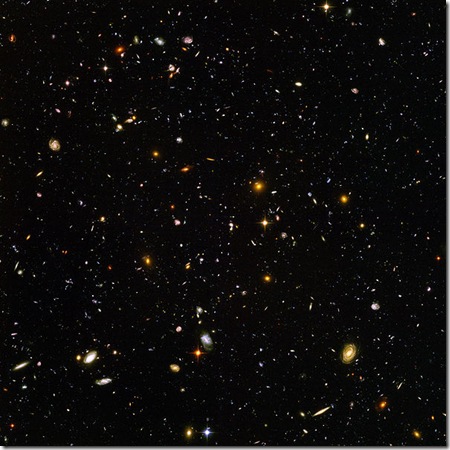
Verily, what we know for sure is what we see in pictures, and that’s plenty:
Hubble Ultra Deep Field: 10,000 galaxies. How many men?
Notions such as the “edge of the universe” are much less scientifically robust than some scientists claim. When some talk about the “First Three Minutes”, one can only laugh, even if countless Nobel Prizes in physics subscribe to the notion. Physics is relative, the search for glory, absolute. At least so do monkeys behave.
The concept of time in Quantum Mechanics and Relativity are in complete contradiction. One is absolute, the other relative. So nobody knows for sure what time is, and what is truly its relation to space (nor do we know what space is, much beyond the pretty pictures given by the telescopes). Speaking of the history of time is completely meaningless, except as poetry. Or scientific sounding poetry. Too many holes in the logic.
Even using standard science to buttress one’s reflection, the size of the universe could well be at least a 1,000 bigger than the 14 billion light year piece that we presently observe. In truth, we have literally no idea. Even when sticking to conventional theory, which predicts only one thing in that respect, namely that the universe is bigger than what we see (it predicts it by requiring it actually, see below).
Another thing is sure: it’s incredibly immense out there, and not just in physical size, but also in conceptual size. We know lower bounds for the universe in size and complexity, but have no idea whatsoever about the upper bounds. Dark Energy is a perfect example. Fifteen years ago, Dark Energy was unknown. Now it makes up 74% of the mass of the universe.
***
PRESENTING SCIENTIFIC PHILOSOPHY AS SCIENCE IS NOT WISE:
It is not a good thing when highly uncertain science is presented as certain, just as much as really true parts of science. It is not just immodest. It undermines, and threatens, science deeply.
Because presenting as certain what is not so is just a lie. But science is truth, and that is why society supports it.
To present as true what is not so ridiculizes the notion of certainty. When, ultimately, the ineluctable collapse of immodest pseudo-certainty occurs, all of science gets slashed with doubt. American witches can run as republican candidates for the US Senate on completely crazed platforms, mumbling about mice with human brains (this happened in the last USA election). Scientists ought not to make craziness respectable by leveraging it themselves. Crazy is crazy, especially when a scientist does it. It’s craziness squared.
Make no mistake: speculation is central to science and even more to philosophy. Just speculation ought to be labeled as such. When I talk about my own TOW theory, I do not present it as fact and certitude.
Most of recent (last 120 years) physics was totally unexpected. A lot of it is true, no doubt, in some sense. Some of it is completely false, too, most probably, in the most fundamental sense. The more fundamental science gets, the more it gets subjected to representations which can be misleading. Thus when some physiology or solid state physics gets established, it will not be shattered. Not so for Quantum Field Theory (most of which being an extrapolation over an energy domain where it has not been tested).
Science, like philosophy, is not just a body of knowledge, but also a method. Both have to use common sense as much as possible. Philosophy uses the external edge of knowledge, the first inklings, the first warnings, the smallest indices, the irreproducible experiments. Thus any scientist searching for really shattering new science will pass through the philosophical method, as a mandatory passage to greater certainty.
When science is proclaimed, it has to be certain. Science is truth in which one can have faith. A lot of the most glitzy cosmology comes short of that. (Thus the adventures of the alleged Big Bang should not be used as an argument to fund expensive accelerators: there are enough good reasons to fund them, not to use the bad ones!) The surest part of cosmology is actually its pretty pictures.
***
INFLATE OUR CLAIMS, IF THE OLD ONES DID NOT WORK OUT:
All of recent conventional cosmology’s biggest and noisiest concepts rest on something called the Inflaton Field. One could say thatit is just as much a rabbit out of a hat as in the best circus acts. There is no justification for it, except to explain what we see: something very big, very homogeneous, apparently contradicting relativity. The universe in its entirity.
The mystery that Cosmic Inflation tries to explain was this: as new regions of the universe come into view (at the speed of light!), it is observed that the new regions are exactly as the region we already know; same aspect, same background temperature, etc. How did they know how to look the same? They could not have talked to each other! Light did not have time to go from one to the other!
According to standard Einsteinian relativity, our region, and those regions, some on the opposite side of the universe from each other, have no common history! (Those new regions which appear are NOT within our past light cone… To use relativity lingo.)
In the USSR, Einstein’s work was criticized in minutia, for ideological reasons (Note1). So the great astrophysicist Zeldovitch came up in 1965 with the idea of inflation (the discovery is attributed to Guth, 1980, in the USA, because the USA buried the USSR, and America is a super power blessed by God, as the resident of the White House reminds his flock every day).
Einstein’s Relativity speaks of the speed of light within space, but not of the speed of space (so to speak). Speed of light is limited within space, speed of space is not limited. So it was breezingly supposed space had inflated at a gigantic speed, before slowing down. So the new regions coming into view had a sort of common history, after all.
From a philosophical perspective, to invent an explanation to explain a specific effect is called an ad hoc hypothesis. It can be a correct way to advance science, if it has predictive power (But differently from the neutrino, or the W, or the Higgs, how do you check for it? Finding the Inflaton particle? The Inflaton is supposed to have given birth to most other particles). In the meantime, it provides some hand waving to explain away an otherwise obvious contradiction with Relativity.
But it is not enough that some of the best theories in physics are weird, with the logical consistency of gruyere.
The apparent discovery of Dark Matter and especially Dark Energy, have brought a new twist. Dark Energy is completely unexplainable.
Dark Energy attracted attention to the fact that Quantum field theory is both the most precise and the most false theory ever contemplated (QFT is off in its prediction of vacuum energy by a factor of ten to the power 120, or so, the greatest mistake in theory, in the entire history of hominids… it would make even baboons scream in dismay.)
NASA-ESA Hubble
Billions of galaxies can be seen when we look as far as we can see. Here is a tiny detail, as far as we can see, without using a gravitational lens. [NASA-ESA Hubble]. Baffling. We are going to need a bigger imagination.
It’s hard for me to escape the feeling that the universe is much older than what standard cosmology believes, as I look at these very ancient, but very diverse galaxies in a piece of sky (Note 2).
Dark energy was discovered when it was realized, in super novae studies, that the universe’s expansion was accelerating (so energy is injected).
A natural question, though is this: ”If, as it turned out, the expansion is accelerating now, maybe it was at standstill much earlier?” Then the universe, even the small piece we can see, would be older and bigger than we have imagined so far. Don’t be afraid of the simple questions. Einstein asked himself at 16 what would happen if he looked at a mirror when going at the speed of light (Note 1).
Time will tell, as long as astronomy gets massively funded. Astronomy (astrophysics, cosmology, etc.) is one of the fields of science where fabulous progress is certain if it gets funded enough (the breakthroughs it made and will make in basic technology, to design the new instruments are very useful to the rest of society too).
In any case, the national debt is secure: it has a long way to go, before it can fill up the entire universe…
***
Patrice Ayme
***
Note 1.
Einstein’s views on space and time came under the label “Theory of Relativity”. That incorporated Lorentz’s work on the correct space-time transformation group compatible with Maxwell equations.
That is why looking at a mirror will not work, at the speed of light, if the conventional addition of speed used by Galileo was really true, because light could not catch up: light could not be seen at the speed of light (just as sound cannot be heard if one goes away from it at the speed of sound). So Galilean Relativity did not work (the first scientists who pointed that out were not Einstein, but Lorentz, Fitzgerald, and Poincare’, among others; Lorentz got the Nobel Prize for it).
Soviet scientists were irritated by the exaggeratedly sounding “Relativity” (since only Marx was absolute). They pointed out that the “Theory of General Relativity” should be called the “Theory of Gravitation”, and then they made more pointed critiques.
Ideology is important in science. The “multiverse” theory, a support of string theory, is a case in point. The multiverse ideology exists, because string theory has nothing to say about the measurement process, so it sweeps that inconvenient truth below an infinity of rugs. The multiverse cannot be fought scientifically, because it is not science. But it is philosophically grotesque, since it consists in claiming that all lies are true, somewhere else.
***
Note 2
The oldest galaxy was detected by Europeans at the Very Large Telescope in the high Chilean desert, in 2004, using a galactic super cluster as a lens (giving the VLT an aperture between 40 and 80 meters), had a redshift of 10, with an apparent age of more than 13 billion years.
***
Note on the notes: What did Einstein do in Relativity? He used an axiomatic method, with two axioms only (Principle of modern Relativity and Constancy of Light Speed).
Both axioms had been proclaimed by Poincare’, as Einstein knew, but Poincare’ had not realized that, with these two axioms only, all the known formulas could be derived in a few pages, as Einstein did (after doing away with the “Ether”, the substance in which waves were supposed to be waving). Einstein said he was influenced by empiricist philosophy from Hume and Mach.
The final story has not been written yet: and if the waves made the space? (TOW.)
Recently, I saw something come in to my in-box that just held my attention for sufficiently long to get me to move from scan reading to actually thinking about what I was reading and how it made me feel.
The US government may require cars to include scrambling tech that would disable mobile-phone use by drivers, and perhaps passengers.
No, this is not some other form of Government interference in areas of our lives that are irrelevant to the real world. This is serious stuff:
Believe it or not, I wasn’t always so outspoken about the dangers of distracted driving. Like a lot of folks, I just didn’t give a lot of thought to it.
But that all changed as I met people from coast to coast who told me about the loved ones they lost in senseless crashes caused by texting and cell phone use behind the wheel. And it was their stories–of dreams shattered and lives cut short–that turned the fight to end distracted driving into my personal crusade.
These people have had a profound effect on me. And I think their stories will have a profound effect on you.
SNIP
Just last year, nearly 5,500 people were killed and 500,000 more were injured in distracted driving-related crashes. But, these aren’t statistics. They’re children and parents, neighbors and friends.
The problem is that the average driver doesn’t think that he or she is an average driver: nearly two-thirds of drivers think of themselves as safer and more skillful than a driver of median safety or skills — a statistical impossibility, of course.
When faced with the prospect of automotive mobile phones being disabled, we’d be willing to bet that most drivers, suffused with confidence in their own skills, will think in terms of personal inconvenience and a restriction on personal freedom.
Perhaps it might be better to think of the guy texting in the lane to your left, or the gal yelling at her ex on her iPhone in the lane to your right, and think not of your own inconvenience, but of some distracted dolt killing you.
Remember one unassailable statistic, as explained by the late, great George Carlin: “Just think of how stupid the average person is, and then realize half of them are even stupider!”
LaHood may be right. Disabling mobile phones in cars should not be looked at as a way of protecting you from yourself, but instead as a way of protecting you from the stupid.
Today, like every day, is a beautiful day of hope!
At 3.30pm US Mountain Time – 10.30pm UK time – the marriage service between me and Jean Susan will commence at the Episcopal Church in Payson, Arizona. It represents a wonderful day of hope.
But hope is something much bigger than a couple getting married. See it from this perspective. From the eyes of Shimon Schocken.
Note: the next 10 days are pretty challenging, in the most positive and beautiful way, as Jean and I are to be married at Payson Episcopal Church on Saturday afternoon and we have guests until the 29th. There will always be a daily post from either me or Jon but do forgive us if they are not of the usual longer reflective style.
Dr. David R. Hawkins, M.D., Ph.D.
Both Jon and I have written about Dr Hawkins many times in Learning from Dogs. But there is also a plethora of valuable material available from the organisation, Veritas Publishing, that is the wrapper, so to speak, around David Hawkins work.
His monthly newsletter is free and often very interesting. For example, in the one that arrived today, there are a couple of extracts from his October lecture that resonate very closely with what Jon published about Eckhart Tolle the previous two days.
“The Self knows. The mind thinks. The thinking is just added as a thrill. Thinking is a thrill and an entertainment. Can you get along without thinking? There is a chair. I don’t think about the chair but I know it’s there. Most of real knowingness goes on without thinking. The animal knows without thinking. It just knows right off the bat who is a friend and who is a burglar.”
“Make choices instead of craving and desire and clutching. Choose to be happy instead of craving what you don’t have. Give up all cravingness. ‘I cannot be happy unless I get to do this or that.’ You are putting happiness as outside of yourself. The source of happiness is within. Winning $1 million does not make a big change in your life. Surrender all cravings to God.”
And do watch this:
Finally, I have repeated a publication today of a post written about Truth published earlier on Learning from Dogs in September. It has come out at the same time as this Post.
Whichever way we look, there appear to be huge problems. Not insurmountable but, metaphorically speaking, sheer vertical cliffs without any easy way up.
One might ponder if the last 50 years, that post-war period of growth and prosperity, have, in reality given society real, sustainable, core improvements or whether all the ‘gains’ have come at such a cost that the net benefit is questionable?
This could be seen as pessimism gone mad. Undoubtedly, there have been some huge gains from a scientific point of view and we now enjoy lives that are greatly enhanced and longer. But not to ask such a fundamental question is to assume the alternative, that everything in the garden is rosy.
Now this may seem a strange introduction to a topic that is going to be deeply personal and private.
But both the private, individual world of the ‘self’ and the great, interconnected world of the planet are indivisible. Every aspect of our lives, our livelihoods, our environment and the future of our children depends on how well, and how sustainably, we manage our personal, local, national and international interests.
For example, if Prof. Lovelock’s theory on the planet being a self-regulating organism is correct, his Gaia theory, then possibly in the lifetimes of our children, and certainly in the lifetimes of our grandchildren, worrying about a job or repaying the mortgage will be irrelevant. Our descendants will be worrying about their very survival!
I called this piece To Move on, First Give Up. Why?
Because the only way forward is to give up on the present.
The future depends on each of us being happy and contented with ourselves and avoiding looking out there for the magic cure to all our troubles. Being, as far as we are able, at peace with our circumstances and able to do the best, individually, as well as the best for our families, our friends and the larger world in which we work and play.
I have heard people ask the question before, “How can I best help the world?” The only truthful answer is to develop ourselves as individuals. In doing this, the field of consciousness that we are all connected to is also lifted or elevated to a higher level.
At this stage of history, either…the general population will take control of its own destiny and will
Noam Chomsky
concern itself with community interests guided by values of solidarity and sympathy and concern for others or alternately there will be no destiny for anyone to control.
-Noam Chomsky
By Jon Lavin
[Anyone who has been affected by this article and wishes to contact Jon may find his contact details here. Ed.]