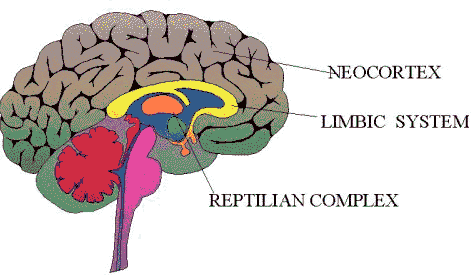
Now of all the things I am not, I am neither a biologist nor a scientist of any description. However, general knowledge told me years ago that the human brain is composed of three areas, as the following diagram shows.
The first time you observe the anatomy of the human brain, its many folds and overlapping structures can seem very confusing, and you may wonder what they all mean. But just like the anatomy of any other organ or organism, the anatomy of the brain becomes much clearer and more meaningful when you examine it in light of the evolutionary processes that created it.
The most efficient model for understanding the brain in terms of its evolutionary history is the famous triune brain theory developed by Paul MacLean. According to this theory, the following three distinct brains emerged successively in the course of evolution and now co-inhabit the human skull:
The reptilian brain, the oldest of the three, controls the body’s vital functions such as heart rate, breathing, body temperature and balance. Our reptilian brain includes the main structures found in a reptile’s brain: the brainstem and the cerebellum. The reptilian brain is reliable but tends to be somewhat rigid and compulsive.
The limbic brain emerged in the first mammals. It can record memories of behaviours that produced agreeable and disagreeable experiences, so it is responsible for what are called emotions in human beings. The main structures of the limbic brain are the hippocampus, the amygdala, and the hypothalamus. The limbic brain is the seat of the value judgments that we make, often unconsciously, that exert such a strong influence on our behaviour.
The neocortex first assumed importance in primates and culminated in the human brain with its two large cerebral hemispheres that play such a dominant role. These hemispheres have been responsible for the development of human language, abstract thought, imagination, and consciousness. The neocortex is flexible and has almost infinite learning abilities. The neocortex is also what has enabled human cultures to develop.
These three parts of the brain do not operate independently of one another. They have established numerous interconnections through which they influence one another. The neural pathways from the limbic system to the cortex, for example, are especially well developed.
I’m well into reading the book Waking The Tiger: Healing Trauma authored by Peter A. Levine. As early as Chapter One, Peter Levine explains [my emphasis]:
The involuntary and instinctual portions of the human brain and nervous system are virtually identical to those of mammals and even reptiles. Our brain, often called the ‘triune brain,’ consists of three integral systems. The three parts are commonly known as the ‘reptilian brain’ (instinctual), the ‘mammalian or limbic brain (emotional), and the ‘human brain or neo-cortex’ (rational). Since the parts of the brain that are activated by a perceived life threatening situation are the parts we share with animals, much can be learned by studying how certain animals, like the impala, avoid traumatization. To take this one step further, I believe that the key to healing traumatic symptoms in humans lies in our being able to mirror the fluid adaptation of wild animals as they ‘shake out’ and pass through the immobility response and become fully mobile and functional.
Unlike wild animals, when threatened, we humans have never found it easy to resolve the dilemma of whether to fight or flee. This dilemma stems, at least in part, from the fact that our species has played the role of both predator and prey. Prehistoric peoples, though many were hunters, spent long hours each day huddled together in cold caves with the certain knowledge that they could be snatched up at any moment and torn to shreds.
Anyway, to get back to what triggered today’s post.
If you read yesterday’s post you will recall me chatting with Jon Lavin and Jon reminding me that humans are drawn to positive messages. But in stark contrast, the news media industry excels in promoting ‘doom and gloom’. Why is this? Why are we so fascinated by danger?
Well here’s my theory.
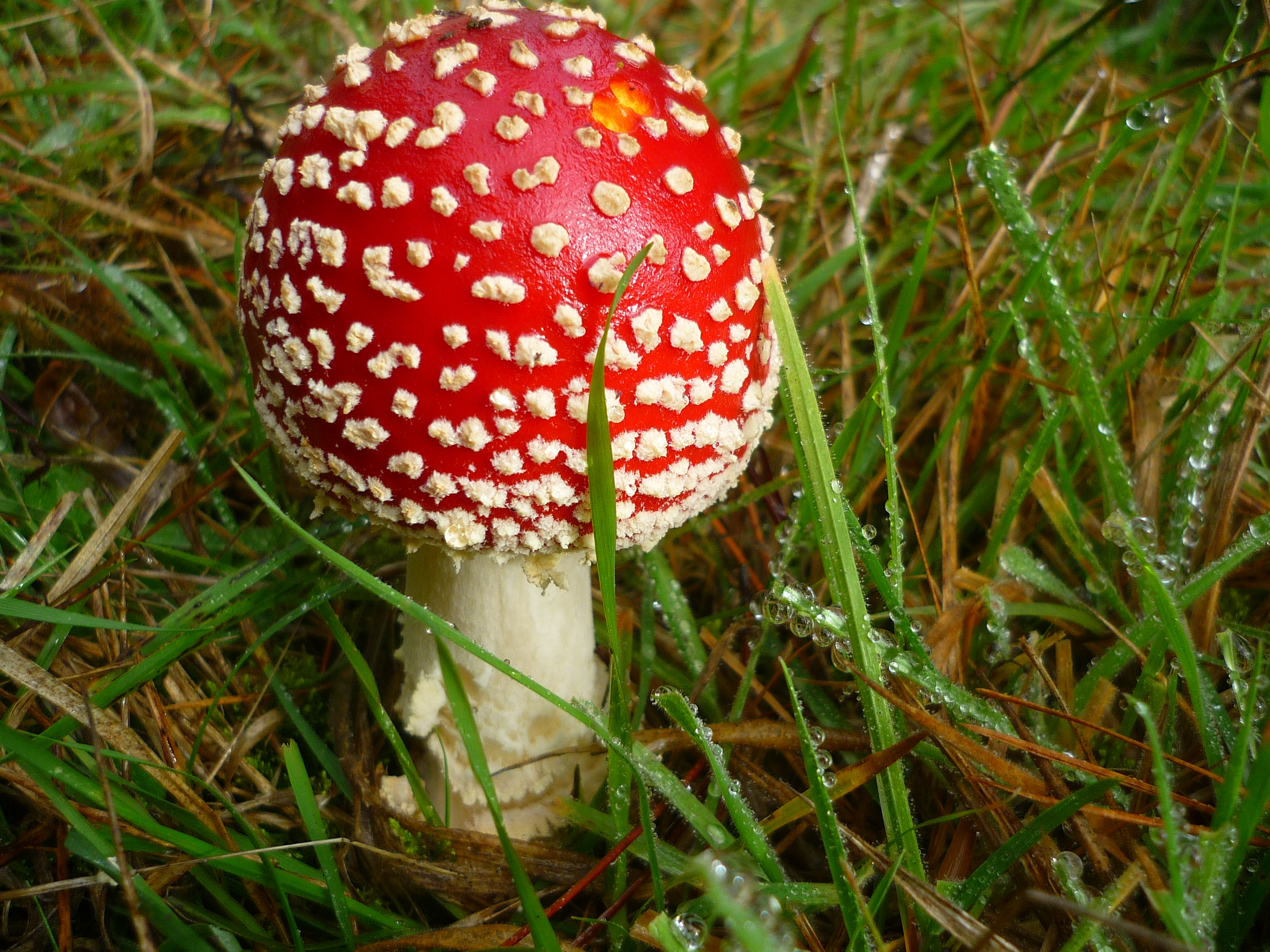
That is our evolution would not have succeeded if early man didn’t become pretty smart at identifying animal behaviours and plants and fruits that had the capacity to harm or even kill. For example, what parent hasn’t made it a priority to teach their children the difference between harmful fungi and edible mushrooms. Indeed to the extent that most of us would think long and hard before eating any fungi found in the wild unless we were 150% certain it was edible. Look at the following picture. Your instinct tells you if it’s safe to eat or not – it’s not!
So early man became over-sensitised to dangers to his health for his own good and continued existence. While modern man functions in ways almost unrecognisable from early man, that good old reptilian brain still is doing it’s best to protect us (flight, fight or freeze). Think how we all respond to a sudden alarming sound, such as a gun shot or a scream, to know that the old reptilian brain is still alive and well.
Thus while all of us hate negativity we all seem to have this fascination with doom and gloom – just in case it helps us and our loved ones survive.
Back to Jon Lavin. He makes it very clear that anything more than a small amount of ‘doom and gloom’ speaking to our consciousness increases the odds of depression and introversion.
Thus the message is that we humans should allow our Neocortex to tell our Reptilian ‘neighbour’ to go easy on the bad news, go and open a beer and watch the world go by! Whoops! Watch the world go by with a smile!
In yesterday’s post about meeting Dhalia, I spoke about a story that was written three years ago. It was the Summer of 2011 and Jean and I had signed up to a Creative Writing course that was being run at our local college in Payson, Arizona where we were then living. This story was a course exercise. While it was published a couple of years ago on Learning from Dogs the fabulous response to the Meet the dogs – Dhalia post yesterday merits it being offered to you, dear reader, for a second time.
The story is fictional. However, the idea for the story was triggered by an event when we were living in Payson, AZ when Dhalia did run off and was lost for a couple of hours, thankfully finding her own way back to the house. Thus while the event did not take place, the location and names of all concerned are real! The photographs are genuine and selected because they seemed so apt for the story, fictional or otherwise. Hope you enjoy!
ooOOoo
Messages from the Night
by
Paul Handover
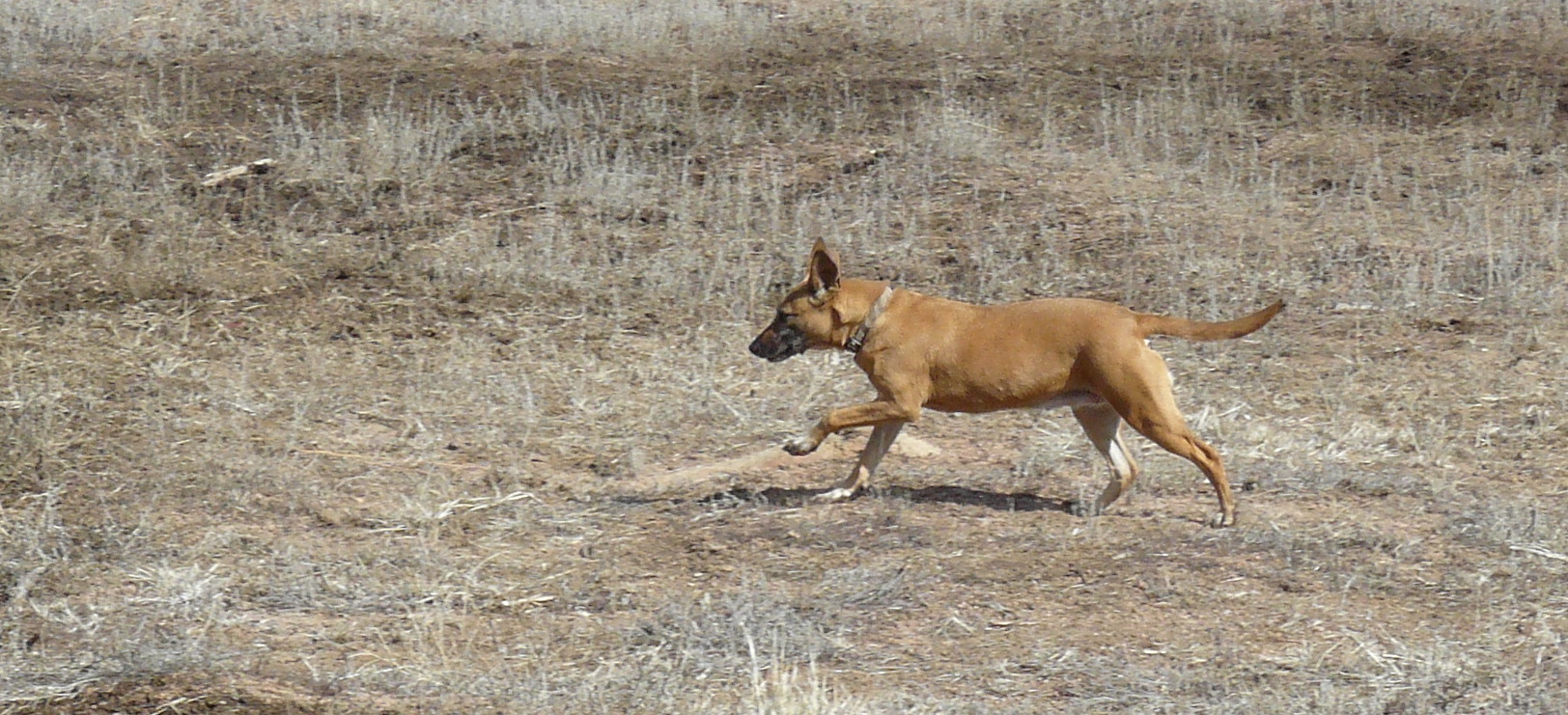
Dhalia heads for the hills!
“Jean, where’s Dhalia?”
“Don’t know. She was here just moments ago.”
“Jeannie, you take the other dogs back to the car and I’ll go and scout around for her. Oh, and you better put Pharaoh on the leash otherwise you know he’ll follow me.”
“Paul, don’t worry, Dhalia’s always chasing scents; bet she beats us back to the car. Especially as it’s going to be dark soon.”
Nonetheless, he started back down the dusty, dirt road, the last rays of the sun pink on the high, tumbled cliffs of granite. This high rocky, forest plateau, known as the Granite Dells, just three miles from their home on the outskirts of Payson, made perfect dog-walking country and rarely did they miss an afternoon out here. However this afternoon, for reasons he was unclear about, they had left home much later than usual.
There was no sign of Dhalia ahead on the road so he struck off left, hoping she was somewhere up amongst the trees and the high boulders. Soon he reached the first crest, panting hard in the thin air. Behind him, across the breath-taking landscape, the setting sun had dipped beneath faraway mountain ridges; a magnificent sight. Suddenly, in the midst of that brief pause admiring this perfect evening, a sound echoed around the cliffs. The sound of a dog barking. He bet his life on that being Dhalia. Just as quickly the barking stopped.
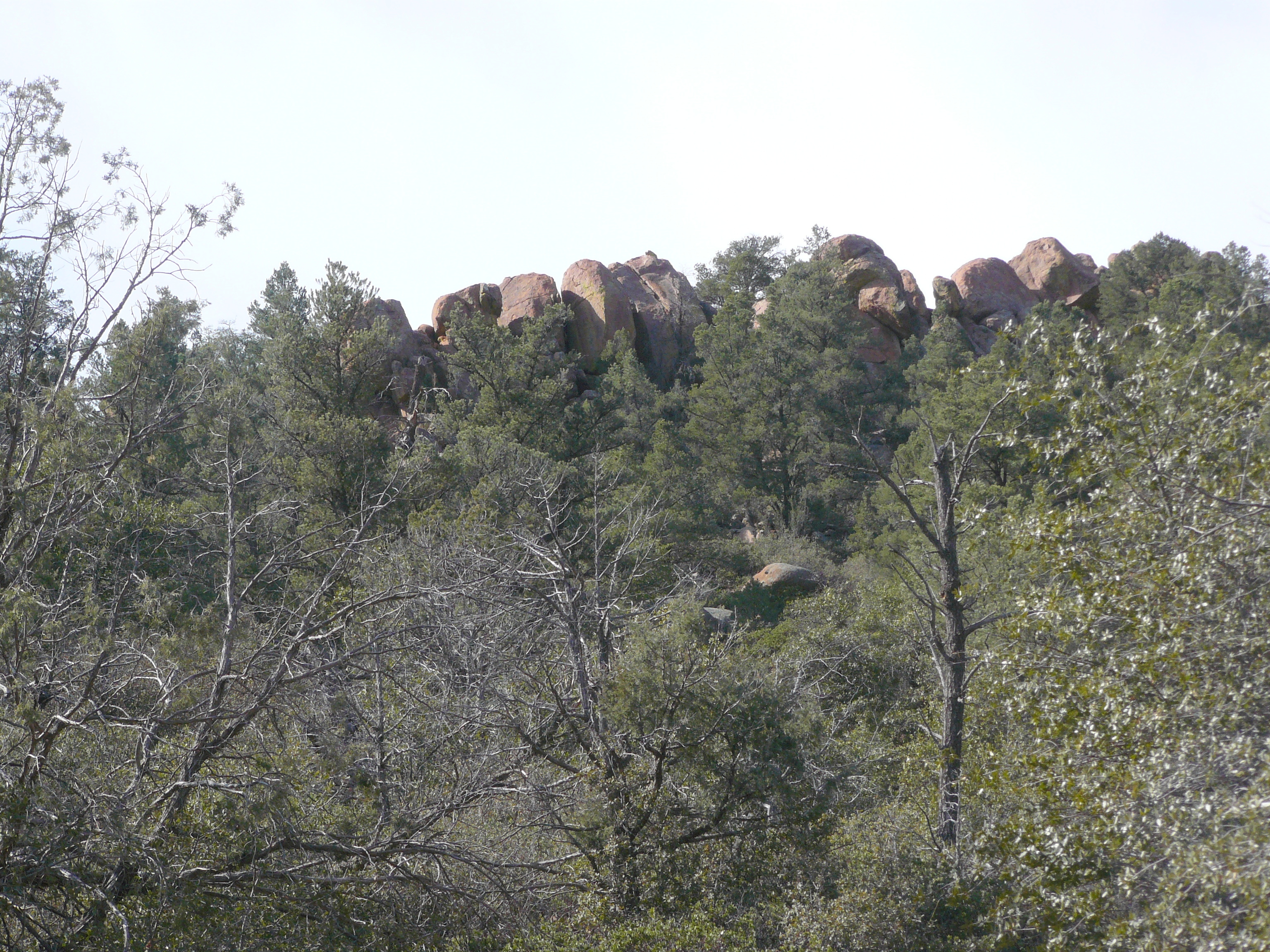
Challenging walking country.
The barking started up again, barking that suggested Dhalia was hunting something. The sound came from an area of boulders way up above the pine trees on the other side of the small valley ahead of him. Perhaps, Dhalia had trapped herself. More likely, he reflected, swept up in the evening scents of the wilderness, Dhalia had temporarily reverted back to the wild, hunting dog she had been all those years ago. That feral Mexican street dog who in 2005 had tentatively turned away from scavenging in a pile of rubbish in a dirty Mexican town and shyly approached Jean. An approach that forever more changed the futures for both the dog and Jean. Jean had named her Dhalia.
He set off down to the valley floor and after fifteen minutes of hard climbing had reached the high boulders on the far side.
He whistled, then called “Dhalia! Dhalia! Come, there’s a good girl.” Thank goodness for such a sweet, obedient dog. He anticipated the sound of dog feet scampering through rough undergrowth. But no sound came.
He listened so intently. There were no sounds, no more barking. Where oh where had she gone? Perhaps past these boulders down in the next steep ravine beyond him, the one so densely forested with pine trees. With daylight practically gone he needed to find Dhalia soon.
He plunged down the slope, through tree branches that whipped across his face, then fell heavily as his foot found empty space instead of the expected firm ground. He cursed, picked himself up and paused. That fall had a message. The madness of continuing this search in the near dark. This terrain made very rough going even in daylight. At night, the boulders and plunging ravines would guarantee a busted body, at best! Plus, he ruefully admitted, he didn’t have a clue about finding his way back to the road from wherever he now was!
The unavoidable truth smacked him full in the face. He would be spending this night alone in the high, open forest. It had one hell of a very scary dimension.
He forced himself not to dwell on just how scary it all felt. He needed to stay busy, find some way of keeping warm; last night at home it had dropped to within a few degrees of freezing. He looked around, seeing a possible solution. He broke a small branch off a nearby mesquite tree and made a crude brush with which he swept up the fallen pine needles he saw everywhere about him. Soon he had a large stack of needles sufficient to cover him, or so he hoped. Thank goodness that when he and Jeannie had decided to give the four dogs this late afternoon walk, he was wearing jeans and a long-sleeved shirt, a pullover thrown over his shoulders. Didn’t make Dhalia’s antics any less frustrating but he probably wasn’t going to freeze to death!
He lay down, shuffled about, swept the pine needles across his body, tried to find a position that carried some illusion of comfort. The air temperature was sinking as if connected to those last rays of the sun. His confidence was sinking in harmony with the temperature. The isolation and loneliness of his predicament was enveloping him like some evil, dark cloud.
No matter the physical position that he adopted with his body, he couldn’t silence his mind. He couldn’t silence the screaming in his head; his deep, primeval fear of this dark forest about him, imagination already running away with visions of hostile night creatures, large and small, watching him, smelling him, biding their time. Perhaps he might sleep for a while and give his imagination a rest? A moment later he was struck by the absurdity of that last thought. Caused him to utter aloud, “You stupid old fool. There’s no way you’re going to sleep through this!” His words echoed back from unseen cliffs nearby in the darkness reinforcing his sense of isolation.
He was very frightened. Why so? Where in his psyche did that come from? He had spent many nights alone at sea without a problem; solo sailing a thousand miles from shore. But, of course, then he knew his location, always had a radio link to the outside world. Being lost in this dark, lonely forest touched something very deep in him. He started shivering.
The slightest movement caused the needles to slip from him and the cold night air began to penetrate his body. He mused about how cold it might get and, by extension, thanked his lucky stars that the night was early October not, say, mid-December. So far, not too cold. But soon it was the fear rather than the temperature that started to devour him. What stupid fool said, ‘Nothing to fear but fear itself!’ His plan to sleep under pine needles, fear or no fear, had failed; he couldn’t get warm. He had to move.
He looked around, faintly saw a boulder a few yards away, like some giant, black shadow. No details, just this huge outline etched against the night. He carefully raised himself, felt the remaining needles fall away from him, and gingerly shuffled across to the dark rock. He half-expected something to bite his extended hand as he explored the surface, ran his fingers down towards the unseen ground. Miracle of miracles, the granite gently emitted the warmth absorbed from the day’s sun. He slowly settled himself to the ground, eased his back against the rock-face, pulled his knees up to his chest and wrapped his arms around his legs. He felt a great deal less vulnerable than he had when laying on the forest floor and let out a long sigh. Moments later he burst into tears, huge heart-rending sobs coming from deep within him.
Gradually the tears washed away his fear, restored a calmer part of his brain. That calmer brain brought him the realisation that he hadn’t considered, well not up until now, what Jeannie must be going through. At least he knew he was alive. Jeannie, not knowing, would be in despair. He bet she would remember that time when out walking here in this area of the Granite Dells they had lost little Poppy, her adorable 10 lb poodle mix, never to be found again despite ages spent combing the area, calling out her name. A year later and Jeannie still said from time to time, “I so miss Poppy!”. First Poppy and now him! No question, he had to get through this in one piece, mentally as much as physically. Presumably, Jeannie would have called 911 and been connected to the local search and rescue unit. Would they search for him in the dark? He thought that unlikely.
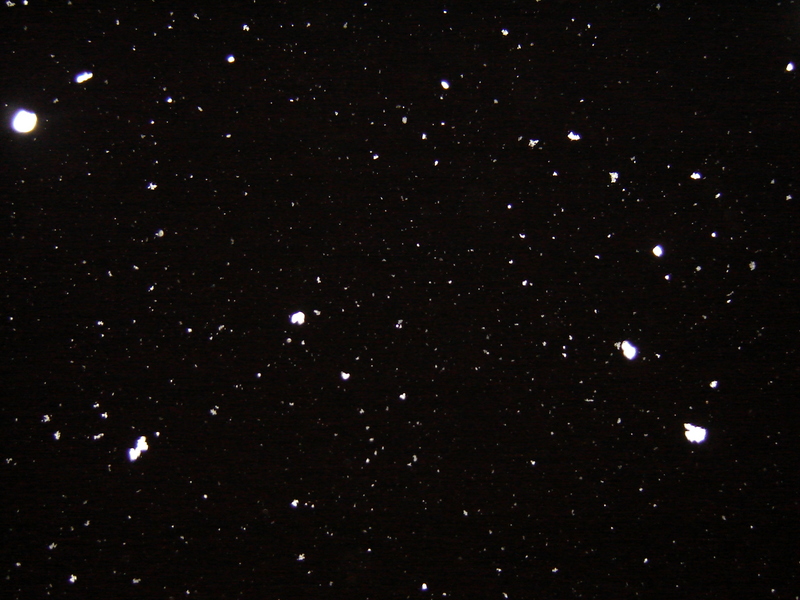
Thinking about Jean further eased his state of mind and at last his shivering stopped. Thank goodness for that! He fought to retain this new perspective. He would make it through, even treasure this night under the sky. This wonderful, awesome, night sky. Even the many crowns of the majestic pine trees that soared way up above him couldn’t mask a sky that just glittered with starlight. The Granite Dells, just outside Payson, were at an elevation of 5,000 feet and, frequently, had beautifully clear skies. Tonight offered a magical example of that.
A heavenly clock.
Often during his life the night skies had spoken to him, presented him with a reminder of the continuum of the universe. On this night, however, he felt more humbled by the hundred, million stars surrounding him than he could ever previously recall.
Time slipped by, his wrist-watch unread in the darkness. Above his head, however, was that vast stellar clock. He scanned the heavens, seeking out familiar pinpoints of light, companions over so much of his lifetime. Ah, yes! There was the Big Dipper; Ursa Major to give the constellation its formal name, and there the Big Dipper pointing the way to Polaris, the star that was so closely aligned to North Pole. Great! Now the rotation of the planet became his watch, the Big Dipper circling around Polaris, fifteen degrees for each hour.
What a situation he had got himself into. As with other challenging times in his life, lost in the Australian bush, at sea hunkering down through a severe storm, there was never a choice other than to work it out. He felt a gush of warm emotions that flowed from this changed perspective.
Far away, a group of coyotes started up a howl. What a timeless sound. How long had coyotes been on the planet? He sank into those inner places of his mind noting how the intense darkness raised such deep thoughts. What if this night heralded the end of his life, the last few hours of the life of Paul Handover? What parting message would he give to those that he loved?
Jeannie would know beyond any doubt how much he had adored her, how her love had created an emotional paradise for him beyond measure. Then his son and daughter, dear Alex and Maija. Oh, the complexities he had created in their lives by leaving their mother so many years ago. He knew that they still harboured raw edges, and quite reasonably so. He still possessed raw edges from his father’s death, way back in 1956. That sudden death, five days before Christmas, so soon after he had turned 12, that had fed a life-long feeling of emotional rejection. That feeling that had lasted for 51 years until, coincidentally, also five days before Christmas, he had met Jean in 2007.
His thoughts returned to Alex and Maija. Did they know, without a scintilla of doubt, that he loved them. Maybe his thoughts would find them. Romantic nonsense? Who knows! Dogs had the ability to read the minds of humans, often from far out of visual range. He knew Pharaoh, his devoted German Shepherd, skilfully read his mind.
He struggled to remember that saying from James Thurber. What was it now? Something about men striving to understand themselves before they die. Would that be his parting message for Alex and Maija? Blast, he wished he could remember stuff more clearly these days and let go of worrying about the quote. Perhaps his subconscious might carry the memory back to him.
He looked back up into the heavens. The Big Dipper indicated at least an hour had slipped by. Gracious, what a night sky in which to lose one’s mind. Lost in that great cathedral of stars. Then, as if through some stirring of his consciousness, that Thurber saying did come back to him: All men should strive to learn before they die, what they are running from, and to, and why. As last words they would most certainly do for Alex and Maija!
He reflected on those who, incarcerated in solitary confinement, had their minds play many tricks, especially when it came to gauging time. What a bizarre oddment of information to pop up in his head! Where had that come from? Possibly because he hadn’t a clue about his present time. It felt later than 11pm and earlier than 4am, but any closer guess seemed impossible. Nevertheless, from out of these terrible, heart-wrenching hours of being alone he found his calm, a calm that had gently arisen from within. He slept.
Suddenly, a sound slammed him awake. Something had made a sound. Something out there in the dark had made a sound fairly close to him. Now his whole body was totally alert, every nerve straining to identify what might be out there, so close to him. It sounded like animal feet moving through the autumn fall of dead leaves. He prayed it wasn’t a mountain lion. Surely such a wild cat preparing to attack him would be silent. Now the unknown creature had definitely paused, no sound, just him knowing that out there something waited. Now what? The creature had started sniffing. He hoped it was not a wild pig. Javelinas, those pig-like creatures that always moved in groups, could make trouble. He knew they had no qualms at attacking a decent-sized dog and crouched down like this he didn’t offer a much larger target.
Should he get to his feet and run? Almost immediately he answered his own question. In the dark and in this terrain he would harm himself within seconds and that would make him an attractive meal for any meat-eating animal out there. No, he chose to stay still. Feeling the ground around him he closed his right-hand around a small rock. The sniffing stopped. Nothing now, save the sound of his rapid, beating heart. He sensed, sensed strongly, the creature looking directly at him. It seemed very close; perhaps ten or twenty feet away. The adrenalin hammered through his veins.
He tried to focus on the spot where he sensed that the animal waited trying not to think what it might be waiting for. He pushed that line of thought straight out of his head. His ears then picked up a weird, bizarre sound. A flap, flap sound against something like the trunk of a small tree. Surely not! Had he lost his senses? It sounded like a dog wagging its tail. A dog’s tail flap, flap, flapping against a tree-trunk. If it was a dog, it just had to be Dhalia!
Then came that small, shy bark! A bark that he knew so well. Unbelievably, it was Dhalia. He softly called, “Dhalia, Dhalia, come here, there’s a good girl.”
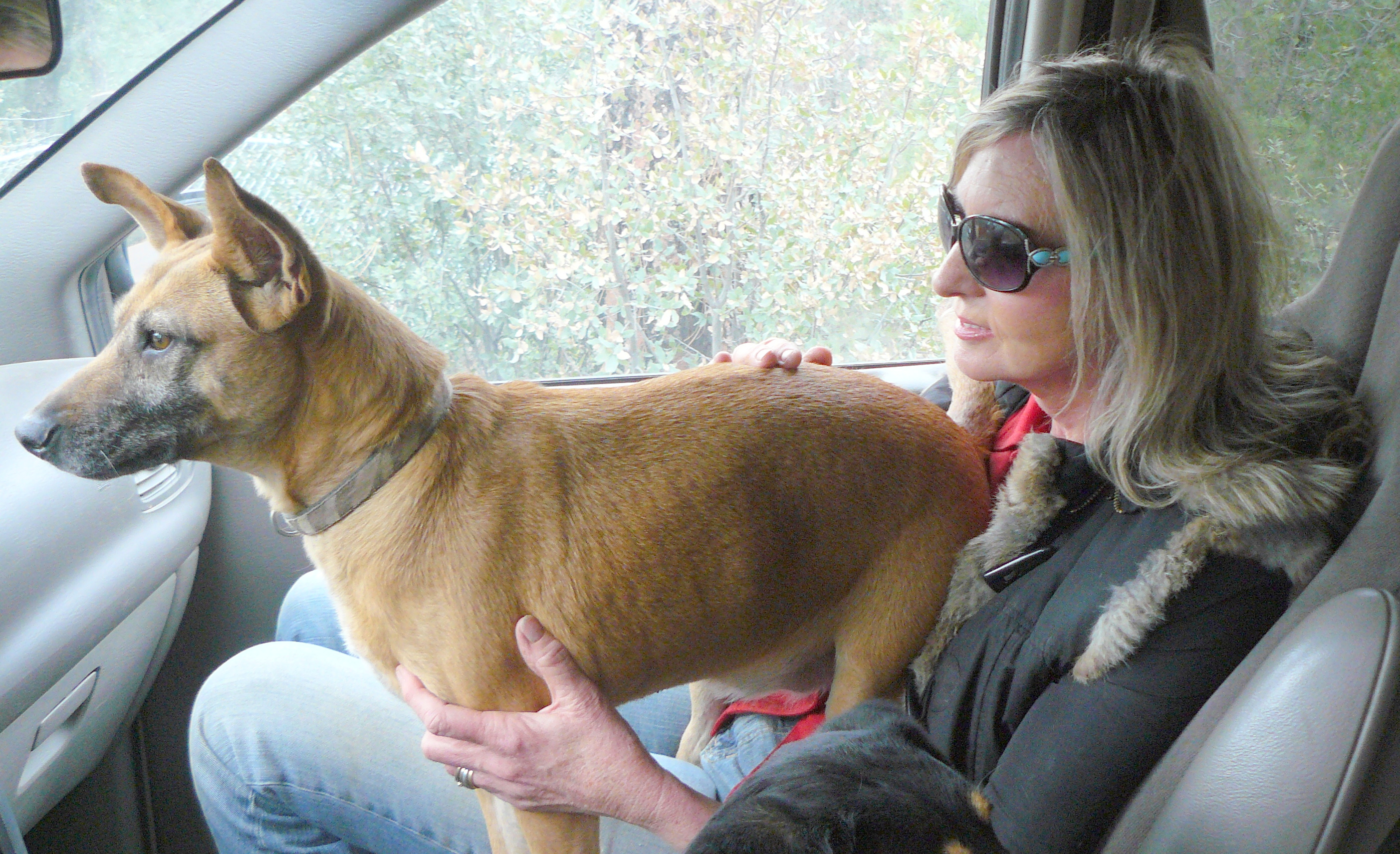
With a quick rustle of feet Dhalia leapt upon him, her tail wagging furiously, her head quickly burrowing into his body warmth. He hugged her and, once more, tears streamed down his face. Despite the darkness, he could see her perfectly in his mind. Her tight, short-haired coat of light-brown hair, her aquiline face, her bright inquisitive eyes and those wonderful head-dominating ears. Lovely large ears that seemed to listen to the world. A shy, loving dog when Jean had rescued her in 2005 and all these years later still a shy, loving dog.
Dhalia licked his tears, her gentle tongue soft and sweet on his skin. He shuffled more onto his back which allowed her to curl up against his chest, still enveloped by his arms. His mind drifted away to an era immensely long ago. Back to an earlier ancient man, likewise wrapped around his dog under a dome of stars, likewise bonded in a thousand mysterious ways. He was unaware of slipping into a deep sleep.
The morning sun arrived as imperceptibly as an angel’s sigh. Dhalia sensed the dawn before Paul, bringing him out of his dreams by the slight stirring of her warm, gentle body.
Yes, there it came, the end of this night. That sun, ancient beyond imagination, galloping towards them across the desert lands; another beat of the planet’s heart. Dhalia slid off his chest, stretched herself from nose to tail, yawned and looked at him, as much to say it’s time to go home! He could just make out the face of his watch: 4.55am. He, too, raised himself, slapped his arms around his body to get some circulation going. The cold air stung his face, yet it couldn’t even scratch the inner warmth of his body, the gift from the loving embrace that he and Dhalia had shared.
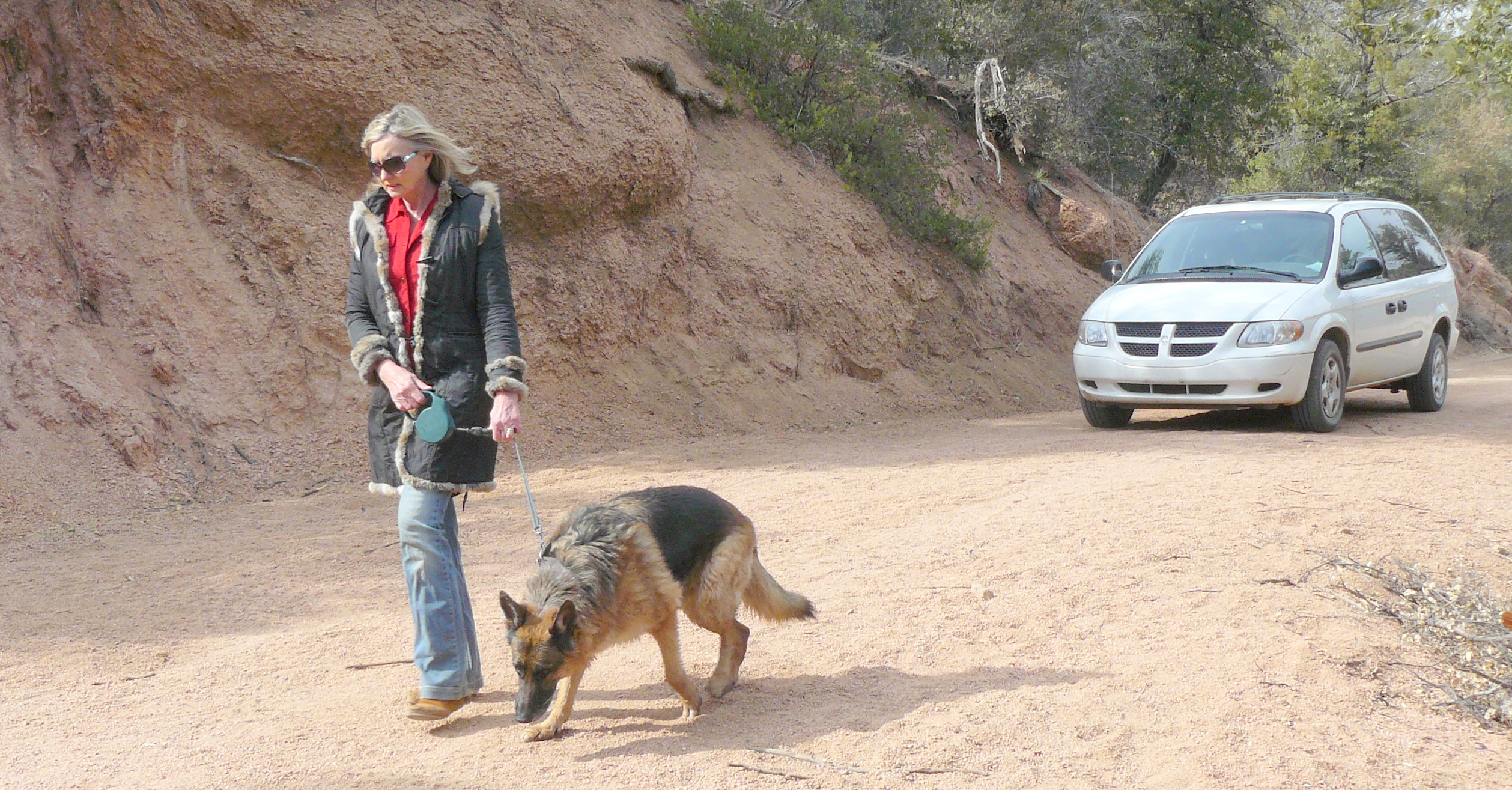
They set off and quickly crested the first ridge. Ahead, about a mile away, they saw the forest road busy with arriving search and rescue trucks. Paul noticed Jean’s Dodge parked ahead of the trucks and instinctively knew she and Pharaoh had already disappeared into the forest; undoubtedly Pharaoh sensing the way to them.
Pharaoh and Jean heading up the search.
They set off down the slope, Dhalia’s tail wagging with unbounded excitement, Paul ready to start shouting for attention from the next ridge. They were about to scrabble across a small, dry creek-bed when, across from them, Pharaoh raced out of the trees. He raced up to them, barking at the top of his voice in clear dog speak, ‘I’ve found them, I’ve found them, they’re safe, they’re safe’. Paul crouched down to receive his second huge face lick in less than six hours.
Later, when safely home, it came to him. When they had set off in that early morning light to return back to civilisation, Dhalia had stayed utterly pinned to him. It was so out-of-character for her not to run off ahead. Let’s face it, that’s what got them into the mess in the first place. What came to him was that Dhalia had known that during that long, dark night, it had been he who had been the lost soul.
The message from the night, as clear as the rays of the new day’s sun, the message to pass to all those he loved. If you don’t get lost, there’s a chance you may never be found.
Whenever someone signs up to follow Learning from Dogs, it seems right and proper for me to thank them directly. In the majority of cases these new subscribers have their own blog site and I go across to that site and leave a thank you message. Almost without exception, I include an invite for that new follower to consider writing a guest post for me.
That’s how the following story came about. Mrs. G., who has the blog site Love Me, Trust Me, Kill Me contacted me and offered a guest post. If that wasn’t sufficiently special Mrs. G. is a teenager with a talent for writing beautiful prose and poetry. Thus the link is not only across the ‘blogosphere’ but across more than fifty years of age difference. I find that deeply humbling.
So without further ado, here is the short but very beautiful post.
ooOOoo
Man’s best friend.
“A dog is a man’s best friend”.
For me, this phrase represents the incontestable truth. I say this for I, too, have one of those wonderful creatures called dogs and I know how much love and comfort they offer. I treat my dog as I would treat a human because, in a way, they are like us just without the complicated emotions and insecurities. To know that there is someone who loves you unconditionally, someone who will never betray you as a human would, someone who will always be there for you when you need them the most, helping you, protecting you, is an indescribable and heartwarming feeling.
They are intelligent, loving, protective and they were, are and will be our companions for a very long time. We must love and protect them just like they love and protect us; unconditionally. If you hurt a dog it will still love you, no matter what. We can learn many things from them, things like loyalty and affection, what it means to care for someone, and they take away the feeling of loneliness. Dogs do not need to learn anything from us, we need to learn from them and they need to teach us how to be better persons.
I see my dog as my friend, I see him as a family member, and I love him with all my heart. I know that one day he will be gone and I’m afraid. I cry when I think about it, but that’s the way it is. Just like humans, dogs are born, they live, they die, and we must treasure them, love them, protect them and learn from them while we still can, because one day dogs may be gone forever.
Kind regards, Georgiana
ooOOoo
Georgiana’s dog is called Shony and she shares it with her sister. You may see the loving animal here.
I’m sure that you, as with me, was greatly moved by Georgiana’s feelings for Shony so beautifully expressed in her words. Further writings from Mrs. G. would be wonderful.
Closing off today’s post was difficult. There are a number of videos on YouTube showing dogs loving people but, in the end, I couldn’t resist a video that was first published on Learning from Dogs last March. It was included in a post called All it takes is love.
Not only is it a beautiful video of a dog loving a cat, the musical backing track is gorgeous – there will be tears, I guarantee you!
Last week was the start of a series of posts giving you, dear reader, background on each of our nine dogs. Thus last week, Jean wrote about Paloma. Here is Jean’s account of how Lilly came into her life.
ooOOoo
Lilly
Lilly – Taken 26th January, 2014
Lilly came into my life fourteen years ago. I had taken my car into the mechanics workshop in San Carlos, Mexico for an oil change and was beckoned over to an old junk car in their lot. It had no glass in the windows and in the hatch-back area lay a smallish dog with five young, suckling puppies. She had apparently walked in off the street and chosen the old airy car as a suitable ‘house’ in which to have her babies. The workers had supplied her with an old greasy towel for a mattress.
My girlfriend, Suze, and I immediately set about making her comfortable with a small quilt and plenty of water and good dog food. She had been dining on tacos and tamales scraps up until then.
Suze and I visited frequently and took plenty of food and at the same time went about looking for homes for the pups. However, one day we arrived and found all the beautiful babies gone. The mechanics had given them away. We were shattered and could only hope that they had gone to loving homes.
‘Rabbit’, as she was then called, continued hanging around the workshop and the men seemed to like her. Rabbit had this trick of leaping on her hind legs, twirling and landing on her four legs; hence her name Rabbit, I guess.
Suze and I would see her once a week on average and had also arranged for Rabbit to be spayed. All seemed well until Easter came (I think we are talking of the year 2000). As is common in Mexico, during Easter week in San Carlos everything shuts down. It’s carnival time. The streets are busy with tourists and there is much traffic. I was worried about Rabbit as the mechanic’s shop was locked up tight and Rabbit was outside in the lot by the street. I planned to take her home for the rest of the holiday but fate intervened. On my way to collect her, I was aghast to see her motionless by the side of the road, obviously having been hit by a car. I gently picked her up and took her home. On inspection, it was clear that she had two broken legs on her right-hand side. Her injuries were so bad that I knew the local vet did not have the skills or instruments to heal her. My late husband, Ben, and I ended up driving her two hours South to Obregon where there was an orthopaedic vet. He put pins in both legs and she stoically set about mending herself. Rabbit became Lilly. Irrespective of name, she was an assertive but sweet young dog and settled in nicely with my burgeoning pack; I had twelve rescue dogs in those days. Her legs healed nicely and she resumed her twirling.
Lilly became a particular favourite of Ben, my late husband. When in 2005 Ben lay dying at home, Lilly slept non-stop by his side on the bed, only leaving to eat or go outside. I knew for sure that Ben had died in the night when one morning I awoke to feel Lilly beside me on my bed. Lilly sensed that now I needed her more.
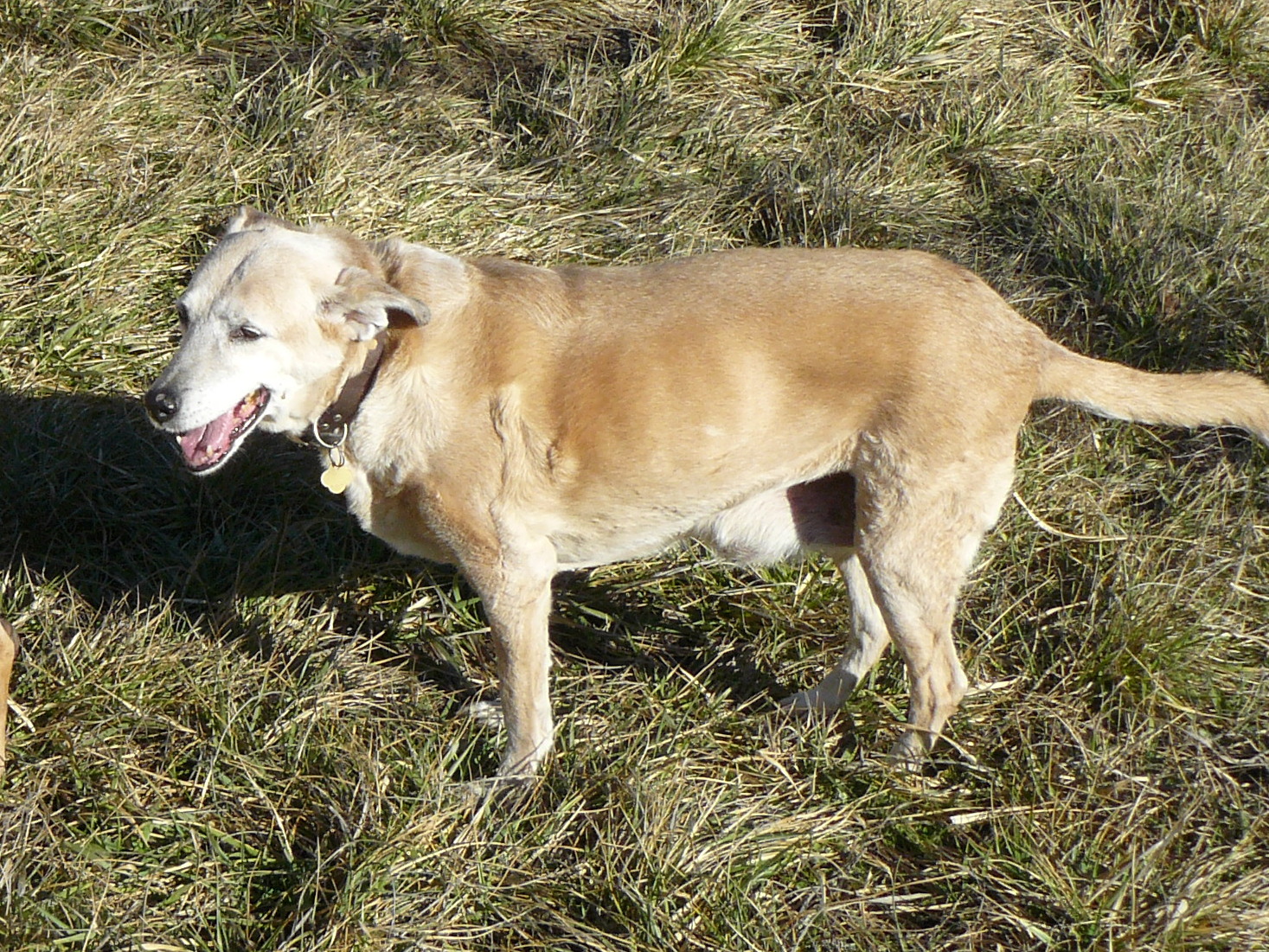
Lilly is still with us. Now a dowager old lady of at least fifteen years of age, she still enjoys going out with her buddies whom she tends to boss somewhat. (Paul thinks that Lilly is an ‘alpha’ dog, in other words has pack leadership in her genes.) But one thing that Lilly doesn’t now do; she doesn’t twirl anymore, but then neither do I.
It will be a very sad day when Paul and I have to say goodbye to this treasure of a dog. In the meantime we endeavour to make each day that she has left as rich as possible.
Another very recent photograph of Lilly.
ooOOoo
Next week another story about another member of our family.
Yet another wonderful opportunity to chuckle at the world.
Sent to me by dear Cynthia Gomez.
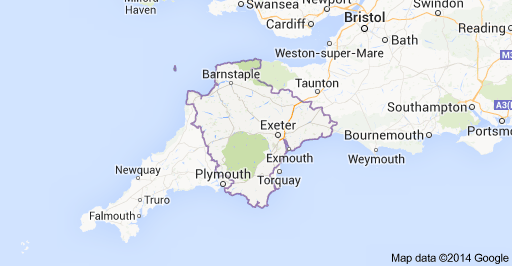
This wonderful collection of sayings from America’s ‘South’ reminded me of the incredibly rich local accents that one experienced all over Britain. Despite being born a Londoner, I spent many of the years before switching home countries from England to America living in the County of Devon in the South-West of England. Here are two images to show those unfamiliar with England where I was living.
County of Devon. Cornwall to the West. Somerset to the East.
oooo
Home used to be in the village of Harberton, 3 miles South-West of Totnes.
Thus anyone born and bred in this part of Devon frequently had a strong South Devon accent. My brother-in-law, John, used to chat to some old Devon fella’s in the local pubs that had accents impossible to understand by such newcomers as me.
So with no further ado, enjoy the following.
ooOOoo
Florida
A Florida senior citizen drove his brand new Corvette convertible out of the dealership. Taking off down the road, he pushed it to 80 mph, enjoying the wind blowing through what little hair he had left. “Amazing,” he thought as he flew down I-95, pushing the pedal even more.
Looking in his rear view mirror, he saw a Florida State Trooper, blue lights flashing and siren blaring. He floored it to 100 mph, then 110, then 120. Suddenly he thought, “What am I doing? I’m too old for this!” and pulled over to await the trooper’s arrival.
Pulling in behind him, the trooper got out of his vehicle and walked up to the Corvette. He looked at his watch, then said, “Sir, my shift ends in 30 minutes. Today is Friday. If you can give me a new reason for speeding — a reason I’ve never before heard — I’ll let you go.
“The old gentleman paused then said: “Three years ago, my wife ran off with a Florida State Trooper. I thought you were bringing her back.
“Have a good day, Sir,” replied the trooper.
Georgia
The owner of a golf course in Georgia was confused about paying an invoice, so he decided to ask his secretary for some mathematical help.
He called her into his office and said, “Y’all graduated from the University of Georgia and I need some help. If I wuz to give yew $20,000, minus 14%, how much would you take off?”
The secretary thought a moment, and then replied, “Everthang but my earrings.”
Louisiana
A senior citizen in Louisiana was overheard saying … “When the end of the world comes, I hope to be in Louisiana .”When asked why, he replied, “I’d rather be in Louisiana ’cause everythang happens in Louisiana 20 years later than in the rest of the world.”
Mississippi
The young man from Mississippi came running into the store and said to his buddy, “Bubba, somebody just stole your pickup truck from the parking lot!”
Bubba replied, “Did y’all see who it was?”
The young man answered, “I couldn’t tell, but I got the license number.”
North Carolina
A man in North Carolina had a flat tire, pulled off on the side of the road, and proceeded to put a bouquet of flowers in front of the car and one behind it. Then he got back in the car to wait.
A passerby studied the scene as he drove by, and was so curious he turned around and went back. He asked the fellow what the problem was.
The man replied, “I got a flat tahr.”
The passerby asked, “But what’s with the flowers?”
The man responded, “When you break down they tell you to put flares in the front and flares in the back. I never did understand it neither.”
Tennessee
A Tennessee State trooper pulled over a pickup on I-65. The trooper asked, “Got any ID?”
The driver replied, “Bout whut?”
Texas
The Sheriff pulled up next to the guy unloading garbage out of his pick-up into the ditch. The Sheriff asked, “Why are you dumping garbage in the ditch? Don’t you see that sign right over your head.”
“Yep,” he replied. “That’s why I’m dumpin’ it here, ’cause it says: ‘Fine For Dumping Garbage.’
ooo
“Y’all kin say whut y’all want ’bout the South, but y’all never heard o’ nobody retirin’ an’ movin’ North.
How something so fundamental as humans talking with each other can so often be mysterious.
When I composed this sub-heading, I wasn’t sure of what word to use to end the sentence. Some of the words that sped through my mind were: complex, distorted, difficult, obtuse and …. well, you get the message.
“The single biggest problem in communication is the illusion that it has taken place.” George Bernard Shaw is reputed to have once said!
Today’s essay on the challenges of speaking clearly to another, perhaps better described as communicating in a clear and unambiguous fashion, came out of a recent conversation with Jon Lavin, a good friend from my Devon days. (Jon offers services for business owners and entrepreneurs under his business banner of The People Workshop.)
Jon was explaining that the number one hurdle for businesses that are managing change, and for so many businesses managing change is practically a constant, is having clear communications within the team.
Seems clear enough to me! 😉
Yet, what we hear and what we say are both modified, frequently unconsciously, by past events, experiences and trauma. That being the case, then it is key, critically so, that we achieve the best possible self-awareness. Because it is only through an understanding of our past that we come to learn of our sensitivities and our associated ‘tender spots’ and their potential for ‘pulling our strings’. Here’s a personal story.
In 1956, when I was 12, I experienced a trauma that was interpreted by my consciousness as emotional rejection. By the age of 14 that sensitivity to rejection had descended into my subconscious. For fifty years, that sensitivity remained hidden yet continued to influence my life in many unseen ways, not all of them negatively by a long measure. In 2007 a period of counselling revealed that hidden emotional rejection; brought it to the surface. It changed beyond imagination how I felt, how I behaved, how I was. Nonetheless, that sensitivity to rejection is still there, albeit now visible. Thus when I hear or experience something that tickles that sensitivity I still react. But because I can now see and feel myself reacting, I can sidestep the emotional strings.
The following is a short, twenty-minute, documentary film about fear. Do watch it. The message that we are so profoundly a product of our past is beautifully presented.
Can ecologism be regarded as an ideology in its own right? (Part 3)
Therefore, having now surveyed all the relevant “territory”, we shall now consider the third and final part of the answer to the question as proposed in the Introduction.
Ecologism – Neither left nor right, but out in front?
According to Philip Shabecoff, it was members of the European Green parties that were the first to assert that they are “neither left nor right but out in front” (2000: 109).
For this to be true, ecologism would have to represent a new paradigm that rejects (or at least challenges) beliefs central to conventional politics (of any orientation). This, it is here argued, is indeed the case: In a discussion of the libertarian ideas of John Locke and Adam Smith, William Ophuls observed that they “…have not gone unchallenged, but with very few exceptions, liberals, conservatives, socialists, communists, and other modern ideologies have taken abundance for granted and assumed the necessity of further growth” (Ophuls 1977: 145).
What is the problem with modernity?
As suggested by Anthony Giddens, modernity encompasses “…modes of social life or organisation which emerged in Europe from about the seventeenth century onwards and which subsequently became more or less worldwide in their influence” (Giddens 1991: 1).
The problem is that the accumulation of personal wealth has become the sole objective of many people in modern society; and perpetual growth is posited as a means whereby even the poorest might achieve it.
Karl Marx (as cited by Jon Elster) coined the term “money fetishism” to describe the belief that money (and/or precious metals) have intrinsic (use) value rather than just instrumental (exchange) value, which Marx felt was as misguided as the religious practice of endowing inanimate objects with supernatural powers (Elster 1986: 56-7).
However, whereas Karl Marx saw capitalism as the problem, the ideology that he gave his name to is just as guilty of Daly’s “growthmania”. For example, whereas Jack Goody accepts that capitalism has been “…connected with the growth of rationality and of secularisation; more recently with urbanisation and industrialisation”, he also notes that for Marxist regimes “…modern meant industrialisation without capitalism” (Goody 2004: 6).
The terms “use value” and “exchange value” were first put forward by Aristotle (384-322 BC) who, according to Daly, also recognised the danger of focusing on the latter (i.e. whereby the accumulation of wealth becomes an end in itself) and, alluding to Marx’s criticism, Daly suggested that the paperless economy (where no useable commodities actually change hands) is the logical end-point for money fetishism (Daly 1992: 186).
Finally, on the subject of the consequences of “the problem”, although the centrally-planned economies of the former USSR and China would appear to have had their day, the flaws of the capitalist system they seem so keen to embrace have also revealed themselves in recent time. For example, when John Gray came to write the introduction to the second edition of his book “False Dawn: The Delusions of Modern Capitalism”, he included the following comment:
In the first edition of this book, published in March 1998, I wrote: ‘Today’s regime of global laissez-faire will be briefer than even the belle époque of 1870 to 1914, which ended in the trenches of the first world war’… Not much more than a decade ago this seemed outlandish, but there have since been many signs that global capitalism was heading for a fall (Gray 2009: xii).
Does ecologism provide the answers?
The starting point for ecologism is the concept of carrying capacity (the maximum population of a species) that an ecosystem can support in perpetuity (Dryzek 2005: 27). In this instance, the species is Homo sapiens and the ecosystem is the planet Earth. Therefore, in 1968, Hardin suggested that these limits exist and must be faced. In 1993, frustrated by the absence of discussion on population growth in international politics, he pointed out that:
Two centuries of intermittent wrestling with population problems have produced useful insights about the reality and nature of limits… Four centuries of sedation by the delusion of limitlessness have left humanity floundering in a wilderness of rhetoric… From this it must be inferred that someday political conservatism will once again be defined as contented living within limits. The limitless world view will have to be abandoned (Hardin 1993: 5-6).
In 1968, his solution had been “...mutual coercion, mutually agreed upon by the majority of the people affected” (Hardin 1968: 1247). However, in an apparent reference to the work of an array of scholars including Malthus, Hardin, Meadows, Ehrlich and others, Daly lamented that:
Anyone who asserts the existence of limits is soon presented with a whole litany of things that someone once said could never be done but subsequently were done… Continuing to study economies only in terms of the [exchange value of money] is like studying organisms only in terms of the circulatory system, without ever mentioning the digestive tract. (Daly 1992: 185-186).
Much more recently, Daly has reminded us that, “Ecological limits are rapidly converting ‘economic growth’ into ‘uneconomic growth’-that is throughput growth that increases costs by more than it increases benefits, thus making us poorer not richer” (Daly 2007: 39).
So, it would seem that the challenge of living “within our planet’s means” remains significant; one that few politicians are willing to discuss (because there are no votes to be gained in doing so). It is this fact that the environment cannot speak for itself (i.e. it is disenfranchised) that led Goodin to the conclusion that “nature has interests… as deserving of protection as anyone else’s, which must be ‘encapsulated’ as part of a discursive participatory democracy” (Goodin 1996: 835).
Similarly, whereas Goodin used the term “encapsulated interests” (to describe how one party’s interests are incorporated in those of another), Dobson suggested that non-human animals and future generations of humans (and maybe even other species) are “new environmental constituencies” requiring human representatives to look after their interests (Dobson 1996: 125).
All that needs to be decided is who we shall admit into the “community of justice” (i.e. how radical you want to be).
Citing Low and Gleeson (1998) and Baxter (1999), Derek Bell therefore distinguishes environmental and ecological justice as follows: Environmental justice concerns the distribution of environmental benefits and burdens among human beings. Whereas ecological justice is concerned with justice between human beings and the rest of the natural world (Bell 2006: 208). Furthermore, Bell also spells out the importance of this distinction (just in case any reader has not appreciated it yet) as follows:
Advocates of environmental justice merely insist that the instrumental value of the environment to humans should be recognised in a theory of social justice or justice among humans. Ecological justice makes the much more radical claim that justice extends beyond relations among humans so that we can talk about ‘justice to nature’ (Bell 2006: 208).
Conclusions
The question that has been addressed herein is whether or not ecologism can or should be regarded as a political ideology in its own right given that both socialists and conservatives can lay claim to some aspects of ecological politics.
In order to provide a defensible answer to this question, it was necessary to define what is meant by ecological politics (i.e. the pursuit of policies that are concerned with the environment; but which are not merely or predominantly anthropocentric) and ecologism (i.e. the pursuit of environmental policies that are biocentric or ecocentric). This therefore highlighted the fact that the two are not the same thing; and that ecological politics also includes anthropocentric environmentalism.
However, it has been demonstrated that, rather than being a simple dividing line within the field of ecological politics, anthropocentrism and ecocentrism represent opposite ends of a spectrum along which it is possible to adopt a variety of philosophical positions. Furthermore, although it has also been demonstrated that it is very difficult to be entirely one thing or the other, when faced with difficult policy decisions, almost everyone (both socialists and conservatives included), tends to favour self-preservation. Therefore, the default position of all humans tends to be towards the anthropocentric end of the spectrum.
Nevertheless, to avoid the tautological response to the question (“ecologism must be regarded as a distinctive political ideology in its own right because it is!”), it was deemed necessary to demonstrate how and why both socialists and conservatives can lay claim to ecological politics (although the majority of both socialists and conservatives do not do so) and, therefore, how and why the ecologism that both find so challenging must be regarded as a political ideology in its own right.
In so doing, it has been shown that some socialists find common cause with those that seek equal rights for the environment; whereas some conservatives may do so in pursuit of maintaining the status quo. However, both generally assume the necessity of further growth (Ophuls); what Daly called ‘growthmania’. Furthermore, capitalism is fixated upon the inherent value of things we may consume; whereas Marxism (an extreme form of socialism) is fixated upon the inherent value of things we may produce. However, ecologism insists that nature has inherent – if not intrinsic – value in and of itself; independent of our finding a use for it.
Ecologically-minded scientists and economists have pointed out that the Earth is finite and its capacity to accommodate humans is finite; whereas the evidence of at least the last 40 years is that many prefer to refuse to accept this reality and, as Schumacher pointed out, are spending environmental capital as if it were income. Therefore, because ecologism demands justice that is ecological (ecocentric) – not just environmental (anthropocentric), it represents a fundamental challenge to conventional politics and, as such, must be regarded as a distinctive political ideology in its own right.
References
Baxter, B. (1999), Ecologism: An Introduction. Edinburgh: Edinburgh University Press.
Bell, D. (2006), ‘Political Liberalism and Ecological Justice’ [online], Analyse & Kritik 28, pp.206-22. [Paper originally presented at ECPR General Conference, Marburg, 18–21 September 2003]. Available at <http://analyse-und-kritik.net/2006-2/AK_Bell_2006.pdf> [accessed 18 April 2011].
Daly, H. (1992), Steady State Economics (2nd edition). London: Earthscan.
Daly, H. (2007), Ecological Economics and Sustainable Development, Selected Essays of Herman Daly. Cheltenham: Edward Elgar.
Dobson, A. (1996), ‘Representative democracy and the environment’, in Lafferty, W. and Meadowcroft, J (eds), Democracy and the Environment: Problems and Prospects. Cheltenham: Edward Elgar, pp.124-39.
Dryzek, J. (2005), The Politics of the Environment (2nd edition). Oxford: Oxford University Press.
Ehrlich, P & Ehrlich, A. (1996), Betrayal of Science and Reason. New York: Island Press.
Elster, J. (1986), An Introduction to Karl Marx. Cambridge: Cambridge University Press.
Giddens, A. (1991), The Consequences of Modernity. Cambridge: Polity Press.
Goodin, R. (1996), ‘Enfranchising the earth, and its alternatives’, Political Studies, 44, pp.835-49.
Goody, J. (2004), Capitalism and Modernity: The Great Debate. Cambridge: Polity Press.
Gray, J. (2009), False Dawn: The Delusions of Modern Capitalism, 2nd edition. London: Granta.
Hardin, G. (1993), Living Within Limits: Ecology, Economics, and Population Taboos. Oxford: Oxford University Press.
Low, N. and Gleeson, B. (1998), Justice, Society and Nature: An Exploration of Political Ecology. London: Routledge.
Malthus, T. (1798), An Essay on the Principle of Population. London: J Johnson.
Ophuls, W. (1977), Ecology and the Politics of Scarcity. San Francisco: Freeman & Co..
Shabecoff, P., (2000), Earth Rising: American Environmentalism in the 21st Century, Washington DC: Island Press.
ooOOoo
I know a good number of readers have followed Martin’s essay since Tuesday and I would like to thank Martin, on my own account and on behalf of all LfD readers, for giving me the opportunity to republish the essay.
Part Two of the three-part guest essay by Martin Lack.
The background to this major essay was covered yesterday, in the introduction to Part One.
ooOOoo
Can ecologism be regarded as an ideology in its own right? (Part 2)
A question of values
According to Carter (2007: 14-15), there is no consistent use of terminology regarding the value ascribed to different entities, so it would seem sensible to use that which he outlines:
Instrumental value: The value which something has for someone as a means to an end (also known as utility value).
Inherent value: The value which something has because it is considered desirable (e.g. precious metals such as silver, gold and platinum).
Intrinsic value: The value which something has because of what it is – typically essential for the existence of life (e.g. sunlight, clean air, and clean water).
As Carter points out (2007: 15), as well as being inconsistently applied to individual entities by those doing the valuing, these terms are not mutually exclusive (i.e. “being valuable in one way does not preclude being valuable in another way”). However, what is clear is that the value judgements that any individual makes will determine their attitude towards consumption and/or pollution of the Earth’s natural resources.
In setting out his “Green Theory of Value”, Robert Goodin boldly acknowledged that, ideally, it should “tell us both what is to be valued and why” (Goodin 1992:19). However, before explaining his own theory of value, Goodin identifies the two main alternatives as capitalist (consumer-based) value; and Marxist (producer-based) value (Goodin 1992: 23-4). Goodin’s green theory of value is thus distinct from both of these because the value-imparting properties are neither those of the consumer nor producer; they are (or at least should be) “natural resource based”; although he specifically does not claim that his theory “is correct utterly to the exclusion of all others” (Goodin 1992: 25-6).
Applying Carter’s typology of value (above) to Goodin’s argument, capitalists would appear to be focussed upon the inherent value of things they consume; and Marxists upon the instrumental value of the things they produce. In contrast to both of these, Goodin seeks to justify the assertion that nature itself should always be considered, independent of the presence or activity of humans, to have inherent – if not intrinsic – value. However, he seems to shy away from the logical conclusion of his argument; that all nature has intrinsic value that does not require the presence of valuers (Goodin 1992: 42-45). This is presumably part of an appeal to reason, which such an extreme view would probably not have.
A question of perspective
If anthropocentrism is a way of thinking “…that regards humans as the source of all value and is predominantly concerned with human interests”, then, in simplistic terms, ecocentrism is one “…that regards humans as subject to… ethical, political and social prescriptions… equally concerned with both humans and non-humans” (Carter 2007: 14). However, as with most things in life, it is not as simple as these definitions imply. For example, from an anthropocentric perspective, it is possible to be concerned about the welfare of individual domesticated animals; and yet not be concerned about the survival of entire endangered species.
Equally, one of the biggest debates in ecological politics may revolve around how one defines “moral persons” (Rawls, 1972: 504-5); or legitimate “recipients of justice” (Garner 2003: 11), although many would probably agree with what Jeremy Bentham (1748-1832) said: “The question is not, can they reason? Not, can they talk? But, can they suffer?” (cited in Dobson 2006: 220-1). However, the contentious and unresolved nature of this debate has led to the appearance of terms such as “shallow” and “deep”; which may be applied to anthropocentrism and ecocentrism alike (with “deep” denoting a more extreme position in either case). Therefore:
Rather than define different perspectives according to which side of the ecocentric/anthropocentric divide they lie, they can be located along a continuum, which moves from ecocentrism through various gradations of anthropocentrism to ‘strong anthropocentrism’ (Carter 2007: 36).
Once it is recognised that there is a range of possible positions that may be adopted (rather than a choice that has to be made), it is possible – as Eckersley has done – to characterise at least five different positions, which are as follows:
Resource conservation – the wise use of natural resources for human benefit: Eckersley suggests that the conservation movement was founded upon the Judeao-Christian notion of humans having “dominion” over the Earth; rather than any duty of “stewardship”, as exemplified by Gifford Pinchot (the first chief of the US Forest Service) (Eckersley 1992: 35).
Human welfare ecology – an appeal to enlightened self-interest: Eckersley cites Barry Commoner’s “four laws of ecology”as (1) everything is connected to everything else; (2) everything must go somewhere; (3) nature knows best; and (4) there’s no such thing as a free lunch (Eckersley 1992: 37-8).
Preservationism – seeking the aesthetic preservation of wilderness areas: Whereas Gifford Pinchot wanted to preserve nature for development (i.e. maximise the utility of natural resources for human benefit), John Muir (of the Sierra Club) wanted to preserve nature from development (i.e. minimise the human impact on the natural environment) (Eckersley 1992: 39).
Animal liberationism – the prevention of cruelty to certain animals: A comparatively modern, radical, development; which can trace its heritage back to “humane” societies formed in the eighteenth and nineteenth centuries, such as the RSPCA (Eckersley 1992: 42).
Ecocentrism – seeking the preservation of nature for its own sake (Eckersley, 1992: 46).
With regard to the latter, given that Eckersley recognised the fact that these positions lie upon a “wide spectrum of differing orientations towards nature”, whose end-points are anthropocentrism and ecocentrism (1992: 33), this could be better defined as deep ecocentrism. However, even using these five labels, it is not hard to see why it is difficult to categorise people: For example, the human welfare ecologists could be regarded as quite ecocentric (if they recognise the validity and/or importance of each and every one of Barry Commoner’s “four laws of ecology”); whereas animal liberationists could be regarded as quite anthropocentric (if they are only concerned about domesticated pets and/or individual animals).
The ecocentric end of the spectrum has also been described as that of “deep ecology” (Devall and Sessions 1985: 70), and “biospherical egalitarianism” (Naess 1989: 170). However, whilst preferring the term “biocentric egalitarianism” for the latter, Carter points out that – as indeed was conceded by Naess (1989: 28) – food is an essential requirement for life and, therefore, an entirely egalitarian position is untenable:
Certainly, any principle along the lines of biocentric egalitarianism would be impossible to implement. Taking it to the extreme, how could a human justify killing any animal or fish, or consuming a vegetable, bean or berry? All involve some restraint on another entity’s capacity to live and flourish (Carter 2007: 36).
So, it would seem that an entirely ecocentric position is hard to maintain, but can the same be said for an entirely anthropocentric position? This, as we shall now see, has been the subject of much debate.
A question of justice
When someone says, “I want justice!” it is normally because they feel they have been wronged in some way; and want what they feel they deserve (i.e. fairness). Hence, Paul Sterba opens his chapter in “Political Theory and the Ecological Challenge” on this subject by saying, “Justice requires giving what is deserved” (Sterba 2006: 148). However, within the sphere of environmental politics, when faced with difficult choices, human beings tend to ‘circle the wagons’ and protect their own kind.
In the introduction to his book “Theory of Ecological Justice”, Brian Baxter uses the example of Sir David Attenborough’s response to the prospect of humans causing species extinctions (i.e. “Surely, it is sad indeed that our descendants should inherit a natural world that is more impoverished than the one we inherited?”) to suggest that all humans are almost incapable of being anything other than anthropocentric (Baxter 2005: 1). However, Attenborough was probably deliberately making the question rhetorical; just as Baxter was probably being provocative in order to retain the interest of readers. Nevertheless, in a wide-ranging consideration of the subject, Baxter discusses the work of numerous authors, to advocate the case for “moral consideration” to be given to sentient non-humans (Baxter 2005: 45).
This would appear to be in accordance with Bentham’s conclusion that it is the ability to suffer that should confer the right to fair treatment. Indeed, one such author Baxter considered, David DeGrazia, proposed the principle of “equal consideration” for all sentient non-humans but pointed out that this could not guarantee justice; merely a fair hearing. He also pointed out that granting equal consideration would not automatically confer upon them the right to moral consideration, but it would be revolutionary; because much animal experimentation (he uses the term “exploitation”) would then seem to be unjustifiable (DeGrazia 1996: 37-38).
Dobson has written a great deal on the subject of justice. In a characteristically thought-provoking contribution to a recent collection of essays on the subject (regarding the difficulties of combining social justice and environmental sustainability; in effect asking “What is to be sustained and for whose benefit?”), he discusses who should be the legitimate “recipients of justice”; and what should be the consequential scope of the “community of justice” thus determined (Dobson 2003: 87-94).
Baxter sees the three main principled objections to the notion of ecological justice as being that justice need only be distributed to (1) those able to voluntarily co-operate to produce and/or preserve environmental benefits; (2) those with property rights; and (3) those capable of reciprocity (Baxter 2005: 77). Baxter deals with the first and last of these reasonably easily, as follows: (1) bacteria are beneficial and slaves were not volunteers (2005: 78-9); and (3) mentally-incapacitated people do not cease to be human because they cannot interact with their surroundings or respond to stimuli (2005: 77-8). However, objection (2) seems a little more intractable (2005: 86). Finally, Baxter concludes that if these objections can indeed be rejected, ecological justice represents a fundamental challenge to the laissez-faire attitude of liberalism (2005: 94).
However, for now, the final word on the question of justice will be given to Dobson, who almost seemed to be responding to Baxter, by saying: “Just who is throwing down the gauntlet here? Is political ecology a challenge for citizenship, or is citizenship a challenge for political ecology?” (Dobson 2006: 216). Whilst acknowledging the historical existence of at least two types of citizenship; namely liberal and civic republican (stressing right-claiming and responsibility-taking respectively), Dobson highlights at least two fundamental challenges to any notion of citizenship (i.e. feminism and cosmopolitanism) (2006: 217-8). However, much more space is given to the ways in which the notion of citizenship is a challenge to ecological politics. Again, this is indicative of the fact that ecologism should be regarded as a distinctive political ideology in its own right.
References
Baxter, B. (2005), A Theory of Ecological Justice. London: Routledge.
DeGrazia, D. (1996), Taking Animals Seriously: Mental Life and Moral Status. Cambridge: Cambridge University Press.
Devall, B. and Sessions, G. (1985), Living as if Nature Mattered. Layton UT: Peregrine and Smith.
Dobson, A. (2003), ‘Social justice and environmental sustainability: ne’er the twain shall meet?’, in Agyeman, J., Bullard, R., and Evans, B. (eds.), Just Sustainabilities: Development in an Unequal World. London: Earthscan, pp.83-95.
Dobson, A. (2006), ‘Citizenship’, in Dobson, A. and Eckersley, R., Political Theory and the Ecological Challenge. Cambridge: Cambridge University Press, pp.216-231.
Garner, R. (2003) ‘Animals, politics and justice: Rawlsian liberalism and the plight of non-humans’, Environmental Politics, 12 (2), pp.3-22.
Goodin, R. (1992), Green Political Theory. Cambridge: Polity Press.
Naess, A. (1989), Ecology, Community and Lifestyle. Cambridge: Cambridge University Press
Rawls, J. (1972), A Theory of Justice. Oxford: Oxford University Press.
Sterba, P. (2006), ‘Justice’, in Dobson, A. and Eckersley, R., Political Theory and the Ecological Challenge. Cambridge: Cambridge University Press, pp.148-64.
ooOOoo
The final part, Part Three, will be published tomorrow.
A few days ago, I remarked that for the time being posts on Learning from Dogs were frequently going to be based on the material of others. It was the only way that I could keep this blog going yet at the same time edit (code for re-write!) a 60,000-word novel that was completed, as a first pass, last November.
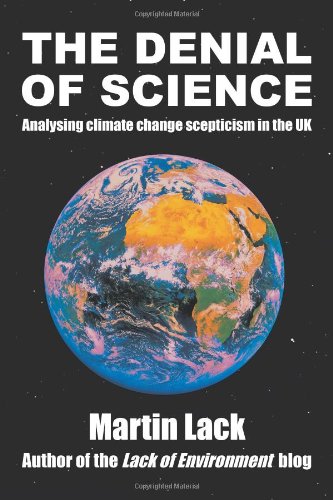
Martin Lack is one major step ahead of yours truly. Not because he, too, writes a blog but because, unlike yours truly, he is a published author! His book is called The Denial of Science; he blogs under the name of Lack of Environment.
Thus I was extremely grateful when a short while ago, Martin offered a major essay of his as a guest post for Learning from Dogs. Better than that, Martin happily accepted my recommendation to send me his essay in three parts.
It may not be the easiest read out in the ‘blogosphere’ but, trust me, Martin’s essay is profoundly important.
ooOOoo
Can ecologism be regarded as an ideology in its own right? (Part 1)
Introduction
Although it might well be assumed that one does not have to define what is meant by ‘socialists’ or – in UK terms at least – ‘conservatives’, it is certainly necessary to define ‘ecologism’: For the purposes of answering the above question, therefore, the latter should be understood as including thinking, behaviour, and the pursuit of policies that are concerned with the environment; but which are not merely or predominantly anthropocentric (i.e. those concerned with human needs and interests).
In a way, the question is nonsensical because use of the term ‘ecologism’, as coined by Andrew Dobson, appears to pre-suppose that ecological politics is indeed a “new political ideology” (2000: 163). If so, to respond to the above question by saying, in effect, ‘just because both socialists and conservatives (can) lay claim to ecological politics does not change the fact that ecologism is a distinctive political ideology in its own right’, would clearly be tautological. Therefore, to provide a defensible answer “Yes” to the above question – as is the intent herein – it is necessary to explain how and why:
both socialists and conservatives can lay claim to ecological politics;
the majority of both socialists and conservatives do not do so; and
the ‘ecologism’ that both find so challenging must therefore be considered as a distinctive political ideology in its own right.
The Socialist claim
One does not have to be an eco-socialist in order to believe or appreciate that there is a great deal of common ground shared by socialist and environmental politics. Socialism is a broad left-of-centre church that, it could be argued, includes everything from social democrats to communists. However, if socialism can be summed-up in the tripartite “Liberté, égalité, fraternité” motto of France (with its origins in the French Revolution of 1789-99), whose English translation would be “Freedom, equality, and brotherhood”, then it is not hard to see why socialists would find common cause with those whose goal is, in effect, to seek equal rights for the environment.
The “four pillars” of ecological politics are – as cited by Neil Carter – those devised by the German Green Party in 1983: ecological responsibility, grassroots democracy, social justice, and non-violence (Carter 2007: 48). Clearly, grassroots democracy and social justice are part of the socialist agenda. Therefore, despite the global dominance of free-market economics, Mary Mellor has asserted that far from being a challenge to socialism, “ecology greatly enhances the case for a redefined and refocused socialism” (Mellor 2006: 35).
The Conservative claim
Although by no means a monolithic entity, environmental politics is usually seen as being a predominantly left-of-centre entity (e.g. Carter 2007: 78); and it is often seen as being easier to define what it opposes than to define what it seeks. If so, ecological politics is essentially a reaction against anthropocentric thinking and the selfish pursuit of individual gain without regard for others or the environment. However, some philosophers such as Roger Scruton have therefore tried to distinguish between such selfish, libertarian, goals and those of traditional conservatives who, as their name suggests, seek the preservation of the status quo for the benefit of both the current generation and those that will follow (Scruton 2006: 7-8). Indeed, as early as 1993, in the wake of the Rio Earth Summit, Scruton was advocating the need for a radical re-think of right-wing politics:
Conservatives need to explore, with greens and others, as yet unthought-of dilemmas of life in societies which are no longer buoyed up by the prospect of incessant economic growth or by modernist pseudo-religions of endless world improvement” (Scruton 1993: 173).
However, in 1993, the idea that there might be limits to growth was hardly new; being based on Garrett Hardin’s Tragedy of the Commons article (1968); the Massachusetts Institute of Technology (MIT) Limits to Growth report for the Club of Rome (Meadows et al., 1972); E. F. Schumacher’s highly influential book Small is Beautiful (1973). For example:
The illusion of [mankind’s] unlimited powers, nourished by astonishing scientific and technological achievements, has produced the concurrent illusion of having solved the problem of production… based on the failure to distinguish between income and capital where this distinction matters most… A businessman would not consider a firm to have solved its problems of production and to have achieved viability if he saw that it was rapidly consuming its capital… (Schumacher 1974: 11).
Therefore, although the dilemmas were not “as yet unthought-of”, Scruton had, nevertheless, identified the source of the challenge that does indeed, it is here argued, begin to transform ecological politics into the distinctive political ideology that is ecologism.
Limits to Growth – a political and economic challenge
Although much disputed (by those that point to the fact that commodity prices have generally fallen over time, or that dire predictions have not yet come true), the Limits to Growth argument is based on the reality of the physical constraints of the planet on which we live.
For example: “Infinite growth is impossible in a closed system. With continued growth in production, the economic subsystem must eventually overwhelm the capacity of the global ecosystem to sustain it” (Daly & Farley 2004: 64). However, this is merely a comparatively recent re-statement of (former World Bank economist) Herman E Daly’s longstanding belief in the need for steady-state growth.
Furthermore, Daly and Farley cite Rudolf Clausius has having “coined the term ‘entropy’ for the Second Law [of Thermodynamics], derived from the Greek word for transformation, in recognition of the fact that entropy was a one-way street of irreversible change; a continual increase in the disorder of the universe” (Daly & Farley 2004: 65).
This is a fundamental tenet of modern physics; one that Daly has been repeating (like a “voice in the wilderness” proclaiming a message that nobody wants to hear) for a long time: It was over 35 years ago that he began an article entitled ‘The Economics of the Steady State’ with a quote from the famous scientist Sir Arthur Eddington, who once said, “But if your theory is found to be against the Second Law of Thermodynamics, I can give you no hope; there is nothing for it but to collapse in deepest humiliation” (as cited in Daly 1974: 15).
With this in mind, perhaps, the Union of Concerned Scientists (UCS) issued the “World Scientists’ Warning to Humanity” on 18 November 1992, from which the following excerpt is taken:
The earth is finite. Its ability to absorb wastes and destructive effluent is finite. Its ability to provide food and energy is finite. Its ability to provide for growing numbers of people is finite. And we are fast approaching many of the earth’s limits. Current economic practices which damage the environment, in both developed and underdeveloped nations, cannot be continued without the risk that vital global systems will be damaged beyond repair (UCS 1992).
Today, we are now well beyond these limits. According to the Global Footprint Network (GFN), humanity is now using the resources of at least 1.5 Earth’s (GFN, 2010). The most recent update to the Limits to Growth report was produced in 2005 and, in a section entitled “why technology and markets alone can’t avoid overshoot”, the authors suggested that:
…the more successfully society puts off its limits through economic and technical adaptations, the more likely it is in the future to run into several of them at the same time… the [model] does not run out of land or food or resources or pollution absorption capacity, it runs out of the “ability to cope” [i.e. too much industrial output has to be diverted to solving problems]… Given enough time, we believe humanity possesses nearly limitless problem solving abilities. [However] exponential growth… shortens the time for effective action. It loads stress on a system faster and faster, until coping mechanisms that have been adequate with slower rates of change finally begin to fail (Meadows et al 2005: 223).
Arguably, it could be said that the evidence for this is already becoming clear in the form of widespread social unrest around the globe, as a result of the increasing cost of – or difficulty in gaining access to – food, water, and energy.
For Robyn Eckersley, the reality of limits to growth and the magnitude of the ecological challenge is something from which we need to be emancipated; and it is also the raison d’être for environmentalism:
The environmental crisis and popular environmental concern have prompted a transformation of Western politics… Whatever the outcome of this realignment… the intractable nature of the environmental problems will ensure that environmental politics… is here to stay (Eckersley 1992: 7).
The latest UN projections for global population (published on 3 May 2011) suggests that stabilisation at about 10 billion by 2100AD is still most likely; but use probabilistic methods to account for the uncertainty in future fertility trends. Therefore, depending on changes in fertility rates in differing countries, the press release also indicates that global population could also peak at 8 billion in 2050 and then fall to 6 billion in 2100, or reach 10 billion by 2050 and continue to rise to 15 billion by 2100 (UN 2011: 1).
The key question the UN press release does not address is, “How many humans is too many?” Furthermore, although it depends on average rates of resource consumption, it is quite probable that there are already too many. However, this raises philosophical and/or ethical issues that form the other main aspect of ecological politics, which ensures that ecologism is a distinct political ideology in its own right.
From Environmentalism to Ecologism – the philosophical and ethical challenge
What’s in a name?
In the introduction above, ‘ecological politics’ was, in effect, defined as being environmentally-friendly and ecocentric (i.e. ecologism). For the avoidance of any doubt, therefore, it should be noted that this implies that it is possible to be concerned for the environment but be anthropocentric (i.e. environmentalism). It is precisely because the two things are not the same that Dobson has asserted that “…environmentalism and liberalism are compatible, but ecologism and liberalism are not” (2000: 165). The reason for this is examined below. (Ed. As in tomorrow!)
References
Carter, N. (2007), The Politics of the Environment (2nd edition). Cambridge: Cambridge University Press.
Daly, H. & Farley, J. (2004), Ecological Economics: Principles and Applications. Washington DC: Island Press.
Daly, H. (1974), ‘The Economics of the Steady State’, The American Economic Review, 64(2), pp.15-21.
Dobson, A. (2000), Green Political Thought, (3rd edition). London, Routledge.
Eckersley, R. (1992), Environmentalism and Political Theory. London: UCL Press.
Hardin, G. (1968), ‘The tragedy of the commons’, Science, 168, pp.1243-8.
Meadows D, et al (1972), The Limits to Growth. New York: Universe Books.
Meadows D, et al (2005), Limits to Growth: the 30-Year Update, London: Earthscan.
Mellor, M. (2006), ‘Socialism’, in Dobson, A. and Eckersley, R., Political Theory and the Ecological Challenge. Cambridge: Cambridge University Press, pp.35-50.
Schumacher, E.F. (1974), Small is Beautiful: A study of Economics as if Small People Mattered, London: Abacus.
Scruton, R. (1993), Beyond the New Right. London: Routledge.
Scruton, R. (2006), ‘Conservatism’, in Dobson, A. and Eckersley, R., Political Theory and the Ecological Challenge. Cambridge: Cambridge University Press, pp.7-19.
UN (2011), World Population Prospects: The 2010 Revision – Press Release. [Online] UN. Available at <http://esa.un.org/wpp/index.htm> [accessed 11/05/2011].