In yesterday’s post, I closed it by saying “More on the theme tomorrow.” What I had in mind was writing about a recent essay that I read; courtesy of Naked Capitalism. However, the essay struck me as of such interest that it should be republished in full. Thus I sent off a request for permission to so do. Hopefully, permission granted in time for me to publish the essay tomorrow (and see my note later on).
That then gave me the opportunity to explain my situation for the next few weeks.
In short, as a result of a number of guests coming to stay with us from the end of July right through to the end of September, the hours that I spend pleasurably preparing and writing posts for Learning from Dogs are going to be under some pressure.
For instance!
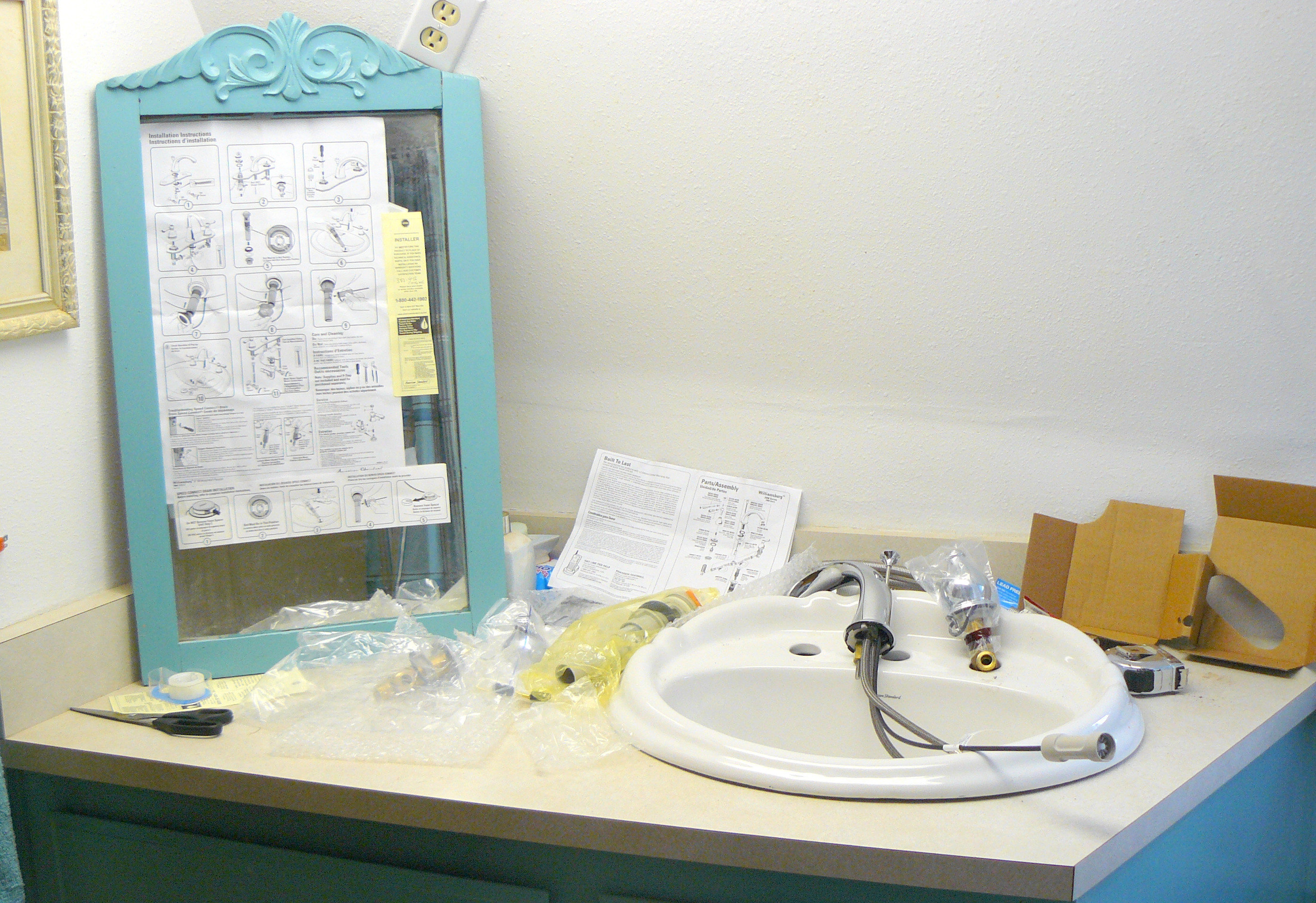
Ahead of the arrival of our first set of guests, my mother from London and my sister from Tokyo, it has been decided to renovate the guest bathroom by upgrading the wash-basin. Naturally, something yours truly wants to do himself! (Don’t believe me? See the following photo!)
Of course, as well as still not speaking American, I’m a very long way from speaking American plumbing! I mean fancy going into a builder’s store and asking for a set of taps.
So how does one connect the hot and cold water to these taps!
I looked at what the store attendant had placed in front of me and said, “No, I don’t mean that sort of tap, I mean a tap for a bathroom basin.”
“Oh, you mean force-it!“, replied the attendant.
(Now how did this attendant know that my tool of choice for jobs around the house was a 2-pound club hammer!)
“Of course,” I replied, “You Americans call them faucets!”
So you get the message!
(By the way, the permission to republish the article from The Automatic Earth just came through – just 12 minutes after I sent off my email request – great service, peeps.)
Plus there’s another distraction! Even more bizarre than pretending to be an American plumber! I am pretending to be an American author!
I have returned to writing the book!
Long-term readers of this blog (you crazy lot) will recall that last November I signed up for NaNoWriMo: National Novel Writing Month. From that accomplishment has flowed a number of very positive outcomes. One of them was being contacted by a company specialising in self-publishing. I was told that really before I get started in earnest, I need to set out a clear idea of what I am writing about and the audience I have in mind. I called it my Statement of Purpose and after a number of weeks of being amended and revised (huge thanks to Jon and John for their help) it was finally completed just a week ago. Here are the opening sections:
Learning from Dogs
the book.
Statement of Purpose v1.51
Introduction
We live in very challenging times.
It seems rare these days to meet someone who doesn’t sense, to one degree or another, a feeling of vulnerability to today’s world. A sense that many aspects of their lives are beyond their control.
These are also times where it is widely acknowledged that the levers of privilege, power and money are undermining the rights and needs of so many. A feeling of unprecedented levels of deceit, lying and greed.
Then there’s the subject of climate change and the “end-of-world” sword just waiting to descend on us all; the so-called beat of the butterfly’s wing!
Yes, these are challenging times. As we are incessantly reminded by the drumbeat of the doom-and-gloom news industry every hour, frequently every half-hour, throughout the day. A symphony of negative energy.
Yet right next to us is a world of positive energy. The world of dogs. A canine world full of love and trust, playfulness and relaxation. A way of living that is both clear and straightforward; albeit far from being simple. As anyone will know who has seen the way dogs interact with each other and with us humans.
In other words, dogs offer endless examples of positive behaviours. The wonderful power of compassion for self, and others, and of loving joy. The way to live that we humans crave for. A life full of hope and positive energy that keeps the power of negativity at bay.
Reading audience
The book is written by ‘an ordinary bloke’, not by someone who has a specialist or professional understanding in the areas of mind and behaviour. The author is no different to the majority of people out there and, presumably, the majority of potential readers.
Readers who feel the weight of all that ‘doom-and-gloom’ and general negativity that seems to be in the air. Yet, readers who desire a positive, compassionate attitude to their own life, and to the lives of the people around them. Almost certainly readers who are animal lovers, in general, and dog lovers in particular.
The clarity provided by the above has been fantastic and I am now firmly committed to writing something, however small in words, each day.
Yet another drag on my blogging time; I regret.
So if over the coming weeks you read something that strikes you as familiar it may be because I have reposted the item from previous years. Or if there seems to be a string of posts that have been republished from elsewhere, then at least you will understand.
Of course even better would be for you, my dear reader, to send me stuff or point me towards material you think others would enjoy. Or write a guest post! 🙂 Now that would be splendid!
Irrespective of the author, it’s always the words that count.
Just recently, a very good friend of this blog sent me a wonderful and inspiring set of words attributed to George Carlin.
As is usual, I took a quick dip into the internet to learn more about how these words came to be. I soon came upon the Snopes website and their page The Paradox of Our Time.
Here’s what I read:
In May 1998, Jeff Dickson posted the ‘Paradox of Our Time’ essay to his Hacks-R-Us online forum, loosing it upon the Internet. That essay has since spread far and wide and has commonly been attributed to a variety authors, including comedian George Carlin, an unnamed Columbine High School student, the Dalai Lama, and that most prolific of scribes, Anonymous!
George Carlin very emphatically denied he had had anything to do with “Paradox,” a piece he referred to as “a sappy load of shit,” and posted his comments about being associated with this essay on his own web site. (The line about “His wife recently died” which was added to many forwarded versions referenced Brenda Carlin, the comedian’s wife, who passed away on 11 May 1997 of liver cancer. Carlin himself died in June 2008.)
The true author of the piece isn’t George Carlin, Jeff Dickson, or the Dalai Lama, nor is he anonymous. Credit belongs to Dr. Bob Moorehead, former pastor of Seattle’s Overlake Christian Church (who retired in 1998 after 29 years in that post). This essay appeared under the title “The Paradox of Our Age” in Words Aptly Spoken, Dr. Moorehead’s 1995 collection of prayers, homilies, and monologues used in his sermons and radio broadcasts.
Now, of course, what is presented on the Snopes webpage also may not be correct. But does it really matter? No!
What matters are the words themselves and the ability of words to inspire us and change the way we think about our lives. So with that, here are those words.
ooOOoo
The Paradox of Our Age
The paradox of our time in history is that we have taller buildings but shorter tempers, wider Freeways, but narrower viewpoints.
We spend more, but have less, we buy more, but enjoy less.
We have bigger houses and smaller families, more conveniences, but less time.
We have more degrees, but less sense, more knowledge, but less judgment, more experts, yet more problems, more medicine, but less wellness.
We drink too much, smoke too much, spend too recklessly, laugh too little, drive too fast, get too angry, stay up too late, get up too tired, read too little, watch TV too much, and pray too seldom.
We have multiplied our possessions, but reduced our values. We talk too much, love too seldom, and hate too often.
We’ve learned how making a living, but not a life.
We’ve added years to life not life to years.
We’ve been all the way to the moon and back, but have trouble crossing the street to meet a new neighbor. We conquered outer space but not inner space. We’ve done larger things, but not better things.
We’ve cleaned up the air, but polluted the soul.
We’ve conquered the atom, but not our prejudice.
We write more, but learn less.
We plan more, but accomplish less.
We’ve learned to rush, but not to wait.
We build more computers to hold more information, to produce more copies than ever, but we communicate less and less.
These are the times of fast foods and slow digestion, big men and small character, steep profits and shallow relationships. These are the days of two incomes but more divorce, fancier houses, but broken homes. These are days of quick trips, disposable diapers, throwaway morality, one night stands, overweight bodies, and pills that do everything from cheer, to quiet, to kill. It is a time when there is much in the showroom window and nothing in the stockroom. A time when technology can bring this letter to you, and a time when you can choose either to share this insight, or to just hit delete…
ooOOoo
I chose to share this with you. (Dear reader, feel free to share this as well!)
That good friend also included some of his own wisdoms.
Remember, spend some time with your loved ones, because they are not going to be around forever.
Remember, say a kind word to someone who looks up to you in awe, because that little person soon will grow up and leave your side.
Remember, to give a warm hug to the one next to you, because that is the only treasure you can give with your heart and it doesn’t cost a cent.
Remember, to say, ‘I love you’ to your partner and your loved ones, but most of all mean it. A kiss and an embrace will mend hurt when it comes from deep inside of you.
Remember to hold hands and cherish the moment. For someday that person will not be there again.
Give time to love, give time to speak! And give time to share the precious thoughts in your mind.
AND ALWAYS REMEMBER:
Life is not measured by the number of breaths we take, but by the moments that take our breath away.
Highlights from the Monty Python Live (mostly) press conference in London, on the day before their reunion shows at London’s O2 Arena kick off. Terry Jones, Michael Palin, Terry Gilliam, Eric Idle and John Cleese answer questions from the press about the rehearsals, the live show and much more.
Welcome to the official Monty Python YouTube channel. This is the place to find top quality classic Python videos, as well as some special stuff that you’ll only find here – such as interviews and behind-the-scenes footage from our live shows. All the Pythons including John Cleese, Michael Palin, Eric Idle, Terry Gilliam, Terry Jones & Graham Chapman can be found here being incredibly silly
Yesterday morning I had a lovely long chat with Jon Lavin in the UK. We chit-chatted for a long time, covering such matters as caring for ourselves, about being compassionate towards the self, and much more besides.
Then in stark contrast, around noon Jean and I went over to “Runaway Tractors” to collect our tractor that had been in for a service.
The afternoon brought along another great conversation with John Hurlburt, he of the highly-appreciated Human arrogance essay last Thursday. That brought forth a whole bundle of ideas to write about.
The talks with Jon and John inspired a wonderful set of essays in my mind – BUT!
But by the time I sat down in front of the PC to write today’s post, I had simply run out of time to write something of value. So I’m cheating, well sort of, by reposting something from a little over a year ago. Hope it’s fresh to your eyes and that you enjoy it.
ooOOoo
Returning to Nature
The power of serendipity!
Why the choice of this sub-heading? Well, just because a number of quite separate articles and essays have come together to offer a powerful, cohesive argument for reconsidering the role of Nature in the future of mankind.
Of course, my use of words in that preceding sentence is completely ludicrous; the suggestion that ‘Nature’ is disconnected from ‘mankind’. Yet millions of us, to a greater or lesser degree, do behave as if we are the masters of the world.
So let me dip into what has been ‘crossing my desk’ in recent times.
On May 28th, George Monbiot published in The Guardian newspaper an essay entitled A Manifesto for Rewilding the World. (The link takes you to the article on the Monbiot blogsite.) Here’s how that essay opened,
Until modern humans arrived, every continent except Antarctica possessed a megafauna. In the Americas, alongside mastodons, mammoths, four-tusked and spiral-tusked elephants, there was a beaver the size of a black bear: eight feet from nose to tail(1). There were giant bison weighing two tonnes, which carried horns seven feet across(2).
The short-faced bear stood thirteen feet in its hind socks(3). One hypothesis maintains that its astonishing size and shocking armoury of teeth and claws are the hallmarks of a specialist scavenger: it specialised in driving giant lions and sabretooth cats off their prey(4). The Argentine roc (Argentavis magnificens) had a wingspan of 26 feet(5). Sabretooth salmon nine feet long migrated up Pacific coast rivers(6).
During the previous interglacial period, Britain and Europe contained much of the megafauna we now associate with the tropics: forest elephants, rhinos, hippos, lions and hyaenas. The elephants, rhinos and hippos were driven into southern Europe by the ice, then exterminated around 40,000 years ago when modern humans arrived(7,8,9). Lions and hyaenas persisted: lions hunted reindeer across the frozen wastes of Britain until 11,000 years ago(10, 11). The distribution of these animals has little to do with temperature: only where they co-evolved with humans and learnt to fear them did they survive.
I’m not going to reproduce the bulk of the article; just hoped that I have tickled your curiousity sufficient for you to read it in full here. But will just show you how it closed:
Despite the best efforts of governments, farmers and conservationists, nature is already beginning to return. One estimate suggests that two thirds of the previously-forested parts of the US have reforested, as farming and logging have retreated, especially from the eastern half of the country(23). Another proposes that by 2030 farmers on the European Continent (though not in Britain, where no major shift is expected) will vacate around 30 million hectares (75 million acres), roughly the size of Poland(24). While the mesofauna is already beginning to spread back across Europe, land areas of this size could perhaps permit the reintroduction of some of our lost megafauna. Why should Europe not have a Serengeti or two?
Above all, rewilding offers a positive environmentalism. Environmentalists have long known what they are against; now we can explain what we are for. It introduces hope where hope seemed absent. It offers us a chance to replace our silent spring with a raucous summer.
Then further research for this post brought to light an interview with David Suzuki in February. Widely reported, I picked the version published on Straight.com, from which comes:
In December, Canadian specialty TV channel Business News Network interviewed me about the climate summit in Copenhagen. My six-minute interview followed a five-minute live report from Copenhagen, about poor countries demanding more money to address climate change and rich countries pleading a lack of resources. Before and after those spots were all kinds of reports on the Dow Jones Industrial Average, the price of gold and the loonie, and the implications of some new phone technology.
For me, this brought into sharp focus the inevitable failure of our negotiating efforts on climate change. BNN, like the New York-based Bloomberg channel, is a 24-hour-a-day network focused completely on business. These networks indicate that the economy is our top priority. And at Copenhagen, money dominated the discussions and the outcome.
But where is the 24-hour network dealing with the biosphere? As biological creatures, we depend on clean air, clean water, clean soil, clean energy, and biodiversity for our well-being and survival. Surely protecting those fundamental needs should be our top priority and should dominate our thinking and the way we live. After all, we are animals and our biological dependence on the biosphere for our most basic needs should be obvious.
The economy is a human construct, not a force of nature like entropy, gravity, or the speed of light or our biological makeup. It makes no sense to elevate the economy above the things that keep us alive. But that’s what our prime minister does when he claims we can’t even try to meet the Kyoto targets because that might have a detrimental effect on the economy.
This economic system is built on exploiting raw materials from the biosphere and dumping the waste back into the biosphere. And conventional economics dismisses all the “services” that nature performs to keep the planet habitable for animals like us as “externalities”. As long as economic considerations trump all other factors in our decisions, we will never work our way out of the problems we’ve created.
Concluding:
Nature is our home. Nature provides our most fundamental needs. Nature dictates limits. If we are striving for a truly sustainable future, we have to subordinate our activities to the limits that come from nature. We know how much carbon dioxide can be reabsorbed by all the green things in the oceans and on land, and we know we are exceeding those limits. That’s why carbon is building up in the atmosphere. So our goal is clear. All of humanity must find a way to keep emissions below the limits imposed by the biosphere.
The only equitable course is to determine the acceptable level of emissions on a global per capita basis. Those who fall below the line should be compensated for their small carbon footprint while those who are far above should be assessed accordingly. But the economy must be aligned with the limits imposed by the biosphere, not above them.
Quite clearly, if we continue to turn our backs on Nature, the consequences won’t be long in tapping us on the shoulder.
So, going to close it today with this, seen nearly a month ago on the PRI website:
Imagine the type of world we could see
If instead of saying ‘pray,’ we said, ‘plant a tree’.
With this one little change so much more could be done
To protect all living things found under the sun.
We could ‘plant a tree’ for our troops sent away into war
So when they return they’d come home to find more.
We could ‘plant a tree’ at our churches with our husband or wife
To praise the Creator through a celebration of life.
We could ‘plant a tree’ for the needy and for those with no food
We could even plant in public without seeming rude.
The government would not have to introduce rules,
And most likely we could ‘plant a tree’ at our schools.
If we took it to task to ‘plant trees’ for the poorest,
We would all soon be reaping the wealth of a forest.
We could plant freely with those of all religions and creeds,
The improvement of earth would be based on these deeds.
We could plant with our neighbours, our family, and friends,
And ‘plant a tree’ with our enemies to help make amends.
If we ‘plant a tree’ for the sick to show them we care,
We would also be healing the soil, water, and air.
We could ‘plant a tree’ to observe when two people wed,
And plant one with our kids each night before bed.
Throughout the history of the whole human race
We find respect for the ‘tree’ has always had a place.
The great Ash of the Norse was their tree of the World,
And on a tree in the Garden is where the serpent once curled.
It was in groves of Oaks that the Druid priests wandered,
And under the Bodhi where the great Buddha pondered.
In the Bible it’s clear that we have all that we need:
‘All the trees with their fruits and plants yielding seed’.
Despite all these lessons that the past has taught
Now days, it seems, we cut our trees without thought.
This is confirmed by the Koran, for in it we read:
‘Many are the marvels of earth, yet we pay them no heed’.
We all have a duty, no matter what nation
To perform our part in protecting Creation.
Just think what we’d have if we had picked up a spade
Every time each one of us bowed our heads and prayed.
A powerful and compelling post from friend and follower: John Hurlburt.
Anyone who can compose phrases such as “an enlightened interest in the quality of the harvest of our transitory lives” deserves to be listened to! Our friend, John, from our Payson, AZ, days, is a regular author of essays that arrive here in Hugo Road via the mail. It’s always a pleasure to read John’s words and frequently I feel the need to share them with you, dear reader. So it was with John’s latest.
I’ll say no more except to promise you that you will be enthralled.
ooOOoo
Arrogance ‘R Us
We hear the drumbeat of steadily increasing global, national, state, regional and local problems every day. When common-sense solutions are offered for any of these problems, the solutions are immediately demonized as actions which would aggravate the problems they would logically solve. This sort of nonsensical circular argument is both a paralyzing paradox and a guaranteed death spiral for our relatively young biological species.
We imagine that we know far more than we do. The Earth doesn’t need living species in order to regenerate life. Human beings continue to need the Earth from which we are made and which sustains our consciously aware being. Some of us believe that having money is the answer to all our problems. Actually, the imaginary power of human “money” is killing life on Earth from the bottom of the food chain up.
Every government in the world competes with every other government in the world for power and control to one degree or another. The richer the nation, the greater it’s illusion of power. We’ve forgotten about responsibility, morality and faith in the power of Nature. Change is a constant. Failure to adapt to change is a death knell for living beings.
We live to learn. Why? Is death a finality or a new beginning? Both classic and quantum physics recognize Conservation of Information and the exchange of energy and matter at the level of fundamental forces. How much of the energy of our lives is absorbed by the cosmos and how much is recycled as life energy? We have no earthly idea of the answer.
Aye, there’s the rub.
We do know that everything fits together. Otherwise, we’d be random atoms. We also know that the cosmos does not exist for the pleasure of human beings. To the contrary, if the cosmos were even minimally different, life as we know it would not exist. We are an infinitesimally small part of Reality.
Statistically, we’re not alone as consciously aware life forms in our universe. When we release ourselves from the bondage of our biological limitations, we connect with the living energy of our planet in harmony with the geo-magnetic network of our planet, our living galaxy, and our living universe. We realize that other life on Earth shares conscious awareness in varying degrees.
Don’t believe it? That’s a matter of choice. Consider that denying the facts of reality is a foundation for ignorance. Letting go is a gateway to enlightenment.
Those who do not accept change profess to believe that the immensity of a universe beyond our inclusive comprehension has existed since the beginning of time solely for their personal benefit. Their corporate slogan is “Arrogance ‘R Us”.
More precisely, the statistical probability of human conscious awareness being unique in the universe is so infinitesimal that it would be laughable if it weren’t for our present species peril.
Not only have we amassed enough fire power to turn the earth into a burning sphere overnight, we are now proceeding to systematically and efficiently eliminate the natural resources we need to live.
We can’t eat computers or opinions. Clean air, clean water, clean food and clean energy are more than slogans. They’re essential for human life. Are we a swarm of predatory locusts or are we stewards of the blessings of a life we don’t fully understand?
Money has dissolved the human contract with Nature which began about 14 million years ago on a planet that’s been around in one form or another for roughly the last 14 billion years. Preservation, sustainability and natural efficiency are enemies of our present delusional global economic system. No living species on Earth is safe from the ecocide being committed by human insanity. We’re experiencing a systemic failure and treating it as a side-show.
We’re suffering from a fatally immoral addiction to what we may personally consider to be the good life. It’s time for our conscious awareness to transcend self and species. We need to combine our spiritual awareness, our natural awareness, our moral awareness, our cultural awareness, our social awareness and our common sense for the immediate purpose of preserving, sustaining and accepting the natural efficiency of our pale blue dot in a universally remote solar system.
So, where do we begin? We begin wherever we are. Today is the tomorrow we dreamed of yesterday. What is our vision of tomorrow? Is it an Earth that is unchanging in the midst of constant change? Is it an Earth that is scorched and barren? Perhaps it can become an Earth that continues to grow and nurture our existence.
The choice is made by our daily actions. Time is not currently in our favor. Freedom is not the exclusive privilege of wealth. Freedom is everyone’s responsibility. Poverty is the deadliest form of violence. Seven trillion dollars of worthless derivatives tick like a time-bomb in dank Wall Street sub-basements. Environmental bankruptcy threatens all life on Earth. It’s more than past half-time to face our shared Reality. There’s no place to hide.
We grieve our former lives. We begin with the suppressed anger we have self-generated through fear until it has become a traumatic syndrome. The antidote for fear is faith. What do we believe? What are our values? Are we moral, semi-moral, immoral or amoral? Do we believe we are the purpose of the Cosmos or a relatively young animal living on a garden planet far from the heart of an emerging universe? Is our immediate gratification more important than any long-term purpose?
Global recovery depends upon inclusive personal recovery and the ability to recognize the urgency of our common purpose. Personal and cultural recovery begin by surrendering the illusionary cocoon of “self”. Stepping stones include daily humility, hope, study, acceptance, inventory, amends, sharing and compassionate service. The result is a new lease on life.
We surrender our politics. We learn to think for ourselves. We question authority. We test our ideas and follow the evidence. Science belongs to all of us. We reserve judgment. We realize that our imagination is nothing in comparison to the majesty of the truth of our shared Reality. We become creative rather than destructive.
We build a global resource management system based on the concepts of common well-being, strategic preservation and strategic efficiency. Our objective is to maintain, grow and recycle natural resources utilizing our technology as a constructive tool rather than as a weapon.
The concept of ownership needs to be replaced by the idea of strategic access to what we need as opposed to what we may superficially believe or think we want. We stop competing and start co-operating as the result of an enlightened interest in the quality of the harvest of our transitory lives.
As we live and learn together, we realize that love is as important to life as air, food, water and shelter.
Peace beyond all understanding,
an old lamplighter
ooOOoo
Fabulous essay! Breathtakingly so! Making it clear that there is so much for us humans to learn! Yet offering a clear pathway to that learning. Starting with unconditional love and openness! Now where’s a dog to learn from!
Hazel teaching us openness and love through her eyes.
Further information on the subject of being grounded.
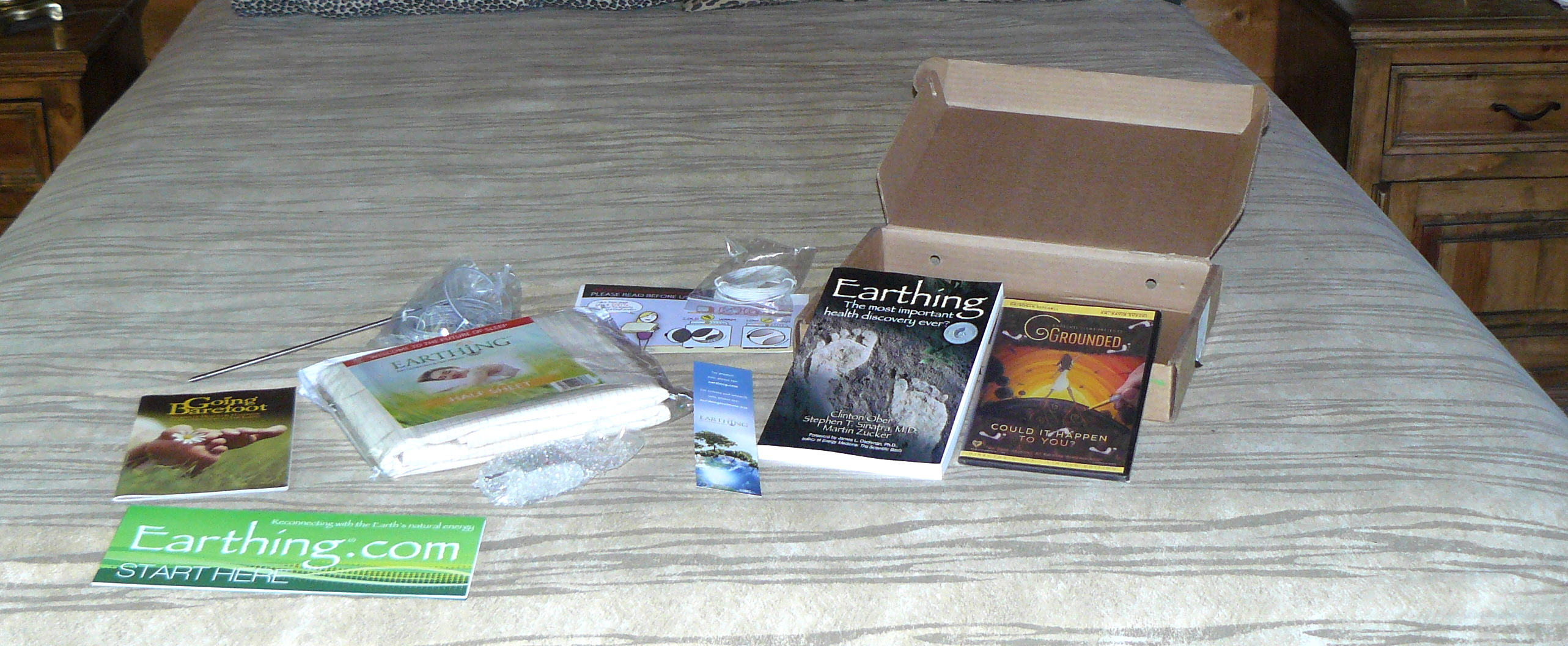
Just to set the scene, so to speak, last Saturday week I published a post on our reaction to the book called Earthing authored by Ober, Sinatra and Zucker. I said that we had been sufficiently convinced to order the half-sheet kit. Then on the 23rd., I wrote of our experiences after having spent 5 nights on the earthing sheet.
The half-sheet kit.
I promised to provide more information today. We have now been sleeping on the earthing sheet for eight nights. All the positive effects written about on Monday continue and, frankly, strengthen.
The website GoingBarefoot.org has much information, including real-life experiences from customers. That website suggests it is the work of Martin Zucker, one of the authors of the book. It also offers this testimonial video:
There is another website Earthing.com that offers much the same information as the GoingBarefoot site. (Indeed, I just called the Earthing company and they confirmed that there was no difference in service between the two websites.)
One of the items in the kit, as shown in the photograph, was a 74-minute, professionally-made film that was fascinating. Guess what! That film is available as a YouTube video.
The film was the product of Kroschel Films and their website is wonderful. You must go there. These two pictures came from there.
Isis, January 2013 – Photo courtesy Dr.Vic Walker
oooo
Steve Kroschel spends some quality time with Lennox the Lynx, Nov.3, 2013
Then a web search brought to light a company with the name of Mercola. Their website has a page with earthing products even including, towards the end of the webpage, instructions on making your own earthing mat. The following video comes from that website.
So I do hope this is of interest and, please, if you have any thoughts or experiences, do please offer them as comments to the post.
(Oh, I guess I should mention that I am not affiliated with any of these companies and stand to gain no advantage if you choose to purchase a product mentioned on Learning from Dogs. Please verify for yourself the potential advantages in using any earthing product.)
How to close?
This seems as good a way as any.
Standing Bear.
There is a road in the hearts of all of us, hidden and seldom traveled, which leads to an unknown, secret place.
The old people came literally to love the soil, and they sat or reclined on the ground with a feeling of being close to a mothering power. Their teepees were built upon the earth and their altars were made of earth. The soul was soothing, strengthening, cleansing, and healing.
That is why the old Indian still sits upon the earth instead of propping himself up and away from its life giving forces. For him, to sit or lie upon the ground is to be able to think more deeply and to feel more keenly.
He can see more clearly into the mysteries of life and come closer in kinship to other lives about him.
Two days ago I published a rather introspective post called The temptation to turn ever inwards. It was the result of reading three disturbing essays about the ‘affairs of man’; essays by Tom Engelhardt, Jim Wright and George Monbiot. Frankly, I wasn’t expecting a great response either in the form of ‘Likes’ or written replies. However, the first reply, a long reply, came in from Patrice Ayme. I made the decision to reply to Patrice via a new post; ergo today’s post. Since making that decision a further comment came in from Sue Dreamwalker, also republished today.
What I am going to do is to reproduce Patrice’s comment but interspersed with my replies.
oooo
The biosphere evolved over billions of years. Now it is taken over by critters who live for just a few years. Solution? Make it so that said critters live longer, thus attaching a greater value upon survival.
I presume that the ‘said critters’ refer to humans? The average lifespan of humans has increased hugely. From a life expectancy of 30 years [1] at birth in Medieval Britain, back in the 13th Century, to an average of 67.2 years for humans worldwide in 2010. [2]
That’s an increase of 124% in a little over 700 years. Yet despite that incredible increase in lifespan, humans have shown no interest in attaching a greater value to their survival: far from it! One might even muse that humans have attached a greater value to those things that actively harm our survival.
For all the (over-) elaborate set-up of dear Monbiot, it’s simpler than that. Instead of going back to Baby Thatcher, Baroness god save the queen knows what, let’s grab a clear and present example.
I’m unclear as to what is meant by “the over-elaborate set-up” but as a long-time reader of Mr. Monbiot‘s essays I applaud both his commitment to the highest standards of journalism and to the UK’s Guardian newspaper for publishing so many of them over the years. I would invite Patrice to give an example of over-elaboration coming from the pen of George Monbiot.
Britain, and many of the Brits, say our dear friend Chris Snuggs, a participant to your, and my, site, have said that they hated Europe, because Europe was not democratic enough. However, one of the latest improvement of the European Constitution is now effective: the head of the EC, the European Commission, is now to be elected by the just elected European PARLIAMENT. Guess what?
Chris Snuggs is more than a participant to Learning from Dogs, he is a close friend of many years. Yes, he has strong views about Europe but those views are expressed in a declared, personal manner.
Chameleon Cameron, came out of the woodworks to bark, in the clearest way, that it was out of the question to do things differently from before, and now dare to have the European Parliament to elect (what is basically) the European Prime Minister.
Never mind that Britain voted for that European Constitutional change.
Never mind that in representative democracies, the leaders of the executive are elected by Parliament.
So what do we see here?
Contradiction within moods and thoughts systems (Britain agreed to the democratic change, and now does not). We also see erroneous ideas imposed (leaders of the executive says Cameron should be nominated undemocratically, that’s erroneous).
The same sort of things is also perking up in Iraq: the USA caused the mess there, committing several major war crimes in the process. Precisely because those war crimes were not prosecuted, a strong push has been exerted on Obama to duplicate Bush, and go back to attack Iraq some more.
Thus, it is simple: there bad ideas out there, and they need to be destroyed. And bad moods too (an example of bad moods is the enormity that the American population was made, by Bush, Cheney, Rumsfeld, etc., into an accomplice of the most major war crime there is, war of aggression. Now that this war is in the process of being lost, some clamor to have the war pursued with renewed vigor.
We are now the stewards of the biosphere, whether we like it, or not. We can’t just sit on our rumps, strokes dogs, and whine we will attend to our garden (Voltaire style). By doing nothing, we leave criminals such as Bush, or their spirit, or their mood, in power. And thus we become accomplices.
There is total agreement for the idea that humans are the stewards of the biosphere. But if the “sit on our rumps, strokes dogs and whine we will attend to our garden” is aimed at me, as it appears to be, then I strongly disagree. Living as simple a life as we can is a long way from “doing nothing”.
So go out there, and engage in combat, bad moods, and bad ideas. That’s what even very old alpha monkeys, covered with age spots, do. We don’t want to let very old monkeys be examples of moral rectitude we cannot emulate.
A last point: Monbiot does not realize the contradiction he engages in. In the guise of criticising the opposition, he puts it on a pedestal, and engages in its very propaganda. Monbiot, and many like him, bemoan a “shift towards conservatism”. Nothing could be more false. People who destroy the biosphere are NOT conservatives. They play conservatives on TV. In truth, they are just the opposite. They are destructionists.
I am of the opinion, totally so, that George Monbiot is not playing at conservatism.
oooo
So, dear reader, there is little in the comment from Patrice that has me nodding my head. Don’t get me wrong! Patrice Ayme is an individual of extreme intellect as even a dip into his blog will confirm. I am a regular reader of the writings over at that place.
However, there is one major stumbling block for me, one that I have communicated privately to the said Patrice, and that is the issue of anonymity. Because Patrice Ayme is a nom-de-plume. Despite following ‘his’ writings for some time and sharing the occasional private email, I have almost no idea about who the person is. Yes, ‘his’ writings are often very strong and highly critical of many aspects of modern life, especially the American political system. But that is not unique. There is a long line-up of writers doing the same, and doing the same over their signatures: Tom Engelhardt, Jim Wright and George Monbiot and many, many others
For me, hiding one’s identity so securely behind a ‘virtual’ mask yet writing so passionately about many of the issues critically affecting the future of mankind, doesn’t work. If one can’t or won’t be honest about who they are, then better, perhaps, that they keep their thoughts and ideas close to them. There is no shortage of people openly being critical about the American Government and much else across the world, and being critical openly.
Later, Sue of Sue Dreamwalker added a comment. That resonated perfectly with me and it, too, is reproduced in full.
Paul sometimes I despair at how Mankind plays out his life in the world Paul… We bemoan lots as we sit in our homes as the virus of hate, greed, and disaster pours into our living rooms via the BLACK BOX of FEAR tricks… Which helps depress, make us anxious, fearful,…. It insights anger, aggression and the spiral of thought escalates out via the Web… Internet at our fingertips- instant reactions…
Some times I wonder as I ponder… at the soup being remixed… as only this week we hear of ISIS another branch of the terrorists we are now supposed to fear… As the UK now makes friends with its long time enemy Iran.. reinstating diplomatic relationships again.. The Saga runs on an on… With Oil as the major players .
That’s why turning inward is sometimes Paul the only thing we can do… As we can only live our lives… While I so want to save the world.. The world has also got to want to save itself…
I can only live my own life and stop the petty squabbles, the judgements, the criticisms as I mend my own world to live at peace within it…
Once we all realise its our thoughts which in fact we send out, in fear, in anger, as we judge and condemn that are reflected back …
WE create the world.. We consume its products, We want to live in the lifestyles that demand this World to exploit others for riches.. And yet condemn the conditions of the haves and have nots…
We have lost sight of our basic values in life Paul…
So yes I often retreat inwards… I have too.. Because I worry too much about the kind of Earth we are leaving our Grandchildren to grow up in…
~Sue
In final reply to Patrice, I shall reproduce this well-known quotation [3]:
“I disapprove of what you say, but I will defend to the death your right to say it.“
3.This saying is widely attributed to Voltaire, but cannot be found in his writings. With good reason. The phrase was invented by a later author as an epitome of his attitude. It appeared in The Friends of Voltaire (1906), written by Evelyn Beatrice Hall under the pseudonym Stephen G. Tallentyre.
A run of essays that, collectively, deeply disturb me.
My seventieth birthday is fewer than six months away. Indeed, it will be just a little over two weeks after we celebrate the second anniversary of our arrival to this beautiful homestead back on October 25th, 2012. Two years: Seventy years! Time seems to run through one’s fingers like the proverbial sand. It’s difficult to avoid the irony that comes with recognising the two journeys. The one journey bringing me to living here on our rural Oregonian acres, with stunning scenery, wonderful animals and so much love in the air. The other journey bringing me to the realisation that this is the Autumn of my life and the sense, the keen sense, of my own mortality.
What, may you ask, has brought this feeling, these words, to the surface?
Well, I’ll tell you.
It’s been the coincidence of essays from three authors across the ‘blogosphere’ that I have recently read. Taken together, they paint a picture that disturbs me. Very much so. They sing out to me that mankind is spiralling ever downwards to oblivion and that the dark forces of greed, power and control will never be stopped; well not by man that is!
Here are the links to those essays.
The first was from Tom Englehardt. It was an essay entitled: A Record of Unparalleled Failurepublished on June 10th. That opened:
The United States has been at war — major boots-on-the-ground conflicts and minor interventions, firefights, air strikes, drone assassination campaigns, occupations, special ops raids, proxy conflicts, and covert actions — nearly nonstop since the Vietnam War began. That’s more than half a century of experience with war, American-style, and yet few in our world bother to draw the obvious conclusions.
Given the historical record, those conclusions should be staring us in the face. They are, however, the words that can’t be said in a country committed to a military-first approach to the world, a continual build-up of its forces, an emphasis on pioneering work in the development and deployment of the latest destructive technology, and a repetitious cycling through styles of war from full-scale invasions and occupations to counterinsurgency, proxy wars, and back again.
The second was from another American, Jim Wright, who is the author of the blog Stonekettle Station. Jim describes himself as:
I’m a retired US Navy Chief Warrant Officer. Nowadays I live in Alaska where I spend most of my time working in my woodshop or fishing. I occasionally consult for the Military. I have delusions of becoming a full time writer – or conquering the universe, whichever is easier…
Thanks to Yves Smith’s Naked Capitalism, I followed a link to a recent essay from Jim under the title of Absolutely Nothing, published on the 14th June.
I’m not going to quote from it, not because I don’t approve of his essay, far from it, but because there are many tough, profane words and I do not wish inadvertently to upset my readers. But it is very strongly recommended.
The third essay is from fellow Englishman, George Monbiot, whose work has been regularly republished on Learning from Dogs.
While his essay is not specifically about war, unlike the other two, it does, nonetheless, contribute to my feelings of not wanting to engage with anything that is outside being a better husband, landowner and animal lover. It is called The Values Ratchet and is republished here with the generous permission of George Monbiot.
ooOOoo
The Values Ratchet
June 10th, 2014
How to ensure that nations slide ever further into selfishness, and ever further to the right.
By George Monbiot, published in the Guardian 11th June 2014
Any political movement that fails to understand two basic psychological traits will, before long, fizzle out. The first is Shifting Baseline Syndrome. Coined by the biologist Daniel Pauly, it originally described our relationship to ecosystems(1), but it’s just as relevant to politics. We perceive the circumstances of our youth as normal and unexceptional – however sparse or cruel they may be. By this means, over the generations, we adjust to almost any degree of deprivation or oppression, imagining it to be natural and immutable.
The second is the Values Ratchet (also known as policy feedback). If, for example, your country has a public health system which ensures that everyone who needs treatment receives it without payment, it helps instil the belief that it is normal to care for strangers, and abnormal and wrong to neglect them(2,3). If you live in a country where people are left to die, this embeds the idea that you have no responsibility towards the poor and weak. The existence of these traits is supported by a vast body of experimental and observational research, of which Labour and the US Democrats appear determined to know nothing.
We are not born with our core values: they are strongly shaped by our social environment. These values can be placed on a spectrum between extrinsic and intrinsic. People towards the intrinsic end have high levels of self-acceptance, strong bonds of intimacy and a powerful desire to help other people. People at the other end are drawn to external signifiers, such as fame, financial success, image and attractiveness(4). They seek praise and rewards from others.
Research across 70 countries suggests that intrinsic values are strongly associated with an understanding of others, tolerance, appreciation, cooperation and empathy(5,6,7). Those with strong extrinsic values tend to have lower empathy, a stronger attraction towards power, hierarchy and inequality, greater prejudice towards outsiders and less concern for global justice and the natural world(8,9). These clusters exist in opposition to each other: as one set of values strengthens, the other weakens(10,11).
People at the extrinsic end tend to report higher levels of stress, anxiety, anger, envy, dissatisfaction and depression than those at the intrinsic end of the spectrum(12,13,14). Societies in which extrinsic goals are widely adopted are more unequal and uncooperative than those with deep intrinsic values. In one experiment, people with strong extrinsic values who were given a resource to share soon exhausted it (unlike a group with strong intrinsic values), as they all sought to take more than their due(15).
As extrinsic values are strongly associated with conservative politics, it’s in the interests of conservative parties and conservative media to cultivate these values. There are three basic methods. The first is to generate a sense of threat. Experiments reported in the journal Motivation and Emotion suggest that when people feel threatened or insecure they gravitate towards extrinsic goals(16). Perceived dangers – such as the threat of crime, terrorism, deficits, inflation or immigration – trigger a short-term survival response, in which you protect your own interests and forget other people’s.
The second method is the creation of new frames, structures of thought through which we perceive the world. For example, if tax is repeatedly cast as a burden, and less tax is described as relief, people come to see taxation as a bad thing that must be remedied(17). The third method is to invoke the Values Ratchet: when you change the way society works, our values shift in response. Privatisation, marketisation, austerity for the poor, inequality: they all shift baselines, alter the social cues we receive and generate insecurity and a sense of threat.
Margaret Thatcher’s political genius arose from her instinctive understanding of these traits, long before they were described by psychologists and cognitive linguists: “Economics are the method; the object is to change the heart and soul.”(18) But Labour and the Democrats no longer have objects, only methods. Their political philosophy is simply stated: if at first you don’t succeed, flinch, flinch and flinch again. They seem to believe that if they simply fall into line with prevailing values, people will vote for them by default. But those values and baselines keep shifting, and what seemed intolerable before becomes unremarkable today. Instead of challenging the new values, these parties keep adjusting. This is why they always look like their opponents, with a five-year lag.
There is no better political passion killer than Labour’s Zero-Based Review(19). Its cover is Tory blue. So are the contents. It promises to sustain the coalition’s programme of cuts and even threatens to apply them to the health service(20). But, though it treats the deficit as a threat that must be countered at any cost, it says not a word about plugging the gap with innovative measures such as a Robin Hood tax on financial transactions, a land value tax, a progressively-banded council tax or a windfall tax on extreme wealth. Nor does it mention tax avoidance and evasion. The poor must bear the pain through spending cuts, sustaining a cruel and wildly unequal social settlement.
At the end of last month, Chris Leslie, Labour’s Shadow Chief Secretary to the Treasury, promised, like George Osborne, that the cuts would be sustained for “decades ahead”(21). He asserted that Labour’s purpose in government would be to “finish that task on which [the Chancellor] has failed”: namely “to eradicate the deficit”. The following day the shadow business secretary, Chuka Umunna, sought to explain why Labour had joined the political arms race on immigration. In doing so, he revealed that his party will be “radical in reforming our economy” in support of “a determinedly pro-business agenda”(22). They appear to believe that success depends on becoming indistinguishable from their opponents.
It’s not quite as mad as the old tactic among some Marxist groups of promoting inequality and injustice in the hope that popular fury would lead to revolution, but it’s not far off. Quite aside from the obvious flaw (what’s the sodding point of voting for a party that offers no substantial change in policy?), it evinces a near-perfect psychological illiteracy. When a party reinforces conservative values and conservative ideas, when it fails clearly to expound any countervailing values, when it refuses to reverse the direction of the Values Ratchet, what outcome does it expect, other than a shift towards conservatism?
1. Daniel Pauly, 1995. Anecdotes and the Shifting Baseline Syndrome of Fisheries. Trends in Ecology and Evolution 10. 10:430.
2. Stefan Svallfors, 2010 Policy feedback, generational replacement, and attitudes to state intervention: Eastern and Western Germany, 1990-2006, European Political Science Review, 2, 119-135.
5. Shalom H. Schwartz, 2006. Basic Human Values: Theory, Measurement, and Applications. Revue Française de Sociologie, 47/4. http://bit.ly/1hL1JFJ
6. Frederick Grouzet et al, 2005. The structure of goal contents across fifteen cultures. Journal of Personality and Social Psychology, 89, 800-816. http://psycnet.apa.org/journals/psp/89/5/800/
9. Kennon M. Sheldon and Charles P. Nichols, 2009. Comparing Democrats and Republicans on
Intrinsic and Extrinsic Values. Journal of Applied Social Psychology, 2009, 39, 3, pp. 589–623.
12. Tim Kasser, 2014. Changes in materialism, changes in psychological well-being: Evidence from three longitudinal studies and an intervention experiment. Motivation and Emotion, 38:1–22. doi: 10.1007/s11031-013-9371-4
20. “We will be cutting departmental spending in 2015-16 and not raising it, with no more borrowing to cover day-to-day spending”
“The fundamental principle of the Zero-Based Review is that all spending is in scope and all budgets will be challenged. The review will cover all areas of public spending, including those that have been protected in the current Spending Review such as health”.