Category: Communication

Reflections on the internet.

An interesting item that recently crossed my ‘screen’.

I make no apologies for cutting corners for today’s post. Because the last few days of looking after, and worrying about, Hazel have soaked up so much of our time and energy that I just couldn’t find the creative impulse to do much more than ‘copy and paste’.

That’s not to downplay the great interest of this article that appeared over on The Conversation blogsite a few days ago.

ooOOoo

Why the Internet isn’t making us smarter – and how to fight back

April 15, 2016 5.58am EDT

Professor of Psychology, University of Michigan

Disclosure statement: David Dunning has received funding from the National Science Foundation, the National Institutes of Health, and the Templeton Foundation in the past.

In the hours since I first sat down to write this piece, my laptop tells me the National Basketball Association has had to deny that it threatened to cancel its 2017 All-Star Game over a new anti-LGBT law in North Carolina – a story repeated by many news sources including the Associated Press. The authenticity of that viral video of a bear chasing a female snowboarder in Japan has been called into question. And, no, Ted Cruz is not married to his third cousin. It’s just one among an onslaught of half-truths and even pants-on-fire lies coming as we rev up for the 2016 American election season.

The longer I study human psychology, the more impressed I am with the rich tapestry of knowledge each of us owns. We each have a brainy weave of facts, figures, rules and stories that allows us to address an astonishing range of everyday challenges. Contemporary research celebrates just how vast, organized, interconnected and durable that knowledge base is.

That’s the good news. The bad news is that our brains overdo it. Not only do they store helpful and essential information, they are also receptive to false belief and misinformation.

Just in biology alone, many people believe that spinach is a good source of iron (sorry, Popeye), that we use less than 10 percent of our brains (no, it’s too energy-guzzling to allow that), and that some people suffer hypersensitivity to electromagnetic radiation (for which there is no scientific evidence).

But here’s the more concerning news. Our access to information, both good and bad, has only increased as our fingertips have gotten into the act. With computer keyboards and smartphones, we now have access to an Internet containing a vast store of information much bigger than any individual brain can carry – and that’s not always a good thing.

Better access doesn’t mean better information

This access to the Internet’s far reaches should permit us to be smarter and better informed. People certainly assume it. A recent Yale study showed that Internet access causes people to hold inflated, illusory impressions of just how smart and well-informed they are.

But there’s a twofold problem with the Internet that compromises its limitless promise.

First, just like our brains, it is receptive to misinformation. In fact, the World Economic Forum lists “massive digital misinformation” as a main threat to society. A survey of 50 “weight loss” websites found that only three provided sound diet advice. Another of roughly 150 YouTube videos about vaccination found that only half explicitly supported the procedure.

Rumor-mongers, politicians, vested interests, a sensationalizing media and people with intellectual axes to grind all inject false information into the Internet.

So do a lot of well-intentioned but misinformed people. In fact, a study published in the January 2016 Proceedings of National Academy of Science documented just how quickly dubious conspiracy theories spread across the Internet. Specifically, the researchers compared how quickly these rumors spread across Facebook relative to stories on scientific discoveries. Both conspiracy theories and scientific news spread quickly, with the majority of diffusion via Facebook for both types of stories happening within a day.

Making matters worse, misinformation is hard to distinguish from accurate fact. It often has the exact look and feel as the truth. In a series of studies Elanor Williams, Justin Kruger and I published in the Journal of Personality and Social Psychology in 2013, we asked students to solve problems in intuitive physics, logic and finance. Those who consistently relied on false facts or principles – and thus gave the exact same wrong answer to every problem – expressed just as much confidence in their conclusions as those who answered every single problem right.

For example, those who always thought a ball would continue to follow a curved path after rolling out of a bent tube (not true) were virtually as certain as people who knew the right answer (the ball follows a straight path).

Defend yourself

So, how so we separate Internet truth from the false?

First, don’t assume misinformation is obviously distinguishable from true information. Be careful. If the matter is important, perhaps you can start your search with the Internet; just don’t end there. Consult and consider other sources of authority. There is a reason why your doctor suffered medical school, why your financial advisor studied to gain that license.

Second, don’t do what conspiracy theorists did in the Facebook study. They readily spread stories that already fit their worldview. As such, they practiced confirmation bias, giving credence to evidence supporting what they already believed. As a consequence, the conspiracy theories they endorsed burrowed themselves into like-minded Facebook communities who rarely questioned their authenticity.

Instead, be a skeptic. Psychological research shows that groups designating one or two of its members to play devil’s advocates – questioning whatever conclusion the group is leaning toward – make for better-reasoned decisions of greater quality.

If no one else is around, it pays to be your own devil’s advocate. Don’t just believe what the Internet has to say; question it. Practice a disconfirmation bias. If you’re looking up medical information about a health problem, don’t stop at the first diagnosis that looks right. Search for alternative possibilities.

Seeking evidence to the contrary

In addition, look for ways in which that diagnosis might be wrong. Research shows that “considering the opposite” – actively asking how a conclusion might be wrong – is a valuable exercise for reducing unwarranted faith in a conclusion.

After all, you should listen to Mark Twain, who, according to a dozen different websites, warned us, “Be careful about reading health books. You may die of a misprint.”

Wise words, except a little more investigation reveals more detailed and researched sources with evidence that it wasn’t Mark Twain, but German physician Markus Herz who said them. I’m not surprised; in my Internet experience, I’ve learned to be wary of Twain quotes (Will Rogers, too). He was a brilliant wit, but he gets much too much credit for quotable quips.

Misinformation and true information often look awfully alike. The key to an informed life may not require gathering information as much as it does challenging the ideas you already have or have recently encountered. This may be an unpleasant task, and an unending one, but it is the best way to ensure that your brainy intellectual tapestry sports only true colors.

ooOOoo

The way the world now communicates, for good and bad, using the internet is staggering. As the website Internet Live Stats reveals: (as of this moment today)

3,352,197,085 Internet Users in the world

1,016,623,500 Total number of Websites

2,060,120 Blog posts written today

So with that last figure in mind, I’ll send this for posting without delay! 😉

Please keep Hazel in your thoughts.

Hazel has recently become rather ill.

CAUTION: The following is offered by way of information reaching out to other loving dog owners. Please do not assume I have any specialist veterinarian knowledge and please do not take the following as a replacement for seeing your own vet.

Hazel

Picture of Hazel taken in the last twenty-four hours.
Picture of Hazel taken in March, 2014.

The story of how this wonderful dog came into our lives was published over two years ago.

About three or four weeks ago we noticed that Hazel’s bark was changing, almost as though she had a sore throat. In every other way she continued being the happy, lively dog that she is.

Then very suddenly last Thursday she started sicking up white, foamy bile and went off her food. Hazel rapidly became lethargic and lacking any vigour. Last Friday we took Hazel to our local Lincoln Road Vet Clinic and she was seen by Dr. Russ Codd, DVM. He took xrays that showed that Hazel’s lungs were far from being as clear as they should be. Potentially, Dr. Codd said that we could be looking at one of three things:

  1. Some form of bronchial pnemonia,
  2. A fungal infection of the lungs,
  3. Cancer.

In view of the fact that Hazel hadn’t been coughing that ruled out 1.

Dr. Codd forwarded the xray pictures to a specialist. Later came the information that the spherules in her lungs, as seen on the xray pictures, were not as would be expected with a cancer diagnosis. Dr. Codd concluded that Hazel was indicating a fungal lung infection. Especially as this is commonly found in hot, drier parts of the USA and Mexico. Hazel was an ex-rescue from Mexico and for a couple of years we lived in Payson, Arizona.

The medical term for the disease is Coccidioidomycosis and I republish a little of what may be read over on the Pet MD website:

Coccidioidomycosis in Dogs

Mycosis is the medical term for any disorder caused by a fungus. Coccidioidomycosis comes from inhalation of a soil-borne fungus which normally affects the dog’s respiratory system. However, it is known (even likely) to spread out into other body systems.

The fungus spores begin in the lungs as round spherules, and live in a parasitic stage in the lungs until they grow large enough to rupture, releasing hundreds of endospores, which then begin a parasitic stage in the tissues, growing and rupturing, spreading out (disseminating) into the body perpetually. Endospores can also take a faster route through the body by way of the lymphatic and blood vessel systems, resulting in systemic infection — meaning the entire body will be affected. Coccidioidomycosis sets in from 7 to 20 days after exposure, though some dogs can develop immunity and never show any symptoms, especially younger dogs.

Dogs that are susceptible to the infection can become ill from only a small amount of the Coccidioides fungus, and fewer than 10 fungus spores are needed to cause the disorder. And though uncommon, Coccidioidomycosis is a deadly disease that originates mainly in the arid, hot regions of the western and southwestern regions of the U.S., and in several Central and South American countries. Coccidioidomycosis affects many different types of mammals, but tends to occur more commonly in dogs than cats. This infection is also known as valley fever, California fever, Cocci, and desert fever.

The condition or disease described in this medical article can affect both dogs and cats. If you would like to learn more about how this disease affects cats, please visit this page in the PetMD health library.

Dr. Codd recommended getting Hazel on a course of antibiotics with Fluconazole being his first choice. That commenced on Friday afternoon.

Early today (Monday) Dr. Codd will be seeking to narrow down the diagnosis with further analysis of Hazel’s blood being undertaken because while he was confident that it is a fungal infection he wanted to confirm precisely the nature of the infection.

I will publish more information as it comes to hand and close with these photographs taken yesterday afternoon.

Hazel taking a very slow walk outside.

oooo

But most of the time she just wanted to be left on her own in our bedroom.

We are holding Hazel very close to our hearts just now.

Picture parade one hundred and forty-three

The final selection of Dog Tired!

(Links to previous selections can be seen here.)

dt22oooo

dt23oooo

dt24oooo

dt25oooo

dt26oooo

dt270000

I can’t close without thanking once again Larry and Janell from next door who sent all these wonderful photographs to be shared with you. How on earth can one follow those up?

Have a wonderful week and return to find out!

Picture parade one hundred and forty-two

Dog tired: selection three

You can backtrack previous selections by going here.

dt15oooo

dt16oooo

dt17oooo

dt18oooo

dt19oooo

dt20oooo

dt21oooo

What a wonderful Sunday smile!

The final selection will be in a week’s time.

As always, you and your wonderful pets be happy.

The essence of our relationship with dogs.

Woman Rescues Burned Puppy and He Grows Up to Save Her Life

This wonderful story was recently published on the Care2 site and is republished here to share with you all and to underline the importance of always trying to find your next pet from a rescue shelter.

ooOOoo

Woman Rescues Burned Puppy and He Grows Up to Save Her Life

2997475.largeBy: Laura S. April 6, 2016

About Laura

Editor’s note: This post was originally published on January 7, 2013. We are republishing it for your reading pleasure. Enjoy!

Anyone who has ever saved an animal will tell you that its the kind of experience that shakes up your DNA. You won’t regrow hair on a balding head or suddenly run a four-minute-mile, but there is a pulse of positive energy that churns through the human body much like a twister. In some cases, fragments of that emotional explosion are powerful enough to be credited with modern medical miracles. And for one Texas woman, the experience was profound enough to help wake her from a coma.

My Name is Danielle…

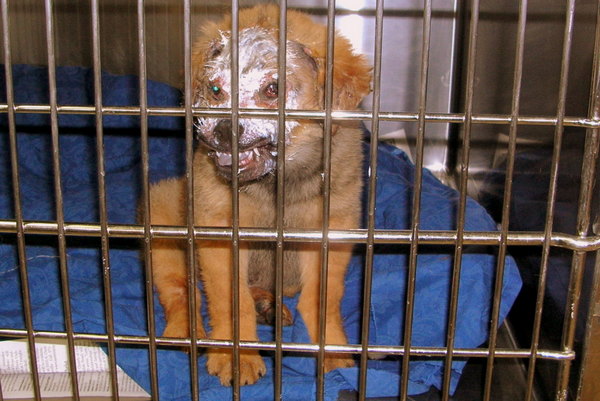
“My name is Danielle and it’s been over a year since something terrible happened to me. I am ready now to share my story,” explained the letter we received recently from veterinary technician Danielle Torgerson of Killeen, Texas. ”Four years ago somebody brought a puppy to the clinic. I was not assigned to that room but I was in the second room when I felt something pull me into the hallway. It was strange, but I glanced into the other exam room and saw a puppy on the table. He looked at me with so much pain and despair. A man had brought him in for a ‘sting’ but I knew instantly that was not the case. The puppy was horribly burned on the head like somebody had poured gasoline over him and set him on fire. He was there to be euthanized.”

But Danielle’s conscience began to wrestle down the injustice of extinguishing this young life before it had known the simple joys that every dog should know. She wondered if he might be able to have a bed of his own. Could there be walks through the park in the cool evening air? Was it possible that this puppy might wake up each morning beside a person whose first words were his name?

“I asked the vet if something could be done,” Danielle recalls. “He said that treatment could be carried out, but only with lots of money.”

The Rescue Begins

And that was all Danielle needed to hear. She wasn’t wealthy, but she was determined and if there was a chance at recovery, she’d already made up her mind to take it. So Danielle had the man who brought in the puppy sign over custody to her. She then contacted Dr. Elaine Caplin in Austin and the puppy was brought in for a surgical consulation to see what could be done.

“He was not able to eat or drink because part of his mouth was melted,” Danielle recalls.

Skingraft surgery was undertaken to reconstruct the mouth and soon the puppy’s condition improved dramatically and he began to function on his own.

Danielle named the puppy D’Artagnan (who served Louis XIV as captain of the Musketeers of the Guard) or Mister D for short and introduced him to other dogs and cats who welcomed him.

Mister D began to grow into a large dog and earned a reputation for his generous nature. “He allows all the cats to sleep with him and we have actually seen him share food with other dogs. He picks out pieces of food and gives it to them.”

All grown up.
All grown up.
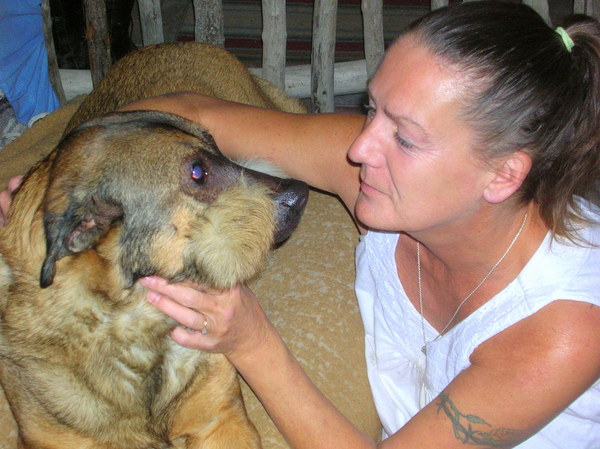
But in the street, Mister D is sometimes regarded as a beast.“He looks like a werewolf with his skin grafts and people are kind of scared,” Danielle explains. “But he truly is my loving angel and I know that saving him is what helped save me.”You see, last year, Danielle was in a terrible motorcycle accident when she tried to avoid a collision with a car. Within seconds, she was on the ground bleeding with a broken skull and awaiting a lifelight helicopter to a trauma center where doctors would find no brain function.Photo00811For 12 days, Danielle lay motionless in her pale blue hospital gown while her mother, who flew in from Germany, went back and forth between the hospital and Danielle’s home to take care of not only her dying daughter, but of the animals who meant the world to her.

At night, Danielle’s ex-husband would help look after the pets so that her mother could spend more time with Danielle, and try to get some rest, but everyone feared the worst.

But in the silence of the mind, a louder voice came from Danielle’s soul.

“I had to get back to Mister D and my other ‘kids’ because they needed me and I needed them,” Danielle says of her sense that she carried that desperate need to be reunited with her pets, despite the lack of medical evidence that she was processing those emotions during her coma.

I Had to Wake Up for My Animals

“After 12 days, a miracle happened,” Danielle says tearfully. “I woke up. The doctors and nurses have told me that the first words that I uttered were ‘Mister D.’”

For several weeks, Danielle remained in rehabilitation while she learned to walk and to fully speak again. It seemed so painfully long for her to be away from the ones she loved and that motivated her to work harder each day.

“When I finally got home, Mister D was so happy,” Danielle said. “He checked on me all the time. When he felt that I was hurting, he would put his paw very carefully on my head and sigh. I truly know that if it was not for Mister D, I would not be here. He has become my musketeer, my protector and has given me the security and protection that I never had from people.”

together-todayNow fully recovered, Danielle’s greatest hope is that her story will inspire others to rescue animals. She asks people to consider rescuing, rather than buying pets and explains that “the bond between you is one that can never be broken.”

ooOOoo

Please help share this message of the bond and love that is possible between us and our pets and to always consider taking on rescues.

Keep shouting it out!

The force of public opinion has never been more important; critically so!

As you all know this world of blogging: authors; followers; readers, is a great number of wonderful communities right across the planet. It is nothing like the traditional media, now owned and controlled by just a handful of large corporations, because the vast majority of blogging participants are free to say what they want, when they want.

Here’s an example.

Martin Lack is an Englishman who is the author of the blog Lack of Environment. As his home page quietly states:

Although scientificly trained (with degrees in Geology and Hydrogeology – see my About page), this blog arises from my having also got an MA in Environmental Politics and, as such, as the tagline indicates, is a blog on “the politics and psychology underlying the denial of all our environmental problems”… I hope you will take this on board; and enjoy the discussion.

“There is something fundamentally wrong in treating the Earth as if it were a business in liquidation” – Herman E. Daly (former World Bank economist).

The science about the chemistry of climate change especially the new danger of methane is clear. The commitment of our political leaders is less clear. But that doesn’t mean that we shouldn’t keep shouting out loud.

As Martin Lack did recently.

ooOOoo

Open Letter to David Cameron

29 March 2016

The Rt. Hon. David Cameron MP

The Prime Minister
10 Downing Street
London, SW1A 2AA

Dear Prime Minister,

Whatever happened to the greenest government ever?

Given my experience of working in environmental consultancy or regulation, I understand the importance of making pragmatic, risk-based decisions (as opposed to dogmatic, opinion-based ones).  I therefore believe that government policy should be formulated this way.  Unfortunately, however, this does not always seem to be the case.

As a pragmatic scientist, I am not ideologically opposed to nuclear power.  However, I do question the logic of pursuing ‘Hinkley Point C’ when equivalent investment in distributed renewable technologies – from domestic solar PV to submarine tidal stream – could probably generate more electricity faster.  Indeed, as Greenpeace has recently pointed out, the UK could meet nearly all its electricity generation needs from renewable energy sources by 2030.[1]

With regard to risk, the scientific consensus is that, in order to minimise anthropogenic climate disruption (ACD), the World must now embark upon the fastest-possible transition to a zero carbon economy.  Therefore, I also question the logic of simultaneously promoting investment in shale gas; discouraging investment in renewables; and cancelling investment in Carbon Capture and Storage research.

It is now over 50 years since scientists started warning of the climatic implications of continuing to burn fossil fuels;[2] and 50 years since fossil fuel company executives started spending huge sums of money on being “Merchants of Doubt”.[3]  As such, along with their counterparts in the tobacco industry, they have clearly not acted in the long-term interest of humanity as a whole.

However, as with the individual health benefit of ceasing to smoke tobacco, the sooner we stop burning fossil fuels the greater the collective environmental benefit will be. Therefore, I am pragmatically opposed to shale gas exploration because burning it is not consistent with the need to transition away from fossil fuels as fast as possible.

I am certain that you would like to secure an enduring political legacy; and would therefore like to ask just one question:

What could be better than being remembered as the Prime Minister that committed the UK to meeting nearly all its electricity generation needs from renewable energy sources by 2030?

Yours sincerely,

Martin C. Lack

————
[1] See: http://www.greenpeace.org.uk/blog/climate/uk-can-be-almost-entirely-powered-renewable-energy-2030-new-study-shows-20150921.

[2] Nuccitelli, D. (2015), ‘Scientists warned the US president about global warming 50 years ago today’, Guardian newspaper, 5 November 2015: London.

[3] Oreskes, N. & Conway E. (2010), Merchants of Doubt,  New York: Bloomsbury. See: http://www.merchantsofdoubt.org/

ooOOoo

Let me finish today’s post by republishing an exchange between Patrice Ayme and Martin over on a recent PA essay, that I republished in full in this place: Runaway Antarctica.

Martin:

I know I am wasting my time writing letters to David Cameron; and I know my opinions are irrelevant. However, the facts of history are not; nor will they be in the future.

Patrice:

I know you are doing the right thing. Writing to Cameron is entirely correct. But of course, he is a guy with just a salary and a few “savings”, a few tens of millions dollars of savings, maybe, or maybe not, and knew nothing about his recently deceased father having a fund of around 50 million dollars sheltered by shell companies, out there, somewhere related to Panama, or the British Virgin Islands, or the Bahamas, or Bermuda, whatever…

OK, David’s wife, officially, has a fund of more than twenty million pounds….

Martin:

For the record: I am socially-conservative (i.e. as opposed to liberal) but under no illusion as to the folly of what has been called ‘money fetishism’ (Karl Marx); and ‘growthmania’ (Herman E. Daly).

Patrice:

Hi Martin, thanks for the comment. I spent a whole hour reading the hard cover version of the paper the electronic version of which I criticized above. It’s quite a bit different. They use RCPs (Reasonable Carbon Projections, or the like in meaning). Yet, they don’t explain what they consist of exactly. All I know is that we are around 500 ppmv, and they work with 400 ppmv, in the 130 K-115 K years BP, when orbital conditions were cooler than now.

Plus we are going to be at 550 ppmv within ten years, at the present rate. The earliest date they have for the failure of Larsen C in their worst RCP 8.5 is 2055 CE. I would be surprised if it did not fail within ten years.

However, the paper version is more insistent on the danger of AIR warming, not just subsurface.

Also the Hansen paper has a scenario, which is suitably apocalyptic, but not apocalyptic enough in my book. Temperatures over the Arctic were strikingly high this winter, of the order of 4 to 5 degrees Centigrade higher than normal, and sometimes more. Nobody expected this sort of jumps. Except for yours truly!😉

Martin:

Thanks for the explanation, Patrice. This is all very reminiscent of the position of (Arizona) Professor Guy McPherson, who believes most scientists are in denial about the consequences of multiple positive feedback mechanisms we can already see operating:
http://lackofenvironment.wordpress.com/2013/02/19/what-on-earth-are-we-doing/

You all have a wonderful weekend and keep hugging those dogs of yours!

Runaway Antarctica

Do you hear the turnstile about to click!

Not so long ago I wrote a series of three posts under the titles of Interconnections One, Interconnections Two and, yes you guessed it 😉 , Interconnections Three. They were about the consequences of rising sea levels.

Now one might argue that this has nothing whatsoever to do with Learning from Dogs but I would disagree. For as I declare in The Vision of this blog:

It seems to me that a Vision statement should encapsulate just why the owners of the enterprise are committed to that venture.  The author of Learning from Dogs is committed to this project; here is the Vision.

Our children require a world that understands the importance of faith, integrity and honesty

Learning from Dogs will serve as a reminder of the values of life and the power of unconditional love – as so many, many dogs prove each and every day

Constantly trying to get to the truth …

The power of greater self-awareness and faith; faith that the only way forward for us is through the truth …

For in a very real and devastating way even a small rise in global sea level is going to cause tens of thousands of dogs, and their loving owners, to become homeless. We are long overdue a commitment from our global leaders and power-brokers to that, “.. faith, integrity and honesty.”

However, championing that greater self-awareness is what blogger Patrice Ayme does almost all of the time. With his kind permission, I republish his latest post on the state of the Antarctic Ice.

ooOOoo

Runaway Antarctica

I have written for years that a runaway Antarctica was certain, with half the icy continent melting rather spectacularly on an horizon of two centuries at most, and probably much less than that. This rested on the fact that half of Antarctica rests on nothing but bedrock at the bottom of the sea. At the bottom of what should naturally be the sea, in the present circumstances of significant greenhouse gas concentrations.

Visualize this: until sometimes in the Nineteenth Century, GreenHouse Gas (GHG) concentration was 280 ppm (280 parts per million), including the man-made sort. Now we are close to 500 ppm, using a variety of exotic gases we produce industrially, among them, CO2. In CO2 alone we are at:  Week beginning on March 20, 2016: 405.62 ppm. Weekly value from 1 year ago: 401.43 ppm. Weekly value from 10 years ago: 382.76 ppm. So the CO2 alone is augmenting at a bit more than 1% a year. Thus we will be at an equivalent of 550 ppm in ten years (including the full panoply of all the other man-made greenhouse gases, not just CO2). There is evidence that, with just 400 ppm, disaster is guaranteed.

Now visualize this:

antarctica-truth-revealed-nyt-2016-450
How Antarctica would appear if its ice melted: it’s half under the sea.

Why so watery? Because the enormous glaciers, up to nearly 5,000 meter thick, press down on the continent with their enormous weight. Since the end of the last glaciation, 10,000 years ago, Scandinavia has been rising, and is still rising (I long used a picture with a similar information about Antarctica’s bedrock.)

A paper published on line in Nature on March 30, 2016, that is, two days ago, “Contribution of Antarctica to past and future sea-level rise” opines that:

Polar temperatures over the last several million years have, at times, been slightly warmer than today, yet global mean sea level has been 6–9 metres higher as recently as the Last Interglacial (130,000 to 115,000 years ago) and possibly higher during the Pliocene epoch (about three million years ago). In both cases the Antarctic ice sheet has been implicated as the primary contributor, hinting at its future vulnerability. Here we use a model coupling ice sheet and climate dynamics—including previously underappreciated processes linking atmospheric warming with hydrofracturing of buttressing ice shelves and structural collapse of marine-terminating ice cliffs—that is calibrated against Pliocene and Last Interglacial sea-level estimates and applied to future greenhouse gas emission scenarios. Antarctica has the potential to contribute more than a metre of sea-level rise by 2100 and more than 15 metres by 2500, if emissions continue unabated. In this case atmospheric warming will soon become the dominant driver of ice loss, but prolonged ocean warming will delay its recovery for thousands of years.

Notice that the scenario evoked in the last sentence is different from my  very old scenario, which is similar to the one advanced in November 2015 by the famous Hansen and Al. (I raised the alarm before Hansen, at least seven years ago). In my scenario, and Hansen’s the ice sheets melt from below, due to warm sea water intrusion.

The West Antarctic Ice Sheet is larger than Mexico.

Here is a taste of the paper (I have a Nature subscription):

“Reconstructions of the global mean sea level (GMSL) during past warm climate intervals including the Pliocene (about three million years ago)1 and late Pleistocene interglacials2, 3, 4, 5 imply that the Antarctic ice sheet has considerable sensitivity. Pliocene atmospheric CO2 concentrations were comparable to today’s (~400 parts per million by volume, p.p.m.v.)6, but some sea-level reconstructions are 10–30 m higher1, 7. In addition to the loss of the Greenland Ice Sheet and the West Antarctic Ice Sheet (WAIS)2, these high sea levels require the partial retreat of the East Antarctic Ice Sheet (EAIS), which is further supported by sedimentary evidence from the Antarctic margin8. During the more recent Last Interglacial (LIG, 130,000 to 115,000 years ago), GMSL was 6–9.3 m higher than it is today2, 3, 4, at a time when atmospheric CO2 concentrations were below 280 p.p.m.v. (ref. 9) and global mean temperatures were only about 0–2 °C warmer10. This requires a substantial sea-level contribution from Antarctica of 3.6–7.4 m in addition to an estimated 1.5–2 m from Greenland11, 12 and around 0.4 m from ocean steric effects10.”

So notice: when CO2 ppm per volume was at 280 130,000 to 115,000 years ago, sea level was up to ten meter higher than now. And now we are at 500 ppmv…

And notice again: When CO2 ppmv was at 400, sea level was up to 30 meters (100 feet) higher than today. And now we are at 500 ppm, and, in a blink, in ten years, at 550 ppm.

Here is another example from the paper. I said all of this before, but to have scientists paid to do research in this area write it black on white in the world’s most prestigious scientific magazine, will no doubt endow me with greater, and much desired, gravitas. So let me indulge, not so much for my greater glory, but because it should help taking what I have long said more seriously.

“Much of the WAIS sits on bedrock hundreds to thousands of metres below sea level (Fig. 1a)13. Today, extensive floating ice shelves in the Ross and Weddell Seas, and smaller ice shelves and ice tongues in the Amundsen and Bellingshausen seas (Fig. 1b) provide buttressing that impedes the seaward flow of ice and stabilizes marine grounding zones (Fig. 2a). Despite their thickness (typically about 1 km near the grounding line to a few hundred metres at the calving front), a warming ocean has the potential to quickly erode ice shelves from below, at rates exceeding 10 m yr−1 °C−1 (ref. 14). Ice-shelf thinning and reduced backstress enhance seaward ice flow, grounding-zone thinning, and retreat (Fig. 2b). Because the flux of ice across the grounding line increases strongly as a function of its thickness15, initial retreat onto a reverse-sloping bed (where the bed deepens and the ice thickens upstream) can trigger a runaway Marine Ice Sheet Instability (MISI; Fig. 2c)15, 16, 17. Many WAIS grounding zones sit precariously on the edge of such reverse-sloped beds, but the EAIS also contains deep subglacial basins with reverse-sloping, marine-terminating outlet troughs up to 1,500 m deep (Fig. 1). The ice above floatation in these East Antarctic basins is much thicker than in West Antarctica, with the potential to raise GMSL by around 20 m if the ice in those basins is lost13. Importantly, previous ice-sheet simulations accounting for migrating grounding lines and MISI dynamics have shown the potential for repeated WAIS retreats and readvances over the past few million years18, but could only account for GMSL rises of about 1 m during the LIG and 7 m in the warm Pliocene, which are substantially smaller than geological estimates.”

I said it before. Including the details. So the evidence was clear, and out there. The optimism (it will take 5 centuries for 50 feet of sea level rise) is not supported by evidence. Actually collapsing channels coming from inverted rivers running up on the bellies of ice sheets are now obvious on satellite pictures and collapse of major ice shelves is going to be a matter of years, not centuries.

But science is made by tribes and these tribes honor the gods (of plutocracy) who finance them, and their whims. So they don’t want to make their sponsors feel bad. So they say unsupported, optimistic stuff, contradicted by a first order analysis.

Science is good, metascience, better. Metascience includes the sociological reasons which explain why some scientists will take some “facts” for obvious (although, coming from another sociology, they are not).

Deep in the Nature paper, in the quote above, or in four drawings and graphs of future sea level rise, one can find projections according to what various models “predict”… 130,000 years ago (!) The “Old Physics” model predicts one meter rise of the sea (this is the official UN maximal prediction for 2100). The new model, again starting with the present conditions, predict more than a six meter rise (!) This is a case of metascience playing with sea level.

This way, the authors of the paper will be able to say, one day: we told you so. While at the same time not irritating their sponsors now (because to understand what they are really saying takes quite a while, and has to be understood as tongue in cheek, when they pretend to apply the analysis to 130,000 years ago… What they really mean is six meters now, not just one meter… Bye bye Wall Street. Punished by its own instruments…)

The question is not whether we will be able to avoid a twenty meter sea level rise: that’s, unbelievably, a given (barring unforeseeable, yet imaginable technological advances to extract quickly a lot of CO2 from the atmosphere). The question is whether we will avoid a 60 meter rise.

Patrice Ayme’

ooOOoo

Let me add a footnote.

Namely, that on Yves Smith’s Naked Capitalism blog on Saturday was an item under the heading of A Wake-Up Call on Climate Change and Clean Energy.

By Eric Beinhocker, Executive Director, INET Oxford. Originally published at the Institute for New Economic Thinking website

A stark warning from Institute researchers on the probability that ‘2°C capital stock’ will be reached in 2017

A new study from the Institute for New Economic Thinking at the Oxford Martin School and the Smith School for Enterprise and Environment, University of Oxford, shows that we are uncomfortably close to the point where the world’s energy system commits the planet to exceeding 2°C.

In the paper, to be published in the peer-reviewed journal Applied Energy, the authors calculate the Two degree capital stock – the global stock of electricity infrastructure from which future emissions have a 50% probability of staying within 2°C of warming. The researchers estimate that the world will reach Two degree capital stock next year, in 2017.

Read the full item here.

It’s enough to make us all feel angry and hopeless. That would be understandable but wrong.

Go and read my Inconnections Three for within that post is this:

Want to fight climate change? Here are the 7 critical life changes you should make.

For the sake of millions of us and our wonderful pets stay with it and demand change from our politicians and leaders in every way that you can.

Labelling and form over substance.

A providential sequel to yesterday’s post.

It was after 3pm yesterday when I turned on my computer and wondered what today’s post was going to be; I wasn’t feeling especially creative!

But sitting in my ‘in-box’ was a link to the latest newsletter from The Smithsonian and within that newsletter was a perfect sequel to yesterday’s post What’s In A Name?

I’ll go straight to that article. (Apologies if you notice that there is a fair degree of overlap between the two articles.)

ooOOoo

Call a Dog a Pit Bull and He May Have Trouble Finding a Home

Dogs labeled as pit bulls at shelters may wait three times longer to be adopted—even when they aren’t actually pit bulls

An adorable shelter dog shouldn’t have a difficult time finding a home—but it might if it comes with the label “pit bull.” (LeticiaRose / iStock)

By Rachel Nuwer, March 23, 2016

Regardless of a canine’s actual breed, simply labeling a dog a “pit bull” can condemn it to a significantly longer stay in a shelter and make it less attractive to potential adopters, concludes a new study in PLOS One.

Pit bulls are often stereotyped as aggressive and dangerous toward humans, though there is little evidence that those characteristics are inherent to the breed. The breed is popular among the dog fighting crowd, however, which contributes to its reputation for aggressiveness. To complicate matters, when attacks do occur, dogs may be labeled as pit bulls even when they are not. Indeed, in the United States, “pit bull” often serves as a catchall for a handful of breeds ranging from English bulldogs to American Staffordshire terriers; one person’s pit bull is another’s American bulldog mix.

This reputation follows the canines when they land in shelters. When potential adopters look at available dogs, they “don’t rate pit bulls any differently than look-alike dogs,” says the study’s lead author, Lisa Gunter, a graduate student in psychology at Arizona State University. “It’s only when we start attaching labels that people begin to perceive them more negatively.”

Most shelter dogs are of unknown origin, so employees often have to guess at an animal’s breed. Over a 10-year career working in shelters, Gunter noticed that she and her co-workers frequently arrived at different conclusions about a dog’s breed. And genetic studies have found significant discrepancies between descriptions of shelter dogs and their actual breed. One study found, for example, that half of the dogs that had been labeled as pit bulls at four Florida shelters had no pit bull ancestry in their DNA.

Gunter and her colleagues undertook a series of studies to find out how those potentially flawed labels might impact an animal’s chance of finding a home. They started by showing college students in California and users of the website Reddit photos of three dogs—a Labrador retriever, a pit bull-like dog and a border collie—without attached breed labels and asked questions about each, such as whether the dog looked smart or if the person would feel comfortable approaching it. The team found that participants ranked the pit bull-type dog as lowest on intelligence, friendliness, approachability and adoptability, and highest on aggressiveness and difficulty to train. When the pit bull appeared in a photo with an elderly woman or a child, however, it was rated more favorably.

Next, the researchers asked potential adopters at an Arizona shelter to rank dogs that appeared in photos and short videos on the animals’ approachability, intelligence, aggressiveness, friendliness, difficulty to train and adoptability. These scores were then summed to create an “attractiveness” composite for each pooch. To get around possible biases, such as apartment rules about animal sizes or bans on certain breeds, the team used phrases such as, “If circumstances allowed, I would consider adopting this dog,” to assess willingness to take a canine home.

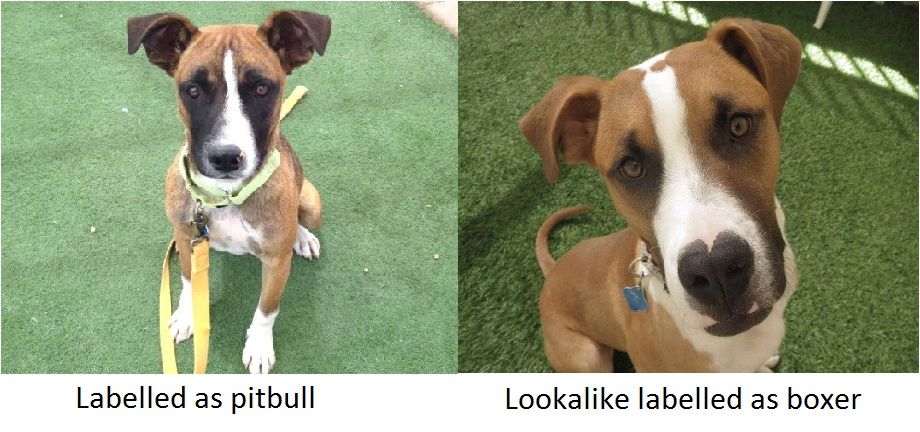
These two dogs may look similar, but the pit bull label could mean that the one on the left may wait a lot longer to find a home. (Arizona Animal Welfare League)

When the dogs were not labeled as any particular breed, participants ranked pit bulls and look-alikes (dogs that were the same size and color as the pit bulls) as equally attractive. Potential adopters even ranked the pit bulls in video recordings as more attractive than the non-pit bull matches. When the researchers introduced breed labels, however, that trend reversed, with participants ranking the same dog as significantly less attractive than similar dogs without the label.

The researchers also found that pit bulls at that shelter waited over three times as long to find a home as their matched counterparts.

Finally, the team analyzed a set of data from an animal shelter in Florida that recently removed breed descriptions altogether. When freed from the loaded label, pit bull-like dogs were much more likely to find a home. Adoptions of these dogs increased by more than 70 percent, compared with the prior year, and the shelter’s euthanasia rate for the same group dropped by 12 percent, probably because more of them were finding homes.

Taken together, these results “are very convincing that breed labels negatively impact any dog that is labeled as ‘pit bull,’” says Erica Feuerbacher, who studies dogs at Carroll College in Montana and was not involved in the study. “Furthermore, we know from other studies that humans are quite bad at correctly labeling breeds, so many dogs could be erroneously labeled pit bull—even though they are not—and by that label they become less adoptable.”

Eliminating breed labels, which people seem to be using as poor proxies for stereotyped traits, may be the key to banishing a significant amount of dog discrimination—and getting more dogs into homes, Feuerbacher and the other researchers argue. There is also a need to devise better means of measuring dogs’ true personalities, including their potential for aggression, and of ensuring those assessments are valid not just in the shelter environment but also in homes, Gunter notes.

“We want to drive the adoption conversation toward evaluating whether an individual dog, regardless of the breed, is a suitable candidate for adoption,” she says. “Then we can match-make between the personality of the dog and that of the person, instead of just relying on labels.”

ooOOoo

You can see why it so perfectly followed on from yesterday!

Not just my post but yesterday’s comments. Such as this from Tony:

Another example of form over substance. When will we learn?

So I know you will all cheer Erica Feuerbacher who is quoted towards the end of that Smithsonian essay and I will close with her words, in part: “We want to drive the adoption conversation toward evaluating whether an individual dog, regardless of the breed, is a suitable candidate for adoption. Then we can match-make between the personality of the dog and that of the person, instead of just relying on labels.

Oh, and a very Happy April Fool’s Day!

What’s in a name?

“What’s in a name? That which we call a rose by any other name would smell as sweet”.

That very well-known quotation from Wm. Shakespeare was the obvious sub-title to today’s post.

You will be aware that I have written several times previously about Pit Bull dogs. But I would like to draw your attention to a post that was published here back in 2013. It was called In praise of Pit Bull dogs and featured a guest post from Noella Schink, in Portland, Maine, where she then lived and played with her 3-year-old pit bull mix, Addie, 8-year old shih-tzu, Brutus, and 2-year old hound, Lula. Apart from all of them being a little older I trust nothing else has changed.

That post in 2013 also included a picture of our gorgeous Casey, as follows.

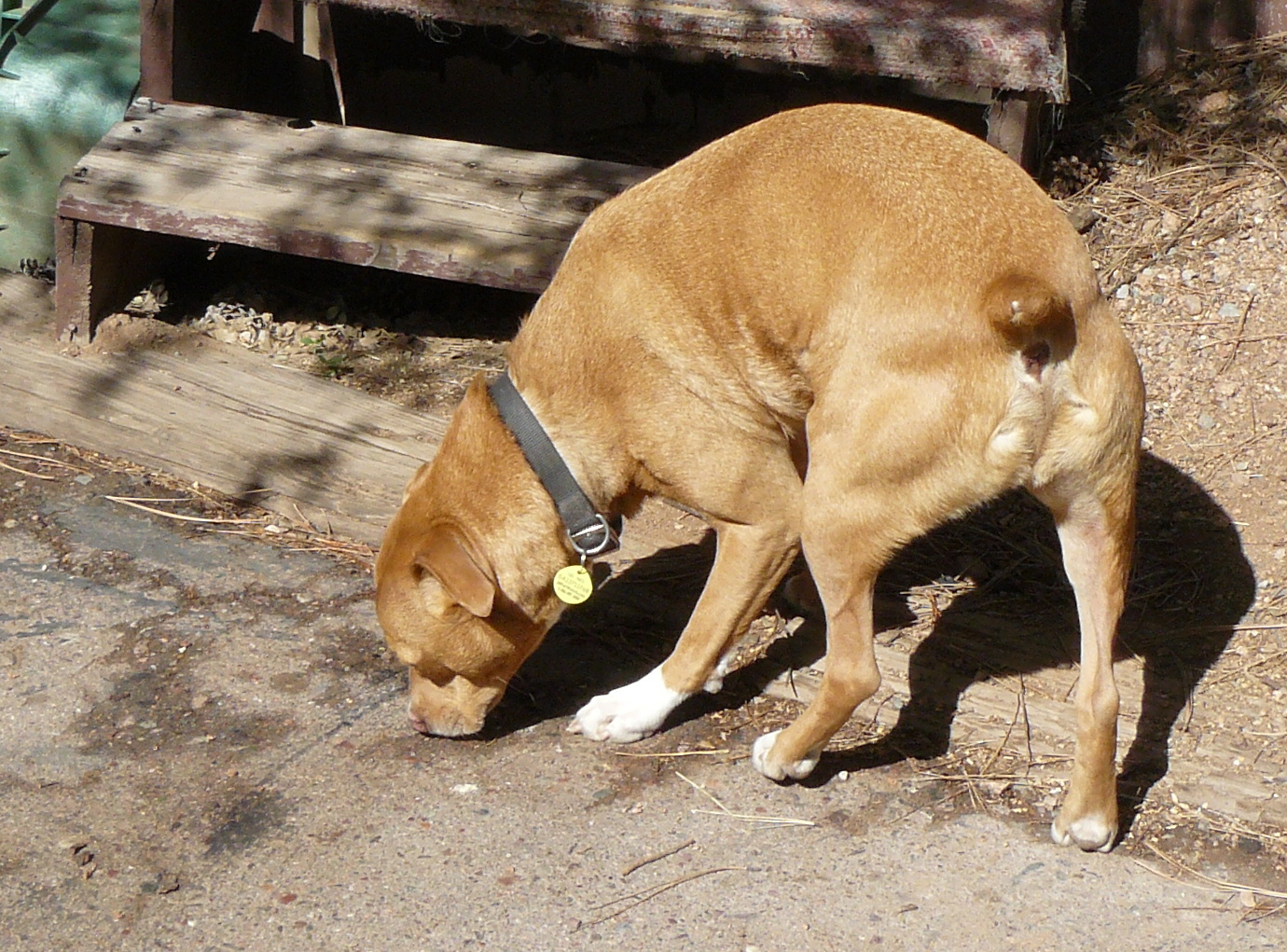
Casey doing what dogs do so well – picking up a scent.
Casey doing what dogs do so well – picking up scents around his home.

Over on the Care2 petition site there was a compelling case being made for Pit Bulls to be given a different name. Read it and see if you are convinced of the need.

ooOOoo

How We Could Save More Dogs From Death Row by Changing One Thing

By: Jessica Ramos, March 29, 2016

About Jessica

3172603.large

Whether we like it or not, labels matter — even for dogs. New research from Arizona State University published in PLOS ONE, suggests labels could even lead to a potential death sentence, if you’re a pit bull.

Pit Bulls Wait 3 Times as Long to be Adopted

The pit bull went from America’s darling dog to one of the most feared (and misunderstood) dogs today. Their fall from grace is evident in stories like Olive’s. Olive the Pit Bull was brought in as a stray and stayed in the shelter for approximately 11 years. Olive was lucky enough to find her forever home, but so many dogs like her aren’t — and our arbitrary labels aren’t helping their cause.

According to Science Daily, researchers from Arizona State University wanted to know if breed identification influences adoption. The researchers found that dogs labeled as “pit bulls” could wait three times as long to be adopted from shelters into their forever homes compared to their lookalikes without the label or labelled as another breed.

Compared to other breeds, like Labradors, pits were perceived as less friendly and more aggressive. They also were considered less “attractive” than their lookalikes. Weird, right?

Even the researchers were surprised by how much the pit bull label influences perception and, ultimately, adoption. As researcher Lisa Gunter from Arizona State University explains, “We were surprised how very similar looking dogs sometimes get labelled ‘pit bull’ and other times as something completely different. These dogs may look and act the same, but the pit bull label damns them to a much longer wait to adoption,” reports Science Daily.

Ultimately, the researchers recommend losing the pit bull label to stop inadvertently penalizing these dogs in the shelter setting.

Heartbreaking Pit Bull Statistics

If you thought that Olive’s story was sad, she’s actually one of the lucky ones — not only for getting adopted, but for staying in the shelter system for the 11 years that she did.

According to Pit Bull Rescue Central (PBCR) 200 pit bulls are euthanized in Los Angeles County animal shelters every single day.

PBCR emphasizes that “for homeless pit bulls the death sentence is almost always automatic.”

Villalobos Rescue Center (made popular by the TV show Pit Bulls and Parolees) had this to say about the pit bull plight in Los Angeles: “The pit bull population has now risen to 40% of all the dogs in 12 shelters in Los Angeles. That means that almost half of the entire Los Angeles dog population is pits or pit mixes! Most are strays, tossed out like dirty laundry. It’s heartbreaking.”

Sadly, the plight of pit bulls is not limited to Los Angeles County. A 2013 Nat Geo Wild infographic reveals that:

  • 60 percent of the total dogs euthanized in U.S. shelters are pit bulls
  • 30 percent of the total dogs admitted to shelters are labeled pit bulls
  • 86.7 percent of pit bulls admitted to open admission shelters are euthanized

Do you know what the worst part of this sad situation is? There’s no such thing as a pit bull.

As Bark Post explains, the pit bull label is just “an umbrella term that most people use to refer to different types of dogs – the American Pit Bull Terrier, the American Staffordshire Terrier, the Staffordshire Bull Terrier, any mixes thereof, and any dog that vaguely resembles these dogs.”

The breed isn’t real, but the stigma has real consequences. And time and again pit bulls prove that they can be great dogs with the correct guidance and training when they get a second chance. Remember how Jericho the Pit Bull went from death row to being an amazing service dog?

Take Action!

Sign and share this petition urging animal rescuers to lose the stigmatizing pit bull label that unnecessarily penalizes innocent dogs. It’s a matter of life and death.

Photo Credit: Max Schneider

ooOOoo

I can’t better the comment to that Care2 item left by Sheri.

Only idiots believe that pit bulls are bad! When are some morons going to finally wake up and realize bad owners are responsible for bad dogs! BSL should be banned everywhere. We must never stop fighting to end the senseless killing of this breed.

Say no more!

Just a sigh between friends.

Something in common with our dogs, or not?

These days there is plenty to sigh about. Whether it’s presidential politics this side of the Atlantic or immigration and ‘Brexit’ in Europe. However, today’s post is not about our, as in human, sighs but is about the sighs that our dogs make.

Stay with this as I republish a recent item that appeared on Mother Nature Network.

ooOOoo

Why do dogs sigh?

Mary Jo DiLonardo, March 24, 2016.
We sigh when we're frustrated and when we're happy. What about our four-legged friends? (Photo: sgilsdorf/flickr)
We sigh when we’re frustrated and when we’re happy. What about our four-legged friends? (Photo: sgilsdorf/flickr)

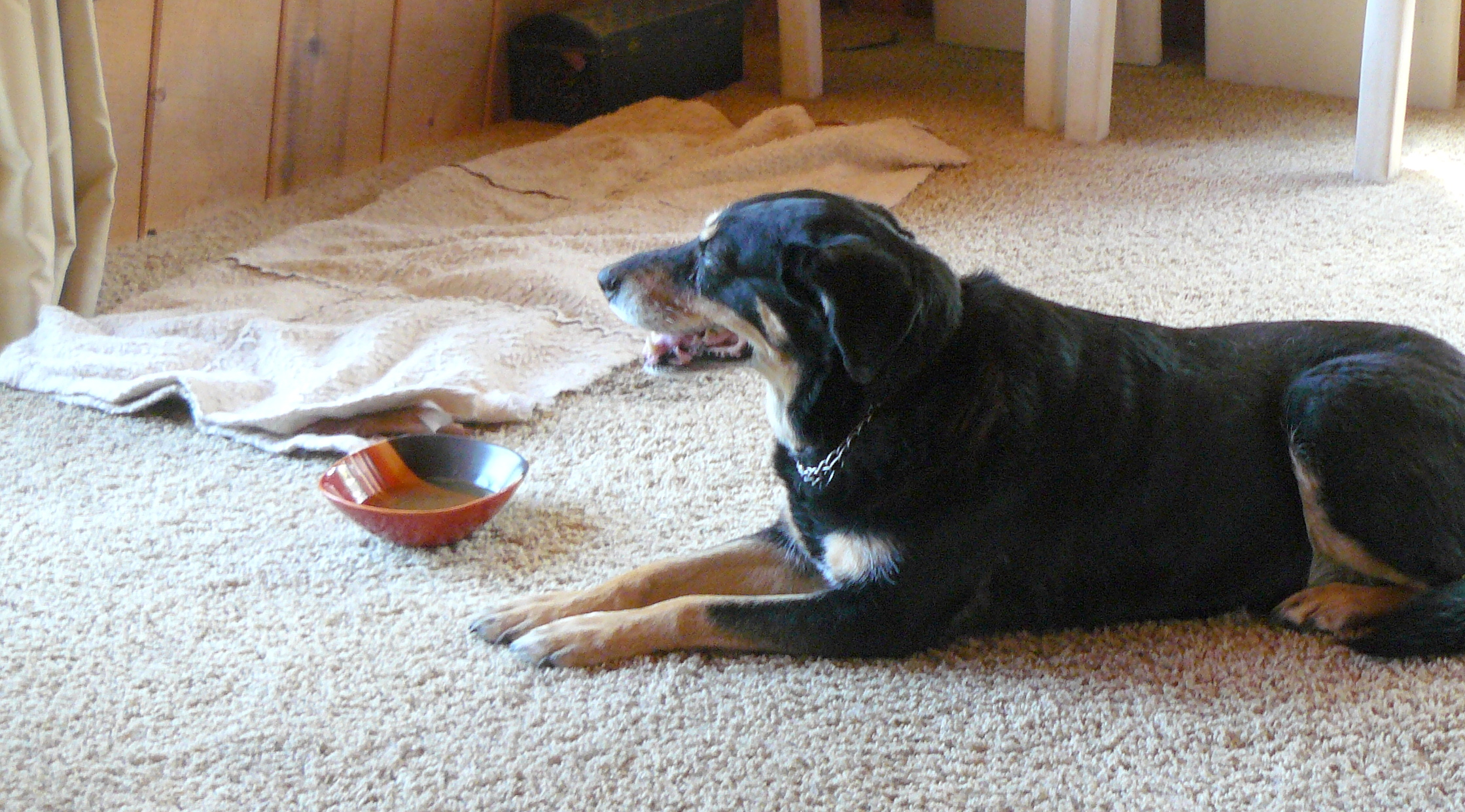
Every dog owner has experienced it at one time or another. Your dog lies down, often with his head on his front paws, and lets out a sigh. Is he sad? Content? Disappointed in his life?

It could be any of the above, it just depends on the context, says the American Kennel Club.

“When the sigh is combined with half-closed eyes, it communicates pleasure; with fully open eyes, it communicates disappointment: ‘I guess you are not going to play with me.'”

Geez. Guilt trip, anyone?

A dog’s sigh is “a simple emotional signal that terminates an action,” writes Stanley Coren, Ph.D. in his book, “Understanding Your Dog for Dummies.”

“If the action has been rewarding, it signals contentment. Otherwise, it signals an end of effort.”

So if you and your dog just finished a fun romp in the yard or a great walk in the park, that sigh means, “I’m content and am going to settle down here awhile.” If your dog has begged at your side all during dinner without a payoff, that sigh signifies, “I’ll give up now and simply be depressed.”

Dog trainer Pat Engel agrees.

“My own unscientific observation is that dogs usually sigh while resting, or when they are what I call ‘resigned,'” she writes in the San Francisco Chronicle. “These sighs seem to mark a physiological transition into a deeper state of relaxation.”

If you feel like your dog sighs (or yawns or makes other noises excessively), it’s worth mentioning to your vet, Engel suggests. There’s always a chance that a health issue might be at the root of the sounds.

If a medical reason isn’t to blame, then concentrate on reading the cues your canine is sharing.

Massachusetts dog trainer Jody Epstein says a dog’s body language is definitely the key to interpreting the noise he’s making.

“If his body is relaxed, ears soft, head down on the bed in what we might call a ‘sleeping’ position, and he’s in perfect health otherwise, then I’d expect it’s just a sign of uber relaxation,” she writes in her All Experts advice column. “If he’s laying there, but sitting up watching you and doing it, then it’s more likely an active communication that you may wish to address.”

Like, hey, buddy, isn’t it time for a treat? Or when was the last time we played ball?

One dog may sigh because he's frustrated; another may sigh because she's comfortable and is ready for a nap. (Photo: Brent Schumacher/flickr)
One dog may sigh because he’s frustrated; another may sigh because she’s comfortable and is ready for a nap. (Photo: Brent Schumacher/flickr)

Is a sigh always a sigh?

“Dogs make many vocalizations, and they mean different things depending on various factors such as context, experience, relationships, the individual dog, and much more,” says certified animal behaviorist and dog trainer Katenna Jones of Jones Animal Behavior, in Warwick, Rhode Island. “There is also human interpretation: One person’s sigh is another person’s huff, moan, groan or whine.”

And, Jones says, some breeds tend to make more or different sounds than others.

“The most important thing is to remember there is no one answer. It’s important to not apply human feelings to dogs because dogs are not humans!” she says. “Look at the context of situations in which your dog is sighing, take note, and see if you can identify why YOUR dog is sighing — because it may be different than why MY dog is sighing.”

Just because we don’t always know what our dogs are trying to say, doesn’t mean we should stop trying to figure things out.

The AKC points out: “Dogs make sounds both intentionally and unintentionally, and they all have certain meanings. Just because we do not understand the wonderful variety of sounds that dogs vocalize does not mean that dogs are not doing their best to communicate with us.”

ooOOoo

So come on, you dear readers, send in some examples of sighing and other wonderful sounds that your dogs make!

Here’s my contribution from YouTube. The sound of a German Shepherd deep asleep and a very familiar sound in this house when Pharaoh is sound asleep.

Published on Sep 5, 2014

At first I had no idea it was him. I thought maybe it was my husband (who was downstairs in the living room taking a nap) and the dogs and I were upstairs….but soon figured out it was him! This was the first time I had heard Jax snore. I especially love his little face when he was woken up by his brother. Which I think he did on purpose. Haha. It is hilarious!