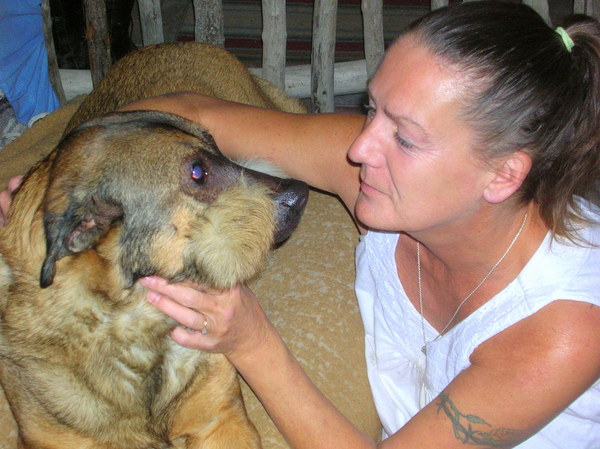
Category: Communication

In honour of St Patrick’s Day.

With huge thanks to Sally McCarthy.

Sally reposted this video that was seen on Paul Goosen’s Facebook page.

Is there no end to what our wonderful dogs can do!

Rogue Valley TV

Huge thank you to Producer John Letz and the whole crew.

A week ago last Saturday Jean and I travelled down to Ashland and to the studios of Rogue Valley Community Television (RVTV). This is how RVTV describe themselves:

Based at the Southern Oregon Digital Media Center, RVTV provides access television and streaming media services for the citizens and local governments of Jackson and Josephine Counties. Please visit rvtv.sou.edu for more information.

John Letz, the Producer for Adventures in Education and Ramping Up your English, had read my book and thought it might make a good programme.

I’m both delighted and flattered to say that the programme is now available and published under a Commons Creative Licence. Here it is!

Picture parade one hundred and thirty-eight

More glorious images of nature.

Continuing from last week.

various15oooo

various14oooo

various13oooo

various12oooo

various11oooo

various10oooo

various18oooo

various17oooo

various16Thank you, Su, for sending me these pictures.

What a beautiful planet we all live on.

Here’s another dog food alert.

It has been quiet since the last one.

That last one was on December 3rd and concerned a recall for Dave’s Pet Food.

Well two days ago Purina announced a recall but it was only alerted by Dog Food Recall yesterday. Here are the details that you can also read here.

ooOOoo

March 10, 2016 — Nestle Purina has announced it is voluntarily recalling select lots of its Beneful and Purina Pro Plan wet dog foods because they may not contain the recommended level of vitamins and minerals.

Purina discovered through its own testing that the affected dog foods did not contain the recommended level of vitamins and minerals and voluntarily recalled the product.

What’s Being Recalled?

The recall includes select lots of wet dog food 10-oz. tubs under the Beneful Prepared Meals, Beneful Chopped Blends and Pro Plan Savory Meals brands.

No other Purina products or sizes are affected.

purina-wet-dog-food-recall-480Lot Information

A complete list of included products by “Best Before” date and production code ranges are listed below:

purina-wet-dog-food-recall-march-2016-480What to Do?

Purina is conducting this voluntary recall as a precaution for those dogs who may have eaten the affected product as their only meal for more than several weeks.

If you have questions about your pet’s health, the company suggests that you contact your veterinarian.

Although most of the recalled product contains all of the vitamins and minerals your dog needs, Purina recommends that you discard any of the affected product you may have.

For more information or to request a refund, please call the company at 800-877-7919.

U.S. citizens can report complaints about FDA-regulated pet food products by calling the consumer complaint coordinator in your area.

Or go to http://www.fda.gov/petfoodcomplaints.

Canadians can report any health or safety incidents related to the use of this product by filling out the Consumer Product Incident Report Form.

Get Dog Food Recall Alerts by Email

Get free dog food recall alerts sent to you by email. Subscribe to The Dog Food Advisor’s recall notification list.

ooOOoo

Feel free to share this widely with other dog lovers. We must look after our fabulous friends.

Saturday Salute

To a very brave dog!

Jacob became blind at just six months old, but it hasn’t slowed him down one bit!

(as first seen here)

A wonderful weekend to you and all your lovely animals.

Pit Bulls – an alternative view

Dangerous dogs very, very rarely exist.

I’m not going to rant on about there never being a dangerous dog just as me saying that there never is a dangerous person is clearly factually incorrect. But they are rare!

In yesterday’s post, I shared the terrible news about Stella, a female Pit Bull mix, that because of her breed, and nothing else, has been locked up by The Devon and Cornwall Police for over two years. Sharon Stone’s petition over on the Care@ website has, at the time of writing this yesterday, received nearly 16,000 signings!

To support the proposition that for the vast majority of dogs, of all breeds, it is how they are loved and cared for by us humans that makes the difference, let me republish a post from a couple of years ago. For we have a Pit Bull mix here at home and he is the most wonderful, caring dog one could ever wish for. Here’s that post.

ooOOoo

Meet the dogs – Casey

On to dog number five.

If you are new to this series then Ruby’s story of last week will link you to all the dogs written about so far. Today, here is Jean’s account of how Casey became part of the family.

ooOOoo

Casey

Casey, at home; picture taken a month ago.

Every Friday, the Payson Roundup newspaper would devote a full page to the Humane Society, displaying some of the cats and dogs they had for adoption. I would read about each animal and quietly wish I could bring them all home.

I was particularly taken with one dog that had appeared several times in this Friday page. His name was Casey and he was a six-year-old Pit Bull mix. Unfortunately, at home (we were then living in Payson, AZ) we were ‘maxed out’ with a total of 14 dogs in three different sections of our house. We just couldn’t take Casey.

I had volunteered to be a dog-walker at the Humane Society dog shelter. But after two sessions walking dogs, I just couldn’t look at these sad little faces without breaking down in tears. I switched my efforts to working at the Society’s Thrift Store. That was great fun and, at least, it felt as though I was still helping the animals. Nonetheless, I was very impressed with the animal shelter. They did their utmost to re-home the animals in their care.

Ruby’s ‘pack’ here at home included Phoebe and Tess, rescue dogs from Mexico. Recently, Phoebe had died with leukaemia and Tess with bone cancer leaving Ruby on her own. Ruby was a dog that didn’t mix at all well with the other dogs, as was explained in last week’s post.

The next Friday, the Payson Roundup showed the Society’s ‘lonely hearts club’, highlighting animals that had been in care for a long time. The first dog shown was Casey. I telephone Chandra, the lady responsible for adoptions, and asked if Paul and I could bring Ruby to the shelter to find a companion for her. When we were at the shelter, Chandra asked us if we had anything against Pit Bulls. Of course we didn’t. Ruby was introduced to Casey and, as they say, the rest was history. Casey and Ruby right from the start were just wonderful together.

Ruby behind Casey.
Ruby behind Casey.

Subsequently, I learned from Chandra that Casey had been in care for over a year and, had we not taken him home, his days were numbered at the shelter. There were many cheers and tears when I signed the adoption paper for Casey.

Casey now lives in the kitchen group here in Oregon: Paloma, Ruby, Lilly and Casey. As with all our dogs, Casey is so happy to have our 14 acres to play in. He is also the sweetest natured of dogs and will try to climb on to your lap at the first opportunity. I have always been a great advocate of Pit Bulls and Pit Bull mixes and have never come across a mean one.

Thus, if you are in the position to adopt a dog, please consider Pit Bulls and Pit Bull mixes for the Pit Bull is a much-maligned breed.

Casey demonstrating a dog's focussing skills!
Casey demonstrating a dog’s focussing skills!

ooOOoo

If there is any news about Stella’s fate I will share that with all you dear readers without delay.

Picture parade one hundred and thirty-seven

Another Sunday, another set of fabulous images.

(Thanks to Su for sending them on to me.)

various2oooo

various3oooo

various4oooo

various5oooo

various6oooo

various7oooo

various8oooo

various9More of these in a week’s time.

Meantime, you all look after yourselves and all your loved ones.

That giving spirit.

Will you help my son support Parkinson’s UK?

Back on the 24th of February I published a post under the title of Personal Journeys. It opened thus:

Life is a one-way track.

Those of you who follow this place on a regular basis know that last Friday I published a post under the title of Friday Fondess. You will also know that later that same day I left this comment to that post:

Sue, and everyone else, we returned from seeing Dr. Lee, the neurologist, a little under two hours ago. Dr. Lee’s prognosis is that Jean is showing the very early signs of Parkinson’s disease, and Jean is comfortable with me mentioning this.

Everyone’s love and affection has meant more than you can imagine. I will write more about this next week once we have given the situation a few ‘coatings of thought’.

Jean sends her love to you all!

Thus, as heralded, I am going to write some more.

You would not be surprised to hear that the last few days have been an emotional roller-coaster, for both Jean and me. Including on Monday Jean hearing from our local doctor here in Grants Pass, OR, that a recent urine test has shown that Jean has levels of lead in her bones some three times greater than the recommended maximum. While our doctor is remaining open-minded it remains to be seen whether Jean is exhibiting symptoms of lead poisoning, whether the lead is a possible cause of the Parkinson’s disease (PD), see this paper, or whether it is a separate issue to be dealt with.

Both my son and my daughter, Alex and Maija, have been very supportive. Alex has even decided to ride in the Ride London 2016 and raise funds for the notable charity Parkinson’s UK. Parkinson’s Disease is affecting more and more people and there is a great incentive to help any charity in pushing back against this disease. As the sub-title on that Parkinson’s UK home page declares, “CHANGE ATTITUDES, FIND A CURE, JOIN US.”

Alex has started a little blog to record his preparation for his charity ride:

ooOOoo

AlexThis is my blog about training for Ride London 2016, on it I will detail what I get up to, who I’m raising money for and also cycling kit reviews as well.

So I entered the ballot for ride London this year and was unlucky, probably as I’m one of 20,000 odd middle aged men in Lycra (MAMIL) who try to get in every year, so I got my lovely rejection magazine and a cycling top as well.

I then found out that my stepmum Jean, has just been diagnosed with Parkinson’s disease, so I thought I would enter on a charity place and raise some much needed funds for research into this disease.  Found out last week that I have been lucky to get onto a charity place and so the training begins…

Link to my fundraising page, thanks 👍

ooOOoo

Please, please if anyone would like to chip in anything at all you can trust me that it will be greatly appreciated by Alex and all those around him. Donations, both from within the UK and overseas, may be made by going here.

Thank you!

Interconnections Two

Continuing the stark assessment of where we are today.

In yesterday’s post I covered the first five of the eleven facts about sea-level rise. Here are the rest of those facts.

ooOOoo


11 alarming facts about sea-level rise

Russell McLendon, February 26, 2016.

6. Sea levels could rise another 1.3 meters (4.3 feet) in the next 80 years.

sea-level rise mapThis map shows areas that would flood (marked in red) due to 1-meter sea-level rise. (Photo: NASA)

In another study published this month, scientists report that global sea levels will likely rise 0.5 to 1.3 meters (1.6 to 4.3 feet) by the end of this century if greenhouse gas emissions aren’t rapidly reduced. Even if last year’s Paris Agreement does spur ambitious climate policy, sea levels are still projected to rise 20 to 60 cm (7.8 to 23.6 inches) by 2100. Taken with the longer-term effects from melting ice sheets in Greenland and Antarctica, that means any strategy to endure sea-level rise must involve adaptation plans as well as efforts to slow the trend.

7. Up to 216 million people currently live on land that will be below sea level or regular flood levels by 2100.

coastal flooding in Typhoon FitowHigher sea levels can exacerbate storm surges, like this 2013 flood in Wenzhou, China. (Photo: STR/AFP/Getty Images)

Of the estimated 147 million to 216 million people in harm’s way, between 41 million and 63 million live in China. Twelve nations have more than 10 million people living on land at risk from sea-level rise, including China as well as India, Bangladesh, Vietnam, Indonesia and Japan. Bangladesh is especially vulnerable, identified by the U.N. as the country most in danger from rising seas. Once the ocean rises by 1.5 meters (4.9 feet) next century, it will affect 16 percent of Bangladesh’s land area and 15 percent of its population — that’s 22,000 km2 (8,500 mi2) and 17 million people.

The situation is also urgent for low-lying island nations like Kiribati, the Maldives, the Marshall Islands and the Solomon Islands, where land is already so close to sea level that a few inches make a world of difference. Some are even mulling mass relocations — the government of Kiribati, for one, has a web page outlining its strategy for “migration with dignity.” A town on Taro Island, the capital of Choiseul Province in the Solomon Islands, is also planning to move its entire population in response to rising seas. The small community of Newtok, Alaska, has already begun the difficult process of transplanting itself away from the encroaching coast.

8. Sea-level rise can contaminate water used for drinking and irrigation.

saltwater intrusionSea-level rise can aid saltwater intrusion of freshwater aquifers, as seen in this schematic illustration. (Image: NRC.gov)

In addition to surface flooding, sea-level rise can both push up the freshwater table and contaminate it with seawater, a phenomenon known as saltwater intrusion. Many coastal areas rely on aquifers for drinking water and irrigation, and once they’re tainted by saltwater they may be unsafe for humans as well as crops.

It is possible to remove salt from water, but the process is complex and costly. San Diego County recently opened the Western Hemisphere’s largest desalination plant, for example, and several other sites are proposed in the state. Yet that may not be practical for many coastal communities, especially in less wealthy nations.

9. It can also threaten coastal plant and animal life.

loggerhead sea turtle hatchlingFloods fueled by rising seas may harm baby sea turtles, like these South African loggerheads. (Photo: Jeroen Looyé/Flickr)

Humans aren’t the only ones who’ll suffer as sea levels rise. Any coastal plants or animals that can’t quickly move to new, less flood-prone habitats could face dire consequences. As one 2015 study noted, sea turtles have a long-established habit of laying eggs on beaches, which need to stay relatively dry for their babies to hatch.

Inundation for one to three hours reduced egg viability by less than 10 percent, the study’s authors found, but six hours underwater cut viability by about 30 percent. “All embryonic developmental stages were vulnerable to mortality from saltwater inundation,” the researchers write. Even for hatchlings that do survive, being starved of oxygen in the egg could lead to developmental problems later in life, they add.

Other beach life may also be at risk, including plants. A recent study found that some salt marshes can adapt, both by growing vertically and by moving inland, but not all flora will be so fortunate. “Trees have to work harder to pull water out of salty soil; as a result, their growth can be stunted — and if the soil is salty enough, they will die, a common sign of sea-level rise,” Climate Central explains. “Even trees that are especially suited to salty soil can’t survive repeated flooding by seawater.”

10. Global flood damage for large coastal cities could cost $1 trillion a year if cities don’t take steps to adapt.

sea-level rise in TokyoThis Google Earth simulation shows a Tokyo neighborhood with 1.3-meter sea-level rise. (Image: Google Earth)

The average global losses from flooding in 2005 were about $6 billion, but the World Bank estimates they’ll rise to $52 billion per year by 2050 based on socioeconomic changes alone. (That means things like increasing coastal populations and property value). If you add the effects of sea-level rise and sinking land — which is happening even faster in some places — the cost could surge to $1 trillion per year.

11. It’s too late to stop sea-level rise — but not too late to save lives from it.

iceberg off GreenlandA full moon shines over an iceberg that broke off Greenland’s Jakobshavn Glacier. If the entire Greenland ice sheet melted, sea levels would rise about 6 meters, or 20 feet. (Photo: Joe Raedle/Getty Images)

Unfortunately, CO2 emissions linger in the atmosphere for centuries, and today’s CO2 levels have already committed Earth to dangerous sea-level rise. About 99 percent of all freshwater ice resides in two ice sheets: one in Antarctica and one in Greenland. Both are expected to melt if humanity’s CO2 output isn’t curbed quickly, but the question is when — and how much damage we still have time to prevent.

The Greenland ice sheet is smaller and melting more quickly. If it completely melted, sea levels would rise by about 6 meters (20 feet). The Antarctic ice sheet has been more buffered from warming so far, but it’s hardly immune, and would raise the ocean by 60 meters (200 feet) if it melted. (Estimates vary widely on how long these ice sheets might survive — while most expect they’ll take centuries or millennia to melt, a controversial 2015 paper suggested it could happen much more quickly.)

Sea levels have naturally risen and receded for billions of years, but they’ve never risen this quickly in modern history — and they’ve never had so much human help. It’s unclear what effect they’ll have on our species, but what is clear is that our descendants will still be dealing with this problem long after we’re all gone. Giving them a head start on a solution is the least we can do.

“With all the greenhouse gases we already emitted, we cannot stop the seas from rising altogether, but we can substantially limit the rate of the rise by ending the use of fossil fuels,” says Anders Levermann, a climate scientist at Columbia University and co-author of the new study on future sea-level rise. “We try to give coastal planners what they need for adaptation planning, be it building dikes, designing insurance schemes for flooding or mapping long-term settlement retreat.”

As another recent study pointed out, any policy decisions made in the next few years and decades “will have profound impacts on global climate, ecosystems and human societies — not just for this century, but for the next ten millennia and beyond.”

ooOOoo

Tomorrow, in the final part of this three-part posting I will look at some positive things that we can all be doing now.

But let me leave you with a rather beautiful consequence of these changing times. As seen over on Grist:

ooOOoo

Incredible glacier art pays homage to our disappearing ice

Interconnections One.

The beat of a butterfly’s wings.

From Wikipedia:

The Butterfly Effect is a concept that small causes can have large effects. Initially, it was used with weather prediction but later the term became a metaphor used in and out of science.[1]

In chaos theory, the butterfly effect is the sensitive dependence on initial conditions in which a small change in one state of a deterministic nonlinear system can result in large differences in a later state. The name, coined by Edward Lorenz for the effect which had been known long before, is derived from the metaphorical example of the details of a hurricane (exact time of formation, exact path taken) being influenced by minor perturbations such as the flapping of the wings of a distant butterfly several weeks earlier. Lorenz discovered the effect when he observed that runs of his weather model with initial condition data that was rounded in a seemingly inconsequential manner would fail to reproduce the results of runs with the unrounded initial condition data. A very small change in initial conditions had created a significantly different outcome.

We all live in an interconnected world. Frankly, it’s such an obvious statement that one presumes that very few would not agree with the sentiment expressed within it.

But (and you knew there was a ‘but’ coming, didn’t you!) very few of us (and I include Jean and me to a very great extent) really understand, “A very small change in initial conditions had created a significantly different outcome.”

Take these few items; more or less randomly read over the last few days.

Such as this post over on Patrice Ayme’s blog.

Biblical Flood Starting Anew

Abstract: update on Sea Level Rise. The meat of the essay is at the end, in the section “THE SITUATION IS ACTUALLY CATACLYSMIC“.

Heard of The Flood? As in the Bible? Sea level rose 120 meters (400 feet), in the period centered around 10,000 years ago. The cause? More than half of Earth’s ice melted in a few millennia,  During the rest of the early Holocene, the rate of rise of the world’s ocean reached peaks as high as 60  millimeters (2.5 inches) per year. The melting of the ice happened because Earth’s positional and orbital parameters had made northern hemisphere’s summers too warm (most of the ice shields rested on the large continents of the north). Nowadays only two enormous ice shields are left: Greenland and Antarctica.

Those who enjoy catastrophes will love it: we have 75 meters of further sea rise to enjoy pretty soon, on our way to a Jurassic climate (the Jurassic was characterized by gigantic warm shallow seas on top of the continents). Here was the situation in the Miocene, when CO2 was at 500 ppm (where we will be at in ten years, see conclusion below).

Patrice said that the essence, the meat, of his essay was at the end. Here are his closing words:

Three scientific papers published in the last two months support my, admittedly drastic, point of view. One observed the collapse of a colossal glacier in northwest Greenland, eaten by a current at one degree C. It was a miniature reproduction of what to expect for entire ice shields. Two others observed the past, and that Antarctica was unstable at 500 ppm CO2. What they did not say is how dramatic the situation was. Indeed, sounding moderate is how they get funded by a benevolent, plutocratically ruled government (and by government, I also mean the corrupt Supreme Court, not just the latest elected buffoons). The scientists who evoked the 500 ppm of CO2 omitted two significant details, where the devil lurks. They claimed that it would take 30 years to get there. That’s not correct; at the present rate, we will add 100 ppm of CO2 within 25 years. But not just that: there are other man-made GreenHouse Gases (GHG): CH4, NOx, Fluorocarbons, etc. All these gases warm up the lower atmosphere much more than CO2. So the correct measurement is not CO2 ppm, but CO2 EQUIVALENT ppm.

We are right now ABOVE 450 ppm in EQUIVALENT CO2, and will be at 500 ppm within ten years. Let’s hope there will be more boats than on the Titanic.

Patrice Ayme’

P/S: If anything, the preceding is a conservative estimate. Indeed very serious scientists evaluated already the man-made greenhouse gases at 478 ppm in 2013. This means we will be above 500 ppm in CO2 equivalent within six years, in line with my previous analyses, such as “Ten Years To Catastrophe“. See:

http://oceans.mit.edu/news/featured-stories/5-questions-mits-ron-prinn-400-ppm-threshold

Now it’s not all ‘doom and gloom’ and there is much that each and every one of us can do. More of that in Interconnections Three on Thursday.

But to continue with this ‘wake up call’ I’m going to republish in full an item that was recently published over on Mother Nature Network: 11 alarming facts about sea-level rise. To stop today’s post being excessively long, I’m going to split that MNN article over today and tomorrow. Here are the first 5 alarming facts. (Don’t read them just before turning the light out when going to bed tonight!)

ooOOoo

11 alarming facts about sea-level rise

Russell McLendon,  February 26, 2016.
 Up to 216 million people currently live on land that will be below sea level or regular flood levels by 2100. (Photo: Shutterstock)
Up to 216 million people currently live on land that will be below sea level or regular flood levels by 2100. (Photo: Shutterstock)

The ocean is coming for us. Global sea levels are now rising by 3.4 millimeters per year, up from an average rate of 1.4 mm per year last century. In just 80 years, the ocean could be a full 1.3 meters (4.3 feet) taller than it is today.

That kind of planetary sea change can be hard to fathom — unless you live in a low-lying place like Miami, the Maldives or the Marshall Islands, where the effects of sea-level rise are already apparent. But within just a few decades, the problem will become unavoidable in major coastal cities around the world, from New Orleans, New York and Amsterdam to Calcutta, Bangkok and Tokyo.

We all know why this is happening. Rising seas are one of the most salient effects of man-made climate change, triggered by thermal expansion of seawater as well as the influx of melting glaciers. Yet many people still see it as a distant risk, failing to grasp how (relatively) quickly the sea is swallowing shores worldwide. And since half of all humans now live within 60 kilometers (37 miles) of a coast, this isn’t a niche issue.

To help put things in perspective, here’s a deeper look at the problem:

1. Global sea levels have already risen by 8 inches (200 mm) since 1880.

sea-level-rise-1880-2014

The chart above was produced by NASA’s Earth Observatory, based on data from the U.S. National Oceanic and Atmospheric Administration (NOAA) and Australia’s Commonwealth Scientific and Industrial Research Organization (CSIRO). Most of those historical data come from tide-gauge measurements, which are now complemented by satellite observations.

2. Not only are sea levels rising; the rate of their rise is rising.

Average global sea-level rise is now 3.41 mm per year, but the rate varies widely by location. (Image: NASA GSFC)

On average, sea levels rose by 1.4 mm from 1900 to 2000. The yearly pace had surpassed 3 mm by 2010, and now it’s up to 3.4 mm per year.

3. That’s the fastest sea-level rise Earth has experienced in 3,000 years.

Cb5MxZ4WIAAAW06If not for surging carbon dioxide in the atmosphere, sea levels should have only risen about an inch or two last century, and might have even fallen. Instead, thanks to the highest CO2 levels at any point in human history, global sea levels rose by 5.5 inches (14 cm) between 1900 and 2000. That’s the fastest oceanic advance in 27 centuries, according to a study published Feb. 22, and it’s still speeding up.

“The 20th century rise was extraordinary in the context of the last three millennia — and the rise over the last two decades has been even faster,” says lead author Robert Kopp, a climate scientist at Rutgers University, in a statement.

“Scenarios of future rise depend upon our understanding of the response of sea level to climate changes,” adds co-author Benjamin Horton. “Accurate estimates of sea-level variability during the past 3,000 years provide a context for such projections.”

4. Every vertical inch of sea-level rise moves the ocean 50 to 100 inches inland.

Miami coastal flooding
Rising seas worsen regular flooding — like this 2015 high tide in Miami Beach — for many coastal cities. Miami is in the midst of a five-year, $400 million effort to upgrade its stormwater pump program. (Photo: Joe Raedle/Getty Images)

5. That’s already causing flood problems in many big coastal cities.

CLICK HERE TO SEE THE EFFECT ON BIG COASTAL CITIES

As the ocean invades coastal cities, the first signs of trouble are often urban saltwater floods. These can also happen naturally, though, so to determine the influence of rising seas, a new report by Climate Central models “alternative histories simulating the absence of anthropogenic climate change” at 27 U.S. tide gauges.

Out of 8,726 days since 1950 when unaltered water levels exceeded the National Weather Service thresholds for local “nuisance” floods, 5,809 didn’t exceed those thresholds in the alternative histories. “In other words,” the report explains, “human-caused global sea level rise effectively tipped the balance, pushing high-water events over the threshold, for about two-thirds of the observed flood days.”

Coastal flooding days have more than doubled in the U.S. since the 1980s, according to the report, in places ranging from Miami, Virginia Beach and New York to San Francisco, Seattle and Honolulu. According to a 2014 report, at least 180 floods will strike Annapolis, Maryland, during high tides every year by 2030 — sometimes twice a day. The same will be true for about a dozen other U.S. cities by 2045, not to mention many other low-lying urban areas around the world.

ooOOoo

To be continued tomorrow.