Yes, nature can be cruel but in ways that we understand. Animals, to the best of my knowledge, do not hunt for sport. Animals do not lie. They don’t seek political power (sorry; couldn’t resist that!).
All of which is my short introduction to an item that Dan sent me yesterday.
ooOOoo
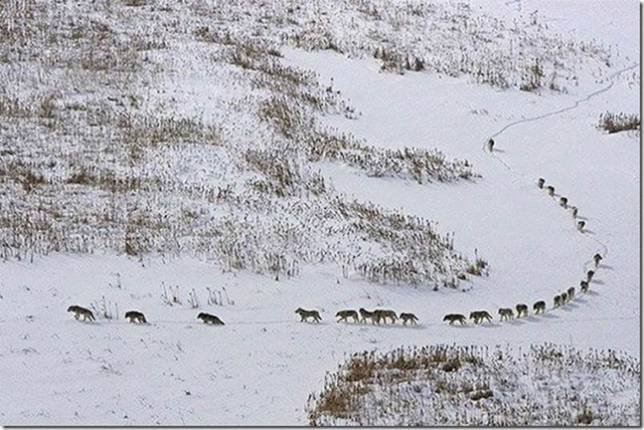
Cesare Brai’s photo.
A wolf pack: the first 3 are the old or sick, they give the pace to the entire pack.
If it was the other way round, they would be left behind, losing contact with the pack. In case of an ambush they would be sacrificed.
Then come 5 strong ones, the front line. In the center are the rest of the pack members, then the 5 strongest following. Last is alone, the alpha. He controls everything from the rear.
In that position he can see everything, decide the direction. He sees all of the pack. The pack moves according to the elders pace and help each other, watch each other.
For once I am speechless, I knew that wolves are different, but didn’t realize how much we could learn from them…
ooOOoo
Compelling, eh! But factually correct?
No!
In this case Nature is not guiding us. It is man misguiding us.
That makes for a compelling and inspirational story about teamwork — but it’s not true.
David Attenborough took the photo in question for the BBC’s “Frozen Planet” Series in 2011. It shows 25 timber wolves hunting bison in Wood Buffalo National Park in Canada. The female alpha wolf led the pack, and the others followed in a single file line to save energy as they made their way through deep snow, according to the environmental website Benvironment.
Wolf packs are typically about half the size of the pack pictured in the photo from 2011. Most packs don’t hunt prey the size of bison (which is 10 times the size of a wolf), but the larger pack is able to. And the wolves walking in a single file line through deep snow is a classic example of how they’re able to use weather conditions to their advantage while hunting prey that’s much larger than them.
Also, the idea that wolves have to be on the lookout for “ambushes” or attacks isn’t true, either. Wolves are at the top of the food chain and have no natural predators. Aside from turf battles with other wolves (which wouldn’t start in an ambush) bears are the only threat to wolves in Canada. Even so, experts say that bears are only able to prey on wolf pups because grown wolves are too fast, swift and clever to get caught by them.
I will close with this quotation from Andre Gide:
Believe those who are seeking the truth. Doubt those who find it.
Back on the 13th September, I published a post under the title of Listening to our pets in more difficult times. I mentioned that Pharaoh was suffering pain in his rear hip joints and struggling at times to get up on all four feet and that we had started giving him Rimadyl.
Don’t wait around for a vet to tell you that your dog is in pain. You live in a state with legal MJ plus hemp oil is legal in all 50 states. I give CBD oil to my BC X Aussie 12 year old dog. He could not get up and yelped in pain before I began giving him 0.7ml daily that I drizzle over his food., After second dose he could stand up without help. Now he walks and runs with fluid movements of all limbs. It is totally safe and doesn’t require expensive tests, The danger of Rimadyl and other meds in that class used to treat arthritis, is that these types of meds cause kidney damage and your pet will have a shortened life span. Hemp oil works like a charm with no side effects.
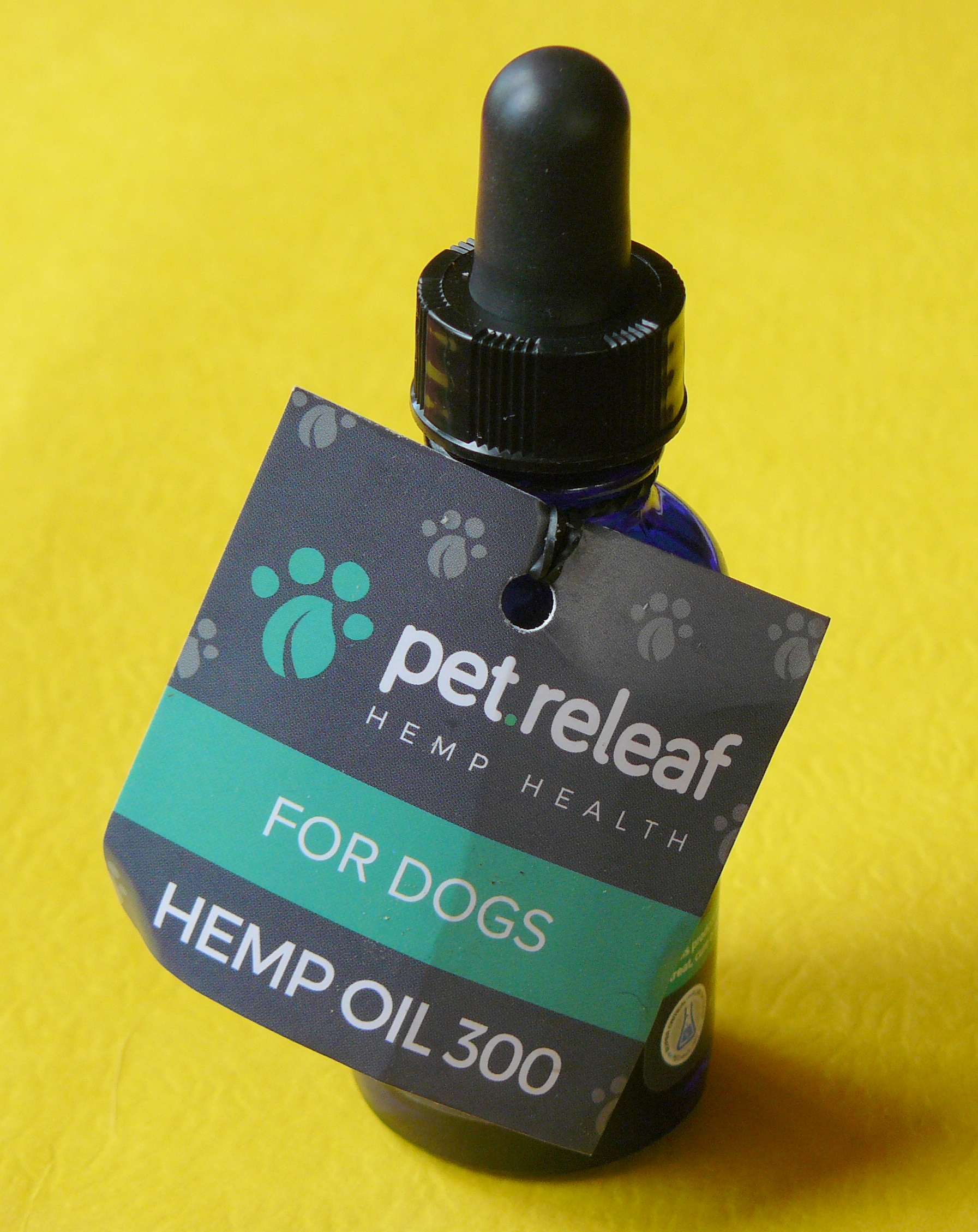
We did some research and came across the following brand of Hemp (CBD) Oil specifically for dogs. We ordered it and it arrived last Saturday. Jean did not delay in adding* it twice a day to the food for both Pharaoh and Paloma.
Here we are at the end of Tuesday, at the time of writing this post, and already we can see observable improvements in both dogs.
Yes, it’s early days but I wanted to share this with you now.
There will be a more extensive report from me once these dogs have been using the oil for a few weeks.
One dropperful twice a day for Pharaoh, approx. 105 lbs, and half a dropperful twice a day for Paloma, approx. 45 lbs.
Returning to the fascinating topic of how dogs understand us humans.
At the beginning of the month I published a post called Be Careful What You Say. It featured an item on BBC Radio Four regarding the science report from a team in Hungary seeking better to understand how dogs process human vocal sounds, as in speech. (The science report was rapidly featured in many other media outlets.)
Anyway, I am delighted to say that the Rights & Permissions Department of the AAAS pointed out that:
Virginia’s article is freely available on our open news website (http://www.sciencemag.org/news) so rather than post, please link to it (http://www.sciencemag.org/news/2016/08/video-your-dog-understands-more-you-think). Your site visitors will encounter no barriers to viewing the article on our website. We welcome hyperlinks to Science articles provided a plain text link is used and providing our content is not framed. We also ask that the text surrounding the hyperlink not imply any endorsement of your website, products or services by AAAS/Science.
The article, written by Virginia Morell, primarily features a video (see below) but I will just republish Virginia’s opening paragraphs.
It’s the eternal question for pet owners: Does your dog understand what you’re saying? Even if Fido doesn’t “get” your words, surely he gets your tone when you let loose about another accident on the carpet. But a new imaging study shows that dogs’ brains respond to actual words, not just the tone in which they’re said. The study will likely shake up research into the origins of language, scientists say, as well as gratify dog lovers.
“It’s an important study that shows that basic aspects of speech perception can be shared with quite distant relatives,” says Tecumseh Fitch, a cognitive biologist at the University of Vienna, who was not involved in the work.
The new results add to scientists’ knowledge of how canine brains process human speech. Dogs have brain areas dedicated to interpreting voices, distinguishing sounds (in the left hemisphere), and analyzing the sounds that convey emotions (in the right hemisphere).
The finding “doesn’t mean that dogs understand everything we say,” says Julie Hecht, who studies canine behavior and cognition at City University of New York in New York City and who was not involved in the study. “But our words and intonations are not meaningless to dogs.” Fitch hopes that similar studies will be done on other domestic animals and on human-raised wolves to see how much of this ability is hardwired in dogs and how much is due to growing up among talking humans.
What a wonderful relationship dogs and humans have with each other!
Over the week-end Jean and I were down in Medford at this event promoting my book Learning from Dogs.
Inevitably, we saw many dogs and their owners come in to the store for we were positioned just inside the main door. Likewise, inevitably we saw a whole range of ‘relationships’ between those dogs and their human companions.
It reminded me of a recent TED Talk that was given by Ian Dunbar about dog training. For those who have not previously come across Mr. Dunbar, his bio reads as follows:
http://www.ted.com Speaking at the 2007 EG conference, trainer Ian Dunbar asks us to see the world through the eyes of our beloved dogs. By knowing our pets’ perspective, we can build their love and trust. It’s a message that resonates well beyond the animal world.
Veterinarian, dog trainer and animal behaviorist Ian Dunbar understands our pets’ point of view. By training dog owners in proper conduct (as much as he trains the dogs themselves), he hopes to encourage better relationships with dogs — not to mention their friends and children, too.
Why you should listen
We may call dogs man’s best friend, but according to Dr. Ian Dunbar, humans often fail to reciprocate. Dunbar’s decades of research on hierarchical social behavior and aggression in domestic animals truly give him a dog’s-eye view of human beings’ incomprehensible and spontaneous — if involuntary — cruelties.
Dunbar says we might break our unseemly, unflattering habits and usher in an “era of dog-friendly dog training” by coming to understand why dogs do what they do — Is Fido misbehaving, or just being a dog? — and the repercussions of our actions toward them. (We might foster better relationships with our fellow humans, too.) His Sirius Dog Training company focuses on training puppies to be playful, yet well-behaved. His second organization, Animalin, promotes games for dogs and puppies at an international level.
What others say
“There is no single person on the face of the planet to whom dog trainers and owners (not to mention dogs) owe more.” — Jean Donaldson, author, The Culture Clash
ooOOoo
I will close with another photograph from the PetSmart event.
(Sorry about the cardboard boxes under the table!)
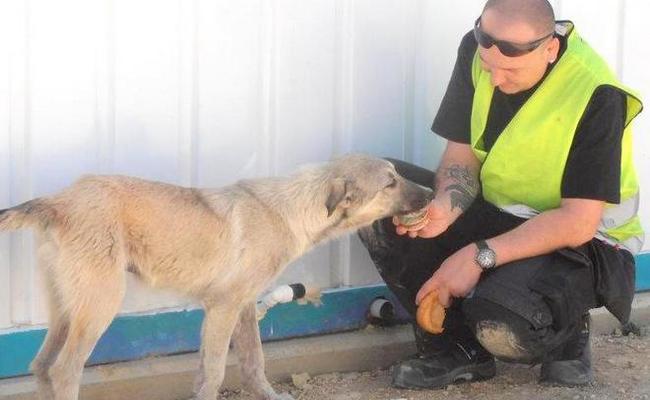
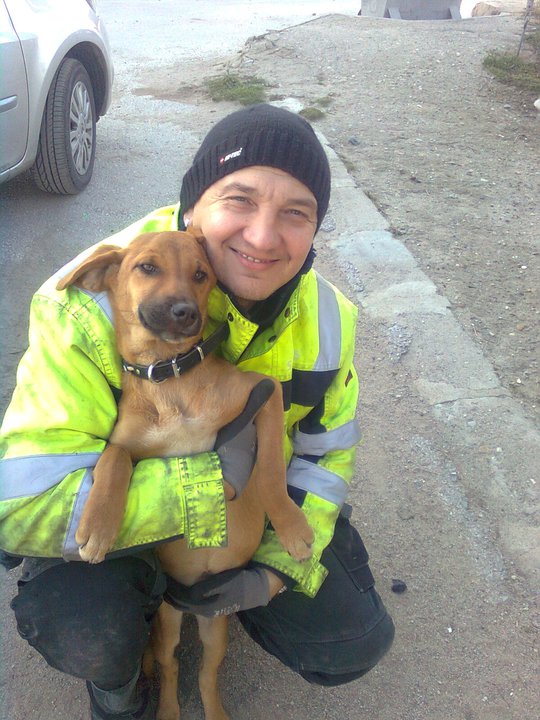
Max Kahrimanovic lives in his hard hat. It’s covered in the dust of three continents where he programs wind turbines, often at a dangerous height. But some may say Max’s greatest accomplishments unfold in the far less intricate scenarios down on the ground where he feeds hungry, and often very thirsty, stray dogs. This is the story of how Max won the trust of one of those dogs and the remarkable new life she is now beginning.
So close he could kiss the clouds, Max programs wind turbines internationally.
“I saw her the very first day I came to the construction site,” Max said of the shy sweetheart he encountered during his latest assignment in Turkey. “She was scared and wouldn’t approach no matter what. I would leave food and would have to walk away. Then, from the far, I would see her eating and drinking what I left for her. Slowly she started to trust me and one day she finally let me pet her on the head.”
From that day forward Karis (as Max named her) decided that she had adopted Max. She would keep watch outside his office door and she would be waiting for him when he arrived at work each morning.
Although she was once so afraid of human touch, Karis soon learned that Max was different than the others she’d encountered.
“She can be naughty at times,” Max laughs, thinking of the occasions Karis dumped over the trash cans. “She wasn’t hungry, I know that much. I was feeding her three times a day. But I guess the leftovers smelled delicious to her and she had to check it out.”
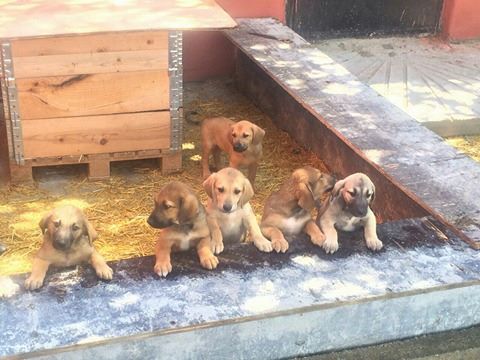
And one day, when Max arrived, Karis had a surprise for him. Overnight, she had delivered seven puppies.
“My first thought was devastation,” Max said candidly. “I know, you’ll think how can I be devastated seeing so much cuteness. But in all these years of traveling through Europe, Morocco, New Zealand, etc. I’ve seen so much misery involving these animals, that I couldn’t feel anything else at that moment.”
At this point, Max had already found a home for Karis in the U.S. and was making arrangements to transport her there. But with seven more lives to worry about, now what?
“How are we gonna manage 7 pups too?” Max wondered. “Knowing what will happen to them after I leave was devastating. I knew they will either die under car wheels, die of starvation, diseases or they will get killed by other bigger dogs that wander around there.”
So, despite the enormity of the costs and challenging logistics, Max and his wife Neli – back in Sweden – began making arrangements to transport the entire family of dogs to the U.S. for adoption. They turned to the Harmony Fund international animal rescue charity for help with the costs of the rescue.
The whole family will be coming to the U.S. soon, and Karis already has a permanent home with one of Max’s friends who has adopted internationally before. Max has no doubt that Karis will be very good to her pups during the transition as she has always been such an excellent mother.
Karis and her pups were moved to a safe location where they await travel to the U.S.
“When she had the puppies, I admired how she never went to eat their food that I gave them,” Max said. “She waited for me to get hers ready. One time I left 6 hard boiled eggs on the table for her lunch. I just stepped out to wash my hands and when I got back eggs were gone. She ate them like that, not peeled or anything.”
Max isn’t always admired for his devotion however. He said he’s known by management as “the guy who feeds strays” and that he has received warnings not to do so. But he simply can’t go against his own moral compass.
Max always makes time to offer food and water to strays like this one in Turkey.
“This is much stronger than me,” Max explains. “I can’t eat my lunch knowing there is a being, not far from me, starving and hasn’t had a piece of bread for days…. We usually work in small villages far from civilization or any bigger cities. If it is possible to buy it, then I always have one or two huge bags of dry food and some cans in the trunk of my car. And on my way from the site to my hotel, I stop and feed strays that I see. If it isn’t possible to buy dog food, then I improvise with our food by either taking extra breakfast from the hotel or just by buying extra food when I go shopping for myself. I know I can’t save them all. But for that day or that time when I meet that dog I can feed him at least and give him some water.”
ooOOoo
I am so pleased to promote what Max Kahrimanovic is doing and to thank Laura for writing this up in the first place.
Max’s admission in that last paragraph uses words that I have heard Jean using when I first met her back in December, 2006 when she was living in Mexico and rescuing so many street dogs and finding loving homes for them in the USA.
Apologies for the fact that the next few days are going to be challenging, from a blogging point-of-view.
A fraction over a month ago I introduced a post called Returning To Happy Dogs where I said:
Yesterday, I was at our local Three Rivers Hospital having a colonoscopy. The procedure was a breeze but I wouldn’t recommend the bowel prep one has to take before the procedure!😦
When the results came through I was informed that the surgeon, Dr. Nelson, had found a fairly large polyp in my colon. The polyp was about 4 cms long but, thankfully, the biopsy taken came back negative – there was no sign of bowel cancer! Joy of joys!
But tomorrow I am returning to Three Rivers Hospital early in the morning so that Dr. Nelson and his team may remove the polyp. I am uncertain as to how quickly I will be “back on my feet”.
Then on Saturday and Sunday PetSmart down in Medford, about an hour South of us here in Merlin, are holding a major cat and dog adoption event. Jean and I have been invited to attend in association with a book signing for my book as a large part of my sale proceeds are going to a local animal rescue society.
Thus for Friday, Saturday, Sunday and Monday I am going to be republishing posts from earlier times.
I made the decision to republish posts from a few years back on the assumption, and hope, that many of you dear people that have signed up to follow these scribbles will not have previously read them. Plus, I am unsure how well connected I will be in terms of replying to comments.
Loving owners want so much to know when their pets may be in pain.
Our dear Pharaoh (born June, 2003) is getting very weak in his rear hip joints and Jean and I are very sensitive to understanding whether or not he is in pain. Any loving owner of a cat or a dog would be the same; and it doesn’t stop with our cats and dogs.
September is Animal Pain Awareness Month. My Lab, Sanchez, is 13-years-old. I still sometimes have a hard time identifying the difference between a behavior problem and a physical ailment. Our dogs are so adaptable and want to please us so much, it’s sometimes challenging to detect their pain.
These often subtle signs will help you determine when your pet may be showing signs of pain. Some require a veterinary visit, but other times there are simple things you can do to help. When Sanchez had a slipped neck disc at age 9, I thought he was in so much pain that he’d never recover. A few acupuncture sessions later, and he turned into a puppy!
1. Mouth Fluttering
It wasn’t until I made a video with Sanchez in it that I noticed he was making all sorts of mouth movements. (He starts the mouth movement at :28 seconds.) I knew he wasn’t stressed and his lip licking was not a calming signal. It sparked enough curiosity that I had my vet look at this mouth. Sure enough, he needed his molars pulled. As hesitant as I was to have this operation on a 13-year-old dog, he came through it just fine and started acting much younger post-surgery. I didn’t realize he was in pain for months.
Little dog maltese refusing eating his food from a bowl in home
2. Decreased Appetite
A change in desire to eat is not always a sign of illness. It sometimes can also be about mouth pain. If you give Fido or Fluffy hard food, try some soft food and see if they want to eat. Experiment with different textures. Decreased appetite is a good reason to visit your vet.
3. Reluctance to Get In The Car
While this might happen throughout a cat’s entire life, dogs may show hesitancy getting in a car when it causes them pain to jump up (or down). Try using a ramp so that they can easily get in and out without adding any pressure to their joints.
4. Difficulty Standing Up
Older pets tend to sleep a lot and they can be slow at getting up. Give them plenty of time to stretch as they know how to listen to their own bodies. But, if Fido or Fluffy is hesitant to stand up, they may be feeling pain. Personally with Sanchez, this is one of the areas where it’s hard to tell the difference between behavior and pain. But, I can usually find out the answer quickly when I entice him with a yummy treat.
5. Decreased Activity and Engagement
When pets are in pain, they often want to be left alone. Watch for any signs of social behavior changes. Is Fido engaging with his dog buddies? Is Fluffy getting in more cat fights? Senior pets have a taxed nervous system in general and aren’t as curious as their puppy or kitty playmates. But notice if there has been any drastic change in their activity level. It may be a reason for a vet call.
The International Veterinary Academy of Pain Management (IVAPM) also offers this downloadable chart that helps you determine when you’ll need to make a vet visit.
ooOOoo
That downloadable chart is a graphical version, as in a pdf, of this post. Nonetheless, IVAPM are to be congratulated on producing the chart and for highlighting the important indicators when trying to decide whether or not to take your loved pet to see a vet.
Yesterday lunchtime was a very stressful period. Because I was speaking to various members of the family in England but especially to my sister, Eleanor, who had come over from South Africa to be with my mother, and to Rose, my cousin, who lives in Baldock, Hertfordshire, and is being so supportive.
In the middle of all of this Brandy came across to the low table where the remains of my lunchtime sandwich were still on my plate and started helping himself. I was striding around the room speaking to Eleanor and when I spotted Brandy eating my lunch I really showed my anger. I shouted “No!” and prodded him hard in the back. Brandy slunk off giving me a really foul look.
Fifteen minutes later Jean and I took the dogs outside for their regular ‘after-lunch’ leg-stretch and Brandy kept his distance from me. I went across to Brandy: “Oh, Brandy! I am so sorry for being cross with you Please forgive me.” There was real remorse in my voice and, undoubtedly, showing on my face too.
Brandy came over to me and nestled his wonderful, beautiful head against my thighs and I curled down and rubbed his chest with my left hand. As simply and as quickly as it could ever be, Brandy had forgiven me.
A short while ago I was approached by a Mary Neilsen who asked me if I would like her to write a post for Learning from Dogs. I agreed and in hindsight I am so pleased I did.
Read her wonderful post and you will understand why!
ooOOoo
Is Your Dog Holding a Grudge?
Your dog throws you that look – you know the one – and walks away. You’ve been snubbed! So what is causing this emotional outburst? Maybe your canine pal is holding a grudge.
“What have I done now?” you might ask yourself. Depending on the circumstances, you may not be guilty of anything. You may just be misinterpreting that look – or yes, indeed, your furry friend may be paying you back for some grievance.
No pet owner is perfect. We all make mistakes. We accidentally step on our pet’s tail; take away a favorite toy; or abandon them to a night alone in the house. These are things that can set our dog to turn their backs on us to teach us a lesson – if only for a little while. But is it true? Do dogs really hold grudges?
The Experts Say No
If you live with guilt every time your furry friend gives you a sideways look, you are reading too much into it, say the experts. They don’t hold grudges and they don’t act in petty ways or seek revenge. [Ed: The dogs that is not the ‘experts’! Sorry; couldn’t resist!] Their emotional lives are not as complicated as humans. Dogs are more simple creatures. They live in the moment.
According to famed canine expert Cesar Millan, dogs don’t hold long-term grudges simply because they can’t. They don’t think that way. Sure, they may act miffed now, but will soon forget what’s bothering them and move past it.
People, on the other hand, tend to hold onto negative feelings and expressing that kind of anger or anxiety can make your dog react too. In other words, if you express prolonged feelings of guilt over slamming your dog’s paw in the screen door, he may react by steering clear. It is not the action that is causing him to distance himself from you for a while; it’s your reaction to the event. In other words, it is your angst causing him to act this way.
What We Can Learn From Our Dogs
There may be some who still believe dogs can (and do) hold grudges, while research shows this assumption incorrect. Even so, there is one thing most canine psychological experts agree on and it is that we can learn an important lesson from our canine counterparts: how to let go.
Humans have a really hard time letting go of our grievances. In a recent Gallop poll, more than two thirds of participants acknowledged the importance of forgiveness, yet less than half actually were able to forgive those who hurt them. That equals a lot of grudge holding going on.
While our dogs move past every infraction, humans tend to hold on, dwelling on our hurts and allowing them to rule our lives. This can cause relational issues; depression, or worse. But, when we take after our dogs and let go of those negative feelings we can experience such benefits as:
Take a look at your dog. He seems happy enough. Wouldn’t you like to be able to experience the kind of true joy and relaxation he does? The trick to that kind of contentment is learning how to let go of those grudges and live in the moment.
Yes, people are going to hurt us. That is simply life. But those hurts do not have to cause you chronic pain. Take a cue from your dog. Allow yourself to feel the pain in the moment, and then move on. You will discover that life is a lot more enjoyable that way.
About the Author
Mary Nielsen is a passionate dog lover, blogger and part-time music teacher. She founded MySweetPuppy.net to share her ups and downs of being a pet parent to a bunch of adorable mutts. When she is not playing with them or teaching, you can find her experimenting in the kitchen.
ooOOoo
Please join with me in thanking Mary for such a delightful guest post and hoping that we will be reading more from her.
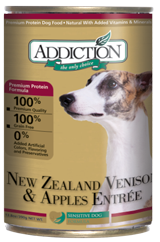
August 31, 2016 — Addiction Foods of Seattle, WA, has announced it is voluntarily recalling limited quantities of its New Zealand Brushtail and Vegetable and New Zealand Venison and Apple canned dog foods.1
What’s Being Recalled?
The affected product was shipped to select distributors and online retailers between February 11, 2016 and March 19, 2016 and include the following:
Addiction New Zealand Brushtail and Vegetables Canned Dog Food Entrée
Size: 13.8oz/390g
UPC Code: 8 885004 070028
Lot Number: 8940:02Dec2018
Expiration Date: December 2018
Addiction New Zealand Venison and Apples Canned Dog Food Entrée
Size: 13.8oz/390g
UPC Code: 8 885004 070462
Lot Number: 8936:01Dec2018
Expiration Date: December 2018
No other Addiction Pet Food products are affected by this recall.
What Caused the Recall
Addiction’s testing has identified elevated levels of Vitamin A and a slight variance in calcium / phosphorous ratios.
There have been no reports of animal health concerns. However, the company claims the affected lots do not meet its quality standards.
According to the company, Addiction Food’s top priority is the safety and quality of its products. For this reason, they are taking immediate action and implementing additional operating procedures to prevent a similar issue from occurring in the future.
What It Means to You
If dogs were fed exclusively these products for 60 days, the expected effect would be a reduction in appetite.
Exposure to excessive Vitamin A levels for an extended period of time may cause adverse health consequences in young, growing animals.
Therefore, out of an abundance of caution, the company is voluntarily recalling these products.
What to Do?
Consumers who purchased the affected items are asked to discontinue use of the product.
Unused cans may be returned to the place of purchase for a full refund.
Consumers may contact the company at 425-251-0330, Monday thru Friday 9am to 5pm PST.
Or via email at info@addictionfoods.com
U.S. citizens can report complaints about FDA-regulated pet food products by calling the consumer complaint coordinator in your area.










 Learning from Dogs