The creators of “SKYGLOW,” a crowd-funded project showing the impact of urban light pollution through time-lapse videos, photos and a book, have another stunning video to share. In “Kaibab Elegy,” filmmakers Gavin Heffernan and Harun Mehmedinović visit Grand Canyon National Park and capture a rare weather event.
In the mesmerizing video, clouds build inside the canyon almost like bubbling water filling a jacuzzi as the sun rises and sets in the background, creating the pinkest sky you’ve ever seen. Those clouds roll like waves in the ocean and crash against the cliffs. This phenomenon is called full cloud inversion, and it happens when cold air is trapped in the canyon and topped by a layer of warm air, which combines with moisture and condensation.
“We were extremely lucky to be there to capture it, and it’s a collection of unique footage not found anywhere else,” Mehmedinović says.
He and Heffernan, who journeyed 150,000 miles around the globe for their new book and video series, work with the International Dark-Sky Association, a nonprofit fighting to preserve the dark skies around the world.
Why can’t we leave nature to do what’s best for our world!
Now, I would be the first to ‘tut-tut’ a little over my sub-heading. For here I am sitting in front of a computer in a room in a reasonably-sized home that undoubtedly has denuded the natural world formerly underneath the present foundations.
Thirteen acres orientated West-East.
Plus, as the property boundary shown on the above picture confirms, about 50% of our acreage is no longer wilderness.
Ergo, it is impossible for humans to live on this planet without there being consequences that conflict with the natural order of the wild.
But homes to live in are one thing. A planned madness for the Lake District in Northern England is another thing altogether.
The attempt to turn the Lake District into a World Heritage site would be a disaster
By George Monbiot, published in the Guardian 9th May 2017
If this bid for power succeeds, the consequences for Britain will be irreversible. It will privilege special interests over the public good, shut out the voices of opposition and damage the fabric of the nation, perhaps indefinitely. No, I’m not writing about the election.
In the next few weeks Unesco, the UN’s cultural organisation, will decide whether or not to grant World Heritage status to the Lake District. Once the decision is made, it is effectively irreversible.
Shouldn’t we be proud that this grand scenery, that plays such a prominent role in our perceptions of nationhood, will achieve official global recognition? On the contrary, we should raise our voices against it. World Heritage status would lock the Lake District into its current, shocking state, ensuring that recovery becomes almost impossible.
Stand back from the fells and valleys and try to judge this vista as you would a landscape in any other part of the world. What you will see is the great damage farming has inflicted: wet deserts grazed down to turf and rock; erosion gullies from which piles of stones spill; woods in which no new trees have grown for 80 years, as every seedling has been nibbled out by sheep; dredged and canalised rivers, empty of wildlife and dangerous to the people living downstream; tracts of bare mountainside on which every spring is a silent one. Anyone with ecological knowledge should recoil from this scene.
This photo was used as the frontispiece of the “State of Conservation” section of the bid documents. It is meant to show how beautiful the fells are. If we saw it anywhere else, we would recognise it as an environmental disaster.
The documents supporting the bid for world heritage status are lavishly illustrated with photos, that inadvertently reveal what has happened to the national park. But this slow-burning disaster goes almost unmentioned in the text. On the contrary, the bid repeatedly claims that the park is in “good physical condition”, and that the relationship between grazing and wildlife is “harmonious”. Only on page 535, buried in a table, is the reality acknowledged: 75% of the sites that are meant to be protected for nature are in “unfavourable condition”.
This is another photo from the bid document, showing St John’s Beck in Thirlmere. The beck is notorious for its flashy response to rainfall – rising dangerously fast. It’s not hard to see why. As the photo shows, it has been dredged and canalised on behalf of the farmers in the valley, and now contains almost no natural features that can slow the flow.
This great national property has degenerated into a sheepwrecked wasteland. And the national park partnership, that submitted the bid, wants to keep it this way: this is the explicit purpose of its attempt to achieve world heritage status. It wants to preserve the Lake District as a “cultural landscape”. But whose culture? Whose landscape? There are only 1080 remaining farms in the district. Should the entire national park be managed for their benefit? If so, why? The question isn’t raised, let alone answered.
I can see the value and beauty of the traditional shepherding culture in the Lake District. I can also see that the farming there, reliant on subsidies, quad bikes and steel barns, now bears little relationship to traditional practice. As the size of landholdings has increased, it looks ever more like ranching and ever less like the old system the bid describes. The bid’s claim that farming there is “wholly authentic in terms of … its traditions, techniques and management systems” is neither intelligible nor true. Remnants of the old shepherding culture tend to be represented ceremonially, as its customs are mostly disconnected from the farm economy.
Shepherding is not the only cultural legacy in play. The other is that the Lake District is the birthplace of the modern conservation movement. Inspired by the Picturesque and Romantic movements, much of our environmental ethic and the groups representing it, such as the National Trust, originated here. Attempts to preserve natural beauty in the district began in the mid-18th century, with complaints against the felling of trees around Derwent Water. Today, the national park cares so little for this legacy that, as the bid admits, “there are no data available” on the condition of the Lake District’s woodlands.
The small group favoured by this bid sees environmental protection as anathema. Farmers’ organisations in the Lake District have fought tooth and nail against conservation measures. They revile the National Trust and the RSPB, whose mild efforts to protect the land from overgrazing are, with the help of a lazy and compliant media, treated like bubonic plague. As one of these farming groups exults, world heritage status “gives us a powerful weapon” that they can wield against those who seek to limit their impacts. If the plan is approved, this world heritage site would be a 230,000-hectare monument to overgrazing and ecological destruction.
30 years ago, this was a bare sheep pasture (with a couple of seeding birch trees). This is a photo I took (with my failing phone) on a hill elsewhere in Britain. It gives an idea of what parts of the Lake District fells could look like if they were allowed to recover.
This is not the only sense in which the bid is unsustainable. Nowhere in its 700 pages is Brexit mentioned. It was obviously written before the referendum, and has not been updated. Yet the entire vision relies, as the bid admits, on the economic viability of the farming system, which depends in turn on subsidies from the European Union.
Without these payments, there would be no sheep farming in the Lake District: it operates at a major loss. European subsidies counteract this loss, delivering an average net farm income of £9,600. Unsurprisingly, people are leaving the industry in droves: the number of farms in the national park is declining by 2% a year. And this is before the payments cease.
What is the national park partnership, that prepared this bid, going to do – march people onto the fells at gunpoint and demand they continue farming? Or does it hope that the government, amid the massacre of public investment that will follow Brexit, will not only match but exceed the £3bn of public money currently being passed to UK farmers by the European Union? Your guess is as good as mine. This omission alone should disqualify the bid.
The failure to mention this fatal issue looks to me like one of many attempts to pull the Herdwick wool over Unesco’s eyes. The entire bid is based on a fairy tale, a pretence that the rural economy of the Lake District hasn’t changed for 200 years. If Unesco grants world heritage status on these grounds, it will inflict irreparable harm on both our natural heritage and its own good standing.
The hills, whose clothes so many profess to admire, are naked. The narrative we are being asked to support is false. The attempt to ensure that the ecological disaster zone we call the Lake District National Park can never recover from its sheepwrecking is one long exercise in woolly thinking.
When one reads this one is left with a feeling of great sadness. A sadness that our ‘movers and shakers’ can’t resist the urge to meddle. Can’t understand the beauty that is found in nature in the raw.
Earlier on I illustrated how our own property has ‘interfered’ with the wilderness of this most beautiful Oregonian countryside. But as I hope to show you with the following photographs taken on our property back in 2014 that wild beauty can be hung on to in some measure.
Looking upstream along Bummer Creek from the driveway bridge.
I have sent a message to Unesco asking if the views of the public are being taken into account and, if so, how those views are to be communicated to Unesco. If you wish to contact them then the details are on this page: http://whc.unesco.org/en/world-heritage-centre/
Any replies from Unesco will be posted here.
UPDATE 0815 PDT May 22nd.
My email yesterday to Unesco was ‘bounced back’ as an invalid email address (despite me using the email address on the Unesco website!!).
But following George Monbiot’s reply to me, giving me the name of James Bridge (jbridge@unesco.org.uk) at Unesco, I have now sent Mr. Bridge the following email:
Dear Mr. Bridge,
I write as a British citizen, born a Londoner in 1944, to protest in the strongest possible terms to the proposal to turn the English Lake District into a World Heritage Site. This is your Tentative List reference http://whc.unesco.org/en/tentativelists/5673/.
Would you please provide me with the details of where or whom within Unesco I can write setting out in detail my objections to this proposal?
Your soonest reply would be very much appreciated.
Sincerely,
Paul Handover
I won’t hold my breath over getting a quick reply.
There are plenty more of those wonderful pictures and cartoons to come to come from Janet Goodbrod.
But a few days ago there were so many beautiful flowers blooming in the Spring sunshine that I couldn’t resist taking photographs of them and sharing them with you. All from home! (Apart from the young tree and the cows on our neighbour’s property for while not being flowery , nonetheless, they seemed to speak to me about springtime.)
oooo
oooo
oooo
oooo
oooo
oooo
Don’t ask me what the names of the various flowers are!
We all know how good are the noses of our dogs. Yet, I suspect, many do not know how truly good is that nose. The Science ABC site has a detailed account of Why Do Dogs Have Such A Great Sense of Smell?
Here’s part of that article:
Dog Nose vs. Human Nose
When we try to smell something, we inhale air with our nose and we use the same passage in our nose to exhale that air. Therefore, all the smell that we get when we are inhaling is lost when we exhale that air. However, a dog has two different air passages, one for breathing and another for smelling. This means that dogs are able to store the smell in their nose even while breathing out the air!
When dogs exhale, they send air out through the slits of their nose, but the manner in which this air is exhaled through their nose helps the dogs to draw in new odor molecules. This also helps dogs capture more smells when sniffing.
You must have noticed that dogs’ noses are always wet, but have you ever wondered why? The mucus on the dog’s nose helps it smell by capturing scent particles. A dog also has the ability to smell independently from each nostril, this helps the dog to understand from which direction the smell is coming.
The passage through which dogs smell the air contains highly specialized olfactory receptor cells, which are responsible for receiving smells. A dog contains about 225-300 million smell receptors, as compared to just 5 million of these receptors being present in a human nose.
Dog Brain vs. Human Brain
By now, we clearly know that dogs have a nose that can smell about 1,000-10,000 times better than a human, but how are dogs able to remember all the different smells that they have sensed throughout their life?
The answer lies in the difference between the brains of dogs and humans. A human brain has a larger visual cortex than dogs, whereas a dog’s brain has a much larger olfactory cortex than humans. The visual cortex is responsible for processing visual information, whereas the olfactory cortex is responsible for processing the sense of smell. A dog’s olfactory cortex is about 40 times larger than that of a human.
Working dogs are an amazing asset not only for people, but for wildlife, endangered species and even threatened habitats. Expanding on the skills dogs have for tracking down scents and guarding something important, we humans have enlisted their help in many ways for conservation.
Here are five ways dogs are contributing to environmental protection efforts.
Smell for scat
It’s amazing the amount of information that can be sussed out of an animal’s poop. We can determine diet, health, genetics — even whether or not an animal is pregnant. Scat is really important to biologists studying elusive, sensitive or endangered species. Putting dogs on the track is an ideal solution.
Take cheetahs, for example. Scientists in Africa are using dogs and their unparalleled sniffing power to find cheetah poop, all in an effort to get an accurate count on the endangered big cats. (Only 7,000 cheetahs are left in the African wild, according to estimates.) And it’s working. Two trained dogs found 27 scats in an area of 2,400 square kilometers in western Zambia, according to a study published in the Journal of Zoology. Humans, looking for cheetah tracks over the same area, found none.
Groups like Conservation Canines (a handler and dog from the program pictured above), Working Dogs for Conservation and Green Dogs Conservation specialize in this area. Conservation Canines rescues highly energetic, “last chance” dogs from shelters and trains them to track down the scat of dozens of species, from wolves to moose to owl. Even things that are nearly impossible for humans to find — the minuscule scat of endangered pocket mice or orca scat floating on the ocean surface — dogs can track down. They are able to make huge contributions to scientific studies, all without ever bothering the wildlife being studied.
Sniff out problems for wildlife
Whether it’s sniffing out invasive species like giant snails in the Galapagos or detecting disease in beehives, dogs’ noses can be put to work in searching out what shouldn’t be there so that humans can act.
Dogs are able to sniff out particular plant species, pointing ecologists to tiny patches of invasive mustard so that the plants can be removed before they take over an area.
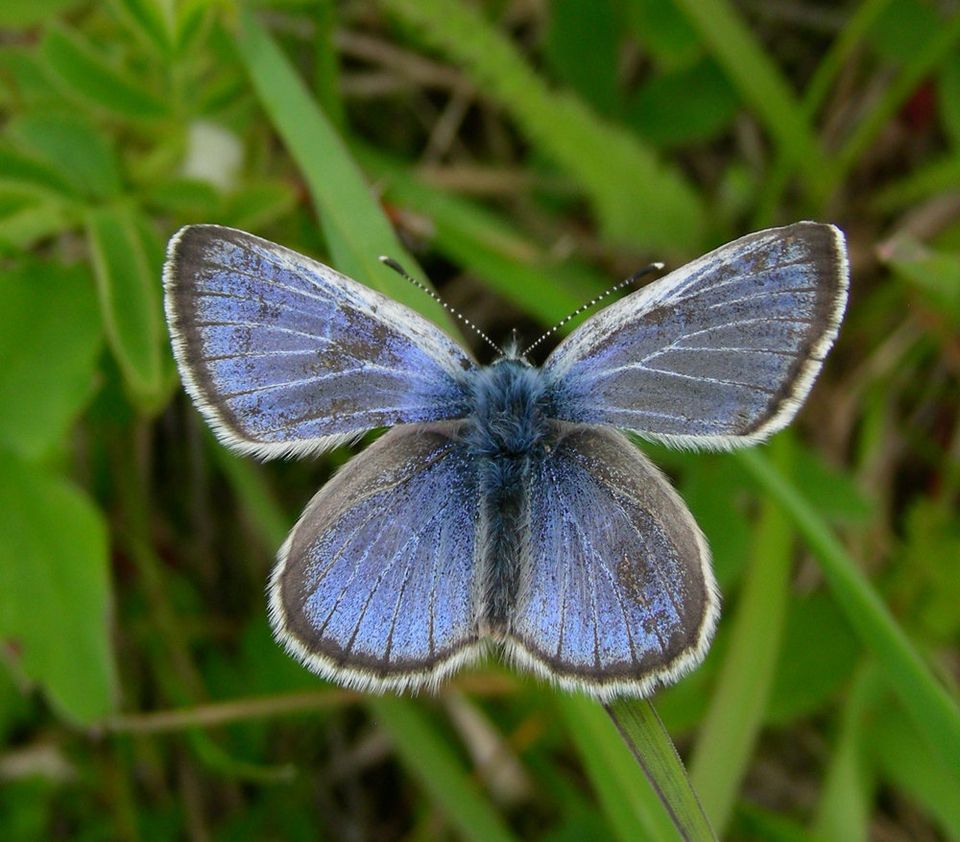
Conversely, dogs can sniff out rare or endangered native plants so that the species can be protected. Rogue is one such dog. The Nature Conservancy writes, “The 4-year-old Belgian sheepdog is part of a Nature Conservancy collaborative project to test the efficacy of using dogs to sniff out the threatened Kincaid’s lupine. The plant is host to the endangered Fender’s blue butterfly, found only in Oregon’s Willamette Valley.”
Surveying for the plant species is difficult work for people. It can only be done when the plant is in bloom so people can visually identify it. However, dogs like Rogue can sniff out the plant even when not in bloom, which can potentially double the length of the field season.
“More refined regional mapping of Kincaid’s lupine could promote the butterfly’s recovery and delisting — and contribute to larger habitat goals and wildlife impacts.”
Track down poachers
The trade in rare or endangered wildlife is a lot tougher for traffickers thanks to wildlife detector dogs. Trained to smell anything from tiger parts to ivory to South American rosewood, dogs are used in shipping ports, airports, border crossings and other locations to sniff out smuggled products.
It doesn’t stop there. Trained dogs can lead rangers to armed poachers in the wild, tracking down the culprits over long hours through heat and rain. They can catch poachers in the act, rather than just the products.
“Canine sleuths aren’t limited to the plains of East Africa, either,” reports National Geographic. “In the Democratic Republic of the Congo, bloodhounds are assisting in the fight against poaching in forested Virunga National Park, where the world’s last remaining mountain gorillas live. In South Africa, Weimaraner and Malinois dogs are helping to find wounded animals and track poachers on foot through the reserves around Kruger National Park.”
Guard endangered species
Dogs are also useful in putting their protective nature to use for endangered species.
Livestock protection dogs are trained to keep predators like cheetahs, lions and leopards safe, which then reduces conflict between ranchers and big cats and minimizes the instances of snaring or retaliatory killing of big cats. Cheetah Conservation Fund has a successful livestock protection dog program, which places Anatolian shepherd and Kangal dogs with ranchers. That not only has significantly reduced the number of livestock killed by predators but is also improving the attitude of local people toward cheetahs.
Sometimes the dogs are put to work guarding the endangered species themselves. One such successful program uses Maremma shepherd dogs to protect colonies of little penguins from foxes.
Keep bears wild
Karelian bear dogs are trained to keep bears from becoming too comfortable around people. A program by Wind River Bear Institute named Partners-in-Life uses a technique called bear shepherding. This specialized breed of hunting dog is used to scare bears away, and are an important part of the “adverse conditioning” work that keeps bears from becoming habituated. The ultimate goal is to protect bears from becoming habituated, a problem that leads to their being relocated or euthanized.
“Our Wind River Bear Institute mission, with the effective training and use of Karelian Bear Dogs, is to reduce human-caused bear mortality and conflicts worldwide to ensure the continued survival of all species of bears for future generations,” states the program.
This list is only a handful of ways that dogs help us with environmental conservation every day. More and more, we are figuring out new ways to put their skills to work, and more and more the dogs are proving they’re ready for the task!
Editor’s note: This story was originally published in July 2016 and has been updated with more recent information.
ooOOoo
Closing words from that Science ABC piece:
A dog does not care how you look or dress, but if he gets good vibes from your smell, then a dog will love you. The world is truly a better place because of these wonderful creatures that we are lucky enough to welcome into our lives.
Why not make the world smell a bit more beautiful for them?
Belay that!
Closing picture taken from the OregonLive website. A stunning picture of the “Fender’s blue butterfly, found only in Oregon’s Willamette Valley.”
It is very hard to avoid hyperbole when one speaks of global warming.
I am indebted to The Nation magazine, May 8/15 Issue, in which is included a feature article authored by Bill McKibben. My sub-heading is much of what Bill wrote in his first line.
It is hard to avoid hyperbole when you talk about global warming. It is, after all, the biggest thing humans have ever done, and by a very large margin.
A few sentences later, Bill offers this:
In the drought-stricken territories around the Sahara, we’ve helped kick off what The New York Times called “one of the biggest humanitarian disasters since World War II.” We’ve melted ice at the poles at a record pace, because our emissions trap extra heat from the sun that’s equivalent to 400,000 Hiroshima-size explosions a day.
Yet what scares me, scares me beyond comprehension, is the almost universal disregard being shown by Governments and those with power and influence right across the world to what in anyone’s language is the most pressing catastrophe heading down the tracks. Not next year; not tomorrow, but now!
Or in Mr. McKibben’s words, once more from that Nation article:
But as scientists have finally begun to realize, there’s nothing rational about the world we currently inhabit. We’re not having an argument about climate change, to be swayed by more studies and journal articles and symposia. That argument is long since won, but the fight is mostly lost—the fight about the money and power that’s kept us from taking action and that is now being used to shut down large parts of the scientific enterprise. As Trump budget chief Mick Mulvaney said in March, “We’re not spending money on that anymore. We consider that to be a waste of your money to go out and do that.” In a case this extreme, scientists have little choice but to be citizens as well. And given their credibility, it will matter: 76 percent of Americans trust scientists to act in the public interest, compared with 27 percent who think the same thing about elected officials.
Whatever your response is to what I have already presented, the one thing that I do know is that you have been aware of humanity’s effect on our atmosphere for many, many years. Indeed, Bill McKibben wrote his first book twenty-eight years ago!
His 1989 book The End of Nature is regarded as the first book for a general audience about climate change, and has appeared in 24 languages; he’s gone on to write a dozen more books.
But I would be the first to acknowledge that back in 1989 while I did become aware of Bill McKibben and did purchase and read that book of his, I didn’t see the effects he prophesied. In addition, I didn’t understand the mechanisms that would bring those effects into place.
Now, today, it’s very difficult to deny that global weather systems are behaving in ways that most do not understand albeit we do understand how those weather changes are affecting our lives.
One person who did, and still does even more, understand the physics involved in our changing weather, is Patrice Ayme. For some nineteen years after Bill McKibben’s first book, Patrice published a post on his blog. I have been following Patrice’s blog for some years and while I would be the first to stick my hand in the air and declare that some of his posts are a little beyond me, there’s no question of the integrity of his writings and his bravery in spelling out the truth of these present times. (OK, the truth a la Monsieur Aymes but I would place a decent bet of PA being closer to the core truth of many issues than Joe Public.)
I am indebted to Patrice for granting me permission to republish that post. Please read it. Don’t be put off by terms that may not be familiar to you. Read it to the end – the message is very clear.
ooOOoo
Applying Equipartition Of Energy To Climate Change PREDICTS WILD WEATHER.
By Patrice Ayme, March 8th, 2008.
Lately, the world weather has been especially perplexing, influenced by the cold ocean temperatures of a La Niña current in the equatorial Pacific. For Earth’s land areas, 2007 was the warmest year on record.
This year, record cold is more the norm. Global land-surface temperatures so far are below the 20th-century mean for the first time since 1982, according to the National Climatic Data Center. Last month in China, snowstorms stranded millions of people, while in Mumbai, officials reported the coldest day in 46 years.
Yet, England basked in its fourth-warmest January since 1914, the British Met Office reported. The crocus and narcissus at the U.K.’s Royal Botanical Gardens at Kew flowered a week earlier than last year — 11 days ahead of their average for the decade and weeks ahead of their pattern in the 1980s. In Prague, New Year’s Day was the warmest since 1775.
“It is difficult to judge the significance of what we are seeing this year,” said Kew researcher Sandra Bell. “Is it a glitch or is it the beginning of something more sinister and alarming?”” (Robert Lee Hotz, Wall Street Journal, March 8, 2008).
Many scientists have pondered this question, as if they did not know the answer, but it is a straightforward application of thermodynamics.
A basic theorem of equilibrium thermodynamics, the EQUIPARTITION OF ENERGY theorem, says that the same amount of energy should be present in all degrees of freedom into which energy can spill.
(How does one demonstrate this theorem? Basically, heat is agitation, kinetic energy at the scale of atoms and molecules. This agitation can spill in a more organized manner, in great ensembles, such as vast low and high pressure systems, or large scale dynamics. See the note on entropy and negative temperatures.)
In the case of meteorology, this implies, oversimplifying a bit, that only one-third of the energy should go into heat (and everybody focuses on the augmentation of temperature). Now, of course, since the energy enters the system as heat, non equilibrium thermodynamics imposes more than one-third of the energy will be heat.
As time goes by, though, the other two degrees of freedom, potential energy (represented as the geometry of gradients of pressures, high and low pressure systems, hurricanes) and dynamics (wind speed and vast movements of air masses of varying temperatures and/or pressure; and the same for sea currents) will also store energy.
Thus the new heat created in the lower atmosphere by the increased CO2 greenhouse will be transformed in all sorts of weather weirdness: heat, cold, high and low pressures, wind, and big moves of big things. Big things such as vast re-arrangements of low and high pressure systems, as observed in the Northern Hemisphere, or the re-arrangement of sea currents as apparently also observed, and certainly as it is expected. Since it happened in the past (flash ice age of the Younger Dryas over Europe, 18,000 years ago).
As cold and warm air masses get thrown about, the variability of temperatures will augment all over.
In other words, record snow and cold in the Alps and record warmth simultaneously in England is a manifestation of the equipartition of energy theorem applied to the greenhouse warming we are experiencing. It is not mysterious at all, and brutal variations such as these, including sudden cold episodes, are to be expected, as more and more energy gets stuffed in the planetary climate, and yanks it away from its previous equilibrium.
Wind speed augmentations have already had a spectacular effect: by shaking the waters of the Austral ocean with increasingly violent waves, carbon dioxyde is being removed as if out of a shaken carbonated drink. Thus the Austral ocean is now a net emitter of CO2 (other oceans absorb CO2, and transform it into carbonic acid).
Hence the observed variations are the beginning of something more sinister and alarming. Climate change is changing speed. Up, up, and away.
Note on entropy: Some may object that transforming heat into collective behavior of vast masses of air or sea violates the Second Law Of Thermodynamics, namely that entropy augments always, in any natural process. Well, first of all, the genius of the genus Homo, not to say of all of life itself, rests on local violations of the Second Law. Secondly, the most recent physics recognizes that fundamental considerations allow systems where increased energy lead to increased order (such a system is said to be in a negative temperature state).
Even more revealingly, a massive greenhouse on planet Earth would lead, as happened in the past, to a much more uniform heat, all around the planet, that is, a more ordered state. Meanwhile, the transition to the present order of a temperate climate to the completely different order of an over-heated Earth will bring complete disorder, as observed.
ooOOoo
Going to leave you with a picture taken from weather.com
An emaciated polar bear is seen on a small sheet of ice in this image taken in August in Svalbard, north of mainland Norway. (Kerstin Langenberger)
Please, please, please: make a difference! Environmentally, domestically and politically, please make a difference.
Will optimistic stories get people to care about nature?
By Diogo Veríssimo David H. Smith Conservation Research Fellow, Georgia State University
May 7, 2017
Nature doesn’t make the news often these days. When it does, the story usually revolves around wildlife on the brink, record-setting climate extremes or ruined landscapes. However, that is not the whole story. There is also good news, but it often receives little attention.
It is easy to see how bleak accounts of the state of the planet can overwhelm people and make them feel hopeless. What is the point of even trying if the world is going down the drain anyway?
To muster public and political support on a scale that matches our environmental challenges, research shows that negative messaging is not the most effective way forward. As a conservation scientist and social marketer, I believe that to make the environment a mainstream concern, conservation discussions should focus less on difficulties. Instead we should highlight the growing list of examples where conservation efforts have benefited species, ecosystems and people living alongside them.
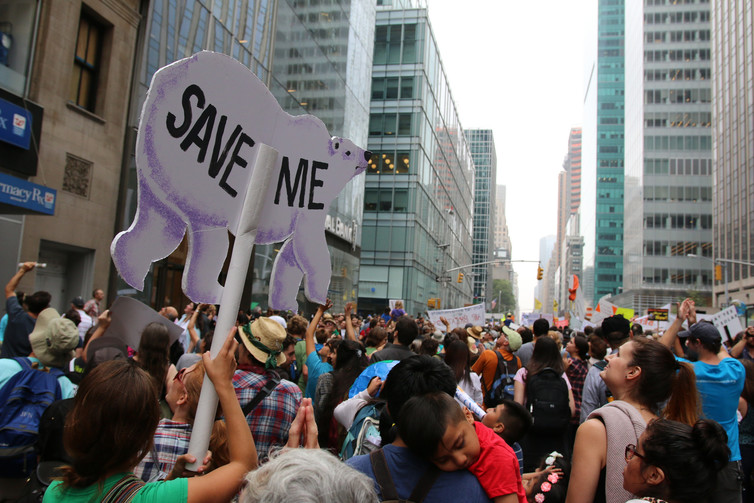
People’s Climate March, New York, New York, Sept. 21, 2014. CIFOR/Flickr, CC BY-NC-ND
The power of positive messages
This question is not new. Professionals in many fields have to consider how to frame their messages to maximize their impact. For example, public health agencies can make positive recommendations that emphasize benefits of being disease-free, or use negative messages that focus on the consequences of disease. A 2008 meta-analysis of 60 health communication studies concluded that messages focused on loss were less likely to be effective than positive messages.
Another study examined ads designed to persuade income support recipients to report their incomes. It concluded that messages focused on fear, shame or guilt could generate emotional backlash, in which people rationalized decisions to protect themselves from feeling ashamed of their behavior. This approach also caused emotional saturation that led people to “switch off” from the message because of its negativity.
Environmental advocates also confront this challenge. Much discussion has centered on the issue of climate change, where a number of scholars and advocates assert that doom-and-gloom messaging has not been effective. Yet until recently, we have not asked the same question about how we frame nature conservation.
Lost and found species
Today a growing number of scholars and activists are working to create a positive vision for protecting wildlife and wild places. One key effort started in 2014 with the launch of a marine conservation movement called Ocean Optimism, which works to “create a new narrative of hope for our oceans,” and by doing so, to help move towards “a sustainable future for our seas.”
In April 2017 the Earth Optimism Summit, organized by the Smithsonian Institution, brought together environmentalists, scientists, industry and the media to shift the global conservation movements focus away from problems and toward solutions. What started as a single event in Washington, D.C. soon turned into a truly global movement, with about 30 sister events in countries including Colombia, New Zealand and Hong Kong.
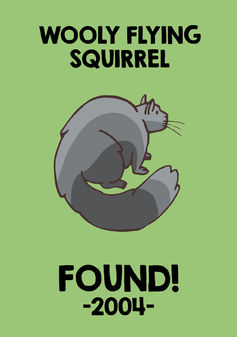
Lost & Found – Author provided
This effort has kick-started a range of initiatives that are all about communicating conservation bright spots to as many people as possible. One, which I co-founded, is the Lost & Found project, sponsored by the Society for Conservation Biology and the British Ecological Society. This online storytelling initiative focuses on a particularly inspiring kind of good news: rediscovering species that once were thought to be long extinct. After all, what can be more rousing than recovering something unique that you thought was lost forever?
Every year numerous species thought to have disappeared are rediscovered. Over the past century more than 300 species have been rediscovered, mostly in the tropics. On average, these species were missing for about 60 years before being rediscovered. Most rediscovered species have restricted ranges and small populations, which means they are usually highly threatened.
Lost & Found – Author provided
Our goal is not only to tell good stories, but also to showcase the dedication and determination of adventurers who lead these improbable quests and rewrite the history of species they care deeply about. While not every reader may be interested in a red-crested tree rat or a golden-fronted bower bird, all humans are curious about other people.
Lost & Found is making content available in various formats, including text, comics and soon, video animations. This helps make the stories more accessible to people who are not instinctively inclined to read about nature. Currently we have 13 stories freely available online that feature diverse species, from squirrels and toads to bats and birds. They cover a wide geographic range, from Latin America and Oceania to North America and Southeast Asia.
The response has been tremendously positive. More than 1,000 people from over 50 countries visited the website in its first 10 days. Some of our more popular stories, such as the Bulmer’s Fruit Bat and the Cave Splayfoot Salamander, are animals that would commonly not be considered particularly charismatic.
Getting these inspirational rediscoveries into the hands of as many people as possible is a first step toward creating a more positive vision for Earth’s future. The timeless principles of storytelling seem like the right place to start. After all, who doesn’t love a happy ending?
ooOOoo
Did you note the name of that website!!
Lost & Found. Go visit it and enjoy these wonderful happy endings!
That article featured the former president of Iceland, Olafur Grimsson, and how he was encouraging new solutions to climate change. Primarily via a new organisation called RoadMap. (Did you sign up??)
There is change in the air. People are starting to make a better future. Cities across the USA (and elsewhere undoubtedly) are pledging to go 100 percent renewable. Here’s what Grist published on May 4th.
ooOOoo
Cities all over the U.S. are pledging to go 100 percent renewable.
Atlanta is the 27th city to make the pledge, according to the Sierra Club. These kinds of municipal promises have been popping up nationwide over the past few months. Here’s a recap:
Portland, Oregon, pledged in April to go 100 percent renewable by 2050. The surrounding Multnomah County got in on the plan, too.
South Lake Tahoe, California, committed to go renewable by 2032. Its initiative is, at least to begin, entirely volunteer-driven.
It’s not just the coasts: In March, Madison, Wisconsin became the biggest city in the Midwest to pledge to a community-wide switch to 100 percent renewable energy (though it hasn’t set a target date).
The tiny town of Abita Springs, Louisiana committed in March to transition to clean energy by 2030 — and its Republican mayor went to bat for it. That’s a big win in our books.
“We know that moving to clean energy will create good jobs, clean up our air and water, and lower our residents’ utility bills,” said Kwanza Hall, an Atlanta City Council member and mayoral candidate, in a statement. “We have to set an ambitious goal or we’re never going to get there.”
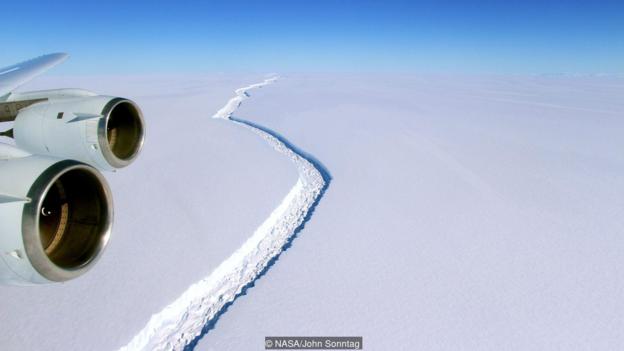
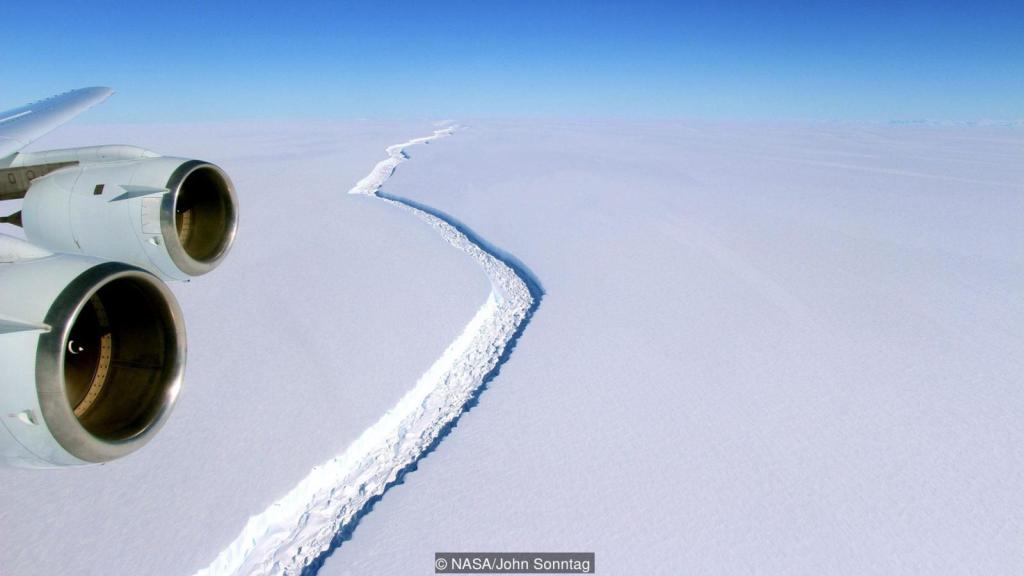
The shape of the world is hanging by a thread – or rather, according to experts, by a 110 mile-long (177km) rift. That’s the extent of a rapidly expanding crack in an enormous ice shelf in Antarctica. When the Larsen C shelf finally splits, the largest iceberg ever recorded (bigger than the US state of Rhode Island and a third the size of Wales) will snap off into the ocean. Widening each day by 3 ft (1 m), the groaning cleft is on the verge of dramatically redrawing the southern-most cartography of our planet and is likely to lead, climatologists predict, to an acceleration in the rise of sea levels globally.
An aerial photo of the frigid fissure, taken late last year when it was discovered that the pace of the icy tear was quickening, was suddenly back in the news this week with the announcement that a second rift in the shelf had been detected. The fracture leads our eye along a zig-zagging path – from the backward gaze of the plane’s right engines to the pristine polar blue of the horizon in the distance. The jaggedness of the cleft, which takes our vision on a journey whose ultimate destination is unfathomable, seems at once monumental and terrifyingly fragile. The photo intensifies our helplessness in the face of cataclysmic change. It freezes the potential destruction in the blink of a camera’s shutter, while at the same time hinting at a catastrophe that we can witness unfolding but are utterly powerless to stop.
A second rift was recently discovered in the Larsen C ice shelf on the Antarctic peninsula (Credit: NASA/John Sonntag)
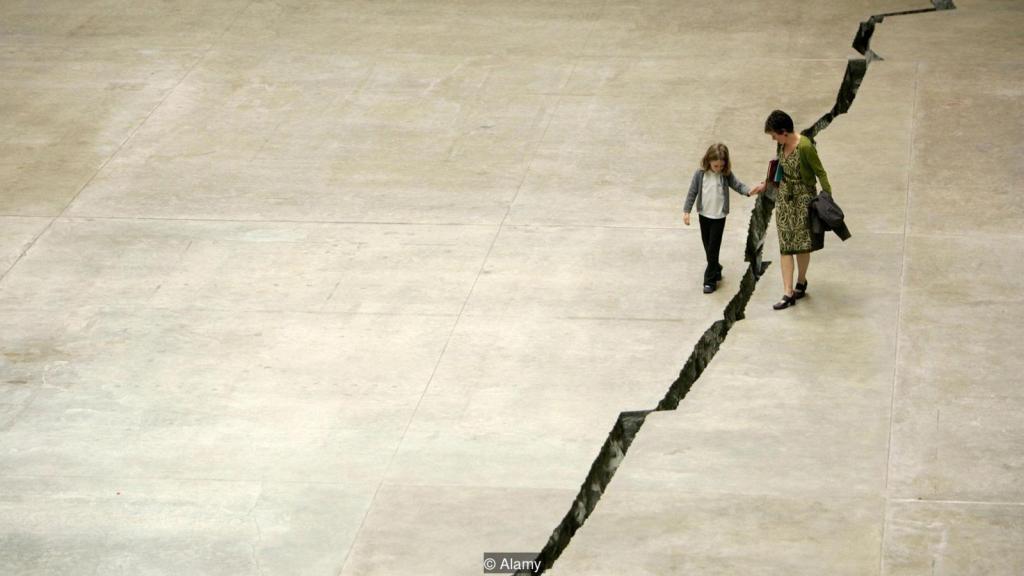
As a visual statement, the aerial photo of the Larsen C crack is, by definition, incomparable; never before has the world marked the glacial advance of such a sublime and fearsome fracture in its very fabric. Yet the reemergence of the image in the news anticipates the ten-year anniversary of one of the most intriguing and innovative large-scale works in contemporary art – a work whose power relies for its thought-provoking effect on the peculiar poetry of ruinous rifts. In October 2007, the Colombian-born artist Doris Salcedo unveiled in London an ambitious installation in the cavernous space of Tate Modern’s Turbine Hall – a piece that split reaction down the middle.
Inviting gallery-goers into the otherwise empty and austere interior of the former Bankside Power Station, Salcedo subverted expectations. Rather than offering visitors a hall of temporarily installed sculptures, she orchestrated the contemplation instead of a ragged subterranean breach that appeared to rip open the concrete floor of the structure – a crevice that extended from one end of the yawning space to the other.
For the Colombian artist Doris Salcedo’s 2007 work, Shibboleth, a giant crack was made in the concrete floor of Tate Modern’s Turbine Hall (Credit: Alamy)
Salcedo deepened the mystery of her bold and experimental conceptual work by giving to it the curious title Shibboleth – a biblical word which, when mispronounced, was said to have exposed the outsider status of individuals. Complicating matters still further, the artist insisted that her work was a comment not on the folly of material ambitions, but on racism – that deep cultural scar that tears at the foundations of humanity. Placed side-by-side, this week’s photo from Antarctica and the image captured a decade ago of Doris Salcedo’s challenging Shibboleth share both a brutal beauty and a common theme: the brittleness of being.
If you would like to comment on this story or anything else you have seen on BBC Culture, head over to our Facebook page or message us onTwitter.
And if you liked this story, sign up for the weekly bbc.com features newsletter, called “If You Only Read 6 Things This Week”. A handpicked selection of stories from BBC Future, Earth, Culture, Capital and Travel, delivered to your inbox every Friday.
ooOOoo
“the brittleness of being.”
Please, all of us, let’s make a positive difference so that we can soften the edges of that brittleness.
Recently Jean was sent a link to an item on Mother Nature Network by Trish, a close friend living down in Tucson, AZ. It shows the strength of character of one particular dog but easily serves as a reminder of the power of love, commitment, endurance and loyalty that thousands of dogs exhibit so many times. Qualities that we humans may so easily overlook because our dogs fit so comfortably into the relationship with us.
The article, on Mother Nature Network, was originally published in 2014 and, as the Editor explains:
Editor’s note: This story has been updated since it was originally published in November 2014.
The article is also presented with the enclosed video at the end of the text. But when Jean and I watched the video last night we were so taken by it that I am making an ‘executive’ decision to present the article slightly differently.
In that I think that watching this beautiful, incredible, video first is better.
A stray dog named Arthur made an amazing trek with his new companions. (Photo: TrendingVideos/YouTube)
The Adventure Racing World Series might be the most fraught and challenging sports event in the world. It usually involves teams of four navigating through a vast wilderness terrain while utilizing adventure skills from a range of disciplines including trekking, adventure running, mountain biking, paddling and climbing.
During the 2014 competition, for the first time ever, an exception was made so that one team could finish the race with five members instead of four. That fifth member? A stray dog, named Arthur by his adopted companions, who decided to follow one team for 430 harrowing miles through the Amazon jungle, according to the Daily Mail. If this story doesn’t warm your heart, you don’t have one.
Team Peak Performance, hailing from Sweden, happened upon Arthur while sharing a meal in advance of a 20-mile race stage through rough terrain in Ecuador. Mikael Lindnord, one of the team’s members, felt sorry for the scruffy, lonely stray, and decided to share a meatball with him. It was an innocent gesture — Lindnord had no intention but to lift the poor pooch’s spirits — but it was a gesture that would earn him a friend for life.
As the team got up to continue their race, Arthur tagged along. The team suspected he would eventually turn back around, but Arthur kept following them. He trailed them through muddy jungle, across vast distances of the Amazon river, all the way to the finish line.
The sport of adventure racing is not for the faint of heart — no more for dogs than for humans. During the most harrowing stages of the race, the team tried to shrug off their canine companion over concerns for his safety, but Arthur would have none of it. He was determined to stick with his adopted companions.
For instance, one crucial stage of the race requires the team to kayak along the coast for 36 miles. Understandably, the team was required to leave Arthur behind on the shore. But as they paddled away, Arthur broke free and leaped into the water and began swimming after the team. Realizing that the dog was willing to drown in order to stay with his friends, the team lifted Arthur onto the kayak so the dog could complete the race with them, to sounds of ovation from bystanders watching from the shore.
Arthur’s loyalty paid off in the end; Lindnord was able to adopt him and bring him back to his home in Sweden, where the dog is currently living, healthy and happy.
“I almost cried in front of the computer, when receiving the decision from Jordbruksverket (Board of Agriculture) in Sweden!” reported Lindnord when he first heard that his request to adopt Arthur was granted. “I came to Ecuador to win the World Championship. Instead, I got a new friend.”
For all my life this has felt like a very special month.
And, dear friends, at the risk of repeating myself to many of you, this is why the month of May is special for me.
Simply that I was born in London during the closing months of the Second World War. Inevitably, I was unaware of the number of German bombs that were falling on London during those last few months. But there were thousands.
On May 8th. 1945, the day that WWII ended and six months to the day from when I was born, my mother looked down at me and said aloud to me: “You are going to live”. Despite the fact that I don’t recall my mother saying that, it was verified many times later when I was growing up.
Now here we are approaching May 8th. 2017 and in a very real sense it seems that we are in another war.
A war of consequence.
A war that we have been engaged in for many, many years.
A war where we are inadvertently fighting on a global battlefield.
A war where 99.99% of us don’t consciously identify the weapons we are using. Weapons that are incredibly effective. So much so that we are in sight of winning the last battle; winning the war.
Yet a war where winning is no win at all. Indeed, where winning this war, this global war, spells the end. The end of life for 99.99% of us humans (and much else besides).
Now what on earth has got me so fired up?
Two things have:
The first is that I am living in my 73rd year of life. I have no idea of when my life comes to an end. But that death is a guarantee. Indeed, if one takes note of the average life expectancy of a male today in the USA (75.6 years) , it may not be that far away.
The second thing is that before my death I truly want to know that humankind has laid down its weapons of war against our planet and that there really is an unstoppable mission, a united wave of passion, to live in peace on this planet. Perhaps better put to live in peace with this planet.
Or in the words of an organization that I now want to introduce:
A mission which will require the hard work and dedication of each and every one of us as we do everything in our power as individuals, but also as we galvanize businesses, entrepreneurs, innovators, city planners, communities, people and politicians—all those who share our purpose.
OK! Thank you if you are still reading this! (Someone give Fred in that soft arm-chair over there a nudge; I can hear his snores from here!)
In the last Smithsonian electronic newsletter that I was reading yesterday morning there was a reference to an organization that I hadn’t previously come across. Here is the link to that item on The Smithsonian website. I am republishing it in full in this place. As you read it you will understand why I am republishing it.
ooOOoo
Using a New Roadmap to Democratize Climate Change
A new tool aims to bypass governments and put the power of climate action in the people’s hands
Olafur Grimsson, who was president of Iceland from 1996 to 2016 and saw his country through the worst economic crisis in its history, making headlines all over the world as banks collapsed and the country fell into a depression, is the very picture of an urbane statesman. Collected and poised, with a striking full head of white hair, as comfortable in English as in his native Icelandic, he seems an unlikely revolutionary, not the sort of person you’d look at and immediately find yourself thinking: “Power to the People.”
But Grimsson is one of the primary architects of a quietly radical new idea whose aim is to facilitate action on climate change without any of the usual suspects—governments, countries, international bodies, negotiating parties.
He and several other veterans of the historic 2015 Paris Agreement on climate change were in Washington, D.C., last year, just before COP22, the climate meeting held in Marrakesh in 2016. They were pondering next steps when the conversation took a new and interesting turn, Grimsson says, addressing the question: “Was it possible to have the success of Paris without governments necessarily being in the leading role?”
The group included movers and shakers such as Peter Seligmann, the chairman of Conservation International; Laurene Powell Jobs, president of the philanthropic organization the Emerson Collective; and Andy Karsner, an assistant energy secretary during the administration of George W. Bush. Galvanized by their own query, they decided to try to answer it—to set about creating a new tool to aid in achieving the goals of the Paris accord.
At the Smithsonian’s Earth Optimism Summit, a gathering this past weekend of conservation-minded citizens, scientists and activists, Grimsson explained: “You get governments that are opposed or even hostile to climate action. We decided to bring together in Marrakesh a gathering of thinkers and scientists and innovators and policymakers from different countries in order to discuss a new model of securing the success of the future of the climate movement.”
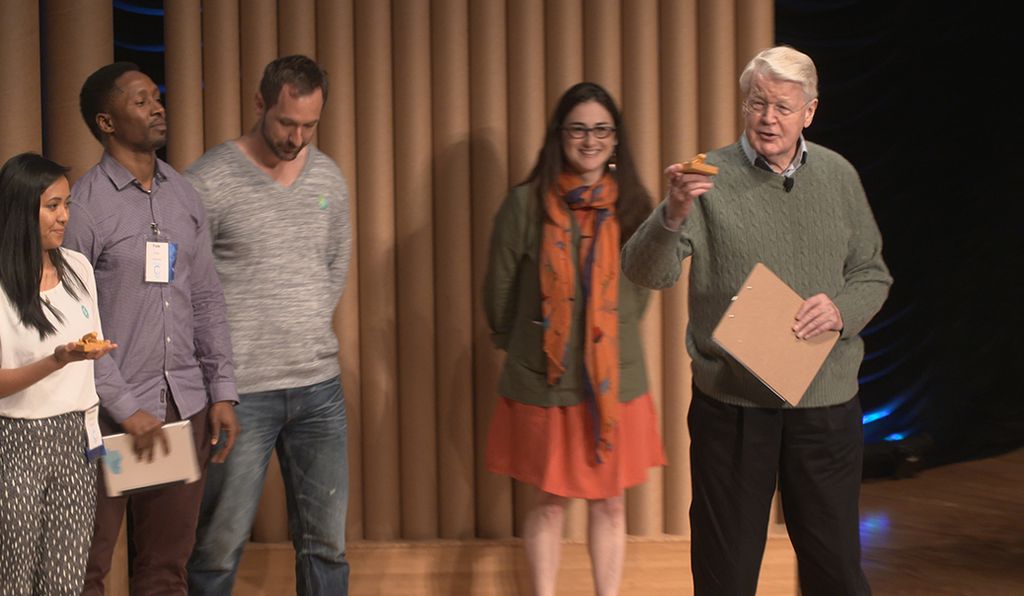
At the Smithsonian’s Earth Optimism Summit, the former president of Iceland Olafur Grimsson encouraged new solutions to climate change, awarding cash prizes to the winners of the “Make for the Planet” challenge. (The Roadmap)
Grimsson’s group felt that due to changes in information technology and social transformations, the large organizations and structures that used to be necessary to effect change were now not needed. And thus was born Roadmap, a new crowdsourcing tool for anyone and everyone interested in climate action. Still in its very early stages, Roadmap’s founders envision it as a platform for those working on climate issues—from scientist and policymaker to farmer and fisherman—to facilitate the sharing of knowledge and ideas, methods and techniques.
“A new political model is possible—where everyone can be a doer, where you no longer need big government or big enterprises to bring about success,” Grimsson says.
This new model for social change that skips the usual cumbersome channels and processes has been seen everywhere from public health, where the Bill & Melinda Gates Foundation has redefined the sector, to the hospitality industry, which is working to combat the human trafficking that plagues its businesses, to perhaps most famously the Arab Spring, where the role of social media in bringing about political change is still being debated today.
And this new model is complemented by technological changes. “The innovation in energy technology is such that we no longer have to wait for the big energy breakthrough,” Grimsson says. “We already have the available technologies. Every individual, home, village, community, town and region can execute change. The good news from the climate point of view is that, in addition to the information technology revolution, there has now also taken place an energy revolution. A house can be a power station: If the people who live in that house have extra energy, they can sell their energy through the smart grid. The notion that every house can be a power station is as revolutionary as saying that every mobile phone can be a media company.”
Grimsson admits that it may seem odd for someone in his position to be advocating that ordinary citizens take action apart from the conventional corridors of governmental power.
“For me to say that these traditional political organizations and positions are somewhat outdated is perhaps a strange statement: I was a professor of political science, I’ve been a member of parliament, I’ve been a minister of finance, I was president for 20 years,” he says.
It was during Iceland’s financial meltdown that he first experienced this new kind of social change: “I saw this very strongly through the financial crisis in my own country, which led to a big social economic uprising. All those activities were engineered by unknown people, people who were not part of a big organization, who used Facebook and the information media to bring thousands of people together in one day.”
Right now, Roadmap consists of a website and a lofty manifesto that speaks of raising the value of “moral currency” and creating a “best practices warehouse.” Visitors to the site can fill out a form if they want to become part of its community of “doers.” The practical part of the manifesto speaks of identifying the best methodologies and models; implementing a “real-time system of measurement” and a way to “gauge and understand what is working, what is not, and exactly what is being achieved.” As the platform develops, it will be interesting to see exactly what form these gauges, measurement systems, and warehouses take.
After the Paris Agreement, Grimsson says of himself and his Roadmap co-founders, “We were all optimistic, but we are all also realists.” It is his belief that if you “give people the tools, they can execute the transformation and the change—without governmental leadership.” Perhaps Roadmap will be one of those tools.
ooOOoo
Here’s a video that spells it out in ways that I find impossible to ignore. (And, yes, I signed up, as in joining, yesterday afternoon.)
Because in hundreds of years time I want others to look at the following picture of Troutbeck Valley in England and know how precious is this one and only planet we live on.
We are witnessing more storms, more unseasonal weather patterns, and I just hope that we wake up soon to the damage we are doing to our beloved Mother that has held us in her eternal arms for so long..
Photo credit: Getty Images
Enjoy the month of May wherever you are in the world!
Closing by repeating a key pronouncement in that RoadMap video above:
Humanity’s safe and viable future depends on seeing things very differently.
Next Tuesday is the 62nd anniversary of the death of Albert Einstein, the famous German theoretical physicist who died on the 18th April, 1955. He delivered many innovative ways of seeing our world way beyond his theory of relativity, one of the two pillars of modern physics (alongside quantum mechanics) (Ref: Wikipedia)
Why do I introduce today’s post with that reference to Mr. Einstein?
Because I wanted to share with you a recent essay from George Monbiot and an Einstein quotation seemed so apt an introduction.
We shall require a substantially new manner of thinking if mankind is to survive.
That essay from George Monbiot was published yesterday and is shared with you all with Mr. Monbiot’s full permission.
It is an essay that deserves being read slowly and carefully. Please take time aside to so do because it really does offer a new manner of thinking.
ooOOoo
Circle of Life
13th April 2017
By reframing the economy, Kate Raworth’s Doughnut Economics changes our view of who we are and where we stand.
By George Monbiot, published in the Guardian 12th April 2017
So what are we going to do about it? This is the only question worth asking. But the answers appear elusive. Faced with a multifaceted crisis – the capture of governments by billionaires and their lobbyists, extreme inequality, the rise of demagogues, above all the collapse of the living world – those to whom we look for leadership appear stunned, voiceless, clueless. Even if they had the courage to act, they have no idea what to do.
The most they tend to offer is more economic growth: the fairy dust supposed to make all the bad stuff disappear. Never mind that it drives ecological destruction, that it has failed to relieve structural unemployment or soaring inequality, that, in some recent years, almost all the increment in incomes has been harvested by the top 1%. As values, principles and moral purpose are lost, the promise of growth is all that’s left.
You can see the effects in a leaked memo from the UK’s foreign office: “Trade and growth are now priorities for all posts … work like climate change and illegal wildlife trade will be scaled down.” All that counts is the rate at which we turn natural wealth into cash. If this destroys our prosperity and the wonders that surround us, who cares?
We cannot hope to address our predicament without a new worldview. We cannot use the models that caused our crises to solve them. We need to reframe the problem. This is what the most inspiring book published so far this year has done.
In Doughnut Economics: seven ways to think like a 21st-century economist, Kate Raworth reminds us that economic growth was not, at first, intended as a measurement of well-being. Simon Kuznets, who standardised the measurement of growth, warned: “the welfare of a nation can scarcely be inferred from a measure of national income.” Economic growth, he pointed out, measures only annual flow, rather than stocks of wealth and their distribution.
Raworth points out that economics in the 20th Century “lost the desire to articulate its goals.” It aspired to be a science of human behaviour: a science based on a deeply flawed portrait of humanity. The dominant model – “rational economic man”, self-interested, isolated, calculating – says more about the nature of economists than it does about other humans. The loss of an explicit objective allowed the discipline to be captured by a proxy goal: endless growth.
The aim of economic activity, she argues, should be “meeting the needs of all within the means of the planet.” Instead of economies that need to grow, whether or not they make us thrive, we need economies that “make us thrive, whether or not they grow.” This means changing our picture of what the economy is and how it works.
The central image in mainstream economics is the circular flow diagram. It depicts a closed flow of income cycling between households, businesses, banks, government and trade, operating in a social and ecological vacuum. Energy, materials, the natural world, human society, power, the wealth we hold in common: all are missing from the model. The unpaid work of carers – principally women – is ignored, though no economy could function without them. Like rational economic man, this representation of economic activity bears little relationship to reality.
So Raworth begins by redrawing the economy. She embeds it in the Earth’s systems and in society, showing how it depends on the flow of materials and energy, and reminding us that we are more than just workers, consumers and owners of capital.
The Embedded Economy. Graphic by Kate Raworth and Marcia Mihotich
This recognition of inconvenient realities then leads to her breakthrough: a graphic representation of the world we want to create. Like all the best ideas, her Doughnut model seems so simple and obvious that you wonder why you didn’t think of it yourself. But achieving this clarity and concision requires years of thought: a great decluttering of the myths and misrepresentations in which we have been schooled.
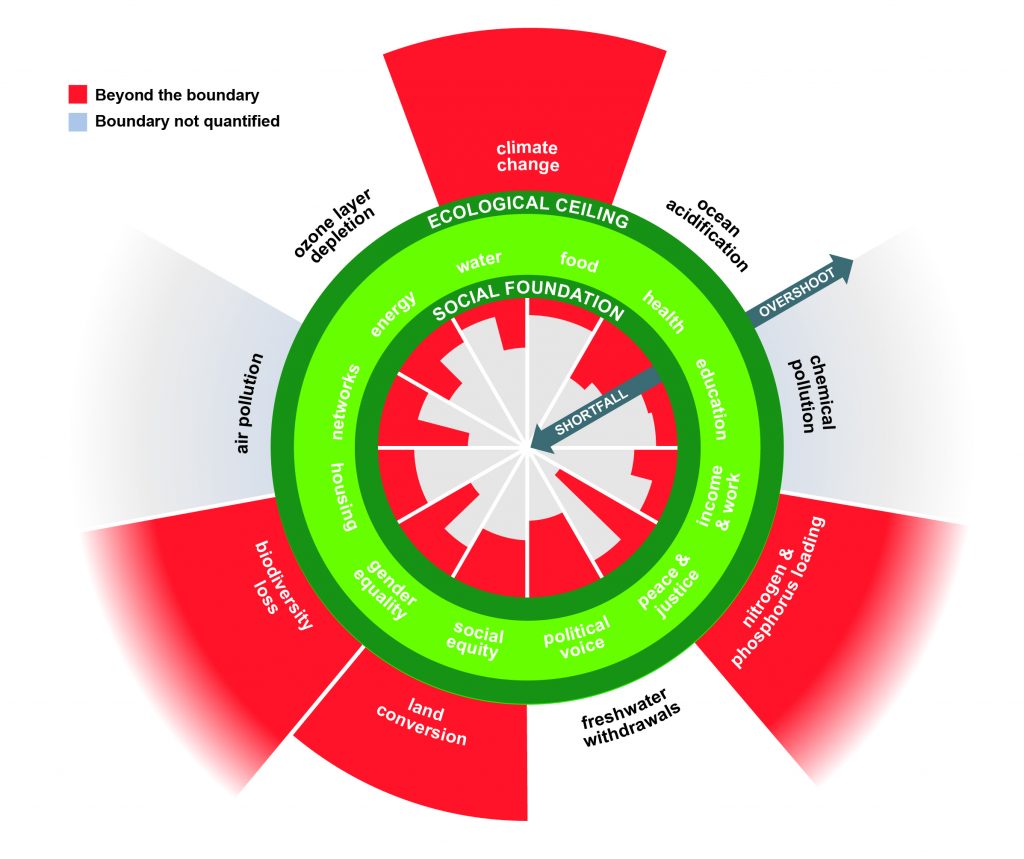
The diagram consists of two rings. The inner ring of the doughnut represents a sufficiency of the resources we need to lead a good life: food, clean water, housing, sanitation, energy, education, healthcare, democracy … . Anyone living below that line, in the hole in the middle of the doughnut, is in a state of deprivation.
The Doughnut. Graphic by Kate Raworth and Christian Guthier/The Lancet Planetary Health
The outer ring of the doughnut consists of the Earth’s environmental limits, beyond which we inflict dangerous levels of climate change, ozone depletion, water pollution, loss of species and other assaults on the living world. The area between the two rings – the doughnut – is the “ecologically safe and socially just space” in which humanity should strive to live. The purpose of economics should be to help us enter that space and stay there.
As well as describing a better world, the doughnut model allows us to see, in immediate and comprehensible terms, the state in which we now find ourselves. At the moment we transgress both lines. Billions of people still live in the hole in the middle. We have breached the outer boundary in several places.
Where we are now. Graphic by Kate Raworth and Christian Guthier/The Lancet Planetary Health
An economics that helps us to live within the doughnut would seek to reduce inequalities in wealth and income. Wealth arising from the gifts of nature would be widely shared. Money, markets, taxation and public investment would be designed to conserve and regenerate resources rather than squander them. State-owned banks would invest in projects that transform our relationship with the living world, such as zero-carbon public transport and community energy schemes. New metrics would measure genuine prosperity, rather than the speed with which we degrade our long-term prospects.
Such proposals are familiar, but without a new framework of thought, piecemeal solutions are unlikely to succeed. By rethinking economics from first principles, Raworth allows us to integrate our specific propositions into a coherent programme, and then to measure the extent to which it is realised. I see her as the John Maynard Keynes of the 21st-Century: by reframing the economy, she allows us to change our view of who we are, where we stand, and what we want to be.
Now we need to turn her ideas into policy. Read her book, then demand that those who wield power start working towards its objectives: human prosperity within a thriving living world.