Taking it easy!
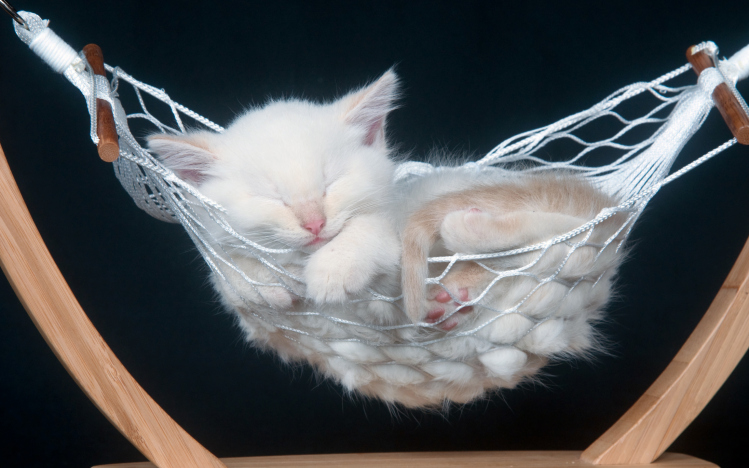 oooo
oooo
 oooo
oooo
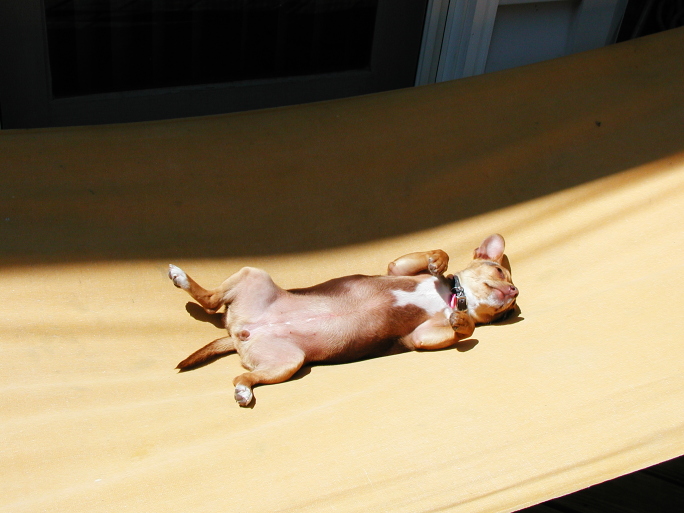 oooo
oooo
 oooo
oooo
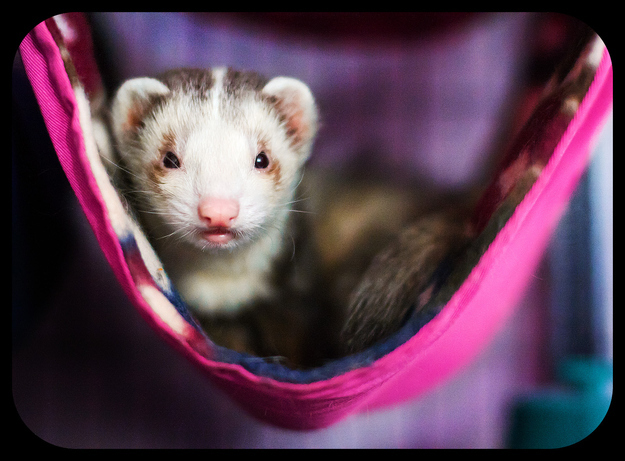 Another set in a week’s time.
Meanwhile, you all take good care of yourselves.
Dogs are animals of integrity. We have much to learn from them.
Category: Cats
Taking it easy!
oooo
oooo
oooo
oooo
Another set in a week’s time.
Meanwhile, you all take good care of yourselves.
Just to demonstrate that this place is not ‘wall-to-wall’ dogs.
How about a wonderful story of a cat that saved the lives of three humans!
It was seen, as so often these days, over on the Care2 site and it just had to be shared with all you good people.
ooOOoo
By: Emily Zak November 30, 2016
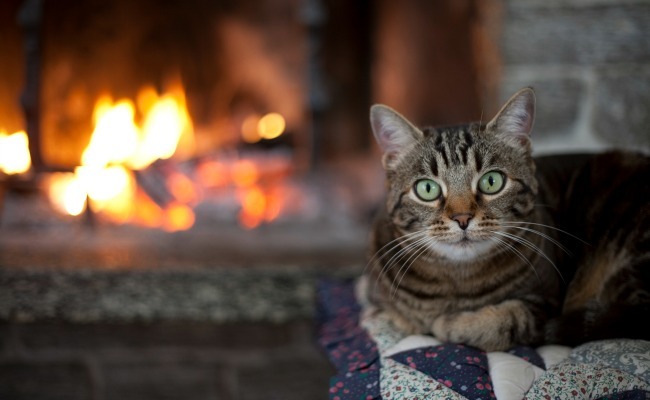 Just before 5 a.m. on Thanksgiving, three people in a quiet San Mateo, Calif., neighborhood woke up to the sound of breaking glass — and their cat, Jackson.
He jumped up on one person and meowed until they woke up, bells on his collar jingling.
At first, everyone thought someone was breaking in. Then, they realized their garage was ablaze.
The fire had just started spreading to the house.
Thanks to Jackson’s alarm, the couple and their roommate escaped outside.
The boyfriend, Chris, tried to quench the flames with a garden hose. But the water stopped and the fire started blazing through the home, up to the attic.
They searched frantically for Jackson, but couldn’t find him.
Then, the fire engines arrived, eight total, as well as ladder trucks and an air support unit.
Firefighters took 40 minutes to extinguish the fire, which had spread to nearby power lines and the side of a neighbor’s house, according to Burlingame Patch.
One rescued Jackson, who was still inside.
A 24-hour emergency vet treated the cat for smoke inhalation, and kept him for observation for at least a day.
Even a local fire chief pegs the Jackson the cat as the hero.
“In my heart, I believe that cat was trying to alert its owners that something wasn’t right,” San Mateo fire Battalion Chief Joe Novelli tells The Mercury News.
No humans were injured. But the blaze displaced them with little more than their lives.
The fire caused $475,000 in damage, displaced all three residents and gutted their home to ash.
But at least Jackson survived.
Photo credit: Thinkstock
ooOOoo
We can never have too many good news stories!
But we should also not forget that this family down in California have one hell of a rebuild hill to climb. So if you can spare a few pennies for the rebuild costs then this is the page to go to: https://www.gofundme.com/thanksgivinghousefire/
And when you go there the first thing that will smack you in the face is this photograph.
 Losing one’s home to a fire has go to be simply dreadful but big hugs to all and a very special cuddle for Jackson the cat!
What a wonderful sequel to yesterday’s post!
I am always amazed at how things turn out. Call it serendipity or what!
Because, as much as I love publishing a daily post in this place, not infrequently I think what on earth am I going to find to write about; or republish!
As it was yesterday morning. Not only did I have a heap of things to do around the house but also other ‘office’ work that had to come first.
Then in my email in-box there was another story from Care2. It made a perfect follow-on to yesterday’s post about how rescued dogs go on to become rescue dogs.
Enjoy! (And many thanks Miss Serendipity!)
ooOOoo
 By: Laura S. November 20, 2016
Murat Şahin climbs onto his dusty motorbike and holds his breath as he turns the key, hoping the engine will start. His trip is important because he’s going to feed more than 100 dogs in the forest of Aydos in Istanbul, Turkey. Dozens of cats living along the rocky coastal walls are waiting for him too.
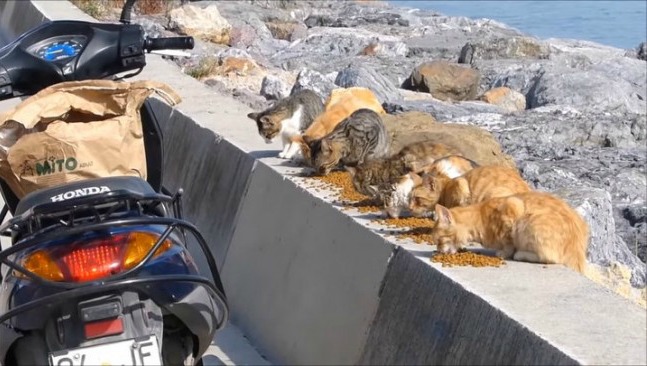 Watch Murat Feed the Animals
Murat’s mission is important to him, it’s a spiritual calling in fact, and he is deeply devoted to serving the hungry animals as you will see in the uplifting video below.
Murat does take some animals to the veterinarian for spay/neuter, but it isn’t always feasible. Some of the animals are wild, and without a car, he can’t bring a trap or transport them easily. He also doesn’t have the funds to do sponsor spay/neuter on a wide scale on his own.
 “Murat has never asked for any help,” fellow volunteer Anna Efe explains. “He has always used his own money and collected food at a restaurant and a local canteen. Also, some butchers were giving him leftovers free of charge. But this year the situation has changed. The butchers stopped giving leftovers for free and, on top of that, Murat’s old motorbike was stolen. It was his only way to deliver food to the forest dogs.”
Though Murat did manage to find a very low-priced bike to replace the stolen one, the replacement bike frequently breaks down. In fact, it broke down immediately after the filming of the video on this page.
Better Days Ahead
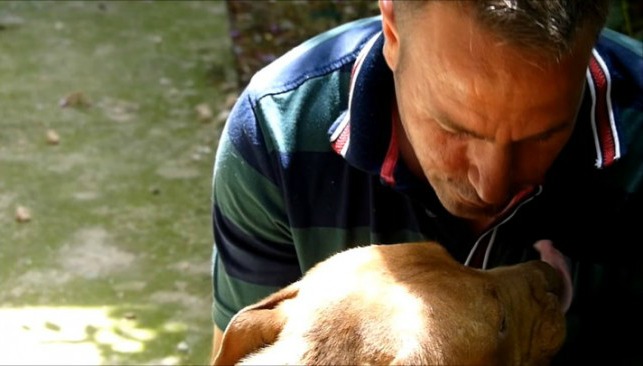 The Harmony Fund charity, based in the U.S., is working on a surprise for Murat. The group is attempting to raise funds to purchase a reliable, used car for Murat’s rescue work and would be shared by Murat and his fellow volunteers working together as an authorized rescue team in Turkey. The car would have several advantages over the bike including carrying larger quantities of food, transporting animals to the veterinarian and safer transportation during bad weather.
ooOOoo
If anyone reading this post can find it in their hearts to make a donation, then this link on the Harmony Fund website is the place to go. You can specifically nominate that your gift goes to Murat out in Turkey. (And Jean and I have made a modest donation to Harmony to be passed to Murat.)
Wonderful reminders of how so many offer so much love to our animals.
 On Saturday Jean and I spent the day at PetSmart’s store in Medford, OR., supporting another of their wonderful pet adoption events.
There were many dogs and cats available and even more wonderful people coming to find a new dog or a new cat for their homes (the final figures not available at the time of writing this post).
Yes, there are a great deal of people who are unloving and uncaring towards our beautiful animals. But never let that cloud the fact that there are countless people who will put their love for animals way ahead of their own needs.
So when Marg emailed me a link to a recent story on ABC News not only did I want to share it with you good people but it was the perfect story to follow Saturday’s adoption event. Here it is:
ooOOoo

Before a trip to doggy heaven, 18-year-old whippet Walnut was joined by hundreds of people and their pups for a walk along an English beach.
Walnut’s owner Mark Woods posted details about the dog’s final walk along the beach on Facebook, inviting dog owners to join him on a beach in Newquay, Cornwall to celebrate his pet’s life.
“He has had an incredible life and having reached the grand age of 18 is ready for his final sleep,” Mr Woods wrote.
“I would love it if dog lovers/owners and friends would join us for a celebration of Walnut on his favourite Porth Beach.”
Hundreds of pooches left paw marks on the sand and supporters used the hashtag #WalkWithWalnut on social media to pay tribute to the animal, who also became a media star in his final days.
“If #walkwithwalnut has done something, it’s restored my faith in the compassion of humanity, in a particularly dreary year,” one tweeted.
“Meanwhile, at Porth Beach Newquay, humans demonstrate proper love and solidarity on their #walkwithwalnut and Mark,” tweeted another supporter.
Mr Woods carried Walnut across the beach as his ill health meant he was no longer able to walk.
He told local media Walnut had provided much comfort over the years, seeing him through two marriages and three engagements.
After Walnut was euthanased the evening after the walk, Mr Woods posted a thank you to all who attended.

“Walnut passed away this morning at 11.56am … he went very quickly and in my arms,” Mr Woods wrote on his Facebook page.
“Thank you to the hundreds of people that attended the walk this morning and to all those that had their own walks with their beloved pets around the world.”
The whippet breed originated in England and have an average lifespan of 12 to 15 years.
ooOOoo
There were many videos taken of the walk lots of them being uploaded to YouTube. I chose the following one to share with you. Be warned, this will bring tears to your eyes!
Finally, let me return to the overall theme of today’s post: how much we return the love our dogs give us.
By including the following photograph of this woman, whose name we missed, chatting to Jean at the PetSmart event. Not only had this loving lady taken in many rescue dogs she also fostered other dogs as they awaited their new home. The terrier mix in her arms is her dog and, of course, was one time a homeless dog that she rescued.
 Don’t our wonderful pets bring out the best in us!
What an amazing rescue!
As many of you know, I subscribe to the Mother Nature Network service and frequently share items from MNN here.
ooOOoo
Animal rescuers dismantled the dryer to find the crying kittens.
Jenn Savedge
October 4, 2016

The owner of a dry-cleaning shop got a surprise recently when he heard crying and mewing from the back of one of his machines. Fortunately, this on-the-ball dry-cleaner called an animal rescue squad who rescued the four small kittens and reunited them with their mother.
According to the BBC , the dry cleaning shop where the kittens were found is located in Forest Gate, a residential suburb of London. The shop owner called animal rescuers from the Celia Hammond Animal Trust, a local animal rescue center, to help identify the source of the sounds.
Rescuers dismantled the tumble dryer where the noises were coming from and found four small ginger kittens inside. They also located the kittens’ mother when they noticed a distressed cat pacing outside the shop.
The shop owner told rescuers that a nearby resident had moved and left the pregnant cat behind. That poor distressed mama clearly needed a warm, dry place to give birth and she found it inside the dry-cleaning tumble machine.
One of the animal rescuers noted on their Facebook page that the kittens were in bad shape when they were found, “[w]hen we picked them up they were filthy, covered in grease and dirt and had been breathing carbon tetrachloride fumes since they were born in the back of the machine.”
Thankfully, the kittens and their mother are now being well cared for in a foster home.
ooOOoo
One might ponder about the kittens having a clean start to their young lives! (Sorry!)
Loving owners want so much to know when their pets may be in pain.
Our dear Pharaoh (born June, 2003) is getting very weak in his rear hip joints and Jean and I are very sensitive to understanding whether or not he is in pain. Any loving owner of a cat or a dog would be the same; and it doesn’t stop with our cats and dogs.
Care 2 Healthy Living recently had an article on just this subject: Trying to know when our pets are in pain.
Here it is shared with you good, caring people.
ooOOoo
 By: Lisa Spector September 11, 2016
September is Animal Pain Awareness Month. My Lab, Sanchez, is 13-years-old. I still sometimes have a hard time identifying the difference between a behavior problem and a physical ailment. Our dogs are so adaptable and want to please us so much, it’s sometimes challenging to detect their pain.
These often subtle signs will help you determine when your pet may be showing signs of pain. Some require a veterinary visit, but other times there are simple things you can do to help. When Sanchez had a slipped neck disc at age 9, I thought he was in so much pain that he’d never recover. A few acupuncture sessions later, and he turned into a puppy!
1. Mouth Fluttering
It wasn’t until I made a video with Sanchez in it that I noticed he was making all sorts of mouth movements. (He starts the mouth movement at :28 seconds.) I knew he wasn’t stressed and his lip licking was not a calming signal. It sparked enough curiosity that I had my vet look at this mouth. Sure enough, he needed his molars pulled. As hesitant as I was to have this operation on a 13-year-old dog, he came through it just fine and started acting much younger post-surgery. I didn’t realize he was in pain for months.

2. Decreased Appetite
A change in desire to eat is not always a sign of illness. It sometimes can also be about mouth pain. If you give Fido or Fluffy hard food, try some soft food and see if they want to eat. Experiment with different textures. Decreased appetite is a good reason to visit your vet.
 3. Reluctance to Get In The Car
While this might happen throughout a cat’s entire life, dogs may show hesitancy getting in a car when it causes them pain to jump up (or down). Try using a ramp so that they can easily get in and out without adding any pressure to their joints.
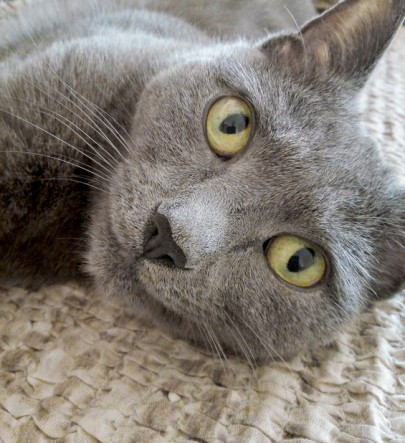 4. Difficulty Standing Up
Older pets tend to sleep a lot and they can be slow at getting up. Give them plenty of time to stretch as they know how to listen to their own bodies. But, if Fido or Fluffy is hesitant to stand up, they may be feeling pain. Personally with Sanchez, this is one of the areas where it’s hard to tell the difference between behavior and pain. But, I can usually find out the answer quickly when I entice him with a yummy treat.
 5. Decreased Activity and Engagement
When pets are in pain, they often want to be left alone. Watch for any signs of social behavior changes. Is Fido engaging with his dog buddies? Is Fluffy getting in more cat fights? Senior pets have a taxed nervous system in general and aren’t as curious as their puppy or kitty playmates. But notice if there has been any drastic change in their activity level. It may be a reason for a vet call.
The International Veterinary Academy of Pain Management (IVAPM) also offers this downloadable chart that helps you determine when you’ll need to make a vet visit.
ooOOoo
That downloadable chart is a graphical version, as in a pdf, of this post. Nonetheless, IVAPM are to be congratulated on producing the chart and for highlighting the important indicators when trying to decide whether or not to take your loved pet to see a vet.
Coping with an emergency includes looking after our dogs.
Most of us live our daily lives without paying too much attention to the likelihood of an emergency. But as Hurricane Hermine and the recent explosion of that SpaceX rocket show the unexpected does come along.
All of which is my preamble to a recent item over on the Mother Network Nature site that reviewed taking care of our beloved pets when an emergency does strike.
I have pleasure in sharing it with you.
ooOOoo

Jaymi Heimbuch August 31, 2016

A car crash, an arrest, a natural disaster or a medical emergency. While no one wants to think about these awful possibilities, sometimes we should to protect and provide for those we love, in case one day we can’t make it home as planned. And those we love include our pets.
Imagine something happens to you and you can’t get home to your dogs, cats, birds or other critters. You need a way to not only alert others to the fact that you have pets at home, but also the information they need to care for your pets in your absence. Here are five ways you can ensure that your pets will be looked after.
Create a card that you can carry in your wallet or purse. If you’re ever in a medical emergency, a rescue worker or paramedic looking through your wallet for identification will also know that there are animals at your home that need care.
The card can be as simple as a note that you have pets at home on one side, and on the other side lists contact information for friends or family members you’ve designated to care for them. Or it can be detailed, listing how many pets you have at home, their names and the kind of animal each pet is, your address, and emergency contact information for two people you trust to care for your pets. How much information you want to include is entirely up to you.
You can create your own card, download a free template online to print out, or buy cards online that you can fill in information with a pen.
Another place to put an alert card is in your window or on the door to your home. An emergency  pet alert sticker is ideal when you can’t get to your home but someone like a firefighter or rescue worker can.
Like a wallet card, a sticker should list how many pets are inside and what species they are, so any rescue worker would know if they’d found all the animals inside.
This is a small but potentially life-saving step in preparing for emergency situations such as after an earthquake, tornado, fire or flood, so that someone who is searching through homes can rescue your pet even if you can’t — or aren’t allowed — to get back to your home.
Your emergency wallet card states contact information for people you trust to care for your pet if you’re in an emergency situation and can’t get home to them. The next step is ensuring they can get to your pet when needed.
Make sure each person listed as an emergency guardian has a set of keys, or that they know the secret hiding place for your spare set of keys. If you have an alarm system on your home, you’ll need to provide these friends with the access code.
Because these friends or family members not only have access to your home but also will take responsibility for your animal companion, you’ll need to put some thought into who you’ll have in place as a temporary caregiver or as a permanent caregiver.
The ASPCA notes:
When choosing a temporary caregiver, consider someone who lives close to your residence. He or she should be someone who is generally home during the day while you are at work or has easy access to your home. When selecting a permanent caregiver, you’ll need to consider other criteria. This is a person to whom you are entrusting the care of your pet in the event that something should happen to you. Be sure to discuss your expectations at length with a permanent caregiver, so he or she understands the responsibility of caring for your pet.
You may want to put down temporary caregiver contact information on your emergency cards, and ensure they know who is designated as the permanent caregiver should you not be able to return home to your pets for a long time, or at all.

A disaster preparedness kit is a great idea both for you and your pet. This also benefits your pet not just for a natural disaster, but if you’re in an emergency and can’t get to them.
An emergency supply kit should include a document that a temporary caregiver or potential permanent guardian can use to understand your pet’s needs. This includes:
Be sure to tell your emergency contacts and temporary caregivers where this information is located in your home, so they can access it should they need it.
We briefly discussed designating someone as a permanent caregiver for your pet should you not be able to return to them. You may want to consider setting up a formal arrangement for this to ensure that your pet definitely goes to the person you’ve designated and receives the care they need.
This could be a formal written arrangement with a permanent caregiver or it may be part of your will. You might also consider creating a trust or other financial arrangement to ensure your pet is cared for if you’re incapacitated. However, Petfinder notes:
Before making formal arrangements to provide for the long-term care of your pet, seek help from professionals who can guide you in preparing legal documents that can protect your interests and those of your pet. However, you must keep in mind the critical importance of making advance personal arrangements to ensure that your pet is cared for immediately if you die or become incapacitated. The formalities of a will or trust may not take over for some time.
Such a document may at first seem like a lot to handle for a “what if” situation, but by taking the appropriate precautions ahead of time, you can be sure that your pets are immediately cared for should something occur that prevents you from returning home to them.
ooOOoo
This all seems like very sound advice and, believe me, advice that Jeannie and I will review and adopt wherever we can.
Please, good people, do take care of yourselves including all your pets.
….. for the animals in our lives.
In yesterday’s post Senior Smiles there was a lovely exchange between Cindy and me. Cindy wrote:
Just a few days ago I relived in my mind the pain of losing our 16 year old Bichon- and that was a year and a half ago! Honestly, that is my biggest fear of adopting another dog- esp an older one.
Cindy then, mistakenly in my view, thought that, “it’s selfish to hang on to grief like this, and I REALLY don’t mean to“, to which I replied:
Grief is not a selfish attitude, far from it! You will know when it’s the right time to adopt, and love, a new dog.
You can then easily imagine my pleasure when thinking of what to write for today’s post to see a recent item over on the Care2 site about our commitment to our pets. About our love for our pets.
The item was called How Far Would You Go For Your Pet? and is republished here today. I would like to dedicate this post to Cindy! Cindy is the author of the blog: Mermaid in a Mudslide.
ooOOoo
 By: TreeHugger. August 23, 2016
There is simply no denying the power that pets hold over us.
I suppose there are a number of reasons why we love our dogs and cats (and others) so much, but surely their innocence and unconditional love rank right up there on top. Plus they’re cute, and furry, and funny, and sweet, and overall good companions. But I have to think there is something about them providing access to the larger animal world in general as well – domesticated animals are like a bridge between us civilized humans and wildlife, and for this they serve an important role. If we can find compassion for our companion animals, in many cases that compassion seeps out and becomes extended to other elements of the natural world as well.
And we really, really have compassion for our pets. Like, approaching fervency. Last year Americans spent over $60 billion on their pets, a number expected to increase by another $2 billion this year. That. Is. So. Much. Money. If you spent $20 per second, it would take 95 years to spend $60 billion.
But even more telling than how much we spend on our pets is the other sacrifices we would make for them. With pets on their mind, the website Abodo conducted a survey of 2,000 dog and cat owners and asked them all kinds of bordering-on-Sophie’s-Choice type of questions. The following results display just how cuckoo we are for our creature cohabitants.

See more of the survey’s results here.
Written by Melissa Breyer, this post originally appeared on TreeHugger.
Photo Credit: dougwoods/Flickr
ooOOoo
The power of (unconditional) love!
Setting a fabulous example of what an animal shelter should be like!
The chances are that the great majority of domestic animal lovers have an impression of the standard animal shelter. The chances are that this impression is not one of wall-to-wall approval. It is tragic that animal shelters are required but it is a fact of life that they are needed. Many of them depend heavily on volunteers and donated money.
But that’s not to say that there can’t be a shelter setting a very high example of how a shelter should be.
My prelude to the following article seen recently over on the Care2 site. Read and enjoy!
ooOOoo
 By: Natalia Lima August 6, 2016 About Natalia
Follow Natalia at @TheNatiLima
The words “county animal services” don’t really evoke thoughts of luxury, comfort or state of the art anything, but Miami-Dade is about to change that.
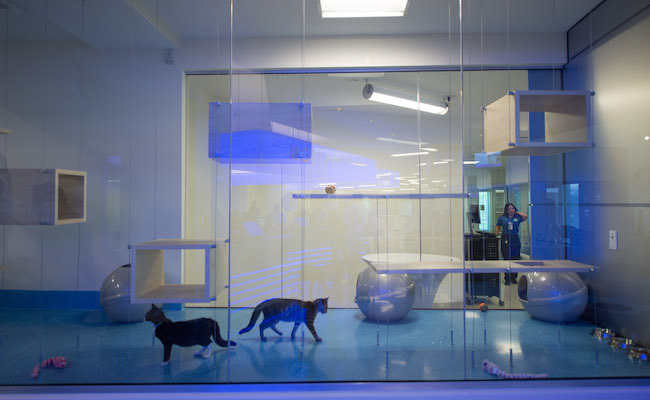
In June, the county opened its first ever “adoption mall,” an air-conditioned, high tech building where potential adopters can “shop” for their new furry best friend without even realizing they’re in a shelter.
“The old shelter was outdated and we wanted more capacity and to improve the wellness of the shelter pets,” explains Alex Muñoz, Director of the Animal Services Department about the project. “We have both cages and free roaming rooms and all areas for pets are air-conditioned.”
The Miami-Dade Animal Services Pet Adoption and Protection Center is a massive 72,000 square-foot facility that sits on five acres. Instead of sitting in kennels that don’t have much more than a small bed or sometimes just a couple of blankets on the concrete floor, adoptable dogs have plenty of space to move around and they stay stimulated in the outdoor canine exercise areas. When they’re done playing they can then retreat inside where the temperature controlled rooms keep them safe from the Florida heat.
 For the kitties, a lounge area filled with toys allows them to play or just communally nap–after all, they are cats.
 In 2015, Miami-Dade became a no-kill county, reaching a 90 percent save rate for all animals going into its shelters. Now with the larger building, the department was also able to expand the number of animals it houses. The new facility has 25 percent more dogs and 50 percent more cats than the previous shelter.
Since disease outbreaks are not uncommon in shelters, the new facility was built to prevent the spread of viruses among the animals.
“The HVAC System includes multiple air exchanges per hour to clean the air in order to avoid air borne diseases,” says Muñoz adding that “dogs are separated in different pods to avoid cross contamination.”
 With the new spiffy location, the county is also hoping to fight the association people make of shelters being depressing and its animals sad or broken.
A 2013 study done by Best Friends Animal Society found that 46 percent of people considered shelter pets second-rate compared to dogs from breeders and only 31 percent of young people were willing to consider a shelter adoption.
In addition to happier and more comfortable animals, the building also houses professionals and volunteers who will spearhead programs advocating for rescuing, fostering, caring for neonatal kittens and working with Miami-Dade County Public Schools to teach kids about responsible pet care.
This new type of shelter comes with a hefty price tag of $15 million but Muñoz says it could definitely be implemented anywhere.
Photo Credit: All images provided by GLO Creative on behalf of Miami-Dade County Animal Services.
ooOOoo
Brilliant!
And, please, if anyone who reads this is thinking of getting another cat or dog then do make a visit to your nearest shelter your first step. For if all the dogs and cats in shelters were found good homes there would be no need for shelters. An idyillic dream, I know!
The two-way flow from having a pet.
I can’t believe it was so long ago but back in February I received an email:
Hey!
I’m sure you get a ton of spammy submissions so I’ll get straight to the point – I’d love to submit a post for publishing on your site.
If you’re still accepting posts, please let me know and I can put together a draft for your approval.
Thanks for your time!
Emily Parker
Chief Creative Cat
Emily Parker is a cat parent to 2 lovely cats, Gus and Louis (Gus only has one eye, but we love him all the same!). She has lived with dogs in the past and can’t wait to add a dog to the family again. She writes about all things cats at her blog, Catological.com.
Don’t ask me how late February became late July but that doesn’t diminish in the slightest the quality of Emily’s guest post.
Before you read on let me present you with a picture of one of our cats that we have here at home.
 ooOOoo
by Emily Parker, Catological.com
You’ve heard it as a kid, and if you have children of your own, you may have told your kids this.
“Having a dog is a big responsibility.”
This is absolutely true. A dog can teach kids how difficult it can be to take care of another living being, all while teaching them valuable life skills.
But little do we know that raising a dog is not a one-way street. Not only do dogs teach kids, but kids teach dogs, too. And if you’re a cat owner, it creates another web of teaching. Let’s break it down.
The Importance of Feeding, and Nutrition
What a dog will teach a kid is the importance of regular feeding. However, a kid can’t just dump some dog food in a bowl and call it a day. To raise a dog properly, the child needs to make sure the pup is getting the adequate nutrition it needs, all while not overeating.
If you have a kid, you must teach the child that proper nutrition is a must when feeding the dog. He or she will need to measure out the serving size, pay attention to ingredients, and become acquainted with the macronutrient profiles most beneficial for their dog. This can bleed into the child’s own eating habits as they learn to eat healthy and measure out portions.
Also, feeding a dog will teach a child that rewarding yourself is good if it’s done on occasion. Nothing wrong with the occasional treat!
Just be sure to keep up on the latest recalls.
A child needs to have at least an hour each day dedicated to getting outside and playing. There are many ways to get a child outside, but perhaps the best way is to have a dog.
A dog needs to be walked every day, and by having your kid walk the dog, they’ll be getting exercise and learning to enjoy the great outdoors. Plus, it can get even more physical. Kids can chase dogs. Dogs can chase kids. Kids can run with their pets. The possibilities, as it turns out, are endless.
This applies to cats as well. Children will have to scoop a cat’s litter, though it may seem a bit cleaner than picking up after a dog, who will of course be doing its business as the child takes it out for a walk, and the child will have to pick up after their pet.
It can seem a little a messy, and it will teach the child how to handle an animal’s waste, (which works out great if they ever decide to have children).
The Importance of Consent
Most dogs are all over you, while some cats tend to want you to pet them at certain times.
Yes, we know that not all cats are like that, but a majority are. Sometimes, a cat doesn’t want to be held, pet, or bothered in general. And that’s okay!
You should teach your kid that sometimes, an animal, or indeed a human, needs their personal space, and that needs to be respected.
The Importance of Sleeping
Cats can sleep almost twice as much as humans can.
While your kid isn’t going to be sleeping for 16 hours a day, they still need 8 hours in most cases (or more if the child is younger), and may be neglecting that.
Having a cat around, who sleeps all the time, can teach the kid that sleep is important to anyone’s life, and they may soon be sleeping along with the kitty.
The Importance of Curiosity
Cats are always curious about their surroundings. If something changes, the cat will examine the surroundings incessantly. While some say that curiosity kills the cat, we believe that being curious about everything around you is a good thing, and should be taught to children.
As Fluffy examines her surroundings, kids will soon learn to examine what is around them. They’ll be aware of the people around them, look around their room when trying to find something, and be aware at all times. All of these are valuable tools for a child to have.
How to Have a Little Fun
Despite learning the cat’s boundaries, some kids will still pick the kitty up, pet them excessively, and bother them. The cat may soon learn to be more sociable. They may have points where they don’t want to be bothered, sure, but they can learn to let loose once in a while.
How to Tolerate Each Other
Sure, cats and dogs can get along great, but at the end of the day, they are two different species with two different ways of behavior. Sometimes, an antisocial, sleeping cat can get annoyed by Fido’s constant need for attention. A dog may be confused by Fluffy scratching it whenever it tries to chase her.
Dogs and cats soon learn, however, to get along, or at least tolerate each other’s differences. This can teach children that they may have to be acquaintances with someone who is different than them and who may annoy them to death, like a coworker or a classmate. You may have to be with some people who are different than you. You’ll have to tolerate it. Heck, you may even grow fond of them after a while.
Cats can get into dog food, and vice versa. While cat food isn’t going to harm a dog and dog food won’t hurt a cat, the food doesn’t meet the nutritional needs of the opposite species. Dogs and cats will soon have to learn where their food is and not get into another animal’s food (though you should keep their feeders and dishes far apart from each other to prevent confusion and territorial fights). It’s a valuable lesson to learn for any pet.
A kid raising a pet isn’t just a learning experience for the child. It can be a learning experience to the pet, as well as a learning experience from one pet to another. In life, you’ll learn different things from different people, and those who aren’t human can ironically be the best teachers.
ooOOoo
Wise words indeed, and a pleasure to publish. Thanks Emily.

 Learning from Dogs