A President with more speech writers than one could imagine.
Got a vested interest or a strong view? Then draft a speech for the President of the United States of America. Many do. Some are clearly very tongue-in-cheek, some are pertinent. The following from CASSE fits into the latter category. Enjoy.
President Obama’s (Hoped for) “Amaze Speech”
Speechwriter: Brian Czech
President Obama’s hoped-for speech first appeared in the Daly News on August 7. We reprint it this week in anticipation of the President’s September 8th speech.
Pres. Obama
Fellow Americans, this evening I have a special message for you. It’s an unprecedented and surprising message, but ultimately it will resonate with your common sense, good will, and patriotic spirit. It turns out that the recessionary cloud we’re under does have an extremely valuable silver lining. I know; it sounds like something only a politician would say, but wait. I think you’ll be surprised to hear my explanation.
Now before I elaborate on the silver lining, I want to make it clear that the cloud has some rain, too. As a nation, we are struggling with debt, credit ratings, and worst of all, the painful experience of unemployment. The last thing I want is to mislead you into thinking these are problems I take lightly, or problems that will be automatically solved by the markets or policy makers. These problems were many years in the making — decades in fact — and it’s going to take years of diligence and readjustment to solve them.
Yet none of these problems can deny us the silver lining, which is this: the economic turmoil we experience today will change the course of history in such a way as to secure the future for American posterity, starting with our children and grandchildren. Let me reiterate, our own kids and grandkids — the most precious American treasure — will have a secure future as a result of the problems we face today. Here’s why…
Far from the trading floors of Wall Street and the policy meetings of the Federal Reserve, crucial discoveries have been made by scientists, economists, anthropologists, historians, and others collaborating under a broad umbrella called “sustainability science.” No, they haven’t discovered an unlimited energy source, a pollution-free car, or a method to stabilize our climate at optimum conditions. They’ve discovered something far more important and exciting: the key to permanent economic security.
For the past few years, as time has allowed, I and my economic advisors, with the assistance of numerous scholars, have studied this key to economic security. The theory and evidence for it is absolutely irrefutable. The only reason this key to security hasn’t broken into public dialog is because it serves no short-term vested interests; no wealthy corporations, think tanks, or political parties that would stand to profit before the next shareholders meeting or election cycle. But that’s also the beauty of it: the key to security is a non-partisan, scientifically sound approach to the long-run interests of all, especially our kids and grandkids. Fortunately for us, it’s surprisingly simple as well.
What is this key to a secure future? We could coin a new phrase to get credit for the idea or to improve its political flavor, but I believe the clearest term is what the scientists already call it: the “steady state economy.” Political advisors think it’s a bit on the dry side, but after what we’ve been through – stock market crashes, insurance crises, banker bailouts, panic over the debt ceiling, having our credit downgraded — doesn’t a “steady state economy” sound like just what the doctor ordered?
In the coming weeks and months, I and my Cabinet will be helping to introduce fellow Americans to the basics of steady state economics, especially what it means for producers, consumers, and public policy. We’ll do this through a series of public announcements, publications, and townhall meetings. Meanwhile, this evening, I’ll provide a brief summary, first by noting what a steady state economy is not.
A steady state economy is not communism, Marxism, or anything at odds with the Constitution of the United States. A steady state economy is not a stagnant, flat-lined economy but is rather continuously dynamic and creative. A steady state economy is not established overnight with draconian policies; instead it evolves as a matter of consumer preference and prudent policy. Most importantly, a steady state economy is in no way opposed to jobs and full employment. To the contrary, a steady state economy is the only economy that can ensure full employment, for your kids and theirs.
The most fundamental feature of the steady state economy is stability. The idea is to stabilize good conditions; stable agriculture, stable manufacturing, stable services, stable production and consumption, stable currency, stable markets, stable international trade, stable impact on the environment, stable air and water, stable climate… You get the picture, and remember, all this stability is at a good level — a level that ensures life, liberty and happiness for us and future generations. At this point in history, the steady state economy is the right goal, and the first step in getting there is recognizing it.
Perhaps you find this amazing. I think you should be amazed. After all, I haven’t said a word about economic growth; in fact I’ve called growth into question. The closest thing to this in presidential history is when President Carter encouraged Americans to consume a little less after the OPEC oil embargo. But President Carter was before his time, and his speech was maligned as the “malaise speech.”
Well, at this point in history, we can no longer afford — literally or figuratively — to pull out all the stops for economic growth. Therefore, tonight you’re hearing the “amaze speech,” the speech that introduces our nation to steady state economics, the alternative to growth.
I understand the adjustment in thinking that this will entail. I’ve gone through it myself. With the exception of President Carter in 1979, my predecessors for over 50 years have prioritized economic growth in their speeches, campaigns, and policies. None even mentioned steady state economics in a speech. Yet with every new president, the pursuit of economic growth has become less realistic, less sustainable, and even less desirable.
Earlier I mentioned the profound developments in sustainability science. Among the sustainability scholars are behavioral scientists and psychologists who have found compelling evidence that economic growth stopped contributing to a happier United States somewhere from the 1950′s to the 1970′s. After that, our gross domestic product continued to rise, but our happiness did not. If you’re like me — meaning old enough to remember — this probably resonates with you. Somewhere along the line the brighter lights, bigger houses and fancier cars stopped making us better off. In fact, all the new “stuff” started working against us. Now we struggle to find enough oil, water, “green space,” solitude, free time, and the peace of mind that comes with a stable climate. It’s all the sign of an economy grown too big.
They say the definition of insanity is doing the same thing over and over again and expecting a different result. I think we’ve all done some crazy things in life, but I don’t want to go down in history as the insane president who kept trying every trick in the book to “stimulate the economy,” when stimulating the economy was neither bound to work nor even desirable by that point in history. I don’t want to oversee more banker bailouts, more stimulus spending, more loosening of environmental protections in a vain attempt to increase GDP growth. That would be insane. Instead, I’m going to tell it like it is: the pursuit of economic growth has become a dangerous obsession that we must overcome. I say this with the backing of sound science, the lessons I’ve learned, and the concern I have for the future of America.
I’m going to test your common sense now. Do you think there is a limit to economic growth? Remember, economic growth is increasing production and consumption of goods and services. It means more and more people, more and more stuff. It takes more energy, water, space to operate in, and places to put out the trash.
Now as a politician, I can assure you that, in the coming days, well-paid pundits will conjure up magical concepts of perpetual growth based on “dematerializing” the economy. Well when they’re ready to dematerialize it, maybe they can beam us up. Meanwhile, the rest of us in the real economy know what perpetual GDP growth would take: evermore people, evermore stuff. And we know we’re running out of evermore room, resources, and patience for unreal notions of evermore growth.
I know that for some, and perhaps for many, this is hard to swallow. For decades we Americans have been encouraged to believe in the notion of continual economic growth. But look at it this way: to think there is no limit to economic growth on Earth is like thinking we could fit a stabilized economy into a perpetually shrinking area. For example, with computers, robots, nanotechnology and the like, we could squish the $70 trillion global economy into North America, then the United States, then Iowa, then into the foyer of the Des Moines Chamber of Commerce, leaving the rest of the world as a designated wilderness area! It’s a ludicrous notion, and it’s precisely as ludicrous as thinking there’s no limit to economic growth in Des Moines, the United States, or Earth.
Now, let’s consider some of the problems we will face if we continue pulling out all the stops for economic growth. The first is inflation. Typically we use monetary policy — such as increasing the money supply — to stimulate growth. But when the real economy isn’t meant to grow as easily as increasing the money supply, the result is inflation. Nothing could be more harmful to our economy at this point than inflation, which is like a devastating tax on the nation.
Another problem is debt. As you know, my Administration injected a major fiscal stimulus into the economy. It helped somewhat and spun off some jobs, but it did not produce the wave of jobs we’d get in an economy with plenty of room to grow. Meanwhile, it added to our deficit and ultimately our debt. Now our credit is coming into question, as with so many nations in a global economy bumping up against the limits to growth.
Of course, there is no shortage of special interests to pounce on the news of faltering fiscal policy. The answer, they say, is to turn over as much as possible to Wall Street. “Take care of national security,” they say, “and let the markets take care of the economy.” The problem with that approach is that national security is about more than having the biggest military. National security starts with a sustainable economy, which requires a stable environment to support the agricultural, fishing, logging, mining, and ranching activities that have always been and always will be the foundation of the American and global economy. Our manufacturing and service sectors — the best in the world — are the best because we have the biggest and best agricultural and extractive sectors. And we have those because we have protected the environment from overuse, pollution, and displacement.
Consider what will happen if we take an unbalanced approach and prioritize economic growth even more over environmental protection. Does anyone really question whether we will have more environmental problems, including devastating problems? More oil spills in the Gulf of Mexico and Gulf of Alaska, more mountaintop mining in the Appalachians, more scraping for shale oil in the Rockies, more nuclear waste, more endangered species, more greenhouse gas emissions, and all the while less water, less fish and wildlife, less wilderness, less nature, less beauty. Does anyone question whether such trends diminish the quality of life for future generations? No, the problems caused by economic growth are unquestionable. It’s just that, for much of American history, the benefits of increasing GDP outweighed the costs. That’s no longer the case, and I’m confident that most of us can sense it.
In fact, the more I thought about this speech, the more amazed I became. Why did it take us so long, in America, to have an open discussion of limits to growth and alternatives to growth? The principles are irrefutable. Neither growth nor recession is sustainable in the long run; a steady state economy is the obvious policy for long-run security. Yet based on the politics of the past 50 years, you’d think economic growth had supplanted apple pie as the companion to motherhood.
Well, now we’re entering a new era of dealing squarely with sustainability. It turns out that economic growth was not a good companion to motherhood, not in the long run. We want apple pie back. We want loving homes for our children, quality time with family and friends, the occasional escape to the great outdoors, and peace. That’s the American dream in a nutshell, and it’s too valuable to sacrifice for economic growth.
So let’s roll up our sleeves and wash our hands of the dirty business of growth at all costs. We know what the right goal is, and malaise won’t get us there. We have work to do to stabilize the economy for our children and grandchildren. Our decisions — what we eat, what we drive, what we build, and frankly how many kids we have — all these will determine the quality of life for the kids that we do have. Meanwhile, those of us privileged to hold public office are responsible for developing the policies to help you thrive in a steady state economy, and for avoiding the policies that force us onto an unsustainable pathway of evermore growth. You could say we are tasked now with “steady statesmanship.”
To conclude, my fellow Americans, do stay tuned. In the coming days and weeks we’ll be discussing the details of transitioning from growth to a steady state. We’ll be talking with you about employment, population growth, stock markets, the banking system, and more. Don’t fear any shocks to the system; you’ve seen most of the shocks already as the policies of economic growth have failed. One by one, we’re going to turn these “failures” into steady state successes.
I’m writing this from the lawn in front of the White House.
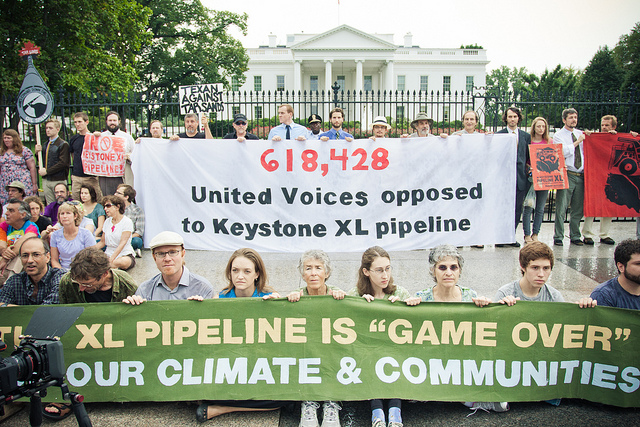
In front of me there’s a sprawling rally underway, with speakers ranging from indigenous elders to the great Canadian writer Naomi Klein. In back of me, another 243 courageous people are being hauled away to jail — it’s the last day of Phase 1 of the tar sands campaign, and 1,252 North Americans have been arrested, the biggest civil disobedience action this century on this continent.
But we’ve been just as cheered by the help that has poured in from around the world — today, activists in front of the White House held a banner with a huge number on it: 618,428. That’s how many people around the world who signed on to the “Stop the Tar Sands” mega-petition to President Obama, including many of you in the 350.org network. Check out this beautiful photo of passion and courage on display:
(Photo Credit: Josh Lopez. If you can’t see the photo above, click here to see it and more inspirational photos from DC.)
But this movement does more than sign petitions: many of you stood strong in front of the White House risking arrest, and protesters on every continent have picketed outside embassies and consulates. That makes sense, for global warming is the one problem that affects everyone everywhere.
And the next moment to prove that is Sept. 24 for Moving Planet — the massive day of climate action that will unite people all over the world. We’ve heard news of amazing actions from every corner of the earth -— from a massive bike rally in the Philippines to an incredible eco-festival in Philadelphia. I truly can’t wait to see the pictures pour in.
But here’s why it’s important: we’re not just a movement that opposes things, we’re also a movement that dreams of what’s coming. And we don’t just dream, we also transform those dreams into reality. On September 24, on bike and on foot and on boards, we’re going to point the way towards that future. By days’ end, we’ll have shown why the bicycle is more glamorous than the car, and why the people have the potential to be more powerful than the polluters.
On some days fighting global warming means swallowing hard, mustering your courage, and making a sacrifice — other days it means getting all your friends up in the saddles of their bikes to have some fun and help move the planet forward.
350.org is building a global grassroots movement to solve the climate crisis. Our online campaigns, grassroots organizing, and mass public actions are led from the bottom up by thousands of volunteer organizers in over 188 countries. You can join 350.org on Facebook by becoming a fan of our page atfacebook.com/350org and follow us on twitter by visiting twitter.com/350. To join our list (maybe a friend forwarded you this e-mail) visitwww.350.org/signup. To support our work, donate securely online at 350.org/donate.
What is 350? 350 is the number that leading scientists say is the safe upper limit for carbon dioxide in our atmosphere. Scientists measure carbon dioxide in “parts per million” (ppm), so 350ppm is the number humanity needs to get below as soon as possible to avoid runaway climate change. To get there, we need a different kind of PPM–a “people powered movement” that is made of people like you in every corner of the planet.
Feel free to circulate this as far and wide as you wish. Thanks, Learning from Dogs
Regular readers will know that I wrote about the XL Pipeline on the 29th August setting out the arguments of those who know much more of the detail as to why the tar sands of Canada are just the worst possible way to continue the madness of using oil. If you didn’t read that then it’s here, and please do so.
The rest of this Post is taken from the Credo Action website. Please do participate. Sign the petition NOW.
That’s what climate scientist James Hansen calls the proposed Keystone XL pipeline — which would carry oil out of Canada’s vast tar sands oil fields to Texas, where it will be refined, then burned across the globe, dealing a catastrophic blow to our chance of returning earth to a stable climate.
This project requires a presidential permit to start building — and it is President Obama’s decision alone to grant or deny that permit. He will make the decision as soon as September.
Tell President Obama: Stop the Keystone XL pipeline.
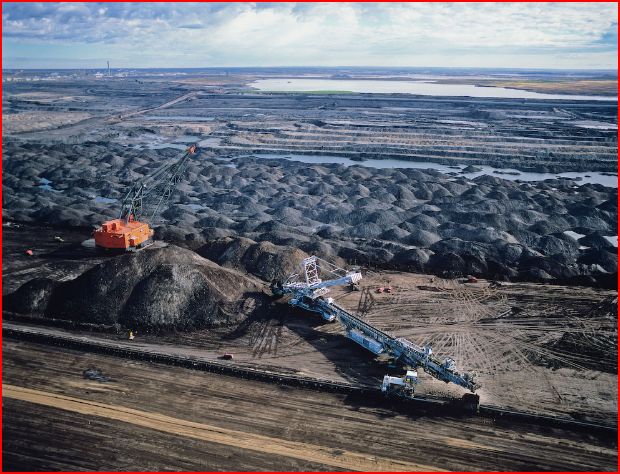
The Alberta tar sands are a carbon bomb. The 3rd largest oil field in the world, the difficult extraction and transportation of the tar sands oil ultimately produces up to three times the carbon emissions of traditional oil. (And extreme environmental devastation along the way.)1
The Keystone XL pipeline is the fuse to this bomb – a highway to swift consumption of this dirty, dangerous crude. As if that wasn’t enough, it poses a massive spill risk in the six states along the pipeline route, including over the Ogallala Aquifer which provides up to 30% of our nation’s agricultural water.
We. Must. Stop. This.
Tell President Obama: Stop the Keystone XL pipeline.
Twenty leading climate scientists have just sent a letter to President Obama urging him to deny the permit.
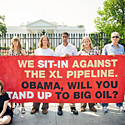
And from August 20th to September 3rd, there will be a massive, historic, daily sit-in outside the White House where more than 1500 people, including CREDO staff, have already signed up to risk arrest in peaceful protest. (For more about the sit in, see below.)
The administration’s previous decisions on climate do not inspire confidence that they will deny the permit. Recently the administration has opened new areas to offshore drilling and coal mining, and late last year, Secretary of State Hillary Clinton even said she was “inclined” to approve Keystone XL.
But President Obama still has the final word. He does not have to negotiate with Congress or industry. As his State Department reviews the permit, the decision — which could have a devastating impact on the livability of our nation, and our world — is entirely in his hands.
We’ve lost too many climate fights already. We need a massive, historic show of pressure to make sure we don’t lose this one. Please sign the petition and read below for other ways to get involved.
Tell President Obama: Stop the Keystone XL pipeline.
Because this fight is so important, leading climate activists including Bill McKibben, Naomi Klein and climate scientist James Hansen are organizing a historic, daily series of peaceful protests between August 20th and Sept. 3rd. The CEO’s and Directors of nearly 30 leading Environmental Organizations, including CREDO’s Michael Kieschnick and Laura Scher, are urging people to participate.
More than 1500 people from across the country, including CREDO staff, have already signed up to join the sit-in outside the White House and risk arrest.
This will be a slightly longer letter than common for the internet age–it’s serious stuff.
The short version is we want you to consider doing something hard: coming to Washington in the hottest and stickiest weeks of the summer and engaging in civil disobedience that will quite possibly get you arrested.
The full version goes like this:
As you know, the planet is steadily warming: 2010 was the warmest year on record, and we’ve seen the resulting chaos in almost every corner of the earth.
And as you also know, our democracy is increasingly controlled by special interests interested only in their short-term profit.
These two trends collide this summer in Washington, where the State Department and the White House have to decide whether to grant a certificate of ‘national interest’ to some of the biggest fossil fuel players on earth. These corporations want to build the so-called ‘Keystone XL Pipeline’ from Canada’s tar sands to Texas refineries.
To call this project a horror is serious understatement. The tar sands have wrecked huge parts of Alberta, disrupting ways of life in indigenous communities–First Nations communities in Canada, and tribes along the pipeline route in the U.S. have demanded the destruction cease. The pipeline crosses crucial areas like the Oglalla Aquifer where a spill would be disastrous–and though the pipeline companies insist they are using ‘state of the art’ technologies that should leak only once every 7 years, the precursor pipeline and its pumping stations have leaked a dozen times in the past year. These local impacts alone would be cause enough to block such a plan. But the Keystone Pipeline would also be a fifteen hundred mile fuse to the biggest carbon bomb on the continent, a way to make it easier and faster to trigger the final overheating of our planet, the one place to which we are all indigenous.
As the climatologist Jim Hansen (one of the signatories to this letter) explained, if we have any chance of getting back to a stable climate “the principal requirement is that coal emissions must be phased out by 2030 and unconventional fossil fuels, such as tar sands, must be left in the ground.” In other words, he added, “if the tar sands are thrown into the mix it is essentially game over.” The Keystone pipeline is an essential part of the game. “Unless we get increased market access, like with Keystone XL, we’re going to be stuck,” said Ralph Glass, an economist and vice-president at AJM Petroleum Consultants in Calgary, told a Canadian newspaper last week.
Given all that, you’d suspect that there’s no way the Obama administration would ever permit this pipeline. But in the last few months the administration has signed pieces of paper opening much of Alaska to oil drilling, and permitting coal-mining on federal land in Wyoming that will produce as much CO2 as 300 powerplants operating at full bore.
And Secretary of State Clinton has already said she’s ‘inclined’ to recommend the pipeline go forward. Partly it’s because of the political commotion over high gas prices, though more tar sands oil would do nothing to change that picture. But it’s also because of intense pressure from industry. The US Chamber of Commerce–a bigger funder of political campaigns than the RNC and DNC combined–has demanded that the administration “move quickly to approve the Keystone XL pipeline,” which is not so surprising–they’ve also told the U.S. EPA that if the planet warms that will be okay because humans can ‘adapt their physiology’ to cope. The Koch Brothers, needless to say, are also backing the plan, and may reap huge profits from it.
So we’re pretty sure that without serious pressure the Keystone Pipeline will get its permit from Washington. A wonderful coalition of environmental groups has built a strong campaign across the continent–from Cree and Dene indigenous leaders to Nebraska farmers, they’ve spoken out strongly against the destruction of their land. We need to join them, and to say even if our own homes won’t be crossed by this pipeline, our joint home–the earth–will be wrecked by the carbon that pours down it.
And we need to say something else, too: it’s time to stop letting corporate power make the most important decisions our planet faces. We don’t have the money to compete with those corporations, but we do have our bodies, and beginning in mid August many of us will use them. We will, each day, march on the White House, risking arrest with our trespass. We will do it in dignified fashion, demonstrating that in this case we are the conservatives, and that our foes–who would change the composition of the atmosphere are dangerous radicals. Come dressed as if for a business meeting–this is, in fact, serious business.
And another sartorial tip–if you wore an Obama button during the 2008 campaign, why not wear it again? We very much still want to believe in the promise of that young Senator who told us that with his election the ‘rise of the oceans would begin to slow and the planet start to heal.’ We don’t understand what combination of bureaucratic obstinacy and insider dealing has derailed those efforts, but we remember his request that his supporters continue on after the election to pressure his government for change. We’ll do what we can.
And one more thing: we don’t just want college kids to be the participants in this fight. They’ve led the way so far on climate change–10,000 came to DC for the Powershift gathering earlier this spring. They’ve marched this month in West Virginia to protest mountaintop removal; a young man named Tim DeChristopher faces sentencing this summer in Utah for his creative protest.
Now it’s time for people who’ve spent their lives pouring carbon into the atmosphere to step up too, just as many of us did in earlier battles for civil rights or for peace. Most of us signing this letter are veterans of this work, and we think it’s past time for elders to behave like elders. One thing we don’t want is a smash up: if you can’t control your passions, this action is not for you.
This won’t be a one-shot day of action. We plan for it to continue for several weeks, till the administration understands we won’t go away. Not all of us can actually get arrested–half the signatories to this letter live in Canada, and might well find our entry into the U.S. barred. But we will be making plans for sympathy demonstrations outside Canadian consulates in the U.S., and U.S. consulates in Canada–the decision-makers need to know they’re being watched.
Twenty years of patiently explaining the climate crisis to our leaders hasn’t worked. Maybe moral witness will help. You have to start somewhere, and we choose here and now.
As plans solidify in the next few weeks we’ll be in touch with you to arrange nonviolence training; our colleagues at a variety of environmental and democracy campaigns will be coordinating the actual arrangements.
We know we’re asking a lot. You should think long and hard on it, and pray if you’re the praying type. But to us, it’s as much privilege as burden to get to join this fight in the most serious possible way. We hope you’ll join us.
Maude Barlow — Chair, Council of Canadians
Wendell Berry — Author and Farmer
Tom Goldtooth — Director, Indigenous Environmental Network
Danny Glover — Actor
James Hansen — Climate Scientist
Wes Jackson — Agronomist, President of the Land Insitute
Naomi Klein — Author and Journalist
Bill McKibben — Writer and Environmentalist
George Poitras — Mikisew Cree Indigenous First Nation
Gus Speth — Environmental Lawyer and Activist
David Suzuki — Scientist, Environmentalist and Broadcaster
Joseph B. Uehlein — Labor organizer and environmentalist
The latest announcement continues to show dogs in very good light!
Before I plunge into this Post, just an apology. I’m trying hard to get out of what feels like a recent pattern of ‘re-publishing’ stuff rather than posting material that is primarily my own creative output. Ironically, it’s become a little harder to achieve since starting a creating writing course last Tuesday 23rd (every Tuesday evening for 12 weeks!). The course requires several thousand words of ‘homework’ each week.
Then I lost the plot and published two posts yesterday, when one of them should have been scheduled for today! Thus making it almost impossible to be fully creative today!
Anyway, to today’s theme. Which comes very close on the heels of my post on Monday about the antics of the big oil companies and ‘recovering’ oil from tar sands in Canada.
We all know that some of the most ecologically and environmentally fragile places on the planet are the polar regions. Of the two polar regions, the more sensitive one is the North Polar region. The Arctic ice cap is forecast to be clear of ice each Summer by 2030 assuming the huge annual run-off of fresh water doesn’t screw up the existing ocean currents before then. (Indeed, a fascinating film about the complexity of the weather systems as a result of very long heating and cooling cycles was seen recently on YouTube – link at the end of this post.)
So continued madness over our love affair with oil is just that: madness. Don’t get me wrong. Jean and I drive gasoline-powered vehicles but at least we are conscious of the damage we are doing and will change just as soon as it becomes viable for us to so do.
So with all that in mind, here’s a recent announcement from Exxon first seen on the BBC News website.
US oil major Exxon Mobil has clinched an Arctic oil exploration deal withRussian state-owned oil firm Rosneft.
The venture seemingly extinguishes any remaining chance of BP reviving its own deal, which lapsed in May.The agreement was signed on Tuesday in the presence of Prime Minister Vladimir Putin, a Rosneft spokesman said.
Prime Minister Putin said that it would also allow Rosneft to develop fields in the Gulf of Mexico and Texas, according to local media reports.
“New horizons are opening up. One of the world’s leading companies, Exxon Mobil, is starting to work on Russia’s strategic shelf and deepwater continental shelf,” he said.
‘Big win
‘Under the agreement, the two firms will spend $3.2bn on deep-sea exploration in the East Prinovozemelsky region of the Kara Sea, as well as in the Russian Black Sea.
Exxon described these areas as “among the most promising and least explored offshore areas globally, with high potential for liquids and gas”.
The two companies will also co-operate on the development of oil fields in Western Siberia.
Exxon spokesman Alan Jeffers told the BBC: “[The Russian Arctic] is among the most promising and least explored regions for oil, that is why we are very interested.
Cynic mode on: “The Russian Arctic is among the most promising and least explored regions for oil …” Well that’s alright then!
If one follows that link in the BBC news item, it goes to the ExxonMobil press release where one can quickly read the following key points,
US $3.2 billion exploration program planned for Kara Sea and Black Sea
Establishment of a joint Arctic Research and Design Center for Offshore Development in St. Petersburg
Rosneft participation in ExxonMobil projects in the U.S. and other countries with a focus on building offshore and tight oil expertise
Joint operations to develop Western Siberia tight oil resources
Companies form partnership to undertake projects in the Russian Federation and internationally
Thus this is not some small sideline – it’s potentially very big business for both partners.
The Kara Sea, an extension of the Arctic Ocean, is located off the coastline of Siberia in far northwestern Russia.
It’s separated from the Barents Sea (in the west) by the Kara Strait and Novaya Zemlya – and the Laptev Sea (in the east) by the Taymyr Peninsula and Severnaya Zemlya. The northern border (shown) is a mapping opinion.
It has an estimated area of 880,000 sq km (340,000 sq mi), an average depth of 128 m (420 ft) and a maximum depth of 620 m (2,034 ft).
Ice-bound for most of the year, the sea is generally navigable only during August and September.
The main ports are Dikson (Dickson) and Novyy Port, and they are heavily used during the two-month (lucrative) fishing season. They will also be distribution points when the petroleum and natural gas discovered here is brought to the surface.
Just look at that map again and see how far North of the Arctic Circle is the Kara Sea.
Dad, where's the ice gone?
Let’s go back to dogs. When dogs were primarily wild animals, really when they were still carrying all the ‘habits’ of the Grey Wolf, from which dogs are genetically descended, they were very territorial, as indeed domestic dogs are towards their domestic area. WikiPedia explains, ‘The core of their territory is on average 35 km2 (14 sq mi), in which they spend 50% of their time.‘ (That’s a great article on WikiPedia about the Grey Wolf, by the way.)
Anyway, the wolves, like practically all other animal species, live in harmony within their territory and only move or amend their territorial boundaries if the survival of the pack is threatened.
So when, oh when, is mankind going to learn that our territory is Planet Earth. We have no other territory to move to. I still remember my form teacher way back in my first English school saying to me, “There are two ways you can learn this lesson, the easy way or the hard way!” Same applies to us all! Let’s urgently learn this lesson from dogs and move on from oil.
Finally, that YouTube video. Less than an hour long, it has some interesting facts about climate change over many thousands of years and a rather interesting conclusion.
(Apologies to all you readers – bit under the cosh at the moment in terms of free thinking time – so have lent on this timely update from CASSE for today.)
From CASSE, the Centre for the Advancement of the Steady State Economy
Why Do So Many People Believe in the Fantasy of Infinite Growth on a Finite Planet?
by Rob Dietz
How do you feel about the economy these days? How about the environment? Do you think we’re sitting in a better spot than we were ten, twenty, or thirty years ago? It’s hard to find folks who are satisfied with either economic or environmental conditions. In the first place, the way we run the economy is producing appalling results. We have a mix of financial fiascos, unacceptable unemployment, and a dismal disparity between the haves and the have-nots. And if you’re not soiling yourself (or at least somewhat concerned) about what’s happening on land, sea and air, then you’re not paying much attention to the omnipresent signs of environmental breakdown.
Each day it becomes more apparent that we are on a misguided mission. Pursuit of perpetual economic growth is not a winning proposition for a lasting prosperity. Building a bigger economy can make sense in some circumstances, but always aiming to build a bigger economy means taking an ever-bigger chunk out of the earth’s ecosystems and the life-support services they provide. Why, then, do so many people believe in the fantasy of infinite growth on a finite planet? Is it because we can’t come up with a better idea? Is it because the rich and powerful have trapped the rest of us in their web of conspiracy? Is it because people are hopelessly greedy and materialistic?
At various times and places we might answer these questions affirmatively, but we can more commonly answer, “No, no, and no.” Putting aside conspiracy theories for the moment, there are three honest (but bogus) reasons why we pursue economic growth past the point of effectiveness and reason.
Bogus Reason #1: We think we have to have economic growth to create jobs.
People, and especially politicians, want jobs. We’ve used the blunt tool of economic growth to create jobs for decades, but do we really need economic growth to have good jobs? It’s true that there are typically more job openings in a growing economy, but there are other, less costly ways to make sure jobs are available. Growth, however, gives corporate elites an easy out. They can point to economic growth as the job creator while doing what they want without considering the impacts of their decisions on jobs.
If jobs are really the priority, then we wouldn’t replace people with machinery. And we wouldn’t eliminate service jobs to shift more and more burden onto people to serve themselves. My friend Chris works as a gas station attendant and provides a valuable service pumping gas for customers. He wouldn’t have a job, however, if he lived elsewhere. He happens to live in Oregon where the law says that only professional attendants can pump gas. In most states, gas station attendants have been replaced by customer labor and credit card readers. This sort of substitution has become commonplace in the name of efficiency — policy makers find it easier (or at least they’ve found it easier in the past) to avoid considering jobs explicitly. Just grow the economy and let Chris find a job elsewhere — that’s just the way it goes if his job is eliminated and the customer is forced to pick up the slack.
The truth is that we can have good jobs without producing and consuming evermore stuff. For starters, we can institute policies to make job-sharing an attainable reality. Many people would gladly trade some salary for more time. We can also stop the process of eliminating jobs through outsourcing and machinery-for-people swaps. Of course stopping this process would require a change in corporate incentives…
Shareholder corporations are severely flawed. In my household, let’s say my overriding goal is to maximize my earnings. What would I do? I would take the highest paying job I could get. I certainly wouldn’t be involved in public policy or a not-for-profit enterprise. I wouldn’t spend much time with my wife or daughter — that would be time away from my career, and it could eat into my earnings (cue the Cat’s in the Cradle). If the goal is so single-focused, the results aren’t surprising. Profit maximization, whether it occurs in my household or in a corporation, produces perverse outcomes.
We know this about shareholder corporations. We know there are better ways to set up productive enterprises that have more worthy goals, but we don’t make the change. The reason is that we are addicted to two things corporations do well. First, we’re addicted to consumer novelty. We’ve gotta have the latest and greatest. People chase after I-phones, I-pods, I-pads, and plenty of other I-wants. Second, we’re addicted to receiving unearned income from investments in stocks or mutual funds. People who can afford it are invested in corporations. Their personal wealth is tied to the ability of corporations to grow. We’ve become accustomed to the idea of passive investment — we put extra money into an account and do absolutely nothing but watch the size of the account get bigger. Are we really entitled to get something for nothing?
Bogus Reason #3: We refuse to pay attention to the downsides of economic growth.
Few people are studying ecology and understanding how economic growth is degrading environmental resources. In fact, a whopping 21% percent of college students are business majors. And as Dr. Seuss noted in his classic book, The Lorax, “Business is business, and business must grow!” While we continue to tempt fate by disrupting and dismantling natural systems that we only partially understand, our attention is locked on the results of reality TV shows, Tiger Woods’s sex life, Jennifer Anniston’s and Justin Bieber’s haircuts, fairytale weddings of figurehead monarchs, and other matters of critical importance.
While we’re failing to pay attention, those who benefit most from growth — the corporate elites — will keep on doing what they do, and they’ll keep on selling it to the rest of us. If we don’t start asking, “why?” real soon, our kids will one day be asking “How did we let this happen?”
The powerful anti-democratic forces that will threaten civilisation.
In one sense this post today carries an underlying political message – and in another sense, it does not. It does in the sense that if every American voter truly understood the risks of a continued relationship with oil then the tar-sands projects wouldn’t have a prayer of a chance of being allowed.
In the other sense, it does not. Because the influence and power of ‘behind-the-scenes’ oil and money is beyond imagination and, just possibly, outside the reach of democracy.
So what’s got me so agitated?
Well first is that I have been quietly reading The Transition Handbook by Rob Hopkins, he of Transition Totnes fame. Most readers will be aware that Totnes was the first Transition Town in the world and started what is becoming the greatest social movement of the 21st century.
In Rob’s book, on page 51, there is a diagram showing the relative energy returns from the energy invested to produce that energy – hope that makes sense! Let me explain further. For example, for every unit of energy invested in building tidal-range generators, there are eighty-seven units of energy returned. I.e. this is a great investment for mankind in terms of the net benefit.
If we look at the generation of electricity from solar photo-voltaic (PV) panels then the return is about eight units from every unit invested.
The worst return of them all is from Tar sands: just one unit returned from every unit invested. Investment and humanitarian madness!
Then next I came across this item about Tar sands on The Ecologist magazine website,
Emissions from tar sands seriously underestimated
Governments and companies making no effort to quantify the real climate impacts
Greenhouse gas emissions from tar sands operations are being significantly under-reported according to new research by Global Forest Watch Canada.
The report, ‘Bitumen and Biocarbon‘, says oil companies and governments are not accounting for emissions from deforestation. It says that when boreal forest is destroyed for tar sands development, significant amounts of greenhouse gases are emitted.
‘Governments and companies are working hard to downplay the impacts of tar sands operations, but it turns out that they don’t even know the full extent of the problem,’ said Christy Ferguson, Greenpeace climate and energy coordinator.
‘What’s worse, they’re doing nothing to find out. Denial is not a climate strategy.’
In addition, the report shows that biological carbon stored in living and decaying plants is lost when natural ecosystems are disturbed or destroyed through mining of bitumen and construction of roads, pipelines or facilities.
‘Peatlands are one of the world’s most important storehouses of soil carbon. Industrial activity in the tar sands is destroying peatlands, releasing carbon and eliminating a crucial natural mechanism.
‘Even if peatlands are reclaimed, the carbon released through industrialisation won’t be replaced for thousands of years,’ said Ferguson.
Finally, today (25th) I received in my in-box the latest TomDispatch offering. (I am indebted to Tom Engelhardt for, once again, giving me permission to reproduce in full this TomGram.)
Tom’s latest piece is written by Bill McKibben (with an introduction by Tom) and I strongly urge you to read it – the implications are global. If you read an earlier TomDispatch article by Bill re-published on Learning from Dogs on the 18th July, The Great American Carbon Bomb, today’s piece will surely make you sit up and fume; as it did me! Here it is in full.
Tomgram: Bill McKibben, Jailed Over Big Oil’s Attempt to Wreck the Planet
What might have happened if John McCain had won the presidency in 2008? One thing is certain: there would have been a lot more protest from Democrats, progressives, and the left. Take it as an irony of his election, but Barack Obama has proved remarkably effective in disarming the antiwar movement, even as the use of war in American policy in the Greater Middle East has only grown. That Obama, the supposed anti-warrior of the 2008 campaign, has paid less than no attention to his antiwar critics is no news at all. It’s now practically a cliché as well that he seems to feel no need to feed his political “base” and that, generally speaking (and explain it as you will), his base has not yet pushed back.
This has been particularly true of Obama’s wars, especially the disastrous, never-ending one in Afghanistan. Had Afghanistan been “McCain’s war,” you would surely have seen growing waves of protest, despite the way 9/11 ensured that the Afghan War, unlike the Iraq one, would long be the unassailable “good war.” Still, as American treasure surged into the ill-starred enterprise in Afghanistan, while funds for so much that mattered disappeared at home, I think the streets of Washington would have been filling. What protest there has been, as John Hanrahan of the Nieman Watchdog website reported recently, tends to be remarkably ill-covered in the mainstream media.
Obama, only two points ahead of Ron Paul in the latest Gallup Poll in the race for 2012, is a beyond-vulnerable candidate. (Somewhere there must be some Democratic pol doing the obvious math and considering a challenge, mustn’t there?) Fortunately, in another area at least as crucial as our wars, demonstrators against a Big Oil tar-sands pipeline from Canada that will help despoil the planet are now out in front of the White House — you can follow them here — and they haven’t been shy about aiming their nonviolent protests directly at Obama. Will he or won’t he act like the climate-change president that, on coming into office, he swore he would be? Time will tell. Meanwhile, let Bill McKibben, TomDispatch regular, an organizer of the protests, and just out of a jail cell, fill you in. Tom
Arrested at the White House
Acting as a Living Tribute to Martin Luther King
By Bill McKibben
I didn’t think it was possible, but my admiration for Martin Luther King, Jr., grew even stronger these past days.
As I headed to jail as part of the first wave of what is turning into the biggest civil disobedience action in the environmental movement for many years, I had the vague idea that I would write something. Not an epic like King’s “Letter from a Birmingham Jail,” but at least, you know, a blog post. Or a tweet.
Heros
But frankly, I wasn’t up to it. The police, surprised by how many people turned out on the first day of two weeks of protests at the White House, decided to teach us a lesson. As they told our legal team, they wanted to deter anyone else from coming — and so with our first crew they were… kind of harsh.
We spent three days in D.C.’s Central Cell Block, which is exactly as much fun as it sounds like it might be. You lie on a metal rack with no mattress or bedding and sweat in the high heat; the din is incessant; there’s one baloney sandwich with a cup of water every 12 hours.
I didn’t have a pencil — they wouldn’t even let me keep my wedding ring — but more important, I didn’t have the peace of mind to write something. It’s only now, out 12 hours and with a good night’s sleep under my belt, that I’m able to think straight. And so, as I said, I’ll go to this weekend’s big celebrations for the openingof the Martin Luther King Jr. National Memorial on the Washington Mall with even more respect for his calm power.
Preacher, speaker, writer under fire, but also tactician. He really understood the power of nonviolence, a power we’ve experienced in the last few days. When the police cracked down on us, the publicity it produced cemented two of the main purposes of our protest:
Eaarth
First, it made Keystone XL — the new, 1,700-mile-long pipeline we’re trying to block that will vastly increase the flow of “dirty” tar sands oil from Alberta, Canada, to the Gulf of Mexico — into a national issue. A few months ago, it was mainly people along the route of the prospective pipeline who were organizing against it. (And with good reason: tar sands mining has already wrecked huge swaths of native land in Alberta, and endangers farms, wild areas, and aquifers all along its prospective route.)
Now, however, people are coming to understand — as we hoped our demonstrations would highlight — that it poses a danger to the whole planet as well. After all, it’s the Earth’s second largest pool of carbon, and hence the second-largest potential source of global warming gases after the oil fields of Saudi Arabia. We’ve already plumbed those Saudi deserts. Now the question is: Will we do the same to the boreal forests of Canada. As NASA climatologist James Hansen has made all too clear, if we do so it’s “essentially game over for the climate.” That message is getting through. Witness the incredibly strong New York Times editorial opposing the building of the pipeline that I was handed on our release from jail.
Second, being arrested in front of the White House helped make it clearer that President Obama should be the focus of anti-pipeline activism. For once Congress isn’t in the picture. The situation couldn’t be simpler: the president, and the president alone, has the power either to sign the permit that would take the pipeline through the Midwest and down to Texas (with the usual set of disastrous oil spills to come) or block it.
Barack Obama has the power to stop it and no one in Congress or elsewhere can prevent him from doing so. That means — and again, it couldn’t be simpler — that the Keystone XL decision is the biggest environmental test for him between now and the next election. If he decides to stand up to the power of big oil, it will send a jolt through his political base, reminding the presently discouraged exactly why they were so enthused in 2008.
That’s why many of us were wearing our old campaign buttons when we went into the paddy wagon. We’d like to remember — and like the White House to remember, too — just why we knocked on all those doors.
But as Dr. King might have predicted, the message went deeper. As people gather in Washington for this weekend’s dedication of his monument, most will be talking about him as a great orator, a great moral leader. And of course he was that, but it’s easily forgotten what a great strategist he was as well, because he understood just how powerful a weapon nonviolence can be.
The police, who trust the logic of force, never quite seem to get this. When they arrested our group of 70 or so on the first day of our demonstrations, they decided to teach us a lesson by keeping us locked up extra long — strong treatment for a group of people peacefully standing on a sidewalk.
No surprise, it didn’t work. The next day an even bigger crowd showed up — and now, there are throngs of people who have signed up to be arrested every day until the protests end on September 3rd. Not only that, a judge threw out the charges against our first group, and so the police have backed off. For the moment, anyway, they’re not actually sending more protesters to jail, just booking and fining them.
And so the busload of ranchers coming from Nebraska, and the bio-fueled RV with the giant logo heading in from East Texas, and the flight of grandmothers arriving from Montana, and the tribal chiefs, and union leaders, and everyone else will keep pouring into D.C. We’ll all, I imagine, stop and pay tribute to Dr. King before or after we get arrested; it’s his lead, after all, that we’re following.
Our part in the weekend’s celebration is to act as a kind of living tribute. While people are up on the mall at the monument, we’ll be in the front of the White House, wearing handcuffs, making clear that civil disobedience is not just history in America.
We may not be facing the same dangers Dr. King did, but we’re getting some small sense of the kind of courage he and the rest of the civil rights movement had to display in their day — the courage to put your body where your beliefs are. It feels good.
So perhaps you understand why every American reading this should make sure your voice is heard. And in the last few minutes – 1.30pm MT 25th August – Reuters have just put out this news release,
Nation’s Leading Environmental NGOs Unified Against Tar Sands Pipeline
Update on Day 5 of Tar Sand Pipeline Protest at the White House
See past update and background.
275 people have been arrested so far and many have been released. Today, the largest environmental groups in the US joined to send a letter to President Obama voicing their unified opposition to the Keystone pipeline and asking him to block it.
Why is this important? “For those of us out there in front of the White House, the best thing about this ringing statement is that the administration won’t be able to play one group off against another by making small concessions here and there”; says protest organizer Bill McKibben.
“There’s only one way to demonstrate to the environmental base the rhetoric of Obama’s 2008 campaign is still meaningful – and that’s to veto this pipeline. Since he can do it without even consulting Congress, this is one case where we’ll be able to see exactly how willing he is to match the rhetoric of his 2008 campaign.”
The letter says:
Dear President Obama,
Many of the organizations we head do not engage in civil disobedience; some do. Regardless, speaking as individuals, we want to let you know that there is not an inch of daylight between our policy position on the Keystone Pipeline and those of the very civil protesters being arrested daily outside the White House.
This is a terrible project – many of the country’s leading climate scientists have explained why in their letter last month to you. It risks many of our national treasures to leaks and spills. And it reduces incentives to make the transition to job-creating clean fuels.
You have a clear shot to deny the permit, without any interference from Congress. It’s perhaps the biggest climate test you face between now and the election.
If you block it, you will trigger a surge of enthusiasm from the green base that supported you so strongly in the last election. We expect nothing less.
Sincerely,
Fred Krupp, Environmental Defense Fund
Michael Brune, Sierra Club
Frances Beinecke, Natural Resources Defense Council
Phil Radford, Greenpeace
Larry Schweiger, National Wildlife Federation Erich Pica, Friends of the Earth
Rebecca Tarbotton, Rainforest Action Network
May Boeve, 350.org
Gene Karpinski, League of Conservation Voters
Margie Alt, Environment America
New York Times Also Opposes Pipeline
In an August 21 editorial, the NY Times took a opposition against the pipeline, citing two main concerns: the risk of oil spills along the pipeline, which would traverse highly sensitive terrain, and the fact that the extraction of petroleum from tar sands creates far more greenhouse emissions than conventional production does.
Building the pipeline would clear the way for Canada to double tar sands production over the next decade to more than 1.8 million barrels a day. To do that, some 740,000 acres of boreal forest – a natural carbon reservoir – would be destroyed.
In addition to the emissions produced by tar sands extraction, would be emissions from the loss of this vast, crucial carbon sink, [editor’s note: not to mention the biodiversity it harbors.] Read the editorial:
Website: here with permission from Sustainable Business
Ernst Friedrich “Fritz” Schumacher (16 August 1911 – 4 September 1977)
Ernst Friedrich "Fritz" Schumacher
It seems amazing to realise both that this far-sighted man was born a century ago this day and that his incredibly influential book, Small is Beautiful, was published 38 years ago.
The book has been hugely influential. Indeed, my gut sense is that it probably started the whole ‘green’ movement. The Times Literary Supplement of October 6, 1995 regarded E.F. Schumacher’s 1973 book Small Is Beautiful: a study of economics as if people mattered as among the 100 most influential books published since the end of the Second World War.
Just a personal note that for many years I lived just a few miles from Dartington in Devon (UK) where Schumacher College was founded in 1991. Named after the great man, it provided, and still does, learning for sustainable living. Perhaps no surprise at all that nearby Totnes became the world’s first ‘transition town’.
Want to find out more? Then go to the New Economics Institute website here and discover,
The New Economics Institute is a US organization that uniquely combines vision, theory, action, and communication to effect a transition to a new economy — an economy that gives priority to supporting human well-being and Earth’s natural systems. Our multidisciplinary approach employs research, applied theory, public campaigns, and educational events to describe an alternative socio-economic system that is capable of addressing the enormous challenges of our times. Our premise is that a fair and sustainable economy is possible and that ways must be found to realize it.
The Institute, formerly the E. F. Schumacher Society, is working in close partnership with the New Economics Foundation from London to add the programs and experience developed in the UK to its own work in the US.
Finally, to get a flavour of this wonderful man and the amazing legacy that he has left the planet, watch this short video of E.F. Schumacher answering a question from the moderator about whether or not Buddhist Economics can work in the West. (Question & Answer Panel at Great Circle Center, 3/19/77. Peter Gillingham Collection, E. F. Schumacher Library Archives.)
In Paul Gilding’s book, The Great Disruption, there is a chapter called When the Dam of Denial Breaks. On page 121 Paul Gilding writes this,
To argue we are naturally greedy and competitive and can’t change is like arguing that we engage naturally in murder and infanticide as our forebears the chimps do and therefore as we did. We have certain tendencies in our genes, but unlike other creatures we have the proven capacity to make conscious decisions to overcome them and also the proven ability to build a society with laws and values to enshrine and, critically, to enforce such changes when these tendencies come to the surface.
So don’t underestimate how profoundly we can change. We are still capable of evolution, including conscious evolution. This coming crisis is perhaps the greatest opportunity in millennia for a step change in human society.
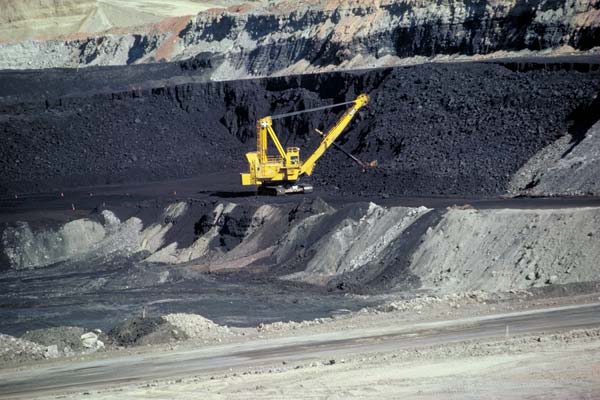
The United States of America gets a lot of stick, rightly so, for it’s greedy consumption of energy, especially the use of coal. According to the World Coal Association, the USA in 2010 produced 932 million tons of hard coal, second in the world to China that produced 3,162 million tons.
Coal mine in Wyoming
But the one thing that the USA has shown time and time again is that it has the capacity to change very quickly, especially when the country, from its leaders to its entrepreneurs, senses a global leadership opportunity. With that in mind, read the latest release from the Earth Policy Institute, reproduced below,
AUGUST 10, 2011 A Fifty Million Dollar Tipping Point?
Lester R. Brown
At a press conference on July 21, New York City Mayor Michael Bloomberg announced that he was contributing $50 million to the Sierra Club’s Beyond Coal Campaign. Michael Brune, head of the Sierra Club, called it a “game changer”. It is that, but it also could push the United States, and indeed the world, to a tipping point on the climate issue.
It is one thing for Michael Brune to say coal has to go, but quite another when Michael Bloomberg says so. Few outside the environmental community know who Michael Brune is, but every business person knows Michael Bloomberg as one of the most successful business entrepreneurs of his generation.
The Sierra Club’s Beyond Coal Campaign has two main goals. The first is to prevent the permitting and construction of new coal-fired power plants. So far 153 proposed power plants have been taken off the board. The second goal is to close the 492 existing plants. The Sierra Club lists 71 plants already scheduled for total or partial closure, most of them by 2016.
The efforts to stabilize climate will be won or lost with coal, the world’s largest source of carbon emissions. The effort to phase out coal is now well under way in the United States, the world’s second ranking coal user after China.
There are likely to be many ripple effects from the Bloomberg grant. To begin with, it may encourage other philanthropists to invest in climate stabilization.
The prospect for investment in coal, already deteriorating, will weaken even faster. In August 2010, the Rainforest Action Network (RAN) announced that several leading U.S. investment banks, including Bank of America and J.P. Morgan, had ceased lending to companies involved in mountaintop removal coal mining. Now with Bloomberg’s opposition, investors will be even more wary of coal.
The Bloomberg-Sierra initiative again focuses attention on the 13,200 lives lost each year in the United States due to air pollution from burning coal. If deaths from black lung disease among coal miners are included the number climbs even higher. The number of coal-related deaths in one year dwarfs total U.S. fatalities in the Iraq and Afghanistan wars. We invest heavily in protecting the lives of our troops in the Middle East, and rightly so. Bloomberg is saying let’s do the same for our people at home.
In addition, this initiative brings attention to the health care costs to society of burning coal. These are currently estimated at more than $100 billion per year, roughly $300 for every person in the United States or $1,200 for a family of four. These costs are real, but it is the American people, not the coal companies, who shoulder the burden.
Further reinforcing the urgency of phasing out coal are the more extreme weather events that climate scientists have been warning about for decades. During the first half of 2011 we watched TV news channels become weather channels. First it was a record number of tornadoes in one month, including the one that demolished Tuscaloosa, Alabama. Then, a few weeks later, an even more powerful tornado demolished Joplin, Missouri. As drought and heat sparked record or near-record wildfires in Arizona, New Mexico, and Texas, the lower Mississippi Basin was flooding. Searing heat waves scorched the southern Great Plains, the Midwest, and the East Coast. Intense heat has continued to break records across the country as Texas suffers its most severe one-year drought on record.
For coal, the handwriting is on the wall. Between 2007 and 2010, coal use in the United States dropped 8 percent. (See data.) Meanwhile, more than 300 new wind farms came online, totaling over 23,000 megawatts of generating capacity—the electricity output equivalent of 23 coal-fired power plants.
When people were asked in a national poll where they would like to get their electricity from, only 3 percent opted for coal. Despite the coal industry’s heavy expenditures to promote “clean coal,” it is still a loser in the public mind.
In addition to the Sierra Club, RAN, and a talented team of Earthjustice lawyers, the anti-coal movement also has allies in Friends of the Earth and Greenpeace, the latter with its highly developed capacity to focus public attention on environmental issues. This was evident in May when a Greenpeace team of eight daring activists scaled the 450-foot Fisk coal plant smokestack located in Chicago and painted “Quit Coal” on it. They were drawing public attention to the deadly air pollution in the city coming from the plant.
As the United States closes its coal-fired power plants, it sends a message to the world. With Michael Bloomberg’s grant bolstering the Sierra Club’s well-organized program to phase out coal, we can now imagine a coal-free United States on the horizon. The United States could again become a world leader, this time in stabilizing climate.
“The United States could again become a world leader, this time in stabilizing climate.” That would be a dream come true, a dream of unimaginable consequences.
“Everyone thinks of changing the world, but no one thinks of changing himself.” Leo Tolstoy
I am going to refer to some ideas before explaining from whom they came, and when.
Try this: the term “future shock” is defined as a certain psychological state of individuals and entire societies. The shortest definition for the term is a personal perception of “too much change in too short a period of time”.
Or try this: society is undergoing an enormous structural change, a revolution from an industrial society to a “super-industrial society”. This change will overwhelm people, the accelerated rate of technological and social change leaving them disconnected and suffering from “shattering stress and disorientation” – future shocked. It was stated that the majority of social problems were symptoms of the future shock.
Stay with me a little longer as I pose a few questions. How do you feel at the moment? Slightly unsure of where the world is going right now? Feeling a little unsettled?
Why those questions? With the Dow Jones index heading down through 11,130 (at the time of writing on the 8th) and ‘chaos across markets’ headlines all over the place these are very unsettling times
Last week’s edition of The Economist had five pages about the present uncertain times in the USA.
The numbers keep being revised inexorably downwards
The rough news did not end there. The Bureau of Economic Analysis (BEA) revised its numbers back through the recession, revealing a downturn more serious than previously understood. The BEA’s first estimate of output in the fourth quarter of 2008, published in January of 2009, showed a contraction of 3.8%, later revised to a 6.8% drop. The new numbers change the figure yet again, to a shocking 8.9% fall in GDP. For 2009 as a whole, the American economy shrank by 3.5% rather than the previously reported 2.6%. American output has yet to reattain its 2007 peak. On a per-person basis, inflation-adjusted GDP stands at virtually the same level as in the second quarter of 2005. America is six years into a lost decade. [my emphasis]
So back to those comments about ‘future shock’. They come from a gentleman known across the world for his writings as a futurist, Alvin Toffler. His website is here and there is a good review of the man and his works on Wikipedia.
Alvin Toffler, born 1928
Toffler’s book, Future Shock, from 1970 was prescient in forecasting …. well here’s how it is written on Wikipedia,
Toffler argues that society is undergoing an enormous structural change, a revolution from an industrial society to a “super-industrial society“. This change will overwhelm people, the accelerated rate of technological and social change leaving them disconnected and suffering from “shattering stress and disorientation” – future shocked. Toffler stated that the majority of social problems were symptoms of the future shock. In his discussion of the components of such shock, he also popularized the term “information overload.”
But there’s an aspect that wasn’t even on the horizon when Toffler was writing that book in the late 60s – the end of growth. That is creating a whole new level of change and ‘information overload’, in my opinion.
Just a few days ago, I reviewed the Paul Gilding book The Great Disruption. I quoted this extract from the very start of the book,
This means things are going to change. Not because we will choose change out of philosophical or political preference, but because if we don’t transform our society and economy, we risk social and economic collapse and the descent into chaos. The science on this is now clear and accepted by any rational observer. While an initial look at the public debate may suggest controversy, any serious examination of the peer-reviewed conclusions of leading science bodies shows the core direction we are heading in is now clear. Things do not look good.
These challenges and the facts behind them are well-known by experts and leaders around the world, and have been for decades. But despite this understanding, that we would at some point pass the limits to growth, it has been continually filed away to the back of our mind and the back of our drawers, with the label “Interesting – For Consideration Later” prominently attached. Well, later has arrived.
Indeed, ‘later’ has arrived. The ‘future’ is now here!
Watch the first 10 minutes of the Future Shock film made back in 1972 and ponder.
The following four parts are easily found on YouTube.
God grant me the serenity to accept the things I cannot change, the courage to change the things I can, and the wisdom to know the difference. Reinhold Niebuhr
A retrospective muse about the present global challenges.
A few days back I posted an article by Tom Engelhardt called The Great American Carbon Bomb. It attracted a number of comments including a couple from Learning from Dogs supporter, Patrice Ayme. Here is one of those comments,
Dear Paul: There is a gentleman leading the Tour de France, right now. He was not given a chance, especially in the mountains. However, he has been going day by day, and has now worn the Yellow Jersey for more than a week, supported by his inferior, but dedicated team. His philosophy: humility, and do the job day by day, trying his best, although he strongly doubts that he is up to the task.
We, as humankind, or, rather, our hubristic leaders are doing the exact opposite. We are not doing our best, and it’s precisely because those leaders are not humble and not honest, and so very sure we are going to pull out OK, because that’s what we do best, and have always done, and thus will always do.
Verily all indicators are that of an unfolding catastrophe. All signals are loud and clear that way. So it’s really not the moment to say:”Oh, BTW, we are very resilient and totally great, so it’s just a matter of time before we put it all together OK. So now let’s all pull together, and it’s fine.”
In truth we are on the verge of an irreversible situation, as the CO2 poisoning will turn, within a decade or so, into a political, and then military issue.
PA
Patrice is an angry man (not a criticism by the way – so many of us are angry!) and anger is a great reason to find someone, something, anything, to blame! I suspect, wearing my cloak of an amateur psychologist, that a core reason why we feel anger is that, so often, the causes of our anger are our own errors. Anger at one’s self is much more difficult to deal with!
Anyway, back to the plot.
Like Patrice I also feel badly let down by our ‘leaders’. Especially with regard to the nightmare of economic and ecological issues fast approaching.
Then I read this in Paul Gilding’s book, The Great Disruption, that has been featured on this Blog a couple of times.
Our addiction to growth is a complex phenomenon, one that can’t be blamed on a single economic model or philosophy. It is not the fault of capitalism or Western democracy, and it is not a conspiracy of the global corporate sector or of the rich. It is not a bad idea that emerged in economics, and it is not the result of free market fundamentalism that emerged in the 1980s with globalization. While each of those factors is involved, it is too simple and convenient to blame any of them as the main driver. Growth goes to the core of the society we have built because it is the result of who we are and what we have decided to value. [Chapter 5, Addicted to Growth, p66]
That last half of that last sentence – ‘it is the result of who we are and what we have decided to value.‘ That strikes me as the core truth. It is the reason why Patrice, and me, and countless thousands of others across the globe, are so angry. At heart we all know that the circumstances we find ourselves in are, in great part and before we ‘saw the light’, the result of earlier personal values which we now know were not compatible with a sustainable relationship with the planet we all live on.
It is very good news. That anger is fuelling change. As Malcolm Gladwell writes in his book The Tipping Point societies change when something of the order of 18% of individuals emotionally commit to change.