Category: Capitalism

The Winston Churchill effect?

Forgive me for making this a much shorter contribution but the efforts of the previous two posts took rather a long time!

This is about the debt situation in the United States of America and, as always, Learning from Dogs trying to get to the underlying truth.

It’s from the BBC and it’s a radio programme that is included in this Post.

But why the headline referring to Churchill?  Well in the programme Justin Webb, of the BBC, reminds the world of a characteristic of the American Nation noted by Sir Winston Churchill, “Americans can always be counted on to do the right thing…after they have exhausted all other possibilities.”  (But caution about the precise wording of that quote – see here!)

Here’s the article that accompanied the BBC broadcast, the radio programme is after this article,

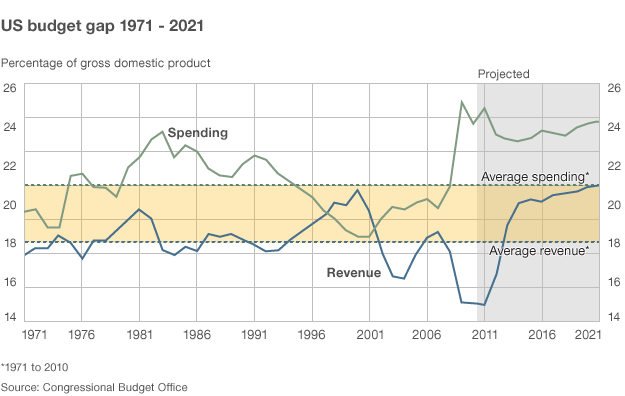
Is the US in denial over its $14tn debt?

Is America in denial about the extent of its financial problems, and therefore incapable of dealing with the gravest crisis the country has ever faced?

This is a story of debt, delusion and – potentially – disaster. For America and, if you happen to think that American influence is broadly a good thing, for the world.

The debt and the delusion are both all-American: $14 trillion (£8.75tn) of debt has been amassed and there is no cogent plan to reduce it.

The figure is impossible to comprehend: easier to focus on the fact that it grows at $40,000 (£25,000) a second. Getting out of Afghanistan will help but actually only at the margins. The problem is much bigger than any one area of expenditure.

The economist Jeffrey Sachs, director of Columbia University’s Earth Institute, is no rabid fiscal conservative but on the debt he is a hawk: “I’m worried. The debt is large. It should be brought under control. The longer we wait, the longer we suffer this kind of paralysis; the more America boxes itself into a corner and the more America’s constructive leadership in the world diminishes.”

The author and economist Diane Coyle agrees. And she makes the rather alarming point that the acknowledged deficit is not the whole story.

The current $14tn debt is bad enough, she argues, but the future commitments to the baby boomers, commitments for health care and for pensions, suggest that the debt burden is part of the fabric of society:

“You have promises implicit in the structure of welfare states and aging populations that mean there is an unacknowledged debt that will have to be paid for by future taxpayers, and that could double the published figures.”

Richard Haass of the Council on Foreign Relations acknowledges that this structural commitment to future debt is not unique to the United States.  All advanced democracies have more or less the same problem, he says, “but in the case of the States the figures are absolutely enormous”.

Mr Haass, a former senior US diplomat, is leading an academic push for America’s debt to be taken seriously by Americans and noticed as well by the rest of the world.

He uses the analogy of Suez and the pressure that was put on the UK by the US to withdraw from that adventure. The pressure was not, of course, military. It was economic.

Britain needed US economic help. In the future, if China chooses to flex its muscles abroad, it may not be Chinese admirals who pose the real threat, Mr Haass tells us. “Chinese bankers could do the job.”

Because of course Chinese bankers, if they withdrew their support for the US economy and their willingness to finance America’s spending, could have an almost overnight impact on every American life, forcing interest rates to sky high levels and torpedoing the world’s largest economy.

Not everyone accepts the debt-as-disaster thesis.

David Frum is a Republican intellectual and a former speech writer to President George W Bush.

He told me the problem, and the solution, were actually rather simple: “If I tell you you have a disease that will absolutely prostrate you and it could be prevented by taking a couple of aspirin and going for a walk, well I guess the situation isn’t apocalyptic is it?

“The things that America has to do to put its fiscal house in order are not anywhere near as extreme as what Europe has to do. The debt is not a financial problem, it is a political problem.”

Mr Frum believes that a future agreement to cut spending – he thinks America spends much too big a proportion of its GDP on health – and raise taxes, could very quickly bring the debt problem down to the level of quotidian normality.

‘Organised hypocrisy’

I am not so sure. What is the root cause of America’s failure to get to grips with its debt? It can be argued that the problem is not really economic or even political; it is a cultural inability to face up to hard choices, even to acknowledge that the choices are there.

I should make it clear that my reporting of the United States, in the years I was based there for the BBC, was governed by a sense that too much foreign media coverage of America is negative and jaundiced.

The nation is staggeringly successful and gloriously attractive. But it is also deeply dysfunctional in some respects.

Take Alaska. The author and serious student of America, Anne Applebaum makes the point that, as she puts it, “Alaska is a myth!”

People who live in Alaska – and people who aspire to live in Alaska – imagine it is the last frontier, she says, “the place where rugged individuals go out and dig for oil and shoot caribou, and make money the way people did 100 years ago”.

But in reality, Alaska is the most heavily subsidised state in the union. There is more social spending in Alaska than anywhere else.

To make it a place where decent lives can be lived, there is a huge transfer of money to Alaska from the US federal government which means of course from taxpayers in New York and Los Angeles and other places where less rugged folk live. Alaska is an organised hypocrisy.

Too many Americans behave like the Alaskans: they think of themselves as rugged individualists in no need of state help, but they take the money anyway in health care and pensions and all the other areas of American life where the federal government spends its cash.

The Tea Party movement talks of cuts in spending but when it comes to it, Americans always seem to be talking about cuts in spending that affect someone else, not them – and taxes that are levied on others too.

And nobody talks about raising taxes. Jeffrey Sachs has a theory about why this is.

America’s two main political parties are so desperate to raise money for the nation’s constant elections – remember the House of Representatives is elected every two years – that they can do nothing that upsets wealthy people and wealthy companies.

So they cannot touch taxes.

In all honesty, I am torn about the conclusions to be drawn. I find it difficult to believe that a nation historically so nimble and clever and open could succumb to disaster in this way.

But America, as well as being a place of hard work and ingenuity, is also no stranger to eating competitions in which gluttony is celebrated, and wilful ignorance, for instance regarding (as many Americans do) evolution as controversial.

The debt crisis is a fascinating crisis because it is about so much more than money. It is a test of a culture.

It is about waking up, as the Americans say, and smelling the coffee. And – I am thinking Texas here – saddling up too, and riding out with purpose.

NB: Copyright BBC © 2011 The BBC is not responsible for the content of external sites. Read more.

Here’s the 30 minute broadcast under the Analysis series from Radio 4 on the BBC.(Just click on this link) analysis_20110628-1024a

Global climate confusion, part one

This is a long theme that is being broken down into two posts.  Hope you can stay with it because it seems to me to represent how difficult it can be, when the topic is complex with significant implications for society, to determine the truth of an issue.

To set my own position clear, I have for many years taken it more or less for granted that mankind, through the mechanisms of increased population, increased standards of living and increased use of carbon-based fuels must be having a deleterious effect on the planet’s atmosphere.

Indeed, there have been a number of articles on Learning from Dogs that support that position of mine.  However, my dear friend Dan Gomez sent me a piece that I published on the 16th. June under the heading of Always two sides.  Frankly, I was still a little sceptical.

Then on the 22nd June, I published an account about the increasing quietness of the sun which, at the end, included a quotation from Dr Frank Hill,  “It is unfortunate that the global warming/cooling studies have become so politically polarizing.” H’mm, I thought, what is it that Dr. Hill sees that causes him to write this way?

Then another good friend of Learning from Dogs, Patrice Ayme, reminded me that he had written a comprehensive article on his own Blog about the apparent enigma of the sun cooling while at the same time the ice caps were melting.  Ah ha, I thought, a thoughtful and erudite explanation that while it was complex we are still in a phase of climate change (i.e. warming) most likely caused by man.  Patrice gave me permission to reproduce his essay in full, which I so do below.

But then reading the comments sent in to Patrice’s original essay on the 31st May, 2009, I was set right back to the position of being very, very confused.  More about the confusion that exists tomorrow, but now here’s Patrice’s original essay.

SUN COOLING, ICE MELTING…

By Patrice Ayme

TWENTY FIVE  METERS SEA LEVEL RISE ALL TOO SOON FROM MELTING OF ANTARCTICA’S ICE BASINS?

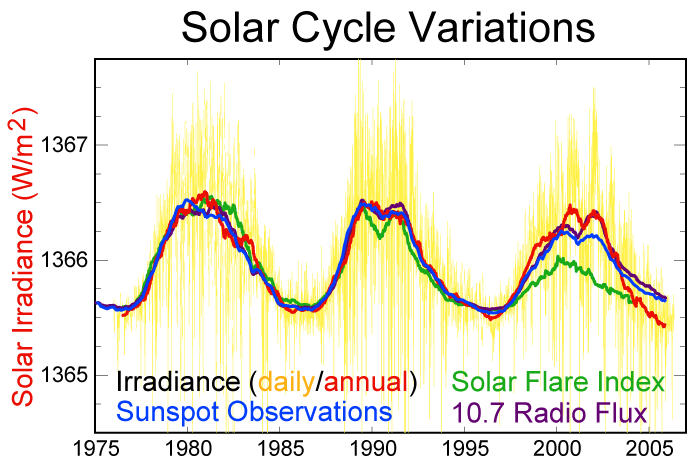
How to enlighten the conversation with one picture worth 10,000 words. Watch the red line below, and how much it dips lately:

Synopsis: More than 98% of scientific papers considering the subject opine that recent human activities have warmed up the climate. But the percentage of the public who believe that is only around 55% … in the USA. This disbelief, far from being healthy, is related to the propaganda of big polluters, allowing the latter to avoid making the economy of the USA efficient (so they have less to do, avoid public inquiry, and make greater profits, while being beyond any suspicion).

One recent tactic of these sneaky types has been to talk about the sun and planets. The main argument they make is that the sun is acting up, thus allegedly causing the warming. Fair enough. Considering the sun is a must, indeed: there is plenty of evidence that the recent Little Ice Age was caused by a sort of Solar Winter. So let’s look at the sun: as the graph above shows, it is COOLING. The sun is cooling. The warming would have been much greater, had the sun not been so kind. Ooopss.

Other climate deniers made some noise about a recent cover article in Science that computed that the collapse of the WAIS (West Antarctica Ice Shield) would rise sea level by only 3.30 meters. But this article sort of cheats: reading its fine print shows that the rise would be rather be 3.80 meters, and it brazenly ignores all possible melting of part of the Antarctica Peninsula (contriving to do so by the not so subtle artifice that said peninsula is not  semantically part of the WAIS; however, the peninsula is more north and warmer, so, one ought to suspect, it would melt even more, as it has actually started to do!).

The authors in Science also ignore other mountainous regions of the WAIS itself, using, once again the artifice that being on land does not make them part of the WAIS, formally speaking,  since the WAIS is a shield, and nothing inclined is, although, of course, having deep blue sea all around the present mountainous areas of the WAIS would warm them up.

I then turn this argument around. Looking towards the east, and I ponder what could happen with East Antarctica. Answer: very serious trouble.

By the way, the expression “climate change” is misleading. The biosphere is attacked in all ways by the rise in Greenhouse Gases, and not just by direct warming. It is losing the battle quickly. Changes that have happened before in millions of years are now happening in decades, so biological species cannot adapt through migration, and, or, biological evolution.

Half of the CO2 recently produced has sunk into the ocean, where it reacted with water to make carbonic acid. So millions of species of the plancton, many making oxygen, are dissolving in an acid prepared by the average American household and its refusal to endure a stiff carbon tax. Moreover entire zones within the oceans have warmed so much that they lost enough oxygen to support life as we know it (most sea species are highly sensitive to tiny temperature variations). And as evolution presently knows it. These gigantic zones are now dead: life does not have time to evolve species adapted to this new environment. What is going on is a BIOSPHERICAL CATASTROPHE, as a result of stuffing life’s environment with 400 million years of carbon deposits.

——————–

SOLAR INPUT:

No climate change discussion can be considered complete without considering the sun. This is one point greenhouse deniers have been making. It is indeed extremely correct.

Greenhouse deniers have been loudly proclaiming, that because some planets (Mars, Pluto) are warming (perhaps), then the sun has got to be warming. This argument can be put to rest: Mars and Pluto’s climates are dominated by astronomical and peculiar factors (see notes).

And, unfortunately for greenhouse deniers, the sun output has been slowing down, as the graph below shows.

What does this mean? We should be cooling down, because the sun’s output has been going down as much as an astounding 6% in some frequencies. But, nevertheless, the lower troposphere has been warming up (while the stratosphere, robbed of heat by the greenhouse blanket BELOW it, has been cooling, a predicted effect of the greenhouse; this warming at low elevation accompanied by a cooling higher up shows that the observed changes of temperatures are due to a greenhouse, not just a global change in solar output).

Thus the warming of recent times is indeed caused by greenhouse warming, as humans augmented greenhouse gases by more than fifty percent in 150 years. Notice that in the graph above that we are reaching a local minimum of solar output, and that solar output should soon increase again in the next 11 years cycle.

Another tactic has been for some greenhouse deniers to turn into outright friends of the greenhouse, and claim that we were spared a new ice age from the human induced greenhouse. (That many people living in the Arctic will love the considerable heating the poles will experience is only natural though.)

Indeed, some scientists have speculated that herding augmented the production of methane during the Neolithic, thus preventing the cooling that would otherwise have happened. Methane is a very strong greenhouse gas. Basically Neolithic man killed the carnivores, and reduced the forests, so the herbivores would have plenty to munch on, and the herbivores became more numerous. As they did, the worldwide density of methane went up significantly, durably warming up the lower atmosphere.

Maybe. But that is not the point. The point is that we are doing GEOENGINEERING on our own planet, haphazardly, driven by short term profit and hubris. In particular what would happen if Mr. Sun would wake up, and produce as much output as it used to a few decades ago? Well, the gentle warming up would turn into outright swift heating.

(This being said, a lot of people living in high latitudes can only be pleased by polar heating: an entire world is opening up, and many of the big polluters know there are significant fossil fuel reserves around the poles, piled up there in warmer eons past…)

LUBRICATION, OR HOW TO LOSE AN ICE CAP:

A few years back, only the fringes of Greenland were melting in summer. The ice cap flowed majestically to the sea, at a sedate pace, through enormous flowing glaciers entering the sea. Greenland’s ice cap towers more than 3000 meters above sea level and the possibility of its melting sounded like bad science fiction.

In recent summers, though, up to half of Greenland has been melting, and “icequakes” have gone from about five a year in 1996 to around 30. In a typical icequake, a glacier the size of Manhattan, and 500 meters thick, slips by say ten meters in one minute (icequakes release their Richter 6 energy with lower frequency waves than the most destructive tectonic earthquakes, so one needs special seismographs to pick them up; although about half of the energy of the tsunami quake of 2004 was released that way, making the waves two-thirds as high as they would have been otherwise; hence that tsunami quake is viewed as 9.1 Richter, or 9.3 Richter, depending whether one counts the low frequency waves, or not…).

The reason for icequakes is undoubtedly lubrication by water gushing below the glaciers, having ended down there by what is called a moulin (a giant waterfall chute, up to twenty meters across and 3 kilometers deep). On the margins of Greenland, where the slope is strong, the glaciers avalanche down. Before 2000, glaciers on the West coast of Greenland had never done so. Now they do.

Interestingly, something a bit similar is found down south. Hundreds of lakes have been found under the main ice shield in Antarctica. They are most probably caused by geothermal heating, but they communicate with each other, and can propel (by appropriate swelling of their liquid mass) the ice shield above. That ice shield can be up to 4,000 meters thick. My point? One could imagine the same formation of moulins occurring down south (although there, right now temperatures, even in summer, oscillate between minus 50 Celsius and minus ten, so there are no dangers of lakes forming on the surface yet, as they now happen on the Greenland ice cap; such lakes can vanish into a newly formed moulin in minutes).

WHY GLACIATIONS COME AND GO, AND WHY IT’S GOING TO BE WARM FOR 50,000 YEARS:

One thing to know about Antarctica is that it was long covered with the same forests found nowadays in Patagonia. Trees and even dinosaurs (!) had adapted to the long nights. Glaciers were only found in the numerous high mountain ranges of the polar continent. In the last four million years, after 70 million years of steady cooling, perhaps because of the closing of the bridge between North and South America, and the rise of mighty mountain ranges, plus the opening of a circumpolar ocean which insulated Antarctica from the rest of the planet thermally, earth’s climate became much cooler. The apparition of glaciated poles was, most certainly, itself an accelerating cause of cooling. Sea level dropped 135 meters below the present level, as water ice gathered in colossal ice shields. Glaciations oscillated, between the poles and the temperate zones, as the parameters of earth’s orbit varied.

Joseph Alphonse Adhemar (1797 – 1862), a French mathematician, was the first to suggest that glaciations occurred from astronomical dispositions, in his 1842 book “Revolutions of the Sea”. Then the self educated Scottish scientist Croll, using Leverrier’s precise math (which had allowed him to discover Neptune) revealed the relationship between ice, albedo (that is the measure of how much sunlight is reflected back to space), and the eccentricity of earth’s orbit.

Croll suggested the basic idea of orbitally forced insolation variations influencing terrestrial temperatures. This comes from a geographical oddity, the fact that the continents of Earth are gathered up in the North. That allows support of enormous ice shields.

The sea does not allow support of huge iceshields, kilometers thick, as it is too warm (except in Antartica). Why the sea stays warm is another miracle, related to CO2 and volcanoes. Basically ice shields all over, as in “Snow Ball Earth”, lock up in the atmosphere CO2, bringing a strong greenhouse, which, in turn, melts the iceshields. A “Snow Ball Earth” related to the rise of complex life, is suspected to have occured a few times around 700 to 600 million years ago. So CO2, life, volcanoes, plate tectonic, active geology and temperature of the biosphere are tightly connected.

So, if not enough sun falls on those northern continents during summer, the ice from the preceding winter will not melt, and the continents will gather ice, and the ice will spread south, if it can.

This lack of sun exposure in summer will happen from celestial mechanics interacting with the inclination of the rotation axis of the earth. Croll’s work was widely discussed, but by the end of the 19th century, the theory was generally disbelieved. Much later, the Serbian Milutin Milankovitch further developed the theory that eventually triumphed in 1976, in modified form.

The bottom line is that the present astronomical calculations show that 65° North summer insolation should increase gradually over the next 25,000 years, and that no declines in 65° North summer insolation sufficient to cause an ice age are expected in the next 50,000 to 100,000 years.

Hence Earth should warm up for the next 50,000 years, an exceptionally long interglacial. [Berger A, Loutre MF (2002). “Climate: An exceptionally long interglacial ahead?”. Science 297: 1287–1288]

A DAMOCLES ICICLE, READY TO CRUSH US ALL: THE WEST ANTARCTIC ICE SHIELD (WAIS)

The West Antarctic Ice Shield (WAIS) looks all white and solid from space, with a few huge mountains ranges coming out. Those mountains are, in truth, massive islands coming out of a frozen mass of fresh water that stands in place of the ocean. The WAIS connects the Antarctic peninsula, which goes north towards Patagonia, to the main part of the polar continent. The WAIS is covered with ice, it is made of ice. The crucial point, though, is that most of the rock supporting the solid ice of the WAIS is below sea level. It is a giant ice cube resting on what ought to be the bottom of the ocean.

The sea is out there, lapping against the boundary of the WAIS, which rests so heavily on the continent, that it pushes it down. The rocky boundary has no ice pushing it down, except a bit on the side, so it is not as low. Thus the rock below the WAIS forms a bowl that would be under water, if it were not under ice. That bowl is glued on its margin by ice. The surface oceanic water is salty, and would be below freezing if it were not so salty, thus it glues efficiently the margin of the WAIS, since the WAIS is made of freshwater, and thus freezes solid below zero Celsius. This system sounds contrived, and it is indeed a rather unstable arrangement.

Water has the curious property that it is denser at 4 degree Celsius (8 degrees Fahrenheit above the freezing point of pure water). Hence the sub freezing salty ocean water is above relatively warmer ocean water. If at some point some warm water can come in contact with the boundary of the WAIS, it could suddenly melt the sweet water ice of the WAIS at the margin, and then flow below the WAIS, melting it from below, and organizing some sort of satanic Carnot thermal engine with a strong circulation squeaking below, and accelerating the whole thing (it maybe how and why the ice shelves dislocate so fast, by the way: sudden circulation forming a thermal engine underneath, I would suggest).

From previous studies, it was widely assumed that the WAIS would cause a sea level rise of 5 meters if it melted. But an article in Science, May 15, 2009, claiming more precise radar telemetry, revisits the threat: “Theory has suggested that the West Antarctic Ice Sheet may be INHERENTLY UNSTABLE. Recent observations lend weight to this hypothesis. We reassess the potential contribution to eustatic and regional sea level from a rapid collapse of the ice sheet and find that previous assessments have substantially overestimated its likely primary contribution. We obtain a value for the global, eustatic sea-level rise contribution of about 3.3 meters, with important regional variations.”

The important regional variations have mostly to do with the rise of the local shores in West Antarctica: as the ice goes away, the continent rebounds. The authors count ONLY regions of where the bedrock slope is opposite to the glacial flow, a pointless restriction, in my not so humble opinion. Counting all regions below sea level, as they should have, the same authors find a rise of 3.8 meters. The authors also ignore the melting in the colossal mountainous islands that would be left, some as large as medium size countries.

THE WEST ANTARCTIC ICE SHIELD (WAIS) IS ALL SET TO BREAK UP:

Temperatures have increased enormously in the polar regions (up to 5 degrees Celsius in some regions such as the Antarctica peninsula, although the overall planetary warming is only 0.75 C, less than one degree Celsius; some say only 0.4 degree Celsius!). This comes from the poles being the planet’s heat sinks: all the heat is sent there, as the greenhouse effect proceeds apace (another why little is being done about it, as temperate areas, where the deciders live, have barely warmed up).

This warming up at the poles has a very practical effect: the surface waters in Antarctica are in danger of reaching zero degree Celsius, the temperature at which fresh water ice melts. That means that the margin of the WAIS could come unglued, and warm ocean water could flow below it. In other words, we are within an easy warming reach of a WAIS catastrophe. Something like this happened to the ice shield over Hudson Bay, which dislocated very fast a few thousands years ago, as warm ocean water slipped below it. (I just suggested a mechanism for this otherwise unexplainable speedy break-up.)

COULD THE EAST ANTARCTIC ICE BASINS DISSOLVE TOO?

As if this looming WAIS disaster was not enough, there is another Damocles icicle hanging above the carbon banquet. A mechanism is revealed with a new actor, that I am perversely pleased to introduce, the East Antarctic Ice Shield, allowing a sea level rise of 35 meters in one generation. I am not saying that it will happen, but that there is a mechanism that could make it happen, and political leaders who claim to be cautious will now to have to consider this.

I looked at the pretty pictures in the same article in Science trying to minimize the danger posed by the WAIS, and looked again. And then looked again, and looked on the side, where East Antarctica, most of Antarctica, is found; disbelief setting in ominously all over.

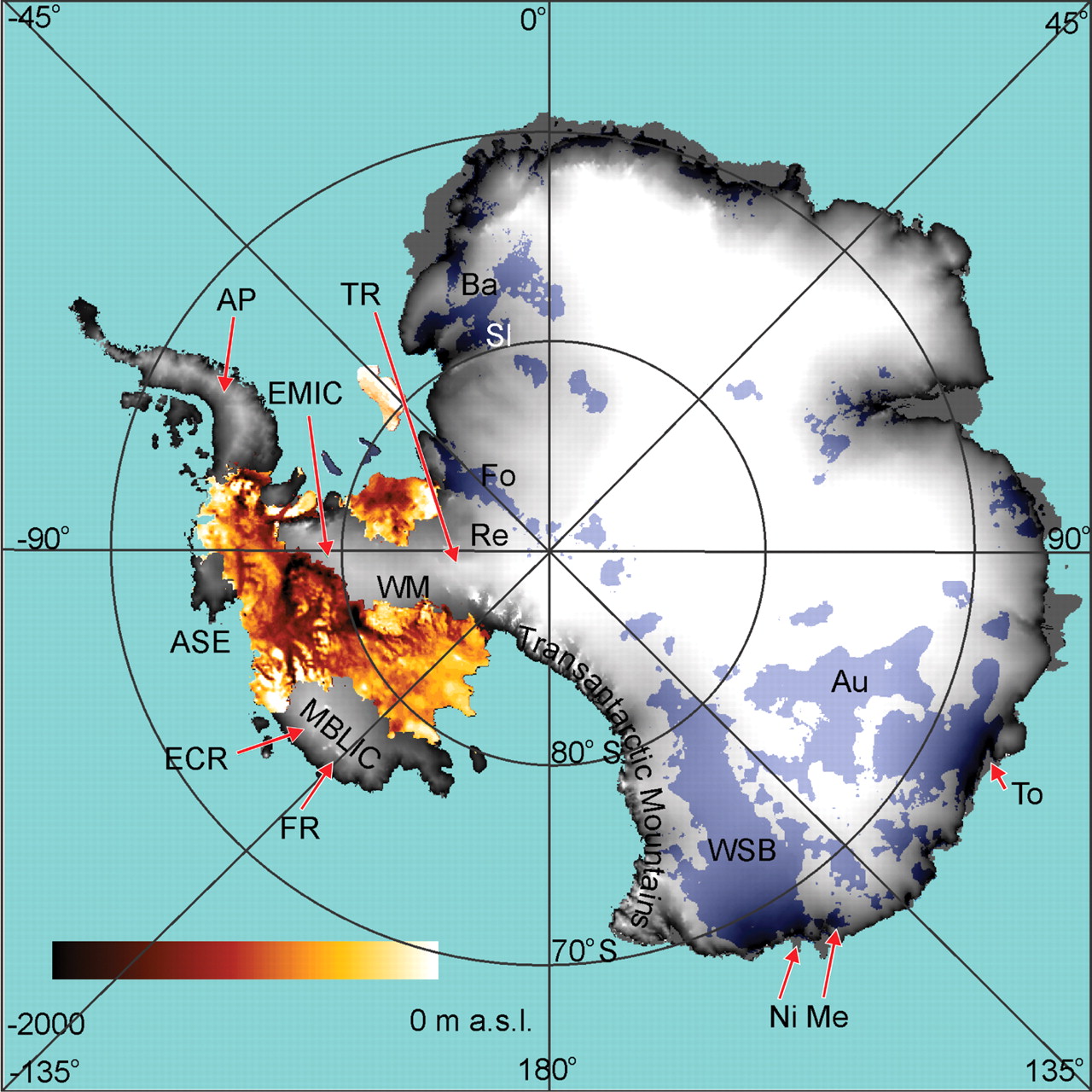
Incredible. How interesting. There I saw a positively enormous area where the ice cap bottom is LOWER than 200 METERS BELOW SEA LEVEL. Yes, 200 meters below! Imagine the disaster when warm water is going to slip below that… There are actually two areas, next to each other, the Wilkes Subglacial Basin and the Aurora Basin, and they obviously communicate below sea level, and moreover front hundreds of kilometers of Antarctic ocean below 200 meters below sea level. They do this nicely by a pleasant 67 degrees of southern latitude, just under the Antarctic Polar Circle, about as close to the pole as Fairbanks, Iceland, and further than the Lofoten islands or the city of Murmansk, or Europe’s North Cape. (All those areas are free of ice, and Fairbanks is not under the influence of the Gulf Stream!)

The ambiance of that article in Science was reassuring in this typically reserved way scientists affect, in the hope of being taken seriously: “Collapse is considered to be a low-probability, high-impact event with, for example, a 5% probability of the WAIS contributing 10 mm per year within 200 years.” Of course, this is pseudo science, because “is considered to be” is not science. Science is about events that can be repeated at will. It’s not about getting consideration in a social setting.

Hence, if anything, I found the conclusions of that article scarier than ever. I want to see an article evoking not just the WAIS, but all the potential flash flood in EASTERN ANTARCTICA. Now, methinks it’s got to be of the order of twenty meters of sea level rise, just looking at it the maps. So thank you science, thank you lord, and let’s get ready for real nomadism, running for the hills! A bad emotion (the melting of the iceshields can only be a multimillennial event) reinforced by a little bit of the wrong knowledge (speciously minimizing arguments on a fraction of the problem, namely the WAIS) often spells disaster.

Conclusion: HELL NOW?

If the poles melt, there is no coming back. The Earth’s albedo will be irreversibly reduced, the dark polar oceans and polar forests will absorb light and heat, instead of throwing it back to space. The planet will switch to its HOT REGIME. To its hot regime it is very familiar with. But the present biosphere is not. We would be back in a flash to Jurassic Park. But without the dinosaurs in Alaska (as they used to be!)

We used to have about 280 ppm of CO2 equivalent greenhouse gases, 150 years ago. Now we are around 450 ppm, and increasing fast (3 ppm a year in CO2 rise alone, which is itself at 385 ppm). From long term geological records, we know that Antarctica covers itself with ice at 425 ppm. Even an American politician should be able to understand what this means; the southern polar icecap is now unstable.

At the most extreme, adding to the preceding tipping points the “clathrate gun” (massive eruptions of frozen methane stores, apparently greater than all the other fossil fuels combined), a hellish scenario seems possible where this would all happen WITHIN A CENTURY. Massive melting within much less than that is also possible: in 2007 frozen methane in the warmest Arctic ocean ever erupted a bit. In 2008, the ocean was a bit colder, and methane came out of the tundra instead. Before, for an entire decade, methane’s density had not augmented.

Methane, CH4 has 100 times the greenhouse capability of CO2; some fancy man-made gases have 10,000 times the greenhouse capability of CO2, hence the difference between 385 ppm of pure CO2, and the 450 ppm of warming by CO2 equivalent gases I evoked.

There is no doubt that at least 90% of mankind would die in the process (nuclear bombing of coal plants for ecological reasons may be an ironical twist, with a rare touch of ecological humor).

That of course, was the bad side of things. On the good side, carbon addicts will be able to burn coal like there is no tomorrow, for a few years more, thanks to the antics of Mr. Sun conveniently truly going to sleep, as CO2 build up. A self-fulfilling prophecy: there will be indeed no tomorrow, thanks to them.

Humankind, playing fast and loose with things it digs up from underground, where they have been buried for hundreds of millions of years, if not billions, burns those things in the atmosphere. The USA, apparently hoping to transmogrify itself through platitudes, is taking its sweet time to do nothing significant about climate change. Not only is the USA also culprit, indirectly, of a lot of Chinese emissions, but, as (still) the world number one industrial power, the USA, through competition of its products worldwide, has an unfair carbon advantage it is using to the hilt (most of the electricity of the USA comes from indigenous coal, cheap and plentiful).

Obama should have put a ten cents per gallon gas tax on his first day, but he found much safer to send more taxpayer money to Afghanistan, and his friends in high finance, so convenient, in truth, with financing him. At least, very short term, so it is: the sea has not reached the White House yet (when it does, it will be too late, as the greenhouse effect is highly non linear, as I described above).

Weirdly, and perniciously, Mr. Sun, which was supposed to be steady as a rock, has been cooperating with the polluters, in the last two decades. But we are at the bottom of the 11 year cycle, so this should be less of a factor for a while.

The Sun has slowed down for decades at least twice in the last millennium. This caused the Little Ice Age (which destroyed Viking Greenland). Should the Sun persists in cooling down in the coming decade, the catastrophe would be even greater than if it did not. Indeed, temperatures would not rise as much.  Thus polluters would be encouraged to stuff the atmosphere with even more CO2, perhaps even arguing that they are sparing us an ice age. However, the CO2 would keep on building up, and half of it dissolves in the ocean, where it reacts with water to make carbonic acid. Thus the oceans would die even faster.

Ultimately, when the Sun wakes up from its slumber, all the heat would return, and more. Moreover a lot of CO2 would come out of the oceans, thanks to the temperature rise.

A little knowledge is a dangerous thing, a lot of knowledge is necessary to those who want to be morally right. Planetary engineering, as we are presently doing, without knowing enough, is the most terrible thing. When the hand of fate comes upon us, not only will the planet get hellish, but many of the vengeful ones in flooded countries will make sure that there is hell to pay.

Patrice Ayme
***

Notes: 1) Mars and Pluto’s climates are dominated by the enormous wobble for the former, and the amazing eccentricity of the second. Sometimes, Pluto is so far from the sun, its atmosphere snows down, and freezes on the ground. As it approaches the sun a century later, or so, the atmosphere goes back up, and puts a greenhouse around the planet, warming it up (right now Pluto is going away from the sun, but there is inertia to its greenhouse, so it keeps on warming).

Mars’ axis of rotation can be so inclined on the ecliptic plane (it oscillates between 10 and 45 degrees!) that then the poles get sun full on, once a year, and melt, and the Martian atmosphere is then thick with CO2 and H2O, two powerful greenhouse gases, so the planet warms up a lot (conversely, when the planet stands upright on its orbital plane, light grazes the poles, and the atmosphere freezes around the ice caps, the greenhouse effect goes way down, and the planet freezes.

2) The glory of SUBOCEANIC ANTARCTICA:

Fig. 1 Antarctic surface topography (gray shading) and bed topography (brown) defining the region of interest. For clarity, the ice shelves in West Antarctica are not shown. The brownish and yellow parts are the WAIS’ bed, and are all below sea level, and are why the WAIS will disintegrate.

Areas more than 200 meters BELOW SEA LEVEL in East Antarctica are indicated by blue shading. NOTICE THAT A LOT OF EAST ANTARCTICA, WHERE THE SUB SEA LEVEL BASINS ARE, HAVE THEIR MARGINS WELL NORTH OF 70 DEGREES (and actually just north of THE SOUTH POLAR CIRCLE).

AP, Antarctic Peninsula; EMIC, Ellsworth Mountain Ice Cap; ECR, Executive Committee Range; MBLIC, Marie Byrd Land Ice Cap; WM, Whitmoor Mountains; TR, Thiel Range; Ba, Bailey Glacier; SL, Slessor Ice Stream; Fo, Foundation Ice Stream; Re, Recovery Glacier; To, Totten Glacier; Au, AURORA BASIN; Me, Mertz Glacier; Ni, Ninnis Glacier; WSB, WILKES SUBGLACIAL BASIN; FR, Flood Range; a.s.l., above sea level.

(Illustrations from Bamber and al. Science May 15, 2009)

P/S 1: We are just coming out of a solar minimum so pronounced that cosmic rays, less deflected by the sun’s weakening magnetic field, have become a problem… Sunspots had nearly completely disappeared for the first half of 2009, before reappearing violently in July… There are mysterious strong correlations between sunspots and Earth’s temperature (mysterious, because, although very strong, they inverted in the 1970s;Vincent Courtillot, 2009).

P/S 2:  Thus, we have had a sort of solar winter in the last generation, and we seem to have reached its nadir right now, in the spring of 2009. (That would explain why the lowest icepack in the Arctic was in 2007, and the second lowest in 2008, with 2009 the third lowest ever recorded.)

Nothing says that the sun will not be even weaker in its next cycle. Maybe the greenhouse effect will save us!

Indeed… During the “Little Ice Age“, there was a considerable cooling, apparently originating from the sun’s reduced activity. After a slow start around 1300 CE which had, nevertheless, dramatic consequences in Europe (famines, and maybe a contribution to the massive war and plague that quickly followed; soon the Greenland Vikking colonies were decimated and had to be evacuated), the SOLAR cooling accelerated around 1600 CE. Galileo still saw some sun spots. But just a few. Soon they completely disappeared (the so called “Maunder minimum”). And they stayed disappeared for centuries. The glaciers in the Alps advanced dramatically, sometimes by several miles. In the late nineteenth century, sunspots reappeared, and the CO2 went up significantly, from industrialization (although warming itself extracts CO2 from sea and tundra). The result was an even faster retreat of the glaciers.

We cannot predict the sun (aside from its 11 year and 22 year, and an apparent 1,000 year cycles). We can only assume it will pick up, back up to what has been its normal activity over the last 5,000 years of civilized history. If it did, solar warming would combine with the greenhouse, and it is to be feared that the planet will switch SUDDENLY to the hot mode. It may be in a way even more violent than anything movies have imagined so far (because of the methane stores, and the dramatic changes their release would lead to: melting poles, CO2 bubbling out of the oceans). Good luck to us all…

The BBC

A remarkably fine institution

Having now been living in Arizona for 18 months, I can say with some degree of certainty that there are few British things that I miss.  One of them is draft English beer, of course, but another one is the BBC.  Luckily modern internet technology means that quite a few of the great BBC television programmes ‘leak’ outside the UK.

The BBC Horizon science series has been one such example of a really well-produced programme.

Recently, a BBC Horizon programme about genetically modified (GM) foods aired by the BBC found its way onto YouTube and thence to the website Top Documentary Films.  Not only is it an interesting programme but it also reveals how the facts of new advances in science are often difficult to understand by us; the general public.

The link to the film on the TDF website is here but if you want to watch it directly from YouTube then here it is.

Solar Impulse

Just enjoy this.

Solar Impulse

From Wired Magazine,

“In a world dependent on fossil energies, Solar Impulse is a paradox, almost a provocation.”

Press release gobbledygook? Absolutely. But you’ve got to give it up for any company with the guts to try designing and building a true solar airplane.

We’ve written about Solar Impulse — it’s a consortium of European financial and technology parters led by the Federal Institute of Technology in Lausanne, Switzerland. The group is working on a solar-powered plane that can take off under its own power without generating any emissions at all. The general idea is that sunlight would not only power the plane during the day but would also charge its lithium batteries, allowing it to fly around the clock pollution free.

That was written May 12th, 2008.  This is now!  Landing at Brussels International Airport, May 2011.

And here’s the Solar Impulse website.

More on Bill McKibben’s book, eaarth.

Some very telling points.

I first mentioned this book on the 13th May when I was about a third of the way in.  Because I thought there might be material useful to the course that has been running here in Payson, I did skip around the book looking for ‘attention-grabbing’ points.  It wasn’t difficult to find numerous extracts.

Try this on page 214 from the Chapter Afterword.

As it turns out, however, the BP spill was not the most dangerous thing that happened in the months after this book was first published.  In fact, in the spring and summer of 2101, the list of startling events in the natural world included:

  • Nineteen nations setting new all-time high temperature records, which in itself is a record.  Some of those records were for entire regions – [then some of the details]
  • Scientists reported that the earth had just come through the warmest six months, the warmest year, and the warmest decade for which we have records; it appears 2010 will be the warmest calendar year on record.
  • The most protracted and extreme heat wave in a thousand years of Russian history (it had never before topped 100 degrees in Moscow) led to a siege of peat fires that shrouded the capital in ghostly, deadly smoke.  [Then goes on to mention the effect of this heat on global grain prices.]
  • Since warm air holds more water vapour that cold air, scientists were not surprised to see steady increases in flooding.  Still, the spring and summer of 2010 were off the charts.  We saw “thousand-year storms” across the globe [goes into details]
  • Meanwhile, in the far north, the Petermann Glacier on Greenland calved an iceberg four times the size of Manhattan.
  • And the most ominous news of all might have come from the pages of the eminent scientific journal Nature, which published an enormous study of the productivity of the earth’s seas. [More details follow – not good news!]
That last point can be read in more detail from Nature‘s website.  It’s here.
The book closes thus (referring to how the BP oil spill was, ultimately, an accident),
But the greatest danger we face, climate change, is no accident.  It’s what happens when everything goes the way it’s supposed to go.  It’s not a function of bad technology, it’s a function of a bad business model: of the fact that Exxon Mobil and BP and Peabody Coal are allowed to use the atmosphere, free of charge, as an open sewer for the inevitable waste from their products.  They’ll fight to the end to defend that business model, for it produces greater profits that any industry has ever known.  We won’t match them dollar for dollar: To fight back, we need a different currency, our bodies and our spirit and our creativity.  That’s what a movement looks like; let’s hope we can rally one in time to make a difference.
Powerful stuff from a powerful book.
Fired up?  Then go and join:  350.org

Greece, or grease?

The agony of watching a country (and a planet) slip.

Readers will be aware that I very rarely stroll through the tangled pastures of international politics and finance.  The only reason that I do so today is on the back of a very impressive letter published in the German newspaper  Handelsblatt.  That was brought to my attention by my subscription to Mike Shedlock’s (Mish) Blog Mish’s Global Economic Trend Analysis.  You will see that I muse at two levels about where we are today.

Earlier, I had read in last Saturday’s, The Economist a leader on Greece’s debt crisis, entitled Trichet the intransigent.   That started thus,

The European Central Bank’s refusal to consider a restructuring of Greek debt could wreck the euro zone
May 12th 2011 | from the print edition

IF THE stakes were not so high, Europeans’ incompetence in the euro-zone debt crisis would be comic.

and concluded thus,

It is time for the Germans and the IMF to call the ECB’s bluff. Together they should demand, and instigate, a restructuring of Greek debt. Germany should push other European governments to cough up money to support Greek banks and, if necessary, to make whole the ECB. The fund, which knows how to restructure debt, must ensure the process is run in a competent manner. The ECB will then be faced with a choice: go along with an orderly restructuring, or trigger a much greater mess by in effect forcing Greece out of the euro zone. Surely Mr Trichet does not want that to be his legacy.

So with that as background, the letter to Georgios Papandreou, Prime Minister of Greece written by Gabor Steingart is powerful and hard hitting.  Here it is in full.

Mr. Prime Minister,

Dear Mr. Papandreou,

With the greatest respect, the Western world is monitoring your efforts to master your country’s debt crisis. No other democratic country has ever managed anything like that in peacetime. You are shrinking the state apparatus; you are fighting corruption; you are teaching your fellow countrymen how to become honest tax-payers.

You are a modern hero. You are attempting the impossible. As the son of a persecuted and ostracized politician who was chased by the military junta you grew up close to danger. When the officers were looking for your father who was hiding in the attic, they threatened you by putting an unlocked pistol to your forehead and challenged you to betray your father. You denied your father’s presence until he, worried about his son’s life, left his hiding place.Later you fled with him to America where you spent your adolescence. You are alarger-than-life-character.

Preceding governments almost ruined your country. Debts amounting to 340 billion Euros are burdening the Greek state,equaling 155 times the profit of the 60 largest companies of your country and 1.5 times the amount of debts the Maastricht Treaty allows. A year ago, this newspaper, Germany’s biggest Business Daily, appealed to the public to buy Greek government bonds in order to give to the country what Greece needs just as urgently as money: confidence. We also wanted to assist in breaking through the negative spiral of growing doubt and increasing interest rates. Everyone who granted you guarantees and loans wanted it, the European Union, the International Monetary Fund, the heads of state and government.

But since then, the spiral has picked up in speed instead of slowing down. In May 2010 the interest rate at which your country was given money on a ten year basis was at eight per cent. Today, it is at 16 per cent. And in all probability, it will be going up further. The bitter truth to which you and all parties who wanted to help Greece have to admit is that the help doesn’t help. Your country is getting deeper and deeper into the mess. Debts are growing, the gross national product will decrease by at least three per cent in 2011. But it would have to grow by three per cent instead if you were to lower your debt to the allowedlimit until 2040. This is becoming more and more unrealistic. You can’t starve and build up your muscles at the same time.

The truth that Greece has to cut back and save has turned into an untruth. The right thing has turned into the wrong thing. You already cut pensions, lowered the salaries of civil servants by 30 per cent and raised the prices of gas by almost 50 per cent. You can’t restore the health of your country by saving. And the European Union can’t restore your country’s health by again and again injecting new loans.

Soon, the day will come when the tortured body will surrender. The Greek construction industry already shrank by 70 per cent. Sales of car dealers sank by half. A daily export volume of 50 million Euros Greece is achieving  far too little.  Soon the day will come which investors fear in their nightmares. Then the word “insolvency” will be on everyone’s lips.

But it is also the day when a new truth will be born: Don’t save but invest, they will tell you – so that the Greek economy will grow again. Do not service debt with debt, you then will be recommended, but spread out the debt service, cut it and maybe even completely suspend it for a while. It will be a day of impositions, especially for those who lendmoney to you and your people. Financial markets will grind to a halt in horror – and then they will turn to embrace the future. Because Argentina in 2001, Mexico at the beginning of the eighties and Germany after World War II taught us that there is a life after death – at least, in the case of highly indebted states.

Mr. Papandreou, so far, you attempted the impossible. Now you should do the possible. Just as you deceived the officers as a boy and denied to know where your father was hiding you now must repudiate the pride of the Greeks – in order to save your country. Come to meet the new uncomfortable truth before it knocks at your door. It’s already on its way.

Respectfully yours,

Gabor Steingart

The author is an award winning Journalist, the former White House Correspondent of “Der Spiegel” and now Handelsblatt’s  Editor-in-Chief.  His book “The war for wealth. The true story of globalization or while the flat world is broken” was  published in the US, GB, China and several other countries by McGraw Hill, New York, in 2008.

You may contact him at

steingart@handelsblatt.com


Powerful, as I said.

In a sense, in a very real sense, this illustration of the end game of our love affair with debt is symptomatic of the end game in terms of mankind’s love affair with, well with mankind.  The following was written by an inmate of Oklahoma Prison in 1998.

At the root of my humanity lies a potentially insatiable self-centredness.  Given its way, it can become unquenchable. Nothing, not even the richest of imagination, will put out its fire.

This ‘what’s in it for me’ mindset is at the root of all my problems and is where my fears live.  From those fears come anger, greed, intolerance, and a host of other shortcomings.

It is no accident that all religions point to the forgetting of self, because all religions know salvation lies in self-forgetting.

As we head relentlessly towards a level of 400 parts per million (PPM) of carbon dioxide in the atmosphere, 50 PPM above the highest safe limit determined by climate scientists, the time for mankind to move on from the debt-laden, over-leveraged, disconnected life from Planet Earth, is now.

That’s now!

eaarth, the book.

The latest edition of Bill McKibben’s book.

I’m about a third of the way through McKibben’s book eaarth.  To say that it is disturbing is an understatement.  I’ll tell you why.

eaarth

Most people when they think about it have, at the very least, feelings of guilt or denial in terms of what humans are doing to the planet’s environment that humans require for survival.  Many of us know in our hearts that it is probably not good news but maybe really thinking about it can be put off for a little longer!

It’s almost as though we know that those aches and pains are a sign of something potentially dangerous to our health but, hey ho, I’ll put off seeing the doctor for a little bit longer.

Then the day comes when one goes to the doctor and he confirms your worst fears; what you really knew deep in your heart.

Thus it is with the planet.  Most of us know that we have been treating the planet as an inexhaustible resource for the sole benefit of mankind and to hell with the future.  The you read a book such as eaarth from Bill McKibben and realise the extreme folly of denial, self-delusion, and the rest.  Here’s the preface of the book,

PREFACE

I’m writing these words on a gorgeous spring afternoon, perched on the bank of a brook high along the spine of the Green Mountains, a mile or so from my home in the Vermont mountain town of Ripton. The creek burbles along, the picture of a placid mountain stream, but a few feet away there’s a scene of real violence a deep gash through the woods where a flood last summer ripped away many cubic feet of tree and rock and soil and drove it downstream through the center of the village. Before the afternoon was out, the only paved road into town had been demolished by the rushing water, a string of bridges lay in ruins, and the governor was trying to reach the area by helicopter.

Twenty years ago, in 1989, I wrote the first book for a general audience about global warming, which in those days we called the “greenhouse effect.” That book, The End of Nature, was mainly a philosophical argument. It was too early to see the practical effects of climate change but not too early to feel them; in the most widely excerpted passage of the book, I described walking down a different river, near my then-home sixty miles away, in New York’s Adirondack Mountains. Merely knowing that we’d begun to alter the climate meant that the water fl owing in that creek had a different, lesser meaning. “Instead of a world where rain had an independent and mysterious existence, the rain had become a subset of human activity,” I wrote. “The rain bore a brand; it was a steer, not a deer.”

Now, that sadness has turned into a sharper-edged fear. Walking along this river today, you don’t need to imagine a damned thing the evidence of destruction is all too obvious. Much more quickly than we would have guessed in the late 1980s, global warming has dramatically altered, among many other things, hydrological cycles. One of the key facts of the twenty- first century turns out to be that warm air holds more water vapor than cold: in arid areas this means increased evaporation and hence drought. And once that water is in the atmosphere, it will come down, which in moist areas like Vermont means increased deluge and flood. Total rainfall across our continent is up 7 percent,1 and that huge change is accelerating. Worse, more and more of it comes in downpours.2 Not gentle rain but damaging gully washers: across the planet, flood damage is increasing by 5 percent a year.3 Data show dramatic increases 20 percent or more in the most extreme weather events across the eastern United States, the kind of storms that drop many inches of rain in a single day.4Vermont saw three flood emergencies in the 1960s, two in the 1970s, three in the 1980s and ten in the 1990s and ten so far in the first decade of the new century.

In our Vermont town, in the summer of 2008, we had what may have been the two largest rainstorms in our history about six weeks apart. The second and worse storm, on the morning of August 6, dropped at least six inches of rain in three hours up on the steep slopes of the mountains. Those forests are mostly intact, with only light logging to disturb them but that was far too much water for the woods to absorb. One of my neighbors, Amy Sheldon, is a river researcher, and she was walking through the mountains with me one recent day, imagining the floods on that August morning. “You would have seen streams changing violently like that,” she said, snapping her fingers. “A matter of minutes.” A year later the signs persisted: streambeds gouged down to bedrock, culverts obliterated, groves of trees laid to jackstraws.

Our town of barely more than five hundred people has been coping with the damage ever since. We passed a $400,000 bond to pay for our share of the damage to town roads and culverts. (The total cost was in the millions, most of it paid by the state and federal governments.) Now we’re paying more to line the creek with a seven-hundred-foot-long wall of huge boulders riprap, it’s called where it passes through the center of town, a scheme that may save a few houses for a few years, but which will speed up the water and cause even more erosion downstream. There’s a complicated equation for how wide a stream will be, given its grade and geology; Sheldon showed it to me as we reclined on rocks by the riverbank. It mathematically defines streams as we have known them, sets an upper limit to their size. You could use it to plan for the future, so you could know where to build and where to let well enough alone. But none of that planning works if it suddenly rains harder and faster than it has ever rained before, and that’s exactly what’s now happening. It’s raining harder and evaporating faster; seas are rising and ice is melting, melting far more quickly than we once expected. The first point of this book is simple: global warming is no longer a philosophical threat, no longer a future threat, no longer a threat at all. It’s our reality. We’ve changed the planet, changed it in large and fundamental ways. And these changes are far, far more evident in the toughest parts of the globe, where climate change is already wrecking thousands of lives daily. In July 2009, Oxfam released an epic report, “Suffering the Science,” which concluded that even if we now adapted “the smartest possible curbs” on carbon emissions, “the prospects are very bleak for hundreds of millions of people, most of them among the world’s poorest.”5

And so this book will be, by necessity, less philosophical than its predecessor. We need now to understand the world we’ve created, and consider urgently how to live in it. We can’t simply keep stacking boulders against the change that’s coming on every front; we’ll need to figure out what parts of our lives and our ideologies we must abandon so that we can protect the core of our societies and civilizations. There’s nothing airy or speculative about this conversation; it’s got to be uncomfortable, staccato, direct.

Which doesn’t mean that the change we must make or the world on the other side will be without its comforts or beauties. Reality always comes with beauty, sometimes more than fantasy, and the end of this book will suggest where those beauties lie. But hope has to be real. It can’t be a hope that the scientists will turn out to be wrong, or that President Barack Obama can somehow fix everything. Obama can help but precisely to the degree he’s willing to embrace reality, to understand that we live on the world we live on, not the one we might wish for. Maturity is not the opposite of hope; it’s what makes hope possible.

The need for that kind of maturity became painfully clear in the last days of 2009, as I was doing the final revisions for this book. Many people had invested great hope that the Copenhagen conference would mark a turning point in the climate change debate. If it did, it was a turning point for the worse, with the richest and most powerful countries making it abundantly clear that they weren’t going to take strong steps to address the crisis before us. They looked the poorest and most vulnerable nations straight in the eye, and then they looked away and concluded a face- saving accord with no targets or timetables. To see hope dashed is never pleasant. In the early morning hours after President Obama jetted back to Washington, a group of young protesters gathered at the metro station outside the conference hall in Copenhagen.It’s our future you decide, they chanted.

My only real fear is that the reality described in this book, and increasingly evident in the world around us, will be for some an excuse to give up. We need just the opposite increased engagement. Some of that engagement will be local: building the kind of communities and economies that can withstand what’s coming. And some of it must be global: we must step up the fight to keep climate change from getting even more powerfully out of control, and to try to protect those people most at risk, who are almost always those who have done the least to cause the problem. I’ve spent much of the last two de cades in that fight, most recently helping lead 350.org, a huge grassroots global effort to force dramatic action. It’s true that we’ve lost that fight, insofar as our goal was to preserve the world we were born into. That’s not the world we live on any longer, and there’s no use pretending otherwise.

But damage is always relative. So far we’ve increased global temperatures about a degree, and it’s caused the massive change chronicled in chapter 1. That’s not going to go away. But if we don’t stop pouring more carbon into the atmosphere, the temperature will simply keep rising, right past the point where any kind of adaptation will prove impossible. I have dedicated this book to my closest colleagues in this battle, my crew at 350.org, with the pledge that we’ll keep battling. We have no other choice.

Nature, big business and the future

Just maybe, economic activity and financial capital could align itself with the planetary demands!

A collection of items crossed my screen in the last few days that reinforced the interconnectedness of all life on Planet Earth.

First I saw an item on the BBC News website that demonstrated that climate change, global warming, or however one wants to describe man’s relationship with the planet, is not some crazy, fuzzy idea of a few liberal environmentalists.  This was a report of the significant drop in global wheat yields.

The report was entitled, Climate shifts ‘hit global wheat yields’ and was written by Mark Kinver, Science and environment reporter, BBC News.  Here’s a taste of what was written.

Shifts in the climate over the past three decades have been linked to a 5.5% decline in global wheat production, a study has suggested.

A team of US scientists assessed the impact of changes to rainfall and temperature on four major food crops: wheat, rice, corn and soybeans.

Climate trends in some countries were big enough to wipe out gains from other factors, such as technology, they said.

Professor David Lobell from Stanford University went on to say,

“In particular, you have to assume how non-linear the response will be and how different the crops of tomorrow will be from the crops of today,” he said.

He added that the study focused on historical data in order to strengthen confidence in the existing projections.

“I think it is very clear that climate is not the predominant driver of change over long periods of time in crop production.

“Across the board, you see crop yields going up over the past 30 years, but the question is how much is climate modified (and) what would have happened if the climate was not changing.

“In some countries, we see that climate has only affected things by a few percent. In other countries, we see that yields would have been rising twice as fast.

“On a global average, we see that wheat production would be about 5% higher if we had not seen the warming since 1980. We see about the same for maize or corn.

“Yet for rice and soybean, we actually find that production is about the same as if climate had not been trending.”

The report may be accessed here.

Sort of moving on, most people, when they stop and think about it, must realise that 6.9 billion people living (i.e. depending) on Planet Earth have to be causing changes.  The Inside Science News Service published a reminder from last December of a calculation that,

By Mary Caperton Morton, ISNS Contributor
Inside Science News Service

STRASBURG, Pa. — Next month, representatives from more than 190 nations will gather in Japan at the Nagoya Biodiversity Summit to develop a global strategy for staunching habitat and biodiversity loss around the world.

The statistics are sobering: Every 20 minutes a species goes extinct. At that rate — estimated to be a thousand times faster than pre-human impact background levels – in 300 years, half of all living species of mammals, birds, fish, reptiles and plants will be gone. [My italics]

This alarming decline has not gone unnoticed. In 1992, the United Nations Convention on Biological Diversity — or CBD — one of the most widely ratified treaties in the world, established lofty conservation goals to be met by 2010. But since then the decline in biodiversity has not slowed. Nearly 16,000 species are still listed as threatened, with more than 200 of them described as “possibly extinct.”

What we need, some might ask, is for big business to get behind and push!  Perhaps not so far fetched.

Last October, the British Guardian newspaper, published a very telling reminder that nothing ever in life stays the same.

The article was presented thus,

Biodiversity loss seen as greater financial risk than terrorism, says UN

Loss of ecosystems perceived by banks and insurance companies to be a greater economic risk than terrorism, finds UN report.

Written by Jonathan Watts in Nagoya.

A controlled burn of oil from the Deepwater Horizon well in the Gulf of Mexico. The report cites the Gulf of Mexico oil spill as an extreme example of the potential impact of inadequate environmental controls. Photograph: Ann Heisenfelt/EPA

The financial risks posed by the loss of species and ecosystems have risen sharply and are becoming a greater concern for businesses than international terrorism, according to a United Nations report released today.

From over-depletion of fish stocks and soil degradation caused by agricultural chemicals to water shortages and mining pollution, the paper – commissioned by the UN Environment Programme and partners – said the likelihood has climbed sharply that declines in biodiversity would have a “severe” $10bn (£6bn) to $50bn impact on business.

With the European Union and other regions increasingly holding companies liable for impacts on ecosystem services, it suggests banks, investors and insurance companies are starting to calculate the losses that could arise from diminishing supplies, tightened conservationcontrols and the reputational damage caused by involvement in an unsound project.

Achim Steiner, UN under-secretary general and Unep executive director, said: “The kinds of emerging concerns and rising perception of risks underlines a fundamental sea change in the way some financial institutions, alongside natural resource-dependent companies, are now starting to glimpse and to factor in the economic importance of biodiversity and ecosystems”.

The briefing paper cites the 55% crash of BP’s share price and the decline of its credit rating in the wake of the Gulf of Mexico oil spill as an extreme example of the potential impact of inadequate environmental controls.

Read the full article in the Guardian here.

The United Nations Environment Programme report may be found here.  The cover page says this,

“ As the global financial sector recovers and moves into the post financial crisis era,
there is one notion that crystallises before our eyes more acutely than ever: we need
to understand systemic risk in a much more holistic way. This CEO Briefing underscores
the critical natural capital that underpins our economic activity and financial capital.”
Richard Burrett, Partner in Earth Capital Partners
Co-Chair, UNEP Finance Initiative

Well put!

As I wrote at the very start, just maybe, economic activity and financial capital could align itself with the planetary demands!

Blood and Oil

Continuing the thoughts of Michael Klare.

(My apologies, this is a difficult week for me as I prepare for a course that starts on the 11th May.  So posts may be a little thinner than usual.)

Yesterday, I wrote about an article by Michael Klare on the theme of the avenging planet.  While researching for that piece, I came across a film that Klare has produced called Blood and Oil.  It seemed worth mentioning it on Learning from Dogs.

Here’s the synopsis,

The notion that oil motivates America’s military engagements in the Middle East has long been dismissed as nonsense or mere conspiracy theory. Blood and Oil, a new documentary based on the critically-acclaimed work of Nation magazine defense correspondent Michael T. Klare, challenges this conventional wisdom to correct the historical record. The film unearths declassified documents and highlights forgotten passages in prominent presidential doctrines to show how concerns about oil have been at the core of American foreign policy for more than 60 years – rendering our contemporary energy and military policies virtually indistinguishable. In the end, Blood and Oil calls for a radical re-thinking of US energy policy, warning that unless we change direction, we stand to be drawn into one oil war after another as the global hunt for diminishing world petroleum supplies accelerates.

Here’s a trailer for the film.

Musings about Planet Earth

Could Planet Earth really be avenging the disregard shown by man?

This is such a meaty subject that, frankly, all this article can do is to set the scene for further muses.  The trigger for the theme was a piece written by Michael Klare that I read on the Tom Dispatch blogsite.  But before going to that piece by Michael Klare, let’s step back for a moment.

Planet Earth from Apollo 8

The idea that the Planet is not a piece of rock covered in a thin layer of air, water and life but something much more deeply connected with all living organisms including the ‘higher order’ forms of life is not new.  But it was Professor James Lovelock who catapulted the idea of the living, breathing planet into the psyche of modern man as in his Gaia hypothesis.  Here’s a link to Lovelock’s original explanation of that idea.  From which is quoted,

Most of us sense that the Earth is more than a sphere of rock with a thin layer of air, ocean and life covering the surface. We feel that we belong here as if this planet were indeed our home. Long ago the Greeks, thinking this way, gave to the Earth the name Gaia or, for short, Ge. In those days, science and theology were one and science, although less precise, had soul. As time passed this warm relationship faded and was replaced by the frigidity of the schoolmen. The life sciences, no longer concerned with life, fell to classifying dead things and even to vivisection. Ge was stolen from theology to become no more the root from which the disciplines of geography and geology were named. Now at last there are signs of a change. Science becomes holistic again and rediscovers soul, and theology, moved by ecumenical forces, begins to realise that Gaia is not to be subdivided for academic convenience and that Ge is much more than just a prefix.

That article concludes thus,

If we are “all creatures great and small,” from bacteria to whales, part of Gaia then we are all of us potentially important to her well being. We knew in our hearts that the destruction of a whole range of other species was wrong but now we know why. No longer can we merely regret the passing of one of the great whales, or the blue butterfly, nor even the smallpox virus. When we eliminate one of these from Earth, we may have destroyed a part of ourselves, for we also are a part of Gaia.

There are many possibilities for comfort as there are for dismay in contemplating the consequences of our membership in this great commonwealth of living things. It may be that one role we play is as the senses and nervous system for Gaia. Through our eyes she has for the first time seen her very fair face and in our minds become aware of herself. We do indeed belong here. The earth is more than just a home, it’s a living system and we are part of it.

So back to Michael Klare.

On the 14th April, Tom Engelhardt wrote a piece on Tom Dispatch that opened as follows:

Last Monday, Yukio Edano, chief cabinet secretary, defended the Japanese government’s response to the nuclear disaster at Fukushima, insisting that the plant complex is in “a stable situation,relatively speaking.”  That’s somewhat like the official description of 11,500 tons of water purposely dumped into the ocean waters off Fukushima as “low-level radioactive” or “lightly radioactive.”  It is, of course, only “lightly” so in comparison to the even more radioactive water being stored at the plant in its place.  But that’s the thing with descriptive words: they can leave so much to the eye of the beholder — and the Japanese government hasn’t been significantly more eager than the Tokyo Electric Power Company (Tepco), which runs the complex, to behold all that much when it comes to Fukushima.

Engelhardt then sets the scene for the guest post by Michael Klare.

The Planet Strikes Back
Why We Underestimate the Earth and Overestimate Ourselves 

By Michael T. Klare

In his 2010 book, Eaarth: Making a Life on a Tough New Planet, environmental scholar and activist Bill McKibben writes of a planet so devastated by global warming that it’s no longer recognizable as the Earth we once inhabited.  This is a planet, he predicts, of “melting poles and dying forests and a heaving, corrosive sea, raked by winds, strafed by storms, scorched by heat.”  Altered as it is from the world in which human civilization was born and thrived, it needs a new name — so he gave it that extra “a” in “Eaarth.”

It would be wrong to do more that selectively offer extracts but here’s how Klare sets the scene,

It’s not enough to think of Eaarth as an impotent casualty of humanity’s predations.  It is also a complex organic system with many potent defenses against alien intervention — defenses it is already wielding to devastating effect when it comes to human societies.  And keep this in mind: we are only at the beginning of this process.

To grasp our present situation, however, it’s necessary to distinguish between naturally recurring planetary disturbances and the planetary responses to human intervention.  Both need a fresh look, so let’s start with what Earth has always been capable of before we turn to the responses of Eaarth, the avenger.

Michael Klare conclude thus,

Bill McKibben is right: we no longer live on the “cozy, taken-for-granted” planet formerly known as Earth.  We inhabit a new place, already changed dramatically by the intervention of humankind.  But we are not acting upon a passive, impotent entity unable to defend itself against human transgression.  Sad to say, we will learn to our dismay of the immense powers available to Eaarth, the Avenger.

Michael T. Klare is a professor of peace and world security studies at Hampshire College, a TomDispatch regular, and the author, most recently, ofRising Powers, Shrinking Planet. A documentary movie version of his previous book, Blood and Oil, is available from the Media Education Foundation.

To close, here’s an interview of Michael Klare by Tom Engelhardt.