John O’Donohue, in yesterday’s post, touched on the essence of today’s theme, “The greatest philosophers admit that to a large degree all knowledge comes through the senses. The senses are our bridge to the world.”
Dogs, of course, demonstrate powerfully how their senses provide a ‘bridge to the world’.
This odd collection of writings (ramblings?) that comprise Learning from Dogs is based around the ‘i’ word – Integrity. The banner on the home page proclaims Dogs are integrous animals. We have much to learn from them. Ergo, dogs offer a powerful metaphor for the pressing need for integrity among those that ‘manage’ our societies.
Thus my senses are more tuned, than otherwise, to the conversations in the world out there that support the premise that unless we, as in modern man, radically amend our attitudes and behaviours, then the species homo sapiens is going to hell in a hand-basket!
End of preamble!
Professor Bill Mitchell is one person who recently touched my senses. As his Blog outlines he is an interesting fellow,
(Photo taken in August 2011 in Melbourne, Australia)
He is also a professional musician and plays guitar with the Melbourne Reggae-Dub band – Pressure Drop. The band was popular around the live music scene in Melbourne in the late 1970s and early 1980s. The band reformed in late 2010.
He also plays with a Newcastle swing blues band – The Blues Box. You can find music and other things on his Home Page.
Professor Mitchell’s Blog is not for the faint-hearted, it can be pretty technical at times. Nevertheless, I have been a daily subscriber for a couple of months now.
Economists have a strange way of writing up briefing documents. There is an advanced capacity to dehumanise economic advice and ignore the most important economic and social problems (unemployment and poverty) in favour of promoting non-issues (like public debt ratios). It reminds me sometimes of how the Nazis who were brutal in the extreme in the execution of their ideology sat around getting portraits of themselves taken with their loving families etc. The training of economists creates an advanced state of separation from human issues and an absence of empathy.
In a sense, we all understand this, this use of language to separate us from our collective humanity. A random Google search came up with this. A statement by British Prime Minister, David Cameron, to Parliament on the 24th regarding Europe, as in,
Mr Speaker, let me turn to yesterday’s European Council.
This European Council was about three things.
Sorting out the problems of the Eurozone.
Promoting growth in the EU.
And ensuring that as the Eurozone develops new arrangements for governance, the interests of those outside the Eurozone are protected.
This latter point touches directly on the debate in this House later today, and I will say a word on this later in my statement.
Resolving the problems in the Eurozone is the urgent and over-riding priority facing not only the Eurozone members, but the EU as a whole – and indeed the rest of the world economy.
Britain is playing a positive role proposing the three vital steps needed to deal with this crisis – the establishment of a financial firewall big enough to contain any contagion; the credible recapitalisation of European banks; and a decisive solution to the problems in Greece.
Read the last paragraph. Wonderful words that seem to make sense to the casual listener but picking up on Prof. Bill, an utter ‘separation from human issues and an absence of empathy‘. There is no humanity in those words from the British Prime Minister. We all know there are hundreds of other examples from mouthpieces all across our global society. Back to Bill Mitchell’s article,
Greece has failed. To say this is not another report of investment banks or research centers, but directly Troika officials who have just completed their review on Hellenic public finance. Linkiesta is in possession of the entire report of the troika, composed of officials from the International Monetary Fund (IMF), European Central Bank (ECB) and European Commission.
I have a rule of thumb that I use when considering documents such as these. The rule is to assess how strong the concern for unemployment is. How often is unemployment mentioned? The answer is zero. The document never mentions the word or concept.
So obsessed are the Troika and their bean counters about public debt stabilisation that they have completely lost sight of one of the worst problems an economy can encounter – the failure to generate work for all.
Read those last words again, “completely lost sight of one of the worst problems an economy can encounter – the failure to generate work for all“. One last extract from the article,
There is absolutely no historical evidence which shows that when all nations are contracting or stagnant and private spending is flat (or contracting) that cutting public spending will create growth.
So why did these economists think that a nation would grow when all components of spending were strongly indicated to fall or were being actually cut? The answer lies in acknowledging that they operate in an ideologically blinkered world and are never taken to account for their policy mistakes. They are unaccountable and do not suffer income losses when the nations they dispense advice to and impose policies on behave contrary to the “expectation” which results in millions being unemployed.
In my view, my profession should be liable for the advice it gives and economists should be held personally liable for damages if their advice causes harm to other individuals. If the economists in the IMF and elsewhere were held personally responsible then the advice would quickly change because they would be “playing” with their own fortunes and not the fortunes of an amorphous group of Greeks that they have never met.
Very powerful words that strike at the heart of the matter, that of integrity. (If you want to read it in full, then the article is here.)
Let me move on a little. The 24th also saw a powerful essay on Yves Smith’s Blog Naked Capitalism, from Philip Pilkington, a journalist and writer living in Dublin, Ireland. Here’s a taste of what Mr. Pilkington wrote.
Every now and then a terrible thought enters my mind. It runs like this: what if the theatre of the Eurocrisis is really and truly a political power-game being cynically played by politicians from the core while the periphery burns?
Yes, of course, we can engage in polemic and say that such is the case. But in doing so we are trying to stoke emotion and generally allowing our rhetorical flourish to carry the argument. At least, that is what I thought. I had heard this rhetoric; I had engaged in it to some extent myself; but I had never really believed it. Only once or twice, in my nightmares, I had thought that, maybe, just maybe, it might have some truth.
Can you see the parallels between Prof. Mitchell and Philip Pilkington? The latter wrote, “a political power-game being cynically played by politicians from the core while the periphery burns“, the former wrote, “If the economists in the IMF and elsewhere were held personally responsible then the advice would quickly change because they would be “playing” with their own fortunes and not the fortunes of an amorphous group of Greeks that they have never met.”
It’s clearly obvious to all those that have commented to both the Bill Mitchell and Philip Pilkington items. That is, in my words, a complete lack of integrity, truth and a commitment to serve the people, from so many in places of influence and power.
We all sense this, hear it so clearly, a separation from human issues and an absence of empathy.
We have so much to learn, so much sense to learn, from dogs!
————–
Footnote. Had just completed the above when I came across a piece by Patrick Cockburn in last Sunday’s Independent newspaper, that starts thus,
World View: A sense of injustice is growing. Elite politicians and notorious wrongdoers appear immune as ordinary Greeks reel from wage and job cuts
Up close, the most striking feature of the reforms being forced on Greece by its international creditors is their destructiveness and futility. The pay cuts, tax rises, cuts and job losses agreed to by parliament in Athens last week will serve only to send the economy into a steeper tailspin, even if it extracted a much-needed €8bn in bailout money from the EU leaders. “Nothing but a lost war could be worse than this situation,” one left-wing ex-minister tells me. “What is worse, no party or political group in Greece is offering real solutions to our crisis.
The ways of our carbon-consuming past & present cannot be continued into the future.
In many ways that sub-heading above is not controversial for millions of citizens of Planet Earth. The challenge is in changing behaviours, ending old habits of energy use, and working towards a truly sustainable relationship with the only planetary home we have!
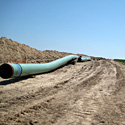
Like many others, Jean and I are of the view that the Keystone XL Pipeline is not required. Last week there was an update from EPI about this subject illustrating how the pipeline is not required. That update is published in full, as follows,
Plan B Updates
OCTOBER 06, 2011
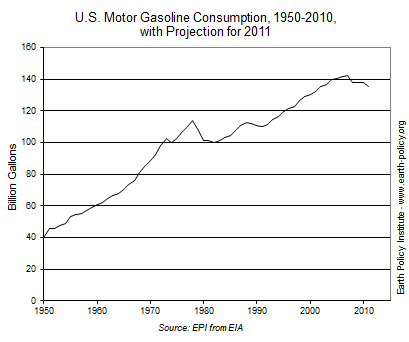
U.S. Gasoline Use Declining: Keystone XL Pipeline Not Needed
Lester R. Brown
As the debate unfolds about whether to build a 1,711-mile pipeline to carry crude oil from the tar sands in Canada to refineries in Texas, the focus is on the oil spills and carbon emissions that inevitably come with it. But we need to ask a more fundamental question. Do we really need that oil?
The United States currently consumes more gasoline than the next 16 countries combined. Yes, you read that right. Among them are China, Japan, Russia, Germany, and Brazil. (See data.)
But now this is changing. Not only is the affluence that sustained this extravagant gasoline consumption eroding, but the automobile-centered lifestyle that was considered part of the American birthright is fading as well. U.S. gasoline use has dropped 5 percent in four years.
Four key developments are set to further reduce U.S. gasoline use: a shrinking car fleet, a decline in the miles driven per car, dramatic mandated future gains in new car fuel efficiency, and the shift from gasoline to electricity to power our cars.
The U.S. fleet appears to have peaked at 250 million vehicles in 2008. From 1994 through 2007, new-car sales were in the range of 15–17 million per year. Since then they have totaled 10–13 million per year, and they are unlikely to top 14 million again. Retirees likely will exceed sales of new cars throughout this decade.
The contraction that began when the fleet dropped from 250 million in 2008 to 248 million in 2010 is likely to continue. Sales of new cars are not matching those of earlier years in part because the economic prospect has dimmed and in part because we are still urbanizing. Today 82 percent of us live in urban areas where cars are becoming less essential.
On top of urbanization, we also have a change in the manner in which young people socialize. For teenagers in rural communities a half century ago, getting a driver’s license and something to drive—a car, a pickup, or even a farm truck—was a rite of passage. That’s what everyone did.
This too is changing. Today’s teenagers, most of whom grew up in an urban setting, socialize through smartphones and the Internet. For many of them, a car is of little interest. The number of licensed teenage drivers in this country—the car owners of the future—has dropped from a peak of 12 million in 1978 to 10 million today.
Cities are also being redesigned for people. Among other things, this means cities are becoming pedestrian- and bicycle-friendly, with ready access to public transit.
Many cities are building a cycling infrastructure of bicycle trails, dedicated bike lanes, and bike racks for parking. Bike-sharing programs are showing up, too. In Washington, D.C., the Capital Bikeshare program that began in 2010 has expanded to 116 stations with 1,100 bicycles. Within the first year, some 16,000 riders signed up for annual membership in the program. Denver and Chicago have similar bike share programs. And New York City is about to launch a huge program of its own.
The second reason that gasoline use is falling is the decline in miles driven per car. This is partly in response to economic uncertainty and the high price of gasoline. When gas costs nearly $4 a gallon, people think twice before jumping in a car and using a gallon of gasoline to pick up a half-gallon of milk.
A third trend that is reducing gasoline use is the rising fuel efficiency of the U.S. automobile fleet. New cars sold in 2008 averaged 27 miles per gallon. But in early 2009, President Obama raised the average fuel efficiency standard so that those sold in 2016 will get 36 miles per gallon. Additional standards announced in 2011 mean that new cars sold in 2025 will use less than half as much gasoline as the 2008 models.
The game changer in reducing gasoline use is going to come as drivers shift from gasoline to electrically powered vehicles, including plug-in hybrids and all-electric cars. General Motors recently introduced the Chevrolet Volt, designed to run largely on electricity, and Nissan unveiled the Leaf, an all-electric vehicle. Beyond these, Toyota is accepting orders for the plug-in version of its Prius hybrid, the pacesetter in fuel efficiency. It will be followed by a steady flow of new plug-in hybrid and all-electric car models coming to market.
Although these electrically powered vehicles are typically more costly to buy, the day-to-day cost of operating them is extraordinarily low. An analysis by Professor Michael McElroy at Harvard indicates that running a car on wind-generated electricity could cost less than the equivalent of 80-cent-a-gallon gasoline.
With the auto fleet shrinking, with the average car being driven less, with the fuel use of new cars to be cut in half by 2025, and with electricity starting to replace gasoline as a fuel, why do we need to build a pipeline to bring crude oil from Canada’s tar sands to oil refineries in Texas? The answer is we don’t.
Lester R. Brown is president of the Earth Policy Institute and author of World on the Edge.
There’s a footnote that I would like to add from the Center for Biological Diversity (great website!) that came out in a recent newsletter.
Here it is,
Lawsuit Seeks to Halt Work on Controversial Keystone XL Pipeline
Keystone Pipeline
The hotly contested Keystone XL pipeline hasn’t been approved for construction, but federal officials don’t seem to care; they’ve allowed the pipeline company to mow down 100 miles of native prairie grasslands in Nebraska to clear the way — before any public hearings were held on whether Keystone XL should move forward at all.
The Center for Biological Diversity and Friends of the Earth filed a lawsuit in federal court in Omaha Wednesday to halt that work. Specifically, we’re challenging decisions by the State Department and U.S. Fish and Wildlife Service to allow work to begin before a decision’s been made on the pipeline or the public hearings, which look like little more than a sham at this point.
If approved, TransCanada’s 1,700-mile pipeline would carry up to 35 million gallons of oil a day from tar sands in Canada to refineries in Texas. Not only will this project add fuel to the global climate crisis, but the pipeline will cut across Nebraska’s legendary Sandhills, hundreds of rivers and streams, and the Ogallala Aquifer, which provides drinking water for millions of people. TransCanada’s existing pipeline, called Keystone 1, has reportedly leaked 14 times since it started operating in June 2010.
Three guest posts from Martin Lack of Lack of Environment, today the concluding Part Three
Hope you have been following the previous two parts of this essay from Martin. Part One can be read here; Part Two here.
————————-
Can modernisation be “ecological”? – Part 3
This is the third and final part of my mini-critique of the school of environmental thought known as Ecological Modernisation.
——————-
Newsflash: Today [Sept. 27th.] isEarth Overshoot Day for 2011. This was a genuine coincidence (i.e. I did not know this when I decided to do this 3-part story). See paragraph 2 below…
——————-
Where are we now?
In his seminal 1968 article on ‘The Tragedy of the Commons’, Garrett Hardin had observed that it was not possible to achieve Jeremy Bentham’s hedonistic goal of “the greatest good for the greatest number” because, at the level of the individual, to do so would require food and/or energy to be used for subsistence purposes only (Hardin 1968: 1243). In 1977, William Ophuls agreed that the optimum population is not the maximum possible, which appears to imply that, if necessary, artificial limits to growth should be imposed. Furthermore, he explicitly stated that, “…this optimum level… may be as little as fifty percent of the theoretical maximum…” (Ophuls 1977: 28).
Mathis Wackernagel et al have recently provided “…evidence that human activities have exceeded the biosphere’s capacity since the 1980s. This overshoot can be expressed as the extent to which human area demand exceeds nature’s supply. Whereas humanity’s load corresponded to 70% of the biosphere’s capacity in 1961; this percentage grew to 120% by 1999.” However, the authors also pointed out that, if… “12% of the bioproductive area was set aside to protect other species; the demand line crosses the supply line in the early 1970s rather than the 1980s” (Wackernagel et al 2002: 9268-9)(emphasis mine).
In laboratory-controlled studies, the size of a population of, say, fruit flies can be shown to depend on the scarcity or abundance of food; and the presence or absence of predators. However, in 2005, Meadows et al pointed out that a growing population “…will slow and stop in a smooth accommodation with its limits… only if it receives accurate, prompt signals telling it where it is with respect to its limits, and only if it responds to those signals quickly and accurately” (Meadows et al 2005: 157).
This pursuit of the resulting “S-curve” is sometimes referred to as the demographic transition of an increasingly affluent society through three stages: (1) high birth and death rates; (2) high birth rate but low death rate; and (3) low birth and death rates. However, in a section entitled ‘Why Technology and Markets Alone Can’t Avoid Overshoot’, Meadowset al also pointed out that if we put off dealing with limits to growth we are more likely to come up against several of them simultaneously (ibid: 223).
Even though no-one seems to want to talk about population control today, neither Hardin nor Malthus was the first to raise this contentious subject because, as Philip Kreager has pointed out, this dubious honour goes to Aristotle’s treatise on Politics within which, “…population is a recurring topic, extensively discussed and integral to the overall argument…” (Kreager 2008: 599). Furthermore, according to Theodore Lianos, although Aristotle was thinking at the scale of a city rather than a country, the great philosopher recognised that there was an optimum population size, which depended on the land area controlled by the city (for food production purposes), which could be determined by, “the land-population ratio that produces enough material goods so that the citizens can live a wise and generous life, comfortable but not wasteful nor luxurious” (Lianos 2010: 3).
Conclusions
It has been demonstrated that dematerialisation alone cannot deal with the problem of resource depletion unless the increase in unit efficiency is greater than the increase in scale of production (i.e. something that cannot be sustainable indefinitely).
Furthermore, whereas it may be possible to partially decouple environmental degradation from economic growth, pursuit of this as a sole objective is a dangerous strategy. This is because to do so is to remain ambivalent about the existence and significance of limits to growth; indeed it is to deny that growth itself may be the problem.
In the final analysis, the only thing that will be sustainable is progression towards the steady-state economy proposed by Daly and others; combined with qualitative development instead of quantitative growth. Therefore, the only form of modernisation that could be ecological is one that places the intrinsic value of vital resources such as clean air and clean water – and the inherent value of a beautiful landscape – well above the instrumental value of money or precious metals.
——————-
References:
Hardin, G. (1968), ‘The Tragedy of the Commons’, Science, 168, pp.1243-8.
Kreager, P. (2008), ‘Aristotle and open population thinking’, Population and Development Review 14(34), pp.599-629.
Lianos, T. (2010), ‘Aristotle’s Macroeconomic Model of the City-State’.
Meadows D, et al (2005), Limits to Growth: the 30-Year Update, London: Earthscan.
Ophuls, W. (1977), Ecology and the Politics of Scarcity, San Francisco: Freeman and Co..
Wackernagel, M. et al (2002), ‘Tracking the ecological overshoot of the human economy’,Proc. of the National Academy of Sciences [USA], 99(14), pp.9266-9271.
Regular readers of Learning from Dogs know that my pattern is to write a single article each day with a focus on something light and airy over the week-end. But I’m making an exception this Sunday, for two reasons. The first was that I spent a couple of hours yesterday catching up on this week’s The Economist and especially liked the tribute to Steve Jobs; a small extract is below with a link to the full article. The second reason was that friend, Neil K. in South Devon, sent me a lovely graphical tribute that I wanted so much to share with you.
So, first to The Economist article,
Steve Jobs
The magician
The revolution that Steve Jobs led is only just beginning
Oct 8th 2011 | from the print edition
Steve Jobs
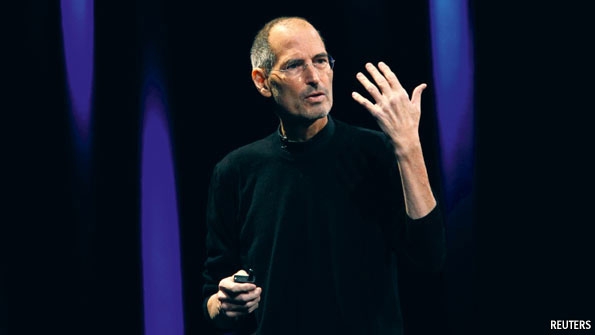
WHEN it came to putting on a show, nobody else in the computer industry, or any other industry for that matter, could match Steve Jobs. His product launches, at which he would stand alone on a black stage and conjure up an “incredible” new electronic gadget in front of an awed crowd, were the performances of a master showman. All computers do is fetch and shuffle numbers, he once explained, but do it fast enough and “the results appear to be magic”. Mr Jobs, who died this week aged 56, spent his life packaging that magic into elegantly designed, easy-to-use products.
Read the full article on The Economist website. The article finishes, thus,
Mr Jobs was said by an engineer in the early years of Apple to emit a “reality distortion field”, such were his powers of persuasion. But in the end he conjured up a reality of his own, channelling the magic of computing into products that reshaped entire industries. The man who said in his youth that he wanted to “put a ding in the universe” did just that.
Three guest posts from Martin Lack of Lack of Environment, today Part Two
As previously mentioned, Martin came to the attention of Learning from Dogs when making a comment to the second part of my Sceptical Voices essay. This is the second part of an essay that Martin wrote that is worthy of deep consideration. Part One can be read here; the concluding Part Three next Monday, the 10th.
————————-
Can modernisation be “ecological”? – Part 2
What is the problem with Modernity?
The problem is that the accumulation of personal wealth has become the sole objective of many people in modern society; and perpetual growth is posited as a means whereby even the poorest might achieve it. However, the New International Version of the Bible records the Apostle Paul as having written, “For the love of money is a root of all kinds of evil…” (1 Timothy 6:10); and economists and politicians have argued about this for centuries…
According to Jon Elster, it was Karl Marx that coined the term ‘money fetishism’ to describe the belief that money (and/or precious metals) have intrinsic (use) value rather than just instrumental (exchange) value, which Marx felt was as misguided as the religious practice of endowing inanimate objects with supernatural powers (Elster 1986: 56-7). However, the terms use value and exchange value were first put forward by Aristotle (384-322 BC) who, according to Daly, also recognised the danger of focusing on the latter (i.e. whereby the accumulation of wealth becomes an end in itself). Therefore, Daly suggests that the paperless economy (where no useable commodities actually change hands) is the ultimate destiny for money fetishism (Daly 1992: 186).
In 1987, the World Commission on the Environment and Development (WCED) was clearly keen to try and settle an argument and, therefore, made the following quite astonishing assertion: “Growth has no set limits in terms of population or resource use beyond which lies ecological disaster” (Brundtland et al 1987: 45). Instead, WCED gave us the much-touted – but ill-defined – concept of sustainable development (SD). However, in stark contrast to the WCED report, Carter much more recently observed that SD “…will require a fundamental transformation in attitudes to economic growth, consumption, production and work” (Carter 2007: 48). This appears to be a subtle acknowledgement of the legitimacy of Herman Daly’s insistence of the need for a move to a steady-state economy; precisely because infinite growth is impossible in a closed system.
A basic tenet of Daly’s thesis is that economic activity does not take place in a vacuum and that economic – not just ecological – collapse awaits us unless we recognise the limited capacity of the ecosystem within which we operate: “Of all the fields of study, economics is the last one that should seek to be ‘value-free’, lest it deserve Oscar Wilde’s remark that an economist ‘is a man that knows the price of everything and the value of nothing.’” (Daly 1992: 4).
On 22 December 2010, the BBC broadcast a Panorama programme entitled “What Price Cheap Food” containing the startling revelation that, in the two years between 1 November 2008 and 1 November 2010, town planners approved applications for at least 577 new supermarkets across the UK. The programme also revealed that so-called “mega farms” (i.e. factory farming of cows and pigs – “dairy-go-rounds” and “sty scrappers” respectively) will be the next ‘big idea’ imported from the USA. The potential mega farm operators argue that there is significant scope for recycling and energy from waste schemes to be incorporated, although environmentalists would question (1) the wisdom of concentrating potentially polluting activities; and (2) the ethics of factory farming (which undoubtedly goes against the grain of green consumerism). However, although the potential for economies of scale cannot be denied, this could all be seen as symptomatic of what Daly called “growthmania“.
Growthmania versus Limits to Growth
One of the world’s most famous deniers of Limits to Growth arguments is Julian Simon, who once famously won a bet with Paul Ehrlich that the price of any commodity would reduce with the passage of time. Nevertheless, how can anyone deny that the Earth’s resource base or its capacity to accommodate human beings is anything other than limited? Quite easily, apparently: In 1994, Simon claimed that “humanity now has the ability (or knowledge) to make it possible to feed, clothe, and supply energy to an ever-growing population for the next 7 billion years.”
However, the stupidity of such a dangerously fallacious argument was exposed 2 years later by Paul and Anna Ehrlich, who pointed out that at 1994 growth rates, “it would take only 774 years for the 1994 population of 5.6 billion to increase to the point where there were 10 human beings for each square meter of ice-free land on the planet!” Furthermore, they pointed out that if growth did not decline from 1994 levels, it would take only 1900 years for the mass of the human population to equal the mass of the Earth! (Ehrlich and Ehrlich 1996: 66).
Fortunately, the UN now believes (May 2011) that the human population on this planet will probably stabilise by the end of the current Century at somewhere between 10 and 15 billion. The only trouble with that is that, we may well have already exceeded the ecological carrying capacity of the planet, and are therefore causing extreme stress to the global ecosystem; of which the most obvious symptom is AGW.
—————-
References:
Daly, H. (1992), Steady State Economics (2nd ed), London: Earthscan.
Elster, J. (1986), An Introduction to Karl Marx, Cambridge: Cambridge University Press.
Ehrlich, P. and Ehrlich, A. (1996), Betrayal of Science and Reason, New York: Island Press.
Three guest posts from Martin Lack of Lack of Environment, today Part One
Martin came to the attention of Learning from Dogs when making a comment to the second part of my Sceptical Voices essay. Since then, he and I have exchanged a number of emails. Over the next few days, I would like to re-publish an essay that Martin wrote that is worthy of deep consideration. Here is Part One. Part Two will be on Friday and Part Three next Monday, the 10th.
————————-
Can modernisation be “ecological”? – Part 1
This is the first of a series of posts based on an essay with this title that I wrote earlier this year as part of the requirements for my MA in Environmental Politics.
Introduction
There are two possible ways of understanding the question; as to require a critique ofEcological Modernisation (EM) as a school of environmental thought or perhaps, far more demandingly, a critique of modernity itself. Although the main intention of this essay is to do the latter; it will inevitably do the former as well.
Definitions
In order to answer this question, it is essential to define what is meant by ‘ecological’; ‘modernisation’; and the theory of EM to which it has given rise:
– In the context of the question, ‘ecological’ is taken to mean thinking, behaviour, and policy that are ‘environmentally-friendly’; rather than merely or predominantly anthropocentric (i.e. concerned with human needs and interests).
– To understand what is implied by the term ‘modernisation’, it is necessary to define what is meant by the word ‘modernity’ because people often conflate the term with industrialisation or even capitalism. However, whereas both of the latter were forged in the industrial revolution of the late eighteenth and early nineteenth century, modernity has its roots in the scientific revolution of “the Enlightenment” in the eighteenth century.
– The theory – if not the practice – of EM emerged from Germany in the early 1980s. Whereas the social scientists Joseph Huber and Martin Jänicke are most-commonly credited with having originated the term, it is probably Arthur Mol that brought it to the attention of the English-speaking world in 1996, when he quoted Huber as having (somewhat enigmatically) said, ‘…all ways out of the environmental crisis lead us further into modernity.’ Thankfully, Mol then went on to explain that EM theory therefore seeks to repair “…a structural design fault of modernity: the institutionalised destruction of nature.” (Mol 1996: 305).
In addition to the above, it is important to differentiate the terms ‘modernity’ and ‘civilisation’: Civilisation pre-dates the Enlightenment by several millennia; and is often equated with the development of agriculture, settled communities, and cities. However, since past civilisations have come and gone, is there any reason to think that our modern civilisation will be any different? This should not be seen as the question of a wannabe anarchist; as it is merely an acknowledgement of human history.
According to John Dryzek, the rhetoric of the EM discourse is reassuringly optimistic; and would have us believe that we can retain a healthy environment without having to sacrifice the benefits of progress (Dryzek 2005: 171). More recently, echoing both Mol and Dryzek, Neil Carter has defined EM as a “…policy strategy that aims to restructure capitalist political economy along more environmentally benign lines based on the assumption that economic growth and environmental protection can be reconciled.” (Carter 2007: 7).
It is in this context that Carter used the term “decoupling” to refer the idea of breaking any direct causal link between economic growth and environmental degradation; but also suggested that “dematerialisation” of manufacturing processes (i.e. the reduction of environmental resources consumed per unit of production) would be essential (2007: 227). However, if we take the manufacturing of motor cars as an example, the rate of fossil fuel consumption will always accelerate unless the percentage increases engine fuel efficiency is greater than the percentage increases in the number of cars. Therefore, since the former must exponentially decline towards zero, the logical conclusion is that we must control the demand for the latter.
—————
References:
Carter, N. (2007), The Politics of the Environment (2nd ed), Cambridge: Cambridge University Press.
Dryzek, J. (2005), The Politics of the Earth (2nd ed), Oxford: Oxford University Press.
Mol, A. (1996), ‘Ecological Modernisation and Institutional Reflexivity: Environmental Reform in the Late Modern Age’, Environmental Politics, 5(2), pp.302-23.
Acceptance of what has happened is the first step to overcoming the consequences of any misfortune.
William James, January 11th, 1842 - August 26th, 1910
The above is a quotation attributed to the late American philosopher, William James, comprehensively written about on the Stanford Encyclopaedia of Philosophy.
When drafting this post last Wednesday, I used the quotation and reference to William James to soften, as it were, me reproducing an item on Yves Smith’s fabulous blog, Naked Capitalism.
I did have second thoughts about including the video below and the summary of what was written by Yves. The second thoughts were around me not wanting Learning from Dogs to stray into sensationalism or hot pop topics.
The reason I did publish this post was that maybe, just maybe, young Mr. Alessio Rastani is saying it how it really is. How we all have been lulled over the years into believing so much rubbish from so many movers and shakers in the world of power and politics. Whereas, in truth, most people who stop and reflect on the world we are presently living in, intuitively sense, that something has broken.
The good news that may be interpreted from Mr. Rastani’s predictions is that we are now living through a period of change, the end of an era, and that the opportunity for a better, more caring world is wide open.
Introduced on the Naked Capitalism site, as follows,
This segment on BBC may not go viral, but it seems to be getting traction, based on the e-mails (hat tip readers Paul S and Marcus) and alerts in the comments section.
This is not an entertaining Rick Santelli-style rant, it’s a cool assessment of how the Euromarket crisis is likely to end, which he thinks is very badly. The flummoxed reaction of the BBC host suggests that the trader, Alessio Rastani, was a booking mistake.
But consider his second message: that Goldman and people rule the world and like him don’t care about what happens to the real economy. A depression is just a great investment opportunity if you see it coming and position yourself accordingly. Rastani is the bland, reasonable face of predatory capitalism.
But in the best interests of scepticism and balance, I also reproduce what was published in the UK’s Telegraph newspaper on the 27th September,
The soundbites won Mr Rastani instant fame. He became a viral hit and was trending on Twitter. BBC business editor Robert Peston was among the fans. “A must watch if you want to understand the euro crisis and how markets work,” he told his army of 82,000 followers on Twitter on Tuesday.
The interview contained such gems as “Governments don’t rule the world, Goldman Sachs rules the world [and] Goldman Sachs does not care about the rescue package.”
But on Tuesday night the BBC was left facing questions about just how qualified Mr Rastani is to speak about the markets.
In the interview Mr Rastani described himself as an independent trader. Elsewhere he claims he’s an “investment speaker”. Instead of operating from a plush office in Canary Wharf Mr Rastani works and lives with his partner Anita Eader in a £200,000 semi in Bexleyheath, south London. The house, complete with a mortgage from Royal Bank of Scotland, belongs to her not him.
He is a business owner, a 99pc shareholder in public speaking venture Santoro Projects. Its most recent accounts show cash in the bank of £985. After four years trading net assets are £10,048 – in the red.
How a man who has never been authorised by the Financial Services Authority and has no discernible history working for a City institution ended up being interviewed by the BBC remains a mystery.
The incongruity led to some commentators speculating Mr Rastani was a professional hoaxer. The BBC denied the allegation: “We’ve carried out detailed investigations and can’t find any evidence to suggest that the interview with Alessio Rastani was a hoax.”
However, the BBC declined to comment on what checks, if any, it had done prior to the interview.
Mr Rastani was a little more forthcoming.
“They approached me,” he told The Telegraph. “I’m an attention seeker. That is the main reason I speak. That is the reason I agreed to go on the BBC. Trading is a like a hobby. It is not a business. I am a talker. I talk a lot. I love the whole idea of public speaking.”
So he’s more of a talker than a trader. A man who doesn’t own the house he lives in, but can sum up the financial crisis in just three minutes – a knack that escapes many financial commentators.
“I agreed to go on because I’m attention seeker,” he said on Tuesday. “But I meant every word I said.”
My apologies but the demands on my time are a little challenging this week. All as a result of the creative writing course that is being undertaken at our local Gila Community College, a course that I am loving, by the way!
Last Saturday, John H. and I went down to Tempe, Phoenix to attend the nearest Moving Planet event. It was well-attended especially by people the right side of 40 years-old! After all it is the succeeding generation that is going to cope with the consequences of the present abuse of the planet’s resources.
The leader of the event down in Tempe was Doug Bland of Arizona Interfaith Power and Light and it was very encouraging to see such a strong ecumenical involvement.
Later this week, I want to respond to the views that came out in the first part of the Sceptical voices piece last week but for now let me just leave you with a 4-minute video that was shown to the group down in Tempe last Saturday. It is called Try not to Make Connections.
Our Planet is a living entity, which means…. well, allow Professor Klare to spell it out.
A few months back, specifically on the 3rd May, I reflected on views that the Planet Earth was a living entity responding to how it was treated. One of those views was the now-famous Gaia hypothesis from Prof. James Lovelock; the other idea, of an avenging planet, was from Michael T. Klare, a professor of peace and world security studies at Hampshire College.
Then in June, Tom Engelhardt, of TomDispatch fame, published a further article from Professor Michael Klare. Tom’s generosity allows me the permission to re-publish the article, which is riveting reading.
The Global Energy Crisis Deepens
Three Energy Developments That Are Changing Your Life
By Michael T. Klare
Here’s the good news about energy: thanks to rising oil prices and deteriorating economic conditions worldwide, the International Energy Agency (IEA) reports that global oil demand will not grow this year as much as once assumed, which may provide some temporary price relief at the gas pump. In its May Oil Market Report, the IEA reduced its 2011 estimate for global oil consumption by 190,000 barrels per day, pegging it at 89.2 million barrels daily. As a result, retail prices may not reach the stratospheric levels predicted earlier this year, though they will undoubtedly remain higher than at any time since the peak months of 2008, just before the global economic meltdown. Keep in mind that this is the good news.
As for the bad news: the world faces an array of intractable energy problems that, if anything, have only worsened in recent weeks. These problems are multiplying on either side of energy’s key geological divide: below ground, once-abundant reserves of easy-to-get “conventional” oil, natural gas, and coal are drying up;above ground, human miscalculation and geopolitics are limiting the production and availability of specific energy supplies. With troubles mounting in both arenas, our energy prospects are only growing dimmer.
Here’s one simple fact without which our deepening energy crisis makes no sense: the world economy is structured in such a way that standing still in energy production is not an option. In order to satisfy the staggering needs of older industrial powers like the United States along with the voracious thirst of rising powers like China, global energy must grow substantially every year. According to the projections of the U.S. Department of Energy (DoE), world energy output, based on 2007 levels, must rise 29% to 640 quadrillion British thermal units by 2025 to meet anticipated demand. Even if usage grows somewhat more slowly than projected, any failure to satisfy the world’s requirements produces a perception of scarcity, which also means rising fuel prices. These are precisely the conditions we see today and should expect for the indefinite future.
It is against this backdrop that three crucial developments of 2011 are changing the way we are likely to live on this planet for the foreseeable future.
Tough-Oil Rebels
The first and still most momentous of the year’s energy shocks was the series of events precipitated by the Tunisian and Egyptian rebellions and the ensuing “Arab Spring” in the greater Middle East. Neither Tunisia nor Egypt was, in fact, a major oil producer, but the political shockwaves these insurrections unleashed has spread to other countries in the region that are, including Libya, Oman, and Saudi Arabia. At this point, the Saudi and Omani leaderships appear to be keeping a tight lid on protests, but Libyan production, normally averaging approximately 1.7 million barrels per day, has fallen to near zero.
When it comes to the future availability of oil, it is impossible to overstate the importance of this spring’s events in the Middle East, which continue to thoroughly rattle the energy markets. According to all projections of global petroleum output, Saudi Arabia and the other Persian Gulf states are slated to supply an ever-increasing share of the world’s total oil supply as production in key regions elsewhere declines. Achieving this production increase is essential, but it will not happen unless the rulers of those countries invest colossal sums in the development of new petroleum reserves — especially the heavy, “tough oil” variety that requires far more costly infrastructure than existing “easy oil” deposits.
In a front-page story entitled “Facing Up to the End of ‘Easy Oil,’” the Wall Street Journal noted that any hope of meeting future world oil requirements rests on a Saudi willingness to sink hundreds of billions of dollars into their remaining heavy-oil deposits. But right now, faced with a ballooning population and the prospects of an Egyptian-style youth revolt, the Saudi leadership seems intent on using its staggering wealth on employment-generating public-works programs and vast arrays of weaponry, not new tough-oil facilities; the same is largely true of the other monarchical oil states of the Persian Gulf.
Whether such efforts will prove effective is unknown. If a youthful Saudi population faced with promises of jobs and money, as well as the fierce repression of dissidence, has seemed less confrontational than their Tunisian, Egyptian, and Syrian counterparts, that doesn’t mean that the status quo will remain forever. “Saudi Arabia is a time bomb,” commented Jaafar Al Taie, managing director of Manaar Energy Consulting (which advises foreign oil firms operating in the region). “I don’t think that what the King is doing now is sufficient to prevent an uprising,” he added, even though the Saudi royals had just announced a $36-billion plan to raise the minimum wage, increase unemployment benefits, and build affordable housing.
At present, the world can accommodate a prolonged loss of Libyan oil. Saudi Arabia and a few other producers possess sufficient excess capacity to make up the difference. Should Saudi Arabia ever explode, however, all bets are off. “If something happens in Saudi Arabia, [oil] will go to $200 to $300 [per barrel],”said Sheikh Zaki Yamani, the kingdom’s former oil minister, on April 5th. “I don’t expect this for the time being, but who would have expected Tunisia?”
Nuclear Power on the Downward Slope
In terms of the energy markets, the second major development of 2011 occurred on March 11th when an unexpectedly powerful earthquake and tsunami struck Japan. As a start, nature’s two-fisted attack damaged or destroyed a significant proportion of northern Japan’s energy infrastructure, including refineries, port facilities, pipelines, power plants, and transmission lines. In addition, of course, it devastated four nuclear plants at Fukushima, resulting, according to the U.S. Department of Energy, in the permanent loss of 6,800 megawatts of electric generating capacity.
This, in turn, has forced Japan to increase its imports of oil, coal, and natural gas, adding to the pressure on global supplies. With Fukushima and other nuclear plants off line, industry analysts calculate that Japanese oil imports could rise by as much as 238,000 barrels per day, and imports of natural gas by 1.2 billion cubic feet per day (mostly in the form of liquefied natural gas, or LNG).
This is one major short-term effect of the tsunami. What about the longer-term effects? The Japanese government now claims it is scrapping plans to build as many as 14 new nuclear reactors over the next two decades. On May 10th, Prime Minister Naoto Kan announced that the government would have to “start from scratch” in devising a new energy policy for the country. Though he speaks of replacing the cancelled reactors with renewable energy systems like wind and solar, the sad reality is that a significant part of any future energy expansion will inevitably come from more imported oil, coal, and LNG.
Read this book.
The disaster at Fukushima — and ensuing revelations of design flaws and maintenance failures at the plant — has had a domino effect, causing energy officials in other countries to cancel plans to build new nuclear plants or extend the life of existing ones. The first to do so was Germany: on March 14th, Chancellor Angela Merkelclosed two older plants and suspended plans to extend the life of 15 others. On May 30th, her government made the suspension permanent. In the wake of mass antinuclear rallies and an election setback, she promised to shut all existing nuclear plants by 2022, which, experts believe, will result in an increase in fossil-fuel use.
China also acted swiftly, announcing on March 16th that it would stop awarding permits for the construction of new reactors pending a review of safety procedures, though it did not rule out such investments altogether. Other countries, including India and the United States, similarly undertook reviews of reactor safety procedures, putting ambitious nuclear plans at risk. Then, on May 25th, the Swiss government announced that it would abandon plans to build three new nuclear power plants, phase out nuclear power, and close the last of its plants by 2034, joining the list of countries that appear to have abandoned nuclear power for good.
How Drought Strangles Energy
The third major energy development of 2011, less obviously energy-connected than the other two, has been a series of persistent, often record, droughts gripping many areas of the planet. Typically, the most immediate and dramatic effect of prolonged drought is a reduction in grain production, leading to ever-higher food prices and ever more social turmoil.
Intense drought over the past year in Australia, China, Russia, and parts of theMiddle East, South America, the United States, and most recently northern Europehas contributed to the current record-breaking price of food — and this, in turn, has been a key factor in the political unrest now sweeping North Africa, East Africa, and the Middle East. But drought has an energy effect as well. It can reduce the flow of major river systems, leading to a decline in the output of hydroelectric power plants, as is now happening in several drought-stricken regions.
By far the greatest threat to electricity generation exists in China, which is suffering from one of its worst droughts ever. Rainfall levels from January to April in the drainage basin of the Yangtze, China’s longest and most economically important river, have been 40% lower than the average of the past 50 years, according toChina Daily. This has resulted in a significant decline in hydropower and severe electricity shortages throughout much of central China.
The Chinese are burning more coal to generate electricity, but domestic mines no longer satisfy the country’s needs and so China has become a major coal importer. Rising demand combined with inadequate supply has led to a spike in coal prices, and with no comparable spurt in electricity rates (set by the government), many Chinese utilities are rationing power rather than buy more expensive coal and operate at a loss. In response, industries are upping their reliance on diesel-powered backup generators, which in turn increases China’s demand for imported oil, putting yet more pressure on global fuel prices.
Wrecking the Planet
So now we enter June with continuing unrest in the Middle East, a grim outlook for nuclear power, and a severe electricity shortage in China (and possibly elsewhere). What else do we see on the global energy horizon?
Despite the IEA’s forecast of diminished future oil consumption, global energy demand continues to outpace increases in supply. From all indications, this imbalance will persist.
Take oil. A growing number of energy analysts now agree that the era of “easy oil” has ended and that the world must increasingly rely on hard-to-get “tough oil.” It is widely assumed, moreover, that the planet harbors a lot of this stuff — deep underground, far offshore, in problematic geological formations like Canada’s tar sands, and in the melting Arctic. However, extracting and processing tough oil will prove ever more costly and involve great human, and even greater environmental, risk. Think: BP’s Deepwater Horizon disaster of April 2010 in the Gulf of Mexico.
Such is the world’s thirst for oil that a growing amount of this stuff will nonetheless be extracted, even if not, in all likelihood, at a pace and on a scale necessary to replace the disappearance of yesterday’s and today’s easy oil. Along with continued instability in the Middle East, this tough-oil landscape seems to underlie expectations that the price of oil will only rise in the coming years. In a poll of global energy company executives conducted this April by the KPMG Global Energy Institute, 64% of those surveyed predicted that crude oil prices will cross the $120 per barrel barrier before the end of 2011. Approximately one-third of them predicted that the price would go even higher, with 17% believing it would reach $131-$140 per barrel; 9%, $141-$150 per barrel; and 6%, above the $150 mark.
The price of coal, too, has soared in recent months, thanks to mounting worldwide demand as supplies of energy from nuclear power and hydroelectricity have contracted. Many countries have launched significant efforts to spur the development of renewable energy, but these are not advancing fast enough or on a large enough scale to replace older technologies quickly. The only bright spot, experts say, is the growing extraction of natural gas from shale rock in the United States through the use of hydraulic fracturing (“hydro-fracking”).
Proponents of shale gas claim it can provide a large share of America’s energy needs in the years ahead, while actually reducing harm to the environment when compared to coal and oil (as gas emits less carbon dioxide per unit of energy released); however, an expanding chorus of opponents are warning of the threat to municipal water supplies posed by the use of toxic chemicals in the fracking process. These warnings have proven convincing enough to lead lawmakers in a growing number of statesto begin placing restrictions on the practice, throwing into doubt the future contribution of shale gas to the nation’s energy supply. Also, on May 12th, the French National Assembly (the powerful lower house of parliament)voted 287 to 146 to ban hydro-fracking in France, becoming the first nation to do so.
The environmental problems of shale gas are hardly unique. The fact is that all of the strategies now being considered to extend the life-spans of oil, coal, and natural gas involve severe economic and environmental risks and costs — as, of course, does the very use of fossil fuels of any sort at a moment when the first IEA numbers for 2010 indicate that it was an unexpectedly record-breaking year for humanity when it came to dumping greenhouse gases into the atmosphere.
With the easily accessible mammoth oil fields of Texas, Venezuela, and the Middle East either used up or soon to be significantly depleted, the future of oil rests on third-rate stuff like tar sands, shale oil, and extra-heavy crude that require a lot of energy to extract, processes that emit added greenhouse gases, and as with those tar sands, tend to play havoc with the environment.
Shale gas is typical. Though plentiful, it can only be pried loose from underground shale formations through the use of explosives and highly pressurized water mixed with toxic chemicals. In addition, to obtain the necessary quantities of shale oil, many tens of thousands of wells will have to be sunk across the American landscape, any of one of which could prove to be an environmental disaster.
Likewise, the future of coal will rest on increasingly invasive and hazardous techniques, such as the explosive removal of mountaintops and the dispersal of excess rock and toxic wastes in the valleys below. Any increase in the use of coal will also enhance climate change, since coal emits more carbon dioxide than do oil and natural gas.
Here’s the bottom line: Any expectations that ever-increasing supplies of energy will meet demand in the coming years are destined to be disappointed. Instead, recurring shortages, rising prices, and mounting discontent are likely to be the thematic drumbeat of the globe’s energy future.
If we don’t abandon a belief that unrestricted growth is our inalienable birthright and embrace the genuine promise of renewable energy (with the necessary effort and investment that would make such a commitment meaningful), the future is likely to prove grim indeed. Then, the history of energy, as taught in some late twenty-first-century university, will be labeled: How to Wreck the Planet 101.
Michael T. Klare is a professor of peace and world security studies at Hampshire College, a TomDispatch regular, and the author, most recently, ofRising Powers, Shrinking Planet. A documentary movie version of his previous book, Blood and Oil, is available from the Media Education Foundation. To listen to Timothy MacBain’s latest TomCast audio interview in which Klare discusses the U.S., Saudi Arabia, and resource conflicts, click here, or download it to your iPod here.
Want a brilliant idea for tomorrow? Stay in the present!
Dogs do this wonderfully. I am told that followers of Zen Buddhism discover peace and grace from embracing the present. But is there more to this? Is there some deeper psychology involved? Does our species have an intrinsic challenge in terms of staying in the present?
My musings on this arise from a couple of recent conversations.
The first was with Peter McCarthy from the Bristol area of West England. Peter and I go back a few years (at my age, everything goes back a few years!) and at one stage I did some work for Peter’s company, Telecom Potential. Just a quick aside, Peter’s company was based in the magnificent Clevedon Hall, a mansion built in 1853 as a family home for Conrad William Finzel, a German-born businessman. Here’s a picture of one of the rooms,
A room at Clevedon Hall
Peter, like me, is sure that the period in which the world now appears to be, is not some cyclical downturn, not some temporary departure from the national growth and employment ambitions promoted by so many countries. No! This one is different.
Peter is sure that a major transition is under way, as big as any of the great societal upheavals of the past. And, for me, a fascinating comment from Peter was his belief that the key attitude required for the next years would be innovation. Peter reminded me that we tend to think of innovation as applying to things physical, scientific and technical. But Peter sensed that it would be in the area of social innovation where key changes would arise and, from which, these large societal changes would flow.
Then a day later I was chatting with one of the founders of a brilliant new authentication process, Pin Plus. It is a very smart solution to a major global problem, the weaknesses of traditional password user-authentication systems.
On the face of it, Pin Plus is obviously a better and more secure way of authenticating users, and a number of key test customers have borne this out. Jonathan C was speaking of the challenges of convincing companies to have faith in this new process. This is what he said,
More than once, indeed many times, I am told by prospects something along the lines that the IT world has been looking so hard and so long for a password solution that a solution can’t possibly exist.
Let’s ponder that for a moment. Are we saying that a far-sighted approach to the potential for change is not an easy place for some, probably many, human brains?
Indeed, Jonathan and I mused that here we were, both speaking via Skype, an internet telephony service, both of us looking at different web sites in support of many of the points that we were discussing and totally dependent, in terms of our mentoring relationship, on the technology of the internet, a multi-node packet-switched communications system that was a direct result of the American shock of seeing the Russians launch the world’s first artificial satellite, Sputnik 1, into low earth orbit on the 4th October, 1957.
Launch of Sputnik 1
At that time, it would have seemed impossible for anyone on the planet to see that the American response to Sputnik 1 would eventually lead to the vast packet-switched network that is now the modern Internet.
But why do we regard the ability to look into the future so utterly out of reach of the common man? Look at this, the Internet Timeline here. Look how quickly the response to Sputnik1 gathered pace. See how Leonard Kleinrock of MIT way back in May, 1961, presented a paper on the theory of packet-switching in large communications networks.
So maybe there’s a blindness with humans. A blindess that creates the following bizarre characteristics,
Whatever is going on in our lives at present we assume will go on forever. I.e. the boom times will never end, or the period of doom and gloom is endless.
Our obsession with how things are now prevents us from reflecting on those signs that indicate changes are under way, even when the likely conclusions are unmistakeable. The ecological and climatic changes being the most obvious example of this strange blindness that mankind possesses.
Yet, unlike animals and some spiritual groups of humans, truly living in the present appears incredibly difficult for man.
However, the history of mankind shows that our species is capable of huge change, practically living in constant change for the last few millennia, and that a very small proportion of a society, see yesterday’s article, is all that is required to create a ‘tipping point’.
I want to continue with this theme but conscious that there is still much to be written. So, dear reader, I shall pause and pick this up tomorrow.