John left an intriguing question as a comment to yesterday’s post.
Oh to have a time machine!
Tell me, Paul, if you did have one, a time machine, what three moments in history would you visit?
It really grabbed Jean and me and we spent quite a few minutes during the day kicking around ideas. At first, it was easy just to do a web search on epic moments in history and see if any of them related to me. But that seemed too easy. So I have picked three that do connect with my life.
May 8th, 1945
I was born on November 8th, 1944. I was born in North London (Acton). It was the period of the Second World War when the V2 rockets were landing all around. Take, for example, the incident just eleven days after my birth, when on the 19th November, 1944 a V2 landed in Wandsworth causing much damage and many fatalities around Hazlehurst Road and Garratt Lane. Spend a moment reviewing who died, and their ages, in that bombing.
So I was precisely six months old when the armistice was announced on May 8th, 1945. As Wikipedia describes it:
Victory in Europe Day, generally known as V-E Day, VE Day or simply V Day was the public holiday celebrated on 8 May 1945 (7 May in Commonwealth realms) to mark the formal acceptance by the Allies of World War II of Nazi Germany’s unconditional surrender of its armed forces.[1] It thus marked the end of World War II in Europe.
On 30 April, Adolf Hitler, the Nazi leader, committed suicide during the Battle of Berlin. Germany’s surrender, therefore, was authorised by his successor, Reichspräsident Karl Dönitz. The administration headed by Dönitz was known as the Flensburg Government. The act of military surrender was signed on 7 May in Reims, France and on 8 May in Berlin, Germany.
I would have loved to witness, by being in the crowd that day, the King and Queen acknowledging the end of the war in Europe.
May 8, 1945: King George VI and Queen Elizabeth, with Princess Elizabeth and Princess Margaret, are joined by Prime Minister Winston Churchill.
Nevertheless, that day in May, 1945 has been memorable for me for all of my life. Because my mother, who is still alive today, aged 96, (still living in London but spending Christmas with my sister in Cape Town, by the way), held me in her arms and said aloud: “My dear Paul, you are going to live!” I grew up with those loving words deeply rooted within me.
2. Stonehenge – too many moons ago!
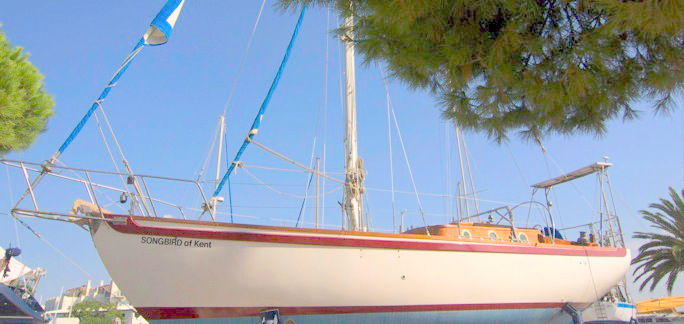
For reasons that I am not entirely clear about, I have always been fascinated by the stars. From the point of view of using the stars to help me navigate strange parts of the world, both on land and at sea. I grew up regarding Polaris, the North Star, almost as a companion. Later in my life when sailing solo from Gibraltar to The Azores, a distance of just under 1,150 nautical miles, on a Tradewind 33 yacht, despite having an early GPS unit it was backup to me using a sextant to maintain (some) awareness of my position.
Tradewind 33 – Songbird of Kent. My home for five years.
(Reminds me of a anecdote when I was crewing on a privately-owned East Coast Essex fishing smack. I was asking Bill, the owner, why he always laid his thumb on the position on the chart in response to the question, “Where are we?” Bill’s reply: “That’s as accurate as anyone can be!”)
In 1969, when I was driving across the desert plains of Australia, often with inhabited places more than a 150-mile radius away (the Simpson Desert especially coming to mind) the Southern Cross seemed to keep me grounded and remind me that I was making progress.
Back when I was living just outside Totnes in South Devon, my frequent drives up to London along the A303 took me past Stonehenge in Wiltshire.
The December solstice happens at the same instant for all of us, everywhere on Earth. This year the solstice occurs on Tuesday December 22nd at 04:49 GMT (Universal time) with the sun rising over Stonehenge in Wiltshire at 08:04.
THE EARLIEST MONUMENT
It is possible that features such as the Heel Stone and the low mound known as the North Barrow were early components of Stonehenge,[3] but the earliest known major event was the construction of a circular ditch with an inner and outer bank, built about 3000 BC. This enclosed an area about 100 metres in diameter, and had two entrances. It was an early form of henge monument.[4]
Within the bank and ditch were possibly some timber structures and set just inside the bank were 56 pits, known as the Aubrey Holes. There has been much debate about what stood in these holes: the consensus for many years has been that they held upright timber posts, but recently the idea has re-emerged that some of them may have held stones.[5]
Within and around the Aubrey Holes, and also in the ditch, people buried cremations. About 64 cremations have been found, and perhaps as many as 150 individuals were originally buried at Stonehenge, making it the largest late Neolithic cemetery in the British Isles.[6]
I would have loved being present at Stonehenge when the builders finally were able to stand back and see the Sun “speak” to them at the first Solstice after that point in its construction.
It seems to me to be a most magical place yet Stonehenge offers a mathematical and rhythmic foundation to that magic.
3. First man into space – 12th April, 1961
It was, of course, Yuri Gagarin, who made the first complete orbit of Planet Earth in space.
Yuri Alekseyevich Gagarin
I would have given anything to be in his seat (and suit). For to look out and see our planet as a small object in an enormous outer space would have to change one’s perception of almost everything; for evermore.
My wish for the New Year is that we recognise our place both in history and on our Planet Earth, and care for it as the sole, beautiful home that we have.
Now that global recognition would be a moment in history that I would want to experience before I die!
(Thanks John for inspiring me to jot down these thoughts!)
I thought it would make a nice change to publish tomorrow’s post a little earlier than usual. To be precise to publish it on Dec. 22, at 04:48, Coordinated Universal Time (UTC). Or in our local Pacific Standard Time (PST) UTC-8 hrs or 20:48 Dec. 21., i.e. 20:48 on the evening of the 21st December. (I am seeing the exact time being declared as 04:48 or 04:49 UTC depending on what you read.)
Granted that the Northern Hemisphere tends to deliver the worst of the Winter weather after the shortest day, it still is good to know that for the next six months, the hours of daylight, in the Northern Hemisphere, will be increasing.
My inclination to write a post on the topic was greatly influenced by a most beautiful post over on Val Boyco’s blogsite. It was called And Winter Came. Here’s the video that Val included in her post.
Isn’t that a most beautiful few minutes!
Impossible to top that!
But I can continue including an informative item that was published over on Mother Nature News, and is republished here within the terms of MNN.
ooOOoo
8 things to know about the winter solstice
From when it happens to why, here’s your crash course on the shortest day of the year.
“A day without sunshine is like, you know, night,” quipped Steve Martin – and indeed, even a day with less sunshine can feel a bit dark. Our world depends on the light radiating from that big star we traipse around, and when it’s in short supply, we feel it. But if you count yourself amongst those who don’t love waking up before the sun rises and getting off work after it has set, things are about to lighten up. Hello, winter solstice!
Although winter is really just beginning, we can at least say goodbye to these short little days we’ve been suffering (and don’t let the door hit you on the way out). With that in mind, here’s a collection of curious facts to celebrate the long-awaited return to longer days.
1. There are actually two winter solstices every year
It’s sometimes easy to be hemisphere-o-centric, but the other side of the planet gets a winter solstice too. With the planet’s orbit tilted on its axis, Earth’s hemispheres swap who gets direct sun over the course of a year. Even though the Northern Hemisphere is closer to the sun during the winter, it’s the tilt away from the sun that causes cold temperatures and less light — which is when the Southern Hemisphere is toasty. So while our winter solstice is on Dec. 21 or 22, the Southern Hemisphere celebrates the same on June 21 or 22.
Here’s how that looks from space (kind of):
2. The winter solstice happens in the blink of an eye
Although the solstice is marked by a whole day on the calendar, it’s actually just the brief moment when the sun is exactly over the Tropic of Capricorn that the event occurs.
3. Which is why it happens on different days in the same year
What? Yes! In 2015, the solstice happens on Dec. 22, at 04:49 on the Coordinated Universal Time (UTC) time clock, the time standard that the world regulates its hours by. Which means any location that is at least five hours behind UTC should break out the party hats on Dec. 21. For example, in the United States the winter solstice happens on Dec. 21 at 11:49 p.m. Eastern Standard Time. The rest of the time zones can welcome longer days beginning on the 22nd.
4. It’s the first day of winter … or it’s not, depending on whom you ask
Meteorologists consider the first day of winter to be Dec. 1, but ask an astronomer — or just about anyone else — and they’ll likely answer that the winter solstice marks the start of the season. There are two ways to look at it: meteorological seasons and astronomical seasons. Meteorological seasons are based on the annual temperature cycle, explains NOAA, while astronomical seasons are based on the position of the Earth in relation to the sun.
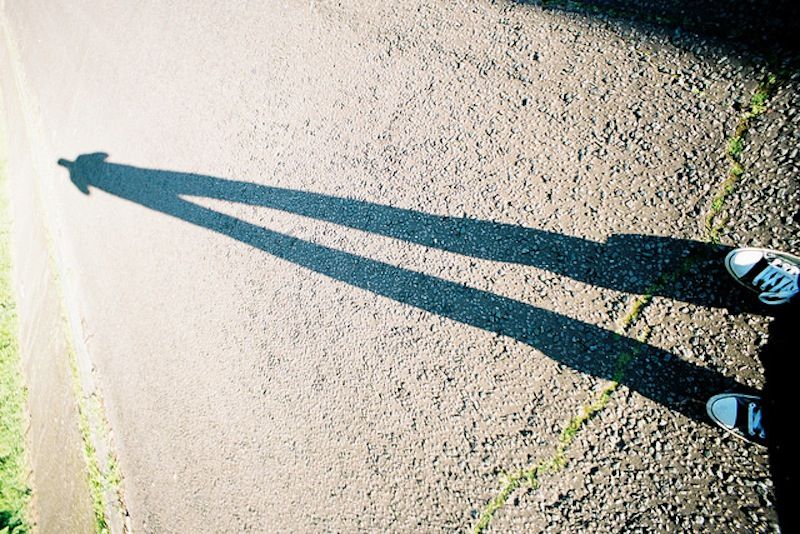
5. It’s a time of gloriously long shadows
Shadows are at their playful best on the solstice. (Photo: Mike Page/flickr)
If you’re inclined to take pleasure in the little things, like shadows that seem cast from a funhouse mirror, then the winter solstice is the time for you. It’s now that the sun is at its lowest arc across the sky and thus, shadows from its light are at their longest. (Imagine a flashlight directly above your head and one hitting you from the side, and picture the respective shadows.) And in fact, your noontime shadow on the solstice is the longest it will be all year. Relish those long legs while you can.
Since 1793, the full moon has only occurred on the winter solstice 10 times, according to the Farmer’s Almanac. The last one was in 2010, which was also a lunar eclipse! The next full moon on a winter solstice won’t be until 2094.
7. There’s a Christmas connection
Since Christ wasn’t issued a birth certificate, there’s no record of the date when he was supposed to have been born. Meanwhile, humans have been celebrating the winter solstice throughout history — the Romans had their feast of Saturnalia, early German and Nordic pagans had their yuletide celebrations. Even Stonehenge has connections to the solstice. But eventually Christian leaders, endeavoring to attract pagans to their faith, added Christian meaning to these traditional festivals. Many Christmas customs, like the Christmas tree, can be directly traced to solstice celebrations.
8. It’s a reminder to thank Copernicus
Will the real Saint Nick please step forward? (Photo: Wikimedia Commons)
The word “solstice” comes from the Latin solstitium, meaning “point at which the sun stands still.” Since when has the sun ever moved?! Of course, before Renaissance astronomer Nicolaus Copernicus (aka “super smartypants”) came up with the ‘ol heliocentric model, we all figured that everything revolved around the Earth, sun included. Our continued use of the word “solstice” is a beautiful reminder of just how far we’ve come and provides a nice opportunity to give a tip of the hat to great thinkers who challenged the status quo.
Only one way to close. That is with this picture of the sun perfectly aligned with the stones at Stonehenge in Wiltshire, UK at the moment of the Winter Solstice.
The December solstice happens at the same instant for all of us, everywhere on Earth. This year the solstice occurs on Tuesday December 22nd at 04:49 GMT (Universal time) with the sun rising over Stonehenge in Wiltshire at 08:04.
Stay safe and warm wherever you are.
The next post from Learning from Dogs will be published at 00:00 PST Wednesday, 23rd December.
Three days ago I was within just a few minutes of queuing this for a blog release when the internet went down. So now that things are back (to normal?) it gives me very great pleasure to publish this guest post.
ooOOoo
My Dog, My Mentor.
We humans share the planet with an enormous variety of life forms. In fact, there are so many organisms in our world that scientists cannot agree even on an estimate of how many exist. Anywhere between two and 100 million, we are told. Those numbers are staggering, leaving me feeling small alongside all those with whom I share terrestrial space.
Today my thoughts come to rest on one specific type of world inhabitant––just one out of the multiple millions: the canine! The one who allegedly is man’s (and woman’s) best friend! I have had close contact with dogs since I was a young child, so it’s hardly surprising that I have a great deal of love and respect for them.
No longer are dogs simply farm animals or household pets. They rescue the lost and wounded after natural disasters, serve in combat, their keen sensitivities are used to detect disease in its early stages, their presence brings comfort to the ill or elderly, they accompany their seeingimpaired human counterpart, detect illegal and harmful substances in public places. In short, they frequently provide expertise and skill that exceed that of humans.
People are hesitant to admit this, always desiring to be on top. To be the best and the most developed. Since we seem to have great difficulty simply living alongside one another, we tend to keep score: higher/ lower; bigger/ smaller; better/ worse; superior/ inferior. One result of this scoring system is that we consider ourselves vastly superior to our animal sisters and brothers–– superior in intelligence, capacity for reason, emotion, creativity and relationship.
Carl Safina, marine conservationist, professor and author, challenges this notion of superiority, stating humans are not necessarily unique (or superior), but simply the most extreme: capable of the most compassion and the worst violence; possessing the greatest capacity for creativity and at the same time most able and willing to inflict destruction on one another and on other inhabitants of this planet.
Yet, animals do not respond in kind. Certainly, they will protect and defend themselves and their own, but humans display vastly more aggression. At times, animals choose to exhibit unsurpassed magnanimity towards humans.
Focusing this phenomenon on the family dog, it may surprise us that not WE but THEY seem to provide the greatest benefit in the human / canine relationship. If we are observant, we will be humbled by the fact that characteristics, effortlessly displayed in our pets, are the very same qualities we strive for and often fall short in attaining. Take gratitude, for example. My darling Maltese––gone since September 11, 2015––waited hours for his human to return home to love on, walk with and feed him. When I walked in the door, he did not unleash venom or aggression for having been left alone while I was away working. His tail wagging knew no bounds––he simply adored the moment he was again joined by his human.
But me? My mind would play all kinds of games when similarly “neglected”: It’s been weeks since I heard from her, it’s about time she called. I didn’t do anything to deserve this silence!
And then there’s unconditional love. What about the times I would become impatient with my furry family member? At times he was distracted on walks, simply delighted by all the sounds, smells and sights of the outdoors. But, I had a goal and a time limit, giving rise to frustration at his digressions. However, my dog wasn’t frustrated. On the contrary, he not only endured my impatient scolding––calls to move on, to hurry––but reciprocated with lavish love the very next moment. How did he do that?
Why is my dog, (whether instinctively or cognitively is actually irrelevant) capable of exhibiting the very virtue I strive for, fail at, attempt repeatedly, become frustrated over failing yet again? The list of virtues seems endless:
kindness,
patience,
resiliency,
forgiveness,
encouragement,
empathy,
sensitivity,
contentment,
the innate ability to live in the moment.
My furry family member expressed––indeed he lived them all.
And what about me? I exhibit these qualities periodically. Sporadically. Brokenly. With enormous, conscious effort.
In his final months, my small Maltese slowed down, had increasing difficulty with mobility, became disoriented, nearly blind and partially deaf. In a word: dependent. Yet his trust, courage and peace were astounding. In his final days he became quiet, hardly uttering a sound, yet the pictures of those days bear witness to his alertness and awareness. He knew!
Could it be that he was quiet because he was at peace with what had been and what was to come? I believe that because he had given all he had to give, in the best way he had been able to give it, he was able to quietly await and accept his departure as well.
What will it be like for me to grow old? Limited? Increasingly dependent? I don’t know! Will I know that the value of my existence is not tied with activity or productivity? Will I learn to live in the moment––grateful, at peace, content?
How will I face the imminent transition from this life to the next? I don’t know! Will my last days be characterized with peace? Absorbing and bestowing love? Satisfied with small things? Inwardly at rest?
These reflections will accompany me for years.
There are questions that are equally relevant––and perhaps more immediate:
How can I have a more sane understanding of my place in this expansive and exquisite terrestrial community?
What will enhance a sense of respect and appreciation for the dizzying variety of species I live alongside?
What will it take for me to continue growing and learning as a human?
These seem profound questions in light of growing disregard for human and animal life. It is not unlikely, however, that sharing space with dogs will help me grow into a more gracious and balanced person.
Today’s post is inspired by something I read that is very special.
The last time I published a post headed What is love?, back in 2012, I included this:
I would imagine that there are almost as many ideas about the meaning of love as there are people on this planet. Dictionary.com produces this in answer to the search on the word ‘love’.
love
[luhv] noun, verb, loved, lov·ing. noun
a profoundly tender, passionate affection for another person.
a feeling of warm personal attachment or deep affection, as for a parent, child, or friend.
sexual passion or desire.
a person toward whom love is felt; beloved person;sweetheart.
(used in direct address as a term of endearment, affection,or the like): Would you like to see a movie, love?
But, I don’t know about you, those definitions leave something missing for me. Here’s my take on what love is, and it’s only by having so many dogs in my life that I have found this clarity of thought.
“Love is trust, love is pure openness, love is knowing that you offer yourself without any barriers. Think how you dream of giving yourself outwardly in the total surrender of love. Reflect on that surrender that you experience when deeply connecting, nay loving, with your dog.“
One of the very special qualities of our dogs is their natural and instinctive ability to love, unconditionally, both us humans and other animals around them (with some notable exceptions; of course.)
Yet as much as we want to learn unconditional love from our dogs, there is something just too complex about us humans to manage that. Possibly rooted in our inability to really live in the present, another quality our dogs also demonstrate so perfectly.
“What is love” was the most searched phrase on Google in 2012, according to the company. In an attempt to get to the bottom of the question once and for all, the Guardian has gathered writers from the fields of science, psychotherapy, literature, religion and philosophy to give their definition of the much-pondered word.
So I sub-titled today’s post by saying that I was inspired by something.
Here it is, recently published over on The Conversation and republished within their terms. I think you are going to love it!
ooOOoo
The life-changing love of one of the 20th century’s greatest physicists
December 9, 2015
Author: Richard Underman, Chancellor’s Professor of Medicine, Liberal Arts, and Philanthropy, Indiana University
Love is for everyone. mawazeFL/Flickr, CC BY-NC
One of the great short stories of the 20th century is Nobel Laureate Isaac Bashevis Singer’s The Spinoza of Market Street. It tells of an aged scholar who has devoted his life to the study of Spinoza’s great work, Ethics. Protagonist Dr Fischelson has lost his library job and, like his hero, been expelled from his religious community for his heretical views. Looking down from his garret with disdain at the crowded street below him, he devotes his days to solitary scholarship. At night he gazes up through his telescope at the heavens, where he finds verification of his master’s wisdom.
Then one day Dr Fischelson falls ill. A neighbor, an uneducated “old maid,” nurses him back to health. Eventually, though the good doctor never understands exactly how or why, they are married. On the night of the wedding, after the unlikeliest of passionate consummations, the old man gazes up at the stars and murmurs, “Divine Spinoza, forgive me. I have become a fool.” He has learned that there is more to life than the theoretical speculations that have preoccupied him for decades.
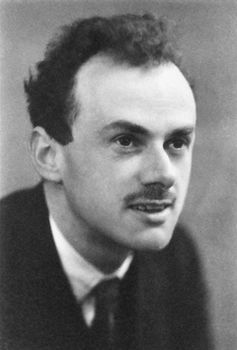
The history of modern physics boasts its own version of Fischelson. His name was Paul Dirac. I first encountered Dirac in physics courses, but was moved to revisit his life and legacy through my service on the board of the Kinsey Institute for the Study of Human Sexuality and teaching an undergraduate course on sexuality and love.
A brilliant but very strange man
Born in Bristol, England, in 1902, Dirac became, after Einstein, the second most important theoretical physicist of the 20th century. He studied at Cambridge, where he wrote the first-ever dissertation on quantum mechanics. Shortly thereafter he produced one of physics’ most famous theories, the Dirac equation, which correctly predicted the existence of antimatter. Dirac did more than any other scientist to reconcile Einstein’s general theory of relativity to quantum mechanics. In 1933 he received the Nobel Prize in Physics, the youngest theoretical physicist ever to do so.
At the time Dirac received the Nobel Prize, he was leading a remarkably drab and, to most eyes,
Paul Dirac in 1933. Nobel Foundation via Wikimedia Commons
unappealing existence. As detailed in Graham Farmelo’s wonderful biography, The Strangest Man: The Hidden Life of Paul Dirac, Mystic of the Atom, on which I rely heavily in this article, Dirac was an incredibly taciturn individual. Getting him to utter even a word could prove nearly impossible, leading his mischievous colleagues to introduce a new unit of measure for the rate of human speech, the Dirac, which amounted to one word per hour.
Dirac was the kind of man who would “never utter a word when no word would do.” Farmelo describes him as a human being completely absorbed in his work, with absolutely no interest in other people or their feelings, and utterly devoid of empathy. He attributes this in part to Dirac’s tyrannical upbringing. His father ruthlessly punished him for every error in speech, and the young Dirac adopted the strategy of saying as little as possible.
Dirac was socially awkward and showed no interest in the opposite sex. Some of his colleagues suspected that he might be utterly devoid of such feelings. Once, Farmelo recounts, Dirac found himself on a two-week cruise from California to Japan with the eminent physicist Werner Heisenberg. The gregarious Heisenberg made the most of the trip’s opportunities for fraternization with the opposite sex, dancing with the flapper girls. Dirac found Heisenberg’s conduct perplexing, asking him, “Why do you dance?” Heisenberg replied, “When there are nice girls, it is always a pleasure to dance.” Dirac pondered this for some minutes before responding, “But Heisenberg, how do you know beforehand that the girls are nice?”
Love finds the professor
Then one day, something remarkable entered Dirac’s life. Her name was Margit Wigner, the sister of a Hungarian physicist and recently divorced mother of two. She was visiting her brother at the Institute for Advanced Study in Princeton, New Jersey, where Dirac had just arrived.
Known to friends and family as “Manci,” one day she was dining with her brother when she observed a frail, lost-looking young man walk into the restaurant. “Who is that?” she asked. “Why that is Paul Dirac, one of last year’s Nobel laureates,” replied her brother. To which she replied, “Why don’t you ask him to join us?”
Thus began an acquaintance that eventually transformed Dirac’s life. Writes Farmelo:
His personality could scarcely have contrasted more with hers: to the same extent that he was reticent, measured, objective, and cold, she was talkative, impulsive, subjective, and passionate.”
A self-described “scientific zero,” Manci embodied many things that were missing in Dirac’s life. After their first meeting, the two dined together occasionally, but Dirac, whose office was two doors down from Einstein, remained largely focused on his work.
After Manci returned to Europe, they maintained a lopsided correspondence. Manci wrote letters that ran to multiple pages every few days, to which Dirac responded with a few sentences every few weeks. But Manci was far more attuned than Dirac to a “universally acknowledged truth” best expressed by Jane Austen: “A single man in possession of a good fortune must be in want of a wife.”
She persisted despite stern warnings from Dirac:
I am afraid I cannot write such nice letters to you – perhaps because my feelings are so weak and my life is mainly concerned with facts and not feelings.
When she complained that many of her queries about his daily life and feelings were going unanswered, Dirac drew up a table, placing her questions in the left column, paired with his responses on the right. To her question, “Whom else should I love?” Dirac responded, “You should not expect me to answer this question. You would say I was cruel if I tried.” To her question, “Are there any feelings for me?” Dirac answered only, “Yes, some.”
Realizing that Dirac lacked the insight to see that many of her questions were rhetorical, she informed him that “most of them were not meant to be answered.” Eventually, exasperated by Dirac’s lack of feeling, Manci wrote to him that he should “get a second Nobel Prize in cruelty.” Dirac wrote back:
You should know that I am not in love with you. It would be wrong for me to pretend that I am, as I have never been in love I cannot understand fine feelings.
Yet with time, Dirac’s outlook began to change. After returning from a visit with her in Budapest, Dirac wrote, “I felt very sad leaving you and still feel that I miss you very much. I do not understand why this should be, as I do not usually miss people when I leave them.” The man whose mathematical brilliance had unlocked new truths about the fundamental nature of the universe was, through his relationship with Manci, discovering truths about human life that he had never before recognized.
Soon thereafter, when she returned for a visit, he asked her to marry him, and she accepted immediately. The couple went on two honeymoons little more than month apart. Later he wrote to her:
Manci, my darling, you are very dear to me. You have made a wonderful alteration in my life. You have made me human… I feel that life for me is worth living if I just make you happy and do nothing else.
A Soviet colleague of Dirac corroborated his friend’s self-assessment: “It is fun to see Dirac married, it makes him so much more human.”
In Dirac, a thoroughly theoretical existence acquired a surprisingly welcome practical dimension.
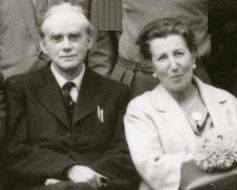
Paul and Manci in 1963. GFHund via Wikimedia Commons, CC BY
A man who had been thoroughly engrossed in the life of the mind discovered the life of the heart. And a human being whose greatest contributions had been guided by the pursuit of mathematical beauty discovered something beautiful in humanity whose existence he had never before suspected.
In short, a brilliant but lonely man found something new and wonderful that had been missing his entire life: love. As my students and I discover in the course on sexuality and love, science can reveal a great deal, but there are some aspects of reality – among them, love – that remain largely outside its ambit.
ooOOoo
Picking up on that last sentence, “there are some aspects of reality – among them, love – that remain largely outside its ambit.” all I can offer is to introduce dogs to the students!
I struggled for ages wondering how to close today’s post. In the end, decided on the following:
For a few hours ago the WordPress theme I am using on Learning from Dogs was changed.
The change is necessary to allow a number of eCommerce features to be added to the blog in connection with me being able to sell my book, both in paperback and eBook formats, directly to you good people.
Plus there’s a real bonus.
This theme is mobile friendly.
In other words, everything on Learning from Dogs will be much, much easier to read on tablets and smartphones.
Finally, if anyone is within reach of Grants Pass then you have a warm welcome to come along on Saturday, December 12th. There will be some specials available to visitors only.
Published on Nov 6, 2015
Another try at a slow motion video of Abbey shaking the water off after a bath
Published on Apr 24, 2014
Stunning, Perfection, Breathtaking – just a few words that describe this 3 minute surfing clip that shows Ian Walsh catching huge waves and making it look effortless.
Well over two million viewings.
Music: Versailles
Warner // Chappell Production Music
Published on Oct 22, 2014
This is a clip from our movie “THE SECRET LIFE OF TREES”.
More on www.homan.pl
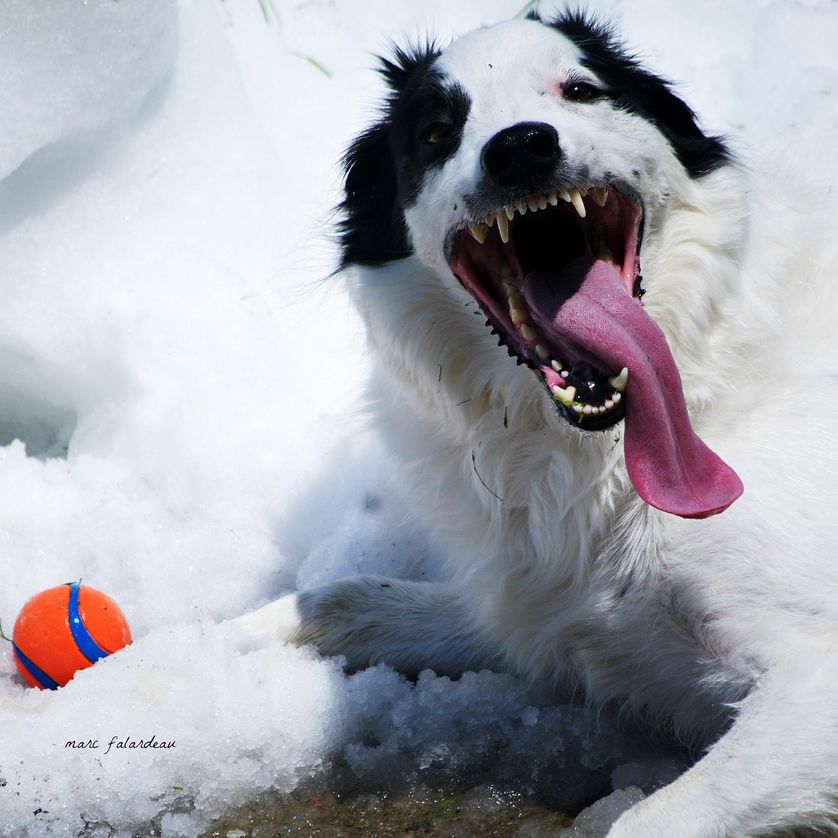
Finally, back to slow animal shakes! (And I must acknowledge Mother Nature News for the idea for today’s picture parade.)
Published on Mar 21, 2013
Why do wet furry mammals shake? Si and Sam give some of their favourite animals a shower to uncover the science behind the ‘wet dog shake’. Sam caught up with Andrew Dickerson from Georgia Institute of Technology to find out more about the science… we’ll have the full interview for you soon.
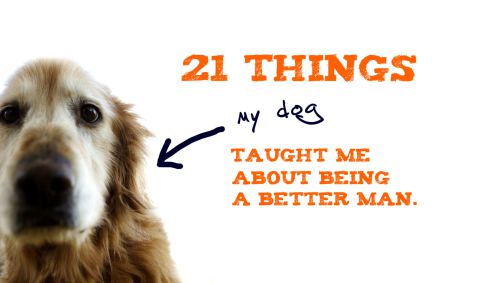
Twenty-one things my dog taught me about being a better man.
June 7, 2010 by Olivier Blanchard
We had to put our golden retriever to sleep this weekend, our friend of fifteen years, our family’s faithful guardian and companion, and one of the kindest, most loyal and giving souls I have ever met. True to her breed, Sasha was courageous, tender and selfless until the end.
I was trying to figure out how to give her a worthy send-off here on The BrandBuilder blog, and settled on some of the things she taught me over the years. Or rather, the things I didn’t realize she had taught me until this past week, much of which I spent caring for her, as she could no longer take care of herself. She and I had some long chats, in our own way, and the old girl was much wiser than I gave her credit for.
Are there business lessons in this list? Yes. There are. But all are deeply human lessons at the core. If being human can make a business better, if it can fuel its soul (or even simply give it one), then yes, let these be business lessons. But don’t ever forget that what makes a business truly great isn’t technology or design or a fancy logo. Those are expressions of something deeper. Something more visceral and powerful and true. What makes a business great, what makes it special, worthy of a connection, worthy of trust and loyalty, admiration and respect, even love, always starts with a beating heart, not a beeping cash register. (One is the cause, and the other one of many effects. Don’t lose sight of that distinction. Horse before cart: Soul drives love. Love drives business.)
It’s so easy to lose sight of what’s important in our lives. And this isn’t me being overly sentimental because I just lost my dog. I mean, yes, sure, okay… But there’s also something to this: That sentimentality, that emotion, these things that make us connect with other souls is at the heart of EVERYTHING this blog has been about these last few years: Business, design, marketing, social media, communications, corporate responsibility, best practices… No company can ever be great unless it can tap into the very essence of what makes us want to connect with each other, and no executive or business manager or cashier can ever truly be great at their jobs unless they also tap into the very thing that makes genuine human connections possible. If ever there was a secret to successfully building a brand, a lovebrand, the kind that people will fight for and whose mark they will tattoo on their bodies, it is this. The rest is merely execution.
If you only walk away with one bit of wisdom from this post, let it be this: You cannot build a better business unless you first become a better human being. Everything that strips you of your humanity, of your empathy, of your ability to connect with others is bad for business. It’s bad practice. It is doomed to fail in the end.
As my good friend John Warner noted yesterday, “If more people were as loyal and loving as dogs the world would be a better place.” (source) And he’s right. How do you become a better human being then? Well, that’s up to you, but if you had asked Sasha, she might have given you a few pointers of her own. Granted, she was never a Fortune 500 C.M.O. She didn’t design the iPad. She didn’t invent the internet or write a book. She never presented at a conference. All she did was hang out with me and Chico. We went on car rides. She watched me work. She lived the simple life of a dog, uncluttered by Twitter followers and Hubspot rankings and the drive to publish and present case studies. She was a dog, and so her perspective is a little different from what you may be used to. At any rate, here are twenty-one she and I discussed at length last week. I hope they will be as valuable to you as they now are to me.
Twenty-one things my dog taught me about being a better man:
1. Be true to your own nature. There’s no point in faking it. A golden retriever isn’t a chihuahua or a pug or a greyhound, and for good reason. Being comfortable in your own skin is 90% of the trick to rocking out your life. Not everyone is meant to be Rintintin or a seeing-eye dog or an Iditarod racer. It’s okay. Find yourself and embrace your nature. That’s always a great place to start.
2. Be true to the ones you love. Your friends, your family, your tribe, your pack. A life lived for others is a life well-lived. Selfish pursuits aside, ambition often grows hollow when turned inwardly instead of outwardly. It’s one thing to want to be pack leader, but there is just as much value and honor in serving than in leading. When in doubt, see item number one.
3. Never say no to a chance to go on a car ride. When the days grow short, I guarantee you’ll wish you’d have gone on more car rides.
4. Leashes are the enemy. Avoid them at all cost.
5. People are strange. So much potential, yet here they are, doing everything they can to complicate rather than simplify their lives. It’s puzzling.
6. Belly scratches.
7. The end isn’t pretty, but if you can face it with dignity and grace, none of your body’s weaknesses will matter. Your heart, your courage, your spirit is what people will see and remember. This isn’t only applicable in your last days and weeks. It’s applicable every day of your life. Adversity happens. It’s how you deal with it that matters.
8. Forgiveness is easier for dogs than for humans, but humans have opposable thumbs and the ability to speak, so it all balances out in the end.
9. Your bark is your own. No one has one quite like yours. Own it. Love it. Project it.
10. Trust your instincts. They rarely steer you wrong. The feeling in your gut though, that’s probably just something you ate.
11. Just because you’re meant to live on land doesn’t mean you can’t feel at home in water. Play outside the safety zone. Swim in the deep end. Dive in. We’re all designed to do more than the obvious.
12. Play more. The game is irrelevant. Just play. Tip: Exploring is play. Having adventures is play. Finding out what’s behind the next hill is play.
13. Your body growing old doesn’t mean you can’t be a puppy at heart. Actually, the first should have no impact on the latter. If you find that it does, take a step back, regroup, and restart. Always be a puppy at heart.
14. Humans aren’t all bad. But they aren’t all good either. Choose yours wisely.
15. Always keep that 20% wolf in you. If you ever give it up, you’re done. A dog without a little wildness in the blood isn’t a dog. It’s a furry robot. The beauty of a great dog doesn’t lie in its obedience but in its loyalty. Loyalty is a choice. Dogs choose to be dogs and not wolves. That’s what makes them so special.
16. Running full bore across a field in the rain.
17. There are no mysteries. Take cats, for example: Half rat, half badger. Crap in a box. Eat rodents. Where’s the mystery in that? If you look hard enough, you can figure most things out for yourself. The world isn’t as complicated as it sometimes seems.
18. Sometimes, you have to back up your growl with a bite. Go with it. Some people like to test your bark-to-bite ratio. With those “inquisitive” types, a little education goes a long way. As much as it sucks to have to go there, it is sometimes necessary. (It’s what the fangs are for.) Your territory, your space, your safety… They’re worth defending. Make a show of it once, and chances are you’ll never have to teach anyone a lesson again.
19. Being alone is no way to go through life. We’re pack animals. Humans, dogs, same thing. We need others to make all of this worthwhile. As an aside, if we live through others, why not also live for others, even if only a little bit? It isn’t that much of a stretch.
20. When you chase the ball, CHASE the fucking ball. Two reasons: a) It’s a chase. You don’t half-ass a chase. You go all out. It’s what you do. It’s the point. b) You don’t want some other mutt to get to the ball before you and slobber it all up, do you?
21. In the end, you will revisit your adventures, your battles, your chases, your voyages and all the excitement of your life with bemused pride, but it’s the quiet moments with loved ones that your mind will settle on. The comfort of those days when all you did was spend lazy hours with them, your head on their lap, their’s on yours, taking in the afternoon sun and the hundreds of fleeting stories carried like whispers on the breeze, those are the memories that will stay with you to the end and beyond.
Never give up on your thirst for life, on the beauty subtle moments, and on chasing that ball as hard and fast as your legs and heart will carry you.
Godspeed, Sasha.
Sasha (1995 – 2010) R.I.P.
ooOOoo
Shortly after completing today’s post, I read the following. It seemed appropriate to include it today.
When you talk, you are only repeating what you know,

 oooo
oooo oooo
oooo oooo
oooo oooo
oooo That’s the last Picture Parade for 2015. See you in the New Year!