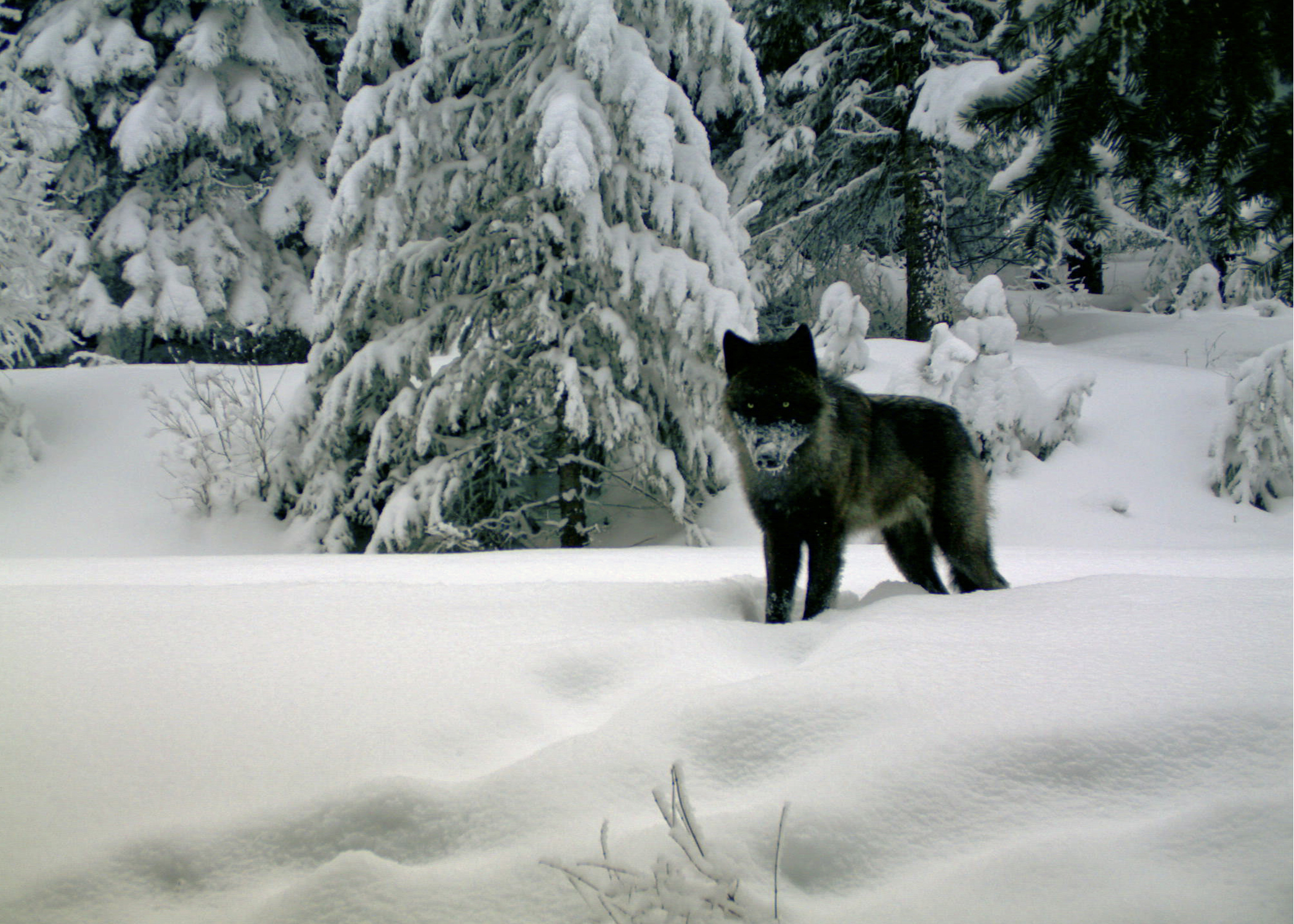
The sub-heading was prompted by me doing research for a writing project. I was doing a google search on the history of the relationship between dogs and humans and top of the returns was a post published by Learning from Dogs back in July 2012! Typically, I had forgotten that post. When I clicked on the link and read it right through, it seemed a brilliant idea to republish it today.
oooo
The woof at the Door.
The grandeur of the ancient relationship between dog and man.
A couple of weeks ago, I came across a fascinating article that had been published in American Scientist magazine (online version) written by Professor Pat Shipman. The article provided the background and evidence to support the proposition that dogs may have been man’s best friend for thousands of years longer than we realized.
Very quickly I came across Pat Shipman’s website and learnt that this is one clever lady. As her About page explains,
CAREER SUMMARY
Prof. Shipman
I am internationally known as a paleoanthropologist and conducted research for many years in Africa on human evolution and the animal communities in which humans evolved.
I have conducted research on material from sites in France, Spain, the United States, Java, Ethiopia, Kenya, Tanzania, and South Africa. I have written more than 50 scholarly articles, appearing in journals such as Nature, Science, Journal of Archaeological Science, Paleobiology, Journal of Human Evolution, and Current Anthropology.
I have written more than 100 articles in popular science magazines or newspapers, including The Guardian, The New York Times, The Times Literary Supplement, American Scientist, Discover, and Natural History. Two of my books were featured on the cover of The New York Times Book Review: The Neadertals and Taking Wing. Taking Wing won the Phi Beta Kappa prize for science book of the year and was a runner-up for the LA Times Science Book prize.
My book on Homo erectus, Wisdom of the Bones, was co-authored by Alan Walker and won the Rhone-Poulenc Prize in science writing.
My books have been widely praised as compelling, accessible, and highly readable, with a strong narrative thread. Reviewers frequently comment upon the meticulous research that underpins my books, a feature I consider to be my trademark.
My most recent popular science book, The Ape in the Tree, written with Alan Walker, was called by The Vancouver Sun “part adventure story, part cutting-edge science.” In a Science magazine review, the book was praised as “a fine account of new ways to puzzle out the behaviors of fossilized animals from odd scraps of bone.” Another reviewer raved, “Wonderfully engaging and insightful, The Ape in the Tree, is sure to become a classic in the literature on human origins.” MacArthur fellow John Fleagle wrote in the Quarterly Review of Biology, “Science writing doesn’t get any better than this.” In 2009, this book was awarded the W.W. Howells Book Prize by the American Anthropological Association.
In Britain, my new biography of Mata Hari, Femme Fatale, was selected as The Book of the Week by BBC radio. Each day during the week, an actress gave dramatic readings from the book on the air for fifteen minutes.
With The Animal Connection, I return to paleoanthropology and consider the influence of our connection with animals on human evolution and the origin of modern human behavior.
See what I mean!
Anyway, as you can readily understand, as the author of a blog that writes about what we can learn from this ancient relationship between the dog and man, it struck me as wonderful if I might be permitted to republish in full that article. Prof. Shipman promptly gave me such permission.
So today, I am doing just that and tomorrow I want to write more about Pat Shipman’s latest book, The Animal Connection.
ooOOoo
The Woof at the Door
Dogs may have been man’s best friend for thousands of years longer than we realized
It’s funny how much difference a single letter makes. A “woof” at the door is a very different thing from a wolf at the door. One is familiar, domestic, reassuring; the other is a frightening apparition of imminent danger. The distinction between our fond companions and the ferocious predator of northern climes goes back a long way.
Dogs are descended from wolves, probably the gray wolf. Some scientists argue that, because dogs and wolves can and do interbreed, they shouldn’t be considered to be separate species at all. They believe that domestic dogs are only a subspecies or variant of the gray wolf, Canis lupus, and ought to be called Canis lupus familiaris (the familiar or domestic wolf) instead of Canis familiaris (the familiar or domestic dog). Although the ability to interbreed and produce fertile offspring is a tried-and-true criterion for recognizing that two populations are really variants of a single species, the reality is more nuanced. We cannot know whether dog-wolf hybrids will thrive and survive, or die out, in the long run.
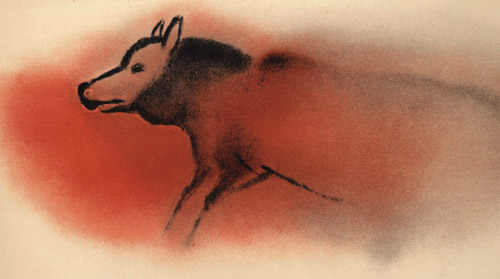
Prehistoric cave paintings rarely depict wolves or other carnivores. This watercolor tracing of a cave painting was made by the archaeologist Abbé Henri Breuil in the early 1900s from the Grotte de Font-de-Gaume in France. The 17,000-year-old cave paintings number about 250 and mostly show bison and mammoths—only one is thought to be a wolf. Canids may have been domesticated by this point; it is possible that portraying wolves and humans was taboo. Paul Bahn
Certainly we expect to be able to distinguish a dog from a wolf if we see one. Of course, domestic dogs are wildly variable in size and shape, thanks to several hundred years of selective breeding. Some have long, fluffy coats; others have tightly curled, nearly waterproof coats and webbed feet. Some are leggy and swift, whereas others are solid, stoutly built guard dogs. Some fit neatly into a pocketbook, but others barely fit into a compact car. As Robert K. Wayne of the University of California at Los Angeles declares, “Dogs show more diversity in appearance than any other mammal.”
What is it that tells us this animal is “dog” and that one is “wolf?”
Modern wolves and dogs can be distinguished reasonably easily by their appearance. The most telling feature of dogs is the snout, which is significantly shorter and wider than wolves’ snouts. Only a few dog breeds with extremely elongated, slender snouts, such as Irish wolfhounds, surpass wolves in “snoutiness.”
But a crucial part of the difference we perceive is in the animals’ manner and attitude towards humans. Domesticated dogs are just that: canids that live in the house or domicile of humans. They are genetically disposed to seek out human attention and approval and to accept human leadership. Wolves are not.
How did this important change come about? Probably in the distant past, humans took in a wolf cub, or even a whole litter of cubs, and provided shelter, food and protection. As the adopted cubs matured, some were aggressive, ferocious and difficult to handle; those probably ended up in the pot or were cast out. The ones that were more accepting of and more agreeable to humans were kept around longer and fed more. In time, humans might have co-opted the natural abilities of canids, using the dogs’ keen noses and swift running skills, for example, to assist in hunting game. If only the most desirable dogs were permitted to breed, the genes encoding for “better” dogs would continue to be concentrated until the new domesticated species (or subspecies) was formed.
Time to Tame
The creation of a domestic, useful, familiar canid by years of selectively breeding wild and terrifying wolves was almost certainly unplanned. The wolf at the beginning of the process of domestication was tamed—made individually docile—but the essential fact is that, over time, the offspring of those initial wolves were genetically inclined to be more tractable.
Domestication was one of the most brilliant accidents in the entire history of humankind. What’s more, we got it right the first time: Dogs were the original trial animal, and successful product, of such an accident—the happy outcome of years of unwitting experiments and dumb luck.
How long does domestication take? Nobody knows. In an experiment, Russian biologists kept a breeding colony of silver foxes and intentionally selected for breeding those with the least fear and the least aggression toward humans. After 10 generations, 18 percent of the foxes sought human contact and showed little fear. After 30 or so generations, a “domesticated fox” had been created.
The catch is that this experiment was deliberate and strictly controlled. The foxes could not breed with wild foxes and dilute the changing gene pool. Human contact was minimized so animals could not be tamed by their handlers. And because of the experiment’s scientific intent, no one could say, “Oh this one is so cute, let’s let it breed even if it is a little aggressive.” So in the case of dogs, without all these controls, the process could have taken much longer.
Another way of estimating the time at which domestic dogs originated is to consider their genetic differences from wolves. One prominent group of researchers, including Robert Wayne, along with Carles Vilà of the Uppsala University in Sweden and their collaborators, initially estimated in 1997 that dogs diverged from gray wolves 100,000 to 135,000 years ago. After more study, they revised their divergence date to between 40,000 and 100,000 years ago. Another group, led by Peter Savolainen of the Royal Institute of Technology in Sweden, favored the Chinese wolf, a subspecies of the gray wolf, as the probable ancestor and estimated in 2002 that it was domesticated between 15,000 and 40,000 years ago.
How do these genetic estimates stack up against the fossil record? Until 2009, the oldest known remains of domestic dogs were two adult skulls dated to between 13,000 and 17,000 years ago, from Eliseevichi, a region in Russia. Both had the relatively broad, short snout typical of dogs, and both were large, heavy animals, nearly the size of great Danes.
Then a team led by Mietje Germonpré of the Royal Belgian Institute of Natural Sciences reported a stunning new finding in the February 2009 issue of Journal of Archaeological Science: a nearly complete fossil dog skull dated to 31,680 + 250 years ago.
Another Look
Germonpré and her colleagues thought that researchers might have overlooked early prehistoric dogs in the fossil record of the Upper Paleolithic, so they analyzed skulls of large canids (wolves or dogs) from various European sites. The Upper Paleolithic time period spanned 40,000 to 10,000 years ago and is divided into sections based on the artifacts from those times. By convention, each span is named for a culture of people who made the artifacts, and the people, in turn, are usually named for the geographical location where the artifacts were found. The Epigravettian culture existed from 14,000 to 10,000 years ago; before that, the Magdalenian culture thrived from 18,000 to 10,000 years ago; and skipping back a few sections, the Aurignacian culture occurred from 32,000 to 26,000 years ago.
In order to identify the fossil skulls accurately, Germonpré’s team first analyzed a large reference sample of 48 wild, modern wolves and 53 dogs belonging to 11 different breeds. They also examined five skulls (including the ones found in Eliseevichi) that were firmly established as prehistoric domesticated dogs.
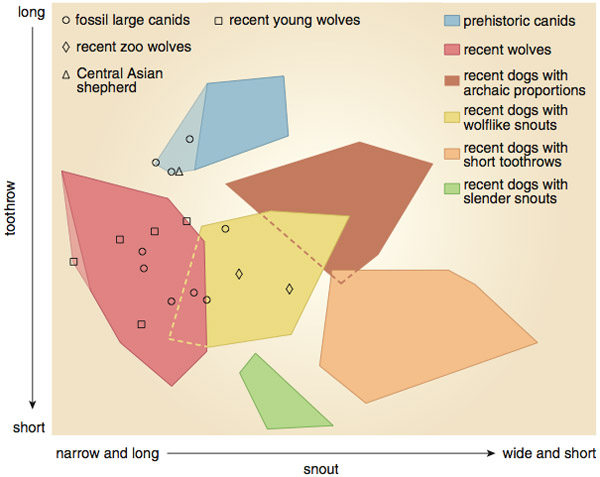
In order to establish the morphological differences between wolves and dogs, a group of researchers led by Mietje Germonpré statistically analyzed skulls from 48 modern, wild wolves and 53 modern dogs from 11 breeds, as well as five skulls that were previously established to be from prehistoric dogs. Recent wolves (pink) and prehistoric dogs (blue) clustered into their own groups, based on the length of their toothrows and the shape of their snouts. Modern dogs clustered into four groups, with some overlap in their areas. Recent dogs with archaic proportions included huskies (brown), recent dogs with wolflike snouts included German shepherds (yellow), recent dogs with short toothrows included great Danes (orange), and recent dogs with slender snouts included doberman pinscers (green). One modern dog, a Central Asian shepherd, clustered with the prehistoric dogs. The group then classified new skulls into the established groupings; examples that fell slightly outside of the ranges but that are statistically likely to be within the group are shown as lighter-shaded areas. Recent young wolves fell into the recent-wolf group, whereas wolves kept in captivity were classifed as recent dogs with wolflike snouts. Fossil canid skulls divided between the recent-wolf group and the prehistoric-dog group, with one falling in the group of recent dogs with wolflike snouts. Stephanie Freese, data courtesy of Mietje Germonpré.
The team used statistical analysis of cranial and dental measurements on the skulls to sort the reference sample into six natural clusters. One cluster contained modern wolves. Another consisted of recent dogs of archaic proportions (such as chow-chows and huskies); a single specimen of a Central Asian shepherd was closer to this group than any other but fell outside it. A third cluster included dogs, such as German shepherds and malinois, which have wolflike proportions. These three groups overlapped each other in their cranial proportions. A fourth group of modern dogs has short toothrows—the length of the jaw that contains teeth—and includes such breeds as great Danes, mastiffs and rottweilers. This group overlapped slightly with the archaic-proportioned dog group but not with the others.
The fifth and sixth clusters were completely separate from all others. One consisted of dogs with extremely long, slender snouts, such as Doberman pinschers. The final group, which had long toothrows and short, broad snouts, was made up of the prehistoric dogs. Statistically, the team’s ability to identify any individual specimen as belonging to the correct group was highly significant and accurate.
Using these clusters as reference categories, Germonpré and colleagues used a statistical technique (called discriminant function analysis ) to assign 17 unknown fossil canid skulls to the established categories. Not all of the “unknowns” were truly unknown, however. Five were immature modern wolves that might have had different proportions because of their age, two were wolves that had been kept in captivity, and one was the Central Asian shepherd that didn’t cluster into any of the groups. Additional unknowns were 11 fossil skulls from sites in Belgium, the Ukraine and Russia, although two of these fossil skulls proved to be too incomplete to classify.
The technique correctly classified all of the immature wolves as wolves, but the two zoo wolves were classified as recent dogs with wolflike snouts. Five of the fossil skulls also fell easily into the modern wolf group; although two of these specimens fell into the region of measurements that overlapped with the group of recent dogs with wolflike snouts, they had a higher statistical probability of being wolves. One fossil skull fit directly into the group of recent dogs with wolflike snouts, even though this specimen was clearly ancient.
The remaining three fossil skulls—one from Goyet Cave in Belgium and one each from Mezin and Mezhirich in the Ukraine—resembled each other closely. All three were classified as prehistoric dogs with probabilities of 99 percent, 73 percent and 57 percent, respectively, as was the (modern) Central Asian shepherd, with a 64 percent probability. In addition, the Mezin skull was odd enough in appearance (for a wolf) that another researcher has suggested it might have been a captive wolf. Germonpré and her team were delighted with these results.
The group also successfully extracted mitochondrial DNA (mtDNA) from seven ancient canid bones from Goyet Cave and Trou des Nutons in Belgium. Rather than damage precious skulls, they sampled only bones in which wolves and dogs differ little, so they presumed all of those they sampled for mtDNA were wolves. From each sample, they sequenced a segment of the mtDNA that is highly variable in living wolves and dogs. Each fossil had a unique mtDNA sequence, or haplotype , in this region, which could not be matched with any known sequences for modern wolves (of which there are about 160) or modern dogs (of which more than 1,000 exist) stored in GenBank, a database of all publicly available nucleotide sequences.
“I was not so surprised at the rich genetic diversity of the fossil wolves,” says Germonpré, because there have been other studies with similar findings. Foxes and wolves underwent a severe bottleneck in population size at the end of the last Ice Age, and many genetic lineages went extinct at this time.
“But we were surprised at the antiquity of the Goyet dog,” Germonpré adds. “We expected it would probably be Magdalenian,” perhaps 18,000 to 10,000 years old. This outcome would fit with their results for the Mezin and Mezhirich skulls, which were found with Epigravettian artifacts roughly 14,000 to 10,000 years old. When the age of this specimen from Goyet was directly dated using accelerated mass spectroscopy radiocarbon-dating techniques, the team found that it was not 18,000 years old, but almost twice as old as the next oldest dog, placing the Goyet dog in the Aurignacian period.
A Time of Change
The Goyet dog fossil shows that the domestication of the first animal was roughly contemporaneous with two fascinating developments in Europe.
Around this time, Europeans began producing objects that are recognizable as art. Some of the earliest known art objects from Europe include the remarkable cave paintings of Chauvet Cave in France, the oldest of which were made 32,900 ± 490 years ago. None of the hundreds of glorious Chauvet paintings show wolves. However, the cave preserves something even more haunting: the footprints of a human child about four-and-a-half feet tall, as well as many footprints of large canids and bears.
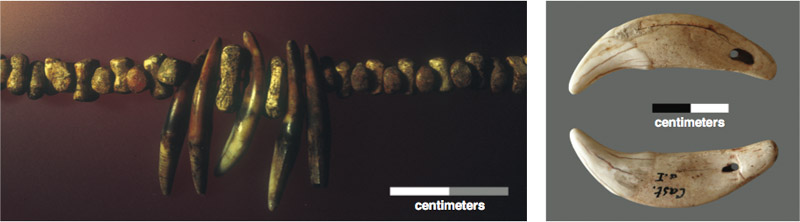
Around 33,000 years ago, humans began perforating teeth for use in decoration. Although canid teeth made up a very small percentage of the total fauna teeth available, they were used in a majority of the ornaments. Fangs from foxes and wolves appear to have been favorites. One example of a perforated wolf tooth (shown in two views at right) is from Abri Castanet in France and has been dated to 33,000 years ago. A strand of beads interspersed with fox teeth came from the Russian site of Sungir and has been dated to 24,000 years ago (left). There is no specific evidence that canid teeth were used in necklaces; the fox-teeth strand may have been a belt. Randall White
Michel-Alain Garcia of the Centre National de la Recherche Scientifique in Nanterre noticed in 1999 that one track of canid prints appears to accompany the child’s prints. These canid prints, unlike the others, have a shortened middle digit on the front paw: a characteristic of dogs. Garcia suggested that the child and dog might have explored the cave together. Charcoal from a torch the child carried is 26,000 years old.
The Upper Paleolithic cultures of Europe are famous for the flowering of all kinds of exquisite art: sculptures, carvings, paintings and engravings. Animals are common and readily recognizable subjects. Prehistoric art expert Paul Bahn notes that depictions of carnivores, including wolves or dogs, and of humans are rare. Bahn conjectures that portraying wolves and humans might have been taboo.
Anne Pike-Tay of Vassar College offers another perspective. She observes that the scarcity of artistic depictions of carnivores parallels their scarcity in the fossil faunas of the Upper Paleolithic. If domesticated dogs were helping humans hunt, she speculates that they might have been placed in a completely different symbolic category from other animals.
“What if dogs were put in the ‘human family’ category as an extension of the hunter, and like humans, warranted no (or very few) painted or engraved depictions?” she wonders.
The second development of the Aurignacian period is the appearance of objects of personal adornment: jewelry. Although beads and perforated objects occurred much earlier in Africa, the earliest such objects in Europe appeared about 40,000 years ago. At 33,000 years ago, early Aurignacian people began perforating animal teeth (and occasionally human teeth) to wear as pendants or other ornaments, such as belts.
Which teeth did they choose? Among their favorite sources are what have been identified as fangs of foxes and wolves. These identifications might better be termed “small or large canids,” because until now no one has considered the possibility that dogs might have been domesticated so long ago. Besides, identifying a single canid tooth specifically as dog or wolf would be difficult, if not impossible.
Randall White of New York University argues that Aurignacian and later people chose to wear objects that displayed their identity or membership in a certain group or clan. Like gang colors or a t-shirt that proclaims its wearer to be a fan of a particular band, ancient people wore things that made their allegiances clear.
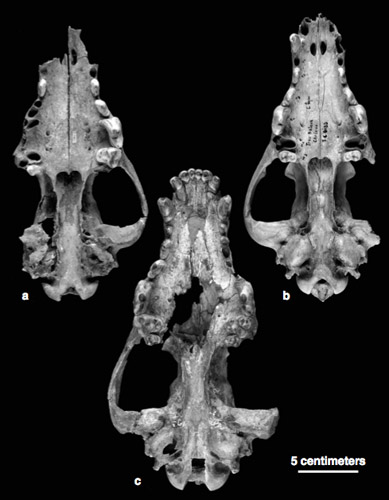
Fossils have helped to establish a far earlier timeframe for dog domestication. A paleolithic canid skull from Goyet in Belgium, about 31,000 years old, has traits characteristic of a dog rather than a wolf (a). When compared to wolves from a similar era, one from Trou Ballu (b) and one from Trou des Nutons (c) in France, the Goyet dog has a relatively wider snout and larger carnassial teeth, and it also has a wider braincase. Elsevier Ltd.
White observes that the teeth Aurignacian people chose to wear were obviously not a random sample of the animals in the fauna. For example, the fauna from the Grotte des Hyènes (Cave of Hyenas) at Brassempouy, France, is dominated by horses, aurochs (a type of cattle) and reindeer—mostly as food remains that often show cutmarks or charring—as well as hyenas, which probably lived in the cave when humans did not. Wolves are rare, making up less than 3 percent of the total fauna. Of approximately 1,600 animal teeth at Brassempouy, only about 2 percent were modified for use as ornaments. However, nearly two-thirds of the ornaments are teeth of wolves or foxes. The rest of the perforated teeth are from other rare species: bear, humans and red deer. None of the teeth of the most common species were used as ornaments at Brassempouy.
Did someone who wore a perforated canid tooth 33,000 years ago proclaim him- or herself to be one of the group that domesticated dogs?
Possibly. Domesticating dogs was a remarkable human achievement that doubtless provided a definite selective advantage to those who accomplished it successfully. They might well have had reason to brag about their accomplishment by wearing canid teeth.
Bibliography
Germonpré, M., et al. 2009. Fossil dogs and wolves from Paleolithic sites in Belgium, the Ukraine and Russia: Osteometry, ancient DNA and stable isotopes. Journal of Archaeological Science 36:473–490.
Morey, D. F. 1994. The early evolution of the domestic dog. American Scientist 82:336–347.
Ostrander, E. A. 2007. Genetics and the shape of dogs. American Scientist 95:406–413.
Savolainen, P., et al. 2002. Genetic evidence for an East Asian origin of domestic dogs. Science 298:1610–1613.
Trut, L. N. 1999. Early canid domestication: The farm-fox experiment. American Scientist 87:160–169.
Vilà, C., et al. 1997. Multiple and ancient origins of the domestic dog. Science 276:1687–1689.
Yet again, another example of a post almost writing itself.
Let me explain.
Yesterday, I published a post about being sensitive to the world around us.
Then this morning there was a new post from Sue Dreamwalker under the title of Fear of the Future. It was uncharacteristically downbeat for Sue.
Now most who follow me know I try to bring a positive touch within my posts… Yet to be quite honest with you all I am really struggling right now to lift myself from the doldrums of my own thoughts.
The key to conquering our fears lies in awareness. When we identify the irrational thoughts that frighten us and replace them with positive affirming ones.
Argh… all easier said than done..
You would think with my inner Knowing, and my Spiritual mind I should be the last person to take a nose dive into that Pit of depression.. Especially when I dredged its depth before and vowed that I had been there done that and worn the T-shirt and I refuse to wear it again.
I could blame it on my Fall which left me feeling bruised with aching, muscles which are still healing.. And I could blame it on grief as I lost a very beloved Aunt last week. I could blame my fatigue on me deciding to move a whole wall of books out the spare bedroom with wrists still recovering from the sprains of the fall.. And I could blame it on the weather being cold and miserable.. I could even blame it on the state of the world, or the Planets .. I have a whole host of excuses I could fall back upon to justify why I am feeling tired and jaded..
Many left comments including me. I spoke of the reward of hugging a dog. My words included:
I don’t have answers other than to feel what you are feeling. All I hang onto when I spend too much time thinking of my own mortality is that the answer, the answer to the moment, is to bury one’s face into the warm, soft fur of a dog. They seem to sense my need at these times. (And that isn’t meant to sound like me devaluing the love and affection that I receive from Jean!)
In other words, that contact with the warm dog holds me in the present and before long the reinforcement of living that present, loving moment puts the unknown future into perspective.
Another comment was left by blogger Rajagopal that included this wonderful tale:
The only thing that I have seen working in my life is to keep living, as much as possible, in the present. There is nothing to fear, either of the now or of the future.
In this context, wish to leave you with the story of the pregnant deer; in a forest, a pregnant deer is about to give birth. She finds a remote field near a strong-flowing river, that looks like a safe place, as she starts going into labour. At the same moment, dark clouds gather in the sky and streaks of lightning sets off a forest fire. The deer looks to her left and sees an approaching hunter with arrow pointed at her. To her right, the deer spots a hungry lion speeding towards her. What can the pregnant deer do? She is in labour! What will happen? Will the deer survive? Will she give birth to the fawn and will it survive? Or will everything be burnt by the forest fire? Or will she perish to the hunter’s arrow? Or does a horrible end await her at the hands of the hungry lion? Constrained by the fire on one side, the flowing river on the other and boxed in by her natural predators, the deer is apparently left with no option. What does she do? Well, she focuses on delivering and giving birth to a new life.
The sequence of events that follows is the Lightning strikes and blinds the hunter, who releases the arrow which zips past the deer and strikes the hungry lion. It starts to rain heavily and the forest fire is slowly doused by rain water. The deer gives birth to a healthy fawn….In our life too there are moments when we are confronted with negative thoughts and possibilities on all sides, so powerful as to overwhelm us. May be we can learn from the deer. The priority of the deer at that given moment was to give birth as safely as possible.
The rest was not in her hands and any change in her focus would have most likely impeded giving birth to the fawn. In the midst of the severest storm, we just have to maintain presence of mind and do what is in our control…the Cosmic power will take care of the rest…best wishes… Raj.
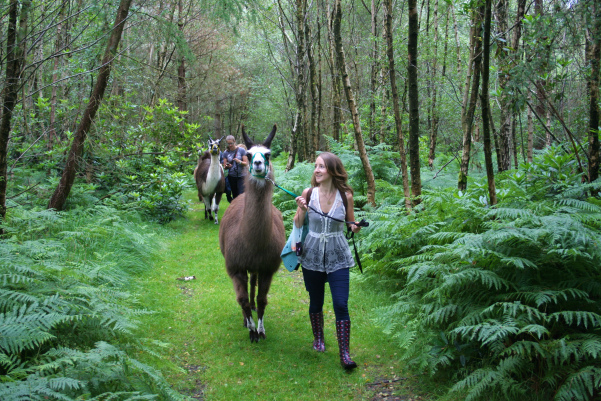
Finally, there was a recent new follower of this place. Her name is Emma and she writes the blog The Muse in the Mirror. Emma was kind enough to grant me permission to republish a post from last December about the healing power of Llamas. Enjoy!
ooOOoo
Llama Loving; The healing power of Llamas
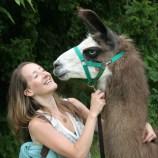
It’s official; I LOVE llamas. There, I said it, put out there for the world to know! I love their gentle, sensitive nature, friendly disposition and most of all their goofy, giggle-worthy expressions, which never fail to bring a smile to my face! Concerned that my llama loving status was bordering on obsession, I was beginning to question whether my love for these comical camelids was founded on anything other than sheer amusement! Thankfully as I researched further my findings confirmed that these beautiful animals are much more than a pretty (funny) face!!!
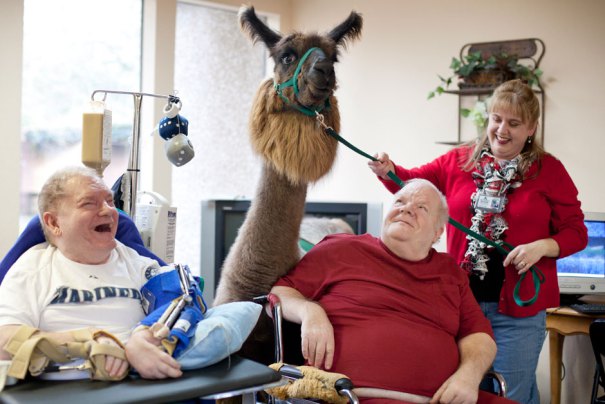
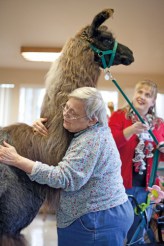
in USA. The adorable photo’s lay testament to the happiness that llama’s bring to residents at Bellingham Health and Rehabilitation Center in Washington, USA. Llama Marisco (pictured above), and Llama N.H. Flight of the Eagle (pictured right) are trained therapists, who spread comfort and joy as they stop at each bed to kiss the patients or have a hug. Resident Holly Barto remarked that…
“It was heaven. Just emotionally – to be able to touch an animal and hold an animal close.”
Another example of the profound healing benefits of llama’s can be seen in this adorable video below showing Rojo the therapy llama and Napoleon the therapy alpaca from Mtn Peaks Therapy Llamas & Alpacas, in Vancouver, WA USA. A non-profit corporation, which offers therapy teams to visit hospitals and schools in the area. The expressions on people’s faces are heart warming to say the least!
“Who knew such fluffed-up, carrot munching mammals could bring so much joy.”
Laughter is the best medicine.
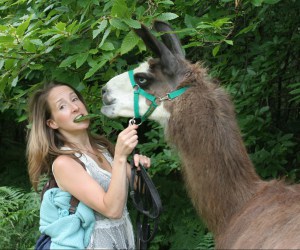
Llama Dave is disgruntled by the fact I was munching in on his dinner!
If I am having an off day, the first thing I reach for is a funny llama picture. Better still, a visit to the local llama park soon blasts my bad moon into infinity and beyond! A good giggle-fest at the Ashdown Forest Llama park, in East Sussex, dissolves the blues and confirms that laughter really is the best medicine! (See my picture gallery below to see me with some of the residents of the Ashdown Forest Llama park!).
There’s a very good reason behind the saying Laughter is the best medicine. Research suggests that people feel less pain after a good laugh, because it causes the body to release chemicals that act as a natural painkiller. ‘Professor Robin Dunbar of Oxford University, who led the research, believes that uncontrollable laughter releases chemicals called endorphins into the body which, as well as generating mild euphoria, also dull pain.’ (BBC)
It is common knowledge that animals in general make us happier and brighten our spirits. A growing body of scientific research now suggests that interacting with animals can make us not only happier, but healthier too. That helps explain the increasing use of animals for therapeutic purposes in hospitals, hospices, nursing homes, schools, jails and mental institutions.
The use of pets in medical settings actually dates back more than 150 years, says Aubrey Fine, a clinical psychologist and professor at California State Polytechnic University. Fine who has written several books on the human-animal bond says:
“One could even look at Florence Nightingale recognizing that animals provided a level of social support in the institutional care of the mentally ill,”
So there you have it, next time you’re feeling blue, you know what to do! Head on out to your nearest llama park to insight those warm fuzzy feelings from a fluffy four legged llama! Check out my favourite selection of Llama and Alpaca pics below, guaranteed to bring a smile to any face!!
ooOOoo
Note: That last photograph above is only one of a wonderful collection of Llama photographs that Emma included in her blog post. Do drop across there and admire all the wonderful pictures.
The incredible healing power of hugging an animal.
Adding to the chorus of voices criticising Budweiser.
I’m going to republish in full what arrived in my ‘in-box’ yesterday from Howling For Justice.
But before I do that, let’s consider the ancient history of the wolf and the connection with our dogs of today. I shall do that by offering a small extract from something that I will be presenting at a meeting in Grants Pass on February, 10th.
Dogs are part of the Canidae species, a family including wolves, coyotes and foxes, thought to have evolved some sixty million years ago. There is no hard evidence as to when dogs and man came together but dogs were certainly around when man developed speech and set out from Africa; about fifty thousand years ago.
What is clear is that the dog represents man’s longest domesticated animal companion; by far. Some scientists believe that we have had the benefits of dogs in our lives for thirty thousand years. Indeed, some have proposed that the benefits of having tame wolves around us humans helped man be so successful a hunter and gatherer that it was instrumental, a mere ten thousand years ago, in humans first discovering how to cultivate crops and domesticate animals. Becoming the most significant single development in human history.
Because reflect that for a previous three million years Stone Age man, the hunter-gatherer, had engaged in activities as natural as the swoop of a hawk or the grazing of a horse.
ooOOoo
OK, on to that Budweiser advertisement.
Budweiser Takes Low Road – Demonizes Wolves To Sell Suds
February 1, 2015
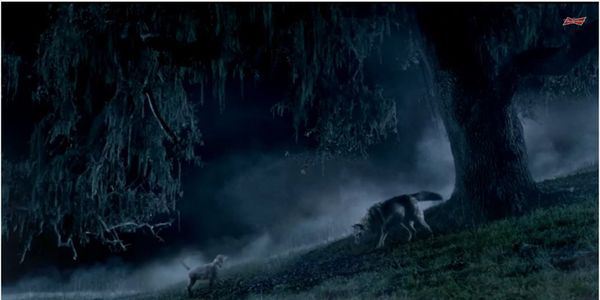
We all know about the Budweiser ad, a little lost puppy being threatened by a wolf. I won’t show the ad because it’s BS and I don’t want to give it any publicity but Budweiser should be ashamed. Are they that desperate to sell beer?
Get a grip Budweiser, very poorly played. Beer drinkers around the country should boycott Bud if the ad is not pulled. It’s a low blow to wolves, one of the most persecuted animals on the planet.
Please click the link below and sign the petition to tell Budweiser what you think of their blatant demonizing of wolves.
===
Tell Budweiser: Don’t Demonize Wolves to Sell Beer
author: Center for Biological Diversity
target: Anheuser-Busch CEO, Thomas W. Sante
Purposefully demonizing an animal that is part of America’s natural heritage is no way to sell beer.
But that hasn’t stopped Budweiser from crafting a commercial for this year’s Superbowl that intentionally drums up anti-wolf sentiment to try and capitalize on our culture’s outsized fear of wolf attacks.
The ad pits a cute puppy against a snarling, evil-looking wolf. In the ad the puppy is saved from the vicious wolf by the arrival of a team of Clydesdale horses.
Here’s a reality check: 1.2 million dogs are euthanized in shelters in the United States each year while another 1.2 million dogs are hit and killed by cars on America’s roads.
By comparison, wolves are a virtually non-existent threat to our furry canine friends, only in very rare instances attacking dogs if they feel threatened or perceive them as competitors. The real threat to both dogs and wolves, as these numbers show and as Budweiser’s cynical attempt to boost sales indicates, is people.
Take action — tell Budweiser to pull its wolf-hating ad, demonizing an endangered species is no way to sell beer.
One of the blog sites that I subscribe to is Exposing the Big Game. The blog does a fabulous job in exposing the terrible ‘game’ of people hunting animals for sport! Many of the topics that author Jim Robertson exposes are incredibly painful to read but, please, do drop across there and support his efforts.
All of which is a preamble to a short item that was posted last Sunday and is republished here today.
Nothing more to add to those rules than offer this photograph taken at home early one day last December, 2013.
Dearest Suzann, who invited me out to San Carlos, Mexico, for the Christmas of 2007, leading to Jean and me meeting, is heavily involved in rescuing the many feral dogs found in that part of the world.
She recently sent me the following:
Shepherd Boy will be euthanized in a few days at the CA state kennel he is at and Jeannie Wade is trying to help save his life….do you guys know of anyone? Let me know asap.
He is located in the Central Coast area of California and goes by the name ‘Shepherd Boy’ and is one year old.
He is in a high kill shelter and has days to live.
Shepherd Boy is shy and sweet tempered and the volunteers at the shelter feel he will make a very good companion/pet for a nice family or couple.
Paul, If I were up there, I would take him in a heartbeat!
Suzann
Please, please share this as far and wide as possible – urgently.
Shepherd Boy may be found at the Central Coast SPCA, Orcutt, California 93457
Suzann has given me the name of Jeannine Wade and she may be emailed at: centralcoastspca@yahoo.com
A reposting of a blog from Dog Leader Mysteries about a dog food recall.
Quickly stepping over the observation that today’s post is about as far removed, topic wise, from yesterday’s post as one could possibly imagine, nonetheless this is important and needs to be widely shared.
ooOOoo
Raw food recall: J J Fuds Frozen Pet Food
J. J. Fuds Raw dog food recall expands
Dear Fellow Dog Lover,
Because you signed up on my website and asked to be notified, I’m sending you this special recall alert.
On January 27, 2015, J. J. Fuds of Valparaiso, Indiana, announced it is expanding its recall of select lots of J. J. Fuds Raw Frozen Pet Food to include 2 other products due to unspecified contamination.
I copied this email notice from The Dog Food Advisor. I highly recommend you sign up for this list.
Please share to save dogs’ lives
We don’t feed Sydney raw meat. We do feed organic raw vegetables in limited quantities. We care about pets and want our readers to share this important news. Also we want you to know that we receive the Dog Food Advisor’s updates. Mike Sagman never stuffs our email box, but sends out notices as fast as he receives them. We asked our local pet stores if they receive notices before opening each day. You can do that. Ask when and how pet foods get pulled from their shelves, your pet’s life depends on this.
I’ve written before about how our breath is connected with our wellbeing and emotional state. Noticing how we are breathing is a tool that we can use to monitor how we are doing.
There is another pause that comes with our breath which is also revealing. The pause at the end of the exhale before we take in more air. When we are distracted, stressed or in an anxious state, there is no pause. We don’t trust we have enough air and we don’t allow ourself to relax and let go.
Just take a moment to tune into how you are breathing right now. Just notice without judgment.
Pausing at the end of an exhale can only happen when we are relaxed and in tune with our mind and body. When our body and mind are aligned in the present moment.
I then left a reply in the comments section:
Excellent advice. For the last few weeks I have been using a biofeedback unit that through guiding one to breathe in harmony with a musical phrase allows one to slow the whole body down. Down to about 4.8 breaths per minute. It really underlines how slow one’s breathing rate can be and, supporting your post, the glorious pauses after each inhale and exhale.
And offered to write a post about the unit and my experiences. (Coming out tomorrow.)
However, what I wanted to do as a ‘lead-in’ to that post was to discover if there was any research into the benefits, as in scientific benefits, of slowing one’s body down in this fashion. What is surely nothing more than a form of meditation. Where to start looking? Needn’t have worried; there were many items on YouTube that covered the benefits of meditation.
There was a video from the AsapSCIENCE guys Mitchell Moffit and Gregory Brown, but I found it too jazzy and irritating, rather ironically! Then there was one from physicist John Hagelin that seemed much more appropriate to my tastes (and that is featured tomorrow as well).
By now it was coming up to 4:30pm and I had a dozen other things to do, plus try and fit in a biofeedback session – I could feel the stress rising within me.
Then I dipped into Terry Hershey’s latest Sabbath Moment and, guess what! Here’s what I read:
Learning to let go
January 26, 2015
Some of us think holding on makes us strong, but sometimes it is letting go. Herman Hesse
Uncertainty is the only certainty there is, and knowing how to live with insecurity is the only security. John Allen Paulos
When you let go of trying to get more of what you don’t really need, it frees up oceans of energy to make a difference with what you have. Lynne Twist
——-
Today I am sitting in a café (and bar) in Vaison-la-Romaine, in the Provence region of France, nursing my espresso.
No, wait… that was last week.
It just sounds sexier than saying, “Today I’m looking out my window at a gloomy winter sky, here in the Pacific Northwest, with a Thesaurus in hand hoping for a gushing synonym for gray.”
Welcome home. Home for me is always awaited and valued, but still elicits a bout of scotoma (selective vision), where we end up comparing the life we have, for the “life we deserve” (the actual wording for a recent advertised e-course).
My favorite part of my recent France trip was visiting family run wineries, spending time with the owner / wine-maker, with the permission to linger, sensing a comfort grounded in story and connection. Said one (when we asked him about being a small winery–in a world where big is everything), “I am glad. I am not alone. I work with family.” (Referring to his son and three daughters.)
And it makes me wonder about this mental sleight of hand we use, thinking about the life we are destined for, as somehow different (or better) from the life we now we live.
There is a Tibetan story about an earnest young man seeking enlightenment. (Earnest people must think this quite unfair–since they play a central role in most parables and stories about enlightenment.)
A famous sage passes through the man’s village. The man asks the sage to teach him the art of meditation. The sage agrees. He tells the man, “Withdraw from the world. Mediate every day in the specific way I will teach you. Do not waver and you will attain enlightenment.”
The earnest man follows the sage’s instructions to the letter. Time passes — and no enlightenment. Two years, five, ten, twenty pass.
It happens that the sage once again passes through the man’s village. The man seeks him out, grumbling that despite his best intentions and devotion and diligent efforts, he does not achieve enlightenment. “Why?”
The sage asks, “What type of meditation did I teach you?”
The man tells him.
The sage says, “Oh, what a terrible mistake I made! That is not the right meditation for you. You should have done another kind altogether. Too bad, for now it is too late.”
Disconsolate, the man returns to his cave. Staking his life on the sage’s instructions, and now believing he is without hope, the man abandons all his wishes and efforts and need to control his road to enlightenment. He does not know what to do. So, he does what he knows best: he begins meditating. And in a short while, much to his astonishment, his confusion begins to dissolve, and his inner world comes to life. A weight falls away and he feels lighter, and regenerated. When he walks out of the cave, the sky is bluer, the snow capped mountains whiter, and the world around him more vivid.
There is no doubt that all too often, our efforts–to succeed or achieve or attain–get in the way of our living. It brings to mind my favorite Robert Capon quote, “We live life like ill-taught piano students. So inculcated with the flub that will get us in dutch, we don’t hear the music, we only play the right notes.”
I understand. I was weaned on a spirituality that predicated itself on artifice. In other words, the importance is placed upon appearance, rather that just being. (It was vital to “look spiritual.” Which begs the question, “What do spiritual people look like?” As a boy, I always thought the “spiritual people” looked as if some part of their clothing was a size too small.)
What is it we are holding on to–so rigid, so firm, white-knuckled in our determination?
At some point, we’ve got to breathe.
Just breathe.
Without realizing it (and after the sage’s disheartening news), the man in the story “let go.”
He let go of the need to see life as a problem to be solved. He let go of the need to have the correct answers (or experiences) for his “enlightenment.” He let go of the need to see his spiritual life in terms of a formula. He let go of the restraints that come from public opinion.
Abandon your masterpiece, sink into the real masterpiece. Leonard Cohen
Without realizing it, he took Leonard Cohen’s advice. He abandoned his “masterpiece”–the perception of what he needed to accomplish, or how he needed to appear, or what he needed to feel–in order to allow himself to sink down into this life, this moment, even with all of its uncertainty and insecurity.
For the first many years, meditation or prayer was a requirement or compulsion. In his emptiness, meditation and prayer was an offering of thanks, freely given, and without constraint. True spiritual enlightenment, it seems, happens when you are not trying to impress anyone, or score any points with heavenly bookkeepers.
It sounds easy doesn’t it? But here’s the deal: My best intentions to play the right notes can fabricate an armor that keeps me from the vividness of life–whether it be to pray or meditate or notice or give or mourn or dance or play or grieve or laugh or celebrate or love… or just to walk.
I never did find a good enough synonym for the gray (although I’ll keep looking). Gladly, the sun has broken through. And there is enough warmth to persuade us that spring may arrive tomorrow. Daffodil shoots everywhere–up through the leaves and debris–help the ruse. So it’s garden time this afternoon, turning manure into the vegetable garden beds, beginning to cut back and clean some of the perennial beds. Enough work for the back to call a time out and request reprieve. I’m headed to the swing under the maple, when I look up to see the sun illuminating the red-twig dogwood shrubs, 10 foot canes glowing, a bright cranberry red. It catches my breath. And I am glad to be alive.
People say that what we’re all seeking is a meaning for life. I don’t think that’s what we’re really seeking. I think what we’re seeking is an experience of being alive… of the rapture of being alive. Joseph Campbell
Such power in those words. Then how moments later what I had read from Terry made so much sense to me. So perfectly connected with yesterday’s post Animals make us human. So relevant that quotation yesterday about animal happiness. This one:
Neuroscience key to animal happiness
“…research in neuroscience has been showing that emotions drive behavior, and my thirty-five years of experience working with animals have shown me that this is true. Emotions come first. You have to go back to the brain to understand animal welfare.”
Animals Make Us Human : Creating the best life for Animals
by Temple Grandin & Catherine Johnson
Such a close parallel with that well-known saying about us humans: ‘we are what we think‘. How our own happiness, just as it is with our animals, has its roots in our emotions.
How letting go, how staying in the present, is so good for us. How dogs do that so perfectly.
How we humans have so much to learn from our dogs.
Pure, deep peace radiating out from Hazel’s loving eyes.
As I have mentioned in the past and undoubtedly will do so again in the future, one of the most wonderful aspects of this world of blogging is the way that connections are made. Just a few weeks ago, a connection was made between Learning from Dogs and Dog Leader Mysteries. DLM’s byline is: Saving dogs’ lives and dog lovers’ sanity. Dog Leader Mysteries is written by author Deborah Taylor-French.
Anyway, out of the exchanges that have taken place between Deborah and myself, came a reference to a post about animal happiness that was published on Deborah’s blog in October, 2013. It is very interesting and I am delighted to be given permission to share it with you.
ooOOoo
Neuroscience key to animal happiness
“…research in neuroscience has been showing that emotions drive behavior, and my thirty-five years of experience working with animals have shown me that this is true. Emotions come first. You have to go back to the brain to understand animal welfare.”
Animals Make Us Human : Creating the best life for Animals
by Temple Grandin & Catherine Johnson
Water dogs having a blast in Spring Lake Park.
By Deborah Taylor-French
Those of us who live and/or work with animals know…
animals have emotions.
Temple Grandin has made the understanding, care and handling of farm animals her life’s work. I refer to her book Animals Make Us Human because not only has she studied farm animals, but she also loves and lives with pets. In her books, especial this one, she insists that we must understand how animals brains work, how they see, hear and smell every sensory detail in their surroundings.
Animals emotions drive their behavior.
To make a better life for our pets, for domestic and wild animals we must understand the main emotions that drive behavior. This will help us to turn on their positive emotions and avoid turning on FEAR, RAGE and GRIEF.
Example: Rabbits and horses are prey animals.
Never chase either rabbits or horses.
Teach your pet rabbit or horse to come to you.
Always reward them for recognizing their name and coming when called.
When you chase a prey animal, you make him or her fearful of you!
Emotions are the gifts of our ancestors. We have them and so do other animals. We must never forget this. When it comes to animal welfare we can always do better. Most of the time “good welfare” is not “good enough.”
The Emotional Lives of Animals by Marc Bekoff.
Dogs Depend on us for freedom from fear and safety
Never tie up your dog unless it is in your company in a human training session.
A dog needs to feel he can flee to safety.
Be sensitive to your dog’s fear signals and show him you will protect and calm him.
Increase your dogs positive emotions by interesting, but not overstimulating activities.
Always stop training before your dog gets tired.
Dogs are the only animals that live with us inside of their flight zone.
Dogs depend on us for positive and playful lives
When you help increase an animal’s curiosity, you turn on his or her positive emotions of SEEKING and PLAY.
Example: Dogs love to play.
Find a time and place when both you and your dog seem relaxed.
Invite your dog to play by doing a play bow or picking up his favorite toy.
Use an excited and happy tone of voice to call your dog.
Run away.
When your dog chases you, stop.
Wait for your dog to run then chase.
Always stop before your dog seems fearful or overexcited.
Dogs love this game, which dog lovers know dogs play every chance they get.
The appalling attitudes of those who kill wild animals for fun!
You will recall that in yesterday’s post, I referred to the fact that Jean and I are supporters of Oregon Wild. If you drop in on the OW blog, one of the items you will read is A New Year for Oregon’s Wolves. Here’s how it starts:
Jan 12, 2015 | Rob Klavins
Photo of a young wolf from the Walla Walla Pack taken on Feb 5, 2014. Photo courtesy of ODFW.
A new year provides opportunities for reflection – and prognostication. For wolves in Oregon, 2014 was a good year. Journey finally found his mate and Oregon continued a management paradigm where killing remained an option of last resort. The result was a small but expanding wolf population and a continued decrease in conflict.
However, it’s not an understatement to say that 2015 is poised to be among the most consequential years for Oregon’s wolf recovery since the passage of the Endangered Species Act in 1973.
After a hard-fought legal settlement, Oregon’s fragile wolf recovery is back on track under the most progressive plan in the country. Though the plan is working for all but the most extreme voices, the Oregon Department of Fish & Wildlife (ODFW) is re-igniting old conflicts by caving to political pressure and giving serious consideration to weakening basic protections for wolves.
Moving on but staying in theme; so to speak.
For a few months now, I have been subscribing to a blog called Exposing the Big Game. Here’s a little from their About page.
This blog site is a haven for wildlife and animal advocates, a wildlife refuge of sorts, that’s posted “No Hunting,” as any true sanctuary should be. Just as a refuge is patrolled to keep hunters and poachers from harassing the wildlife, this blog site is monitored to keep hunters from disturbing other people’s quiet enjoyment of the natural world.
It is not a message board or a chat room for those wanting to argue the supposed merits of animal exploitation or to defend the act of hunting or trapping in any way, shape or form. There are plenty of other sites available for that sort of thing.
Hunters and trappers: For your sake, I urge you not to bother wasting your time posting your opinions in the comments section. This blog is moderated, and pro-hunting statements will not be tolerated or approved. Consider this fair warning—if you’re a hunter, sorry but your comments are going straight to the trash can. This is not a public forum for animal exploiters to discuss the pros and cons of hunting.
We’ve heard all the rationalizations for killing wildlife so many times before; there’s no point in wasting everyone’s time with more of that old, tired hunter PR drivel. Any attempt to justify the murder of our fellow animals will hereby be jettisoned into cyberspace…
Well two days ago, Lydia Millet wrote an opinion piece for the New York Times that was republished on Exposing the Big Game. It was about the American Gray Wolf. I asked permission to republish it in full here.
ooOOoo
Opinion: High Noon for the Gray Wolf
By LYDIA MILLET JAN. 18, 2015
In December 2011, a wild gray wolf set foot in California, the first sighting in almost a century. He’d wandered in from Oregon, looking for a mate. In October 2014, for the first time in almost three-quarters of a century, a gray wolf was seen loping along the forested North Rim of the Grand Canyon, in Arizona. She had walked hundreds of miles, probably from Wyoming or Idaho.
The return of these animals to the homes of their ancestors — however fleeting — was a result of their 40-year protection under the Endangered Species Act.
OR-7, or “Journey,” as schoolchildren named the first wolf, had been born to the Imnaha pack, the first one in Oregon for many decades. When he wandered south, his brother, OR-9, wandered east. Shortly after he crossed into Idaho (where wolves are not protected), he was shot dead. OR-7 lived on, after his repeated incursions into California (where wolves are protected), to sire a litter of pups just north of the state line. He became the subject of a documentary — in California, even a wolf can be a star.
The story of the Grand Canyon wolf, though, may be over: Three days after Christmas, it appears, she was shot and killed in Utah by a man media outlets have called a “coyote hunter.” (A DNA test is pending.)
For almost two centuries, American gray wolves, vilified in fact as well as fiction, were the victims of vicious government extermination programs. By the time the Endangered Species Act was passed, in 1973, only a few hundred of these once-great predators were left in the lower 48 states. After numerous generations of people dedicated to killing wolves on the North American continent, one generation devoted itself to letting wolves live. The animals’ number has now risen to almost 5,500, thanks to their legal protection, but they still occupy less than 5 percent of their ancient home range.
Since 1995, the act has guided efforts to raise wolves in captivity, release them, and follow them in the wild. Twenty years ago this month, the first gray wolves were reintroduced to Yellowstone National Park.
But this fragile progress has been undermined. Since 2011, the federal government has moved to remove federal protection for gray wolves in the Northern Rocky Mountains (Idaho, Montana and Wyoming) and in the western Great Lakes (Minnesota, Wisconsin and Michigan), the two population centers. Management of the species was turned over to these states, which responded with a zeal that looks like blood lust.
Relying on the greatly exaggerated excuse that wolves threaten cattle and sheep, the states opened their doors to the killing of wolves. (In some states, bait can be used to lure the animals to their deaths; in Montana, private landowners can each kill 100 wolves each year; in Wisconsin, up to six hunting dogs on a single wolf is considered fair play.) Legions of wolf killers rose to the challenge, and the toll has been devastating: In just three and a half years, at least 3,500 wolves have been mowed down.
There’s been an outcry from conservationists, ecologists and people who simply like wolves, but this has not stopped the killers. Some say wolves are a threat to their livestock investments (despite the existence of generous rancher-compensation programs in all wolf states save Alaska); others invoke fear of wolves; still others appear to revel in killing. Online, you can find pictures of wolf carcasses held up proudly as trophies and men boasting of running over wolves with their cars. Judges have started to step in. In September, a federal court decided that wolf management in Wyoming — which had allowed people to kill as many wolves as they wanted, throughout 84 percent of the state — should be returned to the federal government. In December, also in response to a lawsuit, another federal court reinstated protections for wolves in the western Great Lakes. These decisions should make clear that the states alone simply can’t be entrusted with the future of our wolves.
In Washington, the threats persist. The Fish and Wildlife Service is considering a proposal that would strip federal protection from almost all gray wolves in the lower 48 states, not just the ones in the Rockies and the Midwest. Meanwhile, right-wing Republicans in the new Congress are champing at the bit to remove the wolves from protection under the act — politics trumping science.
President Obama should direct the Fish and Wildlife Service to retain protection for wolves; if it doesn’t, they could be wiped off the face of the American landscape forever. A unified wolf-recovery plan for the nation is required. Not only do wolves play an important role in keeping wilderness wild, but they were here long before we were, and deserve to remain. Not for nothing was the environmentalist Aldo Leopold transformed by the sight of a “fierce green fire” in a dying wolf’s eyes.
I’ve seen wild gray wolves only once, as they trotted across a dirt road in front of my own family car in a New Mexican forest. There were three of them on the road, no doubt a wolf family, and three of us in the car: my husband, my daughter and me. In the back seat, my little girl was engrossed in a picture book and didn’t look up fast enough. I want her to have another chance; I want her to keep living in a world where something beautiful and wild lurks at the edge of sight.
Lydia Millet is the author, most recently, of the novel “Mermaids in Paradise.”
ooOOoo
Going back to that blog post over on Exposing the Big Game, I was inspired by many of the comments. Here are two examples:
I so agree with your comments, Roger. Here we are, staring at the Faces of Extinction, while, so-called “wildlife groups” grovel, hat in hand, to these agencies, and to the ranchers and hunters, offering yet another “collaboration” or “compromise” so we “can all work together.” I am sickened as to how many of these groups make no apology about having hunters/ranchers on their boards and on their staff. An all out War against these special interests, and their agencies does not seem to be on group’s agenda. So much has already been lost. As you stated, so little is left: the massive slaughter of native wild animals & wild habitats since the 1800’s is criminal, yet there seems to be little passion about it.
Thanks for the article. Strange isn’t it – the killing spree for sport against the wolves for their predatory behavior, yet these same people aren’t calling their behavior or the behavior of hunting dogs predatory?
Finally, here’s the trailer to that film about the wolf OR7
Please do all you can to ensure that federal protection for gray wolves in all US states is maintained.
How we treat wild animals defines how we treat the planet – the only one we have!
A few days ago, we had a visit from the Wilderness Campaign Coordinator from Oregon Wild. Bridget, that being her name, took the opportunity of saying ‘hi’ as a consequence of her coming down from Northern Oregon to Ashland. Bridget was giving a presentation in Ashland regarding securing more wilderness areas in Oregon; a very worthy ambition. Jean and I have supported the organisation since we moved up to Oregon.
Anyway, I offered to use Learning from Dogs to support and promote any campaigns from OW that would be of interest to LfD readers. I sorted out some recent posts that would give Bridget and her colleagues an idea of what was published in this place and sent her the links.
One of the links that I forwarded was this post from last October. I just wanted to share it with you all again.
oooo
Embracing the poetry of nature.
The beauty of poetry.
In yesterday’s post, where I wrote about how Jean and I had the wonderful privilege of feeding a wild deer from our hands, I closed it with a p.s. This is what I wrote: “P.S.It is at times like this that we need poetry. So how about it: Sue?Kim? How would you describe in poetry what Jean and I experienced?“
Well, Sue, of Sue Dreamwalker, replied with a link to a poem of hers that she published back in 2012. I will say no more than republish, with permission, Sue’s beautiful words and close with one of the photographs from yesterday.