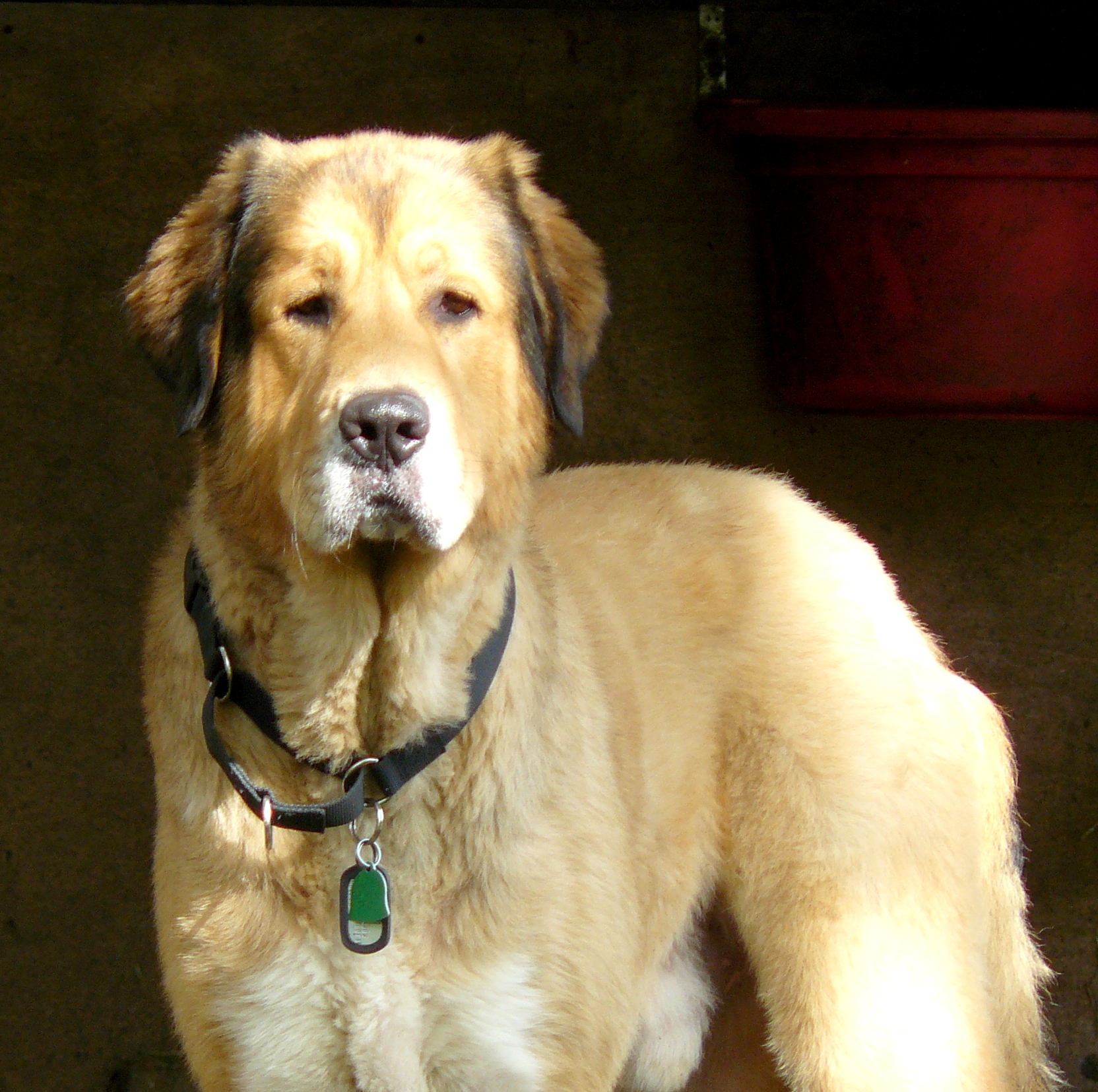
Still a long way from getting to the bottom of what is ailing Hazel.
In my last post about Hazel I opened by saying:
In the last post on Hazel’s condition, back last Thursday, I passed on Dr. Codd’s observation, “… that by not having Hazel on her meds we were, of course, letting the fungal infection continue its damage.”
Dr. Codd also recommended reducing the dosage of the Fluconazole to lower its side effect of suppressing appetite.
So since then, with outstanding care and patience, Jean has been coaxing Hazel to eat just sufficient food for Hazel to be able to take the Fluconazole, for her fungal infection in her lungs, and Doxycycline, for her tick infection. (Mind you, Hazel is still a long way from eating reliably.)
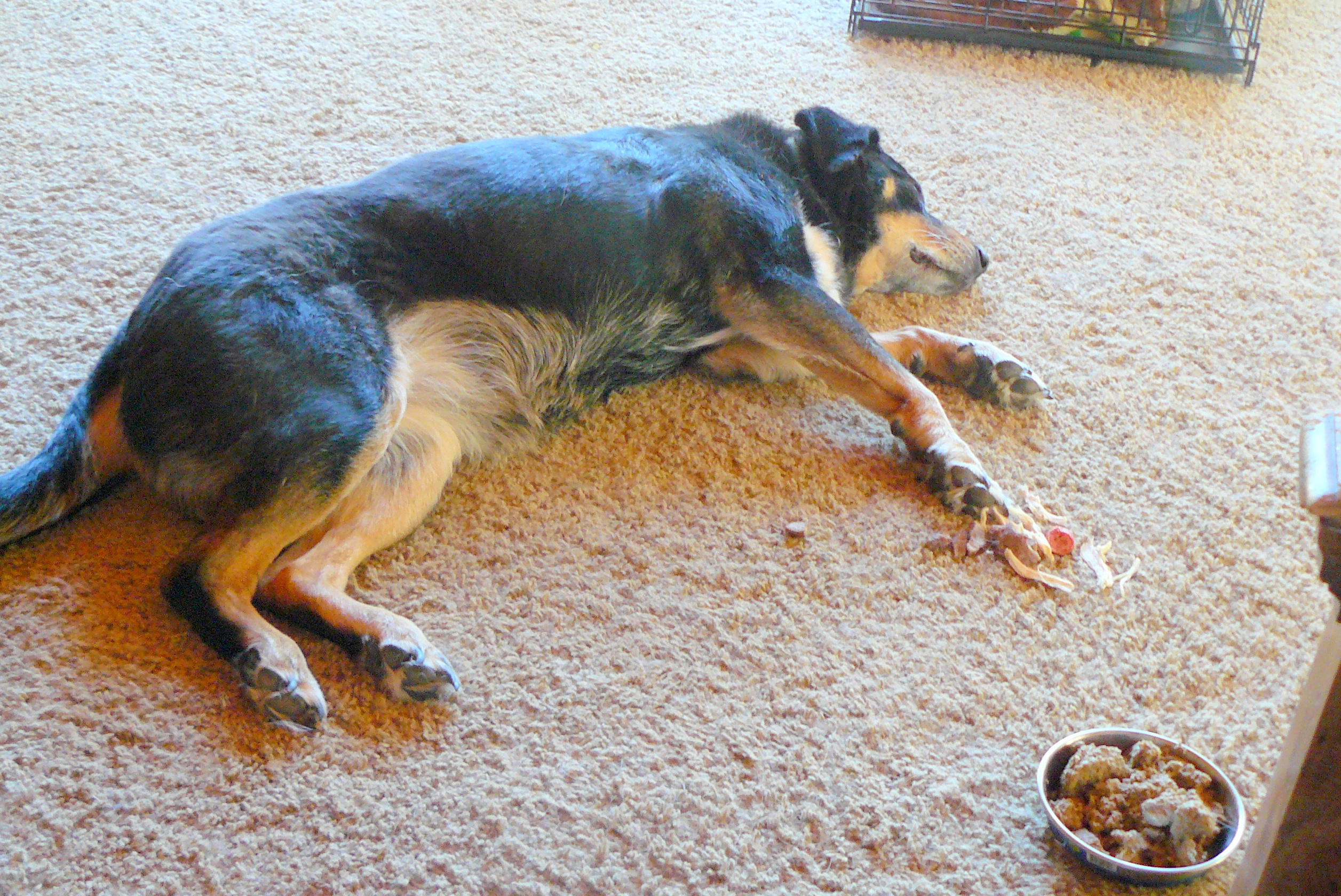
That was a week ago and while, at best, Hazel is just eating sufficient to take her meds she is far from improving to any noticeable degree. But she is not eating enough food to stabilise her weight and yesterday morning Jean was worried we might lose her if we didn’t rethink what was going on.
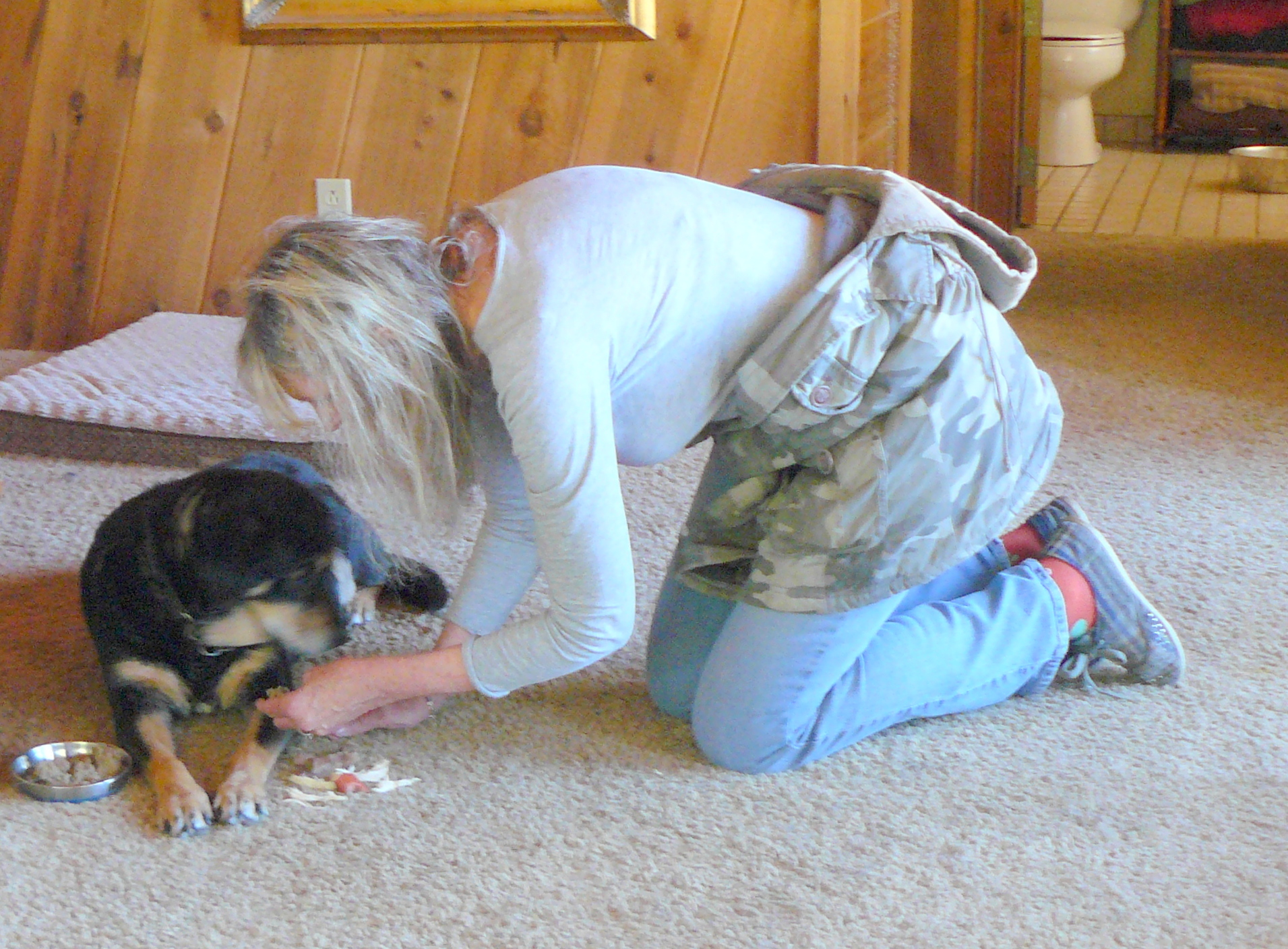
Jean is attempting to get Hazel to eat many times each day.
A Sunday morning call to Dr. Jim Goodbrod brought us the advice to re-think the evidence.
The titre results were negative but because there are so many variants of fungal infection that was discounted.
The film of Hazel’s lungs show what the radiologist described as a clear case of fungal infection.
However, if that infection had been in the past, before Hazel was taken in by us down in Mexico, and that infection had ceased, that film could be showing scarring in the lungs.
The positive result for Tick Fever showed evidence of antibodies not antigens. That might be interpreted as a previous incident.
Jim liaised with Dr. Codd and it was agreed that further examinations needed to be conducted to obtain a clear, unambiguous diagnosis and that in the interim we stop giving Hazel any medications and offer her body systems a bit of a rest.
One option being discussed is to call in a mobile sonogram or ultra-sonic scanner. There is a very expert doctor in the area who uses such a mobile device and scans can be taken of Hazel’s abdomen and lungs here at home.
Because we will do everything to try and return Hazel to good health.
More information will be passed to you just as soon as it is to hand.
Last Wednesday, dear friend Dan Gomez sent me an email that was headed Going to be controversial. It simply contained a link to a recent ScienceAlert item: You need to stop hugging your dog, study finds. I have to admit that my response was a rather rude one! Here’s how that article opened:
With their sweet faces, soft fur, and huge dumb grins, dogs were basically born to be hugged. As a species, they evolved over thousands of years with one clear path – to garner our attention and affection, and profit from all the benefits awarded to ‘Man’s best friend’. But along the way, they’ve had to make some serious trade-offs.
A family dog will never be the leader of the pack. It will be closed in, told when and where to pee, and now, preliminary data from a new study suggests that in return for room and board, our dogs suffer through our hugs.
I know, I know, it’s tough to hear, but bear with us, because it’s not all terrible news. Maybe your dog is cool with hugs. Maybe it finds your hugs annoying, but affection is affection, so it’ll take what it can get. Or maybe it freaking hates hugs and you’re stressing the crap out of it. All dogs are different, you just need to know how to read them.
Anyway, I was delighted to see the Care2 blogsite put out a slightly different assessment. I have great pleasure in republishing that Care2 article in full.
On the feel-good scale of one to 10, tenderly wrapping your arms around your dog and giving your pooch a gentle squeeze rates a solid 10, am I right?
But for dogs, the feeling apparently isn’t mutual, at least according to research by dog-training expert Dr. Stanley Coren, a psychology professor at the University of British Columbia.
Coren examined 250 images on Google and Flickr of people hugging dogs. In his blog “The Data Says ‘Don’t Hug the Dog!’” on Psychology Today, he noted that 81.6 percent of the dogs showed some symptoms of stress, anxiety or discomfort.
“I can summarize the data quite simply by saying that the results indicated that the Internet contains many pictures of happy people hugging what appear to be unhappy dogs,” Coren wrote.
The reason dogs dislike hugs, Coren explained, is because when they are threatened or otherwise under stress, their natural instinct is to run away, so being wrapped in our arms prevents them from doing what comes naturally. This can raise their stress levels.
“Save your hugs for your two-footed family members and lovers,” Coren wrote. “It is clearly better from the dog’s point of view if you express your fondness for your pet with a pat, a kind word and maybe a treat.”
I think it’s important to note that Coren’s study was not peer reviewed (i.e., it has not been approved by other scientists as being legit), nor was it published in any scientific journal, but only on PsychologyToday.com. “This is a set of casual observations,” Coren told the Washington Post in regard to all the recent media attention to his findings.
With this in mind, I decided to conduct my own non-peer-reviewed study for Care2.com. (I’ve been writing professionally about dogs for years and have had them as pets for most of my life, so that makes me kinda-sorta an expert, in my humble opinion.)
For my research, instead of passively Googling photos, I actively hugged two very willing study participants: my dogs, Leroy and Ella.
Leroy (that’s him getting hugged in my profile picture) seemed to enjoy the hug; he wagged his tail and the corners of his mouth curled up in what could be interpreted as a smile. Although Ella, who is a nervous dog, tensed her body at first, she relaxed after a few seconds and calmly rested her chin on my shoulder.
My conclusion: Dogs don’t hate hugs. While I wouldn’t recommend walking up to a strange dog and giving him a big ol’ bear hug, I don’t think there’s any need to stop hugging our own dogs based on Coren’s casual observations.
Neither does Corey Cohen, a companion animal behavior therapist. He told the New York Times the dogs in the photos Coren studied may have appeared anxious because they didn’t like having their pictures taken, or perhaps they were being forced to pose.
“My dogs love being hugged,” Cohen said, probably speaking on behalf of many of us dog owners. “I can definitely tell. Their facial expression changes: ‘Oh, give me more!’”
How to Tell if Your Dog Enjoys Hugs
If you’re not quite sure whether your dog likes to be hugged, here are some of the signs that he’s not into it, according to Coren and Erica Lieberman, a New York City dog trainer and behavior consultant.
Your dog turns his head away as you hug him.
He closes or half-closes his eyes. “Alternatively, dogs will often show what is commonly called a ‘half-moon eye’ or ‘whale eye,’ which is where you can see the white portion of the eyes at the corner or the rim,” Coren wrote.
He lowers his ears.
He licks his lips.
He yawns.
Lieberman told the New York Times that people should look for what she called “cutoff signals” when hugging their dogs. If dogs “shake off” after the hug, just as they shake off water after a bath, it means they didn’t enjoy it.
If your dog shows none of these warning signals, I say go ahead – hug it out.
When it comes to animals it’s practically impossible to have one without the other.
Today’s post was inspired by a comment left on yesterday’s post The most beautiful bond of all by MargfromTassie. This is what she wrote (my emphasis):
Yes, these people are inspirational as are all the people who voluntarily give their time and efforts to animal welfare work, sometimes for years. For many, it can be emotionally traumatising as well as rewarding.
It didn’t take me long to agree that for most it will be emotionally traumatising. In fact, one of the great lessons that we learn from our dogs, and all the other animals that we love, is that unconditional love brings with it emotional trauma.
So much better expressed by Suzanne Clothier in her book Bones Would Rain from the Sky: Deepening Our Relationships with Dogs
There is a cycle of love and death that shapes the lives of those who choose to travel in the company of animals. It is a cycle unlike any other. To those who have never lived through its turnings or walked its rocky path, our willingness to give our hearts with full knowledge that they will be broken seems incomprehensible. Only we know how small a price we pay for what we receive; our grief, no matter how powerful it may be, is an insufficient measure of the joy we have been given.
Our grief is always an insufficient measure of the joy we receive!
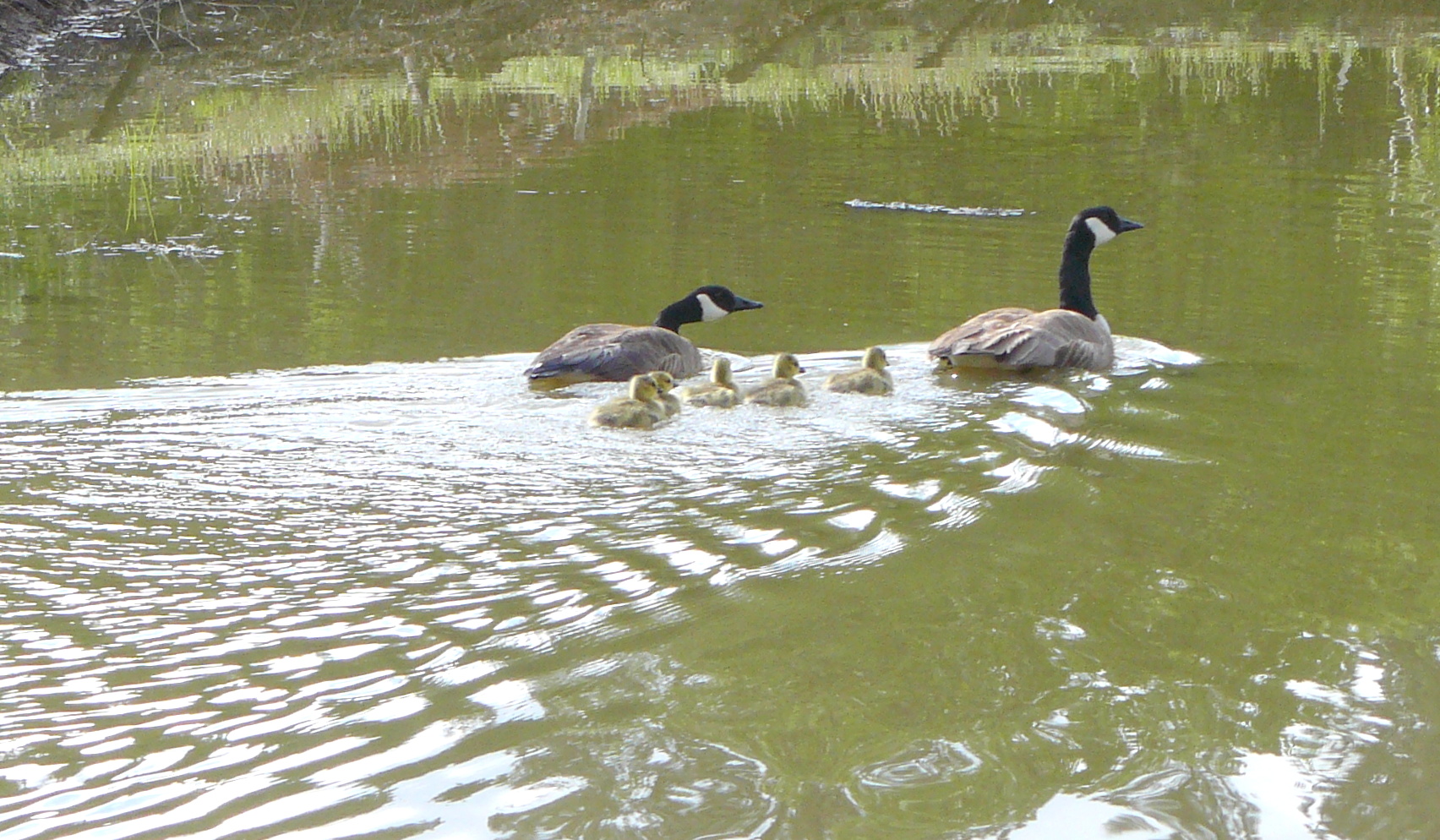
Speaking of joy, when we pulled back the bedroom curtains this morning (Thursday) the nest was empty!
For the last too many weeks to remember a mother Canadian Goose has been sitting on her nest of eggs with Father Goose staying close. We like to think that the mother returned to this place after having been born here a year ago.
Overnight five young healthy goslings were born! 🙂
May their little lives be full of love with a total absence of trauma!
I am referring to the one between human and animal.
The millions of people who love their pets probably never stop to think about how far that love would extend. As I observe Jean’s patience in coaxing Hazel to take food, time and time again each day, it never crosses my mind that there would be a limit to that devotion from her.
When I think about our animals and the special relationships we have with them all, dogs, horses and cats, never for a moment do I weigh up the pros and cons, despite there being many limitations when one stops and ponders the fact. Like the fact that Jean and I have not been away for a honeymoon or any other vacation together since we were married in 2010.
All it takes is for a dog to rub its head against my leg, or a cat to curl up on my lap, or a horse to give in to a hug around its head, something that happens many times each day, and I am content.
However, the following article that appeared on the Care2 blogsite really underlined how much people will give for their animals.
A story recently went viral about a Colombian man who risked his life to save a dog that was hanging from a balcony. The dog, who belongs to the man’s upstairs neighbors, was caught in the railing and was close to falling to the ground. The neighbor, whose name is Diego Andrés Dávila Jimenez, made a dangerous climb from his balcony up to his neighbors’ in order to save the dog.
For animal lovers, there wouldn’t be a second thought about doing the same, whether it was their own pet, someone else’s or an animal in the wild. People go great lengths for animals every day. Here are just a few inspirational examples of them.
Ric O’Barry Does Jail Time for Dolphins
In 1970, Ric O’Barry founded The Dolphin Project and since then, he has dedicated his life to saving dolphins. His life’s work hasn’t been easy, though. O’Barry – who was featured in the 2009 documentary The Cove – has been detained, fined and threatened for his dolphin activism. In January, he was detained at a Japanese airport on his way to monitor the annual dolphin hunt in Taiji. By now, being detained is nothing new to O’Barry, as it happens nearly every time he visits Japan for the hunt. In August, O’Barry was arrested in Japan for not carrying his passport. Still, he carries on with his mission to rescue dolphins.
Adam Warwick saved a black bear from drowning
When a bear is roaming around a neighborhood, sedating it is one of the only safe options. That’s what Florida wildlife officers did when they got a call about a black bear wandering around an Alligator Point neighborhood. The officers shot the bear with a tranquillizer dart, but the bear ran away and headed straight into water, where he would eventually fall asleep and drown. Biologist Adam Warwick came to the bear’s rescue and pulled the 400-pound bear back on land. The bear was then safely transported back to its home in a national forest.
Motorist fights traffic to save injured dog
A Mexican woman was driving down a busy highway when she saw a dog get hit by a car and lay injured on the side of a crash barrier. Nobody stopped or slowed down as they drove by, leaving her to try to dodge traffic to get to the dog. The timid dog tried to limp away, but she eventually gained its trust and took it to an area vet to have its injuries treated.
Man saves a stranger’s dog that was blown off a pier
An Australian woman was walking her Shih Tzu-Maltese Bibi on a pier when a strong gust of wind picked the dog up and carried him into the water. Raden Soemawinata was at the pier scattering his grandmother’s ashes when he saw the Bibi in the water and immediately jumped in to save him. Soemawinata humbly told media that “it wasn’t such a great feat.” We think otherwise.
Two Norwegian men save lamb from drowning
Three friends were out taking pictures when they noticed a lamb struggling in choppy waters. Two of the young men worked together to rescue the lamb, while the other used the camera to take incredible pictures of the rescue. They pulled the lamb to safety and reunited it with its flock.
Randy Jordan removes hooks from sharks
Most people try to avoid sharks. Randy Jordan has made a mission to help them. The diver frequently noticed fishing hooks caught in sharks’ mouths, so he made it his mission to remove the hooks from the sharks he encountered. He worked with scientists in order to find the safest way – for himself and the sharks – to have the hooks removed. Jordan has gone on to free multiple sharks from the painful hooks.
Men save baby giraffe in crocodile-infested waters
For four hours, a baby giraffe tried to keep its head above the Uaso Nyiro river’s harsh waters. The Kenyan river is not only fast moving, but is home to many crocodiles. A group of men ignored the river’s danger and waded through the water to pull the giraffe back onto land.
With so many reminders, especially in the media, of the greed and selfishness of people it really does one good to read these seven examples of how wonderful is the bond between humans and animals.
The powerful combination of good medicine and unconditional love.
In the last post on Hazel’s condition, back last Thursday, I passed on Dr. Codd’s observation, “… that by not having Hazel on her meds we were, of course, letting the fungal infection continue its damage.”
Dr. Codd also recommended reducing the dosage of the Fluconazole to lower its side effect of suppressing appetite.
So since then, with outstanding care and patience, Jean has been coaxing Hazel to eat just sufficient food for Hazel to be able to take the Fluconazole, for her fungal infection in her lungs, and Doxycycline, for her tick infection. (Mind you, Hazel is still a long way from eating reliably.)
Yesterday, (Saturday) Hazel was showing clear signs of feeling better but still having to be hand-fed by Jean.
Then this morning (Sunday) she really was perky and readily came out for a walk with the other dogs.
First time in recent days when Hazel has shown an interest in the world around her.
oooo
A return of a head gesture unique to Hazel that we haven’t seen in ages! 🙂
More generally, Dr. Jim was trying to track down supporting details to the observation made by Dr. Russ:
Namely, that there was evidence that fungal infections can lay dormat for quite long periods of time.
Jim sent me the following email:
Paul …
The following article is the one and only reference I have found so far that refers to the possible dormancy of this fungal infection. In paragraph 2 (Clinical Disease) I have highlighted it in red. I have to admit, I was skeptical.
Jim
The article was:
Coccidioidomycosis (Zoonotic) Last updated on 2/4/2011.
Contributors:
Rhea V. Morgan DVM, DACVIM, DACVO
Synonyms:
San Joaquin Valley Fever
Valley Fever
This is that domancy aspect from that paper that Jim highlighted (in red):
The incubation period in the dog is 1 to 3 weeks.1,2The organism can remain dormant, with exposure preceding the onset of clinical signs by 3 years or more.1,3 Although people may acquire the disease from the same sources as domestic animals and the mycelial forms are highly infectious, with one exception the disease has not been transmitted from animals to people. One published report exists of transmission to a veterinary assistant via the bite of an infected cat.15
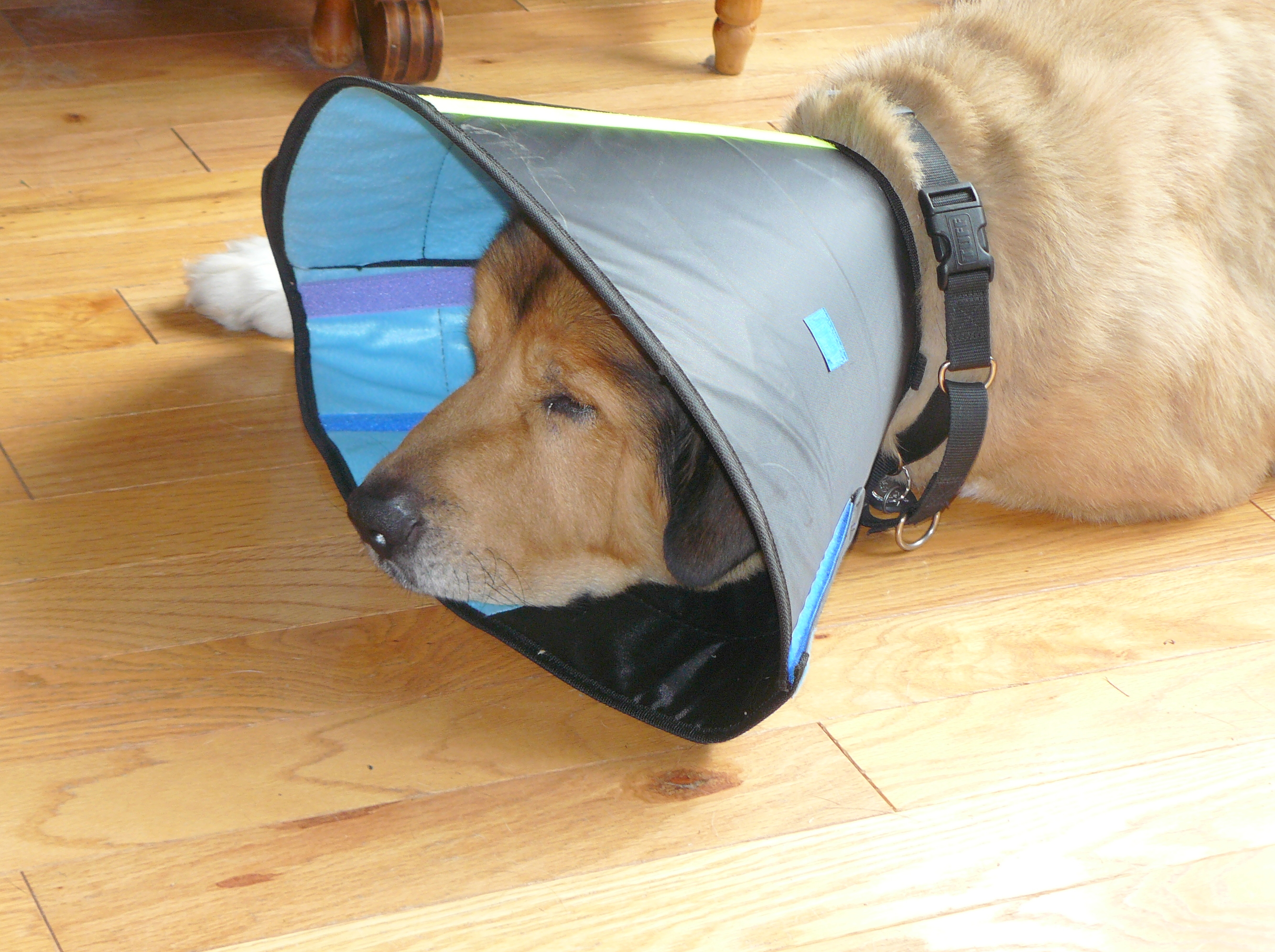
Meanwhile, over in Brandy’s corner, he has very quickly healed after his neutering operation last Thursday. It was fair to say that he was not a happy chappy when he arrived home that day.
Didn’t like that!
oooo
And I can’t even lick my balls!
But his cone was off by Saturday and he is back to the wonderful, bouncing dog we all love so much. (Can’t believe that last Saturday was only the second week that Brandy had been with us; he has so quickly woven his way into all our hearts.)
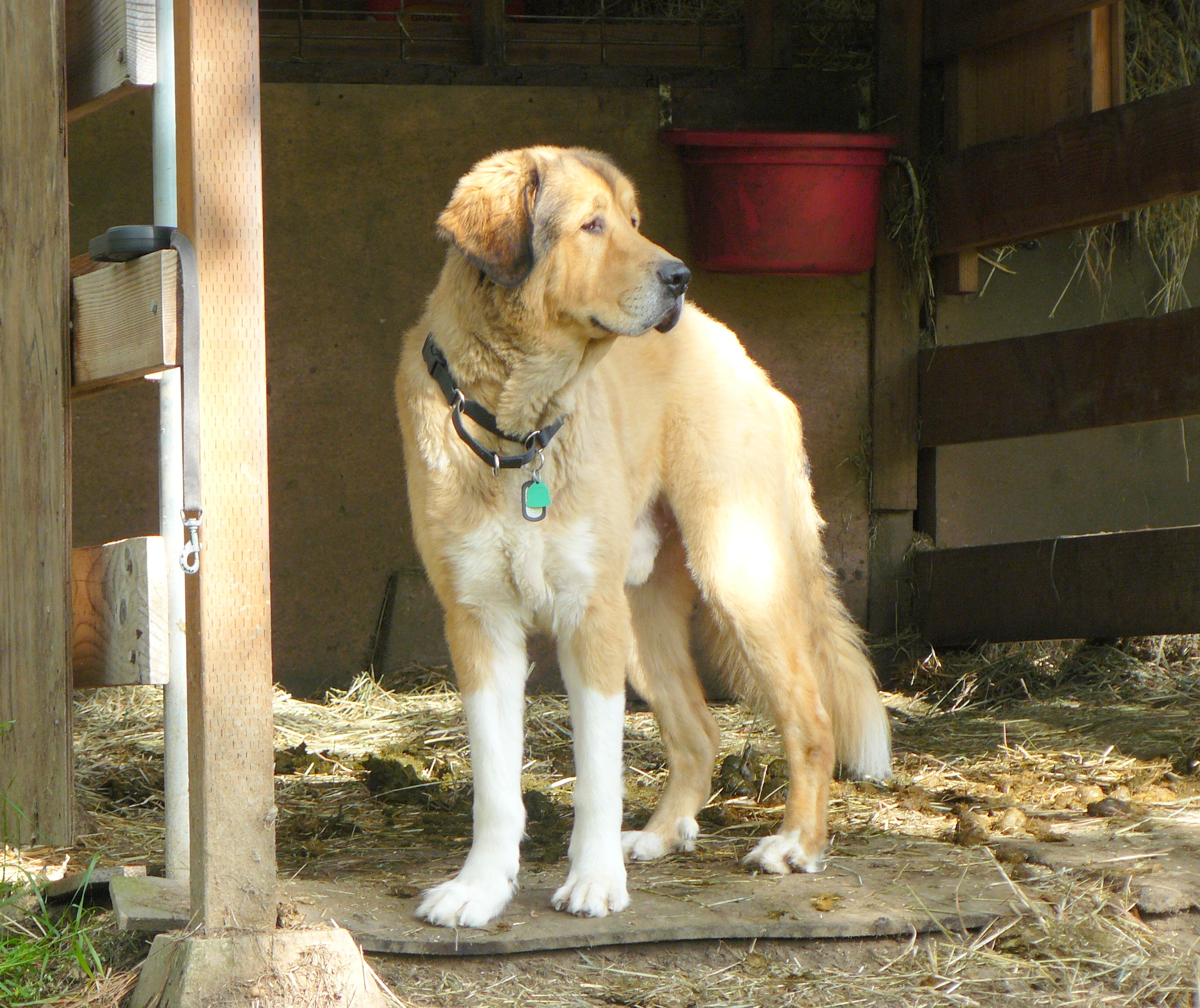
Checking out the stables yesterday (Sunday) morning.
oooo
Behind that placid expression is the most docile, loving brain and heart one could ever wish for!
Returning to Hazel we are still some way from knowing that she has returned to a fully fit dog but the love and caring sent her way by all of you out there has been precious beyond imagination.
A fabulous example of how we reach out to others across the internet!
A week-and-a-half ago in came an email to me:
Hi Paul,
Just came across a post of yours for Earth Day 2014.
Absolutely love the fact that you’ve written about a “Green” topic!
In fact, I wanted to reach out and let you know that in honor of this year’s Earth Day (April 22), I just finished designing an infographic about 14 easy ways dog owners can become more environmentally friendly people.
Would it be okay with you if I passed it along? I’d love to hear your thoughts on it!
Best,
Mike
Mike was Mike Shannon, about which more at the bottom of this guest post. Of course, I was delighted to receive his lovely guest post and infographic. Over to Mike.
ooOOoo
In its 46th anniversary to date, Earth Day is bound to continue to do what it has always succeeded in doing, help raise awareness among† individuals from all across the globe about environmentally-friendly topics so they work together to make this† world a better place to live in for the future generations to come.
In honor of this year’s Earth Day, which happens to be on Friday, April the 22nd, Ultimate Home Life have designed an info-graphic† that explains the most important 14 steps you can take as of today to go green with your dog.
This topic is certainly nothing to be taken lightly, and most certainly nothing of the impossible. Just look at the statistic provided at the beginning of the info-graphic – nearly 50% of families in the United States alone have a dog at home, which makes for more than 70 million dogs!
Let’s kick off our “going green” mission this year by making our dogs greener, one dog at a time.
If you have any tips for going green with your dog, make yourself heard in the comments!
Bio: Michael is the creator, editor, webmaster – alright, let’s just say he runs the show over at UltimateHomeLife.Com! He regularly blogs about anything and everything dog related, with an emphasis on trying to cover all questions that dog owners tend to worry about. So, hop over and give him a bark!
ooOOoo
What a fabulous and highly pertinent post for these times.
Happy Earth Day to all of us and our wonderful dogs right across this magnificent planet.
So said Sophocles. But too slow a decision, or no decision is, of course, a decision in its own right.
Last Tuesday in my update on Hazel Of art, and science I wrote:
It seemed to make sense that until we had confirmation of whether or not Hazel had a lung fungal infection, for which taking Fluconazole would be an excellent course of action, we should pause in her dose until the results were in.
At 08:45 this morning we had to take Brandy in to Lincoln Road Clinic for his neutering operation (that we heard a short time ago has gone well with no complications – he will be collected in about an hour). Dr. Codd asked after Hazel and we said that she was brighter but still not eating sufficient for her to be taking her medications.
Dr. Codd then made the eminently sensible observation that by not having Hazel on her meds we were, of course, letting the fungal infection continue its damage.
In response to the query as to why a fungal infection from either Mexico or Arizona had taken so long to appear, Dr. Codd added more sense to the situation. Namely, that there was evidence that fungal infections can lay dormat for quite long periods of time. Possibly in Hazel’s case the trigger for the infection becoming active was the additional stress on Hazel’s body systems from her recently contracting an Ehrlichia Infection from a local tick.
The final element for the argument of not delaying any longer Hazel’s healing medications was that the titre results would only be a result of one particular ‘brand’ of fungal infection. Dr. Codd said that it may well have been one of many other fungal infections that took hold of Hazel’s lungs.
So the decision was made to try Hazel on an oral anti-nausea med that would be much easier to administer. It is Ondansetron Orally. Also to cut down the dosage of the Fluconazole so that it doesn’t dampen Hazel’s appetite for food, a known side effect of Fluconazole, in quite such a dramatic fashion. (Note: Fluconazole is the least appetite suppressant compared to alternatives.)
So there we are.
We hang on to the fact that Hazel is still with us and coping with what is ailing her, albeit with a heightened stomach sensitivity that is complicating eating. Time is on our side.
A thousand thanks to all of you that have shown so much love and concern for our dear hazel.
Dear people, I must add this: CAUTION: The following is offered by way of information reaching out to other loving dog owners. Please do not assume I have any specialist veterinarian knowledge and please do not take the following as a replacement for seeing your own vet.
Finally, Mike Shannon is my guest blogger with a lovely post for Earth Day 2016 that will be published in a little under 10 hours time. That is why this post has been published now.
The learning and healing journey continues with Hazel.
The title to today’s post came from Dr. Jim Goodbrod, DVM. When he and I were taking a walk yesterday Jim mentioned that diagnosing exactly what an animal is suffering from is as much an art as it is a science.
Jim and Janet are close friends and neighbours who live a couple of roads away. Jim also attends the Lincoln Road Vet Clinic on a part-time basis. Off his own volition he has been speaking with Dr. Codd (Russ) about the situation with Hazel and the pair of them are showing incredible devotion to getting to the bottom of what is happening.
So, like yesterday’s post, today is being offered to you in the spirit of information. Forgive me if I repeat the caution from yesterday. (This is being written at 4pm on April 19th, 2016.)
CAUTION: The following is offered by way of information reaching out to other loving dog owners. Please do not assume I have any specialist veterinarian knowledge and please do not take the following as a replacement for seeing your own vet.
Late on Sunday afternoon Hazel was becoming so weak and lethargic that Jean and I feared that she wouldn’t make it through the night. So it was wonderful to see that she was alive and still connected to the world at 6am yesterday; Monday. Nonetheless, Hazel had not eaten since Saturday afternoon and was only drinking very small amounts of water. We made the decision to ring the Clinic as soon as they opened on Monday at 8am. They recommended that Hazel be brought in to go on to an IV drip to boost her anti-fungal intake and also to receive an anti-nausea intake to help her regain an appetite. But there was the question hanging over everyone that if this was a fungal infection, as in Coccidioidomycosis, that is not present in the Oregonian soil but is found in the drier parts of the USA and Mexico then why had it been such a long time before it brought Hazel down?
Jean also had this suspicion that Hazel might be suffering from a form of ‘Tick Fever’ that is very common in Mexico.
So off we went to the Clinic again. There were discussions about the whole situation.
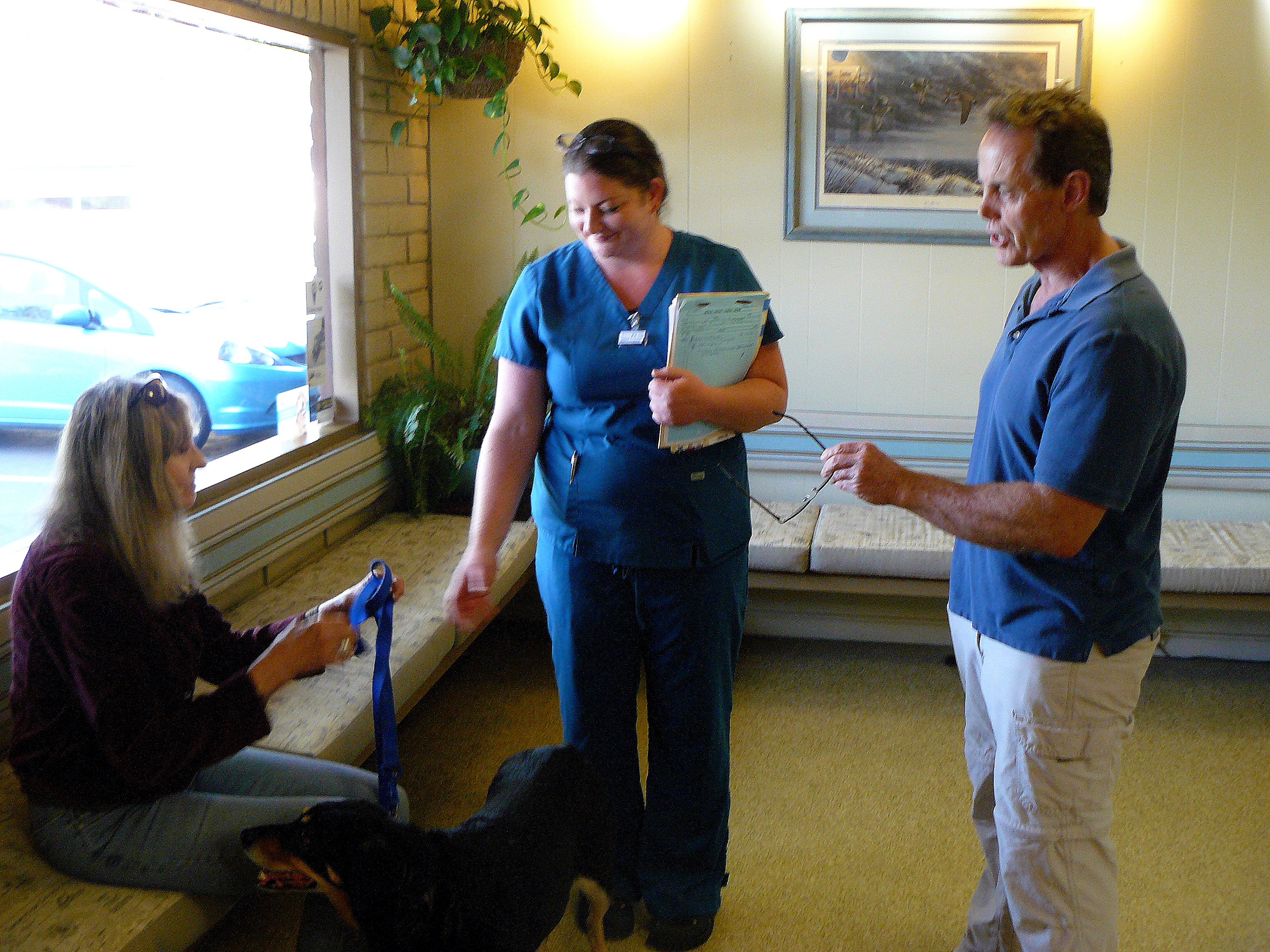
Dr. Codd (RHS) speaking with Jean at the Clinic.
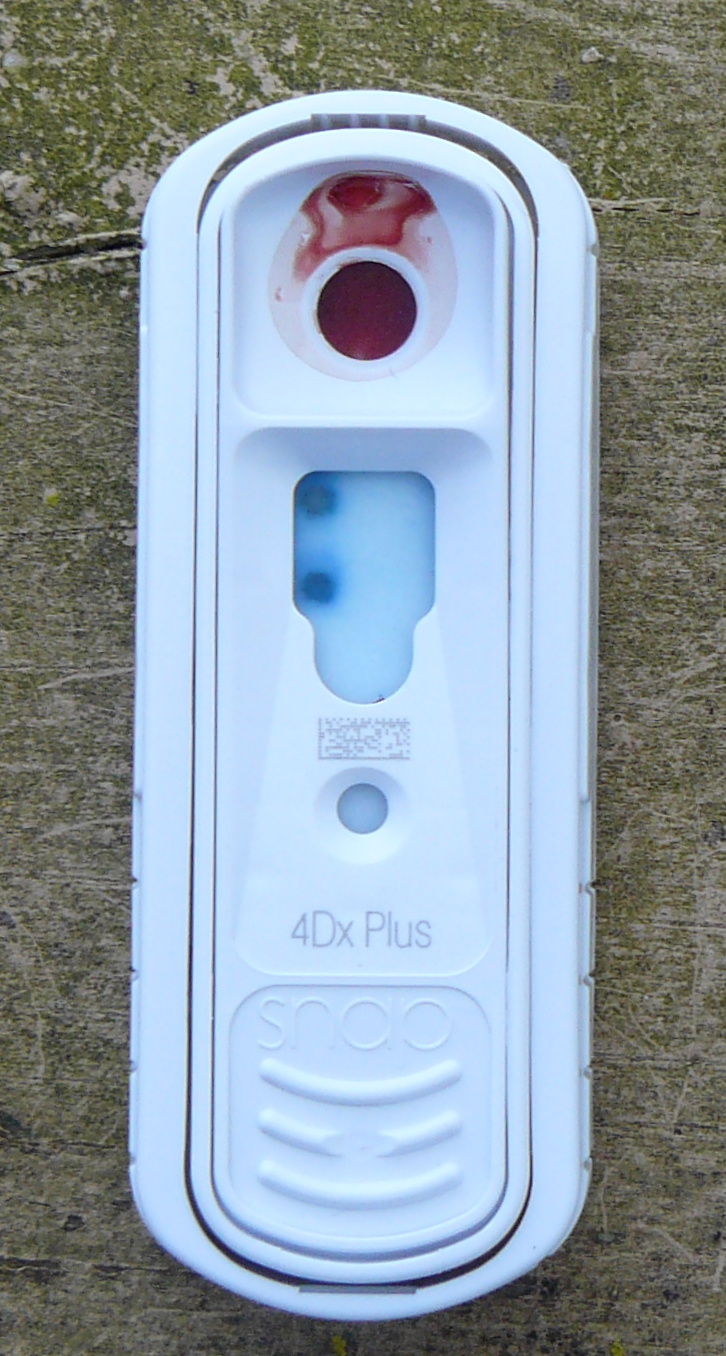
Dr. Codd took a quick blood test and, bingo, it revealed that Hazel was showing that she had, or had had in the past, an Ehrlichia Infection; a tick-borne infection.
The lower of the left-hand spots is the indicator of a past or present Ehrlichia Infection.
The cure for that was a course of Doxycycline.
So now we are looking at battling two separate diseases.
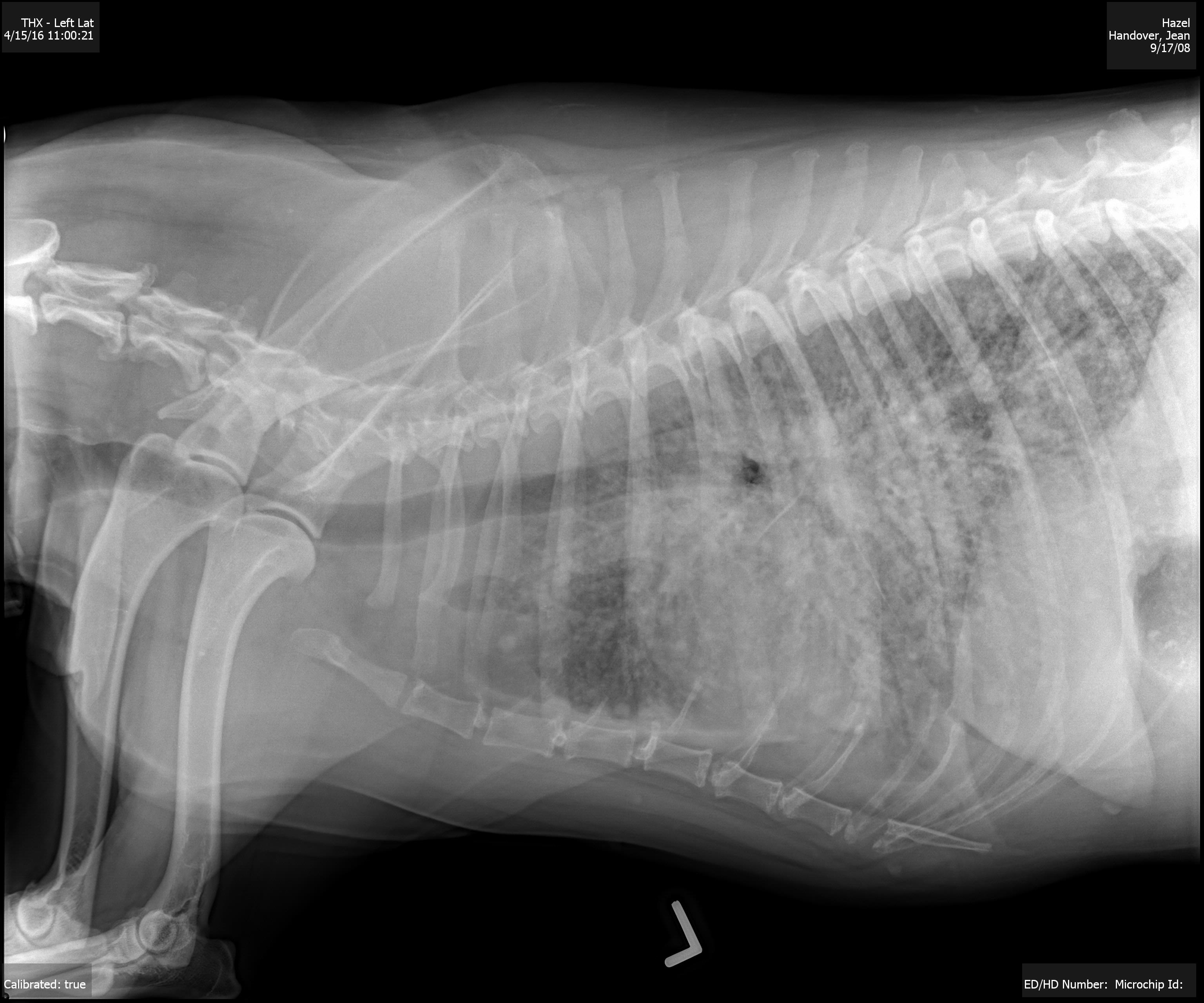
The blood that was taken from Hazel last Friday, when she also had radiographs taken of her lungs, had been sent for a ‘titre’ that would confirm one way or another if her lungs were suffering from a fungal infection. Those results will be available on Wednesday or Thursday of this week.
One of the radiographs taken of Hazel.
Back to Hazel’s lack of appetite. One of the side-effects of Fluconazole is that it depresses appetite. Getting Hazel eating again was becoming a priority. It seemed to make sense that until we had confirmation of whether or not Hazel had a lung fungal infection, for which taking Fluconazole would be an excellent course of action, we should pause in her dose until the results were in. To speed up the return of an appetite Dr. Jim prescribed a short course of Mirtazipine.
So that’s about it for the time being. Except for Jean and me to say how much we appreciate the art and the science that is being so skillfully offered by the Clinic. (As of 19:00 PDT yesterday Hazel was eating again! 🙂 )
Great team effort!
Their “Special Love of Animals” comes over in spades!
CAUTION: The following is offered by way of information reaching out to other loving dog owners. Please do not assume I have any specialist veterinarian knowledge and please do not take the following as a replacement for seeing your own vet.
About three or four weeks ago we noticed that Hazel’s bark was changing, almost as though she had a sore throat. In every other way she continued being the happy, lively dog that she is.
Then very suddenly last Thursday she started sicking up white, foamy bile and went off her food. Hazel rapidly became lethargic and lacking any vigour. Last Friday we took Hazel to our local Lincoln Road Vet Clinic and she was seen by Dr. Russ Codd, DVM. He took xrays that showed that Hazel’s lungs were far from being as clear as they should be. Potentially, Dr. Codd said that we could be looking at one of three things:
Some form of bronchial pnemonia,
A fungal infection of the lungs,
Cancer.
In view of the fact that Hazel hadn’t been coughing that ruled out 1.
Dr. Codd forwarded the xray pictures to a specialist. Later came the information that the spherules in her lungs, as seen on the xray pictures, were not as would be expected with a cancer diagnosis. Dr. Codd concluded that Hazel was indicating a fungal lung infection. Especially as this is commonly found in hot, drier parts of the USA and Mexico. Hazel was an ex-rescue from Mexico and for a couple of years we lived in Payson, Arizona.
The medical term for the disease is Coccidioidomycosis and I republish a little of what may be read over on the Pet MD website:
Coccidioidomycosis in Dogs
Mycosis is the medical term for any disorder caused by a fungus. Coccidioidomycosis comes from inhalation of a soil-borne fungus which normally affects the dog’s respiratory system. However, it is known (even likely) to spread out into other body systems.
The fungus spores begin in the lungs as round spherules, and live in a parasitic stage in the lungs until they grow large enough to rupture, releasing hundreds of endospores, which then begin a parasitic stage in the tissues, growing and rupturing, spreading out (disseminating) into the body perpetually. Endospores can also take a faster route through the body by way of the lymphatic and blood vessel systems, resulting in systemic infection — meaning the entire body will be affected. Coccidioidomycosis sets in from 7 to 20 days after exposure, though some dogs can develop immunity and never show any symptoms, especially younger dogs.
Dogs that are susceptible to the infection can become ill from only a small amount of the Coccidioides fungus, and fewer than 10 fungus spores are needed to cause the disorder. And though uncommon, Coccidioidomycosis is a deadly disease that originates mainly in the arid, hot regions of the western and southwestern regions of the U.S., and in several Central and South American countries. Coccidioidomycosis affects many different types of mammals, but tends to occur more commonly in dogs than cats. This infection is also known as valley fever, California fever, Cocci, and desert fever.
The condition or disease described in this medical article can affect both dogs and cats. If you would like to learn more about how this disease affects cats, please visit this page in the PetMD health library.
Dr. Codd recommended getting Hazel on a course of antibiotics with Fluconazole being his first choice. That commenced on Friday afternoon.
Early today (Monday) Dr. Codd will be seeking to narrow down the diagnosis with further analysis of Hazel’s blood being undertaken because while he was confident that it is a fungal infection he wanted to confirm precisely the nature of the infection.
I will publish more information as it comes to hand and close with these photographs taken yesterday afternoon.
Hazel taking a very slow walk outside.
oooo
But most of the time she just wanted to be left on her own in our bedroom.
We are holding Hazel very close to our hearts just now.
Welcome to Territorio de Zaguates, or “Land of the Strays”.
When it comes to loving stray dogs I thought that the friends of John Zande and his wife were showing the rest of the world how to do it. For it is my understanding that Sandra and her partner down in Brazil are providing a home for around 300 ex-rescue dogs.
Dogs frolic in a lush green field at the Territorio de Zaguates dog sanctuary in Costa Rica. (Photo: Territorio de Zaguates)
Welcome to Territorio de Zaguates, or “Land of the Strays,” an amazing, privately funded, volunteer-run animal sanctuary in Costa Rica where no mutt is turned away.
Located less than an hour outside the bustling capital city of San José, this doggie safe haven is home to hundreds of abandoned canines that have been given a second chance at life.
This is no ordinary animal sanctuary, though. After all, when you live in a place as beautiful as Costa Rica, you take advantage of what the landscape provides. That’s why volunteers lead the ragtag pack of rescued mutts on scenic hikes through the gorgeous mountains nearly every day. It’s a sight to behold.
A volunteer at Territorio de Zaguates leads a pack of dogs up a hill. (Photo: Territorio de Zaguates)
Aside from the free-range mountain hikes with breathtaking scenery, Territorio de Zaguates functions just like any other animal rescue or sanctuary.
“First thing we do when a new dog gets here is spay/neuter, vaccinate and get rid of parasites,” the organization explains on its Facebook page. “Then we assess if the dog requires any other type of special treatment [and] put them in quarantine if necessary.”
Once this initial processing is completed, the new dog is released into the general population, where it can either be adopted by a loving human or spend the rest of its days frolicking in what is essentially a doggy paradise.
There are all kinds of mutts living at Territorio de Zaguates. (Photo: Territorio de Zaguates)
What makes Territorio de Zaguates even more special is the creative approach to finding the dogs forever homes.
To encourage adoption, every doggie resident at the sanctuary is not only given a name, but also a customized “breed” name based on the dog’s phenotypic traits. These one-of-a-kind breed monikers include memorable titles like “Alaskan collie fluffy terrier” and the “chubby-tailed German doberschnauzer.”
The resounding message behind this strategy is that when you adopt a mutt, you’re adopting a unique breed. Learn more about this clever campaign in the video below:
As any animal rescuer will know, maintaining such an massive sanctuary requires an enormous amount of time, money and labor. But thanks to a host of charitable donors and an eager base of volunteers, the sanctuary is a great success.
“We have a very small staff but still we manage to do everything from daily picking up the poo and disposing of it properly, to feeding and medicating the dogs, and everything in between,” a spokesperson for the organization writes.
Continue below for just a glimpse of what life is like for these adorable pups at Territorio de Zaguates:
Mattresses are provided for the dogs to lounge on throughout the day. (Photo: Territorio de Zaguates)
Mattresses provide natural lounge spots for the dogs throughout the day.
A pack of rescued dogs take a leisurely walk in the woods with a few of the sanctuary’s hard-working volunteers. (Photo: Territorio de Zaguates)
The pack takes a leisurely hike in the woods with a few of the sanctuary’s hard-working volunteers and some prospective dog adopters
Photo: Territorio de Zaguates)
Lunch time at Territorio de Zaguates means serious business, which is why kibble donations are so important!
Cushy bed donations are also very important for the sanctuary. (Photo: Territorio de Zaguates)
In addition to food, comfy dog beds are also a much welcomed donation item for the sanctuary!
A volunteer leads the pack downhill. (Photo: Territorio de Zaguates)
A sanctuary volunteer leads the pack downhill during a scenic hike through the mountains.
(Photo: Territorio de Zaguates)
In case you were wondering where all those yummy kibble donations went … behold the trough
(Photo: Territorio de Zaguates)
A few of the sanctuary’s senior residents rest on the steps of the facility. Even if the pups aren’t adopted out, they’ll always be guaranteed a luxurious forever home at the sanctuary.
(Photo: Territorio de Zaguates)
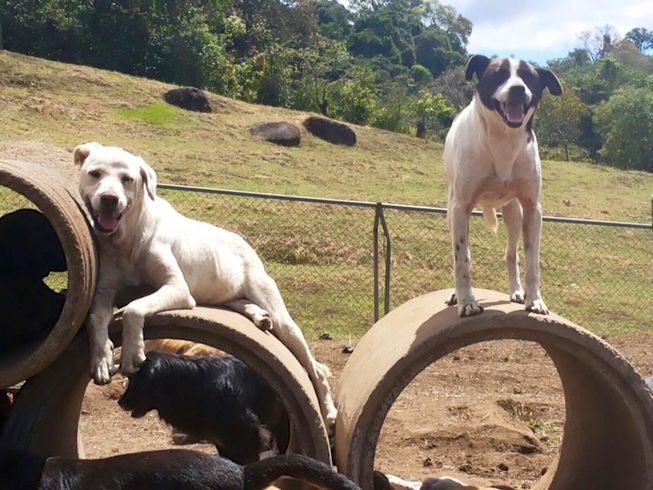
Concrete drainage pipes makes excellent (and sturdy!) makeshift dog houses
(Photo: Territorio de Zaguates)
Rescued dogs hang out in the shade of the sanctuary’s many trees
(Photo: Territorio de Zaguates)
A nice refreshing dip … in some drinking water
(Photo: Territorio de Zaguates)
After a long, fun-filled day of being a dog, there’s nothing like cuddling up with a friend and snoozing before dinner time
ooOOoo
Well it certainly puts our ten dogs in the shade!
In doing a trawl through YouTube I came across this video that I will use to close off today’s post. Chances are that, as with me, you won’t understand the voice-over but it won’t diminish your pleasure at looking at these dogs.
Published on Jul 3, 2014
“Territorio de Zaguates” ubicado en las hermosas montañas de Costa Rica, es un albergue de animales donde se le da casa, comida, atención veterinaria, ejercicio, esparcimiento y cariño a 700 perros callejeros víctimas del maltrato, el abuso, el abandono y la negligencia humana.
–ENGLISH– “Territorio de Zaguates” is a No-kill-shelter in the beautiful mountains of Costa Rica that provides home, food, vet care, exercise, recreation and affection to over 700 stray dogs, victims of neglect, abandonment and abuse.
Actually, let me close off today’s post with these two sets of words from the story above:
Once this initial processing is completed, the new dog is released into the general population, where it can either be adopted by a loving human or spend the rest of its days frolicking in what is essentially a doggy paradise.
“essentially a doggy paradise.”
The resounding message behind this strategy is that when you adopt a mutt, you’re adopting a unique breed.
That is so true! Each and every dog, especially an ex-rescue dog, is a unique breed.
 More information will be passed to you just as soon as it is to hand.







 Learning from Dogs