Category: Animal rescue

Picture Parade Two Hundred and Fifty-Three

The last set of those wonderful Kennel Club photographs.

(As with the previous weeks, words and pictures republished from here.)

Winning Kennel Club images celebrate dogs from all walks of life

  JACQUELINE GULLEDGE   July 17, 2018.

The fifth and final selection of these wonderful photographs and the story behind each one.

ooOOoo

Third Place, I Love Dogs Because…

‘Hide and Seek’ featuring Fenrir, a Border Collie. (Photo: Kirsten van Ravenhorst)

“I am an 18 year old girl from the Netherlands who loves agility, traveling and photography. The dog in the photo is Fenrir, my youngest dog. He is the perfect model, and the reason why I picked up the camera again,” said Kirsten van Ravenhorst. “The camera that I normally use is the Nikon D500, but it needed to be repaired so I used my dad’s D5200 for this photo. This photo was taken in the forest near my house. I went there with my Border Collie Lad Fenrir to test my dad’s new camera.”

Third Place, Man’s Best Friend

‘Home’ featuring Ruby Roo, a Golden Retriever. (Photo: Cheryl Murphy)

“This picture of Ruby was taken whilst she was resting with my friend Chris after playing with her daughter Nellie. My greatest passion is capturing dogs playing and having fun in their natural environment, the camera is a great way of recording what the naked eye would miss,” said Cheryl Murphy.

Third Place, Oldies

‘Resting’ featuring Bentley, a German Shorthaired Pointer. (Photo: Philip Wright)

“This particular photo was taken during an afternoon walk through a local woodland. The ferns were looking wonderful and provided a perfect natural avenue to draw the viewers’ eye in to my subject,” said Philip Wright. “I asked Bentley to lay down and he did so with the most beautiful, almost grave expression. They say that eyes are the windows to the soul, and looking at Bentley here I’d be inclined to agree.”

Third Place, Portrait

‘A Winters Storm’ featuring Hugo, a Pomeranian. (Photo: Michael Sweeney)

“‘I photographed my dog at the window here in my tenement flat in Glasgow using available natural light during a winter’s storm of hailstones, wind and rain,” said Michael Sweeney.

Third Place, Puppies

‘Let’s call it Roly Poly Puppy’ featuring Snickers, a cross breed puppy. (Photo: Robyn Pope)

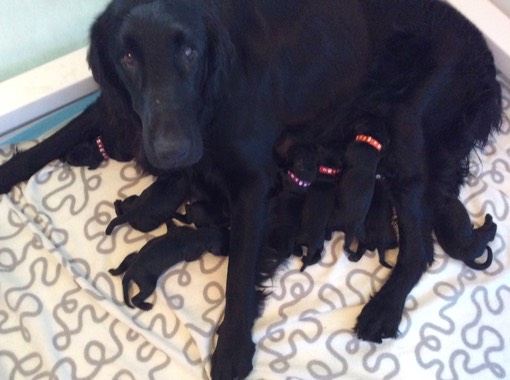
“In this image, I knew the moment Snickers began rolling around on the blanket that I had to embody his zest for life in a photo that would help him find the perfect playful home. I truly love working with dogs of all backgrounds to capture extraordinary photos worthy of even the most sophisticated pet parents and discerning commercial clientele,” said Robyn Pope. “At home, we have six gentle giants of our own who serve as ambassadors on our 7-acre pet photography property and the ultimate creative muses.”

Third Place, Rescue Dogs and Dog Charities

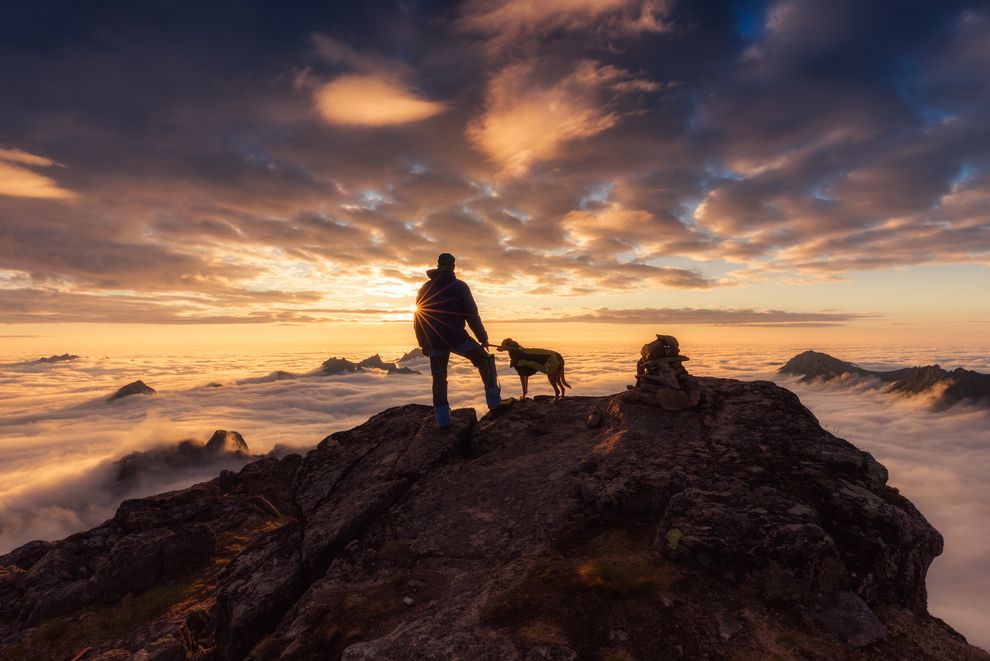
‘Over the sea of fog’ featuring Dania, a cross breed Portuguese Podengo. (Photo: Christina Roemmelt)

“My name is Christina and I was born in Munich. I moved to a small village next to Innsbruck in Austria together with my husband 11 years ago. After having settled down, we adopted two rescue dogs from Spain, thrown away like garbage, found in a dustbin. It wasn’t possible to literally touch Dania for the first six month. Now we spend all the time together. The dogs accompany us to work and in our leisure time we explore the nature together,” said Christina Roemmelt. “My wish was to fix the special mood of these moments, staying outside, enjoying nature together and acting as a team. For this reason, inspired by my husband, who is a landscape photographer, I got in touch with photography three years ago.”

“On the picture you can see one of these very special moments. We hiked on Keipen on Senja [Norway] last year and stood speechless on top when the nature was bathed in golden light by the midnight sun. Everything was calm and peaceful. The dogs and us were completely on our own. This is one of my absolutely all-time favourite pictures from our trips.”

Third Place, Young Pup Photographer

‘Monty’ featuring Monty, a German Shorthaired Pointer. (Photo: Maisie Mitford)

“I live in the North East of England with my Mum, Dad, Sister Millie and two dogs; Monty & Chester. I have always loved animals and I am constantly entertaining my dogs. I have my own lightweight camera which I carry with me most places and always photographing the dogs,” said Maisie Mitford. “Mum had given me her camera (which is really heavy) and set me a challenge to photograph either Monty or Chester for this competition, Chester wasn’t interested but Monty was willing and keen to please — lots of treats were involved!”

The Kennel Club in the U.K. was founded in 1873 and is the oldest recognized kennel club in the world. The organization is “dedicated to protecting and promoting the health and welfare of all dogs. Besides being a voluntary register for pedigree dogs and crossbreed dogs, we offer dog owners and those working with dogs an unparalleled source of education, experience and advice on puppy buying, dog health, dog training and dog breeding.”

ooOOoo

What an incredibly wonderful set of photographs and, in addition, the wonderful reflections of the photographers themselves.

If you missed the start of these photos then go here.

I shall miss these beautiful photographs and the background stories!


People!

What a complex lot we are!

(And that’s putting it kindly!)

I wasn’t planning to publish a post for today. But then a recent post from Patrice Ayme spurred me to so do.

Let me explain.

Our nearest town, Grants Pass, has the wonderful Rogue River flowing through it and alongside it there is Riverside Park. To quote:

Riverside Park in Grants Pass was set aside by our founders for the enjoyment of our citizens and guests.

People come from all over to Riverside Park to watch the majestic Rogue River as it courses its’ way through our city.

As you can see it is a popular place for ducks and geese.

Last Tuesday, we had a contractor completing some new guttering for the house. Terry, the owner of TC Gutters, ran out of the coated aluminium he was folding into the correct shape using a rather cute machine!

Terry apologised and said that he would need to run back into Grants Pass to pick up some more of the sheeting.

He returned a little later and I went over to chit-chat with him.

He was unexpectedly downcast.

Terry, is there a problem?

Paul, when I was in town, down at the bottom of 6th Street near the bridge, there was a flock of ducks crossing the road.

Terry paused for quite a while; I stood there next to him with not a clue as to what was coming.

He sighed, and continued: “Instinctively, I slowed down along with a number of other drivers. But what really upset me was the fact that a few drivers were clearly gleefully driving into the ducks and killing them!

It hurt me to hear that; very much so!

Is it too strong for me to regard those drivers who thought it great fun to drive into those ducks as being evil?

A stock photo courtesy Alamy.

What do you think?

All about Lexi!

Lexi is a wonderful young dog.

Those poor souls who keep on calling in to this place will most likely be aware of my very long-term friend Dan Gomez.

For all of the nearly forty years that I have know Dan he has always had a dog in his life.

Just a few days ago, Dan sent me an email with some pictures of Lexi, a young dog that he has had since she was a puppy.

Lexi! (Photograph taken at the Sante Fe ski basin.)

Or in Dan’s words:

Lexi has been a magnificent example of an adventurous Flat-Coated Retriever.

She’s a wonderful hiker, swimmer, hunter and a great greeter on the trail. She’s happiest when she has her leash clenched in her teeth, parading around from person to person before continuing on her way.

What a great breed these dogs are!

Lexi came from the Brazilian breeder Keli: “Keli is the breeder, a fantastic Brazilian living in a wonderful estate in the hills of San Jose.“; to use Dan’s words.

Apparently, Keli plans for pups that year were taken out of her hands. For the reason that Lexi’s parents, Schmee and Party, decided to creep off into the bushes one day, and:

Schmee and Party are the popular names for the sire and dam and they were free from the kennel one day when Keli was off on a trip and they mated. So, the pups were “accidents”.  But, most assuredly, great accidents!

As Keli’s website explains:

Schmee x Party

Born October 11, 2015

7 girls, 3 boys

Pedigree

J Litter Gallery

While this repeat of our G litter was not planned … We welcomed these ten pups with open arms after seeing the success of the 3 intact G puppies and the stories from owners of other G pups who just adore their dogs.  Not surprising at all, based on Schmee and Party being complete mushballs who just want to hold on to you, be with you and be loved by you.  This litter has surprised and delighted us already with three pointed puppies … Juice, Callie & Popper in their first year of showing.  I cannot wait to see what 2017 holds for them.

Introducing …

Saudades’ Juicy Fruit aka The Juice

Saudades’ Just Do It aka Lexi

Saudades’ Jaboticaba aka Callie

Saudades’ Jelly Belly aka Imogene

Saudades’ Jumbalaya aka Olivia

Saudades’ Jundiai aka Stella

Saudades’ Jasmine Jubilee aka Jasmine

Saudades’ Jewel for Tomme aka Banks

CH Saudades’ Jalapeno RN CGC aka Popper

Saudades’ Jalisco aka Buck

Dan’s email closes:

She will be three in October and her health and performance has been great. She had Rattlesnake aversion training last year in Palm Springs and did very well. She ran a gauntlet of four snakes to learn sound, site and smell.

She’s had two rattler encounters. On one hike, she encountered a rattler, approached it but stopped on a dime when it rattled loudly. I was someway behind, heard the rattle and whistled to her and she backed away, came immediately to me.

Nature vs. training worked perfectly.

We are still hiking two times daily between 3 and 7 miles total all over the West. Addicted.

Schmee and Party were a great “accident”!

Garden of Gods, Colorado

oooo

Sheridan, Wyoming.

Again and again, our lives are so incredibly enriched by having a dog (or six) in our lives!

Learning about our smaller dogs!

Learning about the way they pee!

We have two smaller dogs in our family, Sweeny and Pedy.

Gorgeous Sweeny!
And equally gorgeous Pedy alongside his mate, Brandy, just visible bottom left.

I am sure many of you have dogs that are smaller then the average dog; whatever that means!

So the article that was published, once again on Mother Nature Network, will strike a chord!

ooOOoo

Removed because of copyright infringement.

ooOOoo

“So they aim high to look big.”

I’m sure there must be a joke somewhere there but can’t find it!!

So closing with another two pics of our little ones.

Pedy

oooo

Pedy in front of Sweeny. Picture taken October, 2016.

Picture Parade Two Hundred and Fifty-Two

The penultimate set of those wonderful Kennel Club photographs.

(As with the previous weeks, words and pictures republished from here.)

 Winning Kennel Club images celebrate dogs from all walks of life

  JACQUELINE GULLEDGE   July 17, 2018.

The fourth selection of these wonderful photographs and the story behind each one.

ooOOoo

Second Place, Portrait

‘Waiting Beauty’ featuring Thalia, a Nova Scotia Duck Tolling Retriever. (Photo: Katarzyna Siminiak)

“This photo was taken during session around Old Market Square in Poznań. I’m still amazed how Thalia was calm and focus despite the city noise,” said Katarzyna Siminiak.

Second Place, Puppies

‘Sticking Together’ featuring Beagle mix puppies. (Photo: Charlie Nunn)

“Since early last year, my partner Raymond Janis and I have had the honour of supporting the Vanderpump Dogs Foundation in Los Angeles by photographing their adoptable dogs. In July 2017, we met these adorable beagle mix puppies,” said Charlie Nunn. “As Raymond tried to wrangle them, something magical happened and I was able to capture a perfect moment of a puppy family sticking together.”

Second Place, Rescue Dogs and Dog Charities

‘Happy Girl Rescued’ featuring Magda, a rescue dog cross breed (Hungarian Vizsla and Labrador Retriever). (Photo: Leslie Plesser)

“This particular image is of my own rescue dog, Magda. She was a bit hesitant and shy when my husband and I came home with our baby, but when the baby went off to nursery school, she would curl up on his rocking chair and roll her fur all over, settling in for a nice nap,” said Leslie Plesser.

Second Place, Young Pup Photographer

‘Dinner?’ featuring Dallas, a Whippet. (Photo: Sienna Millward)

“My name is Sienna Wemyss, I’m 10 years old and I’m from England, UK. When I grow up, I want to be a fashion photographer and designer. I have loved dogs since I first encountered one! There are so many different kinds of dogs and they are all so unique,” said Wemyss. “My dream came true in January this year when I became the proud owner of Dallas, a pedigree Whippet puppy. I was overjoyed!”

“I was relaxing on the sofa one day when Dallas crawled beside me. I put my arms out, expecting him to come and cuddle me. Instead, he gazed at the kitchen dreamily! If he could speak then, I bet he would have said, ‘Dinner?’ He looked very curious, so I grabbed my mum’s phone and captured the moment.”

Third Place, Assistance Dogs and Dog Charities

‘A Veterans Best Friend’ featuring Delta, a White Swiss Shepherd. (Photo: Craig Turner-Bullock)

“I am an ambassador for the Kotuku Foundation for Assistance Animals Aotearoa, who source, train and place dogs with people who have any diagnosed condition that dogs are known to be capable of assisting with. This includes diabetes, head injuries, depression and PTSI and many more,” said Craig Turner-Bullock. “Dion is a veteran who fought, and was injured, at the battle of Baghak in 2012. He experienced PTSI and says that ever since Delta came into his life she has made a huge difference. Dogs assisting veterans are now common around the world, but Delta is the first of her kind here in New Zealand.”

Third Place, Dogs at Play

‘Snowy Shenanigans’ featuring Daffy, Taz, and Wile E., Nova Scotia Duck Tolling Retrievers. (Photo: Sarah Beeson)

“We had just moved from one of the snowiest cities (Erie, PA) to the middle of nowhere USA (yes, I love you dear Indiana). I didn’t expect much snow, but come on! It was nearly mid-February and not a flake! My boys were used to lots of snow having lived in Erie but Daffy hadn’t a clue,” said Sarah Beeson. “And then, it happened: Old man winter arrived. Shame on him, while I was at work, no less! By the time 5 pm rolled around, I was in our backyard – Frisbee soaring and camera in hand. Meet Daffy, Taz, and Wile E. We LOVE frisbee!”

Third Place, Dogs at Work

‘I’ve got your back’ featuring Nyx, a German Shepherd Dog. (Photo: Ian Squire)

“For me, the title sums up the image perfectly from both sides. This is a young trainee Police Dog undergoing some initial training. Taken on a miserable, damp day, it shows elements of the bond, trust and relationship that is vital for the partnership between Police Dog and handler,” said Ian Squire.

ooOOoo

Just one more Sunday’s worth to come. Don’t know about you but I shall miss these. They are going to be a hard act to follow!

Getting to know oneself

The journey inwards is the most challenging and yet the most rewarding of all!

This post is essentially a reposting of an item that I published nearly three years ago. It came to me as a result of some delightful exchanges following my post last Thursday: How well our dogs read us!

Tomorrow I will go into more details of that fateful event in my past:  December 20th, 1956.

ooOOoo

Further musings on dogs, women and men.

Published on Learning from Dogs, August 6th, 2015

A few weeks ago, I read a book entitled The Republican Brain written by Chris Mooney and to quote WikiPedia:

The Republican Brain: The Science of Why They Deny Science — and Reality is a book by the journalist Chris Mooney that is about the psychological basis for many Republicans’ rejection of mainstream scientific theories, as well as theories of economics and history.

On page 83, Chris Mooney writes (my emphasis):

Here also arises a chief liberal weakness, in Lakoff’s view (*), and one that is probably amplified by academic training. Call it the Condorcet handicap, or the Enlightenment syndrome. Either way, it will sound very familiar: Constantly trying to use factual and reasoned arguments to make the world better and being amazed to find even though these arguments are sound, well-researched, and supported, they are disregarded, or even actively attacked by conservatives.

When glimpsed from a bird’s eye view, all the morality research that we’re surveying is broadly consistent. It once again reinforces the idea that there are deep differences between liberals and conservatives – differences that are operating, in many cases, beneath the level of conscious awareness, and that ultimately must be rooted in the brain.

(*) George Lakoff, Berkeley Cognitive Linguist and author of the book Moral Politics.

What Chris Mooney is proposing is that the difference between liberals and conservatives could be genetically rooted, at least in part.

That underlines in my mind how each of us, before even considering our gender differences, is truly a complex mix of ‘nature and nurture’ with countless numbers of permutations resulting.

That there are deep differences, apart from the obvious ones, between man and woman goes without saying. In earlier times, these differences were essential in us humans achieving so much and leading to, in the words of Yuval Noah Harari from yesterday’s post., ” … few would disagree that humans dominate planet Earth; we’ve spread to every continent, and our actions determine the fate of other animals (and possibly Earth itself).”

Speaking of earlier times, let me turn to dogs, for it is pertinent to my post, and I would like to quote an extract from what Doctor of Veterinarian Medicine, Jim Goodbrod, writes in the foreword of my forthcoming book:

But what exactly is this human-dog bond and why do we feel such an affinity for this species above all others? My feeling is that it may be associated with our deep but subconscious longing for that age of simple innocence and innate human goodness that we supposedly possessed before we became truly “human”: that child-like innocence or what Rousseau referred to as the “noble savage”, before being corrupted by civilization, before we were booted out of the Garden of Eden. We humans, for better or worse, somewhere along that evolutionary road acquired consciousness or so-called human nature and with it we lost that innocence. What we gained were those marvelous qualities that make us uniquely human: a sense of self-awareness, an innate moral and ethical code, the ability to contemplate our own existence and mortality, and our place in the universe. We gained the ability to think abstract thoughts and the intellectual power to unravel many of the mysteries of the universe. Because of that acquired consciousness and humans’ creative and imaginative mind we have produced the likes of Shakespeare, Mozart, and Einstein. We have peered deep into outer space, deciphered the genetic code, eradicated deadly diseases, probed the bizarre inner world of the atom, and accomplished thousands of other intellectual feats that hitherto would not have been possible without the evolution of our incredible brain and the consciousness with which it is equipped.

No other living species on this planet before or since has developed this massive intellectual power. But this consciousness was attained at what cost? Despite all the amazing accomplishments of the human race, we are the only species that repeatedly commits genocide and wages war against ourselves over political ideology, geographic boundaries, or religious superstition. We are capable of justifying the suffering and death of fellow human beings over rights to a shiny gold metal or a black oily liquid that powers our cars. We are the only species that has the capability to destroy our own planet, our only home in this vast universe, by either nuclear warfare, or more insidiously by environmental contamination on a global scale. Was it worth it? No matter what your or my opinion may be, Pandora’s Box has been opened and we cannot put the lid back on.

What can we do now to reverse this trend and help improve the quality of life for humanity and ensure the well-being of our planet? I think, if we recognize the problem and look very critically at ourselves as a unique species with awesome powers to do both good and bad, and put our collective minds to the task, it may be possible to retrieve some of the qualities of that innocence lost, without losing all that we have gained.

Dogs represent to me that innocence lost. Their emotions are pure. They live in the present. They do not suffer existential angst over who or what they are. They do not covet material wealth. They offer us unconditional love and devotion. Although they certainly have not reached the great heights of intellectual achievement of us humans (I know for a fact that this is true after having lived with a Labrador retriever for several years), at the same time they have not sunk to the depths of depravity to which we are susceptible. It could be argued that I am being overly anthropomorphic, or that dogs are simply mentally incapable of these thoughts. But nevertheless, metaphorically or otherwise, I believe that dogs demonstrate a simple and uncorrupted approach to life from which we all could benefit. I think the crux of Paul’s thesis is that, within the confines and limitations of our human consciousness, we can (and should) metaphorically view the integrity of the dog as a template for human behavior.

“Dogs demonstrate a simple and uncorrupted approach to life …”

I closed yesterday’s post with these words, “It is my contention that humankind’s evolution, our ability to “cooperate flexibly in large numbers”, is rooted in the gender differences between man and woman.”

The premise behind that proposition is that until, say one hundred years ago, give or take, that co-operation between large numbers of humans was critically important in so many areas: health; science; medicine; physics; exploration; outer space and more. (And whether one likes it or not: wars.)  My proposition is that it is predominantly men who have been the ‘shakers and movers’ in these areas. Of course not exclusively, far from it, just saying that so many advances in society are more likely to have been led by men.

But (and you sensed a ‘but’ coming up, perhaps) these present times call for a different type of man. A man who is less the rational thinker, wanting to set the pace, and more a man capable of expressing his fears, exploring his feelings, defining his fear of failure, and more. I don’t know about you but when I read Raúl Ilargi Meijer words from yesterday, “And if and when we resort to only rational terms to define ourselves, as well as our world and the societies we create in that world, we can only fail.”, it was the male of our species that was in my mind. As in, “And if and when we [males] resort to only rational terms to define ourselves …”.

Staying with Raúl Meijer’s words from yesterday (my emphasis), “And those should never be defined by economists or lawyers or politicians, but by the people themselves. A social contract needs to be set up by everyone involved, and with everyone’s consent.”

Dogs demonstrate a simple and uncorrupted approach to life but that doesn’t extend to them making social contracts. Women do understand social contracts, they are predominantly caring, social humans. Less so for men. But for that social contract to be successfully set up by everyone it must, of course, include men. And that requires men, speaking generally you realise, to find safe ways to get in touch with their feelings, to tap into their emotional intelligence, using positive psychology to listen to their feelings and know the truth of what they and their loved ones need to guarantee a better future. What they need in terms of emotional and behavioural change. And, if I may say, sensing when they might need the support of subject experts to embed and sustain those behavioural changes.

It was the fickle finger of fate that led me to the arms, metaphorically speaking, of a core process psychotherapist back in Devon in the first half of 2007. That counselling relationship that revealed a deeply hidden aspect of my consciousness: a fear of rejection that I had had since December, 1956. That finger of fate that took me to Mexico for Christmas 2007 and me meeting Jean and all her dogs. That finger of fate that pointed me to the happiest years of my life and a love between Jeannie and me that I could hitherto never ever have imagined.

However, as much as I love and trust Jean, wholeheartedly, it comes back to dogs.

For when I curl up and wrap myself around a dog and sense that pure unconditional love coming back to me, I have access to my inner feelings, my inner joys and fears, in a way unmatched by anything else.

Where learning from dogs is a gateway to learning from me.

Pharaoh – more than just a dog!

ooOOoo

I will never be able to look at those eyes of Pharaoh, looking into my eyes, without feeling terrible pangs of loss. For he was the most amazing, the most wise, the most deep-thinking dog that I have ever known. Correction: that Jean and I have ever known!

My Heart Dog

A guest post from Terri DeVore

You will just love this story about Terri and Zero.

Enough said!

ooOOoo


My Heart Dog

So what is a “heart dog”? I have heard this saying in the past and was never sure of exactly what it meant. I found a great description and definition from the site Jenna and Snickers. Here is what she writes…

“In my opinion, your heart dog is that once in a lifetime – maybe twice if you’re truly blessed – soul mate dog. He or she is the one you click with similarly to, but different from, how people in love click. There’s an understanding, a bond stronger than most, and a special level of communication. Your heart dog “gets” you and you get him or her right back.”

This is so me and Zero! I have had a couple of dogs in the past when I was growing up, but none have been my dog … my heart dog … like Zero has.

So how did I end up with this amazing dog in my life?

When my son ,Dylan, was younger he started going through that phase of wanting a little brother or a sister. Well, since I wasn’t even dating at the time, I knew that wasn’t going to happen so I figured it was time for a dog!
Side Note: I often joke that if I had the dog first, I might not have had the kid. I mean, if I tell Zero to sit, she just sits…right then…no questions, no complaining, no whining, she just does it. So much easier! LOL

We found Zero at our local Humane Society. She was just under a year and a half old and had been picked up as a stray so they didn’t know anything about her. When we got her out of her kennel and into the big yard so we could see her more, she hardly even came over to us. There was just something about her, though, and we knew she was the one.
We brought her home and the next day when we took her to the vet, learned that she had heart worms…bad. My mom reminded me that the humane society said they would take her back if it was within 72 hours but I just couldn’t do that. First, I was afraid nobody else would adopt her knowing she had heart worms, and second, she was my dog. Like we already totally bonded and I just knew she was my dog.
Long story short, we put her though the pretty intensive heart worm treatment, killed all those little buggers off and she was healthy!

We also learned that she was a pretty fearful dog…scared of so much. She would not walk up the stairs to our apartment so I had to carry her up and down for about a month until we finally coaxed her to walk up and down the entire flight by herself. She had no idea what the TV was and would hide behind my chair whenever it was on. She had no idea how to play with toys. When I would try to teach her fetch and I would throw the ball she would just look at me like, “well, that was stupid…why did you do that?. She had no idea of anything.

To help socialize her more and build her confidence, we put her in agility with Dylan as the handler. They did great! He was about nine at the time and they even competed and won a couple of times! After that she continued to blossom. She learned how to play with toys, learned a ton of commands (she’s so super smart!) and she even got her CGC (Canine Good Citizen) certificate.

It was so great seeing her come out of her shell and watch her confidence grow. Also during this time she was becoming closer and closer to Dylan and I. We were her pack and she was not happy unless we were all together. In fact, when Dylan would run her in agility trials, I would have to go hide because if she saw me she would stop in the middle of her run and charge over to me. Same would happen if I ran her…she would have to search for Dylan. She likes it when all three of us are together.

Now she is thirteen years old and still going strong. The vet even told me at Zero’s last check up that she can’t believe Zero is thirteen and would never guess she was that old by looking at her. She “checks out” to appear much younger. That is 100% okay with me. I have already told Zero she cannot get any older and she must live forever.

She truly is my heart dog. We just know what the other one is thinking. We have our routine, our habits, and our quirks. She loves me unconditionally and I love her back just the same.

Zero Facts:

What type of breed is she? I don’t know for sure. Someone asked me once if she was a kelpie. I had not even heard of that breed before so I looked it up and found pictures online that I could swear were Zero! So, by looks alone yes, I would think she is kelpie. What do you think?

ooOOoo

Of course, I was interested in Terri’s background and this what she wrote me:

As far as my background…had many jobs in the past but the longest was most recent when I worked as a personal trainer. I was in the fitness industry for about 10 years. Got a little burned out and was trying to figure out what’s next. Knew I wanted to roam and when my son moved out I figured now is the time, so I started planning.  Zero and I will be taking off in mid-August to roam and explore the US in my Honda Civic and a tent.  Can’t wait!!

Plus Terri explained how Zero took on that name:

One of our favorite movies at the times was ‘The Nightmare Before Christmas’ (I still jam out to that soundtrack #soGood). The main character (Jack Skellington) has a dog named…yep…you guessed it…Zero.

With Terri going on to add the commands and tricks that Zero has learnt.

Sit
Stay
Bang aka Play Dead
Be a bear (stands up on back feet)
Be sneaky (crawls with her belly on the floor)
Shake Hands
High Five
Roll Over
Here (Runs to me and sits at my feet)

Then a list of Zero’s favorite games:

Hide and Seek (with me and/or Dylan)
Find It : basically hide and seek except I hide her toy and make her find it
Keep Away with her frisbee (Dylan and I throw her frisbee back and forth and she’s in the middle jumping up and trying to get it..she freaking loves that game!)
Fetch with her tennis ball

Finally, Terri offers some random facts [Ed: “she” being Zero not Terri!!]:

She likes apples but wont eat a piece unless it’s peeled #soPicky
She looks up at the sky more than any dog I’ve ever seen. She loves gazing at the sky day or night.
She does not like any delivery truck. Fed Ex, UPS, Mailman, etc…Other trucks are fine
She hates storms and shakes like a leaf when there’s thunder
She’s awesome at soccer and it’s almost impossible to get the ball past her
Her favorite toy is her tennis ball
Her middle name is “Marie”. Not sure why, it just slipped out of my mouth one day when she was in trouble..lol….Zero Marie…
She would always help me get Dylan up in the mornings by burrowing under him and raising him up out of bed

So there you have it; a little bit about my heart dog and my best friend. I really can’t imagine life without her. She’s my protector, my companion, my best friend, my partner in crime … pretty much my everything. She makes my life so much better and I have learned as much from her as she has me.

(All the photographs are by Terri.)

ooOOoo

There are millions out there that have the most beautiful and loving relationships with their dogs.

There are far, far fewer who can articulate just what that love means to the level that Terri has done!

Goodbye, dear ponies!

Dancer and Allegra are off to a new home!

When we were first here we gladly took on a couple of miniature horses from Margo, a neighbour to the west of us. Margo and Clarence’s property adjoins ours.

For some time we had been thinking of finding a better home for Dancer and Allegra especially as ‘sizing down’ was important to us being able to live here for many more years.

Margo will keep Allegra but has found a great new place for Dancer. Margo has been a breeder of miniature horse for many years.

So when I wrote yesterday in a reply to your responses: “The morning calls for other things to be done, more details later ,…” this is what was going on.

Some pictures to remember.

Ranger chatting with Dancer just before the ‘off’.

oooo

Jean leading as Margo and the ponies walk up the track that leads from our stable area.

oooo

Saying goodbye.

oooo

The open gate to a better tomorrow!

oooo

Goodbye, dear Dancer and Allegra!

Defending the world we love!

Mr. George Monbiot offers a deeply personal, deeply powerful reason to change!

I have long followed George Monbiot’s writings. Both for his writing skills and the many times he really spells it out. As in spelling out the madness of our present ways! Frequently I find him very inspiring. However, his latest essay In Memoriam is one of the best ones that I have read. It is a plea from George Monbiot to see what we are doing to our wildlife and our ecosystems.

It is republished here with George Monbiot’s very kind permission. I have taken the liberty of including a few recent photographs of the wildlife that graces our acres here in Oregon.

ooOOoo

In Memoriam

As our wildlife and ecosystems collapse, remembering is a radical act.

By George Monbiot, published in the Guardian 29th June 2018

It felt as disorientating as forgetting my pin number. I stared at the caterpillar, unable to attach a name to it. I don’t think my mental powers are fading: I still possess an eerie capacity to recall facts and figures and memorise long screeds of text. This is a specific loss. As a child and young adult, I delighted in being able to identify almost any wild plant or animal. And now it has gone. This ability has shrivelled from disuse: I can no longer identify them because I can no longer find them.

Perhaps this forgetfulness is protective. I have been averting my eyes. Because I cannot bear to see what we have done to nature, I no longer see nature itself. Otherwise, the speed of loss would be unendurable. The collapse can be witnessed from one year to the next. The swift decline of the swift (down 25% in five years) is marked by the loss of the wild screams that, until very recently, filled the skies above my house. My ambition to see the seabird colonies of the Shetlands and St Kilda has been replaced by the intention never to visit those islands during the breeding season: I could not bear to see the empty cliffs, whose populations have crashed by some 90% this century.

I have lived long enough to witness the vanishing of wild mammals, butterflies, mayflies, songbirds and fish that I once feared my grandchildren would experience: it has all happened faster than even the pessimists predicted. Walking in the countryside or snorkelling in the sea is now as painful to me as an art lover would find her visits to a gallery, if on every occasion another Old Master had been cut from its frame.

The cause of this acceleration is no mystery. The United Nations reports that our use of natural resources has tripled in 40 years. The great expansion of mining, logging, meat production and industrial fishing is cleansing the planet of its wild places and natural wonders. What economists proclaim as progress, ecologists recognise as ruin.

This is what has driven the quadrupling of oceanic dead zones since 1950; the “biological annihilation” represented by the astonishing collapse of vertebrate populations; the rush to carve up the last intact forests; the vanishing of coral reefs, glaciers and sea ice; the shrinkage of lakes, the drainage of wetlands. The living world is dying of consumption.

We have a fatal weakness: a failure to perceive incremental change. As natural systems shift from one state to another, we almost immediately forget what we have lost. I have to make a determined effort to remember what I saw in my youth. Could it really be true that every patch of nettles, at this time of year, was reamed with caterpillar holes? That flycatchers were so common I scarcely gave them a second glance? That the rivers, around the autumn equinox, were almost black with eels?

Others seem oblivious. When I have criticised current practice, farmers have sent me images of verdant monocultures of perennial rye grass, with the message “look at this and try telling me we don’t look after nature”. It’s green, but it’s about as ecologically rich as an airport runway. One of my readers, Michael Groves, records the shift he has seen in the field beside his house, where the grass, that used to be cut for hay, is now cut for silage. Watching the cutters being driven at great speed across the field, he realised that any remaining wildlife would be shredded. Soon afterwards, he saw a roe deer standing in the mown grass. She stayed throughout the day and the following night. When he went to investigate, he found her fawn, its legs amputated. “I felt sickened, angry and powerless … how long had it taken to die?”. That “grass-fed meat” the magazines and restaurants fetishise? This is the reality.

When our memories are wiped as clean as the land, we fail to demand its restoration. Our forgetting is a gift to industrial lobby groups and the governments that serve them. Over the past few months, I have been told repeatedly that the environment secretary, Michael Gove, gets it. I have said so myself: he genuinely seems to understand what the problems are and what needs to be done. Unfortunately, he doesn’t do it.

He cannot be blamed for all of the fiascos to which he has put his name. The 25-year plan for nature was, it seems, gutted by the Prime Minister’s office. The environmental watchdog he proposed was defanged by the Treasury (it has subsequently been lent some dentures by Parliament). Other failures are all his own work. In response to lobbying from sheep farmers, he has allowed ravens, a highly intelligent and long-lived species just beginning to recover from centuries of persecution, to be killed once more. There are 24 million sheep in this country and 7400 pairs of ravens. Why must all other species give way to the white plague?

Responding to complaints that most of our national parks are wildlife deserts, Gove set up a commission to review them. But governments choose their conclusions in advance, through the appointments they make. A more dismal, backward-looking and uninspiring panel would be hard to find: not one of its members, as far as I can tell, has expressed a desire for significant change in our national parks, and most of them, if their past statements are anything to go by, are determined to keep them in their sheepwrecked and grouse-trashed state.

Now the lobbyists demand a New Zealand settlement for farming after Brexit: deregulated, upscaled, hostile to both wildlife and the human eye. If they get their way, no landscape, however treasured, will be safe from broiler sheds and mega-dairy units, no river protected from run-off and pollution, no songbird saved from local extinction. The merger between Bayer and Monsanto brings together the manufacturer of the world’s most lethal pesticides with the manufacturer of the world’s most lethal herbicides. Already the concentrated power of these behemoths is a hazard to democracy; together they threaten both political and ecological disaster. Labour’s environment team have scarcely a word to say about any of it. Similarly, the big conservation groups, as usual, have gone missing in inaction.

We forget even our own histories. We fail to recall, for example, that the Dower report, published in 1945, envisaged wilder national parks than we now possess, and that the conservation white paper the government issued in 1947 called for the kind of large-scale protection that is considered edgy and innovative today. Remembering is a radical act.

That caterpillar, by the way, was a six spot burnet: the larva of a stunning iridescent black and pink moth that once populated my neighbourhood and my mind. I will not allow myself to forget again: I will work to recover the knowledge I have lost. For I now see that without the power of memory, we cannot hope to defend the world we love.

http://www.monbiot.com

ooOOoo

“… the world we love.”

No better illustrated each morning as my world reaches out to me with love and trust.

Thank you, George, for speaking out so powerfully!

Going Vegan!

More evidence that supports the sense, the very great sense, in going vegan!

Some three weeks ago, on June 15th to be exact, I published a post called On Veganism. Jean and I had just watched a film What The Health and what it presented in terms of eating chicken and fish convinced us to immediately go the final step, as in going from being vegetarians to vegans.

Many of you offered kind words and encouragement. Colette Bytes included a link to a blog post that she published in April, 2017. It is called Vegan Future and with her kind permission that post is republished today.

It is chock full of information and videos so do settle down and let all the information provided by Colette ‘speak’ to you! This is really worthy of an evening spent watching all the videos!

ooOOoo

Vegan Future

by Colette Bytes, April 21st 2017

Seventeen percent of human caused greenhouse gases,  come from meat and dairy production. It is actually a greater figure than all CO2 produced by global transportation!

Posted by The Daily Conversation

But is it enough, just to reduce our animal consumption, or should we look at the compelling evidence that we need a Vegan future!

Animal and Environmental Ethics

On a previous blog, I mention the documentary ‘Earthlings’ narrated by Hollywood actor, and lifelong Vegan, Joachim Phoenix. ‘Earthlings’ is the definitive Vegan film on exposing the meat and dairy industry in the US. And while other countries may not have factory farming on such a broad scale, many of the same procedures occur on a smaller scale. No member of the general public is allowed into the kill sections of slaughter houses for a very good reason. It is horrendous to watch a fear-ridden animal that wants to live, face its painful death.

This filmed reaction of a viewer watching ‘Earthlings’ is an average reaction. It is a moving experience for anyone with compassion. Posted by Raw Vegan, Fruitarian, Michael Lanfield, it is worth watching if you cannot bring yourself to actually watch the devastating, but common images of the meat, dairy and egg industry.

Switching your food intake to a plant-based Vegan diet, (eliminating all meat, dairy, egg and seafood), is the biggest change with the most impact that you can possibly make to reduce climate warming, land and water degradation, extinction rates, deforestation, pollution, human and animal suffering, and war (often over lack of food and water resources). And It is the number one thing you can do to improve your own health. It can also cut the cost of your food bill while you continue to eat a healthy diet.

There is no downside to this change if you keep your diet healthy and balanced. You can even eat processed plant-based, meat-like products if you want, but they may cost a similar amount to having meat in your diet.

The United Nations has already stated that we need to switch to a plant based diet if we are to survive.

http://www.un.org/apps/news/story.asp?NewsID=53984

So what is holding you back?

Australian, James Aspey, a survivor of thyroid cancer, has become a Vegan Speaker (on ending animal cruelty) with his own Youtube channel, but he is also one of an exponentially growing number of people who have improved their own health through a plant based diet switch.

James Aspey interview posted by Plant Based News

Find out more about James Aspey on his YouTube channel, Facebook, and on his website:
http://www.jamesaspey.com.au/

Healthy Eating

AllPlants interview on Plant Based News

Lots of new Ethical, Healthy Vegan Ready Made meals like this brand are appearing now on Super market shelves. So even if you don’t ‘do cooking’ you can still find nutritious Vegan options. And Vegan restaurants, holidays and lifestyles are all available now.

And new research is beginning to show that meat and dairy are actually toxic to our body.

Meat is a neurotoxin, Posted by 8/10/10 in London

And for when you have time, do listen to this amazing and life changing Cardiologist’s 1:20:00 hrs talk…on your likelihood of developing heart disease, diabetes, and other life threatening diseases on a meat based diet…and also look at doctor Greger’s work and videos too (links below)

Robert Ostfeld, Cardiologist and Director of a US Cardiology Centre. Posted by Jeanne Schumacher, ‘Plant Power’ YouTube channel

More on Dr Ostfeld is available on The Forks over Knives (film) website https://www.forksoverknives.com/contributors/robert-ostfeld/

Elite Athletes and Hollywood Icons
You’d be surprised how many top athletes eat a vegan diet just to be at the top of their sport…Names like Serena and Venus Williams, Novak Djokovic, and Andy Murray, are all Vegans. Winner of the world Strongman competition is Vegan. Many top boxers eat vegan. Look at PlantBased News on YouTube for lots of informative videos on who is Vegan. And see their 100 countdown of awesome Vegan celebrities.

Top 2017 Vegans posted by PlantBased News

Making the change to Vegan

Eating junk plant-based foods is not advisable as it will lead to nutrient deficiencies…and ultimately a disease state, so you can’t survive on potato crisps, popcorn, and bread….there is a responsibility to eat a balanced fresh food diet to be healthy.

You do need to eat proteins (nuts, legumes, grains, beans, some veggies). You will need to supplement with Vitamin B12, a soil- based, active nutrient essential for our brain & nervous system which we do not get in our diet as we no longer forage and eat unwashed food like our ape ancestors. And you may need to supplement Vit D3 for bone health as we no longer spend enough time outside in the sunshine. Essential oil, Omega 3 can be obtained from flax and hemp seeds. The rest, you should be able to get from a ‘good’ Vegan diet with lots of vegetables, fruits, legumes, beans, grains and nuts. Just 15 grams of nuts per day will give you enough protein to be healthy. Eating Kale and other dark leafy plants, beans, whole grain rice, legumes and some nuts, sweet potatoes are all sources of Calcium. The key to health is to have a full, varied selection of whole plant-based food!

Meat and Dairy Industry  Scare Tactics

The Meat and Dairy industry packers are worried that they will lose their industry and are fighting back with their political power and disinformation campaigns designed to scare us, but the smart companies will begin to think about how they can profit from exponential growth in the Vegan food industry.

Corporate Panick, posted by PlantBased News
Research

There are so many online sources to help you buy, and cook a healthy plant-based diet. Just type ‘Vegan Recipies’ into a search engine and you will find fantastic yummy recipes. You will love the variety and the taste of your new diet. And if you are not into cooking,  mainstream supermarkets are now starting to stock a growing variety of vegan ready made meals, and starting to label Vegan choices.

https://plantbasednews.org/

An all round informative website on Vegan trends, news headlines, and increasing popularity of healthy lifestyles including a plant- based diet.
Medical based RESOURCES on how to stay healthy on a Vegan diet

https://nutritionfacts.org/

Dr Michael Greger, MD, author of Best Seller, ‘How Not to Die’ and distributer of free videos and research on how plant based diets affect us. I have followed his work for years and he backs it all up with science based studies…his short videos and reports are packed with hundreds of supportive reports for a plant based diet.

https://www.drmcdougall.com/

Dr McDougal, Author of ‘A Starch Based Diet’ and follower of Nathan Pritikin, one of the forerunners promoting plant based nutrition.

http://www.theveganjunction.com/top-20-plant-based-health-professionals-to-follow/

Vegan Junction list of Plant-Based Diet health professionals
More Videos

Open Your Eyes – Toronto Pig Save posted by Bite-Size-Vegan

How not To Die – plant based diet by Dr Michael Greger
Latest documentaries to look up

Carnage (only on BBC iPlayer)

The Game Changers

Eating our way to Extinction

What the Health!

Plant Pure Nutrition

And there are so many more resources out there ! Join the growing trend to make this a better world for everyone, by making the biggest difference you can when you shop for food. Pick whole, plant-based, foods and kick the ‘animal eating’ habit to be healthy, stop animal cruelty, and save the environment and reduce global greenhouse gases. What could be a more worthy goal?

Why not check out my blog here on ‘Why do We Hurt Animals?

ooOOoo

This is so much more than just a blog post from Colette. It is a fantastic source of information, from a variety of sources, about why it makes such good sense to become a vegan.

I shall include it as a link from the home page of Learning from Dogs so it may serve as a reference long after it was republished today.

Then what about dogs eating a vegan diet? Sounds a bit strange? Maybe not! I shall be exploring that option with Halo, a company based in Florida, who claim:

Can dogs be vegan? Unlike cats, who are obligate carnivores, dogs can be fed a vegan diet as long as it’s high quality and nutritionally balanced like Halo® Garden of Vegan® dog food.

More on this next week.

In the meantime, I’m taking a day off tomorrow but please do read George Monbiot’s latest post, being republished here on Friday, 6th July.