In yesterday’s post, I referred to Dunkeswell Airfield in South Devon and the fact that I was part of a group that owned a Piper Super Cub that was based at that airfield.
So while the bulk of this post has been previously published in this place it was over three years ago and, perhaps, may be shown again.
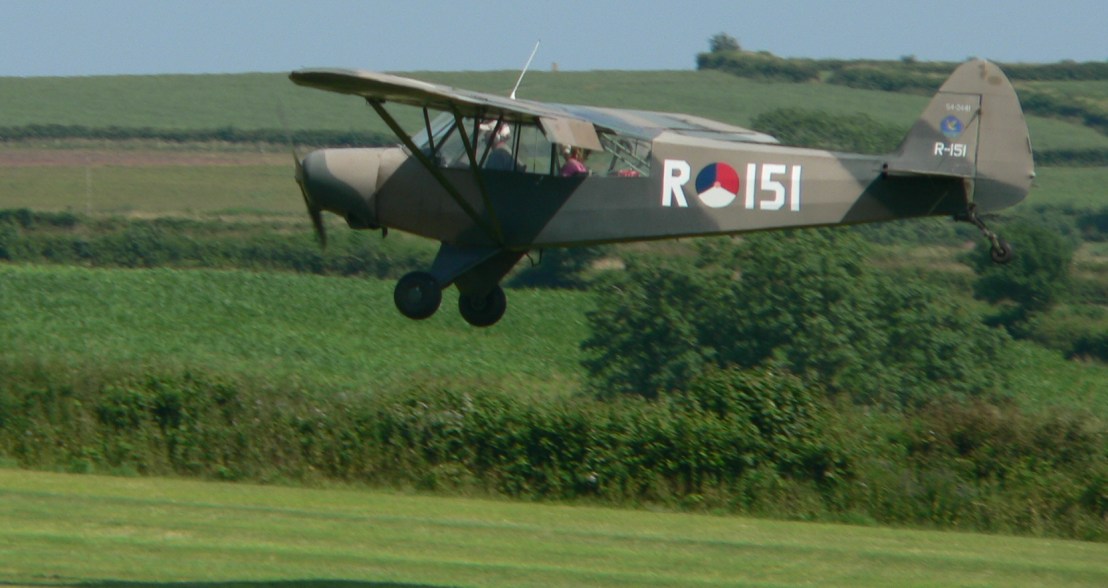
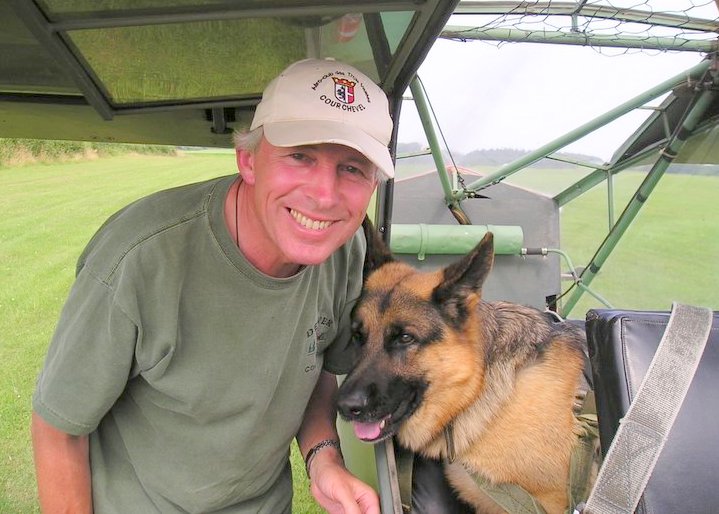
The photograph below was taken in 2006 when Pharaoh was 3 years old. The aircraft, by the way, is an L21B, the military variant of the Piper Super Cub. The aircraft was originally delivered to the Dutch Air Force in 1954 and has dispensation from the UK CAA to retain the original registration and callsign of R151.
More on the aircraft.
Originally when the post was published readers asked for more information on the aircraft.
So here it is.
Piper Super Cub, L-21B, R-151
A/C Construction No. 18-3841, Frame No. 18-3843
Original Engine, Lycoming 135 Type 0-290-D2, 54/2441
Romeo 151 was one of a batch of 298 L-21’s delivered in 1954. There were 584 L-21B’s produced by Piper for military use, the ‘L’ standing for Liaison. The L-21B’s were PA-18-135’s with civil Lycoming 0-290-D2 engines, glasswork as most L-21A’s and L-18’s and a gross weight of 1760 lbs.
This aircraft was delivered to Koninklijke Luchtmacht, Dutch Air Force, on the 1st July, 1954 and registered R-151. After various homes R-151 transferred to the Dutch civil register as PH-GER, 1st April 1976 with 4,458 hours and shortly thereafter was registered to Vlieclub Hoogeveen, Certificate Number 2380.
On the 27th March, 1981 the aircraft was delivered to the UK with a total time of 5,043 hours and in September, 1981 became G-BIYR. In April, 1983 YR was the first of type to be given a Public Transport CofA and was used for training at Tollaton. YR reverted to a Private CofA in January, 1984 when purchased by Mike and Barbara Fairclough at 5,120 hours.
In 1992 YR was re-engined with a Lycoming 150HP, 0320-A2B No. L49809-27A (zero hours). Finally on the 2nd June, 1995 the a/c was repainted in original Dutch insignia and given CAA (UK Civil Aviation Authority) permission to use the original call-sign, Romeo 151.
The aircraft is based in South Devon, England and owned by the five members of the Delta Foxtrot Flying Group.
A few photos of the aircraft.
Approaching home airfield in South Devon, EnglandFlying in the French Alps, Mt Blanc in sight9,300 ft up in the French Alps
Sometimes, one just has to hold one’s head in shame ….
… at the madness that we humans are capable of.
I included this sub-heading in the draft of this post last Thursday intending to make it Friday’s post then changed my mind. Hence the reason behind me writing in Friday’s post:
I was looking at a recent George Monbiot essay and getting myself all wound up about it, thinking that it should be today’s post. Then I thought, “Come on, Paul, end the week on a gentle tone.”
In the light of events in Paris last Friday, I had no idea how pertinent my sub-heading was!
What wound me up, so to speak, was a recent essay from George Monbiot about the damage being done to a Devon river; the River Culm. This river was known to me in the days that I lived in South Devon and had my Piper Super Cub based at Dunkeswell Airfield that was not far from the Culm.
Dunkeswell Airfield
So with no further ado, here is George Monbiot’s essay republished with Mr. Monbiot’s kind permission.
ooOOoo
Strategic Incompetence
12th November 2015
The agencies supposed to protect the living world have been neutered, and polluters and wildlife destroyers now have a free hand.
By George Monbiot, published on the Guardian’s website 12th November 2015
It could scarcely have been a starker case. The river I came across in Devon six weeks ago, and described in the Guardian, was so polluted that I could smell it from 50 metres away. Farm slurry pouring into the water, from a pipe that I traced back to a dairy farm, had wiped out almost all the life in the stretch of River Culm I explored.
All that now grew on the riverbed were long, feathery growths of sewage fungus. An expert on freshwater pollution I consulted told me that the extent of these growths showed the poisoning of the river was “chronic and severe”.
Here, as a reminder of what I saw, are some of the pictures I took:
Sewage fungus covering the river bed.
Slurry pouring from a pipe cut into the riverbank:
Slurry outfall just above the river.
And mingling with the clear water of the river:
The slurry entering the river.
I reported the pollution to the Environment Agency’s hotline. It told me it was taking the matter seriously. So when I received its report on the outcome of its investigation, I nearly fell off my chair.
It had decided to take no action against the farmer, as “the long term ecological impacts on the environment were fortunately low”. How did it know? Because there was “no evidence of a fish kill”.
Why in the name of all that’s holy should there be evidence of a fish kill? This is a chronic pollution case, not an acute one. Fish kills are what you see when a sudden poisoning occurs, as pollutants are flushed into a healthy living system. Chronic pollution deprives fish of their habitats and prey, but no investigator in their right mind would expect to see them floating belly up in the river as a result. They are simply absent from places where you would otherwise have found them.
And if a riverbed covered in nothing but sewage fungus suggests a “low” ecological impact, I dread to think what a high one looks like.
The same inability to distinguish between an acute event and a chronic one was revealed by another of the agency’s statements: the pollution “had a short term impact”. The slurry had plainly been pouring out of the pipe for months, as the luxuriant growths of sewage fungus show. It would doubtless have continued, had I not reported it.
The Environment Agency also told me that it had inspected the farm, and found no problems with the infrastructure, as there was plenty of space for slurry storage under the floor of the barn where the cows were kept. But, the problem, as I had explained to them, had nothing to do with slurry storage in the barn. It was caused by leakage from the outdoor slurry lagoons, where I found cow manure pouring down the hill.
They could scarcely have made a bigger mess of their investigation if they had tried. The mistakes the agency made are so fundamental and so obvious that it makes me wonder whether they are mistakes at all. What does a farmer have to do to get prosecuted these days, detonate an atom bomb?
If this were an isolated case, you could put it down to ineptitude, albeit ineptitude raised to the status of an Olympic sport. But responses like this are now the norm at the Environment Agency. It has been so brutally disciplined by cuts and by ministers’ demands that it leave farms and other businesses alone that it is now almost incapable of enforcement.
Even when the fish kills it appears to see as the only real proof of pollution do occur, in the great majority of cases it doesn’t even bother to assess them, let alone investigate and prosecute. Freedom of information requests by the environmental group Fish Legal reveal that the agency sent its investigators to visit just 16% of reported fish kills.
There was massive regional variation. While in the Anglian Central region, covering parts of Norfolk, Cambridgeshire and surrounding counties, the agency inspected 61% of these events, in Devon they investigated only 3%. (I suspect that it was only because I’m a journalist for a national newspaper that they came out at all in the case I reported). In the fishery areas on either side of it – Cornwall and Wessex – the inspection rate was, er, 0%. If you want to pollute rivers in these regions, there’s nothing stopping you.
The Environment Agency no longer prosecutes even some of the most extreme pollution events. In 2013, a farmer in Somerset released what the agency called a “tsunami of slurry” into the Wellow Brook. One inspector said it was the worst pollution she had seen in 17 years. But the agency dithered for a year before striking a private agreement with the farmer, allowing him to avoid prosecution, a criminal record, a massive fine and court costs, by giving £5000 to a local charity.
New rules imposed by the government means that such under-the-counter deals, which now have a name of their own – enforcement undertakings – are likely to become more common. They are a parody of justice: arbitrary, opaque and wide open to influence-peddling, special pleading and corruption.
I see the agency’s farcical investigation of the pollution incident I reported as strategic incompetence, designed to avoid conflict with powerful landowners. Were it to follow any other strategy, it would run into trouble with the government.
These problems are likely to become even more severe, when the new cuts the environment department (Defra) has just agreed with the Treasury take effect. An analysis by the RSPB and the Wildlife Trusts reveals that, once the new reductions bite, the government’s spending on wildlife conservation, air quality and water pollution will have declined by nearly 80% in real terms since 2009/10.
It’s all up for grabs now: if you want to wreck the living world, the government is not going to stop you. Those who have power, agency, money or land can – metaphorically and literally – dump their crap on the rest of us.
Never mind that the government is now breaking European law left right and centre, spectacularly failing, for example, to ensure that all aquatic ecosystems are in good health by the end of this year, as it is supposed to do under the water framework directive. It no longer seems to care. It would rather use your tax money to pay fines to the European Commission than enforce the law against polluters.
I’ve heard the same description of Liz Truss, the secretary of state for environment, who oversees the work of the Environment Agency, from several people over the past few months. “Worse than Owen Paterson”. At first, I refused to take it seriously. It’s the kind of statement that is usually employed as hyperbole, such as “somewhere to the right of Genghis Khan”, or “more deluded than Tony Blair”. But in this case, they aren’t joking. Preposterous as the notion of any environment secretary being worse than Mr Paterson might seem, they mean it.
Nowhere, as far as I can discover, in Liz Truss’s speeches or writing before she was appointed, is there any sign of prior interest in the natural world or its protection. What we see instead is perhaps the most extreme manifestation of market fundamentalism on this side of the Atlantic. She founded the Conservative Free Enterprise Group, and was co-author of the book Britannia Unchained, that laid out a terrifying vision of a nation run by raw economic power, without effective social or environmental protection. Now she has a chance to put that vision into practice.
Those who have tried to engage with her describe her as indissolubly wedded to a set of theories about how the world should be, that are impervious to argument, facts or experience. She was among the first ministers to put her own department on the block in the latest spending review, volunteering massive cuts. She seems determined to dismantle the protections that secure our quality of life: the rules and agencies defending the places and wildlife we love.
Bureaucracy and regulation are concepts we have been taught to hate, through relentless propaganda in the media. But they are essential pillars of civilisation. They make the difference between a decent society and a barbarous one.
While this essay from Monbiot clearly concerns a river in the South-West of England and may therefore not relate to readers in other parts of the UK or the world, those closing sentences [my emphasis] do relate to all of us wherever we are on this planet.
Bureaucracy and regulation are concepts we have been taught to hate, through relentless propaganda in the media. But they are essential pillars of civilisation. They make the difference between a decent society and a barbarous one.
Tomorrow, I will return to Piper Cubs flying out of Dunkeswell!
In contrast to yesterday’s post highlighting the disgusting way humans kill wildlife, today is all about humans saving life. Specifically, the life of a seven-year-old French bulldog.
I came across a news item reported by Citynews in Canada on the BBC News website. This is how the news story opened:
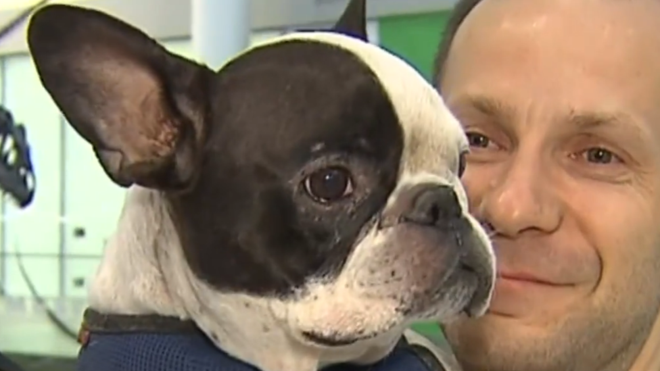
Air Canada flight diverted to save dog from freezing
16 September 2015
Picture copyright CityNews, Toronto.
An Air Canada flight was diverted after the pilot realised that a cargo hold heating unit failed, threatening the life of a pet dog.
Simba, a seven-year-old French bulldog, was riding in the cargo hold where – without heating – temperatures can become very cold at high altitude.
The Sunday flight from Tel Aviv, Israel, to Toronto, Canada, and was diverted to Frankfurt, Germany.
It was then a simple process to go to that CityNews website in Canada and read the original story. It contained these delightful messages:
With the dog’s well-being in peril the pilot decided to land the plane in Frankfurt, Germany.
Simba was placed on another flight and the plane continued on to Toronto.
The dog’s owner was more than grateful.
“It’s my dog, it’s like my child. It’s everything to me,” he said after they were reunited at Pearson Airport.
Aviation expert Phyl Durby said the pilot made the right call, despite tacking on about $10,000 in fuel costs and delaying the flight by 75 minutes.
“If you look at the outside temperature, if it’s minus 50 or 60, there is some insulation but it will probably still get down to below freezing (in the cargo area),” Durby said.
“The captain is responsible for all lives on board, whether it’s human or K-9.”
The owner of the dog, German Kontorovich, was thankful for the pilot’s rapid actions, “It’s my dog, it’s like my child. It’s everything to me,” Mr Kontorovich told the Canadian news website CityNews.
To close today’s good news story, watch the following:
Even before I met Jean back in 2007 and came out from England to be with her in 2008 (with Pharaoh), I had learnt that one of the many joys in having a dog was being able to share so much of one’s life with your loving canine companion.
Thus you will not be surprised in the slightest that walking with your dog is another joyous activity. Plus the benefit of living a few more years, as the following article from Mother Nature News illustrates.
ooOOoo
The secret to adding 7 years to your life
Hint: Get ready to lace up your sneakers.
By: Jenn Savedge, August 31, 2015
Researchers find that just 25 minutes of walking each day can trigger the anti-aging process. (Photo: Nejc Vesel/Shutterstock)
It’s easier than you might think to add another seven years to your life. Researchers have found that adding a simple 25-minute walk to your daily routine could give you several more years of healthy living.
Researchers found that participants in their 50s and 60s who took a brisk daily walk that lasted for at least 25 minutes had half the risk of dying from a heart attack than their couch-potato peers. The study, conducted at Saarland University in Germany, evaluated the health of 69 healthy non-smokers, aged between 30 and 60, who were not regular exercisers before the study began.
Participants were asked to complete various types of daily exercise — from simple aerobics to high-intensity interval training to strength training over a six-month period. Meanwhile, researchers took blood samples that allowed them to measure the increase of telomerase activity and the decrease of senescence markers, two indicators of cellular aging found in the blood. Using these measurements, researchers found that daily aerobic exercise triggers the anti-aging process.
Researchers presented their findings at the European Society of Cardiology conference with the suggestion that people add regular exercise to their daily routine to add years to their lives. They also noted that it’s never too late to start. A 70-year-old woman who has never exercised before can still gain tremendous mental and physical health benefits by adding a brisk daily walk to her routine.
Heart disease is the number one killer of men and women in the U.S. According to the Centers for Disease Control and Prevention, more than 600,000 Americans will lose their lives to the disease this year, but exercise could slash that figure in half, bringing more years to millions of Americans.
Do you have your sneakers laced yet?
ooOOoo
So there you are! Just twenty-five minutes a day with your favourite person and your favourite dog or two and you will all live forever.
Carry on sharing!
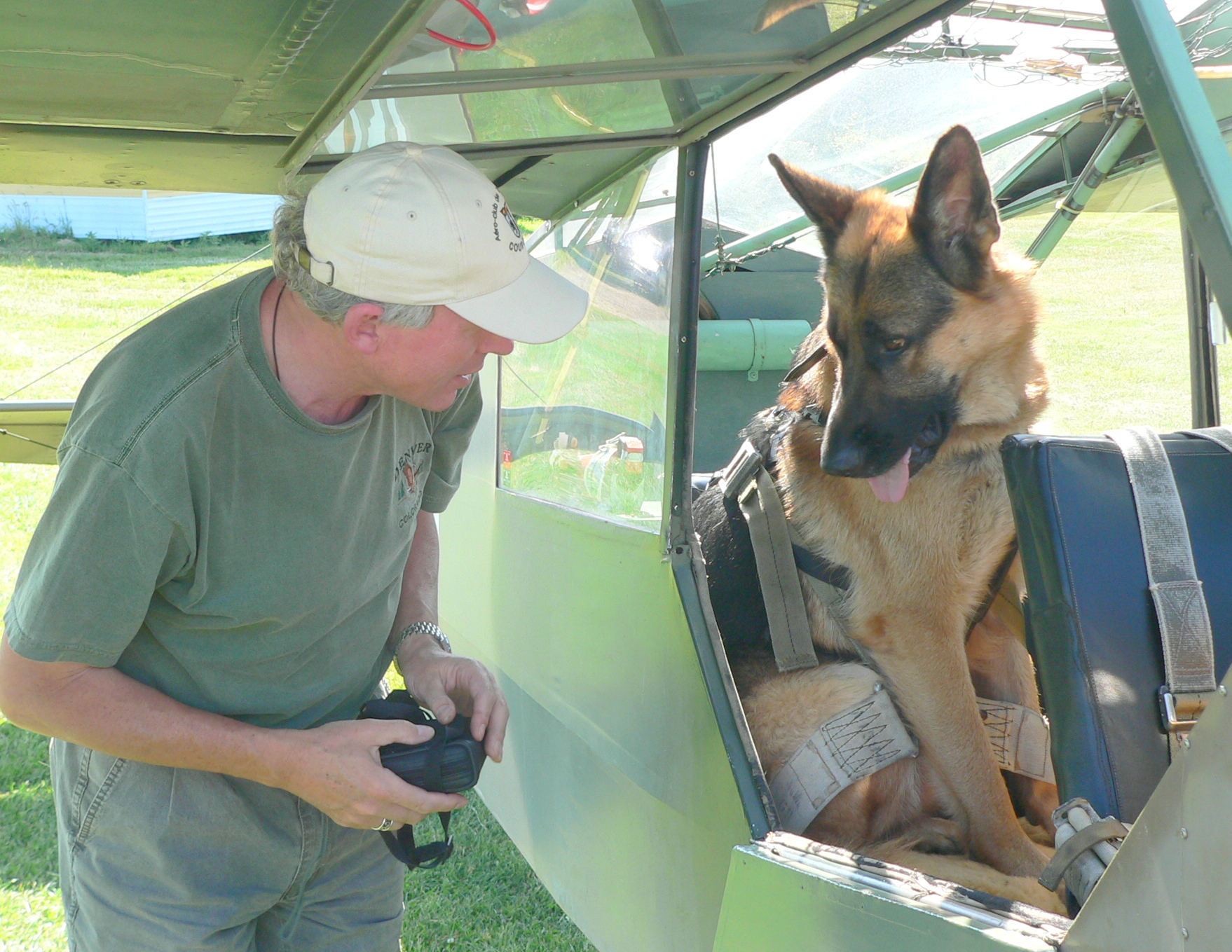
Pharaoh in the back of a Piper Super Cub back in 2002. Proving that he loved taxying around the grass airfield but I drew the line at flying – for both our sakes!
P.S. When I showed Jean this post yesterday evening she remarked that I still had, and wore at times, the same green T-shirt and cap that I featured in the photograph above some 13 years ago. I guess I’m not a fashion plate!
Pharaoh has been my dearest companion every day for these last 12 years.
I’m choosing today to recognise what Pharaoh has meant to me since I took him in my arms, both literally and emotionally, in August, 2003.
Pharaoh, nine months old.
oooo
The story of a great dog!
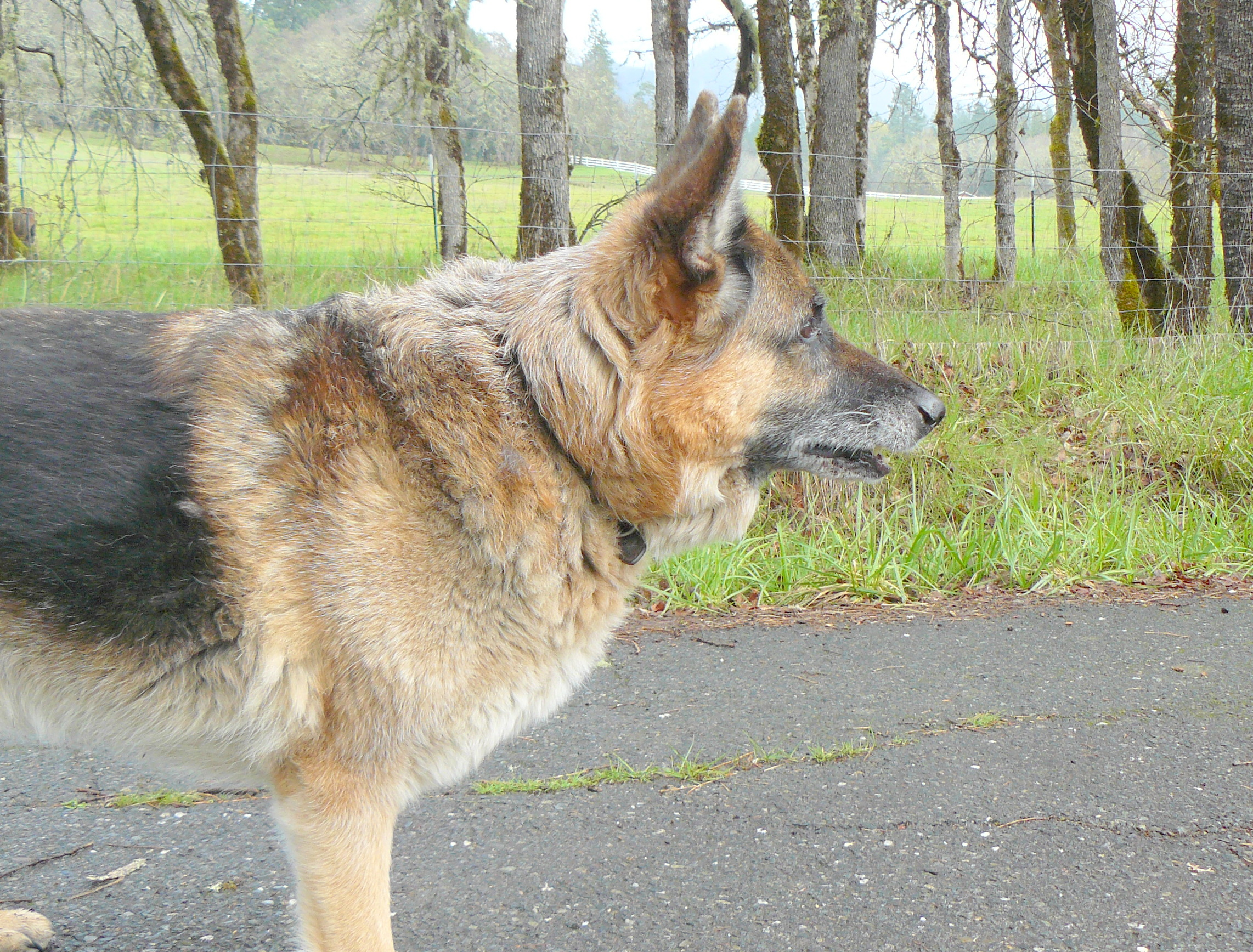
Pharaoh, as of 25th March, 2013.
The biggest, single reward of having Pharaoh as my friend goes back quite a few years. Back to when I was living in Devon, South-West England, and to the time when Jon Lavin and I used to spend hours talking together. Pharaoh was always contentedly asleep in the same room as Jon and me.
It was Jon who introduced me to Dr. David Hawkins and his Map of Consciousness. It was also Jon, who one day when looking down at the sleeping Pharaoh, pointed out that Dr. Hawkins offered evidence that dogs are creatures of integrity with a ‘score’ on that Map of between 205 and 210. (Background is here.)
So this blog, Learning from Dogs, and me writing a book of the same name flow from that awareness of what dogs mean to us humans and what Pharaoh specifically means to me. No, more than that! As a result of that mix of Jon, Dr. David Hawkins, experiencing unconditional love from an animal living with me day-in, day-out, came a journey into myself. From that journey came the self-awareness that allowed me truly to like who I was, to be openly loved by this dog of mine, and be able to love openly in return. As is said: “You cannot love another until you love yourself.”
Trying to pick out a single example of the bond that Pharaoh and I have had is practically impossible. I have to rely on photographs to remind me of the thousands of times that a simple look or touch between Pharaoh and me ‘speaks’ to me in ways that words fail. Here’s an extract from my celebration of Pharaoh’s tenth birthday in June, 2013. It perfectly illustrates the friendship bond between us.
oooo
For many years I was a private pilot and in later days had the pleasure, the huge pleasure, of flying a Piper Super Cub, a group-owned aircraft based at Watchford Farm in South Devon. The aircraft, a Piper PA-18-135 Super Cub, was originally supplied to the Dutch Air Force in 1954 and was permitted by the British CAA to carry her original military markings including her Dutch military registration, R-151, although there was a British registration, G-BIYR, ‘underneath’ the Dutch R-151. (I wrote more fully about the history of the aircraft on Learning from Dogsback in August 2009.)
Piper Cub R151
Anyway, every time I went to the airfield with Pharaoh he always tried to climb into the cockpit. So one day, I decided to see if he would sit in the rear seat and be strapped in. Pharaoh had absolutely no problem with that!
Come on Dad, let’s get this thing off the ground!
My idea had been to fly a gentle circuit in the aircraft. First, I did some taxying around the large grass airfield that is Watchford to see how Pharaoh reacted. He was perfectly behaved.
But then I thought long and hard about taking Pharaoh for a flight. In the Cub there is no autopilot so if Pharaoh struggled it would have been almost impossible to fly the aircraft and cope with Pharaoh. So, in the end, I abandoned the idea of taking him for a flight. The chances are that it would have been fine. But if something had gone wrong, the outcome just didn’t bear thinking about.
So we ended up motoring for 30 minutes all around the airfield which, as the next picture shows, met with doggie approval. The date was July 2006.
That was fun!
oooo
Moving on again. This time to another flying experience. To the day when Pharaoh and I flew out of London bound for Los Angeles and a new life with Jeannie and all her dogs (16 at that time) down in San Carlos, Sonora, Mexico. The date: September 15th, 2008. Just ten months after I had met Jean in Mexico and realised that this was the woman that I was destined to love! (Now you will understand why earlier on I described the Jon Lavin, Dr. Hawkins, Pharaoh mix as the biggest, single reward of having Pharaoh as my friend!)
There followed wonderful happy days for me and Pharaoh. It was gorgeous to see how Pharaoh became so much more a dog, if that makes sense, from having his own mini-pack around him. Those happy days taking us all forwards to Payson, AZ, where Jean and I were married, and then on to Merlin, Oregon arriving here in October, 2012.
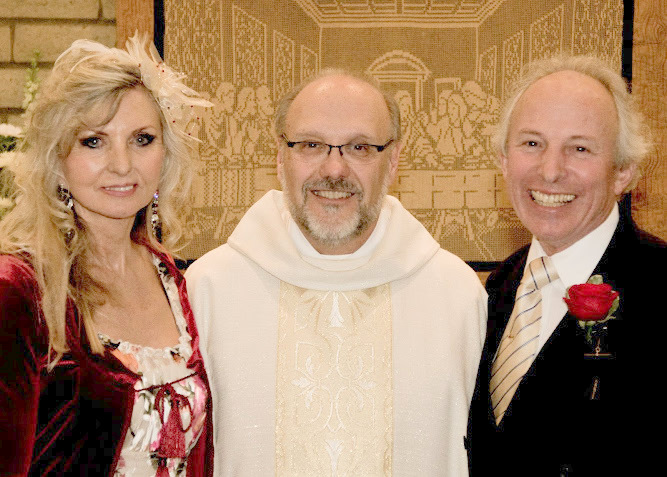
Fr. Dan Tantimonaco with the newly weds!
oooo
Pharaoh ‘married’ to his dearest friends in Oregon. December, 2013.
oooo
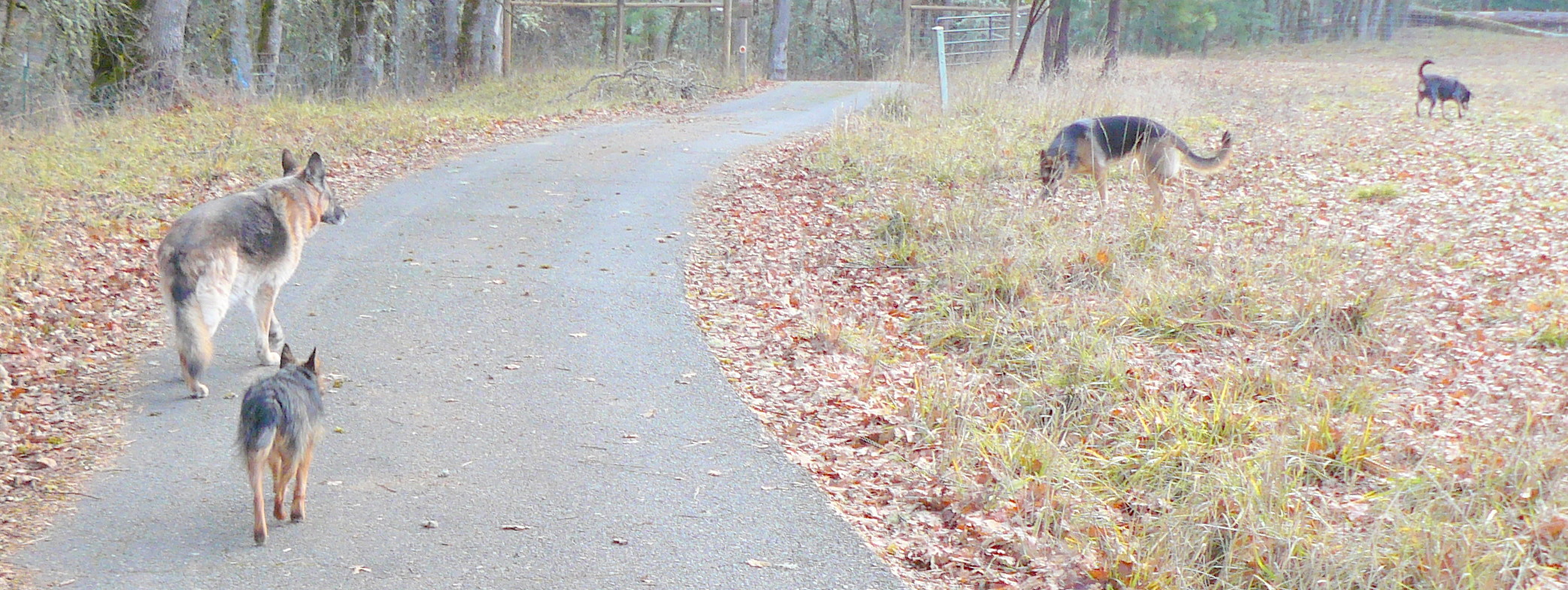
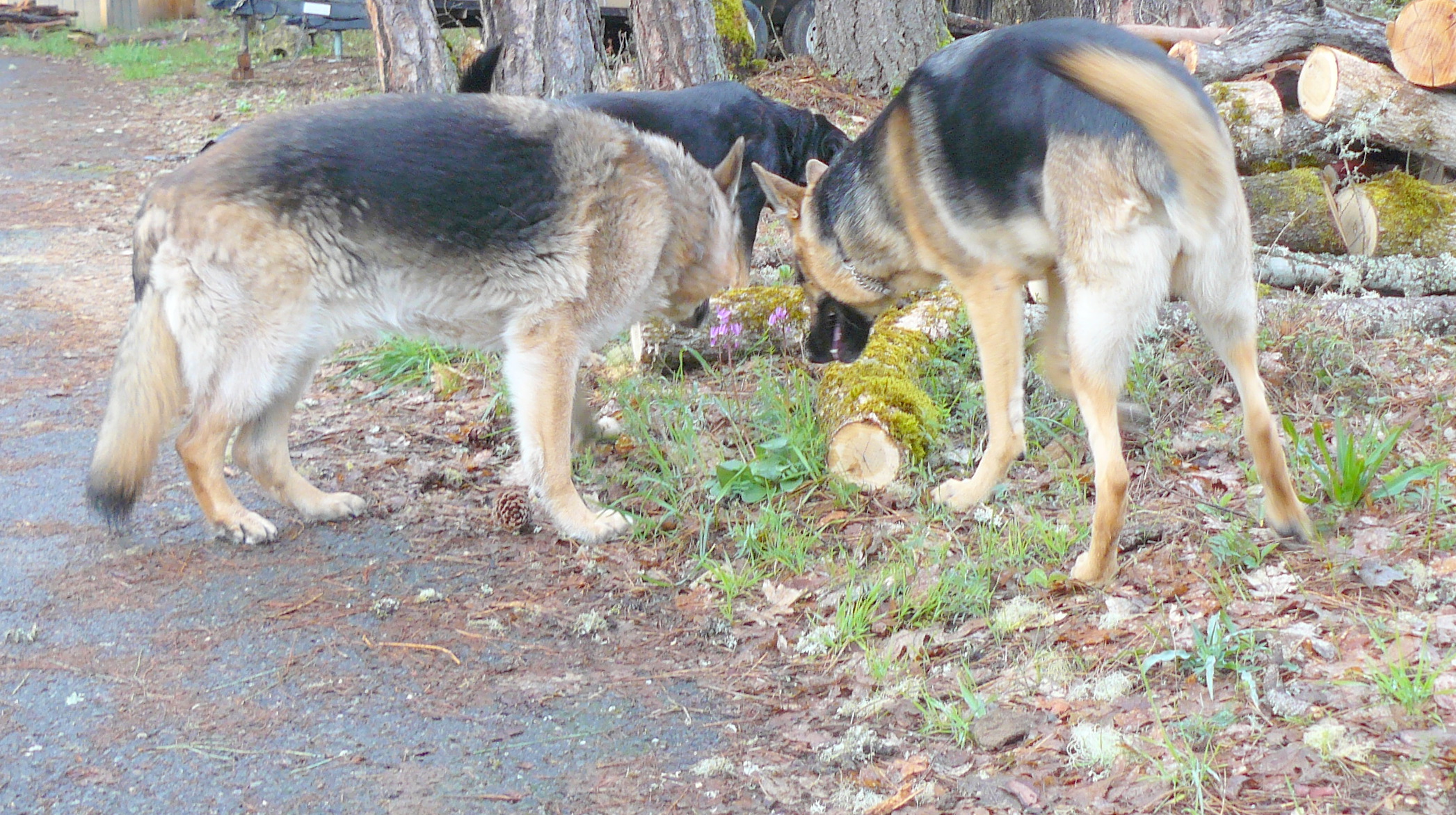
Smelling the flowers! Pharaoh and Cleo with Hazel in the middle.
I could go on! Hopefully, you get a sense, a very strong sense, of the magical journey that both Pharaoh and I have experienced since I first clasped him in my arms back in September, 2003.
Both Pharaoh and I are in the Autumn of our lives; he has just turned 12, I am now 70, and we both creak a little. But so what! Pharaoh has been my greatest inspiration of the power of unconditional love; of the need to smell the flowers in this short life of ours.
One very great animal! (March 25th, 2014)
Thank you, my dear, dear friend!
Can’t close today’s tribute without adding one last photograph of this great dog; a photograph of Pharaoh greeting Cleo, back in 2012.
First meeting between Pharaoh and Cleo; April 7th, 2012.
Nor can I close without including a quotation from the author, Suzanne Clothier:
“There is a cycle of love and death that shapes the lives of those who choose to travel in the company of animals. It is a cycle unlike any other. To those who have never lived through its turnings or walked its rocky path, our willingness to give our hearts with full knowledge that they will be broken seems incomprehensible. Only we know how small a price we pay for what we receive. Our grief, no matter how powerful it may be, is an insufficient measure of the joy we have been given.
Writing in his essay, “The Once Again Prince,” animal lover and gifted writer Irving Townsend summed it up:
We who choose to surround ourselves with lives even more temporary than our own, live within a fragile circle easily and often breached. Unable to accept its awful gaps, we still would live no other way. We cherish memory as the only certain immortality, never fully understanding the necessary plan. It is a fragile circle. But it goes round and round without end.”
Not only to the aircraft but to all the many individuals who made it happen!
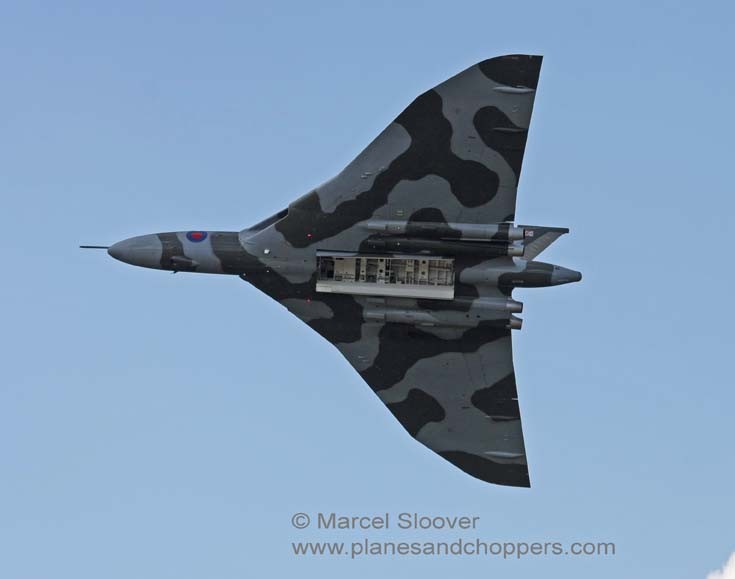
As I mentioned in yesterday’s post Nostalgia with wings, today I was going to write about a particular aircraft: The Avro Vulcan.
I chose the image above because it resonated so strongly with the comment left by Hariod Brawn that I included in yesterday’s post. Namely:
I took my father [who test-piloted the Vulcan and Victor. PH] to see Vulcan XH558 fly what was then thought to be its final flight (it subsequently was overhauled and took to the skies again). It flew along the length of the runway at a 45 degree angle with its bomb bay doors open. On the inside of the doors in huge letters was the single word ‘farewell’. It was really quite an emotional experience both for my father and myself.
There’s a lengthy item on WikiPedia about this aircraft. I will repost a couple of parts of that article.
Avro Vulcan XH558 (civil aircraft registration G-VLCN) The Spirit Of Great Britain is the only airworthy example of the 134 Avro Vulcan V bombers that were operated by the Royal Air Force from 1953 until 1985. Vulcan XH558 served with the RAF between 1960 and 1985 in the bomber, maritime reconnaissance and air-to-air refuelling roles. The RAF operated XH558 as a display aircraft from 1986 until 1992, when budget cuts forced its retirement.
It is operated by the Vulcan to the Sky Trust as a display aircraft, funded entirely by charitable donations and the UK Heritage Lottery Fund. It is registered with the United Kingdom Civil Aviation Authority as G-VLCN but has an exemption to fly in Royal Air Force markings as XH558.
Restoration to flight
The engineering staff of the Vulcan Operating Company (the engineering arm of Vulcan to the Sky Trust, owners of XH558) worked to return Vulcan XH558 to flight, with the first test flight taking place on 18 October 2007. They were supported by the “Vulcan to the Sky” club, a supporters and fundraising organisation. Though the website carried an announcement on 1 August 2006 that the project was in danger of being abandoned due to lack of finance, the target of raising the remaining £1.2m was achieved on 31 August 2006, thanks to a high-profile publicity campaign orchestrated by the supporters club, Vulcan to the Sky Club (formerly Vulcan 558 Club).
Time had almost run out for XH558 when Sir Jack Hayward, a British philanthropist, donated £500,000, which topped off the £860,000 already raised by Vulcan to the Sky Club and Friends. Although the aircraft restoration was nearly complete, the aircraft was not ready for the flypast down The Mall in London for the 25th Anniversary of the Falklands conflict on 17 June 2007 or the RAF Waddington Airshow and the Royal International Air Tattoo (RIAT).
It was intended that the Vulcan would fly during at least one UK airshow during the 2007 season, but due to delays in returning the aircraft to flight, mainly down to delays in the return of refurbished flight-critical components, the aircraft was not ready for the display season.
On 16 August 2007, the aircraft started engine testing on the airfield at Bruntingthorpe. On the next day, XH558’s No.3 Rolls-Royce Olympus 202 jet engine was run for the first time in over 20 years. This is a different engine from that used by XH558 during its final season with the RAF’s Vulcan Display Flight in 1992, with all four of the Vulcan’s original Olympus 202 engines having been replaced by zero-hour units which had been stored since 1982. The VTS Team also has another four fully inhibited engines in stock. The removed engines were either scrapped, sectioned for display or passed on to VRT’s XL426 at Southend. Another milestone in the restoration project was achieved on 22 August 2007, when all four of XH558’s Olympus engines were run at nearly full power settings, for short intervals.
The first post-restoration flight, which lasted 34 minutes, took place on 18 October 2007.
What a great project!
Now to a couple of videos. (There are many to chose from on YouTube, by the way.)
The first is a 45-minute documentary that I have only watched for the first few minutes, but it looks a good one.
and the second is much shorter but reveals to great effect the wonderful sound of the Vulcan’s engines.
Published on Oct 28, 2012
When the engines exceed 92% power, the Vulcan makes this cool howl sound.
He [my father] was an RAF pilot during the war and through to the early 1960’s. He test-piloted the Vulcan and Victor, though started on what he called ‘string bags’, by which he meant Tiger Moths. In between he flew the Spitfire, Lancaster, Meteor and specialised in flying in electrical storms, about which he wrote a manual for the RAF.
……
I took my father to see Vulcan XH558 fly what was then thought to be its final flight (it subsequently was overhauled and took to the skies again). It flew along the length of the runway at a 45 degree angle with its bomb bay doors open. On the inside of the doors in huge letters was the single word ‘farewell’. It was really quite an emotional experience both for my father and myself.
I thought it would be nice to include some video of XH558; that will be tomorrow’s post. For today, I wanted to reminisce from my own private flying days.
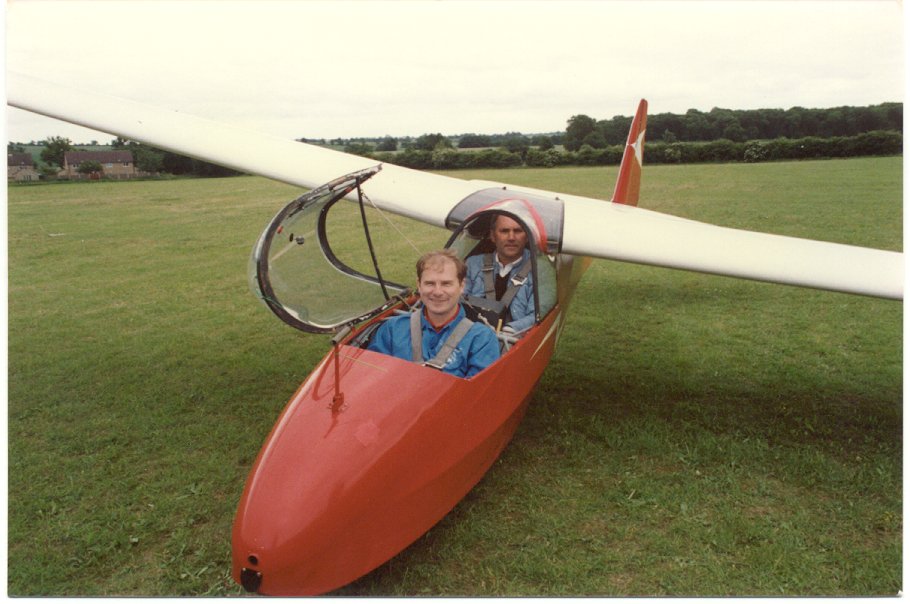
A K-7 two-seat glider.
My first exposure to private flying was on the 7th June, 1981 when, at Rattlesden Gliding Club in Suffolk, I was taken up for two air-experience circuits in a two-seater glider known as a ‘K7’. I was immediately hooked! Those experience flights leading to a 4-minute flight (flight number 46) on the 6th September, 1981 that has the remark in my pilot’s log book: Solo! Now fast forward to October, 1984 and my log book shows me attending a gliding instructor’s course at Lasham, resulting in me being issued with a British Gliding Association (BGA) Assistant Instructor Rating on the 14th October. (105/84).
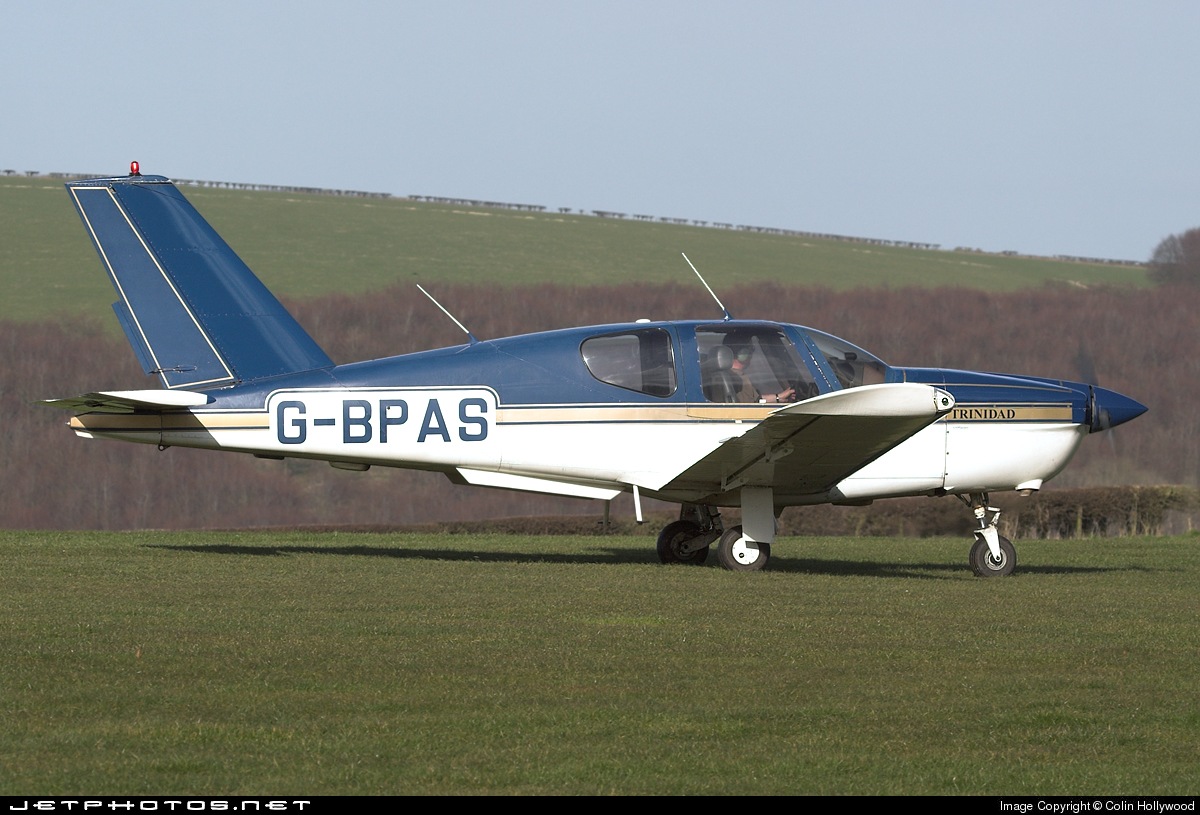
Over on the power side of things, in March, 1984, I started Private Pilot training at the Suffolk Aero Club at Ipswich Airport and gained my PPL on the 9th November, 1984. Subsequently, gaining my Instrument Rating in July, 1999 when I was then operating from Exeter Airport and flying frequently for business purposes. For that ‘serious’ flying I used a Socata TB20, a French retractable, single-engined aircraft, based at Exeter. A very fine, long-distance aircraft.
TB20, G-BPAS, photographed at Compton Abbas airfield (EGHA).
But the aircraft that I had the most fun flying was a dear old Piper Super Cub. Here’s the background to the aircraft.
Piper Super Cub, L-21B, R-151
A/C Construction No. 18-3841, Frame No. 18-3843
Original Engine, Lycoming 135 Type 0-290-D2, 54/2441
Romeo 151 was one of a batch of 298 L-21’s delivered in 1954. There were 584 L-21B’s produced by Piper for military use, the ‘L’ standing for Liaison. The L-21B’s were PA-18-135’s with civil Lycoming 0-290-D2 engines, glasswork as most L-21A’s and L-18’s and a gross weight of 1760 lbs.
This aircraft was delivered to Koninklijke Luchtmacht, Dutch Air Force, on the 1st July, 1954 and registered R-151. After various homes R-151 transferred to the Dutch civil register as PH-GER, 1st April 1976 with 4,458 hours and shortly thereafter was registered to Vlieclub Hoogeveen, Certificate Number 2380.
On the 27th March, 1981 the aircraft was delivered to the UK with a total time of 5,043 hours and in September, 1981 became G-BIYR; ‘YR’. In April, 1983 YR was the first of type to be given a Public Transport CofA (Certificate of Airworthiness) and was used for training at Tollaton. YR reverted to a Private CofA in January, 1984 when purchased by Mike and Barbara Fairclough. The aircraft had by then accumulated 5,120 hours.
In 1992, YR was re-engined with a Lycoming 150HP, 0320-A2B No. L49809-27A (zero hours). Finally on the 2nd June, 1995 the aircraft was repainted in her original Dutch insignia and given CAA (UK Civil Aviation Authority) permission to use the original call-sign: Romeo 151.
The aircraft was based at and flown from Watchford Farm airstrip in South Devon, England.
Now forgive the nostalgic photographic memories!
Yours truly approaching Watchford Farm airstrip in South Devon, EnglandFlying in the French Alps with Mont Blanc in sight9,300 ft up in the French Alps!
Every time I went to the airfield with Pharaoh he always tried to climb into the cockpit. So one day, I decided to see if he would sit in the rear seat and be strapped in. As the next picture shows, there was absolutely no problem with that!
Come on Dad, let’s get this thing off the ground!
My idea had been to fly a gentle circuit in the aircraft. First, I did some taxying around Watchford’s large grass airfield to see how Pharaoh reacted. He was perfectly behaved.
But then I thought long and hard about taking Pharaoh for a flight. In the Piper Cub there is no autopilot so if Pharaoh struggled or became agitated it would have been almost impossible to fly the aircraft and cope with Pharaoh sitting in the seat behind me. So, in the end, I abandoned the idea. The chances are that it would have been fine. But if something had gone wrong, the outcome just didn’t bear thinking about.
Thus we elected for taxying all around the airfield which, as the next picture shows, met with full doggie approval. The date was July 2006.
That was fun!
So enough of my recollections for today – tomorrow the Vulcan XH558.
(and trust me, it’s highly watchable even for non-aviation bods!)
Dan Gomez recently sent me a link to a news item and video of a quite extraordinary formation flight. It concerns the fleet of five development A350 XWB development aircraft.
The Airbus A350 XWB
This picture was taken from a Press Release in 2013 on the Airbus website announcing the first flight:
14 June 2013
A new chapter has opened in Airbus’ 43-year history as the first A350 XWB, the world’s most efficient large twin-engined commercial aircraft, powered aloft this morning for its maiden flight at Blagnac in Toulouse, France at 10.00 hours local time. Equipped with Rolls-Royce Trent XWB turbofans, the A350 XWB first flight is taking place over south-western France.
An international crew of six is on board, comprising two Flight Test Pilots, one Test Flight Engineer and three Flight Test Engineers. At the controls of the A350 XWB’s first flight are Peter Chandler, Airbus’ Chief Test Pilot, and Guy Magrin, Project Pilot for the A350 XWB. Accompanying them in the cockpit is Pascal Verneau, the A350 XWB Project Test Flight Engineer. At their flight test stations in the main aircraft cabin and monitoring the progress of the flight via an extensive array of flight test instrumentation are the three flight test engineers: Fernando Alonso, Head of Airbus Flight & Integration Test Centre; Patrick du Ché, Head of Development Flight Tests; and Emanuele Costanzo, lead Flight Test Engineer for the Trent XWB engine.
This first flight marks the beginning of a test campaign totaling around 2,500 flight hours with a fleet of five development aircraft. The rigorous flight testing will lead to the certification of the A350-900 variant by the European EASA and US FAA airworthiness authorities, prior to entry into service in the second half of 2014 with first operator Qatar Airways.
Anyway, moving on to the video. Here it is:
Published on Dec 2, 2014
The five test and development A350-900s took to the skies for a formation flight in September 2014, bringing together all of the aircraft used for Airbus’ successful campaign leading to certification of this latest Airbus wide-body jetliner.
(Interesting to note that the video has already been watched approaching 1.7 million times!)





 Learning from Dogs