(And, please, make a note of my final remark at the end of today’s post.)
Those who are regular visitors to this place will know that John Zande, who lives in Brazil, is a good friend, and, for that matter, I try to be a good friend of his place. (If you didn’t read my recent review of John’s latest book On The Problem of Good then it is here.)
So when a couple of days ago I received the following email from John you can imagine my positive response to his request.
Paul, hi, I have a favour to ask.
My wife’s sister, Dee (who lives in Australia) has started a gofundme campaign to help cover a rash of vet surgery bills we’ve had recently. These past few months (most of summer, really) has been appalling with the number of dumped animals in our area.
Together with a few other people in our loose group we rescued about ten and got them adopted out to good homes. Plus, we have three in temporary shelters as we nurse them back to health. We took one into our house, Nina, thus making eleven here now, who had her tail amputated last Tuesday. We were fortunate in that our vet worked for free (a 3hr operation) and only charged us for the anesthetist.
We’re lucky to have these wonderful people around, but we’re a tad snowed under right now with the accumulated surgeries and medicines, which is why Dee started this little campaign.
Now there was no question that Jean and I wanted to help. Not only by making a modest donation ourselves but by promoting Dee’s campaign. I emailed a reply to John saying just that.
John then responded with more details, including some photographs:
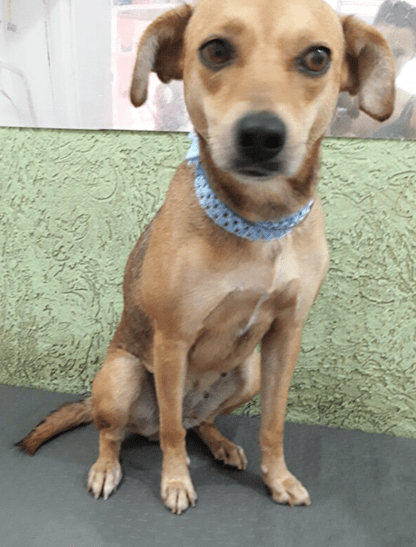
Dee is married to a very good friend of mine from Uni. She started this campaign to help Dionete, my wife, and I (and if possible a few other Vista Verde folk who’re in our rescue network) here in Brazil. Dee was here just before Christmas and saw the problem first hand. She actually helped us rescue a wonderful little fellow, Terrorista, who now lives a few streets away with a wonderful family.
I didn’t know, but Dionete was chatting to her a week or two ago and it came up just how many vet/surgery/medicine expenses we’d accumulated over the summer. Without either of us knowing, she, Dee, then started this gofundme campaign to lend a hand and help clear the vet bills. We’re not an NGO (we actually help four here in Sao Jose dos Campos, two in Sao Paulo, and Sandra’s Maxmello in another city south of Sao Paulo). Because we’re not an NGO we’ve never thought about doing a campaign ourselves, so was surprised when Dee started this one. It’s quite modest, $1,000 Australian dollars (the goal) converted to Brazilian Reis will make a sizable dent in our backlog of vet surgery bills. Our bills are tiny compared to a guy we know who does have an NGO and owes his network of vets 90,000. He’s a wonderful fellow and I’m actually working with him to try and get a mobile neutering unit started here in Sao Jose dos Campos. But that’s another story. So, to be clear, the campaign is for us here in Vista Verde, which is sadly a dumping ground for animals. Surrounding districts seem to think we’re all wealthy here and therefore they can dump their animals. It’s infuriating, and the animals never stop coming.
I am sure that Jean and I aren’t the only ones that want to help.
And John could offer no better reason for seeking some financial support from the wider world. Here’s some of his later email:
My apologies if there was some confusion. I’m actually heading out right now to feed a new fellow I found a few days ago and is sleeping outside a house in another district. When I get back I’ll send some more photos, OK.
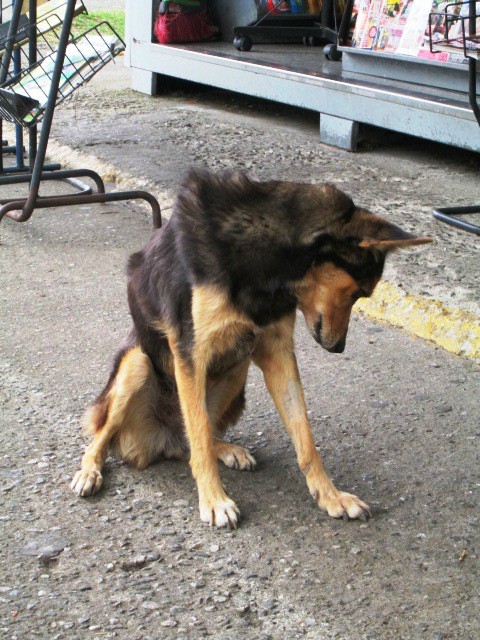
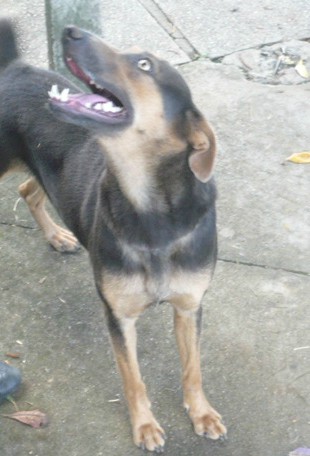
Let me close with some more photos of dogs that have been helped by John, Dionete and the rest of the great band of the Vista Verde Fund.
oooo
oooo
oooo
Finally!
Please offer whatever you can to help. Even the smallest amount makes a real difference.
April 17, 2017 — Party Animal, Inc. has announced it is recalling specific lots of two varieties of its Cocolicious canned dog foods because they have each tested positive for the euthanasia drug, pentobarbital.
What’s Being Recalled?
The following products are affected by the recall:
Cocolicious Beef and Turkey
Size: 12 ounce cans
Lot Number: 0136E15204 04
Best By Date: July 2019
Cocolicious Chicken and Beef
Size: 12 ounce cans
Lot Number: 0134E15 237 13
Best By Date: August 2019
What Caused the Recall?
According to a statement posted on the company’s website and its Facebook page:
The safety of pets is and always will be our first priority. We sincerely regret the reports of the discomfort experienced by the pet who consumed this food.
As pet parents ourselves, we take this matter seriously.
On April 13, a retailer in Texas notified us that their customer had presented samples of our Cocolicious Beef and Turkey Lot #0136E15204 04 and Cocolicious Chicken and Beef Lot #0134E15 237 13 to a testing lab, and that the results had tested positive for pentobarbital.
We have requested those results.
When we were notified, we immediately tracked the lot numbers of the food in question and determined that the food had been manufactured and distributed in 2015.
We then contacted the two probable retailers that had sold the customer the food and asked them to isolate all remaining cans from these lots.
We also requested that the retailers send all of the cans from those lots to us so that we can forward them on to an accredited independent laboratory for independent testing.
We expect to receive the receive the results in 7 to 10 days.
We first saw the formal report from the lab at Texas A&M regarding the customer’s samples, today, April 17.
Out of an abundance of caution, we are retrieving the remainder of these two lots nationwide.
We are working with our distributors and retailers to determine if any additional beef-flavored products manufactured during this 2015 production period remain on shelves and, if so, to retrieve them from shelves, immediately, as well.
What to Do?
Consumers with questions may contact the company by phone at 855-727-8926 or by email at info@partyanimalpetfood.com.
U.S. citizens can report complaints about FDA-regulated pet food products by calling the consumer complaint coordinator in your area.
Offering up a tribute to the work of a professional.
Many, many years ago when I was in business on my own account (1978-1986) I had the pleasure of getting to know Frank Tijou. He was running his own very successful business. But more important than that, Frank had this wonderful ability to explain what he had learned over his years of being an entrepreneur. One such learning was stick to what you really know and don’t try and do things that are best left to other professionals. In other words, don’t be an amateur when it comes to important matters.
Thus when some weeks ago I was strongly recommended by some local authors to have an author website, I looked around for a professional. I quickly came to find Christy Kiltz of Design! by Kiltz Internet Solutions.
Talk about finding a true professional.
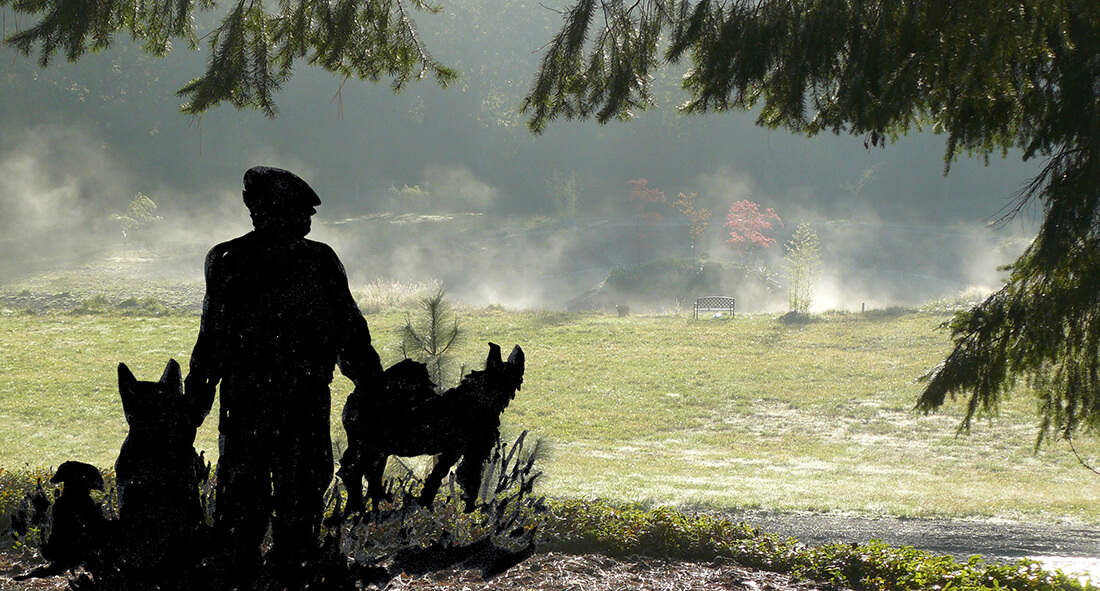
Forgive me, I’m not coming at this in terms of an ego trip. I just want to promote what a wonderful job Christy did. (And not forgetting Emily’s grand design work.) (And most certainly not forgetting my darling Jeannie who did the image of the man in a flat cap with the dogs!)
Natalie returns with her second travel installment.
Almost a month ago, the 18th March to be exact, I introduced Natalie Derham-Weston:
Those who take a close interest in this place (you poor, lost souls!) will have noticed from time to time me posting items that have been sent to me by Bob Derham. He and I first met when we were both based in Larnaca, Cyprus in the late 80’s/early 90’s and we have remained good and close friends ever since.
Natalie is Bob’s beautiful daughter and recently contacted me to ask if she might offer a guest post on her traveling experiences. Natalie has ambitions to be a travel writer and, as you are about to see, would make an excellent one.
On that day Natalie presented the first installment of her travel blog. It was very well received by you good people. Many of you left great comments.
Thus it is with great pleasure that I present Natalie’s next travel installment.
ooOOoo
Travel Blog: Installment 2: Laos
After having set the standard so high in Thailand, there was a lot riding on our following section of the journey. However before moving on to Laos, the logical next step and easiest route to take, we had a few metaphorical “bridges” to cross. Looking back, the process seems an enormous chore but at the time we didn’t question the operation. Although tiredness did sometimes set in heavily, Hannah and I had to mentally overcome this and remind ourselves how this beat office day jobs hands down.
Our last evening in Thailand was spent in Chang Mai. After some deliberation and consulting of maps and Google facilities, we booked a slow boat trip down to Mekong to take us into Laos. The evening was then free to be spent at our leisure. Pre-travelling I was naïve, and perhaps still am. Though even I had heard tell of the Thai “lady boys” and we had the greatest pleasure of spending an afternoon in their company after having looked lost and forlorn at a cross roads and took up their offer of a pool side beer. They spoke openly about their choice to change gender and what they had to undergo. This meeting was purely circumstantial but very memorable all the same. After this curious incident we caught up in town with a friend I had been to school with in South Africa. Carmen was in Thailand teaching English and had an evening to spare, which was such a lovely chance to assemble and to chew the fat as some may say.
On our wander back to our hostel we happened to bump into Nadine, a girl we had met previously on an overnight train. This is one of my most favourite parts of travelling, crossing paths with friends, having had no plans and no inkling of the others location.
The following morning consisted of some organising, dollars had to be sourced for the Laos border and check out was an early evacuation, drying our towels on the outside of our bags and heaving them downstairs to be left for the later pickup. In the meantime, we bought up some supplies to support us through the epic bus journey that we had to embark upon that afternoon. Fortunately, these snacks barely amounted to anything, and certainly made a welcome change to our expensive sandwiches and bottles of water back in the UK!
Our bus was a 7 hour journey, taking us through minute villages and stopping at temples along the way. One in particular stood out, which was pure white. The only colour was a singular red nail on a hand protruding from a statue of swarming limbs surrounding the building.
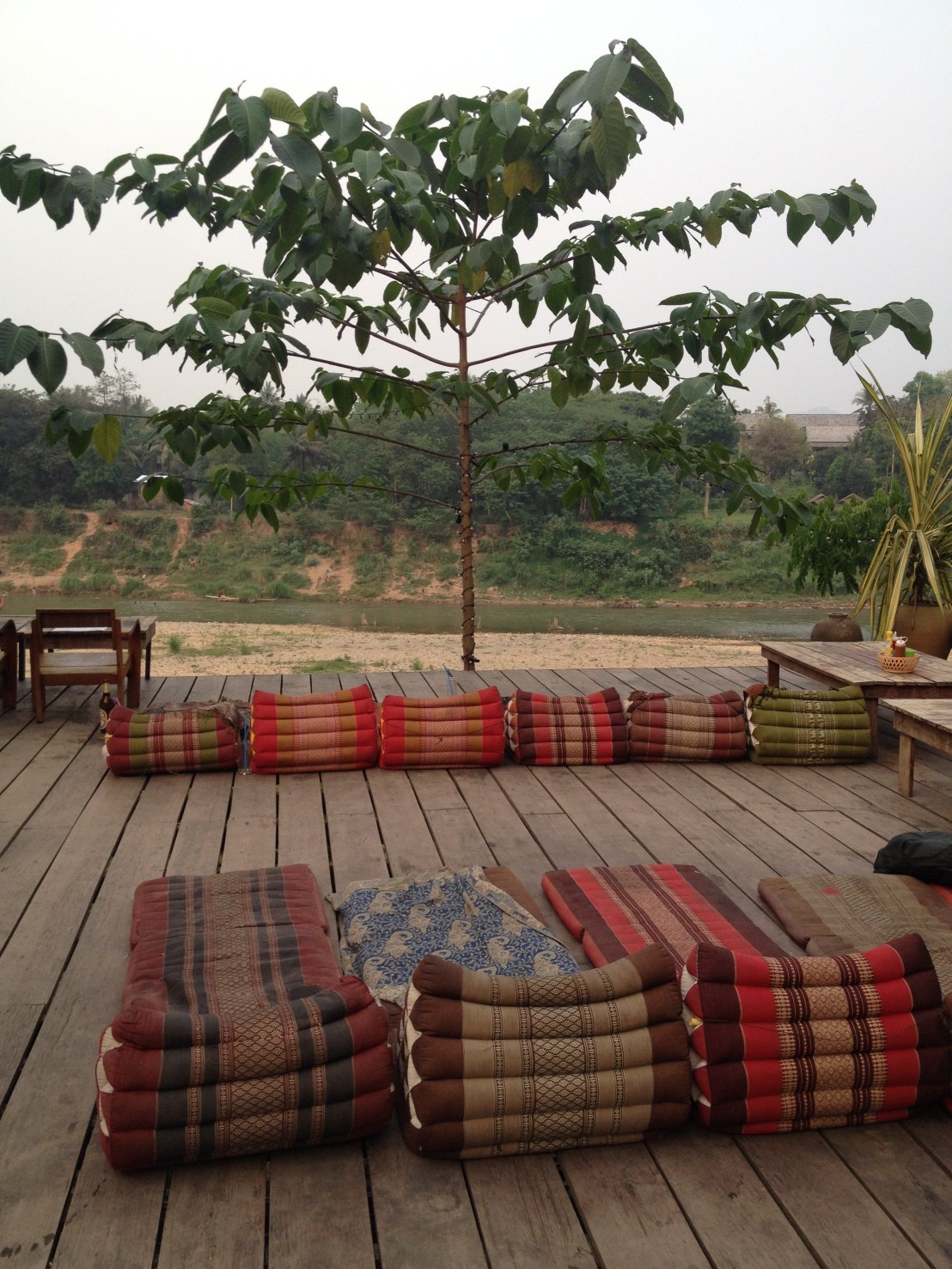
That night was our first sighting of the vast Mekong, a fast flowing murky, brown mass of water with grassy banks and elephants grazing alongside. Children were running down to the shore to bathe and play and generally splash around as much as was possible.
Our accommodation had been part of the ticket and so was basic to say the least. Dinner went untouched due to the extensive family of flies feasting on it. In the morning, the pre stated time of 8:30 got blown out the window and there was a quick panic to depart at 8. After yet more busses, there was a process in place at the border for visa stamps and signing of papers. The long queues were hot and felt much longer than they probably were.
At another stop we convened with a load of other tourists. At this point it dawned on us that neither Hannah nor I had any local currency, which was apparently an issue. So the solution to this was for me to jump on the back of a bike belonging to a tour guide within the group and find the nearest ATM and hope for the best. I sauntered back with 500,000 kip, the equivalent of about £50, and felt very wealthy! 12 of us were stuffed into an open tuktuk, with our bags precariously perched on top and sent down a steep slope to a load of boats tied up, surrounded by pigs in baskets, goats running lose and a huge swarm of blue butterflies milling around the general vicinity.
Nobody seemed able to direct us to the correct boat so after half an hour of debating and questioning, we finally got some sense out of someone and all started to engross ourselves into a comfortable fashion on a long boat. The seats had previously been in a minibus by the looks of them but made for a relatively pleasant crossing. We exhausted every possible game we could think of, including eye spy and cards and took to gazing out the open windows at the scenery, with our legs dangled over the side, dozing in the sun.
Late afternoon time saw us arriving at our overnight spot, a very small village, running solely on the likes of us, temporary tourists. Our newly made friends were mainly from Europe and we stuck together choosing a hostel on the hillside and later all enjoyed a joint dinner out. I remember this being 79,000 kip = £6.50 and what I thought was fantastic value! The shower back at the hostel was nonexistent so I made do with crouching underneath an outside tap arrangement. As it was Easter Sunday, I took some time to have a phone call back home and caught up on the news of England.
The next day entailed an 8 hour boat journey further down the Mekong into the town of Luang Prabang. Still in our group, we found a local bus into the main high street and found our hostel. We ended up in a mixed dorm with a Japanese man we had shared a bus with a few days prior, who made us endless origami frogs, two Dutch girls we had met in Pai and some others from the boat.
We had a quick nap and were out again that evening to try out the local foods and to witness the night market. I added to my collection of foreign art work with a bright Buddha head painting and some more elephant trousers. These really are the way forward, they are light, don’t crease, are breezy and make long journeys far more pleasurable. The food stalls were a sight to behold, full of black eggs, chicken intestines, heads and feet so I opted for some fresh looking fruit. Later we sat as a huge group at a popular bar called Utopia and as happens when travelling, skipped the polite introductions and befriended each other quickly. This is another part of the whole “travel” life that I appreciate. Nobody judges on mundane things that don’t matter, people just seem to mould more easily and quicker.
In the next couple of days we visited waterfalls and woke up at 5 am to witness the “Giving of Alms”. This is a procession of monks who come to receive gifts of food. We found bookshops and read on recliners overlooking the Mekong. It felt like a world away from parents and friends back home.
Collectively, our group made the decision to bus to Vang Vieng shortly after. The main attraction of this town is “tubing”, an activity for the brave and resilient. An all day drinking marathon down the river in rubber rings. I can’t deny, it was fun. The weather was glorious, and everybody was in good spirits. At each stop down the river, we were pulled in by event staff and were given bracelets (this became an obsession with some of us over our travelling time. Some sort of victorious achievement was to have as many travel bracelets as possible.)
The quick interlude in this popular backpacker location included much watching of ‘Friends’, a tradition even cited in the Lonely Planet books. Although after a couple of days, we craved some more brain stirring activities and more cultural action. So again, we took a bus to Vientiane, the capital of Laos, holding up the piles of bags in the back of the bus and awaited our next mode of transport into our next country…
ooOOoo
Please, all of you, wherever you are, have a wonderful weekend.
Humanity’s safe and viable future depends on seeing things very differently.
Next Tuesday is the 62nd anniversary of the death of Albert Einstein, the famous German theoretical physicist who died on the 18th April, 1955. He delivered many innovative ways of seeing our world way beyond his theory of relativity, one of the two pillars of modern physics (alongside quantum mechanics) (Ref: Wikipedia)
Why do I introduce today’s post with that reference to Mr. Einstein?
Because I wanted to share with you a recent essay from George Monbiot and an Einstein quotation seemed so apt an introduction.
We shall require a substantially new manner of thinking if mankind is to survive.
That essay from George Monbiot was published yesterday and is shared with you all with Mr. Monbiot’s full permission.
It is an essay that deserves being read slowly and carefully. Please take time aside to so do because it really does offer a new manner of thinking.
ooOOoo
Circle of Life
13th April 2017
By reframing the economy, Kate Raworth’s Doughnut Economics changes our view of who we are and where we stand.
By George Monbiot, published in the Guardian 12th April 2017
So what are we going to do about it? This is the only question worth asking. But the answers appear elusive. Faced with a multifaceted crisis – the capture of governments by billionaires and their lobbyists, extreme inequality, the rise of demagogues, above all the collapse of the living world – those to whom we look for leadership appear stunned, voiceless, clueless. Even if they had the courage to act, they have no idea what to do.
The most they tend to offer is more economic growth: the fairy dust supposed to make all the bad stuff disappear. Never mind that it drives ecological destruction, that it has failed to relieve structural unemployment or soaring inequality, that, in some recent years, almost all the increment in incomes has been harvested by the top 1%. As values, principles and moral purpose are lost, the promise of growth is all that’s left.
You can see the effects in a leaked memo from the UK’s foreign office: “Trade and growth are now priorities for all posts … work like climate change and illegal wildlife trade will be scaled down.” All that counts is the rate at which we turn natural wealth into cash. If this destroys our prosperity and the wonders that surround us, who cares?
We cannot hope to address our predicament without a new worldview. We cannot use the models that caused our crises to solve them. We need to reframe the problem. This is what the most inspiring book published so far this year has done.
In Doughnut Economics: seven ways to think like a 21st-century economist, Kate Raworth reminds us that economic growth was not, at first, intended as a measurement of well-being. Simon Kuznets, who standardised the measurement of growth, warned: “the welfare of a nation can scarcely be inferred from a measure of national income.” Economic growth, he pointed out, measures only annual flow, rather than stocks of wealth and their distribution.
Raworth points out that economics in the 20th Century “lost the desire to articulate its goals.” It aspired to be a science of human behaviour: a science based on a deeply flawed portrait of humanity. The dominant model – “rational economic man”, self-interested, isolated, calculating – says more about the nature of economists than it does about other humans. The loss of an explicit objective allowed the discipline to be captured by a proxy goal: endless growth.
The aim of economic activity, she argues, should be “meeting the needs of all within the means of the planet.” Instead of economies that need to grow, whether or not they make us thrive, we need economies that “make us thrive, whether or not they grow.” This means changing our picture of what the economy is and how it works.
The central image in mainstream economics is the circular flow diagram. It depicts a closed flow of income cycling between households, businesses, banks, government and trade, operating in a social and ecological vacuum. Energy, materials, the natural world, human society, power, the wealth we hold in common: all are missing from the model. The unpaid work of carers – principally women – is ignored, though no economy could function without them. Like rational economic man, this representation of economic activity bears little relationship to reality.
So Raworth begins by redrawing the economy. She embeds it in the Earth’s systems and in society, showing how it depends on the flow of materials and energy, and reminding us that we are more than just workers, consumers and owners of capital.
The Embedded Economy. Graphic by Kate Raworth and Marcia Mihotich
This recognition of inconvenient realities then leads to her breakthrough: a graphic representation of the world we want to create. Like all the best ideas, her Doughnut model seems so simple and obvious that you wonder why you didn’t think of it yourself. But achieving this clarity and concision requires years of thought: a great decluttering of the myths and misrepresentations in which we have been schooled.
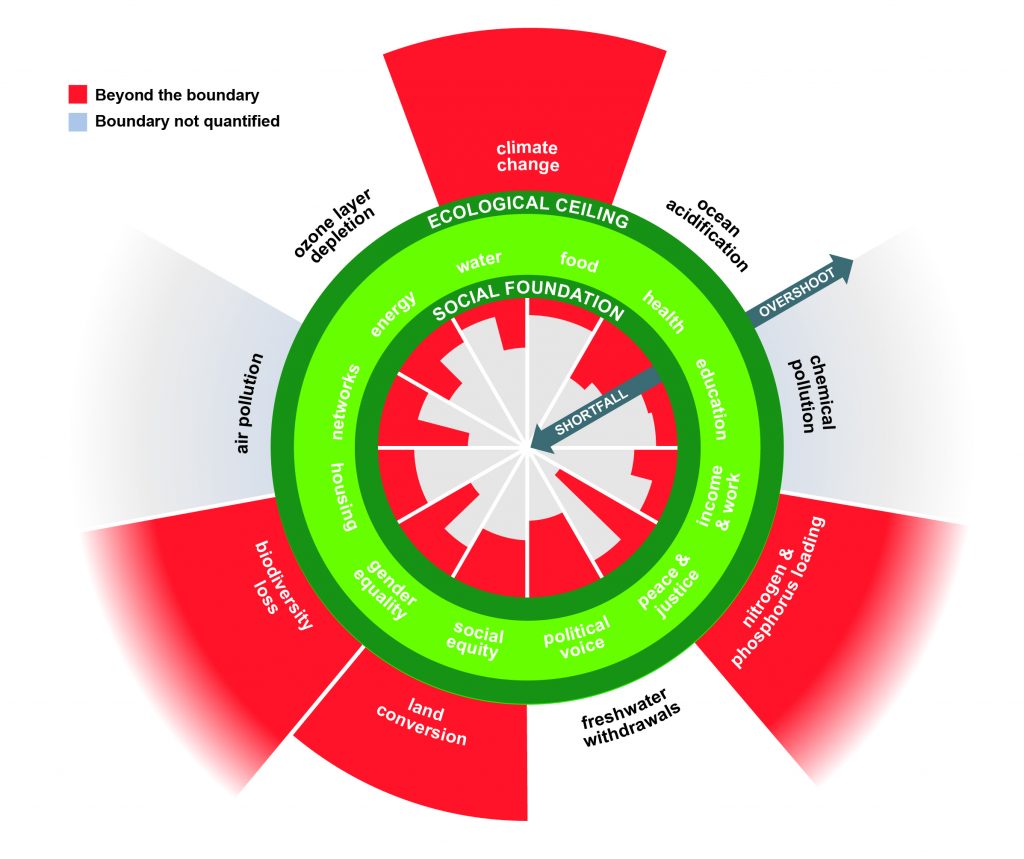
The diagram consists of two rings. The inner ring of the doughnut represents a sufficiency of the resources we need to lead a good life: food, clean water, housing, sanitation, energy, education, healthcare, democracy … . Anyone living below that line, in the hole in the middle of the doughnut, is in a state of deprivation.
The Doughnut. Graphic by Kate Raworth and Christian Guthier/The Lancet Planetary Health
The outer ring of the doughnut consists of the Earth’s environmental limits, beyond which we inflict dangerous levels of climate change, ozone depletion, water pollution, loss of species and other assaults on the living world. The area between the two rings – the doughnut – is the “ecologically safe and socially just space” in which humanity should strive to live. The purpose of economics should be to help us enter that space and stay there.
As well as describing a better world, the doughnut model allows us to see, in immediate and comprehensible terms, the state in which we now find ourselves. At the moment we transgress both lines. Billions of people still live in the hole in the middle. We have breached the outer boundary in several places.
Where we are now. Graphic by Kate Raworth and Christian Guthier/The Lancet Planetary Health
An economics that helps us to live within the doughnut would seek to reduce inequalities in wealth and income. Wealth arising from the gifts of nature would be widely shared. Money, markets, taxation and public investment would be designed to conserve and regenerate resources rather than squander them. State-owned banks would invest in projects that transform our relationship with the living world, such as zero-carbon public transport and community energy schemes. New metrics would measure genuine prosperity, rather than the speed with which we degrade our long-term prospects.
Such proposals are familiar, but without a new framework of thought, piecemeal solutions are unlikely to succeed. By rethinking economics from first principles, Raworth allows us to integrate our specific propositions into a coherent programme, and then to measure the extent to which it is realised. I see her as the John Maynard Keynes of the 21st-Century: by reframing the economy, she allows us to change our view of who we are, where we stand, and what we want to be.
Now we need to turn her ideas into policy. Read her book, then demand that those who wield power start working towards its objectives: human prosperity within a thriving living world.
I wish I understood where my fascination with the night sky came from. Not that I am anything other than an amateur gazer (of the night sky, I should hasten to add!). I have never taken the trouble to gain any real knowledge.
Yet, some of the most serene moments of my life have been when I have been alone at sea under a night sky.
OK, that’s enough wallowing for anyone!
The last week has been an important one for those that take an interest in the planets in our solar system, or to be specific, take an interest in Jupiter.
Today – April 8, 2017 – the planet Jupiter is closest to Earth for this year.
Yet yesterday was Jupiter’s opposition, when Earth flew between Jupiter and the sun, placing Jupiter opposite the sun in our sky. You’d think Jupiter was closest to Earth for 2017 yesterday as well … and yet it wasn’t. It’s closest to Earth for 2017 today, April 8, coming to within 414 million miles (666 million km).
EarthSky also included this image:
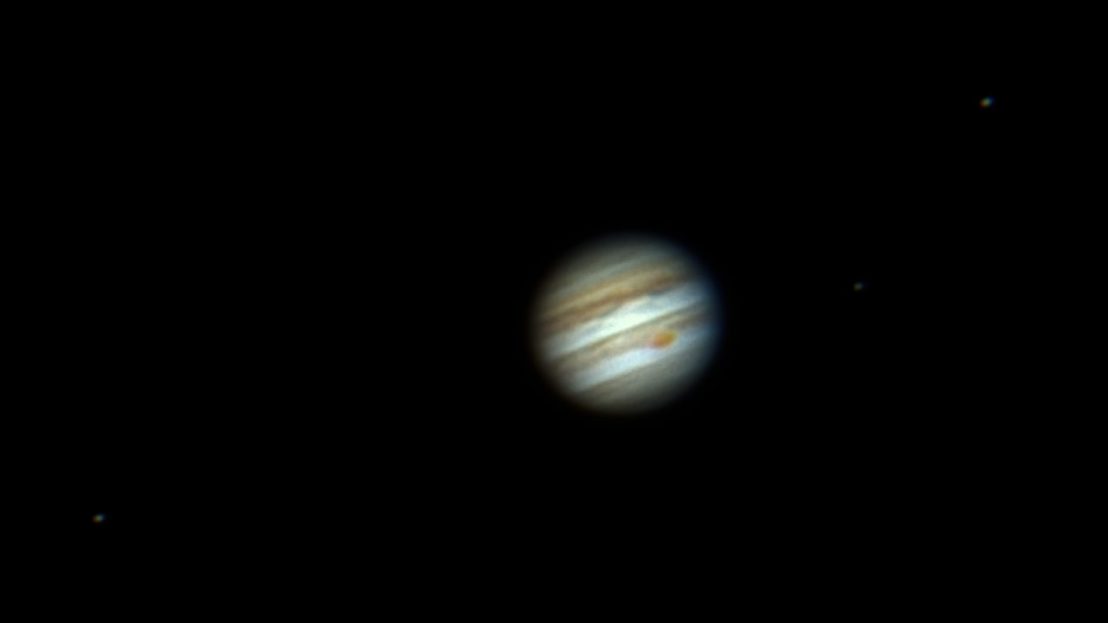
Jupiter at its April 7, 2017 opposition with the Great Red Spot and moons Io, Europa, and Ganymede (L to R). Photo by Rob Pettengill in Austin, Texas.
During the month of April, Jupiter will be in opposition, meaning the planet is at its closest point to Earth. Thanks to the sun, it’s during this window that astronomers can enjoy a particularly close-up photo session that can help reveal how the planet’s atmosphere has changed over time by comparing it with previous such photos of the gas giant.
This photo of Jupiter was taken on April 3 by the Hubble Space Telescope when the enormous planet was 670 million kilometers (or about 416 million miles) from Earth. The photo shows the Great Red Spot, but it also shows something new: a weather feature called the Great Cold Spot, which is almost as large as its more well-known cousin.
“The Great Cold Spot is much more volatile than the slowly changing Great Red Spot, changing dramatically in shape and size over only a few days and weeks, but it has reappeared for as long as we have data to search for it, for over 15 years,” Tom Stallard, a planetary astronomer at the University of Leicester in the U.K. and lead author of the study, said in a statement.
The cold spot is nearly 15,000 miles by about 7,500 miles in size, and it’s dubbed the “cold” spot because it’s 200 degrees Kelvin (about 400 degrees Fahrenheit) cooler than the surrounding atmosphere.
The article included this stunning image of Jupiter.
Photo: A. Simon (GSFC)/NASA, ESA
Jaymi went on to write:
Here’s what some of the other details in the image mean:
The NASA/ESA Hubble Space Telescope reveals the intricate, detailed beauty of Jupiter’s clouds as arranged into bands of different latitudes. These bands are produced by air flowing in different directions at various latitudes. Lighter coloured areas, called zones, are high-pressure where the atmosphere rises. Darker low-pressure regions where air falls are called belts. Constantly stormy weather occurs where these opposing east-to-west and west-to-east flows interact. The planet’s trademark, the Great Red Spot, is a long-lived storm roughly the diameter of Earth. Much smaller storms appear as white or brown-coloured ovals. Such storms can last as little as a few hours or stretch on for centuries.
The Great Red Spot is an anticyclonic storm that is so large that Earth would fit inside it. That stormy spot — which is actually shrinking, though astronomers don’t know why — gives us a great perspective for understanding just how huge Jupiter is compared to our own blue dot in the solar system.
It’s been 27 years since the Hubble Space Telescope went into orbit, and the geriatric observatory is still going strong. When the telescope recently trained its sights on the solar system’s largest planet, the results were spectacular—proof that for the stellar spectator, age is but a number.
The image above is the latest picture of Jupiter. The snapshot was taken by Hubble on April 3 with the help of the telescope’s Wide Field Camera 3, a high-res instrument that lets the telescope observe using different wavelengths. It combines light on the visible, ultraviolet, and infrared spectrum to create an image of a massive planet in constant atmospheric flux.
In a press release, the European Space Agency, which co-runs Hubble with NASA, said that Hubble was able to take advantage of the planet’s current opposition with Earth to take the close-up. At the moment, Jupiter is lined up perfectly with the sun, and Earth is lined up with both the sun and Jupiter. Think of it as a truly heavenly photographic opportunity—a chance to look at the planet head-on. Better yet, Jupiter’s position relative to the sun means that it’s brighter than at any other time of year, which lets telescopes trained on the gigantic planet see even more detail than usual.
AsThe Washington Post’s Amy B. Wang notes, there were no new discoveries in the picture per se, but that doesn’t mean there’s nothing to look at. As ESA explains, scientists will compare the photo to previous views of the planet to hopefully learn more about the atmosphere. And for the rest of us, there’s a strangely soothing view of Jupiter’s layered cloud bands and impressive vortices.
The gas giant is thought to have sucked up most of the space debris left over after the sun formed, grabbing dust and gas with gravity. Scientists think it has two times as much debris as all of the other bodies in the solar system combined—and all of that material swirls through cloud layers in its quickly-rotating atmosphere.
Since Jupiter doesn’t exactly have a surface, it has nothing to slow the spots and vortices that appear in its atmosphere. The most famous, the Great Red Spot, is thought to have been swirling around for more than 150 years, and even though it’s unclear which gases give it that red hue, it’s the planet’s most recognizable feature. As NASA writes, the cloudiness of Jupiter’s atmosphere makes it hard to understand what might be contributing to it. But that doesn’t decrease its allure.
Want to delve even further into the mesmerizing bands of a huge planet’s atmosphere? A high-res version of the snapshot is available online. And if you prefer seeing things live, it’s a great time to check out Jupiter through in the night sky. You can find Jupiter in the east right after the sun goes down—a massive mystery that’s brighter than any star.
Namely, that the universe came into existence some 13.82 billion years ago. The power of natural evolution that came with that event eventually brought along homo sapiens some 200,000 years ago. 200,000 is 0.0000145 of 13.82 billion.
Or to put it another way, we humans have only been a part of this universe for 1/10th of 1% of the life of said universe! (Oh, and dogs came along 100,000 years ago!)
Yet another wonderful saving of a dog from a frozen lake!
One of the ‘generalist’ blogs that I follow is Mother Nature Network (MNN) and yesterday MNN published the account of a dog in Canada being rescued from icy cold water.
Winter hasn’t let go of some parts of North America just yet, including St. Albert, Alberta, in Canada. Cold temperatures keep the lakes frigid and icy, as a local man and his dog discovered recently.
A French bulldog named Cosmo plunged into a lake in a park in St. Albert — it was a leash-free area of the park — and was struggling to pull himself out of the thin ice that covered the lake. Cosmo’s owner, Duncan McIver, jumped in to save his pup.
McIver was able to push Cosmo onto the ice and then, while carrying Cosmo, slowly walked across the ice, but not without plunging into the freezing cold water once more.
In a bit of serendipity, a CTV news crew was already at the park, filming a report on ice safety, and caught the whole episode on camera.
“As soon as the ice broke, I just went right in,” McIver told CTV Edmonton, “I think most people would do the same for their dog.”
The saying goes that a dog is man’s best friend, but we think moments like this prove the feeling is mutual.
ooOOoo
Yes, picking up on that remark by Duncan McIver, most people really would do what Duncan did!
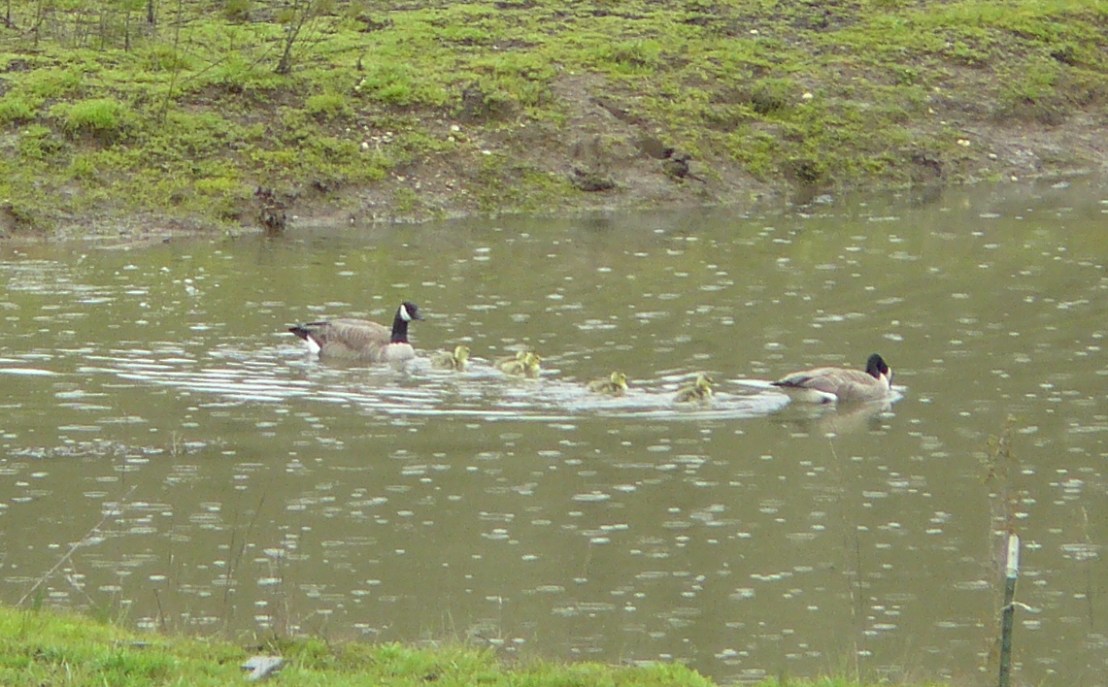
For the last few weeks we have had a pair of Canada geese on our tiny island in the centre of our lake in the large paddock where our horses graze most days. More accurately, we have had the mother sitting on her clutch of eggs for the last few weeks.
We knew it was getting close to the eggs hatching and several times a day we look out to see if the youngsters have made it out of their nest.
A little over two hours ago, Oregon time, I took the following photographs!
Mum and Dad and what looks like 5 goslings.
oooo
oooo
oooo
oooo
oooo
Going round the back of the little island. The nest can be seen on the far right-hand side of the photo.
Stories like this make my toes curl with pleasure!
Less than two weeks ago I shared an item that I had read about the firefighters of Santa Monica, CA, saving the life of a ten-year-old dog.
When Santa Monica firefighters were called to a burning apartment, they found the lifeless body of a tiny dog overcome by the heat and smoke on the floor of a bedroom. They pulled out the dog, named Nalu, but he wasn’t breathing and didn’t have a pulse.
Then two days ago, courtesy of the Care2 Causes blogsite, along comes another fabulous example of the care, love and generosity shown by firefighters.
ooOOoo
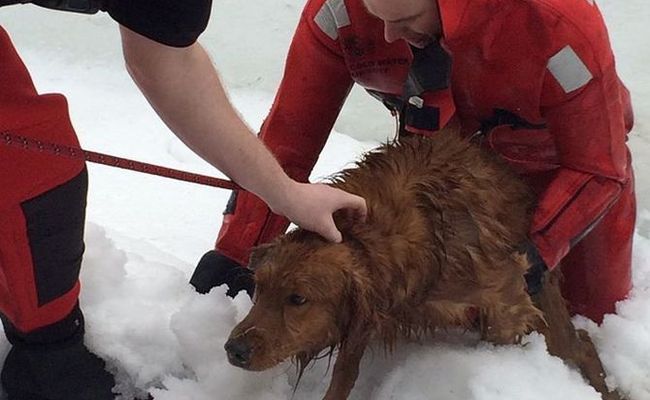
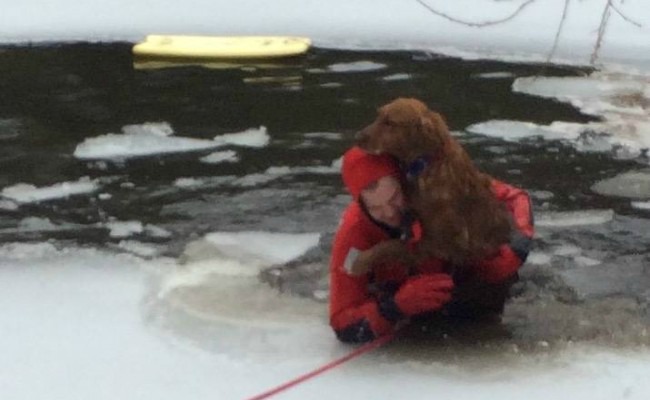
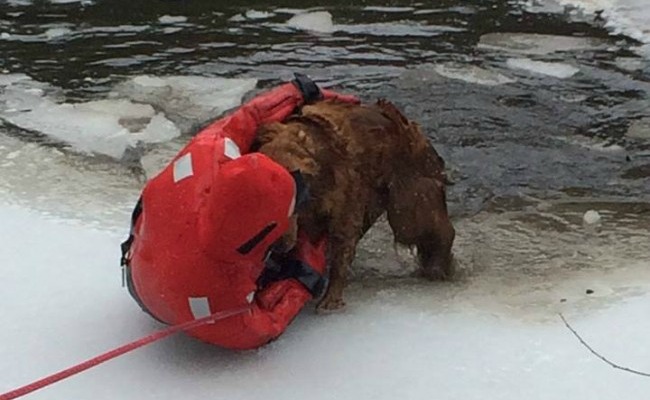
Firefighters Rescue Golden Retriever From Icy Pond
With perhaps just seconds to spare, North Hampton firefighter Will Taber barreled toward a dog who was barely clinging to thin ice last week in New Hampshire.
Photo Credit: North Hampton Professional Fire Fighters
Three-year-old Emmett ran out onto his family’s frozen backyard pond, suddenly falling through the ice. Although homeowner Kacey Eddinger started into the pond to rescue him, she had to turn back when she realized the water was simply too cold. Eddinger and her toddler son waited anxiously for help to arrive.
Photo Credit: North Hampton Professional Fire Fighters
The family isn’t certain exactly how long their golden retriever was in the water before they realized he’d fallen through, but by the time firefighters arrived, Emmett was exhausted and close to drowning.
In thermal ice rescue gear, firefighter Taber held a tethered line as he crossed the ice and entered the water. Once he reached Emmett, the other firefighters pulled the pair back to shore.
Photo Credit: North Hampton Professional Fire Fighters
“The canine was exhausted and scared and minutes from going completely under water and carried by the current under the ice,” the Fire Department posted on Facebook. “The rescue was made just in time where he was then immediately warmed, carried to a police cruiser and transported to North Hampton Animal Hospital.”
Though spring has officially arrived, ice rescues have escalated due to the thin ice that remains on some bodies of water.
Again and again, I find myself rating actions such as these from the North Hampton Fire Fighters (and not forgetting the Santa Monica Fighters) so gloriously uplifting. Again and again, they serve as a reminder that real people all around the world are so very often wonderful, generous and loving real people!