A solid reminder of a key lesson from dogs.
I was researching for a chapter on Communities for my book and came across a wonderful essay by an Erik Kennedy. It was so brimful of common-sense that I wanted to share it with you.
The essay was entitled: On the Social Lives of Cavemen. Here’s how it opens:
essays
by erik d kennedy
On the Social Lives of Cavemen
Tribal Living in the Modern World
May 2011
Introduction: The Gustatory Lives of Cavemen
We may be the pinnacle of millions of years of evolution, but we’re throwing our birthright straight out the window of our comfortable suburban homes. In this essay, we’re going to discuss walking across our family-sized lawn, climbing over our questionably large picket fence, and retrieving that birthright.
Then a little later on, Mr Kennedy writes (my emphasis):
The Tribe
Human beings are no strangers to group living. Call it a family trait. Our closest animal relatives spend a good bulk of their time eating bugs off of their friends’ back. While I’m overjoyed we’re not social in that manner, I’m less pleased that we’re not social more to that degree. In study after study, having and spending time with close friends is consistently correlated with happiness and well-being. And yet, the last few decades in America have seen a remarkable decline in many things associated with being in a tight-knit social circle—things like family and household size, club participation, and number of close friends. Conversely, we’ve seen an increase in things associated with being alone—TV, commutes, and the internet, for example.
This trend is quite unhealthy. It’s no surprise that humans are social animals—but it may be surprising that we’re such social animals that merely joining a club halves your chance of death in the next year—or that living in a close-knit town of three-generation homes can almost singlehandedly keep you safe from heart disease.
Any of you that have a few dogs around you at home know what wonderful close-knit groups they make. Frequently highlighted here on Learning from Dogs.
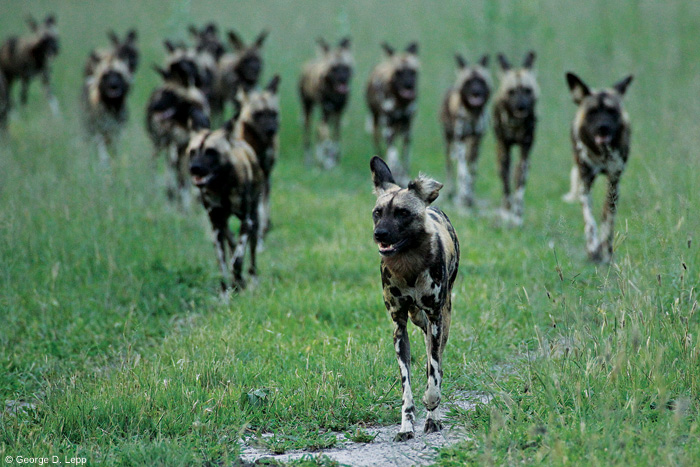
Dogs offer many beautiful examples of the benefits of community. For the reason that their ancient genes, long before they became domesticated animals, still guide their behaviours. When dogs lived in the wild, their natural pack size was around fifty animals. There were just three dogs that had pack status; the alpha, beta and omega dogs. Or more usefully described as the Mentor, Minder and Nanny dogs. (As is still the case in wild dog pack families.)
As has been explained previously in this place, all three dogs of status, wild or domesticated, are born into their respective roles, with their ‘duties’ in their pack being instinctive. There was no such thing as competition for that role as all the other dogs in that natural pack grouping would be equal participants with no ambitions to be anything else.
One doesn’t need to reflect for very long before the obvious question arises: If fifty dogs is the optimum number for a pack of dogs, is there a limit to the number of people we can have in the human equivalent of a pack?
Well, says anthropologist Robin Dunbar, that number is about 150 persons. Robin Dunbar achieved fame by drawing a graph that plotted primates’ social group size as a function of their brain sizes. He inputted the average human brain size into his model, and up came the number 150. Beyond that number is past the upper bounds for both hunter-gatherer tribes and Palaeolithic farming villages. More than that, it appears that everything from startup employee counts to online social networks show this number as a fairly consistent maximum for creating and maintaining close social ties.
Once more, a great lesson from our dogs – wrap the strength of a community around you.
 Learning from Dogs
So interesting Paul!
LikeLike
Val, thank you for taking the trouble to leave your reply. Most welcomed.
LikeLiked by 1 person
Another great read that rings true and makes me think…Yes, 150 is a great start for many endeavors, be it social or business…and those circles grow…
LikeLike
That was an interesting ‘factoid’ from Robin Dunbar, wasn’t it! Anyway, thanks for your comment and a warm welcome to this place.
LikeLike
I had estimated the number to be around 100, not too wide off the mark. Interesting study, Paul…
LikeLike
When I have a quiet moment (Ha! Ha!) I’ll try and dig up more information on Dunbar’s studies. As always, love having your reply.
LikeLike
Interesting article Paul, and right on the nail. They say it takes a village to raise a child and our furry friends have got it right. We need to take heed and learn from them.
LikeLike
Need to learn so many things from them! Barb, thank you so very much for your reply.
LikeLiked by 1 person
I watched a wild life programme last year Paul about Hyenas and their own social hierarchy very interesting… Great information.. Thank you for bringing it.. 🙂
LikeLike
Always my very great pleasure, Sue.
LikeLiked by 1 person