“Season of mists and mellow fruitfulness,”
The sub-heading is the first line of the poem To Autumn by John Keats. The full poem closes today’s post.
Old habits from England die hard. My way of explaining my reticence to adopt a whole panoply of American words including Fall. Of course, it’s the perfect word to describe this time of the year but, nonetheless, Autumn feels like its ‘hard-wired’ into my personal vocabulary.
With the Summer heat behind us, the task-list for jobs to be done outside can no longer be fudged by “it’s too hot to work outside just now” excuse!
Frankly, the weather at the moment is so beautiful that it’s a privelege to be out in the open; to be enveloped by Nature.

One job that we have been engaged in is installing a couple of raised vegetable beds on the flat area that used to be a tennis court. We had the asphalt base torn up a few months back. Yesterday, saw the first of the two beds filled ready for a crop of Winter vegetables to be planted in the coming weeks.

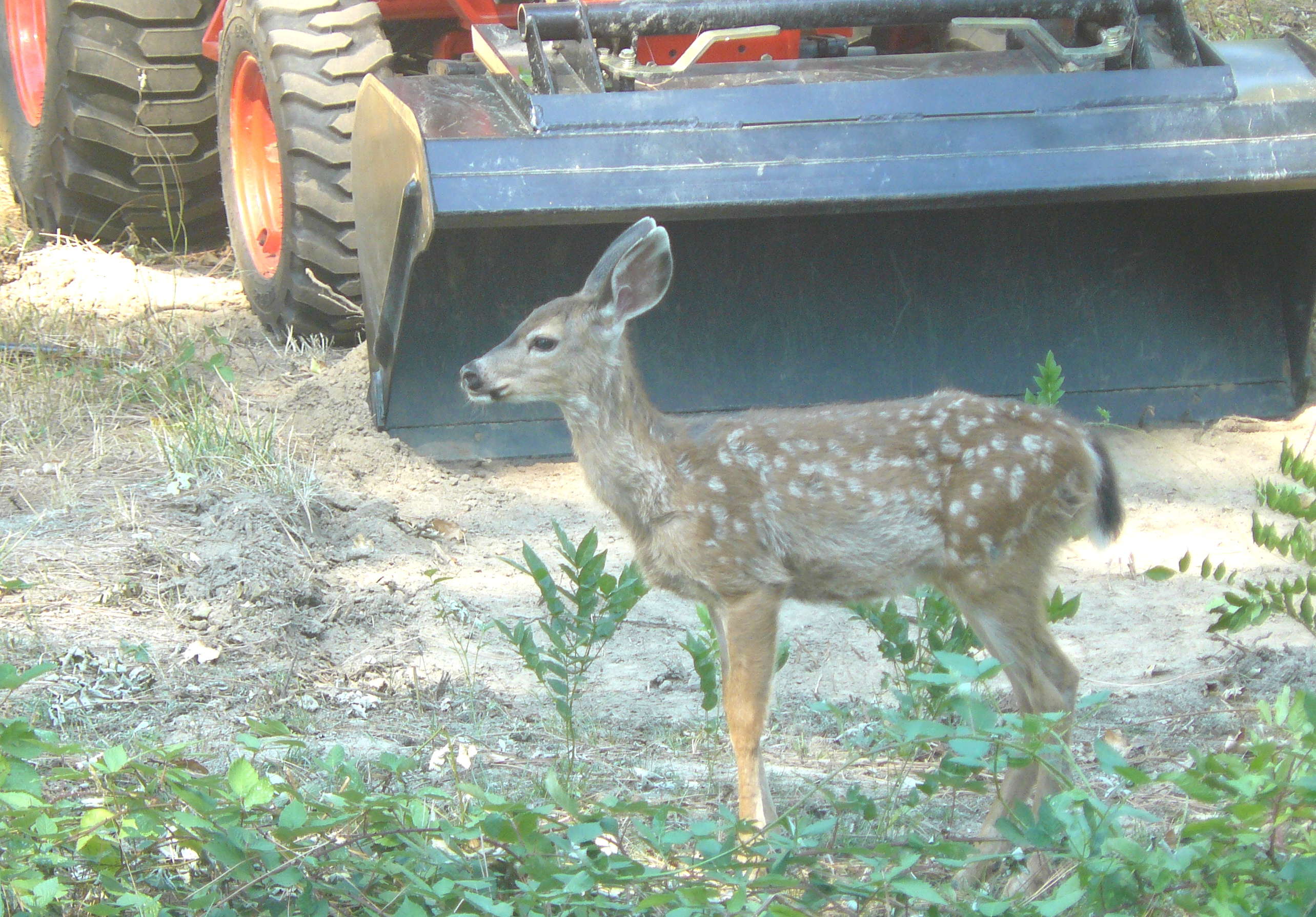
So many wild creatures, large and small, are storing up their body reserves for the long Winter months. Our neighbours, Dordie and Bill, regularly feed the wild deer and we have joined in as well. It’s fascinating to see how quickly they work out that we are not going to harm them. The picture below shows a young deer that allowed me to jump off the tractor, go indoors to find my camera, and return to snap the gorgeous, pretty creature.
There’s been a couple of posts that I want to refer to because they underline the fact that humans are so prone to forgetting that we are of the wild, from the wild and connected to the wild. That’s for tomorrow.
Thus will close today with a recent Autumnal picture of the early-morning mists across our open grass area.

So to that John Keats poem:
To Autumn
John Keats (1820)
Season of mists and mellow fruitfulness,
Close bosom-friend of the maturing sun;
Conspiring with him how to load and bless
With fruit the vines that round the thatch-eves run;
To bend with apples the moss’d cottage-trees,
And fill all fruit with ripeness to the core;
To swell the gourd, and plump the hazel shells
With a sweet kernel; to set budding more,
And still more, later flowers for the bees,
Until they think warm days will never cease,
For Summer has o’er-brimm’d their clammy cells.Who hath not seen thee oft amid thy store?
Sometimes whoever seeks abroad may find
Thee sitting careless on a granary floor,
Thy hair soft-lifted by the winnowing wind;
Or on a half-reap’d furrow sound asleep,
Drows’d with the fume of poppies, while thy hook
Spares the next swath and all its twined flowers:
And sometimes like a gleaner thou dost keep
Steady thy laden head across a brook;
Or by a cyder-press, with patient look,
Thou watchest the last oozings hours by hours.Where are the songs of Spring? Ay, where are they?
Think not of them, thou hast thy music too,—
While barred clouds bloom the soft-dying day,
And touch the stubble-plains with rosy hue;
Then in a wailful choir the small gnats mourn
Among the river sallows, borne aloft
Or sinking as the light wind lives or dies;
And full-grown lambs loud bleat from hilly bourn;
Hedge-crickets sing; and now with treble soft
The red-breast whistles from a garden-croft;
And gathering swallows twitter in the skies.
 Learning from Dogs
Beautiful…
I tried to take a short cut in the dark into Cymbeline Meadows yesterday from North Station in Colchester, into a field… mist… minefield of cow pats… and their creators… cold… and pools of water in islands of grass humps… nearly fell into the river… and knee deep in water…. a misadventure in nature that did not leave me happy, I can laugh now. Autumn in Cymbeline Meadows is beautiful.
LikeLike
I can vaguely recall the route you took, certainly the name of that meadow is still familiar.
By the way, one of the posts mentioned in my post that I want to refer to is your post Nature Deficit Disorder.
LikeLike
Thanks for your future referral of my “Nature Deficit Disorder” post.
LikeLike