Looks like being a Dan Gomez weekend.
Dan sent me an email with a link to a most astounding video. But before we get to that, just take a look at these images. Here are the first three from the set of eight.
Eight breathtaking images of baby stars

1. Beautiful newborns
In a universe of fantastic images, a newborn star is a mystical masterpiece. Cradled within the dusty arms of a nebula, a baby star seems to blink its way to a new life. The lifespan of a star is a series of sequences. A star may spend most of its life in a “main sequence phase” where nuclear fusion of hydrogen into helium is happening in its core. But before this happens, it lives as a protostar, or baby star.
Thanks to NASA’s advanced infrared space telescopes such as Hubble and Spitzer, we are able to view these star births as never before. Pictured here are newborn stars peeking out “from beneath their natal blanket of dust” in the Rho Ophiuchi dark cloud as seen by the Spitzer Space Telescope. (Text: Katherine Butler)
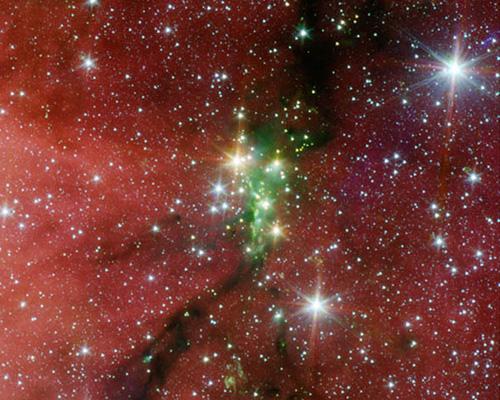
2. Young stars in Serpens
Here the Spitzer Space Telescope reveals the Serpens South star cluster, in which 50 or so young stars exist. They are seen as the “green, yellow, and orange-tinted specks sitting atop the black dust lane.” A supernova or galaxy collision can cause a star to form when huge clouds of hydrogen and helium collapse under mutual gravity. As the cloud collapses, it heats up and starts to spin. Since protostars are covered in dust, they can be seen only through infrared telescopes like Hubble and Spitzer. As Universe Today writes, “After about 100,000 years or so, the protostar stops growing and the disk of material surrounding it is destroyed by radiation.” Then this star, now called a T Tauri or pre-main sequence star, is visible from Earth.
3. Bubbly little star
We are used to images of babies blowing bubbles, and it looks like the infants of the cosmos do the same. This image, taken by the Spitzer Space Telescope, shows the HH 46/47 baby star blowing bubbles into space via powerful jets of gas. Located about 1,140 light-years from Earth, HH 46/47 is the bright white star at the middle of the image. Two bubbles reach out in opposite directions and are formed when the jets collide with the dust and gas surrounding the star. As Universe Today reports, “Astronomers think that young stars accumulate material by gravitationally pulling in gas and dust. This process ends when the star gets large enough to create these jets. Any further material is just blown away into space.”

Go and view the remaining five stunning images here.
Now to what was sent by Dan.
Check out this mind-bending video that talks about the “Hubble Ultra Deep Field” image captured by NASA astronomers nearly a decade ago — a photograph that some call “the most important image ever taken.”
It all started back in 1996 when a group of astronomers pointed the Hubble Space Telescope at an empty patch in the sky close to the Big Dipper in hopes of seeing something, anything. At the time, it was considered to be a risky move, given that demand for use of the telescope was so high. What if the experiment yielded no results? What if nothing but an empty image was the final result?
After ten full days of exposing the telescope’s CCD camera sensor to this seemingly vacuous patch of sky, a breathtaking image was produced. Over three thousand galaxies appeared in one image — some as dots, others as spirals. It was a visual reminder of just how big our universe really is. The photo is called the “Hubble Deep Field“:

In 2004, astronomers pointed Hubble near constellation Orion and opened the shutter for a whopping 11 days. Using sensitive detectors and specialized filters, the telescope was able to capture an image with over 10,000 galaxies. This image became known as the “Hubble Ultra Deep Field.”

Scientists later used redshift calculations of the galaxies to turn the photograph into a “fly-thru” view of the photo:
It didn’t end there. Last year, NASA scientists created the Hubble Extreme Deep Field, which has an equivalent exposure time to 23 days and features. It’s the “deepest image of the sky ever obtained” that reveals “the faintest and most distant galaxies ever seen”:

And just think: scientists created these photos by pointing their mega-camera at a tiny speck of the night sky that appears to be completely devoid of visible stars!
oooOOOooo
“… a tiny speck of the night sky that appears to be completely devoid of visible stars!”
Dan said in his email, “Are we really here? What are the chances?”
You really have to wonder! Incredibly long odds. Both to us being here and to us being the only conscious, intelligent species in the universe.
 Learning from Dogs
Most cosmologists think the odds are very good actually. They say we are here because we live on a planet where life is possible. Given the size of the visible Universe, the probability of such a planet existing somewhere then becomes almost 100%. Having dealt with that problem, most cosmologists have moved on to try and explain away the creation of the Universe itself by invoking 22 dimensions of space-time and multiple Universes. Suddenly nothing is improbable anymore – neither energy, mass, universes, nor life.
It is all very reminiscent to Douglas Admas’ fictional atheist philosopher, Ullon Colluphid, in The Hitch-Hikers Guide to the Galaxy. For those who are not familiar with all this, Colluphid used the existence of something as improbable as a Babel Fish (that enables you to understand anything said to you in any language) to deduce that God does not exist:
LikeLike
Nice job, Paul! More than nice! Fundamental to poetry, mind, inspiration… And even cold computations about our odds.
I don’t want to rain on Martin’s parade, but, since he does not show on my site much, and I miss him, I will, nevertheless.
The French COROT satellite (Corot was a creative French astronomer) found something unexpected, but that did not surprise me. It’s more important than anything the Hubble or Kepler probes found. COROT stands (in part) for CORonal Oscillation. COROT found most stars are more variable than the sun.
That puts into question all and any habitable zones. For the latter, and related concepts see:
http://patriceayme.wordpress.com/2013/02/19/fragile-earth-syndrome/
Questions are of course welcome…
LikeLike
Martin and Patrice, thank you for your comments. I have to admit you are both near the edge of what I really understand. Which is why having your comments is so valuable in stretching the mind of this aged gent! Patrice, I still remember your Fragile Earth Syndrome post and have just dipped into it again. The implications are profound. In a weird way, it resonated with a recent BBC TV programme about the African continent and how close, in geological measures, that continent is to splitting apart geologically.
It all serves as a reminder that man’s existence on this ‘rock’ in space is extraordinarily tenuous.
LikeLike
Amazing beauty in our universe. This is at least one thing humanity is unlikely to ruin.
LikeLike
Alex, I detect just a slight tone of uncertainty in your comment! 😉
LikeLike
Ha ha, you guessed right!
LikeLike
🙂
LikeLike