The world’s 18 strangest airports
The American magazine Popular Mechanics had an interesting piece on some of the more bizarre airports around the world. As the article says,
Engineers tasked with building an airport are faced with countless challenges: The ideal location needs ample space, endless flat ground, favorable winds and great visibility. But spots in the real world are rarely ideal, and engineers are forced to work with what they have, making sure that the end product is the safest possible structure for pilots. A survey of airports around the world turns up a mixed bag, ranging from dangerous and rugged landing strips to mega-size facilities that operate like small cities.
Apart from the general interest in these airports, there is also a personal resonance as three of them are in my aviation log-book: Barra; Gibralter; Courchevel. Indeed my experiences of flying into Barra were the subject of a Post on this Blog a few months ago.
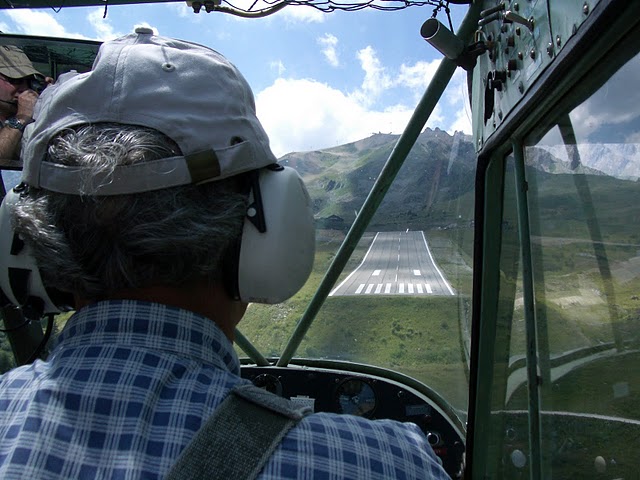
Courchevel in the French Alps is, for all pilots, one of the most amazing, butt-clenching arrivals one could ever imagine.
As Wikipedia puts it:
Courchevel’s airport also has a certain degree of infamy in the aviation industry as home to one of the shortest runways in the world, with a length of 525 metres and a gradient of 18.5% in order to help slow landing aircraft. The airport has a dangerous approach through deep valleys which can only be performed by specially certified pilots. On landing there is no go-around procedure, as most of the worlds airports have – there is merely a very steep hill which has seen a few accidents since the airport first opened.
Quite so!
Here’s an interesting video from YouTube
and a few personal memories:


By Paul Handover
 Learning from Dogs
This just comes to show that when something is risky everyone is more careful… and so perhaps what we really need is higher capital requirements for banks on what is perceived as not risky and that can therefore induce carelessness. Just exactly the opposite of what the financial regulators are doing.
LikeLike
Agree with that. I see from http://baselinescenario.com/2010/02/24/vocker-rules/ that there appears little enthusiasm for real regulatory reform!
LikeLike