Category: Flying

That wildfire smoke

Where it has come from can make a real difference.

Previous to this week, I hadn’t really thought of wildfire smoke other than it being a nuisance, so long as it did not get too close to home.

However, a recent article on The Conversation changed my understanding, and I bet there are many others out there that will feel the same way as I do.

ooOOoo

From flames to haze, wildfire smoke transforms as it travels, and it can harm your health in different ways
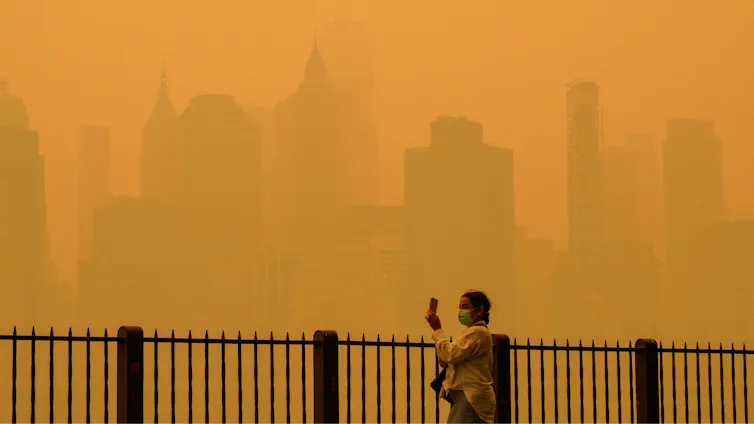
A  person walks along the river holding a phone. Buildings that are normally clearly visible disappear into the haze in New York City.
Wildfire smoke from Canadian fires has turned New York City’s sky a hazy orange several times in recent years. Angela Weiss/AFP via Getty Images

Michael A. Robinson, University of Colorado Boulder

As wildfire smoke plumes travel thousands of miles, sunlight and atmospheric chemistry bleach their color, strip away their campfire aroma and add them to the mix of urban smog.

Smoky skies plagued the East Coast and Midwest again in summer 2026, as wildfires hundreds of miles away forced people to cancel sports practices and run air conditioners around the clock.

Living in the western U.S., I am no stranger to this scene. Wildfires and the thick smoke they produce have become a fixture of summer life here. I also study wildfire smoke as an atmospheric chemist, in particular how the smoke evolves as it moves downwind from the flames to the communities where people breathe it.

To understand what’s in the smoke you might be breathing, you have to look at where it’s been.

A North America map shows how wildfire smoke spreads far from its origin, and stays dense for hundreds of miles.
Wildfire smoke is often too high in the atmosphere to be noticed, but when atmospheric conditions bring it close to the ground, people are left breathing unhealthy particles. Joshua Stevens/NASA Earth Observatory

When a forest burns, the wildfire emits large amounts of fine particulate matter, or PM2.5, along with nitrogen oxides and volatile organic compounds, or VOCs. The compounds and particles emitted by wildfires can harm human health, including the lungs, heart and organs, and include known carcinogens.

How this potent mix of pollutants transforms over time and distance is a complex puzzle. At the NOAA Chemical Sciences Laboratory, our team tracks this behavior, from studying controlled fuel burns in the lab to flying research aircraft through wildfire smoke plumes. Understanding how wildfire smoke ages is essential for predicting its impacts on human health.

It all starts at the flame

The story of smoke begins with how the wildfire burns. High temperature wildfires behave very differently from cool, smoldering wildfires.

Hot, intense flames produce nitrogen oxides, which can harm a person’s respiratory system and contribute to the formation of secondary pollutants and reactive carbon compounds like aromatic hydrocarbons, which can increase the risk of certain cancers with long-term exposure. They also emit smaller amounts of nitrous acid, hydrogen cyanide and isocyanic acid, all of which can be toxic to humans.

Wildfire smoke rising in the distance under a blue sky, viewed from a plane.
Smoke from a wildfire lofts high into the air. As it moves, its chemical composition changes. Steven S. Brown

In contrast, lower-temperature smoldering wildfires release a different mix of compounds, but it is still enriched with toxic aromatic oxygenates and ammonia, which can irritate the respiratory system. This isn’t to say that these wildfire emissions are safer for human health, but rather that burning conditions dictate the chemical makeup of the smoke and its subsequent chemical fate.

Wildfires are rarely just one or the other; they are dynamic mixtures that shift throughout the day as air temperatures rise, humidity drops or evening thunderstorms roll in.

The inside of a small plane filled with racks of instruments and one passenger seat.
The Twin Otter research planes that National Oceanic and Atmospheric Administration scientists use to study wildfire smoke are packed with instruments. Steven S. Brown

Once smoke leaves the flames, three main factors govern its journey: wind speed, atmospheric temperature and sunlight.

Think of a campfire. If you are sitting in the wrong spot, the prevailing wind blows smoke directly in your face. This horizontal movement is called advection. Small fires often don’t generate enough heat to loft their smoke high, meaning you can smell your neighbor’s campfire.

However, massive wildfires generate immense heat and powerful upward winds. This buoyancy acts like an elevator, lifting the smoke plume out of the planetary boundary layer and injecting it into the free troposphere, roughly 1.2 miles (2 kilometers) above the ground. Up there, high-altitude winds take over, transporting the smoke thousands of miles across the continent.

A large smoke plume rises high into the atmosphere
A large smoke plume rises high into the atmosphere. Michael A. Robinson

On occasion, wildfire plumes can generate their own weather, making smoke-laden pyrocumulonimbus clouds, which can inject large amounts of particles into the stratosphere.

How sunlight ‘ages’ the smoke

As smoke travels, it undergoes rapid physical and chemical changes.

First, the plume dilutes as cleaner background air mixes into it. Close to the fire, the smoke is dense and opaque. As it moves downwind, it spreads out and grows more diffuse.

Second, intense sunlight acts as a chemical engine. Solar ultraviolet photons break apart bonds in molecules, creating radicals, which oxidize VOCs. Nitrogen oxides play a key role in driving this chemistry.

Within just hours of being emitted, this mixture reacts to form ground-level ozone, which can irritate the lungs and is a key component of smog.

The wing of a research plane with the orange sky against the smoke plume and blue sky below behind it.
When the Sun shines through thick wildfire smoke, it turns the sky a dirty orange. Steven S. Brown

If smoke is lofted high, into cold free tropospheric air, the chemical aging process can temporarily freeze. The smoke can remain chemically fresh until the air parcel sinks closer to the surface, below about 1.25 miles (2 kilometers), where warmer temperatures can restart the chemical reactions.

When an aging smoke plume passes over a major city, it can mix with urban pollution, such as car exhaust. This interaction can rekindle chemical reactions, creating additional local ozone on top of the fine particulate matter emitted from the fire.

Why distant smoke smells and looks different

Have you ever noticed that long-distance wildfire smoke doesn’t smell like a campfire? There is a chemical reason for that.

The specific compounds responsible for the classic smoky aroma of a campfire – phenolic compounds like guaiacol and syringol – are highly reactive. Sunlight and the associated chemistry destroy them in a matter of hours. By the time the smoke has traveled across several states, the smoky smell is completely gone.

Sunlight also alters the color of the smoke through chemical bleaching of aerosols. Fresh smoke contains dark brown and black carbon particles that absorb light. Over several days of exposure to sunlight and oxidants, chemical reactions break down these dark compounds.

A lifeguard on a stand on a beach. The smoke is so thick, a sailboat is barely visible in the background.
A sailboat passing a lifeguard stand along Chicago’s Lake Michigan is obscured by Canadian wildfire smoke that blanketed the city on July 16, 2026. Scott Olson/Getty Images

The result?

Dark, light-absorbing particles turn into light-scattering particles, transforming dark, dense plumes into the milky white haze seen drifting across the eastern skies. These particles efficiently scatter the blue and green light while letting red and orange wavelengths pass through, creating the uncanny feeling of an all-day sunset.

The wildfire smoke inhaled hundreds of miles downwind is chemically distinct from the smoke that left the flames, but it remains a serious health threat and an area of active research. Consequently, smoke transport and its associated atmospheric chemistry represent a major North American air quality issue, one projected to intensify in the coming years.

Michael A. Robinson, Research Scientist in Atmospheric Chemistry, University of Colorado Boulder

This article is republished from The Conversation under a Creative Commons license. Read the original article.

ooOOoo

As you can see from the second image, the map of wildfire smoke, here in Oregon there has been substantial smoke, albeit because we live to the west of the Cascades, we have not been directly affected.

However, the summer of 2027 is predicted to be an even drier period than this year, and the potential for wildfires and the associated smoke is a problem that is not going away.
Presidential transport

An article about Air Force One.

The Boeing 747, that currently serves as the means of air transport for President Trump, has been written about on The Conversation.

Here is that fascinating article:

ooOOoo

Air Force One is more than transportation – it has defined how presidents run the country and meet the world

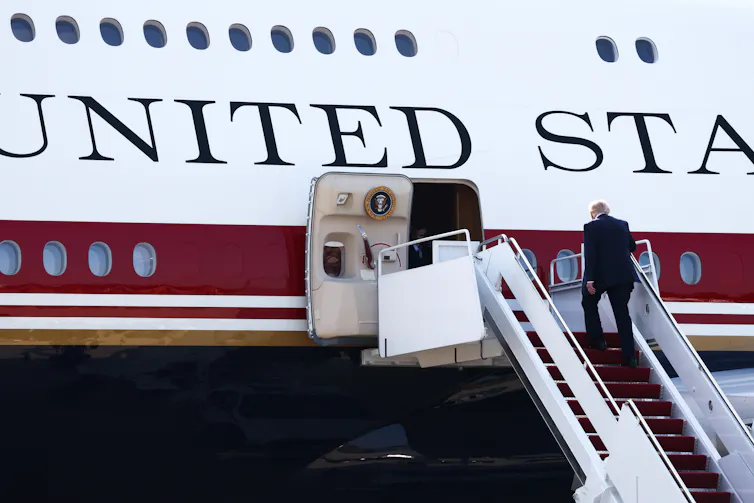
A man in a dark suit climbs a stairway to a large plane.
President Donald Trump boards Air Force One on July 1, 2026, at Joint Base Andrews, Maryland. Finn Gomez/Getty Images

Peter Kastor, Washington University in St. Louis

Air Force One used to be a high-flying symbol of American technology, ingenuity and power. For many, it was also a source of national pride.

The current Boeing 747s that serve as Air Force One are a combination transport vehicle, command center, press room, medical center and apartment, complete with bedroom and office for the nation’s chief executive.

Now, to many, Air Force One has become scandalous.

On July 8, 2026, The New York Times reported that the latest version of the presidential aircraft – presented by Qatar as a gift to President Donald Trump – lacks the sophisticated countermeasures that were a ready defense for the 747s that had been in service since 1990. Critics immediately revived earlier claims that the new 747 was a corrupt transaction from the start. Trump later said the plane would be sent to be “maxed out” with upgrades.

This article is not part of that story. Nor is it the standard story of Air Force One that appears in numerous documentaries, which tend to be gee-whiz accounts of the amazing capacities of the president’s airplane.

I am a historian writing a book about the technologies that have shaped the long history of the American presidency, in which Air Force One looms large. I believe it is important to see Air Force One as more than a cool gadget or political flash point. Von Hardesty, a curator at the Smithsonian’s National Air and Space Museum, certainly understood this when he wrote that “by the end of the 20th century, Air Force One had evolved into an essential arm of the American Presidency.”

Put simply, the presidency as we know it today would have been impossible without Air Force One, which has shaped and defined that role for decades.

A man, waving, and a woman at the top of a stairway leading down from an airplane with 'UNITED STATES OF AMERICA' painted on its side.
President Richard Nixon waves to the crowds from Air Force One with his wife, Pat, as they arrive at Ireland’s Shannon Airport on Oct. 3, 1970. Daily Mirror/Mirrorpix via Getty Images

Horse-drawn carriage to the ‘Sacred Cow’

It was only recently that Americans or their presidents could imagine things this way. When presidents left the capital throughout most of the nation’s history, it was a lengthy, at times arduous, process that severed their connection with government offices.

As a result, presidents rarely traveled while in office and were more likely to depart Washington for extended vacations than for official business. Likewise, no serving president left the United States until Teddy Roosevelt visited the construction of the Panama Canal in 1906. Woodrow Wilson became the first sitting president to cross the Atlantic when he boarded the USS George Washington in 1918 to join the negotiations in Versailles at the end of World War I.

If few presidents got away from Washington to see the country and its residents before 1900, the flip side was also true: Few Americans saw presidential candidates or incumbents in person, especially Americans who lived outside the eastern third of the United States. Instead, the connection between presidents and average citizens was mediated through political parties, the press and eventually through broadcast media.

The first designated presidential aircraft arrived in 1933, but Franklin Roosevelt never flew on it. His first flight as president came in 1943, when American Airlines loaned a flying boat called the Dixie Clipper to ferry Roosevelt to meet with other Allied leaders at the Casablanca Conference. In 1945, Roosevelt traveled to Yalta on a Douglas VC-54C called the Sacred Cow, the first plane specifically built for presidential travel.

Two men, one in a suit and the other in a military uniform, sitting next to each other and talking on an airplane.
President Franklin Roosevelt and Gen. Dwight Eisenhower on the president’s plane en route to the Tehran Conference in December 1943. George Rinhart/Corbis via Getty Images

Despite these flights to important international meetings, Roosevelt and successors Harry Truman and Dwight Eisenhower made limited domestic use of aircraft, preferring instead to travel by railroad. International trips remained lengthy journeys in loud, propeller-driven aircraft that encountered the greater turbulence of lower altitudes.

All this changed in 1962, when President John Kennedy acquired a brand-new Boeing 707, the first jet-powered Air Force One.

Presidential ubiquity

Flying higher, faster and quieter than their predecessors, the jet aircraft used for Air Force One made possible one of the central facets of the modern presidency: The nation’s chief executive could be a ubiquitous player in national politics and world affairs.

Presidential travel increased dramatically, both in its frequency and in the number of stops on each trip. This was not simply the result of the growing use of air travel worldwide. Where Roosevelt, Truman and Eisenhower understood world leadership as their ability to coordinate American power from Washington, Kennedy and his successors sought to make themselves the center of the story.

This seemed particularly important during the Cold War. As the United States asserted its leadership in the struggle against the Soviet Union, American presidents positioned themselves as the symbols of freedom in opposition to communism.

Consider President Richard Nixon traveling to China in 1972 to normalize relations, or Ronald Reagan flying to Iceland for the 1986 Reykjavík conference with Soviet leader Mikhail Gorbachev to negotiate the future of intermediate-range nuclear missiles. The presence of a president at these conferences elevated both the importance of the event and the image of the president as a statesman who was able to quickly pivot back and forth from national to international leadership.
As American presidents struggled to maintain their power and their relevance after the end of the Cold War, their international travel only increased. Bill Clinton, George W. Bush and Barack Obama each made over twice the number of international trips as Ronald Reagan did.

These trips ranged from goodwill visits to maintain old alliances to attempts to build new connections after the collapse of the Soviet empire.

Presidents specifically visited international hot spots, positioning themselves as global peacemakers. The sight of the American president descending the long stairs from Air Force One, smiling and waving along the way, became a symbol of American diplomacy.

A group of people seated on an airplane listening to a man speaking and gesturing with his hands.
President Jimmy Carter meets with reporters aboard Air Force One on July 1, 1979, while flying from Seoul, South Korea, to Honolulu. AP Photo/Ira Schwarz

Official business – and campaigning

If Air Force One enabled presidents to announce themselves as statesmen abroad, it also revolutionized politics at home.

During the 1970s, the two major parties moved from selecting their nominees at national conventions to a system where state primaries decided who would lead the ticket.

This change emerged from demands that political power move from party leaders to party members. But a primary system would have been unimaginable without aircraft to shuttle candidates around the country. That was particularly important for incumbents, as air travel enabled them to be both sitting presidents and active candidates.

Presidents and their handlers learned how to combine official government business, which permitted the use of Air Force One, with campaign opportunities. These moments not only changed how presidents operated; they changed how Americans understood their presidents.

This change began with Kennedy’s use of the jet-powered Air Force One for domestic travel, including the tragic decision to visit Texas in November 1963, where he was assassinated. In just his first year in office, Bill Clinton visited 37 states over the course of 73 days.

Air Force One is a symbol of presidential power, but its problems only reinforce the fact that technology shapes the presidency.

The clearest demonstration was on 9/11. President Bush was in Florida that morning. Air Force One whisked him into the air, delivering him first to the safety of an Air Force base in Louisiana and then to the fortified headquarters of the U.S. Strategic Command in Nebraska, and still had him back at the White House by the end of the day.

It was a grim reminder of the other task for Air Force One: a safe transport for the president during a national crisis or nuclear armageddon. While the aircraft fulfilled its promise to keep the president safe in a crisis, its legendary communication systems faltered. Crucially, Bush struggled to coordinate with senior officials in Washington, leaving him momentarily out of the loop at a terrifying historical juncture.

The role that presidents have assumed at home and abroad, as well as the ways Americans interact with their presidents, have taken form through the possibilities – and the limitations – of presidential aircraft. Air Force One is not just a great way to travel or a nifty gadget, nor is it peripheral to the presidency. It is central to it.

Peter Kastor, Professor of History & American Culture Studies, Washington University in St. Louis

This article is republished from The Conversation under a Creative Commons license. Read the original article.

ooOOoo

The last sentence of the last paragraph spells out how Air Force One is central to the presidency. The aircraft serves as a symbol of presidential power.

An eclipse seen from space

This is beautiful.

I have always been interested in the space flights of the astronaughts. I am sure that I join millions of others who feel the same.

So this article by Deana L. Weibel, Professor of Anthropology at Grand Valley State University is terrific.

ooOOoo

Seeing an eclipse from Earth is awe‑inspiring – for astronauts seeing one from space, the scene was even more grand

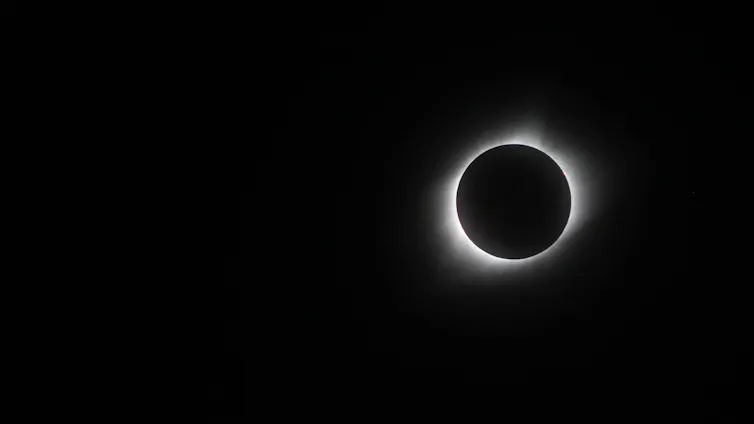
During a total solar eclipse, the Sun is barely visible behind the Moon. Roger Sorensen

Deana L. Weibel, Grand Valley State University

The astronauts on Artemis II’s trip to the Moon in April 2026 didn’t just have an amazing journey through space. They also saw something extraordinary. They were the first humans to see a total solar eclipse from space.

A solar eclipse happens when the Moon moves in front of the Sun. In a total eclipse, the Sun’s central disc is covered completely.

From Earth, the circle of the Sun is about the same size as the circle of the Moon. With the bright circle blocked, you can see the undulating rays of the Sun’s corona, or outer atmosphere, that are normally too dim to be observed.

Moon covering most, then all, then most of the Sun
Composite image of moments before, during and after totality. NASA/Aubrey Gemignani

I’m a cultural anthropologist who studies awe-inspiring aspects of space exploration. I have been lucky enough to have seen two total solar eclipses. The first one was in Nebraska in 2017, the second in Indiana in 2024.

During my second total eclipse, the period of totality – that short span when you can remove your protective glasses and look directly at the eclipse – lasted close to 4 minutes. I saw waves of diffuse light snaking around an ink-black hole in the sky. It looked very wrong – almost alien.

On Aug. 12, 2026, there will be another total solar eclipse, visible only from Greenland, Iceland, Spain and the Balearic Islands of the Mediterranean. Some fortunate viewers in Spain and nearby islands may see the eclipse just before sunset, low on the horizon. The Moon illusion, a phenomenon where the Moon looks bigger when it’s near the horizon, might make this eclipse look unusually large.

Unusual eclipse perspectives

Astronauts will occasionally also have less common eclipse experiences. I interviewed one I call by the pseudonym “Jackie” in my research about astronauts’ experiences of awe. She was part of an astronaut training group that did a flight exercise during a total solar eclipse.

Jackie and her squad flew their jets in the shadow of the Moon. This lengthened their time in totality because they could follow and stay within the shadow. Jackie was most impressed with how the Sun’s corona seemed to shift and ripple.

“It’s not static … it’s alive,” she told me.

On April 6, 2026, the astronauts of NASA’s Artemis II mission saw another kind of unusual eclipse as they flew around the Moon. At one point during their flight, the Moon and the spacecraft aligned so that the Moon was directly between them and the Sun, blocking the Sun’s disk in a way that looks very different from what we see on Earth.

Astronaut Victor Glover said it felt like they “just went sci-fi.” https://www.youtube.com/embed/YLjPci5bo1k?wmode=transparent&start=0 ‘An impressive sight’: The Artemis II crew were the first humans to observe a solar eclipse from near the Moon.

The astronauts were so close to the Moon that the Moon looked bigger than the Sun and hid more of its bright circle. Earth was also in view, and sunlight reflected from the Earth onto the Moon in a phenomenon NASA calls “earthshine.” This dim light is very similar to the moonlight that shines on the Earth at night.

Imagine the Sun hidden behind the Moon, creating a hazy halo around the Moon’s edges. At the same time, faint light reflected from Earth softly illuminates the Moon, revealing mountains and craters in a dim twilight. Now imagine this striking scene lasting 54 minutes.

This sight was, without a doubt, one of the most unusual eclipses ever seen by human eyes.

Although Artemis’ astronauts are trained to think scientifically, this experience propelled them into a state of awe. They talked openly about how their brains were “not processing” what they observed. While NASA kept them busy with a variety of tasks, the sound of emotion and excitement in their voices as they broadcast live from their lunar flyby was unmistakable.

An eclipse visible from space - the Moon is shown shadowed with some sunlight visible behind it, and part of the Orion capsule shown off to the left.
The Moon during a solar eclipse on April 6, 2026, photographed by one of the Orion spacecraft’s cameras during Artemis II. Earth is reflecting sunlight at the left edge of the Moon, called ‘earthshine.’ NASA

The psychology of awe

Researchers have studied the effects of awe on the human brain, including awe felt during solar eclipses. Moments of wonder like these can transform how you feel and even how you think, making you more thoughtful and open-minded.

In my own work I’ve found these experiences can change how astronauts understand their own place in the universe.

One astronaut said she gained an awareness of the fragility of our planet that now shapes everything she does, while another described becoming more curious after returning to Earth. A third said the awe he experienced in lunar orbit changed his understanding of time and infinity.

Space travel creates many opportunities for awe, but a solar eclipse from behind the Moon, as Mission Commander Reid Wiseman put it, required “20 new superlatives.”

It’s an experience most of the earthbound eclipse-chasers heading to Greenland or Iceland or Spain this summer will only dream about. Whether eclipses happen in space or on Earth, though, close encounters with the grandeur of our universe can make you feel profoundly human.

Deana L. Weibel, Professor of Anthropology, Grand Valley State University

This article is republished from The Conversation under a Creative Commons license. Read the original article.

ooOOoo

In this difficuly world at present, this is a perfect article. As was written, “…. the awe he experienced in lunar orbit changed his understanding of time and infinity.

The recent history of flying

A copy of an article published by Historic England.

As many of you know I flew during my years when I was based in England. I flew as a hobby. Very quickly I realised that looking at the ground from a few thousand feet up gave one a unique view of the landscape.

ooOOoo

50 Years of Flying for Heritage

Damian Grady

Damian Grady is the Historic England Aerial Reconnaissance Manager. He joined the Royal Commission on the Historical Monuments of England in 1990 to map archaeology from aerial photographs and from 1998 became responsible for managing the aerial reconnaissance programme.

Published 8 February 2017

On Wednesday 8 February 2017 Historic England celebrated 50 years of our flying programme. Since those early days in 1967 much has changed, but reconnaissance, the act of flying to record and monitor sites and landscapes of archaeological interest, is still at the heart of the work carried out by our research teams.

This article was originally written in 2017 to mark the 50th anniversary but we have kept it live as it continues to be read and enjoyed.

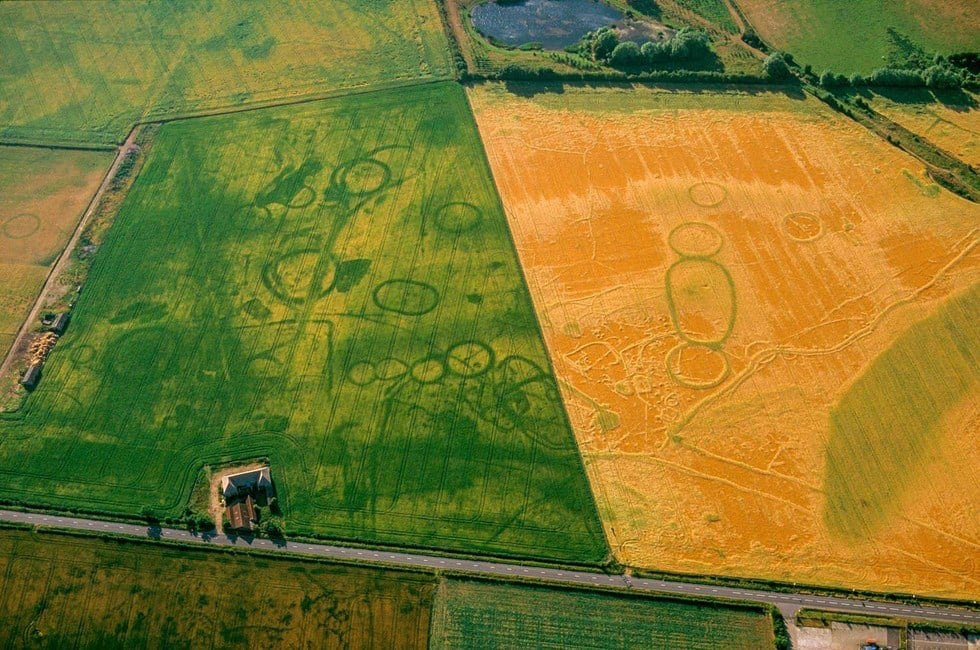
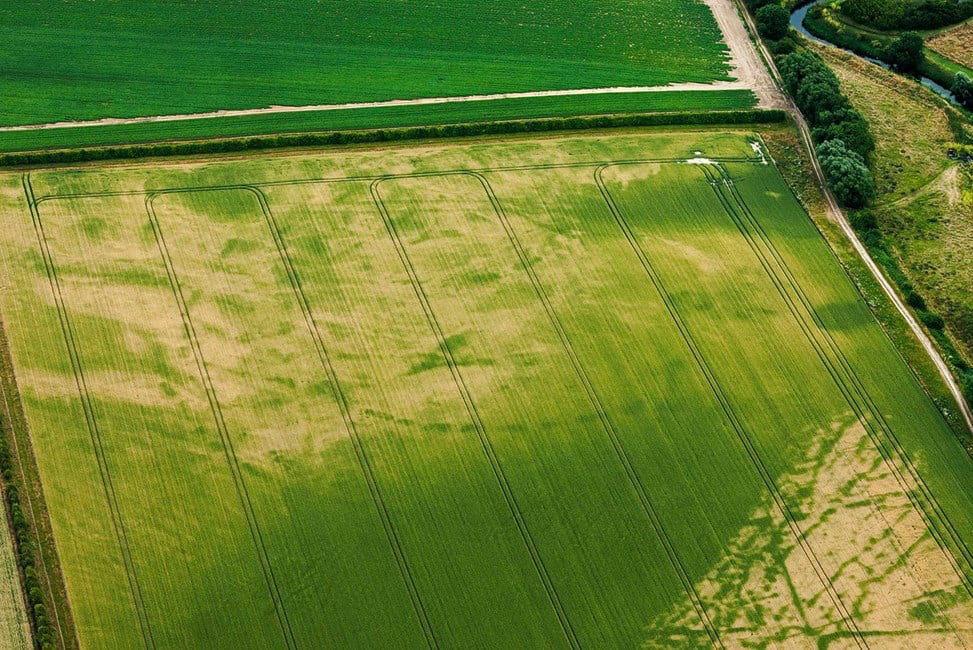
Cropmarks of prehistoric barrow cemetery and enclosures near Eynsham, Oxfordshire photographed on 01 September 1995 (NMR15291/21) © Crown copyright.Historic England Archive: Photographer – Roger Featherstone

Beginnings

On a cold February afternoon in 1967 an Auster, four-seater, light aircraft took off from Fairoaks airfield on the outskirts of south west London. This was the first test flight of the Royal Commission on the Historical Monuments of England (RCHME), one of the predecessors of Historic England. On-board was the pilot, a photographer, Ron Parsons and John Hampton. John was responsible for setting up the RCHME Air Photo Library in 1965 to implement the commission’s resolution (1964) to “use air photography to build up rapidly a record of field monuments throughout England.”

In the beginning this involved acquiring aerial photographs to build up a library of images of archaeological sites. By 1967 it was felt that RCHME should take its own oblique aerial photographs in support of its field survey work. Oblique photographs are taken at an “oblique” angle to the ground, as opposed to directly from above. They are usually taken with a hand held camera through the open window of a plane. The main target at this time was cropmarks; the walls and ditches of buried archaeology can affect the rate at which plants grow over them, causing differences in colour and height. These cropmarks are not always visible on the ground, so the best way to look for them is from the air.

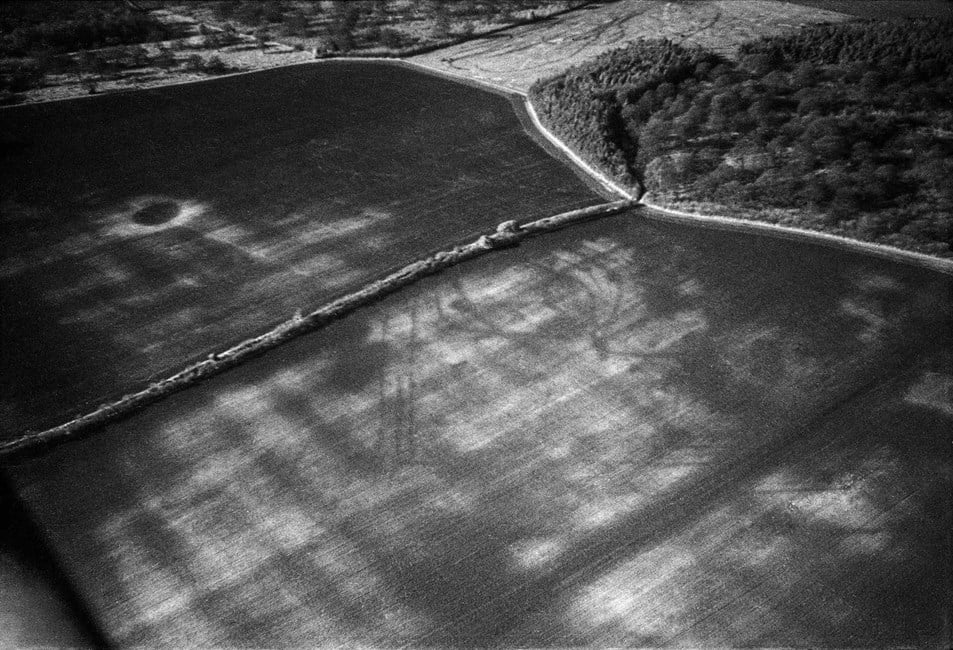
A prehistoric enclosure near Wootton St. Lawrence, Hampshire, recorded on the first flight on 08 February 1967 (NMR 20/3a) © Crown copyright. Historic England Archive: Photographer – Ron Parsons

This first flight was very much an experiment. Flying from Fairoaks to Basingstoke, Tidbury Ring and back they photographed prehistoric sites on the chalk soils of Hampshire. Many of the sites had been ploughed recently and were seen as colour differences in the soil and germinating crops. During the 1.5 hour flight John Hampton learned a number of valuable lessons, such as the best height to fly, the best angle to use and to make sure there was plenty of film! The lessons learned from this and subsequent flights formed the foundation of 50 years of flying by the aerial reconnaissance team in RCHME, English Heritage and now Historic England.

Growth of the archive

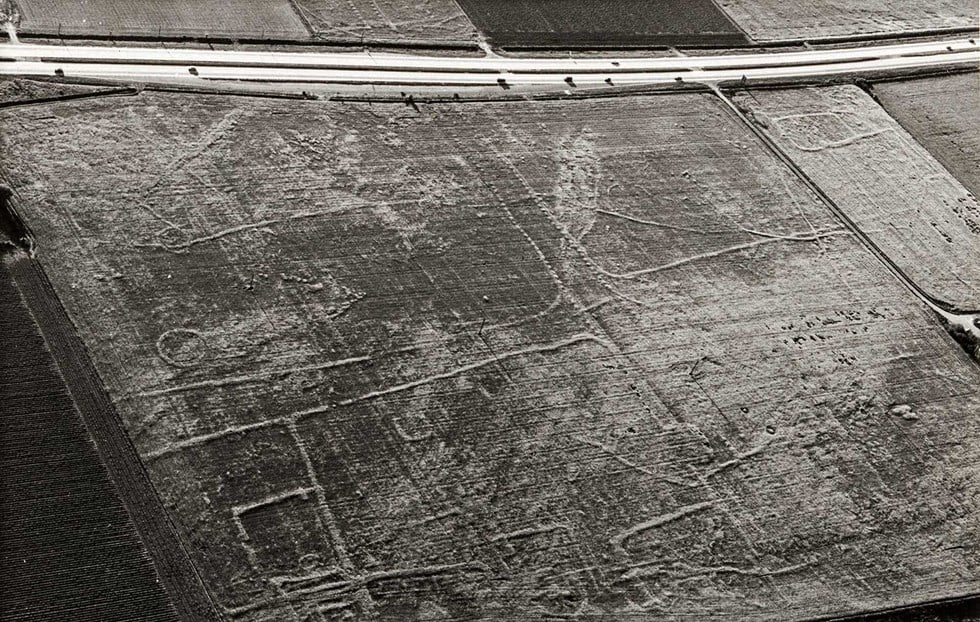
At about the same time as this first flight the collection of aerial photographs grew with the arrival of the Crawford Collection from the Ordnance Survey. Later, in the 1970s, the Air Photo library acquired many more aerial photographs from archaeologists and private fliers keen to discover archaeological sites. One such flier was Derrick Riley who took this photograph of an Iron Age/Roman field system in Nottinghamshire.

Cropmarks of a prehistoric field system in Nottinghamshire taken by Derrick Riley on 06 June 1976  (DNR 847_17). © Historic England Archive (Derrick Riley Collection)

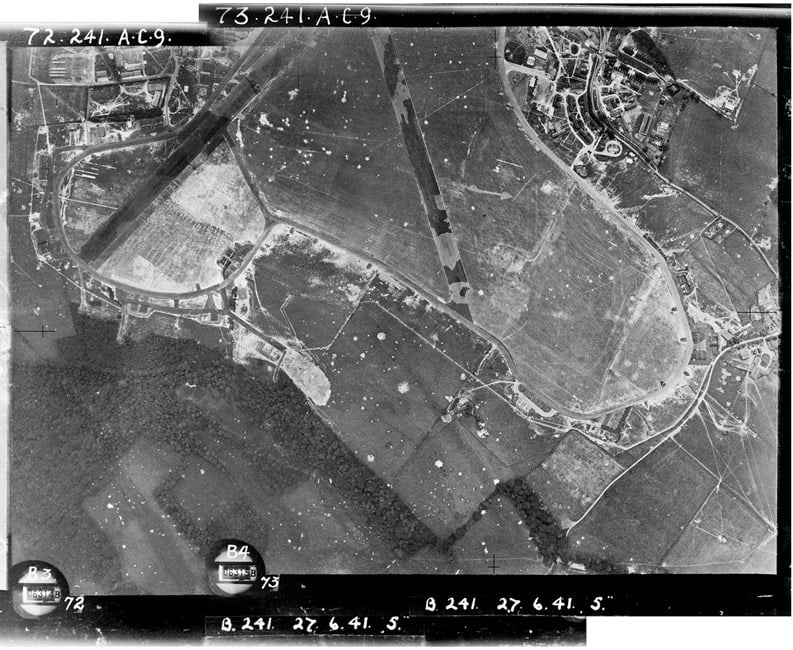
The oblique photographs acquired and taken by RCHME were ordered by kilometre square and stored in distinctive red boxes. Then in the 1980s there was a rapid growth with the acquisition of the Department of the Environment collection of vertical aerial photos. This collection included all prints taken of England by the RAF since the start of WWII such as the image below. This shows the airfield at Biggin Hill, near London with evidence of the many bomb craters sustained during German air raids. Further expansion came in the 1990s with the acquisition of the Ordnance Survey archive and in 2007 with the Aerofilms collection.

Photo mosaic of RAF images of Biggin Hill airfield taken on 27 June 1941, showing a camouflaged runway and filled in bomb craters (RAF_241_72 and 73). Source: Historic England Archive (RAF collection).

Mapping from aerial photographs

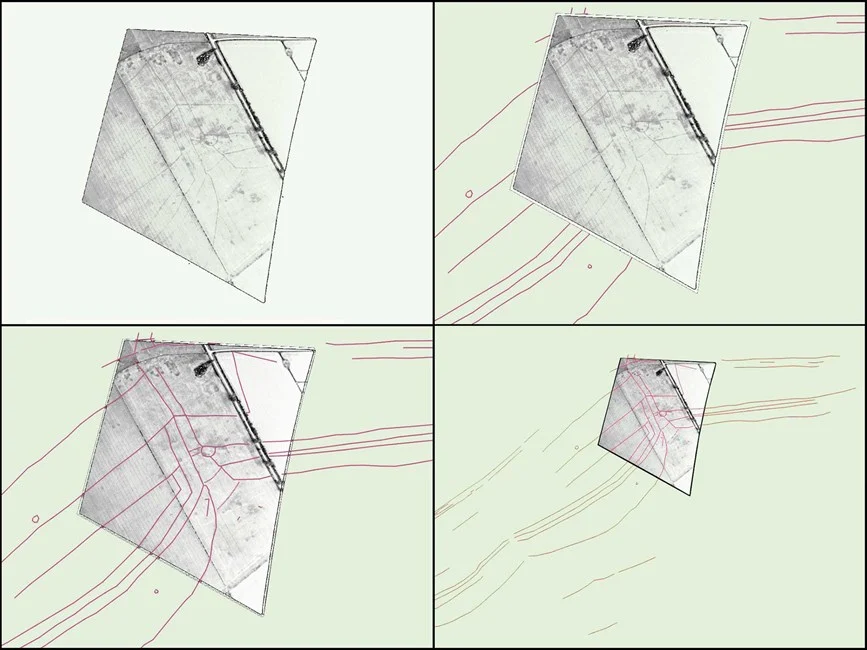
In the 1970s John Hampton and his team looked at various ways of interpreting and mapping from the aerial photographs taken by RCHME and acquired from local fliers. Along with others, they experimented with a variety of mapping techniques from sketch plotting to photogrammetry. An important step in the development of this process was the project to map the archaeology around the Iron Age hillfort of Danebury. This approach was scaled up by RCHME to map the prehistoric archaeology visible as cropmarks on the Yorkshire Wolds. This project used computer aided rectification of oblique aerial photographs, a process that was being developed. 

In the late 1980s, as the archive acquired more aerial photographs, RCHME developed a systematic methodology to interpret, map and record all archaeological features, not just cropmarks, visible on aerial photographs. Pilot projects in Kent, Hertfordshire and the Thames Valley were set up to develop the methodology further. 

Computer-aided rectification, interpretation and mapping allows information from many individual photographs to be combined, revealing extensive landscape features. Here you can see the process from the original rectified photo to how it fits into the wider landscape. Photo (NMR 1580/04A) © Historic England Archive (Derrick Riley Collection)

Increasing our range

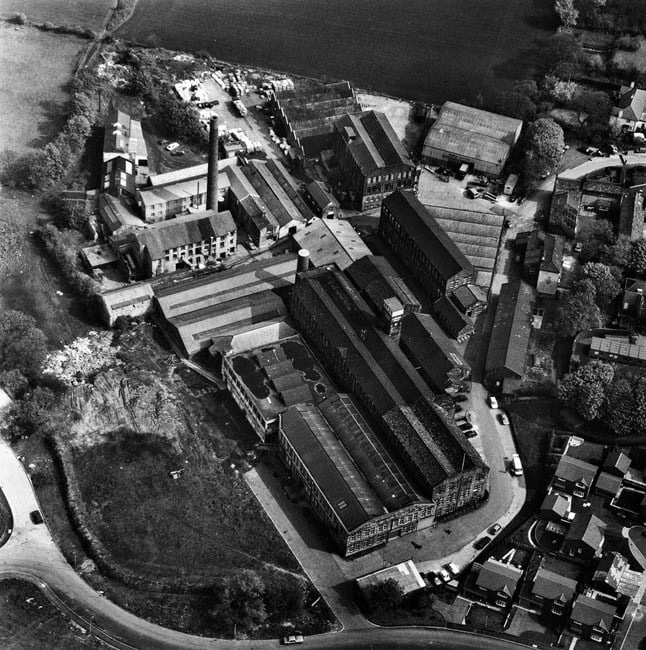
In the 1990s the range of subjects photographed increased as RCHME used aerial photographs to record the large building complexes they were surveying that were undergoing major changes at the time. These included textile mills, hospitals, prisons and Cold War military sites. For some of these sites such as the textile mill below in Leeds, these photographs are the last record we have as development pressures have since led to their demolition.

Laneside Paper mill (foreground) and Churwell knitting mill (top centre), Morley, Leeds, photographed on 17 May 1985, and since demolished (NMR2613_57) © Crown copyright.Historic England Archive: Photographer – Mike Hesketh-Roberts

New discoveries

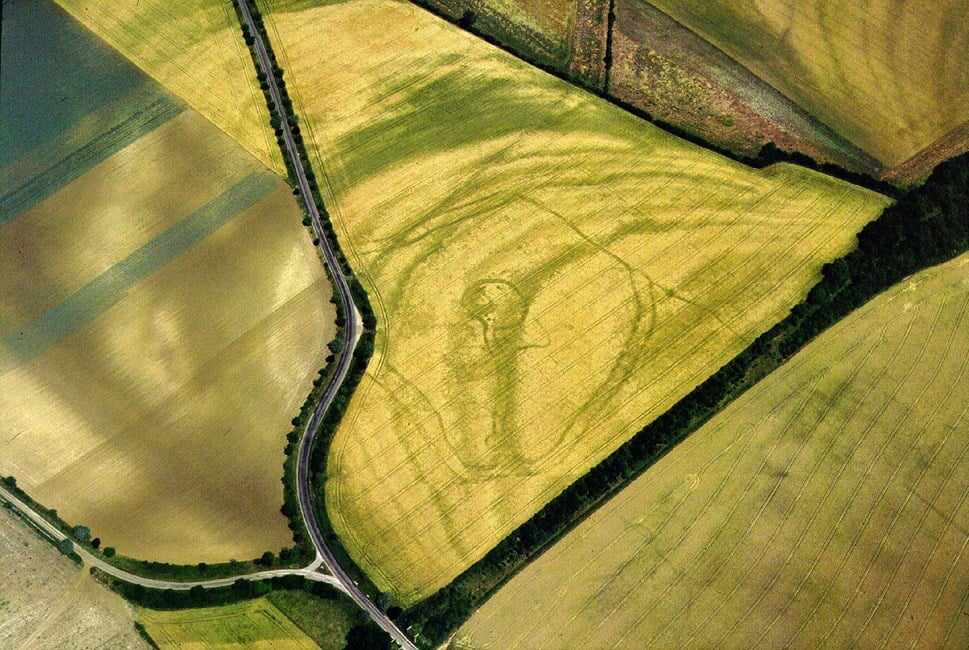
The 1990s also saw new discoveries across the country especially in the hot summers of 1995 and 1996. Below is just one such site, a “banjo” enclosure, so called because of the shape; a circular enclosure with a long funnel neck leading into it. See other examples of new sites discovered in the 1990s and at other times in the gallery below. 

Cropmarks of an Iron Age Banjo enclosure, Rollright, Oxfordshire photographed on 20 July 1995 (NMR 15350_33). © Crown copyright. Historic England Archive.

Expansion

In the 1990s the political changes and opening up of eastern Europe led to archaeologists visiting the survey and archive teams to learn from our experience of flying, mapping and archiving aerial photographs. This led to us joining forces with other aerial archaeologists from western Europe to set up training courses in Hungary and Poland. This in turn led to further work exchanges and training courses across Europe. 

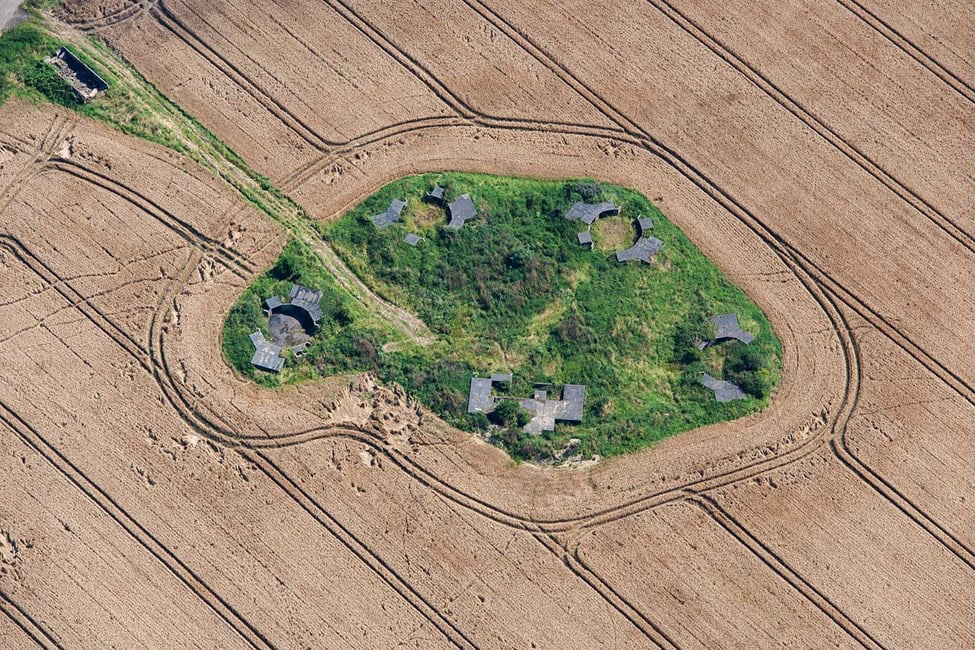
The late 1990s saw RCHME and EH working together to supply aerial photographs to help Field Monument Wardens monitor the condition of scheduled monuments. Following the merger of the two organisations in 1999 this became an important aspect of the flying programme. In the image below the World War Two anti-aircraft battery might appear to be safe since it has been removed from the cultivation that surrounds it. However, it is still at risk from being overgrown by scrub. 

World War Two Heavy Anti-aircraft battery near Bolton upon Dearne, Barnsley photographed on 10 August 2012 (NMR 28324/002). © Historic England Archive

New technology

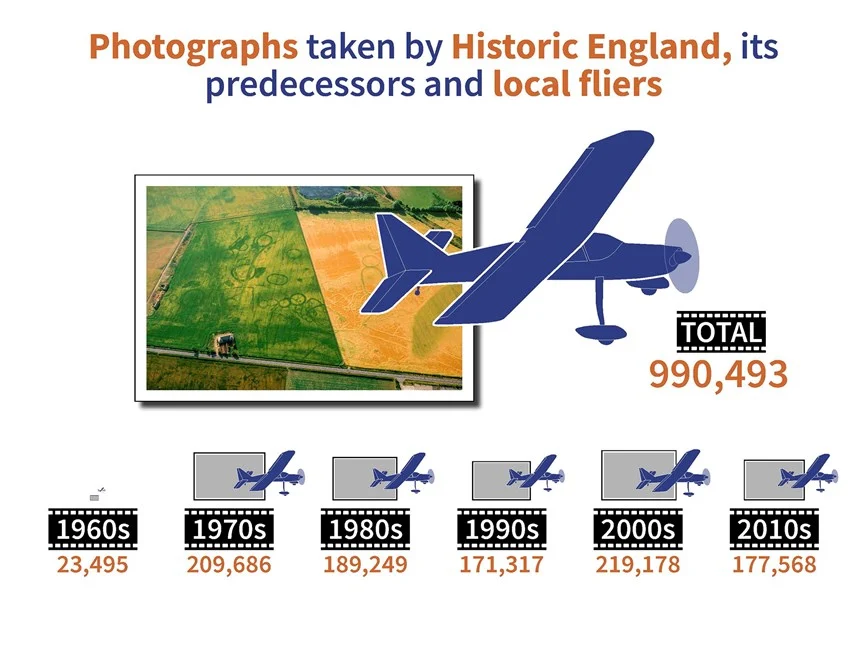
The new century saw important technological developments taken up by the flying and mapping teams.  The reconnaissance teams began experimenting with digital cameras in 2003 and the archive developed standards for the long term preservation of digital data. The last negative film shot in the air was 2006. The archive now holds over 200,000 digital aerial photographs taken by the reconnaissance teams. 

In 2001 English Heritage used lidar, a system of airborne laser scanning, for a review of mapping of the Stonehenge World Heritage site. Since then HE have developed our use of the data and now use it as a regular source for any mapping and interpretation projects. 

The early 2010s saw more new discoveries, of which these are our favourite examples

The distinctive elongated pits of a newly discovered Neolithic enclosure in Cambridgeshire, seen here as cropmarks in a field of wheat on 06 July 2015 (NMR 29353_034) © Historic England Archive: Photographer – Damian Grady

The discovery of new archaeological sites is still the most exciting part of the flying programme, but since the first flight in 1967 the scale, range and scope has changed. New sensors and camera technology are allowing us to look at new ways of taking aerial photographs. New software and access to other aerial data such as lidar allows us to see, map and understand the historic landscape in ways that could only have been dreamed about in 1967. 

Since our systematic analysis of new and archive aerial photographs began in the late 1990s we have discovered over 122,000 new archaeological sites like the one above.

ooOOoo

I very much hope that republishing this article is in order. An email to the Press Office of Historic England requesting permission has been sent last Sunday afternoon.

This morning, 30th July, I received the following email:

To use the aerial images you have seen on our webpage ’50 Years Flying’ athttps://historicengland.org.uk/whats-new/research/50-years-flying/ , please make a note of the image reference numbers and then visit our Aerial Photography Explorer website at https://historicengland.org.uk/images-books/archive/collections/aerial-photos/ . If you then navigate to the oblique image search screen and fill in the reference number under the ‘file contains’ tab you will be taken to that image. By then hovering over that image a share/embed option will appear that will allow you to use the images free of charge on non-commercial websites and some social media sites such as X and Facebook. Our reference is 150356.

Picture Parade Four Hundred and Seventy

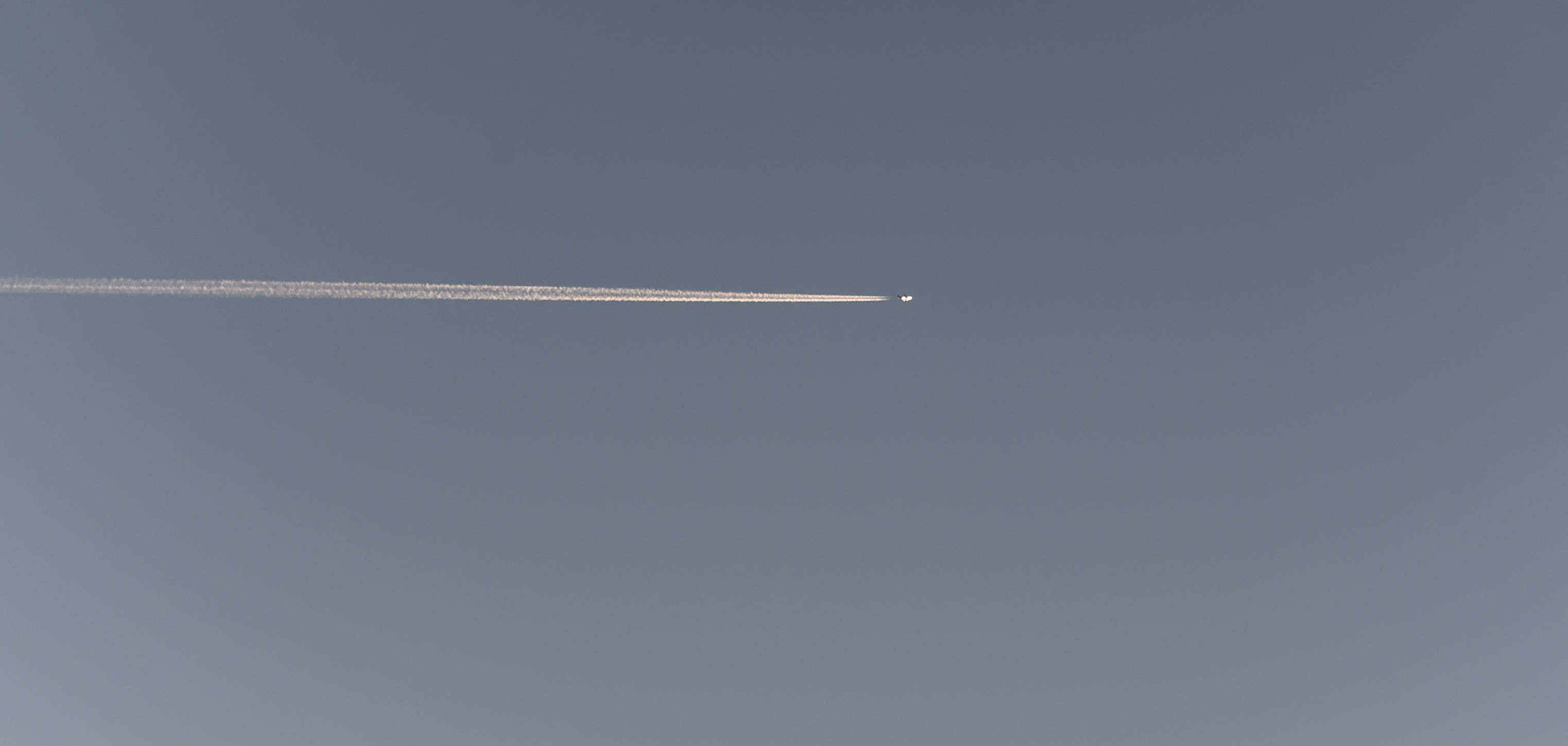
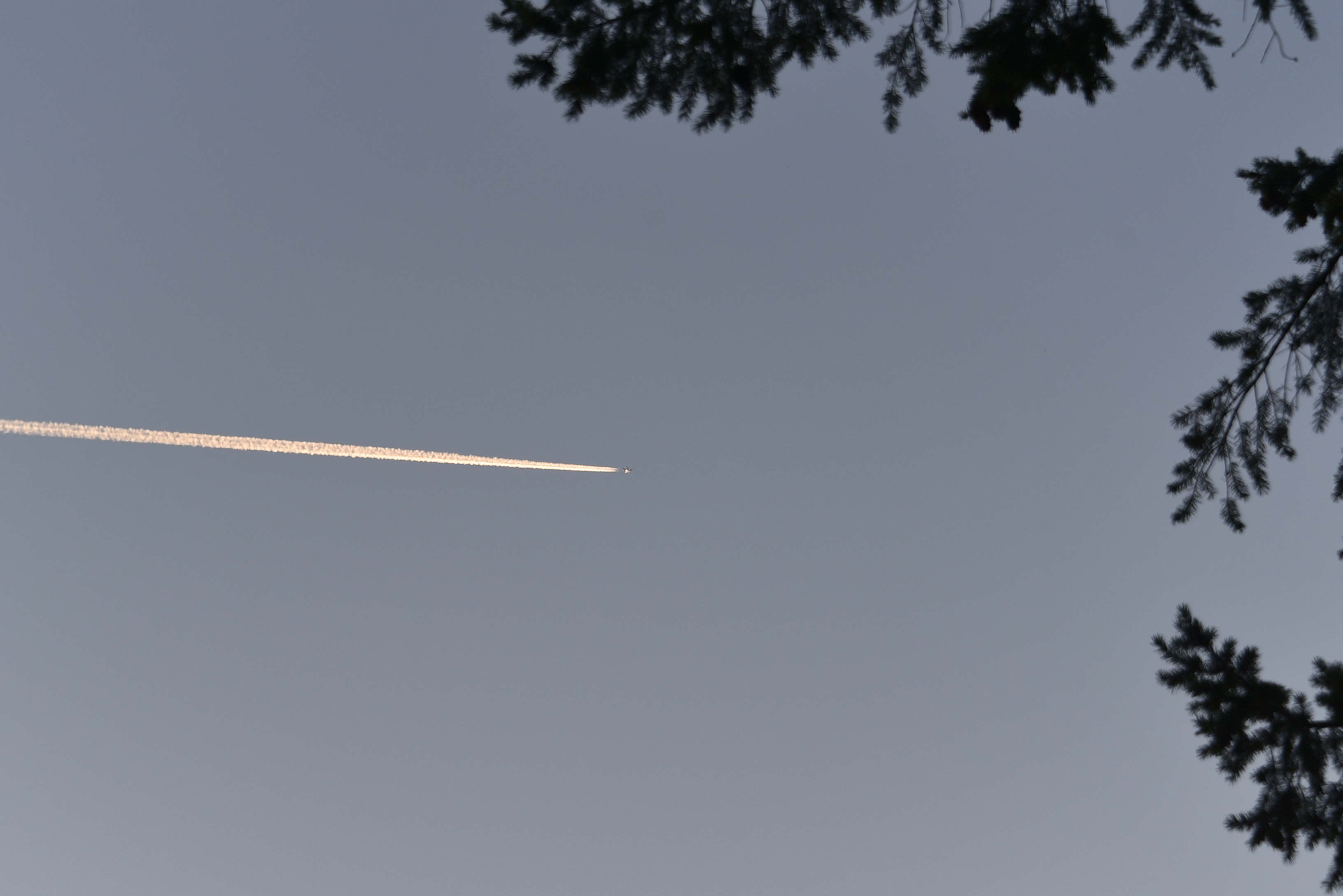
Today it is all about jet contrails.

I just find the contrails of the jets way above us in Merlin, Oregon fascinating.

oooo

oooo

oooo

oooo

oooo

All of the photos taken from our rear deck.

Plus two taken in September last year.

oooo

My dear friend, Richard.

Richard’s funeral was last Thursday.

Julie, his partner, sent me the Order of Service, held on the 20th, that I have published on LfD today.

(Click on the link to see the complete Order.)

UPDATE: Here is the service, sent to me on Sunday by Julie.

ooooo

In Loving Memory and to 

Celebrate the Life of

Richard Julian Maugham

28th October 1946 – 9th February 2025

————–

Entrance Music – 

Theme from Out of Africa (Flying Scene)

By John Barry

——————–

A very warm welcome as we unite in both love and friendship to say, not just goodbye, but more importantly to pay tribute and to celebrate the life of Richard Julian Maugham.

———————-

Richard was a true character, one of a kind, sociable, funny and a wonderful raconteur who led a varied and interesting life which we will hear more about shortly but even then, we will barely scratch the surface of all he was, but I hope when you leave here this afternoon that you will do so with a real sense of having shared in something special, for a friendly, popular and unique individual.

——————-

Reflection Music

We start today by playing a song from one of Richard’s favourite bands The Eagle’s, please sit back, listen and enjoy – ‘It’s Your World Now’ 

——————

Eulogy

The word Eulogy refers to a tribute of somebody’s life and it’s a pleasure for me share these words on behalf of Richard’s family and friends.

Richard was welcomed into this world on 28th October 1946 to parents Phylis and Lesley, born in Chiswick he would join his elder sister Vivienne who aged 4 was quizzed if she would prefer a brother or sister, prompting her response ‘I don’t really mind as long as it’s NOT a boy!’

But fortunately, it didn’t matter as Richard and Vivienne forged a wonderful relationship over the years and although not spending a lot of time together early on, Vivienne has such fond memories of cycling together with a picnic to the local swimming pool and also their cycle trips out with their dad too, Vivienne still recalls seeing Richard with his legs pedalling rapidly as he sped across the ground on the popular child’s bike of that era nicknamed the ‘fairycycle’.  

They both appreciated their safe and secure upbringing enjoying quiet Christmas’s together with a few close relatives and even when their paths took them in different directions, they remained good friends with a great rapport and comfortable in each other’s company. Richard was always very fond of his sister but also couldn’t wait for her to get married and leave home so he could inherit her bedroom however after waiting patiently for this happen his plan was scuppered when his grandma moved in instead! This gave Vivienne a little chuckle at the time having been pestered constantly to tie the knot.

Growing up in Twickenham, Richard passed his eleven plus with ease and attended the best Boy’s Grammer School in the area which would certainly hold him in good stead throughout his career, Richard was sharp as a knife, a confident lad and already showing signs of having the gift of the gab plus a real knack of making friends, with some of you here today as his lifelong friends for over 65 years namely Ken and Robin who formed part of the group known as the Young Pretenders, all meeting annually in the summer for the past 30 years and to Richard this was a very important and a valued friendship group that he held with a great deal of affection. 

Richard’s career path would typify his character a hard worker, charming, good with people and a fantastic communicator but the ideal person equipped to give us the best insight into Richard’s background is one of his best friends Tony, who shared these wonderful memories with me about the various sides to Richard having meet him in 1968 when working together in the Olivetti Sales and Management Training Centre in Haslemere. Tony was there to replace Richard or Dick as he was known then and to create a smooth transition within the workplace. But little did anyone know just what an impact this would have on the 2 of them and their future as friends, Tony for the first 3 months or so watched his every move, listened to his advice and even copied his jokes especially as they both shared the same sense of humour! Tony mused that Richard was your true dapper gentlemen, always extremely smartly dressed and often took on the role as Tony’s personal shopper, costing Tony a fortune in the process but it ensured he looked the part too, ready for their many nights out in Guildford or Haslemere and needless to say with that gift of the gab again, his looks and witty personality they had some memorable and extremely fun times through the years, Tony even recalls the time they attended the Cannes Film Festival, staying in a slightly sleazy apartment they nevertheless donned their best evening suits and walked the red carpet, a treasured memory.

This chance meeting at Olivetti really was the start of something very special, even when Richard went off to become a manager in Croydon and his career took him on a different pathway via some office supplies companies, a spell in Oman in the Middle East which certainly left an impression on him and onto roles in the car industry with Audi and VW as part of the Inchcape Group, Tony will forever remember the fond memories of their shared flats, shared holidays, shared clothing  and a shared love of being just little rascals when together, so as you can imagine Tony was beyond proud when Richard asked him to be his Best Man when he married Jane in 1986, returning the compliment when Tony married as well some years later.

But Tony wasn’t the only lifelong friend that Richard would make during his salesmen years, for in 1982, whilst both selling the Commodore ‘PET’, he would encounter a fellow salesman, Paul, meeting in the Petjet, the private small jet owned by Jack Tramiel, the CEO of Commodore, they hit it off immediately while travelling to the Hannover International Fair.

Richard and Paul took the pilots out for dinner that evening which inspired Paul to start gliding and later power flying, Richard flew on many occasions with Paul, as both being members of a private aircraft club, they would often hire a plane to fly to Jersey or Scotland but one memorable flight was their trip to visit Tony, who had recently relocated to South West France, flying to Bergerac airport they stayed a few nights enjoying Tony’s hospitality before flying back home. 

Richard by now had also developed a passion for all things aeronautical, often visiting air shows in later years and was visibly moved to tears whilst witnessing a Spitfire fly past when attending a Remembrance celebration at Seagry near Chippenham, a very special moment for him.

Paul’s friendship with Richard would continue to grow, living in Oregon now, he still recalls that meeting Richard in the way he did gave him a gift that he has treasured forevermore and a cherished relationship that also included meeting The Prince of Wales, this whilst both volunteering for the Prince’s Trust Charity where they helped many young people start their own businesses, one in particular being a gardening venture which Richard being the type of generous person he was duly employed the appreciative couple to work on his own garden, cementing Richard’s thoughtful and helpful approach to others.

Working until he was 77 years old, Richard will always be known as a hard worker, a great salesman, a fantastic speaker and presenter who was highly thought off across all his companies he graced but it was never all work and no play for Richard, helped by being a self-confessed petrol head, not only from working in the trade but also from the pure joy he experienced in his leisure pastimes with his passion for cars, watching the Monaco Grand Prix with a friend in the 70’s to his own Ferrari and Formula 3 Race Track Driving Experiences that he absolutely adored were just 2 of his highlights, as well as owning a MGB and Porsche that he loved. 

Approaching his 60’s, Richard would also find love again, introduced by a friend, he met a lovely lady, Julie who subsequently relocated to Wiltshire to be with Richard. They would also go on to purchase a property in South West France to renovate, named Mason DeFrere which was once part of a Friary, used by the monks to study and pray whilst it was also located not far from his friend Tony and his wife Caroline, travelling regularly to France they enjoyed many good times, strolling around the markets and spending quality time as a foursome together. 

Richard and Julie also enjoyed a shared love of music, at times Richard could be moved to tears demonstrating a real sensitive side to him not often seen but he could lose himself to the tunes of The Eagles or Hollies and seeing live music from the likes of Fleetwood Mac, Eric Clapton, Tony Bennett, Simply Red and Billy Joel are particular fond memories for Julie. 

Julie appreciated Richard’s sharp wit which was often fuelled by his love of the radio programme recently chaired by Jack Dee called ‘I’m sorry I haven’t a clue’, he would cry with laughter and often use the one liners himself to entertain his friends, he was an out and out ‘wordsmith’ loving his crosswords and an avid reader of the humorous dictionary ‘Meaning of Liff’ which again would have him in stitches and characterised his sense of humour perfectly.

Richard and Julie relocated to Essex to be closer to her son and grandchildren but Richard’s heart always remained in Wiltshire so a decision was made for him to return and continue to spend time with his friends, he had always professed that his Parkinson diagnosis would not define him but as the time moved on and following a fall, he was very much grateful to his wonderful friends Gillie and Colin who visited every other day and remained by his side as he sadly lost his battle last month.

We have lost a truly respected and loved man who gave so much to so many and lived a full life surrounded by people who cared for him, so we can be comforted in the knowledge that he has left us all with some treasured memories of time spent in his company.  

Thank you, Richard 

——————–

Reflection Music

How we love by Beth Neilson Chapman

We have shared some lovely memories and I have no doubt you will all have you own personal memories from times spent with Richard, we would now like to give you a little time to reflect on those while we listen to a lovely tune by Beth Neilson Chapman

——————

Poem

I would now like to share a poem chosen by Julie especially for today’s service and dedicated to Richard and his love of aviation – 

High Flight

Oh! I have slipped the surly bonds of Earth

And danced the skies on laughter-silvered wings;

Sunward I’ve climbed, and joined the tumbling mirth of sun-split clouds – and done a hundred things you have not dreamed of—wheeled and soared and swung high in the sunlit silence.

Hov’ring there, I’ve chased the shouting wind along, and flung my eager craft through footless halls of air ….

Up, up the long, delirious, burning blue

I’ve topped the wind-swept heights with easy grace

Where never lark, or even eagle flew—

And, while with silent lifting mind I’ve trod

The high untrespassed sanctity of space,

Put out my hand, and touched the face of God.

——————-

Tributes

I would now like to invite Ken and Robin to share their tributes to their special friend while we hear in the background a popular song of Richard’s by The Hollies

——————

Farewell

“We are all visitors to this time, this place. We are just passing through. Our purpose here is to observe, to learn, to grow, to love…and then we return home.”

Richard, we have heard the impact that you had on so many people. Your character, humour and individuality that were so much a feature of your life will live on in our memories and create a beautiful legacy of love for your family and friends for much longer than the acute desolation we are feeling here today. 

Richard it is with such sadness we say goodbye to you, but we thank you so much for every little gift you have contributed to this life.

But most of all we thank you for your love and for your friendship; your warmth and care, and for your kind and humble heart.

We thank you Richard for everything you were and all that you gave, and may you now forever rest in peace with the certain knowledge that you were, are, and will always be, dearly loved and terribly missed. 

Farewell Richard Farewell

——————

“Always remember you matter, you’re important and you are loved, and you bring to this world things no one else can.”   

——————–

Exit Music

Don’t Stop Thinking About Tomorrow 

By Fleetwood Mac

oooo

Now a selection of my photos.

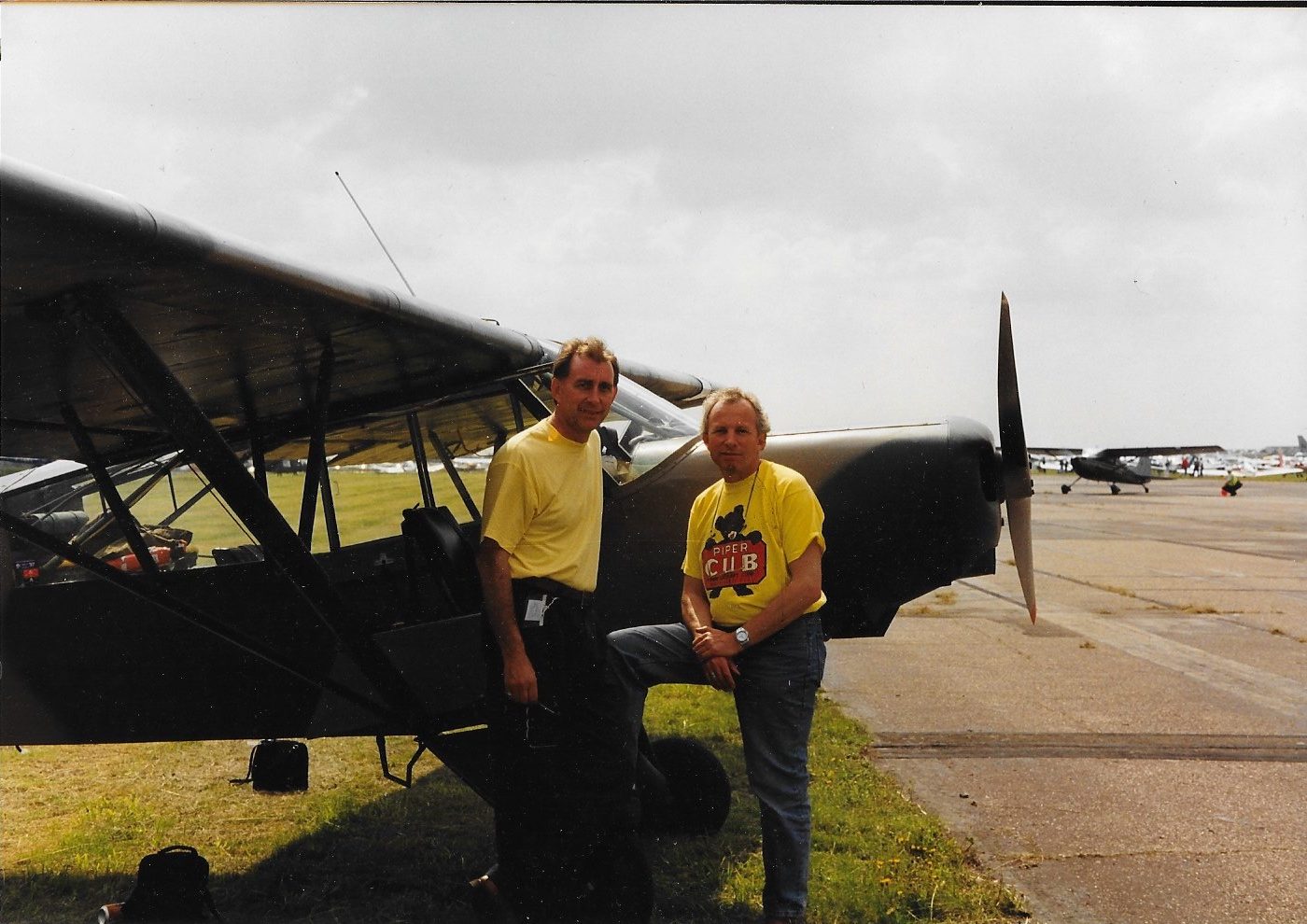
Richard and me by the Piper Super Cub, registration R151.

oooo

Richard and Alex, my son, in front of G-BPAS, a TB20, at another air show.

oooo

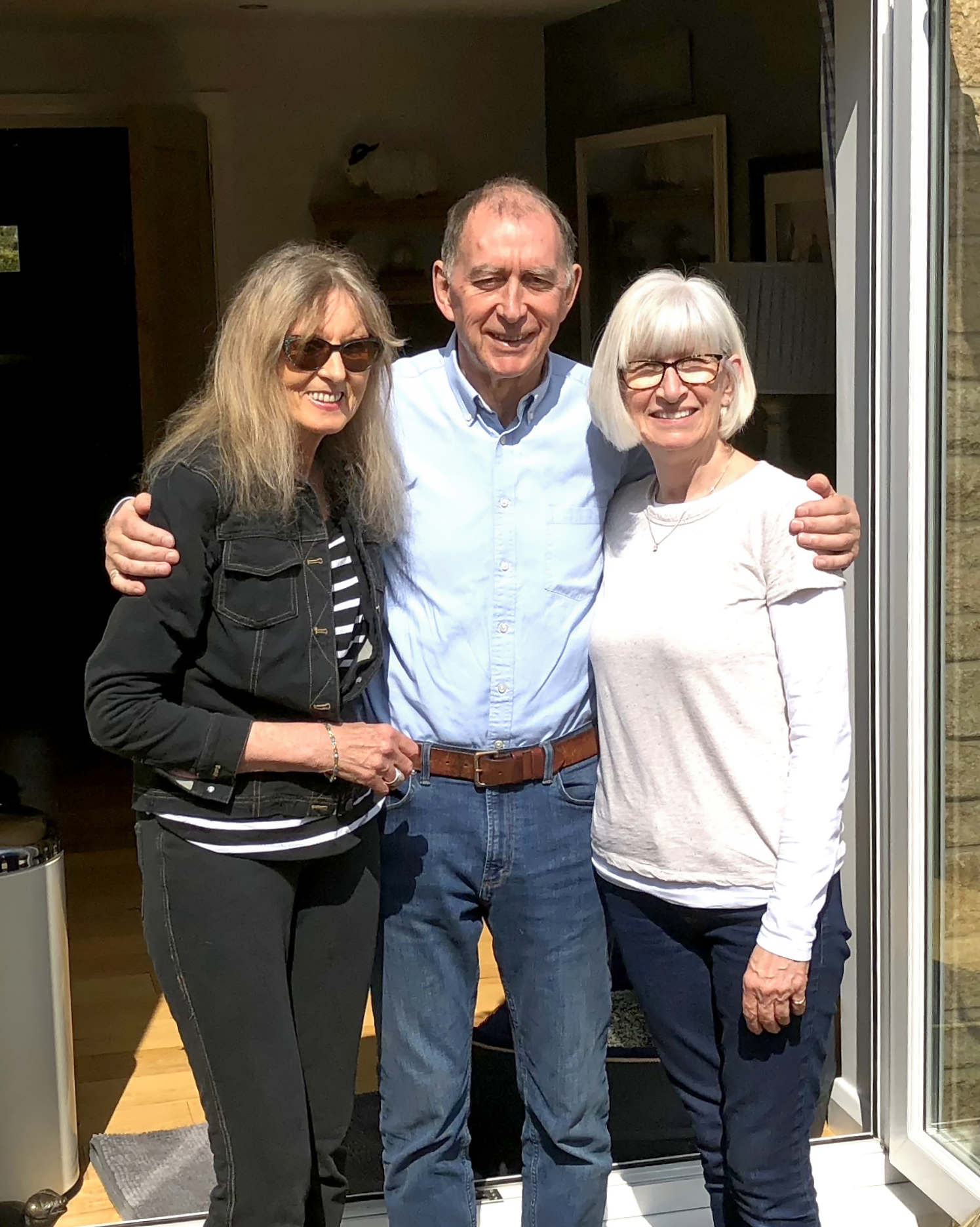
Jeannie, Richard and Julie.

oooo

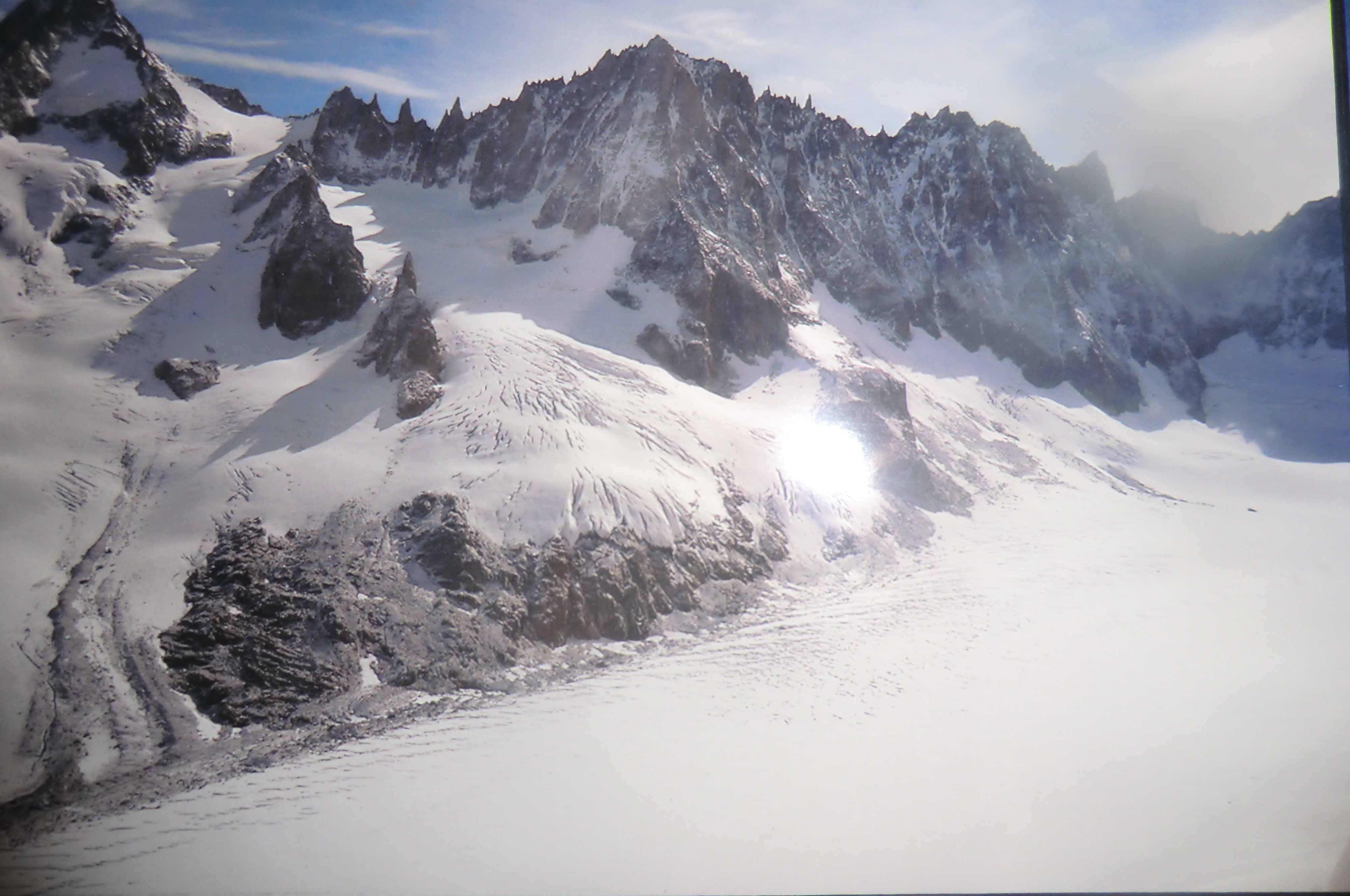
R151 taking me and Richard to see Mont Blanc. It was the 25th August, 2006.

oooo

Another view of the same valley; again the 25th August, 2006.

oooo

The final photograph of Richard and me meeting the then Prince of Wales.

Background to the friendship.

(Previously published on LfD.)

I first met Richard Maugham when we were being treated to a private jet flight to the Hannover International Fair in 1982, some 43 years ago. We were both English and I was living in Tollesbury, Essex, near Colchester and Richard living near Ealing, West London.

The common thread was that all the passengers were major sellers of the Commodore ‘PET’.

Richard and I hit it off straight away. Richard was a fellow salesman. I was ex-IBM Office Products Division and Richard was ex-Olivetti.

Both of us also volunteered for the Prince’s Youth Business Trust, a charity headed by Prince of Wales, as he was then, helping young people start their own business.

My tribute to Richard who will always be missed.

Picture Parade Four Hundred and Fifty-One

A few photographs from home.

oooo

oooo

oooo

oooo

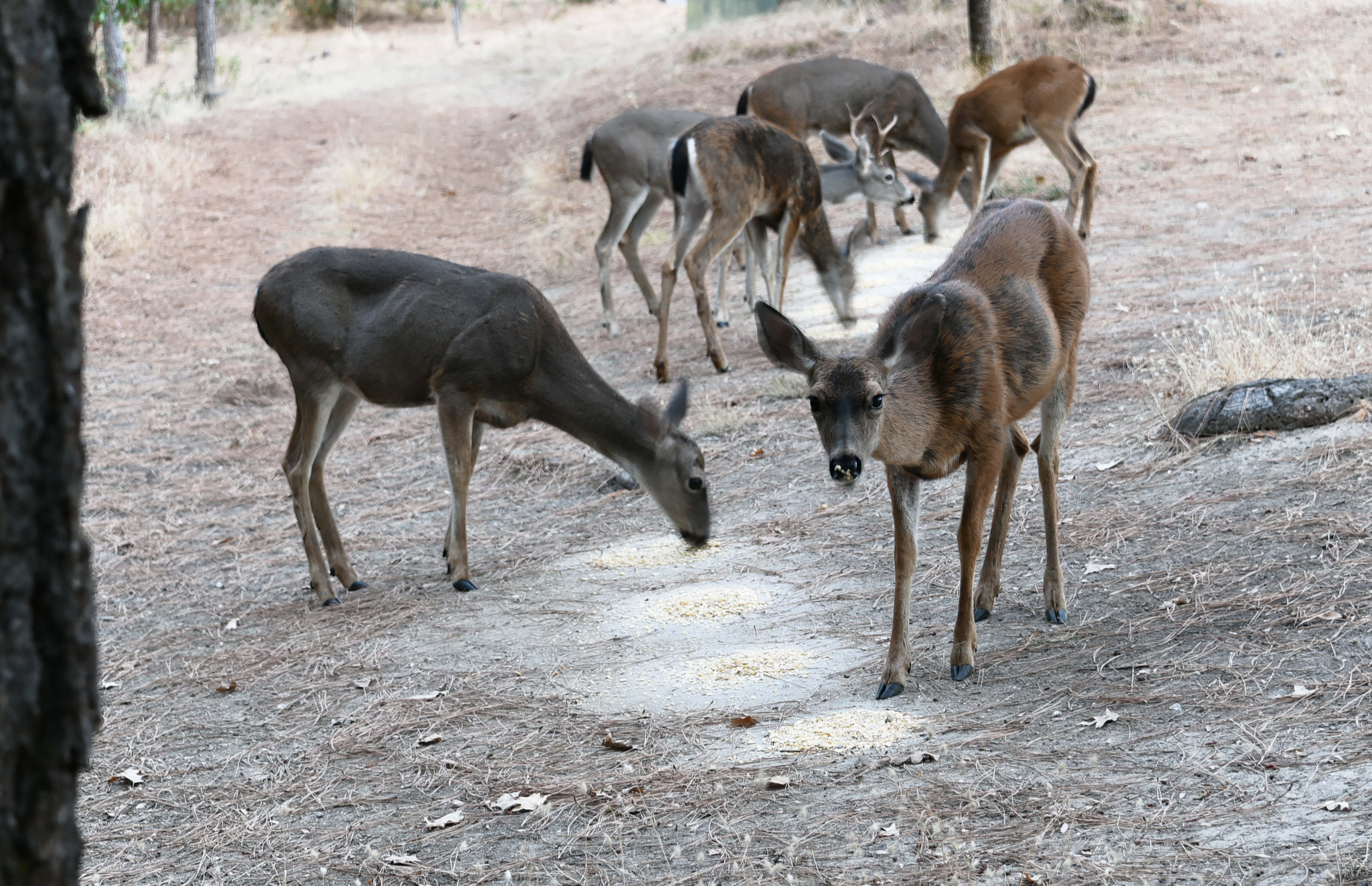
The three deer photos show them feeding from me putting out COB (corn, oats, barley) each morning soon after it is light.

Of course, typically the morning I took my camera out there were just four deer. Usually there between seven and fifteen and a couple of months ago a friendly stag in getting to the COB as I was pouring it out rubbed his right antler on my right leg.

Feeding my friends!

Dogs rescued from ‘Park Fire’.

That’s the fire in California that is growing so quickly!

There are so many stories around about these dogs being rescued. I have chosen the YouTube video which is the CBS News, Chicago, presentation.

A homeowner was forced to leave their truck behind with the adult rottweiler and her puppies. The owner told rescuers where they were, but the intense fire blocked access to the truck. Several days later, rescuers spotted the dogs from a helicopter and landed to get them.

A delightful story

About a blind man and his dog being rescued.

Today’s post is a short video that has no sound. But don’t let that stop you from watching it.

Blind man and dog rescued after days stuck on trail.

A 55-year-old blind man and his dog have been rescued from the Rogue River trail in South-Western Oregon. They began hiking on the trail on July 3 or 4 with a friend. During the hike, the man began to experience heat exhaustion, so the friend left to try to call emergency services. A US Coast Guard helicopter crew airlifted them to safety and the man and his dog were taken to emergency medical services.

My understanding is that they were rescued on July 11th, just a week ago.

Keep it Simple – Live the Dream

A guest post from a friend of many years!

Bob Derham is someone I met many years ago, when I was living on my yacht in Larnaca, Cyprus, and I can do no better than to repeat what I wrote in my autobiography.

ooOOoo

I negotiated what I thought was a good deal and sold the company. Inevitably I resigned from what was now not my company; it was the end of November in the year of 1988.

In Tollesbury, I had my annual tax returns done by Peter Michael, also living in the village. Peter was an accountant who also taught accountancy at the nearby Essex University. I saw Peter and we discussed the recent agreement for the sale of the business.

“Paul, there is not a lot you can do, to be honest. You will be liable in broad terms for the tax in the difference between the opening price and the closing price. In your case the opening price was near enough zero and the closing price…” Peter did not need to finish the sentence. I got the picture and stood up to leave. Just has I was going out of the room, Peter added: “Unless you can leave the country before April 15th next year, and stay away for a minimum of four tax years. In other words, leave before April 15th, 1989.”

I walked home from Peter Michael’s house that November, 1988 with the advice I had been given ringing in my ears. I would worry about the tax implications in a day or two. But once again fate intervened.

I was a subscriber to the boating magazine Practical Boat Owner (PBO). In a late 1988 issue I read in the classifieds:

Songbird of Kent – Tradewind 33

Great opportunity to purchase a long-distance ocean yacht designed by John Rock for sea-kindly short-handed sailing.

Well kitted out, continually updated and maintained Songbird of Kent is the yacht for you if you dream of blue waters and serious long distance cruising.

Lying Larnaca, Cyprus.

I knew about Tradewind yachts, was familiar with John Rock. (As the designer of Tradewind yachts he had been featured several times in Practical Boat Owner magazine), and knew how many of his yachts had made world circumnavigations, and, finally, I deserved a holiday. I arranged to go out to Larnaca as soon as I could.
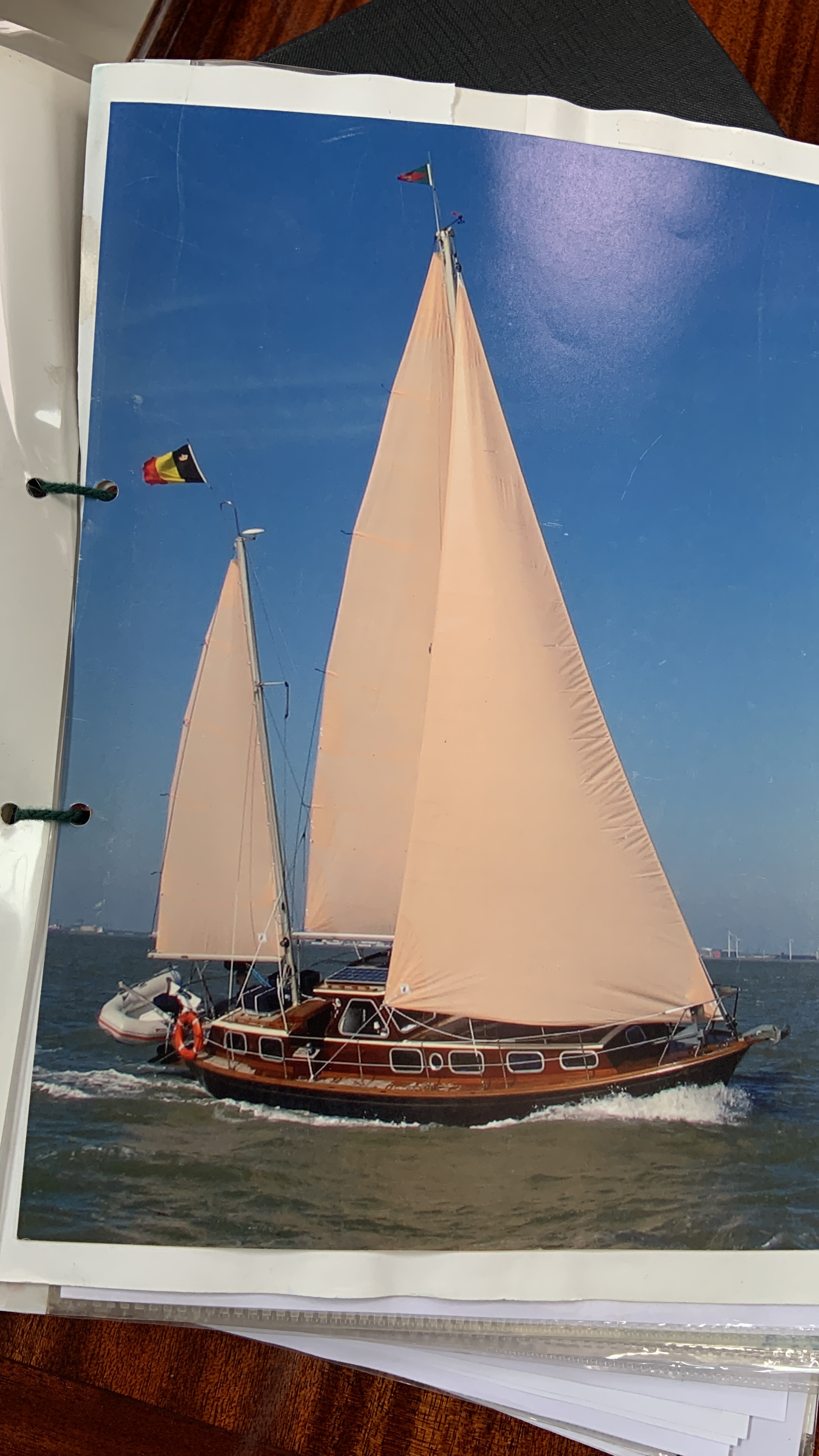
About a week later I caught a flight to Larnaca International Airport; upon arriving I rented a car and drove the few miles to the Marina.

The yacht was easy to find as it was out of the water. I met the owners, Michael and Betty Hughes, who were still living onboard Songbird of Kent. They explained why they were selling. Simply because, as Michael put it, they had been living on the boat for many years and it was time to return to their native Wales. Songbird had been extensively cruised the length of the Mediterranean Sea using Larnaca Marina as the base.

I quietly inspected the boat. Because it was lifted out viewing the boat in detail was much easier than had it still been floating. It was in good condition; very good condition in fact. Then I climbed up the ladder and entered the boat. Again I found everything that I expected, and more. It was clear to me that Michael and Betty had had the boat as their home and, consequently, everything was in order. Or to use the phrase; shipshape and Bristol fashion!

I excused myself, left the yacht and went and sat on a nearby seawall. I wanted to think. To be honest, it was pretty easy thinking. I loved the boat; it was a purchase I could afford, and if everything went to plan and I left the UK before April 15th, 1989, and stayed away for four tax years, there would be no UK tax to pay on the sale of my company Dataview. Nothing: Nada!

So that is exactly what I did!

I went back to Songbird, where Michael and Betty were still sitting in the cockpit, and told them I would buy it. They drew up a contract there and then and I signed it!

My autobiography

ooOOoo

Here is Bob’s story:

Paul and I first met in 1992, when I was working as a contract pilot on the BAC 1-11 for Cyprus Airways.

My last flying post was down in New Zealand, a wonderful place to be, with it’s natural beauty, and lack of aggression and oppression. The joy of life is set around being outdoors, so road trips, camping, sailing, and skiing all feature, but less on big houses, and possessions.

Although I have travelled widely in my career, I now want a simple life, and that amounts to being free of ties to a property, such that all I really need is a warm, dry place to sleep, a suitable place to prepare food, and a place to relax, it is no longer about the big house, which brings it’s own issues, and expenses.

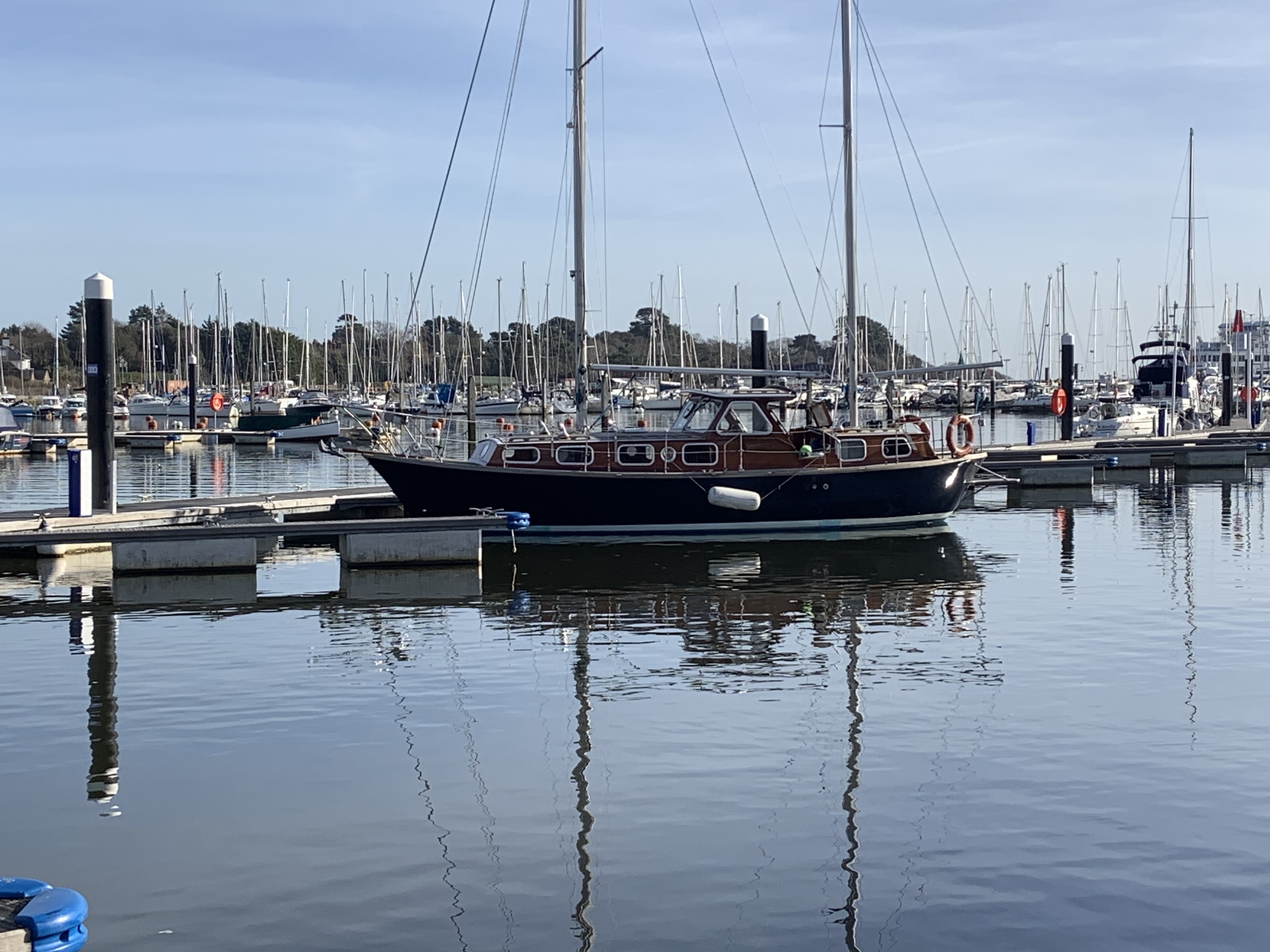
Following on from my time living on Paul’s boat, I was then drawn to living on a boat. I owned a smaller Westerley Centaur, for a few years, and even though small, I had a very happy time when I lived on that. It was down in Lymington, a small market town on the south coast of England opposite Yarmouth, on the Isle of Wight, that I kept my first boat.

The reason for this was simple 🙂

One of the interesting people I met in Cyprus was a man called Les Powles. Paul and I would regularly go out and have a mezze in a side street of Larnaca. Les would be very easy company, and found fun in the most silly situations. I was invited to call by on his boat any time, and have a “ cuppa”  What I was intrigued with onboard was a picture of the globe, but cut in half, and opened up. There were a series of lines around the world. I asked Les what this was. His reply was “It’s where I have been when sailing round the world.“
So why I asked are their three lines ?
“Because I have done it three times!“

Les was a most unusual character in that he had started building his boat in 1970. It took him 5 years to complete, and apart from a few short sea trials, Les actually had no other sailing experience, but in 1975, with barely enough rice and water onboard, he headed west. Actually he had intended to go to the Caribbean, but he had applied the variation to his navigation the wrong way, and made land fall 1500 miles from his intended destination. Les only died last year, 96, and his home had been his boat for all those years.

It’s that bit that has been the big thing for me.

Having a home has been ongoing hassle, the fun and enjoyment has been removed, because you are in a trap.
It is important to have a home, but I started to question the point of having a physical building. That brings all the ongoing costs and expenses, where the authorities can milk you for a lot of money!

I first saw Antoinette, in Lymington, and from the first moment I saw the boat, I knew I could make the boat my “home.”
She went to Southwold in Suffolk, England for a major refit, and so there is a new engine, gearbox, and propeller, replaced decking, and repairs have been carried out to the hull.

Inside, I can stand up, and although only 37 foot long, being beamy, there is a lot of room.
There are double cabins both fore and after, with “heads” (bathrooms). The main cabin and galley is very comfortable. It has a lot of mahogany wood, so looks homely, and the “dog house” (bit in the middle), is a very open useable space, either enclosed when cold and wet, or if the weather permits, opened up to enjoy the sun.

The key is that this is “my home”. 

I can now travel, and go where I like, but I have my home with me. It has heating, but normally when you arrive somewhere, part of the mooring fees offer a shower unit and facilities. I have space to entertain, but above all, I am free of all the ties that we adopt by following the life society offers us as “the norm“.

It is only now that I see the traps that others face, because I can up anchor and head off, and can see where Les Powles got his freedom, and lived his dream.

In the cabin of Antoinette with Finn the dog belonging to Natalie (on the left).

The collie is “Finn”, Natalie’s dog. I think Paul was one of the first to see her when she was born, so 31 years later, Natalie wants to enjoy the alternative life.

As for Finn, he loves it.  Fresh air, plenty going on, and a lot to see.

“Tiny living”, but the release from the way most people live is amazing.

No speeding tickets for me. 🤪

ooOOoo

Thank you, Bob for the story of you and me. That last thirty years have flown by and those years on Songbird of Kent were really special albeit the end of my cruising days were pretty scary.