Tag: Tom Engelhardt

Rewilding the West

Staying with the theme of rejuvenating our relationship with the natural world.

A recent post from TomDispatch republished in this place once again with the generous permission of Tom Engelhardt.  It follows on so sweetly to yesterday’s post Returning to Nature.

oooOOOooo

Tomgram: Chip Ward, Rewilding the West

Rewilding the West

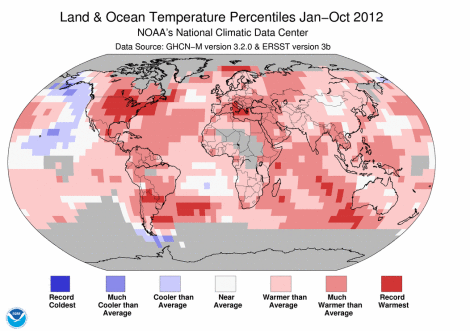
Here’s a nifty trick that’s been on my mind lately. In case you hadn’t noticed, the weather news this season has been pretty grim. Tornados so large and destructive that they would have given Dorothy pause, 500-year European floods, massive rainstorms rolling across the land, record heat in California and Alaska, late snowfalls that boggle the imagination, wildfires that dwarf past ones in the American West. I could go on, but why bother since anyone who has been watching primetime TV news can’t but notice that staggering weather has been the lead or second story much of the time all spring and into the summer.

You’re probably wondering right now: But what’s the trick? I’m surprised you haven’t noticed yourself. All of this weather has a new, made-for-TV label. It’s now regularly called “extreme weather” or “severe weather.”  And that’s anything but inaccurate. The weather has been both “severe” and “extreme” this spring. The trick is that, as a label, “extreme weather” has managed (with rare exceptions) to obviate the need even to mention that any of this could have the slightest thing to do with climate change, with our overheating, over-greenhouse-gassed planet. Think of it as a fabulous form of recognition and denial wrapped in the same package.

The TV news gets all the benefits of night-after-night, eyeball-gluing drama in which the weather goes nuts, houses are destroyed, and people weep (or are stoic) about ruined lives. It gets to bring in the tornado watchers and the weather people in their raincoats and waders.  (Have you noticed that the TV news can’t report a flood without putting some reporter with a mic knee-deep in water?) It gets to focus nightly on those daunting weather maps with their blazing red danger zones, and offer warnings about what potential disaster tomorrow might have to offer, all the while remaining in official, blissful denial about what’s happening on this planet of ours. Somehow, it has managed to incorporate the possible effects of climate change into the nightly news as a major story, while excluding just about all serious discussion of it. Tell me that isn’t a doubly nifty trick!

Of course, if there’s nothing but “extreme weather” happening and that weather has no extreme context, no extreme meaning, then none of us have to worry our little heads about what’s to be done. Those trying to remedy the degradation of conditions on this planet can also be ignored, which is why we couldn’t be more pleased that TomDispatch regular Chip Ward introduces us to such a person today. Tom

Trek West for the Big Picture
Saving the Land One Footfall at a Time
By Chip Ward

My home sits at the gateway to a national park in Utah, a source of envy among tourists who gather along Capitol Reef’s “scenic drive.” But after 40 years of living in one desert or another, I know firsthand that America’s iconic desert landscapes, places like Monument Valley and Arches National Park, are the exceptions, not the rule. The rule is that we dig up, dump on, dam, bomb, drill, over-graze, and otherwise abuse our deserts, most of them public lands owned by you, the taxpaying citizen. Generally, our management of the nation’s public lands is a disgrace and deserts are exhibit A.

But let’s skip the grim survey of how humans are overloading the carrying capacity of our original earthly Eden that usually opens a report like this. The intent of such a recitation of folly is to compel the reader’s attention by underlining the dire importance of the topic at hand. But I assume you understand by now that you woke up this morning on an overheated planet of slums threatened by ecological collapse.

So instead, let’s get right to the point: what do we do about it? How do we begin to heal the wounds?

The crises we face and that our children and grandchildren will endure long after we leave them invite a visionary response.  On the other hand, the world is already awash in well-intentioned tinkerers.  Yet dysfunction and destruction still reign.  Maybe it’s time to leap to a new paradigm.

Enter John Davis and Trek West.  At this very moment, Davis is walking, biking, paddling, and horseback riding 6,000 miles through a chain of mountain ranges that stretches like a spine across North America from the Sierra Madres of Mexico through the Rockies of the American West up into Canada.  He started this winter in the Sonoran desert we share with our southern neighbor and has been heading northward for months.  He will cross many of our most treasured national parks like Yellowstone and Grand Canyon, the ones that tourists love, but his trek is no sightseeing adventure.

Davis and his Trek West partners along the route are advocating for what they call “landscape connectivity” on a continental scale.  Two years ago, Davis trekked from Key West to Quebec, 8,000 human-powered miles.  Same theme: conserve and connect.

A Conservation Revolution

Gone are the days when conservation was all about bullets, hooks, and cameras.  Fishermen and hunters are still an important constituency in the conservation community, but birdwatchers now outnumber them. Ecological criteria increasingly frame any debate about how to heal degraded habitat.  What the nineteenth century naturalist and Sierra Club founder John Muir knew intuitively — that everything in the universe is “hitched to everything else” — has been confirmed beyond doubt by hard science.

Davis is one of the founders of a new school of thought called conservation biology.  Its proponents argue that it is not faintly enough to preserve scenic rock and ice parks and isolated islands of wildlife.  Wild creatures need room to roam so they can find the necessary water, food, and mates.  In the long run, many of America’s wild creatures from salamanders to bears will survive only in Disney movies if we box out genetic diversity, block migration routes, destroy nesting grounds, and save only carefully preserved, isolated populations of a species.  Connectivity is the keel of an emerging conservation ethic for helping to heal this country.

John Davis envisions an unbroken chain of wild lands spanning North America from Mexico to Canada.  When completed, a necklace of “core” areas, including national parks, wildlife reserves, and protected wilderness areas will be linked together and buffered by national forests and private lands.  Creatures now boxed into wild islands surrounded by a sea of development will have room to roam.

A connected landscape will be more resilient as climate change puts further stress on creatures and their habitats.  Already species from birds to mammals are responding to warming temperatures by moving northward if they can, or to higher ground if they can’t migrate horizontally.  The famed scientist and conservationist E.O. Wilson called the project to link together America’s wild lands the most important conservation initiative in the world today.

After trekking through the habitat of the last remaining jaguars on the continent, Davis ran into the new wall designed to keep illegal Mexican migrants out of the United States. It is, he pointed out, a far more effective barrier against wildlife migration than the human version of the same and so is lobotomizing the border ecosystem we share with Mexico.  As for Davis, he easily climbed it in less than five minutes and was on his way.

Backpacks Meet Cowboy Hats 

Although pushing 50, Davis has the trim, muscular build of a professional athlete — and he’ll need every toned muscle he has to complete his quest.  The day before I met him in Escalante, Utah, he had been surprised by a lingering bout of spring weather and found himself pushing his bike through 10 miles of deep snow on top of Utah’s Aquarius Plateau.  The next week, he planned to paddle through Desolation Canyon, one of the most spectacular river passages on the planet.  But when I encountered him, he was taking a break and making a pitch for connectivity before a gathering of federal land managers, concerned local citizens, and ranchers who share the watershed of the Escalante River.

The Escalante River Watershed Partnership (ERWP) is the unwieldy name for a grassroots coalition whose aim is to restore the river’s degraded ecosystem.  The rugged network of high desert canyons that drain into the remote Escalante River have been eroding for years thanks to overgrazing by cattle.  They are also choked with tamarisk and Russian olive trees.

Tamarisks are an invasive species that suck up precious ground water, while filling in springs and seeps that are the only water sources for many bird and animal species.  The tall, feathery plumes of the tamarisk have taken over hundreds of miles of riverbank in the West.  “Tammies” also salt the surrounding soil when they shed their leaves, killing native plants that might otherwise compete.  A beetle was imported from Eurasia to eat the tammies and was unbelievably successful.  As a result, those thick hedges that still block riverbanks are now dead-dry and ready to ignite.  If not cut back, they will burn or regrow.  Russian olive trees also crowd stream banks and add needle-like thorns to the unpleasant mix.

The diverse stakeholders in the Escalante River Watershed Partnership may not share John Davis’s grand vision of an ecologically whole and “rewilded” continent, but they are intent on sewing together and rewilding their pieces of the torn fabric of American life.  As any effective organizer knows, you start where there is common ground — or where there are common weeds.

Ranchers, rangers, biologists, hikers, and back-country guides are in many ways competing constituencies, but it turns out they all share the goal of clearing riparian (wet) canyons of those suffocating tammies.  The scientists survey the ground and identify targets.  Grants are written to bring in volunteers to do the fieldwork.  Last week, a dozen Great Old Broads for Wilderness, mostly outspoken middle-aged women, spent a week clearing unwanted brush as a service project.

As biologists monitor progress and the group discusses issues that arise, inevitably the damage done by grazing cows comes up.  It couldn’t be a more awkward topic.  After all, ranchers are in the room.  Cattle ranching in these desert landscapes is a marginal activity.  Those ranchers depend on federal grants, tax breaks, and access to public land to make it work.  But cows erode stream banks and silt the water, short-circuit forest succession by eating seedlings, and contaminate fresh water with their voluminous poop that also spreads cheatgrass and weeds.

The hope is that eventually the EWRP will become a platform for a public airing of difficult issues like where cattle should be allowed to graze on public land and how many and when.

A Roadkill Extravaganza

Those awaiting Davis’s Trek West presentation this particular day in this particular corner of Utah have already found a scale that seems to fit the desperate needs of our landscape, state, country, and planet.  Most of us who believe in change are caught between the seeming futility of small-scale actions — like recycling our trash or using more energy-efficient light bulbs — and the impotence we experience when we push for large-scale change like climate legislation in Congress or international treaties to limit atmospheric greenhouse gases.

On the one hand, too little; on the other, too late.  There does, however, turn out to be a middle scale between individual action and national or global campaigns that works well and makes sense: the community.  That’s the place where people can best embrace their roles as citizens, face off, share, contend, cooperate, create, learn from, and empower one another.

Watershed partnerships harken back to an old ideal.  John Wesley Powell, the one-armed general and Civil War hero who later explored the Colorado River and its tributaries, was the first person to grasp and publicize the aridity rather than fecundity of significant parts of the American West.  He argued that practices and policies developed for wet Eastern lands were inappropriate for the drier West.  He advocated for governance around watersheds where local stakeholders committed to living within the limits they knew firsthand could come together and plan.  That’s what I’m observing this morning in Utah.  In twenty-first-century terms, think of it as ecological citizenship.

Davis claims he is shy and a poor presenter, but it turns out that he is quietly charismatic.  The case he makes for corridors is practical.   His listeners know that he is trekking across a landscape that is not your grandfather’s Wild West.  The wide-open spaces where the antelope once roamed are now fragmented by a zillion roads featuring SUVs with flattened animals on their bumpers.  Davis says that, on his most recent journey, he’s already seen at least 1,000 crushed, dead creatures.  It’s been a roadkill extravaganza.

So, what to do?  He shows pictures of a landscaped underpass in nearby Kanab, Utah, constructed at a deer crossing where at least 100 deer a year were being hit by cars.  Every year about 10% of the local herd was becoming roadkill along with foxes, turkeys, and the occasional bobcat.  The underpass cost $2.6 million, which is hardly chump change in this neck of the woods, but each deer-car collision costs, on average, $6,600. Do the math, he tells them. Making the landscape permeable for animals seeking food, mates, and water keeps them healthy and pays for itself soon enough.

The Wolf at the Door 

Ranchers and the Bureau of Land Management (BLM) rangers who serve them view John Davis skeptically.  For one thing, he’s been frank about the need to reintroduce wolves across Western ecosystems, given the “keystone” role they play in shaping a healthy landscape. In case you’re not a Westerner, you should know that the subject of wolf reintroduction is a political third rail in much of our region. It’s an idea that would stun and appall our grandfathers, who killed wolves on their lands to leave more deer and elk for hunters and make meadows safe for cattle.

Ecologically, the reintroduction of wolves to Yellowstone National Park has been an unqualified success. Since wolves were returned to that landscape, elk are no longer bunching up and munching down in stream-fed valleys until they are silted, eroded, and devoid of other wildlife. The wolves thin the elk herds and move them, which, in turn, allows willows, aspens, beavers, birds, and a more biodiverse landscape to thrive.  Their success in Yellowstone has confirmed the insights of conservation biologists, giving them credibility and authority. Cowboys fear that, having pushed aside elk, conservationists will go after their cows next.

Meanwhile, back at the ranch, elk hunters, cowboys, gun-nuts, and tea-hadi politicians have worked themselves into an anti-wolf frenzy.  Western state legislators have introduced several bills designed to limit and control wolves even if they haven’t seen one in their area for 100 years.  They want to trade the wolves’ endangered status under the law for licenses to hunt them.  A few days after Davis met the watershed group, the Obama administration caved in to this eco-political hysteria and agreed to remove endangered species protections from wolves.  This backlash against reintroduction has been painful for advocates like Davis.

A Greater Canyonlands National Monument Moment?

The decision to lift wolf protection is consistent with the Obama administration’s disappointing record on Western environmental issues.  Nevertheless, conservation advocacy groups like the Southern Utah Wilderness Alliance and the Sierra Club are urging the president to take a cue from Bill Clinton’s example.  Back in 1996, he created the Grand Staircase Escalante National Monument under the Antiquities Act that allows presidents to set aside natural and archaeological treasures. Now, the conservation groups want Obama to do something similar on an even grander scale and create a “Greater Canyonlands National Monument” from some of the healthiest wild lands in southern Utah.

A few days later, Davis addressed the need for such a monument at a forum in Moab, Utah.  Our state has about nine million acres of quality wilderness land ready to be designated and protected as such.  That’s a lot of core area for John Davis’s conservation vision, a lot of possibility for connectivity. But the public debate about wilderness designation has been stalemated for decades.  Utah Republicans in particular resist more steps to formally protect wilderness areas even though the public overwhelmingly supports it.

They are wedded to traditional mining and grazing interests and like to portray themselves as victims of a bullying federal government that wants to jam national monuments and formally designated wilderness areas down their throats.  But Clinton’s creation of the new monument has proven a boon for Escalante’s economy.  In the 12 years since it came into being, the populations of surrounding Kane and Garfield counties have grown by 8%.  Jobs rose in those years by 38% and per capita income by 30%.  Adjoining counties whose economies are oriented towards gas and oil lagged far behind.

President Obama’s appointment of Sally Jewel, former CEO of REI, a chain of outdoor gear and clothing stores, may signal a shift away from ranching and mining as the dominant voices on the Western political stage. Jewel understands firsthand that recreation and tourism have become powerful economic engines here.

A presidential initiative alone will hardly begin to settle all the questions we face about how to make peace with the land that holds us in its embrace.  But designating another monument here could be a catalyst for an ever-expanding idea of grassroots stewardship of America’s wild lands.

The Escalante watershed partnership was formed in the wake of Clinton’s catalytic act. At that time, the Clinton administration took another experimental step. It gave stewardship of Grand Staircase Escalante to the controversial Bureau of Land Management instead of the National Park Service.  That was a first and undoubtedly a concession to Utah’s politicians who would rather deal with the traditionally compliant, pro-mining, pro-grazing BLM than the stricter National Park Service.  Clinton gambled that the move might instill a missing environmental ethic in that bureau.

The results on that are not yet in, but there is no question about one thing: Clinton’s creation has been a catalyst for grassroots political activity.  When monument status was a done deal, the river’s stakeholders decided the time had finally come to practice that awkward dance of mutuality among conservationists who want to save the land, ranchers who want to use it, and federal land managers charged with sorting out what exactly to do.  John Davis is clearly on the side of conservation.

Making the Imaginary Real

The Trek West sponsors recognize that there may never be some grand national initiative to accomplish their vision, nothing like the Wilderness Act, the Clean Air Act, or the other signature environmental legislation of the 1960s and 1970s.  If our troubled public lands are rescued, it’s likely to happen in a piecemeal fashion, as local and regional groups work to improve their own backyards.  The folks who gather in Escalante don’t claim to have all the answers.  They are not here to spread the truth and save the world.  They belong to no ideology or movement.  They’re just working on their piece of the puzzle, experimenting and learning as they go.  Rivers being the arteries of the land, it makes sense to start there.

An existing constituency almost always trumps an imaginary one.  You can make a case, for example, that a change in land use practices and policies would benefit more people, boost the local economy, and be healthier for wildlife, too, but those imaginary winners can’t compete with cattlemen who are real, well organized, and have been active in the political arena for many years.  They have established close relationships with local politicians who depend on their support.   Because they were there first, they wrote most of the rules and those favor their uses of public land.

The trick for conservationists who want change is to make that imaginary constituency real, to bring a new set of stakeholders together and find ways to empower them.  That may not be the intention of those who gathered in Escalante for the watershed partnership, but it’s what is happening nonetheless — and John Davis is a catalyst.

According to the prevailing belief, growth should always be the bottom line.  Trek West expresses an alternate vision that aims instead to translate ecological principles and criteria into actual designs on the ground.  That’s not simply a matter of making better maps.  Those of us who live within the iconic Western landscapes so treasured by all Americans understand that maps, charts, and spreadsheets do not adequately measure or describe this inspiring and awesome place where we live.

We experience the land sensually.  Perhaps that is the ultimate message John Davis is delivering as he treks across the continent’s wild spine.  He is making sense of the land one footfall at a time, listening to it, watching it, and feeling it as he goes.  So, reconnect landscapes, yes, but also connect head and heart.

Davis’s quest is heroic, but his testimony is simple: when we learn from the land we lean towards wholeness.

Chip Ward, a former librarian and grassroots organizer, is the author of Canaries on the Rim and Hope’s Horizon as well as a TomDispatch regular. He wrote this essay while living between a mountain on fire and a desert that is blowing away.  

Follow TomDispatch on Twitter and join us on Facebook or Tumblr. Check out the newest Dispatch book, Nick Turse’s The Changing Face of Empire: Special Ops, Drones, Proxy Fighters, Secret Bases, and Cyberwarfare.

Copyright 2013 Chip Ward

oooOOOooo

Simply going to finish off today’s post with the two pictures included recently in, I cry for the wolves.
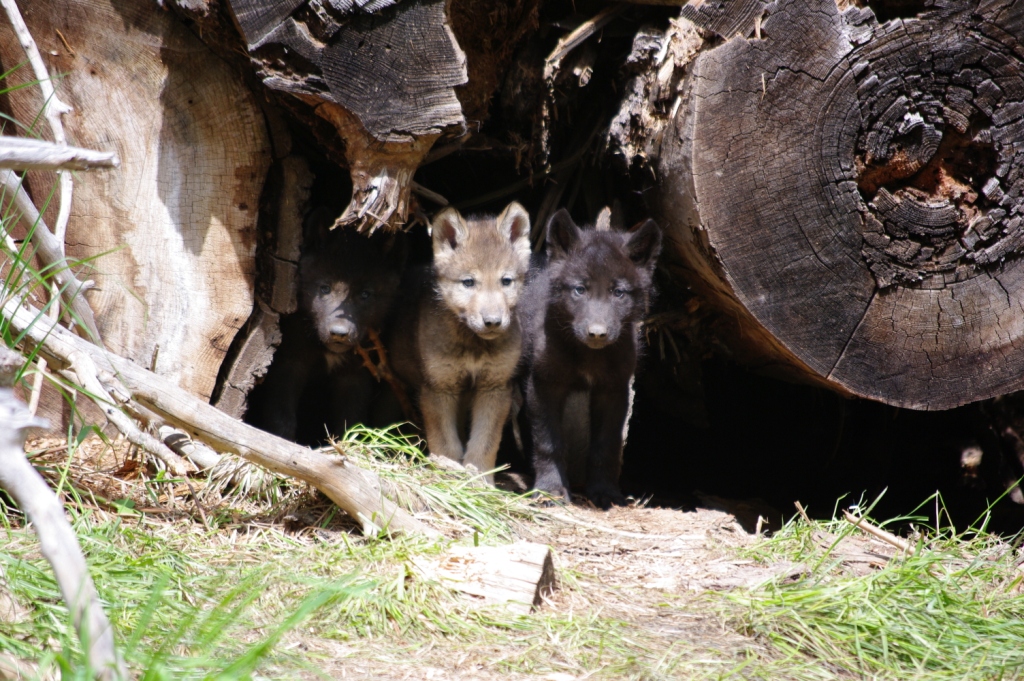
These wolf pups born to the Wenaha Pack in 2012 helped get recovery back on track. But their future remains tenuous (photo courtesy ODFW)

oooo

Wolf greets man.
Wolf greets man, courtesy Wildlife Images Rehabilitation and Education Center, Merlin, Oregon.

Hope and love

Rebecca Solnit, What Comes After Hope

Many of you will be aware that I follow Tom Engelhardt over at TomDispatch.  Tom has been very generous in granting Learning from Dogs blanket permission to republish essays that appear on TomDispatch.  From time to time I do just that; the last one being TomGram: William deBuys, Exodus from Phoenix just a couple of months ago.

Today is another republication of an incredibly powerful essay by Rebecca Solnit, with the usual introduction from Tom.  When you read it you will easily see why it was a must for this week’s focus on love.

To offer a small inducement to read Rebecca’s essay, here is a taste of her words:

If you take the long view, you’ll see how startlingly, how unexpectedly but regularly things change. Not by magic, but by the incremental effect of countless acts of courage, love, and commitment, the small drops that wear away stones and carve new landscapes, and sometimes by torrents of popular will that change the world suddenly. To say that is not to say that it will all come out fine in the end regardless. I’m just telling you that everything is in motion, and sometimes we are ourselves that movement.

Wow!

… the incremental effect of countless acts of courage, love, and commitment, the small drops

that wear away stones and carve new landscapes …

Read and be moved by the words that people write.

oooOOOooo

Rebecca Solnit, What Comes After Hope

I worked for years as an editor at Pantheon Books. Its publisher, maybe the most adventurous in the business, was André Schiffrin. Among his many accomplishments, he “discovered” Studs Terkel (already a well-known Chicago radio personality), published his first oral history (Division Street: America), and made him a bestseller.  Sometime after I arrived at Pantheon in the mid-1970s, he asked me to take a last look at a new manuscript by Studs. It was the equivalent of sending the second team onto the field, but it began my own long relationship with the famed oral historian. He was an experience — a small man who, when he wasn’t listening professionally in a fashion beyond compare, never stopped talking. In doing so, he had an almost magical way of making those around him feel larger than life. Later, I would be the editor for two of his oral histories, one on death and the other on hope (in that splendid order and the second with the Studs-appropriate title Hope Dies Last).

Last October, Bill Moyers interviewed me about the dismal state of American politics.  As our conversation was ending, he suddenly asked: “What keeps you going against all the evidence?” At that moment, Studs came to mind. I mentioned editing “one of the greats of our world” and responded this way: “It turned out that when he wrote his book about hope, it was all about activists and the basic point he made was: in good times you could just be hopeful about your life. You didn’t have to be an activist. You didn’t have to be an anything.  In bad times, if you want to be hopeful, you have to take a step. You’ve got to take some step to do something in the world. And in that sense, TomDispatch is my medicine against despair.  So what makes me hopeful is doing TomDispatch.”

All true. But I realize now that it wasn’t quite a full response. I had left out one crucial figure in my life: Rebecca Solnit, who taught me how to hope in a world that seemed dismal indeed.  She was the one who — I’ve written about it before — slipped through the barely ajar door of my life in May 2003, at a moment as grim and dreary as any in my political experience. The largest antiwar movement ever to protest a war that had yet to happen had just packed its tents and gone home in despair, while Baghdad was occupied by American troops and George W. Bush and his top officials were in their “mission accomplished” triumphalist mode.  Many activists then feared that they would remain so forever and would have dismissed out of hand someone who suggested that their Pax Americana dreams of domination would begin unraveling in mere weeks (as happened), not decades or centuries.

Ten years ago, exactly to the day, I published Rebecca’s miraculous piece “Acts of Hope,” which she would later expand into her book Hope in the Dark. It was written to welcome that “darkness” which seemed already to be enveloping us.  It was written with a sense of how the expectable unravels, of how the future surprises us, often enough with offerings not of horror but of hope.

With few people can you ever say, she (or he) changed my life, changed the very way I understand our world. For me, she’s one of the few — and she’s still doing it with her miraculous new book (out in June), The Faraway Nearby.  She taught me how to look into that future darkness with hope. Like Studs, she taught me that acting, even while not knowing, is a powerful antidote to despair. So it means the world to me that she’s returned to the subject of hope to celebrate the tenth anniversary of her arrival in my life and at TomDispatch. Tom

Too Soon to Tell
The Case for Hope, Continued
By Rebecca Solnit

Ten years ago, my part of the world was full of valiant opposition to the new wars being launched far away and at home — and of despair. And like despairing people everywhere, whether in a personal depression or a political tailspin, these activists believed the future would look more or less like the present.  If there was nothing else they were confident about, at least they were confident about that. Ten years ago, as a contrarian and a person who prefers not to see others suffer, I tried to undermine despair with the case for hope.

A decade later, the present is still contaminated by the crimes of that era, but so much has changed. Not necessarily for the better — a decade ago, most spoke of climate change as a distant problem, and then it caught up with us in 10,000 ways. But not entirely for the worse either — the vigorous climate movement we needed arose in that decade and is growing now. If there is one thing we can draw from where we are now and where we were then, it’s that the unimaginable is ordinary, and the way forward is almost never a straight path you can glance down, but a labyrinth of surprises, gifts, and afflictions you prepare for by accepting your blind spots as well as your intuitions.

The despairing of May 2003 were convinced of one true thing, that we had not stopped the invasion of Iraq, but they extrapolated from that a series of false assumptions about our failures and our powerlessness across time and space. They assumed — like the neoconservatives themselves — that those neocons would be atop the world for a long time to come. Instead, the neocon and neoliberal ideologies have been widely reviled and renounced around the world; the Republicans’ demographic hemorrhage has weakened them in this country; the failures of their wars are evident to everyone; and though they still grasp fearsome power, everything has indeed changed. Everything changes: there lies most of our hope and some of our fear.

I’ve seen extraordinary change in my lifetime, some of it in the last decade. I was born in a country that had been galvanized and unsettled by the civil rights movement, but still lacked a meaningful environmental movement, women’s movement, or queer rights movement (beyond a couple of small organizations founded in California in the 1950s). Half a century ago, to be gay or lesbian was to live in hiding or be treated as mentally ill or criminal. That 12 states and several countries would legalize same-sex marriage was beyond imaginable then. It wasn’t even on the table in 2003.  San Francisco’s spring run of same-sex weddings in 2004 flung open the doors through which so many have passed since.

If you take the long view, you’ll see how startlingly, how unexpectedly but regularly things change. Not by magic, but by the incremental effect of countless acts of courage, love, and commitment, the small drops that wear away stones and carve new landscapes, and sometimes by torrents of popular will that change the world suddenly. To say that is not to say that it will all come out fine in the end regardless. I’m just telling you that everything is in motion, and sometimes we are ourselves that movement.

Unstoppabilities

Hope and history are sisters: one looks forward and one looks back, and they make the world spacious enough to move through freely. Obliviousness to the past and to the mutability of all things imprisons you in a shrunken present. Hopelessness often comes out of that amnesia, out of forgetting that everything is in motion, everything changes. We have a great deal of history of defeat, suffering, cruelty, and loss, and everyone should know it. But that’s not all we have.

There’s the people’s history, the counterhistory that you didn’t necessarily get in school and don’t usually get on the news: the history of the battles we’ve won, of the rights we’ve gained, of the differences between then and now that those who live in forgetfulness lack. This is often the history of how individuals came together to produce that behemoth civil society, which stands astride nations and topples regimes — and mostly does it without weapons or armies. It’s a history that undermines most of what you’ve been told about authority and violence and your own powerlessness.

Civil society is our power, our joy, and our possibility, and it has written a lot of the history in the last few years, as well as the last half century. If you doubt our power, see how it terrifies those at the top, and remember that they fight it best by convincing us it doesn’t exist. It does exist, though, like lava beneath the earth, and when it erupts, the surface of the earth is remade.

Things change. And people sometimes have the power to make that happen, if and when they come together and act (and occasionally act alone, as did writers Rachel Carson and Harriet Beecher Stowe — or Mohammed Bouazizi, the young man whose suicide triggered the Arab Spring).

If you fix your eye on where we started out, you’ll see that we’ve come a long way by those means. If you look forward, you’ll see that we have a long way to go — and that sometimes we go backward when we forget that we fought for the eight-hour workday or workplace safety or women’s rights or voting rights or affordable education, forget that we won them, that they’re precious, and that we can lose them again. There’s much to be proud of, there’s much to mourn, there’s much yet to do, and the job of doing it is ours, a heavy gift to carry. And it’s made to be carried, by people who are unstoppable, who are movements, who are change itself.

Too Soon to Tell

Ten years ago I began writing about hope and speaking about it. My online essay “Acts of Hope,” posted on May 19, 2003, was my first encounter with Tomdispatch.com, which would change my work and my life. It gave me room for another kind of voice and another kind of writing. It showed me how the Internet could give wings to words. What I wrote then and subsequently for the site spread around the world in remarkable ways, putting me in touch with people and movements, and deeper into conversations about the possible and the impossible (and into a cherished friendship with the site’s founder and editor, Tom Engelhardt).

For a few years, I spoke about hope around this country and in Europe. I repeatedly ran into comfortably situated people who were hostile to the idea of hope: they thought that hope somehow betrayed the desperate and downtrodden, as if the desperate wanted the solidarity of misery from the privileged, rather than action. Hopelessness for people in extreme situations means resignation to one’s own deprivation or destruction. Hope can be a survival strategy. For comfortably situated people, hopelessness means cynicism and letting oneself off the hook. If everything is doomed, then nothing is required (and vice versa).

Despair is often premature: it’s a form of impatience as well as certainty. My favorite comment about political change comes from Zhou En-Lai, the premier of the People’s Republic of China under Chairman Mao. Asked in the early 1970s about his opinion of the French Revolution, he reportedly answered, “Too soon to tell.” Some say that he was talking about the revolutions of 1968, not 1789, but even then it provides a generous and expansive perspective. To hold onto uncertainty and possibility and a sense that even four years later, no less nearly two centuries after the fact, the verdict still isn’t in is more than most people I know are prepared to offer. A lot of them will hardly give an event a month to complete its effects, and many movements and endeavors are ruled failures well before they’re over.

Not long ago, I ran into a guy who’d been involved in the Occupy Wall Street movement, that great upwelling in southern Manhattan in the fall of 2011 that catalyzed a global conversation and a series of actions and occupations nationwide and globally. He offered a tailspin of a description of how Occupy was over and had failed.

But I wonder: How could he possibly know? It really is too soon to tell. First of all, maybe the kid who will lead the movement that will save the world was catalyzed by what she lived through or stumbled upon in Occupy Fresno or Occupy Memphis, and we won’t reap what she sows until 2023 or 2043. Maybe the seeds of something more were sown, as they were in Czechoslovakia during the Prague Spring of 1968 and Charter 77, for the great and unforeseen harvest that was the Velvet Revolution of 1989, the nonviolent overthrow of the Soviet totalitarian state in that country.

Second, Occupy began to say what needed to be said about greed and capitalism, exposing a brutality that had long been hushed up, revealing both the victims of debt and the rigged economy that created it. This country changed because those things were said out loud. I can’t say exactly how, but I know it mattered. So much that matters is immeasurable, unquantifiable, and beyond price. Laws around banking, foreclosure, and student loans are changing — not enough, not everywhere, but some people will benefit, and they matter.  Occupy didn’t cause those changes directly, but it did much to make the voice of the people audible and the sheer wrongness of our debt system visible — and gave momentum to the ongoing endeavors to overturn Citizens United and abolish corporate personhood.

Third, I only know a little of what the thousands of local gatherings and networks we mean by “Occupy” are now doing, but I know that Occupy Sandy is still doing vital work in the destruction zone of that hurricane and was about the best grassroots disaster relief endeavor this nation has ever seen. I know that Strike Debt, a direct offshoot of Occupy Wall Street, has relieved millions of dollars in medical debt, not with the sense that we can fix all debt this way, but that we can demonstrate the malleability, the artifice, and the immorality of the student, medical, and housing debt that is destroying so many lives. I know that the Occupy Homes foreclosure defenders have been doing amazing things, often one home at a time, from Atlanta to Minneapolis. (Last Friday, Occupy Our Homes organized a “showdown at the Department of Justice” in Washington, D.C.; that Saturday, Strike Debt Bay Area held their second Debtors’ Assembly: undead from coast to coast.)

Fourth, I know people personally whose lives were changed, and who are doing work they never imagined they would be involved in, and I’m friends with remarkable people who, but for Occupy, I would not know existed. People connected across class, racial, and cultural lines in the flowering of that movement.  Like Freedom Summer, whose consequences were to be felt so far beyond Mississippi in 1964, this will have reach beyond the moment in which I write and you read.

Finally, there was great joy at the time , the joy of liberation and of solidarity, and joy is worth something in itself. In a sense, it’s worth everything, even if it’s always fleeting, though not always as scarce as we imagine.

Climates of Hope and Fear

I had lunch with Middle East and nonviolence scholar Stephen Zunes the other day and asked him what he would say about the Arab Spring now. He had, he told me, been in Egypt several months ago watching television with an activist. Formerly, the news was always about what the leaders did, decided, ordained, inflicted. But the news they were watching was surprisingly focused on civil society, on what ordinary people initiated or resisted, on how they responded, what they thought. He spoke of how so many in the Middle East had lost their fatalism and sense of powerlessness and awoken to their own collective power.

This civil society remains awake in Egypt and the other countries.  What will it achieve? Maybe it’s too soon to tell. Syria is a turbulent version of hell now, but it could be leaving the dynasty of the Assads in the past; its future remains to be written.  Perhaps its people will indeed write the next chapter in its story, and not only with explosives.

You can tell the arc of the past few years as, first, the Arab Spring, then extraordinary civil society actions in Chile, Quebec, Spain, and elsewhere, followed by Occupy. But don’t stop there.

After Occupy came Idle No More, the Canada-based explosion of indigenous power and resistance (to a Canadian government that has gone over to the far right and to environmental destruction on a grand scale). It was founded by four women in November of 2012 and it’s spread across North America, sparking new environmental actions and new coalitions around environmental and climate issues, with flash-mob-style powwows in shopping malls and other places, with a thousand-mile walk (and snowshoe) by seven Cree youth this winter. (There were 400 people with them by the time they arrived at Canada’s Parliament in Ottawa.)

Idle No More activists have vowed to block the construction of any pipeline that tries to transport the particularly dirty crude oil from the Alberta tar sands, whether it heads north, east, or west from northern Alberta. Each of those directions takes it over native land. This is part of the reason why tar sands supporters are pushing so hard to build the Keystone XL pipeline from Alberta to the U.S. Gulf Coast.

Thankfully, the push back is also strong. Our fate may depend on it. As climate scientist James Hansen wrote a year ago, “Canada’s tar sands, deposits of sand saturated with bitumen, contain twice the amount of carbon dioxide emitted by global oil use in our entire history. If we were to fully exploit this new oil source, and continue to burn our conventional oil, gas, and coal supplies, concentrations of carbon dioxide in the atmosphere eventually would reach levels higher than in the Pliocene era, more than 2.5 million years ago, when sea level was at least 50 feet higher than it is now.”

The news just came in that we reached 400 parts per million of carbon dioxide in our atmosphere, the highest level in more than five million years. This is terrible news on a scale that eclipses everything else, because it encompasses everything else. We are wrecking our world, for everyone for all time, or at least the next several thousand years. But “we” is a tricky word here. Some of the people I most love and admire are doing extraordinary things to save the world, for you, for us, for generations unborn, for species yet to be named, for the oceans and sub-Saharan Africans and Arctic dwellers and everyone in-between, for the whole unbearably beautiful symphony of life on Earth that is imperiled.

Part of what sustains me in the face of this potential cataclysm is remembering that, in 2003, there hardly was a climate movement. It was small, polite, mostly believed the troubles were decades away, and was populated with people who thought that lifestyle changes could save the planet — rather than that you have to get out there and fight the power. And they were the good ones.  Too many of us didn’t think about it at all.

Only a few years later, things have changed. There’s a vibrant climate movement in North America.  If you haven’t quite taken that in, it might be because it’s working on so many disparate fronts that are often treated separately: mountaintop coal removal, coal-fired power plants (closing 145 existing ones to date and preventing more than 150 planned ones from opening), fracking, oil exploration in the Arctic, the Tar Sands pipeline, and 350.org’s juggernaut of a campus campaign to promote disinvestment from oil, gas, and coal companies.  Only started in November 2012, there are already divestment movements underway on more than 380 college and university campuses, and now cities are getting on board.  It has significant victories; it will have more.

Some countries — notably Germany, with Denmark not far behind — have done remarkable things when it comes to promoting non-fossil-fuel renewable energy. Copenhagen, for example, in the cold gray north, is on track to become a carbon-neutral city by 2025 (and in the meantime reduced its carbon emissions 25% between 2005 and 2011). The United States has a host of promising smaller projects.  To offer just two examples, Los Angeles has committed to being coal-free by 2025, while San Francisco will offer its citizens electricity from 100% renewable and carbon-neutral sources and its supervisors just voted to divest the city’s fossil-fuel stocks.

There are so many pieces of the potential solution to this puzzle, and some of them are for you to put together. Whether they will multiply or ever add up to enough we don’t yet know. We need more: more people, more transformations, more ways to conquer and dismantle the oil companies, more of a vision of what is at stake, more of the great force that is civil society. Will we get it? I don’t know. Neither do you. Anything could happen.

But here’s what I’m saying: you should wake up amazed every day of your life, because if I had told you in 1988 that, within three years, the Soviet satellite states would liberate themselves nonviolently and the Soviet Union would cease to exist, you would have thought I was crazy. If I had told you in 1990 that South America was on its way to liberating itself and becoming a continent of progressive and democratic experiments, you would have considered me delusional.  If, in November 2010, I had told you that, within months, the autocrat Hosni Mubarak, who had dominated Egypt since 1981, would be overthrown by 18 days of popular uprisings, or that the dictators of Tunisia and Libya would be ousted, all in the same year, you would have institutionalized me.  If I told you on September 16, 2011, that a bunch of kids sitting in a park in lower Manhattan would rock the country, you’d say I was beyond delusional.  You would have, if you believed as the despairing do, that the future is invariably going to look like the present, only more so.  It won’t.

I still value hope, but I see it as only part of what’s required, a starting point.  Think of it as the match but not the tinder or the blaze.  To matter, to change the world, you also need devotion and will and you need to act. Hope is only where it begins, though I’ve also seen people toil on without regard to hope, to what they believe is possible. They live on principle and they gamble, and sometimes they even win, or sometimes the goal they were aiming for is reached long after their deaths.  Still, it’s action that gets you there. When what was once hoped for is realized, it falls into the background, becomes the new normal; and we hope for or carp about something else.

The future is bigger than our imaginations. It’s unimaginable, and then it comes anyway. To meet it we need to keep going, to walk past what we can imagine. We need to be unstoppable. And here’s what it takes: you don’t stop walking to congratulate yourself; you don’t stop walking to wallow in despair; you don’t stop because your own life got too comfortable or too rough; you don’t stop because you won; you don’t stop because you lost. There’s more to win, more to lose, others who need you.

You don’t stop walking because there is no way forward. Of course there is no way. You walk the path into being, you make the way, and if you do it well, others can follow the route. You look backward to grasp the long history you’re moving forward from, the paths others have made, the road you came in on. You look forward to possibility.  That’s what we mean by hope, and you look past it into the impossible and that doesn’t stop you either. But mostly you just walk, right foot, left foot, right foot, left foot. That’s what makes you unstoppable.

Rebecca Solnit’s first essay for Tomdispatch.com turned into the book Hope in the Dark: Untold Histories, Wild Possibilities, since translated into eight languages. Portions of this essay began life as the keynote speech at the National Lawyers’ Guild gala in honor of attorney and human rights activist Walter Riley, whose own life is a beautiful example of unstoppability. Solnit’s latest book, The Faraway Nearby, will be published in June. 

Copyright 2013 Rebecca Solnit

The new tomorrows.

When we are no longer able to change a situation – we are challenged to change ourselves.”  Viktor Frankl.

Like many bloggers I enjoy using a quotation to set the theme for a post.  Found this on the web; it seemed appropriate.

Over the next two days, I want to range across a number of ideas that, together, point to changes that are underway in every conceivable manner for the vast majority of the inhabitants of this planet.

My musings were prompted by a recent essay on Tom Dispatch.  Regulars will know that Tom Engelhardt generously granted me permission to republish essays that appear on his very widely-read blogsite.  This particular essay is about Phoenix in Arizona.

But first indulge me as I recount something rather personal, possibly silly but also mysteriously beautiful.

Many will know that Jean and I moved from San Carlos in Mexico to Payson, Arizona early on in 2010.  (My long comment to yesterday’s post about poor Lupe explains the background.)  Payson is 80 miles North-East of Phoenix and despite being up at 5,000 feet is very much in the same broad weather systems as Phoenix.

With our 14 dogs and 7 cats we quickly settled down and were made to feel very welcome by one and all.  Jean and I were married in Payson in November of 2010.  We were happy and contented.

One night in June last year, I had this vivid dream about going to the bathroom and finding that no water came from the tap.  Where we were living was out of town and our water supplies came from our own well (borehole in English speak!).  While the water level in the well was down by about 50 feet there was no question of the well failing; it was drilled to over 180 feet and flow tests were positive.

When I awoke the dream was still very much in the forefront of my mind.  I talked about it over breakfast with Jeannie.  By chance, we had a guest staying with us and when she heard the tale she said, “If you’re worried about water, you should go to Oregon.

Again, by chance, a couple of weeks later we had someone offer to house-sit.  With our menagerie of animals that was no casual offer!

We accepted, came up to Oregon and found this most beautiful home in Merlin, Southern Oregon complete with 13 acres and Bummer Creek running across the width of the property, a creek that flows for most of the year.

Pharaoh checking out our creek.
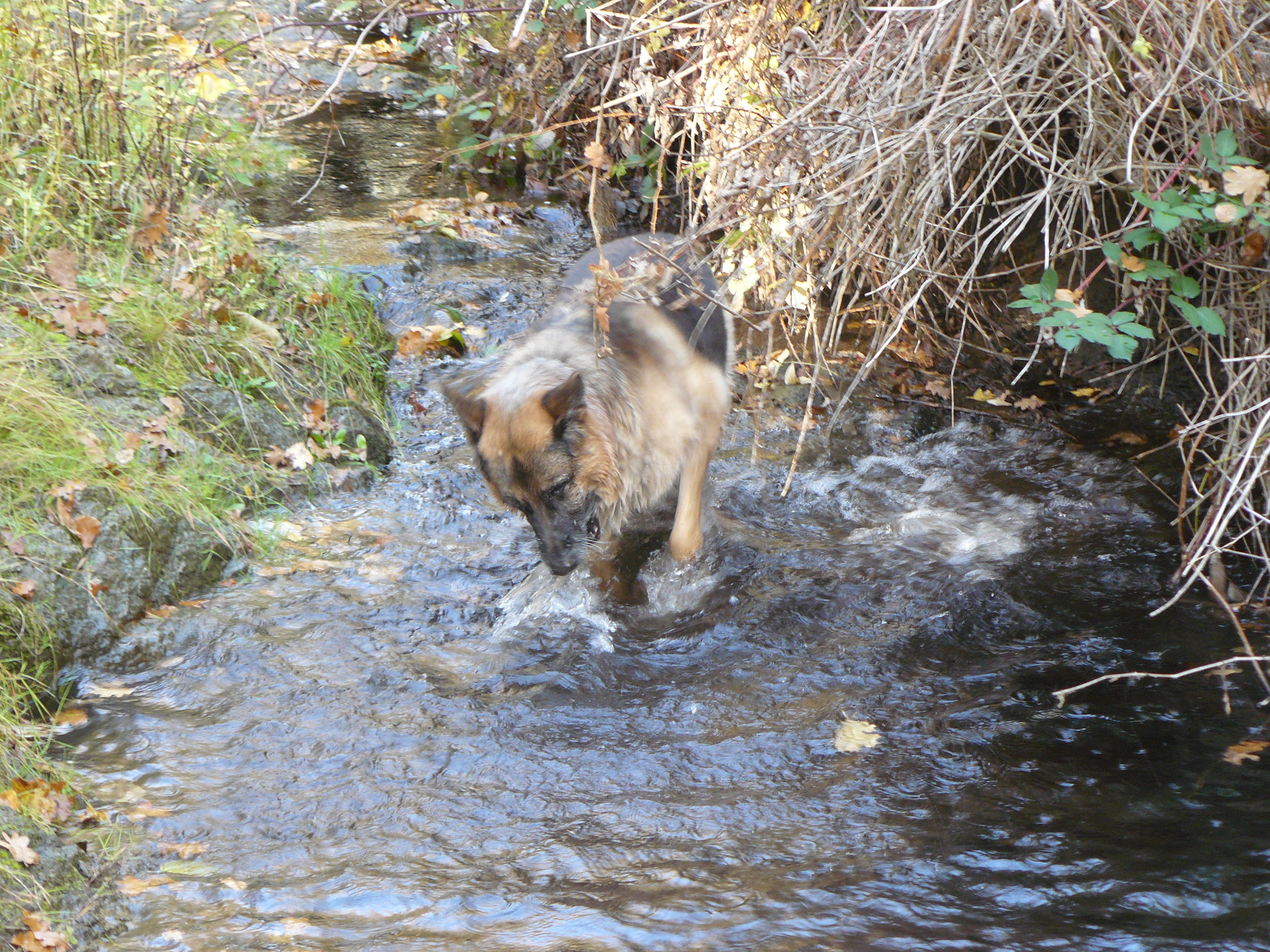
Pharaoh checking out Bummer Creek.

We quickly did the deal, sold the house in Payson and moved in on October 25th 2012, less than 5 months ago.

Keep all of that in mind as you read this TomDispatch essay.

oooOOOooo

Tomgram: William deBuys, Exodus from Phoenix

Posted by William deBuys at 7:58am, March 14, 2013.

We’re not the first people on the planet ever to experience climate stress.  In the overheating, increasingly parched American Southwest, which has been experiencing rising temperatures, spreading drought conditions, and record wildfires, there is an ancient history of staggering mega-droughts, events far worse than the infamous “dust bowl” of the 1930s, the seven-year drought that devastated America’s prairie lands.  That may have been “the worst prolonged environmental disaster recorded for the country,” but historically speaking it was a “mere dry spell” compared to some past mega-droughts that lasted “centuries to millennia.”

Such events even happened in human history, including an almost century-long southwestern dry spell in the second century AD and a drought that was at least decades long in the twelfth century.  These were all events driven by natural climate variation.  Climate change adds a human factor to the equation in a region already naturally dry and short on water.  It ups the odds of bad events happening.  In the coming century, how habitable will parts of the bustling desert Southwest turn out to be?  Already, in the face of heat and drought, small numbers of people from small towns in the region are leaving.  And this, too, has happened before.  There are sobering previous examples of what it means when extreme climate stress hits this area.

Chaco Canyon was abandoned by its native population during that twelfth-century drought, and 150 years later, the Hohokam native culture of what is now central Arizona, whose waterworks in the dry lands of that area were major and impressive, also abandoned its lands, possibly due to drought, as TomDispatch regular William deBuys recounts in his recent book A Great Aridness: Climate Change and the Future of the American Southwest.  “At some point,” he writes, “Hohokam society passed a threshold: the number of able-bodied workers it could muster was no longer sufficient to meet the challenge of rebuilding dams when they washed out and cleaning canals as they inevitably silted up. Eventually the hydraulic system collapsed, and the society that depended on it could no longer exist. The survivors turned their backs on their cities and scattered into the vastness of the land, doing what they could to survive.”

As you read deBuys’s latest post, it’s worth remembering that even the greatest hydraulic engineers have their limits when the water dries up.  When the Anglo farmers of the Phoenix Basin first started using the local rivers, they found themselves “reopening the canals the Hohokam had left behind.”  Who knows what monumental works we, too, might someday abandon? Phoenix, anyone? Tom

Phoenix in the Climate Crosshairs 
We Are Long Past Coal Mine Canaries 
By William deBuys

If cities were stocks, you’d want to short Phoenix.

Of course, it’s an easy city to pick on. The nation’s 13th largest metropolitan area (nudging out Detroit) crams 4.3 million people into a low bowl in a hot desert, where horrific heat waves and windstorms visit it regularly. It snuggles next to the nation’s largest nuclear plant and, having exhausted local sources, it depends on an improbable infrastructure to suck water from the distant (and dwindling) Colorado River.

In Phoenix, you don’t ask: What could go wrong? You ask: What couldn’t?

And that’s the point, really. Phoenix’s multiple vulnerabilities, which are plenty daunting taken one by one, have the capacity to magnify one another, like compounding illnesses. In this regard, it’s a quintessentially modern city, a pyramid of complexities requiring large energy inputs to keep the whole apparatus humming. The urban disasters of our time — New Orleans hit by Katrina, New York City swamped by Sandy — may arise from single storms, but the damage they do is the result of a chain reaction of failures — grids going down, levees failing, back-up systems not backing up. As you might expect, academics have come up with a name for such breakdowns: infrastructure failure interdependencies. You wouldn’t want to use it in a poem, but it does catch an emerging theme of our time.

Phoenix’s pyramid of complexities looks shakier than most because it stands squarely in the crosshairs of climate change. The area, like much of the rest of the American Southwest, is already hot and dry; it’s getting ever hotter and drier, and is increasingly battered by powerful storms. Sandy and Katrina previewed how coastal cities can expect to fare as seas rise and storms strengthen. Phoenix pulls back the curtain on the future of inland empires. If you want a taste of the brutal new climate to come, the place to look is where that climate is already harsh, and growing more so — the aptly named Valley of the Sun.

In Phoenix, it’s the convergence of heat, drought, and violent winds, interacting and amplifying each other that you worry about. Generally speaking, in contemporary society, nothing that matters happens for just one reason, and in Phoenix there are all too many “reasons” primed to collaborate and produce big problems, with climate change foremost among them, juicing up the heat, the drought, and the wind to ever greater extremes, like so many sluggers on steroids. Notably, each of these nemeses, in its own way, has the potential to undermine the sine qua non of modern urban life, the electrical grid, which in Phoenix merits special attention.

If, in summer, the grid there fails on a large scale and for a significant period of time, the fallout will make the consequences of Superstorm Sandy look mild. Sure, people will hunt madly for power outlets to charge their cellphones and struggle to keep their milk fresh, but communications and food refrigeration will not top their list of priorities. Phoenix is an air-conditioned city. If the power goes out, people fry.

In the summer of 2003, a heat wave swept Europe and killed 70,000 people. The temperature in London touched 100 degrees Fahrenheit for the first time since records had been kept, and in portions of France the mercury climbed as high as 104°F. Those temperatures, however, are child’s play in Phoenix, where readings commonly exceed 100°F for more than 100 days a year. In 2011, the city set a new record for days over 110°F: there were 33 of them, more than a month of spectacularly superheated days ushering in a new era.

In Flight From the Sun

It goes without saying that Phoenix’s desert setting is hot by nature, but we’ve made it hotter. The city is a masonry world, with asphalt and concrete everywhere. The hard, heavy materials of its buildings and roads absorb heat efficiently and give it back more slowly than the naked land. In a sense, the whole city is really a thermal battery, soaking up energy by day and releasing it at night. The result is an “urban heat island,” which, in turn, prevents the cool of the desert night from providing much relief.

Sixty years ago, when Phoenix was just embarking on its career of manic growth, nighttime lows never crept above 90°F. Today such temperatures are a commonplace, and the vigil has begun for the first night that doesn’t dip below 100°F. Studies indicate that Phoenix’s urban-heat-island effect may boost nighttime temperatures by as much as 10°F. It’s as though the city has doubled down on climate change, finding a way to magnify its most unwanted effects even before it hits the rest of us full blast.

Predictably, the poor suffer most from the heat.  They live in the hottest neighborhoods with the least greenery to mitigate the heat-island effect, and they possess the least resources for combatting high temperatures.  For most Phoenicians, however, none of this is more than an inconvenience as long as the AC keeps humming and the utility bill gets paid. When the heat intensifies, they learn to scurry from building to car and into the next building, essentially holding their breaths. In those cars, the second thing they touch after the ignition is the fan control for the AC. The steering wheel comes later.

In the blazing brilliance of July and August, you venture out undefended to walk or run only in the half-light of dawn or dusk. The idea for residents of the Valley of the Sun is to learn to dodge the heat, not challenge it.

Heat, however, is a tricky adversary. It stresses everything, including electrical equipment. Transformers, when they get too hot, can fail. Likewise, thermoelectric generating stations, whether fired by coal, gas, or neutrons, become less efficient as the mercury soars.  And the great hydroelectric dams of the Colorado River, including Glen Canyon, which serves greater Phoenix, won’t be able to supply the “peaking power” they do now if the reservoirs behind them are fatally shrunken by drought, as multiple studies forecast they will be. Much of this can be mitigated with upgraded equipment, smart grid technologies, and redundant systems.  But then along comes the haboob.

haboob is a dust/sand/windstorm, usually caused by the collapse of a thunderstorm cell. The plunging air hits the ground and roils outward, picking up debris across the open desert. As the Arabic name suggests, such storms are native to arid regions, but — although Phoenix is no stranger to storm-driven dust — the term haboob has only lately entered the local lexicon. It seems to have been imported to describe a new class of storms, spectacular in their vehemence, which bring visibility to zero and life to a standstill. They sandblast cars, close the airport, and occasionally cause the lights — and AC — to go out. Not to worry, say the two major utilities serving the Phoenix metroplex, Arizona Public Service and the Salt River Project. And the outages have indeed been brief.  So far.

Before Katrina hit, the Army Corps of Engineers was similarly reassuring to the people of New Orleans. And until Superstorm Sandy landed, almost no one worried about storm surges filling the subway tunnels of New York.

Every system, like every city, has its vulnerabilities. Climate change, in almost every instance, will worsen them. The beefed-up, juiced-up, greenhouse-gassed, overheated weather of the future will give us haboobs of a sort we can’t yet imagine, packed with ever greater amounts of energy. In all likelihood, the emergence of such storms as a feature of Phoenix life results from an overheating environment, abetted by the loose sand and dust of abandoned farmland (which dried up when water was diverted to the city’s growing subdivisions).

Water, Water, Everywhere (But Not for Long)

In dystopic portraits of Phoenix’s unsustainable future, water — or rather the lack of it — is usually painted as the agent of collapse. Indeed, the metropolitan area, a jumble of jurisdictions that includes Scottsdale, Glendale, Tempe, Mesa, Sun City, Chandler, and 15 other municipalities, long ago made full use of such local rivers as the Salt, Verde, and Gila. Next, people sank wells and mined enough groundwater to lower the water table by 400 feet.

Sometimes the land sank, too.  Near some wells it subsided by 10 feet or more. All along, everyone knew that the furious extraction of groundwater couldn’t last, so they fixed their hopes on a new bonanza called the Central Arizona Project (CAP), a river-sized, open-air canal supported by an elaborate array of pumps, siphons, and tunnels that would bring Colorado River water across the breadth of Arizona to Phoenix and Tucson.

The CAP came on line in the early 1990s and today is the engine of Arizona’s growth. Unfortunately, in order to win authorization and funding to build it, state officials had to make a bargain with the devil, which in this case turned out to be California. Arizona’s delegation in the House of Representatives was tiny, California’s was huge, and its representatives jealously protected their longstanding stranglehold on the Colorado River. The concession California forced on Arizona was simple: it had to agree that its CAP water rights would take second place to California’s claims.

This means one thing: once the inevitable day comes when there isn’t enough water to go around, the CAP will absorb the shortage down to the last drop before California even begins to turn off its faucets.

A raw deal for Arizona? You bet, but not exactly the end of the line. Arizona has other “more senior” rights to the Colorado, and when the CAP begins to run dry, you may be sure that the masters of the CAP will pay whatever is necessary to lease those older rights and keep the 330-mile canal flowing. Among their targets will be water rights belonging to Indian tribes at the western edge of the state along the lower reaches of the river. The cost of buying tribal water will drive the rates consumers pay for water in Phoenix sky-high, but they’ll pay it because they’ll have to.

Longer term, the Colorado River poses issues that no amount of tribal water can resolve. Beset by climate change, overuse, and drought, the river and its reservoirs, according to various researchers, may decline to the point that water fails to pass Hoover Dam. In that case, the CAP would dry up, but so would the Colorado Aqueduct which serves greater Los Angeles and San Diego, as well as the All-American Canal, on which the factory farms of California’s Imperial and Coachella valleys depend. Irrigators and municipalities downstream in Mexico would also go dry. If nothing changes in the current order of things, it is expected that the possibility of such a debacle could loom in little more than a decade.

The preferred solution to this crisis among the water mavens of the lower Colorado is augmentation, which means importing more water into the Colorado system to boost native supplies. A recently discussed grandiose scheme to bail out the Colorado’s users with a pipeline from the Mississippi River failed to pass the straight-face test and was shot down by then-Secretary of the Interior Ken Salazar.

Meanwhile, the obvious expedient of cutting back on water consumption finds little support in thirsty California, which will watch the CAP go dry before it gets serious about meaningful system-wide conservation.

Burning Uplands

Phoenicians who want to escape water worries, heat waves, and haboobs have traditionally sought refuge in the cool green forests of Arizona’s uplands, or at least they did until recently. In 2002, the Rodeo-Chediski fire consumed 469,000 acres of pine and mixed conifer on the Mogollon Rim, not far from Phoenix. It was an ecological holocaust that no one expected to see surpassed. Only nine years later, in 2011, the Wallow fire picked up the torch, so to speak, and burned across the Rim all the way to the New Mexico border and beyond, topping out at 538,000 charred acres.

Now, nobody thinks such fires are one-off flukes. Diligent modeling of forest response to rising temperatures and increased moisture stress suggests, in fact, that these two fires were harbingers of worse to come. By mid-century, according to a paper by an A-team of Southwestern forest ecologists, the “normal” stress on trees will equal that of the worst megadroughts in the region’s distant paleo-history, when most of the trees in the area simply died.

Compared to Phoenix’s other heat and water woes, the demise of Arizona’s forests may seem like a side issue, whose effects would be noticeable mainly in the siltation of reservoirs and the destabilization of the watersheds on which the city depends. But it could well prove a regional disaster.  Consider, then, heat, drought, windstorms, and fire as the four horsemen of Phoenix’s Apocalypse. As it happens, though, this potential apocalypse has a fifth horseman as well.

Rebecca Solnit has written eloquently of the way a sudden catastrophe — an earthquake, hurricane, or tornado — can dissolve social divisions and cause a community to cohere, bringing out the best in its citizenry. Drought and heat waves are different. You don’t know that they have taken hold until you are already in them, and you never know when they will end. The unpleasantness eats away at you.  It corrodes your state of mind. You have lots of time to meditate on the deficiencies of your neighbors, which loom larger the longer the crisis goes on.

Drought divides people, and Phoenix is already a divided place — notoriously so, thanks to the brutal antics of Maricopa County Sheriff Joe Arpaio. In Bird on Fire: Lessons from the World’s Least Sustainable City, Andrew Ross offers a dismal portrait of contemporary Phoenix — of a city threatened by its particular brand of local politics and economic domination, shaped by more than the usual quotient of prejudice, greed, class insularity, and devotion to raw power.

It is a truism that communities that do not pull together fail to surmount their challenges. Phoenix’s are as daunting as any faced by an American city in the new age of climate change, but its winner-take-all politics (out of which has come Arizona’s flagrantly repressive anti-immigration law), combined with the fragmentation of the metro-area into nearly two dozen competing jurisdictions, essentially guarantee that, when the worst of times hit, common action and shared sacrifice will remain as insubstantial as a desert mirage. When one day the U-Haul vans all point away from town and the people of the Valley of the Sun clog the interstates heading for greener, wetter pastures, more than the brutal heat of a new climate paradigm will be driving them away. The breakdown of cooperation and connectedness will spur them along, too.

One day, some of them may look back and think of the real estate crash of 2007-2008 and the recession that followed with fond nostalgia. The city’s economy was in the tank, growth had stalled, and for a while business-as-usual had nothing usual about it. But there was a rare kind of potential. That recession might have been the last best chance for Phoenix and other go-go Sunbelt cities to reassess their lamentably unsustainable habits and re-organize themselves, politically and economically, to get ready for life on the front burner of climate change. Land use, transportation, water policies, building codes, growth management — you name it — might all have experienced a healthy overhaul. It was a chance no one took. Instead, one or several decades from now, people will bet on a surer thing: they’ll take the road out of town.

William deBuys, a TomDispatch regular, is the author of seven books, most recently A Great Aridness: Climate Change and the Future of the American Southwest. He has long been involved in environmental affairs in the Southwest, including service as founding chairman of the Valles Caldera Trust, which administers the 87,000-acre Valles Caldera National Preserve in New Mexico.

Follow TomDispatch on Twitter and join us on Facebook. Check out the newest Dispatch book, Nick Turse’s The Changing Face of Empire: Special Ops, Drones, Proxy Fighters, Secret Bases, and Cyberwarfare.

Copyright 2013 William deBuys

oooOOOooo

Just to reinforce the magic of my dream and how Jean and I feel so blessed by our life changes, the photo below was taken on our property the day we arrived in Merlin.

Within arm's reach of the beauty of nature.
Within arm’s reach of the beauty of nature.

Musings continued tomorrow.  Hope you stayed with it so far.

The Keystone XL protest event.

A guest post from Tom Engelhardt.

As regular followers of this blog know, Tom Engelhardt of Tom Dispatch fame has very kindly given permission for essays on Tom Dispatch to be republished on Learning from Dogs.  I try to be circumspect about which essays I do republish.

I’m away from my desk for the next two days which seemed like a great reason to republish this reflection from Tom on the Keystone XL protest event held in Washington D.C last February 17th.

oooOOOooo

Tomgram: Engelhardt, Climate Change as History’s Deal-Breaker

Where Is Everybody?
Why It’s So Tough to Get Your Head Around Climate Change 
By Tom Engelhardt

Two Sundays ago, I traveled to the nation’s capital to attend what was billed as “the largest climate rally in history” and I haven’t been able to get the experience — or a question that haunted me — out of my mind.  Where was everybody?

First, though, the obvious weather irony: climate change didn’t exactly come out in support of that rally. In the midst of the warmest years and some of the warmest winters on record, the demonstration, which focused on stopping the Keystone XL Pipeline — it will bring tar-sands oil, some of the “dirtiest,” carbon-richest energy available from Alberta, Canada, to the U.S. Gulf Coast — was the coldest I’ve ever attended. I thought I’d lose a few fingers and toes while listening to the hour-plus of speakers, including Senator Sheldon Whitehouse from Rhode Island, who were theoretically warming the crowd up for its march around the (other) White House.

And I also experienced a moment of deep disappointment. When I arrived early at the spot in front of the Washington Monument on the National Mall where we were to assemble, my heart sank.  It looked like only a few thousand protestors were gathering for what had been billed as a monster event.  I had taken it for granted that I would be adding one small, aging body (and voice) to a vast crowd at a propitious moment to pressure Barack Obama to become the climate-change president he hasn’t been.  After all, he has a decision to make that’s his alone: whether or not to allow that pipeline to be built.  Nixing it would help keep a potentially significant contributor to climate change, those Albertan tar sands, in the ground.  In other words, I hoped to play my tiny part in preserving a half-decent future for this planet, my children, and my new grandson.

Sixty environmental and other organizations were backing the demonstration, including the Sierra Club with its hundreds of thousands of members.  Given what was potentially at stake, it never crossed my mind that the turnout wouldn’t be substantial.  In fact, on that frigid day, lots of demonstrators did turn up.  Evidently, they knew the dirty little secret of such events: that much talk would precede a modest amount of walking and inventive slogan shouting.  So they arrived — poured in actually — late, and in real numbers.

In the end, the organizers estimated attendance at somewhere in the 35,00050,000 range.  Media reports varied between the usual “thousands,” generically used to describe (or, if you’re in a conspiratorial frame of mind, minimize) any demonstration, and tens of thousands.  I have no way of estimating myself, but certainly the crowd was, in the end, sizeable, as well as young, enthusiastic, and loud.  It made itself heard passing the White House. Not that President Obama was there to hear anything.  He was then on a golf course in the Florida warmth teeing up with “a pair of Texans who are key oil, gas, and pipeline players.” That seemed to catch another kind of climate-change reality of our moment and strongly hinted at the strength of the forces any such movement is up against.  In the meantime, Keystone builder TransCanada was ominously completing the already green-lighted first half of the Texas-Oklahoma leg of its prospective future pipeline.

In the end, I felt genuine satisfaction at having been there, but given what was at stake, givenFrankenstorm Sandy, the devastating Midwestern drought and record southwestern fires of 2012, the Snowmageddon winter storm that had recently dropped 40 inches of the white stuff on Hamden, Connecticut, the blistering spring and summer of 2012, the fast-melting Arctic sea ice, and the fact that last year broke all heat records for the continental United States, given the build-up of billion-dollar weather disasters in recent years, and the growing emphasis on “extreme weather” events on the national TV news, shouldn’t hundreds of thousands have been there?  After all, I’ve been inantiwar demonstrations in which at least that many marched and in 1982, I found myself in my hometown in a crowd of a million demonstrating against the possibility of a world-ending nuclear war.  Is climate change a less important issue?

“There Is No Planet B”

While protesting that Sunday, I noted one slogan on a number of hand-made signs that struck me as the most pointed (and poignant) of the march: “There is no planet B.”  It seemed to sum up what was potentially at stake: a planet to live reasonably comfortably on.  You really can’t get much more basic than that, which is why hundreds of thousands, perhaps millions, should have been out in the streets demanding that our leaders begin to attend to climate change before it’s quite literally too late.

After all, to my mind, climate change, global warming, extreme weather — call it what you will — is the obvious deal-breaker in human, if not planetary, history.  Everything but nuclear catastrophe pales by comparison, no matter the disaster: 9/11, 70,000 dead in Syria, failed wars, the grimmest of dictatorships, movements of hope that don’t deliver — all of that’s familiar history.  Those are the sorts of situations where you can try again, differently, or future generations can and maybe do far better.  All of it involves human beings who need to be dealt with or human structures that need to be changed.  While any of them may be the definition of “the worst of times,” they are also thedefinition of hope.

Nature and the weather are another matter (even if it’s humanity that, by burning of fossil fuels atincreasingly staggering rates, has created its own Frankenstein’s monster out of the natural world).  Climate change is clearly something new in our experience.  Even in its relatively early but visibly intensifying stages, it threatens to be the singular event in human history, because unlike every other disaster we can imagine (except a full-scale nuclear war or, as has happened in the planet’s past, a large meteorite or asteroid impact), it alone will alter the basis for life on this planet.

Raise the planet’s temperature by three to six degrees Celsius, as various well-respected scientific types and groups are now suggesting might happen by century’s end (and possibly throw in some more heat thanks to the melting of the permafrost in the north), and if you live in a city on a coastline, you’d better watch out.  And that only begins to suggest the problems humanity will face.

The world, at best, will be a distinctly poorer, less comfortable place for us (and from there the scenarios only get uglier).

Don’t misunderstand me.  I’m no scientist.  I doubt I’d even be considered scientifically literate (though I try).  But the scientific consensus on the subject of climate change seems striking enough to me, and what’s happening around us is no less striking as a confirmation that our world is changing — and remarkably quickly at that.   Whether you read about melting glaciers, the melting Greenland ice shield, melting Arctic waters, melting permafrostacidifying oceans, intensifying storms, greater desertification, wilder wild fires, or so many other allied subjects, doesn’t it always seem that the rates of bad news are on the rise and the word “record” is usually lurking somewhere in the vicinity?

So I continue to wonder, given our situation on this planet, given our future and that of our children and grandchildren, where is everybody?

Can You Organize Against the Apocalypse?

Don’t for a second think that I have some magic answer to that question. Still, as it’s been on my mind, here’s an attempt to lay out at least some of the possible factors, micro to macro, that might have limited the size of that crowd two Sundays ago and perhaps might tend to limit the size of any climate-change crowd, as well as the mobilizing possibilities that lie in the disaster awaiting us.

Outreach: Yes, there were at least 60 groups involved, but how much outreach was there really?  Many people I know hadn’t heard a thing about the event.  And while climate change has been on the human agenda for a while now, a real movement to deal with what’s happening to us is in its absolute infancy.  There is so much outreach and so much education that still needs to be done.

The slowness of movements: It’s easy to forget how long it can take for movements of change to grow, for their messages to cohere, penetrate, and begin to make sense or seem meaningful to large numbers of people in terms of their everyday lives.  Despite its obvious long-term destructive power, for many reasons (see below) climate change might prove a particularly difficult issue to link to our everyday lives in ways that mobilize rather than demobilize us.  On a similarly difficult issue, the nuclear movement, it took literally decades to grow to that million-person march, and even early anti-Vietnam War protests were smaller than the recent Keystone demo.

Politics: Attitudes toward climate change have largely polarized along left-right lines, so that the issue seems politically ghettoized at the moment (though there was a time when Republicans of some stature were concerned about the subject).  To my mind, it’s part of the insanity of our moment that the preservation of our planet as we have known it, which should be the great conservative issue of our era, is now pure poison on the right.  Even American paleo-conservatives, who are willing to make common cause on American war policy with left anti-imperial types, won’t touch it with a 10-foot pole.  When this begins to change, you’ll know something of significance is happening.

Enemies: Here’s a factor it’s easy to ignore, but no one should.  Giant energy companies and energy-connected right-wing billionaires have for years now been funneling staggering amounts of money into a network of right-wing think tanks and websites dedicated to creating doubts about climate change and promoting climate denial.  In the latest revelation about the well-financed climate-denial movement, the British Guardian reports that between 2002 and 2010, $120 million dollars was shuttled, “using a secretive funding route,” into “more than 100 groups casting doubt about the science behind climate change.” It all came from conservative billionaires (and not just the Koch brothers) who were guaranteed total anonymity. And it “helped build a vast network of think tanks and activist groups working to a single purpose: to redefine climate change from neutral scientific fact to a highly polarizing ‘wedge issue’ for hardcore conservatives.”  The funders of this “movement” and their minions should, of course, be disqualified on the spot.  They are almost all identified with and profit from the very fossil fuels that climate-change scientists say are heating up the planet.  But they — and a few outlier scientific types they’ve scrounged up — provide the “balance,” the “two sides,” that the mainstream media adores.  And they play upon the arcane nature of Science itself to intimidate the rest of us.

Science: When you have a bad boss, or your country is ruled by a dictator, or your bank cheats you, it’s within your everyday experience.  You have some body of personal knowledge to draw on to understand the situation.  You are personally offended.  But Science?  For most of us, the very word is intimidating.  It means what we didn’t understand in school and gave up understanding long ago.  To grasp climate change means teaching yourself Science with no professors in sight.  Filling the knowledge bank you don’t have on your own.  It’s daunting.  Oh yes, the Ice-Albedo feedback loop.  Sure thing.  If the boss, the bank, the dictator takes your home, you get it.  If Superstorm Sandy turns your home into rubble, what you get is an argument.  What you need is an education to know just what role “climate change” might have played in making that storm worse, or whether it played any role at all.  Similarly, you need an education to grasp the dangers of those tar sands from Canada.  It can be overwhelming.  Doubts are continually raised (see “enemies”), the natural variability of the weather makes climate change easier to dismiss, and sometimes, when Science takes the lead, it’s easier just to duck.

Nature: Science is bad enough; now, throw in Nature.  How many of us still live on farms?  How many of us still live in “the wilderness”?  Isn’t Nature what we catch on the Discovery Channel?  Isn’t it what we pay a lot of money to drop in on briefly and ogle while on vacation?  In our everyday lives, most of us are, in some way, no longer a part of this natural world of “ours” — not at least until drought strikes your region, or that “record wildfire” approaches your community, or that bear/coyote/skunk/puma stumbles into your (urban or suburban) neck of the woods.  Connecting with Nature, no less imagining the changing natural state of a planet going haywire (along with the likelihood of mass, climate-changed induced extinctions) is again not exactly an easy thing to do; it’s not what comes “naturally” to us.

Blame: Any movement needs a target.  But this isn’t the Arab Spring.  Climate change is not Hosni Mubarak.  This isn’t the Occupy moment.  Climate change is not simply “Wall Street” or the 1%.  It’s not simply the Obama administration, a polarized Congress filled with energy-company-supported climate ignorers and deniers, or the Chinese leadership that’s exploiting coal for all its worth, or the Canadian government that abandoned the Kyoto treaty and supports that tar-sands pipelineor the U.S. Chamber of Commerce, which has put its money where its mouth is in American electoral politics when it comes to climate change.  Yes, the giant energy companies, which are making historic profits off our burning planet, couldn’t be worse news or more culpable.  The oil billionaires are a disaster, and so on.  Still, targets are almost too plentiful and confusing.  There are indeed villains, but so many of them!  And what, after all, about the rest of us who lend a hand in burning fossil fuels as if there were no tomorrow?  What about our consumer way of life to which all of us are, to one degree or another, addicted, and which has been a model for the rest of the world.  Who then is the enemy?  What exactly is to be done?  In other words, there is anamorphousness to who’s aiding and abetting climate change that can make the targeting on which any movement thrives difficult.

The future:  In the environmental movement, there is some serious discussion about why it’s so hard for climate change to gain traction among the public (and in the media).  It’s sometimes said that the culprit is our brains, which weren’t set up, in an evolutionary sense, to deal with a problem that won’t deliver its full whammy for perhaps close to a century or more.  Actually, I wonder about this.  I would argue, based on the historical record, that our brains are well enough equipped to face distant futures and their problems.  In fact, I think it’s a reasonable proposition that if you can’t imagine the future, if you can’t imagine building something not just for yourself but for your children or the children of others and of future generations, then you probably can’t build a movement at all.  All movements, even those intent on preserving the past, are in some sense future-oriented.

The apocalypse: Here’s the thing, though.  It’s difficult to organize for or even against a future that you can’t imagine yourself and those children and future generations in.  The thought of world-ending events may simply close down our operative imaginations.  The end of the world may be popular in fiction, but in everyday life, I suspect, the apocalypse is the version of the future that it’s hardest to mobilize around.  If the prospect is that it’s already hopeless, that the suffering is going to be largely down the line, that we’re all going down anyway, and the planet will simply be destroyed, well, why bother?  Why not focus on what matters to you now and forget the rest?  This is wheredenial, the almost involuntary turning away from unpalatable futures that seem beyond our power or ability to alter, comes into play.  If the future is essentially over before it begins, then better to ignore it and go about your still palatable enough daily life.

Putting Your Money on Climate Change

Add all these factors (and others I’ve probably ignored) together and perhaps it’s a miracle that so many people turned out in Washington two weekends ago.  As we’ve already learned in this nuclear age of ours, it’s quite possible for a grid of exterminationism, a sense of hopelessness about the distant future, to descend upon us almost unnoticed.  That grid in no way stops you from thinking about your own life in the present, or even about the immediate future, about, say, getting married, having a child, making a living, but it’s crippling when it comes to mobilizing for a different future.

I’ve always believed that some of the vaunted organizing power and energy of the famed Sixties came from the fact that, in 1963, the superpowers achieved an agreement on the testing of nuclear weapons that sent them underground and more or less out of consciousness.  The last end-of-the-world films of that era appeared in 1964, just as bomb-shelter and civil defense programs were heading for the graveyard. By 1969, the National Committee for a SANE Nuclear Policy had even eliminated “nuclear” from its own name.  Without necessarily being aware of it, many (especially among the young), I suspect, felt their energies liberated from a paralyzing sense of doom.  You no longer had to think about scenarios in which the two Cold War superpowers would destroy the planet.  It made almost anything seem possible. For a brief period before the Reagan presidency raised such fears again, you could look to the future with a sense of hope, which was exhilarating.

Can there be any doubt that, to steal a phrase from that era, the personal is indeed political?  On the other hand, the apocalypse, particularly an apocalypse that features Science and Nature in its starring roles, seems anything but personal or stoppable — unless you’re a farmer and a pipeline filled with a particularly nasty version of oil runs right through your nearest aquifer.  The real issue here is how to make climate change personal in a way that doesn’t simply cause us to shut down.

One of the cleverer approaches to climate change has been that of Bill McKibben, the man who organized 350.org.  In a determined fashion, he’s been breaking the overwhelming nature of climate change down into some of its component parts that can be grasped, focused on, and organized around.  Stopping the Keystone XL pipeline and encouraging students to lobby to make their schools divest from big fossil fuel companies are examples of his approach.

More generally, climate change is, in fact, becoming more personal by the year.  In the “extreme weather,” which so regularly leads the TV news, its effects are coming closer to us all.  Increasing numbers of us know, in our hearts, that it’s the real deal.  And no, it doesn’t have to be the apocalypse either.  The planet itself, of course, will survive and, given a few hundred thousand or even a few million years, will recover and once again be a thriving place of some unknown sort.  As for humanity, we’re a clever enough species.  Sooner or later, we will undoubtedly figure out how to survive as well, but the questions are: How many of us?  On what terms?  In what kind of degraded state?  And what can we do soon to mitigate climate change’s worst future effects?

Perhaps a modern, post-religious version of seventeenth-century French philosopher Blaise Pascal’s famous bet is what’s needed.  He argued that it was in the interest of those who remained in doubt about God to place a wager on His existence.  As he pointed out, with such a bet, if you win, you win everything; if you lose, you lose nothing.

Something somewhat analogous might be said of climate change.  Perhaps it’s time to put your wager on the reality of climate change, on its paramount importance to us and our children and our children’s children, and to bet as well that your efforts (and those of others) will in the end make enough of a difference.  Then, if you win, humanity wins everything; if you lose, well, there will be hell to pay.

Tom Engelhardt, co-founder of the American Empire Project and author of The United States of Fear as well as a history of the Cold War, The End of Victory Culture, runs the Nation Institute’s TomDispatch.com. His latest book, co-authored with Nick Turse, is Terminator Planet: The First History of Drone Warfare, 2001-2050.

Follow TomDispatch on Twitter and join us on Facebook. Check out the newest Dispatch book, Nick Turse’s The Changing Face of Empire: Special Ops, Drones, Proxy Fighters, Secret Bases, and Cyberwarfare.

Copyright 2013 Tom Engelhardt

Plus ça change – footnote

Plus ça change, plus c’est la même chose (“the more it changes, the more it’s the same thing”).

The final of three repostings from a year ago.  To recap, I wrote on Monday, “… out of curiosity I wondered what I had published a year ago, in early February 2012.  To my amazement what was published was as fresh and relevant as if it had been published today.

The second post from a year ago was reposted yesterday.  Today the footnote is from the 9th February, 2012.  (It reads in its original form with the links and references unchanged.)

oooOOOooo

So many vested opinions!

Regular readers will know that I published recently, in two parts, a post with the heading of Climate, truth and integrity, the first part being here and the second part here.

To me the arguments supporting the premise that mankind is engaged in the process of destroying our very being are powerful and convincing.  But if there is any serious scientific doubt, then I am reminded of that saying in aviation circles about a risk to the safety of an aircraft, “If there’s any doubt, there’s no doubt!”  Surely, that’s the stance the climate change skeptics should be taking!  Because when the evidence of global warming, pollution, natural resource depletion, species extinctions, and habitat destruction is drawn together and there are no skeptics left, then will the last person left alive please switch the lights off!

Anyway, I’m going to republish, with permission, a recent Post that appeared on Tom Engelhardt‘s powerful blogsite, Tom Dispatch.  It was written by Bill McKibben of 350.org fame.  Here it is,

Tomgram: Bill McKibben, Why the Energy-Industrial Elite Has It In for the Planet

Posted by Bill McKibben at 9:39am, February 7, 2012.

Introduction

Two Saturdays ago, I was walking with a friend in a park here in New York City.  It was late January, but I was dressed in a light sweater and a thin fall jacket, which I had just taken off and tied around my waist.  We were passing a strip of bare ground when suddenly we both did a double-take.  He looked at me and said, “Crocuses!”  Dumbfounded, I replied, “Yes, I see them.”  And there they were, a few clumps of telltale green shoots poking up from the all-brown ground as if it were spring.  Such a common, comforting sight, but it sent a chill through me that noticeably wasn’t in the air.  Even the flowers, I thought, are confused by our new version of weather.

Later that same week, as temperatures in the Big Apple crested 60 degrees, I was chatting on the phone with a friend in Northampton, Massachusetts.  I was telling him about the crocuses, when he suddenly said, “I’m looking out my window right now and for the first time in my memory of January, there’s not a trace of snow!”

Of course, our tales couldn’t be more minor or anecdotal, even if the temperatures that week did feel like we were on another planet.  Here’s the thing, though: after a while, even anecdotes add up — maybe we should start calling them “extreme anecdotes” — and right now there are so many of them being recounted across the planet.  How could there not be in a winter, now sometimes referred to as “Junuary,” in which, in the United States, 2,890 daily high temperature records have either been broken or tied at last count, with the numbers still rising?  Meanwhile, just to the south of us, in Mexico, extreme anecdotes abound, since parts of the country are experiencing “the worst drought on record.”  Even cacti are reportedly wilting and some towns are running out of water (as they are across the border in drought-stricken Texas).  And worst of all, the Mexican drought is expected to intensify in the months to come.

And who can doubt that in Europe, experiencing an extreme cold spell the likes of which hasn’t been seen in decades — even Rome had a rare snowfall and Venice’s canals were reported to be freezing over — there are another set of all-too-extreme anecdotes.  After all, in places like Ukraine, scores of the homeless are freezing to death, pipes are bursting, power cuts are growing, and maybe even an instant energy crisis is underway (at a moment when the European Union is getting ready to cut itself off from Iranian oil).

That’s just to begin a list.  And yet here’s the strange thing.  At least in this country, you can read the “freaky” weather reports or listen to the breathless TV accounts of unexpected tornadoes striking the South in January and rarely catch a mention of the phrase “climate change.”  Given the circumstances, the relative silence on the subject is little short of eerie, even if worries about climate change lurk just below the surface.  Which is why it’s good to have TomDispatch regular Bill McKibben, author of Eaarth: Making a Life on a Tough New Planet, take a clear-eyed look at American denialism and just what it is we prefer not to take in. Tom

The Great Carbon Bubble
Why the Fossil Fuel Industry Fights So Hard

By Bill McKibben

If we could see the world with a particularly illuminating set of spectacles, one of its most prominent features at the moment would be a giant carbon bubble, whose bursting someday will make the housing bubble of 2007 look like a lark. As yet — as we shall see — it’s unfortunately largely invisible to us.

In compensation, though, we have some truly beautiful images made possible by new technology.  Last month, for instance, NASA updated the most iconic photograph in our civilization’s gallery: “Blue Marble,” originally taken from Apollo 17 in 1972. The spectacular new high-def image [see below, Ed] shows a picture of the Americas on January 4th, a good day for snapping photos because there weren’t many clouds.

It was also a good day because of the striking way it could demonstrate to us just how much the planet has changed in 40 years. As Jeff Masters, the web’s most widely read meteorologist, explains, “The U.S. and Canada are virtually snow-free and cloud-free, which is extremely rare for a January day. The lack of snow in the mountains of the Western U.S. is particularly unusual. I doubt one could find a January day this cloud-free with so little snow on the ground throughout the entire satellite record, going back to the early 1960s.”

In fact, it’s likely that the week that photo was taken will prove “the driest first week in recorded U.S. history.” Indeed, it followed on 2011, which showed the greatest weather extremes in our history — 56% of the country was either in drought or flood, which was no surprise since “climate change science predicts wet areas will tend to get wetter and dry areas will tend to get drier.” Indeed, the nation suffered 14 weather disasters each causing $1 billion or more in damage last year. (The old record was nine.) Masters again: “Watching the weather over the past two years has been like watching a famous baseball hitter on steroids.”

In the face of such data — statistics that you can duplicate for almost every region of the planet — you’d think we’d already be in an all-out effort to do something about climate change. Instead, we’re witnessing an all-out effort to… deny there’s a problem.

Our GOP presidential candidates are working hard to make sure no one thinks they’d appease chemistry and physics. At the last Republican debate in Florida, Rick Santorum insisted that he should be the nominee because he’d caught on earlier than Newt or Mitt to the global warming “hoax.”

Most of the media pays remarkably little attention to what’s happening. Coverage of global warming has dipped 40% over the last two years. When, say, there’s a rare outbreak of January tornadoes, TV anchors politely discuss “extreme weather,” but climate change is the disaster that dare not speak its name.

And when they do break their silence, some of our elite organs are happy to indulge in outright denial. Last month, for instance, the Wall Street Journal published an op-ed by “16 scientists and engineers” headlined “No Need to Panic About Global Warming.” The article was easily debunked. It was nothing but a mash-up of long-since-disproved arguments by people who turned out mostly not to be climate scientists at all, quoting other scientists who immediately said their actual work showed just the opposite.

It’s no secret where this denialism comes from: the fossil fuel industry pays for it. (Of the 16 authors of the Journal article, for instance, five had had ties to Exxon.)Writers from Ross Gelbspan to Naomi Oreskes have made this case with such overwhelming power that no one even really tries denying it any more. The open question is why the industry persists in denial in the face of an endless body of fact showing climate change is the greatest danger we’ve ever faced.

Why doesn’t it fold the way the tobacco industry eventually did? Why doesn’t it invest its riches in things like solar panels and so profit handsomely from the next generation of energy? As it happens, the answer is more interesting than you might think.

Part of it’s simple enough: the giant energy companies are making so much money right now that they can’t stop gorging themselves. ExxonMobil, year after year, pulls in more money than any company in history. Chevron’s not far behind. Everyone in the business is swimming in money.

Still, they could theoretically invest all that cash in new clean technology or research and development for the same. As it happens, though, they’ve got a deeper problem, one that’s become clear only in the last few years. Put briefly: their value is largely based on fossil-fuel reserves that won’t be burned if we ever take global warming seriously.

When I talked about a carbon bubble at the beginning of this essay, this is what I meant. Here are some of the relevant numbers, courtesy of the Capital Institute: we’re already seeing widespread climate disruption, but if we want to avoid utter, civilization-shaking disaster, many scientists have pointed to a two-degree rise in global temperatures as the most we could possibly deal with.

If we spew 565 gigatons more carbon into the atmosphere, we’ll quite possibly go right past that reddest of red lines. But the oil companies, private and state-owned, have current reserves on the books equivalent to 2,795 gigatons — five times more than we can ever safely burn. It has to stay in the ground.

Put another way, in ecological terms it would be extremely prudent to write off $20 trillion worth of those reserves. In economic terms, of course, it would be a disaster, first and foremost for shareholders and executives of companies like ExxonMobil (and people in places like Venezuela).

If you run an oil company, this sort of write-off is the disastrous future staring you in the face as soon as climate change is taken as seriously as it should be, and that’s far scarier than drought and flood. It’s why you’ll do anything — including fund an endless campaigns of lies — to avoid coming to terms with its reality. So instead, we simply charge ahead.  To take just one example, last month the boss of the U.S. Chamber of Commerce, Thomas Donohue, called for burning all the country’s newly discovered coal, gas, and oil — believed to be 1,800 gigatons worth of carbon from our nation alone.

What he and the rest of the energy-industrial elite are denying, in other words, is that the business models at the center of our economy are in the deepest possible conflict with physics and chemistry. The carbon bubble that looms over our world needs to be deflated soon. As with our fiscal crisis, failure to do so will cause enormous pain — pain, in fact, almost beyond imagining. After all, if you think banks are too big to fail, consider the climate as a whole and imagine the nature of the bailout that would face us when that bubble finally bursts.

Unfortunately, it won’t burst by itself — not in time, anyway. The fossil-fuel companies, with their heavily funded denialism and their record campaign contributions, have been able to keep at bay even the tamest efforts at reining in carbon emissions. With each passing day, they’re leveraging us deeper into an unpayable carbon debt — and with each passing day, they’re raking in unimaginable returns. ExxonMobil last week reported its 2011 profits at $41 billion, the second highest of all time. Do you wonder who owns the record? That would be ExxonMobil in 2008 at $45 billion.

Telling the truth about climate change would require pulling away the biggest punchbowl in history, right when the party is in full swing. That’s why the fight is so pitched. That’s why those of us battling for the future need to raise our game. And it’s why that view from the satellites, however beautiful from a distance, is likely to become ever harder to recognize as our home planet.

Bill McKibben is Schumann Distinguished Scholar at Middlebury College, founder of the global climate campaign 350.org, a TomDispatch regular, and the author, most recently, of Eaarth: Making a Life on a Tough New Planet.

Follow TomDispatch on Twitter @TomDispatch and join us on Facebook.

Copyright 2012 Bill McKibben

This photo was taken on January 4, 2012.

Most Amazing High Definition Image of Earth – Blue Marble 2012

January 25, 2012

*Updated February 2, 2012: According to Flickr, “The western hemisphere Blue Marble 2012 image has rocketed up to over 3.1 million views making it one of the all time most viewed images on the site after only one week.”

A ‘Blue Marble’ image of the Earth taken from the VIIRS instrument aboard NASA’s most recently launched Earth-observing satellite – Suomi NPP. This composite image uses a number of swaths of the Earth’s surface taken on January 4, 2012. The NPP satellite was renamed ‘Suomi NPP’ on January 24, 2012 to honor the late Verner E. Suomi of the University of Wisconsin.

Suomi NPP is NASA’s next Earth-observing research satellite. It is the first of a new generation of satellites that will observe many facets of our changing Earth.

Suomi NPP is carrying five instruments on board. The biggest and most important instrument is The Visible/Infrared Imager Radiometer Suite or VIIRS.

To read more about NASA’s Suomi NPP go to: www.nasa.gov/npp

Credit: NASA/NOAA/GSFC/Suomi NPP/VIIRS/Norman Kuring

Who Owns the World?

Noam Chomsky, Who Owns the World?

Once again, I am indebted to Tom Engelhardt of TomDispatch fame for granting me permission to republish yet another fascinating essay.

In fact, this post was scheduled for Learning from Dogs very shortly after Tom’s essay appeared on TomDispatch some 5 months ago.  For reasons that escape me now, I parked it and then forgot about it.  But what is striking is that, as Tom points out in his introduction, the essay from Noam Chomsky was originally published on Tom Dispatch in April 2011, the thick end of 21 months ago.  It reads as if it was off the press today.  What a truly strange world we all live in.

I include a link to Noam Chomsky’s website after the essay, so now to Tom’s introduction:

oooOOOooo

The Persian Gulf

In Noam Chomsky’s “Who Owns the World?” — the most popular TomDispatch post of all time (which means the last 10 years) — he wrote of one key imperial principle: “The U.S. cannot tolerate ‘any exercise of sovereignty’ that interferes with its global designs.”  Hence, the under-reported but staggering U.S. build-up in the Persian Gulf.

Of late, most “build-up” publicity has gone to the Obama administration’s “pivot” to Asia (to “contain” China), including an announcement that 60% of U.S. naval power will sooner or later be deployed to Asian waters.  But much of this remains a promise for the future.  The real “pivot” focus of the moment, if it can even be called that after all these years, remains Iran.

That country is largely surrounded by American military bases continually being built up, including a new missile defense radar station at a secret site in Qatar, part of a developing U.S. regional anti-missile system.  In addition, there is an ongoing build-up of U.S. commando forces; of the military power of U.S. regional allies, thanks to new weapons systems of all sorts regularly being put on offer by Washington; of U.S. naval forces in the Persian Gulf, already enormous and still growing, including not one but two aircraft carrier battle groups, minesweepers, a new “floating base” for possible special operations forces, and tiny drone submersibles being “rushed” to the region. And don’t forget a similarly large-scale build-up of U.S. air power, including the deployment of the most advanced U.S. fighter plane, the F-22, to a base in the United Arab Emirates.

Add this to a series of warlike acts, including ever-tightening oil sanctions against Iran, the release of cyber worms meant to infect Iranian computer systems connected to its nuclear program, and an evident Israeli campaign to assassinate Iranian nuclear scientists, and you have quite a “pivot” in what is, let’s not forget, the oil heartlands of the planet.  Much of this is being covered in a scattered, almost absentminded way in the mainstream media.  Yet anyone familiar with how World War I began knows that massive military build-ups or mobilizations — and a rickety Iranian regime is doing its best to respond regionally with its own mini-military build-up — can lead to war, whether either side actually intends it or not.  A U.S. ship recently firing on an Indian boat — and killing one fisherman — near Iran is a reminder of where such inherently trigger-happy situations can lead.

Add to all this the fact that the planet’s former self-proclaimed “sole superpower” is visibly decaying and increasingly desperate to maintain its pretensions to global dominance, and you have a formula for future disaster. Isn’t it sad in its own way that Chomsky’s piece, first posted at this site in April 2011 (like the 2004 Chalmers Johnson piece reposted last Sunday), is in no way outmoded?  It’s not faintly ready for the dustbin of history, and in fact, it remains ahead of its moment.  In this sense, the United States is a Chomskyan nation, eerily following the path he’s laid out for it and so, undoubtedly, heading for something ugly indeed. Tom

Is the World Too Big to Fail?
The Contours of Global Order

By Noam Chomsky

The democracy uprising in the Arab world has been a spectacular display of courage, dedication, and commitment by popular forces — coinciding, fortuitously, with a remarkable uprising of tens of thousands in support of working people and democracy in Madison, Wisconsin, and other U.S. cities. If the trajectories of revolt in Cairo and Madison intersected, however, they were headed in opposite directions: in Cairo toward gaining elementary rights denied by the dictatorship, in Madison towards defending rights that had been won in long and hard struggles and are now under severe attack.

Each is a microcosm of tendencies in global society, following varied courses. There are sure to be far-reaching consequences of what is taking place both in the decaying industrial heartland of the richest and most powerful country in human history, and in what President Dwight Eisenhower called “the most strategically important area in the world” — “a stupendous source of strategic power” and “probably the richest economic prize in the world in the field of foreign investment,” in the words of the State Department in the 1940s, a prize that the U.S. intended to keep for itself and its allies in the unfolding New World Order of that day.

Despite all the changes since, there is every reason to suppose that today’s policy-makers basically adhere to the judgment of President Franklin Delano Roosevelt’s influential advisor A.A. Berle that control of the incomparable energy reserves of the Middle East would yield “substantial control of the world.” And correspondingly, that loss of control would threaten the project of global dominance that was clearly articulated during World War II, and that has been sustained in the face of major changes in world order since that day.

From the outset of the war in 1939, Washington anticipated that it would end with the U.S. in a position of overwhelming power. High-level State Department officials and foreign policy specialists met through the wartime years to lay out plans for the postwar world. They delineated a “Grand Area” that the U.S. was to dominate, including the Western hemisphere, the Far East, and the former British empire, with its Middle East energy resources. As Russia began to grind down Nazi armies after Stalingrad, Grand Area goals extended to as much of Eurasia as possible, at least its economic core in Western Europe. Within the Grand Area, the U.S. would maintain “unquestioned power,” with “military and economic supremacy,” while ensuring the “limitation of any exercise of sovereignty” by states that might interfere with its global designs. The careful wartime plans were soon implemented.

It was always recognized that Europe might choose to follow an independent course. NATO was partially intended to counter this threat. As soon as the official pretext for NATO dissolved in 1989, NATO was expanded to the East in violation of verbal pledges to Soviet leader Mikhail Gorbachev. It has since become a U.S.-run intervention force, with far-ranging scope, spelled out by NATO Secretary-General Jaap de Hoop Scheffer, who informed a NATO conference that “NATO troops have to guard pipelines that transport oil and gas that is directed for the West,” and more generally to protect sea routes used by tankers and other “crucial infrastructure” of the energy system.

Grand Area doctrines clearly license military intervention at will. That conclusion was articulated clearly by the Clinton administration, which declared that the U.S. has the right to use military force to ensure “uninhibited access to key markets, energy supplies, and strategic resources,” and must maintain huge military forces “forward deployed” in Europe and Asia “in order to shape people’s opinions about us” and “to shape events that will affect our livelihood and our security.”

The same principles governed the invasion of Iraq. As the U.S. failure to impose its will in Iraq was becoming unmistakable, the actual goals of the invasion could no longer be concealed behind pretty rhetoric. In November 2007, the White House issued a Declaration of Principles demanding that U.S. forces must remain indefinitely in Iraq and committing Iraq to privilege American investors. Two months later, President Bush informed Congress that he would reject legislation that might limit the permanent stationing of U.S. Armed Forces in Iraq or “United States control of the oil resources of Iraq” — demands that the U.S. had to abandon shortly after in the face of Iraqi resistance.

In Tunisia and Egypt, the recent popular uprisings have won impressive victories, but as the Carnegie Endowment reported, while names have changed, the regimes remain: “A change in ruling elites and system of governance is still a distant goal.” The report discusses internal barriers to democracy, but ignores the external ones, which as always are significant.

The U.S. and its Western allies are sure to do whatever they can to prevent authentic democracy in the Arab world. To understand why, it is only necessary to look at the studies of Arab opinion conducted by U.S. polling agencies. Though barely reported, they are certainly known to planners. They reveal that by overwhelming majorities, Arabs regard the U.S. and Israel as the major threats they face: the U.S. is so regarded by 90% of Egyptians, in the region generally by over 75%. Some Arabs regard Iran as a threat: 10%. Opposition to U.S. policy is so strong that a majority believes that security would be improved if Iran had nuclear weapons — in Egypt, 80%. Other figures are similar. If public opinion were to influence policy, the U.S. not only would not control the region, but would be expelled from it, along with its allies, undermining fundamental principles of global dominance.

The Invisible Hand of Power

Support for democracy is the province of ideologists and propagandists. In the real world, elite dislike of democracy is the norm. The evidence is overwhelming that democracy is supported insofar as it contributes to social and economic objectives, a conclusion reluctantly conceded by the more serious scholarship.

Elite contempt for democracy was revealed dramatically in the reaction to the WikiLeaks exposures. Those that received most attention, with euphoric commentary, were cables reporting that Arabs support the U.S. stand on Iran. The reference was to the ruling dictators. The attitudes of the public were unmentioned. The guiding principle was articulated clearly by Carnegie Endowment Middle East specialist Marwan Muasher, formerly a high official of the Jordanian government: “There is nothing wrong, everything is under control.” In short, if the dictators support us, what else could matter?

The Muasher doctrine is rational and venerable. To mention just one case that is highly relevant today, in internal discussion in 1958, president Eisenhower expressed concern about “the campaign of hatred” against us in the Arab world, not by governments, but by the people. The National Security Council (NSC) explained that there is a perception in the Arab world that the U.S. supports dictatorships and blocks democracy and development so as to ensure control over the resources of the region. Furthermore, the perception is basically accurate, the NSC concluded, and that is what we should be doing, relying on the Muasher doctrine. Pentagon studies conducted after 9/11 confirmed that the same holds today.

It is normal for the victors to consign history to the trash can, and for victims to take it seriously. Perhaps a few brief observations on this important matter may be useful. Today is not the first occasion when Egypt and the U.S. are facing similar problems, and moving in opposite directions. That was also true in the early nineteenth century.

Economic historians have argued that Egypt was well-placed to undertake rapid economic development at the same time that the U.S. was. Both had rich agriculture, including cotton, the fuel of the early industrial revolution — though unlike Egypt, the U.S. had to develop cotton production and a work force by conquest, extermination, and slavery, with consequences that are evident right now in the reservations for the survivors and the prisons that have rapidly expanded since the Reagan years to house the superfluous population left by deindustrialization.

One fundamental difference was that the U.S. had gained independence and was therefore free to ignore the prescriptions of economic theory, delivered at the time by Adam Smith in terms rather like those preached to developing societies today. Smith urged the liberated colonies to produce primary products for export and to import superior British manufactures, and certainly not to attempt to monopolize crucial goods, particularly cotton. Any other path, Smith warned, “would retard instead of accelerating the further increase in the value of their annual produce, and would obstruct instead of promoting the progress of their country towards real wealth and greatness.”

Having gained their independence, the colonies were free to ignore his advice and to follow England’s course of independent state-guided development, with high tariffs to protect industry from British exports, first textiles, later steel and others, and to adopt numerous other devices to accelerate industrial development. The independent Republic also sought to gain a monopoly of cotton so as to “place all other nations at our feet,” particularly the British enemy, as the Jacksonian presidents announced when conquering Texas and half of Mexico.

For Egypt, a comparable course was barred by British power. Lord Palmerston declared that “no ideas of fairness [toward Egypt] ought to stand in the way of such great and paramount interests” of Britain as preserving its economic and political hegemony, expressing his “hate” for the “ignorant barbarian” Muhammed Ali who dared to seek an independent course, and deploying Britain’s fleet and financial power to terminate Egypt’s quest for independence and economic development.

After World War II, when the U.S. displaced Britain as global hegemon, Washington adopted the same stand, making it clear that the U.S. would provide no aid to Egypt unless it adhered to the standard rules for the weak — which the U.S. continued to violate, imposing high tariffs to bar Egyptian cotton and causing a debilitating dollar shortage. The usual interpretation of market principles.

It is small wonder that the “campaign of hatred” against the U.S. that concerned Eisenhower was based on the recognition that the U.S. supports dictators and blocks democracy and development, as do its allies.

In Adam Smith’s defense, it should be added that he recognized what would happen if Britain followed the rules of sound economics, now called “neoliberalism.” He warned that if British manufacturers, merchants, and investors turned abroad, they might profit but England would suffer. But he felt that they would be guided by a home bias, so as if by an invisible hand England would be spared the ravages of economic rationality.

The passage is hard to miss. It is the one occurrence of the famous phrase “invisible hand” in The Wealth of Nations. The other leading founder of classical economics, David Ricardo, drew similar conclusions, hoping that home bias would lead men of property to “be satisfied with the low rate of profits in their own country, rather than seek a more advantageous employment for their wealth in foreign nations,” feelings that, he added, “I should be sorry to see weakened.” Their predictions aside, the instincts of the classical economists were sound.

The Iranian and Chinese “Threats”

The democracy uprising in the Arab world is sometimes compared to Eastern Europe in 1989, but on dubious grounds. In 1989, the democracy uprising was tolerated by the Russians, and supported by western power in accord with standard doctrine: it plainly conformed to economic and strategic objectives, and was therefore a noble achievement, greatly honored, unlike the struggles at the same time “to defend the people’s fundamental human rights” in Central America, in the words of the assassinated Archbishop of El Salvador, one of the hundreds of thousands of victims of the military forces armed and trained by Washington. There was no Gorbachev in the West throughout these horrendous years, and there is none today. And Western power remains hostile to democracy in the Arab world for good reasons.

Grand Area doctrines continue to apply to contemporary crises and confrontations. In Western policy-making circles and political commentary the Iranian threat is considered to pose the greatest danger to world order and hence must be the primary focus of U.S. foreign policy, with Europe trailing along politely.

What exactly is the Iranian threat? An authoritative answer is provided by the Pentagon and U.S. intelligence. Reporting on global security last year, they make it clear that the threat is not military. Iran’s military spending is “relatively low compared to the rest of the region,” they conclude. Its military doctrine is strictly “defensive, designed to slow an invasion and force a diplomatic solution to hostilities.” Iran has only “a limited capability to project force beyond its borders.” With regard to the nuclear option, “Iran’s nuclear program and its willingness to keep open the possibility of developing nuclear weapons is a central part of its deterrent strategy.” All quotes.

The brutal clerical regime is doubtless a threat to its own people, though it hardly outranks U.S. allies in that regard. But the threat lies elsewhere, and is ominous indeed. One element is Iran’s potential deterrent capacity, an illegitimate exercise of sovereignty that might interfere with U.S. freedom of action in the region. It is glaringly obvious why Iran would seek a deterrent capacity; a look at the military bases and nuclear forces in the region suffices to explain.

Seven years ago, Israeli military historian Martin van Creveld wrote that “The world has witnessed how the United States attacked Iraq for, as it turned out, no reason at all. Had the Iranians not tried to build nuclear weapons, they would be crazy,” particularly when they are under constant threat of attack in violation of the UN Charter. Whether they are doing so remains an open question, but perhaps so.

But Iran’s threat goes beyond deterrence. It is also seeking to expand its influence in neighboring countries, the Pentagon and U.S. intelligence emphasize, and in this way to “destabilize” the region (in the technical terms of foreign policy discourse). The U.S. invasion and military occupation of Iran’s neighbors is “stabilization.” Iran’s efforts to extend its influence to them are “destabilization,” hence plainly illegitimate.

Such usage is routine. Thus the prominent foreign policy analyst James Chace was properly using the term “stability” in its technical sense when he explained that in order to achieve “stability” in Chile it was necessary to “destabilize” the country (by overthrowing the elected government of Salvador Allende and installing the dictatorship of General Augusto Pinochet). Other concerns about Iran are equally interesting to explore, but perhaps this is enough to reveal the guiding principles and their status in imperial culture.  As Franklin Delano Roosevelt’s planners emphasized at the dawn of the contemporary world system, the U.S. cannot tolerate “any exercise of sovereignty” that interferes with its global designs.

The U.S. and Europe are united in punishing Iran for its threat to stability, but it is useful to recall how isolated they are. The nonaligned countries have vigorously supported Iran’s right to enrich uranium. In the region, Arab public opinion even strongly favors Iranian nuclear weapons. The major regional power, Turkey, voted against the latest U.S.-initiated sanctions motion in the Security Council, along with Brazil, the most admired country of the South. Their disobedience led to sharp censure, not for the first time: Turkey had been bitterly condemned in 2003 when the government followed the will of 95% of the population and refused to participate in the invasion of Iraq, thus demonstrating its weak grasp of democracy, western-style.

After its Security Council misdeed last year, Turkey was warned by Obama’s top diplomat on European affairs, Philip Gordon, that it must “demonstrate its commitment to partnership with the West.” A scholar with the Council on Foreign Relations asked, “How do we keep the Turks in their lane?” — following orders like good democrats. Brazil’s Lula was admonished in a New York Times headline that his effort with Turkey to provide a solution to the uranium enrichment issue outside of the framework of U.S. power was a “Spot on Brazilian Leader’s Legacy.” In brief, do what we say, or else.

An interesting sidelight, effectively suppressed, is that the Iran-Turkey-Brazil deal was approved in advance by Obama, presumably on the assumption that it would fail, providing an ideological weapon against Iran. When it succeeded, the approval turned to censure, and Washington rammed through a Security Council resolution so weak that China readily signed — and is now chastised for living up to the letter of the resolution but not Washington’s unilateral directives — in the current issue ofForeign Affairs, for example.

While the U.S. can tolerate Turkish disobedience, though with dismay, China is harder to ignore. The press warns that “China’s investors and traders are now filling a vacuum in Iran as businesses from many other nations, especially in Europe, pull out,” and in particular, is expanding its dominant role in Iran’s energy industries. Washington is reacting with a touch of desperation. The State Department warned China that if it wants to be accepted in the international community — a technical term referring to the U.S. and whoever happens to agree with it — then it must not “skirt and evade international responsibilities, [which] are clear”: namely, follow U.S. orders. China is unlikely to be impressed.

There is also much concern about the growing Chinese military threat. A recent Pentagon study warned that China’s military budget is approaching “one-fifth of what the Pentagon spent to operate and carry out the wars in Iraq and Afghanistan,” a fraction of the U.S. military budget, of course. China’s expansion of military forces might “deny the ability of American warships to operate in international waters off its coast,” the New York Times added.

Off the coast of China, that is; it has yet to be proposed that the U.S. should eliminate military forces that deny the Caribbean to Chinese warships. China’s lack of understanding of rules of international civility is illustrated further by its objections to plans for the advanced nuclear-powered aircraft carrier George Washington to join naval exercises a few miles off China’s coast, with alleged capacity to strike Beijing.

In contrast, the West understands that such U.S. operations are all undertaken to defend stability and its own security. The liberal New Republic expresses its concern that “China sent ten warships through international waters just off the Japanese island of Okinawa.” That is indeed a provocation — unlike the fact, unmentioned, that Washington has converted the island into a major military base in defiance of vehement protests by the people of Okinawa. That is not a provocation, on the standard principle that we own the world.

Deep-seated imperial doctrine aside, there is good reason for China’s neighbors to be concerned about its growing military and commercial power. And though Arab opinion supports an Iranian nuclear weapons program, we certainly should not do so. The foreign policy literature is full of proposals as to how to counter the threat. One obvious way is rarely discussed: work to establish a nuclear-weapons-free zone (NWFZ) in the region. The issue arose (again) at the Non-Proliferation Treaty (NPT) conference at United Nations headquarters last May. Egypt, as chair of the 118 nations of the Non-Aligned Movement, called for negotiations on a Middle East NWFZ, as had been agreed by the West, including the U.S., at the 1995 review conference on the NPT.

International support is so overwhelming that Obama formally agreed. It is a fine idea, Washington informed the conference, but not now. Furthermore, the U.S. made clear that Israel must be exempted: no proposal can call for Israel’s nuclear program to be placed under the auspices of the International Atomic Energy Agency or for the release of information about “Israeli nuclear facilities and activities.” So much for this method of dealing with the Iranian nuclear threat.

Privatizing the Planet

While Grand Area doctrine still prevails, the capacity to implement it has declined. The peak of U.S. power was after World War II, when it had literally half the world’s wealth. But that naturally declined, as other industrial economies recovered from the devastation of the war and decolonization took its agonizing course. By the early 1970s, the U.S. share of global wealth had declined to about 25%, and the industrial world had become tripolar: North America, Europe, and East Asia (then Japan-based).

There was also a sharp change in the U.S. economy in the 1970s, towards financialization and export of production. A variety of factors converged to create a vicious cycle of radical concentration of wealth, primarily in the top fraction of 1% of the population — mostly CEOs, hedge-fund managers, and the like. That leads to the concentration of political power, hence state policies to increase economic concentration: fiscal policies, rules of corporate governance, deregulation, and much more. Meanwhile the costs of electoral campaigns skyrocketed, driving the parties into the pockets of concentrated capital, increasingly financial: the Republicans reflexively, the Democrats — by now what used to be moderate Republicans — not far behind.

Elections have become a charade, run by the public relations industry. After his 2008 victory, Obama won an award from the industry for the best marketing campaign of the year. Executives were euphoric. In the business press they explained that they had been marketing candidates like other commodities since Ronald Reagan, but 2008 was their greatest achievement and would change the style in corporate boardrooms. The 2012 election is expected to cost $2 billion, mostly in corporate funding. Small wonder that Obama is selecting business leaders for top positions. The public is angry and frustrated, but as long as the Muasher principle prevails, that doesn’t matter.

While wealth and power have narrowly concentrated, for most of the population real incomes have stagnated and people have been getting by with increased work hours, debt, and asset inflation, regularly destroyed by the financial crises that began as the regulatory apparatus was dismantled starting in the 1980s.

None of this is problematic for the very wealthy, who benefit from a government insurance policy called “too big to fail.” The banks and investment firms can make risky transactions, with rich rewards, and when the system inevitably crashes, they can run to the nanny state for a taxpayer bailout, clutching their copies of Friedrich Hayek and Milton Friedman.

That has been the regular process since the Reagan years, each crisis more extreme than the last — for the public population, that is. Right now, real unemployment is at Depression levels for much of the population, while Goldman Sachs, one of the main architects of the current crisis, is richer than ever. It has just quietly announced $17.5 billion in compensation for last year, with CEO Lloyd Blankfein receiving a $12.6 million bonus while his base salary more than triples.

It wouldn’t do to focus attention on such facts as these. Accordingly, propaganda must seek to blame others, in the past few months, public sector workers, their fat salaries, exorbitant pensions, and so on: all fantasy, on the model of Reaganite imagery of black mothers being driven in their limousines to pick up welfare checks — and other models that need not be mentioned. We all must tighten our belts; almost all, that is.

Teachers are a particularly good target, as part of the deliberate effort to destroy the public education system from kindergarten through the universities by privatization — again, good for the wealthy, but a disaster for the population, as well as the long-term health of the economy, but that is one of the externalities that is put to the side insofar as market principles prevail.

Another fine target, always, is immigrants. That has been true throughout U.S. history, even more so at times of economic crisis, exacerbated now by a sense that our country is being taken away from us: the white population will soon become a minority. One can understand the anger of aggrieved individuals, but the cruelty of the policy is shocking.

Who are the immigrants targeted? In Eastern Massachusetts, where I live, many are Mayans fleeing genocide in the Guatemalan highlands carried out by Reagan’s favorite killers. Others are Mexican victims of Clinton’s NAFTA, one of those rare government agreements that managed to harm working people in all three of the participating countries. As NAFTA was rammed through Congress over popular objection in 1994, Clinton also initiated the militarization of the U.S.-Mexican border, previously fairly open. It was understood that Mexican campesinos cannot compete with highly subsidized U.S. agribusiness, and that Mexican businesses would not survive competition with U.S. multinationals, which must be granted “national treatment” under the mislabeled free trade agreements, a privilege granted only to corporate persons, not those of flesh and blood. Not surprisingly, these measures led to a flood of desperate refugees, and to rising anti-immigrant hysteria by the victims of state-corporate policies at home.

Much the same appears to be happening in Europe, where racism is probably more rampant than in the U.S. One can only watch with wonder as Italy complains about the flow of refugees from Libya, the scene of the first post-World War I genocide, in the now-liberated East, at the hands of Italy’s Fascist government. Or when France, still today the main protector of the brutal dictatorships in its former colonies, manages to overlook its hideous atrocities in Africa, while French President Nicolas Sarkozy warns grimly of the “flood of immigrants” and Marine Le Pen objects that he is doing nothing to prevent it. I need not mention Belgium, which may win the prize for what Adam Smith called “the savage injustice of the Europeans.”

The rise of neo-fascist parties in much of Europe would be a frightening phenomenon even if we were not to recall what happened on the continent in the recent past. Just imagine the reaction if Jews were being expelled from France to misery and oppression, and then witness the non-reaction when that is happening to Roma, also victims of the Holocaust and Europe’s most brutalized population.

In Hungary, the neo-fascist party Jobbik gained 17% of the vote in national elections, perhaps unsurprising when three-quarters of the population feels that they are worse off than under Communist rule. We might be relieved that in Austria the ultra-right Jörg Haider won only 10% of the vote in 2008 — were it not for the fact that the new Freedom Party, outflanking him from the far right, won more than 17%. It is chilling to recall that, in 1928, the Nazis won less than 3% of the vote in Germany.

In England the British National Party and the English Defence League, on the ultra-racist right, are major forces. (What is happening in Holland you know all too well.) In Germany, Thilo Sarrazin’s lament that immigrants are destroying the country was a runaway best-seller, while Chancellor Angela Merkel, though condemning the book, declared that multiculturalism had “utterly failed”: the Turks imported to do the dirty work in Germany are failing to become blond and blue-eyed, true Aryans.

Those with a sense of irony may recall that Benjamin Franklin, one of the leading figures of the Enlightenment, warned that the newly liberated colonies should be wary of allowing Germans to immigrate, because they were too swarthy; Swedes as well. Into the twentieth century, ludicrous myths of Anglo-Saxon purity were common in the U.S., including among presidents and other leading figures. Racism in the literary culture has been a rank obscenity; far worse in practice, needless to say. It is much easier to eradicate polio than this horrifying plague, which regularly becomes more virulent in times of economic distress.

I do not want to end without mentioning another externality that is dismissed in market systems: the fate of the species. Systemic risk in the financial system can be remedied by the taxpayer, but no one will come to the rescue if the environment is destroyed. That it must be destroyed is close to an institutional imperative. Business leaders who are conducting propaganda campaigns to convince the population that anthropogenic global warming is a liberal hoax understand full well how grave is the threat, but they must maximize short-term profit and market share. If they don’t, someone else will.

This vicious cycle could well turn out to be lethal. To see how grave the danger is, simply have a look at the new Congress in the U.S., propelled into power by business funding and propaganda. Almost all are climate deniers. They have already begun to cut funding for measures that might mitigate environmental catastrophe. Worse, some are true believers; for example, the new head of a subcommittee on the environment who explained that global warming cannot be a problem because God promised Noah that there will not be another flood.

If such things were happening in some small and remote country, we might laugh. Not when they are happening in the richest and most powerful country in the world. And before we laugh, we might also bear in mind that the current economic crisis is traceable in no small measure to the fanatic faith in such dogmas as the efficient market hypothesis, and in general to what Nobel laureate Joseph Stiglitz, 15 years ago, called the “religion” that markets know best — which prevented the central bank and the economics profession from taking notice of an $8 trillion housing bubble that had no basis at all in economic fundamentals, and that devastated the economy when it burst.

All of this, and much more, can proceed as long as the Muashar doctrine prevails. As long as the general population is passive, apathetic, diverted to consumerism or hatred of the vulnerable, then the powerful can do as they please, and those who survive will be left to contemplate the outcome.

Noam Chomsky is Institute Professor emeritus in the MIT Department of Linguistics and Philosophy. He is the author of numerous best-selling political works. Recent books include a new edition of Power and Terror, The Essential Chomsky (edited by Anthony Arnove), a collection of his writings on politics and on language from the 1950s to the present, and Hopes and Prospects, also available as an audiobookHis web site is http://www.chomsky.info. To catch Timothy MacBain’s latest Tomcast audio interview in which Chomsky discusses the recent shredding of the principles of the Magna Carta, click here or download it to your iPod hereThis piece is adapted from a talk given in Amsterdam in March 2011.

Copyright 2011 Noam Chomsky

As I indicated in my introduction, Noam’s website is here.  Hope you can call back tomorrow as I continue with a look at the world we now live in.

Noam Chomsky
Noam Chomsky

Will the New Year be a profound ‘wake-up’ call?

2013 may be the year that ends any uncertainty about what we are doing to our planet.

Introduction

Regular readers of Learning from Dogs will be familiar with the occasional posts that are presented here, courtesy of Tom Engelhardt of Tom Dispatch.  I am so grateful to Tom’s blanket permission to republish essays from a Tom Dispatch author.  So it is that today sees the republishing of a recent essay on Tom Dispatch by Rebecca Solnit.  It articulates beautifully what 2013 might represent.  So without further ado, here’s Rebecca’s essay prefaced by Tom’s introduction.

oooOOOooo

Tomgram: Rebecca Solnit, 2013 as Year Zero for Us — and Our Planet

[Note for TomDispatch Readers:  It’s that time again.  Another year-ending moment for this website, which began as a no-name listserv in October 2001 and went online as TomDispatch in December 2002, thanks to Ham Fish of the Nation Institute.  It’s been plugging away ever since as a “regular antidote to the mainstream media,” doing its best to connect the unconnected dots in our world.  (Click here to check out a little piece I wrote for the Moyers & Company website this week about what I call “isolation journalism” in the mainstream media where connections are seldom made.) 

With today’s post, we’re closing down for 2012, but expect us back on January 3rd renewed and ready for a new year full of surprises.  In the meantime, profuse thanks are due to the stalwart crew who keep TD going: Managing Editor Nick Turse, who will continue to follow the U.S. military as it garrisons the planet in 2013 and will have a remarkable new book on the Vietnam War published as well; Associate Editor Andy Kroll, who will again be on the economic beat for us; Dimitri Siavelis and Joe Duax, who keep the site miraculously shipshape and ready to roll; Christopher Holmes, proofer-extraordinaire who holds error eternally at bay (or at least to a surprising minimum) in our dispatches; and Erika Eichelberger, our maestro of social media, who has brought TD Facebook page and Twitter feed alive this year.  (Check us out there if you haven’t yet!)  Special thanks are due as well to Andy Breslau, Taya Kitman, and the rest of the staff of the Nation Institute, who continue to stick with us through thick and thin, and finally to Lannan Foundation, which may be last in this list but is certainly first in what it’s done for TomDispatch.  Surrounded by such a crowd, life couldn’t be better. 

Finally, of course, my deepest thanks to TomDispatch readers all over this country and around the world, whose readership and support make all the difference. Your emails to this site offer tips, catch errors, offer criticism, and reveal unknown worlds to me.  They are always read (even when, hard as I try, I’m too busy to answer).  What more could I ask? Have a good holiday. See you all in 2013! Tom]

In weather terms, 2012 in New York City began for me with crocuses.  On an early February day in a week in which the temperature hit 60 degrees, I spotted their green shoots pushing up through the bare ground of a local park on a morning walk — just as if it were spring.  The year was ending last weekend as I wandered with a friend past a communal garden in the same park and noticed that, in a December week in which the temperatures were in the mid-50s, the last few roses were still in bloom.

In between, in that park on a dark night in late October I watched a white-capped Hudson River roiling like some enraged beast, preparing for a storm surge that would flood lower Manhattan, plunging it into darkness and so turning it into “little North Korea,” briefly making true islanders out of New Yorkers and flooding out whole communities.  That, of course, was Hurricane Sandy, the Frankenstorm surprise of New York’s year (though anything but a worst case scenario).  And then, there was the American 2012 in which heat eternally set records and we experienced something close to an “endless summer.”

If climate change had a personality in this year of so many grim records — wildfiresdroughtheatcarbon dioxide emissions — it would definitely be saying: “I’m not the thing your grandchildren will have to deal with, I’m yours!”

In such a new world of upheaval, tradition matters.  And there is one inviolable tradition at TomDispatch: Rebecca Solnit has the last word — as she has for years, peering into the future, sizing up the past, weighing alternatives to what is, and last year considering a season of being Occupied.  Now, for the first time in a long while, weather and climate change are a growing American preoccupation.  Of course, climate change is an area long occupied by the giant energy companies whose compassion extends no further than their bottom lines (which, like the heat, continue to set historical records).  Solnit in her year-ending, TomDispatch-closing piece suggests that it’s time for us to occupy the topic ourselves, and do our best to ensure that this planet, 2013 and beyond, remains a habitable place for us, our children, and our grandchildren.  There could be no more powerful New Year’s wish. Tom

The Sky’s the Limit 
The Demanding Gifts of 2012
By Rebecca Solnit

As this wild year comes to an end, we return to the season of gifts. Here’s the gift you’re not going to get soon: any conventional version of Paradise. You know, the place where nothing much happens and nothing is demanded of you. The gifts you’ve already been given in 2012 include a struggle over the fate of the Earth. This is probably not exactly what you asked for, and I wish it were otherwise — but to do good work, to be necessary, to have something to give: these are the true gifts. And at least there’s still a struggle ahead of us, not just doom and despair.

Think of 2013 as the Year Zero in the battle over climate change, one in which we are going to have to win big, or lose bigger.  This is a terrible thing to say, but not as terrible as the reality that you can see in footage of glaciers vanishing, images of the entire surface of the Greenland Ice Shield melting this summer, maps of Europe’s future in which just being in southern Europe when the heat hits will be catastrophic, let alone in more equatorial realms.

For millions of years, this world has been a great gift to nearly everything living on it, a planet whose atmosphere, temperature, air, water, seasons, and weather were precisely calibrated to allow us — the big us, including forests and oceans, species large and small — to flourish. (Or rather, it was we who were calibrated to its generous, even bounteous, terms.) And that gift is now being destroyed for the benefit of a few members of a single species.

The Earth we evolved to inhabit is turning into something more turbulent and unreliable at a pace too fast for most living things to adapt to. This means we are losing crucial aspects of our most irreplaceable, sublime gift, and some of us are suffering the loss now — from sea snails whose shells are dissolving in acidified oceans to Hurricane Sandy survivors facing black mold and bad bureaucracy to horses starving nationwide because a devastating drought has pushed the cost of hay so high to Bolivian farmers failing because the glaciers that watered their valleys have largely melted.

This is not just an issue for environmentalists who love rare species and remote places: if you care about childrenhealthpovertyfarmersfoodhunger, or the economy, you really have no choice but to care about climate change.

The reasons for acting may be somber, but the fight is a gift and an honor. What it will give you in return is meaning, purpose, hope, your best self, some really good company, and the satisfaction of being part of victories also to come.  But what victory means needs to be imagined on a whole new scale as the news worsens.

Unwrapping the Victories

“Unhappy is the land that needs a hero,” Galileo famously says in Bertold Brecht’s play about that renegade scientist, but at least, the hero has the possibility of doing something about that unhappiness, as, for instance, the Sierra Club has. It’s led the fight against big coal, helping prevent 168 coal-powered plants from opening and retiring 125 dirty coal plants.  The aim of its Beyond Coal campaign is to retire all 522 such plants in the United States, which would be a colossal triumph.

Its’ victories also capture what a lot of our greenest gifts look like: nothing. The regions that weren’t fracked, the coal plants that didn’t open, the mountaintops that weren’t blasted by mining corporations, the children who didn’t get asthma or mercury poisoning from coal emissions, the carbon that stayed in the Earth and never made it into the atmosphere.  The Keystone XL tar sands pipeline bringing the dirtiest of dirty energy from Canada to the Gulf Coast might have already opened without the activists who ringed the White House and committed themselves across the continent.

In eastern Texas, for instance, extraordinary acts of civil disobedience have been going on continuously since August, including three blockaders who this month crawled inside a length of the three-foot-in-diameter pipeline and refused to leave. People have been using their bodies, getting in the way of heavy equipment, and going to jail in an effort to prevent the pipeline from being built. A lot of them are the same kind of robust young people who kept the Occupy encampments going earlier in 2012, but great-grandmothers, old men, and middle-aged people like me have been crucial players, too.

Meanwhile in British Columbia, where pipeline profiteers were looking into alternate routes to transport their climate-destroying products abroad, members of the Wet’suwet’en nation evicted surveyors and politely declared war on them. In Ohio and New York, the fight against fracking is going strong. Across the Atlantic, France has banned fracking, while Germany has made astounding progress toward using carbon-neutral energy sources. If solar works there, we have no excuse. And as Ellen Cantarow wrote at TomDispatch of the anti-fracking movement in New York State, “Caroline, a small hamlet in Tompkins County (population 3,282), is the second town in the state to get 100% of its electricity through wind power and one of the most recent to pass a fracking ban.”

Everywhere people are at work to build a better world in which we — and some of the beauty of this world — will be guaranteed to survive. Everywhere they are at war with the forces threatening us and the planet. I usually avoid war metaphors, but this time it’s barely a metaphor. Our side isn’t violent, but it is engaged in a battle, and people are putting their bodies on the line and their lives behind the cause. The other side is intent on maximizing its profit at the cost of nearly everything.

My father, a high-school student during the Second World War, followed the campaigns closely with pins on a wall map to represent troops and battles. You could map North America that way now and see, when you added up the struggles against drilling in the Arctic, fracking, mountaintop removal, and the various other depredations of big coal and big oil, that remarkable things are already being done. In this war, resistance has been going on for a long time, so overlooked by the mainstream media it might as well be as underground as the French Resistance back then.

A lot of it is on a small scale, but if you connect the pieces you get a big picture of the possible, the hopeful, and the powerful. Think of each of those small acts of defending the Earth as a gift to you. And think of your own power, a gift always latent within you that demands you give back.

If you’re reading this, you’re already in the conversation. No matter who you are, or where, there is something for you to do: educate yourself and others, write letters, organize or join local groups, participate in blockades and demonstrations, work on divestment from oil corporations (if you’re connected to a university), and make this issue central to the conversations and politics of our time.

I’ve started working directly on various projects with 350.org, whose global impact and reinvention of activist tactics I’ve long admired.  Its creator Bill McKibben has evolved from a merely great writer to a pivotal climate organizer and a gift to all of us.

The world you live in is not a given; much of what is best in it has been built through the struggles of passionate activists over the last centuries.  They won us many freedoms and protected many beauties. Count those gifts among your growing heap.

Drawing the Line

Here’s another gift you’ve already received: the lines in the battle to come are being ever more clearly drawn. Clarity is a huge asset. It helps when you know where you stand, who stands with you — and who against you.

We have returned to class war in conflicts around the world — including the Chicago Teacher’s Strike of 2012 and the Walmart protests in this country (which led to 1,197 actions nationwide in support of that company’s underpaid workers on Black Friday), as well as the great student uprisings in Quebec and Mexico City.

There has, of course, been a war against working people and the poor for decades, only we didn’t call it “class war” when just the rich were fighting hard. We called it corporate globalization, the race to the bottom, tax cuts and social-service cuts, privatization, neoliberalism, and a hundred other things.  Now that the poor are fighting back, we can call it by its old name. Perhaps what the conservatives have forgotten is that if you return us to the grim divides and dire poverty of the nineteenth century, you might also be returning us to the revolutionary spirit of that century.

This time, though, it’s not only about work and money.  The twenty-first century class war is engulfing the natural world on which everything rests. We can see how clearly the great environmental battle of our time is about money, about who benefits from climate destruction (the very few) and who loses (everyone else for all time to come and nearly every living thing). This year, Hurricane Sandy and a crop-destroying, Mississippi-River-withering drought that had more than 60% of the nation in its grip made it clear that climate change is here and it’s now and it hurts.

In 2012, many have come to see that climate change is an economic issue, and that economics is a moral and ecological issue.  Why so little has been done about the state of the climate in the past three decades has everything to do with who profits. Not long ago, too many Americans were on the fence, swayed by the oil company propaganda war about whether climate change even exists.

However, this month, according to the Associated Press, “Four out of every five Americans said climate change will be a serious problem for the United States if nothing is done about it.” That widespread belief suggests that potentially broad support now exists and may be growing for a movement that makes climate change — the broiling of the Earth — central, urgent, and everybody’s business.

Ten years ago too, many people thought the issue could be addressed, if at all, through renunciatory personal virtue in private life: buying Priuses, compact fluorescents, and the like. Now most people who care at all know that the necessary changes won’t happen through consumer choice alone.  What’s required are pitched battles against the most powerful (and profitable) entities on Earth, the oil and energy companies and the politicians who serve them instead of us.

That clarity matters and those conflicts are already underway but need to grow.  That’s our world right now, clear as a cold winter day, sharp as broken glass.

Putting Aside Paradise

When I remember the world I grew up in, I see the parts of it that were Paradise — and I also see all the little hells. I was a kid in California when it had the best public education system in the world and universities were nearly free and the economy was not so hard on people and the rich paid a lot of taxes. The weather was predictable and we weren’t thinking about it changing any time before the next ice age.

That was, however, the same California where domestic violence was not something the law took an interest in, where gays and lesbians were openly discriminated against, where almost all elected officials were white men, where people hadn’t even learned to ask questions about exclusion and racism.

Which is to say, paradises are always partial and, when you look backward, it’s worth trying to see the whole picture. The rights gained over the past 35 years were fought for, hard, while so much of what was neglected — including public education, tuition, wages, banking regulation, corporate power, and working hours — slid into hell.

When you fight, you sometimes win; when you don’t, you always lose.

Here’s another gift we have right now: the young. There are quite a lot of heroes among them, including the Dreamers or Dream Act activists standing up for immigrants; the occupiers who challenged Wall Street in its home and elsewhere around the country, became the unofficial first responders who aided the victims of Hurricane Sandy, and have camped out on the doorstep of Goldman Sachs’s CEO these last few months; the young who blockaded that tar-sands pipeline, supplied the tremendous vitality of 350.org globally, and have just begun to organize to pressure universities to divest from fossil fuel companies on 192 campuses across the country.

In 2012, they rose up from Egypt and Russia to Canada and Chile. They are fighting for themselves and their future, but for us, too. They have remarkably few delusions about how little our world is prepared to offer most of them. They know that the only gifts they’ll get are the ones they can wrestle free from the powers that be.

Paradise is overrated. We dream of the cessation of misery, but who really wants a world without difficulty? We learn through mistakes and suffering. These are the minerals that harden our bones and the milestones on the roads we travel. And we are made to travel, not to sit still.

Take pleasure in the route. There is terrible suffering of many kinds in many places, but solidarity consists of doing something about it, not being miserable. In this heroic age, survival is also going to require seeing what fragments of paradise are still around us, what still blooms, what’s still unimaginably beautiful about rivers, oceans, and evening skies, what exhilaration there is in witnessing the stubbornness of small children and their discovery of a world we think we know. All these are gifts as well.

Ice Breaking Up

As you gear up for 2013, don’t forget that 2012 has been an extraordinary year. Who ever thought we’d see Aung San Suu Kyi elected to office in her native Burma and free to travel after so many years of house arrest? Who expected that the United Nations would suddenly vote to give Palestine observer state status? Who foresaw that the silly misinterpretations of Mayan prophesy would be overtaken by the Mayan Zapatistas, who rose once again last Friday? (Meanwhile, Canada’s Native people started a dynamic movement around indigenous rights and the environment that has led to everything from flash-mob dances in an Edmonton Mall to demonstrations in Ottawa.)

Who thought that Occupy Wall Street, roundly dismissed by the mainstream on its one-year anniversary, would spawn two superhero projects, Occupy Sandy and Strike Debt? (Who among the police officers clubbing and tear-gassing the young Occupiers in 2011 thought that a year later these would be the people with the power and the generosity to come to their aid when a climate-fed storm wrecked their homes?) Keep it in mind: the future is not predictable.  Sometimes, the world changes suddenly and in profound ways. Sometimes we make it do so.

Steven Spielberg’s new film Lincoln is a reminder about what it means to fight for what matters most. Permanently freeing five million slaves and abolishing slavery forever meant renouncing a cheap power source in use for more than 200 years. Doing so was initially inconceivable and then a matter of indifference except to the slaves themselves and small groups of abolitionists.  Next, it was daringly radical, then partisan, with the whole nation taking sides, the fuel for a terrible war.  Finally, it was the law of the land. Today, we need to give up on, or at least radically reduce our reliance on, another set of power sources: oil, coal, and natural gas.

This is, among other things, a war of the imagination: the carbon profiteers and their politicians are hoping you don’t connect the dots, or imagine the various futures we could make or they could destroy, or grasp the remarkably beautiful and complex ways the natural world has worked to our benefit and is now being sabotaged, or discover your conscience and voice, or ever picture how different it could all be, how different it will need to be.

They are already at war against the wellbeing of our Earth. Their greed has no limits, their imagination nothing but limits. Fight back. You have the power. It’s one of your gifts.

Rebecca Solnit has seen salmon migrate and polar bears nap, and she’s seen blockaders defend foreclosed homes and shut down oil refineries: all of it was beautiful. She is the author of A Paradise Built in Hell, among many other works. She has been writing TomDispatch’s year-end essays since 2004 and she hopes to see you in the streets in 2013 and at the White House on February 17th.

Follow TomDispatch on Twitter @TomDispatch and join us on Facebook.  Check out the newest Dispatch book, Nick Turse’s The Changing Face of Empire: Special Ops, Drones, Proxy Fighters, Secret Bases, and Cyberwarfare.

Copyright 2012 Rebecca Solnit

oooOOOooo

A fascinating look at the coming New Year.  What interesting times we live in.

A few reflections on a new world order

Maybe the power of open communications is our only way forward.

A number of disparate ideas have flown into my ‘in-box’ and left me with these thoughts.

The first was the last essay on TomDispatch.  This one from the hands of Mr. Engelhardt himself.  I’m referring to Tomgram: Engelhardt, The Washington Straitjacket.  As many of you know, Tom has been generous in granting me blanket permission to republish his posts and I frequently so do;  as yesterday’s post written by Professor Michael Klare demonstrated.

Let me give you a idea of where Tom was coming from with this personal essay,

The Barack Obama Story (Updated) 
How a Community Organizer and Constitutional Law Professor Became a Robot President
By Tom Engelhardt

President Barack Obama
The White House
1600 Pennsylvania Avenue, NW
Washington, D.C. 20500

Dear President Obama,

Nothing you don’t know, but let me just say it: the world’s a weird place. In my younger years, I might have said “crazy,” but that was back when I thought being crazy was a cool thing and only regretted I wasn’t.

I mean, do you ever think about how you ended up where you are? And I’m not actually talking about the Oval Office, though that’s undoubtedly a weird enough story in its own right.

The next paragraph opens, thus:

After all, you were a community organizer and a constitutional law professor and now, if you stop to think about it, here’s where you’ve ended up: you’re using robots to assassinate people you personally pick as targets.

Then there’s a comprehensive description of all the outcomes that have taken place in the last few years as in this paragraph,

Still, who woulda thunk it?  Don’t these “accomplishments” of yours sometimes amaze you? Don’t you ever wake up in the middle of the night wondering just who you are? Don’t you, like me, open your eyes some mornings in a state of amazement about just how you ended up on this particular fast-morphing planet? Are you as stunned as I am by the fact that a tanker carrying liquid natural gas is now making a trip from Norway to Japan across the winter waters of the Arctic? Twenty days at sea lopped off an otherwise endless voyage via the Mediterranean Sea, and the Indian and Pacific Oceans. Did you ever think you’d live to see the opening of the Northeast Passage in winter? Don’t you find it ironic that fossil fuels, which helped burn that oceanic hole in the Arctic ice, were the first commercial products shipped through those open waters? Don’t you find it just a tad odd that you can kill someone in distant Yemen without the slightest obstacle and yet you’ve been able to do next to nothing when it comes to global warming? I mean, isn’t that world-championship weird, believe-it-or-not bizarre, and increasingly our everyday reality?

Tom’s essay comes to this conclusion,

And don’t you ever wonder whether a labyrinth of 17 (yes, 17!) major agencies and outfits in the U.S. “Intelligence Community” (and even more minor ones), spending at least $75 billion annually, really makes us either safe or smart? Mightn’t we be more “intelligent” and less paranoid about the world if we spent so much less and relied instead on readily available open-source material?

I mean, there are so many things to dream about. So many ghostly possibilities to conjure up. So many experimental acts that offer at least a chance at another planet of possibility. It would be such a waste if you only reverted to your community-organizer or constitutional-law self after you left office, once “retirement syndrome” kicked in, once those drones were taking off at the command of another president and it was too late to do a thing. You could still dream then, but what good would those dreams do us or anyone else?

It’s a very powerful analysis that I really encourage you to read.

Then thanks to a mailing from the WordPress team, I was drawn to a recent account of life by Ruth Rutherford.  In an essay from the 13th November, Ruth writes about living in the dark, as this sample evocatively describes,

Dating in the dark

Just got back from visiting my ol’ stomping grounds in New Jersey where I spent the weekend with my parents and grandparents, just talking, eating and enjoying good company. And all this was done in the dark. Yep, that’s right. Even nearly two weeks after Hurricane Sandy unleashed her fury, the Garden State is still struggling to recover. And let me tell you: Living without power for that long will quickly make you appreciate the little things.

Like walking into a dark room and then transforming it with just the flip of a switch. Or turning on a faucet and seeing water actually pour out. Or pulling into a gas station on any day you choose, not just the days you’re allowed to based on the numbers on your license plate. Or just using the bathroom without strategically planning your “number twos” based on how much water is in the tank. Or not having to wake up at two o’clock in the morning to wander outside in your pajamas to fill the generator with gas. (Okay, fine. My dad did that part. But still…)

When you’re without electricity for a while, your mind tends to do a lot of thinking. There are no reality shows to turn your brain into mush, no hair dryers to block out the noise of everyday life, and no steaming hot baths to drown your worries in. Basically, it’s you, alone, with a candle, a flashlight and your thoughts. So I spent the time brain blogging.

At the heart of this essay is the concept that ‘dating’ as in finding one’s life partner has become too complex.  This is how Ruth concludes her ideas.

Yep, I’m telling you to be shallow.

Forget the deep end, folks. Jump, cannonball style, into the shallow end and let the fun begin!

Shared interests. Favorite movies. Local hot spots. Interesting hobbies. Recent vacations. Current music playlists. Boring work stories. Embarrassing childhood memories. Stupid jokes. Mutual attraction. Sparks. Chemistry.

Because if you can’t relate on these basic levels, then who the heck cares if you both want two boys, one girl and a yellow Labrador named Minnie?

Start small. Start simple. Grab a lantern and meet during a power outage. It’s amazing what you’ll find out about your date in the dark. (With your clotheson, people! Get your minds out of the gutter.)

~Ruth

Finally, closer to home. Patrice Ayme and Martin Lack have been exchanging views in comments to my recent post Unintended Consequences.  Patrice ended a comment with this: ” If goodness is to win, it has to be smarter than the enemy.

So what’s this all coming to?  According to WordPress there are over 500,000 people blogging about the world as they see it.  The number of others who read all those words must be well into many, many millions.  Even humble old Learning from Dogs received over 45,000 viewings in November alone bringing the total viewings to over 785,000!

As the saying goes, “the only thing required for evil to win, is for good people to do nothing.”

Go and read the latest from Bill McKibben on 350.org.

The_New_York_Times

The article in The New York Times tells the story of students, faculty and alumni around the country who are demanding divestment from fossil fuels. On a few campuses, like Swarthmore, they’ve been at it for semesters — but all of a sudden, as the article says, they find themselves “at the vanguard of a national movement. In recent weeks, college students on dozens of campuses have demanded that university endowment funds rid themselves of coal, oil and gas stocks. The students see it as a tactic that could force climate change, barely discussed in the presidential campaign, back onto the national political agenda.”

The picture that accompanies the article comes from our Minneapolis roadshow last Friday night, and the article concisely lays out the demands and the strategy of the campaign. It’s precisely the boost we need. So please, go read it here: www.nyti.ms/SESrfr

We’re quickly getting traction, but we can get more if we have your help.

So, first things first: please email the article by clicking the “E-Mail” button on the New York Times website — if we can get it on the newspaper’s “most emailed list”, we can help make sure it goes as far as possible, as fast as possible.

For full instructions on how to email the article, click here: www.350.org/nyt

I sense that we, as in the peoples on this planet, are well into a period of such change that even by the end of 2013, a little over 50 weeks away, the precipice for humanity will be within sight.  I hold out zero hope that any time soon our leaders and politicians will stop ‘playing games’ and focus on doing what’s right.  The time for truth, for integrity, for sound debate is NOW!

The sharing of ideas, thoughts and emotions that this ‘virtual’ world of blogging offers (despite me regarding the word ‘blogging’ as ugly) is going to be the only tool, the only channel to carry sufficient weight and power for the wishes and desires of the ‘common man’ to live peacefully and safely to the end of this century and beyond!

What part of the word ‘no’ are you having trouble with?

So long overdue to saying ‘no’ to more drilling for oil and gas!

Just five days ago, I republished an essay from Tom Engelhardt of TomDispatch fame called The more it changes, the more it’s the same thing.  Despite Tom’s permission for me to republish any of the essays that appear on TomDispatch, I do try to be very selective and not republish too often.

However, what was published by Tom on the 18th, just three days ago, is so powerful that it requires the widest readership possible.  That’s why Tomgram: Ellen Cantarow, “Little Revolution,” Big Fracking Consequences is being republished on Learning from Dogs today and tomorrow.  The reason I have split the essay into two parts is because I want to add some other material. Tom’s publication is in one part so if you can’t wait for my sequel tomorrow, then click here.

Here’s something that I want to draw your attention to:

If you’re 27 or younger, you’ve never experienced a colder-than-average month

By Philip Bump
This image sums up 2012, temperature-wise.

Nowhere on the surface of the planet have we seen any record cold temperatures over the course of the year so far. Every land surface in the world saw warmer-than-average temperatures except Alaska and the eastern tip of Russia. The continental United States has been blanketed with record warmth — and the seas just off the East Coast have been much warmer than average, for which Sandy sends her thanks.

I saw this on the Grist website yesterday.  Here are the next couple of paragraphs from that Grist article:

The National Oceanic and Atmospheric Administration summarizes October 2012:

The average temperature across land and ocean surfaces during October was 14.63°C (58.23°F). This is 0.63°C (1.13°F) above the 20th century average and ties with 2008 as the fifth warmest October on record. The record warmest October occurred in 2003 and the record coldest October occurred in 1912. This is the 332nd consecutive month with an above-average temperature.

If you were born in or after April 1985, (i.e. now 27 years old or younger), you have never lived through a month that was colder than average. That’s beyond astonishing.

You might want to go to the NOAA State of the Climate report just issued to read more.  Indeed, go to read this: (my emboldening)

The average temperature across land and ocean surfaces during October was 14.63°C (58.23°F). This is 0.63°C (1.13°F) above the 20th century average and ties with 2008 as the fifth warmest October on record. The record warmest October occurred in 2003 and the record coldest October occurred in 1912. This is the 332nd consecutive month with an above-average temperature. The last below-average month was February 1985. The last October with a below-average temperature was 1976. The Northern Hemisphere ranked as the seventh warmest October on record, while the Southern Hemisphere ranked as second warmest, behind 1997.

So with all that in mind, here’s the first half of Ellen Cantarow‘s essay including the ‘must-read’ introduction from Nick Turse.

oooOOOooo

Tomgram: Ellen Cantarow, “Little Revolution,” Big Fracking Consequences

Posted by Ellen Cantarow at 5:59pm, November 18, 2012.
Follow TomDispatch on Twitter @TomDispatch.

[Note for TomDispatch Readers: Back in May 2005, this site posted “Against Discouragement,” a graduation speech by the late, great Howard Zinn.  Though it hardly needs be said, it was, of course, inspiring.  I also interviewed him for TomDispatch and hewrote for the site.  A last book of his has just been published, Howard Zinn Speaks: Collected Speeches (1963-2009).  How could I not recommend it?  After all, he still speaks to us all. 

Also a reminder for TD readers: we don’t encourage you to become Amazon customers, but if you already are, and you go to that site via a TomDispatch book link like the one in the previous paragraph (or any book cover image link on the site), we get a modest cut of anything you buy, book or otherwise.  It’s a way to support this site at absolutely no cost to you!  Tom]

To say the Central Intelligence Agency has had an uneven record over its 65 years would be kind.  It found early “success” in plotting to overthrow the legitimate governments of Iran and Guatemala (even if it did fail to foresee the Soviet Union going nuclear in 1949).  Then, it had a troubled adolescence.  The Bay of Pigs.  Vietnam.  Laos.  Spying on Americans.  As the Agency matured, it managed to miss all signs of the oncoming Iranian revolution — the natural endpoint of its glorious 1953 coup that brought the Shah to power — and the Soviet invasion of Afghanistan.  (It did, however, manage to arm America’s future enemies there, sowing the seeds of 9/11.)  Then there was the Reagan era Iran-Contra affair, the failure to notice the fall of the Berlin Wall until it was on CNN, the WMD “intelligence” of the Iraqi leaker codenamed “Curveball,” the Iraq debacle that followed, and…

Well, you get the picture.  Recently, however, things seemed to be looking up.  The most popular general in a generation or two, a soldier-scholar-superman who could do no wrong, became its director.  Just before that, the Agency helped take out America’s public enemy number one in a daring night raid about which Hollywood is soon to release a celebratory movie.

But just as things were looking up, the rock star general was caught with his pants down, resigning in disgrace after an extramarital affair became public.  That titillating development overshadowed another more serious one: a cry for help about a looming threat from the Agency and its brethren in the American intelligence community (IC).  In late October, the National Research Council was toissue a report commissioned by the CIA and the IC.  Superstorm Sandy intervened and so it was only recently released, aptly titled “Climate and Social Stress: Implications for Security Analysis.” And what a dire picture it painted: security analysts should, it explained “expect climate surprises in the coming decade… and for them to become progressively more serious and more frequent thereafter, most likely at an accelerating rate… It is prudent to expect that over the course of a decade some climate events… will produce consequences that exceed the capacity of the affected societies or global systems to manage and that have global security implications serious enough to compel international response.”

Think failed states, water wars, forced mass migrations, famine, drought, and epidemics that will spill across borders, overwhelm national and international mitigation efforts, and leave the United States scrambling to provide disaster response, humanitarian relief, or being drawn into new conflicts.  That’s bad news for everyone, including the intelligence community.  Even worse, the 206-page report calls for more study, more analysis, and more action — and yet none of that is likely to happen without the assent of Congress.

Keep in mind that Republican members of Congress opposed even the creation of a CIA climate change center and tried starve it of funding while, as Kate Sheppard of Mother Jones noted last year, “Republican lawmakers — including the chairman and ranking member of the House and Senate intelligence committees, respectively — have also expressed skepticism about the CIA’s climate work.”

In other words, add Republicans to the list of those who, like Cuban and Laotian communists of yore, have worked to thwart the Agency.  And cross the CIA off any list of potential environmental saviors.  In fact, when it comes to the health of this planet, saviors seem distinctly in short supply.  As TomDispatch regular Ellen Cantarow reports from the frontlines of a full-scale climate conflict, the only hope for the environment may come from unlikely groups of people in the unlikeliest of places fighting a shadow war more important than any ever waged by the CIA. Nick Turse

Frack Fight
A Secret War of Activists — With the World in the Balance
By Ellen Cantarow

There’s a war going on that you know nothing about between a coalition of great powers and a small insurgent movement.  It’s a secret war being waged in the shadows while you go about your everyday life.

In the end, this conflict may matter more than those in Iraq and Afghanistan ever did.  And yet it’s taking place far from newspaper front pages and with hardly a notice on the nightly news.  Nor is it being fought in Yemen or Pakistan or Somalia, but in small hamlets in upstate New York.  There, a loose network of activists is waging a guerrilla campaign not with improvised explosive devices or rocket-propelled grenades, but with zoning ordinances and petitions.

The weaponry may be humdrum, but the stakes couldn’t be higher. Ultimately, the fate of the planet may hang in the balance.

All summer long, the climate-change nightmares came on fast and furious. Once-fertile swathes of American heartland baked into an aridity reminiscent of sub-Saharan Africa. Hundreds of thousands of fish dead in overheated streams. Six million acres in the West consumed by wildfires.  In September, a report commissioned by 20 governments predicted that as many as 100 million people across the world could die by 2030 if fossil-fuel consumption isn’t reduced.  And all of this was before superstorm Sandy wreaked havoc on the New York metropolitan area and the Jersey shore.

Washington’s leadership, when it comes to climate change, is already mired in failure. President Obama permitted oil giant BP to resume drilling in the Gulf of Mexico, while Shell was allowed to begin drilling tests in the Chukchi Sea off Alaska.  At the moment, the best hope for placing restraints on climate change lies with grassroots movements.

In January, I chronicled upstate New York’s homegrown resistance to high-volume horizontal hydraulic fracturing, an extreme-energy technology that extracts methane (“natural gas”) from the Earth’s deepest regions.  Since then, local opposition has continued to face off against the energy industry and state government in a way that may set the tone for the rest of the country in the decades ahead.  In small hamlets and tiny towns you’ve never heard of, grassroots activists are making a stand in what could be the beginning of a final showdown for Earth’s future.

oooOOOooo

The second part of Ellen’s essay will be published tomorrow.

Ellen Cantarow first wrote from Israel and the West Bank in 1979. A TomDispatch regular, her writing has been published in The Village Voice, Grand Street, Mother Jones, Alternet, Counterpunch, and ZNet, and anthologized by the South End Press. She is also lead author and general editor of an oral-history trilogy, Moving the Mountain: Women Working for Social Change, published in 1981 by The Feminist Press/McGraw-Hill, widely anthologized, and still in print.

Follow TomDispatch on Twitter @TomDispatch and join us on Facebook.  Check out the newest Dispatch book, Nick Turse’s The Changing Face of Empire: Special Ops, Drones, Proxy Fighters, Secret Bases, and Cyberwarfare.

Copyright 2012 Ellen Cantarow

No signs of intelligent life!

Sometimes one just has to scratch one’s head and wonder about life!

I can’t recall when and where I first heard the muse as to why Planet Earth has not been visited by aliens, but I recall the answer: “Because alien passers-by have not found any signs of intelligent life!

The reason that this comes to mind is that the damage that we are doing to our planet, nay to life on our planet, if we don’t embrace the reality of climate change is truly ‘gob-smacking’!

The evidence for this statement is over-powering.  Just last Friday, I republished a recent essay from Tom Engelhardt under the title of ‘The more it changes, the more it’s the same thing.”  Tom’s essay focused on the lack of any change that came out of the recent Presidential election.  That essay closed, thus:

But stop waiting for change, “big” or otherwise, to come from Washington.  It won’t.  Don’t misunderstand me: as the residents of the Midwestern drought zone and the Jersey shore now know all too well, change is coming, like it or not.  If, however, you want this country to be something other than its instigator and its victim, if you want the U.S. to engage a world of danger (and also of opportunity), you’d better call yourself and your friends and neighbors to the colors.  Don’t wait for a Washington focused on its own well-being in 2014 or 2016.  Mobilize yourself.  It’s time to occupy this country before it’s blown away in a storm.

An inciteful comment from reader Jules was this:

“Don’t count on anyone doing the obvious: launching the sort of Apollo-style R&D program that once got us to the moon and might speed the U.S. and the planet toward an alternative energy economy, or investing real money in the sort of mitigation projects for the new weather paradigm that might prevent a coastal city like New York — or even Washington – from turning into an uninhabitable disaster zone in some not so distant future.”

A pity. Americans can do some things very well, the kind of stuff that merits some of the hyperbole of being the greatest nation, the ability to mobilise a nation and lead the world being one of them. We need heroes maybe it’s time for you lot to don that cape and be one.

Americans have such a potential for positive change – I just can’t imagine why this Nation isn’t leading the world to a more Earth-friendly environment.

This then came into my ‘in-box’ on Friday: Could NDAA be the Death of Biofuels in America?  The article opened thus:

The US military is one of the most important developers of new technologies leading them to a point where they can be released onto the market for public and private use. Currently the Department of Defense, led by the Navy, is attempting to reduce its dependence on oil by as much as 50% by 2020, by producing US-made biofuels.

and the author concluded:

Nicole Lederer, the co-founder of E2, despaired that, “the military often leads major economic transitions in our country. Yet right now in Washington, some shortsighted lawmakers are poised to block a potentially major transformation of our national energy supply – and also hold back the significant economic growth and job gains that would come with it.”

Russ Teal, founder of the biorefinery builder Biodico, warned that, “the military is the biggest driver of the biofuels industry right now. If Congress stops the military from doing what the military knows is best, Congress also could threaten the growth of the Made-in-America biofuels industry.”

By. Joao Peixe of Oilprice.com

Then more or less the same time as I read the piece above, in came the latest from 350.org, an essay by Naomi Klein.

Naomi Klein: Do The Math, The Fossil Fuel Industry Is Destroying Our Future

Naomi Klein was out in the shattered neighbourhood of Rockaway Park Queens last weekend, participating in the Occupy relief efforts there. In this interview she underscores the importance of both increasing local resilience as a response to our changing climate and addressing the fossil fuel industry’s business model directly. As 350.org’s Do The Math campaign makes clear, the fossil fuel industry’s business plan will destroy the planet. Bill McKibben reminded the “Do The Math”audience in Seattle this month that the global warming math is quite simple: we can burn 565 more gigatons of carbon dioxide and stay below 2 degrees of warming. Anything more than that risks catastrophe for life on earth. The only problem? Fossil fuel corporations now have 2,795 gigatons in their reserves, 5Xs the safe amount. And they are planning to burn it all, unless we rise up & stop them.

So is there any hope?  So easy to think not.  But in terms of hope the answer is “Yes, yes and yes!”  Because the decent peoples of the world are way ahead of their politicians.  Take the transition movement.  I used to live in the village of Harberton, just 3 miles from the town of Totnes, Devon, in the South-West of England.

Totnes High Street

Totnes was the site of the world’s first transition movement: Transition Town Totnes.  But as the Transition US website reveals, there are now:

126 official US initiatives
437 official initiatives worldwide
33 US states
34 countries
13 languages

One of the latest has just been formed in the city where Jean and I were living until just a few weeks ago, namely Payson, Arizona.  Here’s a reflection from John Hurlburt in Payson, one of a group of committed citizens who, like so many millions of others around the world, just can’t wait for governments to ‘lead’ and was one of the founding members of Transition Town Payson.

Keep it Simple

We share a living planet as a living species. Corporate finance fuels political hate and denial. The divisiveness of global and national politics reflects an unprecedented escalating global crisis. We live in a world of constant sorrow.

Our stubborn ignorance is the greatest threat to the objectives of peace and well-being. We have become so entrenched in the ‘ruts’ of our conditioned opinions that any semblance of balanced responsibility is immediately numbed by the deliberate stupidity of well-paid spin-doctors across a global electronic media.

The recovery process is truly simple. Surrender to the scientific facts of our inclusive reality, clean house, and have compassion for each other.  The good news is that a basic natural instinct of all life forms is to survive through adaptation.

John Hurlburt

So, on reflection, I was wrong to open with the degree of irony in my ‘voice’ that I had.  This is now a world of wonderful and amazing communication channels, many of them directly ‘person to person’.  The views of the world’s peoples are now so much louder than in previous times.  I am confident that right, rather than might, will prevail.