We all live in the Quantenary period. From Wikipedia I quote a small piece:
It follows the Neogene Period and spans from 2.6 million years ago to the present.
I don’t know about you but 2.6 million years ago (Ma) seems like a very long time. But then the prior period was the Neogene that went from 2.6 Ma to 23 Ma.
But if one wants to think ‘old’ then try the Ordovician period:
The Ordovician spans 41.6 million years from the end of the Cambrian Period 486.85 Ma (million years ago) to the start of the Silurian Period 443.1 Ma.
****
Just to put us humans into context, human evolution is very much shorter. I have it from six million years onwards. But here are two videos, courtesy of YouTube. The first one is a short one:
Scientists use fossils to reconstruct the evolutionary history of hominins—the group that includes modern humans, our immediate ancestors, and other extinct relatives. Today, our closest living relatives are chimpanzees, but extinct hominins are even closer. Where and when did they live? What can we learn about their lives? Why did they go extinct? Scientists look to fossils for clues.
The second video is a 54-minute one from PBS.
They have both been watched thousands of times.
Now on to today’s post.
ooOOoo
Giant ground sloths’ fossilized teeth reveal their unique roles in the prehistoric ecosystem
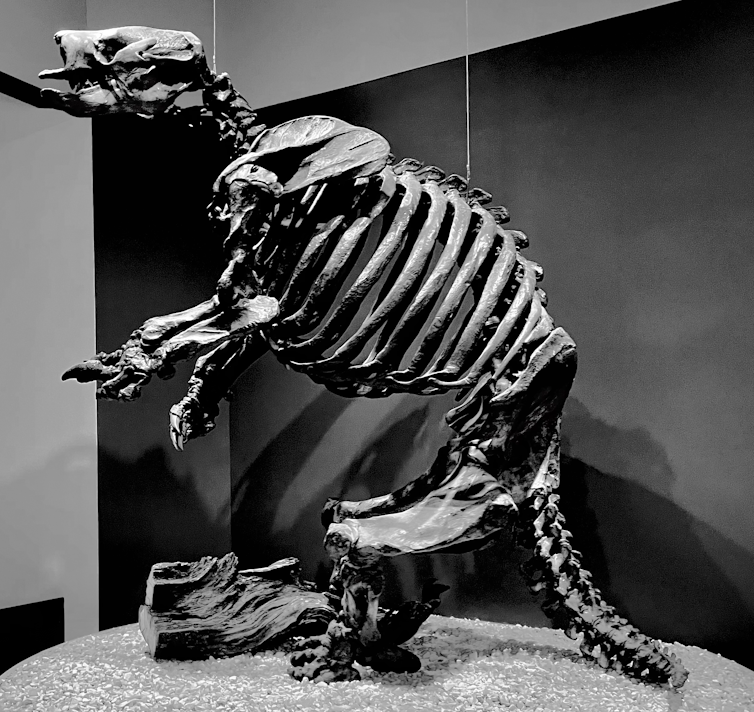
Harlan’s ground sloth fossil skeleton excavated and displayed at the La Brea Tar Pits in Los Angeles. Larisa DeSantis
A two-toed sloth at the Nashville Zoo. Larisa R. G. DeSantis
Imagine a sloth. You probably picture a medium-size, tree-dwelling creature hanging from a branch. Today’s sloths – commonly featured on children’s backpacks, stationery and lunch boxes – are slow-moving creatures, living inconspicuously in Central American and South American rainforests.
But their gigantic Pleistocene ancestors that inhabited the Americas as far back as 35 million years ago were nothing like the sleepy tree huggers we know today. Giant ground sloths – some weighing thousands of pounds and standing taller than a single-story building – played vital and diverse roles in shaping ecosystems across the Americas, roles that vanished with their loss at the end of the Pleistocene.
In our new study, published in the journal Biology Letters, we aimed to reconstruct the diets of two species of giant ground sloths that lived side by side in what’s now Southern California. We analyzed remains recovered from the La Brea Tar Pits of what are colloquially termed the Shasta ground sloth (Nothrotheriops shastensis) and Harlan’s ground sloth (Paramylodon harlani). Our work sheds light on the lives of these fascinating creatures and the consequences their extinction in Southern California 13,700 years ago has had on ecosystems.
Dentin dental challenges
Studying the diets of extinct animals often feels like putting together a jigsaw puzzle with only a portion of the puzzle pieces. Stable isotope analyses have revolutionized how paleoecologists reconstruct the diets of many ancient organisms. By measuring the relative ratios of light and heavy carbon isotopes in tooth enamel, we can figure out what kinds of foods an animal ate – for instance, grasses versus trees or shrubs.
Drilling teeth provides a sample for stable isotope analyses. Aditya Kurre
But the teeth of giant ground sloths lack enamel, the highly inorganic and hard outer layer on most animal teeth – including our own. Instead, sloth teeth are made primarily of dentin, a more porous and organic-rich tissue that readily changes its chemical composition with fossilization.
Stable isotope analyses are less dependable in sloths because dentin’s chemical composition can be altered postmortem, skewing the isotopic signatures.
Another technique researchers use to glean information about an animal’s diet relies on analyzing the microscopic wear patterns on its teeth. Dental microwear texture analysis can infer whether an animal mostly ate tough foods such as leaves and grass or hard foods such as seeds and fruit pits. This technique is also tricky when it comes to sloths’ fossilized teeth because signs of wear may be preserved differently in the softer dentin than in harder enamel.
Prior to studying fossil sloths, we vetted dental microwear methods in modern xenarthrans, a group of animals that includes sloths, armadillos and anteaters. This study demonstrated that dentin microwear can reveal dietary differences between leaf-eating sloths and insect-consuming armadillos, giving us confidence that these tools could reveal dietary information from ground sloth fossils.
Distinct dietary niches revealed
Previous research suggested that giant ground sloths were either grass-eating grazers or leaf-eating browsers, based on the size and shape of their teeth. However, more direct measures of diet – such as stable isotopes or dental microwear – were often lacking.
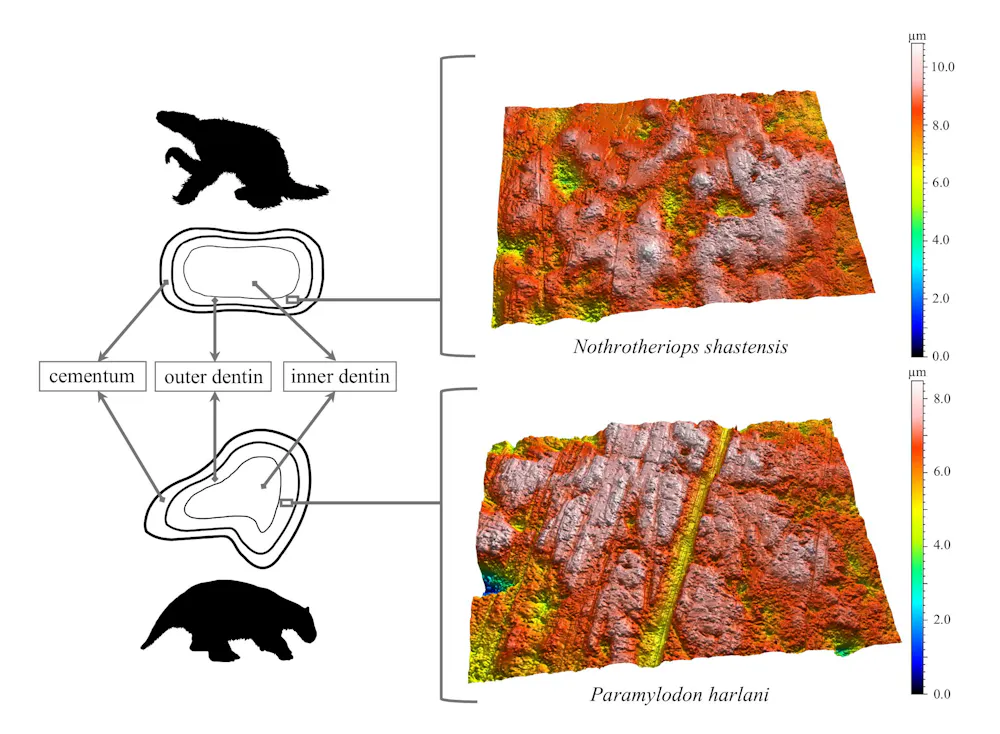
Our new analyses revealed contrasting dental wear signatures between the two co-occurring ground sloth species. The Harlan’s ground sloth, the larger of the two, had microwear patterns dominated by deep pitlike textures. This kind of wear is indicative of chewing hard, mechanically challenging foods such as tubers, seeds, fungi and fruit pits. Our new evidence aligns with skeletal adaptations that suggest powerful digging abilities, consistent with foraging foods both above and below ground.
The fossil teeth of the Harlan’s ground sloth typically showed deeper pitlike textures, bottom, while the Shasta ground sloth teeth had shallower wear patterns, top. DeSantis and Kurre, Biology Letters 2025
In contrast, the Shasta ground sloth exhibited dental microwear textures more akin to those in leaf-eating and woody plant-eating herbivores. This pattern corroborates previous studies of its fossilized dung, demonstrating a diet rich in desert plants such as yucca, agave and saltbush.
Next we compared the sloths’ microwear textures to those of ungulates such as camels, horses and bison that lived in the same region of Southern California. We confirmed that neither sloth species’ dietary behavior overlapped fully with other herbivores. Giant ground sloths didn’t perform the same ecological functions as the other herbivores that shared their landscape. Instead, both ground sloths partitioned their niches and played complementary ecological roles.
Extinctions brought ecological loss
The Harlan’s ground sloth was a megafaunal ecosystem engineer. It excavated soil and foraged underground, thereby affecting soil structure and nutrient cycling, even dispersing seed and fungal spores over wide areas. Anecdotal evidence suggests that some anachronistic fruits – such as the weird, bumpy-textured and softball-size Osage orange – were dispersed by ancient megafauna such as giant ground sloths. When the Pleistocene megafauna went extinct, the loss contributed to the regional restriction of these plants, since no one was around to spread their seeds.
The broader consequence is clear: Megafaunal extinctions erased critical ecosystem engineers, triggering cascading ecological changes that continue to affect habitat resilience today. Our results resonate with growing evidence that preserving today’s living large herbivores and understanding the diversity of their ecological niches is crucial for conserving functional ecosystems.
Studying the teeth of lost giant ground sloths has illuminated not only their diets but also the enduring ecological legacies of their extinction. Today’s sloths, though charming, only hint at the profound environmental influence of their prehistoric relatives – giants that shaped landscapes in ways we are only beginning to appreciate.
And a particular credit must go to the dog’s nose. It is many more times more sensitive than our nose, as the following article taken from Mother Nature Network shows. (And I really must stop republishing articles from MNN!)
ooOOoo
6 medical conditions that dogs can sniff out
From cancer to migraines and even seizures, dogs can give us a heads up about a range of human diseases.
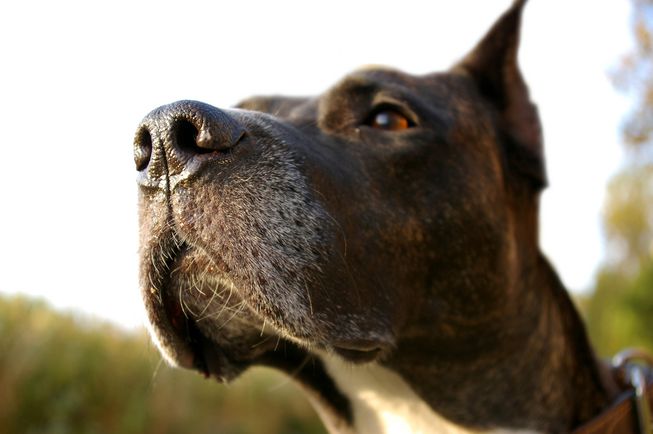
Dogs have millions of smell receptors that can detect countless smells, including the smells of changes going on inside our bodies. (Photo: RedTC/Shutterstock)
Dogs are famous for their sense of smell. With about 220 million scent receptors (compared to our 5 million), dogs can smell things that seem unfathomable to us. They can detect some odors in parts per trillion, and they can detect countless subtleties in scents.
As PBS points out, “Experts have reported incredible true stories about the acuteness of dogs’ sense of smell. There’s the drug-sniffing dog that ‘found’ a plastic container packed with 35 pounds of marijuana submerged in gasoline within a gas tank. There’s the black lab stray from the streets of Seattle that can detect floating orca scat from up to a mile away across the choppy waters of Puget Sound.”
And yes, there are the dogs who have sniffed out medical issues that even doctors weren’t aware of. Dogs can pick up on tiny changes in the human body, from a tiny shift in our hormones to the release of volatile organic compounds, or VOCs, released by cancer cells. Researchers and dog trainers are just beginning to understand how dogs do this and how we might put them to work in being our helpers in health care. Here are six medical conditions that dogs are able to smell.
Dog are naturally tuned into their owner’s emotions, but what about signs of ill health? (Photo: sherwood/Shutterstock)
Cancer
Perhaps the condition dogs are currently most famous for detecting is cancer. Dogs have been able to sniff out a variety of types including skin cancer, breast cancer and bladder cancer.
There are quite a few stories of a pet dog obsessing about an owner’s mole or some part of their body, only to discover in a doctor’s appointment that the dog was actually sensing cancer. For example, Canada Free Press writes of a 1989 instance when a woman’s “dog kept sniffing at a mole on her thigh, but ignored other moles. In fact, the dog had actually tried to bite off the mole when she was wearing shorts. The woman consulted her doctor, the mole was excised and the diagnosis confirmed a malignant melanoma.”
In the last couple decades, researchers have looked seriously into dogs’ sniffing abilities when it comes to cancers. In studies, dogs have successfully been trained to detect the disease using samples from known cancer patients and people without cancer.
The newest study offers the most startling statistics: Dogs can correctly pick out blood samples from people who have cancer with 97% accuracy, a 2019 study published in Experimental Biology found. Heather Junqueira, the lead researcher at BioScentDx who performed the study, used clicker training with four beagles. The dogs focused their efforts on blood samples from patients with lung cancer, and with one exception, they were highly successful. The sample was small, so BioScentDx plans to continue its work, according to Science Daily.
In a 2006 study, five dogs were trained to detect cancer based on breath samples. Once trained, the dogs were able to detect breast cancer with 88 percent accuracy, and lung cancer with 99 percent accuracy. They could do this across all four stages of the diseases.
Sometimes the dogs can do an even better job than the humans in these studies. According to Penn State News, Nancy Dreschel, a veterinarian in Dairy and Animal Science at Penn State University, tells of an illuminating example: “A scientist was training dogs to detect bladder cancer in humans by smelling their urine. She said a dog alerted them to a sample from a supposedly healthy person who was being used as a control. On reexamination that person was found to have bladder cancer, so the dog caught it before anyone else did.”
Study after study has shown that dogs can detect cancer in people, but it may a while before your doctor employs a hound for your annual checkup. Researchers still don’t know exactly what chemical compounds for different types of cancers the dogs are sensing in these samples to alert to the presence of the disease, and this remains a hurdle both for better training of cancer-sniffing dogs and for creating machines that can more accurately detect cancer in the early stages.
Narcolepsy
Narcolepsy is a brain disorder that affects the ability to control sleep-wake cycles. This can mean a person suddenly falls asleep, even in the middle of a task. It’s a dangerous condition, as someone who has an attack could be injured falling to the ground or could have a car accident if it happens while driving.
Mary McNeight, Service Dog Academy director of training and behavior, has been working with narcolepsy service dogs since 2010, and she notes that there’s a scent the dogs pick up on when an attack is coming on. “It’s a biochemical change in the body. We do not know what the particular odor smells like due to the difference between human scent perception and dog scent perception,” she tells Sleep Review.
In a study published in 2013, Luis Dominguez-Ortega, M.D., Ph.D., found that two trained dogs detected 11 of 12 narcolepsy patients using sweat samples, demonstrating that dogs can detect a distinct scent for the disorder.
Service dogs help people with narcolepsy by performing several different types of tasks. They can stand over the person’s lap when an attack comes on, which prevents them from sliding out of a chair onto the floor; they can also stand over the person to protect them if they are out in public, or they can go get help. And most importantly, they can provide a warning up to 5 minutes before an attack comes on, giving their handler a chance to get to a safe place or a safe position.
While large dogs can be helpful in giving a narcoleptic sufferer extra support in balance and mobility after an attack, these dogs don’t have to be big. According to Petful, even medium-sized dogs can do the job. “Theo, a 2-year-old cocker spaniel, has virtually put an end to [Kelly] Sears’ suffering. He can sense when she is about to have a narcoleptic episode and warn her so that she can sit or lie down, waking her after a few seconds with a kiss on her chin. Since arriving two months ago from Medical Detection Dogs, the only organization in Europe that trains narcolepsy service dogs, Theo has proven himself indispensable.”
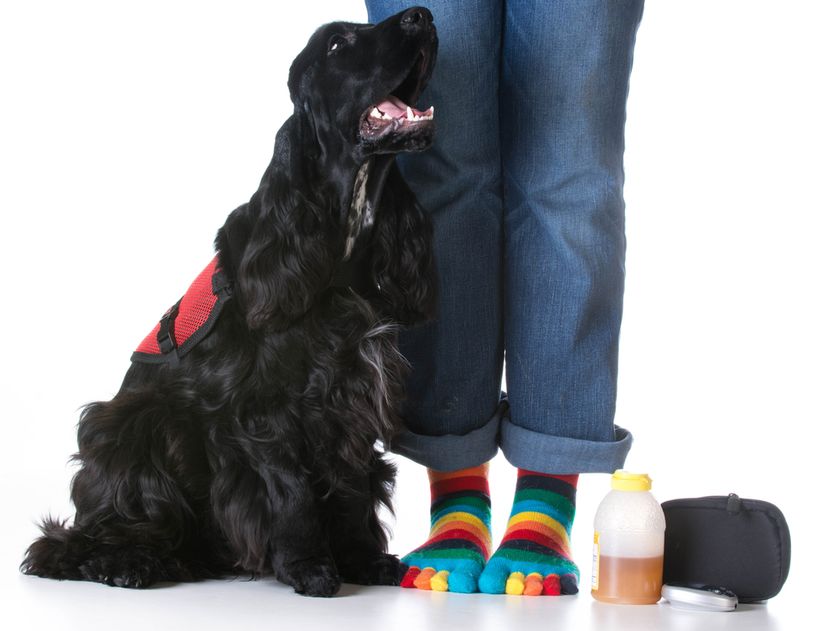
Dogs can smell all sorts of chemical changes in our bodies, including a drop in blood sugar or the onset of a migraine. (Photo: WilleeCole Photography/Shutterstock)
Migraines
For those who suffer migraines, having a warning before one comes on can mean the difference between managing the problem or succumbing to hours or days of intense pain. Fortunately, some dogs have a talent for sniffing out the signs that a migraine is on the way.
Psychology Today reports on a recent study that asked migraine sufferers with dogs if they noticed a change in their dogs’ behavior before or during a migraine. The results show that “54 percent of the 1027 participants indicated they had noticed changes in the behavior of their pets during or preceding migraines. Nearly 60 percent of these subjects indicated that their dog had alerted them to the onset of a headache — usually an hour or two in advance.” The results are fascinating, though it’s important to point out that the study was conducted with self-reports rather than observation by researchers. Even so, the study shows evidence that many dogs seem to detect and point out a change in their human companion’s health.
According to Kendall Winship, a migraine sufferer with a service dog, “These [migraine alert service] dogs are highly valued because the ability to tell when a migraine is approaching is an innate talent; it can’t be taught. Similar to diabetic alert dogs that can smell when their handler has low blood sugar, migraine alert dogs can hone in on the scent of serotonin, a chemical that skyrockets when the body is about to have a migraine. By alerting to the danger long before their handlers might feel any symptoms, these dogs can warn them to take preventative medication. When Rally looks up at me and whines, I know I have about two hours before the migraine will strike, and if I can take my medication early enough, I might be able to avoid the stroke-like symptoms and incapacitating pain.”
Low blood sugar
Increasingly, dogs are helping diabetics know when their blood sugar level is dropping or spiking. Dogs4Diabetics is one organization that trains and places service dogs with insulin-dependent diabetics. These dogs undergo extensive training to be able to detect and alert their handlers to changes in blood sugar levels.
A 2016 study published in the journal Diabetes Care found that the dogs detect isoprene, a common natural chemical found in human breath that rises significantly during episode of low blood sugar. People can’t detect the chemical, but the researchers believe that the dogs are particularly sensitive to it and can tell when their owner’s breath has high levels of it.
Medical News Today reports that dogs are trained to discriminate between the scent from a previous episode and the scent of a current episode. They detect when their handler is having an issue and alert the person, giving them time to test their blood sugar and take the insulin they need.
A 2013 study published in PLOS One showed that having a diabetic alert dog seems to provide significant improvements in both the safety and quality of life of insulin-dependent diabetics. “Since obtaining their dog, all 17 clients studied reported positive effects including reduced paramedic call outs, decreased unconscious episodes and improved independence.”
There’s still some skepticism about whether or not dogs can accurately alert handlers to a blood sugar change at a level beyond chance, something that can be determined with more studies. Even so, for those diabetics living with alert dogs, the sniffing ability of their companions seems to be a big help.
Seizure
One of the more controversial areas where dogs are used to alert to a medical condition is with seizures. There is growing evidence that dogs can and do detect the onset of a seizure; however, the level of accuracy and, most importantly, our ability to train dogs to alert a handler to an oncoming seizure remains a bit questionable.
As is the case with some other conditions, dogs cannot be trained to predict seizures. We don’t have a way to provide them with a scent or information that can be used for training. We can, however, train dogs how to respond to and assist a handler when a seizure occurs. Some service dogs that are placed with seizure patients do develop the ability to detect when a seizure is coming and can provide an alert if the handler pays close attention to the signals the dog provides. WebMD reports, “Jennifer Arnold, founder of Canine Assistants in Georgia, … says about nine out of 10 of the service dogs her organization has placed develop the ability on their own within a year of placement.”
A small 2019 study found that dogs were able to clearly discriminate a general epileptic “seizure odor.” However the study only involved a handful of dogs and involved odor samples that were collected during a seizure. Researchers pointed out that much more extensive testing would need to be done to see if other dogs would respond similarly and if dogs could predict seizures before they happened.
However, there is some question about how dogs are responding. How Stuff Workspoints out that in 2007, “two small studies in the journal Neurology reported that four out of seven seizure alert dogs studied turned out to be warning their masters of psychological, rather than epileptic seizures. This may not seem like a big deal, but the two disorders are different. A 2006 study revealed that up to 30 percent of patients who suffer from psychogenic nonepileptic seizures (PNES) are misdiagnosed with epilepsy. PNES, which results from emotional difficulties and can often be successfully treated with counseling, rather than unnecessary and harsh epilepsy drugs. The 2007 study also revealed one instance of seizures being triggered by the patient’s dog’s warning behaviors, indicating another flaw in the reliability of canine seizure prediction.”
A 2003 study concluded that “findings suggest some dogs have innate ability to alert and/or respond to seizures” however, it notes that further research is needed to uncover which seizure patients would benefit from the help of a dog. We also need more research to learn how to train dogs to be as effective as possible. We have to first learn how dogs know when a seizure is coming — are they smelling a change in body chemistry, or are they picking up on behavior changes? — before we can reliably train them to alert handlers before a seizure happens.
Dogs can smell fear and stress, and they can use that ability to help people with issues such as PTSD. (Photo: Glynnis Jones/Shutterstock)
Fear and stress
The age-old notion that dogs can smell fear is an accurate one. Dogs can smell when we are feeling fear or are experiencing an increased level of stress, even if we aren’t showing outward signs. What dogs are smelling is the surge of hormones our bodies release to respond to stressful situations, including adrenalin and cortisol.
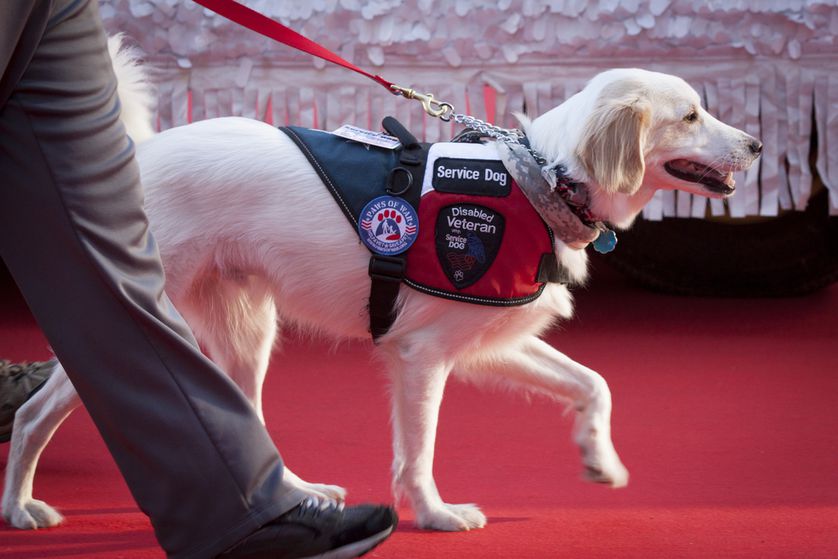
Thankfully, this can be used to humans’ benefit, as dogs can signal a handler that they (or someone else) needs to take a few deep breaths. Dogs that alert handlers of the change in their emotional state — a change that often people aren’t even aware they’re experiencing — can help prevent panic attacks and other possible episodes associated with post-traumatic stress disorder or other issues.
“This 18-month Rhodesian ridgeback is the first cortisol-sniffing dog on staff at a school. Cortisol is known as the ‘stress hormone,’ and people on the autism spectrum tend to have higher levels of cortisol in their blood. Cali is employed to detect rising cortisol levels in the students. She waits outside of school each morning as the students file by. If she notices anyone with a high level of cortisol in their blood, she will signal to her handler, Casey Butler, a health teacher on staff at The Calais School who is a certified specialist in natural canine behavior rehabilitation and in animal adaptive therapy. When Cali stares at a child, Butler knows that is the signal. She then takes that child aside and works with him or her before a meltdown occurs.”
We still have a long way to go to discover exactly what dogs are smelling about us, let alone how we can train them to be as accurate as possible about a change in our bodies. Even though many details are not yet known, it’s clear that dogs have an uncanny ability to sniff out certain medical issues, and that’s a skill that could be a real lifesaver.
Editor’s note: This story was originally published in 2016 and has been updated with new information.
Jaymi Heimbuch ( @jaymiheimbuch ) focuses on wildlife conservation and animal news from her home base in San Francisco.
ooOOoo
Where on earth would we be without these wonderful, clever dogs! Seriously, whether you love dogs or not you cannot deny that they are incredible creatures!
One of the fascinating aspects of my new American life is seeing how loud the volume of dissent is from the American
Bill Moyers
people about the shenanigans on Wall Street and the Too Big To Fail banks. There is an intensity and passion that I can’t see happening on the other side of the Pond. Maybe this is the cultural legacy of a people that just a short time ago, relatively speaking, were opening up this giant country seeking a better way of life than the ‘old countries’.
This intensity and passion is why, in the end, I believe that the solution to the huge crisis that still awaits us will start from this side of the Atlantic. But it will get a whole lot worse before it gets better, such is the complexity and depth of the fraud that is being visited on decent, ordinary folks in this and many other fine countries.
Bill Moyers of the Bill Moyers Journal on PBS is retiring. He’s approaching 76 and that’s a grand age to be dealing with the workload and stress of a weekly television presentation. His last Journal was broadcast on the 23rd April, a week ago today airing two really important topics. My only regret is that I haven’t been here sufficiently long to view many more of his Journals.
William K Black
In that last broadcast on the 23rd, Bill had two key interviews. In this Post, I want to bring to your attention his first report, which was an interview with William K Black, now an academic but, just as importantly, a former bank regulator. William Black really understands what is going on in banking.
The interview is both fascinating and captivating because, well to me anyway, it explains in terms that us laymen can understand, exactly what is going on and why it is so terribly important that legislation and regulations are brought into force to stop this fraud ever happening again.
This interview has not yet made it’s way onto YouTube so I can only post the link to the Bill Moyers website.
But, please, if you care about what is happening to us in whatever country you live in, click on this link and watch the interview.
And if you want to watch the earlier interview that Bill Moyers had with William Black then here it is.






 Learning from Dogs