Tag: Patrice Ayme

The Truth about Gods, part two

The concluding part of this essay by Patrice Ayme.

ooOOoo

Endowing aspects of the universe with spirituality, a mind of their own, is stupid in this day and age, only if one forgets there are natural laws underlying them. But if one wants to feel less alone and more purposeful, it is pretty smart.    

Patrice Ayme

Here is the inventor of monotheism: Nefertiti. Once a fanatic of Aten, the sun god, she turned cautious, once Pharaoh on her own, backpedalled and re-authorized Egyptian polytheism. (The sun-God, Sol Invictis, was revived by Roman emperor Dioclesian 17 centuries later, in his refounding of Romanitas and the empire. His ultra young successor and contemporary, emperor Constantine, used the revived monotheism to impose his invention of Catholicism. Funny how small the conceptual world is.)

***

The preceding part (see Part One yesterday} contains many iconoclastic statements which made the Articial Intelligence (AI) I consulted with try to correct me with what were conventional, but extremely erroneous, ill-informed data points. AI also use the deranged upside down meta-argument that it is well-known that Christianism is not like that, so I have got to be wrong. Well, no, I was raised as a Catholic child in two different Muslim countries, and also in a Pagan one; the Muslim faiths I knew as child were as different from Suny/Shiah faiths as Christianism is, overall, from Islamism. In other words, I know the music of monotheism. So here are:

***

TECHNICAL NOTES: 

[1] To speak in philosophical linguo, we capture two civilizational “ontologies” (logic of existence):

  1. Polytheistic-personal: relational, distributed, ecological.
  2. Monotheistic-fascistic: hierarchical, authoritarian, abstracted.

[2] Paganus, in a religious sense, appears first in the Christian author Tertullian, around 202 CE, to evoke paganus in Roman military jargon for ‘civilian, incompetent soldier‘ by opposition to the competent soldiers (milites) of Christ that Tertullian was calling for.

[3] ‘FAIR OF FACE, Joyous with the Double Plume, Mistress of Happiness, Endowed with Favour, at hearing whose voice one rejoices, Lady of Grace, Great of Love, whose disposition cheers the Lord of the Two Lands.

With these felicitous epithets, inscribed in stone more than 3,300 years ago, on the monumental stelae marking the boundaries of the great new city at Tell el Amarna on the Nile in central Egypt, the Pharaoh Akhenaten extolled his Great Royal Wife, the chief queen, the beautiful Nefertiti.

Nefertiti (‘the beautiful one has come‘) co-ruled Egypt with her older (and apparently famously ugly, deformed by disease) husband. Egypt was at its wealthiest. She was considered to be a DIVINITY. All her life is far from known, and revealed one fragment of DNA or old text at a time. She ruled as sole Pharaoh after her husband’s death, and seems to have offered to marry the Hittite Prince (as revealed by a recently found fragment: ”I do not wish to marry one of my subjects. I am afraid…” she confessed in a letter to the amazed Hittite emperor.). She apparently decided to re-allow the worship of the many Egyptian gods, and her adoptive son and successor Tutankhaten switched his name to Tutankhamen). Both her and Tutankhamen died, and they were replaced by a senior top general of Akhenatten who both relieved the dynasty from too much inbreeding (hence the deformed Akhenaten) and too much centralism focused on the sun-disk (‘Aten’)  

[4] Those who do not know history have a small and ridiculous view of FASCISM. Pathetically they refer to simpletons, such as Hitler and Mussolini, to go philosophical on the subject.. Google’s Gemini tried to pontificate that ‘labeling the structure of monotheism (especially its early forms) as fascistic’ is anachronistic and highly inflammatory. Fascism is a specific 20th-century political ideology. While the author means authoritarian and hierarchical, using ‘fascistic’ distracts from the historical and philosophical points by introducing modern political baggage. It would be clearer and less polemical to stick to Hierarchical’ or ‘Authoritarian-Centralized.

I disagree virulently with this cognitive shortsightedness of poorly programmed AI. The Romans were perfectly aware of the meaning that the faces symbolized (they got them from the Etruscans). So were the founders of the French and American republics aware of the importance of fascism and the crucial capabilities it provided, the powerful republics which, in the end, succeeded the Roman Republic (which died slowly under the emperors until it couldn’t get up); those two republics gave the basic mentality now ruling the planet.

Fascism is actually an instinct. Its malevolent and dumb confiscation by ignorant  morons such as Hitler and Mussolini ended pathetically under the blows of regimes (the democracies on one side, the fascist USSR on the other) which were capable of gathering enough, and much more, and higher quality fascism of their own to smother under a carpet of bombs the cretinism of the genocidal tyrants. It is actually comical, when reading old battles stories, to see the aghast Nazis out-Nazified by their Soviet opponents (discipline on the Soviet side was a lethal affair at all and any moment.) Or then to see SS commanders outraged by the ferocity of their US opponents. At Bir Hakeim, a tiny French army, 3,000 strong, buried in the sands, blocked the entire Afrika Korps and the Italian army, for weeks, under a deluge of bombs and shells, killing the one and only chance the Nazis had to conquer the Middle East. Hitler ordered the survivors executed, Rommel, who knew he was finished, disobeyed him.   

***

Early Christianism was highly genocidal. The Nazi obsession with the Jews was inherited from Nero (who, unsatisfied with just crucifying Christians (64 CE), launched the annihilation wars against Israel) and then the Christians themselves. There were hundreds of thousands of Samaritans, a type of Jew, with their own capital and temple (above Haifa). Warming up, after centuries of rage against civilization, the Christians under emperor Justinian, in the Sixth Century, nearly annihilated the Samaritans; a genocide by any definition.

Later, by their own count, at a time when Europe and the greater Mediterranean counted around 50 million inhabitants, the Christians, over centuries, killed no less than 5 million Cathars from Spain to Anatolia. Cathars, the pure ones in Greek (a name given to them by their genociders), were a type of Christian). In France alone, in a period of twenty years up to a million were killed, (not all Cathars, but that accentuates the homicidal character). As a commander famously said: ”Tuez les tous, Dieu reconnaitra les siens” (Kill them all, God will recognize his own). The anti-Cathars genocide drive in France, an aptly named ‘crusade‘,  something about the cross, lasted more than a century (and boosted the power of the Inquisition and the Dominicans). The extinction of Catharism was so great that we have only a couple of texts left. 

Want to know about Christianism? Just look at the torture and execution device they brandish, the cross. Christianism literally gave torture and execution a bad name, and it’s all the most cynical hypocrisy hard at work. 

And so on. To abstract it in an impactful way, one could say that much of Christianism instigated Nazism. That’s one of the dirty little secrets of history, and rather ironical as the dumb Hitler was anti-Christian, and still acted like one, unbeknownst to himself, his public, and his critiques; those in doubt can consult the descriptions of the Crusades by the Franks themselves, when roasting children was found to relieve hunger.

Chroniclers like Radulph of Caen (a Norman historian writing around 1118) described it vividly: “In Ma’arra our troops boiled pagan adults in cooking-pots; they impaled children on spits and devoured them grilled.” Other sources, such as Joinville, Fulcher of Chartres and Albert of Aachen, corroborate the desperation and brutality, though they express varying degrees of horror or justification.   These acts were not systematic policy but extreme responses to the hunger and chaos of war, and they were preserved in Frankish narratives as part of the Crusade’s grim legacy. (There were also cases of cannibalism in WW2).

Christianism, when not actively genocidal, certainly instigated a mood, a mentality, of genocide; read Roman emperor Theodosius I about heresy. Here is the end of Theodosius’ famous quote: ‘According to the apostolic teaching and the doctrine of the Gospel, let us believe in the one deity of the Father and of the Son and of the Holy Spirit, in equal majesty and in a holy Trinity. We order the followers of this law to embrace the name of Catholic Christians; but as for the others, we judge them to be demented and ever more insane (dementes vesanosque iudicantes), we decree that they shall be branded with the ignominious name of heretics, and shall not presume to give to their conventicles the name of churches. They will suffer in the first place the chastisement of the divine condemnation and in the second the PUNISHMENT OF OUR AUTHORITY which in accordance with the will of Heaven WE SHALL DECIDE TO INFLICT.

The ‘Men In Black‘ of the Fourth Century destroyed books, libraries and intellectuals, ensuring the smothering of civilization, as intended (destruction of the Serapeum in Alexandria, the world’s largest library) around 391 CE. Contemporary writers like Eunapius and Libanius lamented the ‘rage for destruction’ of the Men In Black. Some non-Christian texts were preserved in monasteries, true, but the point is that Christianism made possible the destruction of non-Yahweh knowledge. This is the problem king David himself already had, the fascism, the power obsessed little mind of Yahweh. Monasteries were often built with a covert anti-Christian mentality, things were complicated. When queen Bathilde outlawed slavery (657 CE), her closest allies were bishops, yet she had to execute other, slave-holding bishops. She also founded and funded four monasteries. Soon the Frankish government passed a law enforcing secular teaching by religious establishments.

The uniforms of the Men In Black were copied later by the Dominicans (‘Black Friars’) who led the genocide of the Cathars, in co-operation with the Inquisition, also dressed in black, and then the SS. Luther. Saint Louis expressed explicitly that nothing would bring them more joy than Jews suffering to death. Saint Louis was more descriptive, evoking a knife planted in the belly of the unbeliever and great pleasure. In Joinville’s Life of Saint Louis (c. 1309), Louis recounts a story of a knight who, during a debate with Jews, stabbed one in the belly with a dagger, saying it was better to “kill him like that” than argue theology.  Louis presented this approvingly as zeal for the faith, and wished he could partake. Although he warned, he wouldn’t do it, that would be illegal. With a faith like that Louis IX could only be canonized in 1297 CE. And, following Saint Louis’ hint, the Nazis removed his legal objection by changing the law in 1933, when they got to power.

Luther gave multiple and extensive ‘sincere advices‘ on how to proceed with the genocide of the Jews in his book: ”The Jews and their Lies”. Here is a sample: “If I had to baptize a Jew, I would take him to the bridge of the Elbe, hang a stone around his neck and push him over, with the words, ‘I baptize thee in the name of Abraham.” 

But Musk’s AI, ‘Grok’ informed me that its basic axiom was that Christianism was never genocidal, but instead ‘suppressive‘. Then it thought hard for ‘nine seconds‘ to try to prove to me, with biased context, that I had exaggerated.

I had not.  

***.  

The entire church was into assassination madness, glorifying in its own cruelty; the chief assassin of Hypatia, a sort of Charlie Manson to the power 1000, was made into a saint: Saint Cyril. Cyril’s minions grabbed Hypatia who had just finished giving a lecture, dragged her in the streets, and stripped her clothing, and then stripped her of her own skin, flaying her with oysters shells, causing her demise. She was the top intellectual of the age. Hypatia met her torturous end in 415 CE. Cyril was made into a saint 29 years later, in 444 CE! With saints like that, who needs Hitler?

Not to say Catholicism was useless; the jealous and genocidal, yet loving and all-knowing Yahweh was always a good excuse to massacre savages and extend civilization on the cheap. The Teutonic Knights, finding the Yahweh fanatics known as Muslims too hard a nut to crack, regrouped in Eastern Germany and launched a very hard fought crusade against the Prussian Natives, who were Pagans. After mass atrocities on both sides, the Teutons won.

The Franks embraced the capabilities of the cross, fully. Having converted to Catholicism, they were in a good position to subdue other Germans, who were Arians (and that they did, submitting Goths and Burgonds, Ostrogoths and Lombards). Three centuries later, Charlemagne used Christianism as an instrument to kill Saxons on an industrial scale, in the name of God, to finally subdue them, after Saxons had terminally aggravated Romanitas for 800 years, driving Augustus crazy

Charlemagne, in daily life, showing how relative Christianism was, and its true Jewish origins, used the nickname ‘David’ for king David, the monarch who refused to obey Yahweh, who had ordered David to genocidize a people (petty, jealous God Yahweh then tortured David’s son to death)

Charlemagne lived the life of a hardened Pagan, with a de-facto harem, etc. More viciously, Charlemagne passed laws pushing for secular, and thus anti-Christian education. Following in these respects a well-established Frankish custom. Charlemagne knew Christianism was a weapon, and he was careful to use it only on the Saxons; internally, there was maximum tolerance: Christians could become Jews, if they so wished.

PA

ooOOoo

I found the full essay quite remarkable. Jean has heard me rattle on about it numerous times since I first read the essay on November 2nd. I sincerely hope you will read it soon.

Finally, let me reproduce what I wrote in a response to Patrice’s post:

Patrice, in your long and fascinating article, above, you have educated me in so many ways. My mother was an atheist and I was brought up in likewise fashion. But you have gone so much further in your teachings.

Your article needs a further reading. But I am going to share it with my readers on LfD so many more can appreciate what you have written. Plus, I am going to republish it over two days.

Thank you, thank you, thank you!


The Truth about Gods, part one.

A brilliant essay by Patrice Ayme.

Patrice writes amazing posts, some of which are beyond me. But this one, The Personification Of The World, PAGANISM, Gives Us Friends Everywhere, is incredible.

My own position is that my mother and father were atheists and I was brought up as one. Apart from a slip-up when I was married to my third wife, a Catholic, and she left me and I thought that by joining the Catholic church I might win her back. (My subconcious fear of rejection.)

My subconscious fear of rejection was not revealed to me until the 50th anniversary of my father’s death in 2006 when I saw a local psychotherapist. Then I met Jean in December, 2007 and she was the first woman I truly loved!

Back to the essay; it is a long essay and I am going to publish the first half today and the second half tomorrow. (And I have made some tiny changes.)

ooOOoo

The Personification Of The World, PAGANISM, Gives Us Friends Everywhere

Abstract: Personification of the world (polytheism/paganism) is more pragmatic, psychologically rewarding, and ecologically sound than the hierarchical, abstracted structure of monotheism, which the author labels “fascistic.” [4]

***

Switching to a single fascist God, Ex Pluribus Unum, a single moral order replacing the myriad spirits of the world, was presented as a great progress: now everybody could, should, line up below the emperor, God’s representative on Earth, and obey the monarch and his or her gang. The resulting organization was called civilization. Submitting to God was the only way Rome could survive, because it provided a shrinking army and tax base with more authority than it deserved.

However peasants had to predict the world and it was more judicious to personalize aspects of it. The resulting logico-emotional relationship had another advantage: the supportive presence of a proximal Gods… All over!.[1]

*** 

personification

/pəˌsɒnɪfɪˈkeɪʃn/ noun

1.the attribution of a personal nature or human characteristics to something non-human, or the representation of an abstract quality in human form.

***

Before Christianism, Gods were everywhere. When the Christians took over, they imposed their all powerful, all knowing Jewish God. Some present the Jewish God as a great invention, symbolizing some sort of progress of rationality that nobody had imagined before. 

However, the single God concept was not that new. Even Americans had it in North America, as the chief of God, the Aztecs, had a similar concept, and even Zeus was a kind of chief God. Zoroastrianism had Ahura Mazda, who did not control Angra Manyu, but still was somewhat more powerful. The Hindus had Vishnu and his many avatars.

Eighteen centuries before those great converters to Christianism, Constantine, Constantius II, and Theodosius I, there was an attempt to forcefully convert the Egyptians to a single God. Pharaoh Akhenaten’s monotheistic experiment (worship of Aten) caused turmoil and was erased by his immediate successors.

According to the latest research it seems likely that the famous Nefertiti became a Pharaoh on her own, after the death of her husband, and retreated from monotheism by re-establishing Egyptian polytheism [3]. In the fullness of time, the infernal couple got struck by what the Romans, 15 centuries later, would call damnatio memoriae. Their very names and faith were erased from hundreds of monuments

Shortly after the Aten episode, there was another confrontation between polytheism and monotheism. The colonizers of Gaza were apparently Greek, of Aegean origin, and, as such, over more than a millennium of conflict with the Jewish states in the hills, Greek Gods confronted Yahweh. The Greeks obviously did not see Yahweh as a major conceptual advance, as they did not adopt Him (until Constantine imposed Him, 15 centuries later).

While the area experienced enormous turmoil, including the permanent eclipse of Troy after the war with Greece (see Homer), and later its replacement by Phrygia, then followed by the Bronze Age collapse, then the rise of Tyre, and the Assyrian conquest, the Greeks survived everything, and their civilization kept sprawling (the early Christian writings were in Greek).

Ultimately, the lack of ideological bending, the obsession with pigs and other silliness, helped to bring devastating Judeo-Roman wars. By comparison, the much larger Gaul bent like a reed when confronted with the Greco-Romans, absorbing the good stuff. Mercury, the God of trade, preceded Roman merchants. Gaul didn’t take religion too seriously, and went on with civilizational progress.

The lack of elasticity of the single God religion of the Jews brought their quasi-eradication by Rome; Judaism was tolerated, but Jewish nationalism got outlawed. By comparison, the Greeks played the long game, and within a generation or so of Roman conquest, they had spiritually conquered their conqueror. Christianism was actually an adaptation of Judaism to make Yahweh conquer the heart and soul of fascist Rome.

***

To have Gods everywhere? Why not? Is not the Judeo-Christian God everywhere too? Doesn’t it speak through fountains, and the immensity of the desert, and the moon, and the stars, too?

***

Yahweh, the Jewish God Catholic Romans called “Deus” was deemed to be also the ultimate love object. Yahweh had promised land to the Jews, Deus promised eternal life of the nicest sort – To all those who bought the program. 

Christians were city dwellers and their power over the countryside and barbarians came from those who had imposed Christianism, the imperial powers that be (at the time, more than 90% of the people worked in agriculture). Already as a teenager, Constantine, a sort of superman born from imperial purple, terrified the court which was supposed to hold him hostage. Such a brute and excellent general could only get inspired by Yahweh’s dedication to power.

The country dwellers, the villagers, disagreed that they needed to submit to a God organized, celebrated and imposed by the all-powerful government (god-vernment?). In classical Latin paganus meant ‘villager, rustic; civilian, non-combatant’. In late imperial Latin it came to mean non-Judeo-Christian (and later non-Judeo-Christo-Islamist) [2].

Christianism found it very difficult to penetrate the countryside, where the food was produced. It never quite succeeded (Even in Muslim Albania, Pagan rituals survived until the 20th century; much of the cult of saints is barely disguised Paganism).

Peasants knew that power was distributed throughout nature, and they had to understand those powers, thus love them – That enabled them to predict phenomena.

Peasants could ponder the mood of a river, and even predict it; flooding was more of a possibility in some circumstances, and then it was no time to indulge in activities next to the river. Peasants had to guess the weather, and the earlier, the better. Peasants had to know which part of the astronomical cycle they were in, to be able to plant crops accordingly; that was not always clear just looking outside, but the stars would tell and could be trusted to tell the truth.

We can be friends to human beings, and sometimes it’s great, but sometimes we feel betrayed and abandoned. But a mountain or a sea? They will always be there, they are not running away, they are never deliberately indifferent, and generally exhibit predictable moods. It is more pragmatic and rewarding to love them more rather than an abstract Dog in Heavens. Call them Gods if you want.

ooOOoo

Part two will be published tomorrow.

I am publishing the notes, on both days, so you can look them up now rather than waiting another day.

TECHNICAL NOTES: 

[1] To speak in philosophical linguo, we capture two civilizational ‘ontologies’ (logic of existence):

  1. Polytheistic-personal: relational, distributed, ecological.
  2. Monotheistic-fascistic: hierarchical, authoritarian, abstracted.

[2] Paganus, in a religious sense, appears first in the Christian author Tertullian, around 202 CE, to evoke paganus in Roman military jargon for ‘civilian, incompetent soldier‘ by opposition to the competent soldiers (milites) of Christ that Tertullian was calling for.

[3] ‘FAIR OF FACE, Joyous with the Double Plume, Mistress of Happiness, Endowed with Favour, at hearing whose voice one rejoices, Lady of Grace, Great of Love, whose disposition cheers the Lord of the Two Lands.

With these felicitous epithets, inscribed in stone more than 3,300 years ago on the monumental stelae marking the boundaries of the great new city at Tell el Amarna on the Nile in central Egypt, the Pharaoh Akhenaten extolled his Great Royal Wife, the chief queen, the beautiful Nefertiti.

Nefertiti (‘the beautiful one has come‘) co-ruled with her older (and apparently famously ugly, deformed by disease) husband, Egypt. Egypt was at its wealthiest. She was considered to be a DIVINITY. All her life is far from known, and revealed one fragment of DNA or old text at a time. She ruled as sole Pharaoh after her husband’s death, and seems to have offered to marry the Hittite Prince (as revealed by a recently found fragment: ”I do not wish to marry one of my subjects. I am afraid…” she confessed in a letter to the amazed Hittite emperor). She apparently decided to re-allow the worship of the many Egyptian gods and her adoptive son and successor Tutankhaten switched his name to Tutankhamen. Both her and Tutankhamen died, and they were replaced by a senior top general of Akhenatten who both relieved the dynasty from too much inbreeding (hence the deformed Akhenaten) and too much centralism focused on the sun-disk (‘Aten’).  

[4] Those who do not know history have a small and ridiculous view of FASCISM. Pathetically they refer to simpletons, such as Hitler and Mussolini, to go philosophical on the subject. Google’s Gemini tried to pontificate that ‘labeling the structure of monotheism (especially its early forms) as fascistic’ is anachronistic and highly inflammatory. Fascism is a specific 20th-century political ideology. While the author means authoritarian and hierarchical, using ‘fascistic’ distracts from the historical and philosophical points by introducing modern political baggage. It would be clearer and less polemical to stick to Hierarchical’ or ‘Authoritarian-Centralized’.

The mystery of Dark Matter

This very interesting article is worth a read.

Patrice Ayme published a post on Wednesday, 25th June, 2025 that is deeply conected to the following post from The Conversation.

His post was called: ‘How Does The Universe Expand? The Way Cosmologists Decided That It Does, FLRW Metric! A Causal Loop Is At The Heart Of Modern ΛCDM Cosmology!’

Thus I recommend that you read that article and then the one that is republished by me, with permission, from The Conversation.

ooOOoo

The Vera C. Rubin Observatory will help astronomers investigate dark matter, continuing the legacy of its pioneering namesake

The Rubin Observatory is scheduled to release its first images in 2025. RubinObs/NOIRLab/SLAC/NSF/DOE/AURA/B. Quint

Samantha Thompson, Smithsonian Institution

Everything in space – from the Earth and Sun to black holes – accounts for just 15% of all matter in the universe. The rest of the cosmos seems to be made of an invisible material astronomers call dark matter.

Astronomers know dark matter exists because its gravity affects other things, such as light. But understanding what dark matter is remains an active area of research.

With the release of its first images this month, the Vera C. Rubin Observatory has begun a 10-year mission to help unravel the mystery of dark matter. The observatory will continue the legacy of its namesake, a trailblazing astronomer who advanced our understanding of the other 85% of the universe.

As a historian of astronomy, I’ve studied how Vera Rubin’s contributions have shaped astrophysics. The observatory’s name is fitting, given that its data will soon provide scientists with a way to build on her work and shed more light on dark matter.

Wide view of the universe

From its vantage point in the Chilean Andes mountains, the Rubin Observatory will document everything visible in the southern sky. Every three nights, the observatory and its 3,200 megapixel camera will make a record of the sky.

This camera, about the size of a small car, is the largest digital camera ever built. Images will capture an area of the sky roughly 45 times the size of the full Moon. With a big camera with a wide field of view, Rubin will produce about five petabytes of data every year. That’s roughly 5,000 years’ worth of MP3 songs.

After weeks, months and years of observations, astronomers will have a time-lapse record revealing anything that explodes, flashes or moves – such as supernovas, variable stars or asteroids. They’ll also have the largest survey of galaxies ever made. These galactic views are key to investigating dark matter.

Galaxies are the key

Deep field images from the Hubble Space Telescope, the James Webb Space Telescope and others have visually revealed the abundance of galaxies in the universe. These images are taken with a long exposure time to collect the most light, so that even very faint objects show up.

Researchers now know that those galaxies aren’t randomly distributed. Gravity and dark matter pull and guide them into a structure that resembles a spider’s web or a tub of bubbles. The Rubin Observatory will expand upon these previous galactic surveys, increasing the precision of the data and capturing billions more galaxies.

In addition to helping structure galaxies throughout the universe, dark matter also distorts the appearance of galaxies through an effect referred to as gravitational lensing.

Light travels through space in a straight line − unless it gets close to something massive. Gravity bends light’s path, which distorts the way we see it. This gravitational lensing effect provides clues that could help astronomers locate dark matter. The stronger the gravity, the bigger the bend in light’s path.

Many galaxies, represented as bright dots, some blurred, against a dark background.
The white galaxies seen here are bound in a cluster. The gravity from the galaxies and the dark matter bends the light from the more distant galaxies, creating contorted and magnified images of them. NASA, ESA, CSA and STScI

Discovering dark matter

For centuries, astronomers tracked and measured the motion of planets in the solar system. They found that all the planets followed the path predicted by Newton’s laws of motion, except for Uranus. Astronomers and mathematicians reasoned that if Newton’s laws are true, there must be some missing matter – another massive object – out there tugging on Uranus. From this hypothesis, they discovered Neptune, confirming Newton’s laws.

With the ability to see fainter objects in the 1930s, astronomers began tracking the motions of galaxies.

California Institute of Technology astronomer Fritz Zwicky coined the term dark matter in 1933, after observing galaxies in the Coma Cluster. He calculated the mass of the galaxies based on their speeds, which did not match their mass based on the number of stars he observed.

He suspected that the cluster could contain an invisible, missing matter that kept the galaxies from flying apart. But for several decades he lacked enough observational evidence to support his theory.

A woman adjusting a large piece of equipment.
Vera Rubin operates the Carnegie spectrograph at Kitt Peak National Observatory in Tucson. Carnegie Institution for Science, CC BY

Enter Vera Rubin

In 1965, Vera Rubin became the first women hired onto the scientific staff at the Carnegie Institution’s Department of Terrestrial Magnetism in Washington, D.C.

She worked with Kent Ford, who had built an extremely sensitive spectrograph and was looking to apply it to a scientific research project. Rubin and Ford used the spectrograph to measure how fast stars orbit around the center of their galaxies.

In the solar system, where most of the mass is within the Sun at the center, the closest planet, Mercury, moves faster than the farthest planet, Neptune.

“We had expected that as stars got farther and farther from the center of their galaxy, they would orbit slower and slower,” Rubin said in 1992.

What they found in galaxies surprised them. Stars far from the galaxy’s center were moving just as fast as stars closer in.

“And that really leads to only two possibilities,” Rubin explained. “Either Newton’s laws don’t hold, and physicists and astronomers are woefully afraid of that … (or) stars are responding to the gravitational field of matter which we don’t see.”

Data piled up as Rubin created plot after plot. Her colleagues didn’t doubt her observations, but the interpretation remained a debate. Many people were reluctant to accept that dark matter was necessary to account for the findings in Rubin’s data.

Rubin continued studying galaxies, measuring how fast stars moved within them. She wasn’t interested in investigating dark matter itself, but she carried on with documenting its effects on the motion of galaxies.

A quarter with a woman looking upwards engraved onto it.
A U.S quarter honors Vera Rubin’s contributions to our understanding of dark matter. United States Mint, CC BY

Vera Rubin’s legacy

Today, more people are aware of Rubin’s observations and contributions to our understanding of dark matter. In 2019, a congressional bill was introduced to rename the former Large Synoptic Survey Telescope to the Vera C. Rubin Observatory. In June 2025, the U.S. Mint released a quarter featuring Vera Rubin.

Rubin continued to accumulate data about the motions of galaxies throughout her career. Others picked up where she left off and have helped advance dark matter research over the past 50 years.

In the 1970s, physicist James Peebles and astronomers Jeremiah Ostriker and Amos Yahil created computer simulations of individual galaxies. They concluded, similarly to Zwicky, that there was not enough visible matter in galaxies to keep them from flying apart.

They suggested that whatever dark matter is − be it cold stars, black holes or some unknown particle − there could be as much as 10 times the amount of dark matter than ordinary matter in galaxies.

Throughout its 10-year run, the Rubin Observatory should give even more researchers the opportunity to add to our understanding of dark matter.

Samantha Thompson, Astronomy Curator, National Air and Space Museum, Smithsonian Institution

This article is republished from The Conversation under a Creative Commons license. Read the original article.

ooOOoo

It is difficult to say anything more as my comment will mean practically nothing compared to Patrice Ayme and Samantha Thompson.

I am just grateful that these fine people publish their research with permission for it to be republished elsewhere. Thank you!

There is no-one else

We are speaking of the universe.

I follow Patrice Ayme and have done for many years. Some of his posts are super-intellectual and those I struggle to understand.

But a post published on September 8th, 2024 was very easy for me, and countless others no doubt, to understand and I have pleasure in republishing it on Learning from Dogs today.

ooOOoo

No Civilizations Out There, We Are It. We Must Rise To The Occasion

September 8, 2024

I doubt that there are civilizations around. We are facing a galaxy devoid of intelligent aliens: little green mats out there, not little green men.

First, we don’t see them. With foreseeable technology (hibernation, nuclear propulsion, compact thermonuclear reactors, bioengineering, AI, quantum computers) we should be able to send very large interstellar spaceships at 1,000 kilometers per second… Thus it would take a millennium to colonize the Centaur tri-star system…. 25,000 years to colonize a 200 light years across ball… And the entire galaxy in ten million years… Wars would only accelerate the expansion. So if there was a galactic civilization, within ten million years it would have spanned the entire galaxy and its presence should be in sight.

Second, life took nearly four billion years to evolve animals. Bacterial life could have been nearly extinguished on Earth many times…. Be it only during the Snowball Earths episodes. A star whizzing by could have launched a thousand large comets. The large planets could have fallen inward.

Third, ultra intelligent life may not be able to have hands or tentacles and thus develop industry. Once intelligent life forms have evolved, say sea lions or parrots, let alone wolves, they may just be sitting ducks for the next disaster which would revert life to the bacterial level, erasing billions of years of evolution.

Fourth, when civilization is launched, it can fail… And not get a second chance (from lack of availability of mines after easy picking during the initial civilization).

Fifth, nuclear powered Earth is special. Earth has plate tectonics, probably from a nuclear reactor at the core, keeps the CO2 just so for a temperate temperature… Water, but not too much. Her large Moon stabilizes her. Earth doesn’t have a weird rotation like Venus (retrograde and slow) or Mars (spectacularly tilting axis). Ian Miller has aluminosilicates considerations on top of that.

So I don’t expect little green men… Besides those sent by the perverse Putin…

Just when we thought we knew of all the stress, here is another one: if we go extinct, the universe loses its soul! We have thus found a new Superior Moral Directive: SUS, Save Unique Soul!

Expect little green mats, not little green men.

Patrice Ayme

ooOOoo

A couple of weeks ago I gave a talk to our local Freethinkers group and called it The Next Ten Years. It began, thus:

This presentation is about the world of the future; of the near future. And the biggest issue, most agree, is the change in the climate. 

The Global Temperature anomaly, as of last year, 2023, is 1.17 Centigrade, 2.11 Fahrenheit, above the long-term average from 1951 to 1980. The 10 most recent years are the warmest years on record.

Antoine de Saint-Exupéry is quoted as saying that ‘a goal without a plan is just a wish.’ So my plan is to show you how we can change, no let me put that more strongly, how we must change in the next ten years. Because our present habits are ruining the world.

Our human existence!

We are a very strange bunch.

Jean and I live in an ideal part of America: Merlin in Southern Oregon. We did not plan to come here but in 2012 we wanted to move from Payson, Az. and fortune brought us here. However, I started this blog in 2009 when I had seen the integrity and happiness of dogs and wanted to write about them.

However the wider world is far, far from just the integrity and happiness of dogs.

On March 17th Patrice Ayme posted yet another post on his blog about war and I felt that it was important to be read by as many followers of Learning from Dogs as is possible. (The few small typographical changes are mine.)

ooOOoo

Want No War? A Symptom That Nazism Perdures

Do not whine that war is bad. Ask instead what it is for.

Friend of a friend Manfred Krieger: Will mankind ever learn that wars do no good to anyone?

Patrice Ayme: All over the world, the vermin helping Putin claim that war does not do any good. Similarly the Nazis, after claiming for years that they were the party of peace and minorities, accused big bad France of having launched WW2. France did, indeed, but that was after the Nazis had invaded a few countries, including two democracies, and officially killed a few hundred thousands of alleged mental retards and genetically defective (including a relative of Hitler).

Vermin helping Putin vermin has been crawling around the French and German leadership for a quarter of a century. That Putin was a war criminal was obvious as early as 1999. 

The Putinists claim that war never helped anyone. So the war to stop Hitler did not do good to anyone? Only an obdurate Nazi would hold that opinion.

My family was hunted by the Gestapo: I am delighted that more than five million Nazis got exterminated like the vicious vermin they were. It would have been better if the French Republic had declared war on the Nazi gangrene earlier. Destroying the vermin when it was weaker would have saved the lives of in excess of 50 million thoroughly innocent people who got killed as a result of having let the Axis fly from victory to victory, gathering alliances with nearly as equally repulsive tyrannies in the process.

This may well be happening now: the Chinese dictatorship is sitting on a fence, not trying to help the Kremlin tyrant too much. The fascist Iranian theocracy retreated a bit when threatened recently by the West after attacks in the Red Sea, the Gulf of Aden and Syria. 

This hesitancy on the part of fascists also happened in World War Two; for a long time Mussolini did not dare to join Hitler, but then they militarily cooperated attacking Spain and three years later, attacking France. But ultimately, except for Franco who looked degenerate, but was smarter, fellow dictators, even Stalin, sided with the Axis. 

In final analysis, WW2, and also WW1, happened because, primarily, not enough Germans fought the forces of fascist imperialistic plutocracy inside Germany.

So it is a lack of war, not an excess of it, which brought disaster.

That happened because not enough Morally Correct Germans realized in a timely manner that it would do some good to destroy the fascist imperialistic plutocratic mentality. 

None of this deplorable meta-mentality is obsolete; France and Germany encouraged and empowered the Kremlin vermin in the last quarter of a century, by building its economy and financing it with advantageous trade. Now the Kremlin vermin is potentially the greatest threat against humanity and civilization, ever. And what does the German government do? Claim that one should not fight the Kremlin gangrene too much, to not aggravate matters too much.

But that appeasement in face of the unacceptable only encourages the latter. Germans still have to understand the biggest lessons of history.

‘An appeaser is one who feeds the crocodile quality food, hoping

that the ferocious creature will die of indigestion.’

Patrice Ayme

ooOOoo

Artificial intelligence to the rescue

The colonisation of space.

Patrice Ayme is a writer who lives in France and is a person of extreme breadth of knowledge, and very clever to boot.

He writes blog posts on a variety of topics. His latest post is breathtakingly powerful and could be the way we all go over the future years. Read it for yourself online or as follows:

ooOOoo

How Solar System Colonization Will Save Earth

By Patrice Ayme

Saving Earth and colonizing the Solar System are basically the same problem and have the same solution: much more advanced technology [1]. There is no contradiction, far from it. There is complementarity, as technology that will have to be developed for space will be found to be useful for Earth. For psycho-political reasons those technologies won’t be developed directly for Earth. So those who complain about space, while claiming we should focus on Earth, get it only half right.

Colonizing Mars with present technology is not going to happen anymore than the technology of the 1960s enabled to colonize the Moon. A visit from a human crew on Mars with the technology SpaceX wants to develop is imaginable… Barely.  And those will just be visits, multi-year commitments full of lethal radiation and worse living accommodations than the highest maximum security prison: basically what was done on the Moon in the 1960s, but much more daunting.

It’s much more feasible to establish bases on the Moon. First, there is plenty of oxygen and hydrogen (so water) on the Moon, imprisoned in rocks: one only needs energy to extract them, and the Moon has plenty of that (solar panels!) Second, the gravity well of the Moon is also half that of Mars. Third, the Moon is close by and one can go there all the time (whereas Mars can be visited with present fossil fuel tech only every two years, when the planets align; serious commuting of goods and people between Earth and Mars will require nuclear propulsion).Monitoring robots on the Moon is possible, whereas on Mars, with up to twenty minutes delay, one will have to use advanced, autonomous AI. Fixing problems caused by dust in robots on the Moon with roaming human crews… A solution that won’t exist on Mars, for decades. 

Thus AI is the first order solution: AI just needs energy, not shelter, air, water and food. AI colonies on the Moon, and then, later, Mars could build environments that humans could then inhabit. Say pressurized lava tubes… 

Skeptics could object that I didn’t roll out specific techs. But space colonization, especially if robot and AI driven, will require much higher tech. For example solar energy, which works wonderfully, was led by its usage in space… where it has long worked splendidly. The solar cells used in space have an efficiency more than twice that of the ones used on the ground… from using more advanced (but expensive) materials, like Gallium… That has invited researchers and companies to boost the efficiency of the silicon and now perovskites cells used on the ground. SpaceX uses Reliable Reusable Rockets (RRR), lowering the cost of space access… That is revolutionary, but actually follows the tech used to land on the Moon in the first place. But the first landing rockets, the LEMS, were Lunar Exploration Modules… They showed the way…

Technology is impossible without wisdom, and wisdom impossible without technology. One can’t grow without the other. The quest for tech is a quest for wisdom.

We don’t need AI on Earth, at least so many “leaders” will think (and they would be very wrong)… However, for space colonization, clearly, we need AI. Space AI will then bring in the Earth AI we need to solve countless problems, including the ones we didn’t think we had. 

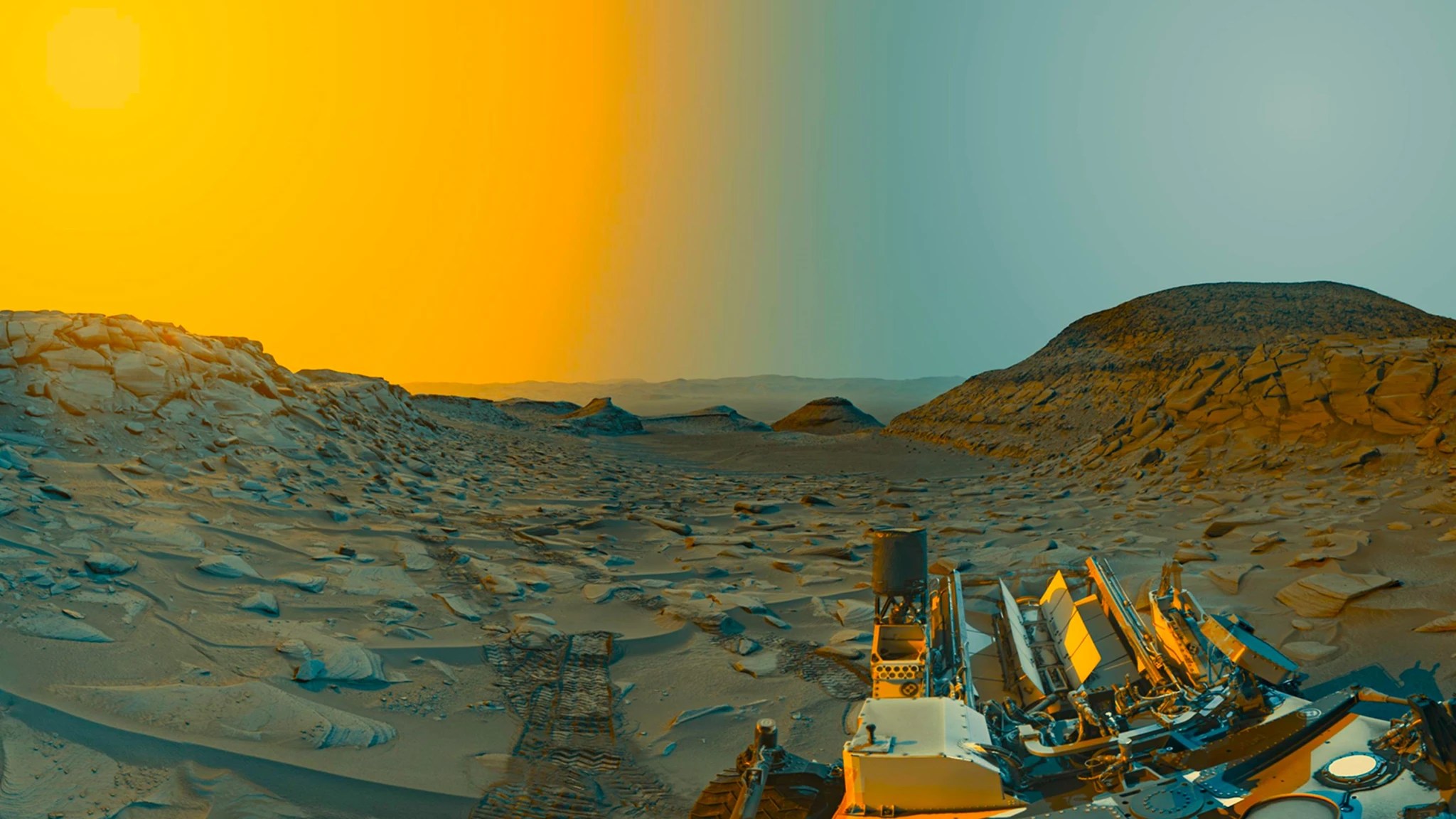
NASA picture from Curiosity rover on a rather barren, poisonous, irradiated, dusty and dry Mars

P/S: Scifi novels are an old genre: The Birds of Aristophanes, making fun of the colonies Athens established everywhere, by establishing one in the sky, preceded the space colonization of Lucian by seven centuries… 

***

[1] The European solution to the Earth Crisis has been Mathusianism: use less energy. This weakens Europe and encourages its dictatorial enemies. Actually the best solution is rather the opposite: to use more ABSOLUTE WORTH ENERGY. Use, much more EFFICIENT energy. In particular, we have to leverage fossil fuels to get out of them… using the energy they provide to invent new science and tech….

ooOOoo

Yet another masterpiece from Mr. Ayme. I cannot add anything to this post except to applaud it.

Sir David Attenborough.

There are not many who achieve so much, but Sir David most definately has!

This is our planet. It is the only one we have (stating the obvious!).

This beautiful photograph taken from the Apollo 11 mission says it all. That Commander Neil Armstrong and lunar module pilot Buzz Aldrin landed the Apollo Lunar Module Eagle on July 20, 1969 changed everything.

But one thing that was not on anyone’s mind then; the state of the planet!

This view of Earth rising over the Moon’s horizon was taken from the Apollo 11 spacecraft. The lunar terrain pictured is in the area of Smyth’s Sea on the nearside. Coordinates of the center of the terrain are 85 degrees east longitude and 3 degrees north latitude.
While astronaut Neil A. Armstrong, commander; and Edwin E. Aldrin Jr., lunar module pilot, descended in the Lunar Module (LM) “Eagle” to explore the Sea of Tranquility region of the moon, astronaut Michael Collins remained with the Command and Service Modules (CSM) “Columbia” in lunar orbit.
Image Credit: NASA

How that has changed since 1969.

David Attenborough is a giant of a man, and I say this out of humility and respect for what he has done in his long life, he was born in May, 1926, and he is still fighting hard to get us humans to wake up to the crisis that is upon us.

Wikipedia has an entry that lists all the television shows, and more, that David Attenborough has made. As is quoted: “Attenborough’s name has become synonymous with the natural history programmes produced by the BBC Natural History Unit.”

Please take 45 minutes and watch this film. It is so important.

But before you do please read this extract taken from this site about the film:

For decades David Attenborough delighted millions of people with tales of life on Earth, exploring wild places and documenting the living world in all its variety and wonder. Now, for the first time he reflects upon both the defining moments of his lifetime as a naturalist and the devastating changes he has seen.

Honest, revealing and urgent, the film serves as a witness statement for the natural world – a first-hand account of humanity’s impact on nature, from Australia’s Great Barrier Reef to the jungles of central Africa, the North Pole and Antarctica. It also aims to provide a message of hope for future generations.

“I’ve had a most extraordinary life. It’s only now I appreciate how extraordinary,” Sir David says in the film’s trailer, in which he also promises to tell audiences how we can “work with nature rather than against it”.

The film retraces Sir David’s career, his life stages and natural history films, within the context of human population growth and the loss of wilderness areas. “I don’t think that the theoretical basis for the reason why biodiversity is important is a widely understood one,” he told the Guardian in September.

This autumn, a series of publications warned that “humanity is at a crossroads” in its relationship with nature, culminating in a UN report that the world has failed to meet a single target to stop the destruction of nature in the past decade.

Sir David has been vocal about the threat of climate change in recent years, calling on politicians to take their “last chance” to act rather than continue to “neglect long-term problems”.

We need to learn how to work with nature, rather than against it”, according to Sir David. In the film, he is going to tell us how.

Now watch the film. Please!

As you can see, in the film Sir David states that the only way out of this mess is a massive focus on rewilding.

Coincidentally, Patrice Ayme last Sunday wrote about rewilding: California Grizzly: Rewilding Is A Moral Duty. In the latter half of that essay, he wrote: “One should strive to reintroduce American megafauna, starting with the more innocuous species (and that includes the grizzly). By the way, I have run and hiked in grizzly country (Alaska), with a huge bear pepper spray cannister at the ready. I nearly used the cannister on a charging moose (with her calf which was as big as a horse). The calf slipped off, and I eluded the mom through a thicket of very closely spaced tough trees. But I had my finger on the trigger, safety off. Moose attack more humans than grizzlies and wolves combined (although a bear attack is more dangerous). In any case, in the US, stinging insects kill around 100, deer around 200 (mostly through car collisions), and lightning around three dozen people, per year.

As it is, I run and hike a lot in California wilderness, out of rescue range. I generally try to stay aware of where and when I could come across bears, lions and rattlers. My last close call with a large rattlesnake, up a mountain slope, was partly due to hubris and not realizing I was moving in dangerous terrain. Fortunately I heard the slithering just in time. Dangerous animals make us aware of nature in its full glory, and the real nature of the human condition. They keep us more honest with what is real, what humanity is all about.

And that should be the primordial sense.

I will close by offering you this photograph. May it inspire you to rewild, in small ways and also, if you can, in bigger ways. All of us must be involved. Otherwise…

Photo by Cosmic Timetraveler on Unsplash

…otherwise… (sentence left unfinished).

Musings from a 77 year old!

Where did it all go? That is: Life! Or more accurately my life.

I was born in Acton, London before the end of WWII. I am in my 77th year. Life these days seems to be more or less a paradox.

There are so many challenges at the moment. Not just in the USA nor in the UK but globally. We love where we live here in rural Merlin but we are already in the third year of below normal rainfall.

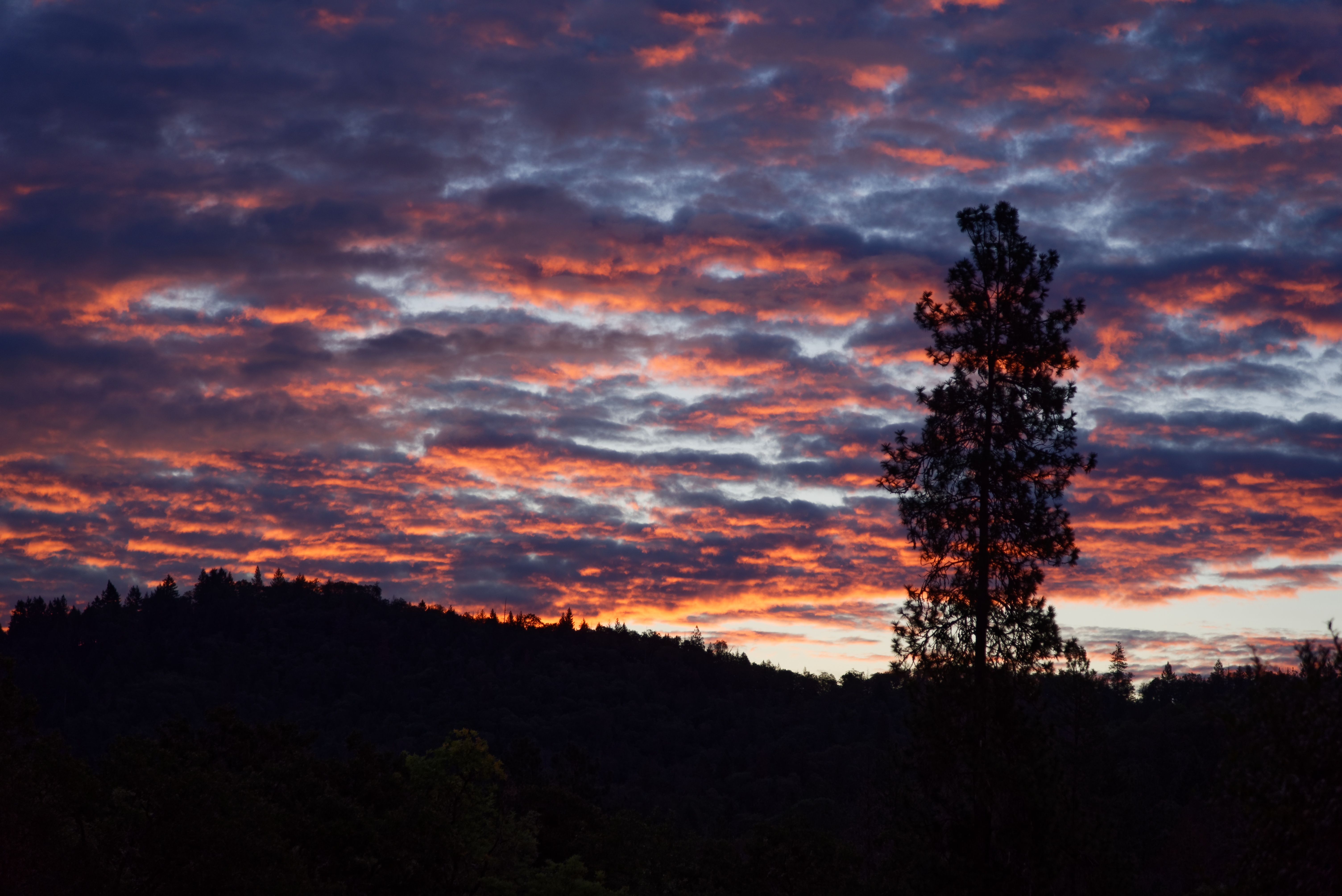
A view of the sunrise from taken from our property.

The contradictions in terms of our life locally and the global scene are huge. This is all leading to me quoting extracts from a recent George Monbiot article. The article starts by saying: “On both sides of the Atlantic, powerful interests seem determined to trigger the collapse of life on Earth. Why?

Sexton Mountain last winter. Again photo taken from our property.

A little later on in Geo. Monbiot’s article, he writes: “When I began work as an environmental journalist in 1985, I knew I would struggle against people with a financial interest in destructive practices. But I never imagined that we would one day confront what appears to be an ideological commitment to destroying life on Earth. The UK government and the US supreme court look as if they are willing the destruction of our life support systems.

Because it does seem as though the political leaders are not taking the future of the planet seriously. As Patrice Ayme concluded recently in a remark to that post: “Biden ought to declare a climate emergency.” But it won’t happen!

(Well I may stand corrected. Yesterday it was widely reported, and I chose Renewable Energy: “The clean energy industry celebrated a moment on August 7 that would have seemed impossible just a few weeks earlier: The Senate passed a budget measure that includes the largest investments in clean energy and climate change in U.S. history.“)

Every morning when I go down to feed our two ex-rescue horses I also feed the wild deer. I have been doing it for many years. Long enough that a young buck has turned into an adult and comes within a few feet of me.

It never ceases to delight.

The contradiction between me going every morning down to the stable area and feeding the horses and the wild deer, and the outcome for the planet is beyond words. In a very real way it is incomprehensible.

Again, Geo. Monbiot writes: “All this might seem incomprehensible. Why would anyone want to trash the living world? Surely even billionaires want a habitable and beautiful planet? Don’t they like snorkelling on coral reefs, salmon fishing in pristine rivers, skiing on snowy mountains? We suffer from a deep incomprehension of why such people act as they do. We fail to distinguish preferences from interests, and interests from power. It is hard for those of us who have no desire for power over others to understand people who do. So we are baffled by the decisions they make, and attribute them to other, improbable causes. Because we do not understand them, we are the more easily manipulated.”

Under our apple tree!

It really is a paradox! And who knows the outcome. All I can say is that, despite me being the age I am, I would not want to be any younger and aware that soon one would be facing the global changes full on.

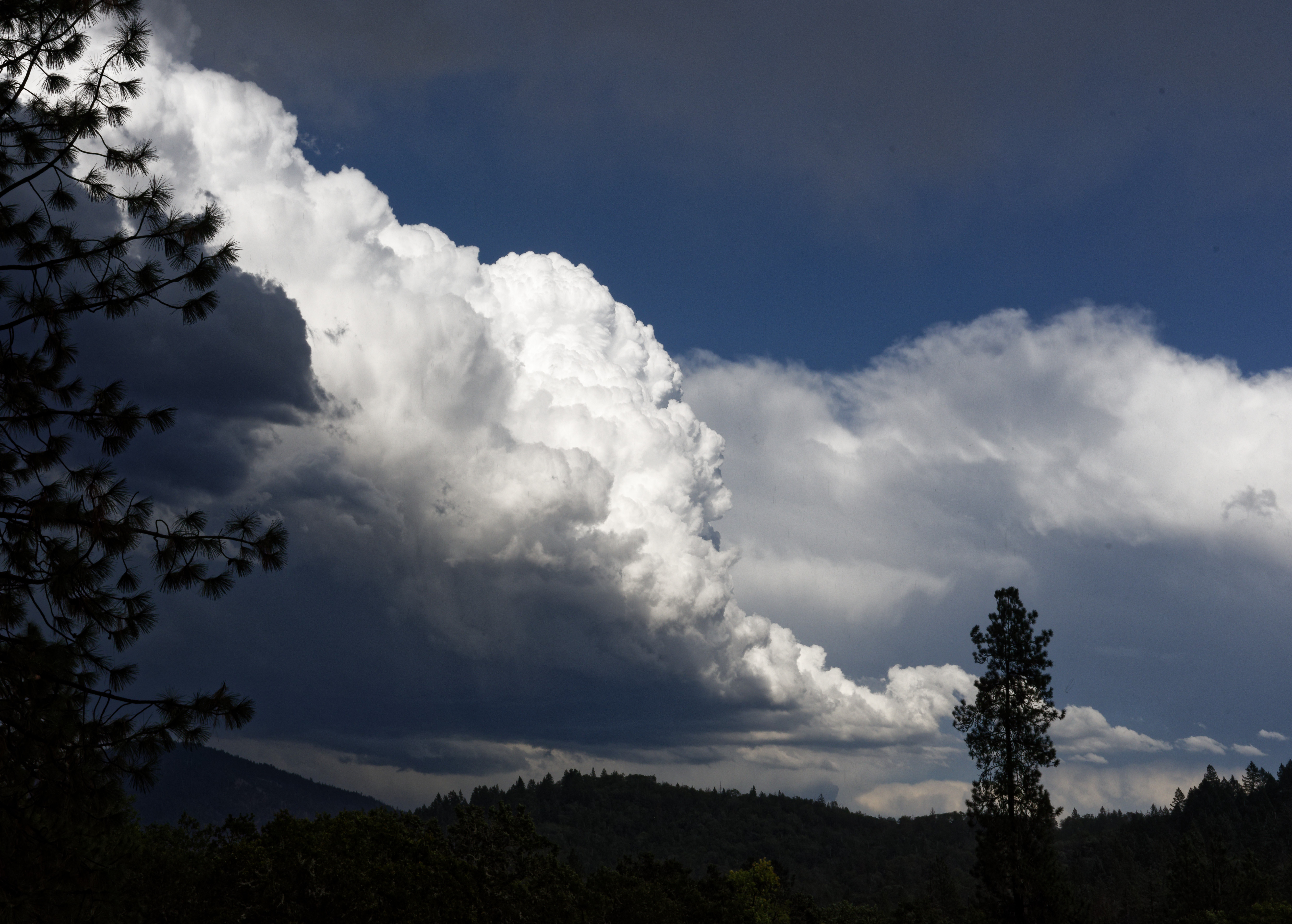
Stacked cumulus clouds to the North-East.

More words from Geo. Monbiot: “Since 1985, I’ve been told we don’t have time to change the system: we should concentrate only on single issues. But we’ve never had time not to change the system. In fact, because of the way in which social attitudes can suddenly tip, system change can happen much faster than incrementalism. Until we change our political systems, making it impossible for the rich to buy the decisions they want, we will lose not only individual cases. We will lose everything.”

I have no idea of the global changes that are afoot and how they will affect us in Merlin. Indeed, I have no idea how long I have to live.

Jean and I met in December, 2007. We met in Mexico but Jean was also born in London, just a few years after me. How’s that for chance!

Jean’s American husband had died in 2005. She was rescuing dogs off the streets, sorting them out, and finding homes for them, mainly in Arizona.

Jean and me in San Carlos, Mexico.

I went out to Mexico with Pharaoh in 2008. With a one-way ticket!

Pharaoh digging in the sand in Mexico.

However of one thing I am sure. Since that meeting in December, 2007 life has been as good as it comes. I have never been happier.

What a contradiction!

The end of our present behaviours!

What is happening to Earth’s climate needs attention NOW!

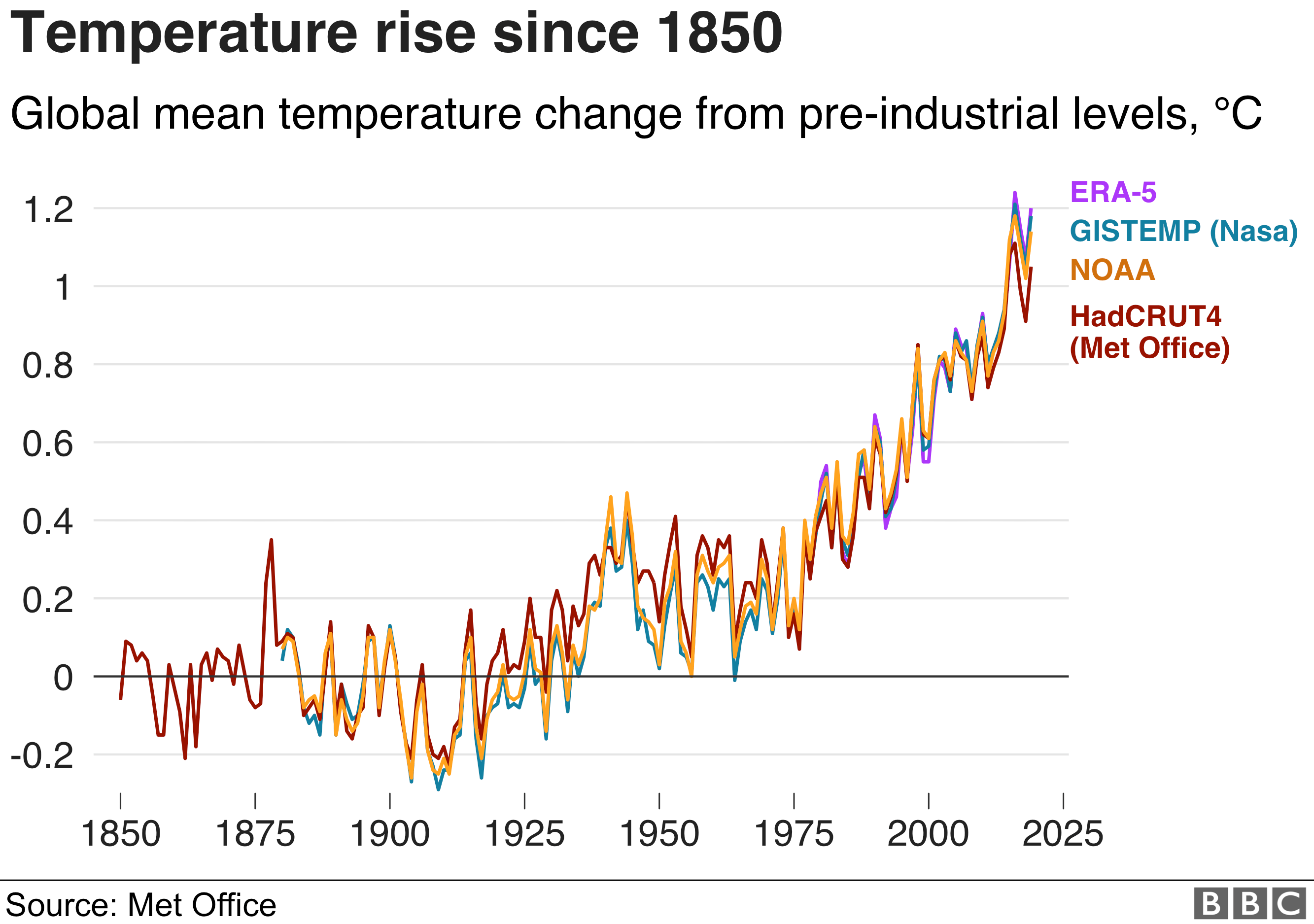
Two charts recently from the BBC News.

The 10 years to the end of 2019 have been confirmed as the warmest decade on record by three global agencies. 

According to Nasa, Noaa and the UK Met Office, last year was the second warmest in a record dating back to 1850. The past five years were the hottest in the 170-year series, with the average of each one more than 1C warmer than pre-industrial.

The Met Office says that 2020 is likely to continue this warming trend.2016 remains the warmest year on record, when temperatures were boosted by the El Niño weather phenomenon.

This is the reality.

It affects every part of the world and it affects everyone. BUT! We, as in you and me, and everyone else, still haven’t got it.

The recent COP26 was progress and, especially, the next convention being held in a year’s time is important. But it is a long way from where we need to be. A very long way.

Patrice Ayme is someone that I follow and there have been times when I have gladly republished his posts. With his permission I should add.

Recently he published a post called Cataclysmic Seven Degree Centigrade Rise and I wanted to share it with you. Here is is:

ooOOoo

CATACLYSMIC SEVEN DEGREES CENTIGRADE RISE

Abstract: Expected rise of temperature in mountains correspond to a seven degree C rise. This informs global heating: in the long run, it will also be 7C. Large systems (Antarctica, Greenland) have greater thermal inertia, so their temperatures rise slower… But they will rise as much. In other words the so-called “forcing” by man-made greenhouse gases (which corresponds to 600 ppm of CO2) is universal, but the smaller the system, the faster the temperature rise

****

Geographical systems with little thermal inertia (mountain glaciers) show an accelerated rate of heating of these parts which is only compatible with a seven (7) degrees rise in Celsius by 2100… A rise the IPCC of the UN considers impossible… But INERTIA says that it IS happening. The first thing this implies is that most forests will burn… worldwide. Then the ice shelves in Antarctica will follow.

TEMPS RISING ULTRA FAST IN MOUNTAINS

Anybody familiar with mountains worldwide know that temperatures are rising extremely fast: large glaciers I used to know have completely disappeared.. As in Chacaltaya, Bolivia. Or Portage, Alaska. The closest glacier to an Alpine village I went to as a child has been replaced by a larch forest (melezes)… One reason for this is that mountains are smaller in frozen mass than immense ensembles like Greenland and Antarctica. Moreover, the mountains’ permafrost is not as cold.  

From 1984 to 2017, the upper reaches of the fires in the Sierra Nevada of California rose more than 1,400 feet. Now the temperature in the lower atmosphere decreases by 7C every 1,000 meters. There are many potential factors to explain why fires go higher (although some contradict each other). To avoid paralysis by analysis, I will assume the rise in fires is all due to temperature rise. So what we have here is a 2.5C rise in 33 years.

….FROM SMALLER THERMAL INERTIA:

Mountain thermal capacity is accordingly reduced relative to those of Greenland and Antarctica. The proportionality factors are gigantic. Say the permafrost of a mountain range is of the order of 10^4 square kilometers, at a depth of one kilometer (typical of the Sierra Nevada of California or the Alps at a temp of -3C. By comparison, Antarctica is 14x 10^6 sq km at a depth of 4 kilometers of permafrost at a temp of -30C. Thinking in greater depth reveals the proportions to be even greater: individual mountains are of the order of square kilometers. This means that (using massively simplified lower bounds), Antarctica has a mass of cold which is at least 4 orders of magnitude higher than a mountain range: to bring Antarctica to seriously melt, as mountain ranges are right now, would require at least 10,000, ten thousand times, as much heat (or maybe even a million, or more, when considering individual mountains).  

As it is, mountains are exposed to a heat bath which makes their permafrost unsustainable. From their small thermal inertia, mountains warm up quickly. Greenland and Antarctica, overall, are exposed to the same bath, the same “forcing”, but because they are gigantic and gigantically cold, they resist more: they warm up, but much slower (moreover as warmer air carries more snow, it snows more while Antarctica warms up).

I have looked, in details at glaciologists records, from the US to Europe… Everywhere glaciologists say the same thing: expect a rise of the permafrost line of 1,000 meters… That corresponds to a SEVEN DEGREE CENTIGRADE RISE. Basically, while glaciers were found down to 2,500 meters in the Alps (some can still be seen in caves)… Expect that, in a few decades, none will occur below 3,500 meters… Thus speak the specialists, the glaciologists…

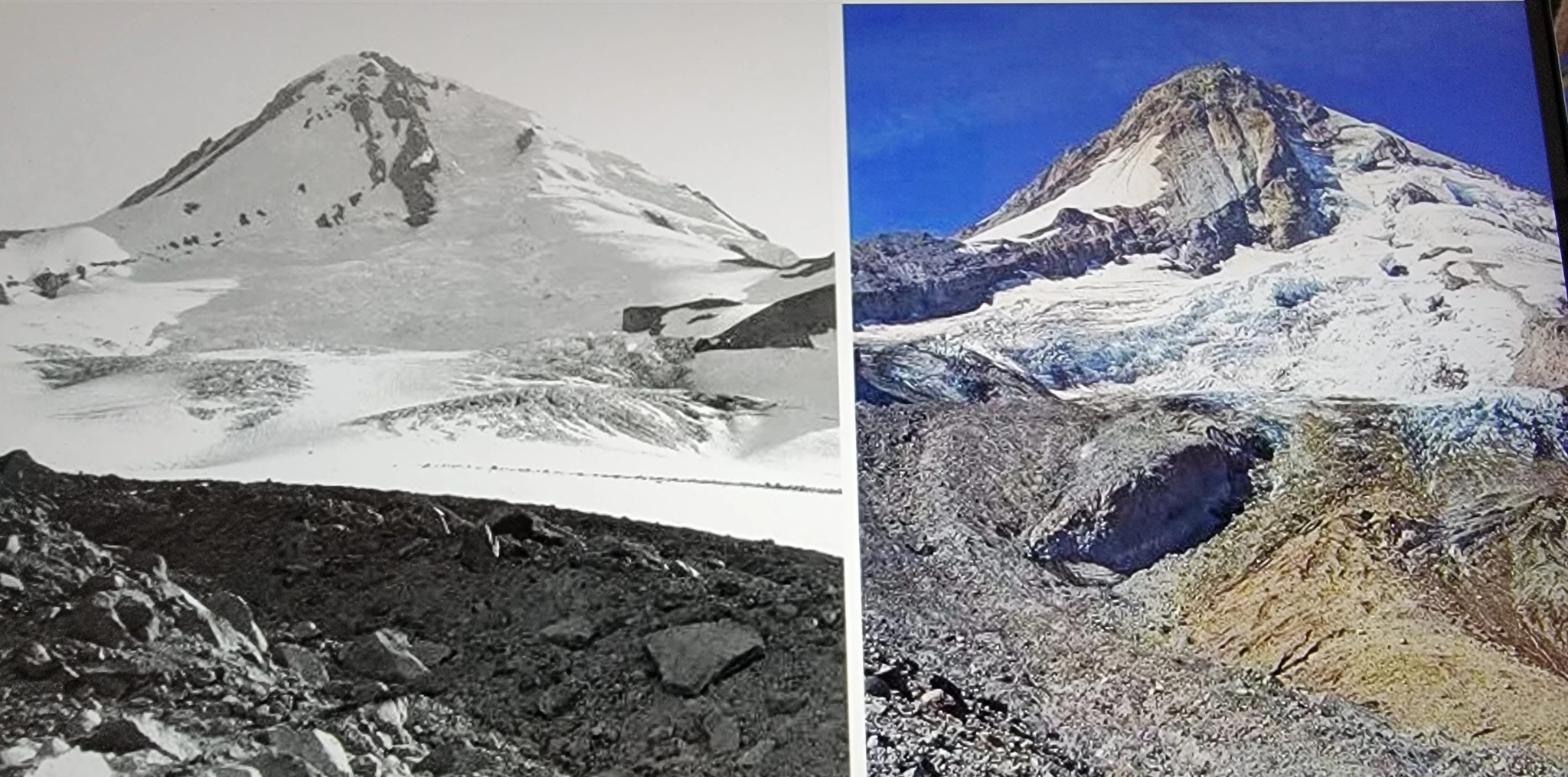
Mount Hood, Oregon, in August 1901 on the left, and August 2015, on the right. The Eliot glacier, front and center, which used to sprawl for miles, is in the process of disappearing completely.

What is happening then, when most climate scientists speak of holding the 1.5 C line (obviously completely impossible, even if humanity stopped emitting CO2 immediately)???… Or when they admit that we are on a 2.7C future in 2100? Well, those scientists have been captured by the establishment… They say what ensure their prosperous careers… At a global rise of 2.7 C, we get a migration of the permafrost line of around 500 kilometers towards the poles… Catastrophic, yes, but still, Antarctica will not obviously start to melt, big time. 

At 7C, the melting of the surrounding of Antarctica, including destabilization of West Antarctica, and the Aurora and Wilkes Basin can’t be avoided… They hold around 25 meters of sea level rise….

If it came to light that a seven degree centigrade rise is a real possibility, authorities would turn around and really do some things, which may destabilize the worldwide plutocratic establishment: carbon tariffs are an obvious example. Carbon tariffs could be imposed next week… and they would have a big impact of the CO2 production. So why are carbon tariffs not imposed? Carbon tariffs would destabilize the deindustrialization gravy train: by employing who are basically slaves in poor countries, plutocrats make themselves ever wealthier, while making sure there would be no insurrection at home… A trick already used in imperial Rome, by the Senatorial aristocracy/plutocracy. That would be highly effective… By the way, without saying so, of course, and maybe even unwittingly, this is basically what Trump had started to do…

The devil has these ways which the commons do not possess…

That would stop the crafty, dissembling nonsense that countries such as France are at 4.6 tons per capita of CO2 emissions per year… That’s only true when all the CO2 emitted to produce the goods the French need is NOT counted.. including deforestation in Brazil to grow soybean. With them counted, one gets to 11 tons or so, more than double… The wonderful graph of CO2 emissions collapsing in Europe is the same graph as collapsing industrial production…

The devil has these ways the commons have not even detected…

Carbon tariffs would be a way to solve two wrongs in one shot: the wrong of deindustrialization, of corrupt pseudo-leaders not putting the most advanced countries, their own countries, first… And the wrong of producing too much CO2.

Little fixes will go a long way, as long as they incorporate hefty financing fundamentally researching new energy (it does not really matter which type, as long as it is fundamental…)

Patrice Ayme

ooOOoo

Now this isn’t some academic treatise that doesn’t affect the likes of you and me. This is, as I have said, the harsh reality of NOW!

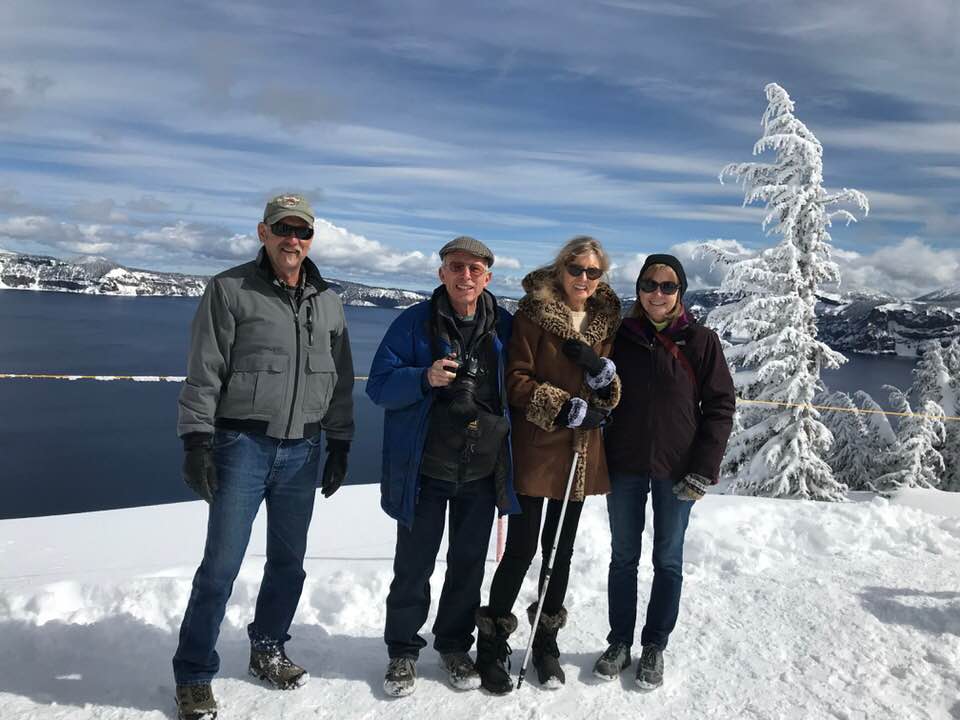
Here’s a photo of me and Jeannie together with Andy and Trish taken in March, 2018. On the edge of Crater Lake.

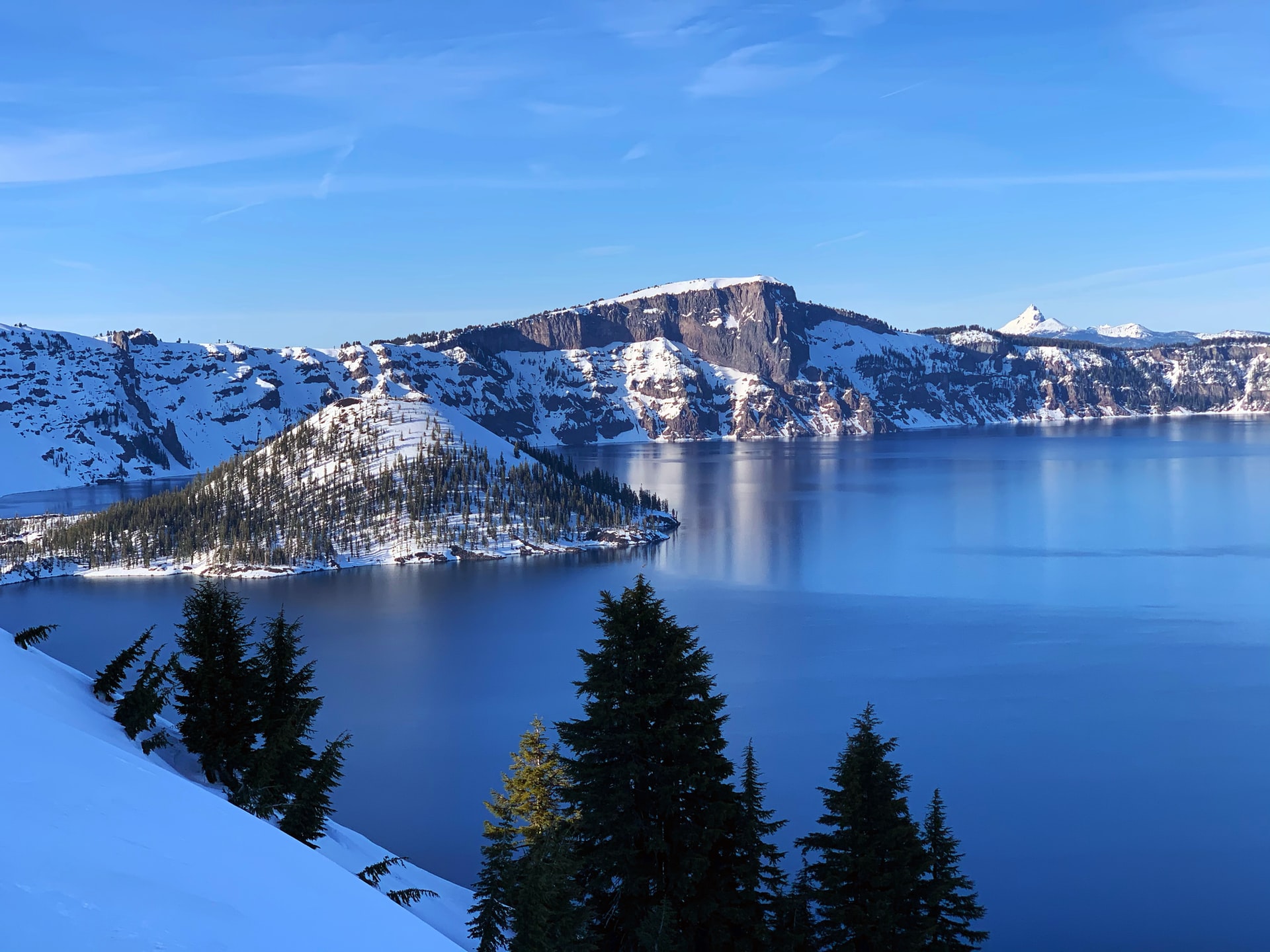
Then this is a stock photograph of Crater Lake taken in March, 2020.

Taken by Valerie Little

Not a great deal of difference but the trees in the photo above aren’t encased in snow as is the tree in the 2018 photo.

Now there is important news to bring you from COP 26. On Sunday Boris Johnson said:

Scientists say this would limit the worst impacts of climate change.

During a Downing Street news conference, Mr Johnson said: 

  • “We can lobby, we can cajole, we can encourage, but we cannot force sovereign nations to do what they do not wish to do”
  • “For all our disagreements, the world is undeniably heading in the right direction”
  • The “tipping point has been reached in people’s attitudes” – with leaders “galvanised and propelled by their electorates”
  • But “the fatal mistake now would be to think that we in any way cracked this thing”

Mr Johnson said that despite the achievements of the summit, his reaction was “tinged with disappointment”.

He said there had been a high level of ambition – especially from countries where climate change was already “a matter of life and death”. 

And “while many of us were willing to go there, that wasn’t true of everybody”, he admitted. But he added the UK could not compel nations to act. “It’s ultimately their decision to make and they must stand by it.”

That point about attitudes is interesting. Who would have thought, say, five years ago, that attitudes had changed so dramatically by late-2021.

One hopes that we will come to our collective senses but I can’t see the CO2 index being returned to its normal range without machines taking the excessive CO2 out of the atmosphere. Because, as was quoted on The Conversation nearly a year ago:

On Wednesday this week, the concentration of carbon dioxide in the atmosphere was measured at at 415 parts per million (ppm). The level is the highest in human history, and is growing each year.

Finally, my daughter, Maija, and my son-in-law, Marius, had a child some ten years ago. He is my grandson and I left England before he was born. He is Morten and he is a bright young spark.

Morten

Morten and all the hundreds of thousands of young persons like him are going to have to deal with the world as they find it!

We are all connected!

Thank you Patrice Ayme for sharing this.

I can’t remember when I first came to know Patrice Ayme; it was quite a few years ago. I followed him for years and then had to take a break simply because there weren’t enough hours in the day! Not because I disliked what he was writing – no siree!

He is a most prolific author. Pop into Patrice Ayme’s Thoughts and have a browse around.

Anyway, Patrice recently forwarded me an article that rightly deserved much attention. Here it is:

ooOOoo

Saving The Animals, Thus Ourselves

Animals die in great numbers trying to cross human transportation systems.

When one provides the animals with crossings, they rush to use them (so are used even before they are finished, by a Noah’s ark of species).

Respecting nature is not just about the beauty and naturalness it provides us with, it is about respecting how we became who we are, at our best. We have to learn to share the planet with animals. Not just because we are smart, but also because they are smart and our smarts evolved from interacting with their smarts. So interacting with wild animals is smart all around… and it has made our species smarter! Wildlife interaction is how we evolved our smarts.

Not book smarts, but the deepest smarts.

Hence by respecting animals, we respect how we became human… and it keeps on being human to do so. Economy means managing the house, in particular, managing earth, which is our common house. As the greenhouse heating proceeds at an accelerating pace, we then have to reserve an increasing part of our economic activity to save the animals by helping them to cope with the changes we have brought.

Morality comes from the mores, the old ways, the ways which perdured, and thus, insure survival. Having a natural environment, full of animals, is the ultimate morality. If we can’t save them, how can we learn to save ourselves?

So it is not just smart and economic to save the animals, but also moral. The money engaged so far is quite small. But the price of an unbalanced environment tottering towards ruin, is incomparably higher. For a nice article with nice videos of animals using their smarts crossing freeways and roads, consider:

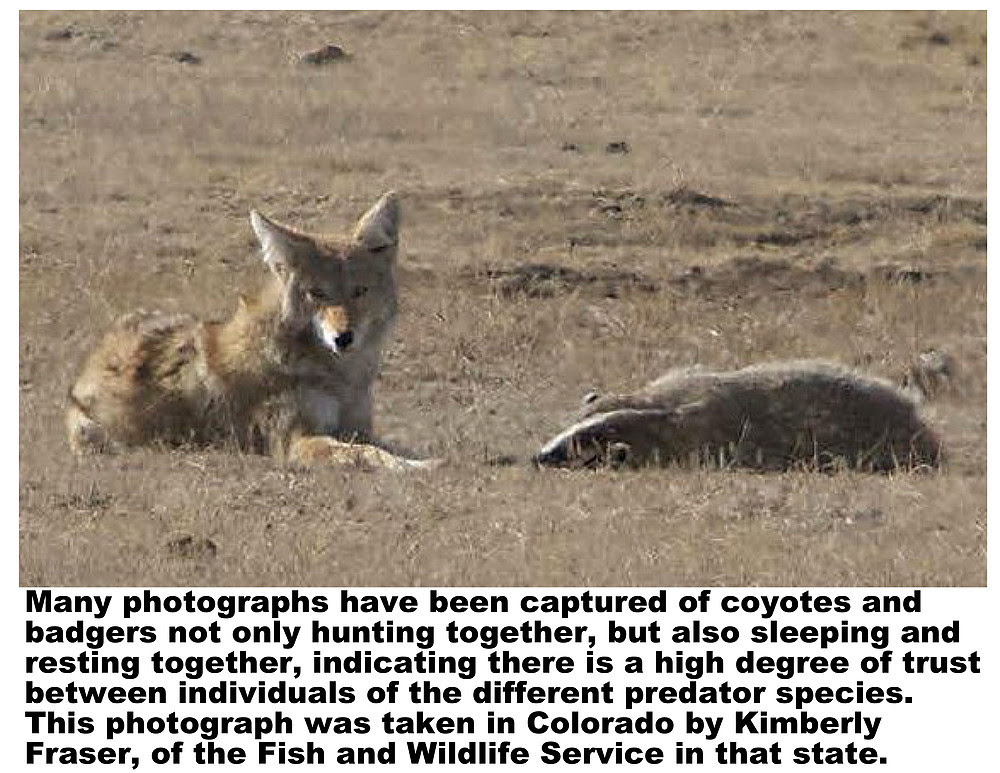
As a badger digs, say for ground squirrels whose burrows have many exits, could not it be that the coyote would seize a fleeing squirrel, and share the meal? This is basic economics and strategy, and it turns out that coyotes and badgers have figured out that behavior, and cooperate together.

The next question would be this: do the individuals concerned figure it out by themselves, as cephalopods do, or is the behavior culturally instigated, namely both badgers and coyotes learn elements of interspecific cooperation from teaching by their elders? I believe the latter.

After all, I trained the (wild) nesting birds on my balcony to benignantly ignore my weird and intrusive ways … which thus had to learn to be a bit more respectful than they usually are. But of course these ways tend to incite the red tail hawks to not land on this particular balcony on a determined culinary mission (as they have been seen doing…) And the birds know this [1].

Saving the animals is first of all about saving us… Not just our sense of beauty.

Patrice Ayme

[1] Hummingbirds set their nests below hawks’ nests, as this protects them from gays. Local hawks do attack nests of birds who are big enough (like gays, crows, etc). And I have seen them pass 10 feet from me, eyeing me suspiciously… Their feathers can be two feet long…

See this: https://www.audubon.org/news/why-hawk-hummingbirds-best-friend

ooOOoo

We are all connected as I said in the title to today’s post.

The only way we are going to survive as a species on this planet is for all of us to recognise this fundamental law of nature. Or should I say this fundamental law of Nature!

It is a little over fifty years since the inaugural celebration of the first Earth Day; on the 22nd April, 1970. In other words we are just over halfway through if one imagines the celebration of the one hundredth Earth Day: 22nd April, 2070. In 1970 the planet was home to 3.7 billion people. Today there are nearly 8 billion people. But more than that these 8 billion people are living to an average of 72 years, up from 59 years in 50 years.

Our failure to address climate change is harming the planet and all the species, including us humans, who live on Planet Earth. I shall be dead by 2070 and also a great many of my fellow humans. But for all those born in the year 2000 and later it is increasingly going to become the number one priority: Saving the planet from a total catastrophe!

We don’t have long!