Tag: Oregon

Maybe home is found in our quietness.

Our truths, our home, our serenity; all flow from stillness.

Soon silence will have passed into legend. Man has turned his back on silence. Day after day he invents machines and devices that increase noise and distract humanity from the essence of life, contemplation, meditation.

Jean Arp (16 September 1886 – 7 June 1966)

As is often the way, a number of disparate items came together for today’s post in a way of lovely connectivity.

A few weeks ago when meeting our local doctor for the first time since we moved to Oregon, I had grumbled about bouts of terrible short-term memory recall and more or less had shrugged my shoulders in resignation that there was nothing one could do: it was just part of getting older, I guessed!

“On the contrary”, responded Dr. Hurd, continuing, “There’s growing evidence that our information-crowded lives: cell phones; email; constant TV; constant news, is pumping too much for our brains to manage.”

Dr. Hurd continued, “Think about it!  Our brains have to process every single sensory stimulus.  The research is suggesting that our brains are being over-loaded and then the brain just dumps the excess data.  If that is the case, and the evidence is pointing in that direction, then try thirty minutes of meditation each day; give your brain a chance to rest.”

So that was the first revelation.

The second was a recent science programme on the BBC under the Horizon series.  The programme was called, The Truth About Personality.

Michael Mosley's brain being measured.
Michael Mosley’s brain being measured.

Michael Mosley explores the latest science about how our personalities are created – and whether they can be changed.

Despite appearances, Mosley is a pessimist who constantly frets about the future. He wants to worry less and become more of an optimist.

He tries out two techniques to change this aspect of his personality – with surprising results.

And he travels to the frontiers of genetics and neuroscience to find out about the forces that shape all our personalities.

Related Links

Within the programme came the astounding fact that even ten minutes a day meditation can help the brain achieve a more balanced personality (balance in terms of not being overly negative in one’s thoughts).

The third revelation came from Jean and me watching a TED Talk last night.  Just 14 minutes long, please watch it – you will be transformed!

Published on Jul 17, 2013

More and more people worldwide are living in countries not considered their own. Writer Pico Iyer — who himself has three or four “origins” — meditates on the meaning of home, the joy of traveling and the serenity of standing still.

Then, just three days ago, John Hurlburt, a long-time supporter and regular contributor to Learning from Dogs, emailed me his reflection on meditation.  John quickly gave permission for it to be published here.

oooOOOooo

evening
The stillness of evening.

Evening Meditation

Our world is increasingly spiritually, morally, mentally, physically and economically bankrupt. Many people would like to change the world one way or another. Most don’t really know why. Some folks simply don’t care. The idea is to leave life a bit better than we found it when we were born.

The fact is we’re all intrinsically sacred in a universe we didn’t create. We tend to prioritize illusion and delusion above reality. Playing God is a precursor of evil.  A supreme faith in Money is self contradictory and ultimately fatal. Arrogance compounds the problem.

We connect in unified awareness through serene meditation. We experience harmony within an emerging celestial symphony. Answers flow from the inside out as we surrender to the eternal energy flow.

Be still and know…

an old lamplighter

oooOOOooo

Finally, after having a real struggle to find the place, both psychologically and physically, where I could start my own relationship with meditation, on Wednesday afternoon, when walking the quarter-mile up to our mail-box, it struck me as obvious.

Embraced by nature.
Embraced by nature.

This quiet place on our creek where the water trickles down from an old flood irrigation dam.  Somewhere to sit under the shade of a tree, somewhere to be still, somewhere as perfect a home as anyone could ever find.

Meditation is the dissolution of thoughts in Eternal awareness or Pure consciousness without objectification, knowing without thinking, merging finitude in infinity.

Voltaire.

Entropia, a review.

A review of the new book by Dr. Samuel Alexander.

Back last November, not long after Jean and I had moved up to Oregon, I saw this on the PRI website: The Sufficiency Economy – Envisioning a Prosperous Way Down. Very quickly I realised the importance of the essay and contacted the author requesting permission to republish on Learning from Dogs.  That author was Dr. Samuel Alexander and permission was quickly given, leading to two essays: The simpler life and Where less is so much more.

Now fast forward to nearly a month ago and in came this email:

Samuel Alexander here, from the Simplicity Institute. I’ve recently published a new book, Entropia: Life Beyond Industrial Civilisation. Was wondering whether you were interested in posting either a review or an excerpt on your website?

I was flattered to have been asked and delighted to review the book.

First, some background. samuelalexanderDr. Alexander is a part-time lecturer with the Office for Environmental Programs, University of Melbourne, Australia. He teaches a course called ‘Consumerism and the Growth Paradigm: Interdisciplinary Perspectives’ in the Masters of Environment.

He is also co-director of the Simplicity Institute and co-founder of Transition Coburg. He writes regularly at the Simplicity Collective and posts most of his academic essays at www.TheSufficiencyEconomy.com.

oooOOOooo

Introduction

After the review was completed, I forwarded it to Sam just to check that I hadn’t made any technical errors.  Within Sam’s reply to that email was his acknowledgement that his book fell into a genre that was not easily classified.  Ergo, the book being fiction yet not a novel.  Sam went on to muse that perhaps he should have been clearer about what the reader was going to get.  He wondered if my review should mention that aspect.  I said that I wouldn’t amend my review but would include an introduction to that effect, as now witnessed!

So to the review.  (Note: For some reason, I was unable to prevent the paragraph spacing from being deleted in the published version.  Hence the insertion of a single ‘-‘ after each paragraph.)

oooOOOooo
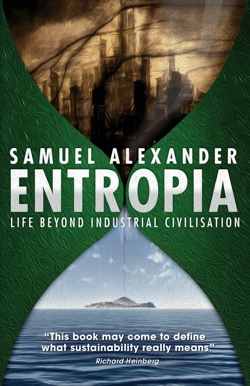
Entropia-Cover

Entropia – Life Beyond Industrial Civilisation by Samuel Alexander

A review by Paul Handover

The title of the book didn’t offer this reader any clue about what might be coming. Nevertheless, very soon an experience of an ‘ah-ha’ moment arrived. Right on page one of the Acknowledgements when this sentence jumped off the page: “Henry Thoreau has been by far the greatest influence on my worldview, for it was he who awakened me to the insight that ‘superfluous wealth can buy superfluities only’.” [my emphasis] Wow, what an intriguing turn of phrase about wealth.

I plunged into the Prologue:

After the poets were banished from Plato’s Republic it is said that they set sail into unknown horizons in search of a new place to call home.

Shortly later reading:

But life proceeds in twists and turns, not straight lines. After losing consciousness in the midst of this perfect storm, the lost poets found themselves washed ashore on a small,fertile island, which was uninhabited and isolated entirely from the rest of civilisation. The boundless opportunities presented by this merciful twist of fate were immediately clear to all.

Some people believe this simple living community flourishes peacefully to this day, lost to the world in its own harmonious, aesthetic existence. But like Atlantis, the Isle of Furor Poeticus, as it has come to be known, has never been found.

* * *

The Isle of Furor Poeticus is a utopian romance of course – a myth. But we should remember that human existence has always been shaped and guided by myths and stories, so let us not dismiss the story of the lost poets too quickly or proudly. After all, we may not be so free from superstitions of our own. Modernity’s ‘myth of progress’ might itself just be a story we have been telling ourselves in recent centuries, one in fact that could soon be dismissed as a story no longer worth telling. Indeed, perhaps that book is closing before our very eyes – has already closed – leaving us to reflect on its themes from beyond as we step forth into unknown pages. And yet, it seems we have not found a new story by which to live. We are the generation in-between stories, desperately clinging to yesterday’s story but uncertain of tomorrow’s. Adrift in the cosmos, without a narrative in which to lay down new roots, humanity marches on – lost and directionless. But then again, perhaps the new words we need are already with us. Perhaps we just need to live them into existence.

Beautiful, magical writing right up to the closing sentences of the Prologue:

By choosing to do so we could again become the poets of our own lives and of a new generation, instead of merely reading out a pre-written script to an audience that is no longer listening. So open your mind, gentle reader, for the future is but clay in the hands of our imaginations.

We are being called to make things new. [again, my emphasis]

The novel, for it is a work of fiction, opens in substance with the account of Mortimer Flynn, a wealthy Texas oil magnate and son and only child of a Welsh coal industrialist, who having achieved “everything of which he had ever dreamed” comes to the realisation that he has no idea at all as to the purpose of his life. From this life-changing reassessment of his journey, his profound crisis of conscious, comes the purpose of the book. A story of a group of people who settle down in a remote South Pacific island, the island of Entropia. A “story about a community that became isolated on its small island in the wake of industrial civilisation’s collapse, during the third decade of the twenty-first century.”

Now, it’s fair to say that at this point I was truly hooked on the book. This was going to be the read of my life. Because it reflected my own belief that humanity was at the point, perhaps beyond the point, where the growing threats to our natural world threatened our moral obligations to the generations that follow.

However, somewhere during the second chapter, the style of writing started to intrude into my absorption of the story. At first the intrusion was more like a fly buzzing around; a minor irritation. Then it got to the stage where I had to stop reading and ponder on why I felt so uncomfortable with this reading experience. I was by now well into the third chapter.

Still couldn’t put my finger on what the problem was. Returned to the book but noticed that I was skim reading and had forcibly to focus on fully reading each page. After all, I was reading the book for review purposes!

Then it struck me. There were no characters coming to life off the page. Consequently, there was no dialogue. It didn’t read like a novel, much more like a report. That was the key to me re-establishing my relationship with the story; the book. Because despite the unusual style for a work of fiction, the value inherent in the pages was beyond measure. Here was a book that described in great detail the way a community discovered the reality of a sustainable way of life. How this group of a couple of thousand souls reinvented a society, a sustainable society, out of the ashes of a failed industrial civilisation.

I read on.

Later on the book described how the community looked at the way they governed themselves, how they set up representative systems and then, on page 119, came something that really punched me in the face, figuratively speaking. It was introduced, thus:

Eventually a short constitutional document was drafted by the Advisory Council and put to a referendum by the People’s Council, and this document received 94 per cent support. It is reproduced in its entirety below, as it serves as the best summary of our social, economic and political vision.

And proceeded:

Charter of the Deep Future

ENOUGH, FOR EVERYONE, FOREVER

.

We affirm that providing ‘enough, for everyone, forever’ is

the defining objective of our economy, which we seek to

achieve by working together in free association.

.

We affirm that everyone is free to create as an aesthetic

project the meaning of their own lives, while acknowledging

that this freedom legitimately extends only so far as others

can have the same freedom. Freedom thus implies restraint.

.

We affirm that our inclusive democracy does not

discriminate on such grounds as race, ethnicity, gender,

age, sexuality, politics, or faith.

.

We affirm that generations into the deep future are entitled

to the same freedoms as present generations.

.

We affirm that respecting the deep future requires maintaining

a healthy environment.

.

We affirm that technology can help to protect our

environment only if it is governed by an ethics of sufficiency,

not an ethics of growth. Efficiency without sufficiency is lost.

.

We affirm that maintaining a healthy environment requires

creating a stationary state economy that operates within

environmental and energy limits.

.

We affirm that a stationary state means stabilising

consumption and population, transitioning to renewable

sources of energy, and adapting to reduced energy supply.

.

We affirm that strict limits on material accumulation are

required if a stationary state is to maintain a just distribution

of resources and avoid corrosive inequalities.

.

We affirm that property rights are justifiable only to the

extent they serve the common good, including the overriding

interests of humanitarian and ecological justice.

.

We affirm that a stationary state economy depends on a

culture that embraces lifestyles of material sufficiency and

rejects lifestyles of material affluence.

.

We affirm that material sufficiency in a free society provides

the conditions for an infinite variety of meaningful, happy,

and fulfilling lives.

___________________________

Well that had such an impact on this reader. For this reason. The contrast between the reality of our present 21st Century life and the lives of those souls on Entropia was like night versus day. Enough, For everyone, Forever. If ever we needed a new cry from the heart, a new cry of hope and purpose, it was now and those are the words of that cry.

Entropia is a book you should read. It is a book that offers much hope, much guidance and much direction. As Samuel Alexander wrote on page 148, “Tranquillity and angst are both contagious, so it matters which of them we feed.

Time to feed that tranquillity.

oooOOOooo

What legacy do we wish to leave others?

What on earth are we all doing!

I started writing this early morning last Friday, 10th May.  It was prompted by a post then just in from Christine’s blog 350 or bust. I didn’t have the heart to republish it for a few days.

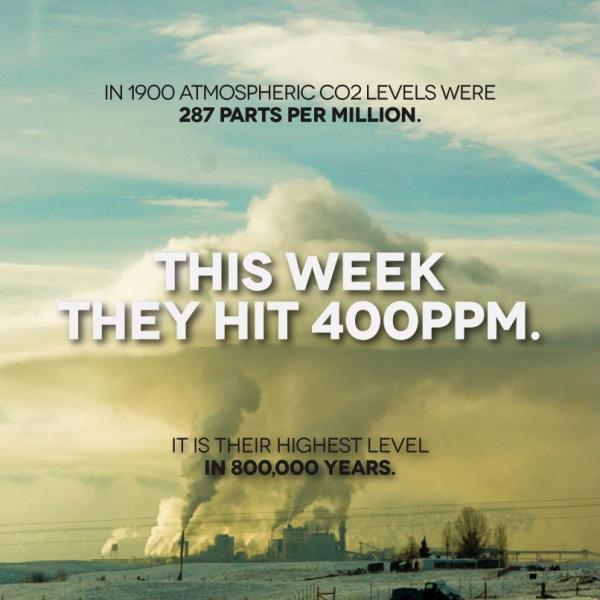
Then as the news of the atmospheric CO2 concentration passing 400 parts per million (ppm) moved more and more into mainstream news, I found myself morphing from sadness and puzzlement into anger and then into some form of determination to ‘do something‘, however insignificant that might be.

Because if humanity does not turn back from our carbon-based lifestyle pretty damn soon then those who are, say, 20 years or more younger than me (I’m 68), are in for some very tough, very rough times indeed.

So over the next two or three days, I shall focus on this topic simply from the motivation of wanting to join the numerous others around the world who are also recognising this moment in the history of man.

Ergo, for today that post from Christine. But I make no apologies for staying with the theme for much of this week.

oooOOOooo

Rolling The Dice: CO2 Concentration Hits Record High Amid Global Inaction On Climate Change

2013/05/10

Via The Guardian:

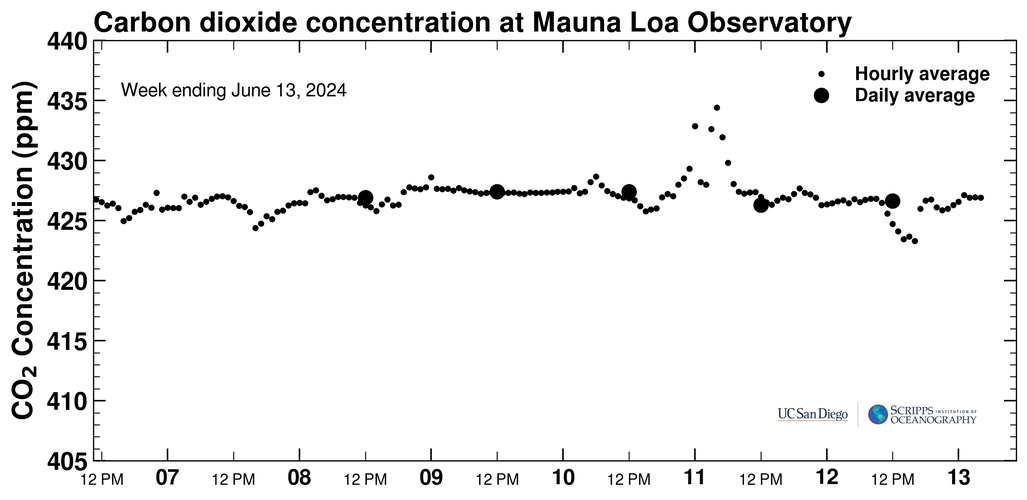
The concentration of carbon dioxide in the atmosphere has reached 399.72 parts per million (ppm) and is likely to pass the symbolically important 400ppm level for the first time in the next few days.

Readings at the US government’s Earth Systems Research laboratory in Hawaii, are not expected to reach their 2013 peak until mid May, but were recorded at a daily average of 399.72ppm on 25 April. The weekly average stood at 398.5 on Monday.

Hourly readings above 400ppm have been recorded six times in the last week, and on occasion, at observatories in the high Arctic. But the Mauna Loa station, sited at 3,400m and far away from major pollution sources in the Pacific Ocean, has been monitoring levels for more than 50 years and is considered the gold standard.

“I wish it weren’t true but it looks like the world is going to blow through the 400ppm level without losing a beat. At this pace we’ll hit 450ppm within a few decades,” said Ralph Keeling, a geologist with the Scripps Institution of Oceanography which operates the Hawaiian observatory.

*

four-hundred-ppm-milestone-reached

*

scripps
Source: Scripps Institute of Oceanography

*

For more on the awful implications of this milestone in human history, check out the links below (hint: it isn’t good news for humans or animals or the ocean).

More links:

As CO2 Concentrations Reach Ominous Benchmark, Daily Updates Begin

The Keeling Curve: A Daily Update of Atmospheric Carbon Dioxide From Scripps Institute of Oceanography At UC San Diego

Greenhouse Gas Levels Near Milestone: Highest in Millions of Years

oooOOOooo

Spring is sprung!

Spring is sprung, the grass is ris.
I wonders where the birdies is.
They say the bird is on the wing.
But that’s absurd?
I always thought the wing was on the bird.

Ah, that feels better!

I was drawn to this wonderful piece of doggerel because it is exactly the sort of humour that dear friend Richard and I have been silly with for 40 years.

The relevance of that is that Richard and his lovely lady Jules have arrived in North America and are coming to stay with us in Oregon for a few days, arriving Saturday. Naturally, we are scurrying around getting the house tidy!  So what with that and wanting to enjoy their company for the next week I shall be posting either light-hearted items or repostings from elsewhere.

Richard is no stranger to Learning from Dogs because like others who take pity on me publishing a daily post, he has sent me material for LfD.  For example, there was Understanding Europe last September, the Euro according to Blackadder and English, as she is spoken, both April this year.

Also last September, Richard sent me the following.  It was published last year but it deserves another airing!

oooOOOooo

An elderly man is stopped by the police around 2 a.m. and is asked where he is going at this time of night.

He replies, “I’m on my way to a lecture about alcohol abuse and the effects it has on the human body, as well as smoking and staying out late.

The police officer asks, “Oh really! Who’s giving that lecture at this time of night?

My wife.

oooOOOooo

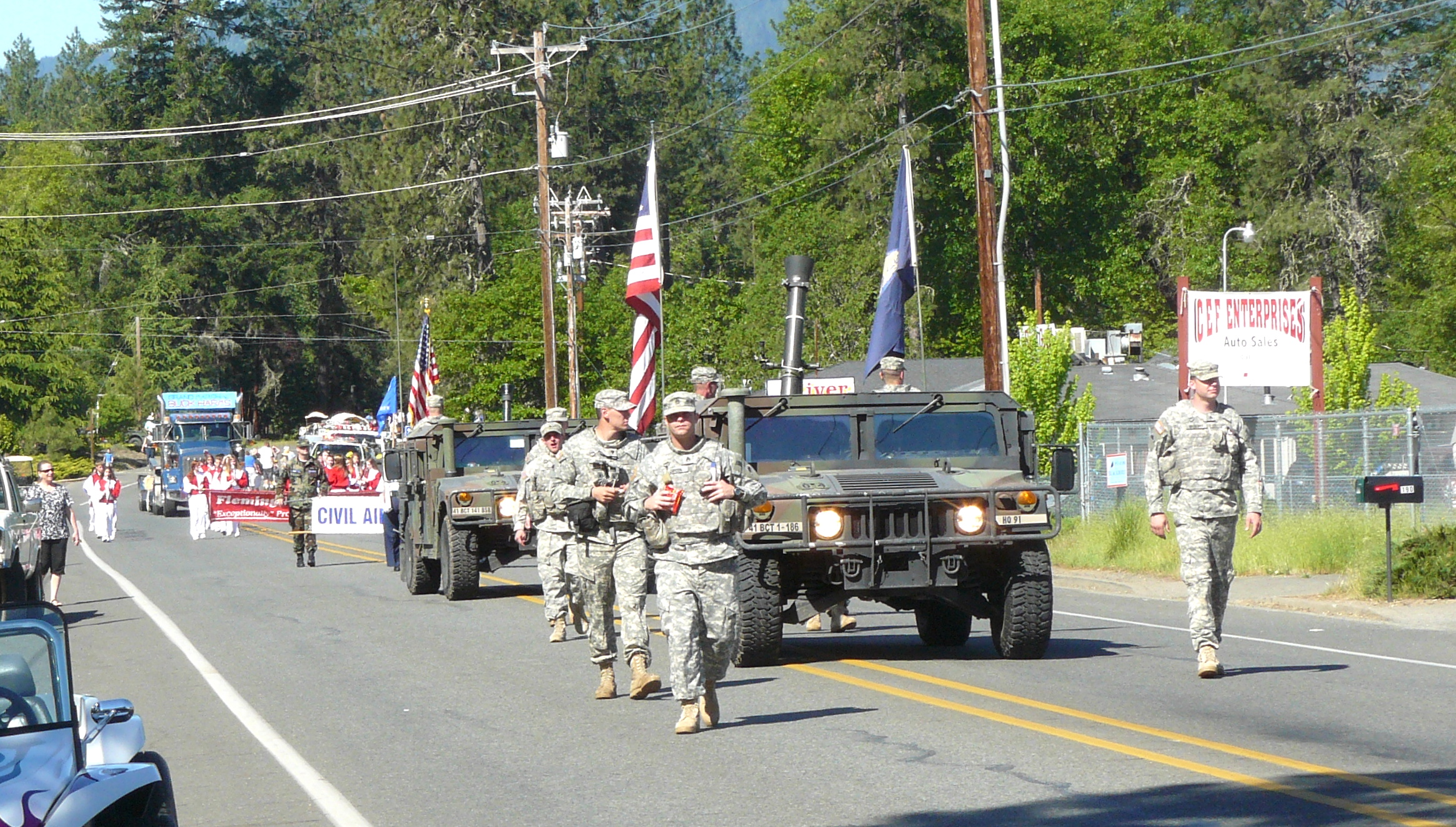
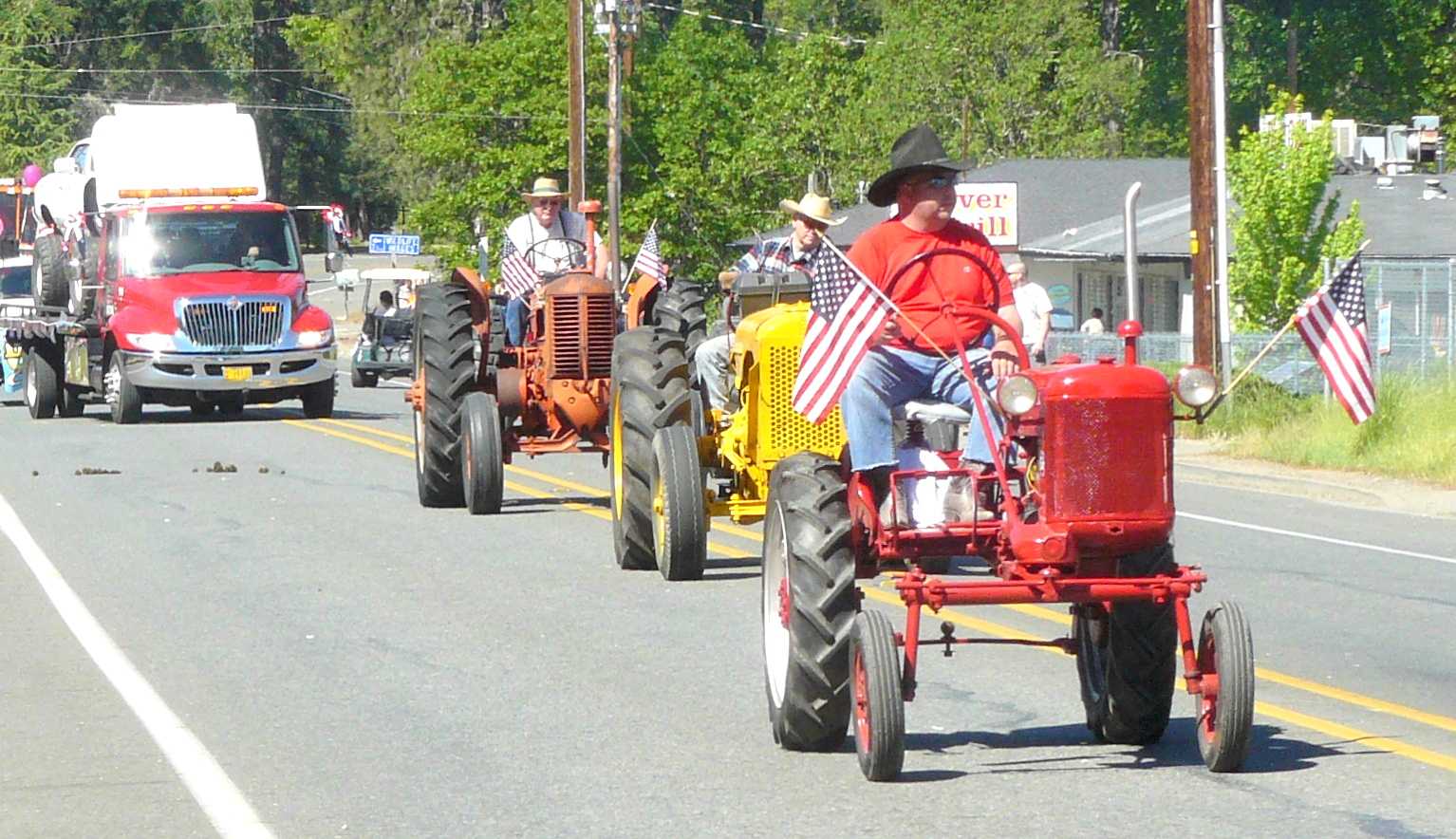
Merlin Parade, May 4th

Community.

Just three photographs from our first experience yesterday of Merlin’s May Parade.  We live just 3 miles from Merlin in Southern Oregon.

P1120943

oooo

Old and New.
Old and New.

oooo

Great effort for such a small community.

Meet Molly.

A most heart-warming story! Beats the heck out of murders, politics and terrorists!

This was sent in by John Hurlburt for Jean who has been a bit of a ‘horse lady’ in her times and is devoted to the two miniature horses we have here in Oregon.

oooOOOooo

Meet Molly

molly1

Molly is a gray speckled pony who was abandoned by her owners when Hurricane Katrina hit southern Louisiana . She spent weeks on her own before finally being rescued and taken to a farm where abandoned animals were stockpiled. While there, she was attacked by a dog and almost died.  Her gnawed right front leg became infected and her vet went to Louisiana State University (LSU) for help.

However, LSU were overwhelmed and Molly became a ‘welfare’ case. You know where that goes, don’t you!

Then surgeon Rustin Moore met Molly and changed his mind. He saw how Molly was careful to lie down on different sides so she didn’t seem to get sores.  He saw how Molly allowed people to handle her. She protected her injured leg. She constantly shifted her weight and didn’t overload her good leg. She was a smart pony with a serious survival ethic.

Surgeon Moore agreed to remove her leg below the knee and a temporary artificial limb was built. Molly walked out of the clinic and, in a very real sense, that’s where her story really begins.

This was the right horse and the right owner!” Moore insisted.

Molly happened to be a one-in-a-million patient. She’s tough as nails, but sweet, and she was willing to cope with pain. She made it obvious she understood that she was in trouble. The other important factor, according to Moore , is having a truly committed and compliant owner who is dedicated to providing the daily care required over the lifetime of the horse.

Molly’s story turns into a parable for life in Post-Katrina Louisiana.  The little pony gained weight and her mane finally felt a comb.  Then, amazingly, a prosthesis designer built her a leg.

The prosthetic has given Molly a whole new life, Allison Barca DVM, Molly’s regular vet, reports:

And she asks for it. She will put her little limb out and come to you and let you know that she wants you to put it on. Sometimes she wants you to take it off too. And sometimes, Molly gets away from Barca. “It can be pretty bad when you can’t catch a three-legged horse,” she laughs.

Most important of all, Molly has a job now. Kay, the rescue farm owner, started taking Molly to shelters, hospitals, nursing homes, and rehabilitation centers. Anywhere she thought that people needed hope. Wherever Molly went, she showed people her pluck. She inspired people, and she had a good time doing it.

It’s obvious to me that Molly had a bigger role to play in life,” Kay said. “She survived the hurricane, she survived a horrible injury, and now she is giving hope to others.

Allison Barca concluded, “She’s not back to normal, but she’s going to be better. To me, she could be a symbol for New Orleans itself.”

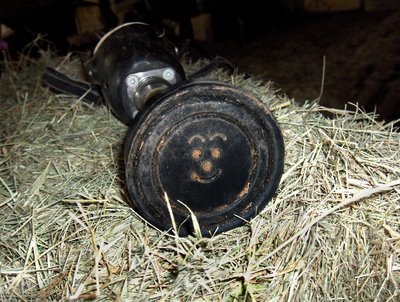
This is Molly's most recent prosthesis.
This is Molly’s most recent prosthesis.

Wherever Molly goes, she leaves a smiley hoof print behind.  Literally as well as metaphorically.

The photo shows the ground surface that she stands on has a smiley face embossed in it!
The photo shows that the bottom flat surface of the prosthesis has a smiley face embossed in it!

Leave you with that wonderful feeling of love for Molly?  Feel free to share it with all the animal lovers that you know.

Oregon and the wolf

Sharing a beautiful aspect of this new home State of ours.

Let’s face it, Jean and I know as much about Oregon as we know about Timbuktu! A house and property requiring much love and care and 10 dogs, 5 cats and 2 miniature horses does rather cramp one’s style!  Actually, let me be honest.  We just adore the grounds that surround the house.  Almost every single walk around the property with or without a few dogs brings some new discovery.  Thus we are not lusting to get out.

Just by way of example, yesterday we discovered that the dam built across our creek, just upstream of the bridge, was used in days long ago for creating flood irrigation.  That’s the dam in the picture below.  The old plank and steel work are still in the undergrowth alongside the creek; to the right of the picture.

Irrigation dam on Bummer Ck.

OK, to the point of this post.

Shortly after we arrived here in Merlin, Oregon we joined Oregon Wild.  Their Mission Statement says: Oregon Wild works to protect and restore Oregon’s wildlands, wildlife and waters as an enduring legacy for all Oregonians.  Can’t argue with that!

Last December a press release was issued about Bringing Wolves Back Home to Oregon.  Here’s part of that release.

Wolves in Oregon:

Gray wolves (Canis lupus) were once common in Oregon, occupying most of the state. However, a deliberate effort to eradicate the species was successful by the late 1940s.

Trouble for wolves began before Oregon even became a state. In 1843 the first wolf bounty was established and Oregon’s first legislative session was called in part to address the “problem of marauding wolves”. By 1913, people could collect a $5 state bounty and an Oregon State Game Commission bounty of $20. The last recorded wolf bounty was paid out in 1947.

After an absence of over half a century, wolves began to take their first tentative steps towards recovery. Having dispersed from Idaho, the native species is once again trying to make a home in Oregon. One of the first sightings came in 1999 when a lone wolf was captured near the middle fork of the John Day River, put in a crate and quickly returned to Idaho. In 2000, two wolves were found dead – one killed by a car, the other illegally shot.

In 2006, a flurry of sightings led state wildlife biologists to believe that a number of wild wolves were living in Northeast Oregon near the Wallowa Mountains and the Eagle Cap Wilderness. In May of 2007 a wolf was found shot to death near La Grande, OR.

As I explain on this blog, there is a deep connection between dogs and wolves:

Dogs are part of the Canidae, a family including wolves, coyotes and foxes, thought to have evolved 60 million years ago.  There is no hard evidence about when dogs and man came together but dogs were certainly around when man developed speech and set out from Africa, about 50,000 years ago.  See an interesting article by Dr. George Johnson.

Back to Oregon Wild.  Just three weeks ago came this update.

State Announces Wolf Recovery Numbers

With the state’s wolf killing program on hold, conservationists celebrate recent success, express concern for the future.

SALEM, OR Jan 16, 2013

Today the Oregon Department of Fish and Wildlife (ODFW) announced the state’s wolf population has risen to at least 53 animals and as many as five breeding pairs. Though still mostly confined to the Northeastern corner of the state, the news was welcomed by conservationists.

The confirmation of wolf numbers comes on the heels of a number of announcements of new wolf pups, interbreeding between packs, and new science demonstrating the important and irreplaceable role wolves and other native hunters play on the landscape.

The announcement also comes on the heels of the one-year anniversary of another great wolf recovery story. On December 28, 2011, a wolf known as Journey (OR-7) crossed the Oregon border to become the first wolf in California in nearly a century. The story was celebrated around the world.

Read the rest of this good news story here.  But I couldn’t resist showing you this photograph that appeared in that story.

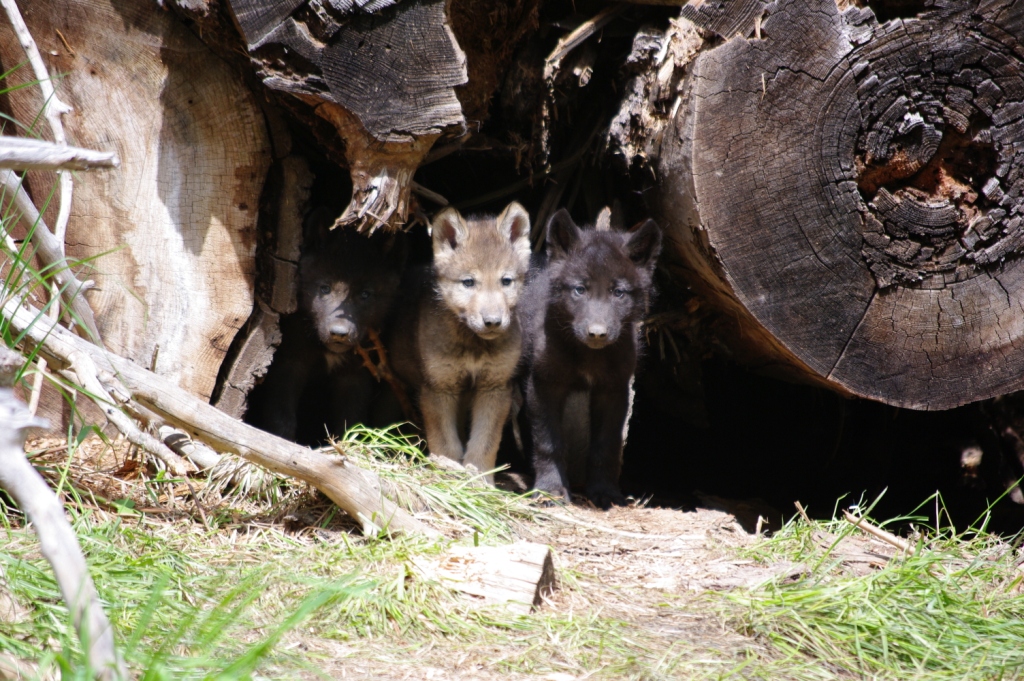
These wolf pups born to the Wenaha Pack in 2012 helped get recovery back on track. But their future remains tenuous (photo courtesy ODFW)

Let me close with these two videos.

Imnaha alpha female wolf, July 2011

Snake River Wolf Pack howling

Published on Aug 1, 2012

On July 25, 2012, an ODFW wolf biologist on a survey for wolf pups took this video of a Snake River wolf pack pup howling. The video was taken in the Summit Ridge area within the Snake River Wildlife Management Unit, in Wallowa County.

In the video, the pup howls three times. A low returning howl is heard and the pup gets up. Then, other members of the wolf pack (not seen in the video) return the pup’s howls.

Wolves are highly social animals and howling is a common behavior that help packs communicate and stay together. Wolf howls can be heard from several miles away.

More information on wolves in Oregon can be found at http://www.dfw.state.or.us/wolves.

Sometimes the meaning escapes us.

Much more than a house move.

Today, the 4th January, we have been at our new home in Oregon for exactly 72 days.  We knew there would be many differences between Payson, Arizona and Merlin, Oregon all of which could be described as objective, factual differences.   However, what was unexpected were the deep, complex emotions associated with moving to this rural part of Josephine County, Oregon.  We were utterly unprepared for that.

In fact, I have been staring at this screen for some time unable to put any structure or meaning to this post.  So I’m not going to try anymore, just offer some photographs and my reflections in the hope that you can sense where I am coming from.

P1120157

The Winter storm that came in on the 20th December was, according to locals, unprecedented.  We lost our power from the 20th until just before Christmas Eve.  It caught us unawares in terms of being ready for this type of winter event.  But then the sun came out one afternoon and I took this picture.

P1120274

It shows the flank of Mt. Sexton, the picture being taken from our deck in front of the house.  I found it impossible to describe the effect that this natural beauty had on me; being in awe just scratches the surface of my feelings.

Moving on.

We have been working hard preparing stables in readiness for two miniature horses that we have purchased from our neighbours, Margo and Clarence.  Last Tuesday, we were busy at this when I saw another breathtakingly beautiful sight.

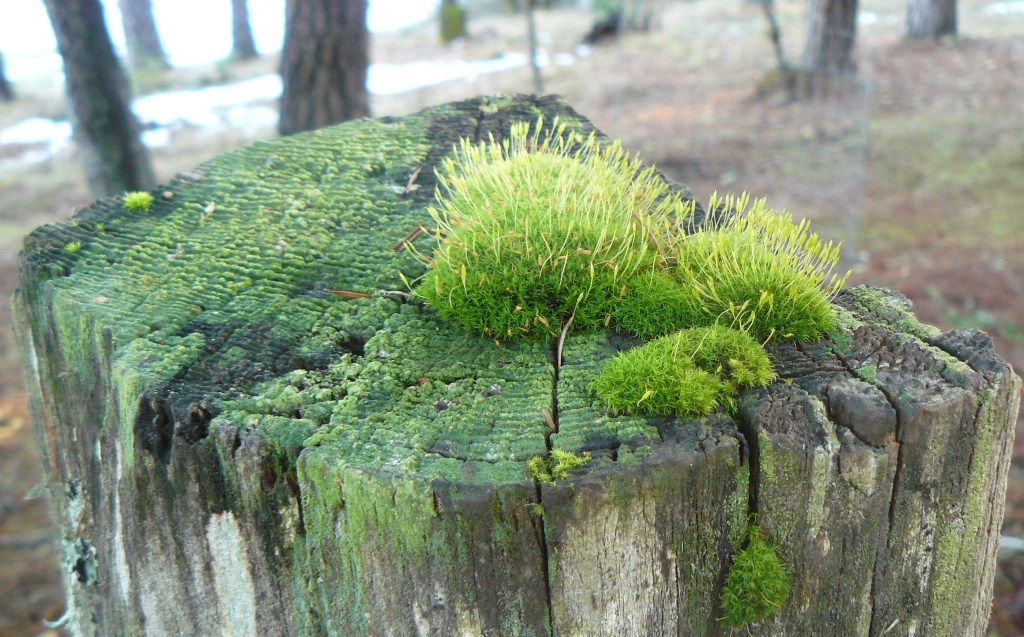
Just some growth on the top of an old fence post.  But the words utterly fail the image.  Here it is.

P1120292

Then about an hour ago (yesterday), while struggling to write this post, I heard the dogs barking in the bedroom next door.  Went into the room and they were ‘speaking’ to some wild deer grazing our pasture land.

P1120306

Wish I could wrap this all up with some profound view, some wise observations about life and the meaning of the universe!

But I can’t!  Can’t make any sense of it at all. How did we get here?  How did I meet Jeannie, this most precious woman, back in Christmas 2007? How did I sell up and walk away from Devon, England, with just Pharaoh by my side, to start this unbelievable new life with Jean and all the dogs?

Anyone know the answers?

P1110454-001
“The silly old sod does mutter on at times!”


Another pause!

More beautiful pictures from Cynthia G.

A couple of weeks ago, I published a selection of photographs from a number of pictures that had been sent to me by Cynthia.  I named the post Small pause today and it received 25 ‘Likes’ and favourable comments including one from Pedantry that simply said, “More of the same, please! :)

So to Pedantry and all you other dear readers, here comes more of the same!

cg1

cg2

cg3

cg4

cg5

cg6

cg7

cg8

cg9

cg10

oooOOOooo

Forgive me now for this little indulgence; a couple of pictures from closer to home – literally!

HugoRd

An early morning picture of the woods overlooking our Oregon property.

Jeannie

My lovely Jeannie helping tidy up the bank of the creek.

Where less is so much more.

The Sufficiency Economy – Envisioning a Prosperous Way Down

For some time now I have been subscribing to the news feed from The Permaculture Research Institute of Australia.  It originally caught my eye because Jean and I want to adopt some of the techniques of permaculture here in Oregon.  However, the ‘news’ from the PRI ranges across such a broad range of topics that rarely is their regular email not worthy of detailed reading.

No less so than on the 24th, just a couple of days ago, when I saw the essay by Dr. Samuel Alexander of the Simplicity Institute under the heading of The Sufficiency Economy – Envisioning a Prosperous Way Down.  I started to read the essay and very quickly realised that I was reading something of profound importance, not just to me and Jeannie, but to millions of other people right across the planet.  I sent an email to both Dr. Alexander of the Simplicity Institute and Craig Mackintosh, Editor of the Permaculture News asking if I might have permission to republish.  Dr. Alexander quickly replied in the affirmative and also approved my suggestion of breaking the essay down into separate chapters.

So, in a radical departure from my normal pattern of different topics each day, this week is going to be devoted entirely to Dr. Alexander’s essay. Tomorrow, I will include information on the Simplicity Institute, an organisation that I hadn’t heard of before, but one that deserves the broadest promotion.

Please, please, dear reader, stay with the topic all week if you possibly can.  I guarantee that it will change your outlook and offer real hope that mankind can turn away from the suicidal path we presently seem to be on.  Indeed, I can do no better that introduce Part One using the opening words written in Permaculture News by Craig Mackintosh.

oooOOOooo

I would exhort readers to ignore the potentially off-putting length of this piece, to instead step into, and allow yourself to be absorbed by, this important and worthy attempt at future-visualising. Readers who have been following my own work over the last several years will recognise and appreciate the themes covered. From my own perspective, what follows is a highly pragmatic view on the potential near-future of civilisation, and I truly feel that the speed and shape of progression (i.e. objectively and cooperatively planned and peacefully implemented), or, regression (i.e. unplanned, reactive, desperate, monopolistic and individualistic), and ultimate form of that future will largely depend on how many people are objectively considering these themes and adjusting their lives, and their influence, accordingly.

THE SUFFICIENCY ECONOMY
ENVISIONING A PROSPEROUS WAY DOWN
Samuel Alexander
Simplicity Institute Report 12s, 2012

Dr Samuel Alexander is co-director of the Simplicity Institute and a lecturer with the Office for Environmental Programs, University of Melbourne.

When [we have] obtained those things necessary to life, there is another alternative than to obtain superfluities; and that is, to adventure on life now, [our] vacation from humbler toil having commenced. – Henry David Thoreau

1. Introduction

If a society does not have some vision of where it wants to be or what it wants to become, it cannot know whether it is heading in the right direction – it cannot even know whether it is lost. This is the confused position of consumer capitalism today, which has a fetish for economic growth but no answer to the question of what that growth is supposed to be for. It is simply assumed that growth is good for its own sake, but of course economic activity is merely a means, not an end. It can only ever be justified by some goal beyond itself, but that is precisely what consumer capitalism lacks – a purpose, a reason for existence. It is a means without an end, like a tool without a task. What makes this state of affairs all the more challenging is that the era of growth economics appears to be coming to a close, due to various financial, ecological, and energy constraints, and this is leaving growth-based economies without the very capacity for growth which defined them historically. Before long this will render consumer capitalism an obsolete system with neither a means nor an end, a situation that is in fact materialising before our very eyes. It seems that today we are living in the twilight of growth globally, which implies that the dawn of a new age is almost upon us – is perhaps already upon us. But as we turn this momentous page in history we find that humanity is without a narrative in which to lay down new roots. We are the generation in between stories, desperately clinging to yesterday’s story but uncertain of tomorrow’s. Then again, perhaps the new words we need are already with us; perhaps we just need to live them into existence.

It is not the purpose of this essay to offer another critique of growth economics, the details of which have been laid down comprehensively many times before (Schumacher, 1973; Meadows et al, 2004; Jackson, 2009; Latouche, 2009). Instead, after briefly summarising the critique, this essay will attempt to describe in some detail an alternative economic system, which I will call ‘the sufficiency economy.’ This term is typically applied to so-called ‘developing economies,’ which either have not yet industrialised or are still in the early phases of industrialisation (see e.g. Suwankitti and Pongquan, 2011). These economies are sometimes called sufficiency economies because they do not or cannot produce material abundance, or do not seek material abundance. Instead, sufficiency economies are focused on meeting mostly local needs with mostly local resources, without the society being relentlessly driven to expand by the growth-focused ethics of profit-maximisation. My point of differentiation in this essay will be to consider the notion of a sufficiency economy within the context of the most highly developed regions of the world – where an economics of sufficiency is most desperately needed – and to explore what such an economy would look like, how it might function, and how the transition to such an economy might transpire. I address this subject having been convinced that the growth paradigm has no future and that some alternative vision is therefore needed as humanity begins its inevitable transition to a world beyond growth. I put forward the sufficiency economy as the most promising alternative model, although it is one that I believe may ultimately be imposed upon us whether we want it or not, for reasons that will be explained. We can go the easier way or the harder way, so to speak, depending on our attitudes and actions.

Defined and defended in more detail below, a sufficiency economy can be understood in direct contrast to the dominant macro-economic paradigm based on limitless growth. Whereas existing economies in our increasingly globalised world are predicated on the assumption that ‘more production and consumption is always better,’ the sufficiency economy described below is shaped by an acceptance that ‘just enough is plenty.’ As will be seen, the implications of this alternative economic perspective are nothing short of revolutionary. Rather than progress being seen as a movement toward ever-increasing material affluence, the sufficiency economy aims for a world in which everyone’s basic needs are modestly but sufficiently met, in an ecologically sustainable, highly localised, and socially equitable manner. When material sufficiency is achieved in these ways, further growth would not continue to be a priority. Instead, human beings would realise that they were free from the demands of continuous economic activity and could therefore dedicate more of their energies to non-materialistic pursuits, such as enjoying social relationships, connecting with nature, exploring the mysteries of the universe, or engaging in peaceful, creative activity of various sorts. How to spend this ‘freedom from want’ is the exhilarating and perhaps terrifying question all human beings would face in a well-established sufficiency economy, so defined.

Such an economy recognises that there are fundamental limits to growth (Meadows et al, 2004), and in this it obviously shares some conceptual ground with the notion of a steady-state economy developed by ecological economists in recent decades (e.g. Daly, 1996). But to date the steady-state economy has remained largely at the level of theoretical abstraction, and this has made it difficult to envision the alternative society it vaguely implies. Unfortunately, this has hurt the movement for change, because if people cannot picture the alternative society, it is very difficult to desire it; and if we do not desire it, no social or political movement will arise to bring it into existence. Many have been persuaded, as I have been, by the insight that economies are a subset of the natural environment, not the other way round, as neoclassical economists assume. Very little attention, however, has been given to describing in detail what economic life would be like if an ecologically sustainable economy actually emerged. How would we feed ourselves? What clothes would we wear? What forms of transport and technology would we use? How much and what types of energy would we require? And what material standard of living would we have if we were to successfully decarbonise the economy? Most importantly, perhaps, what would the quality of daily life be like? These are some of the concrete questions to which this essay will offer some tentative answers, acknowledging all the while that the nature of the sufficiency economy described, like any economy, must ultimately be shaped and understood in context-specific ways. (1)

The analysis begins in the next section by briefly outlining the multi-faceted problems the world finds itself facing, not for the purpose of providing a thorough review of the global situation but simply to contextualise the discussion that follows. Unless one understands the magnitude of the overlapping problems we face, the relevance, importance, or even the necessity of the sufficiency economy may not be immediately apparent. Once the global predicament is outlined, the analysis proceeds to define in more detail the principles that underpin the sufficiency economy, although again this will be more a matter of exposition than comprehensive defence. The main part of the analysis then explores in some detail what economic life might be like if developed nations gave up the pursuit of growth and transitioned to some form of highly localised ‘sufficiency economy’ based on far lower resource and energy consumption. It is hoped that this analysis might provide some guidance on what it will actually take to transition to a just and sustainable society, as well as provide some deeper insight into what life might be like if we were ever to succeed.

————–

Notes:

  1. In forming the following views I have been influenced and inspired by many people, the most significant of whom I would like to acknowledge. With respect to material simplicity and ‘the good life,’ Henry Thoreau (1982) has by far been the greatest influence on my world view, followed by William Morris (2004) and the Greek and Roman Stoics (e.g. Seneca, 2004). I am also greatly indebted to my colleagues and fellow authors at the Simplicity Institute – Ted Trainer, Mark Burch, David Holmgren, and Simon Ussher – all of whom, in their own way, have deeply influenced the following discussion (see Simplicity Institute, 2012). The work of Ernst Schumacher (1973) and the Club of Rome (Meadows et al, 2004) first introduced me to the ‘limits to growth’ analysis, and Serge Latouche (2003; 2009) introduced me to the insight that degrowth, not merely zero-growth, is what is needed to achieve sustainability in overdeveloped nations. With respect to energy, Howard and Elisabeth Odum (2001) and Joseph Tainter (1988) have been my biggest influences, showing me how central energy is to the world we live in. I must also mention and thank Rob Hopkins (2008) and the Transition Movement, for providing what I consider to be the most promising framework for bringing about a just and sustainable, post-carbon world.

(The full set of references will be included in the concluding Part Five to be published on Friday.)

Part Two – The Global Predicament will be published on Learning from Dogs tomorrow.