Tag: NASA

Climate and truth, footnote.

So many vested opinions!

Regular readers will know that I published recently, in two parts, a post with the heading of Climate, truth and integrity, the first part being here and the second part here.

To me the arguments supporting the premise that mankind is engaged in the process of destroying our very being are powerful and convincing.  But if there is any serious scientific doubt, then I am reminded of that saying in aviation circles about a risk to the safety of an aircraft, “If there’s any doubt, there’s no doubt!”  Surely, that’s the stance the climate change skeptics should be taking!  Because when the evidence of global warming, pollution, natural resource depletion, species extinctions, and habitat destruction is drawn together and there are no skeptics left, then will the last person left alive please switch the lights off!

Anyway, I’m going to republish, with permission, a recent Post that appeared on Tom Engelhardt‘s powerful blogsite, Tom Dispatch.  It was written by Bill McKibben of 350.org fame.  Here it is,

Tomgram: Bill McKibben, Why the Energy-Industrial Elite Has It In for the Planet

Posted by Bill McKibben at 9:39am, February 7, 2012.

Introduction

Two Saturdays ago, I was walking with a friend in a park here in New York City.  It was late January, but I was dressed in a light sweater and a thin fall jacket, which I had just taken off and tied around my waist.  We were passing a strip of bare ground when suddenly we both did a double-take.  He looked at me and said, “Crocuses!”  Dumbfounded, I replied, “Yes, I see them.”  And there they were, a few clumps of telltale green shoots poking up from the all-brown ground as if it were spring.  Such a common, comforting sight, but it sent a chill through me that noticeably wasn’t in the air.  Even the flowers, I thought, are confused by our new version of weather.

Later that same week, as temperatures in the Big Apple crested 60 degrees, I was chatting on the phone with a friend in Northampton, Massachusetts.  I was telling him about the crocuses, when he suddenly said, “I’m looking out my window right now and for the first time in my memory of January, there’s not a trace of snow!”

Of course, our tales couldn’t be more minor or anecdotal, even if the temperatures that week did feel like we were on another planet.  Here’s the thing, though: after a while, even anecdotes add up — maybe we should start calling them “extreme anecdotes” — and right now there are so many of them being recounted across the planet.  How could there not be in a winter, now sometimes referred to as “Junuary,” in which, in the United States, 2,890 daily high temperature records have either been broken or tied at last count, with the numbers still rising?  Meanwhile, just to the south of us, in Mexico, extreme anecdotes abound, since parts of the country are experiencing “the worst drought on record.”  Even cacti are reportedly wilting and some towns are running out of water (as they are across the border in drought-stricken Texas).  And worst of all, the Mexican drought is expected to intensify in the months to come.

And who can doubt that in Europe, experiencing an extreme cold spell the likes of which hasn’t been seen in decades — even Rome had a rare snowfall and Venice’s canals were reported to be freezing over — there are another set of all-too-extreme anecdotes.  After all, in places like Ukraine, scores of the homeless are freezing to death, pipes are bursting, power cuts are growing, and maybe even an instant energy crisis is underway (at a moment when the European Union is getting ready to cut itself off from Iranian oil).

That’s just to begin a list.  And yet here’s the strange thing.  At least in this country, you can read the “freaky” weather reports or listen to the breathless TV accounts of unexpected tornadoes striking the South in January and rarely catch a mention of the phrase “climate change.”  Given the circumstances, the relative silence on the subject is little short of eerie, even if worries about climate change lurk just below the surface.  Which is why it’s good to have TomDispatch regular Bill McKibben, author of Eaarth: Making a Life on a Tough New Planet, take a clear-eyed look at American denialism and just what it is we prefer not to take in. Tom

The Great Carbon Bubble
Why the Fossil Fuel Industry Fights So Hard

By Bill McKibben

If we could see the world with a particularly illuminating set of spectacles, one of its most prominent features at the moment would be a giant carbon bubble, whose bursting someday will make the housing bubble of 2007 look like a lark. As yet — as we shall see — it’s unfortunately largely invisible to us.

In compensation, though, we have some truly beautiful images made possible by new technology.  Last month, for instance, NASA updated the most iconic photograph in our civilization’s gallery: “Blue Marble,” originally taken from Apollo 17 in 1972. The spectacular new high-def image [see below, Ed] shows a picture of the Americas on January 4th, a good day for snapping photos because there weren’t many clouds.

It was also a good day because of the striking way it could demonstrate to us just how much the planet has changed in 40 years. As Jeff Masters, the web’s most widely read meteorologist, explains, “The U.S. and Canada are virtually snow-free and cloud-free, which is extremely rare for a January day. The lack of snow in the mountains of the Western U.S. is particularly unusual. I doubt one could find a January day this cloud-free with so little snow on the ground throughout the entire satellite record, going back to the early 1960s.”

In fact, it’s likely that the week that photo was taken will prove “the driest first week in recorded U.S. history.” Indeed, it followed on 2011, which showed the greatest weather extremes in our history — 56% of the country was either in drought or flood, which was no surprise since “climate change science predicts wet areas will tend to get wetter and dry areas will tend to get drier.” Indeed, the nation suffered 14 weather disasters each causing $1 billion or more in damage last year. (The old record was nine.) Masters again: “Watching the weather over the past two years has been like watching a famous baseball hitter on steroids.”

In the face of such data — statistics that you can duplicate for almost every region of the planet — you’d think we’d already be in an all-out effort to do something about climate change. Instead, we’re witnessing an all-out effort to… deny there’s a problem.

Our GOP presidential candidates are working hard to make sure no one thinks they’d appease chemistry and physics. At the last Republican debate in Florida, Rick Santorum insisted that he should be the nominee because he’d caught on earlier than Newt or Mitt to the global warming “hoax.”

Most of the media pays remarkably little attention to what’s happening. Coverage of global warming has dipped 40% over the last two years. When, say, there’s a rare outbreak of January tornadoes, TV anchors politely discuss “extreme weather,” but climate change is the disaster that dare not speak its name.

And when they do break their silence, some of our elite organs are happy to indulge in outright denial. Last month, for instance, the Wall Street Journal published an op-ed by “16 scientists and engineers” headlined “No Need to Panic About Global Warming.” The article was easily debunked. It was nothing but a mash-up of long-since-disproved arguments by people who turned out mostly not to be climate scientists at all, quoting other scientists who immediately said their actual work showed just the opposite.

It’s no secret where this denialism comes from: the fossil fuel industry pays for it. (Of the 16 authors of the Journal article, for instance, five had had ties to Exxon.)Writers from Ross Gelbspan to Naomi Oreskes have made this case with such overwhelming power that no one even really tries denying it any more. The open question is why the industry persists in denial in the face of an endless body of fact showing climate change is the greatest danger we’ve ever faced.

Why doesn’t it fold the way the tobacco industry eventually did? Why doesn’t it invest its riches in things like solar panels and so profit handsomely from the next generation of energy? As it happens, the answer is more interesting than you might think.

Part of it’s simple enough: the giant energy companies are making so much money right now that they can’t stop gorging themselves. ExxonMobil, year after year, pulls in more money than any company in history. Chevron’s not far behind. Everyone in the business is swimming in money.

Still, they could theoretically invest all that cash in new clean technology or research and development for the same. As it happens, though, they’ve got a deeper problem, one that’s become clear only in the last few years. Put briefly: their value is largely based on fossil-fuel reserves that won’t be burned if we ever take global warming seriously.

When I talked about a carbon bubble at the beginning of this essay, this is what I meant. Here are some of the relevant numbers, courtesy of the Capital Institute: we’re already seeing widespread climate disruption, but if we want to avoid utter, civilization-shaking disaster, many scientists have pointed to a two-degree rise in global temperatures as the most we could possibly deal with.

If we spew 565 gigatons more carbon into the atmosphere, we’ll quite possibly go right past that reddest of red lines. But the oil companies, private and state-owned, have current reserves on the books equivalent to 2,795 gigatons — five times more than we can ever safely burn. It has to stay in the ground.

Put another way, in ecological terms it would be extremely prudent to write off $20 trillion worth of those reserves. In economic terms, of course, it would be a disaster, first and foremost for shareholders and executives of companies like ExxonMobil (and people in places like Venezuela).

If you run an oil company, this sort of write-off is the disastrous future staring you in the face as soon as climate change is taken as seriously as it should be, and that’s far scarier than drought and flood. It’s why you’ll do anything — including fund an endless campaigns of lies — to avoid coming to terms with its reality. So instead, we simply charge ahead.  To take just one example, last month the boss of the U.S. Chamber of Commerce, Thomas Donohue, called for burning all the country’s newly discovered coal, gas, and oil — believed to be 1,800 gigatons worth of carbon from our nation alone.

What he and the rest of the energy-industrial elite are denying, in other words, is that the business models at the center of our economy are in the deepest possible conflict with physics and chemistry. The carbon bubble that looms over our world needs to be deflated soon. As with our fiscal crisis, failure to do so will cause enormous pain — pain, in fact, almost beyond imagining. After all, if you think banks are too big to fail, consider the climate as a whole and imagine the nature of the bailout that would face us when that bubble finally bursts.

Unfortunately, it won’t burst by itself — not in time, anyway. The fossil-fuel companies, with their heavily funded denialism and their record campaign contributions, have been able to keep at bay even the tamest efforts at reining in carbon emissions. With each passing day, they’re leveraging us deeper into an unpayable carbon debt — and with each passing day, they’re raking in unimaginable returns. ExxonMobil last week reported its 2011 profits at $41 billion, the second highest of all time. Do you wonder who owns the record? That would be ExxonMobil in 2008 at $45 billion.

Telling the truth about climate change would require pulling away the biggest punchbowl in history, right when the party is in full swing. That’s why the fight is so pitched. That’s why those of us battling for the future need to raise our game. And it’s why that view from the satellites, however beautiful from a distance, is likely to become ever harder to recognize as our home planet.

Bill McKibben is Schumann Distinguished Scholar at Middlebury College, founder of the global climate campaign 350.org, a TomDispatch regular, and the author, most recently, of Eaarth: Making a Life on a Tough New Planet.

Follow TomDispatch on Twitter @TomDispatch and join us on Facebook.

Copyright 2012 Bill McKibben

This photo was taken on January 4, 2012.

Most Amazing High Definition Image of Earth – Blue Marble 2012

January 25, 2012

*Updated February 2, 2012: According to Flickr, “The western hemisphere Blue Marble 2012 image has rocketed up to over 3.1 million views making it one of the all time most viewed images on the site after only one week.”

A ‘Blue Marble’ image of the Earth taken from the VIIRS instrument aboard NASA’s most recently launched Earth-observing satellite – Suomi NPP. This composite image uses a number of swaths of the Earth’s surface taken on January 4, 2012. The NPP satellite was renamed ‘Suomi NPP’ on January 24, 2012 to honor the late Verner E. Suomi of the University of Wisconsin.

Suomi NPP is NASA’s next Earth-observing research satellite. It is the first of a new generation of satellites that will observe many facets of our changing Earth.

Suomi NPP is carrying five instruments on board. The biggest and most important instrument is The Visible/Infrared Imager Radiometer Suite or VIIRS.

To read more about NASA’s Suomi NPP go to: www.nasa.gov/npp

Credit: NASA/NOAA/GSFC/Suomi NPP/VIIRS/Norman Kuring

Kepler 22b

In a sense the discovery of a potential life-supporting planet isn’t news.

What do I mean by that sub-heading?

Many (and I mean ‘many’) years ago I was a student at Faraday House Electrical Engineering College in Southampton Row, London.  The College was closely associated with London University and one year there was an invite to attend a lecture by the famous British astronomer, Sir Bernard Lovell.

Sir Bernard Lovell and the Jodrell Bank radio telescope

Despite that lecture being about 45 years ago, I still recall Sir Bernard explaining the statistics of the universe to demonstrate that the odds of another planet somewhere ‘out there’ that could support life were huge.  (Just as an aside do read this interesting story of Jodrell Bank picking up signals from the Russian Lunar 15 just as Neil Armstrong and Buzz Aldrin prepared to leave the moon’s surface.)

So with the positive identification of this planet some 600 light-years away, Sir Bernard’s speculation has been proved spot-on.

But in another very real sense, the discovery of Kepler 22b is astounding.  Step outside the science of the find and just cogitate a little about the implications; the deep philosophical issues that Kepler 22b raises.  Here’s an extract from Northern Voices Online news,

The excitingly named Kepler 22b, a planet believed to have been discovered orbiting a star a mere 600 light years away, is being hailed as a “New Earth”. But sci-fi fans shouldn’t get too excited just yet: as always with these stories, the likelihood is that we have not met the neighbours. Or, if we have, they probably aren’t very exciting conversationalists.

Talking about the likelihood of intelligent life on Kepler 22b, Dr Lewis Dartnell, of the Centre for Planetary Sciences at UCL, said, “There are big hurdles that life has to get over, and we don’t know how big a hurdle the origin of life itself is. You simply can’t tell with a single datum – you can’t do stats when N=1.

The N that Dr Dartnell mentioned was earth: the only known planet inhabiting intelligent life forms, or better still, life forms of any kind.

Dr Dartnell further adds, “The interesting thing will be when we go to Mars and Europa and see whether there are bacteria there. It would be enormously significant if life is found there. But the next step, once Kepler has looked at a lot of planets, will be to see what their atmospheres are made of, using infrared spectroscopy.

“If one or two of them have oxygen in the atmosphere, it may be a transient thing – like Venus, undergoing a runaway greenhouse effect – but if we find, say, 20 Earth-like planets, all with the signature of oxygen in their atmosphere, then that would be very unlikely. Life would be the more reasonable explanation,” concluded Dr Dartnell.

Read the rest of this article here.

There are many news reports online but this short video caught my eye.

The latest NASA report is here from which is quoted,

NASA’s Kepler Mission Confirms Its First Planet in Habitable Zone of Sun-like Star

NASA’s Kepler mission has confirmed its first planet in the “habitable zone,” the region where liquid water could exist on a planet’s surface. Kepler also has discovered more than 1,000 new planet candidates, nearly doubling its previously known count. Ten of these candidates are near-Earth-size and orbit in the habitable zone of their host star. Candidates require follow-up observations to verify they are actual planets.

The newly confirmed planet, Kepler-22b, is the smallest yet found to orbit in the middle of the habitable zone of a star similar to our sun. The planet is about 2.4 times the radius of Earth. Scientists don’t yet know if Kepler-22b has a predominantly rocky, gaseous or liquid composition, but its discovery is a step closer to finding Earth-like planets.

Previous research hinted at the existence of near-Earth-size planets in habitable zones, but clear confirmation proved elusive. Two other small planets orbiting stars smaller and cooler than our sun recently were confirmed on the very edges of the habitable zone, with orbits more closely resembling those of Venus and Mars.

“This is a major milestone on the road to finding Earth’s twin,” said Douglas Hudgins, Kepler program scientist at NASA Headquarters in Washington. “Kepler’s results continue to demonstrate the importance of NASA’s science missions, which aim to answer some of the biggest questions about our place in the universe.”

So let me leave you with this tantalising thought.  One day it will be confirmed that there is intelligent life on a planet out there in the universe.  That is likely to be one of the astounding events ever in the history of man on this planet.  Even trying some wild guesses about how that will change mankind’s self-perception is more than difficult – yet it will change the way we look at ourselves irrevocably!

I pray that I am still alive when that happens, as I’m sure many others must do.

November 8th birthday update

The passing of an asteroid.

This has been very widely reported but not seen by me until a few moments ago.

Here’s how the BBC is reporting Asteroid 2005 YU55.

Giant asteroid to pass near Earth

Nasa’s Deep Space Network caught a glimpse of the asteroid on Monday

An asteroid that is 400m (1,300ft) wide will pass by the Earth on Tuesday, closer to it even than the Moon.

It poses no danger to the Earth and it will be invisible to the naked eye.

Asteroid 2005 YU55’s closest approach, at a distance of 325,000km (202,000mi), will be at 23:28 GMT. It is the closest the asteroid has been in 200 years.

It is also the largest space rock fly-by the Earth has seen since 1976; the next visit by such a large asteroid will be in 2028.

The aircraft-carrier-sized asteroid is darkly coloured in visible wavelengths and nearly spherical, lazily spinning about once every 20 hours as it races through our neighbourhood of the Solar System.

It will trace a path across the whole sky through to Thursday.

The NASA details may be found here.

And an interesting video on the passing of this rather large rock at 23:28 UTC today, November 8th.

Sceptical voices, part two

More musings about determining the truth.

Those who read yesterday’s part one will undoubtedly have seen the added comment from long-time friend of Learning from Dogs, Patrice Ayme.  Yesterday, I promised to conclude Dan’s sceptical approach to climate warming with three articles that he had sent me.  Here they are,

Global Warming

“Global warming” refers to the global-average temperature increase that has been observed over the last one hundred years or more. But to many politicians and the public, the term carries the implication that mankind is responsible for that warming. This website describes evidence from my group’s government-funded research that suggests global warming is mostly natural, and that the climate system is quite insensitive to humanity’s greenhouse gas emissions and aerosol pollution.

Believe it or not, very little research has ever been funded to search for natural mechanisms of warming…it has simply been assumed that global warming is manmade. This assumption is rather easy for scientists since we do not have enough accurate global data for a long enough period of time to see whether there are natural warming mechanisms at work.

The United Nation’s Intergovernmental Panel on Climate Change (IPCC) claims that the only way they can get their computerized climate models to produce the observed warming is with anthropogenic (human-caused) pollution. But they’re not going to find something if they don’t search for it. More than one scientist has asked me, “What else COULD it be?” Well, the answer to that takes a little digging… and as I show, one doesn’t have to dig very far.

But first let’s examine the basics of why so many scientists think global warming is manmade. Earth’s atmosphere contains natural greenhouse gases (mostly water vapor, carbon dioxide, and methane) which act to keep the lower layers of the atmosphere warmer than they otherwise would be without those gases. Greenhouse gases trap infrared radiation — the radiant heat energy that the Earth naturally emits to outer space in response to solar heating. Mankind’s burning of fossil fuels (mostly coal, petroleum, and natural gas) releases carbon dioxide into the atmosphere and this is believed to be enhancing the Earth’s natural greenhouse effect. As of 2008, the concentration of carbon dioxide in the atmosphere was about 40% to 45% higher than it was before the start of the industrial revolution in the 1800’s.

It is interesting to note that, even though carbon dioxide is necessary for life on Earth to exist, there is precious little of it in Earth’s atmosphere. As of 2008, only 39 out of every 100,000 molecules of air were CO2, and it will take mankind’s CO2 emissions 5 more years to increase that number by 1, to 40.

Earth's atmosphere

The “Holy Grail”: Climate Sensitivity Figuring out how much past warming is due to mankind, and how much more we can expect in the future, depends upon something called “climate sensitivity”. This is the temperature response of the Earth to a given amount of ‘radiative forcing’, of which there are two kinds: a change in either the amount of sunlight absorbed by the Earth, or in the infrared energy the Earth emits to outer space.

The ‘consensus’ of opinion is that the Earth’s climate sensitivity is quite high, and so warming of about 0.25 deg. C to 0.5 deg. C (about 0.5 deg. F to 0.9 deg. F) every 10 years can be expected for as long as mankind continues to use fossil fuels as our primary source of energy. NASA’s James Hansen claims that climate sensitivity is very high, and that we have already put too much extra CO2 in the atmosphere. Presumably this is why he and Al Gore are campaigning for a moratorium on the construction of any more coal-fired power plants in the U.S.

You would think that we’d know the Earth’s ‘climate sensitivity’ by now, but it has been surprisingly difficult to determine. How atmospheric processes like clouds and precipitation systems respond to warming is critical, as they are either amplifying the warming, or reducing it. This website currently concentrates on the response of clouds to warming, an issue which I am now convinced the scientific community has totally misinterpreted when they have measured natural, year-to-year fluctuations in the climate system. As a result of that confusion, they have the mistaken belief that climate sensitivity is high, when in fact the satellite evidence suggests climate sensitivity is low.

The case for natural climate change I also present an analysis of the Pacific Decadal Oscillation which shows that most climate change might well be the result of….the climate system itself! Because small, chaotic fluctuations in atmospheric and oceanic circulation systems can cause small changes in global average cloudiness, this is all that is necessary to cause climate change. You don’t need the sun, or any other ‘external’ influence (although these are also possible…but for now I’ll let others work on that). It is simply what the climate system does. This is actually quite easy for meteorologists to believe, since we understand how complex weather processes are. Your local TV meteorologist is probably a closet ’skeptic’ regarding mankind’s influence on climate.

Climate change — it happens, with or without our help.

And the next one,

Earth may be headed into a mini Ice Age within a decade

Physicists say sunspot cycle is ‘going into hibernation’

By Lewis Page

Posted in Science14th June 2011 17:00 GMT

What may be the science story of the century is breaking this evening, as heavyweight US solar physicists announce that the Sun appears to be headed into a lengthy spell of low activity, which could mean that the Earth – far from facing a global warming problem– is actually headed into a mini Ice Age.

Ice skating on the Thames by 2025?

The announcement made on 14 June (18:00 UK time) comes from scientists at the US National Solar Observatory (NSO) and US Air Force Research Laboratory. Three different analyses of the Sun’s recent behaviour all indicate that a period of unusually low solar activity may be about to begin.

The Sun normally follows an 11-year cycle of activity. The current cycle, Cycle 24, is now supposed to be ramping up towards maximum strength. Increased numbers of sunspots and other indications ought to be happening: but in fact results so far are most disappointing. Scientists at the NSO now suspect, based on data showing decades-long trends leading to this point, that Cycle 25 may not happen at all.

This could have major implications for the Earth’s climate. According to a statement issued by the NSO, announcing the research:

An immediate question is whether this slowdown presages a second Maunder Minimum, a 70-year period with virtually no sunspots [which occurred] during 1645-1715.

As NASA notes [1]:

Early records of sunspots indicate that the Sun went through a period of inactivity in the late 17th century. Very few sunspots were seen on the Sun from about 1645 to 1715. Although the observations were not as extensive as in later years, the Sun was in fact well observed during this time and this lack of sunspots is well documented. This period of solar inactivity also corresponds to a climatic period called the “Little Ice Age” when rivers that are normally ice-free froze and snow fields remained year-round at lower altitudes. There is evidence that the Sun has had similar periods of inactivity in the more distant past.

During the Maunder Minimum and for periods either side of it, many European rivers which are ice-free today – including the Thames – routinely froze over, allowing ice skating and even for armies to march across them in some cases.

“This is highly unusual and unexpected,” says Dr Frank Hill of the NSO. “But the fact that three completely different views of the Sun point in the same direction is a powerful indicator that the sunspot cycle may be going into hibernation.”

Hill’s own research focuses on surface pulsations of the Sun and their relationship with sunspots, and his team has already used their methods to successfully predict the late onset of Cycle 24.

“We expected to see the start of the zonal flow for Cycle 25 by now,” Hill explained, “but we see no sign of it. This indicates that the start of Cycle 25 may be delayed to 2021 or 2022, or may not happen at all.”

Hill’s results match those from physicists Matt Penn and William Livingston, who have gone over 13 years of sunspot data from the McMath-Pierce Telescope at Kitt Peak in Arizona. They have seen the strength of the magnetic fields which create sunspots declining steadily. According to the NSO:

Penn and Livingston observed that the average field strength declined about 50 gauss per year during Cycle 23 and now in Cycle 24. They also observed that spot temperatures have risen exactly as expected for such changes in the magnetic field. If the trend continues, the field strength will drop below the 1,500 gauss threshold and spots will largely disappear as the magnetic field is no longer strong enough to overcome convective forces on the solar surface.

In parallel with this comes research from the US Air Force’s studies of the solar corona. Richard Altrock, in charge of this, has found a 40-year decline in the “rush to the poles” – the poleward surge of magnetic activity in the corona.

“Those wonderful, delicate coronal features are actually powerful, robust magnetic structures rooted in the interior of the Sun,” Altrock says. “Changes we see in the corona reflect changes deep inside the Sun …

“Cycle 24 started out late and slow and may not be strong enough to create a rush to the poles, indicating we’ll see a very weak solar maximum in 2013, if at all. If the rush to the poles fails to complete, this creates a tremendous dilemma for the theorists … No one knows what the Sun will do in that case.”

According to the collective wisdom of the NSO, another Maunder Minimum may very well be on the cards.

“If we are right,” summarises Hill, “this could be the last solar maximum we’ll see for a few decades. That would affect everything from space exploration to Earth’s climate.”

The effects on space exploration would be benign, as fewer or no solar storms would make space a much less hostile environment for human beings. At the moment, anyone venturing beyond the Earth’s protective magnetic field (the only people to have done so were the Apollo moon astronauts of the 1960s and ’70s) runs a severe risk of dangerous or fatal radiation exposure during a solar storm.

Manned missions beyond low Earth orbit, a stated aspiration of the USA and other nations, might become significantly safer and cheaper to mount (cheaper as there would be no requirement for possibly very heavy shielding to protect astronauts, so reducing launch costs).

The big consequences of a major solar calm spell, however, would be climatic. The next few generations of humanity might not find themselves trying to cope with global warming but rather with a significant cooling. This could overturn decades of received wisdom on such things as CO2 emissions, and lead to radical shifts in government policy worldwide.

And the last one,

On the Misdiagnosis of Surface Temperature Feedbacks from Variations in Earth’s Radiant Energy Balance

Roy W. Spencer * and William D. Braswell

ESSC-UAH, University of Alabama in Huntsville, Cramer Hall, Huntsville, AL 35899, USA

* Author to whom correspondence should be addressed.Received: 24 May 2011; in revised form: 13 July 2011 / Accepted: 15 July 2011 / Published: 25 July 2011

Abstract: The sensitivity of the climate system to an imposed radiative imbalance remains the largest source of uncertainty in projections of future anthropogenic climate change. Here we present further evidence that this uncertainty from an observational perspective is largely due to the masking of the radiative feedback signal by internal radiative forcing, probably due to natural cloud variations. That these internal radiative forcings exist and likely corrupt feedback diagnosis is demonstrated with lag regression analysis of satellite and coupled climate model data, interpreted with a simple forcing-feedback model. While the satellite-based metrics for the period 2000–2010 depart substantially in the direction of lower climate sensitivity from those similarly computed from coupled climate models, we find that, with traditional methods, it is not possible to accurately quantify this discrepancy in terms of the feedbacks which determine climate sensitivity. It is concluded that atmospheric feedback diagnosis of the climate system remains an unsolved problem, due primarily to the inability to distinguish between radiative forcing and radiative feedback in satellite radiative budget observations.

So back to me!

As you can see there is every opportunity to be confused.  Not embracing contrary views to the ones that you believe, however, is not the way to determine the truth.

So let me close with a couple of my own contrary views.

The first from Bill McKibben published in the Resurgence Magazine,

WHAT COMES NEXT?

We have a tiny window of opportunity to save something of the magnificence of the Earth so let’s all grab it, writes Bill McKibben, founder of 350.org

Asked to name the biggest thing that’s happened over Resurgence’s 45-year career, I think I’d have to say the melt of the Arctic. When this magazine began publishing, there was 40% more summer sea ice in the Arctic. Viewed from space, in those first pictures from the Apollo spacecraft, the planet looked very different than it does now. In recent summers both the north-west and the north-east passages have opened, allowing sailors to circumnavigate the Arctic through waters that no one thought, even a decade ago, humans would ever navigate.

Or maybe I would pick the rapid acidification of the planet’s seas – they’re 30% more acid than they were in 1966. Which means that the small creatures at the base of the marine food chain are having more trouble forming their shells, and that coral reefs – already stressed by warming waters – have a new trauma to deal with.

Another possibility: the Earth’s atmosphere is about 4% moister than it was 45 years ago, simply because warm air holds more water vapour than cold. This loads the dice for deluge, downpour, flood – it’s not surprising that we’re seeing record rainfall and unprecedented floods. Nor, since that water has to come from somewhere, should increasing drought and desertification come as much of a shock.

Here’s what I’m trying to say: when Resurgence began its run, we were still in the Holocene. Humans had altered much of the planet’s natural environment. We had dirty rivers and dirty air, spreading toxins and endangered species. But the basic operating system of the planet was running pretty much the same as it had for the 10,000 years of human civilisation.

Sometime in the intervening decades we moved out of that comfortable and remarkably stable world, and began the transition to What Comes Next?

Any date would be arbitrary, but if you wanted to pick one, you could say 1988. That was the year NASA scientist Jim Hansen warned the US Congress that global warming was indeed real – and it was the year that we passed the benchmark of 350 parts per million (ppm) of CO2 in the atmosphere. At the time we didn’t know it was a benchmark – it was 20 years later that scientists, again led by Hansen, declared that 350ppm was the absolute upper limit if we wanted a planet “similar to the one on which civilisation developed and to which life is adapted”. If we wanted, in other words, that older world we were born onto.

I could list at some length the various woes this new world is already causing: we see rising sea levels displacing farmers across the deltas of Bangladesh, and Aedes aegypti expanding its boundary and spreading dengue fever like wildfire. Speaking of wildfire, we see record amounts, in part because of more heat and drought, and in part because insects (once kept in check by cold weather) are now spreading.

We see millions still homeless from last year’s flood in Pakistan, and billions struggling to pay for food because a string of crop failures that began with last summer’s Russian drought have increased grain prices by 70–80%.

And I could list at even greater length the woes we expect as the century grinds on. After all, we’ve only raised the temperature about a degree so far, and the climatologists tell us to expect four or five unless we stop burning coal and oil and gas much faster than any government currently plans. Temperatures like that will guarantee the melt of Greenland; according to the agronomists they will cut grain harvests by a third or more; they’ll make current shortages of water seem barely worth mentioning.

But for the moment don’t think about consequences, current or future. Just think about the enormity of what we’ve managed to do: we’ve altered the most basic operations of the one planet we’ve got.

The air is profoundly different, the heat balance with our sun profoundly altered. It’s by far the biggest thing humans have ever done or ever contemplated doing, and were some alien watching from a great distance she’d be scratching her head-like appendage. It’s our head-like appendage that’s responsible, of course. That big brain turned out to be incredibly clever, and its cleverest trick was to figure out that buried carbon could make life easy. Everything that we know around us – the whole modern world – derives from that discovery. Much of it is good. But now we’re threatening to take down the good, and much else with it.

So here’s the question for the next 45 years of Resurgence: can the big brain bail us out?

It’s already provided us with the warnings we need, warnings that would not have been available at any other moment in human history. The scientific method, one of the greatest achievements of our civilisation, has produced a robust consensus on this difficult problem in chemistry and physics: since the mid-1990s the Intergovernmental Panel on Climate Change (IPCC) has said in unmistakably plain language that there is no doubt: we have to cut carbon, and quickly.

But so far that warning has had little or no effect: our national governments, with a few noble exceptions, have paid scant attention; our attempts at global governance have been pathetic failures. The chief reason, I think, is the remarkable power of the fossil-fuel industry to stifle change; for 200 years it has grown bigger and richer and more than able to deal with the threat that science now poses to its reign. It literally makes us stupid: earlier this winter the US House of Representatives, by a 60-vote margin, defeated a resolution that merely stated that global warming was real. Exxon has promoted its own version of physics and chemistry, and they’ve managed to fool a good many too.

The real question, then, is going to be: is there a big enough heart connected to that big brain? Will we be able to heed not only the warnings of science but those of our conscience? Will we, gazing out at the growing array of ‘natural disasters’, figure out that we’ve got to make change? Change in our personal lives, yes, but even more change in our political arrangements, since that’s the only chance that actual physics and chemistry really give us for meeting the deadlines they’ve set.

I think the answer is yes – a tentative and uncertain yes, but one based on just enough real-world data to give me hope.

Three years ago we founded 350.org, the first big global grassroots climate campaign. Rooted in science but expressed in imagination, it has grown to pretty mammoth size. Our first two big global days of action, in the waning months of 2009 and 2010, were what CNN called “the most widespread days of political action in the planet’s history”, with nearly 15,000 demonstrations in every country on Earth but North Korea.

And the good news is we didn’t really ‘organise’ it – our tiny staff worked feverishly, but ultimately it was like a potluck supper. People in every corner of the Earth heard the call and did the work, figuring out what would work in their place. (An underwater demonstration on the dying coral reefs of the Maldives; a giant image of King Canute, composed of thousands of volunteers, trying to hold the sea back on the Brighton seashore!)

It’s not enough yet to beat the fossil-fuel industry – our bodies don’t yet add up to their money. But we’re growing constantly (the next big chance to join us: 24 September 2011, a day we’re calling Moving Planet). And – sad, but true – the natural world is going to continue to give us openings to make the case more strongly. Sooner or later our leaders will listen – and we’re committed to making it sooner.

We’re not going to stop global warming: it’s already warmed and it will warm some more. Those Apollo images of our planet are forever sepia-toned. But we’ve got a tiny window left to save something of the Earth we were born onto – its beauty, its bounty, its safety.

That’s our task, and the next 45 years will tell the tale.

Bill McKibben wrote the first book for a general audience on climate change, The End of Nature, in 1989. He is a scholar in residence at Middlebury College in Vermont.

The second from the BBC News website just a few days ago.

Arctic ice hits second-lowest level, US scientists say

Sea ice cover in the Arctic in 2011 has passed its annual minimum, reaching the second-lowest level since satellite records began, US scientists say.

The National Snow and Ice Data Center (NSIDC) says the minimum, reached on 9 September, was 4.33 million sq km.

That value is 36% lower than the average minimum for 1979-2000.

NSIDC said the figure was preliminary, and that “changing winds could still push the ice extent lower” before final numbers are published in early October.

The preliminary value is 160,000 sq km – or 4% – above the record minimum seen in 2007.

The minimum level of cover is far below the average of 1979-2000

“While the record low year of 2007 was marked by a combination of weather conditions that favoured ice loss – including clearer skies, favourable wind patterns and warm temperatures – this year has shown more typical weather patterns but continued warmth over the Arctic,” they wrote.

“This supports the idea that the Arctic sea ice cover is continuing to thin.”

NSIDC director Mark Serreze said: “Every summer that we see a very low ice extent in September sets us up for a similar situation the following year.

“The Arctic sea ice cover is so thin now compared to 30 years ago that it just can’t take a hit any more. This overall pattern of thinning ice in the Arctic in recent decades is really starting to catch up with us.”

In fact, an analysis released last week by researchers at the University of Bremen in Germany, who use a different satellite to assess ice cover, indicated that 2011’s minimum was the lowest on record.

However, there is some controversy surrounding the result; the Bremen team’s higher-resolution data can detect small patches of water where the NSIDC team would not, but the Bremen record goes back only to 2003.

These analyses are for the extent, or area, of Arctic ice, but recent estimates released by the University of Washington’s Polar Science Center give an indication of the total amount of sea ice.

Their data indicate that the ice volume is at an all-time low for the second year in a row.

Analyses of Arctic ice in recent years consistently indicate a change in the nature of the ice itself – from one solid mass that melts and freezes at its edges towards more dispersed, piecemeal ice cover, and from robust “multi-year” ice toward seasonal floes that melt more easily.

The NSIDC data show ice cover extents consistently below earlier averages

You may want to refer to the worrying images of the Petermann Glacier that I published on the 14th September.

—oooOOOooo—

I hope this article, split over two days, has been useful.  Hopefully, they underline the need to work it out for yourself and remain open-minded at all times.

Sceptical voices, part one

Musings about the importance of challenging accepted wisdoms

Life is full of traps.  In that sense our lives are little different to our ancient days of cavemen.  But the traps are very different.  They have changed from pits embedded with sharp sticks, covered with vegetation, to an avalanche of information, news and media output from which determining truth is challenging.  The modern equivalent of the ancient pit trap.

My sense is that one way we embrace what we perceive as truthful is through pattern matching, a powerful aspect of the human brain.  By pattern matching, I mean the tendency to place greater emphasis on information that matches our view of the world, that accords with our core beliefs, than that which doesn’t.

Thus if one is a liberal with leanings towards social engineering as a means of improving society then news and information that supports that philosophy will be accepted as validation of that view.  Then again, if one is strong on the need for the individual to be independent and responsible for their own lives then the validation of that philosophy will be supported by a completely different stream of information.

A prologue to what follows.

Regular readers of Learning from Dogs will be clear that my view is that mankind is responsible for a range of issues that, if not resolved, will threaten the very ecology of Planet Earth that allows mankind to survive.  My dear Californian friend of over 40 years, Dan, thinks otherwise.  Let me add, Dan is not a mental slouch.

I wanted to share some articles that Dan recently sent me, not to prove who is right or wrong, but to underline the critical importance of never ceasing to question the truth of everything that is fundamental to our knowledge of the world, in the broadest sense, upon which we live.

Dan sent me a link to this item,

New NASA Data Blow Gaping Hole In Global Warming Alarmism

NASA satellite data from the years 2000 through 2011 show the Earth’s atmosphere is allowing far more heat to be released into space than alarmist computer models have predicted, reports a new study in the peer-reviewed science journal Remote Sensing. The study indicates far less future global warming will occur than United Nations computer models have predicted, and supports prior studies indicating increases in atmospheric carbon dioxidetrap far less heat than alarmists have claimed.

Study co-author Dr. Roy Spencer, a principal research scientist at the University of Alabama in Huntsville and U.S. Science Team Leader for the Advanced Microwave Scanning Radiometer flying on NASA’s Aqua satellite, reports that real-world data from NASA’s Terra satellite contradict multiple assumptions fed into alarmist computer models.

 “The satellite observations suggest there is much more energy lost to space during and after warming than the climate models show,” Spencer said in a July 26 University of Alabama press release. “There is a huge discrepancy between the data and the forecasts that is especially big over the oceans.”

In addition to finding that far less heat is being trapped than alarmist computer models have predicted, the NASA satellite data show the atmosphere begins shedding heat into space long before United Nations computer models predicted.

The new findings are extremely important and should dramatically alter the global warming debate.

This is not the full article, which may be read here.

I was interested in what had been published by Yahoo News and sought to verify it directly on NASA’s web site.  I was unable to do so, and replied with links to two findings by NASA that man, indeed, was affecting global climate.  One of those NASA links was here,

A new NASA-led study shows that human-caused climate change has impacted a wide range of Earth’s natural systems, from permafrost thawing to plants blooming earlier across Europe to lakes declining in productivity in Africa.

Cynthia Rosenzweig of NASA’s Goddard Institute for Space Science in New York and scientists at 10 other institutions have linked physical and biological impacts since 1970 with rises in temperatures during that period. The study, published May 15 in the journal Nature, concludes that human-caused warming is resulting in a broad range of impacts across the globe.

adding my own view that “There isn’t a serious scientist in the world who has published a peer-reviewed paper that disagrees with the core notion that man has affected the planet. ”

Dan responded thus,

Paul – This will be a good one.

The point I always try to make is that good science is always subject to change as new evidence is discovered. I believe that science is by nature, controversial; plus ça change and all that….

To state as a “Hard-Core Ideological Truth” that Anthropogenic Global Warming (now known as more PC “Climate Change”) is a fact is self-serving.  To deny the disputative work of many highly regarded scientists and climatologists who challenge this construct, can only result in a politically charged and alarmist position serving, in the end, special-interests.

Being skeptical is a healthy process. This process should be followed in the “Climate Change” debate. Especially in the face of today’s political reality and the funding that special interest groups need to survive. Regarding the proclamations of “Man-Induced Global Warming/Climate Change Proponents” that Man is and will be single-handedly responsible for the global flooding of most of the world’s coastal cities, is arrogant, absurd and unprovable.

Moreover, to ask world governments to take billions and billions of dollars out of their economies to fund nutty programs like “Cap and Trade” in order to ostensibly “contradict” something that has been happening on its own for millions of years, is pretty much over the top.

For the last 2 million years, Earth cycles in and out of ice ages.  It happens whether the planet supports 20 million people or 20 million dinosaurs. Glaciers grow and recede. Polar ice increases and decreases. The planet shifts its axis a few degrees and it gets cold.  It shifts back, it gets hotter. Ocean currents change based on God’s unpredictable timetable causing local droughts and floods. A few volcanoes erupt and we get instant cloud cover drifting over the planet changing climatology drastically. The Sun, its relative position to Earth and its sunspot cycles adds a little flavor. How about putting the Earth’s wobble in the mix?  Or, for that matter, without the Moon we would have no seasons?

Greenhouse gases are mostly water vapor. After that, CO2 and methane. All together, very small components of the Earth’s atmosphere.  That should tell us something.

If you go to NASA scientist, Dr. Spencer’s website – http://www.drroyspencer.com -, you may find some interesting data from his studies that suggest that man-made caused CO2 entering the atmosphere is not all that important.  At the very least, this is a controversial subject that should be treated that way and not as fact.  And please, don’t tax me more to pay for unsubstantiated programs to make it snow more in the Arctic.  What if it snows too much or get’s too cold and Hudson and the Thames freeze again.  Rather be warm than cold.

And by “peel-back-the-onion”, I mean that any ardent, independent researcher should publish both sides of the story as a matter of course.  Especially in regards to global warming.

For what it is worth, I personally believe that the “Anthropogenic Global Warming Crisis” is an attempt by “Political Man” to assign full blame to the “Global Industrial Sector” for increased CO2 emissions which, in turn, will rapidly create an atmospheric, hydrospheric and lithospheric catastrophe beyond anything Man has every seen (Love that one!).  Once that blame can become an incontrovertible truth and that Man is proven Responsible, then the Industrial Enterprises of the Advanced Nations (they have all the money, or they used to) will pay billions to Create Government Managed Programs to Decrease CO2 Emissions and Prevent this World-Ending Catastrophe from ever taking place. Wow.

Instead, what we should really be focused on is something a little more banal like Jobs, freeing up Global Enterprises from regulations and taxes, adjusting our Social Entitlement Programs to fit revenues and paying back Debt.  That’s the Red Meat of this era, in my humble opinion.

Paul, I gotta say, this is fun!  See more below…..

Dan then included more background articles that will be the subject of Sceptical Voices, Part Two.  Hope you can stay with it.

Transitions, pt Two

Reflections on these present times, concluding part.

I closed yesterday with, So maybe there’s a blindness with humans, and then set out the characteristics of that blindness.  One of those characteristics being,

Our obsession with how things are now prevents us from reflecting on those signs that indicate changes are under way, even when the likely conclusions are unmistakeable.  The ecological and climatic changes being the most obvious example of this strange blindness that mankind possesses.

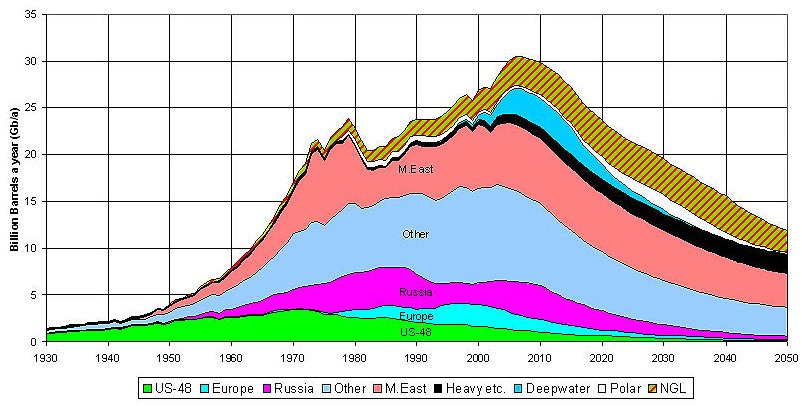
Let’s move this on a little.  The arguments from a wide range of scientists are overwhelmingly in favour of the proposition that mankind is using vastly more resources from the planet than the planet can provide.  Take oil.  This graph show past and projected oil production for the whole Earth out to 2050, less than 40 years away.

Here’s an extract from that website which I encourage you to read in full,

The part before 2007 is historical fact. The part that comes afterward is an ASPO extrapolation.

This graph is worth careful attention as a lot of world history is written into it. Note the steep rise in oil production after World War II. Note that 1971 was the peak in oil production in the United States lower 48. There is a sliver of white labled Arctic oil. That is mostly Alaskan Prudhoe Bay oil, which peaked in 1990. Prudhoe Bay was almost big enough to counteract the lower 48 peak of 1971. The sliver is very narrow now. The OPEC oil embargo of 1973 is very visible. The oil produced by non-OPEC countries stayed nearly constant while OPEC production nearly halved. The embargo caused the world economy to slow. But the high cost of energy spurred the development of energy efficient automobiles and refrigerators and a lot of other things. Note the effect of the collapse of the Russian economy in 1990 on Russian oil production. Note the rapid increase in oil production when the world economy boomed near the end of the twentieth century. Oil was $12 a barrel at that time. Note that European (North Sea) oil peaked in 2000. Note especially what would have happened if the 1973 embargo had not occurred. It is possible that the world would now be on the steep part of the right side of the Hubbert curve.

Take population growth. Here’s a graph that shows that going through seven billion, which is due shortly, is likely to be way short of the eventual peak.  Likely peak might be in the range of  eight to ten billion!  Just take a look at that graph,

Take global warming.  Here’s a graph from NASA, from which I quote,

The five warmest years since the late 1880s, according to NASA scientists, are in descending order 2005, 1998, 2002, 2003 and 2006. (reported in the year 2007!)

No apologies for bashing you around the head with these graphs and figures – most people have a good sense about these aspects of our life on this planet.  But, in a very real sense, that’s the point.

The point that despite powerful and obvious evidence, mankind has great difficulty accepting obvious trends and understanding that whatever ‘today’ feels like, ‘tomorrow’ is almost certainly not going to be more of the same.

At the risk of hammering this point to death, here are two pictures and some text to show how quickly ‘today’ changes and becomes ‘tomorrow’.

Scientist left speechless as vast glacier turns to water

by Helen Turner, Western Mail

THESE images show the astonishing rate of break-up of an enormous glacier in north Greenland – from ice to water in just two years.

The before and after photographs, which left a Welsh scientist who led the 24-month project “speechless”, reveal the worrying effects of climate change in an area previously thought too cold to be much affected.

The Petermann glacier pictured August, 5th, 2009
Petermann glacier, pictured from same position, July 24th, 2011

Dr Alun Hubbard, a reader at Aberystwyth University’s Centre for Glaciology, returned from the Petermann Glacier in north-west Greenland a month ago, but did not see the stark images documenting the changes until this week.

He said: “Although I knew what to expect in terms of ice loss from satellite imagery, I was still completely unprepared for the gob-smacking scale of the break-up, which rendered me speechless.  It was just incredible to see. This glacier is huge, 20km across, 1,000m high.”

“It’s like looking into the Grand Canyon full of ice and coming back two years later to find it’s full of water.”

“It’s quite hard to get your head around the scale of the change.  To be able to see that, everything changed in such a short period of time, I was speechless.”

Do read the full article on the Wales Online website here.

Stay with me a little longer, if you will.

Yves Smith in her wonderfully broad and addictive Blog, Naked Capitalism, had the first part of a powerful interview with Satyajit Das published on the 7th.  Here are a couple of extracts,

 It’s amazing how much money you can make just shuffling paper backwards and forwards. Malcolm Gladwell wrote a piece praising John Paulson who made a killing from the subprime disaster as an entrepreneur. But what did he make? What did he leave behind? Paul Volcker, the former chairman of the Federal Reserve, argued: “I wish someone would give me one shred of neutral evidence that financial innovation has led to economic growth — one shred of evidence. US financial services increased its share of value added from 2% to 6.5% but is that a reflection of your financial innovation, or just a reflection of what you’re paid?”

Just let that quote from Paul Volcker stay with you for a while.  Satyajit goes on to say,

Management and directors of financial institutions cannot really understand what is going on – it’s simply not practical. They cannot be across all the products. For example, Robert Rubin, the former head of Goldman Sachs and Treasury Secretary under President Clinton, encouraged increased risk taking at CitiGroup. He was guided by a consultant’s report and famously stated that risk was the only underpriced asset. He encouraged investment in AAA securities assuming that they were ‘money good’. He seemed not to be aware of the liquidity puts that Citi had written which meant that toxic off-balance sheet assets would come back to the mother ship in the case of a crisis. Now, if he didn’t understand, others would find it near impossible. And I’m talking about executive management.

Non executives are even further removed. Upon joining the Salomon Brothers Board, Henry Kaufman, the original Dr. Doom found that most non-executive directors had little experience or understanding of banking. They relied on board reports that were, “neither comprehensive … nor detailed enough … about the diversity and complexity of our operations.” Non-executive directors were reliant “on the veracity and competency of senior managers, who in turn … are beholden to the veracity of middle managers, who are themselves motivated to take risks through a variety of profit compensation formulas.”

Kaufman later joined the board of Lehman Brothers. Nine out of ten members of the Lehman board were retired, four were 75 years or more in age, only two had banking experience, but in a different era. The octogenarian Kaufman sat on the Lehman Risk Committee with a Broadway producer, a former Navy admiral, a former CEO of a Spanish-language TV station and the former chairman of IBM. The Committee only had two meetings in 2006 and 2007. AIG’s board included several heavyweight diplomats and admirals; even though Richard Breeden, former head of the SEC told a reporter, “AIG, as far as I know, didn’t own any aircraft carriers and didn’t have a seat in the United Nations.”

In other words, there is no shortage of information from all corners of the world to show, with very little doubt, that the last few decades have seen unprecedented mistakes by national governments, mistakes in corporate governance, a lack of understanding of economic fundamentals, poor financial and social management, and on and on and on.

But practically all of us, and I mean all of us, didn’t see it at the time, didn’t see where it was heading and only now, when it is full in our faces, do we get it and see it for what it has really been, a long period of over two decades where the ‘me‘ has been more important than the ‘us‘.

That me versus us even being promoted, if that’s the right word, by a British Prime Minister twenty-five years ago.  That quote from Margaret Thatcher back in 1987,  “And, you know, there is no such thing as society. There are individual men and women, and there are families.” (Margaret Thatcher, talking to Women’s Own magazine, October 31 1987)

Let me draw this all together, yesterday’s part and this concluding part.

There is significant evidence, real hard evidence, that the patterns of mankind’s behaviours of the last few decades cannot continue.  Simply because mankind will go over the edge of self-extinction.  Darwin’s evidence and all that!  We have to accept that humans will see the bleedin’ obvious before it is too late.  We have to keep the faith that our species homo sapiens is capable of huge and rapid change when that tipping point is reached, so eloquently written by Paul Gilding in his book, The Great Disruption, reviewed by me here.  We have to embrace the fact that just because the world and his wife appears to be living in total denial, the seedlings of change, powerful change, are already sprouting, everywhere, all over the world.

So let’s welcome those changes. Let’s nurture those seedlings, encourage them to grow and engulf our society with a new richness, a new fertile landscape.

Let’s embrace the power of now, the beauty of making today much better and letting go of tomorrow.

For today, I am in charge of my life,

Today, I choose my thoughts,

Today, I choose my attitudes,

Today, I choose my actions and behaviours.

With these, I create my life and my destiny.

It’s very difficult to make predictions, especially when they involve the future!

Transitions, pt One

Reflections on these present times.

Want a brilliant idea for tomorrow? Stay in the present!

Dogs do this wonderfully.  I am told that followers of Zen Buddhism discover peace and grace from embracing the present. But is there more to this?  Is there some deeper psychology involved?  Does our species have an intrinsic challenge in terms of staying in the present?

My musings on this arise from a couple of recent conversations.

The first was with Peter McCarthy from the Bristol area of West England.  Peter and I go back a few years (at my age, everything goes back a few years!) and at one stage I did some work for Peter’s company, Telecom Potential.  Just a quick aside, Peter’s company was based in the magnificent Clevedon Hall, a mansion built in 1853 as a family home for Conrad William Finzel, a German-born businessman.  Here’s a picture of one of the rooms,

A room at Clevedon Hall

Peter, like me, is sure that the period in which the world now appears to be, is not some cyclical downturn, not some temporary departure from the national growth and employment ambitions promoted by so many countries.  No! This one is different.

Peter is sure that a major transition is under way, as big as any of the great societal upheavals of the past.  And, for me, a fascinating comment from Peter was his belief that the key attitude required for the next years would be innovation.  Peter reminded me that we tend to think of innovation as applying to things physical, scientific and technical.  But Peter sensed that it would be in the area of social innovation where key changes would arise and, from which, these large societal changes would flow.

Then a day later I was chatting with one of the founders of a brilliant new authentication process, Pin Plus. It is a very smart solution to a major global problem, the weaknesses of traditional password user-authentication systems.

On the face of it, Pin Plus is obviously a better and more secure way of authenticating users, and a number of key test customers have borne this out.  Jonathan C was speaking of the challenges of convincing companies to have faith in this new process.  This is what he said,

More than once, indeed many times, I am told by prospects something along the lines that the IT world has been looking so hard and so long for a password solution that a solution can’t possibly exist.

Let’s ponder that for a moment.  Are we saying that a far-sighted approach to the potential for change is not an easy place for some, probably many, human brains?

Indeed, Jonathan and I mused that here we were, both speaking via Skype, an internet telephony service, both of us looking at different web sites in support of many of the points that we were discussing and totally dependent, in terms of our mentoring relationship, on the technology of the internet, a multi-node packet-switched communications system that was a direct result of the American shock of seeing the Russians launch the world’s first artificial satellite, Sputnik 1, into low earth orbit on the 4th October, 1957.

Launch of Sputnik 1

At that time, it would have seemed impossible for anyone on the planet to see that the American response to Sputnik 1 would eventually lead to the vast packet-switched network that is now the modern Internet.

But why do we regard the ability to look into the future so utterly out of reach of the common man?  Look at this, the Internet Timeline here.  Look how quickly the response to Sputnik1 gathered pace.  See how Leonard Kleinrock of MIT way back in May, 1961, presented a paper on the theory of packet-switching in large communications networks.

So maybe there’s a blindness with humans.  A blindess that creates the following bizarre characteristics,

  • Whatever is going on in our lives at present we assume will go on forever.  I.e. the boom times will never end, or the period of doom and gloom is endless.
  • Our obsession with how things are now prevents us from reflecting on those signs that indicate changes are under way, even when the likely conclusions are unmistakeable.  The ecological and climatic changes being the most obvious example of this strange blindness that mankind possesses.
  • Yet, unlike animals and some spiritual groups of humans, truly living in the present appears incredibly difficult for man.
  • However, the history of mankind shows that our species is capable of huge change, practically living in constant change for the last few millennia, and that a very small proportion of a society, see yesterday’s article, is all that is required to create a ‘tipping point’.

I want to continue with this theme but conscious that there is still much to be written.  So, dear reader, I shall pause and pick this up tomorrow.

Just stay in the present for twenty-four hours!

From otters to aliens!

Big shift of topic from yesterday!

Yesterday, I wrote about the fabulous success of the British otter having gone from the crumbling edge of extinction to now being found in every English county.

For something completely different, and I do mean completely, have a read of this item that appeared in the British Guardian newspaper of the 18th August.

Aliens may destroy humanity to protect other civilisations, say scientists

Rising greenhouse emissions could tip off aliens that we are a rapidly expanding threat, warns a report

It may not rank as the most compelling reason to curb greenhouse gases, but reducing our emissions might just save humanity from a pre-emptive alien attack, scientists claim.

Watching from afar, extraterrestrial beings might view changes in Earth’s atmosphere as symptomatic of a civilisation growing out of control – and take drastic action to keep us from becoming a more serious threat, the researchers explain.

This highly speculative scenario is one of several described by a Nasa-affiliated scientist and colleagues at Pennsylvania State University that, while considered unlikely, they say could play out were humans and alien life to make contact at some point in the future.

Shawn Domagal-Goldman of Nasa’s Planetary Science Division and his colleagues compiled a list of plausible outcomes that could unfold in the aftermath of a close encounter, to help humanity “prepare for actual contact”.

In their report, Would Contact with Extraterrestrials Benefit or Harm Humanity? A Scenario Analysis, the researchers divide alien contacts into three broad categories: beneficial, neutral or harmful.

Beneficial encounters ranged from the mere detection of extraterrestrial intelligence (ETI), for example through the interception of alien broadcasts, to contact with cooperative organisms that help us advance our knowledge and solve global problems such as hunger, poverty and disease.

Another beneficial outcome the authors entertain sees humanity triumph over a more powerful alien aggressor, or even being saved by a second group of ETs. “In these scenarios, humanity benefits not only from the major moral victory of having defeated a daunting rival, but also from the opportunity to reverse-engineer ETI technology,” the authors write.

Other kinds of close encounter may be less rewarding and leave much of human society feeling indifferent towards alien life. The extraterrestrials may be too different from us to communicate with usefully. They might invite humanity to join the “Galactic Club” only for the entry requirements to be too bureaucratic and tedious for humans to bother with. They could even become a nuisance, like the stranded, prawn-like creatures that are kept in a refugee camp in the 2009 South African movie, District 9, the report explains.

The most unappealing outcomes would arise if extraterrestrials caused harm to humanity, even if by accident. While aliens may arrive to eat, enslave or attack us, the report adds that people might also suffer from being physically crushed or by contracting diseases carried by the visitors. In especially unfortunate incidents, humanity could be wiped out when a more advanced civilisation accidentally unleashes an unfriendly artificial intelligence, or performs a catastrophic physics experiment that renders a portion of the galaxy uninhabitable.

To bolster humanity’s chances of survival, the researchers call for caution in sending signals into space, and in particular warn against broadcasting information about our biological make-up, which could be used to manufacture weapons that target humans. Instead, any contact with ETs should be limited to mathematical discourse “until we have a better idea of the type of ETI we are dealing with.”

The authors warn that extraterrestrials may be wary of civilisations that expand very rapidly, as these may be prone to destroy other life as they grow, just as humans have pushed species to extinction on Earth. In the most extreme scenario, aliens might choose to destroy humanity to protect other civilisations.

“A preemptive strike would be particularly likely in the early phases of our expansion because a civilisation may become increasingly difficult to destroy as it continues to expand. Humanity may just now be entering the period in which its rapid civilisational expansion could be detected by an ETI because our expansion is changing the composition of the Earth’s atmosphere, via greenhouse gas emissions,” the report states.

“Green” aliens might object to the environmental damage humans have caused on Earth and wipe us out to save the planet. “These scenarios give us reason to limit our growth and reduce our impact on global ecosystems. It would be particularly important for us to limit our emissions of greenhouse gases, since atmospheric composition can be observed from other planets,” the authors write.

Even if we never make contact with extraterrestrials, the report argues that considering the potential scenarios may help to plot the future path of human civilisation, avoid collapse and achieve long-term survival.

I am bound to say that if Mr Domagal-Goldman and his colleagues believe that spending time and money on the possible outcomes of contact with extraterrestrials is a good idea in these present times then I am minded about those other visitors from outer space who passed Planet Earth by because there were no signs of intelligent life!

Here’s Alex Jones on the topic …

Space, where to now?

A rather poignant moment as the last NASA Space Shuttle is programmed to launch today.

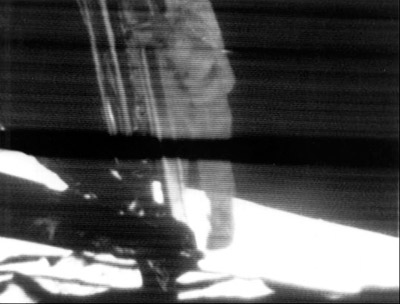
Many of my age will have been fascinated by man’s progress in exploring space, from the Russian Sputnik 1 launched into earth orbit in October, 1957 (I was 12!) through to man first putting a foot on the surface of the moon on 20th July, 1969 on the US Apollo 11 Mission.

Still frame from the video transmission of Neil Armstrong stepping onto the surface of the Moon at 02:56 UTC on 21 July 1969.

Today, the end of an era is being played out.  Today, the last Space Shuttle, Atlantis, is due to be launched.  From the NASA website,

Date: July 8 
Mission: STS-135
Launch Vehicle: Space Shuttle Atlantis
Launch Site: Kennedy Space Center – Launch Pad 39A
Launch Time: 11:26 a.m. EDT
Description: Space shuttle Atlantis will carry the Raffaello multipurpose logistics module to deliver supplies, logistics and spare parts to the International Space Station. Atlantis also will fly a system to investigate the potential for robotically refueling existing spacecraft and return a failed ammonia pump module.

The BBC recently had an interesting news item where all six crew members of Shuttle Discovery were interviewed after that last flight, more details including a video of the interview here.

Astronauts of shuttle Discovery describe ‘amazing’ craft

At almost 27 years old, and with more than 143 million miles on the clock, the space shuttle Discovery returned from her final mission in March.

The crew of Discovery’s final mission, Commander Steve Lindsey, astronauts Eric Boe, Stephen Bowen, Alvin Drew, Michael Barratt and Nicole Stott, spoke to Breakfast News about what it was like to fly the shuttle for the last time.

So where does it go from here?

The current edition of The Economist has a quite a lot to say about that.  A leader starts with raising the question of how big the Earth is?

HOW big is the Earth? Any encyclopedia will give you an answer: its equatorial diameter is 12,756km, or, for those who prefer to think that way, 7,926 miles. Ah, but then there is the atmosphere. Should that count? Perhaps the planet’s true diameter is actually nearer 13,000km, including all its air. But even that may no longer be an adequate measure. For the Earth now reaches farther still. The vacuum surrounding it buzzes with artificial satellites, forming a sort of technosphere beyond the atmosphere. Most of these satellites circle only a few hundred kilometres above the planet’s solid surface. Many, though, form a ring like Saturn’s at a distance of 36,000km, the place at which an object takes 24 hours to orbit the Earth and thus hovers continuously over the same point of the planet.

Later, this leader speculates,

The reason for that second objective is also the reason for thinking 2011 might, in the history books of the future, be seen as the year when the space cadets’ dream finally died. It marks the end of America’s space-shuttle programme, whose last mission is planned to launch on July 8th (see articlearticle). The shuttle was supposed to be a reusable truck that would make the business of putting people into orbit quotidian. Instead, it has been nothing but trouble. Twice, it has killed its crew. If it had been seen as the experimental vehicle it actually is, that would not have been a particular cause for concern; test pilots are killed all the time. But the pretence was maintained that the shuttle was a workaday craft. The technical term used by NASA, “Space Transportation System”, says it all.

But the shuttle is now over. The ISS is due to be de-orbited, in the inelegant jargon of the field, in 2020. Once that happens, the game will be up. There is no appetite to return to the moon, let alone push on to Mars, El Dorado of space exploration. The technology could be there, but the passion has gone—at least in the traditional spacefaring powers, America and Russia.

From STS-1  launched on 12 April 1981 through to today’s planned launch of STS-135, it indeed has been an era for science, for exploration and for adventure.

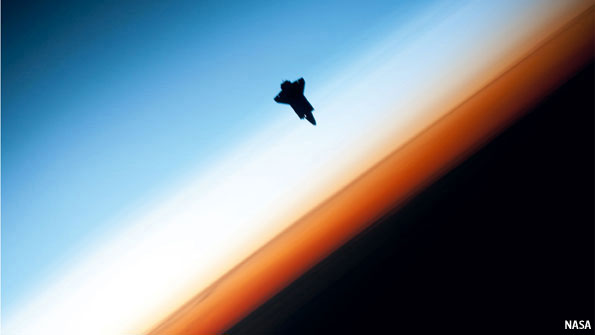
Iconic view of man's urge to explore

UPDATE 10:30 am Mountain Time

Up and safely away!

Still awe-inspiring after all these years.  Live BBC feed is here. Travel safely guys!

Stunning NASA Shuttle picture

The incredible achievements of man.

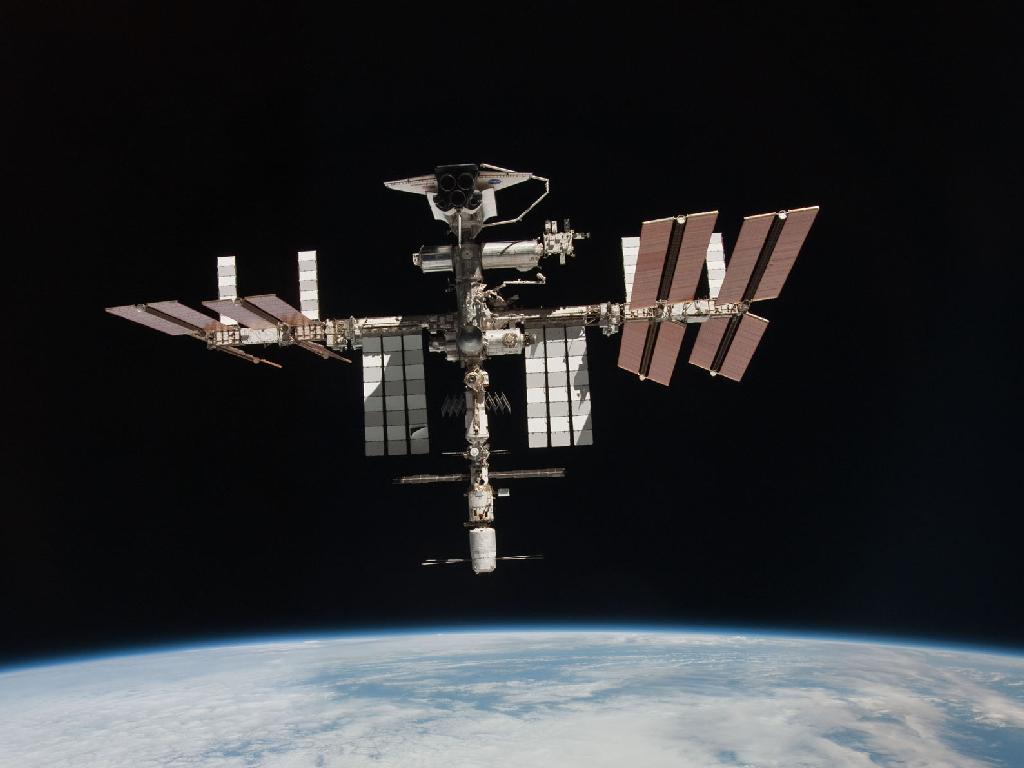
The International Space Station and the Docked Space Shuttle Endeavour

From the BBC website,

By Jonathan Amos
Science correspondent, BBC News

It is a stunning image and one that is bound to be reproduced over and over again whenever they recall the history of the US space shuttle.

The picture was taken by Italian astronaut Paolo Nespoli as he left the International Space Station in May in a Soyuz capsule to return to Earth.

Safety procedures mean the Russian vehicle would never normally be in transit when a shuttle is present.

It makes this the first-ever image of an American orbiter docked to the ISS.

Endeavour sits firmly on the bow of the station, which is moving across the surface of the Earth at a speed of 27,000km/h (17,000mph) and at an altitude of approximately 355km (220 miles).

Nespoli’s camera is looking along the ISS’s truss, or backbone, which carries the four sets of giant solar wings. The stern is occupied by Europe’s robotic freighter – the Johannes Kepler ship.

The pictures were acquired on 23 May but were only released by the US space agency (Nasa) on Tuesday [7th June, PH]. They had been eagerly awaited by space fans.

Nespoli had spent a lot of time during his 159-day stay at the station taking pictures of Earth and life aboard the international outpost. Many of these images were posted on his mission Flickr account. It was widely expected therefore that the European Space Agency astronaut would get some excellent shots during the unique departure.

Enthusiasts on the ground with telescopes routinely try to snap a shuttle attached to the ISS, and some of the results have been very impressive. But none of these pictures compares to the majestic portrait acquired by Nespoli so close to the orbiting complex.

The timing and subject are also perfect. Endeavour is seen here making her final sortie into orbit, making the last big US assembly item delivery – a $2bn particle physics experiment known as the Alpha Magnetic Spectrometer. The seven-tonne machine now sits on top of the platform.

Endeavour was also the orbiter chosen to take up the first American segment of the platform when the project had just got started in the late 1990s.

The youngest of Nasa’s shuttles returned to Earth on 1 June and will now be prepared for public display at a science museum in California. Sister ship Atlantis stands ready on the launch pad in Florida for a swansong of her own in July. Once her mission is done, no orbiter will ever fly again.

Nespoli’s crewmates in the Soyuz were Russian cosmonaut and Expedition 27 commander Dmitry Kondratyev; and Nasa astronaut Cady Coleman. Apart from the photo opportunity, their departure was a standard ISS crew rotation flight.

Their replacements blasted off from Kazakhstan on Tuesday in another Soyuz vehicle. Nasa astronaut Mike Fossum, Russian cosmonaut Sergei Volkov and Japanese astronaut Satoshi Furukawa are scheduled to arrive at the ISS on Thursday, raising its complement once again to six individuals.

The venerable Soyuz will be the only way for astronauts and cosmonauts to reach the platform in the years following the retirement of the shuttle fleet.

Nasa hopes some US commercial carriers will become available in the middle of the decade.

The NASA weblink attributed above is here, from which can be read,

This image of the International Space Station and the docked space shuttle Endeavour, flying at an altitude of approximately 220 miles, was taken by Expedition 27 crew member Paolo Nespoli from the Soyuz TMA-20 following its undocking on May 23, 2011 (USA time). The pictures taken by Nespoli are the first taken of a shuttle docked to the International Space Station from the perspective of a Russian Soyuz spacecraft.  Onboard the Soyuz were Russian cosmonaut and Expedition 27 commander Dmitry Kondratyev; Nespoli, a European Space Agency astronaut; and NASA astronaut Cady Coleman. Coleman and Nespoli were both flight engineers. The three landed in Kazakhstan later that day, completing 159 days in space.

Do go to the NASA website here as there are a total of 40 stunning images.