Tag: NASA

Compelled by curiosity

Wonderful news and a fabulous achievement!

I’m writing this as 5.40 am on the 6th.  I let our ‘bedroom’ dogs out for their early-morning pee some 20 minutes ago and then jumped back in bed, turned on my Kindle and went to the BBC News website.  There I read,

Nasa’s Curiosity rover successfully lands on Mars

The US space agency has just landed a huge new robot rover on Mars.

The one-tonne vehicle, known as Curiosity, was reported to have landed in a deep crater near the planet’s equator at 06:32 BST (05:32 GMT).

It will now embark on a mission of at least two years to look for evidence that Mars may once have supported life.

A signal confirming the rover was on the ground safely was relayed to Earth via Nasa’s Odyssey satellite, which is in orbit around the Red Planet.

The success was greeted with a roar of approval here at mission control at the Jet Propulsion Laboratory (JPL) in Pasadena, California.

As David Shukman, Science Editor of the BBC, wrote,

The day I watched Curiosity being built in a clean room at Nasa’s Jet Propulsion Laboratory in Pasadena last year, the rover’s six wheels were lying on one work bench while the chassis stood on another and it was hard to believe the white-suited engineers could make sense of the maze of tubes and cabling.

But what they’ve created now stands on the red soil of Mars – and it’s in one piece. In the hallway of a JPL building we were shown a full-size replica. Walking around it made me realise something difficult to grasp from the pictures and video: this is a beast of a machine, a kind of cosmic Humvee with instruments instead of weapons.

Sometimes Nasa public relations can appear bragging. Today it feels justified. Curiosity is all set to discover something remarkable about our strangest neighbour.

Well said and people from all around the world will echo those sentiments.

When I read what Patrice wrote in my Setting the scene post not so many hours ago,

Well, OK, keeping my fingers, and even my arms, crossed here. Seems to me the “sky crane” is over-complex, and I was not reassured when one of the physicist-engineers boasted that they had run the landing millions of time on simulator. Yeap, OK, how many times for real in Earth’s gravity?
I don’t see why they could not have landed normally, LEM style. Especially as they have wheels and could have rolled away to find undistrubed land.
There are no back-ups…
OK, let’s hope I’m wrong to be suspicious…
PA

I instinctively agreed and hoped his worries were misplaced.  They were!  The Curiosity rover is down!  Good luck to the Rover and all those who made it possible.  Well done, the team!

The Curiosity Mission.

Just a personal muse!

This has very little to do with anything other than my lifelong fascination in exploring space, which is why just over 21 hours ago I published the taster for this Post.  That ‘Earthrise’ photograph and the one below changed forever how we feel about the home we all live on.

The famous “Blue Marble” shot.

First Full-View Photo of Earth
Photograph courtesy NASA Johnson Space Center

This famous “Blue Marble” shot represents the first photograph in which Earth is in full view. The picture was taken on December 7, 1972, as the Apollo 17 crew left Earth’s orbit for the moon. With the sun at their backs, the crew had a perfectly lit view of the blue planet.

December 7th, 1972.  Coming up to 40 years ago. I was in my late-20s.  This photograph touched me in ways that I still don’t understand.  This is such a beautiful planet.

Thus Curiosity: NASA’s latest Mars rover is due to touch down at 05:31 UTC Monday 6th August.  I decided to publish this at 04:31 UTC on the 6th one hour before the crucial and novel landing, or in terms of local time here in Payson, Arizona, 9.31 pm on the 5th August.

Wishing the Mission and all the hard-working people who have spent so many years working towards this critical point in time in space history the very best of luck!  It will be wonderful wherever one is on this Planet to wake up on the 6th and hear that Curiosity has landed safely! And if you want to follow the Mission then NASA have a website devoted to the latest news.

Let me close by offering you a couple of videos from the fabulous BBC Horizon science series, full hour-long programme about NASA’s latest Mission to Mars.

NASA Engineer Adam Stelzner describes how he hopes the Curiosity rover will land.

Chief Project Scientist John Grotzinger talks about Curiosity’s scientific instruments.

Setting the scene

I have a post coming out in 21.5 hours time and rather have you all wondering why nothing came out today, here’s an image that will make sense when that post comes out.

“Earthrise” photograph taken on December 24, 1968 by William Anders, NASA

From the NASA website:

Earthrise at Christmas

Thirty-five years ago this Christmas, a turbulent world looked to the heavens for a unique view of our home planet. This photo of “Earthrise” over the lunar horizon was taken by the Apollo 8 crew in December 1968, showing Earth for the first time as it appears from deep space.

Astronauts Frank Borman, Jim Lovell and William Anders had become the first humans to leave Earth orbit, entering lunar orbit on Christmas Eve. In a historic live broadcast that night, the crew took turns reading from the Book of Genesis, closing with a holiday wish from Commander Borman: “We close with good night, good luck, a Merry Christmas, and God bless all of you — all of you on the good Earth.”

Regarded as one of the 100 photographs that changed the world, the late adventure photographer Galen Rowell called it “the most influential environmental photograph ever taken.” Captured on Christmas Eve, 1968, near the end of one of the most tumultuous years the U.S. had ever known, the Earthrise photograph inspired contemplation of our fragile existence and our place in the cosmos. For years, Frank Borman and Bill Anders of the Apollo 8 mission each thought that he was the one who took the picture. An investigation of two rolls of film seemed to prove Borman had taken an earlier, black-and-white frame, and the iconic color photograph, which later graced a U.S. postage stamp and several book covers, was by Anders.  Reference from here.

Options for the future

That damn edge, embrace it or ….. or what?

It’s some ago that I read Lester Brown’s book World on the Edge but I still recall the effect it had on me.  Namely, this is not some environmentalist’s ‘willy waving’ but something that has the potential to hurt, I mean HURT!  Since the book was published the stream of information and evidence has turned into a flood of awareness that if we don’t change our ways soon then we, as in the vastness of human life, will go over the edge.

So it was a good reminder to come across a recent extract on the Earth Policy Institute website that is republished in full, as follows:

No previous civilization has survived the ongoing destruction of its natural supports. Nor will ours. Yet economists look at the future through a different lens. Relying heavily on economic data to measure progress, they see the near 10-fold growth in the world economy since 1950 and the associated gains in living standards as the crowning achievement of our modern civilization. During this period, income per person worldwide climbed nearly fourfold, boosting living standards to previously unimaginable levels. A century ago, annual growth in the world economy was measured in the billions of dollars. Today, it is measured in the trillions. In the eyes of mainstream economists, our present economic system has not only an illustrious past but also a promising future.

Mainstream economists see the 2008–09 global economic recession and near-collapse of the international financial system as a bump in the road, albeit an unusually big one, before a return to growth as usual. Projections of economic growth, whether by the World Bank, Goldman Sachs, or Deutsche Bank, typically show the global economy expanding by roughly 3 percent a year. At this rate the 2010 economy would easily double in size by 2035. With these projections, economic growth in the decades ahead is more or less an extrapolation of the growth of recent decades.

But natural scientists see that as the world economy expanded some 20-fold over the last century, it has revealed a flaw—a flaw so serious that if it is not corrected it will spell the end of civilization as we know it. At some point, what had been excessive local demands on environmental systems when the economy was small became global in scope.

A study by a team of scientists led by Mathis Wackernagel aggregates the use of the earth’s natural assets, including carbon dioxide overload in the atmosphere, into a single indicator—the ecological footprint. The authors concluded that humanity’s collective demands first surpassed the earth’s regenerative capacity around 1980. By 2007, global demands on the earth’s natural systems exceeded sustainable yields by 50 percent. Stated otherwise, it would take 1.5 Earths to sustain our current consumption. If we use environmental indicators to evaluate our situation, then the global decline of the economy’s natural support systems—the environmental decline that will lead to economic decline and social collapse—is well under way.

How did we get into this mess? Our market-based global economy as currently managed is in trouble. The market does many things well. It allocates resources with an efficiency that no central planner could even imagine, much less achieve.

However the market, which sets prices, is not telling us the truth. It is omitting indirect costs that in some cases now dwarf direct costs. Consider gasoline. Pumping oil, refining it into gasoline, and delivering the gas to U.S. service stations may cost, say, $3 per gallon. The indirect costs, including climate change, treatment of respiratory illnesses, oil spills, and the U.S. military presence in the Middle East to ensure access to the oil, total $12 per gallon. Similar calculations can be done for coal.

We delude ourselves with our accounting system. Leaving such huge costs off the books is a formula for bankruptcy. Environmental trends are the lead indicators telling us what lies ahead for the economy and ultimately for society itself. Falling water tables today signal rising food prices tomorrow. Shrinking polar ice sheets are a prelude to falling coastal real estate values.

Beyond this, mainstream economics pays little attention to the sustainable yield thresholds of the earth’s natural systems. Modern economic thinking and policymaking have created an economy that is so out of sync with the ecosystem on which it depends that it is approaching collapse. How can we assume that the growth of an economic system that is shrinking the earth’s forests, eroding its soils, depleting its aquifers, collapsing its fisheries, elevating its temperature, and melting its ice sheets can simply be projected into the long-term future? What is the intellectual process underpinning these extrapolations?

We are facing a situation in economics today similar to that in astronomy when Copernicus arrived on the scene, a time when it was believed that the sun revolved around the earth. Just as Copernicus had to formulate a new astronomical worldview after several decades of celestial observations and mathematical calculations, we too must formulate a new economic worldview based on several decades of environmental observations and analyses.

The archeological record indicates that civilizational collapse does not come suddenly out of the blue. Archeologists analyzing earlier civilizations talk about a decline-and-collapse scenario. Economic and social collapse was almost always preceded by a period of environmental decline.

For past civilizations it was sometimes a single environmental trend that was primarily responsible for their decline. Sometimes it was multiple trends. For Sumer, rising salt concentrations in the soil, as a result of an environmental flaw in the design of their otherwise extraordinary irrigation system, led to a decline in wheat yields. The Sumerians then shifted to barley, a more salt-tolerant crop. But eventually barley yields also began to decline. The collapse of the civilization followed.

For the Mayans, it was deforestation and soil erosion. As more and more land was cleared for farming to support the expanding empire, soil erosion undermined the productivity of their tropical soils. A team of scientists from the National Aeronautics and Space Administration has noted that the extensive land clearing by the Mayans likely also altered the regional climate, reducing rainfall. In effect, the scientists suggest, it was the convergence of several environmental trends, some reinforcing others, that led to the food shortages that brought down the Mayan civilization.

Although we live in a highly urbanized, technologically advanced society, we are as dependent on the earth’s natural support systems as the Sumerians and Mayans were. If we continue with business as usual, civilizational collapse is no longer a matter of whether but when. We now have an economy that is destroying its natural support systems, one that has put us on a decline and collapse path.

The reality of our situation may soon become clearer for mainstream economists as we begin to see some of the early economic effects of overconsuming the earth’s resources, such as rising world food prices. On the social front, the most disturbing trend is spreading hunger.

As rapid population growth continues, cropland becomes scarce, wells go dry, forests disappear, soils erode, unemployment rises, and hunger spreads. As environmental degradation and economic and social stresses mount, the more fragile governments are losing their capacity to govern. They become failing states—countries whose governments can no longer provide personal security, food security, or basic social services, such as education and health care. As the list of failing states grows longer each year, it raises a disturbing question: How many states must fail before our global civilization begins to unravel?

How much longer can we remain in the decline phase, whether measured in natural asset liquidation, spreading hunger, or failing states, before our global civilization begins to break down? We are dangerously close to the edge. Peter Goldmark, former Rockefeller Foundation president, puts it well: “The death of our civilization is no longer a theory or an academic possibility; it is the road we’re on.”

Adapted from World on the Edge by Lester R. Brown.  The message is clear.

But if you haven’t read the book it’s available online, for free!  Just go here and not only will you find the link to the book but also links to other valuable materials.

Founder and President of the Earth Policy Institute, Lester Brown, speaks about his new book World on the Edge: How to Prevent Environmental and Economic Collapse. The issues, says Brown, are critical — and the big question is whether we can change direction before “we go over the edge.” Among his points: solar, wind and geothermal energy, with energy efficiency, can provide all the power we need, but a massive effort must be made now to fully shift to these clean, safe, renewable energy technologies. He strongly rejects nuclear power.

Transit of Venus

This is a copy of a Post published on the 31st May to ensure that all who are interested get the details.

That Post was called, The noblest astronomy affords, all that follows is a copy of that Post.

Don’t miss the transit of Venus across the Sun.

Continue reading “Transit of Venus”

The noblest astronomy affords

Don’t miss the transit of Venus across the Sun.

The full quotation is “This sight…is by far the noblest astronomy affords…” and was reputed to have been made by Sir Edmond Halley of Halley’s Comet fame, see here.  But today’s Post is about Venus.

Venus — Sister to Earth

From the NOAA Science on a Sphere website, we can read this about Venus,

Venus has been referred to as the sister or even twin to Earth by many because of its similar chemical composition, density and size. That, however, is where the similarities end. Venus is not only the hottest planet in the solar system, but also the brightest. Both of these characteristics are the result of the atmosphere that surrounds the planet, which is mainly composed of carbon dioxide and some sulfuric acid. This composition allows for the greenhouse effect to be astronomical causing the planet to have a constant temperature of 864°F. The planet is the brightest because the clouds, composed of sulfur dioxide and sulfuric acid, are highly reflective. The pressure of the atmosphere that surrounds Venus is 90 times that of the atmosphere around Earth, crushing any probes that land on Venus in a matter of hours.

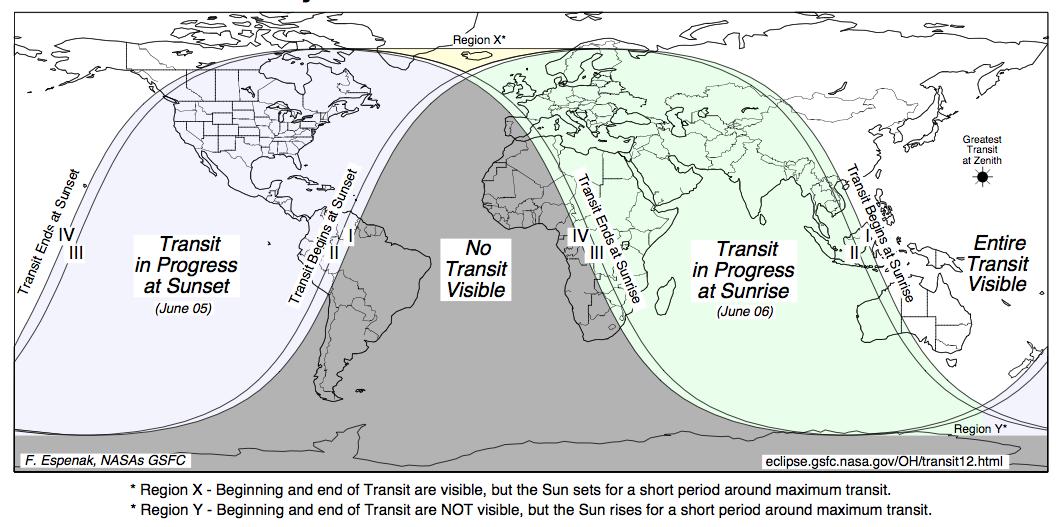
Depending on where you live on Planet Earth you will see the transit on the 5th June, the 6th June or not at all!

Courtesy of Fred Espenak (NASA GSFC), who provides additional transit of Venus data from NASA.

(That additional data referred to above may be found here.)

That transit diagram plus mounds of other interesting stuff is on the Transit of Venus website and on that website this page has the details allowing you to work out what day and time the transit occurs depending on where you are.

To close let me be a little cheeky and reproduce, in full, what appeared on the Science Daily website on the 1st May.

Venus to Appear in Once-In-A-Lifetime Event

ScienceDaily (May 1, 2012) — On 5 and 6 June this year, millions of people around the world will be able to see Venus pass across the face of the Sun in what will be a once-in-a-lifetime experience.

It will take Venus about six hours to complete its transit, appearing as a small black dot on the Sun’s surface, in an event that will not happen again until 2117.

In this month’s Physics World, Jay M Pasachoff, an astronomer at Williams College, Massachusetts, explores the science behind Venus’s transit and gives an account of its fascinating history.

Transits of Venus occur only on the very rare occasions when Venus and Earth are in a line with the Sun. At other times Venus passes below or above the Sun because the two orbits are at a slight angle to each other. Transits occur in pairs separated by eight years, with the gap between pairs of transits alternating between 105.5 and 121.5 years — the last transit was in 2004.

Building on the original theories of Nicolaus Copernicus from 1543, scientists were able to predict and record the transits of both Mercury and Venus in the centuries that followed.

Johannes Kepler successfully predicted that both planets would transit the Sun in 1631, part of which was verified with Mercury’s transit of that year. But the first transit of Venus to actually be viewed was in 1639 — an event that had been predicted by the English astronomer Jeremiah Horrocks. He observed the transit in the village of Much Hoole in Lancashire — the only other person to see it being his correspondent, William Crabtree, in Manchester.

Later, in 1716, Edmond Halley proposed using a transit of Venus to predict the precise distance between Earth and the Sun, known as the astronomical unit. As a result, hundreds of expeditions were sent all over the world to observe the 1761 and 1769 transits. A young James Cook took the Endeavour to the island of Tahiti, where he successfully observed the transit at a site that is still called Point Venus.

Pasachoff expects the transit to confirm his team’s theory about the phenomenon called “the black-drop effect” — a strange, dark band linking Venus’s silhouette with the sky outside the Sun that appears for about a minute starting just as Venus first enters the solar disk.

Pasachoff and his colleagues will concentrate on observing Venus’s atmosphere as it appears when Venus is only half onto the solar disk. He also believes that observations of the transit will help astronomers who are looking for extrasolar planets orbiting stars other than the Sun.

“Doing so verifies that the techniques for studying events on and around other stars hold true in our own backyard.. In other words, by looking up close at transits in our solar system, we may be able to see subtle effects that can help exoplanet hunters explain what they are seeing when they view distant suns,” Pasachoff writes.

Not content with viewing this year’s transit from Earth, scientists in France will be using the Hubble Space Telescope to observe the effect of Venus’s transit very slightly darkening the Moon. Pasachoff and colleagues even hope to use Hubble to watch Venus passing in front of the Sun as seen from Jupiter — an event that will take place on 20 September this year — and will be using NASA’s Cassini spacecraft, which is orbiting Saturn, to see a transit of Venus from Saturn on 21 December.

“We are fortunate in that we are truly living in a golden period of planetary transits and it is one of which I hope astronomers can take full advantage,” he writes.

Editors note: Looking directly at the sun can cause severe and permanent eye damage. Do not look directly at Venus’ transit of the sun.

For more information see Wikipedia article.

Footnote:

I’m going to republish this in full on Monday, 4th June at the usual Learning from Dogs release time of 0700 UTC so to increase the odds of all my readers who would like to see the Transit having the information in good time!

The Lost World of Lake Vostok

A breath-taking film from the BBC Horizon series about a vast hidden lake under the Antarctic ice sheet.

My apologies for putting very little effort into today’s Post.  It’s because Jean and I will be in Phoenix for much of Tuesday (I’m writing this on Monday, 7th!) and it felt easier on me to drop this in for your elucidation than try and write something in a scrabble on Tuesday evenning.

Jean and I watched this last week-end and, …. well just watch it!

It sometimes seems as if our planet has no secrets left – but deep beneath the great Antarctic ice sheet scientists have made an astonishing discovery. They’ve found one of the largest lakes in the world. It’s very existence defies belief. Scientists are desperate to get into the lake because its extreme environment may be home to unique flora and fauna, never seen before, and NASA are excited by what it could teach us about extraterrestrial life. But 4 kilometers of ice stand between the lake and the surface, and breaking this seal without contaminating the most pristine body of water on the planet is possibly one of the greatest challenges science faces in the 21st century.

In 1957 the Russians established a remote base in Antarctica – the Vostok station. It soon became a byword for hardship – dependent on an epic annual 1000km tractor journey from the coast for its supplies. The coldest temperature ever found on Earth (-89°C) was recorded here on the 21st July 1983. It’s an unlikely setting for a lake of liquid water. But in the 1970’s a British team used airborne radar to see beneath the ice, mapping the mountainous land buried by the Antarctic ice sheet. Flying near the Vostok base their radar trace suddenly went flat. They guessed that the flat trace could only be from water. It was the first evidence that the ice could be hiding a great secret.

But 20 years passed before their suspicions were confirmed, when satellites finally revealed that there was an enormous lake under the Vostok base. It is one of the largest lakes in the world – at 10,000 square km it’s about the extent of Lake Ontario, but about twice as deep (500m in places). The theory was that it could only exist because the ice acts like a giant insulating blanket, trapping enough of the earth’s heat to melt the very bottom of the ice sheet.

Not so common sense!

Sometimes one wonders what happened to common sense!

Today’s Post is motivated by a number of items that have crossed my screen over the last few days which when looked at collectively might remind one of the old saw, “You don’t have to be mad to work here, but it does help!

Sit with me, metaphorically, and allow me to muse.

First was a recent Post on 350 or bust that included the March 2012 TED Conference in Long Beach, California where NASA climate scientist Dr. James Hansen explains why he must speak out about climate change. (See the video later on.)  That Post refers to an item on Martin Lack’s Blog, Lack of Environment, where Martin as well as including the video below also lists the challenges that we on this single, finite planet face.  Here is that list,

  1. The Earth’s current energy imbalance is 0.6 Watts per sq.m.; a rate of energy input 20 times greater than the energy output of all human activity; and equivalent to the detonation of 400,000 Hiroshima-type atomic bombs every day.
  2. Since measurements began in 2003, there has been a noticeable acceleration in the annual rate of mass loss from both the Greenland and Antarctica ice caps.
  3. The last time atmospheric CO2 was 390 ppm, sea levels were 15 m higher than they are today, which implies even if we stopped burning all fossil fuels tomorrow, this is where they would end up several centuries from now because the warming “is already in the pipeline” (i.e. because the Earth must warm-up in order to restore its energy balance).
  4. Unless we stop burning fossil fuels soon, sea level rise will continue to accelerate, which is likely to cause between 1 and 5 metre rise by 2100AD (depending on how quickly we now decide to stop burning them).
  5. Palaeoclimatology tells us that 350 ppm is the safe limit for avoiding significant disruption to the planet’s ecological carrying capacity (i.e. in terms of both populations of individual species and overall biodivesity); and it now seems likely that between 20%-50% of all species will be “ticketed for extinction” by the end of the century.
  6. If we push the Earth beyond it’s “tipping point” (i.e. allow all the emerging positive feedback mechanisms to take hold); ACD will become unstoppable; and the ensuing socio-economic damage will be almost unimaginable. The total global cost of mitigation is already put at somewhere between 35 and 70 Trillion US Dollars depending on how soon we choose to act.
  7. If we had started to get off fossil fuels in 2005, it would have required 3% reduction per year in order to restore energy imbalance by 2100AD. If we start next year, it will require 6% p.a. If we wait 10 years it will require 15% p.a.
  8. Recent droughts in Texas, Oklahoma and New Mexico were 3 Standard Deviations outside the norm. Events such as these cannot therefore be ascribed to natural variability; anthropogenic climate disruption (ACD) is happening just as Hansen said it would 24 years ago (if we did not change course – which we haven’t).
  9. Pursuing emissions limits (i.e. Cap and Trade) will not work because there is no actual incentive to reduce emissions without any self-imposed restraint being to the advantage of others who do not do the same (i.e. the Tragedy of the Commons problem).
  10. Hansen uses the analogy of an approaching asteroid – the longer we wait to prevent it hitting us the harder it becomes to do so.

Do watch that Hansen video,

Second is that yesterday Martin Lack published an item that really does seem to endorse the view that there is no sign of intelligent life living on Planet Earth (not counting dogs!).

Think about it.  The planet is warming up.  The use of carbon-based fuels is a strong suspect, putting it mildly, of the rising levels of CO2 in our atmosphere, 394.45 on April 5th, so rather than change the incentives for using such fuels, we are taking advantage of  this warming planet causing the melt of the Arctic ice cap by allowing Shell to drill for oil in the Arctic.  But even crazier than that, Shell have contracted for a Finnish icebreaker to assist them in breaking up the ice!  (I really do feel a headache coming on!)

Greenpeace in the UK are running a campaign to stop this.

Sign up to save the Arctic

Let Shell know your feelings.

The pristine and beautiful Arctic: Shell wants to exploit it for oil. We want it protected.

Dozens of Greenpeace Nordic activists have boarded and occupied a Shell-contracted icebreaker in Helsinki harbour as it prepares to leave for the Alaskan Arctic.

Drilling in this fragile ecosystem – home to the polar bear, narwhal, Arctic fox and other iconic species – is unacceptable. A spill or accident in these waters would be disastrous and the harsh conditions would make responding to such a disaster almost impossible.

Demand Shell stop their plans to put the fragile Arctic and its biodiversity at risk.  We’ll keep you updated on our campaigns.

Write to Mr. Peter Voser.

Mr Peter Voser, Shell

The Arctic isn’t a place you can exploit, it’s a place we have to protect. Time and time again, experts have expressed serious doubts about the possibility of cleaning up an oil spill in the Arctic. The technical challenges posed by drilling there are obvious and no matter how much you try to convince people that your company can operate safely in such a harsh environment, we know the truth.

Because of this, I demand that you scrap your Arctic plans immediately.

Yours sincerely,

————–

By the end of this week we want 500,000 people shouting at Shell that it must end its campaign of Arctic destruction. Click here now[N.B. This is a time-sensitive campaign response – please visit Greenpeace website and enter your name and email address and they will email Shell on your behalf.]

We can change things! Together we can stop Shell and other oil companies from destroying the Arctic. Not everyone can board a ship to demand that change. But today, you can email Shell and ask them to stop drilling for oil and ask 10 of your friends to do the same. Together, we can save the Arctic!

Rosa Gierens
Greenpeace Nordic activist from Finland.

It’s not just an isolated instance of madness! Just a little over 10 days ago, I reported on President Obama’s support for the oil companies that threatens the polar bears, see “President Obama’s proposal for these magnificent and imperiled animals is a gift to Big Oil

In closing, luckily there are many voices being raised about putting an end to this madness; see the recent item from Patrice Ayme.  Hopefully, all these voices will bring about the changes to the way so many of us are governed.  As Patrice commented recently on Learning from Dogs, “Hope is the breathing of the planet“.  Maybe, just maybe, hope will win through.  No better put than by James Hansen,

Most impressive is the work of the Citizens Climate Lobby, a relatively new, fastgrowing, nonpartisan, nonprofit group with 46 chapters across the United States and Canada. If you want to join the fight to save the planet, to save creation for your grandchildren, there is no more effective step you could take than becoming an active member of this group.”
– Dr. James Hansen, head of Goddard Institute for Space Studies, NASA

Oh, and before I forget, a tornado touched down in Southern France!  Not common and not making sense!

Our most beautiful planet.

Revisiting the wonderful NASA time-lapse film.

Last November, I published a Post on Learning from Dogs under the title of This is rocket science!  It included the film Walking on Air shot from the International Space Station.

Anyway, a few days ago, Ginger I. here in Payson, sent me an email with the YouTube version of the film and I decided to include it as the only item in today’s post.

Enjoy.

Time lapse sequences of photographs taken with a 4K-camera by Ron Garan fragileoasis.org/bloggernauts/Astro_Ron and the crew of expedition 28 & 29 onboard the International Space Station from August to October, 2011. All credit goes to them, who to my knowledge shot these pictures at an altitude of around 350 km.  I intend to upload a FullHD-version presently.

HD, refurbished, smoothed, retimed, denoised, deflickered, cut, etc.  All in all I tried to keep the looks of the material as original as possible, avoided adjusting the colors and the like, since in my opinion the original footage itself already has an almost surreal and aestethical visual nature.

Music: Jan Jelinek | Do Dekor, faitiche back2001 w+p by Jan Jelinek, published by Betke Edition janjelinek.com | faitiche.de

Image Courtesy of the Image Science & Analysis Laboratory, NASA Johnson Space Center, The Gateway to Astronaut Photography of Earth eol.jsc.nasa.gov

Editing: Michael König | koenigm.com

Shooting locations in order of appearance:

1. Aurora Borealis Pass over the United States at Night
2. Aurora Borealis and eastern United States at Night
3. Aurora Australis from Madagascar to southwest of Australia
4. Aurora Australis south of Australia
5. Northwest coast of United States to Central South America at Night
6. Aurora Australis from the Southern to the Northern Pacific Ocean
7. Halfway around the World
8. Night Pass over Central Africa and the Middle East
9. Evening Pass over the Sahara Desert and the Middle East
10. Pass over Canada and Central United States at Night
11. Pass over Southern California to Hudson Bay
12. Islands in the Philippine Sea at Night
13. Pass over Eastern Asia to Philippine Sea and Guam
14. Views of the Mideast at Night
15. Night Pass over Mediterranean Sea
16. Aurora Borealis and the United States at Night
17. Aurora Australis over Indian Ocean
18. Eastern Europe to Southeastern Asia at Night

Home, sweet home!

The only one we have, Earth Day or not!

Earthrise.

It was called “the most influential environmental photograph ever taken.” Rightly so!

Those words were spoken by the late Galen Rowell, the famous Californian wilderness photographer, commenting about the Earthrise photograph taken from Apollo 8 on December 24th, 1968 during the first manned mission to the Moon.

No one who saw that picture of the planet we all live on could fail to be moved. Indeed, none more so than onboard NASA astronaut Frank Borman who uttered the words as the Earth rose above the horizon of the moon, “Oh my God! Look at that picture over there! Here’s the Earth coming up. Wow, is that pretty.” It was fellow Apollo 8 crew-member, Bill Anders, who then took the ‘unscheduled’ photograph.

Who hasn’t gazed into a night sky and been lost in the beauty above our heads. Or felt the wind, flowing across our ancient lands, kiss our face. We stand so mite-like, so insignificant in all this immensity of creation. Our planet is ‘pretty’. Indeed, Planet Earth is good, beautiful, and so precious to life. Life that arose in just a fraction of time after our Solar System formed 3.7 billion years ago; the oldest traces of life have been found in fossils dating back 3.4 billion years. Our miracle of life.

But the one thing we cannot do is to take that miracle of life for granted. Here’s a perspective on that. Just a couple of months after that famous Earthrise photograph, in February 1969, America’s National Oceanic and Atmospheric Administration (NOAA) recorded the level of CO2 in the Earth’s atmosphere as 324.42 parts per million (PPM).

From 43 years ago we fast forward to February of 2012. NOAA now recorded that CO2 level as 393.65 PPM, some 21% higher than the 1969 level, but even more importantly over 12% higher than the figure of 350 PPM which is regarded by climate scientists as the maximum safe level for our Planet. And the trend upwards is steepening. Not just for CO2 but also for Methane and Nitrous Oxide which have the potential to be incredibly more damaging to our beautiful planet than CO2.

Across the face of the world people are waking up to the fact that something has to be done. While some Governments and many industries are providing great leadership, the complexities of these modern institutions means that progress is slow; far too slow. People are now taking action for themselves and for their communities.

The most notable group is the worldwide Transition Movement. It started in the UK in September 2006, indeed started in the town of Totnes, Devon, just three miles from where I used to live.

Less than 6 years later across the world there are 975 initiatives!  Including nearly 500 Transition Communities in Europe and 392 in the UK.

In the USA, there are a staggering 285 initiatives with 26 in California and three here in Arizona: Tucson, Pima and and East Valley in Phoenix ‘mulling’ it over. The ideas behind the Transition concept are powerfully simple and can be easily summarised thus:

  • That it is inevitable that our lives will soon have to adapt to a dramatically lower energy consumption, especially carbon-based energy, and that it’s better to plan for it than to be taken by surprise.
  • That the over-whelming majority of communities, currently lacks resilience.
  • That we have to act now to rebuild our community resilience and prepare for life without fossil fuels.
  • That by tapping into the collective potential of the community, it is possible to develop new ways of living that are nourishing, fulfilling and ecologically sustainable.

Reduce our energy use, increase our resilience, switch away from carbon-based fuels and go back to the strength of communities.  No mystery about what to do!

We do not have another 43 years.  Indeed, some say we are very close to the tipping point of runaway climate consequences.

My message for this Earth Day and, indeed, for every day of the rest of our lives.