As I wrote yesterday, “… out of curiosity I wondered what I had published a year ago, in early February 2012. To my amazement what was published was as fresh and relevant as if it had been published today.”
So here’s the second part of that trilogy of posts from February, 2012. (It reads in its original form with the links and references unchanged.)
Last Friday I started re-publishing the wonderful comments that had appeared on Climate Sight in response to a question that I had raised, namely,
“While in every way that I can think of, I support the premise of mankind affecting global climate, I would love to hear from someone who could reconcile the Post above with these recent items:” and then included the links to the WSJ and Daily Mail items.
If you are not familiar with those WSJ and Daily Mail items, then you will need to go back to Friday’s Post.
So moving on.
The third response was from chrisd3, here’s what he wrote,
Paul, here is the Met Office’s response, which begins, “[The Daily Mail] article includes numerous errors in the reporting of published peer reviewed science undertaken by the Met Office Hadley Centre and for Mr. Rose to suggest that the latest global temperatures available show no warming in the last 15 years is entirely misleading.”
Here is Deltoid taking David Rose apart on some earlier pieces:
And NASA never said anything about the Thames freezing over. Rose just made that bit up.
From this, it is pretty clear why Rose chooses 15 years as his starting point: 1997-1998 was the time of the largest El Nino ever recorded, resulting in a huge temperature spike. Using that as the starting point for a temperature comparison is absolutely classic cherry-picking.
And in any event, you can’t say anything about trends in noisy data by simply comparing two arbitrary points. That is not a valid way to analyze the data (especially if you pick an obvious outlier as your starting point!). It is like trying to say whether the tide is coming in or going out by looking at the height of two waves. It just doesn’t work that way. You have to look at the long-term trend to remove the noise.
Let me take you to that Met Office response (and I’m republishing it in full).
Met Office in the Media: 29 January 2012
Today the Mail on Sunday published a story written by David Rose entitled “Forget global warming – it’s Cycle 25 we need to worry about”.
This article includes numerous errors in the reporting of published peer reviewed science undertaken by the Met Office Hadley Centre and for Mr. Rose to suggest that the latest global temperatures available show no warming in the last 15 years is entirely misleading.
Despite the Met Office having spoken to David Rose ahead of the publication of the story, he has chosen to not fully include the answers we gave him to questions around decadal projections produced by the Met Office or his belief that we have seen no warming since 1997.
For clarity I have included our full response to David Rose below:A spokesman for the Met Office said: “The ten year projection remains groundbreaking science. The complete period for the original projection is not over yet and these projections are regularly updated to take account of the most recent data.
“The projections are probabilistic in nature, and no individual forecast should be taken in isolation. Instead, several decades of data will be needed to assess the robustness of the projections.
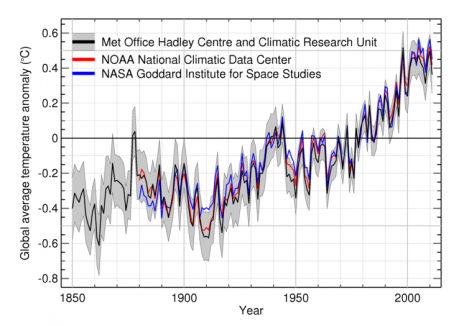
“However, what is absolutely clear is that we have continued to see a trend of warming, with the decade of 2000-2009 being clearly the warmest in the instrumental record going back to 1850. Depending on which temperature records you use, 2010 was the warmest year on record for NOAA NCDC and NASA GISS, and the second warmest on record in HadCRUT3.”
Global average temperatures from 1850 to 2011 from the three individual global temperature datasets (Met Office/UEA HadCRUT3, NASA GISS and NOAA NCDC)
Furthermore despite criticism of a paper published by the Met Office he chose not to ask us to respond to his misconceptions. The study in question, supported by many others, provides an insight into the sensitivity of our climate to changes in the output of the sun.
It confirmed that although solar output is likely to reduce over the next 90 years this will not substantially delay expected increases in global temperatures caused by greenhouse gases. The study found that the expected decrease in solar activity would only most likely cause a reduction in global temperatures of 0.08 °C. This compares to an expected warming of about 2.5 °C over the same period due to greenhouse gases (according to the IPCC’s B2 scenario for greenhouse gas emissions that does not involve efforts to mitigate emissions). In addition the study also showed that if solar output reduced below that seen in the Maunder Minimum – a period between 1645 and 1715 when solar activity was at its lowest observed level – the global temperature reduction would be 0.13C.
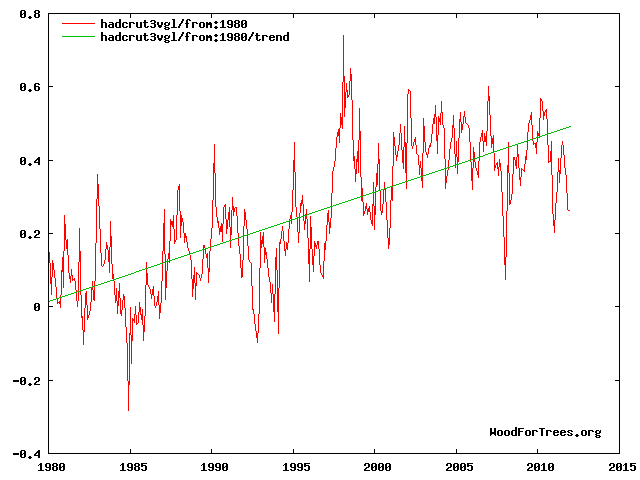
Back to that response from chrisd3. He offered this, “Finally, here is a chart of global temps from HadCRU.” Here is that chart, remember we are looking at Global temperatures.
Global temperature trend
OK, between this Post and my Post last Friday, you probably get the message! There were many other contributions and I could go on and on quoting the great responses I got, all of them uniformly saying there IS global warming unprecedented in recent years. The message is crystal clear and those who wish to deny the evidence … well, I can’t come up with a polite term, so will just leave it at that!
My final contribution is from Martin Lack, author of the Blog Lack of Environment, and a good friend of Learning from Dogs. Here is what he wrote in a recent email,
When I eventually saw your earlier comment, I was surprised and disappointed in equal measure because I almost feel that I have failed in some way. Let me explain: Unlike ClimateSight and SkepticalScience, which both do an excellent job of focusing on the science of climate change, my blog is deliberately focused on the politics underlying the denial of all environmental our problems; including 2 key aspects to my MA dissertation, namely the political misuse of scepticism; and the psychology of denial. See my How to be a Climate Change ‘Sceptic’ for more detail.
Therefore, although not specifically categorised as such, just about everything I have posted is traceable back to Paul and Anne Ehrlich’sBetrayal of Science and Reason (1996) and/or Naomi Oreskes and Erik Conway’s Merchants of Doubt (2010). For someone who does not currently go to any Church, I am remarkably fond of quoting Scripture so, if necessary, please forgive me but, as the Good Book says: “What has been will be again, what has been done will be done again; there is nothing new under the sun” (Ecclesiastes 1:9).
Therefore, I do not think you should be surprised by the amount of misinformation and misrepresentation contained in the original WSJ Sixteen’s article; and/or the fact that denialist arguments are repeated no matter how many times they have been shown to be false. Furthermore, I would warn against trying to summarise it all on Learning from Dogs. This is definitely Book territory and, in addition to the two mentioned above, the market is already saturated by the likes of Climate Change Cover-up by James Hoggan and Climate Change Denial by Haydn Washington and John Cook.
With very best wishes for a fog-free future,
What to say to close these two Posts off? Frankly, it’s difficult to know how to pitch it. The science seems clear beyond reasonable doubt. But if you are reading this and disagree, then PLEASE offer the science to refute the conclusions presented here. I promise you that I will present it on Learning from Dogs.
So let me end with a simple photograph.
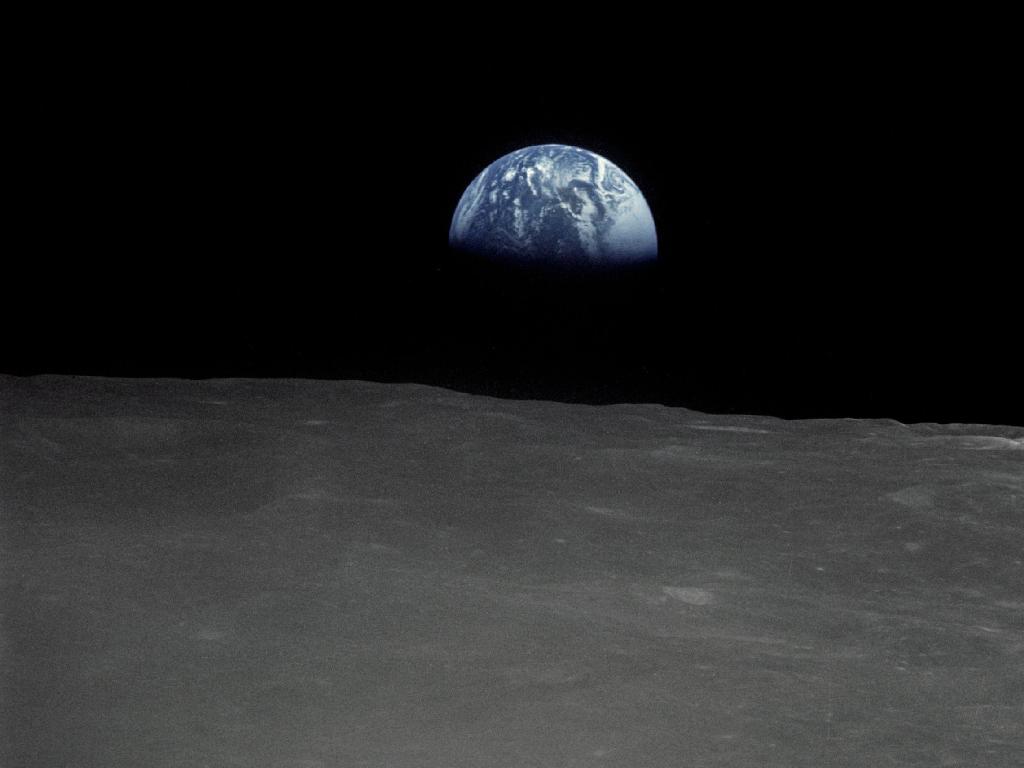
Earthrise
This is the photograph that wilderness photographer Galen Rowell called, “the most influential environmental photograph ever taken.”
The now world-famous photograph was taken by Astronaut William Anders from Apollo 8, the first manned mission to the Moon, a little over 43 years ago on December 24th, 1968.
As the Earth rose above the horizon of the moon, NASA astronaut Frank Borman uttered the words, “Oh my God! Look at that picture over there! Here’s the Earth coming up. Wow, is that pretty.” Bill Anders then took the ‘unscheduled’ photograph.
Now project forward 43 years to the year 2055 and play with the idea of what ‘pretty‘ planet Earth will be like for mankind and so many other species, including our longest companion, the dog, if we don’t get our act together pretty soon!
Maybe not from a Mayan perspective but, nevertheless, who knows!
For some time now I have subscribed to the online magazine Big Think. Daniel Honan, Managing Editor, has contrived to bring together a group of very interesting authors from a wide range of disciplines, presenting a weekly collection of thought-provoking articles. Despite the volume of emails that seems to assault my in-box each day, it’s very rare for me not to browse the weekly digest from Big Think.
Thus it was that early on the 13th (last Thursday) I read a wonderful item written by Steven V. Mazie, Associate Professor of Political Studies at Bard High School Early College-Manhattan.
A quick telephone call to Dan Honan produced an immediate ‘yes’ to my request for permission to republish the Steven Mazie piece here on Learning from Dogs so settle back and enjoy.
oooOOOooo
Googling the Apocalypse: the Web as Epistemological Vortex
Steven Mazie on December 11, 2012, 2:12 PM
Let’s say you’re just now tuning in to reports that the world will end on December 21 when the Mayan calendar resets to zero. Maybe you’re one of the 35 million Americans who fear it will really happen. Maybe the prospect of solar storms, rogue planets and devastating floods is a welcome distraction from more pedestrian anxieties of everyday life. Or maybe you’re just curious how such a ridiculous idea could persuade “panicked” Russians to buy up all the “matches, kerosene, sugar and candles” in town or spur a Chinese man to spend his life savings building an ark to keep him afloat after the catastrophe.
Where do you turn to learn more? To the epistemic umbrella of the 21st century, of course, and here is what Google will show you.
Do you consult the first hit, billed as the “official website for 122112 information”? Do you settle for the detailed account in the Wikipedia entry, listed second? Or do you flick down to the third, an earnest attempt by NASA to explain “Why the World Won’t End”?
If you go with the first site, you will find a bizarre, colorful bazaar of information, perspectives and advice on the approaching doomsday. There is enough to keep you occupied here for a while: a list of celebrities who believe the hype (finding Mel Gibson on the list isn’t much of a surprise, but Janeane Garofolo? really?), an article listing “37 Things You Should Start Hoarding Now” and one remarkable video summarizing the various ways the world might end and calling on world leaders to tell the “TRUTH” about the devastation awaiting us:
The video is a study in epistemic manipulation. Narrated by a man with a severe British accent, the presentation claims — three times — “we just don’t know what to believe anymore” about “the most anticipated date of our time.” Implying that the media, corporate advertisers, the “government-sponsored scientists” at NASA and “even highly respected major religious organizations” are all either mistaken or willfully fooling us, the video appeals to our “gut instincts that something is wrong — something just doesn’t feel right.” It’s a miracle Stephen Colbert hasn’t picked this up yet. “In the eyes of many,” the video announces with no substantiation, “the prophecies of doom have been written.”
The sad hilarity of NASA’s attempt to calm everyone down takes the form of a staid FAQ. There are no bells and whistles, videos, garish colors or flashing links. Just sober, somewhat condescending, straightforward claims: “Our planet has been getting along just fine for more than 4 billion years, and credible scientists worldwide know of no threat associated with 2012.”
The problem is that credible science often fails to convince the masses. It cannot budge the majority of Americans who continue to deny the reality of evolution. It cannot convince more than 41 percent of Americans that the activities of human beings play a role in global warming. It’s no wonder, then, that so many people worldwide are keeping doomsday supply companies in business, buying up freeze-dried food rations and personal bunkers rather than Christmas presents, or that sites like December212012.com are profiting from these advertisers.
It’s dispiriting to witness the mass delusion of a tenth of humanity. You have to feel sorry for the Chinese ark-builder who will be left penniless on December 22, and you have to empathize with the people who are contemplating killing their pets or committing suicide to avoid the doomsday devastation.
But this unsettling phenomenon is a symptom of a universal human quandary: how to know whom to trust about things we can’t see or don’t understand. In a section on the rationality of belief in his delicious book Cunning(2006), political and legal theorist Don Herzog offers this:
What you believe depends on who you believe. And who you believe depends on what you believe. Your beliefs, your knowledge, your experience, your assignments of what I’ll call epistemic authority, that is, who or what sources are trustworthy on what issues: all are caught up in each other…Whether it’s rational for you to believe something depends on how it fits in with what you already believe, not least about the credibility of those reporting it.
The best argument against the doomsday believers may come on December 22, when, with any luck, most of us will still be around. But as my fellow blogger David Ropeik explained recently, and as Herzog’s analysis indicates, the next epistemological doomsday is just around the corner.
My judgment is that I should leave this post as it is. As a slightly tongue-in-cheek review of this much heralded prediction.
But I can’t.
I’m going to follow Steve’s article with this (thanks Christine):
More footage from Chasing Ice, an astonishing clip of the largest iceberg calving ever recorded. Arctic sea ice levels this summer hit a record low; according to the U.S. National Snow & Ice Data Centre in September, more than 600,000 square kilometres more ice had melted in 2012 than was ever recorded by satellites before. We are indeed melting our children’s future, and apparently many of us are too busy to hold our governments to account for their lack of action.
If we don’t change our ways on this beautiful planet pretty damn soon, then my guess is that we are headed for a massive depopulation and a return to a much more primitive lifestyle, a future that will be brutally obvious by 2020.
What is relevant, to a degree unprecedented in the history of humanity, is how the peoples of this planet respond NOW!
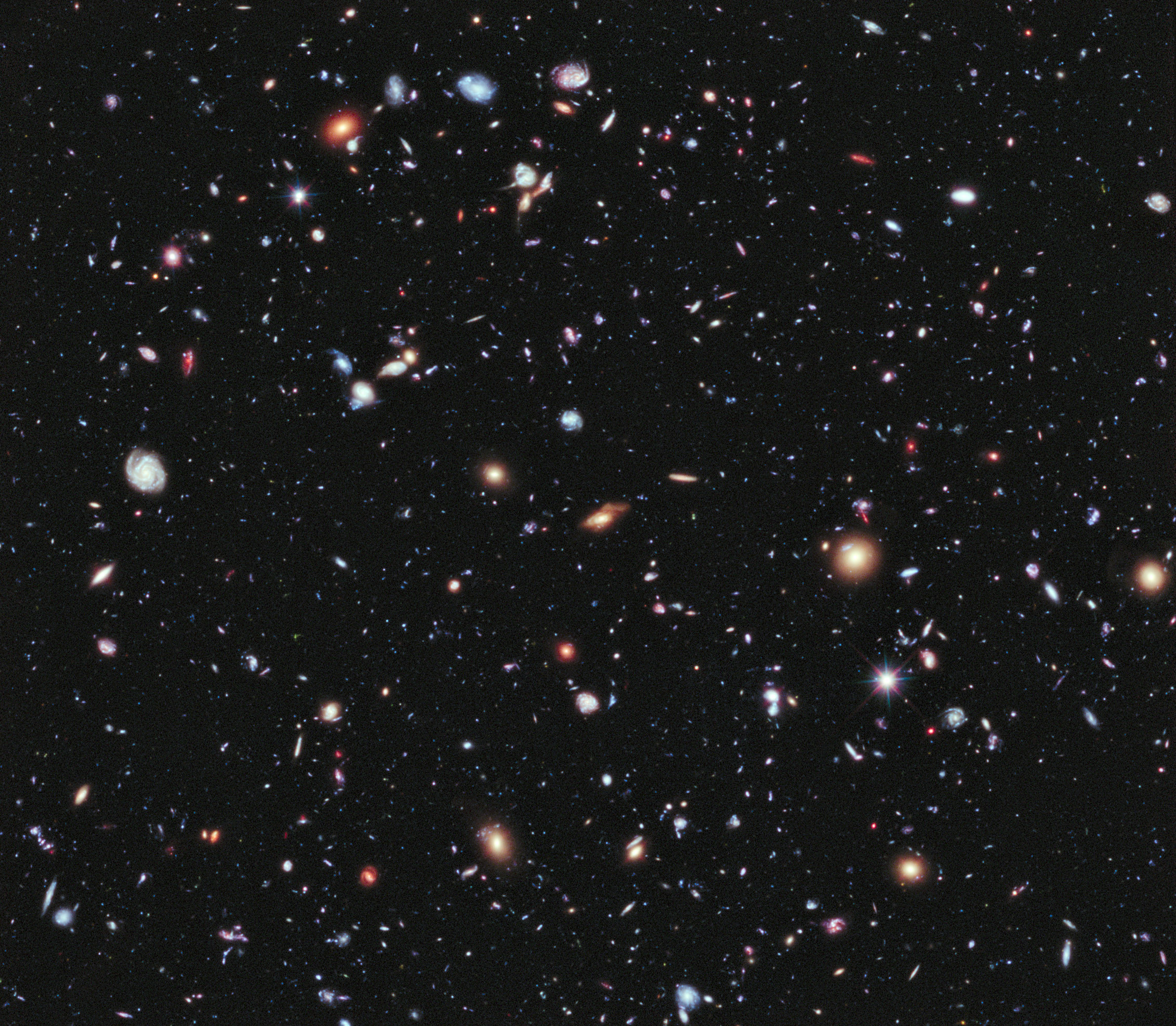
The Hubble Space Telescope (HST) has produced one of its most extraordinary views of the Universe to date.
Called the eXtreme Deep Field, the picture captures a mass of galaxies stretching back almost to the time when the first stars began to shine.
But this was no simple point and snap – some of the objects in this image are too distant and too faint for that.
Rather, this view required Hubble to stare at a tiny patch of sky for more than 500 hours to detect all the light.
“It’s a really spectacular image,” said Dr Michele Trenti, a science team member from the University of Cambridge, UK.
Then while the BBC News item had that stunning picture, over on the NASA website there was the following image together with more information.
Called the eXtreme Deep Field, or XDF, the photo was assembled by combining 10 years of NASA Hubble Space Telescope photographs taken of a patch of sky at the center of the original Hubble Ultra Deep Field. The XDF is a small fraction of the angular diameter of the full moon.
The Hubble Ultra Deep Field is an image of a small area of space in the constellation Fornax, created using Hubble Space Telescope data from 2003 and 2004. By collecting faint light over many hours of observation, it revealed thousands of galaxies, both nearby and very distant, making it the deepest image of the universe ever taken at that time.
The new full-color XDF image is even more sensitive, and contains about 5,500 galaxies even within its smaller field of view. The faintest galaxies are one ten-billionth the brightness of what the human eye can see.
Magnificent spiral galaxies similar in shape to our Milky Way and the neighboring Andromeda galaxy appear in this image, as do the large, fuzzy red galaxies where the formation of new stars has ceased. These red galaxies are the remnants of dramatic collisions between galaxies and are in their declining years. Peppered across the field are tiny, faint, more distant galaxies that were like the seedlings from which today’s magnificent galaxies grew. The history of galaxies — from soon after the first galaxies were born to the great galaxies of today, like our Milky Way — is laid out in this one remarkable image.
Hubble pointed at a tiny patch of southern sky in repeat visits (made over the past decade) for a total of 50 days, with a total exposure time of 2 million seconds. More than 2,000 images of the same field were taken with Hubble’s two premier cameras: the Advanced Camera for Surveys and the Wide Field Camera 3, which extends Hubble’s vision into near-infrared light.
“The XDF is the deepest image of the sky ever obtained and reveals the faintest and most distant galaxies ever seen. XDF allows us to explore further back in time than ever before”, said Garth Illingworth of the University of California at Santa Cruz, principal investigator of the Hubble Ultra Deep Field 2009 (HUDF09) program.
The universe is 13.7 billion years old, and the XDF reveals galaxies that span back 13.2 billion years in time. Most of the galaxies in the XDF are seen when they were young, small, and growing, often violently as they collided and merged together. The early universe was a time of dramatic birth for galaxies containing brilliant blue stars extraordinarily brighter than our sun. The light from those past events is just arriving at Earth now, and so the XDF is a “time tunnel into the distant past.” The youngest galaxy found in the XDF existed just 450 million years after the universe’s birth in the big bang.
Before Hubble was launched in 1990, astronomers could barely see normal galaxies to 7 billion light-years away, about halfway across the universe. Observations with telescopes on the ground were not able to establish how galaxies formed and evolved in the early universe.
Hubble gave astronomers their first view of the actual forms and shapes of galaxies when they were young. This provided compelling, direct visual evidence that the universe is truly changing as it ages. Like watching individual frames of a motion picture, the Hubble deep surveys reveal the emergence of structure in the infant universe and the subsequent dynamic stages of galaxy evolution.
The infrared vision of NASA’s planned James Webb Space Telescope will be aimed at the XDF. The Webb telescope will find even fainter galaxies that existed when the universe was just a few hundred million years old. Because of the expansion of the universe, light from the distant past is stretched into longer, infrared wavelengths. The Webb telescope’s infrared vision is ideally suited to push the XDF even deeper, into a time when the first stars and galaxies formed and filled the early “dark ages” of the universe with light.
The Hubble Space Telescope is a project of international cooperation between NASA and the European Space Agency. NASA’s Goddard Space Flight Center in Greenbelt, Md., manages the telescope. The Space Telescope Science Institute (STScI) in Baltimore, Md., conducts Hubble science operations. STScI is operated by the Association of Universities for Research in Astronomy, Inc., in Washington.
What a fabulous achievement. Just think that “The faintest galaxies are one ten-billionth the brightness of what the human eye can see.” and “The history of galaxies — from soon after the first galaxies were born to the great galaxies of today, like our Milky Way — is laid out in this one remarkable image.” Plus, “The youngest galaxy found in the XDF existed just 450 million years after the universe’s birth in the big bang.”
Do you know what crosses my mind looking at the picture? All those galaxies with, presumably, tens of thousands of planets and, surely, the near certainty that intelligent life must be teeming across those trillions of miles!
Let me close with this YouTube video brought to my attention thanks to Peter Sinclair of Climate Crocks.
We’ve all seen pictures of Earth from space, but have we really taken the time to appreciate what our planet looks like against the starscapes of the Milky Way galaxy? Here, we beckon viewers to see Earth in its cosmic context, which includes the stars, interstellar gases, the moon, the sun, and the solar winds. Be sure to watch in full HD, 1080p, and imagine you’re an astronaut aboard the International Space Station with a little time on your hands.
How Virtual Reality Has Changed the English Language and the Way Humans Communicate
Introduction
Is it noise or content?
One of the wonderful consequences of spending far too much time ‘blogging’ is the connections that I have made over the last 27 months. I have come across a wonderful range of interesting writers and learnt so much more from those links. However, that’s not all, by a long chalk. A number of you have offered to contribute an essay to Learning from Dogs. (And if you are reading this and would like to offer a guest post then ‘fill your boots!‘ )
So it was that a few weeks ago I received an email from Alexa Russell. She offered me a guest post that I found very interesting, leading to it being published today.
I asked Alexa to write a little about herself, to which she replied, “I am a freelance writer who likes to write about technology, education and the changing nature of society. I am currently considering graduate school but fear being scared off by mounting costs and diminishing returns.”
So onto the post, which Alexa explains is about the ways in which virtual reality and digital devices change how we humans communicate and use the English language. Alexa is the author of several resources on studying English and the value in earning anEnglish PhD. Here she asks what Learning from Dogs has previously wondered — do we need to understand language in order to get the message?
oooOOOooo
How Virtual Reality Has Changed the English Language and the Way Humans Communicate
Technology has changed the way we communicate in some obvious (and occasionally obnoxious) ways. Grammar, punctuation, and even a more general respect for lexical rules have diminished in favor of speed and facility in text messages, which are now the most common communicative tool. Probably more periods have been omitted in the last two days than in the hundreds of years since the Gutenberg Bible. None will be omitted here, but maybe they should be.
As social networks expand, making an acquaintance at a coffee shop can easily translate to a lifetime connection – thanks to Facebook. And finally, there is a way to sever contact without engaging in direct conflict – defriending. The funniest thing about defriending is that it is usually considered as an unimpeachable revocation, as starkly offensive as a breakup – when in fact the message has not even crossed the digital threshold to the real world.
As virtual reality and networks progress, so too do our attempts to understand exactly what has happened and may happen to our grip on physical reality. There are a myriad of movies that attempt to explore the subject: The Matrix, Inception, and Avatar, to name a few of the most popular. In The Matrix, Neo discovers that he can will himself to do anything, move with almost infinite speed, gain superman strength, as long as he can carry that belief to his avatar in The Matrix. In Avatar, the protagonist cannot walk in real life but is then given a taller, stronger, more agile host to control. Inception tests the boundaries of the physical, as well as the emotional, as the virtual realities of the “hacked” mind have real impact on his or her emotional truth.
The conclusions that all of these movies come to is the same, albeit shocking fact: virtual reality has real-world effects. Neo can die if he believes he has died. Love can transfer from the blue, tall, strong, avatar to the avatar’s handicapped controller. Inception controls the outlook and actions of an individual well beyond the confines of the dreamworld. It can even come to define the rest of the dreamer’s life.
Virtual reality allows us to shed our physical shells and our weak points. There is nothing holding us back from becoming what or who we want to be. The zits and potbellies of real life give way to what is being communicated. Equally, as in the Matrix, World of Warcraft and even in NASA’s new medical diagnosis virtual reality for astronauts, skills can be learned more quickly than ever will be possible in real life. The NASA device gives astronauts an instant how-to guide, which will enable them to collect data and provide diagnoses as if they had years of medical school under their belts.
So, it really shouldn’t be all that surprising that grammar, punctuation, and spelling have lost a lot of their importance. When people communicate through a virtual medium, they can forget things like academic training and rules of grammar. The value of training and rules is diminishing. It is the essence of the message, not its style, that matters. The biggest question, however is, can you understand the essence?
oooOOOooo
You can understand why it was such a pleasure to receive Alexa’s essay! And the question left in the air, so to speak, in her closing sentence, is one of huge import. As we add to, or is it replace, our tradition of the ‘spoken’ word with this new-world of staccato speak, what’s happening to the essence of the message!
I do hope that Alexa will grace these pages again.
An afterthought about the adventurous spirit of man.
While the focus on the manned exploration of space has declined significantly since those days of the Apollo missions, the spirit to explore has not diminished. This was underlined in spades by a recent post from the British blog Earth & Solar System that I have been subscribing to since a few weeks ago.
This blog reflects the research interests of the Isotope Cosmochemistry and Geochemistry Group at the University of Manchester. In our laboratories we study samples from comets, interstellar dust, interplanetary dust, Mars, the moon and asteroids to understand how the Earth and the Solar System were formed, how they evolved and became what we see today. We study the Earth and its chemistry to understand how it works, its mantle, crust, oceans and how we change it. We want to share and discuss what we find with everyone.
The blog is for sharing science and what we and other research groups discover as we do science in real time. Discussion, questioning and enquiry are good, but politics, and opinion that can’t be backed up by published scientific work are strictly off-limits and will be removed.
Yet another example of why integrity is the only way forward.
Anyway, the recent post that was published came into my ‘in-box’ on Monday and I wanted to share it with you. Primarily because the mainstream media have moved on and there is little ‘news’ about NASA’s Curiosity rover. That’s why this post is so fascinating and it’s reproduced on Learning from Dogs with the permission of Ashley King, the author.
The past week has seen NASAs Curiosity rover return more amazing images of the Gale crater, fire up its DAN and SAM instruments, and take its first steps towards Mt. Sharp.
Mastcam view south-west from the Bradbury landing site. The foreground is boulder-strewn and contains the edge of an impact crater. The layered rocks in the background form the base of Mt. Sharp (NASA/JPL-Caltech/MSSS).
The new images, captured using the 100mm telephoto lens of the Mastcam, provide a glimpse of the geological treats that await scientists at the base of Mt. Sharp. Of particular interest has been the identification of an unconformity, where two rocks in contact but of different ages indicate a break in the geological record. Satellite data suggests that the rocks lying below the unconformity contain hydrous minerals whilst those above are “dry”. It appears these rock units formed under very different environmental conditions.
Unconformity (marked by white dots) at Mt. Sharp (NASA/JPL-Caltech/MSSS).
Next, Curiosity had another driving lesson, this time positioning itself over one of the scour marks created during landing. This allowed the rover to continue testing the ChemCam and turn on the Dynamic Albedo of Neutrons (DAN) instrument, which will be used to search for water below the Martian surface. The Sample Analysis at Mars (SAM) instrument, comprising of a mass spectrometer, gas chromatograph and tunable laser spectrometer, was also gently woken up. SAM can measure the abundance of C compounds, H, N and O, elements associated with life, in atmospheric and powdered rock samples. A quick test of some Earth air trapped in the instrument since launch confirmed that it is working well and should soon be ready for Martian samples.
Curiosity has now completed four drives and is heading for Mt. Sharp. However, the first target is Glenelg, a rock outcrop 400m to the east of the Bradbury landing site, where it’s hoped Curiosity will start using its drill. Although the journey will take several weeks, Glenelg contains at least three different rock types that will help scientists piece together the geological history of Gale crater.
Leaving the Bradbury landing site. This Navcam image shows the tracks left in the Martian soil by Curiosity (NASA/JPL-Caltech).
oooOOOooo
Makes a nice change to forget about the goings-on here on Planet Earth!
Like millions of others on this planet, I was held spellbound by the historic and epic moment of man placing his mark on another heavenly body, the Moon. I had been so wrapped up in NASA’s space missions that I took a holiday from work (I was working at the time for ICIANZ in Sydney, Australia) for the week of July 16th, 1969.
It was, of course, July 16th when the Apollo 11 Mission launched from the Kennedy Space Center culminating at precisely 20:17:39 UTC on July 20, 1969, the moment when the Lunar Module made lunar contact.
But in terms of me writing my own obituary for Neil, what could I offer?
Then a couple of items changed my mind.
Neil Armstrong (August 5, 1930 – August 25, 2012)
The first was reading the obituary printed in The Economist. I have long admired the many, many beautiful obituaries that have been published by this newspaper and this one was no exception. Take this extract from the Neil Armstrong obituary,
He had an engineer’s reserve, mixed with a natural shyness. Even among the other astronauts, not renowned for their excitability, he was known as the “Ice Commander”. Mike Collins, one of his crew-mates on the moon mission, mused that “Neil never transmits anything but the surface layer, and that only sparingly.” He once lost control of an unwieldy contraption nicknamed the Flying Bedstead that was designed to help astronauts train for the lunar landing. Ejecting only seconds before his craft hit the ground and exploded, he dusted himself off and coolly went back to his office for the rest of the day. There was work to be done.
Then the beautiful words that bring the obituary to a close,
Earth’s beauty
Over half a century, the man who never admitted surprise was surprised to observe the fading of America’s space programme. The Apollo project was one of the mightiest achievements of the potent combination of big government and big science, but such enterprises came to seem alien as well as unaffordable. Mr Armstrong, who after his flight imagined bases all over the moon, sadly supposed that the public had lost interest when there was no more cold-war competition.
Yet the flights had one huge unintended consequence: they transformed attitudes towards Earth itself. He too had been astonished to see his own planet, “quite beautiful”, remote and very blue, covered with a white lace of clouds. His reserve, after all, was not limitless. One photograph showed him in the module after he and Buzz Aldrin had completed their moon-walk, kicking and jumping their way across the vast, sandy, silver surface towards the strangely close horizon. He is dressed in his spacesuit, sports a three-day beard, and is clearly exhausted. On his face is a grin of purest exhilaration.
” … they transformed attitudes towards Earth itself. He too had been astonished to see his own planet, “quite beautiful”, remote and very blue, covered with a white lace of clouds.” For that reason alone, we need to celebrate the achievement of the Apollo 11 mission for putting our own planet into perspective within the enormity of the universe.
The second item that persuaded me to write this was a wonderful historic insight into how a potential catastrophy on the surface of the Moon would have been handled by President Nixon. This historic item was published on Carl Milner’s blog the other day, the specific item being What if the Moon Landing Failed? Republished with the very kind permission of Carl.
When Richard Nixon was the President of the United States, they had a speech ready for him to deliver to the world just in case the 1969 moon landing had ended in disaster. In fact many experts believed there was a big chance that Neil Armstrong and Edwin ‘Buzz’ Aldrin could have really gotten stuck on the moon. It’s something we don’t really think about now because we all know it was such a success. American Archives have unearthed the speech that would have been delivered if the late great Armstrong and Aldrin had never made it back to earth. This is such a great piece of history that I thought I might never see.
Give it a read, It’s such a moving and well prepared speech, and such a good thing that President Nixon never had to delivered it.
So, as with millions of others, I am delighted that this speech remained unspoken and instead we experienced: “At 5:35 p.m. (US EDT), Armstrong and Aldrin successfully docked and rejoined Collins, and at 12:56 a.m. on July 22 Apollo 11 began its journey home, safely splashing down in the Pacific Ocean at 12:50 p.m. on July 24.”
Neil Armstrong’s legacy is not only being part of the wonderful team that allowed man to make the first footprint on the Moon but also bringing into our human consciousness that this blue, wonderful planet we all live on is the only home we have.
First Full-View Photo of Earth Photograph courtesy NASA Johnson Space Center This famous “Blue Marble” shot represents the first photograph in which Earth is in full view. The picture was taken on December 7, 1972, as the Apollo 17 crew left Earth’s orbit for the moon. With the sun at their backs, the crew had a perfectly lit view of the blue planet.
Strikes me that celebrating July 20th each year as Blue Planet Day might not be a bad idea! Any takers? Now that would be a legacy for Neil!
Just about the most fundamental requirement in life!
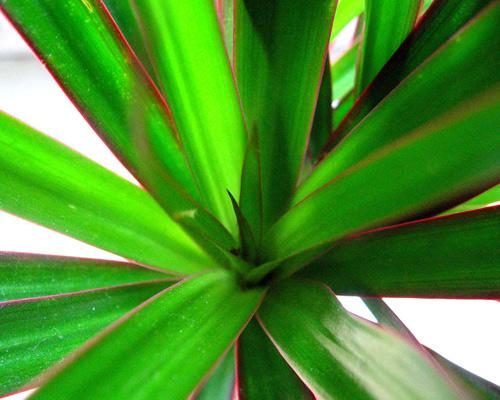
I subscribe to the Mother Nature Network website and recently in their ’round robin’ was this item, A Breath of Fresh Air. It’s all about the role of plants inside the home for improving the quality of the air we breathe. Thought, dear reader, that you would enjoy this.
15 houseplants for improving indoor air quality
Photo: ivama/Flickr
A breath of fresh air
In the late ’80s, NASA and the Associated Landscape Contractors of America studied houseplants as a way to purify the air in space facilities. They found several plants that filter out common volatile organic compounds (VOCs). Lucky for us the plants can also help clean indoor air on Earth, which is typically far more polluted than outdoor air. Other studies have since been published in the Journal of American Society of Horticultural Science furtherproving the science. Want to see the best flowers? Just click through the buttons above to see all 15 plants. (Text: Julie Knapp)<
The image above is just one of 17, each with details of how they contribute to cleaner, less toxic, air. So don’t delay, click here and read all about them yourself. Here’s an example of the presentation from picture number 16.
Peace lily (Spathiphyllum)
Shade and weekly watering are all the peace lily needs to survive and produce blooms. It topped NASA’s list for removing all three of most common VOCs — formaldehyde, benzeneand trichloroethylene. It can also combat toluene and xylene.
Raise your eyes in wonder at the most wonderful annual show from space.
A Perseid meteor streaks across the sky in this Aug. 12, 2008 photo near Rogers Spring in the Lake Mead National Recreation Area in Nevada. (Ethan Miller/Getty Images)
As of August 8, 2012, the zenithal hourly rate (ZHR) of meteors visible in a dark sky has gone up to 21! That’s according to the International Meteor Organization. Clearly the Perseid meteor shower is rising to its peak, as it does every year at this time.
The peak mornings will be August 11, 12 and 13. August 12 might be the best morning. August 11 might be better than August 13. The moon is waning now. And many people are seeing meteors!
The Delta Aquarid and Perseid meteor showers combine in late July and August to create what most consider the best and most reliable meteor display for Northern Hemisphere observers. As always, after midnight is the best time for meteor-watching. The moon will be there, but getting thinner every morning. On the mornings (not the evenings) of August 11, 12 and 13, the moon will be a waning crescent, and the meteors should be flying at a rate closer to their peak of 50 or 60 meteors per hour. As an added treat – on August 11, 12 and 13 – the moon will be sweeping past the brightest planets Venus and Jupiter in the eastern predawn sky. You can’t ask for more!
Well you could ask for more and there is more on that very helpful website, ergo:
August 10/11, 11/12, and 12/13, 2012 Perseids
Meteors are typically best after midnight, but in 2012, with the moon rising into the predawn sky, you might want to watch for Perseid meteors in late evening as well. You can get moonrise times via this custom sunset calendar. As seen from around the world, the waning crescent moon will rise later on August 12 than on August 11, and, on the morning of August 13, although you’re slightly past the peak, the moon will rise later still.
On any of those mornings, moonlight shouldn’t be so overwhelming as to ruin the show. Plus the moon on those mornings will be near the bright planets Venus and Jupiter in the eastern predawn sky. It’ll be a beautiful early morning scene.
The Perseids are typically fast and bright meteors. They radiate from a point in the constellation Perseus the Hero. You don’t need to know Perseus to watch the shower because the meteors appear in all parts of the sky. The Perseids are considered by many people to be the year’s best shower, and often peak at 50 or more meteors per hour in a dark sky.
The Perseids tend to strengthen in number as late night deepens into midnight, and typically produce the most meteors in the wee hours before dawn. These meteors are often bright and frequently leave persistent trains.
Starting in late evening on the nights of August 10/11, 11/12 and 12/13, the Perseid meteors will streak across these short summer nights from late night until dawn, with only a little interference from the waning crescent moon. Plus the moon will be near the bright planets Venus and Jupiter in the eastern predawn sky.
Finally, here’s some fabulously helpful information on the NASA website:
NASA Chat: Stay ‘Up All Night’ to Watch the Perseids!
Escape the heat of the waning days of summer for an evening of sky watching. The Perseid meteor shower peaks on the night of August 11 through the morning of August 12. Perseid rates can get as high as 100 per hour, with many fireballs visible in the night sky. A waning crescent moon will interfere slightly with this year’s show, but viewing should definitely be worth a look!
On the night of Aug. 11-12, astronomer Bill Cooke and his team from the Meteoroid Environment Office at NASA’s Marshall Space Flight Center will answer your questions about the 2012 Perseid meteor shower via an “Up All Night” live chat. To join the chat, simply return to this page and log in. The chat experts will be available to answer questions between the hours of 11 p.m. – 3 a.m. EDT, beginning the evening of Aug. 11 and continuing into the morning of Aug. 12.
Watch the Perseids! Live Video/Audio Feed
On the night of Aug. 11, a live video/audio feed of the Perseid shower will be embedded below (go to here). The camera is mounted at NASA’s Marshall Space Flight Center in Huntsville, Ala. During daylight, you’ll see a dark gray box — the camera is light-activated and will turn on at dusk. At night you’ll see white points, or stars, on a black background.
About the Perseids
The Perseids have been observed for at least 2,000 years and are associated with the comet Swift-Tuttle, which orbits the sun once every 133 years. Each year in August, the Earth passes through a cloud of the comet’s debris. These bits of ice and dust — most over 1,000 years old — burn up in the Earth’s atmosphere to create one of the best meteor showers of the year. The Perseids can be seen all over the sky, but the best viewing opportunities will be across the northern hemisphere. Those with sharp eyes will see that the meteors radiate from the direction of the constellation Perseus.
I’m writing this as 5.40 am on the 6th. I let our ‘bedroom’ dogs out for their early-morning pee some 20 minutes ago and then jumped back in bed, turned on my Kindle and went to the BBC News website. There I read,
Nasa’s Curiosity rover successfully lands on Mars
The US space agency has just landed a huge new robot rover on Mars.
It will now embark on a mission of at least two years to look for evidence that Mars may once have supported life.
A signal confirming the rover was on the ground safely was relayed to Earth via Nasa’s Odyssey satellite, which is in orbit around the Red Planet.
The success was greeted with a roar of approval here at mission control at the Jet Propulsion Laboratory (JPL) in Pasadena, California.
As David Shukman, Science Editor of the BBC, wrote,
The day I watched Curiosity being built in a clean room at Nasa’s Jet Propulsion Laboratory in Pasadena last year, the rover’s six wheels were lying on one work bench while the chassis stood on another and it was hard to believe the white-suited engineers could make sense of the maze of tubes and cabling.
But what they’ve created now stands on the red soil of Mars – and it’s in one piece. In the hallway of a JPL building we were shown a full-size replica. Walking around it made me realise something difficult to grasp from the pictures and video: this is a beast of a machine, a kind of cosmic Humvee with instruments instead of weapons.
Sometimes Nasa public relations can appear bragging. Today it feels justified. Curiosity is all set to discover something remarkable about our strangest neighbour.
Well said and people from all around the world will echo those sentiments.
When I read what Patrice wrote in my Setting the scene post not so many hours ago,
Well, OK, keeping my fingers, and even my arms, crossed here. Seems to me the “sky crane” is over-complex, and I was not reassured when one of the physicist-engineers boasted that they had run the landing millions of time on simulator. Yeap, OK, how many times for real in Earth’s gravity?
I don’t see why they could not have landed normally, LEM style. Especially as they have wheels and could have rolled away to find undistrubed land.
There are no back-ups…
OK, let’s hope I’m wrong to be suspicious…
PA
I instinctively agreed and hoped his worries were misplaced. They were! The Curiosity rover is down! Good luck to the Rover and all those who made it possible. Well done, the team!
This has very little to do with anything other than my lifelong fascination in exploring space, which is why just over 21 hours ago I published the taster for this Post. That ‘Earthrise’ photograph and the one below changed forever how we feel about the home we all live on.
The famous “Blue Marble” shot.
First Full-View Photo of Earth
Photograph courtesy NASA Johnson Space Center
This famous “Blue Marble” shot represents the first photograph in which Earth is in full view. The picture was taken on December 7, 1972, as the Apollo 17 crew left Earth’s orbit for the moon. With the sun at their backs, the crew had a perfectly lit view of the blue planet.
December 7th, 1972. Coming up to 40 years ago. I was in my late-20s. This photograph touched me in ways that I still don’t understand. This is such a beautiful planet.
Thus Curiosity: NASA’s latest Mars rover is due to touch down at 05:31 UTC Monday 6th August. I decided to publish this at 04:31 UTC on the 6th one hour before the crucial and novel landing, or in terms of local time here in Payson, Arizona, 9.31 pm on the 5th August.
Wishing the Mission and all the hard-working people who have spent so many years working towards this critical point in time in space history the very best of luck! It will be wonderful wherever one is on this Planet to wake up on the 6th and hear that Curiosity has landed safely! And if you want to follow the Mission then NASA have a website devoted to the latest news.
Let me close by offering you a couple of videos from the fabulous BBC Horizon science series, full hour-long programme about NASA’s latest Mission to Mars.
NASA Engineer Adam Stelzner describes how he hopes the Curiosity rover will land.
Chief Project Scientist John Grotzinger talks about Curiosity’s scientific instruments.







 Learning from Dogs