Tag: Mexico

The book! Chapter Nineteen.

Apologies for the single post today.

But on Saturday night the temperature dropped to 10 deg F (-12 deg C) and the pipework above our well froze. Despite all day Sunday with the help of neighbour Bill to thaw out some of the pipes the job wasn’t completed by nightfall last night. Thaw coming on Thursday!

Learning from Dogs

Chapter Nineteen

It was difficult at first for Philip to embrace truly what had been opened within him.  Yes, there was one change that was clear and obvious.  Him now knowing that Maggie’s unfaithfulness was a blessing in disguise.  For the simple reason that the marriage would end without Philip having a whole pile of guilt sitting on his shoulders. Apart from that clarity, the other changes within him were much more subtle.  No better described than that there was a feeling of, how would he put it, a feeling of inner peace. Almost impossible to articulate any more clearly than that.  He had no doubt that there would come a time, possible a couple of years hence, when he would look back and fully realise the importance and significance of his time with Jonathan.  What an amazing stroke of luck to have met Jonathan and to have had his trust that they could manage their reversal in their relationship in the way that it turned out.  Golly, and how!

The weeks flowed by in a manner that could be described as tranquil.  It wasn’t until well into August that Philip started to kick around in his mind Lisa’s suggestion of spending his Christmas with her and Don out in Mexico.  Despite so much travelling around the world back in the days of him running his business, he had never been to Mexico, didn’t even have a clue about the place apart from the fact that the national language was Spanish, a language he couldn’t speak.  He rang and spoke with William and Elizabeth who, as he expected, were completely relaxed about the idea of their Dad being out of the country at Christmas time.  Then he called Lisa and Don to get a better idea of what to expect.  He had looked up the details of the San Carlos online but not found anything that really helped him.  Lisa explained to him that San Carlos was a very popular second-home destination for Americans and that not speaking Spanish wouldn’t be an issue at all.  She continued describing San Carlos as a great place to get away from the English Winter weather and, in answer to Philip’s obvious next question, said that it was mostly sunny with daytime temperatures around seventy-five degrees and not falling much below sixty degrees at night.  As they were chatting, Philip idly converted in his head the Fahrenheit temperatures to Centigrade: mid-twenties in the day and not below twelve degrees at night. Gracious, he thought, that’s not a lot different to Summer temperatures in the Western Mediterranean. In particular, thinking of Nice in Southern France, a place that he had been to several times. This might be a lovely, relaxing way to prepare for 2008.

Finally, he asked Lisa about the best way of travelling out there and she told him to take a flight to Los Angeles and then take the short flight from there to Hermosillo in Mexico, going on to explain that Hermosillo was just an hour’s run from their house in San Carlos and that she and Don could pick him up from the airport.

“So, Philip, are you coming out?”

“Yes, I’m strongly minded to do it.  But Lisa, if I was going to come out it would seem to make sense to come for three weeks or so.  Are you sure that’s OK with you guys?”

“Philip, absolutely.  It would be such fun.”

“OK Lisa, leave it with me and as soon as there’s a clear decision I’ll call you with the flight details.”

“Can’t wait, my friend.”

His next call was a quick one to Danny who immediately said that he would be pleased to collect him when he arrived at Los Angeles, have him stay with him and Georgie, and drop him back to the airport when he was ready to fly down to Mexico.

Danny went on to point out that for his return trip he could probably fly in to Los Angeles airport the same day of the evening flight out to London.  Just a simple change of terminals.  Philip made a note of that as it clearly made good sense to do it that way.

He then wandered out from the flat with Pharaoh to find Liz.  She was over in the milking area, raking up the cow pats and shovelling them into a trailer just the other side of the fence.

“Hi Liz, you not shovelling shit again!”

Liz laughed, “Always, got any of yours you want me to shovel up?”

Philip belly-laughed and even Pharaoh joined in by furiously wagging his tail and scampering around the yard.  Pharaoh had quickly settled in to the surroundings and even stopped trying to be boss dog around Liz’s pair of friendly sheep dogs.  He wondered if Tracy and Jack, Liz’s dogs, were teaching Pharaoh how to round up sheep.  For he had caught the three dogs out together in the large field where Liz kept fifteen or twenty sheep, the dogs  appearing to be instructing Pharaoh in the art of rounding up the woolly creatures.

“Liz, I came over to explain about going to Mexico over the Christmas holidays.”

“Ah, yes, you had mentioned the possibility when you first moved in.”

He explained what he was thinking of doing.  Liz responded by telling him to go for it; that it’s not every day that one gets the chance to swap Devon’s Winter weather for Mexico.

“You’ll put Pharaoh with Sandra?”

“Yes, Liz.  I mentioned the possibility of going to Mexico to Sandra when I collected Pharaoh last time back in from California and she said not a problem in the slightest.  Went on to say, in fact, that she was usually so quiet with dogs over Christmas that she could give Pharaoh extra special attention.”

“Oh that’s good, must reassure you hugely.”

“I wouldn’t leave Pharaoh for a minute if I wasn’t sure that he was being looked after fully.”

Later that afternoon and into the evening, Philip trawled online airline websites looking at flight prices, schedules and trying to put together an itinerary that felt sensible to him.  There was one schedule that would have him flying into Hermosillo airport at a little before five in the afternoon.  He called Lisa again,

“Lisa, I’m looking at a direct flight from LAX that comes in to Hermosillo a little before five in the afternoon.  Would that be OK?  Didn’t want it to be too late in the day for you.”

“No, that’s perfect.  There’s a Costco in Hermosillo and I can catch up on some shopping and then come across to collect you.”

He didn’t know what a Costco was but presumed it was some type of American discount store. “Great.  Will get the flights booked and drop you an email with the flight details.”

An hour later it was all done.  He would be flying out to Los Angeles on December, 12th and catching the AeroMexico flight to Hermosillo on Saturday, December 15th.

The weeks turned into months. November slid by and allowed in an unusually wet and warm December to blow over Devon.  While Devon had more than its fair share of rain, Philip had long been fascinated by living down here in the South-West of England because, so often, the arrival of a low-pressure weather system in from the Atlantic perfectly conformed to the classic meteorologist’s textbook description of a Low. In fact, he watched such a classic cold-front chasing him up the A303 as he drove from Devon up to London on the Sunday before his flight out to LA on the following Tuesday morning.  It was an opportunity to stay with his daughter, Elizabeth, for a couple of nights; these days he rarely came up to London without Pharaoh.

The long flight to LA was as uneventful as they always were.  Philip chose to re-read the David Hawkins book Power vs Force rather than watching whatever films were on offer.  When Jonathan had lent the book to him back in June he had longed to write notes over many pages. That had quickly persuaded him to buy his own copy and for a multitude of reasons he had never got around to that second reading.  Today’s long flight was the perfect opportunity to do just that.

He walked out of the terminal to find Danny almost parked in the exact same spot as that day back on the 8th May when he last come over; gracious, he thought, now over seven months ago.  They chit-chatted about what they had both been doing these last few months as Danny drove back to Costa Mesa, the multiple lanes of traffic just as disturbing to Philip as they always were.

Later that evening, as the three of them sat together at home after Georgie had served a delicious dinner, suitably gentle on Philip’s stomach as, once again, his body didn’t know if it was tea-time or breakfast-time, they wanted to know more about his sessions with Jonathan.  Danny had studied psychology at University and easily understood Philip’s earlier family experiences and the resulting long-term implications.  Georgie was just as interested, perhaps even more so. Later in bed, as Philip felt himself slipping into a much-welcomed sleep, he wondered if Georgie’s curiosity in his own emotional discovery was touching some deeper places within her.

The fifteenth, just three days later, came round so quickly. Danny dropped Philip outside Terminal Two back at Los Angeles’ airport.  It was a little after 1 p.m.  He couldn’t recall using Terminal Two before but quickly realised, looking up at the flights board, that many international airlines were coming into this terminal rather than Bradley International.  

Ten minutes later he was sitting in the pre-boarding lounge presuming that the Embraer aircraft that was coming to rest alongside the walkway was his flight to Hermosillo.  Yes, he looked at the tail fin and saw the AeroMexico symbol.  Good, he loved flying in high-winged aircraft because it provided such a great view of the land below, especially as today it would be all new country for him to look.

The flight promptly push-backed from the gate at 2 p.m. and less than ten minutes later was heading out over the blue Pacific before turning to what he guessed was a South-Easterly direction.  He was initially surprised that the aircraft, after gaining height, didn’t continue around to the left to cross the high, rolling mountains he could see in the distance; he presumed the southern end of the Sierra Nevada range.  But, no. They continued following the coast, perhaps only twenty-five miles off to the left, for a good forty-five minutes.  He thought he saw San Diego pass by and then the land started to look much more barren and desolate. He assumed that they were now flying seawards off the Mexican coast.

It all became clear when he was able to match the route map in the airline magazine to what he could see out of his window.  For the land off to their left had obviously become the Baja California peninsula, to the extent that he could see the waters of the Gulf of California beyond the narrow peninsula.  Not long after, the aircraft turned to the left crossing over the peninsula. Perhaps half-way over the waters of the Gulf, a slight reduction in engine speed signalled the start of the descent into Hermosillo.

Philip was now aware of two things.  Outside, a vista that looked very deserted, seemingly a barren, hot, landscape.  Inside, a rising feeling of excitement at his untypical, adventurous idea of coming to Mexico for Christmas.

Moments later, that delicious squeal of tyres on tarmac and the taxi up to the parking spot alongside a two-storey, glass-fronted terminal building.  The few steps from the aircraft to the terminal doors felt more like a hot summer’s day than the late afternoon in mid-December that it was.

Hermosillo was one of those lovely small regional airports that was a joy to pass through.  Even for Philip, suitcase in hand, immediately aware that this was a new country for him with an unfamiliar culture, found he was approaching the glass doors to the outside area in front of the airport terminal in less than twenty minutes from the moment the aircraft had come to a stop. He looked at his watch; it was a little after five in the afternoon. He was looking forward to seeing Lisa the moment he stepped through those doors.

The doors slid open and the heat struck him again.

He put his case down and looked around for Lisa.  Strange, no sight of her.  Even stranger when he considered that there weren’t that many people around. Her distinctive, waist-length plait of white hair would be easy to spot. Maybe she was running a little late. Perhaps caught up in the shops, but even as that thought came into his mind he instinctively rejected the idea.  What could have gone wrong?  Here he was outside a strange airport in a strange part of a strange country unable to speak a word of the local language.

2,212 words. Copyright © 2013 Paul Handover

Sights and sounds.

Just a collection of items that I hope you will enjoy.

So enough of the book this week for you dear readers.

It’s the week-end and time to offer you some odds and ends that have come my way in recent days.

First up is some really glorious singing.

Rebecca Bains

Some years ago, I was working with a colleague and subsequently got to know that his wife was a brilliant singer/songwriter enjoying a good singing career.  Her name is Rebecca Bains and there is a website here although still under construction according to the home page.

So to Rebecca’s singing.

Now for something completely different.

It’s an advertisement for Volvo Trucks.  Sent to me by friend, Neil, from my Devon days. The short video has been seen over 45 million times! If you haven’t seen it, prepared to be wowed!

Now back to Rebecca’s singing.  But with this introduction from me.  Many know that here in Oregon we have nine dogs.  Four of those are dogs that were rescued by Jean from earlier days in Mexico and two from the shelter in Payson, Arizona where we were living before coming to Oregon.  There are many, many  others who adopt rescue dogs or care for homeless dogs in countless ways.

willloveforfood

So as we approach Christmas, the Season of Good Will, please do everything you can to help man’s best friend and companion for, literally, thousands upon thousands of years. If you are thinking of adopting a dog, or a cat, please visit your local shelter or the Pet Finder website.

OK, now to a short video with the singing from Rebecca Bains.

Trust me, this will rightly grab your heartstrings.

Well done, Rebecca.

Finding one’s true self.

A personal journey

In some ways, it is surprising that I haven’t written about my own counselling experiences before.  Perhaps it has never felt like the right moment.

But the guest post from Peter Bloch that I had the honour of publishing yesterday so strongly resonated with the ‘Fergus’ inside me that I was compelled to offer my own journey.  So if you are not into bouts of personal introspection, look away and come back tomorrow! 😉

The fickle finger of fate

I was born in Acton, North London, just 6 months before the end of World War II.  Nothing remarkable about that.  Just another one of the millions of soon-to-be post-war babies.  My father was an architect; my mother a teacher.  Indeed, at the age of 93 my mother is still teaching music!

In 1956 when my father was 55 years-old he developed lung cancer.  I and my sister were blissfully unaware of our father’s terminal condition until the evening of December 19th, 1956.  That evening Mum came into my bedroom and said that father was very ill and may not live for very much longer.  To be honest, it didn’t really register and off I went to sleep.  I was 12 and looking forward to Christmas in 5 days time.

My father died in the night hours of December 19th/20th.  I had slept through not even wakening when his body was removed from the house.  On the morning of the 20th he was just gone!

It was felt by the family doctor, who had been attending my father, that it would be too upsetting for me and my younger sister to attend the funeral.  That funeral was a cremation and therefore no grave.

The good and the not so good.

The only obvious effect of the trauma of my father’s death was that I bombed out at school.  I had passed my ’11+’ exams at my primary school and in September, 1956, become a pupil at Preston Manor County Grammar School near Preston Road, Wembley where we were living; Wembley Stadium could be seen from the back windows of the 2nd floor of our house.

I struggled with schooling, the victim of much bullying as I recall, sat 8 ‘O-level’ exams, passed 2, struggled to get another couple of ‘O-levels’ but it was clear that a University place was not going to be for me.

From then on, in stark contrast, I enjoyed a wonderfully varied life, working as a business salesman, freelance journalist and ending up starting my own company in Colchester in 1978 which became surprisingly successful.

But when it came to relationships, that wasn’t so successful.  If I tell you that Jeannie is my 4th wife, you will get the message!

A little more background.

When running my own business back in the 1980s I had a network of overseas distributors.  My US West Coast distributor was Cimarron, a company owned and run by Daniel Gomez out of Los Angeles.  Dan and I became good friends and still are some 35 years later.  I’ll come back to this highly relevant relationship with Dan.

I sold my business in 1986 and went overseas for 5 years, actually living on a boat based in Larnaca, Cyprus.  (The boat was a Tradewind 33 named ‘Songbird of Kent‘.)

In the early 1990s upon returning to England I chose to live in the South Hams area of South Devon, ending up in the small village of Harberton, pop. 300, near Totnes.  Once settled I took up business mentoring.  In previous years, I had gained Chartered Membership of the Institute of Marketing.  In addition, I became a youth mentor with the Prince’s Youth Business Trust, a really fabulous organisation that does so much good for young people.

One of my personal mentees was Jon Lavin, the founder of The People Workshop.  (Yes, and Jon is aware that his website is a tad out-of-date!)

Out of sight, but not out of mind.

In time I became married to wife number three.  Seemingly happy living in a tranquil part of rural Devon, keeping busy, not thinking too much about life.

Pharaoh became an important part of my life in 2003.  At the time, I had no idea how important!

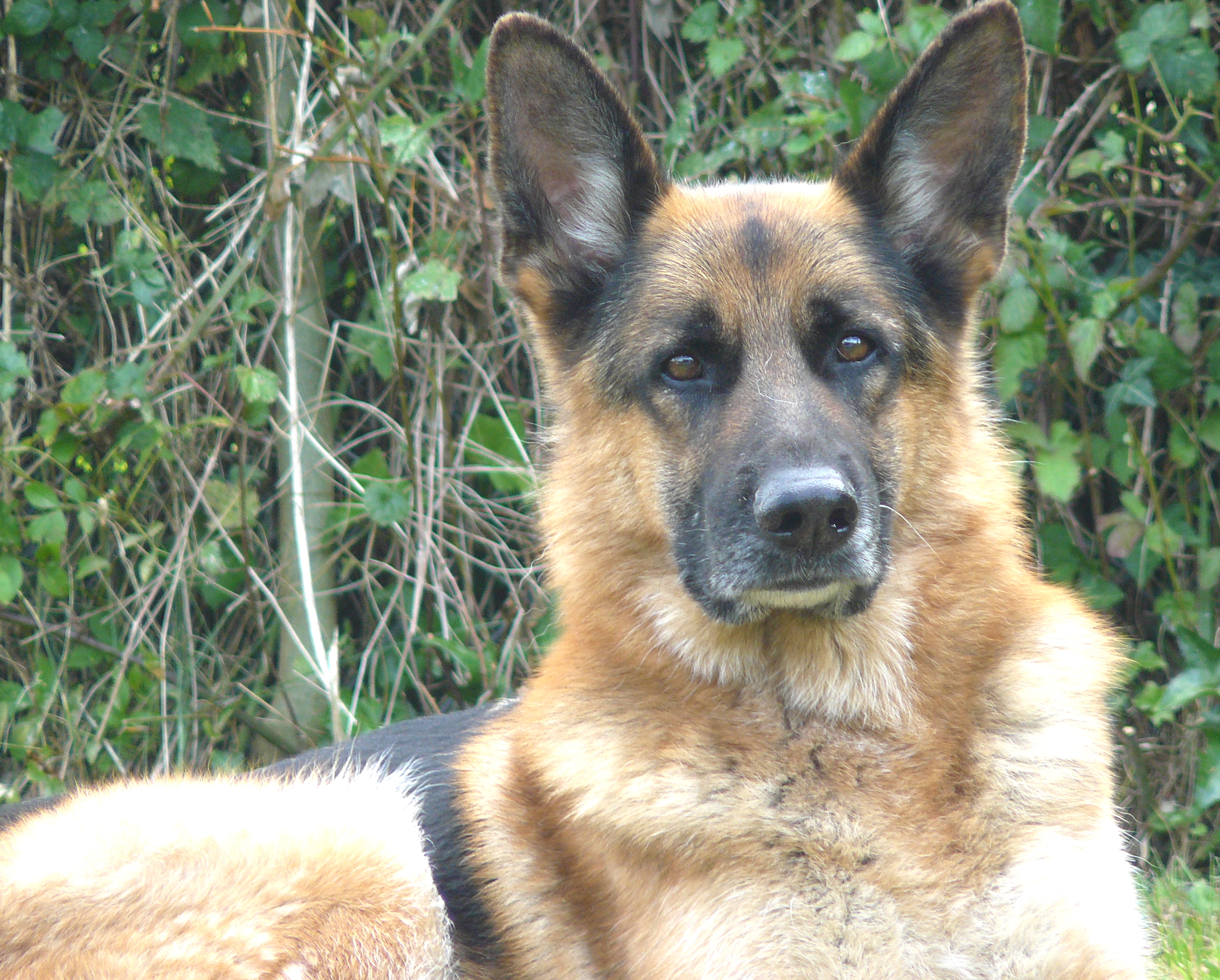
Pharaoh, relaxing in a Devon garden.

On the evening of December 20th, 2006, 50 years to the day that my father died, my wife announced that she had met another man. The implications of this casually delivered bombshell were obvious and catastrophically painful.

I will spare you the details but, trust me, the next few weeks were tough!

High on my priorities were letting close friends know what was happening.  Dan, in characteristic Daniel fashion, said over the phone, “Hey, Handover, you get your arse over to Southern California pronto! Like now!”  I replied that it was much too difficult to do that now but maybe later on in 2007.

Realising that I might need some psychological support, I spoke with Jon Lavin.  However, Jon made it clear that as we already had a working relationship with me as his mentor, he couldn’t now, in turn, be my psychotherapist.  I pleaded with Jon.  He said he would only work with me on the strict understanding that he would terminate the counselling relationship if our past workings interfered.  Of course, I agreed. [See footnote.]

Finding one’s true self after 50 years!

Jon, quite naturally, started into understanding my past experiences. Right back to that fateful day in 1956 when my father died.  And, guess what!

Unbeknownst to me, the lack of time to adjust to my father’s cancer, his sudden death, being unable to ‘say goodbye‘; all had been emotionally interpreted as acute and profound emotional rejection.  Buried deep within me with both strong positive and negative emotional consequences.  Negatively, making me very vulnerable to emotional rejection; positively, causing me to strive for outward success in so many ways.  Those sessions with Jon brought it all to the surface bringing with it deep and peaceful calm.

Yet, the true implications of finding myself were still to come.

In the Summer of 2007, I took up Dan’s offer to ‘get my arse to Southern California!‘  I had a fabulous time with Dan and his dear wife, Cynthia.  It also included a visit to Dan’s sister, Suzann, and her husband, Don, in their home in Los Osos, California.  Su fussed over me restoring my sense of self-worth as Dan and Cynthia had been doing.

One morning over breakfast Suzann said, “Hey Paul, what are you doing for Christmas?

I replied, “Oh, give me a break, Suzann, it’s the middle of June.  Long time before I have to think about dealing with Christmas!

Su then made the offer that was to change my life irrevocably.  “Don and I have a house down in San Carlos, Mexico where we shall be at Christmas.  Why don’t you come and have Christmas with us in Mexico?

And I did.  And it was in San Carlos, Mexico that I met Jean.  Suzann and Jean were great buddies. Jean had been living there since she and her late husband, Ben, had moved there many years ago.  Ben, an American, and Jean had been married for 26 years with Ben, sadly, having died in 2005.

Jean and I spent hundreds of hours chatting and getting to know each other, including the fact that she and I had both been born Londoners within 23 miles of each other.  Jean had been rescuing Mexican feral dogs for years and there were 14 dogs in her house in San Carlos.  So many of those dogs loved me from the start.  It seemed like the most beautiful Christmas I could have wished for.  In such stark contrast to just a year ago.

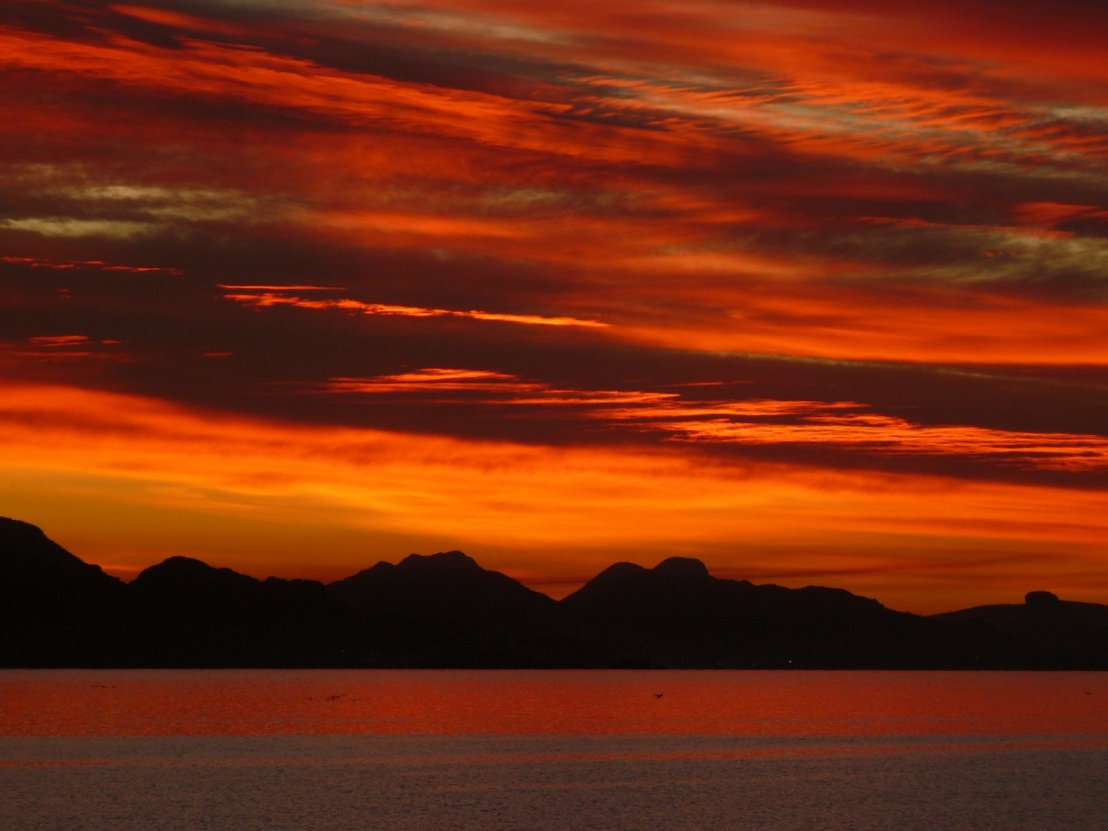
Mexican sunset! San Carlos, 2nd January, 2008.

In September, 2008 after selling the house in Devon, I moved out to San Carlos, Mexico.  Just me and Pharaoh who had been such a devoted friend, companion and confidant over the previous months.

In 2010, we moved to Payson in Arizona, some 80 miles NE of Phoenix. On November 20th, 2010 Jean and I were married.

The marriage of Jean and Paul wonderfully supported by Diane, maid of honour, and best man, Dan Gomez.

Releasing the Fergus in me and all of us.

What Peter Bloch wrote yesterday was so true.  A dog can only be a happy, fulfilled dog, if allowed to be the true dog that is in him or her.  Despite the fact that humans are primates and dogs are canids like wolves, coyotes, and foxes, it still holds as true for us humans as it did for Fergus.

We can only be happy, to put it in the words of Fergus, “happy, energised, purposeful and fulfilled in every way.” if we are given the freedom to be our self.

So if you find that you, like Fergus, suffer from digestive problems, possibly have skin disorders and sometimes behave a little strangely take note – you need to find your healer!

oooOOOooo

Footnote

Back in 2008 when Jon Lavin was working with me, I would take Pharaoh and he would lay on the floor behind my seat.  On one occasion Jon was talking about the findings of Dr. David Hawkins and his Scale of Consciousness; from falsehood to truthfulness. (See here and here for more details.)

Anyway that fateful day, Jon mentioned that Dr. Hawkins had measured dogs as being integrous animals.  That notion stayed with me and later I registered the domain name learningfromdogs (dot) com leading to – yes, you guessed it – this blog.  Funny old world.

To the Sea of Cortez.

Journey to the Sea of Cortez.

John Steinbeck
John Steinbeck

I feel very guilty as I didn’t make a note of where I came across this film.  Whoever highlighted the film, thank you!  It’s truly beautiful.  So, please, settle yourself down and be enthralled.

In March 1940, the author John Steinbeck and his friend, marine biologist Ed Ricketts, sailed down the coast of California and Mexico to the Sea of Cortez. “The abundance of life here gives one an exuberance,” they wrote, “a feeling of fullness and richness.

Their stated purpose was to document the creatures that inhabit shallow waters and tide pools on the margins of the Sea of Cortez. But it became much more. In these mysterious, phosphorescent waters they sought an understanding of mankind’s relationship to the natural world and a wellspring of hope for a world headed toward war.

Looking beyond the events of the day, the two friends foresaw our rising impact on the oceans and the devastating impact that over fishing would have on this rich sea. And yet, in their journey, they encountered a periodic cooling of the eastern Pacific Ocean known as La Niña that can still set off an explosion of life.

Can the story of their journey inspire new efforts to preserve the Sea of Cortez? Down along the shores of western Mexico, the wind blows hot and dry. Beyond these barren landscapes, cold currents rush up from the deep and the ocean literally boils with life.

Following their journey down to the Sea of Cortez in March of 1940, John Steinbeck and Ed Ricketts searched for a way to describe what they saw. “Trying to remember this place,” they wrote, “is like trying to re-create a dream. It is fierce and hostile and sullen. The stone mountains pile up to the sky and there is little fresh water. But we know we must go back if we live, and we don’t know why.

The Sea of Cortez is one of the most diverse marine ecosystems on the planet. It’s shaped by the cool waters of the California Current flowing into the warm tropics and by a complex undersea terrain that rises up along a chain of islands and sea mounts. It was the shorelines, between the desert and the deep, that drew John Steinbeck, the author, and Ed Ricketts, a marine biologist and expert on coastal ecosystems.

Ricketts’ book, “Between Pacific Tides,” is a classic study of the inter-tidal zones of the California coastline and the myriad creatures that live in shallow pools, clinging to rocks to sift the rich nutrients carried in by the tides. Steinbeck and Ricketts sought to extend this work to the Sea of Cortez and to explore ideas at the core of their friendship. They shared a belief that man’s fate, like that of the animals they saw, is linked to the health of the natural world. [Ed. my emphasis]

Ricketts is said to have inspired some of Steinbeck’s most memorable characters, including Doc in Cannery Row, and the preacher Jim Casy in The Grapes of Wrath, published a year before their voyage. Set against the backdrop of drought and economic depression, the book describes the dustbowl conditions that gripped the American heartland in the 1930’s. “Now the wind grew strong and hard and it worked at the rain crust in the corn fields. Little by little the sky was darkened by the mixing dust, and carried away. The wind grew stronger. The rain crust broke and the dust lifted up out of the fields and drove gray plumes into the air like sluggish smoke.

In most years, southerly winds carry moisture into the midsection of the country from the Gulf of Mexico. In the 1930’s, according to a recent NASA study, those winds were diverted by a build up of warm water in the Western Atlantic and by a periodic cooling of the Eastern Pacific known as La Niña. This combination robbed the region of rain.

By the time Steinbeck and Ricketts began their journey, the historic backdrop had shifted to war. Fighting had engulfed Europe and was spreading to the western Pacific. While the United States was still officially neutral, American companies had begun supplying arms to the allied effort. In early 1940, John Steinbeck used money he earned from “The Grapes of Wrath” to hire a sardine boat called the Western Flyer. From Monterrey, California, he, his wife Carol, Ed Ricketts and a four-man crew headed south, charting a course along the Mexican coastline.

By all accounts, the journey was filled with adventure, camaraderie, and a sense of wonder at the diversity of living things they encountered. Over a six-week period, the two friends wrote journal entries, took notes on conversations, and catalogued specimens they collected on the way. They compiled these writings into a book: “Sea of Cortez, A Leisurely Journal of Travel and Research,” later changed to “The Log From the Sea of Cortez.”

The work amounts to a search for a way to understand nature, and humanity at large, in a world steadily coming apart at the seams.

Ed Ricketts
Ed Ricketts

The film was released last Feb 28, 2013. Directed by Thomas Lucas, the Producers were John Friday, Thomas Lucas and Adam Ravetch.

oooOOOooo

Will end with a couple of personal reflections.  First is that when I was invited out to Mexico for Christmas 2007 by Suzann and Don, I travelled to San Carlos, Mexico on the Eastern shores of the Sea of Cortez.  San Carlos is a little under 300 miles south of the Arizonan border with Mexico and was where Jean had been living for many years.  Meeting Jean changed my life forever!  Here’s a picture of the Sea of Cortez through the rear door of Jean’s house in San Carlos.

Not the longest walk in the world to the beach!

Second reflection is about dogs. Jean had spent many years rescuing Mexican feral dogs and finding homes for them; hundreds of them over her time in San Carlos.  We brought 13 of those dogs with us when we moved to Arizona and 9 came to Oregon.  Below is Hazel, one of the five remaining Mexican ‘rescue’ dogs that are still with us in Oregon.

Hazel doing what she does so well - sleeping.
Hazel doing what she does so well – sleeping.

Be in peace, dear Lupe.

Forgive the shortness of today’s post.

I’m writing this at 3pm on the Tuesday, i.e. yesterday afternoon.

In under an hour’s time we have to leave to travel to Grants Pass to see the vet and have poor Lupe euthenised.  She has been suffering from dementia since before Christmas and has got to the point where she has little or no quality of life left.  Jeannie has been a saint in patiently administering to Lupe’s needs; feeding her, cleaning her up, and more.  All for many weeks now.  It was about 2 hours ago that Jean knew the time had come.

A few pictures from better times.

P1030118

From Mexico days back in 2008.  Lupe is second from the left.

P1100990

Lupe leading Lilly, taken in February of 2012 at our home in Payson, AZ.

P1120522

Picture of Lupe taken just 8 weeks ago, showing clearly the effects of the dementia in terms of her posture.

Lupe was always a challenge having been terribly treated as a feral dog in Mexico.  In fact, it was 6 months before Jean could fondle her after she had been rescued by Jean.  But slowly she learnt to trust Jean and then to offer Jean lots of doggie love.  I, too, have fond memories of being cheek-to-cheek with Lupe; her love and trust overcoming all fears.

Yet again, so much to learn from dogs.

Sweet, dear Lupe.


Plus ça change – footnote

Plus ça change, plus c’est la même chose (“the more it changes, the more it’s the same thing”).

The final of three repostings from a year ago.  To recap, I wrote on Monday, “… out of curiosity I wondered what I had published a year ago, in early February 2012.  To my amazement what was published was as fresh and relevant as if it had been published today.

The second post from a year ago was reposted yesterday.  Today the footnote is from the 9th February, 2012.  (It reads in its original form with the links and references unchanged.)

oooOOOooo

So many vested opinions!

Regular readers will know that I published recently, in two parts, a post with the heading of Climate, truth and integrity, the first part being here and the second part here.

To me the arguments supporting the premise that mankind is engaged in the process of destroying our very being are powerful and convincing.  But if there is any serious scientific doubt, then I am reminded of that saying in aviation circles about a risk to the safety of an aircraft, “If there’s any doubt, there’s no doubt!”  Surely, that’s the stance the climate change skeptics should be taking!  Because when the evidence of global warming, pollution, natural resource depletion, species extinctions, and habitat destruction is drawn together and there are no skeptics left, then will the last person left alive please switch the lights off!

Anyway, I’m going to republish, with permission, a recent Post that appeared on Tom Engelhardt‘s powerful blogsite, Tom Dispatch.  It was written by Bill McKibben of 350.org fame.  Here it is,

Tomgram: Bill McKibben, Why the Energy-Industrial Elite Has It In for the Planet

Posted by Bill McKibben at 9:39am, February 7, 2012.

Introduction

Two Saturdays ago, I was walking with a friend in a park here in New York City.  It was late January, but I was dressed in a light sweater and a thin fall jacket, which I had just taken off and tied around my waist.  We were passing a strip of bare ground when suddenly we both did a double-take.  He looked at me and said, “Crocuses!”  Dumbfounded, I replied, “Yes, I see them.”  And there they were, a few clumps of telltale green shoots poking up from the all-brown ground as if it were spring.  Such a common, comforting sight, but it sent a chill through me that noticeably wasn’t in the air.  Even the flowers, I thought, are confused by our new version of weather.

Later that same week, as temperatures in the Big Apple crested 60 degrees, I was chatting on the phone with a friend in Northampton, Massachusetts.  I was telling him about the crocuses, when he suddenly said, “I’m looking out my window right now and for the first time in my memory of January, there’s not a trace of snow!”

Of course, our tales couldn’t be more minor or anecdotal, even if the temperatures that week did feel like we were on another planet.  Here’s the thing, though: after a while, even anecdotes add up — maybe we should start calling them “extreme anecdotes” — and right now there are so many of them being recounted across the planet.  How could there not be in a winter, now sometimes referred to as “Junuary,” in which, in the United States, 2,890 daily high temperature records have either been broken or tied at last count, with the numbers still rising?  Meanwhile, just to the south of us, in Mexico, extreme anecdotes abound, since parts of the country are experiencing “the worst drought on record.”  Even cacti are reportedly wilting and some towns are running out of water (as they are across the border in drought-stricken Texas).  And worst of all, the Mexican drought is expected to intensify in the months to come.

And who can doubt that in Europe, experiencing an extreme cold spell the likes of which hasn’t been seen in decades — even Rome had a rare snowfall and Venice’s canals were reported to be freezing over — there are another set of all-too-extreme anecdotes.  After all, in places like Ukraine, scores of the homeless are freezing to death, pipes are bursting, power cuts are growing, and maybe even an instant energy crisis is underway (at a moment when the European Union is getting ready to cut itself off from Iranian oil).

That’s just to begin a list.  And yet here’s the strange thing.  At least in this country, you can read the “freaky” weather reports or listen to the breathless TV accounts of unexpected tornadoes striking the South in January and rarely catch a mention of the phrase “climate change.”  Given the circumstances, the relative silence on the subject is little short of eerie, even if worries about climate change lurk just below the surface.  Which is why it’s good to have TomDispatch regular Bill McKibben, author of Eaarth: Making a Life on a Tough New Planet, take a clear-eyed look at American denialism and just what it is we prefer not to take in. Tom

The Great Carbon Bubble
Why the Fossil Fuel Industry Fights So Hard

By Bill McKibben

If we could see the world with a particularly illuminating set of spectacles, one of its most prominent features at the moment would be a giant carbon bubble, whose bursting someday will make the housing bubble of 2007 look like a lark. As yet — as we shall see — it’s unfortunately largely invisible to us.

In compensation, though, we have some truly beautiful images made possible by new technology.  Last month, for instance, NASA updated the most iconic photograph in our civilization’s gallery: “Blue Marble,” originally taken from Apollo 17 in 1972. The spectacular new high-def image [see below, Ed] shows a picture of the Americas on January 4th, a good day for snapping photos because there weren’t many clouds.

It was also a good day because of the striking way it could demonstrate to us just how much the planet has changed in 40 years. As Jeff Masters, the web’s most widely read meteorologist, explains, “The U.S. and Canada are virtually snow-free and cloud-free, which is extremely rare for a January day. The lack of snow in the mountains of the Western U.S. is particularly unusual. I doubt one could find a January day this cloud-free with so little snow on the ground throughout the entire satellite record, going back to the early 1960s.”

In fact, it’s likely that the week that photo was taken will prove “the driest first week in recorded U.S. history.” Indeed, it followed on 2011, which showed the greatest weather extremes in our history — 56% of the country was either in drought or flood, which was no surprise since “climate change science predicts wet areas will tend to get wetter and dry areas will tend to get drier.” Indeed, the nation suffered 14 weather disasters each causing $1 billion or more in damage last year. (The old record was nine.) Masters again: “Watching the weather over the past two years has been like watching a famous baseball hitter on steroids.”

In the face of such data — statistics that you can duplicate for almost every region of the planet — you’d think we’d already be in an all-out effort to do something about climate change. Instead, we’re witnessing an all-out effort to… deny there’s a problem.

Our GOP presidential candidates are working hard to make sure no one thinks they’d appease chemistry and physics. At the last Republican debate in Florida, Rick Santorum insisted that he should be the nominee because he’d caught on earlier than Newt or Mitt to the global warming “hoax.”

Most of the media pays remarkably little attention to what’s happening. Coverage of global warming has dipped 40% over the last two years. When, say, there’s a rare outbreak of January tornadoes, TV anchors politely discuss “extreme weather,” but climate change is the disaster that dare not speak its name.

And when they do break their silence, some of our elite organs are happy to indulge in outright denial. Last month, for instance, the Wall Street Journal published an op-ed by “16 scientists and engineers” headlined “No Need to Panic About Global Warming.” The article was easily debunked. It was nothing but a mash-up of long-since-disproved arguments by people who turned out mostly not to be climate scientists at all, quoting other scientists who immediately said their actual work showed just the opposite.

It’s no secret where this denialism comes from: the fossil fuel industry pays for it. (Of the 16 authors of the Journal article, for instance, five had had ties to Exxon.)Writers from Ross Gelbspan to Naomi Oreskes have made this case with such overwhelming power that no one even really tries denying it any more. The open question is why the industry persists in denial in the face of an endless body of fact showing climate change is the greatest danger we’ve ever faced.

Why doesn’t it fold the way the tobacco industry eventually did? Why doesn’t it invest its riches in things like solar panels and so profit handsomely from the next generation of energy? As it happens, the answer is more interesting than you might think.

Part of it’s simple enough: the giant energy companies are making so much money right now that they can’t stop gorging themselves. ExxonMobil, year after year, pulls in more money than any company in history. Chevron’s not far behind. Everyone in the business is swimming in money.

Still, they could theoretically invest all that cash in new clean technology or research and development for the same. As it happens, though, they’ve got a deeper problem, one that’s become clear only in the last few years. Put briefly: their value is largely based on fossil-fuel reserves that won’t be burned if we ever take global warming seriously.

When I talked about a carbon bubble at the beginning of this essay, this is what I meant. Here are some of the relevant numbers, courtesy of the Capital Institute: we’re already seeing widespread climate disruption, but if we want to avoid utter, civilization-shaking disaster, many scientists have pointed to a two-degree rise in global temperatures as the most we could possibly deal with.

If we spew 565 gigatons more carbon into the atmosphere, we’ll quite possibly go right past that reddest of red lines. But the oil companies, private and state-owned, have current reserves on the books equivalent to 2,795 gigatons — five times more than we can ever safely burn. It has to stay in the ground.

Put another way, in ecological terms it would be extremely prudent to write off $20 trillion worth of those reserves. In economic terms, of course, it would be a disaster, first and foremost for shareholders and executives of companies like ExxonMobil (and people in places like Venezuela).

If you run an oil company, this sort of write-off is the disastrous future staring you in the face as soon as climate change is taken as seriously as it should be, and that’s far scarier than drought and flood. It’s why you’ll do anything — including fund an endless campaigns of lies — to avoid coming to terms with its reality. So instead, we simply charge ahead.  To take just one example, last month the boss of the U.S. Chamber of Commerce, Thomas Donohue, called for burning all the country’s newly discovered coal, gas, and oil — believed to be 1,800 gigatons worth of carbon from our nation alone.

What he and the rest of the energy-industrial elite are denying, in other words, is that the business models at the center of our economy are in the deepest possible conflict with physics and chemistry. The carbon bubble that looms over our world needs to be deflated soon. As with our fiscal crisis, failure to do so will cause enormous pain — pain, in fact, almost beyond imagining. After all, if you think banks are too big to fail, consider the climate as a whole and imagine the nature of the bailout that would face us when that bubble finally bursts.

Unfortunately, it won’t burst by itself — not in time, anyway. The fossil-fuel companies, with their heavily funded denialism and their record campaign contributions, have been able to keep at bay even the tamest efforts at reining in carbon emissions. With each passing day, they’re leveraging us deeper into an unpayable carbon debt — and with each passing day, they’re raking in unimaginable returns. ExxonMobil last week reported its 2011 profits at $41 billion, the second highest of all time. Do you wonder who owns the record? That would be ExxonMobil in 2008 at $45 billion.

Telling the truth about climate change would require pulling away the biggest punchbowl in history, right when the party is in full swing. That’s why the fight is so pitched. That’s why those of us battling for the future need to raise our game. And it’s why that view from the satellites, however beautiful from a distance, is likely to become ever harder to recognize as our home planet.

Bill McKibben is Schumann Distinguished Scholar at Middlebury College, founder of the global climate campaign 350.org, a TomDispatch regular, and the author, most recently, of Eaarth: Making a Life on a Tough New Planet.

Follow TomDispatch on Twitter @TomDispatch and join us on Facebook.

Copyright 2012 Bill McKibben

This photo was taken on January 4, 2012.

Most Amazing High Definition Image of Earth – Blue Marble 2012

January 25, 2012

*Updated February 2, 2012: According to Flickr, “The western hemisphere Blue Marble 2012 image has rocketed up to over 3.1 million views making it one of the all time most viewed images on the site after only one week.”

A ‘Blue Marble’ image of the Earth taken from the VIIRS instrument aboard NASA’s most recently launched Earth-observing satellite – Suomi NPP. This composite image uses a number of swaths of the Earth’s surface taken on January 4, 2012. The NPP satellite was renamed ‘Suomi NPP’ on January 24, 2012 to honor the late Verner E. Suomi of the University of Wisconsin.

Suomi NPP is NASA’s next Earth-observing research satellite. It is the first of a new generation of satellites that will observe many facets of our changing Earth.

Suomi NPP is carrying five instruments on board. The biggest and most important instrument is The Visible/Infrared Imager Radiometer Suite or VIIRS.

To read more about NASA’s Suomi NPP go to: www.nasa.gov/npp

Credit: NASA/NOAA/GSFC/Suomi NPP/VIIRS/Norman Kuring

Sunrises for ever!

This first published on the 4th November, 2009 when we were living in Mexico.

Here in San Carlos, Mexico, we have good sunrises most mornings.  But this one made me grab my camera. The picture is unedited. Very simple things can provide a huge amount of pleasure.

Sunrise

Taken at 06:15 local time (GMT -7hrs)  Camera is a Panasonic Lumix DMC-FZ8

H’mmm

The way the world is – now!

There has been a wealth of information going past my ‘desk’ in the last couple of days that gives plenty of cause to worry.  But I’m going to spend a few days mulling it all over rather than react in some ‘knee-jerk’ fashion.

However, a couple of stories caught my eye a few days ago on the BBC News website and seemed worthy of sharing with you.

The first was,

Mild drought caused Maya collapse in Mexico, Guatemala

Relatively mild drought conditions may have been enough to cause the collapse of the Classic Maya civilisation, which flourished until about AD950 in what is now southern Mexico and Guatemala.

Scientists have long thought that severe drought caused its collapse.

But Mexican and British researchers now think that a sustained drop in rainfall of only 25-40% was enough to exhaust seasonal water supplies in the region.

The findings were published in the journal Science.

The research was conducted by the Yucatan Centre for Scientific Research in southern Mexico and the University of Southampton in the UK.

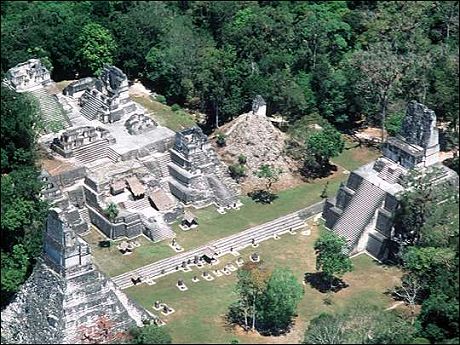
Mayan pyramids of Tikal

Read the full news piece here.

The second piece published by the BBC within 24 hours went as follows,

Drought conditions in England ‘set to widen’

Ongoing dry weather over the spring and summer threatens to place more areas of England in a state of drought, the Environment Agency (EA) has warned.

It singled out parts of western, central and south western England and parts of south east Yorkshire.

The agency said time was running out for rain to restore groundwater levels before the new growing season begins.

Earlier this week the South East joined most of East Anglia in a state of official drought.

In parts of south-east England groundwater levels are lower than in the infamously dry summer of 1976.

Again, read the full article on the BBC website here.

And closer to home?

The historical (30-year average) precipitation for Payson up here in the Rim Country is 2.30 inches for January, and 2.41 inches for February.  Today, February 29th 2012, we have had less than 0.5 inches for the whole of 2012 so far!  Interesting times!

The Granite Dells Wilderness

Climate and truth, footnote.

So many vested opinions!

Regular readers will know that I published recently, in two parts, a post with the heading of Climate, truth and integrity, the first part being here and the second part here.

To me the arguments supporting the premise that mankind is engaged in the process of destroying our very being are powerful and convincing.  But if there is any serious scientific doubt, then I am reminded of that saying in aviation circles about a risk to the safety of an aircraft, “If there’s any doubt, there’s no doubt!”  Surely, that’s the stance the climate change skeptics should be taking!  Because when the evidence of global warming, pollution, natural resource depletion, species extinctions, and habitat destruction is drawn together and there are no skeptics left, then will the last person left alive please switch the lights off!

Anyway, I’m going to republish, with permission, a recent Post that appeared on Tom Engelhardt‘s powerful blogsite, Tom Dispatch.  It was written by Bill McKibben of 350.org fame.  Here it is,

Tomgram: Bill McKibben, Why the Energy-Industrial Elite Has It In for the Planet

Posted by Bill McKibben at 9:39am, February 7, 2012.

Introduction

Two Saturdays ago, I was walking with a friend in a park here in New York City.  It was late January, but I was dressed in a light sweater and a thin fall jacket, which I had just taken off and tied around my waist.  We were passing a strip of bare ground when suddenly we both did a double-take.  He looked at me and said, “Crocuses!”  Dumbfounded, I replied, “Yes, I see them.”  And there they were, a few clumps of telltale green shoots poking up from the all-brown ground as if it were spring.  Such a common, comforting sight, but it sent a chill through me that noticeably wasn’t in the air.  Even the flowers, I thought, are confused by our new version of weather.

Later that same week, as temperatures in the Big Apple crested 60 degrees, I was chatting on the phone with a friend in Northampton, Massachusetts.  I was telling him about the crocuses, when he suddenly said, “I’m looking out my window right now and for the first time in my memory of January, there’s not a trace of snow!”

Of course, our tales couldn’t be more minor or anecdotal, even if the temperatures that week did feel like we were on another planet.  Here’s the thing, though: after a while, even anecdotes add up — maybe we should start calling them “extreme anecdotes” — and right now there are so many of them being recounted across the planet.  How could there not be in a winter, now sometimes referred to as “Junuary,” in which, in the United States, 2,890 daily high temperature records have either been broken or tied at last count, with the numbers still rising?  Meanwhile, just to the south of us, in Mexico, extreme anecdotes abound, since parts of the country are experiencing “the worst drought on record.”  Even cacti are reportedly wilting and some towns are running out of water (as they are across the border in drought-stricken Texas).  And worst of all, the Mexican drought is expected to intensify in the months to come.

And who can doubt that in Europe, experiencing an extreme cold spell the likes of which hasn’t been seen in decades — even Rome had a rare snowfall and Venice’s canals were reported to be freezing over — there are another set of all-too-extreme anecdotes.  After all, in places like Ukraine, scores of the homeless are freezing to death, pipes are bursting, power cuts are growing, and maybe even an instant energy crisis is underway (at a moment when the European Union is getting ready to cut itself off from Iranian oil).

That’s just to begin a list.  And yet here’s the strange thing.  At least in this country, you can read the “freaky” weather reports or listen to the breathless TV accounts of unexpected tornadoes striking the South in January and rarely catch a mention of the phrase “climate change.”  Given the circumstances, the relative silence on the subject is little short of eerie, even if worries about climate change lurk just below the surface.  Which is why it’s good to have TomDispatch regular Bill McKibben, author of Eaarth: Making a Life on a Tough New Planet, take a clear-eyed look at American denialism and just what it is we prefer not to take in. Tom

The Great Carbon Bubble
Why the Fossil Fuel Industry Fights So Hard

By Bill McKibben

If we could see the world with a particularly illuminating set of spectacles, one of its most prominent features at the moment would be a giant carbon bubble, whose bursting someday will make the housing bubble of 2007 look like a lark. As yet — as we shall see — it’s unfortunately largely invisible to us.

In compensation, though, we have some truly beautiful images made possible by new technology.  Last month, for instance, NASA updated the most iconic photograph in our civilization’s gallery: “Blue Marble,” originally taken from Apollo 17 in 1972. The spectacular new high-def image [see below, Ed] shows a picture of the Americas on January 4th, a good day for snapping photos because there weren’t many clouds.

It was also a good day because of the striking way it could demonstrate to us just how much the planet has changed in 40 years. As Jeff Masters, the web’s most widely read meteorologist, explains, “The U.S. and Canada are virtually snow-free and cloud-free, which is extremely rare for a January day. The lack of snow in the mountains of the Western U.S. is particularly unusual. I doubt one could find a January day this cloud-free with so little snow on the ground throughout the entire satellite record, going back to the early 1960s.”

In fact, it’s likely that the week that photo was taken will prove “the driest first week in recorded U.S. history.” Indeed, it followed on 2011, which showed the greatest weather extremes in our history — 56% of the country was either in drought or flood, which was no surprise since “climate change science predicts wet areas will tend to get wetter and dry areas will tend to get drier.” Indeed, the nation suffered 14 weather disasters each causing $1 billion or more in damage last year. (The old record was nine.) Masters again: “Watching the weather over the past two years has been like watching a famous baseball hitter on steroids.”

In the face of such data — statistics that you can duplicate for almost every region of the planet — you’d think we’d already be in an all-out effort to do something about climate change. Instead, we’re witnessing an all-out effort to… deny there’s a problem.

Our GOP presidential candidates are working hard to make sure no one thinks they’d appease chemistry and physics. At the last Republican debate in Florida, Rick Santorum insisted that he should be the nominee because he’d caught on earlier than Newt or Mitt to the global warming “hoax.”

Most of the media pays remarkably little attention to what’s happening. Coverage of global warming has dipped 40% over the last two years. When, say, there’s a rare outbreak of January tornadoes, TV anchors politely discuss “extreme weather,” but climate change is the disaster that dare not speak its name.

And when they do break their silence, some of our elite organs are happy to indulge in outright denial. Last month, for instance, the Wall Street Journal published an op-ed by “16 scientists and engineers” headlined “No Need to Panic About Global Warming.” The article was easily debunked. It was nothing but a mash-up of long-since-disproved arguments by people who turned out mostly not to be climate scientists at all, quoting other scientists who immediately said their actual work showed just the opposite.

It’s no secret where this denialism comes from: the fossil fuel industry pays for it. (Of the 16 authors of the Journal article, for instance, five had had ties to Exxon.)Writers from Ross Gelbspan to Naomi Oreskes have made this case with such overwhelming power that no one even really tries denying it any more. The open question is why the industry persists in denial in the face of an endless body of fact showing climate change is the greatest danger we’ve ever faced.

Why doesn’t it fold the way the tobacco industry eventually did? Why doesn’t it invest its riches in things like solar panels and so profit handsomely from the next generation of energy? As it happens, the answer is more interesting than you might think.

Part of it’s simple enough: the giant energy companies are making so much money right now that they can’t stop gorging themselves. ExxonMobil, year after year, pulls in more money than any company in history. Chevron’s not far behind. Everyone in the business is swimming in money.

Still, they could theoretically invest all that cash in new clean technology or research and development for the same. As it happens, though, they’ve got a deeper problem, one that’s become clear only in the last few years. Put briefly: their value is largely based on fossil-fuel reserves that won’t be burned if we ever take global warming seriously.

When I talked about a carbon bubble at the beginning of this essay, this is what I meant. Here are some of the relevant numbers, courtesy of the Capital Institute: we’re already seeing widespread climate disruption, but if we want to avoid utter, civilization-shaking disaster, many scientists have pointed to a two-degree rise in global temperatures as the most we could possibly deal with.

If we spew 565 gigatons more carbon into the atmosphere, we’ll quite possibly go right past that reddest of red lines. But the oil companies, private and state-owned, have current reserves on the books equivalent to 2,795 gigatons — five times more than we can ever safely burn. It has to stay in the ground.

Put another way, in ecological terms it would be extremely prudent to write off $20 trillion worth of those reserves. In economic terms, of course, it would be a disaster, first and foremost for shareholders and executives of companies like ExxonMobil (and people in places like Venezuela).

If you run an oil company, this sort of write-off is the disastrous future staring you in the face as soon as climate change is taken as seriously as it should be, and that’s far scarier than drought and flood. It’s why you’ll do anything — including fund an endless campaigns of lies — to avoid coming to terms with its reality. So instead, we simply charge ahead.  To take just one example, last month the boss of the U.S. Chamber of Commerce, Thomas Donohue, called for burning all the country’s newly discovered coal, gas, and oil — believed to be 1,800 gigatons worth of carbon from our nation alone.

What he and the rest of the energy-industrial elite are denying, in other words, is that the business models at the center of our economy are in the deepest possible conflict with physics and chemistry. The carbon bubble that looms over our world needs to be deflated soon. As with our fiscal crisis, failure to do so will cause enormous pain — pain, in fact, almost beyond imagining. After all, if you think banks are too big to fail, consider the climate as a whole and imagine the nature of the bailout that would face us when that bubble finally bursts.

Unfortunately, it won’t burst by itself — not in time, anyway. The fossil-fuel companies, with their heavily funded denialism and their record campaign contributions, have been able to keep at bay even the tamest efforts at reining in carbon emissions. With each passing day, they’re leveraging us deeper into an unpayable carbon debt — and with each passing day, they’re raking in unimaginable returns. ExxonMobil last week reported its 2011 profits at $41 billion, the second highest of all time. Do you wonder who owns the record? That would be ExxonMobil in 2008 at $45 billion.

Telling the truth about climate change would require pulling away the biggest punchbowl in history, right when the party is in full swing. That’s why the fight is so pitched. That’s why those of us battling for the future need to raise our game. And it’s why that view from the satellites, however beautiful from a distance, is likely to become ever harder to recognize as our home planet.

Bill McKibben is Schumann Distinguished Scholar at Middlebury College, founder of the global climate campaign 350.org, a TomDispatch regular, and the author, most recently, of Eaarth: Making a Life on a Tough New Planet.

Follow TomDispatch on Twitter @TomDispatch and join us on Facebook.

Copyright 2012 Bill McKibben

This photo was taken on January 4, 2012.

Most Amazing High Definition Image of Earth – Blue Marble 2012

January 25, 2012

*Updated February 2, 2012: According to Flickr, “The western hemisphere Blue Marble 2012 image has rocketed up to over 3.1 million views making it one of the all time most viewed images on the site after only one week.”

A ‘Blue Marble’ image of the Earth taken from the VIIRS instrument aboard NASA’s most recently launched Earth-observing satellite – Suomi NPP. This composite image uses a number of swaths of the Earth’s surface taken on January 4, 2012. The NPP satellite was renamed ‘Suomi NPP’ on January 24, 2012 to honor the late Verner E. Suomi of the University of Wisconsin.

Suomi NPP is NASA’s next Earth-observing research satellite. It is the first of a new generation of satellites that will observe many facets of our changing Earth.

Suomi NPP is carrying five instruments on board. The biggest and most important instrument is The Visible/Infrared Imager Radiometer Suite or VIIRS.

To read more about NASA’s Suomi NPP go to: www.nasa.gov/npp

Credit: NASA/NOAA/GSFC/Suomi NPP/VIIRS/Norman Kuring

An ancient bond, indeed!

The mystery of the call of a dog in need of help.

Two days ago, I wrote a piece about how the evolution of the domestic dog has been reliably re-calibrated back to around 33,000 years ago.  I quoted from an article in the Arizona Republic, here are the opening paragraphs of that article.

Tamed dogs may go back 33,000 years

by Anne Ryman – Jan. 24, 2012 11:33 PM
The Republic | azcentral.com

Dogs have been “man’s best friend” longer than any other animal. And, as it turns out, longer than previously thought.

A pair of research papers published in the past few years, one most recently by a team that includes the University of Arizona, significantly pushes back the timeline for domestication of dogs from about 14,000 years ago to more than 30,000 years ago.

Researchers at UA and universities in England and the Netherlands used radiocarbon dating to determine that the skull of a Siberian dog was about 33,000 years old. Slightly older dog remains were identified in Belgium a few years ago by a separate research team.

The full Post is here.

So moving on, and apologies for a bit of a personal muse.

Last night (the night of the 30th/31st Jan.) a single, gentle yelp from Pharaoh had me instantly awake. Initially hadn’t a clue about the time but instinctively knew it was an un-Godly hour!  Jean and I had been late to bed and I was pretty tired when the lights went out – off to sleep in an instant.  Ergo, waking up at 2am as it turned out to be, the classic deep-sleep time of the night, was challenging!  It is also relevant to mention that Pharaoh is reliably a very good sleeper at night.

Yet, in literally an instant of time, I had transitioned from being totally asleep to being mentally alert wondering what had caused him to cry out.  Pharaoh came to the side of the bed and let me rub his head, then went back to near the door and uttered another soft yelp.  I knew without any doubt at all that he was in pain and lay on my back anticipating what would be coming – putting a dressing-gown on and leading his nibs out into a very cold and dark night!

Then a clawed paw on the door told me to get moving, and within moments of Pharaoh being outside, it was clear that he had a badly upset tummy.

The whole episode was repeated around 4.45 am.

It was later in the morning that I was reflecting with Jean about the evolution of the dog-human relationship that a) gave the dog the instinctive confidence to call out to his ‘master’ in a different ‘I need help‘ tone, and b) that the call was so rapidly interpreted by a human as a call for help from another species.

But dogs sleeping near or around their human companions for more than 30,000 years allows plenty of time for species bonding to develop in ways that are both beautiful and mysterious.  Long may that bonding remain beautiful and mysterious.

Fabulous animals!

Pharaoh. June 2008, 3 months before we both left for Mexico!