Tag: George Monbiot

There’s nowt so queer as folk!

George Monbiot offers some surprising ideas.

The title to today’s post is an old British expression that harks back to the days when “queer” meant strange. This blog has published no shortage of posts giving many examples of how “queer” we humans can be at times.

So the latest essay from Mr Monbiot is rather refreshing. I’ll say no more, apart from confirming that Monbiot’s post is republished with his kind permission.

ooOOoo

Human Kind

14th October 2015

Fascinating new lines of research suggest that we are good people, tolerating bad things.

By George Monbiot, published in the Guardian 14th October 2015

Do you find yourself thrashing against the tide of human indifference and selfishness? Are you oppressed by the sense that while you care, others don’t? That because of humankind’s callousness, civilisation and the rest of life on earth are basically stuffed? If so, you are not alone. But neither are you right.

A study by the Common Cause Foundation, due to be published next month, reveals two transformative findings. The first is that a large majority of the 1000 people they surveyed – 74% – identify more strongly with unselfish values than with selfish values. This means that they are more interested in helpfulness, honesty, forgiveness and justice than in money, fame, status and power. The second is that a similar majority – 78% – believes others to be more selfish than they really are. In other words, we have made a terrible mistake about other people’s minds.

The revelation that humanity’s dominant characteristic is, er, humanity will come as no surprise to those who have followed recent developments in behavioural and social sciences. People, these findings suggest, are basically and inherently nice.

A review article in the journal Frontiers in Psychology points out that our behaviour towards unrelated members of our species is “spectacularly unusual when compared to other animals”. While chimpanzees might share food with members of their own group, though usually only after being plagued by aggressive begging, they tend to react violently towards strangers. Chimpanzees, the authors note, behave more like the Homo economicus of neoliberal mythology than people do.

Humans, by contrast, are ultra-social: possessed of an enhanced capacity for empathy, an unparalleled sensitivity to the needs of others, a unique level of concern about their welfare and an ability to create moral norms that generalise and enforce these tendencies.

Such traits emerge so early in our lives that they appear to be innate. In other words, it seems that we have evolved to be this way. By the age of 14 months, children begin to help each other, for example by handing over objects another child can’t reach. By the time they are two, they start sharing things they value. By the age of three, they start to protest against other people’s violation of moral norms.

A fascinating paper in the journal Infancy reveals that reward has nothing to do with it. Three to five-year-olds are less likely to help someone a second time if they have been rewarded for doing it the first time. In other words, extrinsic rewards appear to undermine the intrinsic desire to help. (Parents, economists and government ministers, please note). The study also discovered that children of this age are more inclined to help people if they perceive them to be suffering, and that they want to see someone helped whether or not they do it themselves. This suggests that they are motivated by a genuine concern for other people’s welfare, rather than by a desire to look good. And it seems to be baked in.

Why? How would the hard logic of evolution produce such outcomes? This is the subject of heated debate. One school of thought contends that altruism is a logical response to living in small groups of closely related people, and evolution has failed to catch up with the fact that we now live in large groups, mostly composed of strangers. Another argues that large groups containing high numbers of altruists will outcompete large groups which contain high numbers of selfish people. A third hypothesis insists that a tendency towards collaboration enhances your own survival, regardless of the group in which you might find yourself. Whatever the mechanism might be, the outcome should be a cause of celebration.

So why do we retain such a dim view of human nature? Partly, perhaps, for historical reasons. Philosophers from Hobbes to Rousseau, Malthus to Schopenhauer, whose understanding of human evolution was limited to the Book of Genesis, produced persuasive, influential and catastrophically mistaken accounts of “the state of nature” (our innate, ancestral characteristics). Their speculations on this subject should long ago have been parked on a high shelf marked “historical curiosities”. But somehow they still seem to exert a grip on our minds.

Another problem is that – almost by definition – many of those who dominate public life have a peculiar fixation on fame, money and power. Their extreme self-centredness places them in a small minority, but, because we see them everywhere, we assume that they are representative of humanity.

The media worships wealth and power, and sometimes launches furious attacks on people who behave altruistically. In the Daily Mail last month, Richard Littlejohn described Yvette Cooper’s decision to open her home to refugees as proof that “noisy emoting has replaced quiet intelligence” (quiet intelligence being one of his defining qualities). “It’s all about political opportunism and humanitarian posturing,” he theorised, before boasting that he doesn’t “give a damn” about the suffering of people fleeing Syria. I note with interest the platform given to people who speak and write as if they are psychopaths.

The consequences of an undue pessimism about human nature are momentous. As the Common Cause Foundation’s survey and interviews reveal, those who have the bleakest view of humanity are the least likely to vote. What’s the point, they reason, if everyone else votes only in their own selfish interests? Interestingly, and alarmingly for people of my political persuasion, it also discovered that liberals tend to possess a dimmer view of other people than conservatives do. Do you want to grow the electorate? Do you want progressive politics to flourish? Then spread the word that other people are broadly well-intentioned.

Misanthropy grants a free pass to the grasping, power-mad minority who tend to dominate our political systems. If only we knew how unusual they are, we might be more inclined to shun them and seek better leaders. It contributes to the real danger we confront: not a general selfishness, but a general passivity. Billions of decent people tut and shake their heads as the world burns, immobilised by the conviction that no one else cares.

You are not alone. The world is with you, even if it has not found its voice.

www.monbiot.com

ooOOoo

Speaking of nice, happy souls, there’s only one way to close off this post.
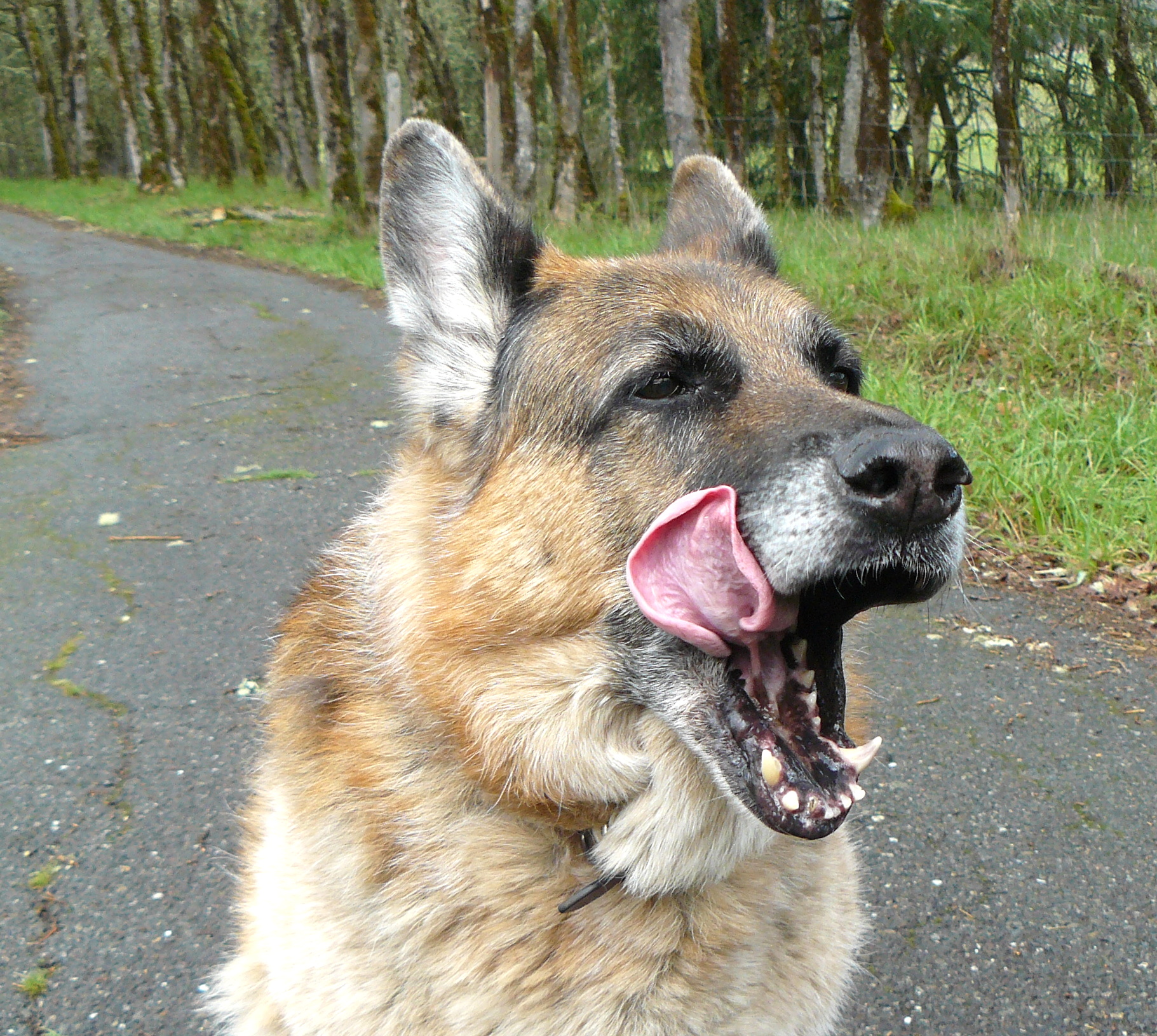
One happy, loving dog!

You all have a very happy, loving weekend.
The power of hope!

It really is about good people refusing to let evil dominate our world.

The response to yesterday’s post was incredible and very gratifying.

For I was conscious that many would simply reject the proposition that I saw in John Zande’s book, namely that, “there was an evil origin to the universe and, more directly, that the deep, and growing, suffering of the pinnacle of evolution, us humans, can be traced back to that evil origin.”

The emotional challenge, of which I am acutely aware, is recognising that core proposition, that as we humans evolve so too does the capacity for human suffering, yet not wanting to give up on my personal core belief that better times ahead are possible, given sufficient people sharing that power of hope. Echoing what Sue wrote as a response to yesterday’s post that motivated me to reply, in part, thus:

If there was one sentence of yours that struck me as spot on, it was your declaration that what we think is what we create. Or as I often reflect, we are what we think.

Jean and I last night watched the latest BBC Panorama report about the migrant/refugee crisis in Europe. It was profoundly upsetting for reasons that many will understand.

George Monbiot’s essay that follows shortly is also profoundly upsetting.

But if hope is to be translated into a determination to make a difference, then it demands that we don’t ignore the pain but use our anger to fuel our passion to behave appropriately: We are what we think! Or in the much more eloquent words of Albert Einstein:

Learn from yesterday, live for today, hope for tomorrow. The important thing is not to stop questioning.

George Monbiot is to be saluted for his commitment to questioning and I am privileged to have his permission to republish the following.

ooOOoo

Inhospitable Planet

29th September 2015

There may be water on Mars. But is there intelligent life on Earth?

By George Monbiot, published in the Guardian 30th September 2015

Evidence for flowing water on Mars – this opens up the possibility of life; of wonders we cannot begin to imagine. Its discovery is an astonishing achievement. Meanwhile, Martian scientists continue their search for intelligent life on Earth.

We might be captivated by the thought of organisms on another planet, but we seem to have lost interest in our own. The Oxford Junior Dictionary has been excising the waymarks of the living world. Adders, blackberries, bluebells, conkers, holly, magpies, minnows, otters, primroses, thrushes, weasels and wrens are now surplus to requirements.

In the past four decades, the world has lost 50% of its vertebrate wildlife. But across the latter half of this period, there has been a steep decline in coverage. In 2014, according to a study at Cardiff University, there were as many news stories broadcast by the BBC and ITV about Madeline McCann (who went missing in 2007) as there were about the entire range of environmental issues.

Think of what would change if we valued terrestrial water as much as we value the possibility of water on Mars. Only three percent of the water on this planet is fresh, and of that two-thirds is frozen. Yet we lay waste to the accessible portion. Sixty percent of the water used in farming is needlessly piddled away by careless irrigation. Rivers, lakes and aquifers are sucked dry, while what remains is often so contaminated that it threatens the lives of those who drink it. In the UK, domestic demand is such that the upper reaches of many rivers disappear during the summer. Yet still we install clunky old toilets and showers that gush like waterfalls.

As for salty water of the kind that enthralls us when apparently detected on Mars, on Earth we express our appreciation with a frenzy of destruction. A new report suggests that fish numbers have halved since 1970. Pacific bluefin tuna, that once roamed the seas in untold millions, have been reduced to an estimated 40,000, yet still they are pursued. Coral reefs are under such pressure that most could be gone by 2050. And in our own deep space, our desire for exotic fish rips through a world scarcely better known to us than the red planet’s surface. Trawlers are now working at depths of 2000 metres. We can only guess at what they might be destroying.

A few hours before the Martian discovery was announced, Shell terminated its Arctic oil prospecting in the Chukchi Sea. For the company’s shareholders, it’s a minor disaster: the loss of $4 billion. For those who love the planet and the life it sustains, it is a stroke of great fortune: it happened only because the company failed to find sufficient reserves. Had Shell succeeded, it would have exposed one of the most vulnerable places on Earth to spills that are almost inevitable, where containment is almost impossible. Are we to leave such matters to chance?

At the beginning of September, two weeks after he granted Shell permission to drill in the Chukchi Sea, Barack Obama travelled to Alaska to warn Americans about the devastating effects that climate change, caused by the burning of fossil fuels, might catalyse in the Arctic. “It’s not enough just to talk the talk”, he told them. “We’ve got to walk the walk.” We should “embrace the human ingenuity that can do something about it.” Human ingenuity is on abundant display at Nasa, which released those astounding images. But when it comes to policy, the search for intelligent life goes on.

Let the market decide: this is the way in which governments seek to resolve planetary destruction. Leave it to the conscience of consumers, while that conscience is muted and confused by advertising and corporate lies. In a near-vacuum of information, we are each left to decide what we should take from other species and other people; what we should allocate to ourselves or leave to succeeding generations. Surely there are some resources and some places – such as the Arctic and the deep sea – whose exploitation should simply stop?

All this drilling and digging and trawling and dumping and poisoning – what is it for anyway? Does it enrich human experience, or stifle it? A couple of weeks ago, I launched the hashtag #extremecivilisation, and invited suggestions. They have flooded in. Here are just a few of the products my correspondents have found. All of them, as far as I can tell, are real.

An egg tray for your fridge, that syncs with your phone to let you know how many eggs are left. A gadget for scrambling them – inside the shell. Wigs for babies, to allow “baby girls with little or no hair at all the opportunity to have a beautifully realistic hair style”. The iPotty, that permits toddlers to keep playing on their iPads while toilet training. A £2000 spider-proof shed. A snow sauna, on sale in the United Arab Emirates, in which you can create a winter wonderland with the flick of a switch. A refrigerated watermelon case on wheels: indispensable for picnics. Or perhaps not, as it weighs more than the melon. Anal bleaching cream, for … to be honest, I don’t want to know. An “automatic watch rotator” that saves you the bother of winding your luxury wrist candy. A smart phone for dogs, with which they can take pictures of themselves. Pre-peeled bananas, in polystyrene trays covered in clingfilm. Just peel back the packaging …

Every year, clever new ways of wasting stuff are devised, and every year we become more inured to the pointless consumption of the world’s precious resources. With each subtle intensification, the baseline of normality shifts. It should not be surprising to discover that the richer a country becomes, the less its people care about their impacts on the living planet.

Our alienation from the world of wonders with which we evolved has only intensified since David Bowie described a girl stumbling through a “sunken dream”, on her way to be “hooked to the silver screen”, where a long series of distractions diverts her from life’s great questions. The song, of course, was Life on Mars.

www.monbiot.com

ooOOoo

David Bowie’s track Life on Mars from the album Hunky Dory was released in 1971. Courtesy of YouTube, here it is again:

Never stop fighting for a better world.

Protecting our right to breathe good, clean air.

robertgreeningersoll118442

Fundamentally, today’s post is not about dogs. But it is about the qualities that we can see in our dogs: trust, honesty, openness, and the core quality that inspires my writings about dogs: integrity.

I’m speaking of the disgusting news that has been headlined in the world’s media in recent days, no better summarised than by this extract from a current (1pm PDT yesterday)) BBC news report:

Volkswagen chief executive Martin Winterkorn has resigned following the revelation that the firm manipulated US diesel car emissions tests.

Mr Winterkorn said he was “shocked” by recent events and that the firm needed a “fresh start”.

He added that he was “not aware of any wrongdoing on my part” but was acting in the interest of the company.

VW has already said that it is setting aside €6.5bn (£4.7bn) to cover the costs of the scandal.

The world’s biggest carmaker admitted last week that it deceived US regulators in exhaust emissions tests by installing a device to give more positive results.

The company said later that it affected 11 million vehicles worldwide.

As ever, the voice of George Monbiot speaks a little clearer than most, and I am referring to his recent essay published both on his blog and in The Guardian newspaper.  I am very pleased to have Monbiot’s permission to republish his essay here on Learning from Dogs.

ooOOoo

Smoke and Mirrors

22nd September 2015

Pollution, as scandals on both sides of the Atlantic show, is a physical manifestation of corruption.
By George Monbiot, published in the Guardian 23 September 2015

In London, the latest figures suggest, it now kills more people than smoking. Worldwide, a new study estimates, it causes more deaths than malaria and HIV-Aids together. I’m talking about the neglected health crisis of this age, that we seldom discuss or even acknowledge. Air pollution.

Heart attacks, strokes, asthma, lung and bladder cancers, low birth weight, low verbal IQ, poor memory and attention among children, faster cognitive decline in older people and – recent studies suggest – a link with the earlier onset of dementia: all these are among the impacts of a problem that, many still believe, we solved decades ago. The smokestacks may have moved to China, but other sources, whose fumes are less visible, have taken their place. Among the worst are diesel engines, sold, even today, as the eco-friendly option, on the grounds that their greenhouse gas emissions tend to be lower than those of petrol engines. You begin to wonder whether any such claims can still be trusted.

Volkswagen’s rigging of its pollution tests is an assault on our lungs, our hearts, our brains. It is a classic example of externalisation: the dumping of costs that businesses should carry onto other people. The air that should have been filtered by its engines is filtered by our lungs instead. We have become the scrubbing devices it failed to install.

Who knows how many people have paid for this crime already, with their health or with their lives? In the USA, 200,000 deaths a year are attributed to air pollution. For how many of those might Volkswagen be responsible? Where else was the fraud perpetrated? Of what proportion of our health budgets has this company robbed us?

The fraud involves the detection of nitrogen oxides (NOx), of which diesel engines are the major source in many places. This month, for the first time in our history, the UK government estimated the impact of NOx emissions on public health, and discovered that they are likely almost to double the number of deaths from air pollution, adding 23,000 to the 29,000 attributed to particulates (tiny particles of soot).

The government released this discovery, alongside its useless proposals for dealing with the problem, on Saturday 12 September, a few minutes before Jeremy Corbyn’s election as Labour leader was announced. How many government press releases are published on a Saturday? How many are published on a Saturday during an event on which everyone is focused? In other words, as a Labour press officer once notoriously advised, this was “a good day to bury bad news”. Not only was the number of deaths buried by this means, but so was the government’s consultation on its feeble plans for reducing this pollution: a consultation to which it evidently wanted as few respondents as possible. Liz Truss, the environment secretary, has some explaining to do.

She has her reasons for keeping us in the dark. In April, the Supreme Court ruled that the UK is in breach of the European air quality directive, and insisted that the government draw up a plan for compliance by the end of this year. Instead, Truss produced a plan to shed responsibility. Local authorities, her consultation suggests, should create clean air zones in at least eight cities, in which diesel engines are restricted or banned. But she has given them neither new money nor new powers. Nor has she offered an explanation of how this non-plan is going to address the issue in the rest of the country, as the ruling demands.

Already, the UK has missed the European deadline by six years. Under Truss’s proposals, some places are likely still to be in breach by 2025: 16 years after the original deadline. I urge you to respond to the consultation she wanted you to miss, which closes on November 6.

The only concrete plan the government has produced so far is to intensify the problem, through a new programme of airport expansion. This means more nitrous oxides, more particulates, more greenhouse gas emissions.

Paradoxically, the Volkswagen scandal may succeed where all else has failed, by obliging the government to take the only action that will make a difference: legislating for a great reduction in the use of diesel engines. By the time this article is published, we might know whether the company’s scam has been perpetrated in Europe as well as North America: new revelations are dripping by the hour. But whether or not this particular deception was deployed here, plenty of others have been.

Last week the Guardian reported that nine out of ten new diesel cars break European limits on nitrous oxides – not by a little but by an average of sevenfold. Every manufacturer whose emissions were tested had cars in breach of the legal limit. They used a number of tricks to hotwire the tests: “stripping components from the car to reduce weight, using special lubricants, over-inflating tyres and using super-smooth test tracks.” In other words, the emissions scandal is not confined to Volkswagen, not confined to a single algorithm and not confined to North America: it looks, in all its clever variants, like a compound global swindle.

There are echoes here of the ploys used by the tobacco industry: grand deceptions smuggled past the public with the help of sophisticated marketing. Volkswagen sites advertising the virtues of “clean diesel” have been dropping offline all day. In 2009, the year in which its scam began, the TDI engine at the centre of the scandal won the Volkswagen Jetta 2.0 the green car of the year award. In 2010, it did the same for the Audi A3.

There’s plenty that’s wrong with corporate regulation in the United States, but at least the fines, when they occur, are big enough to make a corporation pause, and there’s a possibility of guilty executives ending up in prison. Here, where corruption, like pollution, is both omnipresent and invisible, major corporations can commit almost any white-collar crime and get away with it. Schemes of the kind that have scandalised America are, in this country, both commonplace and unremarked. How can such governments be trusted to defend our health?

www.monbiot.com

ooOOoo

I found myself having two emotional reactions to Monbiot’s essay. The first was that for many years, when I was living and working in England, I drove diesel-powered cars on the (now false) belief that they were better for the environment.

My second reaction was to Monbiot listing the likely impacts from air pollution,”Heart attacks, strokes, asthma, lung and bladder cancers, low birth weight, low verbal IQ, poor memory and attention among children, faster cognitive decline in older people and – recent studies suggest – a link with the earlier onset of dementia. . . “, for the reason that at the age of 70, I am already noticing the creeping onset of reduced verbal IQ, cognitive decline, and worry about the onset of dementia. To think that my earlier decisions about what cars to drive might be a factor in this is disturbing.

I am going to close this post by highlighting how fighting for what we want is important, critically so. By republishing an item that was posted on AmericaBlog just over a year ago, that fortuitously is a reward for living in the State of Oregon.

ooOOoo

Climate win: Appeals court in Oregon rules state court must decide if atmosphere is a “public trust”

6/16/14 10:00am by Gaius Publius

Two teenagers from Eugene, Ore. filed suit against Governor Kitzhaber and the State of Oregon for failing to protect the “atmosphere, state waters, and coast lines, as required under the public trust doctrine.”

They lost the first round, where the state court said that climate relief was not a judicial matter. But they won on appeal. The case goes back to the original court, which now has orders to decide the case on its merits and not defer to the executive or legislature.

The gist of the appeals court decision:

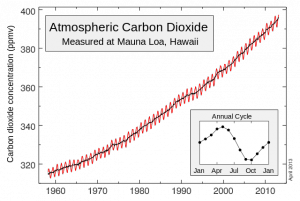
Their lawsuit asked the State to take action in restoring the atmosphere to 350 ppm of CO2 by the end of the century. The Oregon Court of Appeals rejected the defenses raised by the State, finding that the youth could obtain meaningful judicial relief in this case.

That’s quite a nice victory. Here’s the full story, from the Western Environmental Law Center (my emphasis throughout):

Keeling-curve_CO2_ppm_Mauna_Loa_Carbon_Dioxide_Apr2013.svg_-300x201

In a nationally significant decision in the case Chernaik v. Kitzhaber, the Oregon Court of Appeals ruled a trial court must decide whether the atmosphere is a public trust resource that the state of Oregon, as a trustee, has a duty to protect. Two youth plaintiffs were initially told they could not bring the case by the Lane County Circuit Court. The trial court had ruled that climate change should be left only to the legislative and executive branches. Today, the Oregon Court of Appeals overturned that decision.

Two teenagers from Eugene, Kelsey Juliana and Olivia Chernaik, filed the climate change lawsuit against Governor Kitzhaber and the State of Oregon for failing to protect essential natural resources, including the atmosphere, state waters, and coast lines, as required under the public trust doctrine. Their lawsuit asked the State to take action in restoring the atmosphere to 350 ppm of CO2 by the end of the century. The Oregon Court of Appeals rejected the defenses raised by the State, finding that the youth could obtain meaningful judicial relief in this case. …

In reversing the Lane County trial court, the Oregon Court of Appeals remanded the case ordering the trial court to make the judicial declaration it previously refused to make as to whether the State, as trustee, has a fiduciary obligation to protect the youth from the impacts of climate change, and if so, what the State must do to protect the atmosphere and other public trust resources.

The implications of this are broad, and similar cases are pending in other states, as the article describes.

Make no mistake; decisions like this matter. It places the court squarely in the mix as a power player in the climate war, the fight for “intergenerational justice” as James Hansen puts it — or the war against intergenerational betrayal, as I put it.

This is a cornerstone decision from the Oregon Court of Appeals in climate change jurisprudence. The court definitively ruled that the question of whether government has an obligation to protect the atmosphere from degradation leading to climate change is a question for the judiciary, and not for the legislative or executive branches. The Court did not opine as to how that question should be answered, only that it should be answered by the judiciary.

We can win this; it’s not over. If we reach 450 ppm and we’re still not stopping with the CO2, then it’s over and I become a novelist full-time. But we’re not there yet, and please don’t surrender as if we were.

The courts are now a powerful tool, as is divestment. James Hansen has a way to restore the atmosphere to 350 ppm CO2 in time to stop slow feedbacks from kicking in. It’s a doable plan, but we’ll need to use force. Using the courts, as with using divestment campaigns, counts as force. Stay tuned.

(Want to use force at the national level? Find a way to challenge Obama publicly to stop leasing federal land to coal companies. He’s a hypocrite until he stops federal coal from being mined and sold abroad. A simple and obvious challenge for him. You too can be the activist.)

GP

Twitter: @Gaius_Publius
Facebook: Gaius Publi

(Facebook note: To get the most from a Facebook recommendation, be sure to Share what you also Like. Thanks.)

ooOOoo

 Never forget that you, me and every other good-minded person on this planet can make a positive difference. Need inspiration? Gain it from our dogs! Let’s use the liberty we enjoy to make a difference.

Two views of the United Kingdom

The very good and the very ugly.

Yesterday was the moment when Queen Elizabeth II became the longest-reigning UK monarch. As the BBC reported (in part) yesterday:

Queen Elizabeth II becomes longest-reigning UK monarch

The Queen has thanked well-wishers at home and overseas for their “touching messages of kindness” as she becomes Britain’s longest-reigning monarch.

Speaking in the Scottish Borders, the 89-year-old monarch said the title was “not one to which I have ever aspired”.

At 17:30 BST she had reigned for 23,226 days, 16 hours and approximately 30 minutes – surpassing the reign of her great-great-grandmother Queen Victoria.

David Cameron said the service the Queen had given was “truly humbling”.

Dressed in turquoise with her trusty black handbag at her side, the Queen spoke briefly to the gathered crowds earlier.

“Inevitably a long life can pass by many milestones – my own is no exception – but I thank you all and the many others at home and overseas for your touching messages of great kindness,” she said.

Newly released official photographs show the Queen with her official red box, containing the day's policy papers, cabinet documents, Foreign Office papers and other letters.
Newly released official photographs show the Queen with her official red box, containing the day’s policy papers, cabinet documents, Foreign Office papers and other letters.

Here’s a video that is worth viewing:

So that was the ‘good’ news.

Now here is the ‘ugly’ news; the latest essay by George Monbiot republished here with Mr. Monbiot’s kind permission.

ooOOoo

Britain’s Mafia State

8th September 2015

Where does legitimate business end and organised crime begin?

By George Monbiot, published in the Guardian 9th September 2015

Be reasonable in response to the unreasonable: this is what voters in the Labour election are told. Accommodate, moderate, triangulate, for the alternative is to isolate yourself from reality. You might be inclined to agree. If so, please take a look at the reality to which you must submit.

To an extent unknown since before the First World War, economic relations in this country are becoming set in stone. It’s not just that the very rich no longer fall while the very poor no longer rise. It’s that the system itself is protected from risk. Through bail-outs, quantitative easing and delays in interest rate rises, speculative investment has been so well cushioned that, as Larry Elliott puts it, financial markets are “one of the last bastions of socialism left on earth.”

Public services, infrastructure, the very fabric of the nation: these too are being converted into risk-free investments. Social cleansing is transforming inner London into an exclusive economic zone for property speculation. From a dozen directions, government policy converges on this objective. The benefits cap and the bedroom tax drive the poor out of their homes. The forced sale of high-value council houses creates a new asset pool. An uncapped and scarcely regulated private rental market turns these assets into gold. The freeze on council tax banding since 1991, the lifting of the inheritance tax threshold and £14 billion a year in breaks for private landlords all help to guarantee stupendous returns.

And for those who wish simply to sit on their assets, the government can help here too, by ensuring that there are no penalties for leaving buildings empty. As a result, great tracts of housing are removed from occupation. Agricultural land has proved an even better punt for City money: with the help of capital gains, inheritance and income tax exemptions, as well as farm subsidies, its price has quadrupled in 12 years.

Property in this country is a haven for the proceeds of international crime. The head of the National Crime Agency, Donald Toon, notes that “the London property market has been skewed by laundered money. Prices are being artificially driven up by overseas criminals who want to sequester their assets here in the UK.”

It’s hardly surprising, given the degree of oversight. Private Eye has produced a map of British land owned by companies registered in offshore tax havens. The holdings amount to 1.2 million acres, including much of our prime real estate. Among those it names as beneficiaries are a cast of Russian oligarchs, oil sheikhs, British aristocrats and newspaper proprietors. These are the people for whom government policy works, and the less regulated the system that enriches them, the happier they are.

The speculative property market is just one current in the great flow of cash that sluices through Britain while scarcely touching the sides. The financial sector exploits an astonishing political privilege: the City of London is the only jurisdiction in the UK not fully subject to the authority of parliament. In fact, the relationship seems to work the other way. Behind the Speaker’s chair in the House of Commons sits the Remembrancer, whose job is to ensure that the interests of the City of London are recognised by the elected members. (A campaign to rescind this privilege – Don’t Forget the Remembrancer – will be launched very soon). The City has one foot in the water: it is a semi-offshore state, a bit like the UK’s Crown dependencies and overseas territories, tax havens legitimised by the Privy Council. Britain’s financial secrecy undermines the tax base while providing a conduit into the legal economy for gangsters, kleptocrats and drug barons.

Even the more orthodox financial institutions deploy a long succession of scandalous practices: pension mis-selling, endowment mortgage fraud, the payment protection insurance con, Libor rigging. A former minister in the last government, Lord Green, ran HSBC while it engaged in money laundering for drugs gangs, systematic tax evasion and the provision of services to Saudi and Bangladeshi banks linked to the financing of terrorists. Sometimes the UK looks to me like an ever-so-civilised mafia state.

At next month’s Conservative party conference, corporate executives will pay £2,500 to sit with a minister. Doubtless, because we are assured that there is no link between funding and policy, they will spend the day discussing the weather and the films they have seen. If we noticed such arrangements overseas, we might be inclined to regard them as corruption. But that can’t be the case here, not least because the invitation explains that “fees associated with business day & dinner are considered a commercial transaction and therefore do not constitute a political donation.”

The government also insists that there is no link between political donations and seats in the House of Lords. But a study by researchers at Oxford University found that the probability of so many major donors arriving there by chance is 1.36 x 10-38: roughly “equivalent to entering the National Lottery and winning the jackpot 5 times in a row”. Why does the Lords remain unreformed? Because it permits plutocratic power to override democracy. Both rich and poor are kept in their place.

Governed either by or on behalf of the people who fleece us, we cannot be surprised to discover that all public services are being re-engineered for the benefit of private capital. Nor should we be surprised when governments help to negotiate, without public consent, treaties such as TTIP and CETA (the Comprehensive Economic and Trade Agreement), which undermine the sovereignty of both parliament and the law. Aesop’s observation that “we hang the petty thieves and appoint the great ones to public office” remains true in spirit, though hanging has been replaced by community payback.

Wherever you sniff in British public life, something stinks: I could fill this newspaper with examples. But, while every pore oozes corruption, our task, we are told, is merely to trim the nails of the body politic.

To fail to confront this system is to collaborate with it. Who on the left would wish to stand on the sidelines as this carve-up continues? Who would vote for anything but sweeping change?

www.monbiot.com

ooOOoo

Going to close with this picture:

Ma'am's best friend: The Queen has owned corgis for more than 60 years. Picture seen on in the UK's Daily Mail newspaper.
Ma’am’s best friend: The Queen has owned corgis for more than 60 years. Picture seen in the UK’s Daily Mail newspaper.

Taking the two stories together, all that comes to mind is that we could do much better if the United Kingdom, and other countries, were governed by dogs!

Habituated to eating

A startling and counter-intuitive essay from George Monbiot.

Hariod Brawn, she of the blog Contentedness.net, left a response to yesterday’s post in this place. Here is what Hariod said:

Yes Paul, I too recognise the value in understanding the neural substrates involved, regardless of what may in any case be reliably inferred and readily apparent in behavioural evidence. The social intelligence of the dog seems remarkably advanced of course, and so naturally provides a rich source for such research. Having said that, I am struck by the amount of academic funding that goes into confirming what is already self-evident, and wonder if the apportioning of funds is done quite as effectively as it could be. Much is determined by commercial interests of course.

“Much is determined by commercial interests …”

I have been a resident of the United States since April 2011. There has been much to take in and embrace at so many levels. However, one of the things that has seemed very foreign to my eyes was the extent of the obesity seen almost everywhere that one is out and about. At first it seemed more of an American issue, but over the last few years watching news items from the UK and seeing other general items on the internet from ‘the old country’ I came to realise that countries both ‘sides of the pond’ are grappling with what could be fairly described as an epidemic.

Yesterday, George Monbiot published an essay called Slim Chance. As with so many of Mr. Monbiot’s essays this one highlights issues that I am sure are not widely appreciated. It is republished here with Mr. Monbiot’s kind permission.

ooOOoo

Slim Chance

11th August 2015

New evidence suggests that obesity might be incurable. So why does the government propose to punish sufferers?

By George Monbiot, published in the Guardian 12th August 2015

Is overeating more addictive than crack cocaine? It’s hard to compare addiction rates, or to produce a clear definition that holds true across all substances and behaviours. But consider this crude contrast. Between 10 and 20% of people who use crack cocaine become addicted to it. Across a 9-year study of 176,000 obese people, 98.3% of the men and 97.8% of the women failed to return to a healthy weight. Once extreme overeating begins, it appears to be almost impossible to stop.

A paper published in the journal Neuroscience and Biobehavioral Reviews proposed that “food addiction” is a less accurate description of this condition than “eating addiction”. There is little evidence that people who are driven to overeat become dependent on a single ingredient; instead they tend to seek out a range of highly palatable, energy-dense foods, of the kind with which we are now surrounded.

The activation of reward systems in the brain and the loss of impulse control are similar to those involved in dependency on drugs. But eating addiction appears to be more powerful. As the same paper notes, in laboratory experiments “a majority of rats will prefer a sweet reward over a cocaine reward.”

Once you become obese, an article published in the Lancet this year explains, biological changes lock you in. Fat cells proliferate. The brain becomes habituated to dopamine signalling (the reward pathway), driving you to compensate by increasing your consumption. If you try to lose weight, the body perceives that it is being starved, and powerful adaptations (such as an increase in metabolic efficiency) try to bounce you back to your previous state. People who manage, against great odds, to return to a normal weight must consume 300 fewer calories per day than those who have never been obese, if they are not to put the weight back on. “Once obesity is established, … bodyweight seems to become biologically stamped in”. The more weight you lose, the stronger the biological pressure to get back to your former, excessive size.

The researchers find that “these biological adaptations often persist indefinitely”: in other words, if you have once been obese, staying slim means sticking to a strict diet for life. The best you can hope for is not a dietary cure, but “obesity in remission”. The only effective, long-term treatment for obesity currently available, the same paper says, is bariatric surgery. This can cause a number of grim complications.

I know this statement will be unwelcome. I too hate the idea that people cannot change their circumstances. But the terrible truth is that, except through surgery, for the great majority of sufferers, obesity is an incurable disease. In one respect it resembles cancer: the changes in lifestyle that might have prevented it are unlikely to be of use in curing it.

Fat-shaming is worse than useless. Another paper found that the more weight-conscious people are, the more likely they are to overeat: the stress it induces is a trigger for comfort eating. As Sarah Boseley points out in her book The Shape We’re In, “the diet industry … is one of the biggest frauds of our time”. For the obese, temporary reductions in weight will almost inevitably be reversed.

People who are merely overweight, rather than obese (in other words who have a BMI of between 25 and 30) appear not to suffer from the same biochemical adaptations: their size is not “stamped in”. For them, changes of diet and exercise are likely to be effective. But urging obese people to buck up produces nothing but misery.

The crucial task is to reach children before they succumb to this addiction. As well as help and advice for parents, this surely requires a major change in what scientists call “the obesogenic environment” (high energy foods and drinks and the advertising and packaging that reinforces their attraction). Unless children are steered away from overeating from the beginning, they are likely to be trapped for life.

You might have expected this knowledge to lead to acceptance, empathy and an end to stigmatisation. Fat chance. A fortnight ago, just after the figures I mentioned at the top of this article were published, David Cameron announced a review that could lead to obese people being deprived of social security payments if they fail to accept “treatment” for their condition.

This review, conducted by Dame Carol Black, has already pre-empted its conclusions: eight times it describes obesity as “treatable”. Really? How? It will consider the case “for linking benefit entitlements to take up of appropriate treatment”. Are Cameron and Black proposing that benefit claimants will be forced to undergo surgery? Or will they be pressed into a useless and punitive dietary regime? These proposals look to me like a transfer of blame for the disease away from food manufacturers and advertisers and onto those afflicted.

Why do we have an obesity epidemic? Has the composition of the human species changed? Have we suffered a general collapse in willpower? No. The evidence points to high-fat, high-sugar foods that overwhelm the impulse control of children and young adults, packaged and promoted to create the impression that they are fun, cool and life-enhancing. Many are placed in the shops where children are bound to encounter them: around the tills, at grasping height.

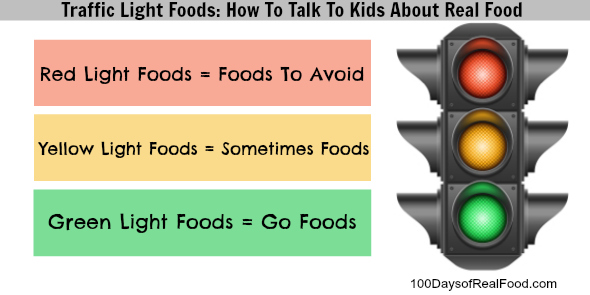
The disease will keep ravaging the population (and slowly overwhelm the health service) until these circumstances change. But the government’s sole contribution has been to tear down mandatory controls, replacing them with a voluntary – and therefore useless – “responsibility deal” with manufacturers and retailers. It allows them to choose whether or not to use the traffic light system, which is the most effective way of informing people about the likely impact of what they eat. And many corporations, unsurprisingly, choose not to. As far as nutritional content is concerned, food manufacturing is effectively unregulated.

Industry and government will resist the obvious solutions until they can be resisted no longer. Eventually, the change will have to happen: similar restrictions on advertising, sponsorship, display and accessibility to those imposed on the tobacco pedlars. One day, though not before many thousands have needlessly died, it will become illegal to advertise any food or drink that merits a red traffic light warning. They will be sold only in plain packaging, with health warnings, on high shelves.

Does this seem draconian to you? If so, remember that obesity afflicts a quarter of the adult population, and is rising rapidly. It causes a range of hideous conditions, just one of which – diabetes – accounts for one sixth of NHS admissions and 10% of its budget. If smoking demands fierce intervention, why not overeating?

This is the choice we face. To recognise that the only humane and effective means of addressing the obesity epidemic is to prevent more people from being hooked, by restricting the pushers. Or to continue a programme of fat-shaming, bullying and compulsory treatment, whose only likely outcome is unhappiness. Now ask yourself again: which of these two options is draconian?

www.monbiot.com

ooOOoo

Let me close with an image. The image that George Monbiot believes will be seen very widely and representing the same common-sense in eating that we have been used to with regard to No Smoking signs.

9129948_orig

A return to the topic of rewilding.

Lessons from the wild

At the end of 2013, I published a post under the title of We must rewild. The core of that post was an essay from Patrice Aymes called Rewilding Us. Here’s a small extract from that essay:

In Africa, there are about 500,000 elephants. 25,000 to 30,000 are killed, a year, to send the ivory to east Asia (China, Vietnam). So African elephants may disappear. This is beyond tragic, it’s irreplaceable. Elephants understand people’s gestures, without any learning (they apparently learn to use trunk gestures among themselves). One is talking about extremely intelligent animals here. (In contrast, chimpanzees have great difficulties understanding human gestures.)

My post also included this photograph of young Cleo, just five months old, showing that her innate skills of being in the wild were alive and well, despite thousands of years of dogs being domesticated animals. Ergo, humans could manage just as well.

Photograph taken 25th April, 2012.

Last Friday, George Monbiot published an essay in The Guardian newspaper that stays with the theme of loving the wild.  It is republished here with Mr. Monbiot’s very kind permission.

ooOOoo

Falling in Love Again

17th July 2015

Rebuilding our relationship with the natural world can re-animate our own lives, as well as the ecosystem.

When the robin was voted the UK’s national bird last month, we chose to celebrate half of a broken relationship. The robin is to the wild boar what the oxpecker is to the Cape buffalo: it has evolved to catch the worms and insects exposed by their grubbing. But boar are mostly absent from the UK, so its survival often depends on finding the next best thing: human gardeners. This is why the robin is so tame in this country. As far as the bird is concerned, you and I are just fake pigs.

We are surrounded by such broken relationships, truncated natural processes, cauterised ecologies. In Britain we lack almost all large keystone species: ecological engineers that drive the fascinating dynamics which allow other lifeforms to flourish. Boar, beavers, lynx, wolves, whales, large sharks, pelicans, sturgeon: all used to be abundant here, all, but for a few small populations or rare visitors, are missing.

The living systems that conservationists seek to protect in some parts of this country are a parody of the natural world, kept, through intensive management, in suspended animation, like a collection in a museum. An ecosystem is not just a place. It is also a process.

I believe their diminished state also restricts the scope of human life. We head for the hills to escape the order and control that sometimes seem to crush the breath out of us. When we get there, we discover that the same forces prevail. Even our national parks are little better than wet deserts.

Our seas were once among the richest on earth. A few centuries ago, you could have watched fin whales and sperm whales hammering the herring within sight of the shore. Shoals of bluefin tuna thundered up the North Sea. Reefs of oysters and other sessile animals covered the seabed, over which giant cod, skate and halibut cruised. But today, industrial fishing rips up the living fabric of all but 0.01% of our territorial waters. To walk or dive in rich environments we must go abroad.

Though not, I hope, for long. On Wednesday, a new organisation, Rewilding Britain, was launched. (It was inspired by my book Feral and I helped to found it, but I don’t have a position there). Its aim is to try to catalyse the mass restoration of the living world, bring trees back to bare hills, allow reefs to form once more on the seabed and to return to these shores the magnificent, entrancing animals of which we have so long been deprived. Above all it seeks to enhance and enrich the lives of the people of this nation. I hope that it might help to change the face of Britain.

Already, local projects hint at what could be achieved. In the southern uplands of Scotland, the Borders Forest Trust has bought 3000 hectares of bare mountainside and planted hundreds of thousands of native trees. The community of Arran seabed trust in the Firth of Clyde managed, after 13 years of campaigning, to persuade the government to exclude trawlers and scallop dredgers from one square mile of seabed. The result, in this tiny reserve, is an explosion of lobsters, crabs, scallops and fish. It’s now trying to extend the project to a larger area.

In Sussex, the Knepp Castle estate gave up its unprofitable wheat farming, released a few cattle and pigs and let natural processes take over. Now it hosts some of Britain’s highest populations of nightingales, purple emperor butterflies and turtle doves. Partly through ecotourism and accommodation and selling high-grade meat, it has become profitable. In south London, the Wandle Trust has turned a mangled and polluted urban river back into a beautiful chalkstream, supporting kingfishers and wild trout. Wonderful as these projects are, until now they have lacked a national voice. Britain remains in a state of extreme depletion.

Some people argue that we should not seek to re-establish missing species until we’ve protected existing wildlife. But nothing better protects our ecosystems than keystone species. Beaver dams provide habitats for fish, invertebrates, amphibians and waterbirds. In Ireland, resurgent pine martens appear to have pushed back the grey squirrel, allowing red squirrels to recolonise. One study suggests that our woodland ecology cannot recover unless half the country’s deer are culled every year. Lynx could do it for nothing. Functional ecosystems, in which dynamic living processes prevail once more, are likely to be more resistant to climate change than stagnant collections in virtual glass cases.

Over the past two years, there has been a surge of enthusiasm for change. A poll in Scotland found that 60% support the reintroduction of beavers, with only 5% opposed. 91% of respondents to a survey by the Lynx UK Trust supported a trial reintroduction. Researchers at the University of Cumbria digitally altered photographs of Borrowdale in the Lake District, adding or subtracting trees. 69% of the people who saw them favoured the images with extra trees. A video extracted from my TED talk, about the relationship between wolves and other wildlife, has been watched 18 million times.

But the interests of local people must never be overruled. Rewilding must take place only with active consent. Already, landowners are coming forward, proposing to rewild their own property. Community groups, such as Cambrian Wildwood in mid-Wales, are seeking to buy and restore surrounding land. What rewilding offers is a new set of options in places where traditional industries can no longer keep communities alive, where schools and shops and chapels and pubs are closing and young people are leaving the land to find work elsewhere.

In the hills of southern Norway, the return of trees has been accompanied by a diversification and enrichment of the local economy. There, the small income from farming is supplemented with eco-tourism, forest products, rough hunting, fishing, outdoor education, skiing and hiking. The governments of Britain now claim to be willing to pay for the protection of soils and watersheds. These are likely to be more resilient sources of income than the current farm subsidy system upon which all hill farming in this country depends, whose gross injustice – transferring vast sums from the poor to the rich simply for owning land – is as unsustainable politically as it is ecologically.

Perhaps most importantly, rewilding offers hope. It offers the hope of recovery, of the enhancement of wonder and enchantment and delight in a world that often seems crushingly bleak. My involvement with rewilding, to my own amazement, has made me much happier and more optimistic than I was before. I feel an almost evangelical sense of excitement about the prospects for change. I want other people to be able to experience it too.

In 2009, the rewilding pioneers Trees for Life released some wild boar into an enclosure at Dundreggan, in the Scottish Highlands. Within twenty minutes, robins came down from the trees and started following them. Their ecological memory was intact. When I’ve accompanied children from deprived London boroughs to the woods and rockpools for the first time in their lives, I have seen something similar: an immediate, instinctive re-engagement, the restoration of a broken ecological relationship. Once we have richer wild places to explore, we won’t need much prompting to discover their enchantments.

www.monbiot.com

ooOOoo

In the copy of George Monbiot’s essay that was published on his blogsite there were 25 links to other materials. I feel very bad that I just didn’t have the time to copy across all those links so my strong recommendation is that if you enjoyed reading this here then you go across to the essay on his blogsite and check out all the additional material available to you. My only exception was to insert the link to the organisation Rewilding Britain that was referred to in the sixth paragraph.

Consequences.

I can’t resist this essay from George Monbiot.

As regular followers of Learning from Dogs will know, I frequently republish essays written by George Monbiot. I do so because there is only so much one can write about dogs, Mr. Monbiot is a great writer, and the gentleman has generously given me blanket permission to republish his essays! 😉

Plus, while many of my posts are directly about dogs, the underlying theme of this blog is to use the qualities of dogs as emblems, or metaphors, for how mankind has to behave if we are to have any chance of survival into the longterm. Or in the words of my essay on Dogs and integrity:

Because of this closeness between dogs and man, we (as in man!) have the ability to observe the way they live.  Now I’m sure that scientists would cringe with the idea that the way that a dog lives his life sets an example for us humans, well cringe in the scientific sense.  But man seems to be at one of those defining stages in mankind’s evolution where the forces bearing down on the species homo sapiens have the potential to cause very great harm.  If the example of dogs can provide a beacon of hope, an incentive to change at a deep cultural level, then the quicker we ‘get the message’, the better it will be.

All of which is my way of introducing Mr. Monbiot’s latest essay on the recent shenanigans involving Greece, in particular, and the EU, in general.

ooOOoo

Breaking Faith

13th July 2015

The European Union is becoming ever harder for progressives to love. Is it time to get out?

By George Monbiot, published on the Guardian’s website, 10th July 2015

Had I been asked a couple of years ago how I would vote in the referendum on whether or not the UK should stay in the European Union, my answer would have been unequivocal.

The EU seemed to me to be a civilising force, restraining the cruel and destructive tendencies of certain member governments (including our own), setting standards that prevented them from destroying the natural world or trashing workers rights, creating a buffer between them and the corporate lobby groups that present an urgent threat to democracy.

Now I’m not so sure. Everything good about the European Union is in retreat; everything bad is on the rampage.

I accept the principle of sharing sovereignty over issues of common concern. I do not accept the idea of the rich nations combining to crush the democratic will of the poorer nations, as they are seeking to do to Greece.

I accept the principle that the European Union should represent our joint interests in creating treaties for the betterment of humankind. I do not accept that it has a right to go behind our backs and quietly negotiate a treaty with the United States – the Transatlantic Trade and Investment Partnership (TTIP) – that transfers power from parliaments to corporations.

I accept the principle that the EU could distribute money to the poor and marginalised. I do not accept that, as essential public services are cut, €57bn a year should be sloshed into the pockets of farmers, with the biggest, richest landowners receiving the largest payments. The EU’s utter failure to stop this scandal should be a source of disillusionment even to its most enthusiastic supporters.

While these injustices, highly damaging to the reputation of the European Union among people who might otherwise be inclined to defend it, are taking place, at the same time the EU’s restraints on unaccountable power are in danger of being ripped away.

The slippage began with the disastrous abandonment last year of the Soil Framework Directive, at the behest of agricultural lobbyists and the British government. It’s the first time a directive has been derailed.

The directive would have obliged the member states to minimise soil erosion and compaction, maintain the organic matter contained in the soil, prevent landslides and prevent soil from being contaminated with toxic substances. Could any sentient person object to these aims? And can anyone who has studied the complete failure of current soil protection measures in countries like the United Kingdom, where even Farmer’s Weekly admits that “British soils are reaching crisis point” fail to see that further measures are required?

The National Farmers Union, who appear to regard it as their mission to vandalise the fabric of the nation, took credit for the decision.

Now the same industries are trying to sink the directives protecting the natural world. In some European countries, the nature directives are just about all that prevent the eradication of the wildlife that belongs to everyone and no one. Thanks to the capture and cowardice of the European Commission, there is now a real danger that the industrial lobbyists who want to destroy our common heritage will get their way.

The European Union’s two nature directives – the Birds Directive and the Habitats Directive – are often all that stand between our wildlife and the industries that would destroy them.

Look, for example, at what’s happening to our harbour porpoises. These beautiful creatures, that enhance the lives of everyone who has seen them leaping and playing the sea, are being caught and killed in fishing nets, starved to death by overfishing, mashed up by propellers and driven out of their feeding grounds by a cacophony of underwater noise from boats.

The only way in which they can be protected is through creating areas in which these activities are restricted, particularly in places such as the Hebrides, the outer Moray Firth and in parts of Cardigan Bay. But the only site the government has proposed is a tiny speck of sea off the coast of Northern Ireland.

The one defence this species has against the mailed fist of the fishing industry, which appears to be locked around the sensitive parts of the UK’s environment department, is an appeal under the Habitats Directive, of which this country is blatantly in breach.

Or look at the continued massacre of birds of prey by grouse shooting estates, which operate as black holes in which hen harriers, peregrines, eagles and other species disappear without trace: shot, trapped or poisoned by an industry that exists to serve the ultra-elite, while damaging the common heritage of humankind. There’s no point in asking nicely: representing the interests of the ultra-elite while damaging the common interests of humankind appears to be the government’s mission. So the only possible restraint is an appeal under the Birds Directive, which the UK government signed and still claims to uphold.

Badly and erratically as we protect our precious species and the places in which they live, they would be in a much worse state were it not for the restraining influence of European law.

I happen to think that there is quite a lot wrong with the Habitats Directive. Some of the places it protects, at the behest of national governments, are highly degraded ecosystems, and it locks them into their depleted state, ensuring that they can recover neither the wealth of species that might live there, nor much of the dynamism and ecological function that could otherwise have been restored.

The irrational way in which upland heather moors are protected is one example. Like the strikingly similar landscapes of low wiry vegetation that you can now see in some former rainforest areas in the tropics, these habitats have been created through repeated cycles of cutting and burning. This destruction is necessary to keep these wastelands in their current state, by preventing trees from returning.

While we decry these processes when we see them take place abroad, here we treat them as if they were essential conservation tools. It’s a form of madness which afflicts everyone from grouse moor owners to conservationist groups, and it reflects an astonishing loss of perspective on the part of those who should be protecting the natural world. The Habitats Directive is one of the legal instruments that has turned this continued destruction into a legal requirement.

But the European Commission’s proposals to “reform” the directives, are likely to make them worse, not better. The danger is that it will leave their irrational aspects intact, while stripping away the essential protections they offer to our wildlife.

No one is in any doubt that the “reform” being proposed is the kind that is usually enacted with a can of petrol and a box of matches. In November last year, Jean-Claude Juncker, the president of the European Commission, instructed the Environment Commissioner to “overhaul” the directives and to examine the possibility of merging them. A reliable if sometimes eccentric set of protections is now at mortal risk.

A public consultation on these proposals is taking place at the moment, and it closes on July 24. I’ll repeat that because the only hope these directives possess is a huge public response calling for their defence. The consultation closes on July 24. Please send in your views. Already, 270,000 people have done so, prompted by campaigning organisations such as the RSPB. Let’s turn this into half a million.

The ostensible purpose of this proposed vandalism is to reduce the costs to business. But when the Conservative former president of Bavaria, Edmund Stoiber, was asked by the European Commission to conduct a review of all European legislation, with a view to deregulating it, he discovered that the combined impact of all seven of the EU’s environmental directives (of which birds and habitats are just two) is less than 1% of the total cost to business caused by European law. In other words it is utterly insignificant.

In fact, changing these directives could be costly for businesses, as they have already adapted their practices to meet them, and they would have to start all over again if the laws are changed.

The threat to the directives arises not from a demand by business as a whole, but from pressure by two of the most destructive industries in the European Union, Big Farmer and the construction lobby. That the European Commission should have chosen to listen to them while ignoring the views of everyone else cuts to the heart of what is going wrong there.

So when the referendum comes, I will find myself in a struggle I never anticipated. I am an internationalist. I think it’s essential that issues which transcend national borders are tackled together, rather than apart. I recognise the hideous history of conflict in Europe, and the extraordinary achievement of peace that the European Union represents. I feel nothing in common with the Eurosceptics of the right, who appear to see the EU as interfering with their god-given right to exploit other people and destroy their surroundings.

My feelings towards the EU are now similar to my feelings towards the BBC: a sense that I ought to join the defence of this institution against reactionary forces, but that it has succumbed so catastrophically to those forces that there is little left to defend. If the nature directives go down, while TTIP and the fiscal waterboarding of countries like Greece proceed, it will not be obvious what continued membership has to offer us.

http://www.monbiot.com

ooOOoo

 Difficult to add anything of value to these powerful words from GM other than to remind everyone, both in the EU and outside (for the survey accepts non-EU resident contributions), to complete the survey highlighted by George Monbiot. The link is here.

Our love for the natural ways of the world.

“In defending the natural world, we should be honest about our motivations – it’s love that drives us, not money.”

Not my words but the opening line from a brilliant essay published yesterday by George Monbiot.

I can add very little to the power of Mr. Monbiot’s essay other than to ‘top and tail’ his words with a couple of photographs taken here at home. Plus not forgetting to add that the essay is republished with George Monbiot’s very kind permission.

A view of our property looking out to the North-East. Our boundary is the other side of the line of trees. (Photo taken July, 2012)

ooOOoo

Channelling the Joy

17th June 2015

In defending the natural world, we should be honest about our motivations – it’s love that drives us, not money.

By George Monbiot, published in the Guardian 17th June 2015

Who wants to see the living world destroyed? Who wants an end to birdsong, bees and coral reefs, the falcon’s stoop, the salmon’s leap? Who wants to see the soil stripped from the land, the sea rimed with rubbish?

No one. And yet it happens. Seven billion of us allow fossil fuel companies to push shut the narrow atmospheric door through which humanity stepped. We permit industrial farming to tear away the soil, banish trees from the hills, engineer another silent spring. We let the owners of grouse moors, 1% of the 1%, shoot and poison hen harriers, peregrines and eagles. We watch mutely as a small fleet of monster fishing ships trashes the oceans.

Why are the defenders of the living world so ineffective? It is partly, of course, that everyone is complicit; we have all been swept off our feet by the tide of hyperconsumption, our natural greed excited, corporate propaganda chiming with a will to believe that there is no cost. But perhaps environmentalism is also afflicted by a deeper failure: arising possibly from embarrassment or fear, a failure of emotional honesty.

I have asked meetings of green-minded people to raise their hands if they became defenders of nature because they were worried about the state of their bank accounts. Never has a hand appeared. Yet I see the same people base their appeal to others on the argument that they will lose money if we don’t protect the natural world.

Such claims are factual, but they are also dishonest: we pretend that this is what animates us, when in most cases it does not. The reality is that we care because we love. Nature appealed to our hearts, when we were children, long before it appealed to our heads, let alone our pockets. Yet we seem to believe we can persuade people to change their lives through the cold, mechanical power of reason, supported by statistics.

I see the encyclical by Pope Francis, which will be published on Thursday, as a potential turning point. He will argue that not only the physical survival of the poor, but also our spiritual welfare depends on the protection of the natural world; and in both respects he is right.

I don’t mean to suggest that a belief in God is the answer to our environmental crisis. Among Pope Francis’s opponents is the evangelical Cornwall Alliance for the Stewardship of Creation, which has written to him arguing that we have a holy duty to keep burning fossil fuel, as “the heavens declare the glory of God; and the firmament proclaims his handiwork”. It also insists that exercising the dominion granted to humankind in Genesis means tilling “the whole Earth”, transforming it “from wilderness to garden and ultimately to garden city”.

There are similar tendencies within the Vatican. Cardinal George Pell, its head of finance, currently immersed in a scandal involving paedophile priests in Australia, is a prominent climate change denier. His lecture to the Global Warming Policy Foundation was the usual catalogue of zombie myths (discredited claims that keep resurfacing), nonsequiturs and outright garbage, championing, for example, the groundless claim that undersea volcanoes could be responsible for global warming. There are plenty of senior Catholics seeking to undermine the Pope’s defence of the living world; which could explain why his encyclical was leaked.

What I mean is that Pope Francis, a man with whom I disagree profoundly on matters such as equal marriage and contraceptives, reminds us that the living world provides not only material goods and tangible services, but is also essential to other aspects of our well-being. And you don’t have to believe in God to endorse that view.

In his beautiful book The Moth Snowstorm, Michael McCarthy suggests that a capacity to love the natural world, rather than merely to exist within it, might be a uniquely human trait. When we are close to nature, we sometimes find ourselves, as Christians put it, surprised by joy: “a happiness with an overtone of something more, which we might term an elevated or, indeed, a spiritual quality.”

He believes we are wired to develop a rich emotional relationship with nature. A large body of research suggests that contact with the living world remains essential to our psychological and physiological well-being. (A paper published this week, for example, claims that green spaces around city schools improve children’s mental performance).

This does not mean that all people love nature; what it means, McCarthy proposes, is that there’s a universal propensity to love it, which may be drowned out by the noise that assails our minds. As I’ve found while volunteering with the outdoor education charity Wide Horizons, this love can be provoked almost immediately, even among children who have never visited the countryside before. Nature, McCarthy argues, remains our home, “the true haven for our psyches”, and retains an astonishing capacity to bring peace to troubled minds. Acknowledging our love for the living world does something that a library full of papers on sustainable development and ecosystem services cannot: it engages the imagination as well as the intellect. It inspires belief; and this is essential to the lasting success of any movement.

Is this a version of the religious conviction from which Pope Francis speaks? Or could his religion be a version of a much deeper and older love? Could a belief in God be a way of explaining and channelling the joy, the burst of love that nature sometimes provokes in us? Conversely, could the hyperconsumption that both religious and secular environmentalists lament be a response to ecological boredom: the void that a loss of contact with the natural world leaves in our psyches?

Of course, this doesn’t answer the whole problem. If the acknowledgement of love becomes the means by which we inspire environmentalism in others, how do we translate it into political change? But I believe it’s a better grounding for action than pretending that what really matters to us is the state of the economy. By being honest about our motivation we can inspire in others the passions that inspired us.

www.monbiot.com

ooOOoo

Will close this thoughtful essay from Mr. Monbiot with another photograph.

Same view but this time on a foggy Autumn day in 2013.

It truly is love that drives our relationship with nature.

Reintroducing ourselves to the wolf

A guest essay from Karla Powell.

A couple of weeks ago, an email arrived in my ‘in-box’, as follows:

Hi Karla and Paul,

I hope this email finds you both well. I recently met Karla on an Oregon Wild hike last weekend in the Gorge. Karla is a longtime Oregon Wild supporter, passionate wildlife advocate and published author. She recently wrote a really lovely article on the human connection to wolves that I found quite inspiring.

I wanted you two to connect as Paul is also a wildlife advocate, now living in southern Oregon with his wonderful partner Jean. Paul, I thought you might be able to recommend a place, online or otherwise, Karla might be able to submit this article. I think you’ll quite enjoy it.

Thank you both for supporting our work for so many years,
Bridget

Clearly, I was able to recommend a place where Karla could submit her article! Here on Learning from Dogs!

Karla and I made contact and, bingo!, here is her remarkable essay.

ooOOoo

Reintroducing Ourselves to the Wolf

Karla Powell

Is it possible that by reconciling our troubled relationship with the North American wolf, we may come to better know our own nature as well as theirs? In the realm of natural history, wolves have long been left to myth and superstition. “Well into the 20th century, even science lagged behind in its knowledge of wolves and retained certain biases,” says award-winning nature writer, Barry Lopez, in his definitive book Of Wolves and Men. Even in the 21st century, science still can be skewed towards special interests. Yet the relative merits of facts notwithstanding, it is opinions about wolves that hold sway, points out Lopez.

As a lifelong urban creature, I had neither opinions nor knowledge when it came to the existence of wolves. Then in mid-life I found myself living alone in a cabin in rural Oregon and running a Junior Rangers program for the local state park. I also oversaw the weekend evening family programs. One such program featured hybrid wolves who’d found shelter in a nearby sanctuary and were presented for educational purposes. It was the closest I’d ever come to the real thing. So the next day I incorporated the theme of wolves into my Jr. Ranger activity.

I began by encouraging my young charges to howl along with me. I’d been practicing in the car on the way and it felt great! (I can see why they say wolves may howl at times for sheer pleasure.) My Jr. Rangers eagerly entered the fray, and every dog in the campground soon followed. Contrast this youthful exuberance to the dispiriting recollection of Joseph Marshall, author of The Wolf: A Native American Symbol. Marshall’s tale is recounted in the book War Against Wolf. “As a seven-year-old, I knew that there were no wolves left in my world, and I knew why. One day my grandfather… told me that the spirits of all the dead wolves … would wait until the time was right for them to return and walk again on the earth.”

Marshall, a Sicangu Lakota, believed that the 1995 reintroduction of wolves in Yellowstone heralded that this day had arrived. Yet we’re still a far cry from the sustainable recovery of a species we nearly annihilated. Reintroduction efforts in several western states contend with tired old beliefs. This vocal minority seem to me not far removed from those distant ancestors whose hysteria about the animal went so far as to conjure human “werewolves,” who were hunted and burned alive.

The folklore that led to such extremes was ultimately carried to our shores. In the book Vicious: Wolves and Men in America, the author tells of “Euro-American colonists who captured live wolves and tortured them for fun, ignoring the animals’ cowering for clemency.” Yet canines at home could display similar signals, which their masters sympathetically interpreted.

None other than John James Audubon casually recorded the maniacal torture and vicious killing of a pack of wolves by an Ohio farmer in 1814. Audubon and other observers, including trappers, sometimes noted the meek submittal of wolves to human aggression. Yet even a naturalist at that time couldn’t extrapolate this to meaningful analysis of wolves’ socialization, which includes “signaling” postures as a plea for mercy.

“This is not predator control,” says Lopez in his chapter on the gruesome excesses of “wolf fever” in the settling of our continent. “It is the violent expression of a terrible assumption: that men have the right to kill other creatures not for what they do, but for what we fear they may do.” Lopez then goes on to discuss “theriophobia” or “fear of the beast as an irrational, violent, insatiable creature.” The author continues: “At the heart of theriophobia is the fear of one’s own nature.”

Some 200 years before Christ, the Roman dramatist Plautus pithily depicted the beast we humans carry within by saying, “Man is wolf to man.” A glance at today’s headlines reveals that man’s dual nature is far from reconciled. Our legacy with the wolf is equally dualistic. In conquest, labels of savagery or demonization of the “other” are commonly projected by the oppressor onto those whom they, in turn, savagely treat. Wilderness and wildlife also are targets of such dominating impulses.

The most basic familiarity with human psychology recognizes that if we repress or deny our own capacity for shadowy motives, we invariably project such motives onto scapegoats. In America’s nation-building, the 19th century campaign to exterminate the wolf indicates we were far more guilty of depradation upon them than they upon us.

The ever-popular Saint Francis of Assisi also lived in a time of conquest run amok. An allegory about a wolf in Gubbio, Italy, has Francis and this village interloper come to an amical agreement that restored harmony for all. A contemporary visionary can be found in environmental activist George Monbiot. His 2013 TEDGlobal talk addresses the trophic cascade that resulted from the reintroduction of wolves into Yellowstone.

This phenomenon begins at the top of the food chain and tumbles down, says Monbiot. The return of wolves to Yellowstone has restored the entire ecosystem to a more healthful balance, recalling the “complex, lost, natural food chains that once prevailed,” explains Monbiot. This trophic cascade brought about by wolves simply being wolves has regenerated entire valleys and even changed the behavior of a river, he points out.

Just as St. Francis struck a deal with the wolf of Gubbio by promising he’d be fed by the villagers, we moderns too might benefit from a more cooperative pact. The wolf was a source of fascination to Homo sapiens when they also existed as communal hunters. Some theorize that prehistoric man’s social structure was modeled on how effectively wolves assured their packs’ common good.

The advent of an agrarian society disrupted this complex food chain that formerly prevailed. An agrarian society also emphasized the notion of property. The most common argument against wolves in agricultural communities is they kill animals that are human property. Yet since we’ve eradicated the natural habitat and prey of our indigenous wolf, their only guilt is they must eat to survive. This is no sin, as St. Francis demonstrated at Gubbio.

Top predators such as wolves needed time to adapt to such “quirky and aggressive killers {as man},” says Vicious author Jon T. Coleman. “The short supply of energy at the top of the food pyramid denied them this time. Euro-American colonists attacked animals in a vulnerable niche, creatures stuck with few options in a thermodynamic dead end.”

Consider that the very term “civilizing forces” is an oxymoron. Judging from how we have in some ways devolved into morbid obesity and epidemic diet-related diseases (many of them induced by altering food’s integrity), is it not possible for us to restore more wonder into our world by “rewilding” somewhat, as Monbiot and others propose? Not a return to the Stone Age. But perhaps a truly evolutionary step. One that restores us to a future that can reimagine coexistence as an effective survival strategy.

As an archetype in differing cultures, the wolf has been both revered and demonized. Yet whether seen as good or evil, it is still being objectified. Can we not instead view it as a living being worthy of both reason and regard? Despite more data about wolves than ever before, reason still lags behind, Lopez notes in the afterword to his original book. “Some folklore is so deeply entrenched that its adherents completely shut out emerging insights … In their rigid stances, they are impervious even to reason.”

As for regard, I suggest some discernment that takes us beyond even the necessary rational analysis. No less than Kepler, Darwin and Einstein have said that intuition is key to the scientific process, Lopez points out. He then suggests that we remind ourselves, “There could be more, there could be things we don’t understand.” Such a reminder may be our only hope for the wolf— as well as for us.

ooOOoo

I have no doubt that everyone who reads Karla’s wonderful essay will be enthralled by the beautiful messages.

Only one way to close today’s post.

The long-awaited return of the Yellowstone wolf!

Factory farming.

 We truly reap what we sow!

Yesterday, I wrote about what I saw as a prelude to today’s post. It was a post about the madness of the way we ingest antibiotics, frequently without us being aware that we are so doing.

The reason I regarded it as a very appropriate prelude to today is fully spelt out by George Monbiot’s second essay on the utter insanity about how our food is grown. His first essay was called Fowl Deeds and you may read it here.

So with no further ado, here is George Monbiot’s second essay republished with his kind permission.

ooOOoo

The Abuses of Enchantment

29th May 2015

The cruelties of factory farming shelter behind a fairytale image, promoted by advertisers and children’s authors.

By George Monbiot, published on the Guardian’s website 29th May 2015

The way that meat, eggs and milk are produced is surrounded by one of our great silences, in which most people collaborate. We don’t want to know, because knowing would force anyone with a capacity for empathy to change their diet.

You break this silence at your peril. After I published an article on chicken farming last week, I had to re-read it to check that I hadn’t actually proposed the slaughter of the firstborn by terrorist devil worshippers – so outraged and vicious were some of the responses. And that was just the consumers.

The producers didn’t like it much either, though their trade associations responded in more measured tones. In letters to the Guardian on Saturday, the National Farmers’ Union and the British Poultry Council angrily defended the industry. The NFU wrote:

“In the UK 90% of all chicken is produced to Red Tractor standards and this demonstrates that the chicken has met production standards developed by experts on animal welfare, safety, hygiene and the environment. Farmers take the welfare of their birds extremely seriously, and therefore to accuse the sector of cruelty is absolutely unfounded.”

The BPC maintained that chicken “provides a wholesome, nutritious, sustainable and affordable source of protein, produced by an industry unsubsidised by government.”

Let’s spend a moment examining these claims, before raising the issue of how they get away with it.

In my view, the Red Tractor standard is a classic example of an almost meaningless label, whose purpose is to reassure customers in a vague and fuzzy way while holding producers to standards that scarcely rise above the legal minimum. That’s a long-winded way of saying bullshit.

Take the key welfare issue, stocking density. Here’s what the government recommendations say:

The maximum stocking density for chickens kept to produce meat for the table should be 34 kg/m2, which should not be exceeded at any time during the growing period.

But the standard for broiler chickens set by the Red Tractor scheme is actually worse than this:

“Planned stocking densities must not exceed 38kg/m2 for broilers”

Incidentally, this stocking density – 38kg/m2 – gives each bird an area the size of a piece of A4 paper. [Ed. 8.27 in X 11.69 in]

This meets the legal requirement only because the UK uses a cruel derogation from European law, permitting a maximum stocking density of 39kg/m2. [Ed. American units convert that to 74.8 lbs of chicken mass per square yard.] So much for the NFU’s statement about taking the welfare of chickens extremely seriously.

On almost every welfare indicator, and across all the main farm animals, including chickens, Red Tractor scored worse than any other certification scheme evaluated by Compassion in World Farming. Amazingly, the Red Tractor label imposes no restrictions on the growth rates of chickens: it allows the most overbred varieties to be stuffed with high-protein feed, with the result that the birds often suffer from painful and crippling health problems, as their hearts, lungs and legs are overloaded.

As for the British Poultry Council’s claims, if chickens fed on soya – as the great majority in this country are – are sustainable, what does unsustainable look like? Soya production is one of the major agents of the destruction of rainforests, cerrado and other threatened habitats in South America. The environmental impacts of chickenfeed are, well, anything but chickenfeed. The mass production of chickens has major consequences at the other end of the bird too: the mountains of excrement cause both water and air pollution.

Nor is the claim that this industry is unsubsidised correct. Many chicken growers barely break even on the sale of birds, and survive only as a result of the government’s renewable heat incentive. This is a remarkably generous scheme whose ostensible purpose is to reduce carbon emissions, but which really functions as another subsidy for businesses, especially farms. Most new chicken units use biomass boilers subsidised by the RHI, and it is immensely profitable.

So now to the real question: how do they get away with it? How is it that we, who regard ourselves as a nation of animal lovers, accept such terrible standards of meat production? If dogs and cats were treated as pigs and chickens are, there would be a deafening outcry: in fact there are plenty of people in Britain who campaign against the raising of dogs and cats for food in Asia. But what’s the difference? Why is it acceptable to treat some animals – even creatures as intelligent and capable of suffering as pigs – so brutally, but not others?

In part, this reflects the deep disavowal in which we tend to engage when we eat meat. But I also believe that a major part of the problem is the fairytale view of farming implanted in our minds from the very onset of consciousness.

Many of the books produced for very young children are about farms; and most tell broadly the same story. The animals – generally just one or two of each species – live in perfect harmony with the rosy-cheeked farmer, roaming around freely and talking to each other, almost as if they were members of the farmer’s family. Understandably enough, none of the uncomfortable issues – slaughter, butchery, castration, tusking, separation, battery production, farrowing crates – ever feature.

So deeply embedded is this image that I believe many people go through life unable to dismiss it from their minds. It is not easy to unlearn what we are taught when we’re very young, and even the grim realities of industrial farming cannot displace the storybook images from our minds. At a deep, subconscious level, the farm remains a place of harmony and kindness – and this suits us very well if we want to keep eating meat.

Perhaps the starkest example of this myth-making I’ve come across is a children’s book distributed with Saturday’s Guardian called The Tale of City Sue. It tells the story of a herd of cows on an Irish farm.

“This friendly, Friesian family

were free to roam and browse

and eat the freshest, greenest grass

which made them happy cows.

“They belonged to farmer Finn

Who called them by their names

And when it was their birthday

He brought party hats and games.

“He played his violin for them

inside the milking shed,

and sung them soothing lullabies

when it was time for bed.”

Only after I had unthinkingly read it to my three-year-old then turned the back cover, did I discover that it wasn’t a book at all, but an extended advertisement for Kerrygold butter.

It wasn’t billed as such. The Guardian’s website marketed this publication as “A tale from the meadow of imagination: children’s author Jeanne Willis’s latest book captures the idyllic atmosphere of rural Ireland.” Following my questions to the Guardian, this has now been changed to make its provenance clearer.

I find disguised marketing of any kind objectionable, and disguised marketing to children (aimed in this case at reaching their parents) even worse. I feel that this book misleads children about the nature of farming and milk production and sanitises the relationship between farmers and their animals, on behalf of a large corporation (Kerrygold’s parent company, Adams Foods). It exploits children’s credulity and natural sympathy with animals for corporate profits.

When I challenged the Guardian about this, its spokesperson told me:

“All branded content should be clearly labelled for the benefit of our readers in line with our guidelines. On this occasion the insert was not correctly labelled and we apologise for this error.”

I also wrote to the author, Jeanne Willis, who replied as follows: “I was commissioned by Kerrygold so it’s best they answer your questions. Xxxx Xxxx from Brazen PR will be in touch soon.”

Brazen PR. Hmmm.

I wrote back, asking her, “Do children’s authors not have a responsibility towards those they write for? Is there not an issue of conscience here for you? After all, if a children’s author is misleading children on behalf of a corporation, that’s a serious matter, surely? It has been done in your name, and promoted as your “latest book”, so simply shrugging off responsibility like this feels wrong to me. You must have a view about whether or not accepting this commission was the right thing to do, and whether you were justified in discharging it as you did.”

She responded as follows:

“… to the best of my knowledge, Kerrygold seem to be particularly strong on animal welfare so there wasn’t a question that what I created was going to be misleading. The brief was very simple: Kerrygold cows spend a lot of time outside feeding on grassy meadows so let’s tell some fun stories about our cows. I don’t feel it’s exploiting kids because the only take out is that it’s better to feed cows on grass and ensure they spend as much time outside as possible.”

“I’m very careful which brands I work with to avoid this exact situation – I wouldn’t have done this if I thought it was morally wrong. It’s a storybook for families to enjoy. There is no overt message to buy butter. It’s just about the cows. That said, it clearly says Kerrygold on the inside cover and on the back.”

It seems to me that subliminal persuasion of this kind (“the cows are happy”) can be more insidious than overt marketing (“buy our butter”). To my mind, Kerrygold is seeking to persuade people of the inherent goodness of its products at a deeper level than merely flashing up the products.

As for the issue of animal welfare, Kerrygold’s website states “We work with small co-operative farms where small herds are free to graze on lush Irish meadows.” But it does not say “We work only with small co-operative farms …”.

The parent website run by Adams puts it slightly differently: “Kerrygold is … is owned by Irish dairy farmers, many of their farms are small and family run”. Which could also mean that many of them are not. So I asked the company, “What is your milk buying policy? In other words, what specifications – on scale, feed, the treatment of animals, process etc – do you put in place that your suppliers have to adhere to?” I have not had a response.

From what I can glean, Kerrygold’s marketing seems to rely on the public perception that Irish dairy farms are small and mostly grass-fed. But they are changing fast.

Last summer, 3,000 dairy farmers visited the biggest dairy operation in the country (which has 820 milking animals) to discover how to increase the scale of their operations. This farm has made a major investment in indoor facilities, and supplements the grass they are fed with maize, barley and soya.

According to the former chair of the Irish Farmers’ Association, “scale must go up. … The dairy farm of the future is going to have to be bigger.”

Could the current Kerrygold marketing blitz be an attempt to embed in our minds a bucolic, superannuated image of an industry that is now changing beyond recognition? If so, it might be an effective way of pre-empting criticism about the changing nature of its suppliers.

Dairy cows, like chickens and pigs, get a rough deal, while the effluent from dairy farms creates major environmental problems. Imagine the response if children were exposed to such blatant sanitisation of a harsh and polluting industry in any other sector. But so prevalent is this mythologised view of farming, and so wilfully unaware do we remain of the realities of industrial agriculture, that it passes almost without challenge. My guess is that the Guardian made this error – a serious one in my view – partly because the themes Jeanne Willis and Kerrygold exploited are so familiar that they are almost background noise.

Isn’t it time that children’s authors showed a little more imagination and stopped repeatedly churning out the same basic story, even when they are not doing it on behalf of a large corporation?

Is it not time that adults weaned themselves off the fairytale version of farming and began to judge it by the same standards as we would judge other industries?

And is it not time for all of us to become a little more curious about where meat, milk and eggs come from, and how they are produced?

www.monbiot.com

ooOOoo

 Now I haven’t been a resident of the United Kingdom since 2008 so I have no personal views to add to those expressed by Mr. Monbiot. However, I do not have the slightest hesitation in saying that not only do I trust George Monbiot’s integrity in this matter but I fear that the situation here in the USA is just as terrible, if not worse.

I thought I would close today’s post by offering some pictures of broiler chicken units.  There are many images on the ‘net’.

But they were so ghastly to view that I didn’t have the heart to include a picture.

So I included this one:

free-range-chicken1

The picture was on the website of Mini Mac Farm in Long Valley, NJ.