Tag: George Monbiot

Consequences.

I can’t resist this essay from George Monbiot.

As regular followers of Learning from Dogs will know, I frequently republish essays written by George Monbiot. I do so because there is only so much one can write about dogs, Mr. Monbiot is a great writer, and the gentleman has generously given me blanket permission to republish his essays! 😉

Plus, while many of my posts are directly about dogs, the underlying theme of this blog is to use the qualities of dogs as emblems, or metaphors, for how mankind has to behave if we are to have any chance of survival into the longterm. Or in the words of my essay on Dogs and integrity:

Because of this closeness between dogs and man, we (as in man!) have the ability to observe the way they live.  Now I’m sure that scientists would cringe with the idea that the way that a dog lives his life sets an example for us humans, well cringe in the scientific sense.  But man seems to be at one of those defining stages in mankind’s evolution where the forces bearing down on the species homo sapiens have the potential to cause very great harm.  If the example of dogs can provide a beacon of hope, an incentive to change at a deep cultural level, then the quicker we ‘get the message’, the better it will be.

All of which is my way of introducing Mr. Monbiot’s latest essay on the recent shenanigans involving Greece, in particular, and the EU, in general.

ooOOoo

Breaking Faith

13th July 2015

The European Union is becoming ever harder for progressives to love. Is it time to get out?

By George Monbiot, published on the Guardian’s website, 10th July 2015

Had I been asked a couple of years ago how I would vote in the referendum on whether or not the UK should stay in the European Union, my answer would have been unequivocal.

The EU seemed to me to be a civilising force, restraining the cruel and destructive tendencies of certain member governments (including our own), setting standards that prevented them from destroying the natural world or trashing workers rights, creating a buffer between them and the corporate lobby groups that present an urgent threat to democracy.

Now I’m not so sure. Everything good about the European Union is in retreat; everything bad is on the rampage.

I accept the principle of sharing sovereignty over issues of common concern. I do not accept the idea of the rich nations combining to crush the democratic will of the poorer nations, as they are seeking to do to Greece.

I accept the principle that the European Union should represent our joint interests in creating treaties for the betterment of humankind. I do not accept that it has a right to go behind our backs and quietly negotiate a treaty with the United States – the Transatlantic Trade and Investment Partnership (TTIP) – that transfers power from parliaments to corporations.

I accept the principle that the EU could distribute money to the poor and marginalised. I do not accept that, as essential public services are cut, €57bn a year should be sloshed into the pockets of farmers, with the biggest, richest landowners receiving the largest payments. The EU’s utter failure to stop this scandal should be a source of disillusionment even to its most enthusiastic supporters.

While these injustices, highly damaging to the reputation of the European Union among people who might otherwise be inclined to defend it, are taking place, at the same time the EU’s restraints on unaccountable power are in danger of being ripped away.

The slippage began with the disastrous abandonment last year of the Soil Framework Directive, at the behest of agricultural lobbyists and the British government. It’s the first time a directive has been derailed.

The directive would have obliged the member states to minimise soil erosion and compaction, maintain the organic matter contained in the soil, prevent landslides and prevent soil from being contaminated with toxic substances. Could any sentient person object to these aims? And can anyone who has studied the complete failure of current soil protection measures in countries like the United Kingdom, where even Farmer’s Weekly admits that “British soils are reaching crisis point” fail to see that further measures are required?

The National Farmers Union, who appear to regard it as their mission to vandalise the fabric of the nation, took credit for the decision.

Now the same industries are trying to sink the directives protecting the natural world. In some European countries, the nature directives are just about all that prevent the eradication of the wildlife that belongs to everyone and no one. Thanks to the capture and cowardice of the European Commission, there is now a real danger that the industrial lobbyists who want to destroy our common heritage will get their way.

The European Union’s two nature directives – the Birds Directive and the Habitats Directive – are often all that stand between our wildlife and the industries that would destroy them.

Look, for example, at what’s happening to our harbour porpoises. These beautiful creatures, that enhance the lives of everyone who has seen them leaping and playing the sea, are being caught and killed in fishing nets, starved to death by overfishing, mashed up by propellers and driven out of their feeding grounds by a cacophony of underwater noise from boats.

The only way in which they can be protected is through creating areas in which these activities are restricted, particularly in places such as the Hebrides, the outer Moray Firth and in parts of Cardigan Bay. But the only site the government has proposed is a tiny speck of sea off the coast of Northern Ireland.

The one defence this species has against the mailed fist of the fishing industry, which appears to be locked around the sensitive parts of the UK’s environment department, is an appeal under the Habitats Directive, of which this country is blatantly in breach.

Or look at the continued massacre of birds of prey by grouse shooting estates, which operate as black holes in which hen harriers, peregrines, eagles and other species disappear without trace: shot, trapped or poisoned by an industry that exists to serve the ultra-elite, while damaging the common heritage of humankind. There’s no point in asking nicely: representing the interests of the ultra-elite while damaging the common interests of humankind appears to be the government’s mission. So the only possible restraint is an appeal under the Birds Directive, which the UK government signed and still claims to uphold.

Badly and erratically as we protect our precious species and the places in which they live, they would be in a much worse state were it not for the restraining influence of European law.

I happen to think that there is quite a lot wrong with the Habitats Directive. Some of the places it protects, at the behest of national governments, are highly degraded ecosystems, and it locks them into their depleted state, ensuring that they can recover neither the wealth of species that might live there, nor much of the dynamism and ecological function that could otherwise have been restored.

The irrational way in which upland heather moors are protected is one example. Like the strikingly similar landscapes of low wiry vegetation that you can now see in some former rainforest areas in the tropics, these habitats have been created through repeated cycles of cutting and burning. This destruction is necessary to keep these wastelands in their current state, by preventing trees from returning.

While we decry these processes when we see them take place abroad, here we treat them as if they were essential conservation tools. It’s a form of madness which afflicts everyone from grouse moor owners to conservationist groups, and it reflects an astonishing loss of perspective on the part of those who should be protecting the natural world. The Habitats Directive is one of the legal instruments that has turned this continued destruction into a legal requirement.

But the European Commission’s proposals to “reform” the directives, are likely to make them worse, not better. The danger is that it will leave their irrational aspects intact, while stripping away the essential protections they offer to our wildlife.

No one is in any doubt that the “reform” being proposed is the kind that is usually enacted with a can of petrol and a box of matches. In November last year, Jean-Claude Juncker, the president of the European Commission, instructed the Environment Commissioner to “overhaul” the directives and to examine the possibility of merging them. A reliable if sometimes eccentric set of protections is now at mortal risk.

A public consultation on these proposals is taking place at the moment, and it closes on July 24. I’ll repeat that because the only hope these directives possess is a huge public response calling for their defence. The consultation closes on July 24. Please send in your views. Already, 270,000 people have done so, prompted by campaigning organisations such as the RSPB. Let’s turn this into half a million.

The ostensible purpose of this proposed vandalism is to reduce the costs to business. But when the Conservative former president of Bavaria, Edmund Stoiber, was asked by the European Commission to conduct a review of all European legislation, with a view to deregulating it, he discovered that the combined impact of all seven of the EU’s environmental directives (of which birds and habitats are just two) is less than 1% of the total cost to business caused by European law. In other words it is utterly insignificant.

In fact, changing these directives could be costly for businesses, as they have already adapted their practices to meet them, and they would have to start all over again if the laws are changed.

The threat to the directives arises not from a demand by business as a whole, but from pressure by two of the most destructive industries in the European Union, Big Farmer and the construction lobby. That the European Commission should have chosen to listen to them while ignoring the views of everyone else cuts to the heart of what is going wrong there.

So when the referendum comes, I will find myself in a struggle I never anticipated. I am an internationalist. I think it’s essential that issues which transcend national borders are tackled together, rather than apart. I recognise the hideous history of conflict in Europe, and the extraordinary achievement of peace that the European Union represents. I feel nothing in common with the Eurosceptics of the right, who appear to see the EU as interfering with their god-given right to exploit other people and destroy their surroundings.

My feelings towards the EU are now similar to my feelings towards the BBC: a sense that I ought to join the defence of this institution against reactionary forces, but that it has succumbed so catastrophically to those forces that there is little left to defend. If the nature directives go down, while TTIP and the fiscal waterboarding of countries like Greece proceed, it will not be obvious what continued membership has to offer us.

http://www.monbiot.com

ooOOoo

 Difficult to add anything of value to these powerful words from GM other than to remind everyone, both in the EU and outside (for the survey accepts non-EU resident contributions), to complete the survey highlighted by George Monbiot. The link is here.

Our love for the natural ways of the world.

“In defending the natural world, we should be honest about our motivations – it’s love that drives us, not money.”

Not my words but the opening line from a brilliant essay published yesterday by George Monbiot.

I can add very little to the power of Mr. Monbiot’s essay other than to ‘top and tail’ his words with a couple of photographs taken here at home. Plus not forgetting to add that the essay is republished with George Monbiot’s very kind permission.

A view of our property looking out to the North-East. Our boundary is the other side of the line of trees. (Photo taken July, 2012)

ooOOoo

Channelling the Joy

17th June 2015

In defending the natural world, we should be honest about our motivations – it’s love that drives us, not money.

By George Monbiot, published in the Guardian 17th June 2015

Who wants to see the living world destroyed? Who wants an end to birdsong, bees and coral reefs, the falcon’s stoop, the salmon’s leap? Who wants to see the soil stripped from the land, the sea rimed with rubbish?

No one. And yet it happens. Seven billion of us allow fossil fuel companies to push shut the narrow atmospheric door through which humanity stepped. We permit industrial farming to tear away the soil, banish trees from the hills, engineer another silent spring. We let the owners of grouse moors, 1% of the 1%, shoot and poison hen harriers, peregrines and eagles. We watch mutely as a small fleet of monster fishing ships trashes the oceans.

Why are the defenders of the living world so ineffective? It is partly, of course, that everyone is complicit; we have all been swept off our feet by the tide of hyperconsumption, our natural greed excited, corporate propaganda chiming with a will to believe that there is no cost. But perhaps environmentalism is also afflicted by a deeper failure: arising possibly from embarrassment or fear, a failure of emotional honesty.

I have asked meetings of green-minded people to raise their hands if they became defenders of nature because they were worried about the state of their bank accounts. Never has a hand appeared. Yet I see the same people base their appeal to others on the argument that they will lose money if we don’t protect the natural world.

Such claims are factual, but they are also dishonest: we pretend that this is what animates us, when in most cases it does not. The reality is that we care because we love. Nature appealed to our hearts, when we were children, long before it appealed to our heads, let alone our pockets. Yet we seem to believe we can persuade people to change their lives through the cold, mechanical power of reason, supported by statistics.

I see the encyclical by Pope Francis, which will be published on Thursday, as a potential turning point. He will argue that not only the physical survival of the poor, but also our spiritual welfare depends on the protection of the natural world; and in both respects he is right.

I don’t mean to suggest that a belief in God is the answer to our environmental crisis. Among Pope Francis’s opponents is the evangelical Cornwall Alliance for the Stewardship of Creation, which has written to him arguing that we have a holy duty to keep burning fossil fuel, as “the heavens declare the glory of God; and the firmament proclaims his handiwork”. It also insists that exercising the dominion granted to humankind in Genesis means tilling “the whole Earth”, transforming it “from wilderness to garden and ultimately to garden city”.

There are similar tendencies within the Vatican. Cardinal George Pell, its head of finance, currently immersed in a scandal involving paedophile priests in Australia, is a prominent climate change denier. His lecture to the Global Warming Policy Foundation was the usual catalogue of zombie myths (discredited claims that keep resurfacing), nonsequiturs and outright garbage, championing, for example, the groundless claim that undersea volcanoes could be responsible for global warming. There are plenty of senior Catholics seeking to undermine the Pope’s defence of the living world; which could explain why his encyclical was leaked.

What I mean is that Pope Francis, a man with whom I disagree profoundly on matters such as equal marriage and contraceptives, reminds us that the living world provides not only material goods and tangible services, but is also essential to other aspects of our well-being. And you don’t have to believe in God to endorse that view.

In his beautiful book The Moth Snowstorm, Michael McCarthy suggests that a capacity to love the natural world, rather than merely to exist within it, might be a uniquely human trait. When we are close to nature, we sometimes find ourselves, as Christians put it, surprised by joy: “a happiness with an overtone of something more, which we might term an elevated or, indeed, a spiritual quality.”

He believes we are wired to develop a rich emotional relationship with nature. A large body of research suggests that contact with the living world remains essential to our psychological and physiological well-being. (A paper published this week, for example, claims that green spaces around city schools improve children’s mental performance).

This does not mean that all people love nature; what it means, McCarthy proposes, is that there’s a universal propensity to love it, which may be drowned out by the noise that assails our minds. As I’ve found while volunteering with the outdoor education charity Wide Horizons, this love can be provoked almost immediately, even among children who have never visited the countryside before. Nature, McCarthy argues, remains our home, “the true haven for our psyches”, and retains an astonishing capacity to bring peace to troubled minds. Acknowledging our love for the living world does something that a library full of papers on sustainable development and ecosystem services cannot: it engages the imagination as well as the intellect. It inspires belief; and this is essential to the lasting success of any movement.

Is this a version of the religious conviction from which Pope Francis speaks? Or could his religion be a version of a much deeper and older love? Could a belief in God be a way of explaining and channelling the joy, the burst of love that nature sometimes provokes in us? Conversely, could the hyperconsumption that both religious and secular environmentalists lament be a response to ecological boredom: the void that a loss of contact with the natural world leaves in our psyches?

Of course, this doesn’t answer the whole problem. If the acknowledgement of love becomes the means by which we inspire environmentalism in others, how do we translate it into political change? But I believe it’s a better grounding for action than pretending that what really matters to us is the state of the economy. By being honest about our motivation we can inspire in others the passions that inspired us.

www.monbiot.com

ooOOoo

Will close this thoughtful essay from Mr. Monbiot with another photograph.

Same view but this time on a foggy Autumn day in 2013.

It truly is love that drives our relationship with nature.

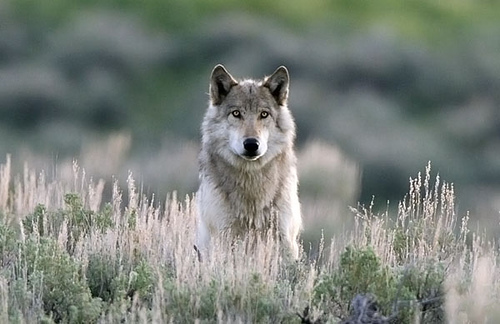
Reintroducing ourselves to the wolf

A guest essay from Karla Powell.

A couple of weeks ago, an email arrived in my ‘in-box’, as follows:

Hi Karla and Paul,

I hope this email finds you both well. I recently met Karla on an Oregon Wild hike last weekend in the Gorge. Karla is a longtime Oregon Wild supporter, passionate wildlife advocate and published author. She recently wrote a really lovely article on the human connection to wolves that I found quite inspiring.

I wanted you two to connect as Paul is also a wildlife advocate, now living in southern Oregon with his wonderful partner Jean. Paul, I thought you might be able to recommend a place, online or otherwise, Karla might be able to submit this article. I think you’ll quite enjoy it.

Thank you both for supporting our work for so many years,
Bridget

Clearly, I was able to recommend a place where Karla could submit her article! Here on Learning from Dogs!

Karla and I made contact and, bingo!, here is her remarkable essay.

ooOOoo

Reintroducing Ourselves to the Wolf

Karla Powell

Is it possible that by reconciling our troubled relationship with the North American wolf, we may come to better know our own nature as well as theirs? In the realm of natural history, wolves have long been left to myth and superstition. “Well into the 20th century, even science lagged behind in its knowledge of wolves and retained certain biases,” says award-winning nature writer, Barry Lopez, in his definitive book Of Wolves and Men. Even in the 21st century, science still can be skewed towards special interests. Yet the relative merits of facts notwithstanding, it is opinions about wolves that hold sway, points out Lopez.

As a lifelong urban creature, I had neither opinions nor knowledge when it came to the existence of wolves. Then in mid-life I found myself living alone in a cabin in rural Oregon and running a Junior Rangers program for the local state park. I also oversaw the weekend evening family programs. One such program featured hybrid wolves who’d found shelter in a nearby sanctuary and were presented for educational purposes. It was the closest I’d ever come to the real thing. So the next day I incorporated the theme of wolves into my Jr. Ranger activity.

I began by encouraging my young charges to howl along with me. I’d been practicing in the car on the way and it felt great! (I can see why they say wolves may howl at times for sheer pleasure.) My Jr. Rangers eagerly entered the fray, and every dog in the campground soon followed. Contrast this youthful exuberance to the dispiriting recollection of Joseph Marshall, author of The Wolf: A Native American Symbol. Marshall’s tale is recounted in the book War Against Wolf. “As a seven-year-old, I knew that there were no wolves left in my world, and I knew why. One day my grandfather… told me that the spirits of all the dead wolves … would wait until the time was right for them to return and walk again on the earth.”

Marshall, a Sicangu Lakota, believed that the 1995 reintroduction of wolves in Yellowstone heralded that this day had arrived. Yet we’re still a far cry from the sustainable recovery of a species we nearly annihilated. Reintroduction efforts in several western states contend with tired old beliefs. This vocal minority seem to me not far removed from those distant ancestors whose hysteria about the animal went so far as to conjure human “werewolves,” who were hunted and burned alive.

The folklore that led to such extremes was ultimately carried to our shores. In the book Vicious: Wolves and Men in America, the author tells of “Euro-American colonists who captured live wolves and tortured them for fun, ignoring the animals’ cowering for clemency.” Yet canines at home could display similar signals, which their masters sympathetically interpreted.

None other than John James Audubon casually recorded the maniacal torture and vicious killing of a pack of wolves by an Ohio farmer in 1814. Audubon and other observers, including trappers, sometimes noted the meek submittal of wolves to human aggression. Yet even a naturalist at that time couldn’t extrapolate this to meaningful analysis of wolves’ socialization, which includes “signaling” postures as a plea for mercy.

“This is not predator control,” says Lopez in his chapter on the gruesome excesses of “wolf fever” in the settling of our continent. “It is the violent expression of a terrible assumption: that men have the right to kill other creatures not for what they do, but for what we fear they may do.” Lopez then goes on to discuss “theriophobia” or “fear of the beast as an irrational, violent, insatiable creature.” The author continues: “At the heart of theriophobia is the fear of one’s own nature.”

Some 200 years before Christ, the Roman dramatist Plautus pithily depicted the beast we humans carry within by saying, “Man is wolf to man.” A glance at today’s headlines reveals that man’s dual nature is far from reconciled. Our legacy with the wolf is equally dualistic. In conquest, labels of savagery or demonization of the “other” are commonly projected by the oppressor onto those whom they, in turn, savagely treat. Wilderness and wildlife also are targets of such dominating impulses.

The most basic familiarity with human psychology recognizes that if we repress or deny our own capacity for shadowy motives, we invariably project such motives onto scapegoats. In America’s nation-building, the 19th century campaign to exterminate the wolf indicates we were far more guilty of depradation upon them than they upon us.

The ever-popular Saint Francis of Assisi also lived in a time of conquest run amok. An allegory about a wolf in Gubbio, Italy, has Francis and this village interloper come to an amical agreement that restored harmony for all. A contemporary visionary can be found in environmental activist George Monbiot. His 2013 TEDGlobal talk addresses the trophic cascade that resulted from the reintroduction of wolves into Yellowstone.

This phenomenon begins at the top of the food chain and tumbles down, says Monbiot. The return of wolves to Yellowstone has restored the entire ecosystem to a more healthful balance, recalling the “complex, lost, natural food chains that once prevailed,” explains Monbiot. This trophic cascade brought about by wolves simply being wolves has regenerated entire valleys and even changed the behavior of a river, he points out.

Just as St. Francis struck a deal with the wolf of Gubbio by promising he’d be fed by the villagers, we moderns too might benefit from a more cooperative pact. The wolf was a source of fascination to Homo sapiens when they also existed as communal hunters. Some theorize that prehistoric man’s social structure was modeled on how effectively wolves assured their packs’ common good.

The advent of an agrarian society disrupted this complex food chain that formerly prevailed. An agrarian society also emphasized the notion of property. The most common argument against wolves in agricultural communities is they kill animals that are human property. Yet since we’ve eradicated the natural habitat and prey of our indigenous wolf, their only guilt is they must eat to survive. This is no sin, as St. Francis demonstrated at Gubbio.

Top predators such as wolves needed time to adapt to such “quirky and aggressive killers {as man},” says Vicious author Jon T. Coleman. “The short supply of energy at the top of the food pyramid denied them this time. Euro-American colonists attacked animals in a vulnerable niche, creatures stuck with few options in a thermodynamic dead end.”

Consider that the very term “civilizing forces” is an oxymoron. Judging from how we have in some ways devolved into morbid obesity and epidemic diet-related diseases (many of them induced by altering food’s integrity), is it not possible for us to restore more wonder into our world by “rewilding” somewhat, as Monbiot and others propose? Not a return to the Stone Age. But perhaps a truly evolutionary step. One that restores us to a future that can reimagine coexistence as an effective survival strategy.

As an archetype in differing cultures, the wolf has been both revered and demonized. Yet whether seen as good or evil, it is still being objectified. Can we not instead view it as a living being worthy of both reason and regard? Despite more data about wolves than ever before, reason still lags behind, Lopez notes in the afterword to his original book. “Some folklore is so deeply entrenched that its adherents completely shut out emerging insights … In their rigid stances, they are impervious even to reason.”

As for regard, I suggest some discernment that takes us beyond even the necessary rational analysis. No less than Kepler, Darwin and Einstein have said that intuition is key to the scientific process, Lopez points out. He then suggests that we remind ourselves, “There could be more, there could be things we don’t understand.” Such a reminder may be our only hope for the wolf— as well as for us.

ooOOoo

I have no doubt that everyone who reads Karla’s wonderful essay will be enthralled by the beautiful messages.

Only one way to close today’s post.

The long-awaited return of the Yellowstone wolf!

Factory farming.

 We truly reap what we sow!

Yesterday, I wrote about what I saw as a prelude to today’s post. It was a post about the madness of the way we ingest antibiotics, frequently without us being aware that we are so doing.

The reason I regarded it as a very appropriate prelude to today is fully spelt out by George Monbiot’s second essay on the utter insanity about how our food is grown. His first essay was called Fowl Deeds and you may read it here.

So with no further ado, here is George Monbiot’s second essay republished with his kind permission.

ooOOoo

The Abuses of Enchantment

29th May 2015

The cruelties of factory farming shelter behind a fairytale image, promoted by advertisers and children’s authors.

By George Monbiot, published on the Guardian’s website 29th May 2015

The way that meat, eggs and milk are produced is surrounded by one of our great silences, in which most people collaborate. We don’t want to know, because knowing would force anyone with a capacity for empathy to change their diet.

You break this silence at your peril. After I published an article on chicken farming last week, I had to re-read it to check that I hadn’t actually proposed the slaughter of the firstborn by terrorist devil worshippers – so outraged and vicious were some of the responses. And that was just the consumers.

The producers didn’t like it much either, though their trade associations responded in more measured tones. In letters to the Guardian on Saturday, the National Farmers’ Union and the British Poultry Council angrily defended the industry. The NFU wrote:

“In the UK 90% of all chicken is produced to Red Tractor standards and this demonstrates that the chicken has met production standards developed by experts on animal welfare, safety, hygiene and the environment. Farmers take the welfare of their birds extremely seriously, and therefore to accuse the sector of cruelty is absolutely unfounded.”

The BPC maintained that chicken “provides a wholesome, nutritious, sustainable and affordable source of protein, produced by an industry unsubsidised by government.”

Let’s spend a moment examining these claims, before raising the issue of how they get away with it.

In my view, the Red Tractor standard is a classic example of an almost meaningless label, whose purpose is to reassure customers in a vague and fuzzy way while holding producers to standards that scarcely rise above the legal minimum. That’s a long-winded way of saying bullshit.

Take the key welfare issue, stocking density. Here’s what the government recommendations say:

The maximum stocking density for chickens kept to produce meat for the table should be 34 kg/m2, which should not be exceeded at any time during the growing period.

But the standard for broiler chickens set by the Red Tractor scheme is actually worse than this:

“Planned stocking densities must not exceed 38kg/m2 for broilers”

Incidentally, this stocking density – 38kg/m2 – gives each bird an area the size of a piece of A4 paper. [Ed. 8.27 in X 11.69 in]

This meets the legal requirement only because the UK uses a cruel derogation from European law, permitting a maximum stocking density of 39kg/m2. [Ed. American units convert that to 74.8 lbs of chicken mass per square yard.] So much for the NFU’s statement about taking the welfare of chickens extremely seriously.

On almost every welfare indicator, and across all the main farm animals, including chickens, Red Tractor scored worse than any other certification scheme evaluated by Compassion in World Farming. Amazingly, the Red Tractor label imposes no restrictions on the growth rates of chickens: it allows the most overbred varieties to be stuffed with high-protein feed, with the result that the birds often suffer from painful and crippling health problems, as their hearts, lungs and legs are overloaded.

As for the British Poultry Council’s claims, if chickens fed on soya – as the great majority in this country are – are sustainable, what does unsustainable look like? Soya production is one of the major agents of the destruction of rainforests, cerrado and other threatened habitats in South America. The environmental impacts of chickenfeed are, well, anything but chickenfeed. The mass production of chickens has major consequences at the other end of the bird too: the mountains of excrement cause both water and air pollution.

Nor is the claim that this industry is unsubsidised correct. Many chicken growers barely break even on the sale of birds, and survive only as a result of the government’s renewable heat incentive. This is a remarkably generous scheme whose ostensible purpose is to reduce carbon emissions, but which really functions as another subsidy for businesses, especially farms. Most new chicken units use biomass boilers subsidised by the RHI, and it is immensely profitable.

So now to the real question: how do they get away with it? How is it that we, who regard ourselves as a nation of animal lovers, accept such terrible standards of meat production? If dogs and cats were treated as pigs and chickens are, there would be a deafening outcry: in fact there are plenty of people in Britain who campaign against the raising of dogs and cats for food in Asia. But what’s the difference? Why is it acceptable to treat some animals – even creatures as intelligent and capable of suffering as pigs – so brutally, but not others?

In part, this reflects the deep disavowal in which we tend to engage when we eat meat. But I also believe that a major part of the problem is the fairytale view of farming implanted in our minds from the very onset of consciousness.

Many of the books produced for very young children are about farms; and most tell broadly the same story. The animals – generally just one or two of each species – live in perfect harmony with the rosy-cheeked farmer, roaming around freely and talking to each other, almost as if they were members of the farmer’s family. Understandably enough, none of the uncomfortable issues – slaughter, butchery, castration, tusking, separation, battery production, farrowing crates – ever feature.

So deeply embedded is this image that I believe many people go through life unable to dismiss it from their minds. It is not easy to unlearn what we are taught when we’re very young, and even the grim realities of industrial farming cannot displace the storybook images from our minds. At a deep, subconscious level, the farm remains a place of harmony and kindness – and this suits us very well if we want to keep eating meat.

Perhaps the starkest example of this myth-making I’ve come across is a children’s book distributed with Saturday’s Guardian called The Tale of City Sue. It tells the story of a herd of cows on an Irish farm.

“This friendly, Friesian family

were free to roam and browse

and eat the freshest, greenest grass

which made them happy cows.

“They belonged to farmer Finn

Who called them by their names

And when it was their birthday

He brought party hats and games.

“He played his violin for them

inside the milking shed,

and sung them soothing lullabies

when it was time for bed.”

Only after I had unthinkingly read it to my three-year-old then turned the back cover, did I discover that it wasn’t a book at all, but an extended advertisement for Kerrygold butter.

It wasn’t billed as such. The Guardian’s website marketed this publication as “A tale from the meadow of imagination: children’s author Jeanne Willis’s latest book captures the idyllic atmosphere of rural Ireland.” Following my questions to the Guardian, this has now been changed to make its provenance clearer.

I find disguised marketing of any kind objectionable, and disguised marketing to children (aimed in this case at reaching their parents) even worse. I feel that this book misleads children about the nature of farming and milk production and sanitises the relationship between farmers and their animals, on behalf of a large corporation (Kerrygold’s parent company, Adams Foods). It exploits children’s credulity and natural sympathy with animals for corporate profits.

When I challenged the Guardian about this, its spokesperson told me:

“All branded content should be clearly labelled for the benefit of our readers in line with our guidelines. On this occasion the insert was not correctly labelled and we apologise for this error.”

I also wrote to the author, Jeanne Willis, who replied as follows: “I was commissioned by Kerrygold so it’s best they answer your questions. Xxxx Xxxx from Brazen PR will be in touch soon.”

Brazen PR. Hmmm.

I wrote back, asking her, “Do children’s authors not have a responsibility towards those they write for? Is there not an issue of conscience here for you? After all, if a children’s author is misleading children on behalf of a corporation, that’s a serious matter, surely? It has been done in your name, and promoted as your “latest book”, so simply shrugging off responsibility like this feels wrong to me. You must have a view about whether or not accepting this commission was the right thing to do, and whether you were justified in discharging it as you did.”

She responded as follows:

“… to the best of my knowledge, Kerrygold seem to be particularly strong on animal welfare so there wasn’t a question that what I created was going to be misleading. The brief was very simple: Kerrygold cows spend a lot of time outside feeding on grassy meadows so let’s tell some fun stories about our cows. I don’t feel it’s exploiting kids because the only take out is that it’s better to feed cows on grass and ensure they spend as much time outside as possible.”

“I’m very careful which brands I work with to avoid this exact situation – I wouldn’t have done this if I thought it was morally wrong. It’s a storybook for families to enjoy. There is no overt message to buy butter. It’s just about the cows. That said, it clearly says Kerrygold on the inside cover and on the back.”

It seems to me that subliminal persuasion of this kind (“the cows are happy”) can be more insidious than overt marketing (“buy our butter”). To my mind, Kerrygold is seeking to persuade people of the inherent goodness of its products at a deeper level than merely flashing up the products.

As for the issue of animal welfare, Kerrygold’s website states “We work with small co-operative farms where small herds are free to graze on lush Irish meadows.” But it does not say “We work only with small co-operative farms …”.

The parent website run by Adams puts it slightly differently: “Kerrygold is … is owned by Irish dairy farmers, many of their farms are small and family run”. Which could also mean that many of them are not. So I asked the company, “What is your milk buying policy? In other words, what specifications – on scale, feed, the treatment of animals, process etc – do you put in place that your suppliers have to adhere to?” I have not had a response.

From what I can glean, Kerrygold’s marketing seems to rely on the public perception that Irish dairy farms are small and mostly grass-fed. But they are changing fast.

Last summer, 3,000 dairy farmers visited the biggest dairy operation in the country (which has 820 milking animals) to discover how to increase the scale of their operations. This farm has made a major investment in indoor facilities, and supplements the grass they are fed with maize, barley and soya.

According to the former chair of the Irish Farmers’ Association, “scale must go up. … The dairy farm of the future is going to have to be bigger.”

Could the current Kerrygold marketing blitz be an attempt to embed in our minds a bucolic, superannuated image of an industry that is now changing beyond recognition? If so, it might be an effective way of pre-empting criticism about the changing nature of its suppliers.

Dairy cows, like chickens and pigs, get a rough deal, while the effluent from dairy farms creates major environmental problems. Imagine the response if children were exposed to such blatant sanitisation of a harsh and polluting industry in any other sector. But so prevalent is this mythologised view of farming, and so wilfully unaware do we remain of the realities of industrial agriculture, that it passes almost without challenge. My guess is that the Guardian made this error – a serious one in my view – partly because the themes Jeanne Willis and Kerrygold exploited are so familiar that they are almost background noise.

Isn’t it time that children’s authors showed a little more imagination and stopped repeatedly churning out the same basic story, even when they are not doing it on behalf of a large corporation?

Is it not time that adults weaned themselves off the fairytale version of farming and began to judge it by the same standards as we would judge other industries?

And is it not time for all of us to become a little more curious about where meat, milk and eggs come from, and how they are produced?

www.monbiot.com

ooOOoo

 Now I haven’t been a resident of the United Kingdom since 2008 so I have no personal views to add to those expressed by Mr. Monbiot. However, I do not have the slightest hesitation in saying that not only do I trust George Monbiot’s integrity in this matter but I fear that the situation here in the USA is just as terrible, if not worse.

I thought I would close today’s post by offering some pictures of broiler chicken units.  There are many images on the ‘net’.

But they were so ghastly to view that I didn’t have the heart to include a picture.

So I included this one:

free-range-chicken1

The picture was on the website of Mini Mac Farm in Long Valley, NJ.

A future apocalypse?

How many of us really, truly care about the future?

If you sense a heartfelt plea in my sub-heading then you will not be wrong.

What has happened to our instincts for our survival?

What strikes me as so tragic is that if I asked you to guess the topic of today’s post before you read on, the odds are that you would chose from any number of subjects that reveal a society hell-bent on self-extinction!

OK, let me get to the point.

A little over 10 days ago I republished a George Monbiot essay that spoke about the madness of chicken production in the UK. Mr. Monbiot’s essay was called Fowl Deeds and was within my post called We are what we eat!

Well George Monbiot has just published a sequel to Fowl Deeds that I am going to republish in this place tomorrow.

But what I am going to offer for today, as a prelude to tomorrow’s post, is a YouTube video of a BBC Panorama program that was screened earlier on in May. The program was called Antibiotic Apocalypse and was about the threat of increasing resistance to modern Antibiotics.

Why does this make such an important prelude?

Because as you will see when you watch the Panorama program much of our ‘factory’ food comes from animals that are fed antibiotics!

How to close?

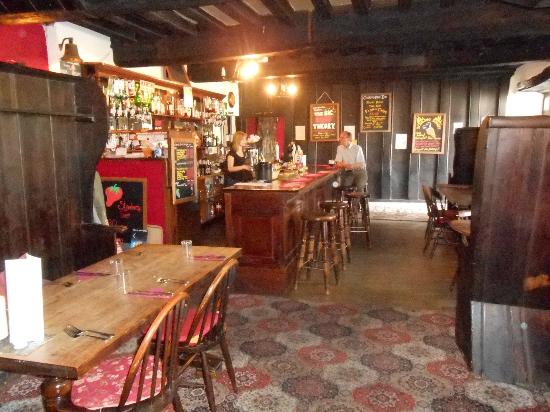
All that comes to mind is a wonderful throwaway remark from a old boy, village resident, when supping a pint of bitter in The Church House Inn; what used to be my local pub in my home village of Harberton, Devon.  This is what he said:

All the world’s a little queer except thee and me, and I ha’ me doubts about thee!

church-house-inn
Interior of The Church House Inn, Harberton, Devon.

Indeed, all the world is more than a ‘little queer’!

The great global tragedy.

Reinforcing the need to move personhood beyond the human person.

Yesterday, I wrote about the moves to have the concept of personhood extended to chimpanzees. Here’s a small extract:

The order to show cause on the issue of habeas corpus is the first step in a process which Steven Wise and the Nonhuman Rights Project (NhRP) hope will secure Hercules and Leo’s bodily liberty and integrity. If the court were to find in their favour, the chimpanzees would no longer be kept for research and could be moved to a sanctuary in Florida.

Last Friday, George Monbiot published an essay that reinforced our need to regard our animals differently than hitherto; especially our larger animals. It is my pleasure to republish it with Mr. Monbiot’s permission.

ooOOoo

Megadeath

22nd May 2015

The destruction of some of the last of the huge animals that shaped us inflicts a great wound in our lives.

By George Monbiot, published on the Guardian’s website 22nd May 2015

When I read about the attacks on the world’s remaining elephants and rhinos, the first thought that enters my head is: “these creatures used to be everywhere”. Almost every area of land and sea, in every region of the world, had a megafauna. Elephants lived throughout Europe, Asia, Africa and America until very recently in ecological time (30,000 years ago in Europe, 14,000 years ago in the Americas). Rhinos lived across Africa, Asia and Europe. Temperate forest rhinos lived in Britain during previous interglacials, and woolly rhinos lived here in colder periods. Russia was haunted by two gigantic species: humpbacked rhinos the size of elephants, eight feet to the crest, weighing perhaps five tonnes.

Lions were everywhere except Australasia (that had a marsupial equivalent); tigers ranged to the borders of Europe; hippos wallowed in British rivers; hyaenas survived into the early Mesolithic in Britain and northern Europe. All this is easily forgotten in a world afflicted by Shifting Baseline Syndrome: our habit of conceptualising as natural and normal the ecosystems that prevailed in our own youth, unaware that they were, even then, in an extremely degraded state.

The places in which monsters remain are the last tiny redoubts of what was once a global population. Of the 42 species of terrestrial mammals weighing more than a tonne that existed on Earth when modern humans left Africa, just eight are left: the African and Asian elephants, the larger of the two hippopotamus species and the black, white, Indian, Javan and Sumatran rhinos. Seven of them are threatened and four are critically endangered.

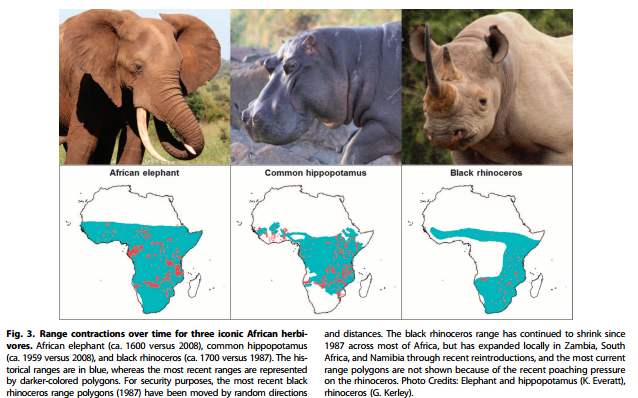
Even in the relatively recent past, the area of land over which these animals roamed has drastically declined. Maps published in a new paper in the journal Science Advances show that elephants, hippos and black rhinos occupied most of sub-Saharan Africa when their populations were first encountered by modern Europeans, but are now confined to a few tiny specks of land.

From William J. Ripple et al, 1st May 2015. Collapse of the world’s largest herbivores. Science Advances. 2015;1:e1400103

Why do the very large animals prove most susceptible to destruction? It’s partly because they reproduce slowly and partly because they require plenty of land and food for their survival, so the destruction of wild places tends to hit them sooner than it affects smaller species. But it’s also, I believe, because we have a deep-rooted urge to assert our status by killing them and owning their body parts. Even when people don’t do the killing themselves, possessing their skins, heads, tusks or horns has long been a means of acquiring bragging rights.

From the exquisite sculpture of two reindeer migrating across a river, carved from a piece of mammoth ivory 13,000 years ago and now housed in the British Museum, to the tiger skin rugs and heads of exotic beasts exhibited in stately homes today, bigging ourselves up by displaying our mastery of great beasts seems to be a fundamental human trait. Today’s aristocrats, some of whom are descendants of tribal chiefs, hang their ancestors on the wall to establish their genealogy and the heads of the animals they have killed beside them, to establish their prowess. Not much has changed in thousands of years.

Many of the world’s great sagas, tales of Ulysses, Sinbad, Sigurd, Beowulf, Cú Chulainn, St George, Arjuna, Lạc Long Quân and Glooskap, tell of struggles with megafauna real or imagined. Doubtless at least some of these stories originated in real battles with beasts whose true nature has been forgotten, as a result of their extinction. Think of Sinbad and the roc, which might be a garbled version of encounters with the elephant bird of Madagascar.

Today, some very rich people try to recreate these battles in ways that seem to me grotesque. They bid on the internet for the right to shoot a particular animal, sometimes paying tens of thousands of dollars, arrange a date, a time and a place, then fly over, in some cases with their taxidermists in tow, to bag the creature they have bought.

The animal is waiting for them – sometimes in an enclosure, sometimes just after being released from one, sometimes in the wild but already located by guides. There is no question about the outcome; otherwise the money would have to be repaid. I have heard that in some cases these people fly to a country for just a couple of days, during which they have booked the killing of several spectacular animals. Their diary secretaries arrange their schedules so that they can fit them all in. Once they have posed triumphantly with a foot on the beast they have just killed, they leave it for the taxidermist to process and move on to the next appointment with death.

This looks to me as dry and joyless as it is brutal and unsporting. Though I would struggle nowadays to bring myself to shoot a mammal or a bird (in my youth I killed and ate a few rabbits, squirrels and pigeons), I can understand the attraction of doing so in difficult circumstances, stalking and crawling and lying in wait much as a wild predator would. Canned, predetermined hunting of this kind seems empty of challenge and romance, bought rather than won. But such is the drive to establish dominion over the largest and most magnificent of beasts, and such is the obsession with conspicuous outcomes, that, for some people, none of this appears to matter.

Others are satisfied to remove themselves even further from contingency, by purchasing pieces of animals that have already been killed. My guess is that the use of rhino horn, tiger bones and other such body parts in traditional Chinese medicine, which are of course clinically useless, might be another manifestation of this deep-rooted drive, to make ourselves feel better by association with creatures larger or fiercer than ourselves.

You might have imagined that there were now plenty of alternative means of asserting our status and persuading ourselves of our own value, but traits that resonate with our evolutionary past – our ghost psyche – die hard.

So this great global tragedy continues. I know I should write about it more often. But I find it too upsetting.

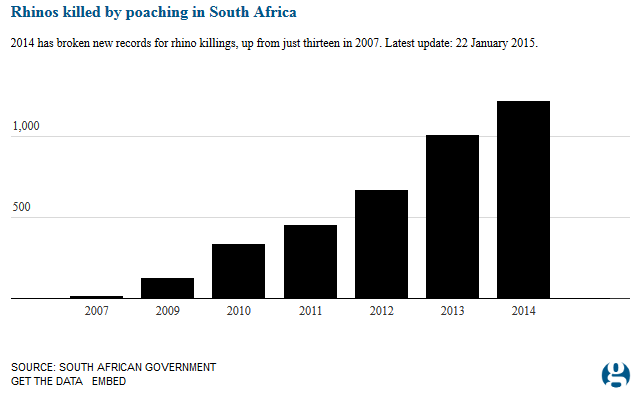
Until 2008, conservationists, in some places at least, appeared to be winning. But in that year the number of rhinos killed in South Africa rose (from 13 in 2007) to 83. By 2011, the horrible tally had risen to 448. It climbed to 668 in 2012, 1004 in 2013 and 1215 in 2014. In the first four months of this year, 393 rhinos have been killed there, which is 18% more than in the same period last year.

rhino-poaching-trend

The reasons for this acceleration in the Great Global Polishing are complex and not always easy to tease out. But they appear to be connected to rising prosperity in Vietnam, the exhaustion of illegal stocks held by Chinese doctors and, possibly, speculative investment in a scarce and tangible asset during the financial crisis. Corruption and judicial failure help to keep the trade alive.

Already, the western black rhino is extinct (the declaration was made in 2011). The northern white rhino has been reduced to five animals: a male at the end of its anticipated lifespan and four females, scattered between Kenya, the US and the Czech Republic.

Similar stories can be told about some populations of elephants – in particular the forest elephants of West and central Africa.

It’s not just these wonderful, enchanting creatures that are destroyed by poaching, but also many of the living processes of the places they inhabit. Elephants and rhinos are ecological engineers, creating conditions that hundreds of other species have evolved to exploit.

As the paper in Science Advances notes, the great beasts maintain a constantly shifting mosaic of habitats through a cycle of browsing and toppling and trampling, followed by the regrowth of the trees and the other plants they eat. They open up glades for other herbivores, and spaces in which predators can hunt. They spread the seeds of trees that have no other means of dispersal (other animals are too small to swallow the seeds whole, and grind them up). Many trees in Africa and Asia are distributed exclusively by megaherbivores.

They transport nutrients from rich places to poor ones and in some places reduce the likelihood of major bushfires, by creating firebreaks and eating twigs and leaves that would otherwise accumulate as potential fuel on the ground. Many animal species have co-evolved with them: the birds that eat their ectoparasites, the fish that feed on hippos’ fighting wounds (some of these species, I believe, are now used for fish pedicures), the wide range of life that depends on their dung for food and moisture, on their wallows for habitats, on the fissures they create in trees for nesting holes.

Who knows what ecological processes the world has already lost through the retreat of the megafauna? Everywhere on earth, living systems have been radically altered by the loss of the great beasts. (I’ll be discussing the impacts of the extinction of European elephants in next month’s edition of BBC Wildlife magazine).

The destruction of some of the last populations of the animals that shaped us, as well as the natural world, inflicts, I feel, a great wound in our lives, diminishing the wonderful planet on which we evolved, shrinking imagination, crushing experience. All of us should have an interest in supporting those who seek to save these wonderful creatures.

www.monbiot.com

ooOOoo

Dear Reader, I don’t intend to cast you in some dark mental place with the republication of this dark essay from Mr. Monbiot. Yet if you care about the world that we are leaving for the next generation, and I’m certain that the majority, the vast majority, of you readers do so care, then these terrible aspects of humanity must be highlighted. For if just one person is moved to make a difference then the mental pain is a necessary step on that journey of making a difference.

Always search for the rainbow – it’s there somewhere. If

you can’t find one, invent one.Anon.

We are what we eat!

Some aspects of our food that many of us would rather not know about!

Many readers will be used to me republishing the essays from George Monbiot. Admittedly, not every single one of them but especially those that seem to have a message that deserves a wider promulgation. Having Mr. Monbiot’s permission to so do is generous of him.

Yesterday, there was an essay written by him that was published both on his blog and in the UK’s Guardian Newspaper. At first reading, it seemed to apply predominantly to the United Kingdom. Then, upon a second reading, I was convinced that this was yet another ‘message’ that quite happily fits in here, on Learning from Dogs. Because it is another reminder that integrity is missing from so many aspects of our societies.

You be the judge!

ooOOoo

Fowl Deeds

19th May 2015

The astonishing, multiple crises caused by chicken farming.

By George Monbiot, published in the Guardian 20th May 2015

It’s the insouciance that baffles me. To participate in the killing of an animal: this is a significant decision. It spreads like a fungal mycelium into the heartwood of our lives. Yet many people eat meat sometimes two or three times a day, casually and hurriedly, often without even marking the fact.

I don’t mean to blame. Billions are spent, through advertising and marketing, to distract and mollify, to trivialise the weighty decisions we make, to ensure we don’t connect. Even as we search for meaning and purpose, we want to be told that our actions are inconsequential. We seek reassurance that we are significant, but that what we do is not.

It’s not blind spots we suffer from. We have vision spots, tiny illuminated patches of perception, around which everything else is blanked out. How often have I seen environmentalists gather to bemoan the state of the world, then repair to a restaurant in which they gorge on beef or salmon? The Guardian and Observer urge us to go green, then publish recipes for fish whose capture rips apart the life of the sea.

The television chefs who bravely sought to break this spell might have been talking to the furniture. Giant chicken factories are springing up throughout the west of England, the Welsh Marches and the lowlands of the east. I say factories for this is what they are: you would picture something quite different if I said farm; they are hellish places. You might retch if you entered one, yet you eat what they produce without thinking.

Two huge broiler units are now being planned to sit close to where the River Dore rises, at the head of the Golden Valley in Herefordshire, one of the most gorgeous landscapes in Britain. Each shed at Bage Court Farm – warehouses 90 metres long – is likely to house about 40,000 birds, that will be cleared out, killed and replaced every 40 days or so. It remains to be seen how high the standards of welfare, employment and environment will be.

The UK now has some 2,000 of these factories, to meet a demand for chicken that has doubled in 40 years [1]. Because everything is automated, they employ few people, and those in hideous jobs: picking up and binning the birds that drop dead every day, catching chickens for slaughter in a flurry of shit and feathers, then scraping out the warehouses before the next batch arrives.

The dust such operations raise is an exquisite compound of aerialised faeces, chicken dander, mites, bacteria, fungal spores, mycotoxins, endotoxins, veterinary medicines, pesticides, ammonia and hydrogen sulphide. It is listed as a substance hazardous to health, and helps explain why 15% of poultry workers suffer from chronic bronchitis. Yet, uniquely in Europe, the British government classifies unfiltered roof vents on poultry sheds as the “best available technology”. If this were any other industry, it would be obliged to build a factory chimney to disperse the dust and the stink. But farming, as ever, is protected by deference and vested interest, excused from the regulations, planning conditions and taxes other business must observe. Already, Herefordshire County Council has approved chicken factories close to schools, without surveying the likely extent of the dust plumes either before or after the business opens. Bage Court Farm is just upwind of the village of Dorstone.

Inside chicken factories are scenes of cruelty practised on such a scale that they almost lose their ability to shock. Bred to grow at phenomenal speeds, many birds collapse under their own weight, and lie in the ammoniacal litter, acquiring burns on their feet and legs and lesions on their breasts. After slaughter they are graded. Those classified as grade A can be sold whole. The others must have parts of the body removed, as they are disfigured by bruising, burning and necrosis. The remaining sections are cut up and sold as portions. Hungry yet?

Plagues spread fast through such factories, so broiler businesses often dose their birds with antibiotics. These require prescriptions but – amazingly – the government keeps no record of how many are issued. The profligate use of antibiotics on farms endangers human health, as it makes bacterial resistance more likely.

But Herefordshire, like other county councils in the region, scarcely seems to care. How many broiler units has it approved? Who knows? Searches by local people suggest 42 in the past 12 months. But in December the council claimed it has authorised 21 developments since 2000. [2] This week it told me it has granted permission to 31 since 2010. It admits that it “has not produced any specific strategy for managing broiler unit development” [3]. Nor has it assessed the cumulative impact of these factories. At Bage Court Farm, as elsewhere, it has decided that no environmental impact assessment is needed [4].

So how should chicken be produced? The obvious answer is free range, but this exchanges one set of problems for another. Chicken dung is rich in soluble reactive phosphate. Large outdoor flocks lay down a scorching carpet of droppings, from which phosphate can leach or flash into the nearest stream. Rivers like the Ithon, in Powys, are said to run white with chicken faeces after rainstorms. The River Wye, a special area of conservation, is blighted by algal blooms: manure stimulates the growth of green murks and green slimes that kill fish and insects when they rot. Nor does free range solve the feed problem: the birds are usually fed on soya, for which rainforests and cerrado on the other side of the world are wrecked.

There is no sensible way of producing the amount of chicken we eat. Reducing the impact means eating less meat – much less. I know that most people are not prepared to stop altogether, but is it too much to ask that we should eat meat as our grandparents did, as something rare and special, rather than as something we happen to be stuffing into our faces while reading our emails? To recognise that an animal has been sacrificed to serve our appetites, to observe the fact of its death, is this not the least we owe it?

Knowing what we do and what we induce others to do is a prerequisite for a life that is honest and meaningful. We owe something to ourselves as well: to overcome our disavowal, and connect.

http://www.monbiot.com

[1] Total purchases for household consumption (uncooked, pre-cooked and take-aways combined) rose from 126 grammes per person per week in 1974 to 259 grammes in 2013 (see the database marked UK – household purchases).

[2] BBC Hereford and Worcester, 15th December 2014

[3] Response to FoI request IAT 7856, 13th August 2014

[4] Herefordshire County Council, 22nd December 2014. Screening Determination of Bage Court Farm development, P143343/F

ooOOoo

Jean and I found a way to watch the BBC Panorama programme that was broadcast recently. It was screened under the title of Antibiotic Apocalypse. This is how the programme was introduced on the BBC website:

Panorama investigates the global advance of antibiotic-resistant superbugs and the threat they pose to modern medicine and millions of patients worldwide. Reporter Fergus Walsh travels to India and finds restricted, life-saving antibiotics on sale without prescription and talks to NHS patients whose recovery depends on them.

There is much in George Monbiot’s essay that resonates with the findings of that Panorama programme. Indeed, the Panorama programme showed the extent of the use of antibiotics in many animals over and beyond chickens.

It hardly needs to be said by me that the reason this is republished in a blog based in Southern Oregon, USA is because this is a problem that is not unique to the United Kingdom; far from it!

What a strange species we humans are!

More sharing of ideas

A positive message from George Monbiot.

I ran out of writing time yesterday so looked for a quick and easy post to offer you.

Not that that undervalues what is presented; far from it!

George Monbiot’s essays are frequently on topics that concern him and rightly so. However, last Thursday George published an essay that offers real hope to those that want to see an end to the ceaseless news of lost species.  It is called Otter Joy and is published with George Monbiot’s kind permission.

ooOOoo

Otter Joy

The return of Britain’s otters offers a glimpse of rewilding’s great rewards

By George Monbiot, published on the Guardian’s website, 7th May 2015

I spent last week travelling with my family across the Scottish Highlands, meeting land managers to discuss possibilities of rewilding. The speed of change there is astonishing, and opportunities for a mass restoration of living systems are emerging faster than I could have imagined even a year ago. I’ll be writing about this in a few weeks, when Rewilding Britain is launched.

But for now I want to talk not about the practicalities of rewilding but about its essence: the reason why this idea excites and inspires me so much that I’ve chosen to devote much of the rest of my life to it.

During our tour across the Highlands we stopped for a few days in the village of Shieldaig, at the head of a sea loch on the west coast. We took a cottage overlooking Shieldaig Island, partly because, for the past few years, white-tailed eagles have been nesting there. After becoming extinct in Britain in 1916, this magnificent bird, bigger than a golden eagle, was reintroduced to the island of Rum in 1975. It has been spreading slowly along the west coast. (It could have moved further across Scotland were it not for shooting and poisoning by grouse estates and others). This is one of the species I would love to see returning to much of the rest of Britain.

Unfortunately, the eagles have chosen another place to nest this year. But there were other returning species to see. I woke one morning when it was still dark, and lay in bed until I heard the song thrush in the sycamore behind the cottage start to sing. I slipped out as the light began to rise over the hills.

There’s a path that leads out of the village, winding north over the headlands and around the small bays of Loch Shieldaig. The willow warblers in the trees along the path had started to sing, and from behind the crest of a hill I heard the cry of an unfamiliar raptor – listening later to recordings, I felt it might have been a white-tailed eagle. There was not a tremor of wind and the air was clear. I could see the promontories and islands stepping away for many miles across a polished sea.

As I came over a low ridge, I noticed a disturbance in the water below me, a few metres from the shore. I dropped into the heather and watched. A moment later, two small heads broke from the sea, then the creatures arced over and disappeared again.

After another moment, the larger one – the dog otter – scrambled out of the water with something thrashing in its mouth. He dropped it onto the rocks, gripped it again, then chewed it up. Then the bitch emerged from the sea beside him, also carrying something, that she dispatched just as quickly. They plunged in again, and I watched the trails of bubbles they made as they rummaged round the roots of the kelp that filled the shallow bay.

When they emerged once more, each with a fish in its mouth, I was able to identify the quarry. They were catching rocklings: small, very slippery fish of the same olive-brown as the kelp. Over the next half hour, each of them caught about fifteen. I marvelled at their ability to grab such difficult prey. I loved the slick, swift movements with which they dived and dolphined and twisted underwater. It looked to me like an expression of pure joy.

Hiding among the rocks and heath, I could keep ahead of the otters without being seen, as they foraged round the coast. As the cliffs became lower, I found myself coming ever closer to them. Then, though I don’t know why, the otters emerged from the water without fish, shook themselves out, and climbed up the rocks, long low bodies undulating, towards me. The dog grunted and huffed while his mate made a high whickering noise. They kept raising their heads and staring in my direction. But as I was buried in the heather and they have weak eyesight, I doubt they could have seen me. Soon they were standing about 20 or 30 feet away, raising their bristly little faces to smell the air. I could hear them panting.

Then they turned and rippled back down the rocks, slipped into the water with scarcely a splash and started hunting round the coast once more. Soon they disappeared around a cliff I couldn’t negotiate.

I walked back elated, recharged with wonder and enchantment. A week later, the feeling still buoys me up.

While many species in this country are in rapid decline, the otter is among the few whose prospects are improving. This is partly because it’s no longer hunted, and partly because of a reduction in the organochlorine insecticides that accumulated up the food chain. But, especially in England, it still inhabits just a fraction of its former range.

Otters are an adaptable species that, given the chance, can quickly recolonise the habitats from which they have been excised. Their hesitant return sharpens the hopes of those of us who want a wilder Britain, who strive for the re-establishment of magnificent, enthralling wildlife that you don’t have to travel halfway around the world to see.

Already otters are beginning to appear in a few towns and cities. As they become accustomed to their protected status, they’re likely to become less shy and easier to watch, bringing nature’s wonders closer to the lives of people who have become disconnected from the living planet. If our advocacy of the widespread return to Britain of animals such as beavers, boar and lynx succeeds (and one day, perhaps, of wolves, bison, pelicans, bluefin tuna and whales of several species), the opportunities for re-enchantment will begin to blossom in places that are currently little more than wildlife deserts.

Everyone should be able to experience such marvels, and to step outside the ordered, regulated, predictable world of our own making, that sometimes seems to crush the breath out of us.

www.monbiot.com

ooOOoo

If you, like me, are uncertain what the White-tailed eagle looks like then here’s a photograph of one.

Image: Niall Benvie. RSPB.

The image was taken from a news item on the website of the Royal Society for the Protection of Birds and opens:

2011 has proved another record breaking year for breeding pairs of Scotland’s largest bird of prey. White-tailed eagles soared to new heights despite heavy storms throughout the 2011 breeding season.

Conservationists, and many sea eagle enthusiasts, had been concerned that the high winds felt across Scotland in May could have had a detrimental impact on breeding white-tailed eagles at the vulnerable part of the season when most nests contain small chicks. Indeed, some nests failed including that of BBC Springwatch star, nicknamed “Itchy”, who experts fear lost his chicks in the storm.

However, the bad weather failed to blow the species off course. Recent survey figures for the 2011 breeding season reveal that there were 57 territorial pairs in Scotland, an increase of 10 per cent on the previous year. A total of 43 young fledged successfully from these nests.

George’s essay also mentioned the Scottish sea otter.

RICHARD PETERS photography

This image came from a post on Richard Peters’ Wildlife Photography blog which is very well worth visiting.

OK, Time for Change!

George Monbiot’s devastating analysis of British politics.

Note to readers:

When you start reading the following introduction, ahead of George Monbiot’s essay, you may be excused for thinking I have lost the plot!  However, trust me there is a purpose. For this blog is called Learning from Dogs.

Introduction

We know that the relationship between Planet Earth and man, as in H. sapiens, goes back around 200,000 years.

We also know, indicated by DNA evidence, that the dog separated from the grey wolf about 100,000 years ago.

The relationship between dogs and man goes back thousands of years as well; “The going theory is that dogs were domesticated somewhere between 15,000 and 40,000 years ago.“[1]

Certainly, the dog was the first animal to be domesticated by man. In fact, some archaeologists speculate that without the dog man could not have been such a successful ‘hunter-gatherer’ allowing, in time, man to evolve into farming; the real start of modern man.

But what of today?

There is little doubt that many people, even with the minimum of awareness about the world that we live in, are deeply worried. On so many fronts there are forbidding and scary views. It feels as though all the certainty of past times has gone; as if all the trusted models of society are now broken. Whether we are talking politics, economics, employment or the environment, nothing seems to be working.

Why is this? What’s the cause?

It would be easy to condemn man’s drive for progress and an insatiable self-centredness as root causes. But it’s not the case, certainly not the whole case.

The root cause is clear. It is this. How mankind has developed is the result of mankind’s behaviours. All of us behave in many ways that are hugely damaging to the survival of our species upon this planet. It is likely that these behaviours are little unchanged over thousands of years.

But 2,000 years ago, the global population of man was only 300 million. It took 1,200 years for that global population to become 1 billion; in 1800. Now track the intervals as we come forward in time.

In 1927, just 127 years later, the two-billionth baby was born. In 1960, only 33 years on, the three-billionth baby. Just 16 years on, in 1974, the four-billionth baby was born. In 1987, 13 years later, five billion. Around October 1999, the sixth-billionth baby was born! It’s trending to a billion every decade. In other words, a 100-million population growth every year, or about 270,000 more persons every single day!

Combine man’s historic behaviours with this growth of population and we have the present situation. A totally unsustainable situation disconnected from the finite planet that supports us.

The only viable solution is to amend our behaviours. To tap into the powers of integrity, self-awareness and mindfulness and change our game.

We all have to work with the fundamental, primary relationships we have with each other and with the planet upon which we all depend. We need a level of consciousness with each other and with the living, breathing planet that will empower change. We need spiritual enlightenment. And we need it now!

That is why we have so much to learn from dogs. They are man’s best friend. They are man’s oldest friend. They have a relationship with us that is very special; possibly verging on the telepathic.[2]

They can show us how we need to live our lives. Now!

[1] The Origin of Dogs, Scientific American, August 20th, 2009
[2] Refer Dr Rupert Sheldrake best known for his theory of morphic fields and morphic resonance

The George Monbiot essay.

(I hope as you read his essay, you can now understand the reasoning behind my introduction.)

Republished with the very kind permission of Mr. George Monbiot.

ooOOoo

Code of Silence

Almost all the issues worth debating are left unmentioned in this election.

By George Monbiot, published in the Guardian 6th May 2015

Political coverage is never more trivial or evanescent than during an election. Where we might hope for enlightenment about the issues on which we will vote, we find gossip about the habits and style of political leaders, an obsession with statistically meaningless shifts in opinion polls and empty speculation about outcomes. (All this is now compounded by the birth of a royal baby, which means that our heads must simultaneously be dunked in a vat of sycophantic slobber). Anyone would think that the media didn’t want us to understand the choices confronting us.

While analysis of the issues dividing the political parties is often weak, coverage of those they have collectively overlooked is almost non-existent. The Conservatives, Labour, the Liberal Democrats and even the SNP might claim to be at each other’s throats, but they have often reached consensus about which issues are worthy of debate. This article will list a few of the omissions.

The first is so obvious that it should feature in every political discussion: the corrupt and broken system under which we will vote. The argument I’ve heard several Labour activists use – “vote for us because it’s the best we can hope for under first-past-the-post” – would carry more weight if Labour had any plans to change the system.

Where are the furious arguments about the UK’s unreformed political funding, that allows billionaires and corporations to buy the politics they want? Where is the debate about the use and abuse of royal prerogative by successive prime ministers? Where is there even a mention of the democratic black hole at the heart of Britain, into which hopes for financial and fiscal reform are sucked: the Corporation of the City of London, whose illegitimate powers pre-date the Magna Carta?

Here’s a fact with which politicans should be assailed every day: the poor in this country pay more tax than the rich. If you didn’t know this – and most people don’t* – it’s because you’ve been trained not to know it through relentless efforts by the corporate media. It distracts us by fixating on income tax, one of the few sources of revenue that’s unequivocally progressive. But this accounts for just 27% of total taxation. Overall, the richest tenth pay 35% of their income in tax, while the poorest tenth pay 43%, largely because of the regressive nature of VAT and council tax. The Equality Trust found that 96% of respondents to its survey would like a more progressive system. But where is the major party mobilising this desire, or even explaining the current injustice?

A comprehensive failure to tax land and property is a policy shared by the three major English parties, mansion tax notwithstanding. None of them seems to mind that this failure helps to replace the entrepreneurial society they claim to support with an economy based on rent and patrimonial capital. None of them seems to mind that their elaborate fiscal ringfencing of land and buildings clashes with their professed belief that capital should be used productively.

Nor will any of them mount an effective challenge to kleptoremuneration: executives siphoning off wealth they had no role in creating. None seek to modify a limited liability regime so generous that it allowed the multi-millionaire authors of the financial crisis, such as Fred Goodwin and Matt Ridley, to walk away from the pain they helped to inflict without forfeiting a penny.

Even these issues are trivial by comparison to the unacknowledged cloud that hangs over our politics: the impossibility of infinite growth on a finite planet. All major parties and media outlets are committed to never-ending economic growth, and use GDP as the primary measure of human progress. Even to question this is to place yourself outside the frame of rational political debate.

To service this impossible dream, we must work relentlessly, often in jobs that deliver no social utility and cause great harm. Who in politics is brave enough to propose that we work less and enjoy life more? Who will challenge working conditions characterised by ridiculous quotas and impossible demands, or reform a social security regime more draconian and intrusive than day release from prison? Who is prepared to wonder aloud what all this striving and punishment is for?

And how about some acknowledgement of the epidemic of loneliness, or the shocking rise in conditions such as self-harm, eating disorders, depression, performance anxiety and social phobia? Evidently, these are not fit and proper subjects for political discourse, which creates the impression that those who suffer them are not fit and proper electors.

How about some arguments over the loss of public space? Or a debate about what’s happening to children, confined as never before within four walls, both at school and at home? How about some recognition of the radical changes in transport demand, that are likely, in the age of peak car and peak plane, to render redundant the new roads and airports to which all the large parties are committed? Forget it.

The national and global collapse of biodiversity, the horrifying rate of soil loss, the conflict between aspirations to minimise climate change and maximise the production of fossil fuels: none of these are put before voters as issues of significant difference. All major parties tacitly agree to carry on as before.

Politicians will not break these silences voluntarily. They are enforced by a narrow and retentive public discourse, dominated by the corporate media and the BBC, that ignores or stifles new ideas, grovels to the elite and ostracises the excluded, keeping this nation in a state of arrested development.

After this election, we need to think again; to find new means of pushing neglected issues onto the political agenda. We might try to discover why the social media have so far mostly failed to fulfill their democratising promise. We might seek new ways of building political communities, using models as diverse as Podemos and evangelical Christianity. We might experiment with some of the Latin American techniques that have helped to transform politics from the bottom up. However we do it, we should never again permit democracy to be reduced to so narrow a choice.

www.monbiot.com

* 68% of respondents to the Equality Trust’s Survey believed that households in the highest 10% income group pay more of their income in tax than households in the lowest 10% income group.

ooOOoo

(Readers in other countries will easily be able to identify their country’s version of the issues that Mr. Monbiot speaks about.)

Conclusion

Sooner or later, and preferably sooner, each and every one of us must start looking at ourselves in the mirror, every morning, and say, “What behaviour will I change today to save this planet for all future generations?

Welcome to the asylum!

Michael Klare offers convincing proof that the world is mad!

Once again, serendipity has stepped in and provided me with today’s post.

What do I mean?

Well yesterday, I republished in full a recent essay from George Monbiot.  He demonstrated that when it comes to “fiddling while Rome burns” the United Nations takes some beating. This is in the context of 23 years of UN gatherings to control the levels of CO2 in our planet’s atmosphere without attempting, in the slightest, to control the production of coal, oil and gas.  Take this excerpt as an example of our madness.

You cannot solve a problem without naming it. The absence of official recognition of the role of fossil fuel production in causing climate change – blitheringly obvious as it is – permits governments to pursue directly contradictory policies. While almost all governments claim to support the aim of preventing more than 2°C of global warming, they also seek to “maximise economic recovery” of their fossil fuel reserves. (Then they cross their fingers, walk three times widdershins around the office and pray that no one burns it). But few governments go as far as the UK has gone.

In the Infrastructure Act that received royal assent last month, maximising the economic recovery of petroleum from the UK’s continental shelf became a statutory duty. Future governments are now legally bound to squeeze every possible drop out of the ground.

The idea came from a government review conducted by Sir Ian Wood, the billionaire owner of an inherited company – the Wood Group – that provides services to the oil and gas industry. While Sir Ian says his recommendations “received overwhelming industry support”, his team interviewed no one outside either the oil business or government. It contains no sign that I can detect of any feedback from environment groups or scientists.

Then serendipitously, yesterday morning up pops an essay from Michael Klare published on Tom Dispatch that continues to underline the absence, the global absence, of any form of smart thinking.  It is republished today with the kind permission of Tom Engelhardt.

ooOOoo

Tomgram: Michael Klare, Is Big Oil Finally Entering a Climate Change World?

Posted by Michael Klare at 8:00am, March 12, 2015.
Follow TomDispatch on Twitter @TomDispatch.

Welcome to the asylum! I’m talking, of course, about this country, or rather the world Big Oil spent big bucks creating.You know, the one in which the obvious — climate change — is doubted and denied, and in which the new Republican Congress is actively opposed to doing anything about it. Just the other day, for instance, Senate Majority Leader Mitch McConnell wrote a column in his home state paper, the Lexington Herald-Leader, adopting the old Nancy Reagan slogan “just say no” to climate change. The senator from Coalville, smarting over the Obama administration’s attempts to reduce carbon emissions from coal-fired power plants, is urging state governors to simply ignore the Environmental Protection Agency’s proposed “landmark limits” on those plants — to hell with the law and to hell, above all, with climate change. But it’s probably no news to you that the inmates are now running the asylum.

Just weeks ago, an example of Big Energy’s largess when it comes to sowing doubt about climate change surfaced. A rare scientific researcher, Wei-Hock Soon, who has published work denying the reality of climate change — the warming of the planet, he claims, is a result of “variations in the sun’s energy” — turned out to have received $1.2 million from various fossil fuel outfits, according to recently released documents; nor did he bother to disclose such support to any of the publications using his work. “The documents,” reported the New York Times, “show that Dr. Soon, in correspondence with his corporate funders, described many of his scientific papers as ‘deliverables’ that he completed in exchange for their money. He used the same term to describe testimony he prepared for Congress.”

There’s nothing new in this. Big Energy (like Big Tobacco before it) has for years been using a tiny cadre of scientists to sow uncertainty about the reality of climate change. Naomi Oreskes and Erik Conway wrote a now-classic investigative book, Merchants of Doubt, about just how the fossil fuel companies pulled this off, creating a public sense of doubt where a scientific one didn’t exist. Now, the book has been made into a striking documentary film, which has just opened nationally. Someday, perhaps, all of this will enter a court of law where those who knowingly perpetrated fraud on the American and global publics and in the process threatened humanity with a disaster of potentially apocalyptic proportions will get their just desserts. On that distant day when those who ran the planet into the ground for corporate profits have to pay for their criminal acts, Merchants of Doubt will undoubtedly be exhibit one for the prosecution.

In the meantime, TomDispatch regular Michael Klare continues his invaluable chronicling at this site of the depredations of Big Oil on this fragile planet of ours. Tom

Big Oil’s Broken Business Model

The Real Story Behind the Oil Price Collapse
By Michael T. Klare

Many reasons have been provided for the dramatic plunge in the price of oil to about $60 per barrel (nearly half of what it was a year ago): slowing demand due to global economic stagnation; overproduction at shale fields in the United States; the decision of the Saudis and other Middle Eastern OPEC producers to maintain output at current levels (presumably to punish higher-cost producers in the U.S. and elsewhere); and the increased value of the dollar relative to other currencies. There is, however, one reason that’s not being discussed, and yet it could be the most important of all: the complete collapse of Big Oil’s production-maximizing business model.

Until last fall, when the price decline gathered momentum, the oil giants were operating at full throttle, pumping out more petroleum every day. They did so, of course, in part to profit from the high prices. For most of the previous six years, Brent crude, the international benchmark for crude oil, had been selling at $100 or higher. But Big Oil was also operating according to a business model that assumed an ever-increasing demand for its products, however costly they might be to produce and refine. This meant that no fossil fuel reserves, no potential source of supply — no matter how remote or hard to reach, how far offshore or deeply buried, how encased in rock — was deemed untouchable in the mad scramble to increase output and profits.

In recent years, this output-maximizing strategy had, in turn, generated historic wealth for the giant oil companies. Exxon, the largest U.S.-based oil firm, earned an eye-popping $32.6 billion in 2013 alone, more than any other American company except for Apple. Chevron, the second biggest oil firm, posted earnings of $21.4 billion that same year. State-owned companies like Saudi Aramco and Russia’s Rosneft also reaped mammoth profits.

How things have changed in a matter of mere months. With demand stagnant and excess production the story of the moment, the very strategy that had generated record-breaking profits has suddenly become hopelessly dysfunctional.

To fully appreciate the nature of the energy industry’s predicament, it’s necessary to go back a decade to 2005, when the production-maximizing strategy was first adopted. At that time, Big Oil faced a critical juncture. On the one hand, many existing oil fields were being depleted at a torrid pace, leading experts to predict an imminent “peak” in global oil production, followed by an irreversible decline; on the other, rapid economic growth in China, India, and other developing nations was pushing demand for fossil fuels into the stratosphere. In those same years, concern over climate change was also beginning to gather momentum, threatening the future of Big Oil and generating pressures to invest in alternative forms of energy.

A “Brave New World” of Tough Oil

No one better captured that moment than David O’Reilly, the chairman and CEO of Chevron. “Our industry is at a strategic inflection point, a unique place in our history,” he told a gathering of oil executives that February. “The most visible element of this new equation,” he explained in what some observers dubbed his “Brave New World” address, “is that relative to demand, oil is no longer in plentiful supply.” Even though China was sucking up oil, coal, and natural gas supplies at a staggering rate, he had a message for that country and the world: “The era of easy access to energy is over.”

To prosper in such an environment, O’Reilly explained, the oil industry would have to adopt a new strategy. It would have to look beyond the easy-to-reach sources that had powered it in the past and make massive investments in the extraction of what the industry calls “unconventional oil” and what I labeled at the time “tough oil”: resources located far offshore, in the threatening environments of the far north, in politically dangerous places like Iraq, or in unyielding rock formations like shale. “Increasingly,” O’Reilly insisted, “future supplies will have to be found in ultradeep water and other remote areas, development projects that will ultimately require new technology and trillions of dollars of investment in new infrastructure.”

klarepbk2012For top industry officials like O’Reilly, it seemed evident that Big Oil had no choice in the matter. It would have to invest those needed trillions in tough-oil projects or lose ground to other sources of energy, drying up its stream of profits. True, the cost of extracting unconventional oil would be much greater than from easier-to-reach conventional reserves (not to mention more environmentally hazardous), but that would be the world’s problem, not theirs. “Collectively, we are stepping up to this challenge,” O’Reilly declared. “The industry is making significant investments to build additional capacity for future production.”

On this basis, Chevron, Exxon, Royal Dutch Shell, and other major firms indeed invested enormous amounts of money and resources in a growing unconventional oil and gas race, an extraordinary saga I described in my book The Race for What’s Left. Some, including Chevron and Shell, started drilling in the deep waters of the Gulf of Mexico; others, including Exxon, commenced operations in the Arctic and eastern Siberia. Virtually every one of them began exploiting U.S. shale reserves via hydro-fracking.

Only one top executive questioned this drill-baby-drill approach: John Browne, then the chief executive of BP. Claiming that the science of climate change had become too convincing to deny, Browne argued that Big Energy would have to look “beyond petroleum” and put major resources into alternative sources of supply. “Climate change is an issue which raises fundamental questions about the relationship between companies and society as a whole, and between one generation and the next,” he had declared as early as 2002. For BP, he indicated, that meant developing wind power, solar power, and biofuels.

Browne, however, was eased out of BP in 2007 just as Big Oil’s output-maximizing business model was taking off, and his successor, Tony Hayward, quickly abandoned the “beyond petroleum” approach. “Some may question whether so much of the [world’s energy] growth needs to come from fossil fuels,” he said in 2009. “But here it is vital that we face up to the harsh reality [of energy availability].” Despite the growing emphasis on renewables, “we still foresee 80% of energy coming from fossil fuels in 2030.”

Under Hayward’s leadership, BP largely discontinued its research into alternative forms of energy and reaffirmed its commitment to the production of oil and gas, the tougher the better. Following in the footsteps of other giant firms, BP hustled into the Arctic, the deep water of the Gulf of Mexico, and Canadian tar sands, a particularly carbon-dirty and messy-to-produce form of energy. In its drive to become the leading producer in the Gulf, BP rushed the exploration of a deep offshore field it called Macondo, triggering the Deepwater Horizon blow-out of April 2010 and the devastating oil spill of monumental proportions that followed.

Over the Cliff

By the end of the first decade of this century, Big Oil was united in its embrace of its new production-maximizing, drill-baby-drill approach. It made the necessary investments, perfected new technology for extracting tough oil, and did indeed triumph over the decline of existing, “easy oil” deposits. In those years, it managed to ramp up production in remarkable ways, bringing ever more hard-to-reach oil reservoirs online.

According to the Energy Information Administration (EIA) of the U.S. Department of Energy, world oil production rose from 85.1 million barrels per day in 2005 to 92.9 million in 2014, despite the continuing decline of many legacy fields in North America and the Middle East. Claiming that industry investments in new drilling technologies had vanquished the specter of oil scarcity, BP’s latest CEO, Bob Dudley, assured the world only a year ago that Big Oil was going places and the only thing that had “peaked” was “the theory of peak oil.”

That, of course, was just before oil prices took their leap off the cliff, bringing instantly into question the wisdom of continuing to pump out record levels of petroleum. The production-maximizing strategy crafted by O’Reilly and his fellow CEOs rested on three fundamental assumptions: that, year after year, demand would keep climbing; that such rising demand would ensure prices high enough to justify costly investments in unconventional oil; and that concern over climate change would in no significant way alter the equation. Today, none of these assumptions holds true.

Demand will continue to rise — that’s undeniable, given expected growth in world income and population — but not at the pace to which Big Oil has become accustomed. Consider this: in 2005, when many of the major investments in unconventional oil were getting under way, the EIA projected that global oil demand would reach 103.2 million barrels per day in 2015; now, it’s lowered that figure for this year to only 93.1 million barrels. Those 10 million “lost” barrels per day in expected consumption may not seem like a lot, given the total figure, but keep in mind that Big Oil’s multibillion-dollar investments in tough energy were predicated on all that added demand materializing, thereby generating the kind of high prices needed to offset the increasing costs of extraction. With so much anticipated demand vanishing, however, prices were bound to collapse.

Current indications suggest that consumption will continue to fall short of expectations in the years to come. In an assessment of future trends released last month, the EIA reported that, thanks to deteriorating global economic conditions, many countries will experience either a slower rate of growth or an actual reduction in consumption. While still inching up, Chinese consumption, for instance, is expected to grow by only 0.3 million barrels per day this year and next — a far cry from the 0.5 million barrel increase it posted in 2011 and 2012 and its one million barrel increase in 2010. In Europe and Japan, meanwhile, consumption is actually expected to fall over the next two years.

And this slowdown in demand is likely to persist well beyond 2016, suggests the International Energy Agency (IEA), an arm of the Organization for Economic Cooperation and Development (the club of rich industrialized nations). While lower gasoline prices may spur increased consumption in the United States and a few other nations, it predicted, most countries will experience no such lift and so “the recent price decline is expected to have only a marginal impact on global demand growth for the remainder of the decade.”

This being the case, the IEA believes that oil prices will only average about $55 per barrel in 2015 and not reach $73 again until 2020. Such figures fall far below what would be needed to justify continued investment in and exploitation of tough-oil options like Canadian tar sands, Arctic oil, and many shale projects. Indeed, the financial press is now full of reports on stalled or cancelled mega-energy projects. Shell, for example, announced in January that it had abandoned plans for a $6.5 billion petrochemical plant in Qatar, citing “the current economic climate prevailing in the energy industry.” At the same time, Chevron shelved its plan to drill in the Arctic waters of the Beaufort Sea, while Norway’s Statoil turned its back on drilling in Greenland.

There is, as well, another factor that threatens the wellbeing of Big Oil: climate change can no longer be discounted in any future energy business model. The pressures to deal with a phenomenon that could quite literally destroy human civilization are growing. Although Big Oil has spent massive amounts of money over the years in a campaign to raise doubts about the science of climate change, more and more people globally are starting to worry about its effects — extreme weather patterns, extreme storms, extreme drought, rising sea levels, and the like — and demanding that governments take action to reduce the magnitude of the threat.

Europe has already adopted plans to lower carbon emissions by 20% from 1990 levels by 2020 and to achieve even greater reductions in the following decades. China, while still increasing its reliance on fossil fuels, has at least finally pledged to cap the growth of its carbon emissions by 2030 and to increase renewable energy sources to 20% of total energy use by then. In the United States, increasingly stringent automobile fuel-efficiency standards will require that cars sold in 2025 achieve an average of 54.5 miles per gallon, reducing U.S. oil demand by 2.2 million barrels per day. (Of course, the Republican-controlled Congress — heavily subsidized by Big Oil — will do everything it can to eradicate curbs on fossil fuel consumption.)

Still, however inadequate the response to the dangers of climate change thus far, the issue is on the energy map and its influence on policy globally can only increase. Whether Big Oil is ready to admit it or not, alternative energy is now on the planetary agenda and there’s no turning back from that. “It is a different world than it was the last time we saw an oil-price plunge,” said IEA executive director Maria van der Hoeven in February, referring to the 2008 economic meltdown. “Emerging economies, notably China, have entered less oil-intensive stages of development… On top of this, concerns about climate change are influencing energy policies [and so] renewables are increasingly pervasive.”

The oil industry is, of course, hoping that the current price plunge will soon reverse itself and that its now-crumbling maximizing-output model will make a comeback along with $100-per-barrel price levels. But these hopes for the return of “normality” are likely energy pipe dreams. As van der Hoeven suggests, the world has changed in significant ways, in the process obliterating the very foundations on which Big Oil’s production-maximizing strategy rested. The oil giants will either have to adapt to new circumstances, while scaling back their operations, or face takeover challenges from more nimble and aggressive firms.

Michael T. Klare, a TomDispatch regular, is a professor of peace and world security studies at Hampshire College and the author, most recently, of The Race for What’s Left. A documentary movie version of his book Blood and Oil is available from the Media Education Foundation.

Follow TomDispatch on Twitter and join us on Facebook. Check out the newest Dispatch Book, Rebecca Solnit’s Men Explain Things to Me, and Tom Engelhardt’s latest book, Shadow Government: Surveillance, Secret Wars, and a Global Security State in a Single-Superpower World.

Copyright 2015 Michael T. Klare

ooOOoo

Both yesterday’s essay from George Monbiot and Michael Klare’s essay above are not quick reads.  But reading them thoroughly is rewarding because it underlines the degree to which the lives of millions of hard-working citizens comes to naught when big money, power and politics are involved.