Day three of recognising the passing of 400 ppm atmospheric CO2.
In nearly four years of writing for Learning from Dogs, I can’t recall devoting three days of posts to a single subject. To put that into context, today’s post is number 1,683 since the first one was published on July 15th, 2009; not all of them from the brain of yours truly by any means you understand!
Today, I’m going to feature a recent essay written by George Monbiot finishing up three days of ‘reporting’ on the deeply disturbing, but fully anticipated, news that the planet’s atmosphere has reached a concentration of 400 ppm CO2.
Then yesterday, a post under the title of 400 ppm, as the BBC reported it. I closed with a reference to a remark made by Professor Sir Brian Hoskins, director of the Grantham Institute for Climate Change at Imperial College London; the remark being “A greater sense of urgency was needed.“
I wrote that those wishy-washy words were pathetic. That we needed the sort of words that George Monbiot penned a few days ago in the Guardian newspaper. There it was entitled “Climate milestone is a moment of symbolic significance on road of idiocy“.
But I think the title that Mr. Monbiot chose to use on his own blog was far more apt: Via Dolorosa. (Note that I haven’t formally requested permission to republish the essay but trust that the following is acceptable to both Mr. Monbiot and the Guardian newspaper.)
Here’s how it opened:
Via Dolorosa
May 10, 2013
Corruption and short-termism are pushing us along the path of sorrows.
By George Monbiot, published on the Guardian’s website, 10th May 2013
The records go back 800,000 years: that’s the age of the oldest fossil air bubbles extracted from Dome C, an ice-bound summit in the high Antarctic. And throughout that time there has been nothing like this. At no point in the pre-industrial record have concentrations of carbon dioxide in the air risen above 300 parts per million. 400 is a figure that belongs to a different era.
The difference between 399 and 400ppm is small, in terms of its impacts on the world’s living systems. But this is a moment of symbolic significance, a station on the Via Dolorosa of environmental destruction. It is symbolic of our collective failure to put the long term prospects of the natural world and the people it supports above immediate self-interest.
The symbolic significance of the planet’s atmospheric concentrations of CO2 passing 400ppm is that, I hope, with all the hope that my heart can summon up, it will bring us back from the brink. Then one ponders about this possibility as Monbiot’s next paragraph unfolds:
The only way forward now is back: to retrace our steps along this road and to seek to return atmospheric concentrations to around 350 parts per million, as the 350.org campaign demands. That requires, above all, that we leave the majority of the fossil fuels which have already been identified in the ground. There is not a government or an energy company which has yet agreed to do so.
“not a government or an energy company … has yet agreed to do so.”
I’m going to repeat that again, with emboldening; “not a government or an energy company … has yet agreed to do so.”
In fact, one could reasonable argue that having any hope for a turning back is utterly naive. Look what the essay goes on to say:
Just before the 400-mark was reached, Shell announced that it will go ahead with its plans to drill deeper than any offshore oil operation has gone before: almost three kilometres below the Gulf of Mexico.
A few hours later, Oxford University opened a new laboratory in its department of earth sciences. The lab is funded by Shell. Oxford says that the partnership “is designed to support more effective development of natural resources to meet fast-growing global demand for energy.” Which translates as finding and extracting even more fossil fuel.
The European Emissions Trading Scheme, which was supposed to have capped our consumption, is now, for practical purposes, dead. International climate talks have stalled; governments such as ours now seem quietly to be unpicking their domestic commitments. Practical measures to prevent the growth of global emissions are, by comparison to the scale of the challenge, almost non-existent.
As an example of the scale of the hypocrisy in which we are all immersed, last week’s The Economist magazine carried a full-age advertisement from Chevron on page 5 under the banner of ‘Protecting The Planet Is Everyone’s Job – We agree‘ and going on to explain:
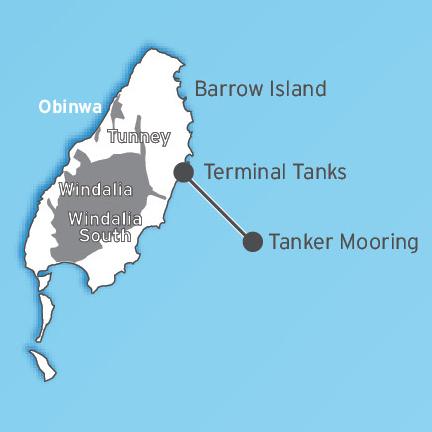
We go to extraordinary lengths to protect the integrity of the places where we operate. Places all over the world, like Australia’s Barrow Island. It’s home to hundreds of native species of wildlife, including wallabies, ospreys, and perenties.
We’ve been producing energy on the island for more than 40 years, and it remains a Class A Nature Reserve.
Didn’t take me two moments to find this image:
Barrow Island, Australia. Taken from the Chevron Australia website.
To my mind this advertisement completely misses the point; deliberately or otherwise. Chevron and all other oil producing companies in the world are endangering the future of the entire planet by continuing to ‘produce energy’, aka oil. Period. Full stop.
Or to put it in the words of George Monbiot’s essay:
The problem is simply stated: the power of the fossil fuel companies is too great. Among those who seek and obtain high office are people characterised by a complete absence of empathy or scruples, who will take money or instructions from any corporation or billionaire who offers them, and then defend those interests against the current and future prospects of humanity. This new mark reflects a profound failure of politics, worldwide, in which democracy has quietly been supplanted by plutocracy. Without a widespread reform of campaign finance, lobbying and influence-peddling and the systematic corruption they promote, our chances of preventing climate breakdown are close to zero.
Thus the final sentence in GM’s essay carries a deep sadness.
So here we stand at a waystation along the road of idiocy, apparently determined only to complete our journey.
A real pleasure and privilege to republish this article from Mr. Monbiot.
For some time now I have subscribed to the articles published by The Permaculture Research Institute of Australia. From time to time references have been made to PRI articles here on Learning from Dogs.
Recently, I read a PRI essay that had been penned by George Monbiot. It was called The Great Unmentionable. It blew me away. So I took a deep breath and dropped George M. an email asking if I might republish it here. George was very gracious in giving me such permission.
Mr. George Monbiot.
First some background to George Monbiot for those who are unfamiliar with his work and his writings. As his website explains:
I had an unhappy time at university, and I now regret having gone to Oxford, even though the zoology course I took – taught, among others, by Richard Dawkins, Bill Hamilton and John Krebs – was excellent. The culture did not suit me, and when I tried to join in I fell flat on my face, sometimes in a drunken stupor. I enjoyed the holidays more: I worked on farms and as a waterkeeper on the River Kennet. I spent much of the last two years planning my escape. There was only one job I wanted, and it did not yet exist: to make investigative environmental programmes for the BBC.
After hammering on its doors for a year, I received a phone call from the head of the BBC’s natural history unit during my final exams. He told me: “you’re so fucking persistent you’ve got the job.” They took me on, in 1985, as a radio producer, to make wildlife programmes. Thanks to a supportive boss, I was soon able to make the programmes I had wanted to produce. We broke some major stories. Our documentary on the sinking of a bulk carrier off the coast of Cork, uncovering evidence that suggested it had been deliberately scuppered, won a Sony award.
We have offshored both our consumption and our perceptions
By George Monbiot
Every society has topics it does not discuss. These are the issues which challenge its comfortable assumptions. They are the ones that remind us of mortality, which threaten the continuity we anticipate, which expose our various beliefs as irreconcilable.
Among them are the facts which sink the cosy assertion, that (in David Cameron’s words) “there need not be a tension between green and growth.”
At a reception in London recently I met an extremely rich woman, who lives, as most people with similar levels of wealth do, in an almost comically unsustainable fashion: jetting between various homes and resorts in one long turbo-charged holiday. When I told her what I did, she responded, “oh I agree, the environment is so important. I’m crazy about recycling.” But the real problem, she explained, was “people breeding too much”.
I agreed that population is an element of the problem, but argued that consumption is rising much faster and – unlike the growth in the number of people – is showing no signs of levelling off. She found this notion deeply offensive: I mean the notion that human population growth is slowing. When I told her that birth rates are dropping almost everywhere, and that the world is undergoing a slow demographic transition, she disagreed violently: she has seen, on her endless travels, how many children “all those people have”.
As so many in her position do, she was using population as a means of disavowing her own impacts. The issue allowed her to transfer responsibility to other people: people at the opposite end of the economic spectrum. It allowed her to pretend that her shopping and flying and endless refurbishments of multiple homes are not a problem. Recycling and population: these are the amulets people clasp in order not to see the clash between protecting the environment and rising consumption.
In a similar way, we have managed, with the help of a misleading global accounting system, to overlook one of the gravest impacts of our consumption. This too has allowed us to blame foreigners – particularly poorer foreigners – for the problem.
When nations negotiate global cuts in greenhouse gas emissions, they are held responsible only for the gases produced within their own borders. Partly as a result of this convention, these tend to be the only ones that countries count. When these “territorial emissions” fall, they congratulate themselves on reducing their carbon footprints. But as markets of all kinds have been globalised, and as manufacturing migrates from rich nations to poorer ones, territorial accounting bears ever less relationship to our real impacts.
While this is an issue which affects all post-industrial countries, it is especially pertinent in the United Kingdom, where the difference between our domestic and international impacts is greater than that of any other major emitter. The last government boasted that this country cut greenhouse gas emissions by 19% between 1990 and 2008. It positioned itself (as the current government does) as a global leader, on course to meet its own targets, and as an example for other nations to follow.
But the cut the UK has celebrated is an artefact of accountancy. When the impact of the goods we buy from other nations is counted, our total greenhouse gases did not fall by 19% between 1990 and 2008. They rose by 20%. This is despite the replacement during that period of many of our coal-fired power stations with natural gas, which produces roughly half as much carbon dioxide for every unit of electricity. When our “consumption emissions”, rather than territorial emissions, are taken into account, our proud record turns into a story of dismal failure.
There are two further impacts of this false accounting. The first is that because many of the goods whose manufacture we commission are now produced in other countries, those places take the blame for our rising consumption. We use China just as we use the population issue: as a means of deflecting responsibility. What’s the point of cutting our own consumption, a thousand voices ask, when China is building a new power station every 10 seconds (or whatever the current rate happens to be)?
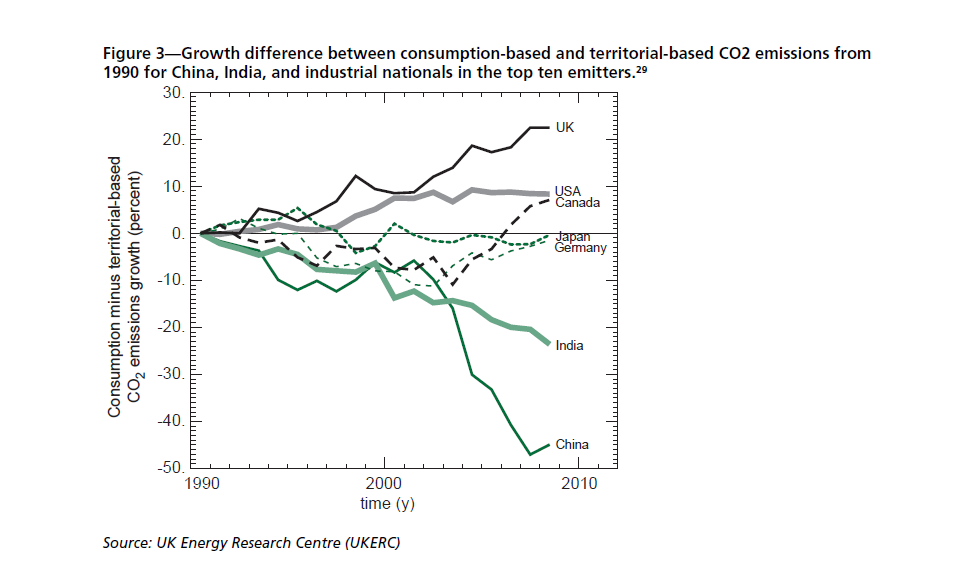
But, just as our position is flattered by the way greenhouse gases are counted, China’s is unfairly maligned. A graph published by the House of Commons Energy and Climate Change Committee shows that consumption accounting would reduce China’s emissions by roughly 45%. Many of those power stations and polluting factories have been built to supply our markets, feeding an apparently insatiable demand in the UK, the US and other rich nations for escalating quantities of stuff.
The second thing the accounting convention has hidden from us is consumerism’s contribution to global warming. Because we consider only our territorial emissions, we tend to emphasise the impact of services – heating, lighting and transport for example – while overlooking the impact of goods. Look at the whole picture, however, and you discover (using the Guardian’s carbon calculator) that manufacturing and consumption is responsible for a remarkable 57% of the greenhouse gas production caused by the UK.
Unsurprisingly, hardly anyone wants to talk about this, as the only meaningful response is a reduction in the volume of stuff we consume. And this is where even the most progressive governments’ climate policies collide with everything else they represent. As Mustapha Mond points out in Brave New World, “industrial civilization is only possible when there’s no self-denial. Self-indulgence up to the very limits imposed by hygiene and economics. Otherwise the wheels stop turning”.
The wheels of the current economic system – which depends on perpetual growth for its survival – certainly. The impossibility of sustaining this system of endless, pointless consumption without the continued erosion of the living planet and the future prospects of humankind, is the conversation we will not have.
By considering only our territorial emissions, we make the impacts of our escalating consumption disappear in a puff of black smoke: we have offshored the problem, and our perceptions of it.
But at least in a couple of places the conjuring trick is beginning to attract some attention.
On April 16th, the Carbon Omissions site will launch a brilliant animation by Leo Murray, neatly sketching out the problem*. The hope is that by explaining the issue simply and engagingly, his animation will reach a much bigger audience than articles like the one you are reading can achieve.
(*Declaration of interest (unpaid): I did the voiceover).
On April 24th, the Committee on Climate Change (a body that advises the UK government) will publish a report on how consumption emissions are likely to rise, and how government policy should respond to the issue.
I hope this is the beginning of a conversation we have been avoiding for much too long. How many of us are prepared fully to consider the implications?
So very difficult to pick out the sentence that carried the most power, for the essay is powerful from start to end. But this one did hit me in the face, “The impossibility of sustaining this system of endless, pointless consumption without the continued erosion of the living planet and the future prospects of humankind, is the conversation we will not have.“
Finally, I can’t resist reminding you, dear reader, of the point made by Prof. Guy McPherson in his book Walking Away from Empire, which I reviewed on March 6th. particularly in the first paragraph of the first chapter; Reason:
At this late juncture in the era of industry, it seems safe to assume we face one of two futures. If we continue to burn fossil fuels, we face imminent environmental collapse. If we cease burning fossil fuels, the industrial economy will collapse. Industrial humans express these futures as a choice between your money or your life, and tell you that, without money, life isn’t worth living. As should be clear by now, industrial humans — or at least our “leaders” — have chosen not door number one (environmental collapse) and not door number two (economic collapse), but both of the above.
Maybe this is why we seem unable to have the conversation because to do so means we have to look at ourselves in the mirror. Each one of us, you and me, has to address something so deeply personal. Back to Prof. McPherson and page 177 of his book (my emphasis):
It’s no longer just the living planet we should be concerned about. It’s us. The moral question, then: What are you going to do about it?
For my money, Mr. Monbiot is yet another voice of reason in the wilderness; another voice that deserves to be followed. I say this because by way of introduction to his philosophy, he opens thus:
My job is to tell people what they don’t want to hear. That is not what I set out to do. I wanted only to cover the subjects I thought were interesting and important. But wherever I turned, I met a brick wall of denial.
Denial is everywhere. I have come to believe that it’s an intrinsic component of our humanity, an essential survival strategy. Unlike other species, we know that we will die. This knowledge could destroy us, were we unable to blot it out. But, unlike other species, we also know how not to know. We employ this unique ability to suppress our knowledge not just of mortality, but of everything we find uncomfortable, until our survival strategy becomes a threat to our survival.
“… until our survival strategy becomes a threat to our survival.”
I sense the growing of this threat to the point where maybe within less than a year the vast majority of open-minded, thinking individuals know the truth of where we are all heading.
Science may just be starting to make some sense of this cruelest of diseases.
It used be to the dreaded ‘C’ word; cancer. But now that ‘C’ word has a companion, the dreaded ‘A’ word. The incidence of Alzheimer’s disease seems to be on a terrible rise. Indeed, my wife, Jean, lost her late husband to Alzheimer’s disease. My half-sister back in England is now very ill with the disease. Just chatting to some people here in Payson a few days ago revealed many who had friends or relations suffering.
So a recent item first seen on the website of The Permaculture Research Institute of Australia really jumped off the ‘page’! It was an article by George Monbiot entitled The Mind Thieves. I dropped Mr. Monbiot a quick email requesting permission to republish the article and very promptly received a positive answer. Thank you, Sir.
So before moving to the article, first a little background on George M. From his website, one quickly reads,
George Monbiot
I had an unhappy time at university, and I now regret having gone to Oxford, even though the zoology course I took – taught, among others, by Richard Dawkins, Bill Hamilton and John Krebs – was excellent. The culture did not suit me, and when I tried to join in I fell flat on my face, sometimes in a drunken stupor. I enjoyed the holidays more: I worked on farms and as a waterkeeper on the River Kennet. I spent much of the last two years planning my escape. There was only one job I wanted, and it did not yet exist: to make investigative environmental programmes for the BBC.
I’m not going to copy the full ‘About George‘ description but do urge you to pop across to here and read it yourself; George has had, trust me, a fascinating life journey that I suspect is far from over. This is how that About description closes,
Here are some of the things I love: my family and friends, salt marshes, arguments, chalk streams, Russian literature, kayaking among dolphins, diversity of all kinds, rockpools, heritage apples, woods, fishing, swimming in the sea, gazpacho, sprinting up the pitch in ultimate frisbee, ponds and ditches, growing vegetables, insects, pruning, forgotten corners, fossils, goldfinches, etymology, Bill Hicks, ruins, Shakespeare, landscape history, palaeoecology and Father Ted.
Here are some of the things I try to fight: undemocratic power, corruption, deception of the public, environmental destruction, injustice, inequality and the misallocation of resources, waste, denial, the libertarianism which grants freedom to the powerful at the expense of the powerless, undisclosed interests, complacency.
Here is what I fear: other people’s cowardice.
I still see my life as a slightly unhinged adventure whose perpetuation is something of a mystery. I have no idea where it will take me, and no ambitions other than to keep doing what I do. So far it’s been gripping.
The article was first published in the British Guardian newspaper (there’s an online link to it here) as the article mentions below. But I am republishing, in full thanks to George, the copy that appeared on George’s website on the 10th September last, including the references.
oooOOOooo
The Mind Thieves
September 10th, 2012
The evidence linking Alzheimer’s disease to the food industry is strong and growing.
By George Monbiot, published in the Guardian, 11th September 2012
When you raise the subject of over-eating and obesity, you often see people at their worst. The comment threads discussing these issues reveal a legion of bullies, who appear to delight in other people’s problems.
When alcoholism and drug addiction are discussed, the tone tends to be sympathetic. When obesity is discussed, the conversation is dominated by mockery and blame, though the evidence suggests that it can be driven by similar forms of addiction(1,2,3,4). I suspect that much of this mockery is a coded form of snobbery: the strong association between poor diets and poverty allows people to use this issue as a cipher for something else they want to say, which is less socially acceptable.
But this problem belongs to all of us. Even if you can detach yourself from the suffering caused by diseases arising from bad diets, you will carry the cost, as a growing proportion of the health budget will be used to address them. The cost – measured in both human suffering and money – could be far greater than we imagined. A large body of evidence now suggests that Alzheimer’s is primarily a metabolic disease. Some scientists have gone so far as to rename it. They call it diabetes type 3.
New Scientist carried this story on its cover last week(5): since then I’ve been sitting in the library trying to discover whether it stands up. I’ve now read dozens of papers on the subject, testing my cognitive powers to the limit as I’ve tried to get to grips with brain chemistry. While the story is by no means complete, the evidence so far is compelling.
Around 35 million people suffer from Alzheimer’s disease worldwide(6); current projections, based on the rate at which the population ages, suggest that this will rise to 100 million by 2050(7). But if, as many scientists now believe, it is caused largely by the brain’s impaired response to insulin, the numbers could rise much further. In the US, the percentage of the population with diabetes type 2, which is strongly linked to obesity, has almost trebled in 30 years(8). If Alzheimer’s, or “diabetes type 3”, goes the same way, the potential for human suffering is incalculable.
Insulin is the hormone which prompts the liver, muscles and fat to absorb sugar from the blood. Diabetes 2 is caused by excessive blood glucose, resulting either from a deficiency of insulin produced by the pancreas, or resistance to its signals by the organs which would usually take up the glucose.
The association between Alzheimer’s and diabetes 2 is long-established: type 2 sufferers are two to three times more likely to be struck by this dementia than the general population(9). There are also associations between Alzheimer’s and obesity(10) and Alzheimer’s and metabolic syndrome (a complex of diet-related pathologies)(11).
Researchers first proposed that Alzheimer’s was another form of diabetes in 2005. The authors of the original paper investigated the brains of 54 corpses, 28 of which belonged to people who had died of the disease(12). They found that the levels of both insulin and insulin-like growth factors in the brains of Alzheimer’s patients were sharply reduced by comparison to those in the brains of people who had died of other causes. Levels were lowest in the parts of the brain most affected by the disease.
Their work led them to conclude that insulin and insulin-like growth factor are produced not only in the pancreas but also in the brain. Insulin in the brain has a host of functions: as well as glucose metabolism, it helps to regulate the transmission of signals from one nerve cell to another, and affects their growth, plasticity and survival(13,14).
Experiments conducted since then appear to support the link between diet and dementia(15,16,17,18), and researchers have begun to propose potential mechanisms. In common with all brain chemistry, these tend to be fantastically complex, involving, among other impacts, inflammation, stress caused by oxidation, the accumulation of one kind of brain protein and the transformation of another(19,20,21,22). I would need the next six pages of this paper even to begin to explain them, and would doubtless get it wrong (if you’re interested, please follow the links on my website).
Plenty of research still needs to be done. But if the current indications are correct, Alzheimer’s disease could be another catastrophic impact of the junk food industry, and the worst discovered so far. Our governments, as they are in the face of all our major crises, appear to be incapable of responding.
In this country as in many others, the government’s answer to the multiple disasters caused by the consumption of too much sugar and fat is to call on both companies and consumers to regulate themselves. Before he was replaced by someone even worse, the former health secretary, Andrew Lansley, handed much of the responsibility for improving the nation’s diet to food and drinks companies: a strategy that would work only if they volunteered to abandon much of their business(23,24).
A scarcely-regulated food industry can engineer its products – loading them with fat, salt, sugar and high fructose corn syrup – to bypass the neurological signals which would otherwise prompt people to stop eating(25). It can bombard both adults and children with advertising. It can (as we discovered yesterday) use the freedoms granted to academy schools to sell the chocolate, sweets and fizzy drinks now banned from sale in maintained schools(26). It can kill the only effective system (the traffic light label) for informing people how much fat, sugar and salt their food contains. Then it can turn to the government and blame consumers for eating the products it sells. This is class war: a war against the poor fought by the executive class in government and industry.
We cannot yet state unequivocally that poor diet is a leading cause of Alzheimer’s disease, though we can say that the evidence is strong and growing. But if ever there was a case for the precautionary principle, here it is. It’s not as if we lose anything by eating less rubbish. Averting a possible epidemic of this devastating disease means taking on the bullies: those who mock people for their pathologies and those who spread the pathologies by peddling a lethal diet.
References:
1. Caroline Davis et al, 2011. Evidence that ‘food addiction’ is a valid phenotype of obesity. Appetite Vol. 57, pp711–717. doi:10.1016/j.appet.2011.08.017
2. Paul J. Kenny, November 2011. Common cellular and molecular mechanisms in obesity and drug addiction. Nature Neuroscience, Vol. 12, pp 638-651. doi:10.1038/nrn3105
3. Joseph Frascella et al, 2010. Shared brain vulnerabilities open the way for nonsubstance addictions: Carving addiction
at a new joint? Annals of the New York Academy of Sciences, Vol. 1187, pp294–315. doi: 10.1111/j.1749-6632.2009.05420.x
4. Ashley N. Gearhardt et al, 2010. Can food be addictive? Public health and policy implications. Addiction, 106, 1208–1212. ad. d_3301 1208..1212 doi:10.1111/j.1360-0443.2010.03301.x
5. Bijal Trivedi, 1st September 2012. Eat Your Way to Dementia. New Scientist.
6. Sónia C. Correia et al, 2011. Insulin-resistant brain state: The culprit in sporadic Alzheimer’s disease? Ageing Research Reviews Vol. 10, 264–273. doi:10.1016/j.arr.2011.01.001
7. Fabio Copped`e et al, 2012. Nutrition and Dementia. Current Gerontology and Geriatrics Research, Vol. 2012, pp1-3. doi:10.1155/2012/926082
8. See the graph in Bijal Trivedi, 1st September 2012. Eat Your Way to Dementia. New Scientist.
9. Johanna Zemva and Markus Schubert, September 2011. Central Insulin and Insulin-Like Growth Factor-1 Signaling – Implications for Diabetes Associated Dementia. Current Diabetes Reviews, Vol.7, No.5, pp356-366. doi.org/10.2174/157339911797415594
10. Eg Weili Xu et al, 2011. Midlife overweight and obesity increase late life dementia risk: a population-based twin study. Neurology, Vol. 76, no. 18, pp.1568–1574.
11. M. Vanhanen et al, 2006. Association of metabolic syndrome with Alzheimer disease: A population-based study. Neurology, vol. 67, pp.843–847.
12. Eric Steen et al, 2005. Impaired insulin and insulin-like growth factor expression and signaling mechanisms in Alzheimer’s disease – is this type 3 diabetes?. Journal of Alzheimer’s Disease, Vol. 7, pp.63–80.
13. Konrad Talbot et al, 2012. Demonstrated brain insulin resistance in Alzheimer’s disease patients is associated with IGF-1 resistance, IRS-1 dysregulation, and cognitive decline. The Journal of Clinical Investigation, Vol.122, No.4, pp.1316–1338. doi:10.1172/JCI59903.
14. Naoki Yamamoto et al, 2012. Brain insulin resistance accelerates Aβ fibrillogenesis by inducing GM1 ganglioside clustering in the presynaptic membranes. Journal of Neurochemistry, Vol. 121, 619–628. doi: 10.1111/j.1471-4159.2012.07668.x
15. Eg:
Wei-Qin Zhao and Matthew Townsend, 2009. Insulin resistance and amyloidogenesis as common molecular foundation for type 2 diabetes and Alzheimer’s disease.
Biochimica et Biophysica Acta, Vol.1792, pp.482–496. doi.org/10.1016/j.bbadis.2008.10.014,
16. Sónia C. Correia et al, 2011. Insulin-resistant brain state: The culprit in sporadic Alzheimer’s disease? Ageing Research Reviews Vol. 10, 264–273. doi:10.1016/j.arr.2011.01.001
17. T. Ohara et al, 2011. Glucose tolerance status and risk of dementia in the community, the Hisayama study. Neurology, Vol. 77, pp.1126–1134.
18. Karen Neumann et al, 2008. Insulin resistance and Alzheimer’s disease: molecular links & clinical implications. Current Alzheimer Research, Vol.5, no.5, pp438–447.
19. Eg: Lap Ho et al, 2012. Insulin Receptor Expression and Activity in the Brains of Nondiabetic Sporadic Alzheimer’s Disease Cases. International Journal of Alzheimer’s Disease, Volume 2012. doi:10.1155/2012/321280
20. Suzanne M. de la Monte, 2012. Contributions of Brain Insulin Resistance and Deficiency in Amyloid-Related Neurodegeneration in Alzheimer’s Disease. Drugs, Vol. 72, no.1, pp. 49-66. doi: 10.2165/11597760
21. Ying Liu et al, 2011. Deficient brain insulin signalling pathway in Alzheimer’s disease and diabetes. Journal of Pathology, Vol. 225, pp.54–62. doi: 0.1002/path.2912
22. Konrad Talbot et al, 2012. Demonstrated brain insulin resistance in Alzheimer’s disease patients is associated with IGF-1 resistance, IRS-1 dysregulation, and cognitive decline. The Journal of Clinical Investigation, Vol.122, No.4, pp.1316–1338. doi:10.1172/JCI59903.
Don’t know about you but the above is a fine example of investigative reporting. It deserves the widest circulation because if it is proved that there is a link between diet and Alzheimer’s disease then, once again, it shows how taking personal responsibility for our health has huge implications for us, our families and for society at large.
The latest from Bill McKibben has to be read and shared.
Introduction
We live in a world where there’s a great fondness for shortness, whether it’s headlines, soundbites, Twitter length ‘conversations’, text messages, and the rest. However, I’m introducing an essay from Bill McKibben that is long. When I use the word long I mean both literally, the essay is a shade under 6,200 words, and subjectively, the essay is long, very long, on meaning.
It was published in the August 2nd, 2012 issue of Rolling Stone. As Allyse of the 350.org team wrote in a widely distributed email,
Here at 350.org, we do a lot of our internal communication via online chat, and our written shorthand for “YES!” and “totally awesome!” and “you rock!” is “++”. Which is why I say to you: ++ Social Media Team, ++. You all rock.
Bill McKibben’s article in Rolling Stone—which we asked you to spread around the internet last week—has been shared on Facebook almost 100K times and seen by hundreds of thousands of people. Great work. If you haven’t read it yet, please do.
This article really lays out the intellectual framework for much of our work in the weeks, months, and years ahead. We want to keep pushing these ideas out there, especially this one: our objection to the fossil fuel industry is structural—these businesses are in fact planning to wreck the planet!
So we took a quote from Bill’s article and made it into a graphic that’s already been shared almost 2,500 times on Facebook. Will you help us push it past 5,000? Click here to share.
As you know if you’ve read the article, this is really an all-hands-on-deck moment for humanity. Thanks for doing your part—in ways both large and small.
Onward,
Allyse
Will you put aside some time, settle down in a comfortable chair, and read the article? Please do!
It crossed my mind to split it over a couple of days but I decided against that. But I have inserted a ‘click to reveal more’ about 1,100 words into the article – please do read on when you reach that point. And just as important, do comment!
Oh, want to see that image on Facebook that has been shared so widely? Here it is:
A’int that the truth!
Finally, feel free to share this as far and wide as you want. Thank you.
oooOOOooo
(Apart from the first image from Edel Rodriguez, all the other photographs have been inserted by me and are not in the original Rolling Stone production – I decided to insert them to make reading the article more visually attractive on a screen.)
Global Warming’s Terrifying New Math
Three simple numbers that add up to global catastrophe – and that make clear who the real enemy is
If the pictures of those towering wildfires in Colorado haven’t convinced you, or the size of your AC bill this summer, here are some hard numbers about climate change: June broke or tied 3,215 high-temperature records across the United States. That followed the warmest May on record for the Northern Hemisphere – the 327th consecutive month in which the temperature of the entire globe exceeded the 20th-century average, the odds of which occurring by simple chance were 3.7 x 10-99, a number considerably larger than the number of stars in the universe.
Meteorologists reported that this spring was the warmest ever recorded for our nation – in fact, it crushed the old record by so much that it represented the “largest temperature departure from average of any season on record.” The same week, Saudi authorities reported that it had rained in Mecca despite a temperature of 109 degrees, the hottest downpour in the planet’s history.
Not that our leaders seemed to notice. Last month the world’s nations, meeting in Rio for the 20th-anniversary reprise of a massive 1992 environmental summit, accomplished nothing. Unlike George H.W. Bush, who flew in for the first conclave, Barack Obama didn’t even attend. It was “a ghost of the glad, confident meeting 20 years ago,” the British journalist George Monbiot wrote; no one paid it much attention, footsteps echoing through the halls “once thronged by multitudes.” Since I wrote one of the first books for a general audience about global warming way back in 1989, and since I’ve spent the intervening decades working ineffectively to slow that warming, I can say with some confidence that we’re losing the fight, badly and quickly – losing it because, most of all, we remain in denial about the peril that human civilization is in.
When we think about global warming at all, the arguments tend to be ideological, theological and economic. But to grasp the seriousness of our predicament, you just need to do a little math. For the past year, an easy and powerful bit of arithmetical analysis first published by financial analysts in the U.K. has been making the rounds of environmental conferences and journals, but it hasn’t yet broken through to the larger public. This analysis upends most of the conventional political thinking about climate change. And it allows us to understand our precarious – our almost-but-not-quite-finally hopeless – position with three simple numbers.
Trying to make sense of the utter nonsense of the Rio+G20 summit.
I share the deep frustration that must be felt by millions around the globe at the outcome of the Rio summit meeting, if outcome is the appropriate word! Martin Lack summarised his anger in a post last Friday and I’m going to publish an extract from his writings because they so perfectly reflect not only his anger but, I suspect, the anger of millions of others.
“It would have been naïve to pin too many hopes on a single conference, but undeniably we expected more from the outcome document. Entitled ‘The Future We Want’, the text doesn’t live up to the aspirations of the title – it’s more a case of ‘The Future We’ll Get If We Rely On Politicians’. Full of weak phrases, and re-confirmations of previous aspirations which they haven’t realised, the text fails to commit governments to actions, targets, timeframes and finance to which we can hold them accountable….What we have is an agreement within the bounds of what they thought politically possible; what we needed was an agreement to address what is scientifically necessary. This is no way to manage our planet!”
“World leaders have spent 20 years bracing themselves to express ‘deep concern’ about the world’s environmental crises, but not to do anything about them…Several of the more outrageous deletions proposed by the United States – such as any mention of rights or equity or of common but differentiated responsibilities – have been rebuffed. In other respects the Obama government’s purge has succeeded, striking out such concepts as “unsustainable consumption and production patterns” and the proposed decoupling of economic growth from the use of natural resources.”
I would like to be able to dismiss this as facile criticism from the liberal left. However, in reality, to do so would be to second-guess the scientists who have been telling us for decades that we need action not words. Our children and grandchildren will not forgive us for failing to act.
BUT a conversation I had with Lew L. here in Payson last Friday afternoon helped crystalise some thoughts that I would like to share with you.
Representative democracy a la British House of Commons
The first is about democracy, or more accurately representative democracy. Lew pointed out that some US Towns still employ direct democratic processes where all the people who attend a Town meeting vote in person for or against the motion. The challenge for a representative democratic process is that those elected representatives are vulnerable to a wide range of influences and between elections may be taking decisions that the people would neither support nor approve of.
The idea of direct democracy goes back a very long time, as Wikipedia reveals,
The earliest known direct democracy is said to be the Athenian Democracy in the 5th century BC,
So it could be argued that the fundamental flaw in the Rio+G20 meeting was not the lack of any real progress by our ‘leaders’, but in our expectations, as in the expectations of ‘you and me’, all across the world. The money and power that must be intertwined in such games of international politics doesn’t bear thinking about. It was Lord Acton, the British historian, who said: ‘Power tends to corrupt, absolute power corrupts absolutely‘.
So rather than expecting our representatives and leaders to do what we what them to do and being bitterly disappointed, time and time again, there is another equally valid way of bringing about change – create the change you desire by changing yourself.
As my friend Jon Lavin expressed in a very recent email,
People like something solid to relate to in such changing and unpredictable times and a dogs view is brilliant because dogs just are because they are in the present. All that matters is the ‘now’. Most of our problems can be traced back to our lack of ability to be in the ‘now’. Driven by regrets about the past, and a fear of what the future holds, we carry on hoping that all our problems can be solved by amassing material possessions.
Oh, well. The best way to save the world is to work on our selves.
So that leads on to my second thought, the urgency in tackling what is happening to the Earth’s climate. In Martin’s second angry post over at Lack of Environment, he writes,
Global average temperatures are rising. Since the 1980s, every decade has been warmer than the last. 1998 was a very warm year, but global warming has not stopped; it has morphed into Anthropogenic Climate Disruption (ACD). Some even suggest we should call it Human Induced Rapid Global Overheating (HIRGO) but I prefer ACD, because that is what we are experiencing: It will be decades before it becomes obvious that HIRGO is happening and, if we wait for it to be obvious, there will be no way to stop it.
We need to accept that ACD is a reality; it is an inevitable consequence of a warming atmosphere; one with more moisture in it more of the time and – as I said – it is exactly what the climate models have being tell us would happen for decades. That being the case, how is it that our politicians – seemingly led by members of a supposedly left-of-centre Democratic Party administration in the USA – can have such monumental tunnel vision as to offer up the planet itself as a sacrifice upon the altar of the god of Growth?
But do you see the fundamental error? The idea that our leaders have to create change: “.. how is it that our politicians …. can have such monumental tunnel vision as to offer up the planet itself as a sacrifice upon the altar of the god of Growth?”
As Jon Lavin revealed in his email to me, the agency of change is within each of us. It is not a “thing.” There’s a huge amount of information revealed by a simple Google search on change, the change process, change management process, etc., etc., so I’m not going to add to the noise by quoting the experts. It’s as simple as Jon wrote:
“The best way to save the world is to work on our selves.”
OK, moving on to my second thought, and for this I want to play a little mind-game.
That is what would be the impact if 50% of the combined populations of North America and Europe decided to save the power of one 60-watt lamp, or equivalent, for 36 hours a year, i.e. turning off one 60-watt lamp for less than one hour a day for a year!
Let’s take this a step at a time.
The combined population of the USA, Canada and Europe is 1,090,487,000 people, i.e. a little over 1 billion.
Thus half that population is 545,243,500 persons.
Saving 60 watts for 36 hours a year is 60 X 36 = 2,160 watts.
Thus 545,243,500 people times 2,160 watts = 1,177,725,960,000 watts. Which is 1.178 trillion watts. (rounded up)
I say again: 1.178 trillion watts.
How can one get any notion of what that means? The best I could find from a web search was this:
The U.S. electric power industry’s total installed generating capacity was 1,119,673 megawatts (MW) as of December 31, 2009—a 1.0-percent increase from 2008.
Ergo, in 2009 the USA had the capability of generating 1,119,673 megawatts. A megawatt is one million watts so 1,119,673 megawatts is 1,119,673,000,000 watts, or 1.119 trillion watts.
Wow! switching off a 60-watt lamp for less than an hour a day would save 1.178 trillion watts, more than the combined generating capacity of the entire USA in 2009 of 1.119 trillion watts.
I suspect that the current USA generating capacity isn’t that much different and, of course, one can’t run away with the idea that all of that is generated by fossil fuels.
But if I have done my mathematics correctly (and do please check my sums), the simple expediency of turning off one 60-watt lamp for 36 hours a year, if done by just half the populations of North America and Europe, would be the equivalent of saving 105% of the total US generating capacity!
So thinkabout the change you want in your life, and the lives of your children and grandchildren, and get on with it. Turn out that light!
“The best way to save the world is to work on our selves.”
And I can do no better in terms of reflecting on the power of our minds, than courtesy of this fabulous video which Christine of 350orbust had last Saturday:
Final thought! If one thinks of the way that we trust the Internet for so much these days, and the huge number of people that are now ‘wired’, it doesn’t seem to be beyond the wit of man to come up with a reliable, secure method of direct voting electronically. Wonder why that hasn’t caught on?



 Learning from Dogs