Tag: fear

On being honest.

A reposting of an article by Jon Lavin, first published on the 3rd July, 2010.)

Conscientiousness isn’t all it’s cracked out to be!

(Foreword from Paul.)

Jon is one of those rare individuals who not only has been committed to a path of self-awareness for more than 30 years but who has also studied incredibly hard so as to be able to help others and do so from a base of real competence, as his own Blog describes.

But then I realised the great strength in what Jon has written.  It is this.

There are many notable teachers to whom thousands upon thousands have turned to for a deeper understanding of what life is all about.  As far back as time itself, teachers have surfaced and given spiritual guidance to those that come in need.  But it’s very difficult to read or listen to these great teachers and connect with the fact that they were born, as we are all born, with nothing.  And all of them, like many of us, went through Hell on wheels to come out the other side with a greater self-awareness and a deeper understanding of the real truths in nature.  Like all of us who wish to rise above our present place they first acknowledged their own frailties. It is the starting point.

So, let me get to the point.  Jon has the awareness and understanding to offer real help to those that seek answers that are currently beyond reach.  Jon’s article is an wonderful illustration that he experiences the same fears and feelings of helplessness that you and I feel.  You and I and Jon and all of humanity are much more closely connected than we realise.

Paul H.

oooOOOooo

To see in is to see out!

I’ve been running my own business for about 12 years now. In the beginning it started because I had a thirst for wanting to make a difference in small business in our local area and a passion for wanting to do it through working with people directly, on their behaviours. Still have, really.

I think this came as a form of acknowledgement to the few exceptional people managers I experienced while I was employed, and the all too common, terrible ones.

I was also mentored by a group of people to whom no developmental tool was barred. My eyes were well and truly opened to how a change of view could change outcomes.

The final boot up the backside was redundancy in the late 90s. I was all ready to go and just needed a kick.

My work ethic, trained at home and then through an engineering apprenticeship, was to conscientiously work hard and try hard and to treat people the way you want to be treated. Nothing wrong with that. I assumed automatic reward would follow as long as I did those things.

Over time I wised up and became a bit less idealistic and a little more politically aware but carried on in much the same way.

Much later I found myself embarking on a whole new adventure, with a lovely wife and family, all dependent on me, with a few contacts to start getting work from!

It took a year before the first jobs came in that didn’t necessitate robbing the almost non-existent savings and redundancy payment just to keep food on the table. Then, work slowly picked up and it started to get quite good for a one-man band. We were able to go on holiday once a year, camping, but still great, and then abroad.

All the time, I beavered away, trying hard, being very conscientious, as I’d been brought up to be, but slowly getting very stressed.

Time was when it took Friday night to de-stress, then 3 days, then 10 days and recently, not at all.

So faced with this present downturn, which is likely to go on for much longer than any of the others I’ve seen and survived, I’m wondering just what new strategy to adopt. Money is already getting very tight and everything is feeling very ‘hand to mouth’. Can’t really see one month in front of the other.

I notice our local farmer who I went to school with but didn’t really know.

I’ve got degrees, lived abroad, can speak Finnish fluently, (what use is that, I hear you say!), and can turn my hand to most things, but I still feel quite dis-empowered and at a bit of a loss.

My farmer friend is always smiling, he’s got a flock of geese he’s fattening up, the same with his beef cattle, does livery for half a dozen horses or so, has fields planted with various cereal crops, and has his finger in lots of different pies – and definitely does not look stressed. He is also renting his land plus another farm.

I honestly don’t know what to make of this all except for a few really important things – the importance of diversification, relationships and appreciating what you’ve got, especially people things, here, in the now.

I have also come to the realisation that I still haven’t cracked the main thing with being self-employed, and that is replacing fear with trust.

It’s been said by various enlightened people that we see a reflection of the world we hold in mind. Going forward into this brave new world I would like to see opportunities rather than fear, I will diversify into things which make more use of my wide range of talents, and I will swap fear for trust.

By Jon Lavin

Transformation

(A reposting of an article by Jon Lavin, first published on the 9th October, 2009.)

These are hard times for millions – transformation is the only practical option.

I’ve been working with most of my clients recently through painful transformation brought about by the recession.

deep riverAn interesting metaphor really because, since the first wave of uncertainty in the UK banking system triggered panic, I have been picking up on that uncertainty.

That uncertainty feels like it’s stalking the globe at the moment; one has been aware of an underlying fear that was difficult to name and source in me. It has been rather like a deep river in that whilst the surface feels slow moving, currents are moving things powerfully below.

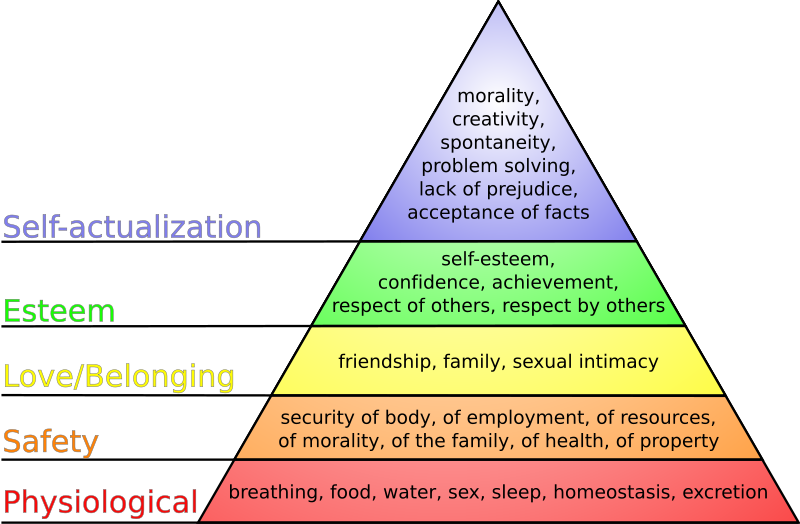
For example, we now are the proud owners of 6 Light Sussex chickens. Our youngest son, Sam, and I have dug up the back lawn and planted vegetables and built a poly-tunnel. We are also planning to install a wood burning cooker. Right back down to the base of Maslow’s pyramid.

Maslow's Pyramid of Needs
Maslow’s Pyramid of Needs

These feelings have brought about such change everywhere and I wonder seriously whether we will ever return to what was, indeed, would we want to?

I might not have mentioned it in previous Posts but as well as an engineering background, in latter years, I have focussed on the interpersonal and success in business founded on quality relationships, integrity and, vitally, awareness.

To inform this, some 6 years ago, I embarked on an MA in Core Process Psychotherapy, primarily to work on myself so that I could be the best I could be in my relationships in and out of work.

The point I’m trying to make is that the same panic I notice in many of the companies I work in, and in me, is based on fear of the unknown and on a lack of trust in abundance in all it’s forms.

We get more of what we focus on. So we can choose to focus on the constant news of more difficulties, hardship and redundancies or, we can focus on what is working. In the workplace it has been pulling people together across functions and sites and pooling resources and ideas.

When we realise we’re not doing this alone it’s amazing how much lighter a load can feel and how much more inspired we feel. I also notice how humour begins to flow and what a powerful antidote for doom and gloom that is.

Transformation is never easy but the rewards exceed the effort put in ten fold.

So what is it going to be? Are we all going to bow down to the god of Doom & Gloom, fear and anxiety, heaping more and more gifts around it; as most media focusses on, or are we going to start noticing and focussing on the other neglected god of relationship; joy, trust, abundance and light?

Whatever the future holds for us, a belief in our inherent ability to adapt and change and focus on the greater good rather than fear, anxiety, greed and selfishness is the only sustainable way forward.

By Jon Lavin

Footnote from Paul: Considering that this was first published nearly four years ago, the level of uncertainty across the world seems practically undiminished!

Fear versus Faith

“Fear comes from uncertainty. When we are absolutely certain, whether of our worth or worthlessness, we are almost impervious to fear.”  William Congreve, English playwright and poet.

It’s Sunday (i.e. yesterday).  I woke around 6am to a cold morning (28 deg F/-2.2 deg C), the result of a clear, moonlit night.

Then as the night sky lightened with the coming dawn, the green, forest-cloaked valleys, visible to the East through the bedroom windows filled with a white, morning mist.  In a metaphorical sense that descending mist matched a mood of gloom that was trying to descend on me.

Early morning mist, Merlin, Oregon
Early morning mist, taken 7:15 am Sunday, 24th Feb.

As I lay back against the headboard of the bed, Jean still sleeping close to me, dogs Cleo, Hazel and Sweeny snoozing on and around me, I pondered on my mood.  It came to me that I might be picking up the growing sense of anxiety, of uncertainty, that seems to be ‘in the air’.  Me reading too many blog articles about global warming, climate change, et al.  Being three-quarters through Professor Guy McPherson’s book Walking Away from Empire: A Personal Journey wasn’t helping either!

Then I recalled a recent conversation with dear friend and colleague from our Payson, AZ. days, John Hurlburt, who said that fear is the absence of faith.  That if we trust what will be will be, then we can counter the fear of the unknown and embrace the present day, one day at a time.  Living in the now as, you’ve guessed it, that dogs do so supremely well.  Something else to learn from dogs!

I made a decision to take a stroll in the forest, emotionally speaking, for this week, so far as Learning from Dogs is concerned.  Enjoy the beauty of the world around me and offer a few essays on the meaning of life. No blog posts at all about anything that engenders fear from any quarter!

And if that doesn’t slash the readership figures, I don’t know what will! So there! You have been warned.

So let me start by offering this essay from John.  John is one of those rare people who has been through more than his fair share of ‘challenges’ over the years, yet has grown from those experiences.

Here’s John – I’m turning over and going back to sleep!

oooOOOooo

Education, Formation and Transformation

Most Americans remain comfortably complacent despite world economic brinksmanship, the escalating deterioration of our planetary environment and raging world discontent. Although we may be caring and compassionate in our personal lives, we are often reluctant to take any risk of reducing our personal comfort.

Education is a process. A process of learning how to think life through in order to become aware of whom we are, what we are, where we are, and why we exist. Education has always been the human gateway to a better future.

Knowledge does not guarantee wisdom. Education, formation and transformation are an integrated process which includes studying to gain knowledge, making natural connections based on the best information available, and experiencing the higher levels of conscious awareness we recognize as wisdom. The educational process works best when it is open minded, factual and sustained. We learn best when we learn together.

The human wisdom tradition is rich in myth, mysticism, symbols, imagination and creativity. It tells a common story of emergence through centuries of sacred writings stretching back through time to the earliest human cave scratchings roughly 17,000 years ago, and the beauty of the prayers of the Rig-Veda 12,000 years ago which all begin with an homage to the natural energy of the Sun.

We’re conscious components of a living planet. We’re surface dwellers with exposure to universal and planetary energies. Our species is only 200,000 years old. The universe is roughly 13 billion years old. Our planet is deteriorating and we’ve lost our collective moral compass. What can we do to make a local difference?

We only recently learned to hunt woolly mammoths in packs using bows, arrows and spears as tools. A perception of God in relation to our responsibility to each other and creation exists as the foundation of a human wisdom tradition which, relatively speaking, has just began.

In many ways, nothing seems to have changed as we have passed through successive cyclic waves of emergence and contraction. It becomes simultaneously increasingly more complex and exquisitely simple to understand. That is as we begin to realize how our metanexus emerges, contracts and turns inside out without breaking … like a pulse.

The next ten years are more important than the next several thousand years in respect to the choices we make about our biosphere.

There seems to be little doubt that our world problems are steadily increasing. What’s the next right thing to do?  It’s time to grow our conscious connection in God. It’s time to share the spring of human wisdom from the ground up. It’s time to develop a world economy which is gentle to the earth.

The Clearing Rests in Song and Shade

The clearing rests in song and shade.
It is a creature made
By old light held in soul and leaf.
By humans joy and grief,
By human work,
Fidelity of sight and stroke,
By rain, by water on
The parent stone.
We join our work to Heaven’s gift,
Our hope to what is left,
That field and woods at last agree
In an economy
Of widest worth.
High Heaven’s Kingdom come on earth,
Imagine Paradise
O dust, arise!

Wendell Berry; 1909

oooOOOooo

The illiterate of the future will not be the person who cannot read. It will be the person who does not know how to learn.” Alvin Toffler

The art of relaxation

Yesterday’s article reminds me of something fundamental!

In Patricia’s guest post of yesterday, she wrote about Chloe, her dog,

Chloe was born knowing. She knows about joy. She knows about living a life in balance. She knows about forgiveness, trust, exuberance, a passion for learning and the power of a good nap.

I was speaking with Jon Lavin a few days ago about the effect of anxiety on memory.  Jon confirmed that as we get older even low levels of anxiety can play games with our mental focus.  He described what many of us know – of walking into a room, for instance, and suddenly realising that you didn’t have a clue as to why you had come into the room!  In a very real sense anxiety is the body’s manifestation of fear.

Jon went on to say that practicing ‘letting go’ for a couple of 10-minute sessions a day is wonderfully therapeutic for the mind.  In fact, when Jon was a guest author for Learning from Dogs he touched on the subject of fear in a post almost two years ago to the day; Dealing with the fear of the known.  Indeed, I’m going to reproduce that article in full – here it is,

Jon Lavin

Can we ever conquer fear?

In a recent article I discussed the fear of the unknown, linked to the down-turn, redundancies, etc.

Per Kurowski, a great supporter of this Blog, posed the following question. “Great advice… but how do we remove the fear of what is known?”  A simple, and slightly flippant answer would be, “Develop a different relationship with it.”

What I’m saying is that when we are facing the known, and I’m assuming that it’s something unpleasant, our choices are limited. It’s going to happen, so the only thing we can do is change the way we view it.

This brings us back full circle to developing a different relationship with it. Let’s take the word, ‘fear’.

All fear is an illusion, walk right through“. I heard Dr David Hawkins say on a CD. Granted, a great trick if you can do it!

Here’s another description of fear: Fear = False Evidence Appearing Real

Fear is generally future-based. We tend to use the past as a learning reference to inform us of what to be afraid of in the future. So human beings live their lives trying to predict and prepare for the future, limited by their past experiences.

Unfortunately, the only way to work with fear of the known is to live in the present!

Our whole society is geared up to look into the future. We are forever worrying about or planning something for the future.

To begin focussing on the present, try this.

Simply, to start off, become aware of the breath and sensations in the body. This will slowly start to remind us to be present, or embodied, in our own body. Problems, fear and spiral thinking, often at 3 or 4 in the morning, are generated in the mind. Thoughts occur randomly, although we call them, “Our thoughts“, and refer to, “Our mind“.

By dropping out of the thought processes into the awareness of our breath and our body, the noise stops, even if only for a moment.  Here’s the rub: So very few people in the world will have even the slightest inkling what these words mean!

If more of us got used to coming out of the mind before making an important decision, and simply sat with the question for a while, the answer would probably present itself.

This will probably raise more questions than it answers but that’s not a bad thing.

By Jon Lavin

Difficult to add anything to that very sound advice save to try it out yourself, and if you own a dog or have one as a friend, just look much more closely at how he or she behaves and remember why this blog is called what it is!  Or as Trish wrote,

Chloe was born knowing. She knows about joy. She knows about living a life in balance. She knows about forgiveness, trust, exuberance, a passion for learning and the power of a good nap.

Ah, the power of a good nap!

Puppy Cleo enjoying a good nap!

The way forward?

A big vote of thanks to Paul for plugging away for so long without any contribution from me.  Unlike Paul who is retired, well retired in the sense of a paying job, I have a family, a dog (Jess) and the usual set of household overheads to cover, so the week is very much a working week for me.  Ergo, I shall never be able to contribute to Learning from Dogs in the same manner as Paul but a regular contribution is assured. To get things rolling again, I want to re-publish an article that I wrote on my business blog the other day.

Removing the fear of the unknown

Seeing the light

I’ve been working with most of my clients recently through painful transformations brought about by the economic downturn.

An interesting metaphor really because since the first wave of uncertainty triggered panic, first noticed in the UK banking system, I have been picking up on that uncertainty that feels like it’s stalking the globe and has been for some time. Recent stock market crashes have simply exacerbated this and that, coupled with the riots taking place in major cities in the UK, make for pretty disturbing reading.

Interestingly, I, too, have been aware of an underlying fear that was difficult either to name or source.

It has been rather like a deep river in that whilst the surface feels slow-moving, currents are moving things powerfully below.

So this ‘fear’ has caused a few household changes.

1) We now are the proud owners of 12 chickens. Our youngest son and I have dug up the back lawn and planted vegetables and built a poly tunnel.

2) We have also installed a wood burning cooker. Right back down to the base of Maslow’s triangle really!

Maslow's triangle of needs

These feelings have brought about such change everywhere and I wonder seriously whether we will ever return to what was; indeed would we want to?

I might not have mentioned it in previous blogs but as well as an engineering background, in latter years, I have focused on how success in business is linked directly to aspects of relationships and how we are in our relationships with others, so things like integrity, self-awareness and the ability to see the point of view of others, and modify our approach appropriately.

To inform this, some 7 years ago, I embarked on an MA in Core Process Psychotherapy, primarily to work on myself so that I could be the best I could be in my relationships, in and out of work.

The point I’m trying to make is that the same panic I notice in many of the companies I work in, and in me, is based on fear of the unknown and on a lack of trust in all its forms.  I’ve deliberately underlined that last phrase because it is so incredibly important.

The truth is that we get more of what we focus on.

So we can choose to focus on the constant news of more difficulties, hardship and redundancies, or we can focus on what is working.

In the workplace this positive focus has been pulling people together across functions and sites and pooling resources and ideas.

When we realise we’re not doing this alone it’s amazing how much lighter a load can feel and how much more inspired we all feel.

I also notice how humour begins to flow and what a powerful antidote for doom and gloom that is.

Transformation is never easy but the rewards far exceed the effort put in ten fold.

So what is it going to be? Are we all going to bow down to the god of Doom & Gloom, fear and anxiety, heaping more and more gifts around it, or are we going to start noticing and focusing on the other neglected god – that of relationship, joy, trust, abundance and lightness?

Whatever the future holds for us all a belief in our inherent ability to adapt and change and focus on the greater good rather than fear, anxiety, greed and selfishness is the only sustainable way forward.

By Jon Lavin

The Role of Fear

Fear of the Known – thinking aloud about stuff

Jon Lavin wrote a Post on the 13th June, 2010 entitled, “Dealing with the fear of the known.” I’ve been thinking about that in recent weeks including the comment to Jon’s article from Per. Here’s how Jon closed that article:

If more of us got used to coming out of the mind before making an important decision, and simply sat with the question for a while, the answer would probably present itself.

This will probably raise more questions than it answers but that’s not a bad thing.<!–

And here’s the recent comment from Per: Great advice… but how do we remove the fear of what is known?

Presumably Per was implying that we shouldn’t fear the known. However, I beg to differ here; it is actually fear of the UNKNOWN that is rather pointless (I am not afraid of aliens), while fear of the KNOWN is CRUCIAL to our survival.

But like anything else, you can have too little or too much. Too little, and you survive a very short time. Too much, and you sit cowering in your cellar afraid to go out. As with EVERYTHING in life it is a question of BALANCE.

How do we know how much fear to deploy? Instinct, intelligence, knowledge and experience. If any of these are deficient, we may apply an inappropriate fear quotient.

Let’s take “Global Warming”! How afraid of it should I be? What are my marks out of 10 for the four fear-factors above?

Instinct = 8 – I instinctively fear a situation when my environment is getting hotter, as I don’t know what that will imply.
Intelligence = 8 – I am (just) intelligent enough to appreciate the dangers of a rise in temperature.
Knowledge = 4 – I have no real idea exactly what is going on or how far it will go; the messages are mixed and I see no real panic among governments.
Experience = 0

So, a score of just 20 out of 40, which means IGNORANCE and DOUBT and these add up to FEAR ….. so I am quite afraid.

Home grown vegetables

More apparently, than my leaders seem to be, who can’t even ban flying across the Atlantic at a cost of 60,000 tons of CO2 per day. The question is, will this considerable amount of fear push me into actually DOING something about GW? What is my inertia level and what is my tipping point? What would it take to get me to dig up my garden and plant potatoes? To sell my car and buy a horse? Sadly, humans are in general pretty inert …… it is much easier to do nothing or too little until it is (almost) too late.

So, “fear” is absolutely essential to our survival. If you’re a driver who doesn’t fear accidents then please keep out my my way until you very soon die in one.

Fear is also what pushes me to drive very carefully. People who greedily lent money to Madoff had no fear they would lose it, having lost all control of  whatever ration of commonsense and/or logic they might once have had. Perhaps now people will fear rather more about losing their money and therefore invest it more wisely.

To take another topical example, any company in the future (is there one?) drilling for oil in the Gulf of Mexico will fear the lash of Obama’s tongue and stick and this fear will push them to be a bloody sight more careful and to have an effective contingency plan. Actually, why more people don’t have a lot more fear is a mystery to me.

Right, having dealt with fear, we come to our response to it, which is of course the interesting bit. The world is changing so fast that almost all of us have limited control. Even the US President has limited control. This is not comfortable.

How then can we gain more control and become more comfortable? Jon has pointed the way; we must become more self-reliant. Jon will presumably now have much less fear of starving to death, since he is producing a proportion of his own grub. Anyone installing solar-panelled heating will be much less fearful about their electricity being cut off.

I would go further. Anyone owning a horse will or would have much less fear about running out of fuel and being immobile – or more to the point, of being unable to plough and sow his fields, without which we really are stuck. (Incidentally, I am predicting a big comeback for work horses. They are slower, yes, but you can’t breed a tractor (or indeed talk to it) or produce your own fuel, which is where the horse wins out. We’ll have to move more slowly, but then speed is vastly overrated.)

Now Jon with his chickens is a special case. Is there, I wonder, a small element of “fear” in his decision to keep chickens? Humans are complex …. Another major factor pushing Jon down this road could be (and in his case probably is) social responsibility.

It seems pretty clear that if EVERYONE became more self-reliant then vast, expensive, high-consuming centres  of production would be scaled down. Unfortunately, social responsibility is not exactly fasionable in today’s consumer world (or we wouldn’t use plastic bags for a start, just to take one small example). Like the vegetarians of 30 years ago, Jon might be seen as an exception if not crank; until of course the fear factor becomes higher and then everyone will try to grow their own potatoes.

So, fear of powerlessness drives us to take initiatives that will help to remove at least some of this fear; a circular but inevitable process.  Nothing new about it; the only sad thing is that humans seem to need to travel quite a long way down the path of doom before they really start to react.

This of course is why we did nothing when Hitler invaded the Rheinland in 1936; wait and see seemed easier at the time. It’s also why America totally ignored Jimmy Carter’s ideas of some decades ago about reducing America’s dependence on Arab oil. It was much easier to deride him and do the easy (but totally wrong) thing, especially of course as the oil companies have loads of money and can buy off people who otherwise might see the light.

Well, we’re well past “Wait-and-see” now …… we are now entering the “Do-it-or-else ….” period. And where Jon is of course achieving a double-whammy is that his increasing self-reliance is also GOOD FOR SOCIETY. If everyone were more self-reliant in every way a vast saving in energy and everything else could be achieved. Flying exotic fruits into Britain from South Africa is insane, yet so normal that it seems … errrmmmm … normal.

All this was obvious years if not millennia ago, but the current state of the world has increased the fear factor and is pushing people like Jon down this road. But it is an interesting road. Being self-reliant has multiple advantages, though it will be pretty hard on the rich, who may have to learn how to do things they usually pay underlings to do.

But Jon is in the vanguard of this movement; there is VAST scope for increasing self-reliance. It could and should be an adventure, though it will involve enormous change.  The latter of course can also be stressful, but less so when it is clearly a change for the better, as I believe it will be.

By Chris Snuggs