In fact the heading was taken from an email that came in from Bill McKibben’s 350.org yesterday. But before reproducing that email in full, let me take you back to the 6th January this year when I published a piece simply called Keystone XL pipeline. This is how that Post opened up,
Yesterday, I had published a lecture given in Melbourne by Britain’s eminent Astronomer Royal, Lord Martin Rees. Lord Rees concluded his lecture with the call for us to take better care of our own planet. He, like many others, recognises the unique place in history that we occupy. For the first time a single species is capable of exerting profound changes on the Earth’s natural and physical environments.
Over and over again, scientists are reporting the rise in climate temperature of Planet Earth and the implications thereof if we do not wakeup soon to changing our ways. The Keystone pipeline is a huge potential mistake!
Bill McKibben of 350.org
Not easy to focus on a single sentence from Lord Rees but this one’s pretty direct, “For the first time a single species is capable of exerting profound changes on the Earth’s natural and physical environments.”
Thailand has the worst flooding in its history, only a month after Central America has the worst flood in its history, a month after Vermont has the worst flooding in its history in the same year that the Mississippi river has the worst flooding in its history. And Queensland in Australia has its worst floods only a few months after Pakistan floods so badly that 20 million people are forced from their homes – it’s connected, folks.
Across the planet now we see ever more flood, ever more drought, ever more storms. People are dying, communities are being wrecked — the impacts we’re already witnessing from climate change are unlike anything we have seen before.
But because the globe is so big, it’s hard for most people to see that it’s all connected. That’s why, on May 5, we will Connect the Dots.
In places from drought-stricken Mongolia to flood-stricken Thailand, from fire-ravaged Australia to Himalayan communities threatened by glacial melt, we will hold rallies reminding everyone what has happened in our neighborhoods. And at each of those rallies, from Kenya to Canada, from Vietnam to Vermont, someone will be holding a…dot. A huge black dot on a white banner, a “dot” of people holding hands, encircling a field where crops have dried up, a dot made of fabric and the picture taken from above — you get the idea. We’ll share those images the world around, to put a human face on climate change–we’ll hold up a mirror to the planet and force people to come face to face with the ravages of climate change.
Anyone and everyone can participate in this day. Many of us do not live in Texas, the Philippines, or Ethiopia — places deeply affected by climate impacts. For those communities, there are countless ways to stand in solidarity with those on the front-lines of the climate crisis: some people will giving presentations in their communities about how to connect the dots. Others will do projects to demonstrate what sorts of climate impacts we can expect if the crisis is left unchecked. And still others of us will express our indignation to local media and politicians for failing to connect the dots in their coverage of “natural disasters.”
However you choose to participate, your voice is needed in this fight — and you can sign up here: www.climatedots.org
These will be beautiful events, we’re sure. But they will also have an edge. It’s important for all of us whose lives are being damaged to know that it’s right that we get a little angry at those forces causing this problem. The fossil fuel industry is at fault, and we have to make that clear. Our crew at 350.org will work hard to connect all these dots — literally — and weave them together to create a potent call to action, and we will channel that call directly to the people who need to hear it most.
May 5 is coming soon; we need to work rapidly. Because climate change is bearing down on us, and we simply can’t wait. The world needs to understand what’s happening, and you’re the people who can tell them.
Please join us–we need you to send the most important alarm humanity has ever heard:www.climatedots.org
Onwards,
Bill McKibben for the whole team at ClimateDots.org
In fact the heading was taken from an email that came in from Bill McKibben’s 350.org yesterday. But before reproducing that email in full, let me take you back to the 6th January this year when I published a piece simply called Keystone XL pipeline. This is how that Post opened up,
Yesterday, I had published a lecture given in Melbourne by Britain’s eminent Astronomer Royal, Lord Martin Rees. Lord Rees concluded his lecture with the call for us to take better care of our own planet. He, like many others, recognises the unique place in history that we occupy. For the first time a single species is capable of exerting profound changes on the Earth’s natural and physical environments.
Over and over again, scientists are reporting the rise in climate temperature of Planet Earth and the implications thereof if we do not wakeup soon to changing our ways. The Keystone pipeline is a huge potential mistake!
Bill McKibben of 350.org
Not easy to focus on a single sentence from Lord Rees but this one’s pretty direct, “For the first time a single species is capable of exerting profound changes on the Earth’s natural and physical environments.”
God only knows what money, power and influence is going on behind the scenes because no leader in their right mind ought to be supporting any major investment in the continuation of carbon-based energy. So it was with deep dismay that around 2pm US Mountain Time yesterday afternoon the following email arrived in my in-box. (Feel free to republish this Post, indeed please do so!)
Dear friends,
Earlier today, Barack Obama wrapped up his first trip to Oklahoma as President. He arrived just after a week of floods, capping off a winter that never came, which followed the hottest and driest summer Oklahoma had seen in thousands of years, perhaps ever.
But he wasn’t in Oklahoma to talk about these climate disasters. He was there to laud his administration’s fast-tracking of the southern leg of the Keystone XL tar sands pipeline. In his speech today, President Obama didn’t connect the dots between fossil fuel extraction, climate change, and the extreme weather that has reshaped so much of the American landscape this past year.
It’s a painful reminder that sometimes we must be leaders ourselves, before we can expect our elected officials to follow. It’s clearly up to us to connect the dots.
Today 350.org is launching a global day of action to call attention to these and other climate disasters, here on the same day as the President’s annoucement. Across the planet now we see ever more flooding, ever more drought, ever more storms. People are dying, communities are being wrecked — the impacts we’re already witnessing from climate change are unlike anything we have seen before.
If we’re going to do these communities justice, we need to connect the dots between these disasters and show how all of them are linked to fossil fuels. We’re setting aside May 5th for a global day of action to do just that: Connect the Dots between extreme weather and climate change.
Anyone and everyone can participate in this day. Many of us do not live in Oklahoma, the Philippines, or Ethiopia — places deeply affected by climate impacts. For those of us not in directly-impacted communities, there are countless ways to stand in solidarity with those on the front-lines of the climate crisis: some people will be giving presentations in their communities about how to connect the dots. Others will do projects to demonstrate what sorts of climate impacts we can expect if the crisis is left unchecked. And here in the US, it’s particularly important that we make the connections clear to our elected officials — beginning with President Obama.
However you choose to participate, your voice is needed in this fight — and you can sign up to host a local event here: www.climatedots.org/start
(For more general info about the day, check out our new website here: www.climatedots.org)
350.org has done giant global days of action before (over the last three years we’ve helped coordinate over 15,000 events in 188 countries) and they’re always beautiful moments when our movement stands together. This year we’ll use that same captivating tactic to draw attention to the struggles of our friends around the world — the communities already feeling the harsh impacts of climate change.
These will also be beautiful events, we’re sure. But they will also have an edge. It’s right that we get a little angry at those forces causing this problem. The fossil fuel industry is at fault, and we have to make that clear. Our crew at 350.org will work hard to connect all these dots — literally — and weave them together to create a potent call to action, and we will channel that call directly to the people who need to hear it most.
May 5 is coming soon; we need to work rapidly. Because climate change is bearing down on us, and we simply can’t wait. The world needs to understand what’s happening, and you’re the people who can tell them.
Please join us — we need you to send the most important alarm humanity has ever heard.
All my life, well all the years that I have appreciated a ‘tea-break’, stopping for a cup of hot tea has been laden with symbolism. A chance to let the brain catch up with whatever one is doing. When working with others an opportunity to stand back and evaluate how the particular project is going. When sharing a project with a loved one, an opportunity to lay down memories for future years, and so forth. (Jean and I were building a chicken coop yesterday afternoon.) Sure there are millions of people that share these feelings.
Anyway, as many of you have been aware, the last 10 days or so on Learning from Dogs have been pretty ‘full-on’ in terms of man and Planet Earth. It started with me publishing on the 27th February a Post called Please help! – A plea to those who understand climate science so much better than I do!. Then on the 2nd March, I republished a Post from Patrice Ayme called The collapse of the biosphere.
That there were a total of 6,313 viewings of those Posts and 69 comments (OK, that doesn’t mean different individuals) was incredibly gratifying – a very big ‘thank you’ to all of you that read the Posts, and likewise to those that commented.
But one of the most wonderful aspects for me was the incredible sharing of ideas and resources. So the point of today’s Post is to bring all those links and contacts onto one ‘page’, so to speak.
Martin Lack was the first to point me in the direction of the book, Merchants of Doubt. There are a number of videos on YouTube but the one below is a good introduction to Naomi Oreskes.
On October 28, 2010 historian of science Naomi Oreskes gave a presentation at Forum Lectures (US Embassy Brussels), based on her new book, Merchants of Doubt: How a Handful of Scientists Obscured the Truth on Issues from Tobacco Smoke to Global Warming, about how right wing scientists founded the George Marshall Institute which has become a key hub for successfully spreading fear, uncertainty and doubt about climate change, along with other environmental issues, and how myths about science enable these political strategies to work.
An in-depth video of over an hour from the University of Rhode Island’s Spring 2010 Vetlesen Lecture Series, hugely worth watching, is here.
Then there is the powerful blog site, De Smog Blog. As the site explains, “The DeSmogBlog Project began in January 2006 and quickly became the world’s number one source for accurate, fact based information regarding global warming misinformation campaigns. TIME Magazine named DeSmogBlog in its “25 Best Blogs of 2011” list.”
Moving on. One of the challenges is knowing how to look up some reasonably reliable information about a person who is claiming this or that. That’s where SourceWatch is invaluable. The website describes itself, “The Center for Media and Democracy publishes SourceWatch, this collaborative resource for citizens and journalists looking for documented information about the corporations, industries, and people trying to influence public policy and public opinion. We believe in telling the truth about the most powerful interests in society—not just relating their self-serving press releases or letting real facts be bleached away by spin.”
Let me give you an example of how SourceWatch works. In my Post A skeptic’s view, Dan offered extensive comment about U.S. Senator James Inhofe’s book The Greatest Hoax. A quick search on SourceWatch revealed (a) (my emboldening)
Arthur B. Robinson is one of the three co-founders of the Oregon Institute of Science and Medicine, a group best known for organising a petition disputing the scientific evidence for human-induced global warming.
On January 7, 2009, the Willamette Week reported that Robinson is “in the vanguard of a small but vocal and persistent collection of scientists, industry advocates and commentators who dismiss human culpability for climate change. … Robinson’s critics say his analysis is simplistic, but it remains persuasive a decade later with powerful policymakers like U.S. Senator James Inhofe (R-Okla.), a visible and effective player in blocking a bill to limit greenhouse-gas emissions last fall.
James Mountain Inhofe, usually known as Jim Inhofe, has been a Republican Senator for Oklahoma since winning a special election in 1994.
Oil
James M. Inhofe has voted in favor of big oil companies on 100% of important oil-related bills from 2005-2007, according to Oil Change International. These bills include Iraq war funding, climate change studies, clean energy, and emissions.
On to another book. I forget who recommended the book by James Hansen, Storms of my Grandchildren but it’s another ‘must-read’ for all those wanting to better understand the risks that lay ahead. As the book’s website explains,
In Storms of My Grandchildren, Dr. James Hansen—the nation’s leading scientist on climate issues—speaks out for the first time with the full truth about global warming: The planet is hurtling even more rapidly than previously acknowledged to a climatic point of no return.
On that website there is a section Hansen On The Issues that includes this 2-minute YouTube video of Dr. Hansen talking about his book.
I can’t close without mentioning some other wonderful websites. There is Skeptical Science, described thus,
Explaining climate change science & rebutting global warming misinformation
Scientific skepticism is healthy. Scientists should always challenge themselves to improve their understanding. Yet this isn’t what happens with climate change denial. Skeptics vigorously criticise any evidence that supports man-made global warming and yet embrace any argument, op-ed, blog or study that refutes global warming. This website gets skeptical about global warming skepticism. Do their arguments have any scientific basis? What does the peer reviewed scientific literature say?
Then there’s ClimateSight, a wonderful effort by Kate, “Kate is a B.Sc. student and aspiring climatologist from the Canadian prairies. She started writing this blog when she was sixteen, simply to keep herself sane, but hopes that she’ll be able to spread accurate information about climate change far and wide while she does so.” Kate’s interest and passion in the subject is unmissable and it’s a real pleasure to subscribe to her postings.
Bill McKibben’s famous site, 350.org, is a must for the thousands of people that are working for a better future. As the mission statement opens up,
350.org is building a global grassroots movement to solve the climate crisis. Our online campaigns, grassroots organizing, and mass public actions are led from the bottom up by thousands of volunteer organizers in over 188 countries.
350 means climate safety. To preserve our planet, scientists tell us we must reduce the amount of CO2 in the atmosphere from its current level of 392 parts per million to below 350 ppm. But 350 is more than a number—it’s a symbol of where we need to head as a planet.
350.org works hard to organize in a new way—everywhere at once, using online tools to facilitate strategic offline action. We want to be a laboratory for the best ways to strengthen the climate movement and catalyze transformation around the world.
RealClimate is a commentary site on climate science by working climate scientists for the interested public and journalists. We aim to provide a quick response to developing stories and provide the context sometimes missing in mainstream commentary. The discussion here is restricted to scientific topics and will not get involved in any political or economic implications of the science. All posts are signed by the author(s), except ‘group’ posts which are collective efforts from the whole team. This is a moderated forum.
There are so many more fabulous sources of real caring about the society we are and, more importantly, the society we hope to be. In this category comes Wibble. Then there’s Dogs of Doubt, that I shall be referring to tomorrow on Learning from Dogs, and The Green Word and so on and so on. It shows the power of ‘hands across the ether’ that the modern world of web sites now offers. I put great faith in this power becoming the power of truth and the power of change. (If you have a blog or a website that resonates with the ones mentioned here, please do drop me an email giving me details.)
Finally, I’m closing with this. If it all sometimes feels too much for you and you want to drift away into the world of the inner consciousness, into the world of dreamtime, then you can do no worse than to call by Sue Dreamwalker‘s wonderful website. Try this, for example. Dan and I had no idea what we were getting into. 😉
Regular readers will know that I published recently, in two parts, a post with the heading of Climate, truth and integrity, the first part being here and the second part here.
To me the arguments supporting the premise that mankind is engaged in the process of destroying our very being are powerful and convincing. But if there is any serious scientific doubt, then I am reminded of that saying in aviation circles about a risk to the safety of an aircraft, “If there’s any doubt, there’s no doubt!” Surely, that’s the stance the climate change skeptics should be taking! Because when the evidence of global warming, pollution, natural resource depletion, species extinctions, and habitat destruction is drawn together and there are no skeptics left, then will the last person left alive please switch the lights off!
Tomgram: Bill McKibben, Why the Energy-Industrial Elite Has It In for the Planet
Posted by Bill McKibben at 9:39am, February 7, 2012.
Introduction
Two Saturdays ago, I was walking with a friend in a park here in New York City. It was late January, but I was dressed in a light sweater and a thin fall jacket, which I had just taken off and tied around my waist. We were passing a strip of bare ground when suddenly we both did a double-take. He looked at me and said, “Crocuses!” Dumbfounded, I replied, “Yes, I see them.” And there they were, a few clumps of telltale green shoots poking up from the all-brown ground as if it were spring. Such a common, comforting sight, but it sent a chill through me that noticeably wasn’t in the air. Even the flowers, I thought, are confused by our new version of weather.
Later that same week, as temperatures in the Big Apple crested 60 degrees, I was chatting on the phone with a friend in Northampton, Massachusetts. I was telling him about the crocuses, when he suddenly said, “I’m looking out my window right now and for the first time in my memory of January, there’s not a trace of snow!”
Of course, our tales couldn’t be more minor or anecdotal, even if the temperatures that week did feel like we were on another planet. Here’s the thing, though: after a while, even anecdotes add up — maybe we should start calling them “extreme anecdotes” — and right now there are so many of them being recounted across the planet. How could there not be in a winter, now sometimes referred to as “Junuary,” in which, in the United States, 2,890 daily high temperature records have either been broken or tied at last count, with the numbers still rising? Meanwhile, just to the south of us, in Mexico, extreme anecdotes abound, since parts of the country are experiencing “the worst drought on record.” Even cacti are reportedly wilting and some towns are running out of water (as they are across the border in drought-stricken Texas). And worst of all, the Mexican drought is expected to intensify in the months to come.
And who can doubt that in Europe, experiencing an extreme cold spell the likes of which hasn’t been seen in decades — even Rome had a rare snowfall and Venice’s canals were reported to be freezing over — there are another set of all-too-extreme anecdotes. After all, in places like Ukraine, scores of the homeless are freezing to death, pipes are bursting, power cuts are growing, and maybe even an instant energy crisis is underway (at a moment when the European Union is getting ready to cut itself off from Iranian oil).
That’s just to begin a list. And yet here’s the strange thing. At least in this country, you can read the “freaky” weather reports or listen to the breathless TV accounts of unexpected tornadoes striking the South in January and rarely catch a mention of the phrase “climate change.” Given the circumstances, the relative silence on the subject is little short of eerie, even if worries about climate change lurk just below the surface. Which is why it’s good to have TomDispatch regular Bill McKibben, author of Eaarth: Making a Life on a Tough New Planet, take a clear-eyed look at American denialism and just what it is we prefer not to take in. Tom
The Great Carbon Bubble
Why the Fossil Fuel Industry Fights So Hard
By Bill McKibben
If we could see the world with a particularly illuminating set of spectacles, one of its most prominent features at the moment would be a giant carbon bubble, whose bursting someday will make the housing bubble of 2007 look like a lark. As yet — as we shall see — it’s unfortunately largely invisible to us.
In compensation, though, we have some truly beautiful images made possible by new technology. Last month, for instance, NASA updated the most iconic photograph in our civilization’s gallery: “Blue Marble,” originally taken from Apollo 17 in 1972. The spectacular new high-def image [see below, Ed] shows a picture of the Americas on January 4th, a good day for snapping photos because there weren’t many clouds.
It was also a good day because of the striking way it could demonstrate to us just how much the planet has changed in 40 years. As Jeff Masters, the web’s most widely read meteorologist, explains, “The U.S. and Canada are virtually snow-free and cloud-free, which is extremely rare for a January day. The lack of snow in the mountains of the Western U.S. is particularly unusual. I doubt one could find a January day this cloud-free with so little snow on the ground throughout the entire satellite record, going back to the early 1960s.”
In fact, it’s likely that the week that photo was taken will prove “the driest first week in recorded U.S. history.” Indeed, it followed on 2011, which showed the greatest weather extremes in our history — 56%of the country was either in drought or flood, which was no surprise since “climate change science predicts wet areas will tend to get wetter and dry areas will tend to get drier.” Indeed, the nation suffered 14 weather disasters each causing $1 billion or more in damage last year. (The old record was nine.) Masters again: “Watching the weather over the past two years has been like watching a famous baseball hitter on steroids.”
In the face of such data — statistics that you can duplicate for almost every region of the planet — you’d think we’d already be in an all-out effort to do something about climate change. Instead, we’re witnessing an all-out effort to… deny there’s a problem.
Our GOP presidential candidates are working hard to make sure no one thinks they’d appease chemistry and physics. At the last Republican debate in Florida, Rick Santorum insisted that he should be the nominee because he’d caught on earlier than Newt or Mitt to the global warming “hoax.”
Most of the media pays remarkably little attention to what’s happening. Coverage of global warming has dipped 40% over the last two years. When, say, there’s a rare outbreak of January tornadoes, TV anchors politely discuss “extreme weather,” but climate change is the disaster that dare not speak its name.
And when they do break their silence, some of our elite organs are happy to indulge in outright denial. Last month, for instance, the Wall Street Journal published an op-ed by “16 scientists and engineers” headlined “No Need to Panic About Global Warming.” The article was easily debunked. It was nothing but a mash-up of long-since-disproved arguments by people who turned out mostly not to be climate scientists at all, quoting other scientists who immediately said their actual work showed just the opposite.
It’s no secret where this denialism comes from: the fossil fuel industry pays for it. (Of the 16 authors of the Journal article, for instance, five had had ties to Exxon.)Writers from Ross Gelbspan to Naomi Oreskes have made this case with such overwhelming power that no one even really tries denying it any more. The open question is why the industry persists in denial in the face of an endless body of fact showing climate change is the greatest danger we’ve ever faced.
Why doesn’t it fold the way the tobacco industry eventually did? Why doesn’t it invest its riches in things like solar panels and so profit handsomely from the next generation of energy? As it happens, the answer is more interesting than you might think.
Part of it’s simple enough: the giant energy companies are making so much money right now that they can’t stop gorging themselves. ExxonMobil, year after year, pulls in more money than any company in history. Chevron’s not far behind. Everyone in the business is swimming in money.
Still, they could theoretically invest all that cash in new clean technology or research and development for the same. As it happens, though, they’ve got a deeper problem, one that’s become clear only in the last few years. Put briefly: their value is largely based on fossil-fuel reserves that won’t be burned if we ever take global warming seriously.
When I talked about a carbon bubble at the beginning of this essay, this is what I meant. Here are some of the relevant numbers, courtesy of the Capital Institute: we’re already seeing widespread climate disruption, but if we want to avoid utter, civilization-shaking disaster, many scientists have pointed to a two-degree rise in global temperatures as the most we could possibly deal with.
If we spew 565 gigatons more carbon into the atmosphere, we’ll quite possibly go right past that reddest of red lines. But the oil companies, private and state-owned, have current reserves on the books equivalent to 2,795 gigatons — five times more than we can ever safely burn. It has to stay in the ground.
Put another way, in ecological terms it would be extremely prudent to write off $20 trillionworth of those reserves. In economic terms, of course, it would be a disaster, first and foremost for shareholders and executives of companies like ExxonMobil (and people in places like Venezuela).
If you run an oil company, this sort of write-off is the disastrous future staring you in the face as soon as climate change is taken as seriously as it should be, and that’s far scarier than drought and flood. It’s why you’ll do anything — including fund an endless campaigns of lies — to avoid coming to terms with its reality. So instead, we simply charge ahead. To take just one example, last month the boss of the U.S. Chamber of Commerce, Thomas Donohue, called for burning all the country’s newly discovered coal, gas, and oil — believed to be 1,800 gigatons worth of carbon from our nation alone.
What he and the rest of the energy-industrial elite are denying, in other words, is that the business models at the center of our economy are in the deepest possible conflict with physics and chemistry. The carbon bubble that looms over our world needs to be deflated soon. As with our fiscal crisis, failure to do so will cause enormous pain — pain, in fact, almost beyond imagining. After all, if you think banks are too big to fail, consider the climate as a whole and imagine the nature of the bailout that would face us when that bubble finally bursts.
Unfortunately, it won’t burst by itself — not in time, anyway. The fossil-fuel companies, with their heavily funded denialism and their record campaign contributions, have been able to keep at bay even the tamest efforts at reining in carbon emissions. With each passing day, they’re leveraging us deeper into an unpayable carbon debt — and with each passing day, they’re raking in unimaginable returns. ExxonMobil last week reported its 2011 profits at $41 billion, the second highest of all time. Do you wonder who owns the record? That would be ExxonMobil in 2008 at $45 billion.
Telling the truth about climate change would require pulling away the biggest punchbowl in history, right when the party is in full swing. That’s why the fight is so pitched. That’s why those of us battling for the future need to raise our game. And it’s why that view from the satellites, however beautiful from a distance, is likely to become ever harder to recognize as our home planet.
Follow TomDispatch on Twitter @TomDispatch and join us on Facebook.
Copyright 2012 Bill McKibben
This photo was taken on January 4, 2012.
Most Amazing High Definition Image of Earth – Blue Marble 2012
January 25, 2012
*Updated February 2, 2012: According to Flickr, “The western hemisphere Blue Marble 2012 image has rocketed up to over 3.1 million views making it one of the all time most viewed images on the site after only one week.”
A ‘Blue Marble’ image of the Earth taken from the VIIRS instrument aboard NASA’s most recently launched Earth-observing satellite – Suomi NPP. This composite image uses a number of swaths of the Earth’s surface taken on January 4, 2012. The NPP satellite was renamed ‘Suomi NPP’ on January 24, 2012 to honor the late Verner E. Suomi of the University of Wisconsin.
Suomi NPP is NASA’s next Earth-observing research satellite. It is the first of a new generation of satellites that will observe many facets of our changing Earth.
Suomi NPP is carrying five instruments on board. The biggest and most important instrument is The Visible/Infrared Imager Radiometer Suite or VIIRS.
Money must be guided by morality. – A powerful essay courtesy of Resurgence Magazine
(Because the essay, by Satish Kumar, is so well-worth reading, let me postpone my background chit-chat until later!)
Here it is.
If we take care of people and Nature, then the economy will take care of itself.
Money was a clever and convenient invention; it was designed as a means of exchange and a measure of wealth. But somehow that has changed; what was once solely a means to an end has become the end itself, and what was a measure of wealth has become wealth itself.
Take for example agriculture, the purpose of which was to produce nutritious food whilst ensuring that the land remained in good heart for all future generations and for the good health of biotic communities. Agriculture was a way of life that gave farmers their dignity, and in turn they cultivated the crops with tender loving care and considered their work intrinsically good.
Then came money, which changed everything: agriculture turned into agribusiness and the paramount purpose of it became the making of money. Food became a commodity and yet another means of making large profits. As a result British farmers – even those with 2,000 acres of land – cannot make a living, and farm labourers are paid £10 an hour whilst bankers are paid £1,000 an hour.
The example of agriculture turned to agribusiness is only one illustration of how our society has lost sight of right and wrong. We can cut down the rainforest to make money, we can pollute the rivers and over-fish the oceans for profit, we can destroy the local economy in search of cheaper goods, no matter how much CO2 is omitted in the process. The bottom line always comes first. We can hire and fire people at will for the sake of boosting the economy; people have become little more than the instruments of making money. GM crops, nuclear energy, cloning and animal experimentation – nothing is forbidden, just as long as it adds to GDP and increases the share value of corporations and companies.
Ethics, morals and human dignity are all secondary and subservient to the profit margin. Bankrupt bankers have to be bailed out even though we can all see that they and other business leaders are utterly incapable of solving the economic crisis. Politicians and policymakers have to obey their desires. No wonder then that our governments are completely incapable of creating conditions for the stability and wellbeing of people – because all social, political, educational and communal values exist solely to serve economic growth, which simply means growth in money supply, in GDP and in consumption.
As long as we are wedded to this financial paradigm and its money model, the strong will exploit the weak, and our social and environmental fabric (and morals) will continue to fall apart.
The current economic crisis gives us an opportunity to look deeper and examine the consequences of confusing the means with the ends. Money has a place, of course, but we must keep it in its place and not allow it to dominate our lives in such a manner that we lose all our bearings and become its slaves. Money was made to serve people, not the other way around. Unfortunately, we have allowed money to become the master and override all other moral, ethical and ecological values. There is more to life than an endless pursuit of money and profit.
Money is not wealth; real wealth is land, forest, rivers, animals and people. Wealth is created by the imagination, creativity and skill. Bankers and business leaders in search of ever-increasing profit are not the wealth creators; at best they are wealth counters and at worst wealth destroyers. So let’s honour the true wealth creators: skilled workers, architects and artists, craftsmen and women, teachers and doctors, builders and farmers; the economy is safe in their hands. Let us respect the generous Earth and wild Nature, the eternal source of wellbeing and prosperity. If we take care of people and Nature, then the economy will take care of itself.
Some people might say that this is too idealistic; but what have the realists done? They have made a complete mess of the world economy. Normally, we need idealism and realism in equal measure, but for the time being a little extra idealism will be helpful. We have had far too much realism.
Money must be guided by morality. And we are delighted to present this ideal in this issue of Resurgence, the first of a brand-new year.
Satish Kumar is Editor-in-Chief at Resurgence magazine.
with written permission from Resurgence magazine – at the heart of earth, art and spirit
published by The Resurgence Trust, Ford House, Hartland, Bideford, Devon EX39 6EE
oooOOOooo
OK, back to me!
I hope you enjoyed the essay, it certainly jumped off the page, as it were, for me hence my email to Emma Cocker, Picture Researcher & Assistant Editor at Resurgence Magazine which resulted in a very prompt approval for re-publishing on Learning from Dogs.
Satish Kumar
Satish Kumar is an extraordinary person as a dip into his biographical details here will underline. Please do read about Satish; you will be amazed by his background! It includes this fact,
During this time, he has been the guiding spirit behind a number of now internationally-respected ecological and educational ventures including Schumacher College in South Devon where he is still a Visiting Fellow.
Schumacher College was well-know to me, 2006 and before, as I lived in the small village of Harberton, just outside Totnes in South Devon, England and Schumacher College at Dartington was less than 5 miles away. The College description includes,
People from all over the world, of all ages and backgrounds, have been informed, inspired and encouraged to act, by our 20 years of transformative courses for sustainable living.
Then later, this,
It is precisely at this time of global upheaval that we want you to come to the College to share with us the ways in which you are moved to live and act differently.
No wonder that Bill McKibben of 350.org fame and often quoted on this Blog is quoted on the Schumacher website,
Schumacher is a very special place. As we try and figure out what on earth we’re going to do with this unraveling planet, it’s become a thinktank for hope, a battery for positive vision!
Bill McKibben, founder of 350.org
Finally, there are a number of videos presented by Satish that I propose to include in subsequent Posts on Learning from Dogs.
Yesterday I received an email from 350.org as part of their mailing to all 350.org supporters. I have previously written a number of times, for example see here and here, about this proposed project and why it is so important to have it rejected.
Yesterday I published a lecture given in Melbourne by Britain’s eminent Astronomer Royal, Lord Martin Rees. Lord Rees concluded his lecture with the call for us to take better care of our own planet. He, like many others, recognises the unique place in history that we occupy. For the first time a single species is capable of exerting profound changes on the Earth’s natural and physical environments.
Over and over again, scientists are reporting the rise in climate temperature of Planet Earth and the implications thereof if we do not wakeup soon to changing our ways. The Keystone pipeline is a huge potential mistake!
Bill McKibben of 350.org
Anyway, to the letter issued by 350.org – note the link to send a message to President Obama works – please use it!
Direct threats from Big Oil over Keystone XL
01/05/12, 11:43am
Here’s the email that Bill McKibben just sent to US 350.org supporters who have been working on Keystone XL:
Just in case you thought there was anything subtle about the Keystone battle, you need to hear what the president of the American Petroleum Institute — the oil industry’s #1 front group — said yesterday: if the President doesn’t approve the project there will “huge political consequences.”
That’s as direct a threat as you’re ever going to hear in DC, and it shows just how mad you made the oil industry last year by exposing Keystone for the climate-killing danger it is. And the oil industry can obviously make good on their threats — they’ve got all the money on earth, and thanks to Citizens United they can use it without restriction in our elections. They’re not used to ever losing.So far the Obama administration is standing firm in the face of Big Oil’s bullying — the White House made it completely clear last month that if the oil industry and its harem in Congress forced a speeded-up review, it would lead to an outright rejection of the permit for the pipeline. We expect they’ll keep their word.
Here’s what I think we need to do.
1- Let the president know you’ve got his back when he rejects the pipeline. Tell him that addressing climate change is the key to our future, and that you’re glad he’s not bending.
2- Take the offensive against the oil industry. If they’re going to try and ram Keystone down our throats we’re going to try and take away something they hold dear, the handouts that Congress gives them each and every year. They’re the richest industry on earth, they’re doing great damage to the planet — and they expect us to pay for it with our tax dollars.
Can you send a quick note to President Obama covering those two key points?
President Obama: Thank you for opposing the rushed Keystone XL pipeline permit. Responding to climate change is critical to preserving our collective future, and I hope this is a first step towards the dramatic changes we need to avoid catastrophe. PS: Please take handouts for the fossil fuel industry out of next year’s budget. There are people in America who need that money more.
There’s lots more to be done, of course. In the slightly longer run, we’ve got to take on the greatest subsidy of all: the special privilege that Congress gives the fossil fuel industry to use the atmosphere as an open sewer into which to dump its carbon for free.But today — right now, in the face of this kind of straight-up bullying — it’s time to punch back. We’re nonviolent, but we’re not wimps.
My rather slow response to my Versatile Blogger award!
Last Friday morning, the 16th, I turned on my PC to discover that lovely Kathryn Johnston of 4amWriter had nominated Learning from Dogs for the Versatile Blogger Award. I was blown away especially as since then the connections I have made with other writers have been wonderful.
However, a more prompt acknowledgement on LfD seems to have escaped me until today. I quickly learnt that there is a proper protocol associated with the response to the award.
Thank the award-giver and link back to them in your post.
Share 7 things about yourself.
Pass this award along to 15 blogs you enjoy reading.
Contact your chosen bloggers to let them know about the award.
So here goes!
Award logo
So first, a very big thank you to Kathryn of 4amWriter for including me in her list. As she said on her post, “This title says it all! If you love dogs, this is a must-visit!” That’s generous of Kathryn. Dogs are a very powerful reminder of an uncomplicated way to live, as described on the Home Page. The Vision behind the Blog is:
Our children require a world that understands the importance of faith, integrity and honesty
Learning from Dogs will serve as a reminder of the values of life and the power of unconditional love – as so many, many dogs prove each and every day
Constantly trying to get to the truth …
The power of greater self-awareness and faith …
Seven things about me!
H’mm, what to say.
Born in London 6 months before the end of WWII,
Been a business-to-business salesman most of my life,
Started my own business in 1978 and remained in ‘self-employment’ until quite recently,
Lived on my own boat, based in Larnaca, Cyprus, for 5 years,
A keen glider pilot for many years at Rattlesden Gliding Club in Suffolk, later a private pilot,
Always wanted to write,
And, finally, happier than I have ever been being married to Jean, having met in Mexico in 2007, moving out there with Pharaoh, my GSD, in 2008 and subsequently arriving in Payson, Arizona in 2010 with 11 dogs and 6 cats!
So here are the 16 Blogs (I use that description loosely) that I wish to pass this award to:
Yves Smith of Naked Capitalism. How Yves finds the time to produce the huge volume of articles and website links every day is beyond me.
James Kwak and Simon Johnson of Baseline Scenario. James and Simon were, for me, an early source of openness about the key issues affecting the global economy that slammed into our collective faces in 2008.
Patrice Ayme of the Blog of his own name. Patrice’s sub-heading on his Blog reads, “Intelligence at the core of humanism.” Again, a prolific writer with a huge intellect that he puts to wonderful use. Just pick anything that he has written to see that proved in spades.
Bill McKibben of 350.org. The headline on the website says, “We’re building a global movement to solve the climate crisis.” Say no more!
Michelle of Dog Kisses’s blog. Wonderful blog – just go there and enjoy it.
Sue of Sue Dreamwalker. Again, just a wonderful Blog – do please visit.
Vlatko, the owner of Top Documentary Films. We do not subscribe to any television channels at home so Vlatko’s resource is so valuable for us. Huge selection of free documentary films to watch.
Deanna Raeke and Andrea Rosebrock of the Blog For The Love of a Dog. Very active in fighting all corners on behalf of man’s oldest companion.
Rob Hopkins and his team at Transition Network. Rob is one of the leading voices for changing to a sustainable relationship with this planet. He is based in Totnes, Devon, my local town for many years when I lived in the village of Harberton. His books on Transition are masterpieces.
Victoria Brown, Daniel Honan and team at Big Think. As their headline says, “A forum where top experts explore the big ideas and core skills defining the 21st century.” Fabulous resource.
All the Directors and team at Sustainable Arizona. As is described on their site, Sustainable Arizona is about, “Our nonprofit organization is made up of volunteers and professionals committed to making sustainable development possible. We accomplish this by encouraging businesses that add true value to our communities while preserving the environment.“
Anthony Watts of Watt’s Up With That. With over 9,000 followers and over 98 million viewers this very reasonably can be regarded as the world’s most viewed climate website. Anthony’s 3 million monthly visitors puts my 40,000 into perspective!
The whole team at the US-based National Wildlife Federation. Their Mission: As America’s largest conservation organization, National Wildlife Federation works with more than 4 million members, partners and supporters in communities across the country to inspire Americans to protect wildlife for our children’s future!
Peter Russell of Spirit of Now. Peter writes on his Blogsite, “There are many observations I make in daily life—some profound, some mundane—mostly concerning the natural world around, or the nature of the inner world of mind. Some incline us to wonder and awe. Others make us think, and question our assumptions.” Never before have we needed so much to think about the way we think!
Nakibul Hoq, blogging from Bangladesh in the city of Dhaka under the Blog name of Freedom to Survive.
I shall be passing on the ‘award’ to all bloggers today.
Let me close again by saying such a big thank you to Kathryn of 4amWriter and, from that, how quickly I came across Limebird Writers who, I know, will be a great source of support as I face 2012 and ‘the novel’!
Disappointing news about the Keystone XL pipeline project.
I have previously written about the madness of this proposed project, in fact have written six or seven times before. You may like to dip back into this Post. This one, too, shows starkly how our relationship with oil is changing the world we live in.
So it is with some sadness that I reproduce in full a recent circulation from Duncan Meisel from 350.org.
Dear friends,
I’m writing to share some disappointing news: yesterday, the U.S. House of Representatives voted in favor of rushing approval of the Keystone XL oil pipeline.
This doesn’t mean the pipeline is getting built — not by a long shot. The bill would still have to pass the Senate and be signed by the President, neither of which are likely to happen. It does show that we need to be vigilant after our temporary victory to stop Keystone XL — the corporate polluters pushing this climate disaster never sleep.
Since we blocked the front door, Big Oil is now trying to bring Keystone in through the back — their representatives in Congress are attaching the pipeline as an amendment to a crucial bill about taxes and the economy. If we want to make sure the pipeline never gets built, once again we need to get loud and bring this fight back into the public.
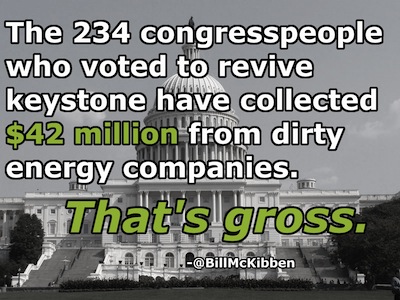
Here’s the truth: much of our Congress is bought and sold by corporations. The 234 members of the House who supported this bill took $42,374,100 from corporate polluters in the last decade. If we want Congress to start working for us, and for the planet, we need to call them out on this corruption whenever it happens.
Can you share this image (with a quote from Bill McKibben) on Facebook or Twitter to show just how much this corrupt attempt to revive the pipeline stinks?
We’ll never have the money and the lobbyists of Big Oil, so we’ve got to use our voices and our bodies to make our point.
Over the past six months, we’ve signed petitions, led actions in communities coast-to-coast, and organized large-scale civil disobedience against this pipeline. All that work added up. President Obama’s announcement about the pipeline delay was HUGE, and gave us the chance to shut Keystone XL down for good.
Ultimately, we’re in a long term fight to save the planet from the polluters who would buy their way to total catastrophe. It’s up to us to use this moment to show just how dangerous they have become, and begin making the case that corporate control over government must end. Let’s make sure all of our friends know how much their latest Keystone XL stunt stinks.
P.S. In case you were wondering, we’re not only spreading the word online — folks in certain states are calling their senators and we’re continuing to ratchet up our actions across the country. As I type this, activists in Ohio are staging a “human oil spill” to House Speaker Boehner’s front door. We’ll need all sorts of creative tactics on the road ahead — more on that in a future email!
Please do everything to spread this message. Thank you.
Finally, go and put your arms around your dog, give him or her a very big hug, and pray that mankind might learn something about truth and integrity from the humble dog!
A quick piece of web research turned up a quote by the famous physicist, Richard P. Feynman, as follows,
“In physics the truth is rarely perfectly clear, and that is certainly universally the case
in human affairs.“
I thought the quote an apt introduction to an article written by Bill McKibben of 350 org fame, recently published on Tom Engelhardt’s TomDispatch blog. As always, a vote of thanks to Tom for giving me permission to reproduce his pieces.
The topic is the Keystone XL pipeline, recently sidelined by Pres. Obama and now generating some interesting musings about the political strategy that may be at play here. I have written previously about this pipeline and a quick search from the home page of Learning from Dogs using the search terms ‘keystone pipeline’ will find these articles.
Do read the full article from Bill McKibben. Despite it’s length it’s full of thought-provoking ideas. As Tom Engelhardt says in the closing sentences of his introduction, “Mark my words on this one: sooner or later, Americans are going to wake up to climate change, just as they have this year on the issue of inequality, and when they do, watch out. There will be political hell to pay.Tom”
Posted by Bill McKibben at 8:07am, November 15, 2011.
What’s the biggest story of the last several weeks? Rick Perry’s moment of silence, all 53 seconds’worth? The Penn State riots after revered coach JoePa went down in a child sex abuse scandal? The Kardashian wedding/divorce? The European debt crisis that could throw the world economy into a tailspin? The Cain sexual harassment charges? The trial of Michael Jackson’s doctor?
The answer should be none of the above, even though as a group they’ve dominated the October/November headlines. In fact, the piece of the week, month, and arguably year should have been one that slipped by so quietly, so off front-pages nationwide and out of news leads everywhere that you undoubtedly didn’t even notice. And yet it’s the story that could turn your lifeand that of your children and grandchildren inside out and upside down.
On the face of it, it wasn’t anything to shout about — just more stats in a world drowning in numbers. These happen to have been put out by the U.S. Department of Energy and they reflected, as an Associated Press headline put it, the “biggest jump ever seen in global warming gases.” In other words, in 2010, humanity (with a special bow to China, the United States, and onrushing India) managed to pump more carbon dioxide into the atmosphere than at any time since the industrial revolution began — 564 million more tons than in 2009, which represents an increase of 6%.
According to AP’s Seth Borenstein, that’s “higher than the worst case scenario outlined by climate experts just four years ago.” He’s talking about the Intergovernmental Panel on Climate Change, or IPCC, which is, if anything, considered “conservative” in its projections of future catastrophe by many climate scientists. Put another way, we’re talking more greenhouse gases than have entered the Earth’s atmosphere in tens of millions of years.
Consider as well the prediction offered by Fatih Birol, chief economist at the International Energy Agency: without an effective international agreement to staunch greenhouse gases within five years, the door will close on preventing a potentially disastrous rise in the planet’s temperature. You’re talking, that is, about the kind of freaky weather that will make October’s bizarre snowstorm in the Northeast look like a walk in the park. (That storm had all the signs of a climate-change-induced bit of extreme weather: New York City hadn’t recorded an October snowfall like it since the Civil War and it managed to hit the region in a period of ongoing warmth when the trees hadn’t yet had the decency to lose their leaves, producing a chaos of downed electrical wires.) And don’t get me started on what this would mean in terms of future planetary hot spells or sea-level rise.
Honestly, if we were sane, if the media had its head in the right place, this would have been screaming headlines. It would have put Rick Perry and Herman Cain and the Kardashians andItaly and Greece and Michael Jackson’s doctor in the shade.
The only good news — and because it unsettled the politics of the 2012 election, it did garner a few headlines — was that the movement Bill McKibben and 350.org spearheaded to turn back the tar-sands pipeline from Hades (or its earthly global-warming equivalent, which is Alberta, Canada) gained traction in our Occupy Wall Street moment. Think of it as a harbinger. Mark my words on this one: sooner or later, Americans are going to wake up to climate change, just as they have this year on the issue of inequality, and when they do, watch out. There will be political hell to pay.Tom
Obama’s Positive Flip and Romney’s Negative Flop
Is Global Warming an Election Issue After All?
By Bill McKibben
Conventional wisdom has it that the next election will be fought exclusively on the topic of jobs. But President Obama’s announcement last week that he would postpone a decision on the Keystone XL pipeline until after the 2012 election, which may effectively kill the project, makes it clear that other issues will weigh in — and that, oddly enough, one of them might even be climate change.
The pipeline decision was a true upset. Everyone — and I mean everyone who “knew” how these things work — seemed certain that the president would approve it. The National Journalruns a weekly poll of “energy insiders” — that is, all the key players in Washington. A month to the day before the Keystone XL postponement, this large cast of characters was “virtually unanimous” in guaranteeing that it would be approved by year’s end.
Transcanada Pipeline, the company that was going to build the 1,700-mile pipeline from the tar-sands fields of Alberta, Canada, through a sensitive Midwestern aquifer to the Gulf of Mexico, certainly agreed. After all, they’d already mowed the strip and prepositioned hundreds of millions of dollars worth of pipe, just waiting for the permit they thought they’d bought with millions in lobbying giftsand other maneuvers. Happily, activists across the country weren’t smart enough to know they’d been beaten, and so they staged the largest civil disobedience actionin 35 years, not to mention ringing the White House with people, invading Obama campaign offices, and generally proving that they were willing to fight.
No permanent victory was won. Indeed, just yesterday Transcanada agreed to reroute the pipeline in Nebraska in an effort to speed up the review, though that appears not to change the schedule. Still, we’re waiting for the White House to clarify that they will continue to fully take climate change into account in their evaluation. But even that won’t be final. Obama could just wait for an election victory and then approve the pipeline — as any Republican victor certainly would. Chances are, nonetheless, that the process has now gotten so messy that Transcanada’s pipeline will die of its own weight, in turn starving the tar-sands oil industry and giving a boost to the global environment. Of course, killing the pipeline will hardly solve the problem of global warming (though heavily exploiting those tar sands would, in NASA scientist James Hansen’s words, mean “game over for the climate.”)
In this line of work, where victories of any kind are few and far between, this was a real win. It began with indigenous activists, spread to Nebraska ranchers, and eventually turned into the biggest environmental flashpoint in many years. And it owed no small debt to the Occupy Wall Street protesters shamefully evicted from Zuccotti Park last night, who helped everyone understand the power of corporate money in our daily lives. That these forces prevailed shocked most pundits precisely because it’s common wisdom that they’re not the sort of voters who count, certainly not in a year of economic trouble.
In fact, the biggest reason the realists had no doubts the pipeline would get its permit, via a State Department review and a presidential thumbs-up of that border-crossing pipeline, was because of the well-known political potency of the jobs argument in bad economic times. Despite endless lazy reporting on the theme of jobs versus the environment, there were actually no net jobs to be had from the pipeline. It was always a weak argument, since the whole point of a pipeline is that, once it’s built, no one needs to work there. In addition, as the one study not paid for by Transcanada made clear, the project would kill as many jobs as it would create.
The Washington Post’s Juliet Eilperin and Steven Mufson finally demonstrated this late in the game with a fine report taking apart Transcanada’s job estimates. (The 20,000 jobs endlessly taken for granted assumed, among other stretches, that modern dance troupes would move to Nebraska, where part of the pipeline would be built, to entertain pipeline workers.) Still, the jobs trope remained, and you can be sure that the Chamber of Commerce will run 1,000 ads during the 2012 presidential campaign trying to hammer it home. And you can be sure the White House knew that, which was why it was such a tough call for them — and why the pressure of a movement among people whose support matters to them made a difference.
Let’s assume the obvious then: that one part of their recent calculations that led to the postponement decision might just be the suspicion that they will actually win votes thanks to the global-warming question in the next election.
For one thing, global warming denial has seen its apogee. The concerted effort by the fossil-fuel industry to underwrite scientific revision met its match last month when a team headed by Berkeley skeptic and prominent physicist Richard Muller–– with funding from the Koch Brothers, of all people — actually found that, what do you know, all the other teams of climate-change scientists were, um, right. The planet was indeed warming just as fast as they, and the insurance companies, and the melting ice had been insisting.
Still, scientific studies only reach a certain audience. Weird weather is a far more powerful messenger. It’s been hard to miss the record flooding along the Mississippi and Missouri Rivers, and across the Northeast; the record drought andfires across the Southwest; the record multi-billion dollar weather disasters across the country this year; the record pretty-much everything-you-don’t-want across the nation. Obama certainly noticed. He’s responsible for finding the cash every time some other state submerges.
As a result, after years of decline, the number of Americans who understand that the planet is indeed warming and that we’re to blame appears to be on the rise again. And ironically enough, one reason may be the spectacle of all the tea-partying GOP candidates for the presidency being forced to swear fealty to the notion that global warming is a hoax. Normal people find this odd: it’s one thing to promise Grover Norquist that you’ll never ever raise taxes; it’s another to promise that you’ll defeat chemistry and physics with the mighty power of the market.
Along these lines, Mitt Romney made an important unforced error last month. Earlier in the primaries, he and Jon Huntsman had been alone in the Republican field in being open to the idea that global warming might actually be real. Neither wanted to do anything about it, of course, but that stance itself was enough to mark them as realists. It was also a sign that Romney was thinking ahead to the election itself, and didn’t want to be pinned against this particular wall.
In late October, however, he evidently felt he had no choice but to pin himself to exactly that wall and so stated conclusively: “My view is that we don’t know what’s causing climate change on this planet.” In other words, he not only flip-flopped to the side of climate denial, but did so less than six months after he had said no less definitively: “I don’t speak for the scientific community, of course, but I believe the world’s getting warmer… And number two, I believe that humans contribute to that.” Note as well that he did so, while all the evidence, even some recently funded by the deniers, pointed the other way.
If he becomes the Republican presidential candidate as expected, this may be the most powerful weathervane ad the White House will have in its arsenal. Even for people who don’t care about climate change, it makes him look like the spinally challenged fellow he seems to be. But it’s an ad that couldn’t be run if the president had okayed that pipeline.
Now that Obama has at least temporarily blocked Keystone XL, now that his team has promised to consider climate change as a factor in any final decision on the pipeline’s eventual fate, he can campaign on the issue. And in many ways, it may prove a surprise winner.
After all, only people who would never vote for him anyway deny global warming. It’s a redoubt for talk-show rightists. College kids, on the other hand, consistently rank it among the most important issues. And college kids, as Gerald Seib pointedout in the Wall Street Journal last week, are a key constituency for the president, who is expected to need something close to the two-thirds margin he won on campus in 2008 to win again in 2012.
Sure, those kids care about student loans, which threaten to take them under, and jobs, which are increasingly hard to come by, but the nature of young people is also to care about the world. In addition, independent voters, suburban moms — these are the kinds of people who worry about the environment. Count on it: they’ll be key targets for Obama’s presidential campaign.
Given the economy, that campaign will have to make Mitt Romney look like something other than a middle-of-the-road businessman. If he’s a centrist, he probably wins. If he’s a flip-flopper with kooky tendencies, they’ve got a shot. And the kookiest thing he’s done yet is to deny climate science.
If I’m right, expect the White House to approve strong greenhouse gas regulations in the months ahead, and then talk explicitly about the threat of a warming world. In some ways it will still be a stretch. To put the matter politely, they’ve been far from perfect on the issue: the president didn’t bother to waste any of his vaunted “political capital” on a climate bill, and he’s opened huge swaths of territory to coal mining and offshore drilling.
But blocking the pipeline finally gave him some credibility here — and it gave a lot more of the same to citizens’ movements to change our world. Since a lot of folks suspect that the only way forward economically has something to do with a clean energy future, I’m guessing that the pipeline decision won’t be the only surprise. I bet Barack Obama talks on occasion about global warming next year, and I bet it helps him.
But don’t count on that, or on Keystone XL disappearing, and go home. If the pipeline story (so far) has one lesson, it’s this: you can’t expect anything to change if you don’t go out and change it yourself.
Fabulous news from The President’s Office re the Keystone XL pipeline.
On the 27th October, I introduced an article about the pipeline, thus,
“Have the courage to say no. Have the courage to face the truth. Do the right thing because it is right. These are the magic keys to living your life with integrity.”
The above is attributed to W. Clement Stone, a businessman, philanthropist and author who died in 2002, aged 100. It seemed an appropriate quotation with which to introduce a recent article by Bill McKibben, on the Grist blog, about the proposed Keystone XL pipeline.
A short time ago (Thursday) I received the following from Bill McKibben, 350.org.
Dear Friends,
Um, we won. You won.
Not completely. The President didn’t outright reject the Keystone XL pipeline permit. My particular fantasy — that he would invite the 1253 people arrested on his doorstep in August inside the gates for a victory picnic by the vegetable garden — didn’t materialize.
But a few minutes ago the President sent the pipeline back to the State Department for a thorough re-review, which most analysts are saying will effectively kill the project. The president explicitly noted climate change, along with the pipeline route, as one of the factors that a new review would need to assess. There’s no way, with an honest review, that a pipeline that helps speed the tapping of the world’s second-largest pool of carbon can pass environmental muster.
And he has made clear that the environmental assessment won’t be carried out by cronies of the pipeline company — that it will be an expert and independent assessment. We will watch that process like hawks, making sure that it doesn’t succumb to more cronyism. Perhaps this effort will go some tiny way towards cleaning up the Washington culture of corporate dominance that came so dramatically to light here in emails and lobbyist disclosure forms.
It’s important to understand how unlikely this victory is. Six months ago, almost no one outside the pipeline route even knew about Keystone XL. One month ago, a secret poll of “energy insiders” by the National Journal found that “virtually all” expected easy approval of the pipeline by year’s end. As late as last week the CBC reported that Transcanada was moving huge quantities of pipe across the border and seizing land by eminent domain, certain that its permit would be granted. A done deal has come spectacularly undone.
Our movement spoke loudly about climate change and the President responded. There have been few even partial victories about global warming in recent years so that makes this an important day. We need to let the president and oil companies know that we’re ready to take action should they try to push this pipeline through in a couple of years. There’s a pledge to take bold action against the pipeline up on our site, and I’ll be keeping your names an emails safely stored away so that you’ll be the first to know about anything we need to do down the road.
The President deserves thanks for making this call — it’s not easy in the face of the fossil fuel industry and its endless reserves of cash. The deepest thanks, however, go to you: to indigenous peoples who began the fight, to the folks in Nebraska who rallied so fiercely, to the scientists who explained the stakes, to the environmental groups who joined with passionate common purpose, to the campuses that lit up with activity, to the faith leaders that raised a moral cry, to the labor leaders who recognized where our economic future lies, to the Occupy movement that helped galvanize revulsion at insider dealing, and most of all to the people in every state and province who built the movement that made this decision inevitable.
Our fight, of course, is barely begun. Some in our movement will say that this decision is just politics as usual: that the President wants us off the streets — and off his front lawn — until after the election, at which point the administration can approve the pipeline, alienating its supporters without electoral consequence. The president should know that If this pipeline proposal somehow reemerges from the review process we will use every tool at our disposal to keep it from ever being built; if there’s a lesson of the last few months, both in our work and in the Occupy encampments around the world, it’s that sometimes we have to put our bodies on the line.
In the meantime, since federal action will be in abeyance for a long stretch, we need to figure out how best to support our Canadian brothers and sisters, who are effectively battling against proposed pipelines west from the tar sands to the Pacific. And we need to broaden our work to take on all the forms of ‘extreme energy’ now coming to the fore: mountaintop removal coal mining, deepsea oil drilling, fracking for gas and oil. We’ll keep sending you updates; you keep letting us know what we need to do next.
Last week, scientists announced that the planet had poured a record amount of CO2 into the atmosphere last year; that’s a sign of how desperate our battle is. But we take courage from today’s White House announcement; it gives us some clues about how to fight going forward.
And I simply can’t say thank you enough. I know, because of my own weariness, how hard so many of you have worked. It was good work, done in the right spirit, and it has secured an unlikely victory. You are the cause of that victory; you upended enormous odds.
I’m going to bed tired tonight. But I’ll get up in the morning ready for the next battle, more confident because I know you’re part of this fight too.




 Learning from Dogs