Just a short post for today but one that is long on feelings!
The following short video was broadcast by WPLG Local 10 on July 7th this year. It follows the collapse of the twelve-storey building at Surfside in Florida on June 24th.
“Comfort dogs arrive in South Florida to help first responders in Surfside.”
Did you just adopt a new dog and now you’re super excited to introduce her to all the awesome people and animals in your life?
While you might want to bring her everywhere you go right away, it’s also important to take the right steps inorder to set her up for success — especially when it comes to dog training and socialization skills.
To understand how to socialize your dog, The Dodo reached out Juliana Willems, head trainer at JW Dog Training in Washington, D.C., for some insight.
What does it mean to socialize a dog?
Socialization is the process of helping a dog enjoy and feel comfortable with people, other animals, places, novel objects and environments.
It means bringing your dog out into the world and introducing her to various kinds of people and situations — which helps to make sure she learns how to be a happy, friendly pup (with manners!), and can reduce fear in unknown situations.
It also helps to give your dog the skills she needs to learn about boundaries — meaning she’s not running around and bulldozing other dogs who clearly just want to sleep whenever she’s around them.
What’s the best age to socialize a dog?
According to Willems, the best age to socialize your dog is when she’s a puppy — because there’s a critical socialization window in a dog’s life between 3 and 16 weeks.
“This is the age where puppies are like sponges, soaking up information and using the experiences during this time to determine how they feel about the world later in life,” Willems said.
Experiences — or a lack of experiences — during this critical socialization window can have a direct impact on a dog’s behavior as an adult.
So what happens if you adopt an older dog outside of the socialization window?
Unless you adopt a puppy who’s 4 months old or younger, Willems said that the dog you’re bringing home is well outside the critical socialization period.
“What this means is you won’t be able to undo what did or didn’t happen during that window when they were a puppy,” Willems said. “That being said, a goal with newly adopted rescue dogs is always to introduce them to new people, animals, places and activities in a positive way.”
Of course, there’s a good chance your pup was already socialized, especially if she was living happily with a foster family before she went up for adoption. But no matter what stage she’s in socially, it doesn’t hurt to be aware of what to look out for.
As with puppies, being exposed to people, animals and places isn’t enough if you’re hoping to get your pup to truly love and be comfortable with these experiences. You should be paying attention to how she’s reacting to these situations as well.
According to Willems, simple exposure without looking at if your dog is having fun, feeling comfortable and enjoying herself leaves the door open for a negative experience.
That means it’s important you don’t overwhelm your dog by going to too many new places — or meeting too many new people — when she first comes home.
How to socialize your dog
According to Willems, the best way to socialize a new rescue dog is to go at her pace, use treats and always pay attention to body language.
“When you let your new rescue dog approach situations at their pace — allowing them to approach or retreat when they need to — you’re giving them choice in the interaction and you’re decreasing the chances that your dog will feel overwhelmed and scared,” Willems said.
And make sure you have some of your dog’s favorite treats ready to go during the process!
If you give your dog high-value treats when she meets new people or new animals or goes somewhere new, you’re increasing the chances that she ends up really liking those experiences. Why? Because she’s learning that new people, animals or places equal tasty treats!
While you’re keeping her happy with yummy treats, make sure you’re also paying attention to how she might be feeling in this new situation — and always give her the opportunity to take a breather if she needs one.
She should always have the option to leave a new situation if she’s uncomfortable — especially when it comes to meeting new people and dogs.
How can you tell if your dog’s uncomfortable?
According to Willems, your best bet is to look at your pup’s body language — and it’s helpful to be able to understand what certain signals mean.
Obvious ones include:
A tucked tail
Trying to move away
Avoiding interactions
Growling or barking
More subtle stress signals include:
Lip licking
Yawning
Ears back
Stiffening
If your dog exhibits stress signals like these, it’s important you advocate for her and move her out of the situation.
What should you do if your dog’s uncomfortable?
If you find yourself in a situation that’s making your dog uncomfortable, you’ll want to get her some relief by moving away — and you can also try adding something your dog loves to the equation.
“The most effective tool here is high-value treats — something squishy and stinky that your dog really enjoys,” Willems suggested.
Keep in mind, though, that you won’t want to give your pup a high-value treat or toy around a dog she isn’t comfortable with, to avoid sparking any possessive aggression.
Take your time — and socialize her slowly
It’s definitely worth it to put in the work with your new dog to help her get comfortable with her new life — but make sure to resist the urge to take her to tons of new places or introduce her to a bunch of new people or animals right away.
“Aggressive behaviors are rooted in fear, so all the more reason to be very intentional, patient and positive in your socialization practice to help your dog learn their world with you is not a scary place!” Willems said.
Your new dog has been through so many changes — so let her decompress and get acclimated to her new home, routine and family.
All those couch snuggles will be worth it.
ooOOoo
I don’t know about you but I found this article very useful and very informative. Now many books have been written on the subject and the odd blogpost or twenty.
But I hope that some readers found it informative. It would be lovely to hear from you if you are one of those people.
Alok Sharma on why COP26 is our best chance for a greener future.
I wanted to share the eight-minute video that appeared on TED Talks. But it hasn’t appeared on YouTube as yet.
But the link is embedded above so if you don’t want to watch the slightly longer version (just 22 minutes) then that is fine.
I will share the words that came with the TED Talks video.
Something powerful is happening around the world. The issue of climate change has moved from the margins to the mainstream, says Alok Sharma, the President-Designate of COP26, the United Nations climate conference set to take place in November 2021 in Glasgow, Scotland. He unpacks what this shift means for the world economy and the accelerating “green industrial revolution” — and lays out the urgent actions that need to happen in order to limit global temperature rise.
Plus on the speaker, Alok Sharma.
Alok Sharma is a British politician, Cabinet Minister and President-Designate of COP26, the United Nations Climate Change Conference being held in Glasgow from 31 October until 12 November.
Sharma was previously UK Secretary of State for Business, Energy and Industrial Strategy. Before that, he was UK Secretary of State for International Development. He has also served in ministerial roles in the Department of Work and Pensions, Department for Communities and Local Government, and at the Foreign and Commonwealth Office. Prior to politics, he worked in finance.
Please watch the video for all our sakes.
For the sake of our dogs, and for the sake of everyone on this planet.
It’s even a difficult title to write for today’s story.
There are some despicable people for whom having a dog is not a loving companion nor a humane business interest. I can’t define them and, frankly, they are not even worth the mental effort required to think of a term.
That makes it all the more important to share this article with you.
ooOOoo
Dogs Are Not Disposable
Some people dump pets that are too old, not ‘perfect,’ or to go on vacation.
Blind puppy Gertie weighs just over 2 pounds. Mary Jo DiLonardo
This may seem like a no-brainer, but with all the news from overwhelmed shelters and rescues this summer, it’s probably worth saying out loud.
Dogs are not disposable.
Disreputable breeders toss out puppies that aren’t “perfect.” Some people give up the family pet when they go on vacation so they don’t have to pay for boarding. Others give up an older puppy whose cute behaviors are now obnoxious or a senior dog who may have other health issues.
That little mouse you see at the top of the page is one of two special needs puppies I’m fostering right now. She’s actually a 2.1-pound puppy that we were told is an Aussiedoodle. I still think she might be an exotic guinea pig.
Gertie was dropped off by a breeder at a vet’s office to be euthanized because she was blind. The vet contacted a rescue instead.
I also have a deaf puppy that was given up by a breeder. Many other fosters are also doubling up because the need is so great right now. Probably the biggest reason is that it’s the summer and people are traveling for the first time again in more than a year. That means it’s hard to find adopters and it’s hard to find fosters. Everyone wants out of the house.
I’ve seen messages and social media posts from rescuer and shelter workers who say they feel helpless because the requests for help right now are so crushing.
“My rescue cannot keep up trying to save them,” one wrote.
“I’m sickened at the number of rescue and surrender requests we are getting and I am completely heartbroken,” wrote another.
“We need a lifeline,” said another rescuer.
There are some news stories that claim many pandemic puppies are being returned, but the numbers don’t back that up. Instead, it’s just a crush of other reasons, many involving summer travel.
I think the hardest thing for most loving pet owners to fathom is the idea that some people would drop off their dog at a shelter on their way out of town. There’s just anecdotal evidence and no statistics about how often it happens, but it’s cited very often from disheartened rescuers and shelter workers.
The people who surrender their pets say they don’t want to pay for boarding and they’ll just get a new one when they return. Shelter workers say it’s heart-wrenching to hold a dog while they watch their person drive away. Some will stare out the door for hours, thinking for sure their family will return.
“Unfortunately, it doesn’t surprise us anymore which is really sad,” says Jen Schwarz, one of the directors of Speak! St. Louis, the special needs rescue I foster for. The rescuers hear the story often from shelter and humane society workers.
“They don’t want to pay for boarding or can’t find anybody to take their dog,” says Schwarz. “It’s basically being selfish.”
And people might think they’re doing their dog a favor by taking it to a shelter, hoping they’ll get adopted by someone else. But typically, if shelters have to euthanize for space, they’ll turn to owner-surrendered pets before strays because they know no one is looking for them.
“That’s the sad reality,” Schwarz says.
The other thing that happens often is people asking to have the family pet put to sleep because they’re too much hassle.
“That happens a lot. The kids are gone, they want to travel, the dog’s too much, and they have it euthanized,” Schwarz says. “That’s worse than dumping it at the shelter.”
Rescuers are saving as many as they can and that’s why I have one puppy sleeping behind me in my office and one napping in a playpen in the living room. Soon everyone will head outside for a game of tag where I’ll make sure everyone gets a chance to win.
And the only thing disposable here is an awful lot of very tiny puppy poo.
ooOOoo
When Jen Schwarz says: “That happens a lot. The kids are gone, they want to travel, the dog’s too much, and they have it euthanized,” I wonder what a lot is numerically. Anyone know?
The stories from the shelter workers breaks hearts here as well. Dogs are so intuitive; so smart. It is no surprise that they will stare for hours trying to work out what has happened.
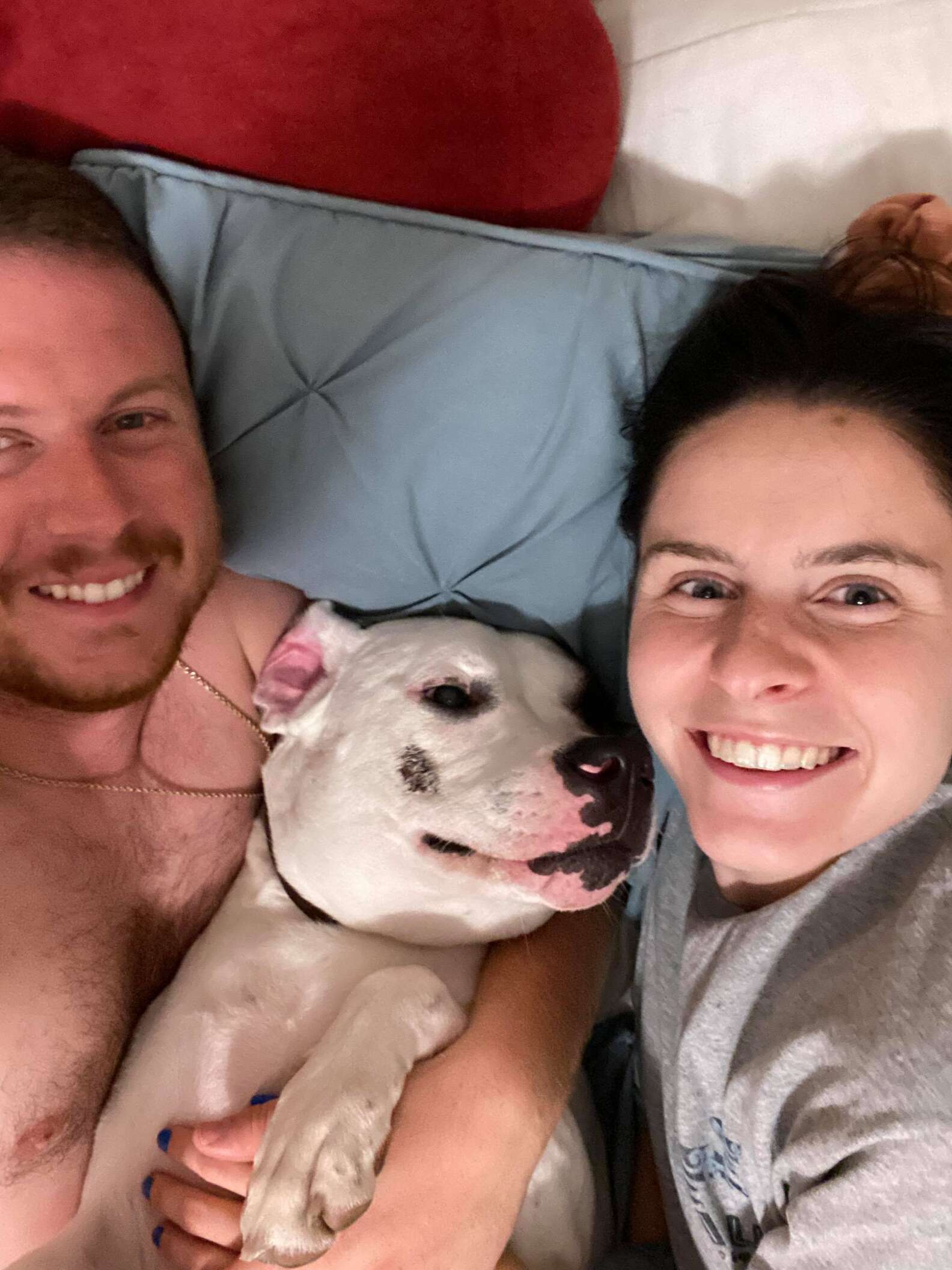
Mikayla Sengle and her boyfriend, Anthony Noto, weren’t planning on adopting a dog. But when Wylie suddenly came into their lives, it seemed meant to be.
Last month, Noto was on his way home from work when he passed by a dog park near an apartment complex. In the back of the park, a white and brown pittie sat all alone, looking confused.
As Noto approached the dog, he noticed that he wasn’t wearing a collar and looked a bit banged up.
“He looked lost, but at the same time, he seemed like he was on a mission to find something,” Noto told The Dodo. “When I walked over towards where my work truck was, he came up [to me] all innocent with his head down, seeing if I’d accept him.”
“Maybe I was what he was looking for,” he added.
Noto slipped a loose rope around the pup’s neck and walked him around the area trying to find his owner. But when no one recognized the dog, Noto put him in his truck and drove him home.
The pup didn’t seem to want to upset his new friends and was determined to show Sengle and Noto that he had the best manners.
“With people, he would wait for them to give the OK to lick and pay attention to people,” Sengle told The Dodo. “He seemed extremely relieved and happy. He got a bath and some treats as soon as he came home.”
“He instantly would look at my boyfriend for permission for everything,” Sengle added. “When he got home and ran in the yard, he was thrilled. It seemed like he never experienced the opportunity to be free and fun.”
The first night, Wylie slept in bed between his rescuers, as if to make sure they wouldn’t leave him. And he’d never been more comfortable and happy in his life.
Sengle posted on social media searching for the dog’s family, but when she finally received a response, it broke her heart.
“A young girl reached out to us and basically said that it was her friend’s dog and [her friend] had seen the post and said she no longer wanted him anymore because he was annoying,” Sengle said. “She even begged us not to give him back if they did reach out to us because they used to hit him and were not nice to him.”
Sengle and Noto kept Wylie for the five-day stray hold, giving the owners time to claim him. But when the week was up, there was no question that he was staying with them — forever.
Sengle and Noto thought their family was complete, but now they can’t believe that they got so lucky.
“He is a very sweet dog and a great companion,” Sengle said. “My boyfriend and him grew a bond almost instantly. He slept right in between us the first night we got him and from then on, we knew in our hearts he was our dog.”
ooOOoo
All photographs by Mikala Sengle.
It shows again how quickly a dog can open up the heart strings of us humans. As Single and Noto remarked above, they now can’t believe they were so lucky. It’s how we feel about our dogs. It’s how countless others feel about their many, many four-legged loved ones!
I know this has been said before and no doubt I will say it again many times but dogs frequently bond closely with other dogs. There’s no knowing, frankly, what triggers the friendship but we humans can see it so clearly.
Take this recent article published on The Dodo about a dog and his sister.
ooOOoo
Dog Knows Just How To Help His Anxious Sister When She Gets Carsick
Meet Eddy — a dog who knows exactly when his family needs a little extra help.
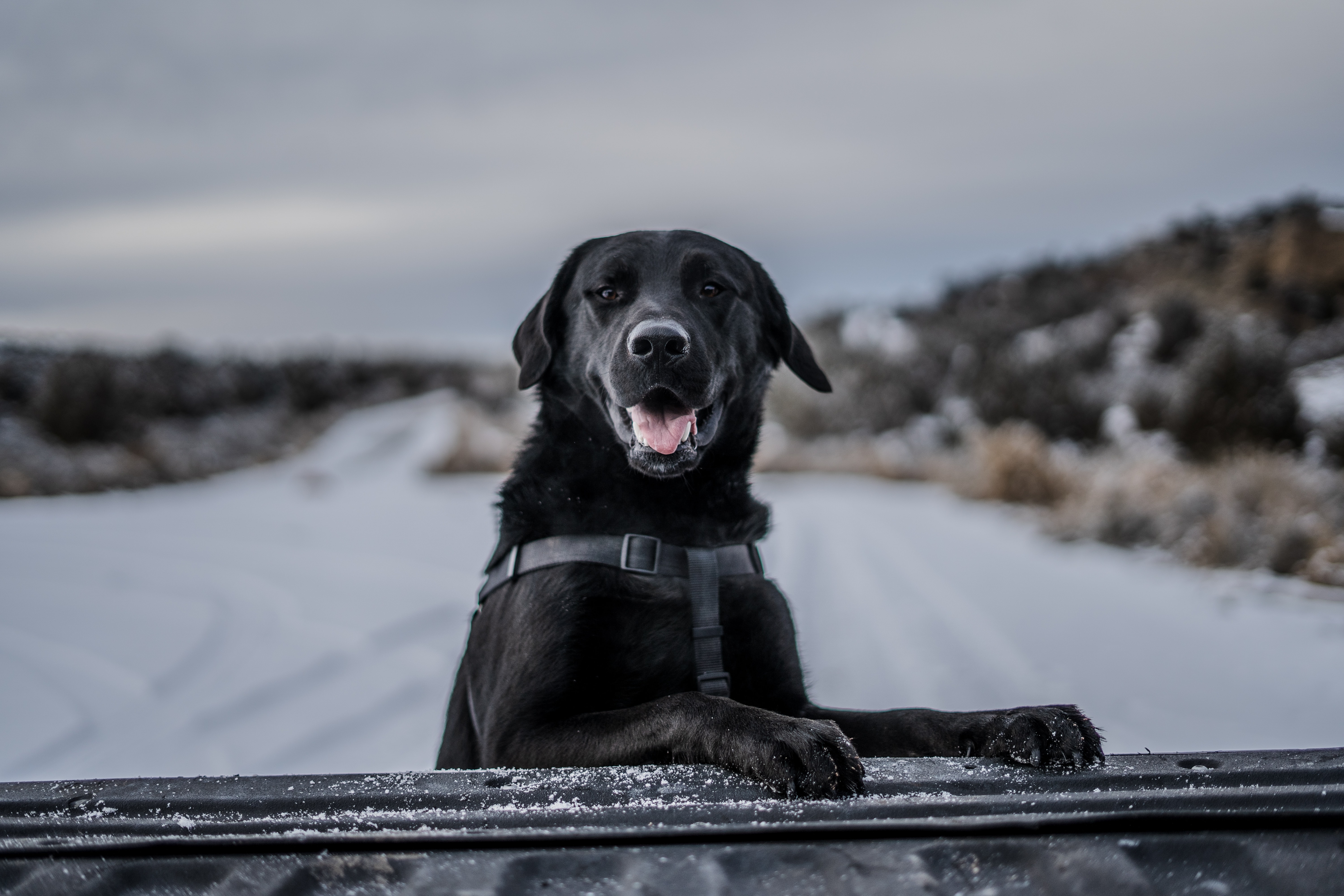
Ashley Karlin adopted Eddy, a black Lab, from a shelter two years ago as a companion for her senior dog, Daisy. And since that day, Eddy and Daisy have been inseparable.
“Eddy and Daisy play like siblings. They egg each other on and run around in the backyard together,” Karlin told The Dodo. “They sleep next to each other and sometimes on each other.”
The 95-pound cuddle bug is also extremely perceptive. Eddy can sense immediately when something is off with a member of his family — and he hops into action.
Eddy uses this skill frequently when traveling with his sister. Daisy has always had car sickness and gets anxious when it’s time to go for a drive, but Eddy is a pro when it comes to soothing her.
“When she lies down in the back seat and starts to drool, Eddy lays the opposite way so he can rest his head on top of hers,” Karlin said. “If he doesn’t do this, Daisy constantly gets up, lies down, gets up, lies down on repeat until she vomits.”
“I think Eddy just has a sense of when others aren’t feeling well and he’s always there to comfort her,” Karlin added. “We’ve noticed every time they lie down together like this, she doesn’t puke and usually will fall asleep.”
Eddy also monitors his mom to make sure she’s OK and is always the first to know when there’s any change.
“My husband and I recently found out I’m pregnant, and one of the signs that tipped us off was that Eddy constantly would put his head on my tummy,” Karlin said. “Eddy has [also] on numerous occasions woken me while sleeping to alert me that I was going hypoglycemic, even though he’s not trained to do so.”
Eddy is always there when his mom or sister needs him — and they can’t picture their lives, or car rides, without him.
ooOOoo
All photographs by Ashley Karlin
This is yet another example of the caring and bonding that dogs make. Make with many other dogs and many of us humans.
They are an example to all of us!
And another case of ex-rescue dogs bearing no scars!
Now of course the majority of people reading the title to today’s post would think of us humans. And what I am about to republish is for us. But dogs require exercise just as much as we humans. The question is whether dog’s brains are better protected with exercise?
The exercise pill: How exercise keeps your brain healthy and protects it against depression and anxiety.
By Arash Javanbakht, Associate Professor of Psychiatry, Wayne State University, February 25th, 2021
As with many other physicians, recommending physical activity to patients was just a doctor chore for me – until a few years ago. That was because I myself was not very active. Over the years, as I picked up boxing and became more active, I got firsthand experience of positive impacts on my mind. I also started researching the effects of dance and movement therapies on trauma and anxiety in refugee children, and I learned a lot more about the neurobiology of exercise.
I am a psychiatrist and neuroscientist researching the neurobiology of anxiety and how our interventions change the brain. I have begun to think of prescribing exercise as telling patients to take their “exercise pills.” Now knowing the importance of exercising, almost all my patients commit to some level of exercise, and I have seen how it benefits several areas of their life and livelihood.
We all have heard details on how exercise improves musculoskeletal, cardiovascular, metabolic and other aspects of health. What you may not know is how this happens within the brain.
Brain biology and growth
Working out regularly really does change the brain biology, and it is not just “go walk and you will just feel better.” Regular exercise, especially cardio, does change the brain. Contrary to what some may think, the brain is a very plastic organ. Not only are new neuronal connections formed every day, but also new cells are generated in important areas of the brain. One key area is the hippocampus, which is involved in learning and memory and regulating negative emotions.
A molecule called brain-derived neurotrophic factor helps the brain produce neurons, or brain cells. A variety of aerobic and high-intensity interval training exercises significantly increase BDNF levels. There is evidence from animal research that these changes are at epigenetic level, which means these behaviors affect how genes are expressed, leading to changes in the neuronal connections and function.
Finally, there is evidence for the positive effects of exercise on the neurotransmitters – brain chemicals that send signals between neurons – dopamine and endorphins. Both of these are involved in positive mood and motivation.
Exercise improves clinical symptoms of anxiety and depression
Exercise could even potentially desensitize people to physical symptoms of anxiety. That is because of the similarity between bodily effects of exercise, specifically high-intensity exercise, and those of anxiety, including shortness of breath, heart palpitation and chest tightness. Also, by reducing baseline heart rate, exercise might lead to signaling of a calmer internal physical environment to the brain.
It is important to note that the majority of studies examined the effects of exercise in isolation and not in combination with other effective treatments of clinical anxiety and depression, such as psychotherapy and medication. For the same reason, I am not suggesting exercise as a replacement for necessary mental health care of depression or anxiety, but as part of it, and for prevention.
There are other perks besides the neurobiological impacts of exercise. When going out for a walk, one gets more exposure to sunlight, fresh air and nature. One of my patients befriended a neighbor during her regular walks, leading to regular taco Tuesdays with that new friend. I have made some great friends at my boxing gym, who are not only my motivators, but also a great supporting social network. One might pick a dog as their running mate, and another might meet a new date, or enjoy the high energy at the gym. Exercise can also function as a mindfulness practice and a respite from common daily stressors, and from our electronic devices and TV.
So how can you find time to exercise, especially with all the additional time demands of the pandemic, and the limitations imposed by the pandemic such as limited access to the gyms?
Pick something you can love. Not all of us have to run on a treadmill (I actually hate it). What works for one person might not work for another. Try a diverse group of activities and see which one you will like more: running, walking, dancing, biking, kayaking, boxing, weights, swimming. You can even rotate between some or make seasonal changes to avoid boredom. It does not even have to be called an exercise. Whatever ups your heartbeat, even dancing with the TV ads or playing with the kids.
Use positive peer pressure to your advantage. I have created a group messaging for the boxing gym because at 5:30 p.m., after a busy day at the clinic, I might have trouble finding the motivation to go to the gym or do an online workout. It is easier when friends send a message they are going and motivate you. And even if you do not feel comfortable going to a gym during the pandemic, you can join an online workout together.
Do not see it as all or none. It does not have to be a one-hour drive to and from the gym or biking trail for a one-hour workout vs. staying on the couch. I always say to my patients: “One more step is better than none, and three squats are better than no squats.” When less motivated, or in the beginning, just be nice to yourself. Do as much as possible. Three minutes of dancing with your favorite music still counts.
Merge it with other activities: 15 minutes of walking while on the phone with a friend, even around the house, is still being active.
When hesitant or low on motivation, ask yourself: “When was the last time I regretted doing it?”
Although it can help, exercise is not the ultimate weight loss strategy; diet is. One large brownie might be more calories than one hour of running. Don’t give up on exercise if you are not losing weight. It is still providing all the benefits we discussed.
Even if you do not feel anxious or depressed, still take the exercise pills. Use them for protecting your brain.
ooOOoo
This is a very good post. Arash Javanbakht is a scientist of the first order and we all should do as she advises. I’m going to close today’s post by republish the first two paragraphs of his bio that is also published by The Conversation:
Associate Professor of Psychiatry, Wayne State University Arash Javanbakht, M.D., is the director of the Stress, Trauma, and Anxiety Research Clinic (STARC; https://www.starclab.org) at Wayne State University. Dr Javanbakht and her work have been featured on the National Geographic, The Atlantic, CNN, Aljazeera, NPR, Washington Post, Smithsonian, PBS, American Psychiatric Association, Anxiety and Depression Association of America, American Academy of Child and Adolescent Psychiatry, and tens of other media.
Her clinical and research work is mainly focused on anxiety and trauma related disorders, and PTSD. She often helps civilians and first responders with PTSD. Her clinic utilizes pharmacotherapy (medication), psychotherapy, exercise, and lifestyle modification to help patients achieve their full capacity for a fulfilling life.
We are relying on a Level One call, a Be Ready call, to finish off the packing. Of course we hope that never comes but at least we have done the planning.
The Dodo had a great article the other day and I wanted to share it with you all.
ooOOoo
Dog Refuses To Eat Snow Cone After Mom Orders The Wrong Flavor
Lola’s story started when she was taken in by a local shelter, but when she was spayed she experienced rare complications that left her unable to walk. She started to recover very slowly, and after a few months, she was taken in by Big Hearts for Big Dogs. The rescue found her a foster family who could commit to taking her to physical therapy every week, and they fostered her for two years — before deciding they couldn’t pretend anymore and officially adopted her into their family.
ANNIE BELANGER BURLEY
Now Lola lives on a farm with her forever family, where every other animal has a rescue story, too. She’s blossomed into the weirdest, most personality-filled dog her family has ever met, and they wouldn’t have her any other way.
Annie Belanger Burley
“We have had her for six years, but she’s been ‘ours’ for four,” Annie Belanger Burley, Lola’s mom, told The Dodo. “We have no clue how old she is, but she literally doesn’t age. She has the most amazing temperament, but she’s a total weirdo! She requires being tucked in at night. She’s goofy, she snores when she’s awake, other dogs think she’s growling, but she’s really just breathing. She has looks that could kill. Sometimes her happy face looks like her mean mug.”
Annie Belanger Burley
Lola’s family loves her so much and loves to spoil her whenever they can. One of her favorite activities is going out for snow cones, and she always gets so excited, even if she’s not always sure how to show it.
“We go to Pelican Snowballs in North Fort Myers a few times a month,” Burley said. “Her favorite flavor is chicken broth served with a Milk-Bone on top … When she gets excited, it’s usually with her eyes. She has a grumpy face the majority of the time.”
Annie Belanger Burley
Lola and her mom were getting snow cones recently, like they always do, but this time, Burley decided to order Lola a plain snow cone because she’d had an upset stomach the night before and she didn’t want her to overdo it. She figured Lola would still enjoy a treat even if it wasn’t her normal order — but she was wrong.
Annie Belanger Burley
Lola sniffed the plain snow cone, then stared at her mom and made it very clear that she had absolutely no intention of eating it. It wasn’t the right flavor, and she refused to compromise.
“She refused to eat it the entire way home and glared at me in her usual side-eye,” Burley said.
Annie Belanger Burley
Instead, Lola let the snow cone melt right next to her. She decided it was better to stand up for what she believes in rather than eat it. She’s strong in her convictions.
Annie Belanger Burley
Even though Lola didn’t get her snow cone that day, there will be many, many other trips, and hopefully, her mom can redeem herself in Lola’s eyes by ordering her the “correct” thing again next time.
ooOOoo
To be honest if it were not for our dogs (and Jeannie) I don’t think it would ever be normal again.
But one can stroke and cuddle a dog or six and cuddle up to Jeannie and forget about the outside world for a tad!

:max_bytes(150000):strip_icc()/MaryJoDiLonardo-bw-treehugger-6d5044d7d4ae44298fb31df11a3d5a66.jpg)













 Learning from Dogs