A repeat posting of a wonderful joke from earlier times.
Good friend from my English days, Bob Derham, a few days ago sent me the well-known joke about the dog for sale. At first, I had forgotten that I had posted a slightly modified version back in April, 2012. When I re-read it, I had to repost it today. It’s wonderful.
oooo
DOG FOR SALE
New home needed for this wonderful animal.
A guy is driving around the back streets of Bristol, England.
He sees a sign in front of an unkempt terraced house: ‘Talking Dog For Sale‘, so he rings the bell and the owner appears and tells him the dog is in the garden.
The guy goes into the backyard and sees a nice looking Labrador retriever sitting there.
‘You talk?‘ he asks.
‘Yep,’ the Lab replies.
After the guy recovers from the shock of hearing a dog talk, he says ‘So, what’s your story?‘
The Lab looks up and says, ‘Well, I discovered that I could talk when I was pretty young.. I wanted to help the government, so I told the SAS. [Special Air Service or SAS is a corps of the British Army]
In no time at all they had me jetting from country to country, sitting in rooms with spies and world leaders, because no one figured a dog would be eavesdropping.‘
‘I was one of their most valuable spies for eight years running…
But the jetting around really tired me out,and I knew I wasn’t getting any younger so I decided to settle down. I signed up for a job at the airport here in Bristol to do some undercover security. You know, wandering near suspicious characters and listening in, that sort of thing. I uncovered some incredible dealings and was awarded a batch of medals.’
‘Then I got married, had a load of puppies, and now I’m just retired.‘
The guy is amazed. He goes back in and asks the owner what he wants for the dog.
‘Ten quid,’ the guy says.
‘Ten quid? This dog is amazing! Why on earth are you selling him so cheap?‘
‘Because he’s a liar. He’s never been out of the garden all his life!’
It’s the way I tell ’em!
oooo
Really hope that many of you haven’t come across this wonderful joke before!
In the funny way that items flow around the internet, I recently read an item that appeared on the daily email summary from EarthSky. It was entitled: Read the message your dog sends with his tail. That, in turn, had been prompted by an article published on the website ScienceDirect. It was a study announced in Current Biology and published on the 18 November 2013, (Pages 2279–2282). Here’s how that article opens (and go here to read the numbered references):
Seeing Left- or Right-Asymmetric Tail Wagging Produces Different Emotional Responses in Dogs
Marcello Siniscalchi, Rita Lusito, Giorgio Vallortigara, Angelo Quaranta
Summary
Left-right asymmetries in behavior associated with asymmetries in the brain are widespread in the animal kingdom [1], and the hypothesis has been put forward that they may be linked to animals’ social behavior [2 and 3]. Dogs show asymmetric tail-wagging responses to different emotive stimuli —the outcome of different activation of left and right brain structures controlling tail movements to the right and left side of the body. A crucial question, however, is whether or not dogs detect this asymmetry. Here we report that dogs looking at moving video images of conspecifics exhibiting prevalent left- or right-asymmetric tail wagging showed higher cardiac activity and higher scores of anxious behavior when observing left- rather than right-biased tail wagging. The finding that dogs are sensitive to the asymmetric tail expressions of other dogs supports the hypothesis of a link between brain asymmetry and social behavior and may prove useful to canine animal welfare theory and practice.
Graphical Abstract
In terms of understanding for the non-scientific minded, then the EarthSky article is an easier read.
Read the message your dog sends with his tail
Tail-wagging is a reflection of what’s happening in your dog’s brain. Learn to read your dog’s tail signals, and you’ll know if he’s happy … or stressed.
Tail-wagging in dogs is the classic signal for happiness. But researchers have found that tail-wagging can mean that your dog is either happy or stressed.
Activation of the left-brain causes a dog’s tail to wag to the right. Activation of the right-brain causes a wag to the left. That’s not new knowledge. Scientists detected that difference seven years ago.
What is new is that, not surprisingly, other dogs can easily read the message your dog is sending with his tail. And so can you.
Researchers at the University of Trento in Italy tested 43 dogs of various breeds for their ability to distinguish between tail wags. They showed the dogs videos of other dogs wagging their tails (much like the one above) and monitored the dogs’ heart rates and reactions. How could they be sure that the dogs weren’t watching their canine buddies’ facial or body cues? The researchers also showed the dogs only a silhouetted version of a tail-wagging dog.
As it turned out, every dog responded the same way. Dogs watching other dogs wag their tails to the left looked anxious, and their heart rates increased. In other words, they, too, became stressed. But dogs watching others swing their tails to the right stayed calm and relaxed — an indication that right wags are an expression of companionship and confidence, according to these scientists.
Why study tail wags in dogs? The team said in the summary to their study, which was published in Current Biology last year:
The finding that dogs are sensitive to the asymmetric tail expressions of other dogs supports the hypothesis of a link between brain asymmetry and social behavior and may prove useful to canine animal welfare theory and practice.
Bottom line: A dog wagging his tail to the right is happy, but a dog wagging to the left is stressed, say researchers.
Let me finish off today’s post with the following video.
So here’s to dozens of people watching their dogs’ tails!
A reflection of the future year; this last day of 2014
I struggled for some time, wondering what to write for this day: December 31st, 2014. Part of me wanted to be light and cheerful. Yet, nothing came to mind in terms of what to write that wouldn’t be pointless or inane. Then dear Colin who writes the blog Wibble – just another glitch in the matrix posted yesterday: Are we ready for 2015? Here’s that post:
Are we ready for 2015?
I’m not sorry for sounding somewhat melodramatic, here: what we face is nothing less than the archetypical existential threat. You may well
Graph (hand-drawn in 2008) showing that carbon emissions must peak by 2015 to keep global warming to the internationally agreed upper limit of 2°C (the point beyond which we risk runaway climate change).
dismiss me as ‘alarmist’: but if you were in a crowded theatre and you were to hear me shout “FIRE!” — what would you do then?
When, in late 2009, I first saw The Age of Stupid, I was struck by one scene in which ‘a man in a shed’ stated, quite categorically, that humanity’s carbon emissions had to peak by around 2015 in order for us to avoid the risks of passing beyond 2°C above the average pre-industrial global temperature. Almost everyone agrees that two degrees centigrade of warming is the threshold beyond which we will face serious risk of uncontrollable planet-wide climate change effects of potentially catastrophic proportions. And I do mean ‘civilisation-ending’.
This is not histrionics; it’s based upon very solid science. The ‘man in the shed’ is Mark Lynas, author of ‘Six Degrees: Our Future on a Hotter Planet,’ which won the Royal Society’s science book of the year award in 2008. In the short video clip below he speaks from that same year, and his message is blunt: he says we have “seven years” to stabilise global carbon emissions to avoid the risk of climate change accelerating beyond our ability to control it.
The problem is that 2008 + 7 = 2015. Those seven years are up: we’ve squandered them.
Now, I don’t know if you’ve been paying attention — perhaps you’re more focused upon the fortunes of your favourite football team, or the latest antics on ‘Strictly’ or Eastenders; maybe your mind is firmly on your house or job move, or where your children are going to school next year, or any one of the myriad of (relative) trivia such as the ‘immigrant problem’, or the ‘war on terror’ — so in case you’re not familiar with the current situation:
Global carbon emissions are not slowing towards a peak in this coming year. On the contrary, emissions are soaring beyond anything humans have ever previously managed. I’m talking BIG numbers. Yay, us: we’re beating all records.
So… What are your new year resolutions?
On reading the blog post I found myself leaving a comment that seemed to encapsulate my inner fears, explaining why I was struggling to find a light and cheerful tone for today’s post. Here is that comment that I left for Colin:
I hesitate to offer a view. Not because I don’t agree with your article, agree totally, but because I’m afraid that I can’t offer any original thoughts. There is a growing awareness of the need to change, even some quasi-political ambitions that the world ‘needs to talk about climate change’, but no sign that we are anywhere close to a global response of emergency proportions.
Despite being a person with a naturally positive view of life, for reasons I can’t articulate, I have a profound sense of gloom about the New Year. Maybe a result of recently becoming aware of my own mortality. Maybe, an unspoken fear of some huge global catastrophe, natural or otherwise, just around the corner. I hope that I am wrong. Then if I am wrong, it is suggesting that 2015 will be more of the same and, as you so acutely point out, more of the same is the last thing this natural world of ours requires.
So make of that what you will! (And apologies for rambling on a tad!)
Happy New Year to you and all your loved ones.
Then something struck me. It’s no good just giving up and having a moan. Each and every one of us has to find a motivation for changing. Or, if the scale of global change required is just too overwhelming a prospect, then embrace these times as just one of the planet’s natural thresholds; global changes that have been going on for billions of years.
As we come to the end of 2014, it’s natural to reflect on the year that has gone by, as well as to look forward to the new year ahead. This is a time for “kind sight”.
Below are two journalling exercises to explore, now that the rush of the Holidays is over. I like to think of this as a Middle Ground pause. A time for being present, reflecting and allowing your inner wisdom to inspire you for whatever comes next.
Take a few moments to let yourself get settled and comfortable. Start by reflecting with “kind sight” on the past year. “Kind sight” means being kind to yourself, instead of being critical or judging. With “kind sight” we are able to see mistakes as lessons, and life’s challenges as times of resiliency and personal growth.
Ask yourself the following questions and write down your answers:
What happened during 2014…
What was a highlight?
What was a lowlight?
What was a surprise?
What do I feel proud of?
What do I feel grateful for?
What did I learn (or am still learning) from either the highlights or lowlights?
Some people do a month by month reflection, while others evaluate important areas in their lives. (For example – career, family, health, hobbies, learning, contribution, spirituality, travel, environment, self-care, personal growth).
Once you’ve reflected on 2014, write a Future Gratitude Letter:
This is a letter to yourself written a year in advance, describing all the things that you are grateful for during the year. Start with the date December 31st, 2015 and address it to yourself.
Include who you’ve become and what you now have or are moving towards. Be careful not to include anything that feels like a “have to” goal or something that you “should” achieve.
This is a letter of “kind sight” for the year ahead. The key is in the energy. If your energy feels uplifted when you think about the things you’re grateful for in a year’s time, then you are tapping into your own passion and inner wisdom.
This can be a revealing and inspiring process, letting the creative juices and intention begin it’s journey.
ooOOoo
Val’s recommendation is fabulous. Maybe, just maybe, I’ll have a go myself. And if I do write the letter, it will be published in this place.
So!
However you feel about yourself and about the future, whether you are gloomy and downcast, or upbeat and hopeful, never forget that you are a valid human being, a unique individual, and capable of amazing things.
So go and hug a dog and wish yourself the very best for 2015!
A Happy New Year to all – and thank you for your wonderful support of this blog these past years!
Not only to the aircraft but to all the many individuals who made it happen!
As I mentioned in yesterday’s post Nostalgia with wings, today I was going to write about a particular aircraft: The Avro Vulcan.
I chose the image above because it resonated so strongly with the comment left by Hariod Brawn that I included in yesterday’s post. Namely:
I took my father [who test-piloted the Vulcan and Victor. PH] to see Vulcan XH558 fly what was then thought to be its final flight (it subsequently was overhauled and took to the skies again). It flew along the length of the runway at a 45 degree angle with its bomb bay doors open. On the inside of the doors in huge letters was the single word ‘farewell’. It was really quite an emotional experience both for my father and myself.
There’s a lengthy item on WikiPedia about this aircraft. I will repost a couple of parts of that article.
Avro Vulcan XH558 (civil aircraft registration G-VLCN) The Spirit Of Great Britain is the only airworthy example of the 134 Avro Vulcan V bombers that were operated by the Royal Air Force from 1953 until 1985. Vulcan XH558 served with the RAF between 1960 and 1985 in the bomber, maritime reconnaissance and air-to-air refuelling roles. The RAF operated XH558 as a display aircraft from 1986 until 1992, when budget cuts forced its retirement.
It is operated by the Vulcan to the Sky Trust as a display aircraft, funded entirely by charitable donations and the UK Heritage Lottery Fund. It is registered with the United Kingdom Civil Aviation Authority as G-VLCN but has an exemption to fly in Royal Air Force markings as XH558.
Restoration to flight
The engineering staff of the Vulcan Operating Company (the engineering arm of Vulcan to the Sky Trust, owners of XH558) worked to return Vulcan XH558 to flight, with the first test flight taking place on 18 October 2007. They were supported by the “Vulcan to the Sky” club, a supporters and fundraising organisation. Though the website carried an announcement on 1 August 2006 that the project was in danger of being abandoned due to lack of finance, the target of raising the remaining £1.2m was achieved on 31 August 2006, thanks to a high-profile publicity campaign orchestrated by the supporters club, Vulcan to the Sky Club (formerly Vulcan 558 Club).
Time had almost run out for XH558 when Sir Jack Hayward, a British philanthropist, donated £500,000, which topped off the £860,000 already raised by Vulcan to the Sky Club and Friends. Although the aircraft restoration was nearly complete, the aircraft was not ready for the flypast down The Mall in London for the 25th Anniversary of the Falklands conflict on 17 June 2007 or the RAF Waddington Airshow and the Royal International Air Tattoo (RIAT).
It was intended that the Vulcan would fly during at least one UK airshow during the 2007 season, but due to delays in returning the aircraft to flight, mainly down to delays in the return of refurbished flight-critical components, the aircraft was not ready for the display season.
On 16 August 2007, the aircraft started engine testing on the airfield at Bruntingthorpe. On the next day, XH558’s No.3 Rolls-Royce Olympus 202 jet engine was run for the first time in over 20 years. This is a different engine from that used by XH558 during its final season with the RAF’s Vulcan Display Flight in 1992, with all four of the Vulcan’s original Olympus 202 engines having been replaced by zero-hour units which had been stored since 1982. The VTS Team also has another four fully inhibited engines in stock. The removed engines were either scrapped, sectioned for display or passed on to VRT’s XL426 at Southend. Another milestone in the restoration project was achieved on 22 August 2007, when all four of XH558’s Olympus engines were run at nearly full power settings, for short intervals.
The first post-restoration flight, which lasted 34 minutes, took place on 18 October 2007.
What a great project!
Now to a couple of videos. (There are many to chose from on YouTube, by the way.)
The first is a 45-minute documentary that I have only watched for the first few minutes, but it looks a good one.
and the second is much shorter but reveals to great effect the wonderful sound of the Vulcan’s engines.
Published on Oct 28, 2012
When the engines exceed 92% power, the Vulcan makes this cool howl sound.
He [my father] was an RAF pilot during the war and through to the early 1960’s. He test-piloted the Vulcan and Victor, though started on what he called ‘string bags’, by which he meant Tiger Moths. In between he flew the Spitfire, Lancaster, Meteor and specialised in flying in electrical storms, about which he wrote a manual for the RAF.
……
I took my father to see Vulcan XH558 fly what was then thought to be its final flight (it subsequently was overhauled and took to the skies again). It flew along the length of the runway at a 45 degree angle with its bomb bay doors open. On the inside of the doors in huge letters was the single word ‘farewell’. It was really quite an emotional experience both for my father and myself.
I thought it would be nice to include some video of XH558; that will be tomorrow’s post. For today, I wanted to reminisce from my own private flying days.
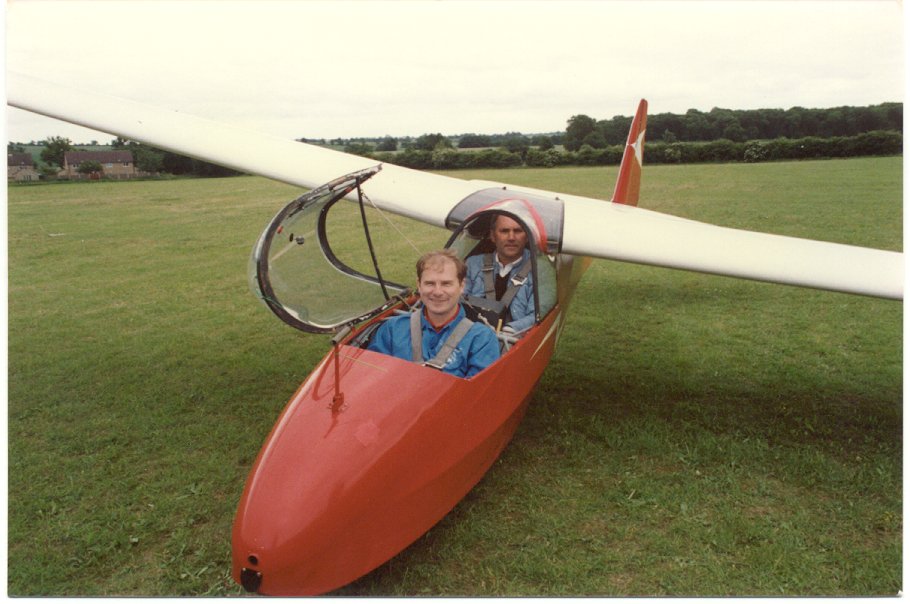
A K-7 two-seat glider.
My first exposure to private flying was on the 7th June, 1981 when, at Rattlesden Gliding Club in Suffolk, I was taken up for two air-experience circuits in a two-seater glider known as a ‘K7’. I was immediately hooked! Those experience flights leading to a 4-minute flight (flight number 46) on the 6th September, 1981 that has the remark in my pilot’s log book: Solo! Now fast forward to October, 1984 and my log book shows me attending a gliding instructor’s course at Lasham, resulting in me being issued with a British Gliding Association (BGA) Assistant Instructor Rating on the 14th October. (105/84).
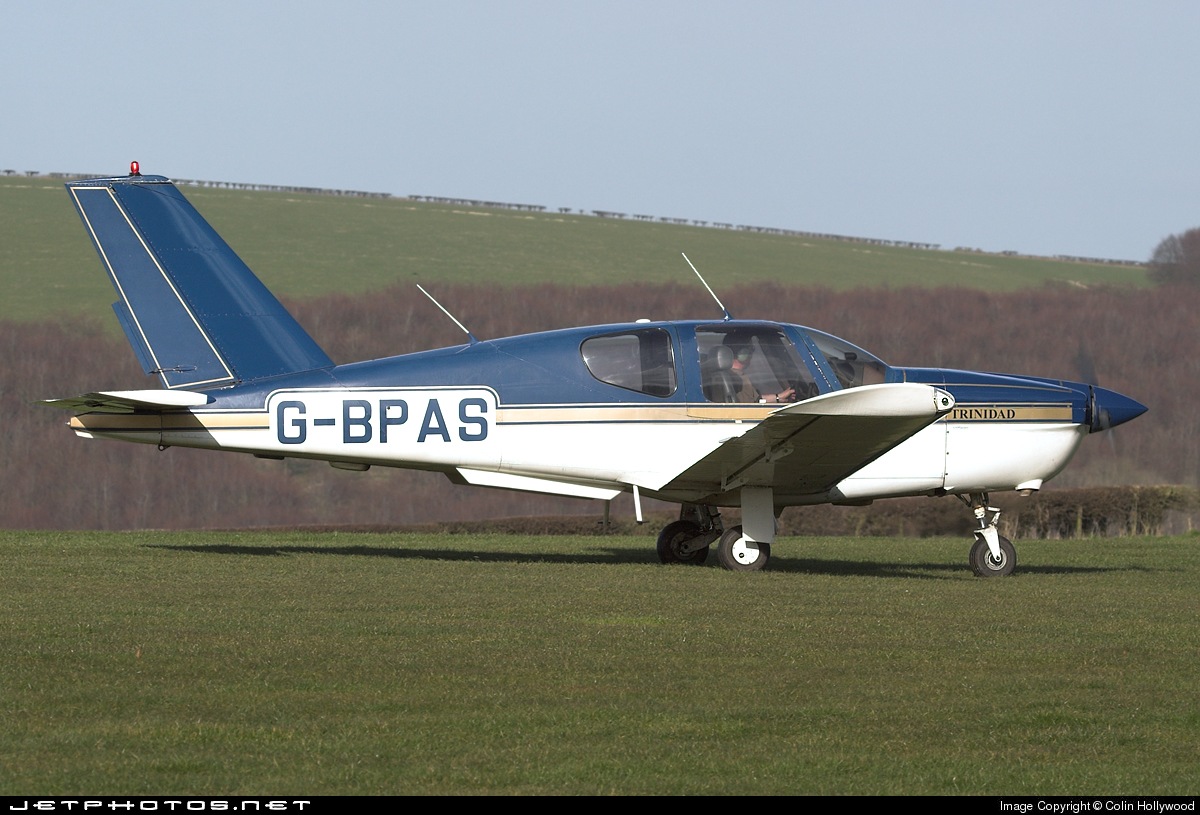
Over on the power side of things, in March, 1984, I started Private Pilot training at the Suffolk Aero Club at Ipswich Airport and gained my PPL on the 9th November, 1984. Subsequently, gaining my Instrument Rating in July, 1999 when I was then operating from Exeter Airport and flying frequently for business purposes. For that ‘serious’ flying I used a Socata TB20, a French retractable, single-engined aircraft, based at Exeter. A very fine, long-distance aircraft.
TB20, G-BPAS, photographed at Compton Abbas airfield (EGHA).
But the aircraft that I had the most fun flying was a dear old Piper Super Cub. Here’s the background to the aircraft.
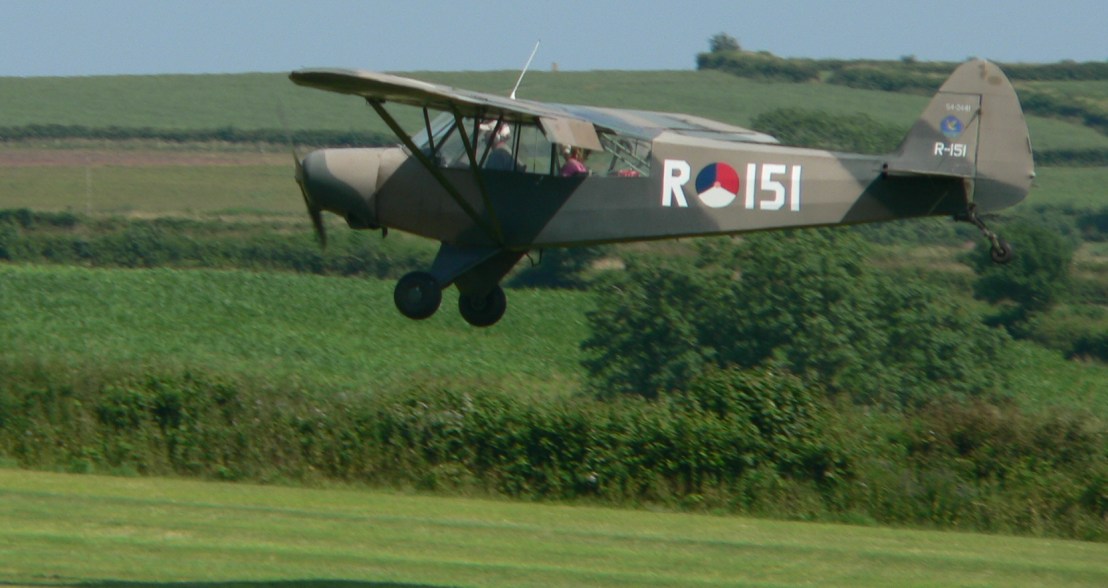
Piper Super Cub, L-21B, R-151
A/C Construction No. 18-3841, Frame No. 18-3843
Original Engine, Lycoming 135 Type 0-290-D2, 54/2441
Romeo 151 was one of a batch of 298 L-21’s delivered in 1954. There were 584 L-21B’s produced by Piper for military use, the ‘L’ standing for Liaison. The L-21B’s were PA-18-135’s with civil Lycoming 0-290-D2 engines, glasswork as most L-21A’s and L-18’s and a gross weight of 1760 lbs.
This aircraft was delivered to Koninklijke Luchtmacht, Dutch Air Force, on the 1st July, 1954 and registered R-151. After various homes R-151 transferred to the Dutch civil register as PH-GER, 1st April 1976 with 4,458 hours and shortly thereafter was registered to Vlieclub Hoogeveen, Certificate Number 2380.
On the 27th March, 1981 the aircraft was delivered to the UK with a total time of 5,043 hours and in September, 1981 became G-BIYR; ‘YR’. In April, 1983 YR was the first of type to be given a Public Transport CofA (Certificate of Airworthiness) and was used for training at Tollaton. YR reverted to a Private CofA in January, 1984 when purchased by Mike and Barbara Fairclough. The aircraft had by then accumulated 5,120 hours.
In 1992, YR was re-engined with a Lycoming 150HP, 0320-A2B No. L49809-27A (zero hours). Finally on the 2nd June, 1995 the aircraft was repainted in her original Dutch insignia and given CAA (UK Civil Aviation Authority) permission to use the original call-sign: Romeo 151.
The aircraft was based at and flown from Watchford Farm airstrip in South Devon, England.
Now forgive the nostalgic photographic memories!
Yours truly approaching Watchford Farm airstrip in South Devon, EnglandFlying in the French Alps with Mont Blanc in sight9,300 ft up in the French Alps!
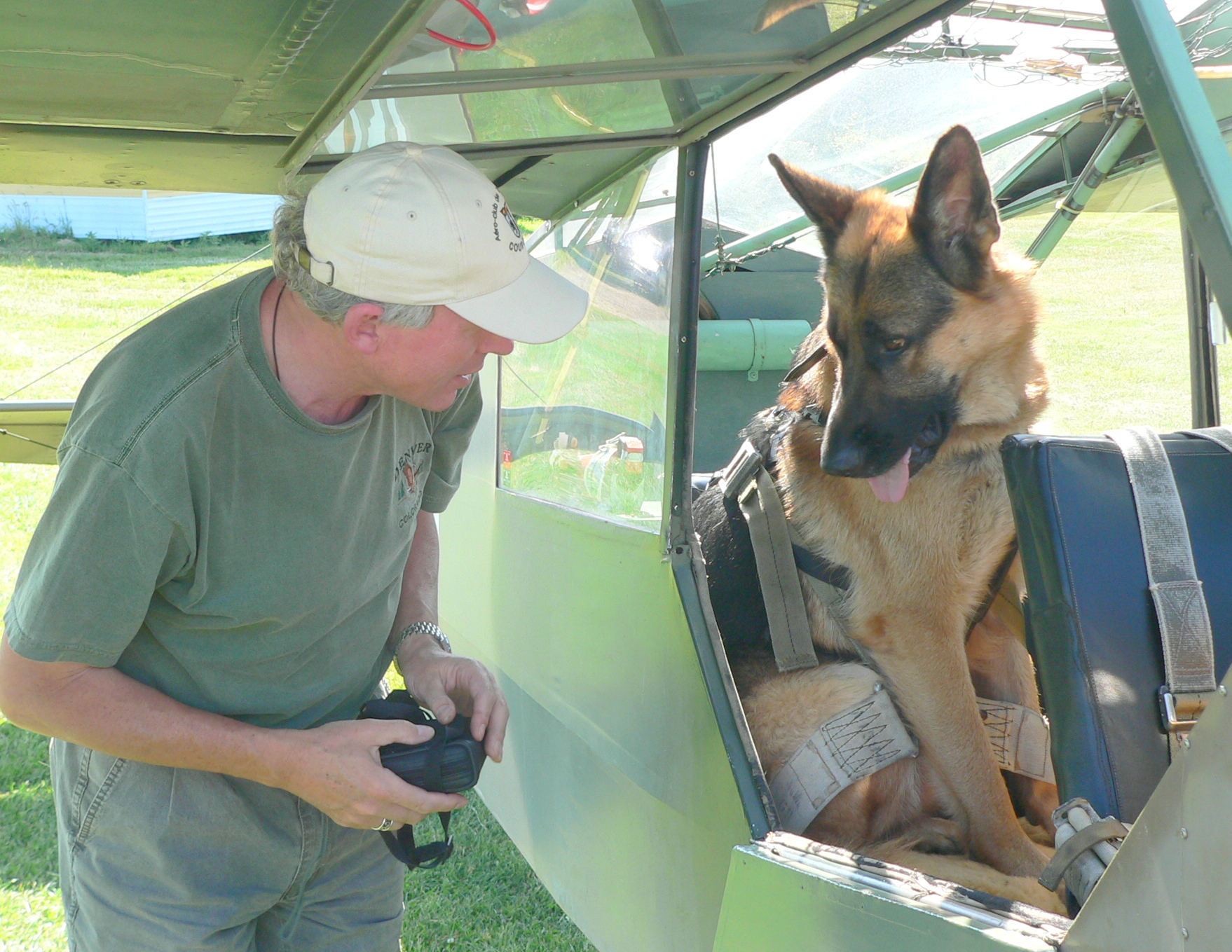
Every time I went to the airfield with Pharaoh he always tried to climb into the cockpit. So one day, I decided to see if he would sit in the rear seat and be strapped in. As the next picture shows, there was absolutely no problem with that!
Come on Dad, let’s get this thing off the ground!
My idea had been to fly a gentle circuit in the aircraft. First, I did some taxying around Watchford’s large grass airfield to see how Pharaoh reacted. He was perfectly behaved.
But then I thought long and hard about taking Pharaoh for a flight. In the Piper Cub there is no autopilot so if Pharaoh struggled or became agitated it would have been almost impossible to fly the aircraft and cope with Pharaoh sitting in the seat behind me. So, in the end, I abandoned the idea. The chances are that it would have been fine. But if something had gone wrong, the outcome just didn’t bear thinking about.
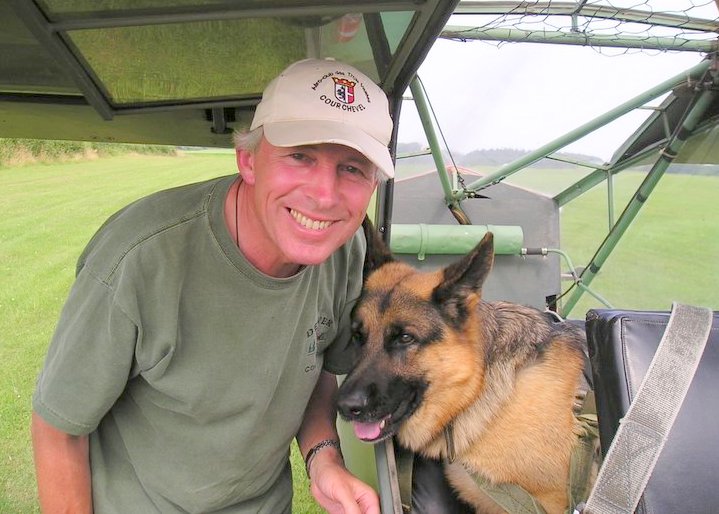
Thus we elected for taxying all around the airfield which, as the next picture shows, met with full doggie approval. The date was July 2006.
That was fun!
So enough of my recollections for today – tomorrow the Vulcan XH558.
(Apologies if these are not widely appreciated but with all our families living thousands of miles away, this seemed like a convenient way of sharing a few pictures from our Christmas day.)
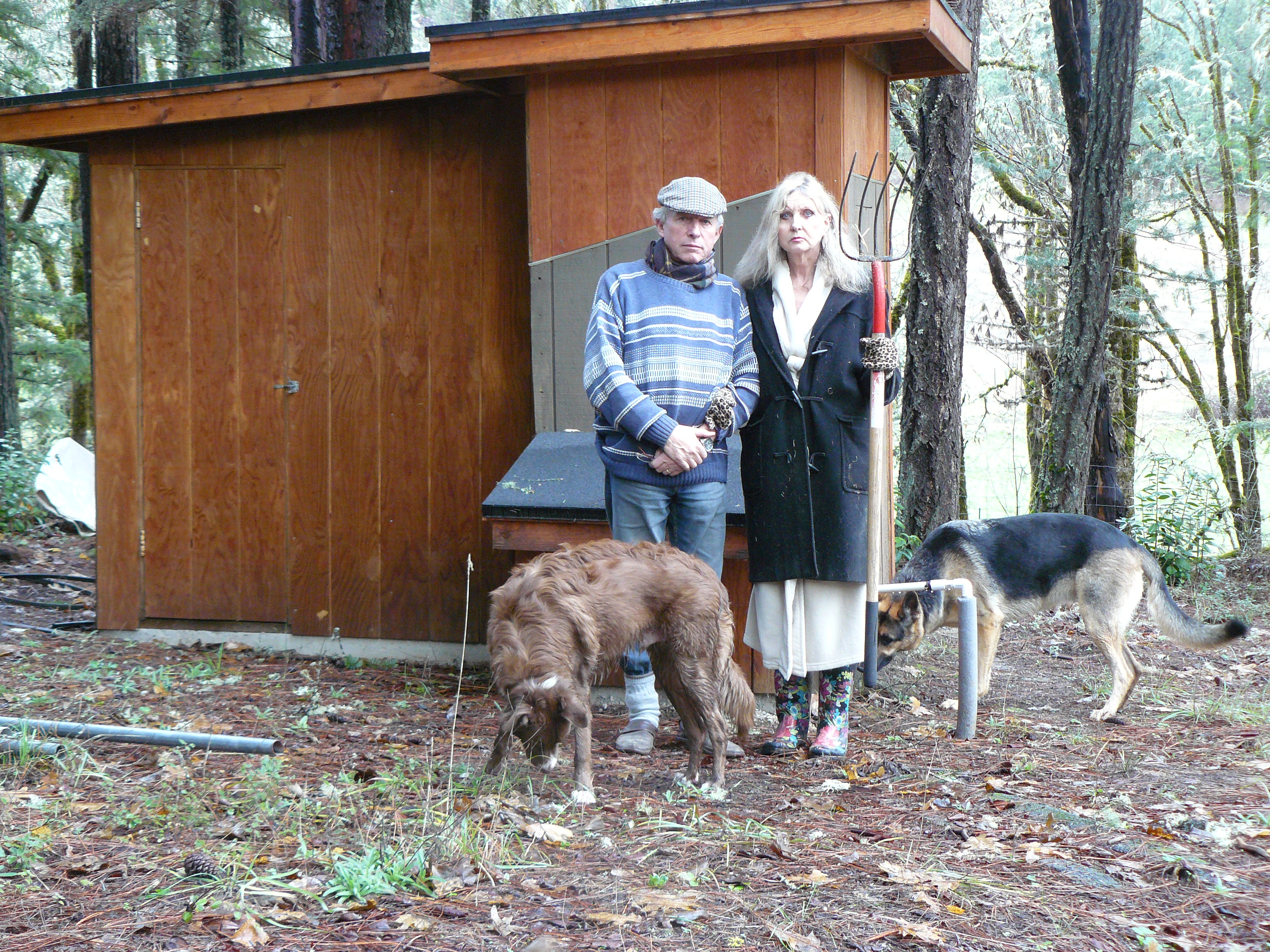
There was no point in getting all dressed up before we had completed our ‘house’ duties, that included mucking out the stables.
Our ‘country’ look seemed to warrant a photograph! Taken in front of the well-house.
The morning forecast had rain and declining temperatures with the snow-line expected to be around 2,500 feet. This picture was taken on Highway I5 as it heads South for the Siskiyou Mountain pass; where we pulled over being about 3,000 feet.
Together with our neighbours, Dordie and Bill, we had all decided to have a Christmas Lunch at Callahan’s Mountain Lodge on Old Highway 99 just off I5 Exit 6.
Callahan’s Mountain Lodge
oooo
Looking out from the deck of Callahan’s Lodge showing clearly that we were above the snow-line.
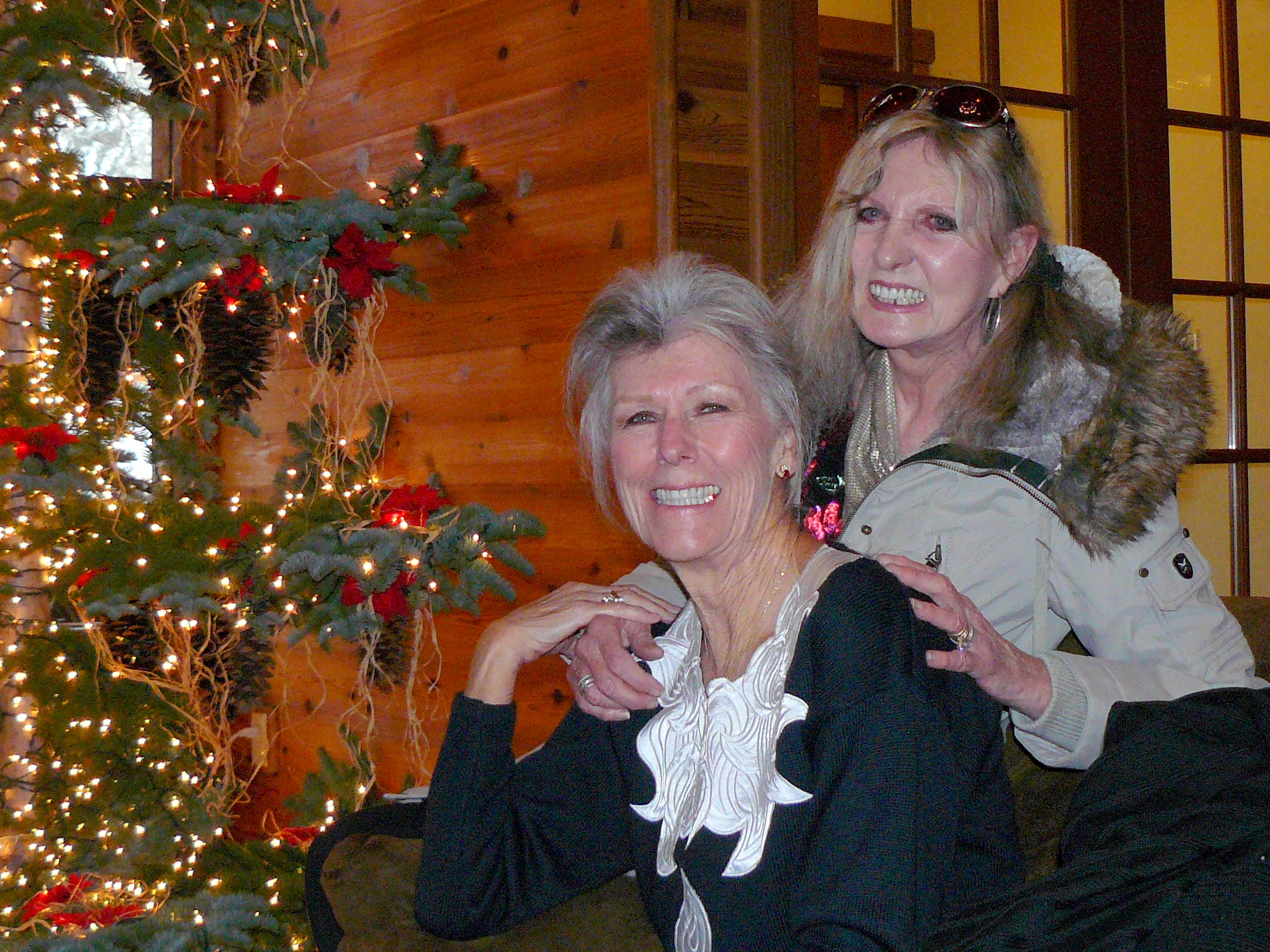
From L-R: Jean, yours truly, Dordie & Bill.
Two lovely ladies!
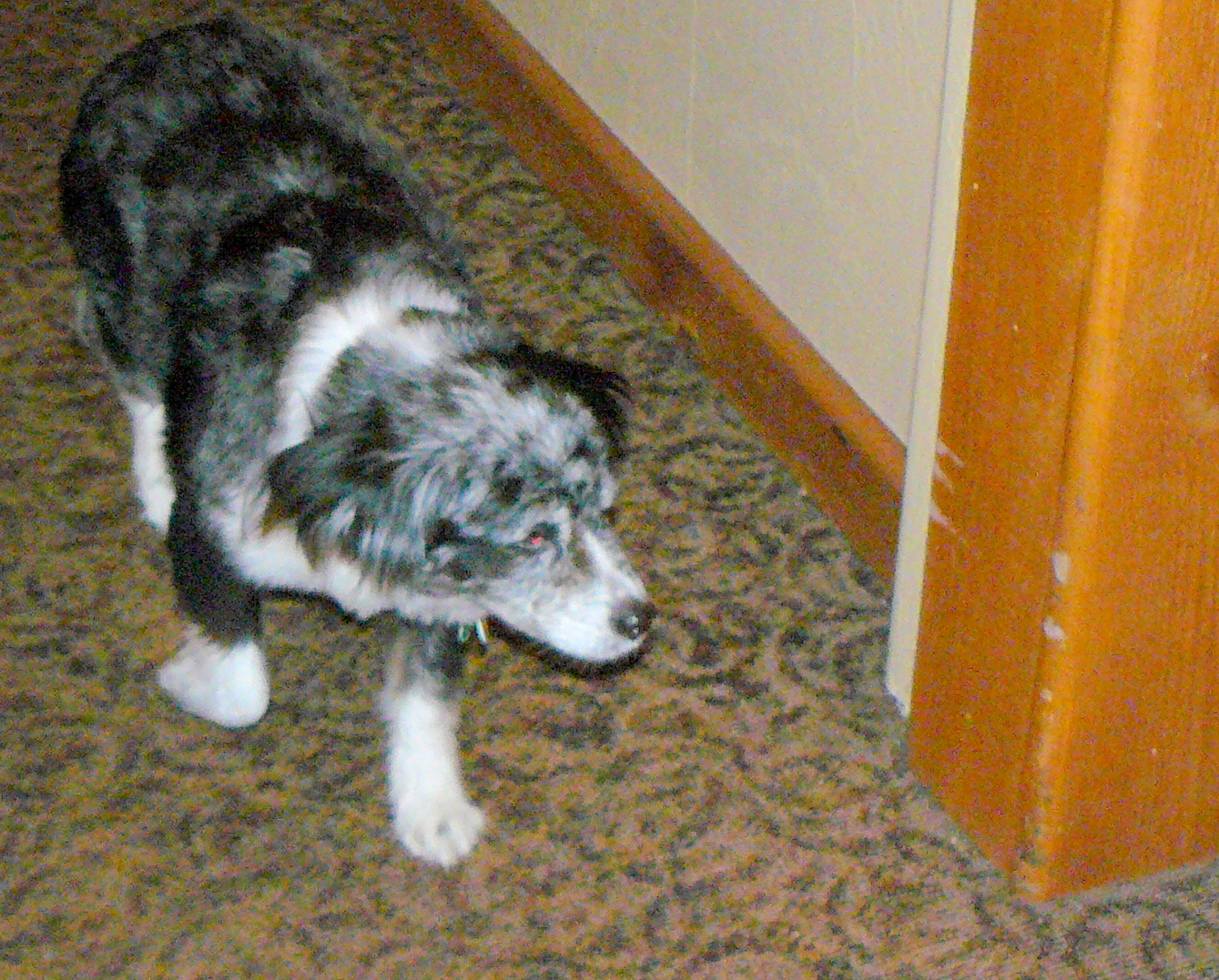
The Lodge’s dog, Blue, that happily wandered all about the place including among the diners!
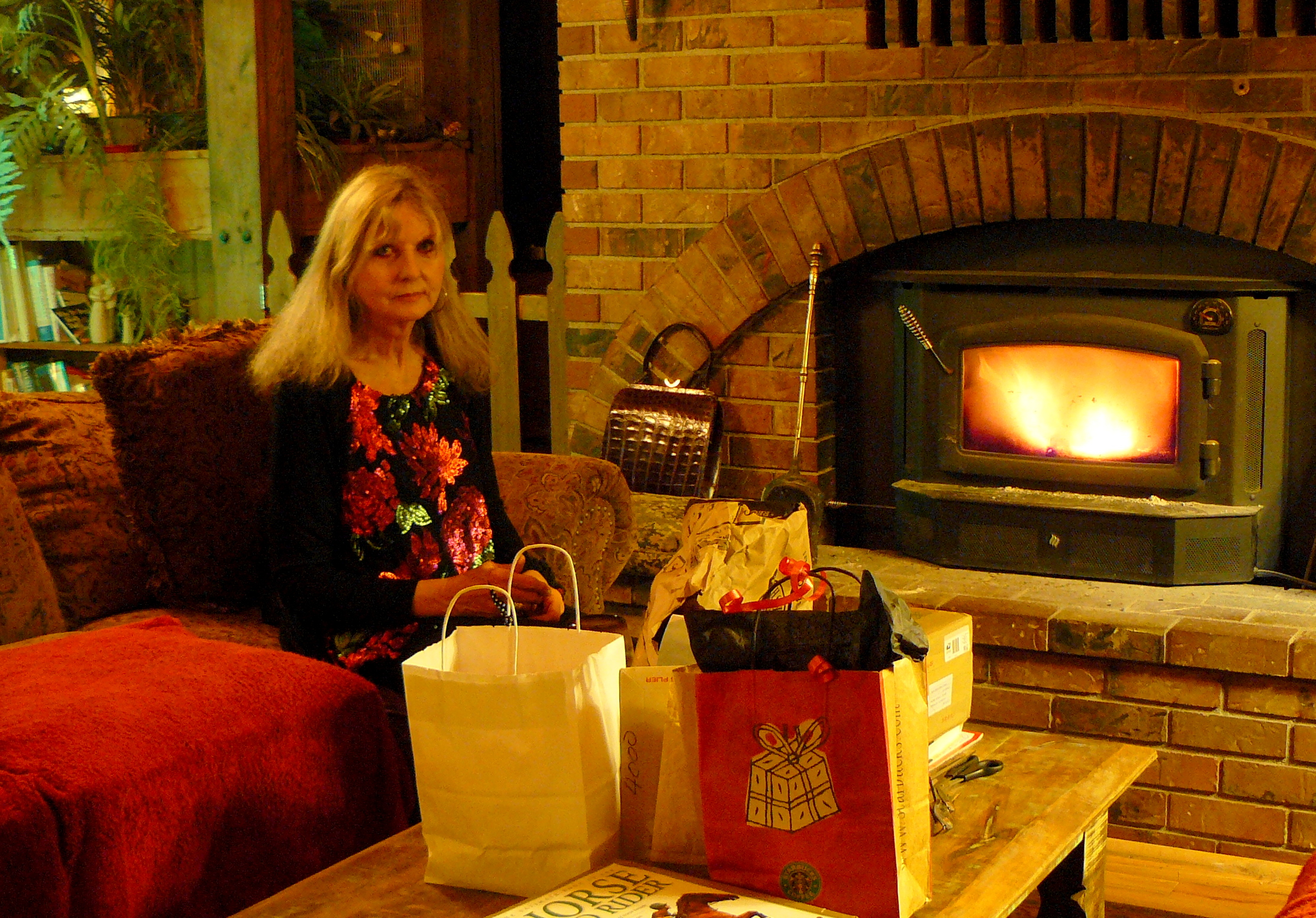
Later on in the afternoon, when Jean and I had returned home, it was time to open a few Christmas presents.
I trust that every one of you dear readers had as happy and pleasant a day as did Jean and me. Because, for us, it was wall-to-wall smiles from the moment we awoke …..
(and trust me, it’s highly watchable even for non-aviation bods!)
Dan Gomez recently sent me a link to a news item and video of a quite extraordinary formation flight. It concerns the fleet of five development A350 XWB development aircraft.
The Airbus A350 XWB
This picture was taken from a Press Release in 2013 on the Airbus website announcing the first flight:
14 June 2013
A new chapter has opened in Airbus’ 43-year history as the first A350 XWB, the world’s most efficient large twin-engined commercial aircraft, powered aloft this morning for its maiden flight at Blagnac in Toulouse, France at 10.00 hours local time. Equipped with Rolls-Royce Trent XWB turbofans, the A350 XWB first flight is taking place over south-western France.
An international crew of six is on board, comprising two Flight Test Pilots, one Test Flight Engineer and three Flight Test Engineers. At the controls of the A350 XWB’s first flight are Peter Chandler, Airbus’ Chief Test Pilot, and Guy Magrin, Project Pilot for the A350 XWB. Accompanying them in the cockpit is Pascal Verneau, the A350 XWB Project Test Flight Engineer. At their flight test stations in the main aircraft cabin and monitoring the progress of the flight via an extensive array of flight test instrumentation are the three flight test engineers: Fernando Alonso, Head of Airbus Flight & Integration Test Centre; Patrick du Ché, Head of Development Flight Tests; and Emanuele Costanzo, lead Flight Test Engineer for the Trent XWB engine.
This first flight marks the beginning of a test campaign totaling around 2,500 flight hours with a fleet of five development aircraft. The rigorous flight testing will lead to the certification of the A350-900 variant by the European EASA and US FAA airworthiness authorities, prior to entry into service in the second half of 2014 with first operator Qatar Airways.
Anyway, moving on to the video. Here it is:
Published on Dec 2, 2014
The five test and development A350-900s took to the skies for a formation flight in September 2014, bringing together all of the aircraft used for Airbus’ successful campaign leading to certification of this latest Airbus wide-body jetliner.
(Interesting to note that the video has already been watched approaching 1.7 million times!)
Forgive the introspection of this old fart, this day after Christmas
Jean is a great lover of music and, without fail, has music playing in the kitchen, especially when she is preparing the evening meal. Thus it was that last Tuesday, I was sitting alongside the kitchen in our living room and heard some tracks that took me back many years; in the way that music can do.
The tracks were songs from Alan Parsons. I was taken back to early 1971 when, freshly back from Australia, I was living in a flat in Harpenden with my then wife: Britta. At the start of 1971, I had joined the Guided Weapons Division of the British Aircraft Corporation (BAC) as a Commercial Apprentice. My office was in Six Hills Way, Stevenage; fewer than 15 miles from Harpenden.
Living in the flat above us were a couple, whose names escape me after all these years, and they were newly into listening to Alan Parsons. That is how I came to learn of the Alan Parsons Project as the group were known and have loved the music ever since.
Now, coming up to forty-four years later, I can share one of my favourite tracks from the album The Time Machine; “… the third solo album produced and engineered by Alan Parsons following the split of The Alan Parsons Project.” (Wikipedia)
That track is called Ignorance is Bliss.
I have included the wonderful words written by the person who uploaded that video.
Published on Feb 23, 2013
Every once in a while in your life, a song will speak to you because it’s happening right then and there. There was a time in my own life where I had tears streaming down my face and this song played on repeat. It was a time of turmoil, where all I could imagine was the peace that only ignorance of my own situation could bring.
A good song writer will set up a situation where it could be applicable in a variety of ways to hit the broadest audience. The trouble is, how do you make a broadly interpretive song that isn’t too broad as to be intangible?
This song walks the line, but the line IS defined if you listen closely. The ‘paradise’ the writer finds is in ignorance. It’s a dreamworld of course, none of us can fully forget our own existence or return to the womb, but it’s a beautiful thought sometimes – particularly when the wind changes, ‘shakes the ground on which you stand’, and ‘blows away your wonderland’.
Anyone who’s lost a loved one, been diagnosed with a terminal illness, gone through a divorce, or had a life-changing experience will understand ‘sand castle’ demolition. The author postulates that maybe we don’t find true peace until we are willing to give up those things we are so concerned about (our sand castles). After all, how long can you protect a sand castle against the inevitable tide?
And when those things that we cared so much about are gone, there’s nothing more to worry about. Perhaps you’ll find peace at last…
However, I have still not grasped the wisdom that the author is in the assumption that the elimination of the things I care most about will bring eventual peace. I’ve known people who NEVER got over a tragedy. Is it that they won’t let go, or that they CAN’T let go? Still though, it’s a nice thought and a pretty song.
In a more mellow and beautiful tone is “Ignorance Is Bliss.” This song shares traits with music by Dan Fogelberg. This mellow song has the honor of being the longest on this CD (The Time Machine) , as well as being one of the most beautiful. The lead vocal on this song is by Alan Parson’s veteran Colin Blunstone, who provided the vocals for the excellent Alan Parson’s Project song “Old and Wise.” There is a lovely orchestral arrangement in the extended bridge of this song, which I consider a must listen for Alan Parson’s fans.
Here are the lyrics:
“Ignorance Is Bliss“
I find this Paradise and rest beside a river
No need to walk another mile
It seems like everyone has everything that wishes could provide
But no one seems to smile
You won’t believe me when I tell you this is fantasy
Don’t ask how long all this can last
The same old sun will rise and make tomorrow just like yesterday
And so your time will pass
A shelter from the storm
A room without a view
A place where you belong
And like a mother’s kiss
That carries you to sleep
The ignorance is bliss
One day the wind may change and blow at your defences
And shake the ground on which you stand
One day the tide may turn and wash away your castles in the sand
And silence rule the land
A shelter from the storm
A room without a view
A place where you belong
And like a mother’s kiss
That carries you to sleep
The ignorance is bliss
One day the wind will change and blow away your wonderland
Blue skies will soon be overcast
One day the tide will turn and wash away your castles in the sand
And you’ll find peace… at last







 This is a letter to yourself written a year in advance, describing all the things that you are grateful for during the year. Start with the date December 31st, 2015 and address it to yourself.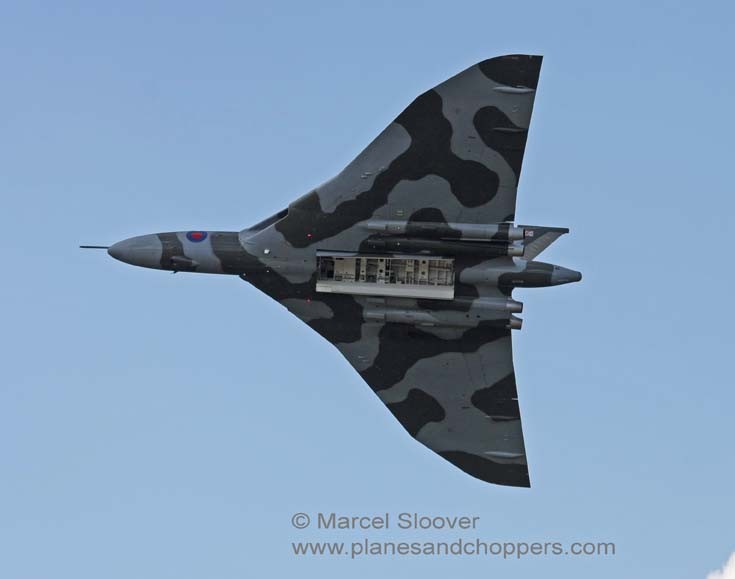






 Learning from Dogs