Category: Writing

Out of this world

The text, and more photographs, of that Sunday Picture Parade.

ooOOoo

33 out-of-this-world images of the Milky Way, aurora borealis and more

Astronomy Photographer of the Year contest reveals dozens of photos before winners are announced.

By JACQUELINE GULLEDGE   July 20, 2018

‘Rigel and the Witch Head Nebula’ (Photo: Mario Cogo)

An aurora borealis that lights up the night sky in Iceland. The Milky Way that illuminates in a remote area in Australia. Even nebulae that display dazzling colors. All these phenomena have delighted astronomy enthusiasts for years, and many people travel the globe to capture such events.

The Astronomy Photographer of the Year competition honors amateur astronomy photographers who capture stunning images of space. The organization released several dozens images out of the more than 4,200 entries it received ahead of its announcement this October of this year’s winners. The competition began in 2009 and is organized by the Royal Observatory Greenwich in the United Kingdom.

The photographers featured here are a mixture of amateurs and professionals, but their images are universally stunning.

The photo above entitled “Rigel and the Witch Head Nebula” was taken by Mario Cogo in Namibia. “The dark Namibian sky was the perfect location to capture the wonder of the Witch Head Nebula and Rigel,” said Cogo in his submission. “The Witch Head Nebula is a very faint molecular gas cloud which is illuminated by supergiant star Rigel, the seventh brightest star of the sky and the brightest star in the constellation of Orion.”

The caption listed below each photo was written by the photographer and provides additional context.

‘Thunderstorm under milky way’ (Photo: Tianyuan Xiao)

“A glorious Milky Way looms over a thunderstorm that lights up the Florida sky. The photographer wanted to show the great contrast between stable (Milky Way) and moving (thunderstorm) objects in the sky.” — Tianyuan Xiao
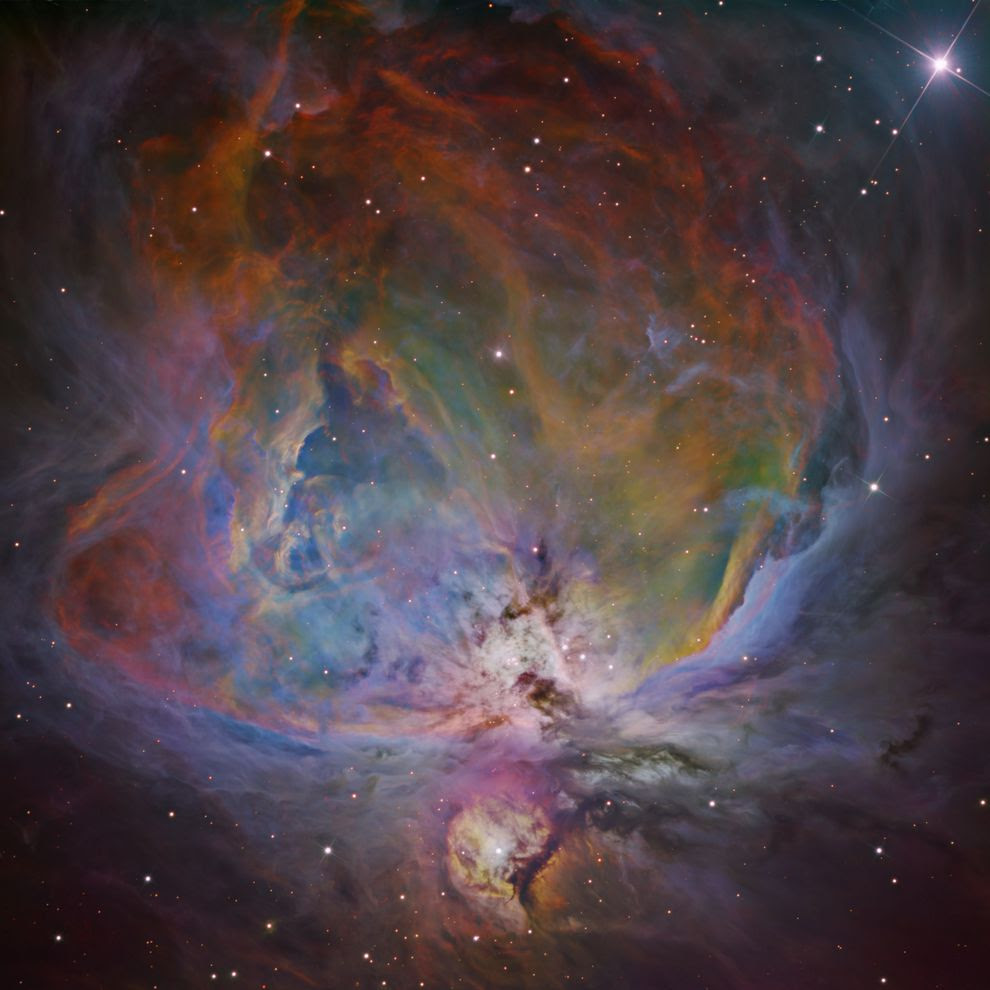
‘The Orion Nebula in 6-Filter Narrowband’ (Photo: Bernard Miller)

“One of the brightest nebulae, the M42 or the Orion Nebula, is located in the Milky Way south of Orion’s belt. It is an emission nebula about 1500 light years away in the constellation Orion. This image was produced by combining 36 hours of total exposure using six different filters; Ha, SII, OIII, Red, Green, and Blue. The central Trapezium cluster of the nebula is so bright that it is usually over exposed with the long exposures needed for the nebula. In this image a series of short 3-second exposures in each filter were blended with the long exposures to create a high dynamic range image that produces detail in the faint nebula and bright Trapezium.” — Bernard Miller

The neglected neighbour’ (Photo: Kfir Simon)

“Taken from Tivoli Southern Sky Guest Farm in Namibia, the great Horsehead nebula is overlooking the striking and often overlooked Nebula NGC 2023. At 4 light years in diameter it is one of the largest reflection nebulae ever discovered.” — Kfir Simon

‘The Hidden Galaxy’ (Photo: Tom O’Donoghue and Olly Penrice)

“Camelopardalis, also known as the Hidden Galaxy is one of the largest Galaxies visible from the Northern Hemisphere; however it is also obscured by foreground stars and dust, as it lies in the Milky Way plane. The photographer added a Ha filter to this LRGB image in order to enhance the emission nebula regions in the galaxy and after stacking single exposures (subs) the brilliant spiral arms at the core were revealed.” — Tom O’Donoghue and Olly Penrice

‘The Eagle nebula’ (Photo: Marcel Drechsler)

“The Eagle Nebula, also known as Messier 16, is a young open cluster of stars, surrounded by hot hydrogen gas in the constellation Serpens and lies at a distance of 7,000 light years from Earth. Taken at the Baerenstein Observatory in Germany, the photo is a RGB-Ha-OIII image and shows off the radiant red and blue colours of the nebula. In the centre you can spot the famous Pillars of Creation.” — Marcel Drechsler

‘Stars over Sacred Mongolian Ovoo’ (Photo: Qiqige Zhao)

“Taken during a summer night in Mingantu in Inner Mongolia, star trails are sweeping over the colourful and extraordinary sacred altars, called Ovoo, creating a spectacular painting.” — Qiqige Zhao
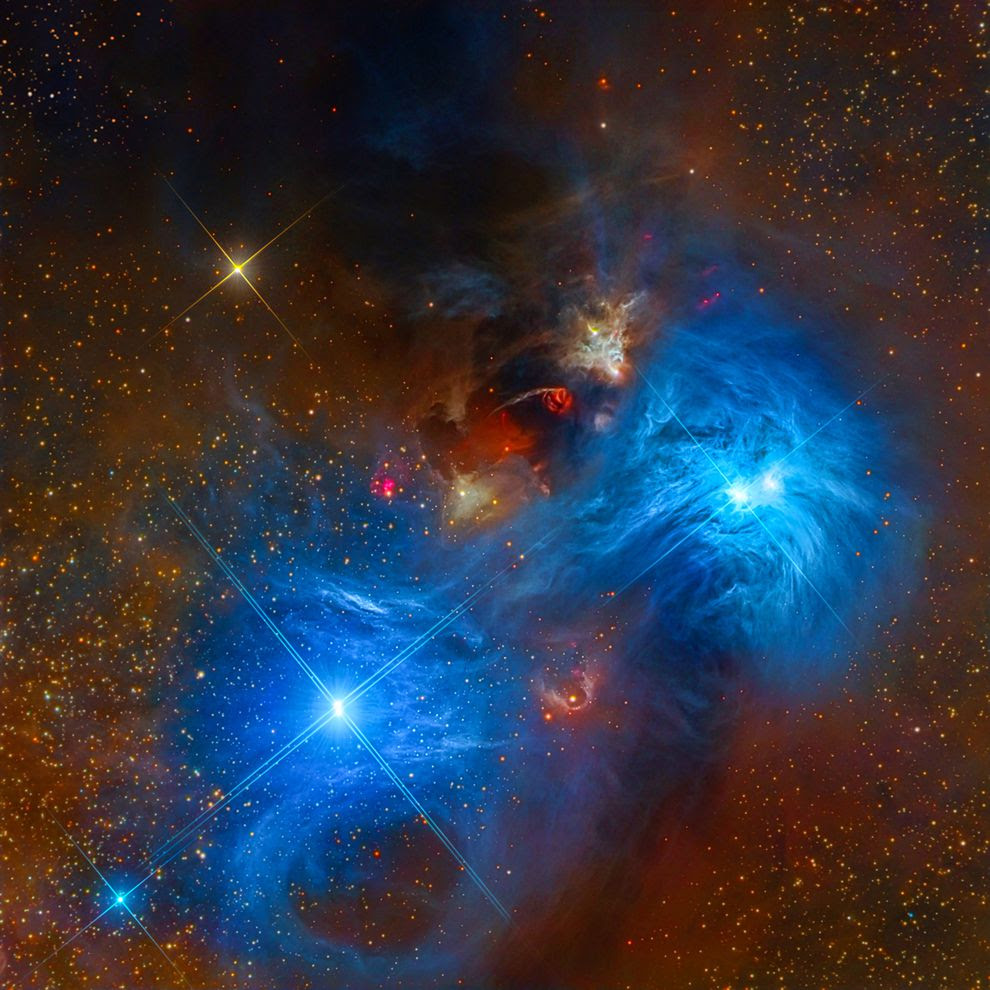
‘NGC 6726 and NGC 6727’ (Photo: Mark Hanson, Warren Keller, Steve Mazlin, Rex Parker, Tommy Tse, David Plesko, Pete Proulx)

“These spectacular reflection nebulae in the Corona Australis constellation depict the characteristic vivid blue color produced by the light of hot stars, reflected by silica-based cosmic dust. A rare high resolution view of the cores NGC 6726 and 6727 is captured on camera. The data was acquired by Star Shadows Remote Observatory at CTIO’s PROMPT2, using LRGB filters, stacked with CCDStack and post-processed in Photoshop and PixInsight.” — Mark Hanson, Warren Keller, Steve Mazlin, Rex Parker, Tommy Tse, David Plesko and Pete Proulx

‘Mosaic of the Great Orion & Running Man Nebula’ (Photo: Miguel Angel García Borrella and Lluis Romero Ventura)

“The Orion Nebula, also known as Messier 42, M42, or NGC 1976, is a diffuse nebula situated in the Milky Way, south of Orion’s Belt in the constellation of Orion. It is one of the brightest nebulae and is visible to the naked eye during a clear night sky. M42 is 1270 light years from our planet and is the closest region of massive star formation to Earth. It is estimated to be 24 light years across and it has a mass of about 2,000 times more than that of the Sun. This image is the result of the efforts of two astrophotographers using different equipment from their observatories. Located hundreds of kilometres away from each other, they chose the Orion Sword are as a common target to render. The software suites used in this image are Maxim DL, Pixinsight and Photoshop CC 2017.” — Miguel Angel García Borrella and Lluis Romero Ventura

‘Milky Way shining over Atashkooh’ (Photo: Masoud Ghadiri)

“The Milky Way stretches across the night sky between four columns in the ancient Atashkooh Fire Temple near Mahllat city in Iran. The camera was placed on the ground in the centre of the four columns, and with no use of any other equipment, the photographer managed to capture our magnificent galaxy using just one image.” — Masoud Ghadiri
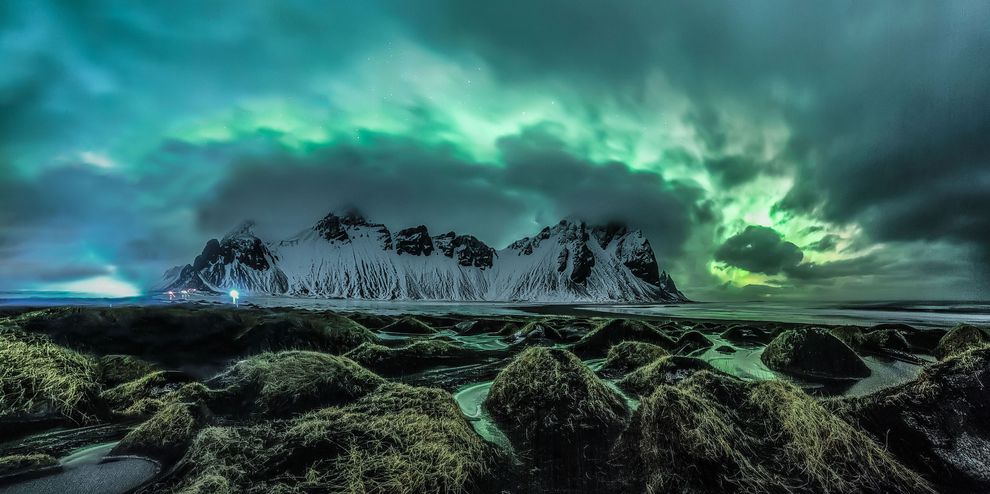
‘Magic’ (Photo: Jingyi Zhang)

“The magical Aurora Borealis explodes from the clouds and looms over the mountains in Stokknes on the south coast of Iceland. Snow has melted and created pools of water between the dunes, creating a perfect foreground for this image.” — Jingyi Zhang

‘Kynance cove by night’ (Photo: Ainsley Bennett)

“On a family trip to Cornwall after visiting Kynance Cove, on the Lizard Peninsula, the beautiful landscape seemed to be the ideal place for the photographer to capture the glimmering stars and the striking colours of the Milky Way illuminating the beautiful rocky coastline. This is a composition of two separate exposures, one for the sky and one for the foreground blended together post-processing to achieve the desired result, producing a more even exposure.” — Ainsley Bennett

‘Keeper of the Light’ (Photo: James Stone)

“The Milky Way rises above an isolated lighthouse in Tasmania. The photographer planned his position to shoot the perfect composition positioning the Milky Way in conjunction with the lighthouse and observing how to best light the tower for artistic effect. This image is part of a time-lapse sequence, allowing the photographer some time to climb the tower into the lantern room of the lighthouse and reflect on the hard and lonely, yet incredible life the former lighthouse keepers would have lived.” — James Stone
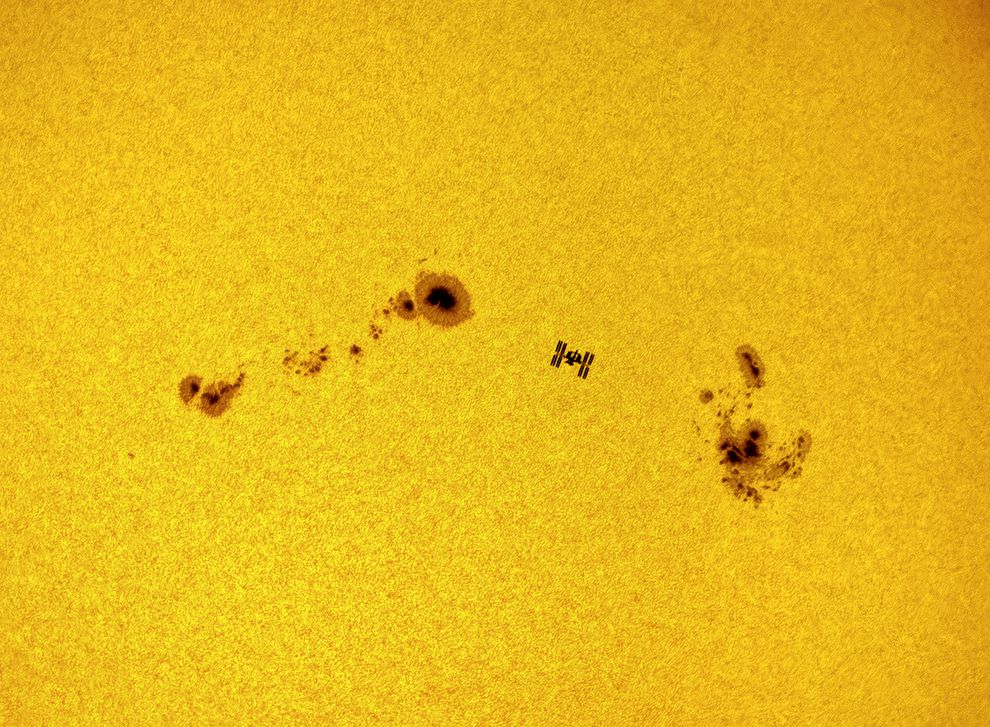
‘ISS sunspots’ (Photo: Dani Caxete (Fernández Méndez))

“The International Space Station (ISS) was captured between two massive sunspots, the AR 12674 and AR 12673, during its solar transit. The image was taken in Madrid and it took ISS less than a second to cross the solar disk.” — Dani Caxete
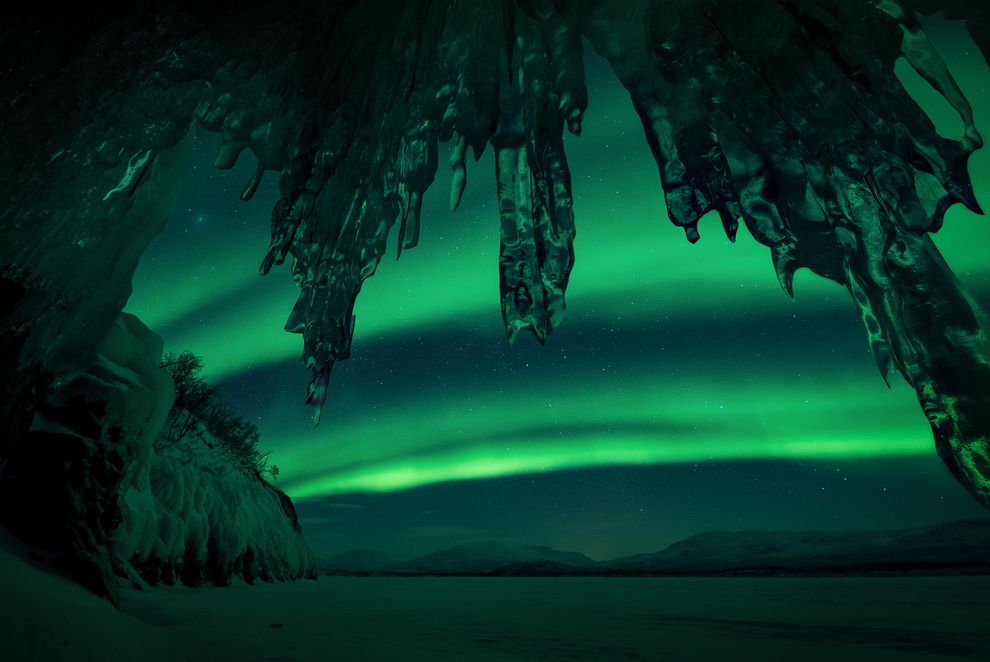
‘Ice Castle’ (Photo: Arild Heitmann)

“A remarkable display of the Northern Lights reflecting shades of green and yellow on the snow. Squeezed into a tiny cave on Lake Torneträsk, in Swedish Lapland, in minus 26 degrees with the camera lens just a few centimeters away from the icicles, it was a challenge well worth it for the photographer.” — Arild Heitmann

‘Holy Light II’ (Photo: Mikkel Beiter)

“The Black Church at Búðir in Iceland beneath the stripes of the Aurora Borealis and the bright stars in the night sky. Fighting the worst weather the photographer had ever encountered in Snæfellsnes Peninsula and with strong gale winds around 30 meters per second on the night the image was taken, his hard work paid off.” — Mikkel Beiter
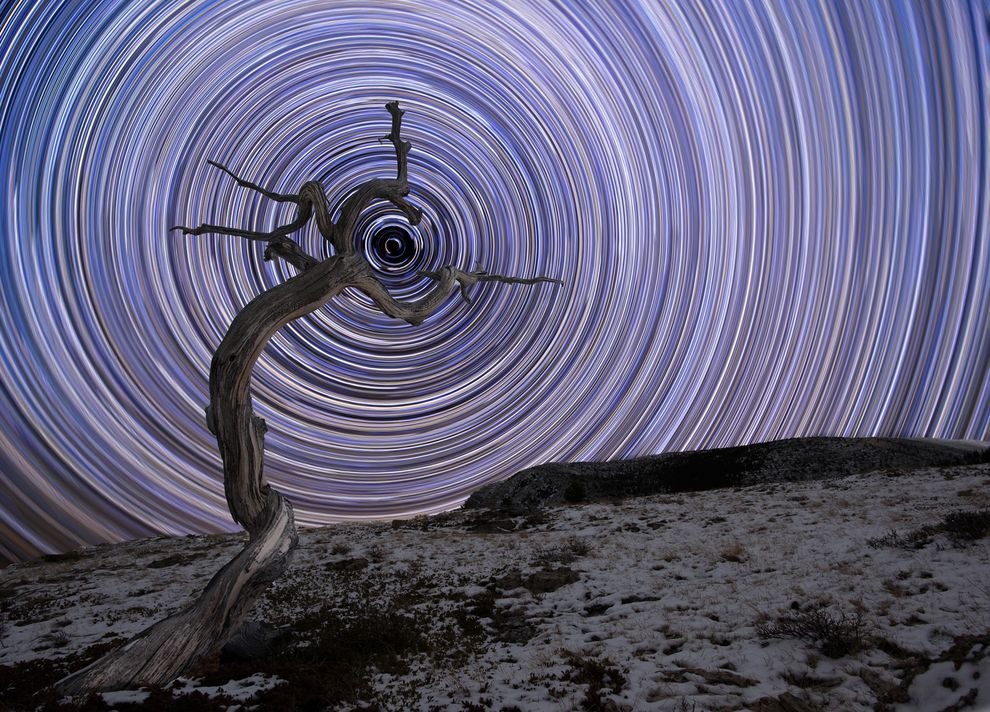
‘Holding Due North’ (Photo: Jake Mosher)

“A weathered juniper tree in Montana’s northern Rocky Mountains is filled with arced star trails and in the centre sits Polaris, the brightest star in the constellation of Ursa Minor. It took several test frames of long exposures to make sure that Polaris was in the right position, but eventually things lined up and the Moon provided enough light to the foreground, yet plenty of dark skies to allow a high enough ISO to capture lots of stars.” — Jake Mosher
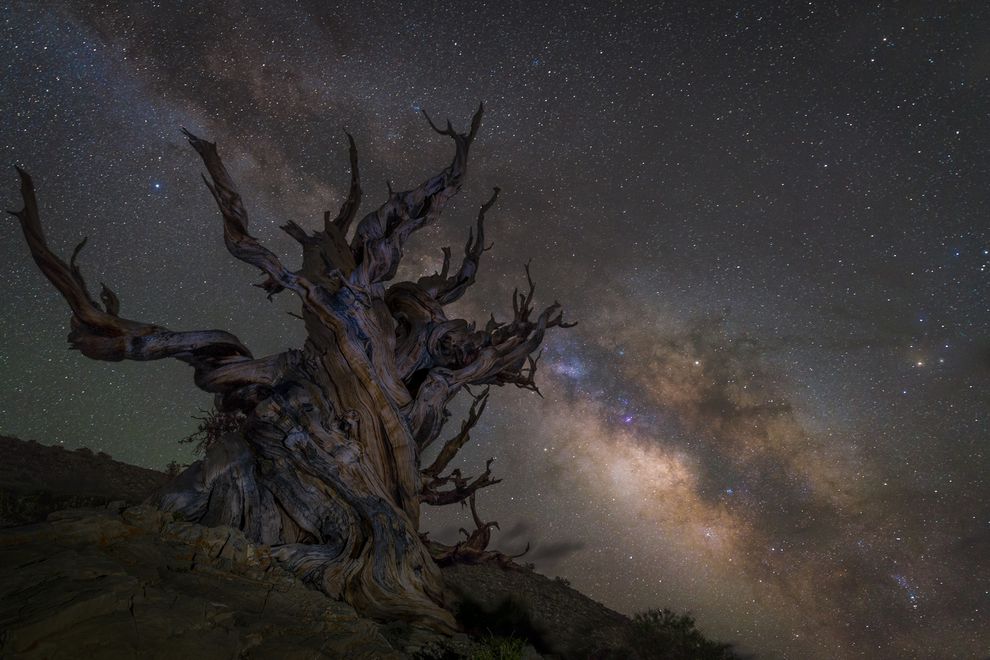
‘Guarding the galaxy’ (Photo: Jez Hughes)

“The Milky Way rises over some of the oldest trees on Earth in the Ancient Bristlecone Pine Forest, set within the Inyo National Forest along the White Mountains in California. Growing at altitudes of over 10,000 feet, these trees can live for over 4,000 years. The high elevation also results in thin air and incredibly dark skies on display. This photograph was taken in between rolling thunderstorms which were passing through the Eastern Sierras, leaving time for only a few exposures.” — Jez Hughes

Guardian of Tre Cime’ (Photo: Carlos F. Turienzo)

“This panoramic image, composed out of eight photos, depicts the Milky Way emerging over the rocky Dolomites in Tre Crime on the left and on the right the lights from a house illuminating the beautiful terrain. The photographer noted that the image represents sharing unforgettable moment with the ones you love.” — Carlos F. Turienzo

‘First Impressions’ (Photo: Casper Kentish)

“After a few days of cloudy skies the photographer finally got the chance to use his birthday present, a new telescope. The clouds were moving fast so there was not much time to capture the Moon. With the help of his grandfather who kept moving the telescope and trying to keep an iPad at the right position, he managed to capture this wonderful and artistic image of his first viewing of our Moon.” — Casper Kentish

‘Expedition to Infinity’ (Photo: Jingpeng Liu)

“The photographer captured the splendor of our galaxy in Badlands National Park, in South Dakota and is a panoramic view of a 6-shot composite, three for the sky and three for the foreground, all of which were taken successively using the same gear and equivalent exposure settings, from the same location, within a short period. The raw files were initially processed in Lightroom for lens correction only, followed by merging to panorama in Photoshop. Final retouching was applied back in Lightroom, including WB correction, basic toning and local adjustments.” — Jingpeng Liu
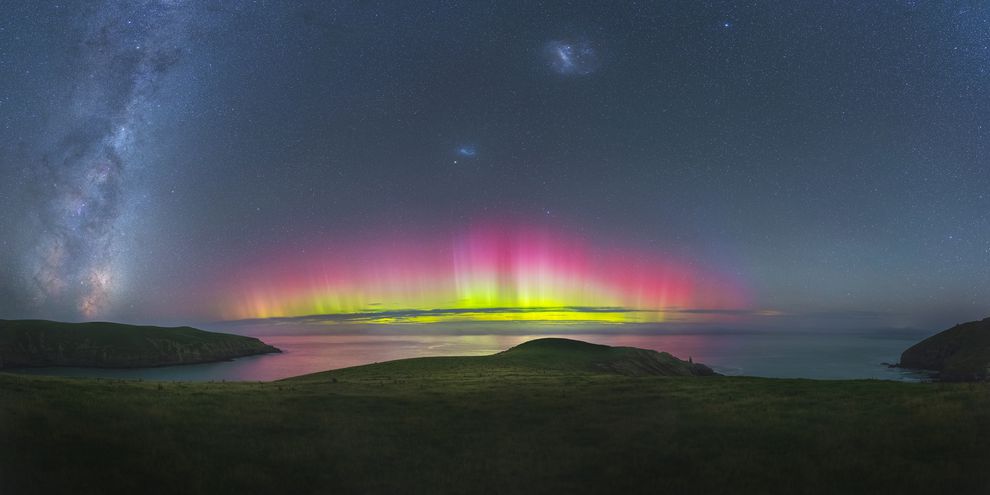
‘Empyreal’ (Photo: Paul Wilson)

“A flared up Aurora reflects bright pink and yellow colours on the water at Southern Bays near Christchurch, New Zealand. The incredible combination of the radiant Aurora colours, the wide green fields and the dark blue, starry night sky paint a spectacular picture and accentuates the wonders of our galaxy.” — Paul Wilson

‘Earth Shine’ (Photo: Peter Ward)

“During a solar eclipse, the brightness of the solar corona hides the details of the moon. By layering 9 exposures ranging from 2 seconds to 1/2000th of a second and with Extreme High Dynamic Range photography or XHDR the image shows not just the radiant solar corona, but the newest possible of new moons, seen here illuminated by sunlight reflecting off the earth.” — Peter Ward

‘Deep Space’ (Photo: Dave Brosha)

“Exploring the remarkable underbelly of the Breiðamerkurjökull glacial tongue in Iceland. With this image the photographer wanted to pay tribute to the serenity and wonder he felt while he spent some time in this peaceful and magnificent place.” — Dave Brosha

‘Daytime Moon’ (Photo: Helen Schofield)

“Earth’s only natural satellite is situated above the horizon of our planet so it is visible during daytime and the waxing gibbous phase can clearly be seen in the sky. The photographer captured this imposing image in Malaga, Spain while vacationing with her children.” — Helen Schofield

Color-Full Moon’ (Photo: Nicolas Lefaudeux)

“A phenomenal image depicting the incredible colours and details of the surface of the Moon. The photographer applied a similar procedure he used for capturing the solar eclipse and noted that this lit up the full Moon like a Christmas tree ornament, with a great variety of hues and shades.” — Nicolas Lefaudeux

‘Cable Bay’ (Photo: Mark Gee)

“The magnificent Milky Way stretches across the night sky reflecting on the Cable Bay near Nelson, New Zealand. The photographer had to take the picture before the light washed out the sky. 42 individual images were stitched in to a large multi row panorama to create this image.” — Mark Gee

‘Aurorascape’ (Photo: Mikkel Beiter)

“The conditions the night the image was taken were not ideal because of the bright moon lighting up the sky. The photographer managed to overcome this obstacle and capture the incredible Aurora Borealis above the fjord at Haukland in the gorgeous Lofoten archipelago, Northern Norway. The small pool of water with rocks made the perfect foreground and a natural leading line into the frame.” — Mikkel Beiter

‘Aurora Borealis on the coast of the Barents sea’ (Photo: Michael Zav’yalov)

“From the city of Yaroslavl in Russia to the coast of the Barents Sea in the Arctic Circle, a party of three travelled 2000 kilometers to capture the magnificent Northern Lights. The photographer stayed in the village of Teriberka in the Murmansk Oblast district for five days. After four days of bad weather, with heavy snow and thick clouds the sky finally cleared on the last day and the Northern Lights appeared in all their glory.” — Michael Zav’yalov

‘AR 2665 and Quiescent Prominence’ (Photo: Łukasz Sujka)

“The sunspot AR2665 was one of the most active regions in 2017 on the right you can see a phenomenal quiescent prominence extending from our star, the Sun. This type of prominence lasts for a very long time and its structure is quite stable. The photo is a composition of two images: one of the magnificent prominence and one of the Sun’s surface. The surface is much brighter than the prominence so it is a negative to reveal details of Sun chromosphere (spicules and filaments).” — Łukasz Sujka
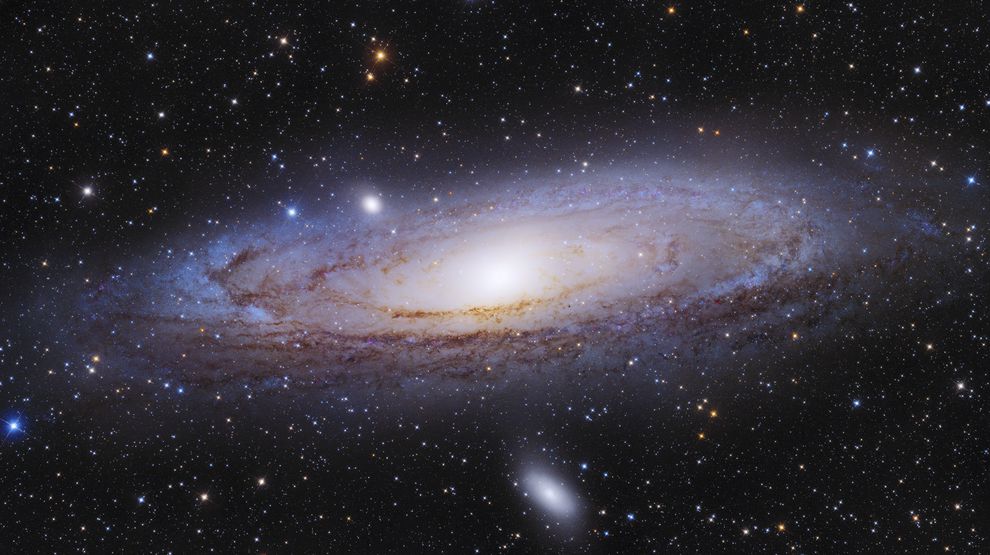
‘Andromeda Galaxy’ (Photo: Péter Feltóti)

“Andromeda Galaxy has always amazed the photographer. The dust lanes and bright star clusters in its arms, the emblematic galaxy shape of it, and the magnificent look of this great star city make it one of his most desired objects to photograph. This image was taken using a 200mm mirror and creating a three panel mosaic.” — Péter Feltóti

‘A Magnificent Saturn’ (Photo: Avani Soares)

“In high resolution planetary photography having a good view of a planet is a key factor but also completely out of a photographer’s control. In this image the photographer was lucky to capture our second largest planet, Saturn, in all its glory. After stacking 4,000 out of 10,000 frames we can admire details such as the beautiful polar hexagon, the Encke Division and even the crepe ring.” — Avani Soares

ooOOoo

These are the most beautiful images of the cosmos that I have ever seen!

Yet more dog food recalls

These are taking priority over the text for yesterday’s Picture Parade.

And there are two of them.

Nutrisca Dog Food Recall | November 2018

November 3, 2018 — Nutrisca, of Saint Louis, MO, is voluntarily recalling one formula of Nutrisca dry dog food because it contains elevated levels of vitamin D.

Nutrisca did not include an image with its FDA news release. So, the following image has been copied from the company’s website and provided in good faith by The Dog Food Advisor.

What’s Recalled?

  • Nutrisca Chicken and Chickpea Dry Dog Food
    Package Size: 4 pounds
    Bag UPC: 8-84244-12495-7
    Best By Dates: February 25, 2020 thru September 13, 2020
  • Nutrisca Chicken and Chickpea Dry Dog Food
    Package Size: 15 pounds
    Bag UPC: 8-84244-12795-8
    Best By Dates: February 25, 2020 thru September 13, 2020
  • Nutrisca Chicken and Chickpea Dry Dog Food
    Package Size: 28 pounds
    Bag UPC: 8-84244-12895-5
    Best By Dates: February 25, 2020 thru September 13, 2020

Bags affected have a Best By Date code of February 25, 2020 through September 13, 2020. The Best By Date code can be found on the back or bottom of each bag.

The products were distributed to retail stores nationwide.

What Caused the Recall?

Nutrisca became aware of the elevated levels of vitamin D after receiving complaints from three pet owners of vitamin D toxicity after consuming the product.

An investigation revealed a formulation error led to the elevated vitamin D in the product.

About Elevated Vitamin D

Dogs ingesting elevated levels of Vitamin D may exhibit symptoms such as vomiting, loss of appetite, increased thirst, increased urination, excessive drooling, and weight loss.

Vitamin D when consumed at very high levels can lead to serious health issues in dogs including renal dysfunction.

Consumers with dogs who have consumed any of the products listed above and are exhibiting these symptoms, should contact their veterinarian.

What to Do?

Consumers should stop feeding the products listed above.

Consumers who have purchased any of the products affected by this recall should dispose of it or return it to the place of purchase for a full refund.

Consumers with questions may contact Nutrisca at 888-279-9420 from 8 AM to 5 PM Central Standard time, Monday through Friday, or by email at consumerservices@nutrisca.com for more information.

No other Nutrisca products, including Nutrisca Chicken & Chickpea wet dog foods are impacted.

All other Nutrisca dog and cat food products are safe to feed to pets.

According to the company…

“This is a voluntary recall and is being conducted in cooperation with the U.S. Food and Drug Administration.

“We genuinely regret that this has occurred as we place the highest priority on the health of pets.”

U.S. citizens can report complaints about FDA-regulated pet food products by calling the consumer complaint coordinator in your area.

Or go to http://www.fda.gov/petfoodcomplaints.

Canadians can report any health or safety incidents related to the use of this product by filling out the Consumer Product Incident Report Form.

oooo

Natural Life Pet Products Dog Food Recall

November 3, 2018 — Natural Life Pet Products of Saint Louis, MO, is voluntarily recalling its Chicken and Potato dry dog food due to it containing elevated levels of Vitamin D.

What’s Recalled?

No product image was included with the official news release.

  • Natural Life Chicken and Potato Dry Dog Food
    Package Size: 17.5 pounds
    Bag UPC: 0-12344-08175-1

Bags affected have a Best By Date code of May 29, 2020 through August 10, 2020. The Best By Date code can be found on the back or bottom of each bag.

The products were distributed to retail stores in:

  • Alabama
  • California
  • Florida
  • Georgia
  • North Carolina
  • South Carolina
  • Tennessee
  • Virginia

What Caused the Recall?

Natural Life Pet Products became aware of the elevated levels of vitamin D after receiving complaints from three pet owners of vitamin D toxicity after consuming the product.

An investigation revealed a formulation error led to the elevated vitamin D in the product.

About Elevated Vitamin D Levels

Consumers should stop feeding the product listed above.

Dogs ingesting elevated levels of Vitamin D may exhibit symptoms such as vomiting, loss of appetite, increased thirst, increased urination, excessive drooling, and weight loss.

Vitamin D when consumed at very high levels can lead to serious health issues in dogs including renal dysfunction.

Consumers with dogs who have consumed the product listed above and are exhibiting these symptoms, should contact their veterinarian.

What to Do?

Consumers who have purchased the product affected by this recall should dispose of it or return it to the place of purchase for a full refund.

Consumers with questions may contact Natural Life Pet Products at 888-279-9420 from 8 AM to 5 PM Central Standard time, Monday through Friday, or by email at consumerservices@nutrisca.com for more information.

This is a voluntary recall and is being conducted in cooperation with the U.S. Food and Drug Administration.

U.S. citizens can report complaints about FDA-regulated pet food products by calling the consumer complaint coordinator in your area.

Or go to http://www.fda.gov/petfoodcomplaints.

oooo

Please, please good people, you take care of your dogs.

Returning to Sabrina.

These next couple of weeks are going to be challenging!

So ….. I am returning to a post I published a year ago.

Sabrina’s Loyalty

Lisa Mae DeMasi offers you all a beautiful guest post.

ooOOoo

How this Handler and Service Dog Nurture One Another

by Lisa Mae DeMasi

At two years old, Lady’s ribs protruded from her coat and her belly was swollen with milk.

Like the thirteen other Labs that had arrived at a rest stop in Union, CT on the straight 12½-hour drive from Muncie, IN, she was presented to us on a crisp autumn day amid the chaos of respective adopters.

My husband Dennis had never experienced the warmth and companionship of having a dog and well, I surprised him with Lady, who we quickly renamed to Sabrina. The very afternoon we picked her up, we raced to the park, wanting her to feel the joy of freedom and play. My husband’s face lit up and while I was thrilled at the opportunity to befriend and care for Sabrina; it meant closing the 20-year gap since our beloved German Shepard from my childhood passed away.

Until laying my eyes on Sabrina’s profile, my heart couldn’t entertain loving another dog.

And what canine isn’t after the same love?

 In Sabrina’s case, she couldn’t know of the family members that awaited to embrace her presence. Within days of the initial hair-raising excitement, the cat sought out occasions to groom her ears. Our pet rat was free to waddle the kitchen floor un-bothered, and the pair of bonded bunnies in want of company stretched out beside her on the living room floor.

Dog, cat, rat, rabbit?
You bet.
And Dennis and me?
Like kids again.
Sabrina settled into the folds of our lives, well-nourished and exercised in Boston’s epic snowfall in the winter of 2009-2010, taking careful watch over all of us. The fear expressed in her eyes pre-adoption disappeared.

Eight years later, she watches over me in particular. Thirty years ago, I was struck and thrown from the passenger side of a car until my abdomen collided with the steering wheel—blunt force that called for iterative repair to my digestive system  and caused permanent damage to the nerves that signal my bladder is full.
Today when I’m busy working away, Sabrina will alert me to get up every couple of hours to make a trip to the restroom by gently placing her head in my lap.

When I suffer acute intestinal cramping, Crohns-like symptoms, she’ll sit at my side and lean her body against mine. Her calm and steady source of nurturing, helps me to relax and mitigates the cramps.

In 2008, the Department of Justice amended the Americans with Disabilities Act (ADA). This was amended to include digestive, bowel and bladder impairments that limit major life activities as the disabled, calling for employers to make reasonable accommodations and if the individual elects, to allow task-oriented service animals [dog or miniature horse] to accompany them on the job.

Sabrina, serving in the capacity of a sensory/medical assist – alerting me to get up and take care of myself –  qualifies.

The HR Director, Debra Susler of Reputation Institute in Cambridge, MA this past April would not allow Sabrina to accompany me on-the-job. I sent her an elaborate email explaining my condition and Sabrina’s certification. She did not reply to me but to my supervisor.

She said “no”.

My response?

I walked out of the place

Sabrina: rescue dog to devoted helper dog.

Respectively, Sabrina’s competencies and understanding of language cease to astound us and her behavior on-the-job at Dell EMC is so well-mannered, coworkers never run out of compliments.

And bystanders in public? The grocery store, pharmacy, gym, dentist, doctor?

Gazes from cell phones are broken, conversations fall short.

Then, come the smiles. A question. Praises. The feel-good moment.

Sabrina brings people together.

I recently read a distressing post from a woman who said every time she looks into a service dog’s eyes, she sees sadness. Even Ingrid Newkirk, CEO and Co-Founder of PETA, has told me, “the life of a typical service dog is a terrible one.”

It’s true. Any canine enslaved to servitude is doomed a dog’s life unlived.

Service animals are working animals, not pets.

The ADA confirms it.

But that’s not the relationship Sabrina and I share [and I understand it can’t be the same with other handlers and service dogs]. In addition to being my devoted helper, Sabrina teaches me to exist in the moment — just like she does. To enjoy the sight of the sun shimmering through the trees, the call of the birds, the fragrance of wildflowers, the feel of the soft soil I tread a few yards behind her when we’re on our hikes.

What more could a dog do for a girl?

ooOOoo

There is something rather special about Lisa’s guest post; special in an introspective way!

That will be better appreciated if you go across to Lisa’s blog site at Nurture Is My Nature.
In particular when you read, via her ‘About’ link, what Lisa offers about herself. Republished here in full.

ooOOoo

As time goes by and you’re getting older and stuff like that—getting older sucks. You know, I hear all this crap about, ‘Oh, you can age with dignity.’ Really? —Mickey Rourke

Lisa’s creative work has recently placed second in Fiftiness’s 2017 Writing Contest (Why I Love Bike Commuting in Boston) and been featured in the anthologies, Unmasked, Women Write About Sex & Intimacy After Fifty (9/17, print) and The Best of Vine Leaves Literary Journal (11/17, print). Her essays have been published in the lit journals and several other media outlets. She considers Massachusetts her home, but has lived in Connecticut, Vermont, New York State and two other planets called Wyoming and Arizona. She earned a B.A. from Regis College and an MBA from Babson College, and holds a Master certificate in Reiki.

Lisa is seeking a development editor [that gets her] to work on her collection of essays and her memoir.

Published work:

Contests:

Why I Love Bike Commuting in Boston, Fiftiness, Second Place Winner, 5/23/17

Anthologies:

  1. The Kickass Formula that Restored My Libido, Unmasked, Women Write About Sex & Intimacy After Fifty, print, 9/17
  2. Grievances, Vine Leaves Vignette Collection (coffee table book), 11/1/17

Literary journals:

  1. This Writer’s Secret (Fiction Southeast, 11/1/170
  2. Snowflake (Crux Magazine, 9/17) [FINALLY got picked up!]
  3. Ain’t Misbehavin’ (Gravel, 12/4/16)
  4. T-boned (Gravel, 12/4/16)
  5. Forgive Me (Slippery Elm, 12/16)
  6. What More Is There to Ask? (Foliate Oak, 9/1/16)
  7. Becoming Our Fathers (East Bay Review, 2/23/16)
  8. The Subversive Writer (Shark Reef, 7/9/14)

Media Outlets:

  1. Not Having Children Was My Perfect Path (Fiftiness, 12/16)
  2. What More Is There to Ask? (Huffpost, 9/16)
  3. The Secret to Doing What You Love (The Artist Unleashed 9/16; HuffPost 3/15)
  4. The Kickass Formula That Restored My Libido (HuffPost 2/16; Rebelle Society 4/15)
  5. My Dear Friend, the Dirty (HuffPost 1/16; Elephant Journal, 12/14)
  6. She, Mother. Me, Daughter. (Huffpost 2/16; Elephant Journal, 1/15)
  7. What the Wrong Job Can Teach You (HuffPost 1/16)
  8. What Happened When I Performed Reiki on My Conservative Mother (Elephant Journal, 1/15)
  9. Why Regret Is So Deliciously Fun (HuffPost 1/16; Midlife Boulevard 8/15)

 Write to me at lisa dot demasi at gmail

ooOOoo

Now please watch “Just Like Heaven,” the video Lisa filmed of Sabrina, post-adoption in 2009.

Not only beautiful …….

……. but also intelligent.

There is something about a Huskie that takes one’s breath away. Not only because of the grace and wit with which they conduct their lives but also because the majority of them are working dogs.

So it was with interest that I read recently about the Huskies and wanted to share it with you all.

Here it is.

ooOOoo

Why do huskies have blue eyes?

New genetic study finally solves the mystery.

BRYAN NELSON,   October 4, 2018.

A happy husky with its characteristic blue eyes. (Photo: Nancy Wong/Wiki Commons)

A dog DNA startup company called Embark, based out of Boston, Massachusetts, and Ithaca, New York, appears to have finally solved the mystery as to why huskies sport their beautiful blue eyes. The study is the first consumer genomics study ever conducted in a non-human model, as well as the largest canine genome-wide association study to date, reports Phys.org.

The key, it turns out, lies in the dogs’ 18th chromosome. A duplication on chromosome 18, near the ALX4 gene, was found to be strongly associated with blue eye color. The ALX4 gene plays an important role in mammalian eye development, so this association is not entirely out of left field. And interestingly, the study also found this same genetic quirk in non-merle Australian shepherds, which also tend to have blue eyes.

This flies in the face of how eye color is usually thought to be determined in dogs. For instance, two genetic variants are known to underlie blue eye color in many dogs, but scientists have long known that these variants do not explain the blue eyes of huskies, thus the mystery.

In fact, even though we’re seemingly in a genomic scientific age, the genetic underpinnings of many traits in non-human animals are still largely unknown, even for humans’ best friends. Embark aims to change that.

For the study, which was performed in partnership with Cornell University College of Veterinary Medicine, researchers used a diverse panel of 6,070 genetically tested dogs, with owners who contributed phenotype data — physical traits of the dogs — via web-based surveys and photo uploads. A comprehensive, consumer-driven survey of this size is largely unprecedented.

“Using genetic data from the pets of our customers, combined with eye colors reported by customers for those same animals, we have discovered a genetic duplication that is strongly associated with blue eye color. This study demonstrates the power of the approach that Embark is taking towards improving canine health,” explained Aaron J. Sams of Embark. “In a single year, we collected enough data to conduct the largest canine study of its kind. Embark is currently pursuing similar research projects in a range of morphological and health-related traits and we hope to continue to use our platform to move canine genetics and health forward in a very real way.”

It’s all in the name of improved health care options for our canine companions, as well as helping curious human owners better understand the origins of their pets. Answering why huskies have blue eyes is just the first such mystery they hope to solve.

ooOOoo

What can one say! They are such beautiful dogs!

Picture Parade Two Hundred and Fifty-Nine

Taken from the world’s most smartest dogs.

From this site,

Herding dogs are often considered some of the smartest breeds.

oooo

The Border Collie

oooo

The Poodle combines brain and brawn.

oooo

The gorgeous German Shepherd Dog

oooo

My heart goes out to a Golden Retriever

oooo

The keenest eyes in this Doberman Pinscher.

oooo

Have you seen such a face in this Shetland Sheepdog Sheltie.

oooo

Three Labrador Retrievers

oooo

The enchanting face of the Papillion.

Onward and upwards to another set.

Support the Orcas

If you can, please support this PDX event coming up on the 5th.

In my post that was my letter to Mr. Neptune, Colette left a reply that was a ‘heads up’ to an event being held in Portland, Oregon on October 5th. Ergo, this coming Friday.

Now the odds are that very few of you dear readers will be within reach of that event.

But that doesn’t stop me from promoting the event so that the details may be shared as far and wide as possible.

ooOOoo

PDX ACTIVIST

activism and resistance events in Portland

Save Our Orcas

–

Holladay Park Portland, OR

NE 11th Street & Hollady Street

Description

Join us October 5th for a peaceful Demonstration to help endangered Southern Resident Killer Whales. There are only 74 left after the loss of 2 baby Orcas this Summer. You may have seen the dead newborn Orca carried “Save our Orcas”. Meet promptly at Holladay Park at 3:00pm.

ooOOoo

Here’s a news item taken from CBS News.

Then for those that would like more background on the Orca whale, let me republish the opening paragraphs of an item from Wikipedia.

The killer whale or orca (Orcinus orca) is a toothed whale belonging to the oceanic dolphin family, of which it is the largest member. Killer whales have a diverse diet, although individual populations often specialize in particular types of prey. Some feed exclusively on fish, while others hunt marine mammals such as seals and dolphins. They have been known to attack baleen whale calves, and even adult whales. Killer whales are apex predators, as no animal preys on them. A cosmopolitan species, they can be found in each of the world’s oceans in a variety of marine environments, from Arctic and Antarctic regions to tropical seas, absent only from the Baltic and Black seas, and some areas of the Arctic Ocean.

Killer whales are highly social; some populations are composed of matrilineal family groups (pods) which are the most stable of any animal species. Their sophisticated hunting techniques and vocal behaviours, which are often specific to a particular group and passed across generations, have been described as manifestations of animal culture.

The International Union for Conservation of Nature assesses the orca’s conservation status as data deficient because of the likelihood that two or more killer whale types are separate species. Some local populations are considered threatened or endangered due to prey depletion, habitat loss, pollution (by PCBs), capture for marine mammal parks, and conflicts with human fisheries. In late 2005, the southern resident killer whales, which swim in British Columbia and Washington statewaters, were placed on the U.S. Endangered Species list.

Wild killer whales are not considered a threat to humans,[6] but there have been cases of captive orcas killing or injuring their handlers at marine theme parks. Killer whales feature strongly in the mythologies of indigenous cultures, with their reputation ranging from being the souls of humans to merciless killers.

Orcas leaping. Picture from the Whale and Dolphin Conservation (WDC) website.

A Letter to Mr. Cosmos, Page Two

The concluding part of my letter to Mr. Cosmos.

Your Universe, Mr. Cosmos, is an enormous place.

Just the view at night from one small planet, the one that I happen to live on, Planet Earth, reveals millions upon millions of stars. It is then beyond inconceivable that there are not, in turn, countless numbers of other planets.

Extending this line of thought and recognising that a ‘mere’ billion years after the formation of our solar system and Planet Earth, some 4.54 billion years ago, the earliest life appeared, we can’t surely be alone!

Granted it was only cyanobacteria, as in blue-green algae, but, but, but ……… that this evolution of life on Planet Earth, and that evolution eventually leading to intelligent life, including the gift to us humans of the genetic separation of the dog from the wolf some 100,000 years ago, has not occurred on other planets is also totally inconceivable.

So, dear Mr. Cosmos, why have we not detected any signs of that intelligent life. Where are they?

Mr. Cosmos, back in June this year there was an article on the Big Think site that asked just this question.

Are we alone in the universe? New Drake equation suggests yes

A fresh take on the decades-old Drake equation incorporates new factors and greater uncertainty, suggesting a high likelihood that humanity is alone in the universe.

By , 25th June, 2018

At the Los Alamos National Laboratory in 1950, physicist Enrico Fermi famously posed to his colleagues a simple question borne of complex math: ‘Where are they?’

He was asking about aliens—intelligent ones, specifically. The Italian-American scientist was puzzled as to why mankind hasn’t detected any signs of intelligent life beyond our planet. He reasoned that even if life is extremely rare, you’d still expect there to be many alien civilizations given the sheer size of the universe. After all, some estimates indicate that there is one septillion, or 1,000,000,000,000,000,000,000,000, stars in the universe, some of which are surrounded by planets that could probably support life.

So, where are they, and why aren’t they talking to us?

Now, as the article reveals, there is a lot to tackling this question, much of it involving statistics and mathematics, but it does prove one very important fact: Finding another planet as good for life and humanity as this one is just about impossible.

This is our only home!!

My wish, dear Mr. Cosmos, to you is this: That before I die it becomes clear beyond question that the peoples of this sweet Planet, from the lone individual living on some island out in the wilderness to the Governments of the most powerful nations on Earth, understand that nothing is more important than loving, caring for and looking after Planet Earth.

I remain, dear Mr. Cosmos, your respectful servant.

Paul H.

A Letter to Mr. Cosmos, Page One

The last in this recent series on me examining my navel!

Dear Mr. Cosmos,

Clearly, I have no idea how many letters you receive from us funny inhabitants on Planet Earth. Can’t imagine you get floods of them but then neither can I imagine that this is the first one you have ever received.

Why can I not imagine this is to be your first? Simply, because us funny folk on this incredible planet of yours have been around for quite a while. I mean that over in that country we folk call Israel there has been found evidence of “control of fire by humans nearly 790,000 years ago.”

Whoops!

Just realised that me saying “quite a while” and writing of “790,000 years ago” will be utterly meaningless, in terms of scale, to how you describe your past. Just as it is utterly meaningless for me to contemplate that in cosmological terms the ‘Big Bang”, generally recognised as the start of your Universe, was, give or take, some 13.8 billion years ago.

I wish I could really get an idea of what a million years feels like, let alone a billion years. Ah well!

Let me stay with this notion of stuff being meaningless.

My dear, long-time friend Dan Gomez sent me a link to an item that had been published on the Science Alert website. It was about how the NASA Hubble space telescope had recently embarked on a new mission. Or in the words of that article:

Hubble Just Revealed Thousands of Hidden Galaxies in This Jaw-Dropping Photo

By Michelle Starr, September 13th, 2018

Hubble has embarked on a new observation mission: to study the farthest reaches of the Universe, using some of the most massive objects in the Universe – galaxy clusters.

And this newly released picture shows how.

At the centre is Abell 370, a cluster of a few hundred galaxies located around 4 billion light-years from Earth. And arrayed around it, never seen before, are thousands of galaxies, out even farther in the depths of space.

The reason we can see them now is because of Abell 370. All those hundreds of galaxies, clustered so close together, and the associated dark matter, create an immense field of gravity.

When the light behind that field passes through it, the gravitational force is so strong that it bends the path of the light. This creates a magnifying effect called gravitational lensing, allowing us to see objects we usually can’t.

Abell 370 is the first of these clusters.

Here is one of those photographs,

(NASA, ESA, A. Koekemoer, M. Jauzac, C. Steinhardt, and the BUFFALO team)

And an explanation of what we are looking at:

In the image, you can see the galaxies in Abell 370. The brightest yellowish white ones are huge, containing hundreds of billions of stars. The bluer ones are smaller, spiral galaxies, like the Milky Way, with younger populations of stars. And the dimmer, yellower galaxies are older, with ageing star populations.

The galaxies behind Abell 370 appear as smeared lines of light. The most spectacular, to the lower left of the centre, is nicknamed the Dragon (possibly for its resemblance to a Chinese dragon), with its head to the left. It’s made up of five images of the same spiral galaxy, magnified and stretched by the gravitational lens.

Mr. Cosmos, you know a little earlier I was remarking about how it is impossible to comprehend the age of the Universe. Well, dear Sir, it’s just as impossible to comprehend your distances.

Take Abell 370 out there some 4 billion light years from Planet Earth! I really wanted to have a go at understanding that distance.

First, I looked up the distance in miles that is represented by one light-year. Answer: one light year is a tad under six trillion miles.

Just one, let alone some 4 billion of them!

Next, I looked up the distance of our very familiar Big Dipper constellation. You must have heard of it? This one!

The Big Dipper. Image Credit & Copyright: Jerry Lodriguss

Turns out that even this very familiar sight in our night sky ranges from 78 to 123 light years away. Average that as 100 light years and, bingo, you are looking at this familiar cluster of stars that is 590 trillion miles away!

So, dear Mr. Cosmos, that puts your Abell 370 constellation about a distance that is 10 million times more distant than our Big Dipper!

I wrote above that “I really wanted to understand that distance.” In reference to how far that Abell 370 constellation truly was.  My conclusion is that I will never, ever understand that distance.

Anyone able to help?

Tomorrow, Mr. Cosmos, the closing page two of my letter to you.


Science and the ocean floor

A wonderful postscript to my letter to Mr. Neptune!

The following was published last Wednesday and appeared on The Conversation site.

I found it very interesting and wanted to share it with you.

ooOOoo

Scientists have been drilling into the ocean floor for 50 years – here’s what they’ve found so far

September 26, 2018

By Professor Suzanne O’Connell, Professor of Earth & Environmental Sciences, Wesleyan University

The scientific drilling ship JOIDES Resolution arrives in Honolulu after successful sea trials and testing of scientific and drilling equipment. IODP, CC BY-ND

It’s stunning but true that we know more about the surface of the moon than about the Earth’s ocean floor. Much of what we do know has come from scientific ocean drilling – the systematic collection of core samples from the deep seabed. This revolutionary process began 50 years ago, when the drilling vessel Glomar Challenger sailed into the Gulf of Mexico on August 11, 1968 on the first expedition of the federally funded Deep Sea Drilling Project.

I went on my first scientific ocean drilling expedition in 1980, and since then have participated in six more expeditions to locations including the far North Atlantic and Antaractica’s Weddell Sea. In my lab, my students and I work with core samples from these expeditions. Each of these cores, which are cylinders 31 feet long and 3 inches wide, is like a book whose information is waiting to be translated into words. Holding a newly opened core, filled with rocks and sediment from the Earth’s ocean floor, is like opening a rare treasure chest that records the passage of time in Earth’s history.

Over a half-century, scientific ocean drilling has proved the theory of plate tectonics, created the field of paleoceanography and redefined how we view life on Earth by revealing an enormous variety and volume of life in the deep marine biosphere. And much more remains to be learned.

Technological innovations

Two key innovations made it possible for research ships to take core samples from precise locations in the deep oceans. The first, known as dynamic positioning, enables a 471-foot ship to stay fixed in place while drilling and recovering cores, one on top of the next, often in over 12,000 feet of water.

Anchoring isn’t feasible at these depths. Instead, technicians drop a torpedo-shaped instrument called a transponder over the side. A device called a transducer, mounted on the ship’s hull, sends an acoustic signal to the transponder, which replies. Computers on board calculate the distance and angle of this communication. Thrusters on the ship’s hull maneuver the vessel to stay in exactly the same location, countering the forces of currents, wind and waves.

Another challenge arises when drill bits have to be replaced mid-operation. The ocean’s crust is

The re-entry cone is welded together around the drill pipe, then lowered down the pipe to guide reinsertion before changing drill bits. IODP, CC BY-ND

composed of igneous rock that wears bits down long before the desired depth is reached.

When this happens, the drill crew brings the entire drill pipe to the surface, mounts a new drill bit and returns to the same hole. This requires guiding the pipe into a funnel shaped re-entry cone, less than 15 feet wide, placed in the bottom of the ocean at the mouth of the drilling hole. The process, which was first accomplished in 1970, is like lowering a long strand of spaghetti into a quarter-inch-wide funnel at the deep end of an Olympic swimming pool.

Confirming plate tectonics

When scientific ocean drilling began in 1968, the theory of plate tectonics was a subject of active debate. One key idea was that new ocean crust was created at ridges in the seafloor, where oceanic plates moved away from each other and magma from earth’s interior welled up between them. According to this theory, crust should be new material at the crest of ocean ridges, and its age should increase with distance from the crest.

Part of a core section from the Chicxulub impact crater. It is suevite, a type of rock, formed during the impact, that contains rock fragments and melted rocks. IODP, CC BY-ND

The only way to prove this was by analyzing sediment and rock cores. In the winter of 1968-1969, the Glomar Challenger drilled seven sites in the South Atlantic Ocean to the east and west of the Mid-Atlantic ridge. Both the igneous rocks of the ocean floor and overlying sediments aged in perfect agreement with the predictions, confirming that ocean crust was forming at the ridges and plate tectonics was correct.

Reconstructing earth’s history

The ocean record of Earth’s history is more continuous than geologic formations on land, where erosion and redeposition by wind, water and ice can disrupt the record. In most ocean locations sediment is laid down particle by particle, microfossil by microfossil, and remains in place, eventually succumbing to pressure and turning into rock.

Microfossils (plankton) preserved in sediment are beautiful and informative, even though some

are smaller than the width of a human hair. Like larger plant and animal fossils, scientists can use these delicate structures of calcium and silicon to reconstruct past environments.

Thanks to scientific ocean drilling, we know that after an asteroid strike killed all non-avian dinosaurs 66 million years ago, new life colonized the crater rim within years, and within 30,000 years a full ecosystem was thriving. A few deep ocean organisms lived right through the meteorite impact.

Ocean drilling has also shown that ten million years later, a massive discharge of carbon – probably from extensive volcanic activity and methane released from melting methane hydrates – caused an abrupt, intense warming event, or hyperthermal, called the Paleocene-Eocene Thermal Maximum. During this episode, even the Arctic reached over 73 degrees Fahrenheit.

The resulting acidification of the ocean from the release of carbon into the atmosphere and ocean caused massive dissolution and change in the deep ocean ecosystem.

This episode is an impressive example of the impact of rapid climate warming. The total amount of carbon released during the PETM is estimated to be about equal to the amount that humans will release if we burn all of Earth’s fossil fuel reserves. Yet, an important difference is that the carbon released by the volcanoes and hydrates was at a much slower rate than we are currently releasing fossil fuel. Thus we can expect even more dramatic climate and ecosystem changes unless we stop emitting carbon.

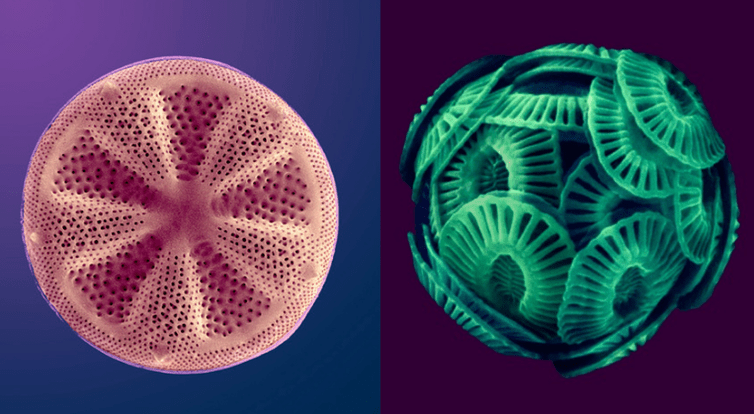
Enhanced scanning electron microscope images of phytoplankton (left, a diatom; right, a coccolithophore). Different phytoplankton species have distinct climatic preferences, which makes them ideal indicators of surface ocean conditions. Dee Breger, CC BY-NC-ND


Finding life in ocean sediments

Scientific ocean drilling has also shown that there are roughly as many cells in marine sediment as in the ocean or in soil. Expeditions have found life in sediments at depths over 8000 feet; in seabed deposits that are 86 million years old; and at temperatures above 140 degrees Fahrenheit.

Today scientists from 23 nations are proposing and conducting research through the International Ocean Discovery Program, which uses scientific ocean drilling to recover data from seafloor sediments and rocks and to monitor environments under the ocean floor. Coring is producing new information about plate tectonics, such as the complexities of ocean crust formation, and the diversity of life in the deep oceans.

This research is expensive, and technologically and intellectually intense. But only by exploring the deep sea can we recover the treasures it holds and better understand its beauty and complexity.

ooOOoo

Did the phrase in the first paragraph of the article jump out for you as it did for me?

This one: “…we know more about the surface of the moon than about the Earth’s ocean floor.”

Doesn’t Mr. Neptune hold his cards close to his chest.

Wonder if he communes with man’s best friend??


A Letter to Mr. Neptune

Continuing my series on examining my navel.

Dear Mr. Neptune,

Your oceans of the world are truly breath-taking. The power you can display in the odd wave or million through to the tranquility you so often also display defy rational explanations.

I have had the profound experience of sailing upon your waters, dear Mr. Neptune, over a number of years sailing back and forth between Cyprus and Turkey. Not a long distance but still sufficient to experience being solo on a yacht day and night.

Tradewind 33 – Songbird of Kent. My home for five years.

Then on my way sailing back to Plymouth, SW England, the magical, almost primeval, feeling of being alone on the Atlantic Ocean. Looking up at the night sky, feeling so insignificant, so infinitesimally minute with 500 miles of open ocean in all directions and those stars above my head.

No question, that practically everything about your oceans is beyond the understanding of us humans. Indeed, I had to look up online how much water there is on Earth to discover there is:

It’s roughly 326 million cubic miles (1.332 billion cubic kilometers), according to a recent study from the U.S. Geological Survey.

Because I simply didn’t have a clue.

And knowing there are approximately 326 million cubic miles of water doesn’t help because I am still left not having a clue as to what that means!

So, thank goodness, Mr. Neptune this is all a ‘walk in the park’ for you!

But I do have a question for you.

What do you make of this?

The image is cropped from the following:

The description of these figures is:

Figure. (upper) Change in global upper-level (0–2000 m) ocean heat content since 1958. Each bar shows the annual mean relative to a 1981–2010 baseline. (lower) Annual mean ocean heat content anomaly in 2017 relative to a 1981–2010 baseline.

And it was taken from research undertaken by Lijing Cheng and Jiang Zhu and found on the web here.

Ocean Heat Content

Owing to its large heat capacity, the ocean accumulates the warming derived from human activities; indeed, more than 90% of Earth’s residual heat related to global warming is absorbed by the ocean (IPCC, Cheng et al. 2017). As such, the global ocean heat content record robustly represents the signature of global warming and is impacted less by weather-related noise and climate variability such as El Niño and La Niña events (Cheng et al. 2018). On the other hand, ocean thermal expansion due to ocean temperature change contributes substantially (30%~50%) to the sea level change, which can considerably influence human populations in coastal and island regions and marine ecosystems. Therefore, monitoring the OHC changes and understanding its variation are crucial for climate change.

Is it possible, Mr. Neptune, that even you as the master of all our oceans is worried about the future?

I hope not but I do fear your answer.

Sincerely,

Paul