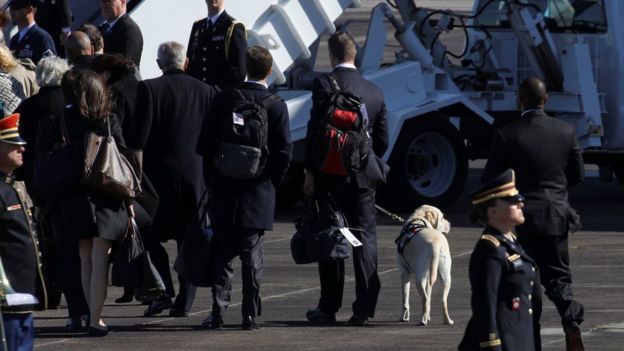
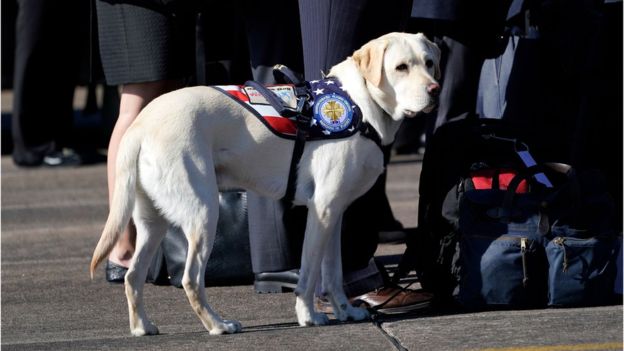
Despite Tom Engelhardt giving me permission years ago to republish his essays I rarely go down that path. Not because many of his essays aren’t deeply interesting but because he doesn’t to the best of my knowledge write about dogs!
It’s quite a long article.
Whether you realize it or not, we are in a new age of imperial geopolitics on a grand — and potentially disastrous — scale. TomDispatch regular Alfred McCoy, author of In the Shadows of the American Century: The Rise and Decline of U.S. Global Power, lays out devastatingly just what that is likely to mean in the age of Donald Trump. And once you’ve read his piece on a century-plus of geopolitical thinkers who helped reorganize this planet in genuinely discordant ways, perhaps you’ll feel it’s time for us to imagine a new kind of geopolitics, one that finally addresses the disaster of empire and the ways in which such geopolitical thinking now intersects with another kind of disaster: climate change. For catastrophic as the previous versions of geopolitics may have been, just wait until such imperial and national follies, including the drive of China and India to build new coal plants galore, meet global warming. By this century’s end, that phenomenon may leave significant parts of the planet facing six nightmarish crises at once, ranging from mega-droughts and mega-fires to rising sea levels and catastrophic flooding. Or what about the possibility that intense heat waves (sparked in part by the massive burning of coal) will, later in this century, make the north China plain, now the most heavily populated part of that country, uninhabitable and do the same for parts of northern India and South Asia? Or what about the recent estimate in a congressionally mandated report on climate change (carefully released by the Trump administration on Black Friday in an attempt to bury it) that this country will also be deeply affected, as, for instance, wildfires of the kind that just devastated parts of California will triple, and the U.S. economy will be downsized by 10% or more by 2100?
We are now on a planet guaranteed, barring a miracle of coordinated human action, to find itself in a set of geo-ruins of an unprecedented sort by 2100, ruins that will remain so on a time scale anything but historical or in any way human. With that in mind, consider McCoy’s account of the “architects of imperial disaster” who got us to just this spot and to an American president whose goal in life is to do everything humanly possible to pump more greenhouse gases in the atmosphere. Tom
Trump’s Trade Czar, The Latest Architect of Imperial Disaster
Five Academics Who Unleashed the “Demon” of Geopolitical Power
By Alfred W. McCoy
As Washington’s leadership fades more quickly than anyone could have imagined and a new global order struggles to take shape, a generation of leaders has crowded onto the world stage with their own bold geopolitical visions for winning international influence. Xi Xinping has launched his trillion-dollar “Belt and Road Initiative” to dominate Eurasia and thereby the world beyond. To recover the Soviet Union’s lost influence, Vladimir Putin seeks to shatter the Western alliance with cyberwar, while threatening to dominate a nationalizing, fragmenting Eastern Europe through raw military power. The Trump White House, in turn, is wielding tariffs as weapons to try to beat recalcitrant allies back into line and cripple the planet’s rising power, China. However bizarrely different these approaches may seem, they all share one strikingly similar feature: a reliance on the concept of “geopolitics” to guide their bids for global power.
Over the past century, countless scholars, columnists, and commentators have employed the term “geopolitics” (or the study of global control) to lend gravitas to their arguments. Few, though, have grasped the true significance of this elusive concept. However else the term might be used, geopolitics is essentially a methodology for the management (or mismanagement) of empire. Unlike conventional nations whose peoples are, in normal times, readily and efficiently mobilized for self-defense, empires, thanks to their global reach, are a surprisingly fragile form of government. They seem to yearn for strategic visionaries who can merge land, peoples, and resources into a sustainable global system.
The practice of geopolitics, even if once conducted from horseback, is as old as empire itself, dating back some 4,000 years. Until the dawn of the twentieth century, it was the conquerors themselves — from Alexander the Great to Julius Caesar to Napoleon Bonaparte — whose geopolitical visions guided the relentless expansion of their imperial domains. The ancient Greek historian Plutarch tried to capture (or perhaps exaggerate) the enormity of Caesar’s conquest of Gaul — a territory that comprises all of modern France and Belgium — by enumerating the nine years of war that “took by storm more than eight hundred cities, subdued three hundred tribes, and fought pitched battles… with three million men, of whom he slew one million… and took as many more prisoners.”
In his own account, however, Caesar reduced all of this to its geopolitical essentials. “All Gaul is divided into three parts,” he wrote in that famous first sentence of his Gallic Wars. “Of all these, the Belgae are the bravest, because… they are the nearest to the Germans, who dwell beyond the Rhine, with whom they are continually waging war; for which reason the Helvetii also surpass the rest of the Gauls in valor, as they contend with the Germans in almost daily battles.” When those formidable Helvetii marched out of their Alpine cantons to occupy Gallic lowlands in 58 BC, Caesar deployed geopolitics to defeat them — seizing strategic terrain, controlling their grain supplies, and manipulating rival tribes. Instead of enslaving the vanquished Helvetii as other Roman generals might have, Caesar, mindful of the empire’s geopolitical balance, returned them to their homelands with generous provisions, lest the German “barbarians” cross the Rhine and destabilize Gaul’s natural frontier.
In more modern times, imperial expansion has been guided by professional scholars who have made the formal study of geopolitics a hybrid field of some significance. Its intellectual lineage is actually remarkably straightforward. At the end of the nineteenth century, an American naval historian argued that seapower was the key to national security and international influence. A decade later, a British geographer observed that railroads had shifted the locus of global power landward into the interior of the vast Eurasian continent. In the succeeding century, a succession of scholars would draw on these two basic ideas to inspire bold geopolitical gambits by Nazi Germany, Cold War Washington, post-Soviet Russia, and even Donald Trump’s White House.
There is, in fact, a common thread in those disparate scholarly lives: in each case, the study of geopolitics seemed to change the trajectory of their careers, lifting them from the margins of society to the right hand of power. There, at moments when the empire they lived in was experiencing a crisis, their unconventional, even eccentric, ideas won influence — often in what would prove in the long term a nightmarish fashion.
Over the last century or so, while the actual application of such thinking regularly proved problematic at best and genuinely horrific at worst, geopolitics would remain a seductive concept with a persistent power to entice would-be practitioners. It would also prove an enormously elusive style of thinking, making it difficult to distinguish between the banal and the brilliant, between the imperially helpful and the imperially devastating.
Charting the interplay of land, people, and resources inside any empire, much less in a clash between such behemoths, is impossibly difficult. Admittedly, geopolitics in the hands of a grandmaster has, in the past, led to the crushing of armies and the conquest of continents. But seemingly similar strategies have also produced searing defeat and disaster. Caesar’s deft geopolitical balancing of Gaul and Germany on the fulcrum of the Rhine survived for some four centuries; Napoleon’s similar attempt lasted all of seven years.
Telling the difference, in the historical moment, is a daunting task and one that hasn’t turned out well in the last century. With that in mind, let’s now approach the careers of five modern “grandmasters” of geopolitics with an appropriate skepticism.
America’s Strategic Visionary
In 1890, as the industrial boom of the Gilded Age prepared the nation for a debut on the world stage, Captain Alfred Thayer Mahan, arguably America’s only original strategic thinker, published his famed Influence of Seapower Upon History. In it, he argued that naval power was the determining factor in the fate of nations. Born at West Point, where his father taught military tactics to Army cadets, Mahan came to the study of strategy almost by birthright. After graduating from the Naval Academy and having an indifferent career at sea, he became the head of the Naval War College in 1886. There, he developed novel geopolitical ideas that would revive a stalled career.
By analyzing sea power through a wide range of factors, including the defensibility of ports, national technological prowess, and the nature of good government, Mahan would produce the first serious study of geopolitics in the guise of a guide to naval strategy. In the process, he became an international celebrity, influencing admirals from London to Tokyo and inspiring leaders worldwide to join a naval arms race that would drain their treasuries to build costly battleships. The admiral who headed Germany’s navy, for instance, distributed 8,000 copies of Mahan’s history in translation and in the process won passage of the country’s first naval bill in 1898, funding his fateful challenge to British sea power.
As Europe’s empires continued to spread globally in the 1890s, Mahan’s prolific prose persuaded Washington that national defense required the creation of a genuine blue-water navy and bases in both the Caribbean and the Pacific. So important were such bases for the nation’s defense that, as Mahan gravely concluded, “No European state should henceforth acquire a coaling position within three thousand miles of San Francisco” — a distance that encompassed the Hawaiian Islands, soon to become U.S. possessions.
Like many advocates of geopolitics to come, Mahan would use seemingly precise strategic concepts to project his country’s current position into a murky future. As his geopolitical principles took physical form after 1898, they would produce an indefensible string of bases stretching across the Pacific from Panama to the Philippines.
Following his doctrine, the Navy ordered Admiral George Dewey’s squadron to seize Manila Bay during the Spanish-American War of 1898, which he did by sinking the Spanish fleet. Within five years, however, Japan’s stunning victory over the Russian fleet in the Sea of Japan forced Washington to withdraw much of its navy from the Western Pacific. In 1907, President Theodore Roosevelt began building a new Pacific bastion at Pearl Harbor in Hawaii, not in Manila Bay, saying that the Philippines, by then an American colony, is “our heel of Achilles.” Making matters worse, the Versailles peace settlement at the end of World War I conceded the Mariana Islands in the Western Pacific to Japan, allowing its navy to block the sea-lanes from Pearl Harbor to Manila Bay — a geopolitical reality that would doom General Douglas MacArthur’s Philippine command to a searing defeat at the start of World War II.
At that war’s end, however, Washington finally resolved this geopolitical conundrum by conquering Japan and building a chain of more than 100 bases from that country to the Philippines, making the Pacific littoral the strategic fulcrum for the defense of one continent (North America) and dominion over another (Eurasia).
Sir Halford Propagates Geopolitics
Little more than a decade after Mahan wrote his influential studies of seapower, Sir Halford Mackinder, head of the London School of Economics (LSE), published a seminal article that shifted the focus of geopolitics from sea to land. Writing in 1904, as the 5,700 miles of the Trans-Siberian Railway was still being built from Moscow to Vladivostok, Mackinder argued that future rail lines would knit Eurasia into a unitary landmass that he dubbed “the world island.” When that day came, Russia, perhaps in alliance with another land power like Germany, could control Eurasia’s sprawling “heartland,” allowing “the use of vast continental resources for fleet-building, and the empire of the world would be in sight.”
This path-breaking analysis came at a fortuitous time in Mackinder’s academic career. After teaching geography at Oxford for 10 years, he had failed to win a professorship and his marriage collapsed. At this low ebb in his life, he tried to establish himself as an exploratory geographer by making the first recorded ascent of Mount Kenya. Using the “moral suasion of my Mauser” rifle to force his 170 African bearers to “obey like the faithful dogs they are,” Mackinder moved through the famine-stricken foothills leading to that mountain by extracting food from hungry villages at gunpoint. Then, in September 1899, at the cost of 10 porters shot and many more whipped for “malingering,” he traversed glaciers to reach the summit at 17,000 feet. His triumph before a cheering crowd at the Royal Geographical Society in London was, however, marred not by his treatment of those bearers but by his failure to bring back significant findings or scientific specimens.
So, in yet another career change, Mackinder joined the LSE where he produced that influential article on geopolitics. At the end of World War I, he turned it into a book that contained his most memorable maxim: “Who rules East Europe commands the Heartland; Who rules the Heartland commands the World-Island; Who rules the World-Island commands the World.”
Mackinder’s expertise in imperial geopolitics helped launch his political career, including gaining him a seat in Parliament. In 1919, amid the turmoil of the Russian revolution, Britain was shipping arms to anti-Bolshevik forces there under General Anton Denikin. At Winston Churchill’s behest, the cabinet then appointed Mackinder as a special high commissioner for southern Russia. In a unique test of his “heartland” theory, Mackinder made an abortive attempt to rally the Czarist forces by meeting General Denikin inside his railcar in the Caucasus to propose an alliance with Poland and promise a mass evacuation in the event of defeat. Upon return to London, ignoring the general’s role in slaughtering some 100,000 Jews, Mackinder recommended recognizing his government and providing aid — advice the cabinet quickly dismissed.
From that brief moment at the apex of power, Mackinder soon fell into obscurity — losing his seat in Parliament, retiring from the LSE, and settling into a sinecure as chairman of the Imperial Shipping Committee. Were it not for the surprising later appeal of his ideas in Nazi Germany and Vladimir Putin’s Russia, his name would have been largely forgotten.
The Sorcerer’s Nazi Apprentice
As the Versailles peace conference of 1919 stripped Germany of its colonial empire and placed its Rhineland frontier under foreign occupation, Karl Haushofer exchanged his general’s baton for a geography professorship at Munich University. There, he would apply Mackinder’s concepts in an attempt to assure that his fatherland would never again engage in the sort of strategic blunders that, in World War I, had led to such a humiliating defeat.
While Mackinder himself was courting the powerful in postwar London, Haushofer was teaching geopolitics to future top Nazis in Munich — first to his graduate assistant Rudolf Hess (later to become the deputy Führer), and then to Adolf Hitler himself while he was writing Mein Kampf during his incarceration at Munich’s Landsberg Prison in 1924. Both Haushofer and his son Albrecht, who would train Nazi diplomats in the geopolitics of European conquest, were later rewarded with influential positions in the Third Reich. By dressing the British don’s idea of the Eurasian heartland as the pivot of world power in the local garb of Lebensraum (or “the Greater German Reich’s dazzling ascent by war… for extension of its living space”), Haushofer helped propagate an enticing logic of expansion that would send Hitler’s army on the road to defeat.
In 1942, Hitler dispatched a million men, 10,000 artillery pieces, and 500 tanks to breach the Volga River at Stalingrad and capture Russia’s heartland for lebensraum. In the end, the Reich’s forces would suffer 850,000 casualties — killed, wounded, and captured — in a vain attempt to break through the East European rimland into the world island’s heartland.
Appalled by the attack on Russia, Haushofer’s son joined the underground’s attempt to assassinate Hitler and was imprisoned. Before he was finally shot by the SS (on the day the Allies captured Berlin), he would compose mournful sonnets about geopolitical power, which he saw metaphorically as buried deep under the sea until “my father broke the seal” and “set the demon free to roam throughout the world.” A few months later, Karl Haushofer and his Jewish wife committed suicide together when confronted with the possibility that the victorious allies might prosecute him as a senior Nazi war criminal.
The Liberator of Eastern Europe
As the United States recoiled from its searing defeat in Vietnam, Zbigniew Brzezinski, an émigré Polish aristocrat and autodidact when it came to geopolitics, went from teaching international relations in New York to being President Jimmy Carter’s national security advisor in Washington. There, his risky geopolitical gambits gained an attentive audience after the Soviet Red Army invaded Afghanistan in 1979.
As an intellectual acolyte of Mackinder, Brzezinski embraced his concept of the Eurasian heartland as the “pivot” of global power. But in marked contrast to Mackinder’s failure in southern Russia in 1920, Brzezinski would prove adept at applying that geopolitician’s famous dictum on the dynamic that tied Eastern Europe to Eurasia’s heartland. (In the end, however, his Afghan moves would help give rise to Osama bin Laden, al-Qaeda, the 9/11 attacks, and the never-ending war on terror of this century.)
Wielding a multi-billion-dollar CIA covert operation in Afghanistan like a sharpened wedge, Brzezinski drove radical Islam deep into the heart of Soviet Central Asia. In the process, he drew Moscow into a debilitating decade-long Afghan war, so weakening it that Eastern Europe would finally break free from the Soviet empire in 1989. Asked about the enormous human suffering his strategy inflicted on Afghanistan and his role in creating a militant Islam hostile to the United States, he would remain coolly unapologetic. “What is most important to the history of the world?” he responded in 1998. “The Taliban or the collapse of the Soviet empire? Some stirred-up Moslems or the liberation of Central Europe and the end of the Cold War?”
In retirement, Brzezinski resumed his study of Mackinder’s theory, doing a better job as an armchair analyst than he had as a presidential adviser. In a 1998 book, he warned that dominance over Eurasia remained “the central basis for global primacy.” To control that vast region, Washington, he insisted, would have to preserve its “perch on the Western periphery” of Europe and hold its string of “offshore bases” along the Pacific littoral. Should these conditions change, he predicted with some prescience, “a potential rival to America might at some point arise.”
Putin’s Geopolitical Visionary
In the aftermath of the Soviet Union’s collapse, a Russian rightist ideologue, Alexander Dugin, would revive Mackinder’s ideas yet again to promote expansion into Eurasia. In the process, he would become “a major influence” on Russian President Vladimir Putin.
In the 1980s, as the Soviet Union was beginning to unravel, Dugin was still moving in Moscow’s bohemian circles as a dabbler in the occult and a fringe member of the “ultra-nationalist and anti-Semitic organization Pamiat.” After the Soviet collapse, he became chief ideologue for an eclectic alliance of patriotic and punk-rock groups called the New Bolshevik Party, serving as its candidate for a seat in the 1995 Duma legislative elections and winning just 1% of the vote.
At this political nadir for both him and his country, Dugin recycled Mackinder’s long-forgotten writings in a 1997 bestseller, The Foundation of Geopolitics: Russia’s Geopolitical Future. As his book moved into its fourth printing and he “became a pole star for a broad section of Russian hardliners,” he began teaching geopolitics to military officers at the General Staff Academy, later lecturing on it to elite students at Moscow State University, and anchoring Landmarks, a weekly television show on the subject. In those years, Moscow bookstores even opened special sections for geopolitics, the legislature formed a geopolitics committee, and the Russian leadership began to embrace Dugin’s vision of expansionist nationalism.
Drawing on Haushofer’s German writings, he argued that Russia should become a Eurasian bastion against “the conspiracy of ‘Atlanticism’ led by the United States and NATO… aimed at containing Russia within successive geographic rings” of the former Soviet republics. To achieve the destiny envisioned by Mackinder, Russia needed, in Dugin’s view, to dominate Eurasia — annexing Ukraine, conquering Georgia, incorporating Finland, and bringing the Balkan states (Serbia, Romania, and Bulgaria) under its rule as an Orthodox “Third Rome.” To advance such ideas, Dugin founded the Eurasia Youth Union of Russia in 2005, first to serve as “human shields” to fight against the Orange revolution in Ukraine and later to counter the “degeneration” caused by American cultural influence.
For the past decade, he has been a forceful advocate for Russian expansionism. During that country’s war with Georgia in 2008, he was photographed with a rocket launcher in South Ossetia and quoted in the national press calling for its annexation. After serving as “the brains behind Vladimir Putin’s wildly popular annexation of Crimea” in March 2014, Dugin embraced the Russian minority in eastern Ukraine, prodding the Russian president to openly support their separatist militia.
While advocacy of aggressive geopolitics has given Dugin significant political influence and Putin unprecedented popularity in Russia, it is still unclear whether in the long run such expansionism, in defiance of international norms, will prove a geopolitical masterstroke or a diplomatic debacle.
The Geopolitics of Trump’s Trade War
Most recently, a dissident economist and failed California politician named Peter Navarro has parlayed his hostility toward China into the role of key architect of Donald Trump’s “trade war” against Beijing. Like his Russian counterpart Alexander Dugin, Navarro is another in a long line of intellectuals whose embrace of geopolitics changed the trajectory of his career.
Raised by a single mom who worked secretarial jobs to rent one-bedroom apartments where he slept on the couch, Navarro went to college at Tufts on a scholarship and earned a doctorate in economics from Harvard. Despite that Ivy League degree, he remained an angry outsider, denouncing the special interests “stealing America” in his first book and later, as a business professor at the University of California-Irvine, branding San Diego developers “punks in pinstripes.” A passionate environmentalist, in 1992 Navarro plunged into politics as a Democratic candidate for the mayor of San Diego, denouncing his opponent’s husband as a convicted drug-money launderer and losing when he smirked as she wept during their televised debate.
For the next 10 years, Navarro fought losing campaigns for everything from city council to Congress. He detailed his crushing defeat for a seat in the House of Representatives in a tell-all book, San Diego Confidential, that dished out disdain for that duplicitous “sell out” Bill Clinton, dumb “blue-collar detritus” voters, and just about everybody else as well.
Following his last losing campaign for city council, Navarro spent a decade churning out books attacking a new enemy: China. His first “shock and awe” jeremiad in 2006 told horror stories about that country’s foreign trade; five years later, Death By China was filled with torrid tales of “bone-crushing, cancer-causing, flammable, poisonous, and otherwise lethal products” from that land. In 2015, a third book turned to geopolitics, complete with carefully drawn maps and respectful references to Captain Mahan, to offer an analysis of how China’s military was pursuing a relentless strategy of “anti-access, area denial” to challenge the U.S. Navy’s control over the Western Pacific.
To check China, the Pentagon then had two competing strategies — “Air-Sea Battle,” in which China’s satellites were to be blinded, knocking out its missiles, and “Offshore Control,” in which China’s entire coastline was to be blockaded by mining six maritime choke points from Japan to Singapore. Both, Navarro claimed, were fatally flawed. Given that, Navarro’s third book and a companion film (endorsed by one Donald Trump) asked: What should the United States do to check Beijing’s aggression and its rise as a global power? Since all U.S. imports from China, Navarro suggested, were “helping to finance a Chinese military buildup,” the only realistic solution was “the imposition of countervailing tariffs to offset China’s unfair trade practices.”
Just a year after reaching that controversial conclusion, Navarro joined the Trump election campaign as a policy adviser and then, after the November victory, became a junior member of the White House economic team. As a protectionist in an administration initially dominated by globalists, he would be excluded from high-level meetings and, according to Time Magazine, “required to copy chief economic adviser Gary Cohn on all his emails.” By February 2018, however, Cohn was on his way out and Navarro had become assistant to the president, with his new trade office now the co-equal of the National Economic Council.
As the chief defender of Trump’s belief that “trade wars are good and easy to win,” Navarro has finally realized his own geopolitical dream of attempting to check China with tariffs. In March, the president slapped heavy ones on Chinese steel imports and, just a few weeks later, promised to impose more of them on $50 billion of imports. When those started in July, China’s leaders retaliated against what they called “typical trade bullying,” imposing similar duties on American goods. Despite a warning from the Federal Reserve chairman that “trade tensions… could pose serious risks to the U.S. and global economy,” with Navarro at his elbow, Trump escalated in September, adding tariffs on an additional $200 billion in Chinese goods and threatening another $267 billion worth if China dared retaliate. Nonetheless, Beijing hit back, this time on just $60 billion in goods since 95% of all U.S. imports had already been covered.
Then something truly surprising happened. In September, the U.S. trade deficit with China ballooned to $305 billion for the year, driven by an 8% surge in Chinese imports — a clear sign that Navarro’s bold geopolitical vision of beating Beijing into submission with tariffs had collided big time with the complexities of world trade. Whether this tariff dispute will fizzle out inconsequentially or escalate into a full-blown trade war, wreaking havoc on global supply chains and the world economy, none of us can yet know, particularly that would-be geopolitical grandmaster Peter Navarro.
The Desire to be Grandmaster of the Universe
Though such experts usually dazzle the public and the powerful alike with erudition and boldness of vision, their geopolitical moves often have troubling long-term consequences. Mahan’s plans for Pacific dominion through offshore bases created a strategic conundrum that plagued American defense policy for a half-century. Brzezinski’s geopolitical lunge at the Soviet Union’s soft Central Asian underbelly helped unleash radical Islam. Today, Alexander Dugin’s use of geopolitics to revive Russia’s dominion over Eurasia has placed Moscow on a volatile collision course with Europe and the United States. Simultaneously, Peter Navarro’s bold gambit to contain China’s military and economic push into the Pacific with a trade war could, if it persists, produce untold complications for our globalized economy.
No matter how deeply flawed such geopolitical visions may ultimately prove to be, their brief moments as official policy have regularly shaped the destiny of nations and of empires in unpredictable, unplanned, and often dangerous ways. And no matter how this current round of geopolitical gambits plays out, we can be reasonably certain that, in the not-too-distant future, another would-be grandmaster will embrace this seductive concept to guide his bold bid for global power.
Alfred W. McCoy, a TomDispatch regular, is the Harrington professor of history at the University of Wisconsin-Madison. He is the author of The Politics of Heroin: CIA Complicity in the Global Drug Trade, the now-classic book which probed the conjuncture of illicit narcotics and covert operations over 50 years, and the recently published In the Shadows of the American Century: The Rise and Decline of U.S. Global Power (Dispatch Books).
Follow TomDispatch on Twitter and join us on Facebook. Check out the newest Dispatch Books, John Feffer’s new dystopian novel (the second in the Splinterlands series) Frostlands, Beverly Gologorsky’s novel Every Body Has a Story, and Tom Engelhardt’s A Nation Unmade by War, as well as Alfred McCoy’s In the Shadows of the American Century: The Rise and Decline of U.S. Global Power and John Dower’s The Violent American Century: War and Terror Since World War II.
Copyright 2018 Alfred W. McCoy










 Deinah Storm is a pet lover from the US that’s had cats and dogs all her life. When she’s not walking the dogs with her family, she spends time writing informational and interesting blogs about pets to share with pet lover communities.