Category: Writing

It’s not just me!

I thought this was worth sharing!

The problem with coming up to the age of 75, and aware that I am close to the average life expectancy in the US, is that one increasingly worries about stuff. Such as it seems like the world is becoming more unsettled. But then it is put down to age!

But this article does imply that it is a more unsettled world and we should take notice. Republished with permission.

ooOOoo

5 tips for surviving in an increasingly uncertain world

What does the future hold – and how will you handle what comes next?
Svetlana Lukienko/Shutterstock.com

Jelena Kecmanovic, Georgetown University

A recent study showed that North Americans are becoming less tolerant of uncertainty.

The U.S. presidential impeachment inquiry has added another layer of uncertainty to an already unstable situation that includes political polarization and the effects of climate change.

As a clinical psychologist in the Washington, D.C. area, I hear people report being stressed, anxious, worried, depressed and angry. Indeed, an American Psychological Association 2017 survey found that 63% of Americans were stressed by “the future of our nation,” and 57% by the “current political climate.”

Humans dislike uncertainty in most situations, but some deal with it better than others. Numerous studies link high intolerance of uncertainty to anxiety and anxiety disorders, obsessive-compulsive disorder, depression, PTSD and eating disorders.

While no one person can reduce the uncertainty of the current political situation, you can learn to decrease intolerance of uncertainty by implementing these scientifically sound strategies.

1. Commit to gradually facing uncertainty

Even though humans encounter uncertain situations every day, we often avoid feeling the discomfort of facing the uncertainty.

When unsure how to best proceed with a work assignment, you might either immediately seek help, over-research or procrastinate. As you prepare for the day, uncertainty about the weather or traffic is quickly short-circuited by checking a phone. Similarly, inquiries about family or friends’ whereabouts or emotions can be instantly gratified by texting or checking social media.

All this avoidance of uncertainty leads to relief in the short run, but lessens your ability to tolerate anything short of complete certainty in the long run.

Tolerance for uncertainty is like a muscle that weakens if not used. So, work that muscle next time you face uncertainty.

Start gradually: Resist the urge to reflexively check your GPS the next time you are lost and aren’t pressured for time. Or go to a concert without Googling the band beforehand. Next, try to sit with the feelings of uncertainty for a while before you pepper your teenager with texts when he is running late. Over time, the discomfort will diminish.

2. Connect to a bigger purpose

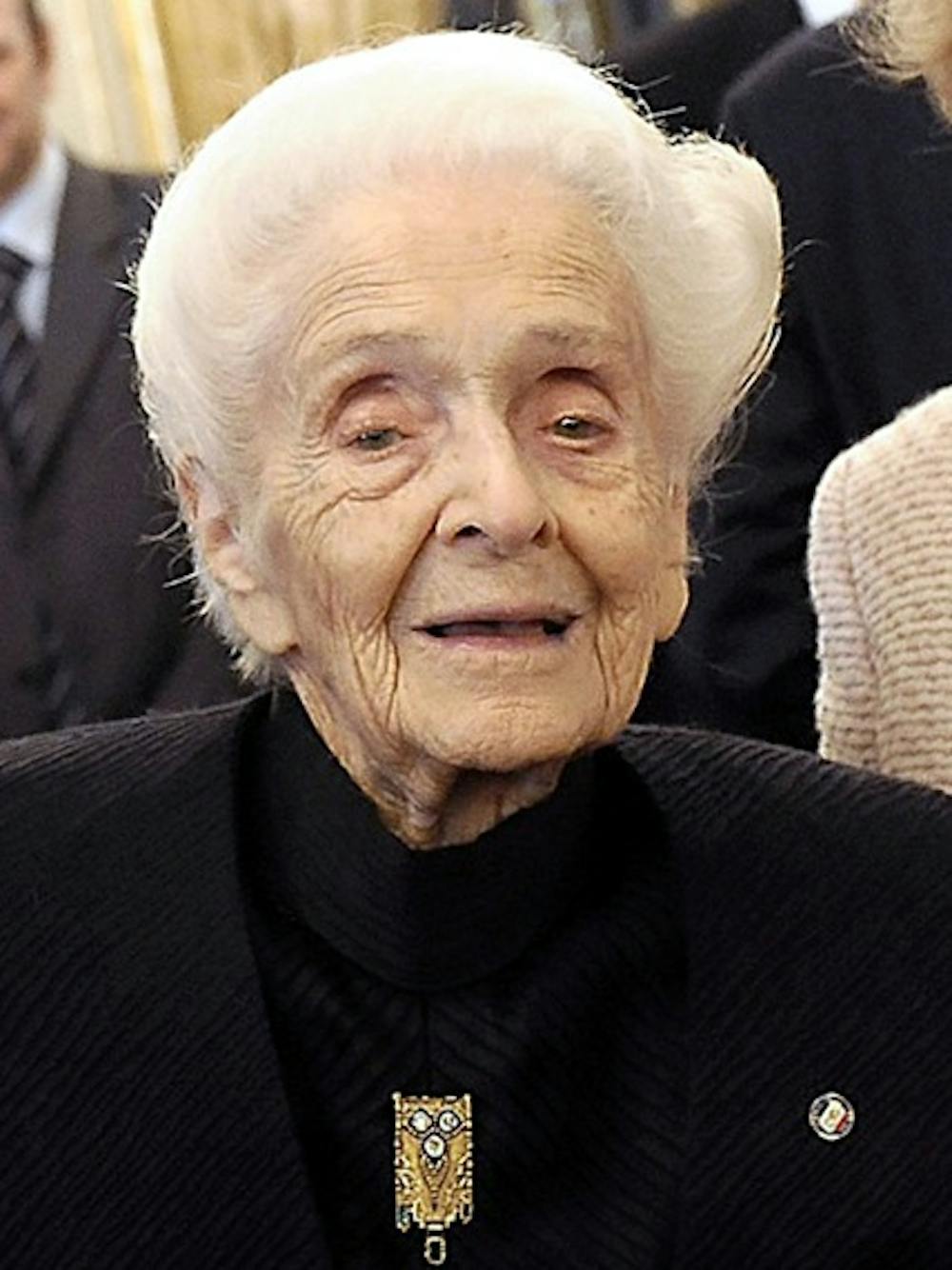
Rita Levi-Montalcini.
Presidency of Italian Republic/Wikimedia, CC BY

Rita Levi-Montalcini was a promising young Jewish scientist when fascists came to power in Italy and she had to go into hiding. As World War II was raging, she set up a secret lab in her parents’ bedroom, studying cell growth. She would later say that the meaning that she derived from her work helped her to deal with the evil outside and with the ultimate uncertainty of whether she would be discovered.

What gives your life meaning? Finding or rediscovering your life purpose can help you deal with uncertainty and the stress and anxiety related to it.

Focusing on what can transcend finite human existence – whether it is religion, spirituality or dedication to a cause – can decrease uncertainty-driven worry and depression.

3. Don’t underestimate your coping ability

You might hate uncertainty because you fear how you would fare if things went badly. And you might distrust your ability to cope with the negative events that life throws your way.

Most people overestimate how bad they will feel when something bad happens. They also tend to underestimate their coping abilities.

It turns out that humans are generally resilient, even in the face of very stressful or traumatic events. If a feared outcome materializes, chances are you will deal with it better than you could now imagine. Remember that the next time uncertainty rears its head.

4. Bolster resilience by increasing self-care

You have probably heard it many times by now: Sleep well, exercise and prioritize social connections if you want to have a long and happy life.

What you might not know is that the quantity and quality of sleep is also related to your ability to deal with uncertainty. Exercise, especially of the cardio variety, can increase your capacity to cope with uncertain situations and lower your stress, anxiety and depression. A new review study suggests that regular exercise may even be able to prevent the onset of anxiety and anxiety disorders.

Possibly the best tool for coping with uncertainty is making sure that you have an active and meaningful social life. Loneliness fundamentally undermines a person’s sense of safety
and makes it very hard to deal with the unpredictable nature of life.

Having even a few close family members or friends imparts a feeling that “we are in this all together,” which can protect you from psychological and physical problems.

5. Appreciate that absolute certainty is impossible

Nothing is certain in life. The sooner you start thinking about that fact, the easier it will be to face it.

Moreover, repeated attempts at predicting and controlling everything in life can backfire, leading to psychological problems like OCD.

In spite of civilization’s great progress, the fantasy of humankind’s absolute control over its environment and fate is still just that – a fantasy. So, I say to embrace the reality of uncertainty and enjoy the ride.

[ You’re smart and curious about the world. So are The Conversation’s authors and editors. You can read us daily by subscribing to our newsletter. ]The Conversation

Jelena Kecmanovic, Adjunct Professor of Psychology, Georgetown University

This article is republished from The Conversation under a Creative Commons license. Read the original article.

ooOOoo

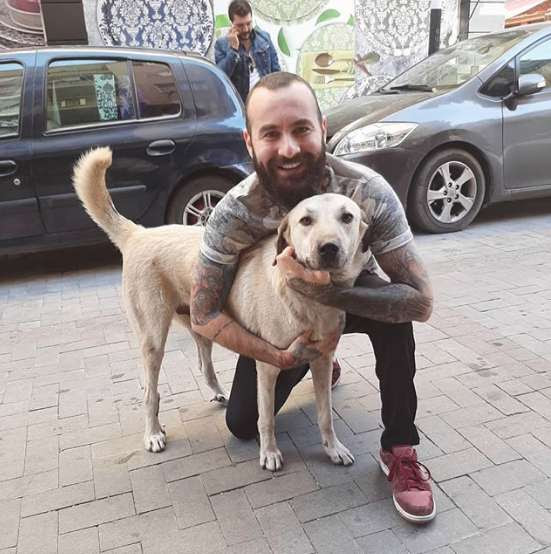
Photo Credit: Twitter/bendemistims

Now whatever uncertainty exists in your life a dog or two will make things a great deal better.

That’s a fact!

There’s no end to the things dogs do.

This is about a dog that lives near a golf course.

This was a story that appeared on The Dodo website in September. Unfortunately I can’t seem to republish the video nor the entry in Instagram but it is still a cute story and worth sharing with you all.

ooOOoo

Friendly Dog Who Lives Near Golf Course Loves Begging For Pets

She even has her own little window ❤️️

BY
PUBLISHED ON 09/27/2019

Loni Gaisford was out golfing with her family last Sunday at the Mick Riley Golf Course in Murray, Utah, when she saw something unusual by the fourth hole.

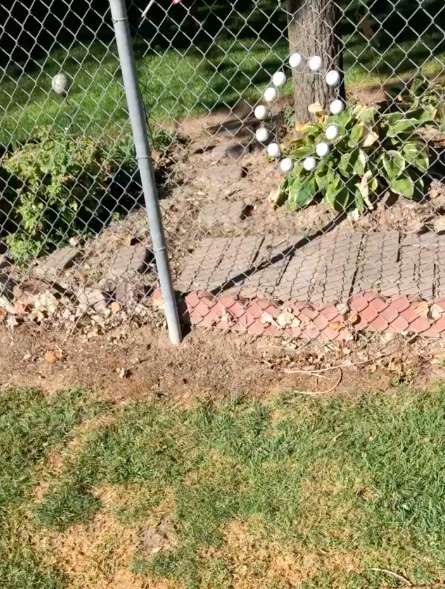
Golf balls were attached in a ring to the metal fence separating the green from a neighboring house. Gaisford decided to investigate, curious why someone would make such a strange display.

Loni Gaisford

“When we pulled up to the tee box … we noticed the golf ball ring in the fence with a sign next to it,” Gaisford told The Dodo. “I walked over to read the sign thinking it was a memorial for someone.”
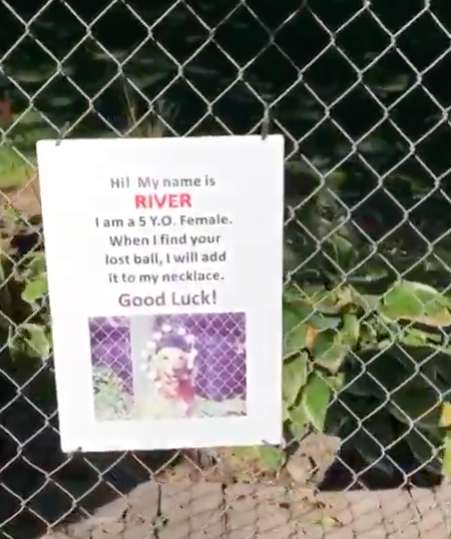
The sign read: “Hi! My name is River. I’m a 5 Y.O. female. When I find your lost ball, I will add it to my necklace. Good luck!”

Loni Gaisford

Gaisford finally understood the hilarious meaning behind the golf ball ring — and then she spotted the dog from the photo, playing nearby.
“We noticed River was in the backyard with a toy,” Gaisford said. “[She] walked over to the hole in the fence but the toy was too big to stick her head through the window so she just let us rub her back.”

After Gaisford teed off, she returned to say goodbye to River. The dog suddenly dropped the toy and stuck her head through the “necklace” to receive a few head scratches
Gaisford posted the video to her Instagram later that night, and as the comments came in, she realized that River was something of a local celebrity. “Every time I play that course she never does that … Jealous,” one commenter wrote.
Another commenter couldn’t resist making a few golf puns: “What’s the best type of fence for a dog who lives next to a golf course!? A fence with a hole in one!”
When the video made it to Reddit, more golf lovers shared stories of their own special experiences with the pup: ”One day, I was at McRiley and the owner of that dog was walking her (no leash) and she jumped right into our cart and sat down,” la_fern72 wrote on Reddit. “She was super friendly.”

Gaisford couldn’t be happier that her video has reached so many people — including those who will never set foot on a golf course. “Meeting River brightened my day,” Gaisford said, “and I knew the internet would love meeting River as much as I did.”

ooOOoo

Well I tried ever so hard to find a way of showing you the video, and unfortunately it is not on YouTube, so you are going to have to go across to the website to watch it. Sorry!

The treasure that is a pit bull

This is the true nature of this breed.

Pit Bulls have such a bad reputation. But in our experience if they are cared for and loved and not used for fighting then they are great dogs.

No better illustrated than by this story that appeared on The Dodo website.

ooOOoo

Dog Refuses To Leave Mom’s Hospital Room After Saving Her Life

SUCH a good girl 👏🐕💕
BY

PUBLISHED ON 10/10/2019

When Shauna Darcy first brought Ruby home, the plan was to have Ruby act as a service dog to help her with anxiety, depression and agoraphobia. Ruby was an incredible service dog and companion from the very beginning — and quickly showed Darcy just how far she would go to help her.

Shauna Darcy

“While she was training to be a service dog I noticed that she started picking up on changes in my heart rate and would act funny — for example, paw at me, try to get my attention, get on top of me, etc.,” Darcy told The Dodo.

Picking up on Ruby’s cues, Darcy went to the doctor and discovered she had health issues she hadn’t known about, including a rare heart condition called vascular Ehlers-Danlos syndrome. Ruby had known something was wrong even before Darcy did, and her main focus as a service dog quickly switched to Darcy’s cardiac issues.


Shauna Darcy

Every day, Ruby helps her mom with things like monitoring her heart rate and blood pressure, helping her during panic attacks and retrieving emergency medications. She also carries groceries, picks up dropped items and gets things her mom can’t reach, and is trained in deep pressure therapy.

“When I pass out she gets on top of me and applies all her pressure on me and licks my hands and face until I come around,” Darcy said.

Shauna Darcy

Ruby is there for her mom every single day — even when she doesn’t realize she needs her.

Last week, when Ruby started alerting her mom that something was wrong, she had no idea why. At that point, Darcy was feeling fine, but decided to trust Ruby and call an ambulance anyway, just in case.

“It turns out my heart was going into atrial fibrillation,” Darcy said. “By the time the paramedics came, I was in pain and barely conscious.”

Shauna Darcy

As the paramedics rushed Darcy to the hospital, she realized that Ruby had saved her life that day.

While Darcy was in the hospital and the doctors worked to get her stable again, Ruby refused to leave her mom’s side. Even while Darcy was unconscious, Ruby lay in her hospital bed, pressed up against her, hoping her mom could sense she was there and that her presence would make her feel safe.

Shauna Darcy

During their stay at the hospital, so many people stopped by to meet Ruby. She’s always very popular whenever she and her mom are at the hospital and loves saying hi to everyone — but also makes sure that she’s never too far away from her mom. She loves her so much, and her mom loves her just as much right back.

Shauna Darcy

Without Ruby, Darcy’s life would be very different. Ruby helps her mom stay healthy and safe every single day, and her mom is so grateful for everything she’s done for her.

“I wouldn’t be alive without her,” Darcy said.

ooOOoo

“I wouldn’t be alive without her,”

I’m emboldening that last statement.

This is a wonderful story.

For Darcy has articulated what millions of other dog lovers know in their hearts. That the relationship between a dog and a human is extra special!

Not all things to do with Turkey are bad.

This is a delightful man-meets-dog story.

I was pondering that I really should return to sharing stories about dogs. After all this is a blog that is called Learning from Dogs.

Then I recently saw this story from Turkey. It’s about a stray dog and it is in Turkey and it’s from The Dodo so is republished with permission.

That did it!

ooOOoo

Security Camera Catches Man Sharing Adorable Moment With Stray Dog

Photo Credit: Twitter/bendemistim

In the early hours of Saturday morning, Metin Can Şener was walking home along a street in Turkey when a figure emerged from the darkness in front of him.

It was a pup — his tail wagging eagerly at the sight of Şener approaching.

Şener had seen the dog before, but apparently only during the day; he often hangs out at Şener’s local coffee shop, where this random encounter at 2:51 a.m. took place.

“He comes to that street all the time,” Şener told The Dodo. “I always see him by the café.”

Photo Credit: Twitter/bendemistims

On this particular early morning, however, Şener and the dog became much better acquainted. As if compelled by the same joyful spirit upon seeing a familiar face on that empty street, the two of them reacted in the sweetest way: “We started dancing,” Şener said.

The adorable moment was captured on video.

Şener and the dog were passing strangers no longer.

“We became good friends,” Şener said. “I already have four dogs, so I couldn’t take him home.”

Fortunately, despite apparently living as a stray, the dog appears to be well-fed — perhaps having endeared himself to people in the area. Their random meeting this particular morning certainly had that effect on Şener.

Photo Credit: Twitter/bendemistims

Neither Şener nor the dog knew at the time that their heartwarming encounter had been caught on film. The owner of the café had evidently reviewed the security footage and shared it with Şener the next day.

And since posting it online, the happy scene has gone viral.

“I was surprised to see it had been caught on camera. I thought it was so much fun,” Şener said. “I always like to dance with animals like this. I love animals even more than people.”

ooOOoo

The video on YouTube follows. But before I go let me comment about that last photograph, the one just above, because this is what having a dog in your life is all about!

http://www.youtube.com/watch?v=IuWkeMADcBE

Delightful!

Being alone!

We have had a taste of this a week-and-a-half ago.

We were truly alone when we went to Utah.

But then again, one of the privileges of being on 13 acres, 13 very rural acres, here in Southern Oregon is that being alone is not that far away!

I don’t want to underplay the importance of this posting, republished from The Conversation website (with permission), because we live in so busy times.

Written by three professors, it’s a very wise and profound article.

ooOOoo

Spending time alone in nature is good for your mental and emotional health

June 4th, 2018

By

Professor of Outdoor Education, Montreat College

Associate Professor and Program Director of Parks and Recreation Management, Western Carolina Universit

Associate Professor of Outdoor Education, Montreat College

Today Americans live in a world that thrives on being busy, productive and overscheduled. Further, they have developed the technological means to be constantly connected to others and to vast options for information and entertainment through social media. For many, smartphones demand their attention day and night with constant notifications.

As a result, naturally occurring periods of solitude and silence that were once commonplace have been squeezed out of their lives. Music, reality TV shows, YouTube, video games, tweeting and texting are displacing quiet and solitary spaces. Silence and solitude are increasingly viewed as “dead” or “unproductive” time, and being alone makes many Americans uncomfortable and anxious.

But while some equate solitude with loneliness, there is a big difference between being lonely and being alone. The latter is essential for mental health and effective leadership.

We study and teach outdoor education and related fields at several colleges and organizations in North Carolina, through and with other scholars at 2nd Nature TREC, LLC, a training, research, education and consulting firm. We became interested in the broader implications of alone time after studying intentionally designed solitude experiences during wilderness programs, such as those run by Outward Bound. Our findings reveal that time alone in nature is beneficial for many participants in a variety of ways, and is something they wish they had more of in their daily life.

On an average day in 2015, individuals aged 15 and over spent more than half of their leisure time watching TV. Bureau of Labor Statistics, Americans Time Use Survey

Reflection and challenge

We have conducted research for almost two decades on Outward Bound and undergraduate wilderness programs at Montreat College in North Carolina and Wheaton College in Illinois. For each program, we studied participants’ experiences using multiple methods, including written surveys, focus group interviews, one-on-one interviews and field notes. In some cases, we asked subjects years later to look back and reflect on how the programs had affected them. Among other questions, our research looked at participant perceptions of the value of solo time outdoors.

Our studies showed that people who took part in these programs benefited both from the outdoor settings and from the experience of being alone. These findings build on previous research that has clearly demonstrated the value of spending time in nature.

Scholars in fields including wilderness therapy and environmental psychology have shown that time outdoors benefits our lives in many ways. It has a therapeutic effect, relieves stress and restores attention. Alone time in nature can have a calming effect on the mind because it occurs in beautiful, natural and inspirational settings.

Spending time in city parks like Audubon Park in New Orleans provides some of the same benefits as time in wilderness areas, including reduced stress levels and increased energy levels. InSapphoWeTrust, CC BY-SA

Nature also provides challenges that spur individuals to creative problem-solving and increased self-confidence. For example, some find that being alone in the outdoors, particularly at night, is a challenging situation. Mental, physical and emotional challenges in moderation encourage personal growth that is manifested in an increased comfort with one’s self in the absence of others.

Being alone also can have great value. It can allow issues to surface that people spend energy holding at bay, and offer an opportunity to clarify thoughts, hopes, dreams and desires. It provides time and space for people to step back, evaluate their lives and learn from their experiences. Spending time this way prepares them to re-engage with their community relationships and full work schedules.

Putting it together: The outdoor solo

Participants in programmed wilderness expeditions often experience a component known as “Solo,” a time of intentional solitude lasting approximately 24-72 hours. Extensive research has been conducted on solitude in the outdoors because many wilderness education programs have embraced the educational value of solitude and silence.

Solo often emerges as one of the most significant parts of wilderness programs, for a variety of reasons. Alone time creates a contrasting experience to normal living that enriches people mentally, physically and emotionally. As they examine themselves in relation to nature, others, and in some cases, God, people become more attuned to the important matters in their lives and in the world of which they are part.

Solo, an integral part of Outward Bound wilderness trips, can last from a few hours to 72 hours. The experience is designed to give participants an opportunity to reflect on their own thoughts and critically analyze their actions and decisions.

Solitary reflection enhances recognition and appreciation of key personal relationships, encourages reorganization of life priorities, and increases appreciation for alone time, silence, and reflection. People learn lessons they want to transfer to their daily living, because they have had the opportunity to clarify, evaluate and redirect themselves by setting goals for the future.

For some participants, time alone outdoors provides opportunity to consider the spiritual and/or religious dimension of life. Reflective time, especially in nature, often enhances spiritual awareness and makes people feel closer to God. Further, it encourages their increased faith and trust in God. This often occurs through providing ample opportunities for prayer, meditation, fasting, Scripture-reading, journaling and reflection time.

Retreating to lead

As Thomas Carlyle has written, “In (solitary) silence, great things fashion themselves together.” Whether these escapes are called alone time, solitude or Solo, it seems clear that humans experience many benefits when they retreat from the “rat race” to a place apart and gather their thoughts in quietness.

In order to live and lead effectively, it is important to be intentional about taking the time for solitary reflection. Otherwise, gaps in schedules will always fill up, and even people with the best intentions may never fully realize the life-giving value of being alone.

ooOOoo

I would modify that advice from Thomas Carlyle and that is to include a dog.

For in my experience when one is in the mood for a bit of solitary reflection your dog seems to sense it as well.

Picture Parade Three Hundred and Eight

Well it’s not a true picture parade but nonetheless it’s lovely.

Taken from here.

Photo Credit: Laurenda Marie Photography

oooo

Photo Credit: Laurenda Marie Photography

oooo

Photo Credit: Laurenda Marie Photography

oooo

Photo Credit: YouTube/Patrick Helleng

Wild Deer Crashes Wedding Shoot To Eat The Bride’s Bouquet

Wedding crashers aren’t usually a good thing. But for one Michigan couple, an uninvited guest made the day even more special.

Morgan and Luke were celebrating their nuptials on the Felt Estate, in Saugatuck, Michigan, when photographer Laurenda Marie Bennett stole the couple away for “golden hour portraits.”

“We walked over this hill and made it to a field where we saw just over a wooden fence was a deer,” Bennett told The Dodo. “As soon as we arrived, the deer looked up and just casually walked over to the bride and groom.”

The friendly deer greeted the couple and quickly spotted the bride’s bouquet. The spray of flowers was too tempting for the deer to resist.

“[He] started reaching his neck over and grabbing flowers from her bouquet and just chewing away,” Bennett said. “Then he steps over the fence so he’s standing in front of them, and he’s just hanging out eating her bouquet.”

After the initial shock of the wildlife encounter wore off, Bennett started snapping photos of the bride and groom. “We were all kind of giggling and looking at each other like, ‘What’s going on? What should we do?’” Bennett said. “Morgan’s expressions were priceless — they just kind of made the photos.”

As it turned out, this specific deer is a bit of a celebrity in the area. He’s even made it to the news for photobombing a few engagement photo shoots earlier this summer.

“Never in a million years did I think I’d run into him, especially when photographing a wedding,” Bennett said. “I felt like it was meant to be.”

The deer would stop at nothing to get the flowers, so the bride eventually decided to give the hungry animal her bouquet. She had to borrow one of the bridesmaids’ arrangements for the bouquet toss — but it was worth it for the hilarious photobomb.

Videographer Patrick Hellenga, of Patrick James Films, was also on-site to capture the sweet encounter on film.

When the couple returned to the field later that night, they found that the deer had left something behind for the bride — a little wedding gift.

“When we walked back to the area where we dropped the bouquet, the deer was gone but there was one white rose still intact,” Bennett said. “She picked it up and joked, ‘It’s the final rose.’”

That’s a lovely story!


TED Talk

This is good

This doesn’t really have a link to dogs. However, I sense that dog lovers across the world have less of a problem with depression.

ooOOoo

In a moving talk, journalist Johann Hari shares fresh insights on the causes of depression and anxiety from experts around the world — as well as some exciting emerging solutions. “If you’re depressed or anxious, you’re not weak and you’re not crazy — you’re a human being with unmet needs,” Hari says.

Why you should listen

Johann Hari’s first book, Lost Connections: Why You’re Depressed and How to Find Hope, is being translated into 27 languages and has been praised by a broad range of people — from Elton John (who said it “will change your life”) to the British Journal of General Practice, who called it “one of the most important texts in recent years.” His second book, Chasing the Scream: The First and Last Days of the War on Drugs, has been translated into 15 languages and is currently being adapted into a major Hollywood film by Oscar-winning director Lee Daniels, and into a non-fiction documentary series.

Hari graduated from Cambridge University with the highest degree grade, a Double First, in social and political sciences. He grew up in London, with a Swiss father who was a bus driver and a Scottish mother who worked in a shelter for victims of domestic violence. Today, he lives half the year in London, and he spends the other half of the year traveling to research his books.

Hari has written over the past eight years for some of the world’s leading newspapers and magazines, including the New York Times, the Los Angeles Times, the Guardian, the Spectator, Le Monde Diplomatique, the Melbourne Age and Politico. He has also appeared on leading TV shows, including HBO’s Realtime With Bill Maher. He was twice named “National Newspaper Journalist of the Year” by Amnesty International. He has also been named “Cultural Commentator of the Year” and “Environmental Commentator of the Year” at the Comment Awards, and “Gay Journalist of the Year” at the Stonewall Awards. Read about what Johann is working on now.

About Johann Hari

I’m indebted to Wikipedia from which I have drawn some of the following:

Early Career

Hari was born in Glasgow, Scotland, to a Scottish mother and Swiss father, before his family relocated to London when he was an infant. Hari was physically abused in his childhood while his father was away and his mother was ill.

According to Hari, he attended the John Lyon School, an independent school affiliated with Harrow School, and then Woodhouse College, a state sixth-form in Finchley. Hari graduated from King’s College, Cambridge in 2001 with a double first in social and political sciences.

Later Career

In January 2012, after leaving The Independent, Hari announced that he was writing a book on the war on drugs, which was subsequently published as Chasing the Scream: The First and Last Days of the War on Drugs.

His 2015 T.E.D. talk entitled “Everything you think you know about addiction is wrong” has been viewed over 9.4 million times (as of July 12, 2018), and lays out the idea that most addictions are functional responses to experiences and a lack of healthy supportive relationships, rather than a simple biological need for a particular substance.

In January 2018, Hari’s book Lost Connections on depression and anxiety was published, with Hari citing his childhood issues, career crisis, and experiences with antidepressants and psychotherapy as fuelling his curiosity in the subject. Kirkus Reviews praised the book. Material from the book was criticised by neuroscientist and Guardian writer Dean Burnett, who pointed out that Hari appeared to be reporting as his own discoveries material — such as the biopsychosocial model – that has been common knowledge for decades, and for misrepresenting the medical, psychiatric and scientific establishments as “some shadowy monolithic organisation, in thrall to the drug industry”.

His website

Johann Hari

ooOOoo

Now as far as I can see Johann is not without some criticism but, for me, that doesn’t remove the validity of the talk on depression.

Picture Parade Three Hundred and Seven

These are really gorgeous!

And republished with full permission!

My wife & I do volunteer work for a breed specific dog rescue, the Shiba Inu Rescue Association. Actually my wife does the work & I drive the car, offer words of encouragement and take photos. Yesterday we met up with Several Shibas & their owners. For those not familiar with this breed, they are a small Japanese dog, averaging 18 to 20 lbs although some are as small as 10 lbs & others 30 lbs or more. They are, genetically, still very close to wolves. Their coat color varies a bit but primarily, as seen below, either red, black & tan or creamy. We have over the years fostered and placed in new “forever homes” approx. 25 dogs. They are extremely intelligent and very “cat like” in their temperament.

oooo

Chillin

oooo

I loves me a gooood stick

oooo

Treats? Did someone say treats?

oooo

Take that camer, and shove it….

oooo

Little dog, big dreams.

All taken from here.

Waterfalls!

Another one to share with you while we are away!

ooOOoo

Taken from here.

Chasing Waterfalls

Posted on

Written by I recently returned from a research sail through the Denmark Straits and I couldn’t be more in awe of mother nature.

We sailed aboard the gaft-rigged ketch Tecla out of Isafjordur, Iceland, bound for Greenland. We were thirteen women and men on a hundred-foot steel-hulled sailing vessel.

As we cleared the steep-sided fjord and sailed out into the bay past towering headlands, we saw a humpback whale breach. It rose straight out of the water, extended enormous knobby flippers, rotated and fell on its side with a large splash.

We sailed on, and another wheeled before us.

Further out, white-beaked dolphins streaked, exhaled, and splashed in the bow waves at the front of our boat.

Gray and white fulmars with outstretched wings carved the sky and nearly scratched the sea. And then there were icebergs.

The natural beauty of Mother Earth never ceases to take my breath away, no matter how many times I see it.

We traversed the threshold between the Atlantic and the Arctic Oceans. The south-bound East Greenland current squeezed between the craggy coasts of Iceland and Greenland to become a “superhighway” for turbulent water. Here, the denser Arctic water mass crashes into the bulwark front of warmer Atlantic Water. Arctic water plunges downwards into the Denmark Strait Cataract. This is the world’s largest waterfall. Yet, skimming the surface of immense water all we see are waves that crest white tumble and stream like the tossed manes of charging horses.

Unfortunately, we also saw the threats to nature.

First, a quick science lesson: When seawater freezes at the ocean surface, the ice is actually made of freshwater; the salt gets rejected back into the surrounding water. That surrounding water then becomes denser and sinks. This happens on a massive scale, which results in ocean currents around the world. Think of it like an organic engine that circulates the oceans’ water.

Now, because global warming exposes more of the surface every summer than it used to (about twice as much, in fact) that means more surface ice each winter. That means that our ocean circulation engine is twice as big, which radically alters the seascape, threatens not only the ocean ecosystem – from tiny algae to those humpback whales – but life worldwide.

We caused global warming. Now we must come together to decrease carbon emissions and increase carbon capture. For the Denmark Strait, for the humpback whales, and for our own places of habitation.

ooOOoo

I will do no better than to repeat that last paragraph.

We caused global warming. Now we must come together to decrease carbon emissions and increase carbon capture. For the Denmark Strait, for the humpback whales, and for our own places of habitation.

Here! Here!

This is perfect!

A fabulous elephant story!

ooOOoo

Wild Elephant Brings Her Newborn To Meet The People Who Saved He

Such an incredible moment ❤️️

BY

PUBLISHED ON 09/13/2019
To Loijuk the elephant, nothing is more important than family — especially now that she is starting one of her own.
In 2006, the orphaned elephant was found all alone at only 5 months old, and was rescued by the Sheldrick Wildlife Trust (SWT) in Kenya. She was hand-raised by SWT until she was old enough to return to the wild.
Years have passed, but Loijuk still has a close bond with her human family. She returns to the grounds of the sanctuary every month to visit. But in September, Loijuk surprised her former caretakers with a newborn elephant calf in tow.

Sheldrick Wildlife Trust

It was clear the proud elephant mom couldn’t wait to show off her baby. The calf, who has since been named Lili, was only hours old — likely born only the night before.

Loijuk has never forgotten the kindness of those who helped her. She even invited Benjamin Kyalo, the head keeper, to have a special moment with her newborn calf.

Sheldrick Wildlife Trust

“Benjamin was able to get close to Lili (who nestled into his legs), stroke her delicate newborn skin and breathe into her trunk, thereby letting her know who he was via his scent,” Rob Brandford, executive director of SWT, told The Dodo. “Elephants have an incredible memory and sense of smell and our keepers will often breathe into the orphans’ trunks so they can recognize who they are.”

You can watch a video of Loijuk and Lili’s touching visit here:

Lili was quite wobbly on her feet during the meeting, but over the course of the week, Kyalo watched as she got stronger and stronger.

“Loijuk has stayed close to the area around the unit, allowing our keepers to watch over her and check how she’s getting on,” Brandford said. “Considering September is the peak of the dry season in Tsavo, not the most favorable of conditions for a new baby, we are delighted that Loijuk has returned close to home so that we can help supplement her diet when she visits.”

Sheldrick Wildlife Trust

In the wild, calves are raised with the help of female relatives within the herd. Loijuk has played nanny to other babies before giving birth to Lili, and now her calf has nannies of her very own — two other wild orphans named Naserian and Ithumbah.

Lili will remain with her mom’s herd in the wild for life, and if she is ever in need, she now knows there is a safe place she can always return to.

Sheldrick Wildlife Trust

Lili is the 31st calf born to female orphaned elephants raised by SWT now living wild, and she is a beacon of hope for threatened elephant populations everywhere.

“Moments like these are momentous,” Brandford said. “In saving one orphaned elephant’s life, we are not only seeing that orphan thrive but start a family.”

“Lili has a brighter future ahead of her than many elephants,” Brandford added, “and we look forward to watching this little girl grow up in the wild.”

ooOOoo

Absolutely wonderful!