Category: Water

Interconnections Two

Continuing the stark assessment of where we are today.

In yesterday’s post I covered the first five of the eleven facts about sea-level rise. Here are the rest of those facts.

ooOOoo


11 alarming facts about sea-level rise

Russell McLendon, February 26, 2016.

6. Sea levels could rise another 1.3 meters (4.3 feet) in the next 80 years.

sea-level rise mapThis map shows areas that would flood (marked in red) due to 1-meter sea-level rise. (Photo: NASA)

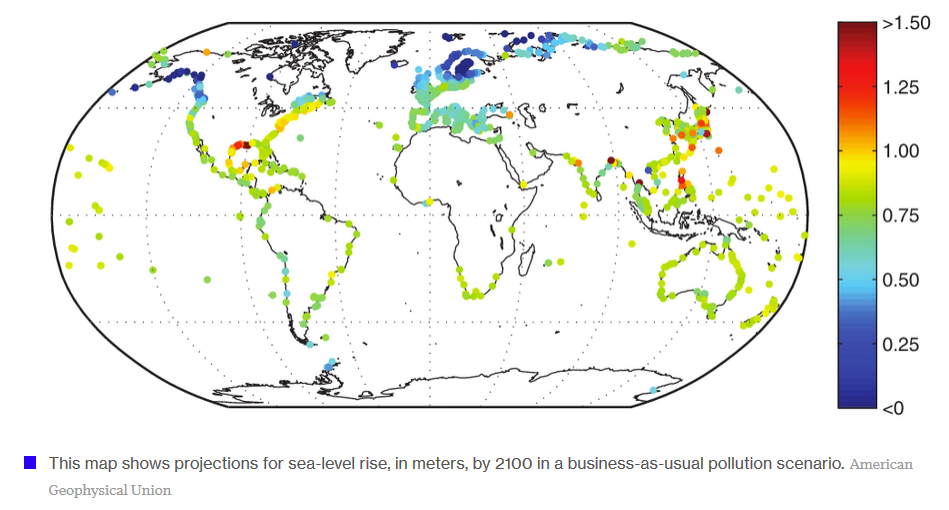
In another study published this month, scientists report that global sea levels will likely rise 0.5 to 1.3 meters (1.6 to 4.3 feet) by the end of this century if greenhouse gas emissions aren’t rapidly reduced. Even if last year’s Paris Agreement does spur ambitious climate policy, sea levels are still projected to rise 20 to 60 cm (7.8 to 23.6 inches) by 2100. Taken with the longer-term effects from melting ice sheets in Greenland and Antarctica, that means any strategy to endure sea-level rise must involve adaptation plans as well as efforts to slow the trend.

7. Up to 216 million people currently live on land that will be below sea level or regular flood levels by 2100.

coastal flooding in Typhoon FitowHigher sea levels can exacerbate storm surges, like this 2013 flood in Wenzhou, China. (Photo: STR/AFP/Getty Images)

Of the estimated 147 million to 216 million people in harm’s way, between 41 million and 63 million live in China. Twelve nations have more than 10 million people living on land at risk from sea-level rise, including China as well as India, Bangladesh, Vietnam, Indonesia and Japan. Bangladesh is especially vulnerable, identified by the U.N. as the country most in danger from rising seas. Once the ocean rises by 1.5 meters (4.9 feet) next century, it will affect 16 percent of Bangladesh’s land area and 15 percent of its population — that’s 22,000 km2 (8,500 mi2) and 17 million people.

The situation is also urgent for low-lying island nations like Kiribati, the Maldives, the Marshall Islands and the Solomon Islands, where land is already so close to sea level that a few inches make a world of difference. Some are even mulling mass relocations — the government of Kiribati, for one, has a web page outlining its strategy for “migration with dignity.” A town on Taro Island, the capital of Choiseul Province in the Solomon Islands, is also planning to move its entire population in response to rising seas. The small community of Newtok, Alaska, has already begun the difficult process of transplanting itself away from the encroaching coast.

8. Sea-level rise can contaminate water used for drinking and irrigation.

saltwater intrusionSea-level rise can aid saltwater intrusion of freshwater aquifers, as seen in this schematic illustration. (Image: NRC.gov)

In addition to surface flooding, sea-level rise can both push up the freshwater table and contaminate it with seawater, a phenomenon known as saltwater intrusion. Many coastal areas rely on aquifers for drinking water and irrigation, and once they’re tainted by saltwater they may be unsafe for humans as well as crops.

It is possible to remove salt from water, but the process is complex and costly. San Diego County recently opened the Western Hemisphere’s largest desalination plant, for example, and several other sites are proposed in the state. Yet that may not be practical for many coastal communities, especially in less wealthy nations.

9. It can also threaten coastal plant and animal life.

loggerhead sea turtle hatchlingFloods fueled by rising seas may harm baby sea turtles, like these South African loggerheads. (Photo: Jeroen Looyé/Flickr)

Humans aren’t the only ones who’ll suffer as sea levels rise. Any coastal plants or animals that can’t quickly move to new, less flood-prone habitats could face dire consequences. As one 2015 study noted, sea turtles have a long-established habit of laying eggs on beaches, which need to stay relatively dry for their babies to hatch.

Inundation for one to three hours reduced egg viability by less than 10 percent, the study’s authors found, but six hours underwater cut viability by about 30 percent. “All embryonic developmental stages were vulnerable to mortality from saltwater inundation,” the researchers write. Even for hatchlings that do survive, being starved of oxygen in the egg could lead to developmental problems later in life, they add.

Other beach life may also be at risk, including plants. A recent study found that some salt marshes can adapt, both by growing vertically and by moving inland, but not all flora will be so fortunate. “Trees have to work harder to pull water out of salty soil; as a result, their growth can be stunted — and if the soil is salty enough, they will die, a common sign of sea-level rise,” Climate Central explains. “Even trees that are especially suited to salty soil can’t survive repeated flooding by seawater.”

10. Global flood damage for large coastal cities could cost $1 trillion a year if cities don’t take steps to adapt.

sea-level rise in TokyoThis Google Earth simulation shows a Tokyo neighborhood with 1.3-meter sea-level rise. (Image: Google Earth)

The average global losses from flooding in 2005 were about $6 billion, but the World Bank estimates they’ll rise to $52 billion per year by 2050 based on socioeconomic changes alone. (That means things like increasing coastal populations and property value). If you add the effects of sea-level rise and sinking land — which is happening even faster in some places — the cost could surge to $1 trillion per year.

11. It’s too late to stop sea-level rise — but not too late to save lives from it.

iceberg off GreenlandA full moon shines over an iceberg that broke off Greenland’s Jakobshavn Glacier. If the entire Greenland ice sheet melted, sea levels would rise about 6 meters, or 20 feet. (Photo: Joe Raedle/Getty Images)

Unfortunately, CO2 emissions linger in the atmosphere for centuries, and today’s CO2 levels have already committed Earth to dangerous sea-level rise. About 99 percent of all freshwater ice resides in two ice sheets: one in Antarctica and one in Greenland. Both are expected to melt if humanity’s CO2 output isn’t curbed quickly, but the question is when — and how much damage we still have time to prevent.

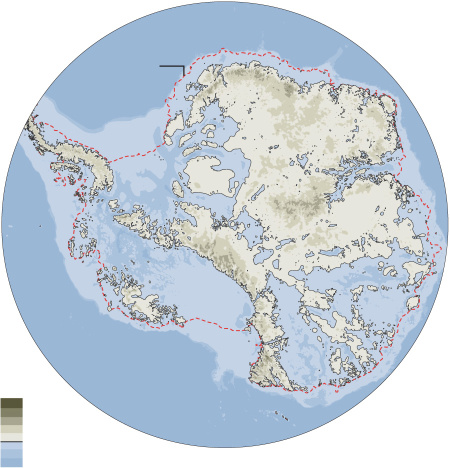
The Greenland ice sheet is smaller and melting more quickly. If it completely melted, sea levels would rise by about 6 meters (20 feet). The Antarctic ice sheet has been more buffered from warming so far, but it’s hardly immune, and would raise the ocean by 60 meters (200 feet) if it melted. (Estimates vary widely on how long these ice sheets might survive — while most expect they’ll take centuries or millennia to melt, a controversial 2015 paper suggested it could happen much more quickly.)

Sea levels have naturally risen and receded for billions of years, but they’ve never risen this quickly in modern history — and they’ve never had so much human help. It’s unclear what effect they’ll have on our species, but what is clear is that our descendants will still be dealing with this problem long after we’re all gone. Giving them a head start on a solution is the least we can do.

“With all the greenhouse gases we already emitted, we cannot stop the seas from rising altogether, but we can substantially limit the rate of the rise by ending the use of fossil fuels,” says Anders Levermann, a climate scientist at Columbia University and co-author of the new study on future sea-level rise. “We try to give coastal planners what they need for adaptation planning, be it building dikes, designing insurance schemes for flooding or mapping long-term settlement retreat.”

As another recent study pointed out, any policy decisions made in the next few years and decades “will have profound impacts on global climate, ecosystems and human societies — not just for this century, but for the next ten millennia and beyond.”

ooOOoo

Tomorrow, in the final part of this three-part posting I will look at some positive things that we can all be doing now.

But let me leave you with a rather beautiful consequence of these changing times. As seen over on Grist:

ooOOoo

Incredible glacier art pays homage to our disappearing ice

Interconnections One.

The beat of a butterfly’s wings.

From Wikipedia:

The Butterfly Effect is a concept that small causes can have large effects. Initially, it was used with weather prediction but later the term became a metaphor used in and out of science.[1]

In chaos theory, the butterfly effect is the sensitive dependence on initial conditions in which a small change in one state of a deterministic nonlinear system can result in large differences in a later state. The name, coined by Edward Lorenz for the effect which had been known long before, is derived from the metaphorical example of the details of a hurricane (exact time of formation, exact path taken) being influenced by minor perturbations such as the flapping of the wings of a distant butterfly several weeks earlier. Lorenz discovered the effect when he observed that runs of his weather model with initial condition data that was rounded in a seemingly inconsequential manner would fail to reproduce the results of runs with the unrounded initial condition data. A very small change in initial conditions had created a significantly different outcome.

We all live in an interconnected world. Frankly, it’s such an obvious statement that one presumes that very few would not agree with the sentiment expressed within it.

But (and you knew there was a ‘but’ coming, didn’t you!) very few of us (and I include Jean and me to a very great extent) really understand, “A very small change in initial conditions had created a significantly different outcome.”

Take these few items; more or less randomly read over the last few days.

Such as this post over on Patrice Ayme’s blog.

Biblical Flood Starting Anew

Abstract: update on Sea Level Rise. The meat of the essay is at the end, in the section “THE SITUATION IS ACTUALLY CATACLYSMIC“.

Heard of The Flood? As in the Bible? Sea level rose 120 meters (400 feet), in the period centered around 10,000 years ago. The cause? More than half of Earth’s ice melted in a few millennia,  During the rest of the early Holocene, the rate of rise of the world’s ocean reached peaks as high as 60  millimeters (2.5 inches) per year. The melting of the ice happened because Earth’s positional and orbital parameters had made northern hemisphere’s summers too warm (most of the ice shields rested on the large continents of the north). Nowadays only two enormous ice shields are left: Greenland and Antarctica.

Those who enjoy catastrophes will love it: we have 75 meters of further sea rise to enjoy pretty soon, on our way to a Jurassic climate (the Jurassic was characterized by gigantic warm shallow seas on top of the continents). Here was the situation in the Miocene, when CO2 was at 500 ppm (where we will be at in ten years, see conclusion below).

Patrice said that the essence, the meat, of his essay was at the end. Here are his closing words:

Three scientific papers published in the last two months support my, admittedly drastic, point of view. One observed the collapse of a colossal glacier in northwest Greenland, eaten by a current at one degree C. It was a miniature reproduction of what to expect for entire ice shields. Two others observed the past, and that Antarctica was unstable at 500 ppm CO2. What they did not say is how dramatic the situation was. Indeed, sounding moderate is how they get funded by a benevolent, plutocratically ruled government (and by government, I also mean the corrupt Supreme Court, not just the latest elected buffoons). The scientists who evoked the 500 ppm of CO2 omitted two significant details, where the devil lurks. They claimed that it would take 30 years to get there. That’s not correct; at the present rate, we will add 100 ppm of CO2 within 25 years. But not just that: there are other man-made GreenHouse Gases (GHG): CH4, NOx, Fluorocarbons, etc. All these gases warm up the lower atmosphere much more than CO2. So the correct measurement is not CO2 ppm, but CO2 EQUIVALENT ppm.

We are right now ABOVE 450 ppm in EQUIVALENT CO2, and will be at 500 ppm within ten years. Let’s hope there will be more boats than on the Titanic.

Patrice Ayme’

P/S: If anything, the preceding is a conservative estimate. Indeed very serious scientists evaluated already the man-made greenhouse gases at 478 ppm in 2013. This means we will be above 500 ppm in CO2 equivalent within six years, in line with my previous analyses, such as “Ten Years To Catastrophe“. See:

http://oceans.mit.edu/news/featured-stories/5-questions-mits-ron-prinn-400-ppm-threshold

Now it’s not all ‘doom and gloom’ and there is much that each and every one of us can do. More of that in Interconnections Three on Thursday.

But to continue with this ‘wake up call’ I’m going to republish in full an item that was recently published over on Mother Nature Network: 11 alarming facts about sea-level rise. To stop today’s post being excessively long, I’m going to split that MNN article over today and tomorrow. Here are the first 5 alarming facts. (Don’t read them just before turning the light out when going to bed tonight!)

ooOOoo

11 alarming facts about sea-level rise

Russell McLendon,  February 26, 2016.
 Up to 216 million people currently live on land that will be below sea level or regular flood levels by 2100. (Photo: Shutterstock)
Up to 216 million people currently live on land that will be below sea level or regular flood levels by 2100. (Photo: Shutterstock)

The ocean is coming for us. Global sea levels are now rising by 3.4 millimeters per year, up from an average rate of 1.4 mm per year last century. In just 80 years, the ocean could be a full 1.3 meters (4.3 feet) taller than it is today.

That kind of planetary sea change can be hard to fathom — unless you live in a low-lying place like Miami, the Maldives or the Marshall Islands, where the effects of sea-level rise are already apparent. But within just a few decades, the problem will become unavoidable in major coastal cities around the world, from New Orleans, New York and Amsterdam to Calcutta, Bangkok and Tokyo.

We all know why this is happening. Rising seas are one of the most salient effects of man-made climate change, triggered by thermal expansion of seawater as well as the influx of melting glaciers. Yet many people still see it as a distant risk, failing to grasp how (relatively) quickly the sea is swallowing shores worldwide. And since half of all humans now live within 60 kilometers (37 miles) of a coast, this isn’t a niche issue.

To help put things in perspective, here’s a deeper look at the problem:

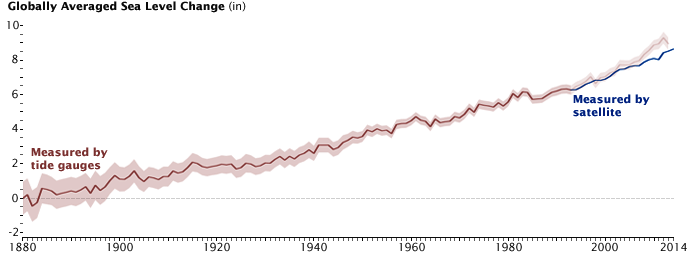
1. Global sea levels have already risen by 8 inches (200 mm) since 1880.

sea-level-rise-1880-2014

The chart above was produced by NASA’s Earth Observatory, based on data from the U.S. National Oceanic and Atmospheric Administration (NOAA) and Australia’s Commonwealth Scientific and Industrial Research Organization (CSIRO). Most of those historical data come from tide-gauge measurements, which are now complemented by satellite observations.

2. Not only are sea levels rising; the rate of their rise is rising.

Average global sea-level rise is now 3.41 mm per year, but the rate varies widely by location. (Image: NASA GSFC)

On average, sea levels rose by 1.4 mm from 1900 to 2000. The yearly pace had surpassed 3 mm by 2010, and now it’s up to 3.4 mm per year.

3. That’s the fastest sea-level rise Earth has experienced in 3,000 years.

Cb5MxZ4WIAAAW06If not for surging carbon dioxide in the atmosphere, sea levels should have only risen about an inch or two last century, and might have even fallen. Instead, thanks to the highest CO2 levels at any point in human history, global sea levels rose by 5.5 inches (14 cm) between 1900 and 2000. That’s the fastest oceanic advance in 27 centuries, according to a study published Feb. 22, and it’s still speeding up.

“The 20th century rise was extraordinary in the context of the last three millennia — and the rise over the last two decades has been even faster,” says lead author Robert Kopp, a climate scientist at Rutgers University, in a statement.

“Scenarios of future rise depend upon our understanding of the response of sea level to climate changes,” adds co-author Benjamin Horton. “Accurate estimates of sea-level variability during the past 3,000 years provide a context for such projections.”

4. Every vertical inch of sea-level rise moves the ocean 50 to 100 inches inland.

Miami coastal flooding
Rising seas worsen regular flooding — like this 2015 high tide in Miami Beach — for many coastal cities. Miami is in the midst of a five-year, $400 million effort to upgrade its stormwater pump program. (Photo: Joe Raedle/Getty Images)

5. That’s already causing flood problems in many big coastal cities.

CLICK HERE TO SEE THE EFFECT ON BIG COASTAL CITIES

As the ocean invades coastal cities, the first signs of trouble are often urban saltwater floods. These can also happen naturally, though, so to determine the influence of rising seas, a new report by Climate Central models “alternative histories simulating the absence of anthropogenic climate change” at 27 U.S. tide gauges.

Out of 8,726 days since 1950 when unaltered water levels exceeded the National Weather Service thresholds for local “nuisance” floods, 5,809 didn’t exceed those thresholds in the alternative histories. “In other words,” the report explains, “human-caused global sea level rise effectively tipped the balance, pushing high-water events over the threshold, for about two-thirds of the observed flood days.”

Coastal flooding days have more than doubled in the U.S. since the 1980s, according to the report, in places ranging from Miami, Virginia Beach and New York to San Francisco, Seattle and Honolulu. According to a 2014 report, at least 180 floods will strike Annapolis, Maryland, during high tides every year by 2030 — sometimes twice a day. The same will be true for about a dozen other U.S. cities by 2045, not to mention many other low-lying urban areas around the world.

ooOOoo

To be continued tomorrow.

Personal journeys

Life is a one-way track.

Those of you who follow this place on a regular basis know that last Friday I published a post under the title of Friday Fondness. You will also know that later that same day I left this comment to that post:

Sue, and everyone else, we returned from seeing Dr. Lee, the neurologist, a little under two hours ago. Dr. Lee’s prognosis is that Jean is showing the very early signs of Parkinson’s disease, and Jean is comfortable with me mentioning this.

Everyone’s love and affection has meant more than you can imagine. I will write more about this next week once we have given the situation a few ‘coatings of thought’.

Jean sends her love to you all!

Thus, as heralded, I am going to write some more.

You would not be surprised to hear that the last few days have been an emotional roller-coaster, for both Jean and me. Including on Monday Jean hearing from our local doctor here in Grants Pass, OR, that a recent urine test has shown that Jean has levels of lead in her bones some three times greater than the recommended maximum. While our doctor is remaining open-minded it remains to be seen whether Jean is exhibiting symptoms of lead poisoning, whether the lead is a possible cause of the Parkinson’s disease (PD), see this paper, or whether it is a separate issue to be dealt with.

However, I want to offer some more from the consultation that Jean had with the neurologist Dr. Eric Lee last Friday. Shared with the full support of Jean who has read the whole of today’s post yesterday evening; as she does with every post published in this place.

But before so doing, please understand that while I was present throughout the complete examination of Jean, what you are about to read carries no more weight than that of any casual onlooker. If you are at all affected by any of the following make an appointment to see your own doctor!

Jean’s examination lasted for about an hour. It consisted of a great number of checks and tests on how her body responded to many different tests and stimulations. At the end of the examination Dr. Lee said that while he wasn’t 100% certain the balance of probability was that Jean was demonstrating the very early signs of PD. For example, showing such signs as walking and not swinging both arms in a normal, balanced manner. Or having a very slow blink rate. Then she was exhibiting some difficulty with rapid finger-to-thumb taps.

However, Dr. Lee did say that Jean was at the very early stages of PD and that we would have to wait another six months to see if the PD indicators were firming up. He also said that he had PD patients who had had the disease for twenty, even thirty years. Some of the general indicators that PD is progressing include a stooped gait, decreasing size of handwriting, and a quieter speaking tone. The NINDS website has more information on this. Here’s a little of what they explain about PD:

What is Parkinson’s Disease?

Parkinson’s disease (PD) belongs to a group of conditions called motor system disorders, which are the result of the loss of dopamine-producing brain cells. The four primary symptoms of PD are tremor, or trembling in hands, arms, legs, jaw, and face; rigidity, or stiffness of the limbs and trunk; bradykinesia, or slowness of movement; and postural instability, or impaired balance and coordination. As these symptoms become more pronounced, patients may have difficulty walking, talking, or completing other simple tasks. PD usually affects people over the age of 60.  Early symptoms of PD are subtle and occur gradually.  In some people the disease progresses more quickly than in others.  As the disease progresses, the shaking, or tremor, which affects the majority of people with PD may begin to interfere with daily activities.  Other symptoms may include depression and other emotional changes; difficulty in swallowing, chewing, and speaking; urinary problems or constipation; skin problems; and sleep disruptions.  There are currently no blood or laboratory tests that have been proven to help in diagnosing sporadic PD.  Therefore the diagnosis is based on medical history and a neurological examination.  The disease can be difficult to diagnose accurately.   Doctors may sometimes request brain scans or laboratory tests in order to rule out other diseases.

But here’s the good news regarding my darling wife – there are three things that Dr. Lee strongly recommends:

  1. Hang on to a positive mental attitude for the body actively produces dopamine when in a positive mental state.
  2. At least 30-minutes of good aerobic exercise three times a week,
  3. And physiotherapy.

In addition, Dr. Lee said to always THINK BIG! Big in voice, big in attitude, big in stature.

Finally, let me share with you what was posted on the Visible Procrastinations blog back in 2009. Reposted with the author’s permission.

ooOOoo

My Change Journey

Some notes from My Change Journey: This workshop is designed to help you understand your emotional and psychological needs during times of change and strategies you can use to take control of your own change journey. It also focuses on creating opportunities and seeing possibilities in the new world of work.

change – an event that occurs when something passes from one state or phase to another;

transition – the act of passing from one state or place to the next

The Big Picture

You are not always seeing the bigger picture;

Experiencing Transitions

When change is implemented at any level in an organisation, people typically respond by moving through a series of phases. People will spend different times in each phase.
Bridges (1995)
William Bridges (1995) Bridges’ three-phase transition framework: The first phase, the Ending phase, is about letting go of an old identity, an old reality or an old strategy. The Neutral Zone is akin to crossing the wilderness between the old way and the new. The final phase is making a new beginning and functioning effectively in a new way.

The Process of Transition

John Fisher’s model of personal change – The Transition Curve – is an excellent analysis of how individuals deal with personal change.
J.M.Fisher’s ‘transition curve’

John Fisher’s transition curve – the stages of personal transition – and introduction to personal construct psychology. http://www.businessballs.com

http://www.businessballs.com/personalchangeprocess.htm

Influencing and exploring options

“You should only worry about things that are within your sphere of influence.”

You should only worry about things that are within your sphere of influence.

From The Seven Habits of Highly Effective People – you should only worry about things in your “sphere of influence.” If you have no control over certain aspects of your life, why bother worrying about them?

circle of concern

Mental Models: our way of seeing the world

Mental models are usually tacit, existing below the level of awareness – they should be tested, examined and evaluated.

Joel Barker pioneered the concept of paradigm shifts to explain profound change and the importance of vision to drive change within organizations. View The Power of Paradigms [SWF].

Take 1000
add 40 to it
Now add another 1000
Now add 30
Add another 1000
Now add 20
Now add another 1000
Now add 10
What is the total?

Did you get 5000 ? The correct answer is actually 4100 .

The Fifth Discipline Fieldbook by Peter M. Senge

References

Amado, G., & Ambrose A. (Eds.) (2001) The Transitional Approach to Change. London: Karnac

Amado, G., & Vansina, L. (Eds.) (2004) The Transitional Approach in Action. London: Karnac

Bridges, W. (1998) Managing Transitions: Making the Most of Change London: Nicholas Brealey.

Bridges, W. & Associates (online resources to articles and assessment tools for ‘Managing Transitions’) www.wmbridges.com

Bunker, K. (2008) Responses to Change: Helping People Make Transitions San Francisco: Jossey-Bass

Covey, S.R. (1990) The Seven Habits of Highly Successful People Melbourne: The Business Library

Duck, J. (1993) Managing Change: the art of balancing Harvard Business Review, 71 (Nov/Dec): pp.109-118

Ethical work and life learning (Free online education for ethical work, business, career and life learning; training materials for entrepreneurs, organizations, seflf-development, business management, sales, marketing, project management, communications, leadership, time management, team building and motivation) www.businessballs.com

Fischer, P. (2008) The New Boss: How to Survive the First 100 Days. London: Kogan Page.

Johnson, S. (1999) Who Moved My Cheese? An amazing way to deal with change in your work and in your life London: Vermillion

O’Hara, S. & Sayers, E. Organizational change through individual learning. Career Development International, 1 (4): pp. 38-41

Rogers, C.R. & Roethlisberger, F.J (1991) Barriers and gateways to communication. Harvard Business Review (Nov-Dec): pp.105-111

Stuart, R (1995) Experiencing organizational change: triggers, processes and outcomes of change journeys Personnel Review, 24 (2): pp.3-88

Vansina, L. & Vansina-Cobbaert, J-M (2008) Psychodynamics for Consultants and Managers: From Understanding to Leading Meaningful Change. Chichester: John Wiley & Sons

Williams, D (1999, 2008 update) Transitions: Managing Personal and Organisational Change.

ooOOoo

LearningFromDogs_3DBook_500x

Let me close today’s post with the opening and closing paragraphs from Chapter 25 of my book: A Way into Our Own Soul.

“Happiness resides not in possessions, and not in gold, happiness dwells in the soul.”

So wrote the philosopher Democritus who was born in 460 BCE (although some claim his year of birth was 490 BCE). He acquired fame with his knowledge of the natural phenomena that existed in those times and history writes that he preferred a contemplative life to an active life, spending much of his life in solitude. The fact that he lived to beyond 100 suggests his philosophy didn’t do him any harm.

………..

In humans, that part of the brain in which self-awareness is thought to arise is called the ventromedial prefrontal cortex. Apparently, that just happens to be located behind the eyes. Ergo, we learn[1] to associate the identity of others with our eyes. Then as we mature, our eyes take on more importance because we develop awareness and a better understanding of the social cues that other people convey with their eyes.
Therefore, is it any surprise that dogs, being the intuitive creatures that they are, soon learn to read us humans and the feelings and emotions that we transmit from our eyes? There’s a knowing in my mind, albeit an unscientific knowing, that dogs, too, give out emotions and feelings from their own eyes.

That loving a dog and being loved back by that dog truly does offer us a way into our own souls. No better put than in the exquisite words of Anatole France,

Until one has loved an animal, a part of one’s soul remains unawakened.


[1] Refer to Christina Starmans and Paul Bloom of the Mind and Development Lab at Yale University.

ooOOoo

Oh, and a postscript. Having a loving contact with another person or your dog also releases dopamine within the body – so go and hug your partner or your dog! Now! 🙂

Theo19


More sharing the thoughts of others.

Unexplored waters ahead!

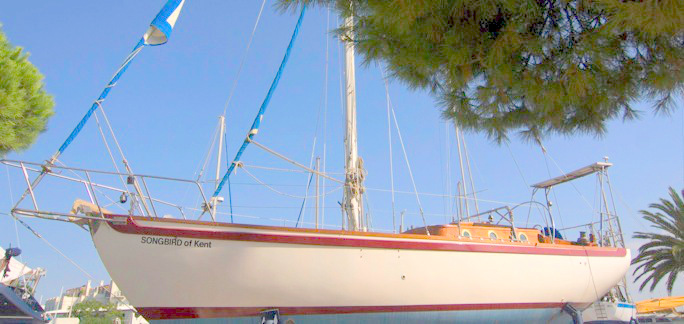
My sub-title comes from personal knowledge of what it feels like to set out on an ocean voyage into waters that one has not sailed before. In my case, leaving Gibraltar bound for The Azores on my yacht Songbird of Kent in the Autumn of 1969.

Tradewind 33 - Songbird of Kent.
My home for five years – Tradewind 33: Songbird of Kent.

Despite me being very familiar with my boat, and with sailing in general, there was nonetheless a sense of trepidation as I headed out into a vast unfamiliar ocean.

Coming to matters closer to hand, there is a sense of trepidation felt by me and countless others as to what world we are heading into if we don’t take seriously the risks that are ‘tapping on our door’.

So hold that in your mind as you read a recent essay published by Patrice Ayme’; an essay that highlights very uncertain times ahead if we, as a global society, don’t get our act together pretty damn quick. Republished here on Learning from Dogs with Patrice’s kind permission.

ooOOoo

Record Heat 2015, Obama Cool

2014 was the warmest year ever recorded. 2015 was even warmer, and by far, by .16 degrees centigrade. The UK (Great Britain) meteorological office announced that the temperature rise is now a full degree C above the pre-industrial average. At this annual rate of increase, we will get to two degrees within six years (as I have predicted was a strong possibility).

What’s going on? Exponentiation. Just as wealth grows faster, the greater the wealth, mechanisms causing more heat are released, the greater the heat. Yes, it could go all the way to tsunamis caused by methane hydrates explosions. This happened in the North Atlantic during the Neolithic, leaving debris of enormous tsunamis all over Scotland.

heat-2015
2015: Not Only Record Heat, But Record Acceleration Of Heat

The Neolithic settlements over what is now the bottom of the North Sea and the Franco-English Channel (then a kind of garden of Eden), probably perished the hard way, under giant waves.

Explosions of methane hydrates have started on the land, in Siberia. No tsunami, so far. But it can, and will happen, any time. The recent North Easter on the East Coast of the USA was an example of the sort of events we will see ever more of: a huge warm, moist Atlantic born air mass, lifted up by a cold front.

Notice that, at the COP 21 in Paris all parties, 195 nations, agreed to try their best to limit warming to 1.5 degree Centigrade. At the present instantaneous rate, that’s less than 4 years away. Even with maximum switching out of fossil fuels, we are, at the minimum, on a three degrees centigrade target, pretty soon.

By the way, if all nations agree, how come the “climate deniers” are still heard of so loudly? Well, plutocrats control Main Stream Media. It’s not just that they want to burn more fossil fuels (as it brings them profit, they are the most established wealth). It’s also that they want to create debates about nothing significant, thus avoiding debates about significant things, such as how much the world is controlled by Dark Pools of money.

Meanwhile, dear Paul Krugman insists in “Bernie, Hillary, Barack, and Change“, that it would be pure evil to see him as a “corrupt crook“, because he believes everything Obama says about change and all that. Says Krugman: “President Obama, in his interview with Glenn Thrush of Politico, essentially supports the Hillary Clinton theory of change over the Bernie Sanders theory:

[Says Obama]: ‘I think that what Hillary presents is a recognition that translating values into governance and delivering the goods is ultimately the job of politics, making a real-life difference to people in their day-to-day lives.’”

This is all hogwash. We are not just in a civilization crisis. We are in a biosphere crisis, unequalled in 65 million years. “Real-life differences“, under Obama, have been going down in roughly all ways. His much vaunted “Obamacare” is a big nothing. All people in the know appraise that next year, it will turn to a much worse disaster than it already is (in spite of a few improvements, “co-pays” and other enormous “deductibles” make the ironically named, Affordable Care Act, ACA, unaffordable).

The climate crisis show that there is no more day-to-day routine. At Paris, the only administration which caused problem, at the last-minute, was Obama’s. How is that, for “change”? The USA is not just “leading from behind”, but pulling in the wrong direction. Really, sit down, and think about it: under France’s admirable guidance (!), 194 countries had agreed on a legally enforceable document. Saudi Arabia agreed. The Emirates agreed. Venezuela agreed. Nigeria agreed. Russia agreed. Byelorussia agreed. China, having just made a treaty with France about climate change, actually helped France pass the treaty. Brazil agreed. Zimbabwe agreed. Mongolia agreed. And so on. But, lo and behold, on the last day, Obama did not.

I know Obama’s excuses well; they are just that, excuses. Bill Clinton used exactly the exact same excuses, 20 years ago. Obama is all for Clinton, because, thanks to Clinton, he can just repeat like a parrot what Clinton said, twenty years ago. Who need thinkers, when we have parrots, and they screech?

I sent this (and, admirably, Krugman published it!):

“No doubt Obama wants to follow the Clintons in making a great fortune, 12 months from now. What is there, not to like?

Obama’s rather insignificant activities will just be viewed, in the future, as G. W. Bush third and fourth terms. A janitor cleaning the master’s mess. Complete with colored (“bronze”) apartheid health plan.

What Sanders’ supporters are asking is to break that spiral into ever greater plutocracy (as plutocrat Bloomberg just recognized).”

Several readers approved my sobering message, yet some troll made a comment, accusing me of “racist “slander”. Racist? Yes the “bronze” plan phraseology is racist. I did not make it up. And it is also racist to make a healthcare system which is explicitly dependent upon how much one can afford. Krugman is all for it, but he is not on a “bronze” plan. Introducing apartheid in healthcare? Obama’s signature achievement. So why should we consider Obama as the greatest authority on “progressive change”? Because we are gullible? Because we cannot learn, and we cannot see? Is not that similar to accepting that Hitler was a socialist, simply because he claimed to be one, it had got to be true, and that was proven because a few million deluded characters voted for him?

We are in extreme circumstances, unheard of in 65 million years, they require extreme solutions. They do not require, nor could they stand, Bill Clinton’s Third Term (or would that be G. W. Bush’s fifth term? The mind reels through the possibilities).

“Change we can believe in”: the new boss, same as the old boss, the same exponentiation towards inequality, global warming and catastrophe, the same warm rhetoric of feel-good lies.

As it is, there is a vicious circle of disinformation between the Main Stream Media, and no change in the trajectory towards Armageddon. Yes, Obama was no change. Yes, Obama was the mountain of rhetoric, who gave birth to a mouse. Yes, we need real change, and it requires to start somewhere. And that means, not by revisiting the past.

Patrice Ayme’

ooOOoo

Yes, we do need real change, and every day that we think that this change is the responsibility of someone else then that is another day lost forever. Or in the more proasic words of Mahatma Gandi, “You must be the change you wish to see in the world.”

More Dogs and Dolphins

Can’t resist these videos.

I was looking up stories on German Shepherds, a breed we just adore, and quite by chance came across a lovely follow-up to my post last Tuesday Dogs and Dolphins.

Published on Mar 9, 2012

This is a video of a German Shepherd jumping in on some dolphins while we were underway in our boat. I guess he wanted to play with the dolphins lol
Thanks for watching

After that video had come to an end, YouTube then automatically went on to this one:

(The soundtrack quality is poor but, nevertheless, it was been viewed over six million times!)

You all have a great week-end.

Yes, it rains in Oregon!

Reflections on where we two Brits live.

We never planned to come and live in Southern Oregon. It was the result of a bizarre dream about our well running dry when we were living back in Payson, Arizona. Someone who was staying with us at the time, upon hearing about my strange dream, responded: “If you’re worried about water go and live in Oregon.”

So we did!

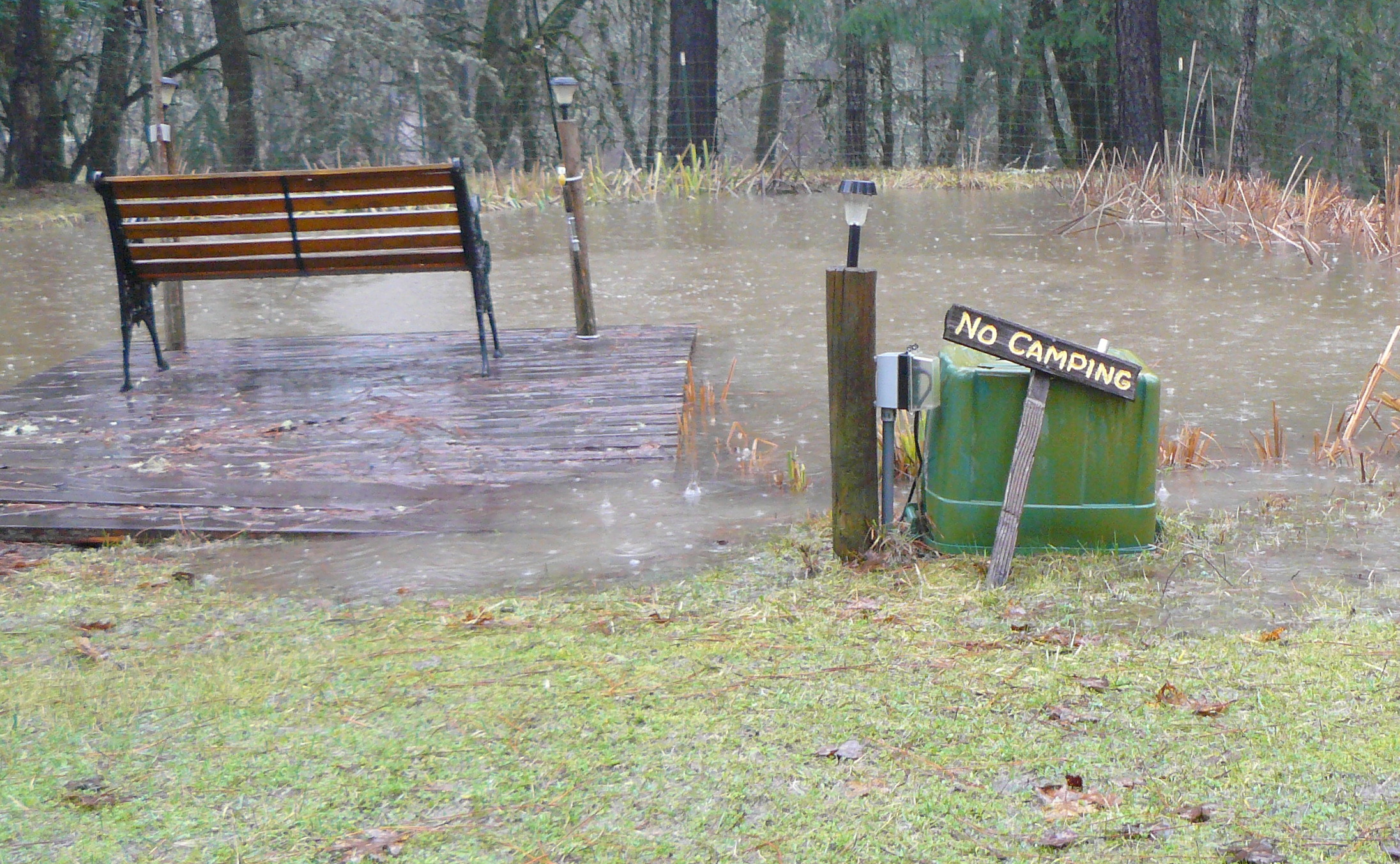
At the time of writing this post (2pm yesterday) our weather station that we have at home had recorded a total of 7.78 inches of rain for January that brought the total for December and January to 25.66 inches. Two days ago we had 2.48 inches in a single day, as these photographs bear out.

Just asas and already
Not even 11am and already 1.8 inches has fallen since midnight.

oooo

A very wet landscape.

oooo

Bummer Creek in full flow (the central pier is from a previous bridge.)

Anyway, all this is a preface to a lovely item about living in Oregon that was sent to me by Janet, a neighbour of ours.

ooOOoo

  • If someone in a Home Depot store offers you assistance and they don’t work there, you live in Oregon.
  • If you’ve worn shorts, sandals and a parka at the same time, you live in Oregon.
  • If you’ve had a lengthy telephone conversation with someone who dialed the wrong number, you live in Oregon.
  • If you measure distance in hours, you live in Oregon.
  • If you know several people who have hit a deer more than once, you live in Oregon.
  • If you have switched from ‘heat’ to ‘A/C’ and back again in the same day, you live in Oregon.
  • If you install security lights on your house and garage but leave both doors unlocked, you live in Oregon.
  • If you can drive 75 mph through 2 feet of snow during a raging blizzard without flinching, you live in Central, Southern or Eastern Oregon.
  • If you design your kid’s Halloween costume to fit over 2 layers of clothes or under a raincoat, you live in Oregon.
  • If driving is better in the winter because the potholes are filled with snow and ice, you live in Oregon.
  • If you know all 4 seasons: almost winter, winter, still winter, and road construction, you live in Oregon.
  • If you feel guilty throwing aluminum cans or paper in the trash, you live in Oregon.
  • If you know more than 10 ways to order coffee, you live in Oregon.
  • If you know more people who own boats than air conditioners, you live in Oregon.
  • If you stand on a deserted corner in the rain waiting for the “Walk” signal, you live in Oregon.
  • If you consider that if it has no snow or has not recently erupted, it is not a real mountain, you live in Oregon.
  • If you can taste the difference between Starbucks, Seattle’s Best, and Dutch Bros, you live in Oregon.
  • If you know the difference between Chinook, Coho and Sockeye salmon, you live in Oregon.
  • If you know how to pronounce Sequim, Puyallup, Clatskanie, Issaquah, Oregon, Umpqua, Yakima and Willamette, you live in Oregon.
  • If you consider swimming an indoor sport, you live in Oregon.
  • If you know that Boring is a city and not just a feeling, you live in Oregon.
  • If you can tell the difference between Japanese, Chinese and Thai food, you live in Oregon.
  • If you never go camping without waterproof matches and a poncho, you live in Oregon.
  • If you have actually used your mountain bike on a mountain, you live in Oregon.
  • If you think people who use umbrellas are either wimps or tourists, you live in Oregon.
  • If you buy new sunglasses every year, because you cannot find the old ones after such a long time, you live in Oregon.
  • If you actually understand these jokes and forward them to all your OREGON friends, you live or have lived in Oregon.

ooOOoo

Picking up that point about never go camping without waterproof matches and a poncho, let me close today’s post by returning to Oregon rain. Or more accurately, to a photograph that I took back last Sunday over at our neighbour’s property.

P1150884All the best, everyone!


Dogs and Dolphins

This is gorgeous.

(Apologies for such a short post – I got badly squeezed timewise yesterday – it doesn’t detract from this delightful video.)

Dog sees Dolphins from boat; What happens next will touch your heart forever.

Published on Aug 10, 2015

http://www.DolphinWhisperer.org : Sandy meets the dolphins!
I’ve been bringing people to swim with wild dolphins for years, this was the first time I brought a dog. Sandy was a stray taken in by friends here in Bimini. Sandy is a strong swimmer (she can swim over a kilometer). Last week she came out on the ocean with me, it was her first time ever on a boat. The next time I went out, she wanted to come, even jumped off the dock and swam after me, so I scooped her up and off we went.
Sandy was very curious about the dolphins, it was clear she wanted to go in. The following footage is of her first wild dolphin swim!

Special thanks to Jwala, Amlas, Atmo, Sukhama and of course Sandy!
Joebaby aka Joe Noonan is a shamanic nature guide, author and dolphin whisperer who leads private custom ocean adventures swimming with wild dolphins for small groups and families in Hawaii and the Bahamas. Visit his website at http://www.DolphinWhisperer.org

Enjoy everyone!

Cute with a capital ‘K’.

Young animals are especially gorgeous.

Here’s a short video to watch:

And here’s the background story:

Published on Dec 22, 2015

Welcome to the world, tiny otter pup! A wild otter mom gave birth to her pup in our Great Tide Pool over the weekend.

It was then just a mouse click to go to the website of the Monterey Bay Aquarium and read this:

ooOOoo

The squee heard ‘round the world!

Sea Otter gives birth to newborn pup in Monterey Bay Aquarium Tide Pool

As you probably know by now, a wild baby sea otter was born this morning in our Great Tide Pool! For the last several days, a wild female sea otter had been using the protected basin of our Great Tide Pool to rest from the winter storms. Last night, just as the Aquarium closed, she was spotted once again slinking into the pool for some shut-eye. It’s rare for a healthy sea otter to visit the pool so frequently—we started to wonder if she was doing all right.

Sea Otter gives birth to newborn pup in Monterey Bay Aquarium Tide Pool

Well, mystery solved! Around 8:30 a.m., Aquarium staff witnessed a BRAND NEW pup resting on her belly, being furiously groomed by a proud momma. We’re talking umbilical-chord-still-attached, whoa-is-that-yep-that’s-the-placenta new-born otter pup!

Sea Otter gives birth to newborn pup in Monterey Bay Aquarium Tide Pool

In steady waves, Aquarium staff, volunteers, and then the days’ visitors made their way to the back deck to watch a conservation success story taking place—and become fluffier in front of their eyes. Not that long ago, sea otters were hunted to near extinction. Maybe 50 were left in all of California by the early 1800’s. But now, thanks to legislative protection and a change of heart toward these furriest of sea creatures, the otter population has rebounded to steady levels in the Monterey Bay, and with 3,000 total in central California.

Sea Otter gives birth to newborn pup in Monterey Bay Aquarium Tide Pool

We’ll keep you updated on this new otter family—mom may decide to head out any time. As of this writing though, she’s still grooming her pup and enjoying the comfort of our Great Tide Pool. The cute overload continues.

ooOOoo

“The cute overload continues.”

Just wonderful and a very long way from becoming an overload to this person!


Picture parade one hundred and twenty-nine

Welcome to the New Year!

The final set of stunning ice photographs – Set One is here and Set Two here.

ice14oooo

ice15oooo

ice16oooo

ice17oooo

ice18oooo

ice19oooo

ice20oooo

You all take care!

Picture parade one hundred and twenty-eight.

More of those fabulous ice photographs.

(The first set were published a week ago.)

ice9

oooo

ice10oooo

ice11oooo

ice12oooo

ice13oooo

And the last one this week is a photograph of the full moon taken Christmas Day evening shortly after 9pm PST.

Note: The next full moon to be seen on December 25th will not be until 2034!

P1150851That’s the last Picture Parade for 2015. See you in the New Year!