Category: Water

And speaking of Brazil!

What a wonderful coincidence! From the country to the surname!

As many of you will know yesterday I published a delightful story of how fisherman Joao Pereira de Souza, 71, who lives in an island village just outside Rio de Janeiro, Brazil [my italics] saved a penguin that then bonded with Joao.

So imagine my surprise when yesterday morning I read over on the Care2 website a story of a policeman, Officer Joe Brazil [my italics] who rescued a dog. I was compelled to republish that in full for your pleasure.

ooOOoo

Barefoot Policeman Saves Pup From Watery Danger

By: Laura S. May 30, 2016

About Laura

13087551_10206497645741920_394354682604112285_n-11Every so often a photo shines light on a moment of heroism more than words ever could. This amazing image comes from Rhode Island resident Peggy Edwards who stayed on scene as a 911 call summoned help for a puppy trapped in a culvert.

The dog, now known to be Cece, had escaped from her Woonsocket home one day after arriving. Without her litter mates for the first time and unfamiliar with her new surroundings, Cece became frightened after slipping through a back door and being confronted by the great outdoors.

Cece ran all night and wasn’t spotted until the next afternoon. She was wandering down Alice Avenue when a passing car startled her further and she took refuge in a culvert. To further complicate the situation, Cece went quite far into the tunnel and soon found herself trying to cling to the edge as water flowing from a nearby brook lapped her body.

“She was stuck about 20-25 feet in and was clinging to the side,” Peggy Edwards explained. “We tried to help but were afraid of scaring her further in”

But when Officer Joe Brazil arrived on scene, he calmly took off his shoes and rolled up his pants. If Cece couldn’t come to him, he’d simply go to her.

“As I got closer, I could see Cece just clinging to the side and just shaking,” Brazil told NBC 10 News. “(The dog was) very, very frightened.”

Cece sniffed Brazil’s hand briefly and then allowed him to pick her up.

“It just seemed like she was almost saying thank you. Like she knew I was there to help,” Brazil said.

Cece’s owner, Michelle Perez, was deeply relieved to be reunited with her new family member.

“She’s only 5 months old. I wasn’t able to sleep,” Perez said. “All I kept doing was just driving around, calling her.”

And as for Officer Brazil, well, he is reportedly looking to adopt a dog of his own very soon.

ooOOoo

 I shall be going nuts over the next few hours trying to think of a follow-on third story about Brazil! (Apologies: just could resist that!)

Gratitude – the Penguin model!

The Bricklayer and the Penguin.

The following glorious story, a true story I should have made clear, was sent to me recently by Cynthia, wife of my long-term Californian friend Dan Gomez. It’s a story that was broadcast by TV Globo, not a station I had previously heard of. Unsurprising really when a quick web search finds their details:

Rede Globo, or simply Globo, is a Brazilian television network, launched by media mogul Roberto Marinho on 26 April 1965. It is owned by media conglomerate Grupo Globo, being by far the largest of its holdings.

Here’s that story.

ooOOoo

The Bricklayer and the Penguin

This penguin swims 5,000 miles every year for a reunion with the man who saved his life.

Mail Attachment
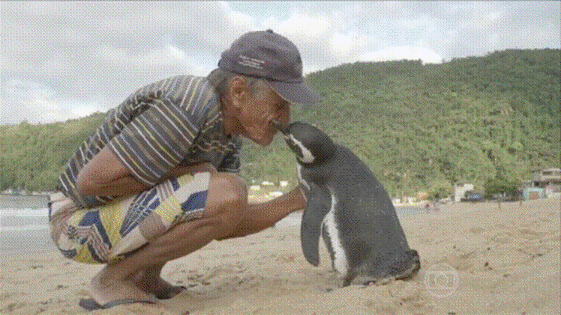
Best buds (Picture: TV Globo)

Todays most heartwarming story is brought to you from a beach in Brazil. The story of a South American Magellanic penguin who swims 5,000 miles each year to be reunited with the man who saved his life.

Retired bricklayer and part time fisherman Joao Pereira de Souza, 71, who lives in an island village just outside Rio de Janeiro , Brazil , found the tiny penguin, covered in oil and close to death, lying on rocks on his local beach in 2011. Joao cleaned the oil off the penguin’s feathers and fed him a daily diet of fish to build his strength. He named him Dindim.

The prodigal penguin returns (Picture: TV Globo)

After a week, he tried to release the penguin back into the sea. But, the bird wouldn’t leave.

He stayed with me for 11 months and then, just after he changed his coat with new feathers, he disappeared, Joao recalls. And, just a few months later, Dindim was back. The penguin spotted the fisherman on the beach one day and followed him home.

Look who's back (Picture: TV Globo)
Look who’s back (Picture: TV Globo)

For the past five years, Dindim has spent eight months of the year with Joao and is believed to spend the rest of the time breeding off the coast of Argentina and Chile. It is thought he swims up to 5,000 miles each year to be reunited with the man who saved his life.

(Picture: Rio de Janeiro Federal University )
(Picture: Rio de Janeiro Federal University)

I love the penguin like it’s my own child and I believe the penguin loves me, Joao told Globo TV. No one else is allowed to touch him. He pecks them if they do. He lays on my lap, lets me give him showers, allows me to feed him sardines and to pick him up.

It's thought Dindim believes the fisherman is also a penguin (Picture: TV Globo)
It’s thought Dindim believes the fisherman is also a penguin (Picture: TV Globo)

Everyone said he wouldn’t return but he has been coming back to visit me for the past four years. He arrives in June and leaves to go home in February and every year he becomes more affectionate as he appears even happier to see me.

(Picture: Rio de Janeiro Federal University)

Biologist Professor Krajewski, who interviewed the fisherman for Globo TV, told The Independent: “I have never seen anything like this before. I think the penguin believes Joao is part of his family and probably a penguin as well. When he sees him he wags his tail like a dog and honks with delight.”

And, just like that, the world seems a kinder place again.

ooOOoo

Unsurprisingly there are numerous videos of Joao and Dindim to be found on YouTube but I have selected the following one for you.

It’s wonderful how our worries about the nature of us humans can be swept away just as easily as an ocean wave breaking on a beach near an island village just outside Rio de Janeiro.

Dogs will be dogs!

Sully the Saint Bernard still hasn’t outgrown his love for mud.

I was working outside until late afternoon so wanted to find something quickly for today’s post.

Came across this video on YouTube from Rumble Viral – enjoy!

Published on May 19, 2016

At 4 years old Sully the Saint Bernard still hasn’t outgrown his love for mud. Here we find him playing with another dog as they run, jump and lay in a big pool of muddy water. If you’re wondering what pure happiness looks like, this is it!

One hopes these two happy dogs don’t go home and lay on the furniture.

All is takes is love!

Too easy to be very disheartened about us humans so this makes a wonderful contrast.

As seen on Mother Nature Network and republished to offer you all a ‘Saturday smile’.

Dolphin returns to the ocean with a helping hand from humans | MNN - Mother Nature Network
Dolphin returns to the ocean with a helping hand from humans | MNN – Mother Nature Network

ooOOoo

Dolphin returns to the ocean with a helping hand from humans

Noel Kirkpatrick May 4, 2016.

With a swish of his flipper, a dolphin named Octavius became the first to be rescued, rehabilitated and released back into the wild off Louisiana’s coast. The rescued dolphin returned to the Gulf of Mexico on April 29 after five months of rehabilitation and medical monitoring in Louisiana.

The process from rescue to release was spearheaded by the Audubon Nature Institute and the Louisiana Department of Wildlife and Fisheries (LDWF) with assistance from the NOAA’s National Marine Fisheries Service and Chicago Zoological Society’s Sarasota Dolphin Research Program.

After receiving a call from a private citizen regarding a washed up dolphin on Grand Isle Beach, biologists from the LDWF headed for the scene in October 2015 to see if the dolphin could be saved.

“We had a short window to diagnose whether the animal could be released or brought back to Freeport-McMoRan Audubon Species Survival Center (FMASSC) in New Orleans for treatment,” said Audubon’s Stranding and Rescue Coordinator Gabriella Vazquez. “He was lethargic and had short, shallow breaths. We attempted a soft release in the surf, but he showed no initiative to swim back into the Gulf.”

The dolphin was transported to FMASSC where the process to get him ready for reintroduction to the ocean began.

Determining if the dolphin — named Octavius in honor of the veterinarian working most with him — was ready for release was a multi-step process. Octavius was monitored for behavioral challenges, ranging from swimming and breathing to becoming reliant on and desensitized to humans. Octavius demonstrated no such issues.

“Dolphins are very intelligent animals. Over time, they can learn to associate humans and boats as a source for food, which is why it is illegal to feed them in the wild,” explained Mandy Tumlin, the Louisiana state stranding coordinator for marine mammals and sea turtles.

The next two steps Octavius had to clear dealt with his overall health. He demonstrated no signs of hearing impairment, a key component for dolphins’ survival. In addition to hearing, veterinarians checked Octavius’s blood for congenital defects or other medical problems that could make surviving in the wild more difficult.

Octavius passed all three of the steps related to release, but vets weren’t through just yet. Because of his potential age — vets estimated Octavius to be between 1 and 7 years old — Octavius was affixed with a tag to the dorsal fin by Dr. Randy Wells, director of the Chicago Zoological Society’s Sarasota Dolphin Research Program.

“The tag allows for satellite tracking as well as radio tracking. Since he could be a younger animal, this type of monitoring is necessary to ensure he is thriving back in the wild,” said Tumlin.

After all of this, Octavius was transported to Barataria Bay where he was released and swam back into the ocean of his own volition.

ooOOoo

Enjoy this video.

Published on May 2, 2016

A young dolphin has been released back into the waters off Louisiana’s coast after being found stranded on a beach a year ago. The Audubon Nature Institute believes that high waters and rough sears from Hurricane Patricia likely caused him to get stuck there. He was lethargic and short of breath. They named him Octavius and brought him back to their facility for rehabilitation. Before he could be released he had to reach milestones that include behavior and medical tests.

Of love, and trauma.

When it comes to animals it’s practically impossible to have one without the other.

Today’s post was inspired by a comment left on yesterday’s post The most beautiful bond of all by MargfromTassie. This is what she wrote (my emphasis):

Yes, these people are inspirational as are all the people who voluntarily give their time and efforts to animal welfare work, sometimes for years. For many, it can be emotionally traumatising as well as rewarding.

It didn’t take me long to agree that for most it will be emotionally traumatising. In fact, one of the great lessons that we learn from our dogs, and all the other animals that we love, is that unconditional love brings with it emotional trauma.

So much better expressed by Suzanne Clothier in her book Bones Would Rain from the Sky: Deepening Our Relationships with Dogs

There is a cycle of love and death that shapes the lives of those who choose to travel in the company of animals. It is a cycle unlike any other. To those who have never lived through its turnings or walked its rocky path, our willingness to give our hearts with full knowledge that they will be broken seems incomprehensible. Only we know how small a price we pay for what we receive; our grief, no matter how powerful it may be, is an insufficient measure of the joy we have been given.

Our grief is always an insufficient measure of the joy we receive!

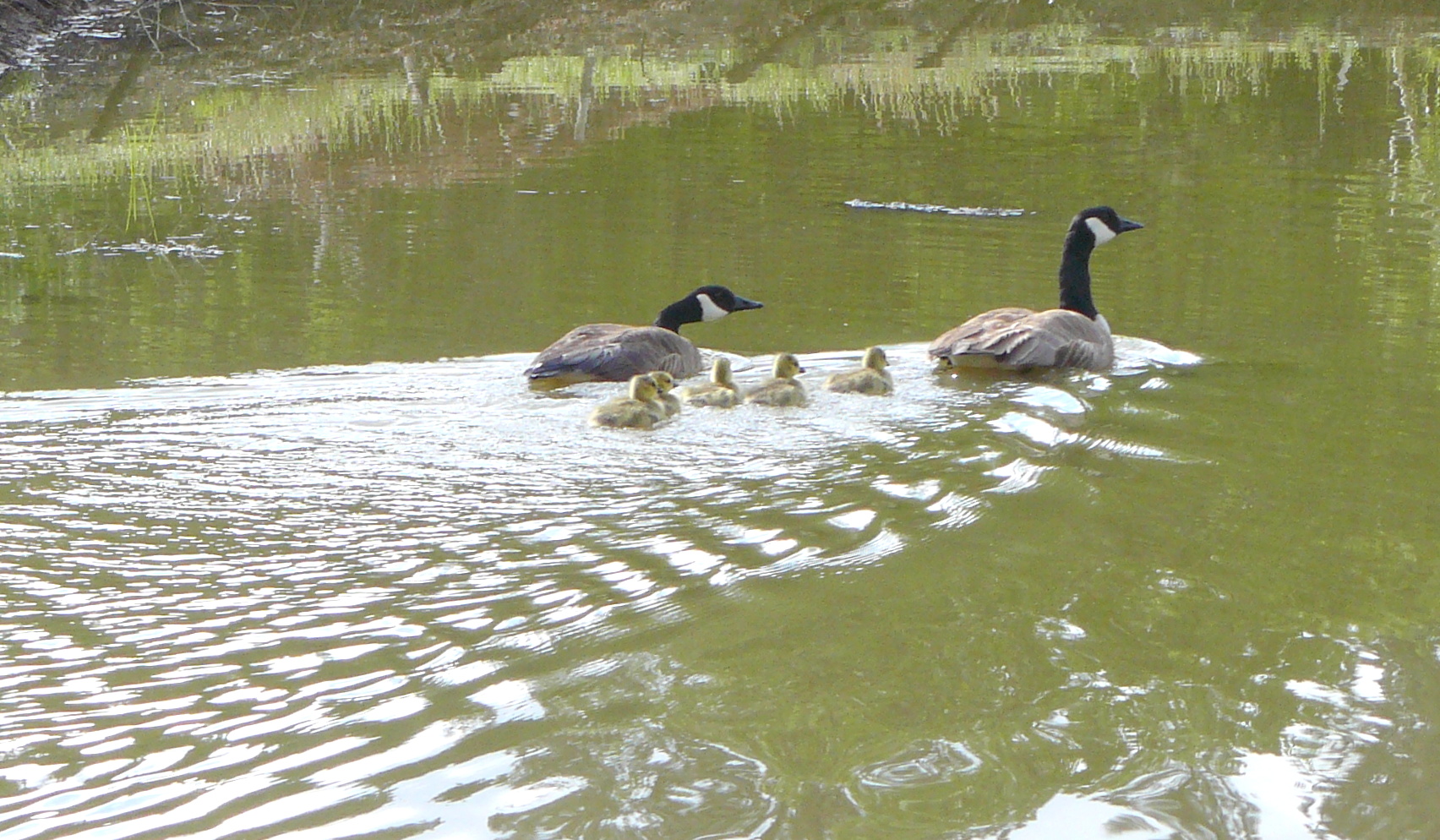
Speaking of joy, when we pulled back the bedroom curtains this morning (Thursday) the nest was empty!

P1160060For the last too many weeks to remember a mother Canadian Goose has been sitting on her nest of eggs with Father Goose staying close. We like to think that the mother returned to this place after having been born here a year ago.

Overnight five young healthy goslings were born! 🙂

P1160059May their little lives be full of love with a total absence of trauma!

The most beautiful bond of all.

I am referring to the one between human and animal.

The millions of people who love their pets probably never stop to think about how far that love would extend. As I observe Jean’s patience in coaxing Hazel to take food, time and time again each day, it never crosses my mind that there would be a limit to that devotion from her.

When I think about our animals and the special relationships we have with them all, dogs, horses and cats, never for a moment do I weigh up the pros and cons, despite there being many limitations when one stops and ponders the fact. Like the fact that Jean and I have not been away for a honeymoon or any other vacation together since we were married in 2010.

All it takes is for a dog to rub its head against my leg, or a cat to curl up on my lap, or a horse to give in to a hug around its head, something that happens many times each day, and I am content.

However, the following article that appeared on the Care2 blogsite really underlined how much people will give for their animals.

ooOOoo

7 Times Humans Went the Distance for Animals

3175047.largeBy: Lindsay Patton, April 24, 2016

A story recently went viral about a Colombian man who risked his life to save a dog that was hanging from a balcony. The dog, who belongs to the man’s upstairs neighbors, was caught in the railing and was close to falling to the ground. The neighbor, whose name is Diego Andrés Dávila Jimenez, made a dangerous climb from his balcony up to his neighbors’ in order to save the dog.

For animal lovers, there wouldn’t be a second thought about doing the same, whether it was their own pet, someone else’s or an animal in the wild. People go great lengths for animals every day. Here are just a few inspirational examples of them.

Ric O’Barry Does Jail Time for Dolphins

In 1970, Ric O’Barry founded The Dolphin Project and since then, he has dedicated his life to saving dolphins. His life’s work hasn’t been easy, though. O’Barry – who was featured in the 2009 documentary The Cove –  has been detained, fined and threatened for his dolphin activism. In January, he was detained at a Japanese airport on his way to monitor the annual dolphin hunt in Taiji. By now, being detained is nothing new to O’Barry, as it happens nearly every time he visits Japan for the hunt. In August, O’Barry was arrested in Japan for not carrying his passport. Still, he carries on with his mission to rescue dolphins.

Adam Warwick saved a black bear from drowning

When a bear is roaming around a neighborhood, sedating it is one of the only safe options. That’s what Florida wildlife officers did when they got a call about a black bear wandering around an Alligator Point neighborhood. The officers shot the bear with a tranquillizer dart, but the bear ran away and headed straight into water, where he would eventually fall asleep and drown. Biologist Adam Warwick came to the bear’s rescue and pulled the 400-pound bear back on land. The bear was then safely transported back to its home in a national forest.

Motorist fights traffic to save injured dog

A Mexican woman was driving down a busy highway when she saw a dog get hit by a car and lay injured on the side of a crash barrier. Nobody stopped or slowed down as they drove by, leaving her to try to dodge traffic to get to the dog. The timid dog tried to limp away, but she eventually gained its trust and took it to an area vet to have its injuries treated.

Man saves a stranger’s dog that was blown off a pier

An Australian woman was walking her Shih Tzu-Maltese Bibi on a pier when a strong gust of wind picked the dog up and carried him into the water. Raden Soemawinata was at the pier scattering his grandmother’s ashes when he saw the Bibi in the water and immediately jumped in to save him. Soemawinata humbly told media that “it wasn’t such a great feat.” We think otherwise.

Two Norwegian men save lamb from drowning

Three friends were out taking pictures when they noticed a lamb struggling in choppy waters. Two of the young men worked together to rescue the lamb, while the other used the camera to take incredible pictures of the rescue. They pulled the lamb to safety and reunited it with its flock.

Randy Jordan removes hooks from sharks

Most people try to avoid sharks. Randy Jordan has made a mission to help them. The diver frequently noticed fishing hooks caught in sharks’ mouths, so he made it his mission to remove the hooks from the sharks he encountered. He worked with scientists in order to find the safest way – for himself and the sharks – to have the hooks removed. Jordan has gone on to free multiple sharks from the painful hooks.

Men save baby giraffe in crocodile-infested waters

For four hours, a baby giraffe tried to keep its head above the Uaso Nyiro river’s harsh waters. The Kenyan river is not only fast moving, but is home to many crocodiles. A group of men ignored the river’s danger and waded through the water to pull the giraffe back onto land.

Photo Credit: AmazonCARES

ooOOoo

With so many reminders, especially in the media, of the greed and selfishness of people it really does one good to read these seven examples of how wonderful is the bond between humans and animals.
 

Runaway Antarctica

Do you hear the turnstile about to click!

Not so long ago I wrote a series of three posts under the titles of Interconnections One, Interconnections Two and, yes you guessed it 😉 , Interconnections Three. They were about the consequences of rising sea levels.

Now one might argue that this has nothing whatsoever to do with Learning from Dogs but I would disagree. For as I declare in The Vision of this blog:

It seems to me that a Vision statement should encapsulate just why the owners of the enterprise are committed to that venture.  The author of Learning from Dogs is committed to this project; here is the Vision.

Our children require a world that understands the importance of faith, integrity and honesty

Learning from Dogs will serve as a reminder of the values of life and the power of unconditional love – as so many, many dogs prove each and every day

Constantly trying to get to the truth …

The power of greater self-awareness and faith; faith that the only way forward for us is through the truth …

For in a very real and devastating way even a small rise in global sea level is going to cause tens of thousands of dogs, and their loving owners, to become homeless. We are long overdue a commitment from our global leaders and power-brokers to that, “.. faith, integrity and honesty.”

However, championing that greater self-awareness is what blogger Patrice Ayme does almost all of the time. With his kind permission, I republish his latest post on the state of the Antarctic Ice.

ooOOoo

Runaway Antarctica

I have written for years that a runaway Antarctica was certain, with half the icy continent melting rather spectacularly on an horizon of two centuries at most, and probably much less than that. This rested on the fact that half of Antarctica rests on nothing but bedrock at the bottom of the sea. At the bottom of what should naturally be the sea, in the present circumstances of significant greenhouse gas concentrations.

Visualize this: until sometimes in the Nineteenth Century, GreenHouse Gas (GHG) concentration was 280 ppm (280 parts per million), including the man-made sort. Now we are close to 500 ppm, using a variety of exotic gases we produce industrially, among them, CO2. In CO2 alone we are at:  Week beginning on March 20, 2016: 405.62 ppm. Weekly value from 1 year ago: 401.43 ppm. Weekly value from 10 years ago: 382.76 ppm. So the CO2 alone is augmenting at a bit more than 1% a year. Thus we will be at an equivalent of 550 ppm in ten years (including the full panoply of all the other man-made greenhouse gases, not just CO2). There is evidence that, with just 400 ppm, disaster is guaranteed.

Now visualize this:

antarctica-truth-revealed-nyt-2016-450
How Antarctica would appear if its ice melted: it’s half under the sea.

Why so watery? Because the enormous glaciers, up to nearly 5,000 meter thick, press down on the continent with their enormous weight. Since the end of the last glaciation, 10,000 years ago, Scandinavia has been rising, and is still rising (I long used a picture with a similar information about Antarctica’s bedrock.)

A paper published on line in Nature on March 30, 2016, that is, two days ago, “Contribution of Antarctica to past and future sea-level rise” opines that:

Polar temperatures over the last several million years have, at times, been slightly warmer than today, yet global mean sea level has been 6–9 metres higher as recently as the Last Interglacial (130,000 to 115,000 years ago) and possibly higher during the Pliocene epoch (about three million years ago). In both cases the Antarctic ice sheet has been implicated as the primary contributor, hinting at its future vulnerability. Here we use a model coupling ice sheet and climate dynamics—including previously underappreciated processes linking atmospheric warming with hydrofracturing of buttressing ice shelves and structural collapse of marine-terminating ice cliffs—that is calibrated against Pliocene and Last Interglacial sea-level estimates and applied to future greenhouse gas emission scenarios. Antarctica has the potential to contribute more than a metre of sea-level rise by 2100 and more than 15 metres by 2500, if emissions continue unabated. In this case atmospheric warming will soon become the dominant driver of ice loss, but prolonged ocean warming will delay its recovery for thousands of years.

Notice that the scenario evoked in the last sentence is different from my  very old scenario, which is similar to the one advanced in November 2015 by the famous Hansen and Al. (I raised the alarm before Hansen, at least seven years ago). In my scenario, and Hansen’s the ice sheets melt from below, due to warm sea water intrusion.

The West Antarctic Ice Sheet is larger than Mexico.

Here is a taste of the paper (I have a Nature subscription):

“Reconstructions of the global mean sea level (GMSL) during past warm climate intervals including the Pliocene (about three million years ago)1 and late Pleistocene interglacials2, 3, 4, 5 imply that the Antarctic ice sheet has considerable sensitivity. Pliocene atmospheric CO2 concentrations were comparable to today’s (~400 parts per million by volume, p.p.m.v.)6, but some sea-level reconstructions are 10–30 m higher1, 7. In addition to the loss of the Greenland Ice Sheet and the West Antarctic Ice Sheet (WAIS)2, these high sea levels require the partial retreat of the East Antarctic Ice Sheet (EAIS), which is further supported by sedimentary evidence from the Antarctic margin8. During the more recent Last Interglacial (LIG, 130,000 to 115,000 years ago), GMSL was 6–9.3 m higher than it is today2, 3, 4, at a time when atmospheric CO2 concentrations were below 280 p.p.m.v. (ref. 9) and global mean temperatures were only about 0–2 °C warmer10. This requires a substantial sea-level contribution from Antarctica of 3.6–7.4 m in addition to an estimated 1.5–2 m from Greenland11, 12 and around 0.4 m from ocean steric effects10.”

So notice: when CO2 ppm per volume was at 280 130,000 to 115,000 years ago, sea level was up to ten meter higher than now. And now we are at 500 ppmv…

And notice again: When CO2 ppmv was at 400, sea level was up to 30 meters (100 feet) higher than today. And now we are at 500 ppm, and, in a blink, in ten years, at 550 ppm.

Here is another example from the paper. I said all of this before, but to have scientists paid to do research in this area write it black on white in the world’s most prestigious scientific magazine, will no doubt endow me with greater, and much desired, gravitas. So let me indulge, not so much for my greater glory, but because it should help taking what I have long said more seriously.

“Much of the WAIS sits on bedrock hundreds to thousands of metres below sea level (Fig. 1a)13. Today, extensive floating ice shelves in the Ross and Weddell Seas, and smaller ice shelves and ice tongues in the Amundsen and Bellingshausen seas (Fig. 1b) provide buttressing that impedes the seaward flow of ice and stabilizes marine grounding zones (Fig. 2a). Despite their thickness (typically about 1 km near the grounding line to a few hundred metres at the calving front), a warming ocean has the potential to quickly erode ice shelves from below, at rates exceeding 10 m yr−1 °C−1 (ref. 14). Ice-shelf thinning and reduced backstress enhance seaward ice flow, grounding-zone thinning, and retreat (Fig. 2b). Because the flux of ice across the grounding line increases strongly as a function of its thickness15, initial retreat onto a reverse-sloping bed (where the bed deepens and the ice thickens upstream) can trigger a runaway Marine Ice Sheet Instability (MISI; Fig. 2c)15, 16, 17. Many WAIS grounding zones sit precariously on the edge of such reverse-sloped beds, but the EAIS also contains deep subglacial basins with reverse-sloping, marine-terminating outlet troughs up to 1,500 m deep (Fig. 1). The ice above floatation in these East Antarctic basins is much thicker than in West Antarctica, with the potential to raise GMSL by around 20 m if the ice in those basins is lost13. Importantly, previous ice-sheet simulations accounting for migrating grounding lines and MISI dynamics have shown the potential for repeated WAIS retreats and readvances over the past few million years18, but could only account for GMSL rises of about 1 m during the LIG and 7 m in the warm Pliocene, which are substantially smaller than geological estimates.”

I said it before. Including the details. So the evidence was clear, and out there. The optimism (it will take 5 centuries for 50 feet of sea level rise) is not supported by evidence. Actually collapsing channels coming from inverted rivers running up on the bellies of ice sheets are now obvious on satellite pictures and collapse of major ice shelves is going to be a matter of years, not centuries.

But science is made by tribes and these tribes honor the gods (of plutocracy) who finance them, and their whims. So they don’t want to make their sponsors feel bad. So they say unsupported, optimistic stuff, contradicted by a first order analysis.

Science is good, metascience, better. Metascience includes the sociological reasons which explain why some scientists will take some “facts” for obvious (although, coming from another sociology, they are not).

Deep in the Nature paper, in the quote above, or in four drawings and graphs of future sea level rise, one can find projections according to what various models “predict”… 130,000 years ago (!) The “Old Physics” model predicts one meter rise of the sea (this is the official UN maximal prediction for 2100). The new model, again starting with the present conditions, predict more than a six meter rise (!) This is a case of metascience playing with sea level.

This way, the authors of the paper will be able to say, one day: we told you so. While at the same time not irritating their sponsors now (because to understand what they are really saying takes quite a while, and has to be understood as tongue in cheek, when they pretend to apply the analysis to 130,000 years ago… What they really mean is six meters now, not just one meter… Bye bye Wall Street. Punished by its own instruments…)

The question is not whether we will be able to avoid a twenty meter sea level rise: that’s, unbelievably, a given (barring unforeseeable, yet imaginable technological advances to extract quickly a lot of CO2 from the atmosphere). The question is whether we will avoid a 60 meter rise.

Patrice Ayme’

ooOOoo

Let me add a footnote.

Namely, that on Yves Smith’s Naked Capitalism blog on Saturday was an item under the heading of A Wake-Up Call on Climate Change and Clean Energy.

By Eric Beinhocker, Executive Director, INET Oxford. Originally published at the Institute for New Economic Thinking website

A stark warning from Institute researchers on the probability that ‘2°C capital stock’ will be reached in 2017

A new study from the Institute for New Economic Thinking at the Oxford Martin School and the Smith School for Enterprise and Environment, University of Oxford, shows that we are uncomfortably close to the point where the world’s energy system commits the planet to exceeding 2°C.

In the paper, to be published in the peer-reviewed journal Applied Energy, the authors calculate the Two degree capital stock – the global stock of electricity infrastructure from which future emissions have a 50% probability of staying within 2°C of warming. The researchers estimate that the world will reach Two degree capital stock next year, in 2017.

Read the full item here.

It’s enough to make us all feel angry and hopeless. That would be understandable but wrong.

Go and read my Inconnections Three for within that post is this:

Want to fight climate change? Here are the 7 critical life changes you should make.

For the sake of millions of us and our wonderful pets stay with it and demand change from our politicians and leaders in every way that you can.

Our incredible dogs.

Dog lost at sea is found – five weeks later!

This story has been widely reported and for good reason. The source of my post is here.

ooOOoo

Dog presumed lost at sea shows up 5 weeks later, wagging her tail

Mary Jo DiLonardo March 17, 2016
Luna likely survived on dead fish and mice, as well as fresh water that was shipped in for Navy employees. (Photo: U.S. Navy - Naval Base Coronado)
Luna likely survived on dead fish and mice, as well as fresh water that was shipped in for Navy employees. (Photo: U.S. Navy – Naval Base Coronado)

When Nick Haworth’s dog, Luna, fell off his fishing boat a couple miles off the shore of San Clemente Island in the Pacific Ocean, he thought there was a good chance she’d swim for land.

“Nick was pretty certain she would make for shore because she was a very strong swimmer,” says Sandy DeMunnik, public affairs officer for the U.S. Navy’s Naval Base Coronado, which includes the island. “He asked if he could have permission to come ashore to get her.”

San Clemente Island is a weapons training facility where they work with bombs and offshore bombardment, so they had to shut off one of the artillery ranges to look for the 1 1/2-year-old German shepherd/Husky mix. The staff helped Haworth search for her to no avail. He stayed in the area for two more days and couldn’t find her.

“After about a week, it was presumed she had never even made it to shore because they hadn’t seen a sign of her,” says DeMunnik. “They presumed she was lost at sea.”

Fast forward five weeks to March 15 when Navy staff arrived on the island for work.

“She was sitting on the side of the road just wagging her tail,” says DeMunnik. The staff members knew immediately that this was the dog they had been searching for. They opened their door, whistled and Luna jumped right in the truck.

After more than a month of being gone, Luna takes a well-deserved nap. (Photo: U.S. Navy - Naval Base Coronado)
After more than a month of being gone, Luna takes a well-deserved nap. (Photo: U.S. Navy – Naval Base Coronado)

They immediately called Haworth and let him know the happy news. Luna was examined by the island’s wildlife biologist, who said she likely wasn’t seen for five weeks because her tan-and-black coloring let her blend in with the island’s landscape. Miraculously, except for having lost a little weight, she was OK.

“Amazingly for being lost for five weeks in a very dangerous and treacherous environment, she was fine,” says DeMunnik. “During that time, there was bombardment training, weapons training … there was a lot of very loud, very dangerous training going on, and we had some very severe El Nino storms.”

Those storms probably helped keep the dog alive because fresh water was brought to the island by barge for the staff during the storm. They determined that Luna had survived by eating dead fish and rodents.

Because her owner, a commercial fisherman and student at San Diego State University, was away on a fishing trip, he sent his best friend, Conner Lamb, to meet Luna’s plane. When the plane doors opened, she leapt into Lamb’s arms and he fought back tears. On her first night home, he made her a steak for dinner.

The commanding officer of the base sent Luna home with a keepsake of her time spent on the island: her own set of military dog tags. They are engraved with her name, the dates she was missing, and “Keep the faith.”

Luna is greeting by paparazzi — but it's clear that's she's had enough media coverage for the day. (Photo: U.S. Navy - Naval Base Coronado)
Luna is greeting by paparazzi — but it’s clear that’s she’s had enough media coverage for the day. (Photo: U.S. Navy – Naval Base Coronado)

ooOOoo

Two more pictures to reinforce this wonderful story.

The first from US News:

Luna was found Tuesday on San Clemente Island, a Navy-owned training base 70 miles off San Diego.

And the second from Eye Witness News on abc:

Nick Hawarth and Lucky Luna.
Nick Haworth and Lucky Luna.

Well done everyone!


In praise of Monarchs!

But not of the royal variety.

Last week, author and blogger (4am Writer) Kate Johnston published a post about getting 1 million supporters to help save the monarch butterfly. Kate was very happy for me to republish that here on Learning from Dogs. Please read it and sign up.

ooOOoo

Join the Monarch Squad

World Wildlife Fund has set a goal – getting 1 million supporters to help save the monarch butterfly.

Threatened by illegal logging, global warming, herbicide use, and vanishing food source (milkweed) for caterpillars, monarchs are in serious danger.

“Now more than ever, Mexico, the United States, and Canada should increase their conservation efforts to protect and restore the habitat of this butterfly along its migratory route,” said Omar Vidal, Director General for WWF-Mexico.

Last year, I began planting my own butterfly garden in an effort to help provide a habitat for monarch butterflies, and any other form of wildlife that might seek food and shelter there.

BEFORE

Ready for planting!
Ready for planting!

AFTER

Not very organized and probably have too much in there, but I didn’t expect everything to take off the way it did!
Turtles come through my backyard every summer to lay their eggs in the same place. Each generation of turtle somehow knows the exact route, like they have their own inner GPS.
See the butterfly in the middle of the milkweed? This is not a monarch, as it has no white spots. I think it might be a fritillary, maybe the variegated species.
This is a harmless garter snake, and they love my garden!
Just a baby, though. Hubs still took off, so my son had to take the pics.
Hubs nearly ran over this guy with the mower. I had to come and get it ‘cuz it’s a snapping turtle!

Spring is just around the corner in the US, and the monarch butterflies will be heading along their migratory route, back to their northern homes. They will be in search of food and shelter. They will need milkweed, the only plant on which they lay their eggs and the one food source for their babies.

If you have a backyard, won’t you consider providing a home for some beautiful monarchs? Even if you’re sans yard, you can still fight for their survival.

Join the Monarch Squad

ooOOoo

So, please sign up and share this as widely as you can.

For everyone’s sake!

dog-nose

Interconnections Three

Is there a case for optimism? You bet there is!

To be honest, at a personal level I just don’t know the answer to that question. It seems to depend on the mood that Jean and I are in at any particular time. All I can fall back on is that well-used saying from me: “Never underestimate the power of unintended consequences”.

In other words, we shouldn’t underestimate the strength of millions of good people when their demands start reaching out to those in power. (And whatever your reaction to this post, please don’t miss watching the inspirational Al Gore speech towards the end of this post.)

Recently over on the Grist site there was an article about the critical changes that each and every one of us should be making. I want to share it with you in full.

ooOOoo

Want to fight climate change? Here are the 7 critical life changes you should make