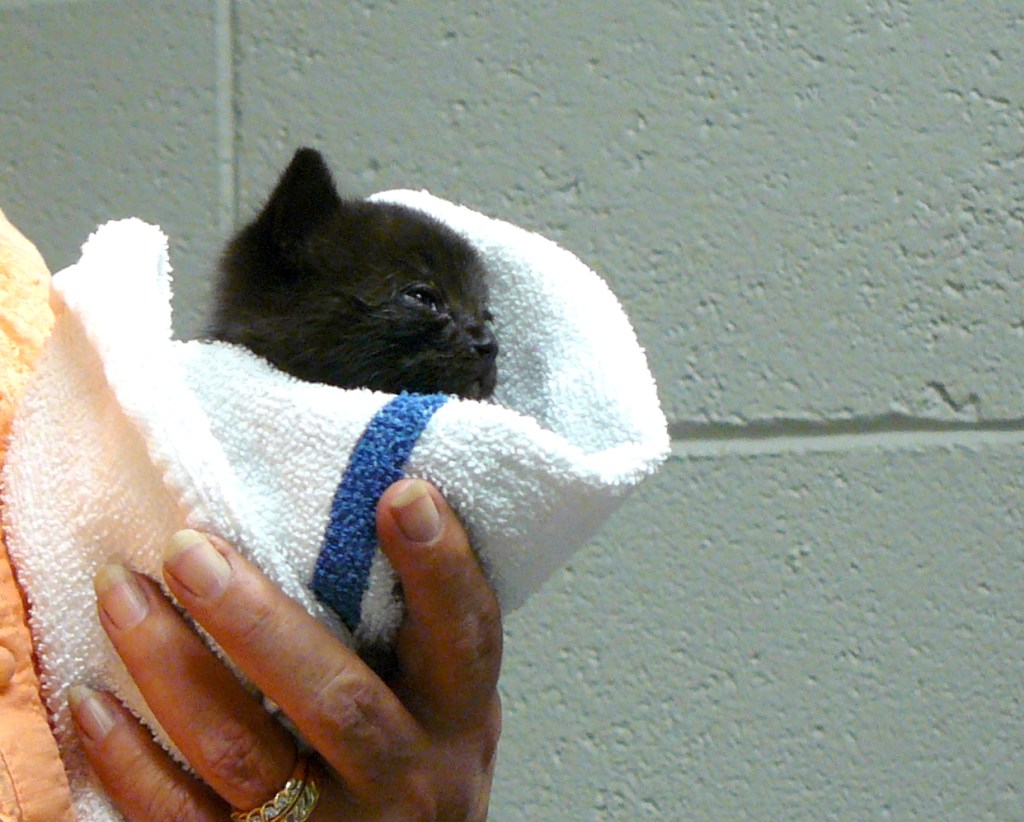
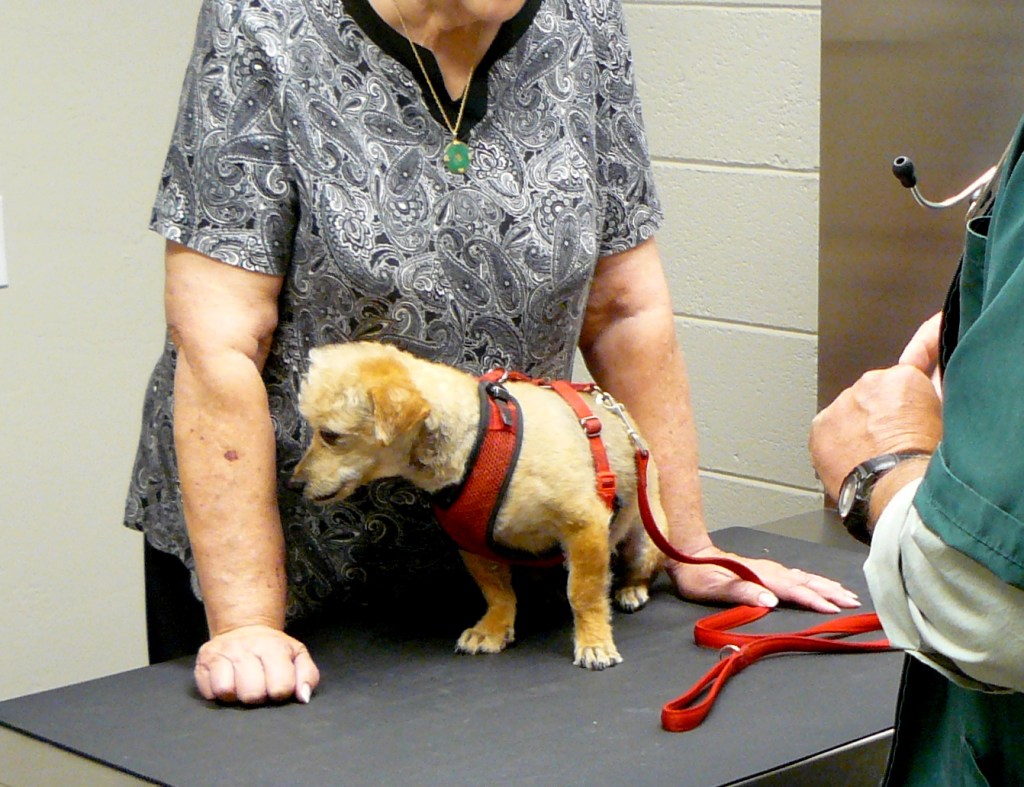
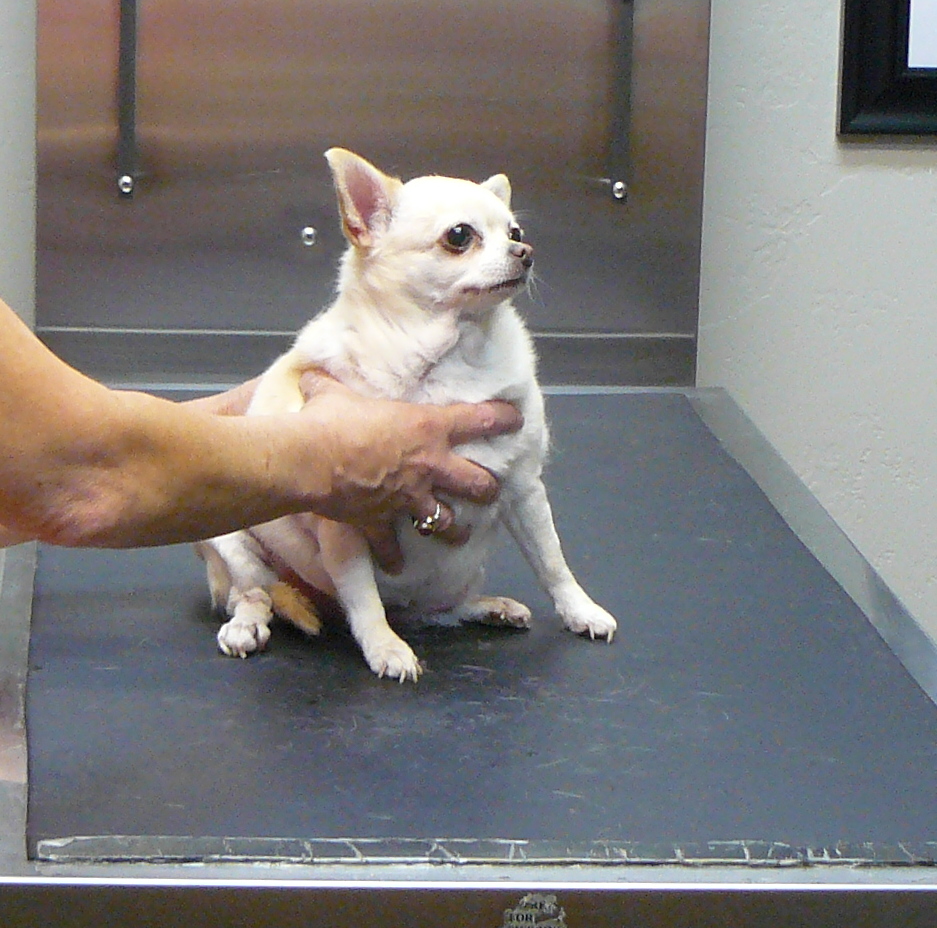
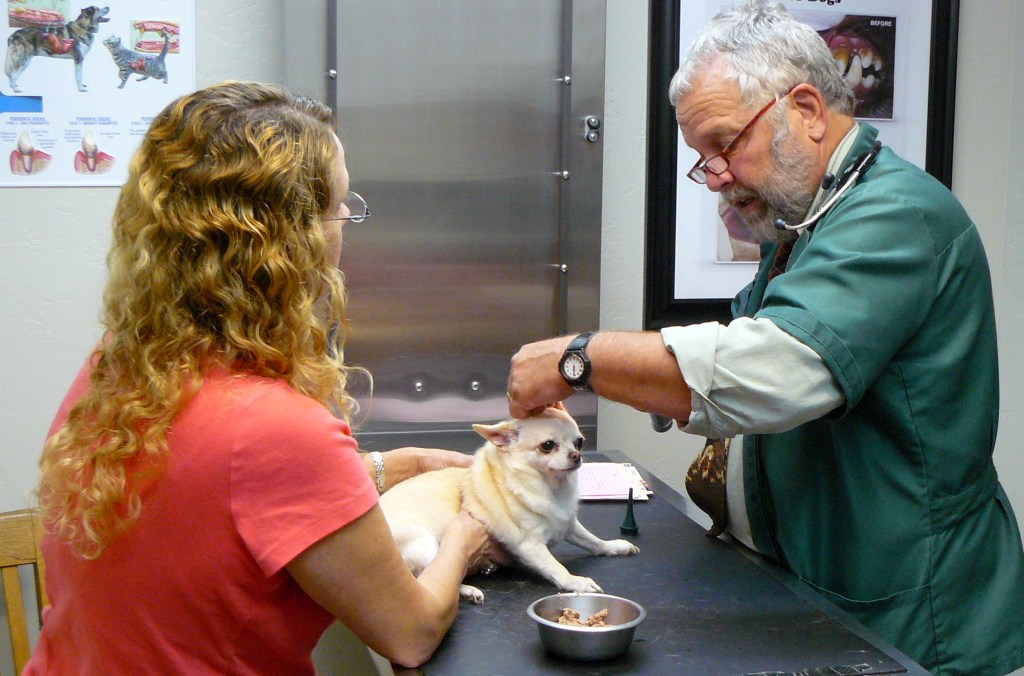
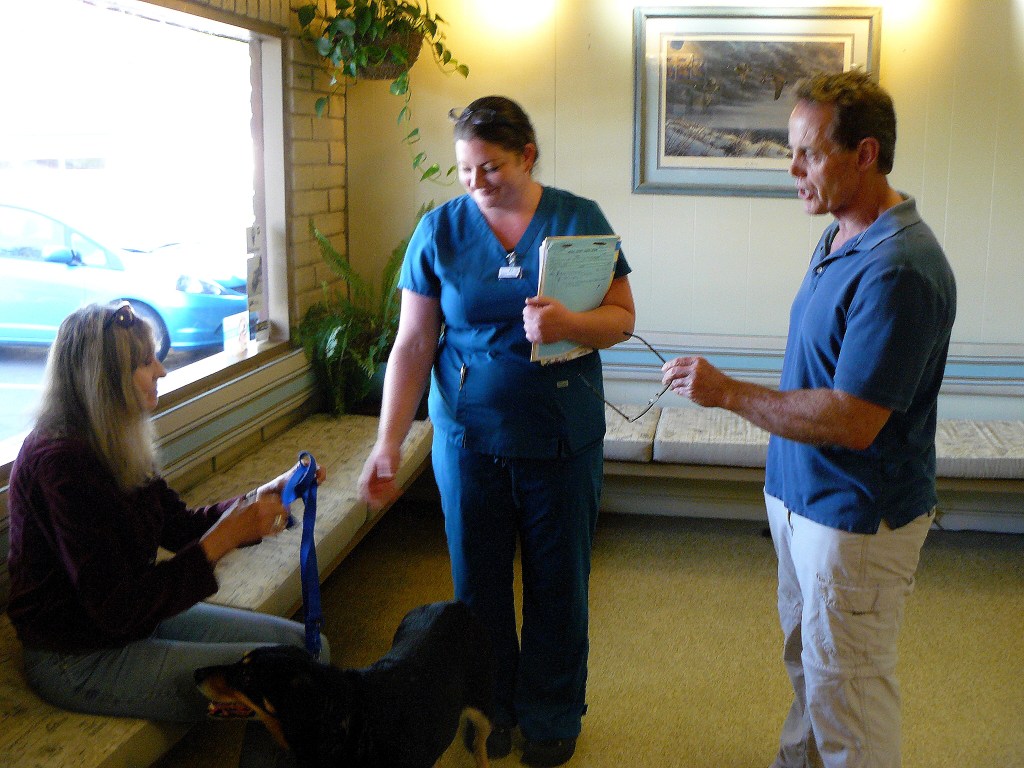
As soon as it was time to say ‘goodbye’ to Ace the cat then in came an entirely different case.
1020 – Back to dogs!
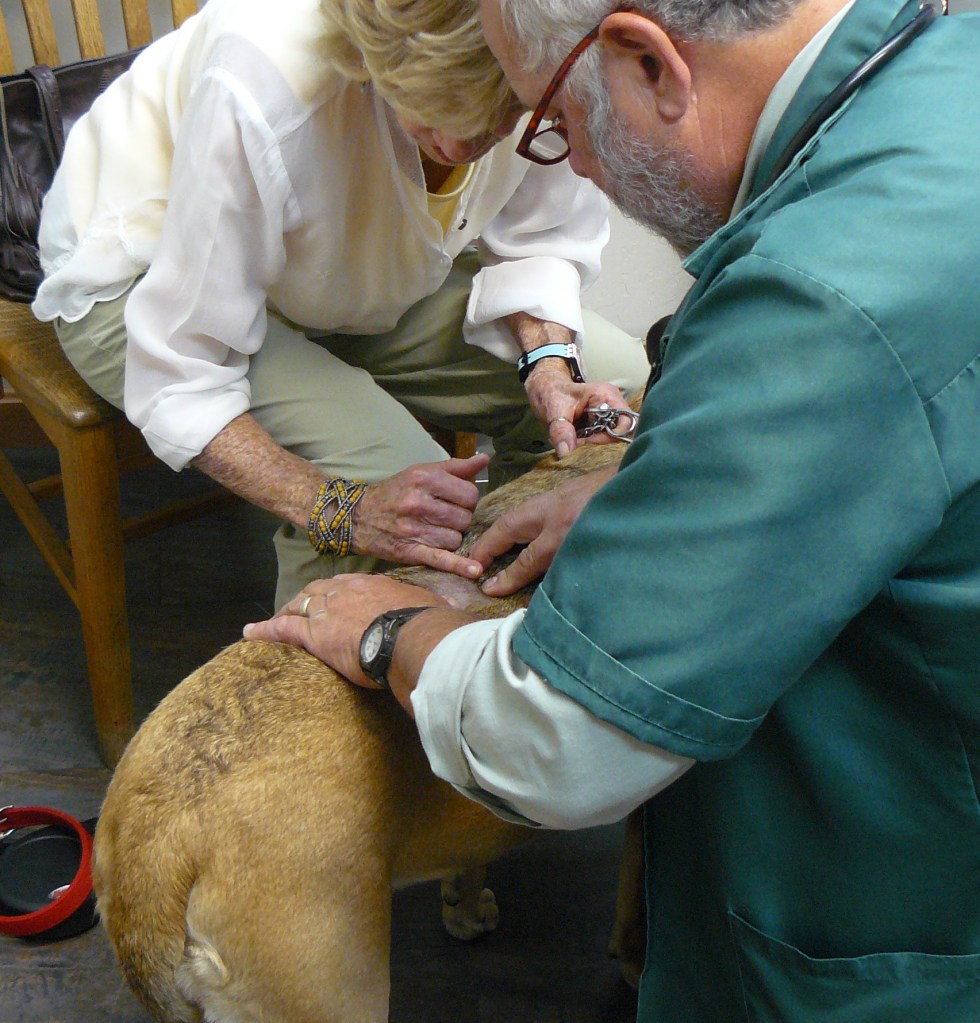
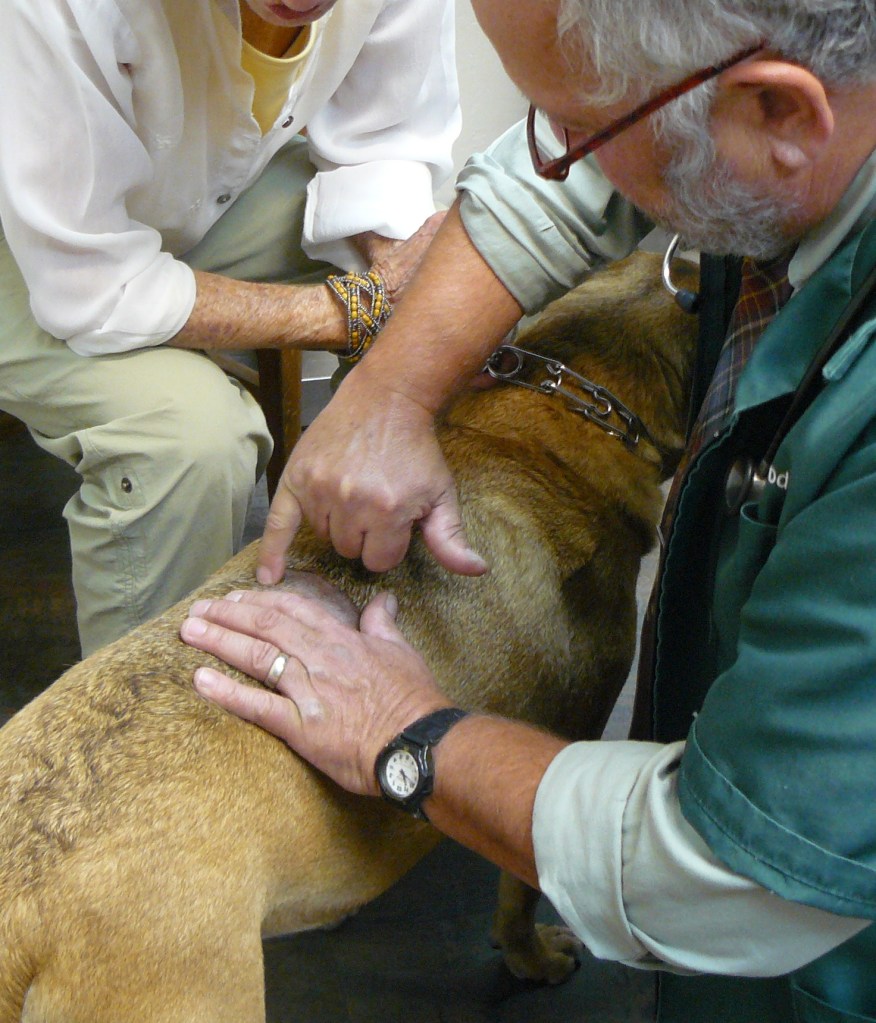
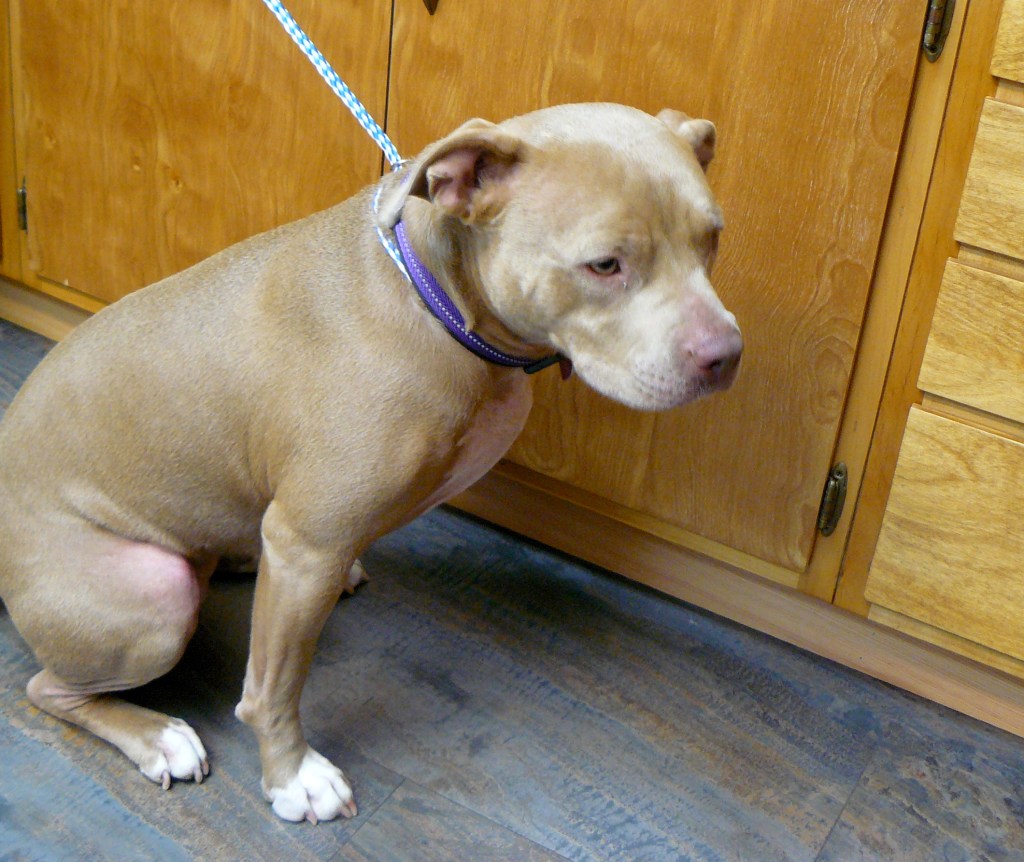
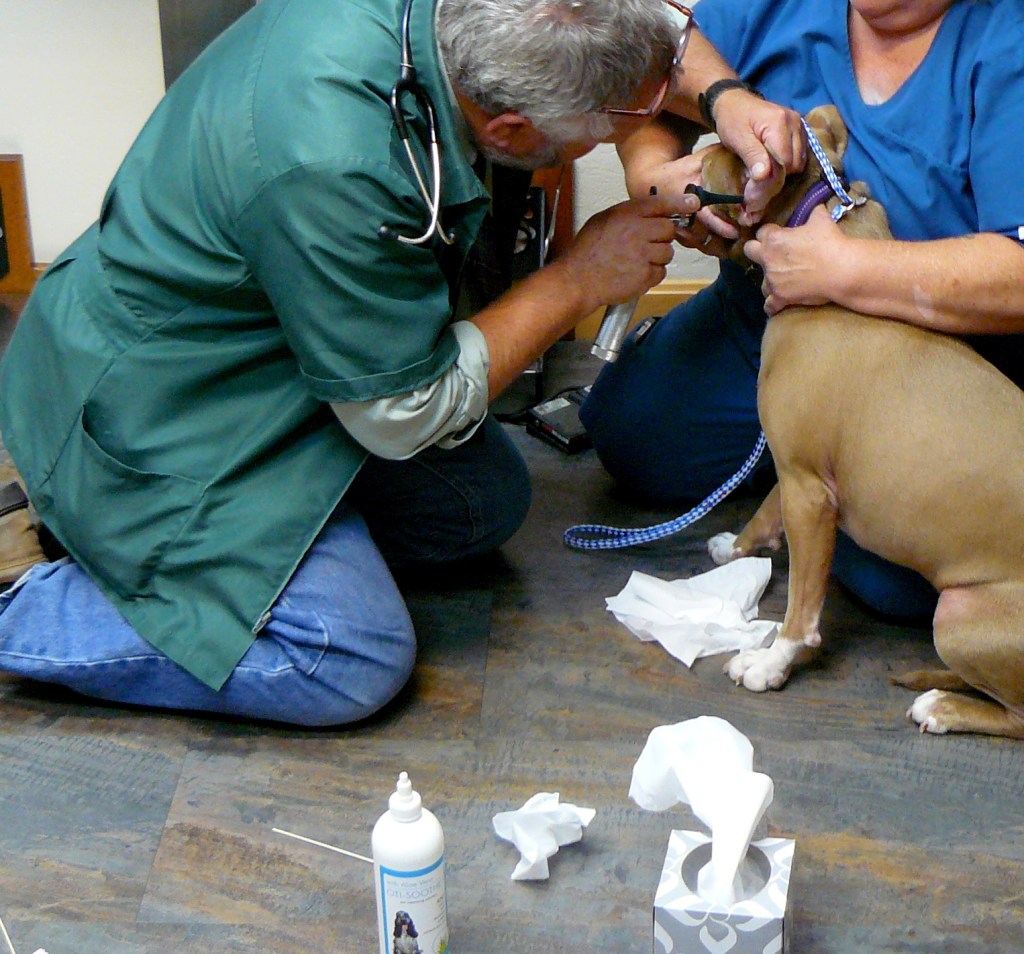
This was Millie, a pit mix, who had been dropped off at the Clinic earlier on. Millie’s owner said that there appeared to be something troubling Millie’s ears. Millie was, indeed, shaking her head a great deal.
Jim established that it was Millie’s left ear that was the source of the irritation. This was immediately obvious since Millie cried as soon as Jim touched that left ear.
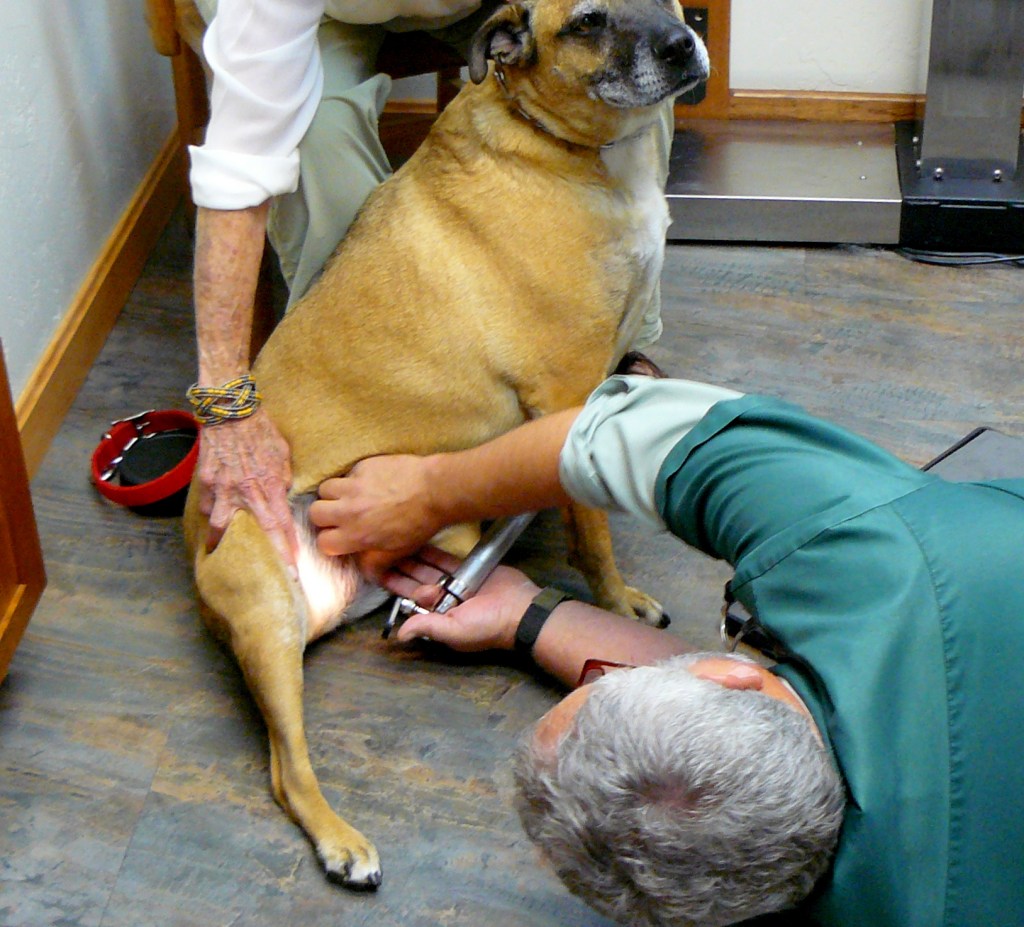
The first examination didn’t identify anything that might be the cause. But apparently the endoscope had such a narrow field of view that it was easy to miss an irritant. Time for another, more extensive examination using that same endoscope.
This time the problem was identified. A foxtail that had penetrated Millie’s ear so deeply that the seed-head had pierced Millie’s eardrum.
Carefully, oh so carefully, Jim pulled the foxtail out from Millie’s ear. I couldn’t believe just how large it was.
About an inch (2.5 cm) long.
I was unable to grab a photograph of Millie’s face once the foxtail had been removed. Trust me it was a face full of doggie smiles.
But I can’t move on to the next patient without remarking how Millie was so beautifully behaved. How maligned the Pitbull and Pitbull Mixes are!
10:45 All done with Millie!
To be continued:
(Please note: These observations are mine alone and because of the busy environment it must be assumed that my interpretation of what was taking place might not be totally accurate. Nothing in this blog post should be used by a reader to make any medical judgment about an animal. If you have any concern about an animal do make an appointment to see a properly qualified veterinarian doctor.)
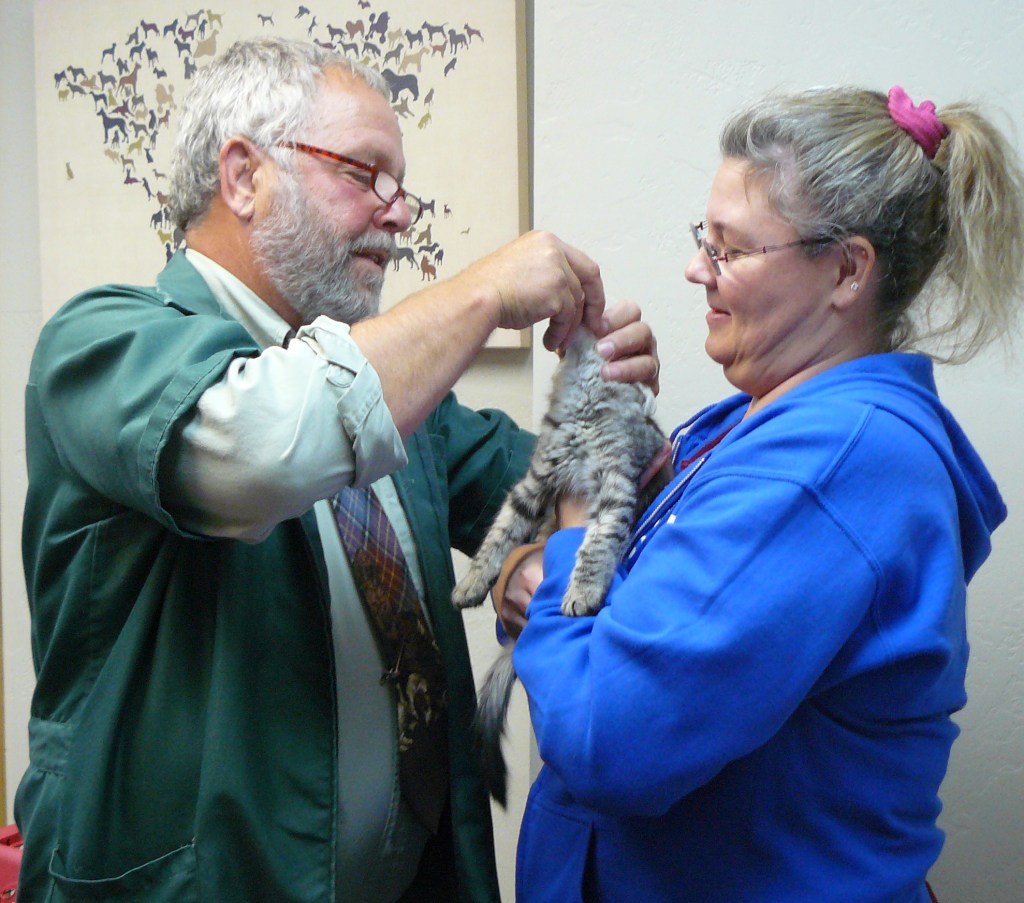
It’s 09:00 and the next animals to be brought in to see Dr. Jim are a couple of cats requiring vaccination.
The kittens are named Grace and Frankie and both were adopted from the Nevada Humane Society although I wasn’t familiar with the circumstances surrounding that adoption.
But great to see them being cared for by the two women and the degree of professional service that I saw in Jim’s briefing of these new cat owners.
That care included giving one of the kittens the necessary pills by mouth.
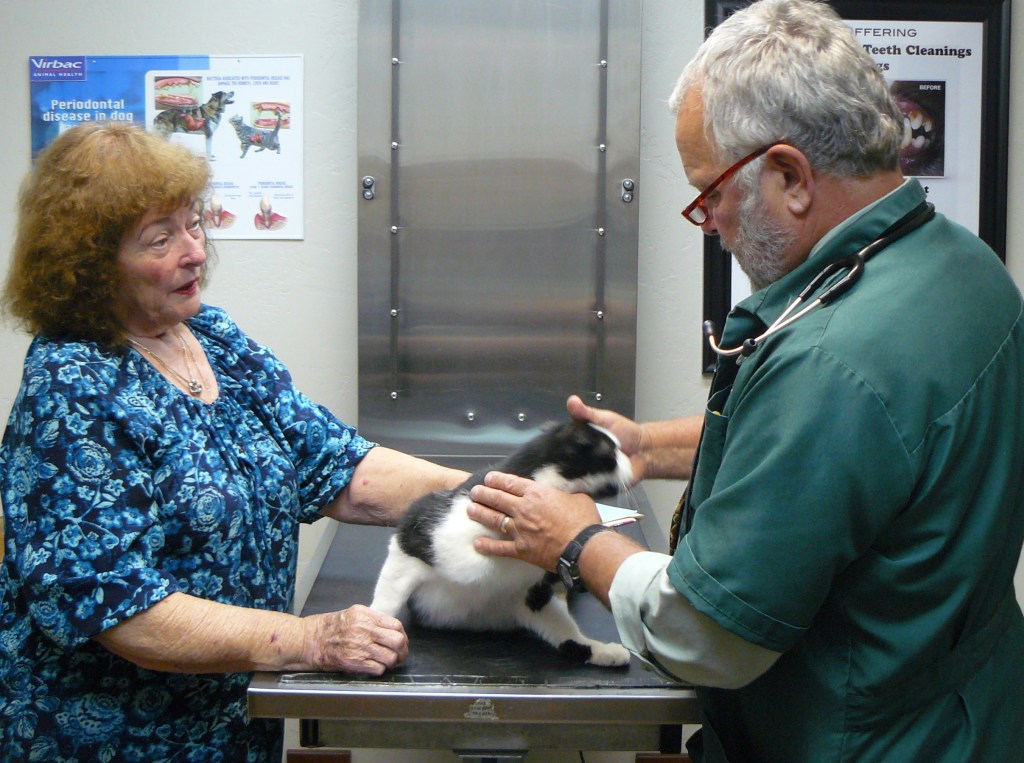
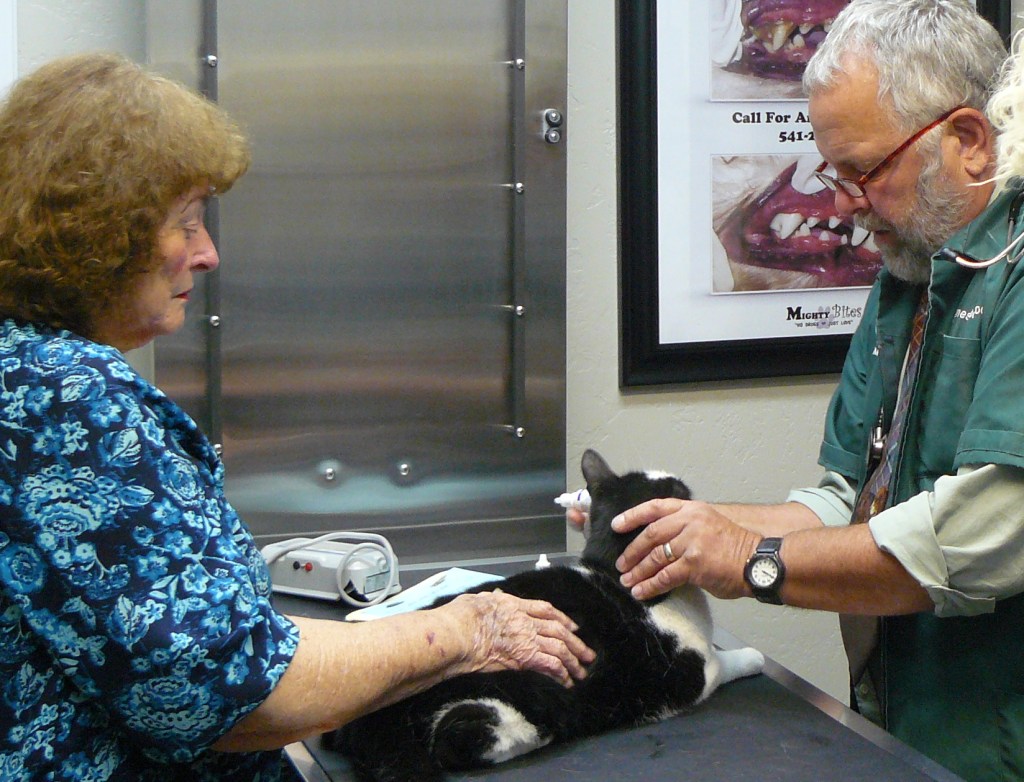
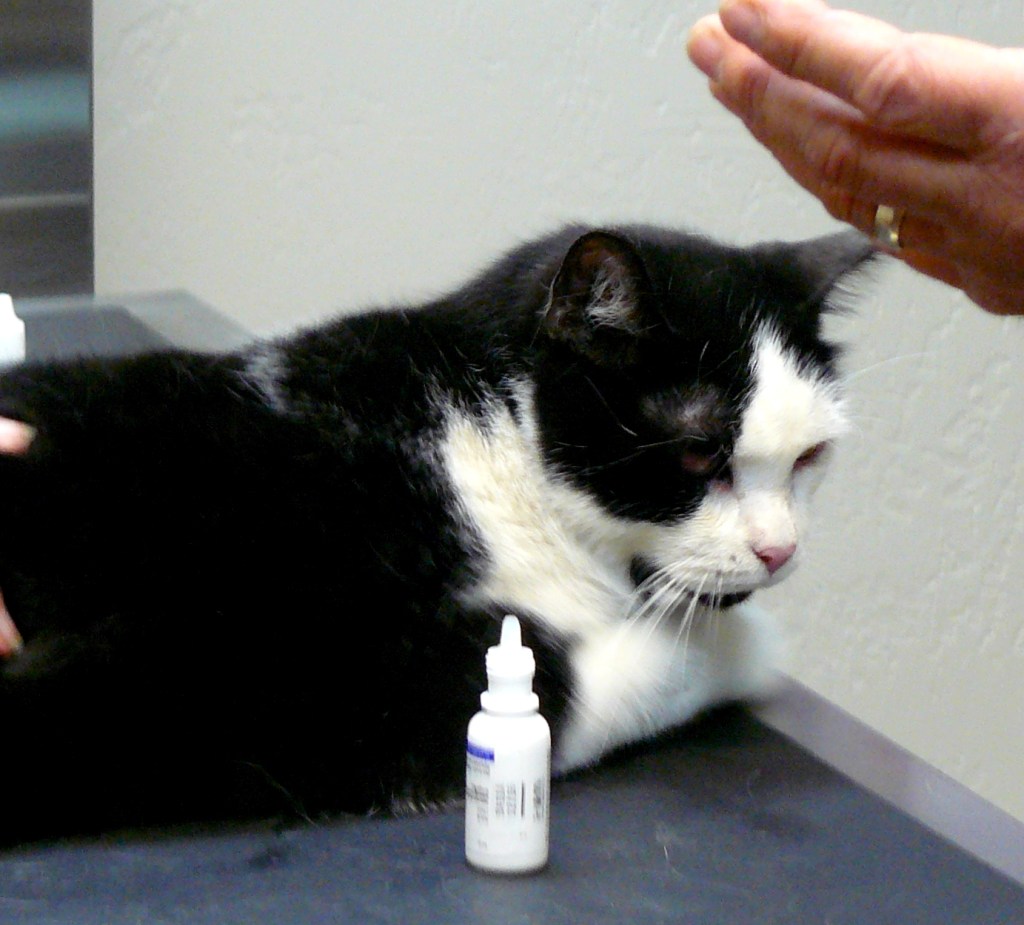
It is now 09:25 and the next case for Jim is another cat. In this case a cat, named Ace, that the owner thinks is having trouble seeing out of it’s right eye.
Jim applies a fluorescent stain to the Ace’s eye that then enables Jim to use a special UV lamp to determine the degree of damage to the eye.
It is determined that the pressure in Ace’s eyeball is normal and Jim is pretty certain that Ace has no sight at all in that right eye. He recommends giving the cat some antibiotics and explains to the owner that cat’s can function perfectly adequately with just one eye. Indeed, if necessary the eyeball could be removed, something that would not be a disadvantage for Ace.
The lady owner of Ace takes note of Jim’s advice and is clearly grateful for what has been explained to her.
It is 10:10.
To be continued:
(Please note: These observations are mine alone and because of the busy environment it must be assumed that my interpretation of what was taking place might not be totally accurate. Nothing in this blog post should be used by a reader to make any medical judgment about an animal. If you have any concern about an animal do make an appointment to see a properly qualified veterinarian doctor.)
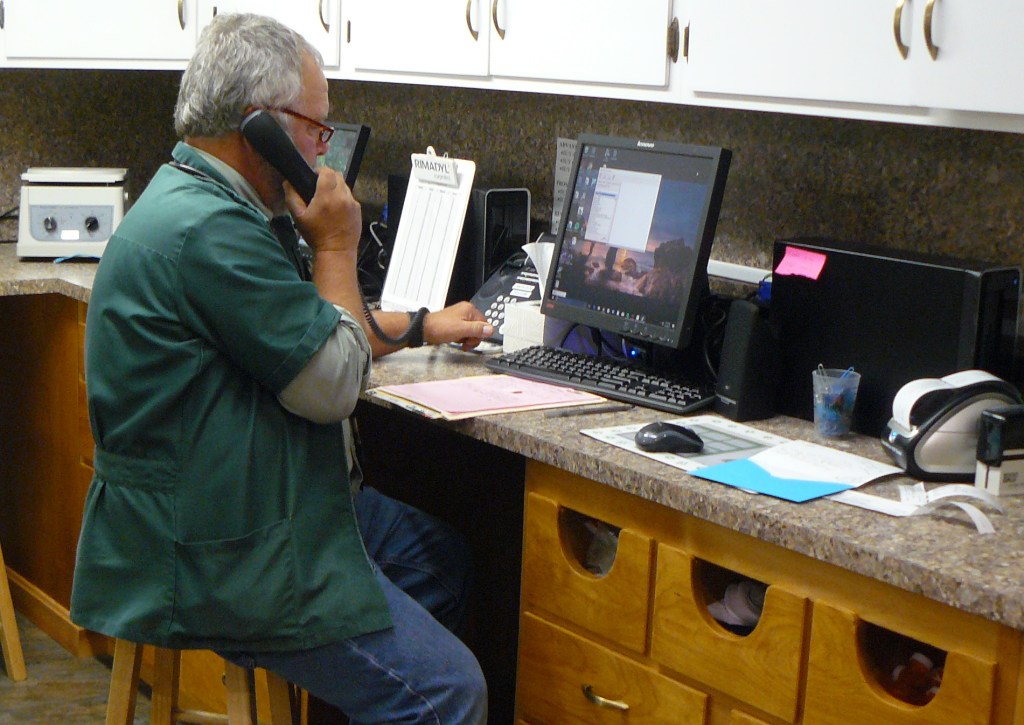
I arrived a little before 8:30 to find both receptionists busy on the telephone. They signaled for me to wait in the reception area until Dr. Jim came out to meet me.
As I waited it quickly became clear that Janice, one of persons behind the front desk, was speaking to someone who was having to make the decision to euthanize their dog. I hadn’t bargained for how that made me feel since it was so recently that Jean and I had trodden the same path. I had to give myself a stern reminder that I was here as the quiet, unobtrusive observer and that my own feelings had to be tucked out of sight.
Shortly thereafter, with Janice still on the telephone patiently and compassionately speaking with that dog’s owner, someone came in with Daisy who was here for teeth cleaning. Jim came out to meet her and advise the owner that one of the team would be doing Daisy’s teeth not himself.
Then it was time for me to go back with Jim and start the day with him. (Jim had arrived at 8:20am.)
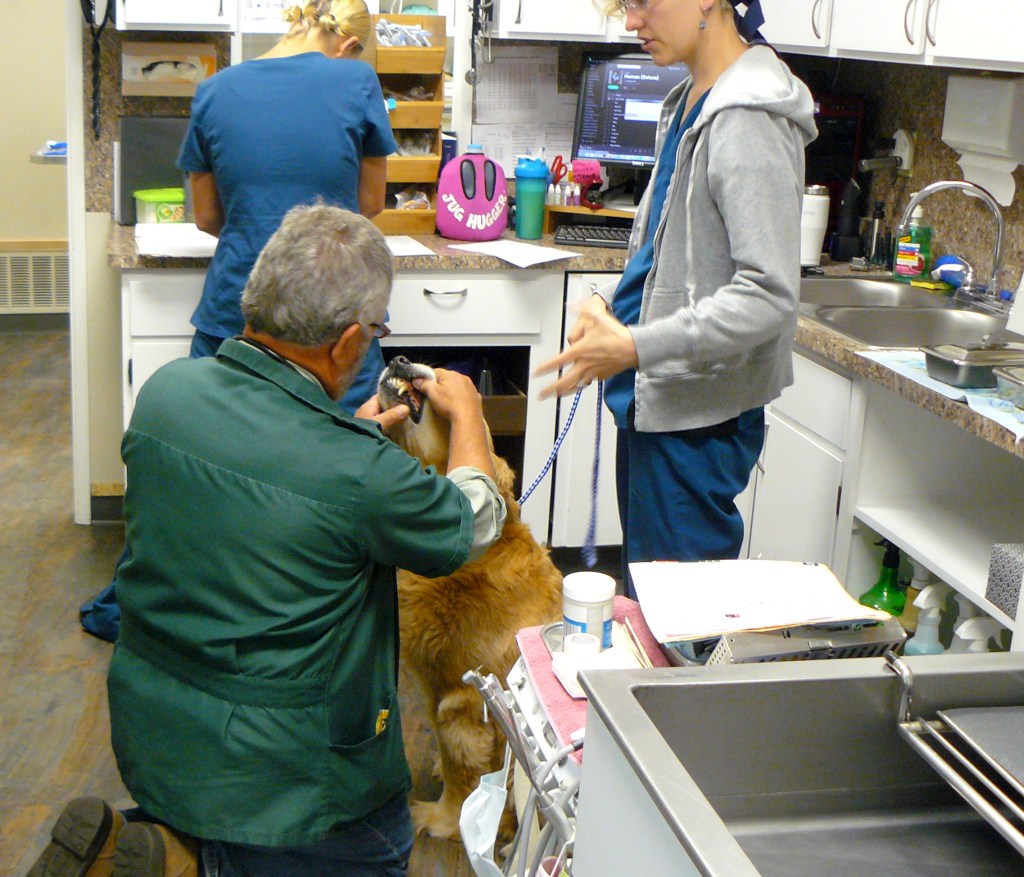
Jim’s first case was Ginger. Ginger, a female Golden Retriever, had been brought in earlier on because she had lost weight, was lethargic and was generally off-color.
Jim started to examine Ginger assisted by Cianna, a veterinary technician at the clinic.
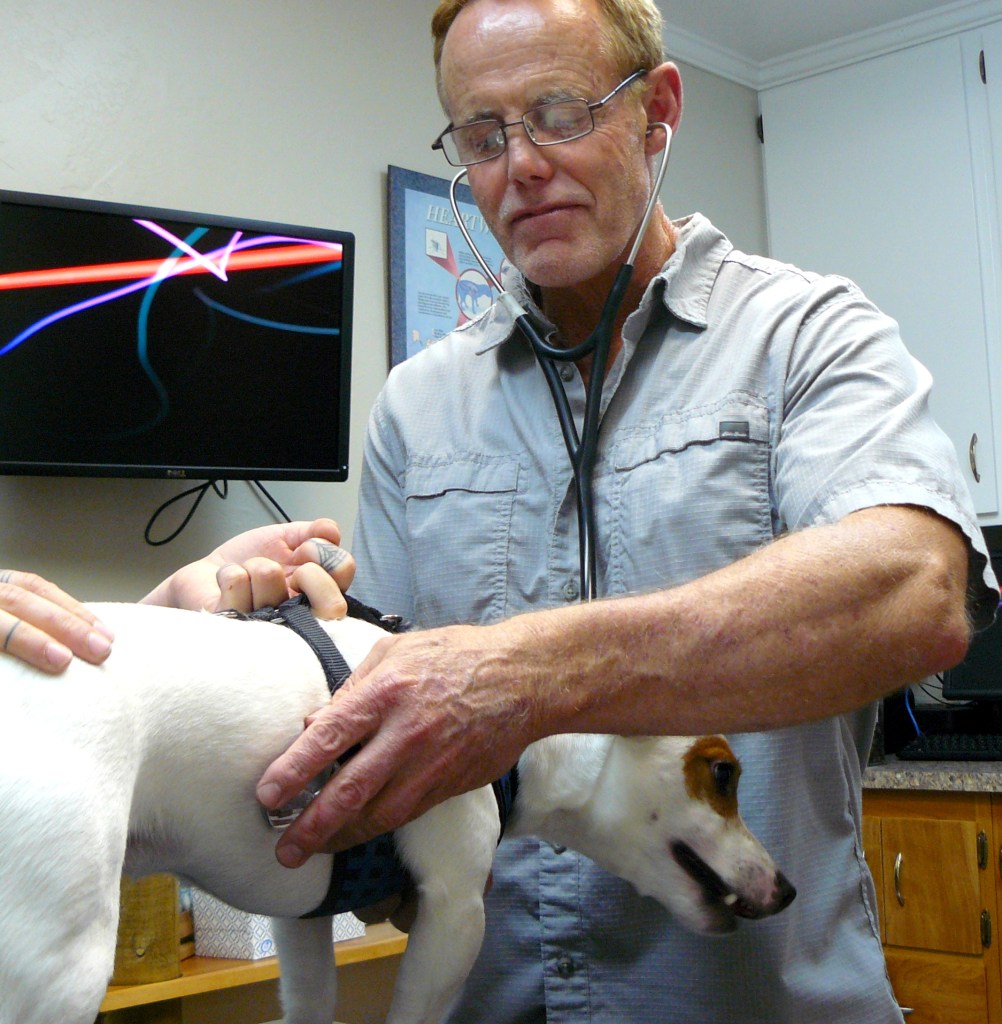
It was immediately clear to Jim when he listened to Ginger’s heart that it was racing; Jim thought at something like 200 beats per minute. Jim continued to check Ginger over although, as he told me later, he had an idea that Ginger’s medical problem was a cardiac issue. Jim arranged for Ginger to be given an X-ray as well as blood work.
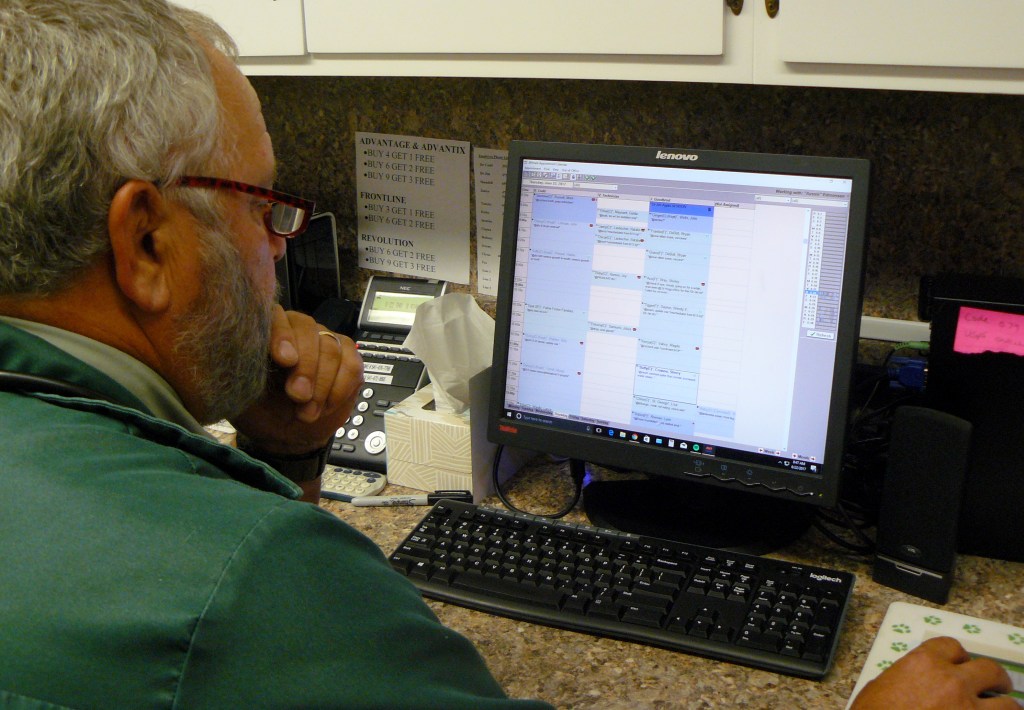
It would take a few minutes for the results of Ginger’s X-ray to come through so Jim showed me the primary software program used in the clinic to record all the details of each patient and all the individual medical details. The software was called AVImark.
I was impressed, very much so, but then again not surprised. For the veterinary business is big business in many countries. For instance, the American Veterinary Medical Association (AVMA) reports that in 2016 there were 107,995 veterinarians in the USA. Of course, there would be a wide range of software tools for the industry.
Back to Ginger’s status.
Her X-ray having been taken, the digital image of her heart was transferred electronically to Dr. Jim’s computer. It showed an extremely enlarged heart. Jim said that the owners of Ginger would be facing a potentially complex analysis but in the interim Ginger should be put on one of the ‘pril’ drugs to reduce the very high stress on Ginger’s heart: Lisinopril; Enalapril; Benazepril. That was arranged then and there. (I didn’t make a note of which drug was given to Ginger.)
Time to call Ginger’s owners and report the findings.
The owners said that they would be in to collect Ginger at 12:30.
I looked at my watch. It was 8:58!
Already the next patient is ready to be seen by the good Doctor.
To be continued:
(Please note: These observations are mine alone and because of the busy environment it must be assumed that my interpretation of what was taking place might not be totally accurate. Nothing in this blog post should be used by a reader to make any medical judgment about an animal. If you have any concern about an animal do make an appointment to see a properly qualified veterinarian doctor.)
Opening up the world of a busy veterinary practice.
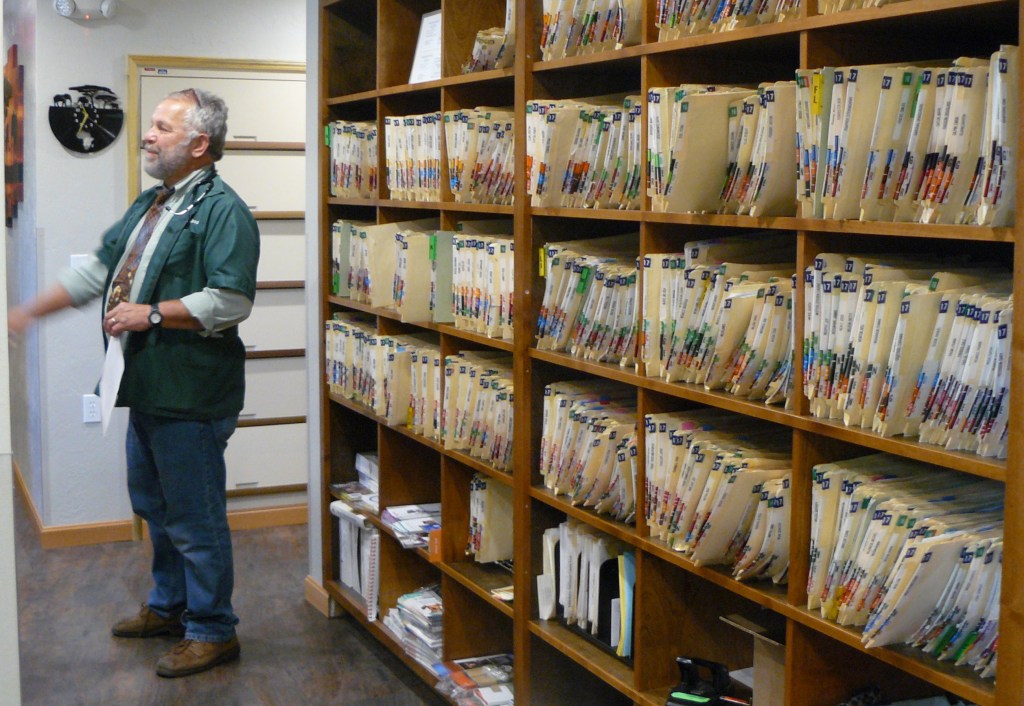
Like the majority of pet owners, our experiences of taking a cat or a dog to the local vet clinic are gained entirely in regard to those particular animals. The only small difference between this household and most others is that we have the distinct privilege of having Jim and Janet Goodbrod as close friends just a short distance away. Jim is a Doctor of Veterinary Medicine (DVM) and thank goodness for that as it was more than wonderful that Jim was able to be on hand a week ago when it came to Pharaoh’s last few moments.
Jim is a regular DVM working at Lincoln Road Veterinary Practice in nearby Grants Pass. That practice is run by Dr. Russel Codd.
Dr. Russel Codd (RHS) speaking with Jean at the Clinic back in the days of our dear Hazel.
Some time ago, when we were visiting Lincoln Road, it struck me that the detail of what takes place ‘behind the counter’ of a busy vet clinic is most likely not commonly appreciated by those that visit said clinic.
I asked Russel one day if I might be allowed to spend time watching and listening to what goes on behind the scenes; so to speak. Russel said that he would be delighted for me to do that.
So it came to pass that last Thursday, June 22nd, I did just that.
It was a day when Dr. Jim worked a half-day at the clinic and I spent the thick end of six hours listening and observing what took place. I had a camera with me but as was only fit and proper was very sensitive to what photographs were taken. Likewise, I didn’t interrupt the proceedings with my questions although each pet owner had specifically said it was alright for me to be in the same room. In other words, what I will be writing in each post is much more my impressions of the workings of a day in the life of a veterinary clinic.
So tomorrow I will publish the first of my articles and at regular intervals report more from my day at Lincoln Road.
They will be published under the overall heading of Visiting The Vet.
The power of a dog’s nose is incredible and it is something that has been written about in this place on more than one occasion.
But two recent news items reminded me once again of the way we humans can be helped by our wonderful canine partners.
The first was a report that appeared on the Care2 website about how dogs are being used to search for victims in the burnt out ruins following that terrible Grenfell Tower fire. That report opened, thus:
Wearing heat-proof booties to protect their feet, specially trained dogs have been dispatched in London’s Grenfell Tower to help locate victims and determine the cause of last week’s devastating fire that killed at least 79 people.
Because they’re smaller and weigh less than humans, urban search-and-rescue dogs with the London Fire Brigade (LFB) are able to access the more challenging areas of the charred 24-story building, especially the upper floors that sustained the most damage.
It then went on to include a photograph from the London Fire Brigade.
We’ve used specialist search dogs at #GrenfellTower. They’re lighter than humans and can cover a large area quickly.
The next item, apart from also being about the dog’s nose, couldn’t have been more different. It appeared on the Mother Nature Network site and is republished in full.
ooOOoo
Border collies join the search for Amelia Earhart
4 dogs skilled in finding long-buried bones are headed to the uninhabited island of Nikumaroro.
Amelia Earhart standing under nose of her Lockheed Model 10-E Electra. (Photo: Wikimedia Commons)
The high-tech search to find the remains of pilot Amelia Earhart and close the book on one of the aviation world’s greatest mysteries is going to the dogs.
According to National Geographic, four border collies — Berkeley, Piper, Marcy and Kayle — will embark on a voyage later this month to the uninhabited island of Nikumaroro (previously called Gardner Island) in the western Pacific Ocean. The remote triangular coral atoll, less than five miles long and two miles wide, is widely speculated as the location where Earhart and her co-pilot, Fred Noonan, performed an emergency landing during their ill-fated 1937 world flight.
While concrete evidence of the pair surviving as castaways on Nikumaroro has never been found, there have been some intriguing clues. These include a piece of scrap metal that likely came from Earhart’s Lockheed Electra 10E, a sextant box, and fragmented remains of U.S. beauty and skin care products that may date back to the 1930s.
The most intriguing find, however, happened in 1940 with the discovery of 13 bones under a tree on the island’s southeast corner. The remains were shipped to Fiji and subsequently misplaced, but measurements recorded before their loss and examined later by forensic anthropologists indicate that they may have belonged to “a tall white female of northern European ancestry.” With these findings were recently thrown into doubt, the only true way to know if the remains belong to Earhart or Noonan is to find the remaining bones.
The right nose for the job
The four dogs headed to Nikumaroro, officially known as Human Remains Detection Dogs, are part of the latest expedition organized by TIGHAR (The International Group for Historic Aircraft Recovery). Trained at the Institute for Canine Forensics (ICF), these specialized dogs are capable of sniffing out bones centuries old and buried as much as 9 feet deep.
“No other technology is more sophisticated than the dogs,” Fred Hiebert, archaeologist in residence at the National Geographic Society, which is sponsoring the canines, said in a statement. “They have a higher rate of success identifying things than ground-penetrating radar.”
According to the ICF, detection dogs are never trained to smell out live humans, focusing instead on old cases, small scent sources and residual scent. They also excel at locating remains without disturbing the burial site.
You can view one of the ICF dogs in action, seeking out the remains of ancient Native American burial sites, in the video below.
“This kind of searching requires the dog to be slow and methodical and keep its nose just above the surface of the ground, any fast moves and the dog can miss the grave,” the group explains. “It takes many years of slow and patient training to develop the skills needed to do this work.”
Once remains are detected, the dogs generally do little more than lie down on top of the potential burial site. Should Berkeley, Piper, Marcy and Kayle detect anything, TIGHAR’s archeologists will perform a careful excavation to uncover the source.
In addition to using canines, the team from TIGHAR will also take time over the eight-day expedition to survey sites on Nikumaroro using metal detectors and even an advanced underwater drone. Their greatest hope, however, lies with the highly advanced noses of the very good boys and girls sniffing out an 80-year-old mystery.
“If the dogs don’t find anything, we’ll have to think about what that means,” Hiebert added. “But if the dogs are successful, it will be the discovery of a lifetime.”
I am referring to the result of the British election that was held last Thursday.
Now I am well aware that many readers will not have the same relationship with the outcomes of British elections as your faithful scribe. But I am also aware that we live in a very connected world. I am also acutely aware that for many, many years I was a devoted listener to the 15-minute weekly radio broadcast on the BBC by Alistair Cooke Letter from America.
So for me, and many others I don’t doubt, the views of America as to what goes on across the pond are just as fascinating today as they have always been.
But in the absence of dear Mr. Cooke (20 November 1908 – 30 March 2004) passing on his experienced assessment on what the outcomes of British elections mean for America then I turn to a recent item on The Conversation site and republished here within the terms of that site.
ooOOoo
How populism explains May’s stunning UK election upset: Experts react
June 9, 2017 6.04am EDT
Editor’s note: U.K. Prime Minister Theresa May’s election gamble failed badly as her Conservatives lost 12 seats, leaving them with 318, shy of a majority. It was a stunning loss for a party earlier projected to gain dozens of seats. Without a majority, the Conservatives will have to rely on another party to govern – known as a hung Parliament. If they’re unable to forge a coalition, rival Labour leader Jeremy Corbyn – whose party gained 31 seats – would be able to give it a go. We asked two experts to offer their insights on what Americans should make of the election and its results.
May had a bad night and may face a struggle over her party’s leadership
The results of this election show how similar, and yet how different, British politics are from what is happening in America.
As in the United States, there has been an explosion of populism in Britain, most recently evidenced by the Brexit referendum. This new political force is translating into less liberal policies from the major parties.
In continental Europe, the new populism is mostly embodied by the resurgent far right. But in Britain, as in America, it is being filtered through the existing two-party system – though the U.K.‘s smaller parties do complicate the electoral map.
To accommodate the political winds, May and her Conservatives decided to shift their electoral strategy away from Margaret Thatcher’s pro-market economic approach toward a greater focus on immigration, security and economic nationalism.
Labour leader Jeremy Corbyn, for his part, deserted the more centrist “New Labour” ideas of Tony Blair in favor of a more robust form of social democracy.
The American left, like its British counterpart, has also become increasingly skeptical of unbridled markets. But among Republicans, a traditional hostility to “big government” makes pro-worker redistributive policies, some of which the Tories have adopted to win votes, hard to stomach. For this reason, populism on the American right has mostly taken the form of protectionist and anti-immigrant policies, as embodied by Donald Trump.
Yesterday’s results were devastating for May and indicate that the Conservatives were ultimately unable to balance their new populist message with their traditional support for neo-liberal policies.
Corbyn, for his part, will use this unexpected victory (of sorts) to solidify his hold over the Labour Party and to move it further to the left.
It remains to be seen whether the election will result in a minority or a coalition government, or whether the parties will be well and truly deadlocked. Whatever happens, the British electorate, like its cousin across the pond, has shown itself to be highly polarized.
Still, at a minimum, Britain’s parliamentary structure, along with the ability of the Labour leadership to co-opt disillusioned voters, seems to have spared Britain the fate of America – the takeover of government by a populist insurgent.
Corbyn and his Labour Party had reasons to smile on election night. AP Photo/Frank Augstein
May took a calculated political risk and lost. While the market reaction has been severe, with the pound plunging, it’s nothing new to companies, which take calculated risks like that every day – some pay off and some do not.
So first of all, U.S. corporate executives will need to take a deep breath. Assuming a combination of other parties do not cobble together at least 322 seats – despite winning seven seats, Northern Ireland’s Sinn Fein will not send MPs to London – the Conservatives will dominate a coalition government and have considerable sway over policy.
This means a “hard Brexit,” as outlined by May in January, and as seen in the European Union’s tough negotiating guidelines, is unlikely to change. But this is what most U.S. companies have been planning for anyway since last June’s Brexit vote. Many companies, particularly banks and financial institutions, are already planning to move some of their U.K. operations to other EU countries to take advantage of the single market rules.
This process will continue no matter who’s in power, since only the low-polling Liberal Democrat and Green parties promised a Brexit revote.
Second, a weakened Conservative Party will need more foreign friends, and that includes U.S. companies. Since Brexit, some foreign businesses have threatened to downsize or close their U.K. operations as leverage for obtaining government subsidies. Expect more companies to use this strategy with a weaker U.K. government.
As I argue in my recent book, the business environment of Europe is much more than the U.K. market, and U.S. companies have become increasingly aware of this since Brexit.
In other words, it’s business as usual, and that means the continued segmenting of companies’ U.K. and EU strategies, regardless of who is governing in London.
ooOOoo
Expect things to continue to be interesting for some time. Or as more eloquently put by Tariq Ramadan “Times have changed; so must the lenses through which we see the political future.”
Back to Alistair Cooke. There are many of his broadcasts available on the BBC Radio website and on YouTube.
I’m closing with just a small part of Charlie Rose interviewing Alistair Cooke in May, 1996.
Uploaded on Sep 25, 2011
Tuesday, May 7, 1996
Charlie Rose: An interview with Alistair Cooke
Alistair Cooke celebrates the 50 year anniversary of his BBC broadcast, “Letter from America”, a 15-minute talk about life in America for British listeners.
Recorded some twenty-one years ago. Somethings don’t seem to change!
A couple of weeks ago I wrote a post Talking to One’s Dog. Many of you stopped by and left your comments, all of which was to confirm how much speaking to your dogs (and cats) is part of normal life for you.
I finished that post writing:
Let me close by reminding all you good people of yet another wonderful aspect of the relationship between humans and dogs. In that we all know the dog evolved from the grey wolf. But had you pondered on the fact that wolves don’t bark! Yes, they howl but they do not bark.
There is good science to underpin the reason why dogs evolved barking; to have a means of communicating with us humans.
Every person who has a dog in their life will instinctively understand the meaning of most, if not all, of the barks their dog utters.
Anyway, I was going through some websites yesterday and, quite by chance, came across that science that I referred to above. It was in a Care2 article published last September and I am republishing it below.
ooOOoo
Yes, Dogs Apparently Do Understand What We’re Saying
You might want to start spelling out some words around your dog. According to a new study, not only do dogs comprehend what we’re trying to tell them by the tone of our voices, but they can also even understand what it is we’re saying — sort of.
Neuroscientist Attila Andics and his fellow researchers at the Eotvos Lorand University in Budapest discovered that just like human brains, a dog’s brain reacts to both the meaning of a word and how it is spoken. Just like us, the left hemisphere of a dog’s brain responds to meaning, while the right hemisphere responds to intonation.
The study, published August 30 in the journal Science, shows that even non-primate mammals who cannot speak can still comprehend the meanings of words in a speech-filled environment. This suggests that the ability of our brains to process words is not unique to humans, and may have evolved much earlier than previously thought.
Not only could these results help make communicating with our dogs more efficient, but the study sheds new light on the origin of words during language evolution. “What makes words uniquely human is not a special neural capacity, but our invention of using them,” Andics said in a press release.
While previous studies have observed dogs to see how they understand us, this is the first one that took a look inside their brains using magnetic resonance imaging (MRI). The 13 participants were all family pets. They included six border collies, five golden retrievers, a Chinese crested dog and a German shepherd.
To be tested, the dogs were first trained to lie still for eight minutes in the MRI machine while wearing headphones and a radio-frequency coil. (Based on the wagging tail of a Golden Retriever in the video below, this didn’t seem to bother at least one of the participants.) Their brain activity was recorded as they listened to a recording of their trainer saying, in both positive and neutral tones, words of praise – like “Good boy!” and “Well done!” – as well as neutral words like “however” and “as if.”
Not too surprisingly, the positively spoken positive words got a big reaction in the reward centers of the dogs’ brains. The positive words spoken neutrally and neutral words spoken with positive tones? Not so much.
Regardless of how they were spoken, the dogs processed the meaningful words in the left hemisphere of their brains. They processed intonation in the right hemisphere.
“There’s no acoustic reason for this difference,” Andics told Science. “It shows that these words have meaning to dogs. They integrate the two types of information to interpret what they heard, just as we do.”
Of course, this doesn’t mean dogs understand every single thing we say (although a Border Collie named Chaser understands over 1,000 words, which is pretty doggone remarkable).
Julie Hecht, a Ph.D. student studying canine behavior and cognition at City University of New York, offers this advice in Scientific American: “Before discussing this with your dog — ‘I knew you could understand me this whole time!’ — the caveat to this research is that a dog processing words — registering, ‘Ah! That’s familiar!’ — and a dog understanding words as you intend are not necessarily the same thing.”
Photo credit: Thinkstock
ooOOoo
I have recounted this example before about how well our dogs listen to Jean and me.
For we take our dogs out for some playtime each day after our lunch. Years ago we used to chat about whether or not to have a cup of tea before taking the dogs for a walk. But pretty quickly once they heard the word “walk’ spoken aloud they were all crowding around the front door.
Then it was a case of spelling out the word: “W – A – L – K”. That lasted for, oh, two or three days.
Then it was using a variety of phrases that we thought would be meaningless to the dogs. That didn’t work!
And on and on.
Now, as soon as we are finishing up our food they are at the door. Jean and I now delay our hot drink to later on!
The most beautiful human – animal relationship in the world!
We all know that so many things in life have two sides to them. As in a positive and negative side. Which ‘side’ we look at has more to do with ourselves, again as you all know.
So when I republished an essay from Patrice Ayme a little over a year ago about the loss of the ice in Antarctica I was in harmony with Patrice’s gloomy stance:
I have written for years that a runaway Antarctica was certain, with half the icy continent melting rather spectacularly on an horizon of two centuries at most, and probably much less than that. This rested on the fact that half of Antarctica rests on nothing but bedrock at the bottom of the sea. At the bottom of what should naturally be the sea, in the present circumstances of significant greenhouse gas concentrations.
But Lady Luck comes into view and we have this: (Courtesy of Mother Nature Network.)
ooOOoo
Global warming is making Antarctica green again, and it’s stunning
At current rates, it’s not crazy to think that the Antarctic peninsula could eventually become forested again.
From white to green: plant life is booming in Antarctica as the climate warms. (Photo: Matt Amesbury, University of Exeter/Flickr)
When you think of Antarctica, you probably imagine a frigid, windswept, icy, inhospitable domain; the whitest, most barren canvas on Earth. That’s pretty much the way the Southern continent has been for at least the last 3 million years, since the last time atmospheric carbon dioxide levels approached their current levels. But times, they are a-changing.
The effects of global warming are beginning to radically alter the Antarctic landscape in some surprising ways. Scientists say it’s like looking back in time, to an epoch when this bleached terrain was actually green. Mossy mats are rapidly spreading across the thawed, exposed soils at unprecedented rates, transforming the land from a place of desolation, to a place of viridescence.
At the very least, we’re getting a peek at Antarctica’s future, which like its past was green and filled with plant-life, reports the Washington Post.
“This is another indicator that Antarctica is moving backward in geologic time — which makes sense, considering atmospheric CO2 levels have already risen to levels that the planet hasn’t seen since the Pliocene, 3 million years ago, when the Antarctic ice sheet was smaller, and sea-levels were higher,” said Rob DeConto, a glaciologist at the University of Massachusetts, Amherst.
“If greenhouse gas emissions continue unchecked, Antarctica will head even further back in geologic time… perhaps the peninsula will even become forested again someday, like it was during the greenhouse climates of the Cretaceous and Eocene, when the continent was ice free.”
So far, the greening of Antarctica is mostly limited to the peninsula, where two different species of mosses are fanning out at a startling clip, at four to five times the rate seen just a few decades ago. They gain a footing in the summers, when the frozen ground thaws, then freeze back over in the winter. But these layers-upon-layers are thickening, generating an increasingly detailed record of Antarctica’s warming climate.
It’s perhaps only a matter of time before grasses, bushes, perhaps even trees begin to sprout. As beautiful as a forested Antarctica might be to imagine, it’s important to remember that this isn’t necessarily a good thing. Climate change is an ambiguous beast; Antarctica might be getting greener, but deserts elsewhere in the world are expanding, sea levels are rising, and weather is becoming more severe.
“These changes, combined with increased ice-free land areas from glacier retreat, will drive large-scale alteration to the biological functioning, appearance, and landscape of the [Antarctic peninsula] over the rest of the 21st century and beyond,” wrote the authors of the study, which was published in the journal Current Biology.
Lead author Matthew Amesbury added: “Even these relatively remote ecosystems, that people might think are relatively untouched by human kind, are showing the effects of human induced climate change.”
ooOOoo
Sorry to drag out this old saw of mine, but it is so perfect: “I can predict anything except those things that involve the future”!
Because I am still staying with the Lady Luck theme but this time going from the vastness of the Southern polar regions to something a little closer to home. (Again, seen on Mother Nature Network.)
ooOOoo
Pit bull on ‘death row’ at shelter gets new life as police dog
Leonard recently became Ohio’s first ever pit bull K-9. Jenn Savedge May 19, 2017
Leonard found his forever home with Ohio’s Clay Township police force. (Photo: Union County Humane Society/Facebook)
When Leonard, a stout young pit bull, arrived on the doorstep of the Union County Humane Society in Ohio a few months ago, the staff had little hope for his prospects of being adopted. Leonard was deemed “aggressive,” and that meant he was more likely to be euthanized than sent home with a new family. But Jim Alloway, the center director, saw something different in the dog. And thanks to his observation, Leonard has a future that includes work, play and lots of belly rubs.
As luck would have it, Alloway has an extensive background of working with police dogs. He realized Leonard’s aggression was really a very strong desire to play. Whenever someone was holding something, Leonard wanted it and would try to grab it. As a pet in the average family, this may not be a desirable trait. But this strong “prey drive” made him a great candidate for training as a police dog.
So Alloway called Storm Dog K-9 training. After an initial round of testing, Mike Pennington, the owner of the training facility, agreed to take Leonard on and train him to sniff out narcotics. (Leonard wasn’t a good candidate for tracking and catching suspects because he loves people way too much.)
Before his training with Pennington, Leonard didn’t even know basic commands. But after a few weeks of hard work — which his trainers said he absolutely loved — Leonard was fully certified as a police dog, becoming Ohio’s first pit bull K-9 officer.
Leonard was paired with Terry Mitchell, Clay Township’s Chief of Police. Mitchell told the local ABC affiliate that he was unsure at first about the idea of using a pit bull as a K-9. But the pair bonded immediately.
“I scheduled a time to come down and see him, and after about 10 minutes, I knew this was the dog for us,” Mitchell said.
Leonard officially started work with the force this week. When he has his police vest on, Mitchell says the pup is all business and ready to tackle his narcotics-sniffing job. Off-duty though, Leonard is just a sweet, playful pup, hopping on Mitchell’s lap for evening naps. Oh, and according to Mitchell, he snores horribly.
Leonard — and Mitchell — couldn’t be happier.
ooOOoo
Wonder how long it will be before we have happy ex-rescue dogs frolicking through the forests of Antarctica!!
Will optimistic stories get people to care about nature?
By Diogo Veríssimo David H. Smith Conservation Research Fellow, Georgia State University
May 7, 2017
Nature doesn’t make the news often these days. When it does, the story usually revolves around wildlife on the brink, record-setting climate extremes or ruined landscapes. However, that is not the whole story. There is also good news, but it often receives little attention.
It is easy to see how bleak accounts of the state of the planet can overwhelm people and make them feel hopeless. What is the point of even trying if the world is going down the drain anyway?
To muster public and political support on a scale that matches our environmental challenges, research shows that negative messaging is not the most effective way forward. As a conservation scientist and social marketer, I believe that to make the environment a mainstream concern, conservation discussions should focus less on difficulties. Instead we should highlight the growing list of examples where conservation efforts have benefited species, ecosystems and people living alongside them.
People’s Climate March, New York, New York, Sept. 21, 2014. CIFOR/Flickr, CC BY-NC-ND
The power of positive messages
This question is not new. Professionals in many fields have to consider how to frame their messages to maximize their impact. For example, public health agencies can make positive recommendations that emphasize benefits of being disease-free, or use negative messages that focus on the consequences of disease. A 2008 meta-analysis of 60 health communication studies concluded that messages focused on loss were less likely to be effective than positive messages.
Another study examined ads designed to persuade income support recipients to report their incomes. It concluded that messages focused on fear, shame or guilt could generate emotional backlash, in which people rationalized decisions to protect themselves from feeling ashamed of their behavior. This approach also caused emotional saturation that led people to “switch off” from the message because of its negativity.
Environmental advocates also confront this challenge. Much discussion has centered on the issue of climate change, where a number of scholars and advocates assert that doom-and-gloom messaging has not been effective. Yet until recently, we have not asked the same question about how we frame nature conservation.
Lost and found species
Today a growing number of scholars and activists are working to create a positive vision for protecting wildlife and wild places. One key effort started in 2014 with the launch of a marine conservation movement called Ocean Optimism, which works to “create a new narrative of hope for our oceans,” and by doing so, to help move towards “a sustainable future for our seas.”
In April 2017 the Earth Optimism Summit, organized by the Smithsonian Institution, brought together environmentalists, scientists, industry and the media to shift the global conservation movements focus away from problems and toward solutions. What started as a single event in Washington, D.C. soon turned into a truly global movement, with about 30 sister events in countries including Colombia, New Zealand and Hong Kong.
Lost & Found – Author provided
This effort has kick-started a range of initiatives that are all about communicating conservation bright spots to as many people as possible. One, which I co-founded, is the Lost & Found project, sponsored by the Society for Conservation Biology and the British Ecological Society. This online storytelling initiative focuses on a particularly inspiring kind of good news: rediscovering species that once were thought to be long extinct. After all, what can be more rousing than recovering something unique that you thought was lost forever?
Every year numerous species thought to have disappeared are rediscovered. Over the past century more than 300 species have been rediscovered, mostly in the tropics. On average, these species were missing for about 60 years before being rediscovered. Most rediscovered species have restricted ranges and small populations, which means they are usually highly threatened.
Lost & Found – Author provided
Our goal is not only to tell good stories, but also to showcase the dedication and determination of adventurers who lead these improbable quests and rewrite the history of species they care deeply about. While not every reader may be interested in a red-crested tree rat or a golden-fronted bower bird, all humans are curious about other people.
Lost & Found is making content available in various formats, including text, comics and soon, video animations. This helps make the stories more accessible to people who are not instinctively inclined to read about nature. Currently we have 13 stories freely available online that feature diverse species, from squirrels and toads to bats and birds. They cover a wide geographic range, from Latin America and Oceania to North America and Southeast Asia.
The response has been tremendously positive. More than 1,000 people from over 50 countries visited the website in its first 10 days. Some of our more popular stories, such as the Bulmer’s Fruit Bat and the Cave Splayfoot Salamander, are animals that would commonly not be considered particularly charismatic.
Getting these inspirational rediscoveries into the hands of as many people as possible is a first step toward creating a more positive vision for Earth’s future. The timeless principles of storytelling seem like the right place to start. After all, who doesn’t love a happy ending?
ooOOoo
Did you note the name of that website!!
Lost & Found. Go visit it and enjoy these wonderful happy endings!