Category: Science

Electrosensitivity (EHS)

Musings on the subject of radio frequency energy.

Faraday House, London

Let me first be completely open about this.  Despite spending a number of years studying for a Diploma in Electrical Engineering at Faraday House, Southampton Row, London and becoming a UK Radio Amateur at the age of 17 (G3PUK), my memory of this subject has become less focused!  Bit like my eyesight!  (I’ll wallow in this nostalgia for Saturday’s post!)

There’s a wealth of information available if you do a web search on the subject of ‘radio frequency spectrum‘ including diagrams such as this one.

Radio Spectrum in demand

In fact, if you use the image above with this one below, you will get a quick idea of the range of frequencies and how almost every aspect of modern life is connected to ‘RF’.  (NB: I find the one below a little out of focus but hope it’s legible.)

rf spectrum

If you look at the frequency band 300 MHz to 3GHz, known as the Ultra-High Frequency or UHB band you will see that it is used by devices including mobile or cell phones as well as wireless phones and the newer DECT phones; these latest phones operating at 900 MHz.

Now I don’t understand the physics of Radio Frequency (RF) transmissions but I do know that the higher the frequency, the more energy is carried.  Living cells are not happy in the presence of RF particularly at those higher frequencies.  Just go back to that top diagram and think about being zapped by X-Rays, Gamma Rays or Cosmic Rays!  Here’s an extract from a Wikipedia article on Radiation burn.

The most common type of radiation burn is a sunburn caused by UV radiation. High exposure to X-rays during diagnostic medical imaging or radiotherapy can also result in radiation burns. As the ionizing radiation interacts with cells within the body—damaging them—the body responds to this damage, typically resulting in erythema—that is, redness around the damaged area. Radiation burns are often associated with radiation-induced cancer due to the ability of ionizing radiation to interact with and damage DNA, occasionally inducing a cell to become cancerous. Cavity magnetrons can be improperly used to create surface and internal burning. Depending on the photon energygamma radiation can cause very deep gamma burns, with 60Co internal burns are common. Beta burns tend to be shallow as beta particles are not able to penetrate deep into the person; these burns can be similar to sunburn.

Radiation burns can also occur with high power radio transmitters at any frequency where the body absorbs radio frequency energy and converts it to heat.[1] The U.S. Federal Communications Commission (FCC) considers 50 watts to be the lowest power above which radio stations must evaluate emission safety. Frequencies considered especially dangerous occur where the human body can become resonant, at 35 MHz, 70 MHz, 80-100 MHz, 400 MHz, and 1 GHz.[2] Exposure to microwaves of too high intensity can cause microwave burns.

We marvel at the efficiency of microwave ovens but possibly don’t connect those with holding a cell phone or cordless phone next to the head!  If you didn’t watch yesterday’s film Beings of Frequency then I really do recommend that you put some time to one side and watch it.

Like so many aspects of modern life, once one has been made aware of something one finds a mountain of information.  So it is with Electromagnetic hypersensitivity.

Again, Wikipedia.

Idiopathic environmental intolerance attributed to electromagnetic fields (IEI-EMF) is a descriptive term for symptoms purportedly caused by exposure to electromagnetic fields.[1] Other terms for IEI-EMF include electromagnetic hypersensitivity (EHS), electrohypersensitivityelectro-sensitivity, and electrical sensitivity (ES).

Although the thermal effects of electromagnetic fields on the body are established, self-described sufferers of electromagnetic hypersensitivity report responding to non-ionizing electromagnetic fields (or electromagnetic radiation) at intensities well below the limits permitted by international radiation safety standards. The majority of provocation trials to date have found that self-described sufferers of electromagnetic hypersensitivity are unable to distinguish between exposure to real and fake electromagnetic fields,[2][3] and it is not recognized as a medical condition by the medical or scientific communities.

The reported symptoms of EHS include headache, fatigue, stress, sleep disturbances, skin symptoms like prickling, burning sensations and rashes, pain and ache in muscles and many other health problems. Whatever their cause, EHS symptoms are a real and sometimes a disabling problem for the affected persons.

Later on that WikiPedia reference states:

A 2001 survey found that people related their symptoms most frequently to mobile phone base stations (74%), followed by mobile phones (36%), cordless phones (29%) and power lines (27%). The survey was not designed to find any causal connection between electromagnetic field exposure and ill health.[5]

A report from the UK Health Protection Agency said that self-described “electrical sensitivity” sufferers have symptoms that can be grouped into two broad categories: facial skin symptoms and more general, non-specific symptoms across a range of body systems. The facial skin symptoms and their attribution to visual display units was mostly a Nordic phenomenon. The report pointed out that it did not “imply the acceptance of a causal relationship between symptoms and attributed exposure”.[6]

Recently a smaller group of people in Europe as a whole and in the USA have reported general and severe symptoms such as headache, fatigue, tinnitus, dizziness, memory deficits, irregular heart beat, and whole-body skin symptoms.[7] A 2005 Health Protection Agency report noted the overlap in many sufferers with other syndromes known as symptom-based conditions, FSS (Functional Somatic Syndromes) and IEI (Idiopathic Environmental Intolerance).[6] Levitt proposed ties between electromagnetic fields and some of these 20th-century maladies, including Chronic Fatigue SyndromeGulf War Syndrome, and Autism.[8]

Anyone find what was described in that last paragraph touch a sore point! Go here to read the full item and the numbered references.

There’s a host of other websites on the subject.  Just picking one more or less at random reveals this:

Electromagnetic Hypersensitivity (EHS) is a “growing worldwide health concern” according to a December 2005 press release issued by the World Health Organization. EHS can be difficult to understand and even more difficult to diagnose. Many doctors and other health professionals here in North America are not yet aware of the recent scientific evidence surrounding electromagnetic energy (EMF) and its effects on human health.

Symptoms of Electrical Hypersensitivity may include skin rash, sleep disorders, muscle and joint pain (fibromyalgia), chronic fatigue, depression, headaches, dizziness, nausea, difficulty concentrating, memory loss, irritability, anxiety, weakness, muscle spasms, numbness, tingling, leg and foot pain, “flu-like” symptoms and fever.

So that’s enough for today.

Tomorrow, I will explore what we can do to lessen the effects of Electro-Magnetic Fields.

Don’t delay. In the EU sign now!

Reblogged, with permission, from Lack of Environment

It is nearly 50 years since Rachel Carson wrote here seminal book Silent Spring. Why are we humans so stupid that we do not learn even the most basic of lessons? It is time to put the environmental protection before commercial profit.

This email from Avaaz was sent to me almost 24 hours ago so, if you live in the EU, please sign the petition immedaitely. The politicians clearly want to do the right thing; please help ensure that big business (in this case Bayer) do not persuade them to fail to learn from the past.

——

Dear friends,


Bees around the world are dying off and Europe’s food watchdog just said certain pesticides are part of the problem.We’ve got 48 hours before key meetings – let’s get a 2-million-person swarm to save the bees.Click to take urgent action now:

Sign the petition

Quietly, globally, billions of bees are dying, threatening our crops and food. But in 48 hours the European Union could move to ban the most poisonous pesticides, and pave the way to a global ban that would save bees from extinction.

Four EU countries have begun banning these poisons, and some bee populations are already recovering. Days ago the official European food safety watchdog stated for the first time that certain pesticides are fatally harming bees. Now legal experts and European politicians are calling for an immediate ban. But Bayer and other giant pesticide producers are lobbying hard to keep them on the market. If we build a huge swarm of public outrage now, we can push the European Commission to put our health and our environment before the profit of a few.

We know our voices count! Last year, our 1.2 million strong petition forced US authorities to open a formal consultation on pesticides — now if we reach 2 million, we can persuade the EU to get rid of these crazy poisons and pave the way for a ban worldwide. Sign the urgent petition and send this to everyone – Avaaz and leading MEPs will deliver our message ahead of this week’s key meeting in Brussels:

http://www.avaaz.org/en/hours_to_save_the_bees/?bSkdncb&v=21422

Bees don’t just make honey, they are vital to life on earth, every year pollinating 90% of plants and crops — with an estimated $40bn value and over one-third of the food supply in many countries. Without immediate action to save bees, many of our favourite fruits, vegetables, and nuts could vanish from our shelves.

Recent years have seen a steep and disturbing global decline in bee populations – some bee species are already extinct and some US species are at just 4% of their previous numbers. Scientists have been scrambling for answers and now the European Food Safety Authority is saying that toxic chemicals called neonicotinoid pesticides could be responsible for the bee deaths. France, Italy, Slovenia and even Germany, where the main manufacturer Bayer is based, have banned one of these bee-killing pesticides. But Bayer continues to export its poison across the world.

Now the issue is coming to a boil. EU parliamentarians are stepping up their pressure on the European Commission and key governments to push new legislation to ban the deadly pesticides, and we can offer them the public support they need to counter the powerful pesticide lobby. Sign the urgent petition to Europe’s leaders, then forward this email widely:

http://www.avaaz.org/en/hours_to_save_the_bees/?bSkdncb&v=21422

Our world is beset with threats to what makes it habitable, and to what fills it with wonder. The Avaaz community comes together to defend both — large or small. Whether winning a battle to keep the International Whaling Commission from sanctioning the murder of these giants, or saving bees, the tiny creatures upon which so much depends, we will come together and stand up for the world we all want.

With hope,

Luis, Ari, Alice, Iain, Ricken, David, Alaphia, and the Avaaz team

SOURCES

Pesticides pose danger to bees (European Voice)
http://www.europeanvoice.com/article/2013/january/pesticides-pose-danger-to-bees/76158.aspx

Crop pesticides are ‘killing our bees’ – says MEP (Public Service Europe)
http://www.publicserviceeurope.com/article/3007/crop-pesticides-are-killing-our-bees-says-mep#ixzz2JGICse6a

Death knell for nerve agent pesticides in move to save bees (Independent)
http://www.independent.co.uk/environment/nature/death-knell-for-nerve-agent-pesticides-in-move-to-save-bees-8454443.html

Give Bees a Chance! (The Greens European Free Alliance)
http://www.greens-efa.eu/give-bees-a-chance-9012.html

Studies fault Bayer in bee die-off (Christian Science Monitor)
http://www.csmonitor.com/Science/2012/0406/Studies-fault-Bayer-in-bee-die-off

oooOOOooo

Do go to Martin’s post here if not only to read the comment from Lionel:

I get my honey from local producers it is has far more flavour and texture than the insipid brand names.

Talking to them I learned about their concerns, including vandalism which is sad, and quizzed them on CCD (Colony Collapse Disorder) having read this book:

A Spring without Bees on visiting the associated web site Plan Bee Central,

and this book:

A World Without Bees and a web site of the same name A World Without Bees. The local bee keepers bowered my copy for some time.

I saw a CountryFile (BBC) segment some two or more years ago and John Craven was very soft-footed with a Bayer rep’ as they talked in a field, I was rather disappointed as John let him off the hook rather.

I have taken an interest in photographing Bumble Bees and have an excellent reference on those common, or once common in the UK.

Beings of Frequency

A necessary diversion from my usual style of post.

bees

Today, I am asking you to watch a film.  A full-length film that is on YouTube.  It will open your eyes and almost certainly confirm suspicions that you may have harboured about the long-term consequences of holding a microwave transmitter close to the brain; namely a cell phone or mobile phone.

Tomorrow, I will explore what we can do to reduce the risks that so many of us are exposed to.

So settle down as soon as you can and watch.

Published on Nov 27, 2012

(Full Film) RESONANCE ➜ This James Russell film is a Sensational Eye Opening Documentary that examines 60 years of scientific research! ➜ Join the FACEBOOK page http://goo.gl/yf4Qs

➜ James Russell (Director + Producer)
http://www.FlatFrogFilms.com

➜ John Webster (Director)
http://www.PatientZeroProductions.com

This spectacular documentary uncovers for the very first time the actual mechanisms by which mobile phone technology can cause cancer. And how every single one of us is reacting to the biggest change to the environment this planet has ever seen.

Two billion years ago life first arrived on this planet; a planet which was filled with a natural frequency. As life slowly evolved, it did so surrounded by this frequency and inevitably began tuning in.

By the time mankind arrived on earth an incredible relationship had been struck, a relationship that science is just beginning to comprehend.

Research is showing that being exposed to this frequency is absolutely integral to us. It controls our mental and physical health, it synchronizes our circadian rhythms, and it aids our immune system and improves our sense of wellbeing.

Not only are we surrounded by natural frequencies, our bodies are filled with them too. Our cells communicate using electro-magnetic frequencies. Our brain emits a constant stream of frequencies and our DNA delivers instructions, using frequency waves. Without them we couldn’t exist for more than a second.

This delicate balance has taken billions of years to perfect. But over the last 25 years the harmony has been disturbed and disturbed dramatically.

Mankind has submerged itself in an ocean of artificial frequencies. They are all around us filling the air and drowning out the earth’s natural resonance.

To the naked eye the planet appears to be the same. But at a cellular level it is the biggest change that life on earth has endured; the effects of which we are just starting to see and feel.

butterfly

Essence of wisdom, page two.

Doing the right thing has power.

Thus wrote Laura Leggett Linney.  Maybe Laura doesn’t fit into the same folder as Confucius (she’s well and truly alive for one thing) but the quote was perfect, hence the connection.

Yesterday, I offered an overview of the human brain.  Today I want to expand on the idea of “how we jumble up how we act with what is best for us” as was put in yesterday’s introduction.

In researching for today’s essay, the power of the Internet quickly found the quotation by ex-President Lyndon B. Johnson that “Doing what’s right isn’t the problem. It’s knowing what’s right.”  Reflecting on the escalation of America’s involvement in Vietnam that was a product of LBJ’s term of office, perhaps his quotation carries a certain pathos that wasn’t intended at the time of its pronouncement!  In other words, it’s not the ‘knowing‘ but the ‘doing‘ that is critical, as LBJ’s legacy so clearly illustrated.  Johnson might have better said, “Knowing what’s right is sometimes hard. Doing what’s right is sometimes even harder.

To illustrate the challenge of converting these fine concepts into the grind of daily life, I’m going to use a recent essay published by Ian Welsh.  Ian is a frustrated author who writes about his experiences in completing a book on Prosperity. It struck me as a fabulous insight into the vagaries of homo sapiens and one that lent itself beautifully to what I am trying to convey today.

Ian very promptly gave me written permission to republish his essay on Learning from Dogs.  So what I am going to do is to add my own thoughts to Ian’s essay in a way that hopefully supports the proposition that we are far from being logical creatures.

To know what to do is not enough

by Ian Welsh – January 2nd, 2013

For the past year I’ve been writing a book on prosperity, by which I mean widespread affluence. It’s been slow going, not because I don’t believe I know the general technical requirements of prosperity (I do, if I didn’t, I shouldn’t be wasting anyone’s time, including mine, writing the book), but because the real problem isn’t the technical details like eliminating bottlenecks, or redistributing income, or setting up positive feedback loops, or avoiding fraud, or stopping financialization, or any of the dozens of other subjects I either visit at chapter length or touch on briefly.  The problem as with, say, stopping smoking, isn’t so much what to do, it is how it comes that we do it.  When do we make the decision we’re willing to do what it takes, sufferer the negative consequences of getting to a better place, and then push ourselves through those consequences?

Let’s dally with that phrase, “isn’t so much what to do, it is how it comes that we do it.”  On the 1st January, I published an article called Why?  It included a film by Simon Sinek looking at the Why, How, and What of human decision-making.  The film supports the thesis that those who succeed act, think and do things differently; the crucial point being that spending time on understanding why you do what you do is very revealing.  You can see the resonance between Simon Sinek and Ian Welsh, can’t you?  If we better understand ‘why’ we want to do something, we can better think 0f what is the best way of achieving that.

Back to Ian’s essay.

This is a huge problem in individuals, as the weight loss, addiction, psychology, psychiatry and self-help industries attest.  There is, generally, more money in  not solving a problem, as drug makers with their palliatives understand, than in solving it.  The people who have power and money and influence in the status quo are not sure that in a new world, with a new economy, and the new ethics which must undergird that new economy, they will be on top.  They are right to believe so.  They are creatures of the current world, and in being created, have created the world they are unsteady masters of.  Their ethics and morals, their way of business, of living, of apportioning power and influence and money must go if there is to be widespread affluence.  Their methods have been tried for 40 odd years now, and if measured against the human weal, have failed.  They will not, they cannot adapt, not as a group. They were not selected for the skills it takes to create a new type of affluent society, they have not even been able to maintain the mass affluence of the old society, and not just because they have not wanted to.  They would be a different elite, made up of different people with different ethics, talents and skills if they did want to.

This paragraph is just laden with powerful ideas.

First, the recognition that millions opt for the palliative rather than the cure.  Second, that these same millions live in present times that are controlled undemocratically by plutocrats.  Thirdly, changing to a new, better order is not going to come easily.  Ergo, for the last few decades there has been a massive failure of wisdom.  Applying that failure to millions does not, of course, avoid the charge that each of us, individual by individual, each in our own tiny manner, has contributed to that failure of wisdom.

Ian amplifies this idea, as you will see by reading on.

Ordinary people also have the wrong ethics, the wrong morality.  Much is written about why consumerism is bad, but the ultimate problem of consumerism is not how it makes us feel but that the consumer passively chooses from a menu created by others, not to fill the consumer’s real needs, but to benefit those who created the menu.  Such a passive people cannot understand that choosing choices without creating choices is not choice, it is the illusion of choice.

So while my book has a lot of general principles of the sort which books on prosperity often have, such as about trade, and productivity and technological change, that isn’t the most important part.  The part that matters isn’t about the technical requirements of prosperity, it’s about why and when people do what is required to achieve prosperity, and when they don’t.  And when, having obtained it, they throw it away.

Such a passive people cannot understand that choosing choices without creating choices is not choice, it is the illusion of choice.”  Pick the bones out of that!

On we go.  Going to let you read Ian’s closing four paragraphs as one piece.

Our society is ours.  A tautology, but one we forget too often.  As individuals we often feel powerless, as a mass, we have created our own society.  There are real constraints, physical constraints on what society we can have, based on the resources we have, the technology we have mastered and what we understand about ourselves and our world, but those constraints are not, right now, so tight as to preclude widespread affluence, to preclude prosperity.

They are, however, tight enough to preclude continuing to do the same thing, led by the same sorts of people, and expect anything but decline, repeated disasters and eventual catastrophe.  We can be affluent and prosperous, we can spread that affluence and prosperity to those who do not have it now, but we cannot do it if we insist on keeping the current forms of our economy, including our current forms of consumption.  This does not mean doing with less, it means doing with different things, valuing different things.  Those new values will be better for us, objectively, they will make us both happier and healthier, just as most addicts are happier once they’ve broken their addiction, or rather once they’ve gone through withdrawal and rebuilt their lives.

We can choose not to do so.  We have, in certain respects, already chosen not to do so, as with our refusal to do anything about climate change until it is too late (the two problems are combined, climate change is a subset of the political and economic problems we have).  We can, also, choose to make the necessary changes, not only to avoid the worst catastrophes (disasters are now inevitable, there are consequences to failure, stupidity and greed), but to create an actual, better, world, a world in which the vast majority are healthier, happier and doing work they care about.

The monster facing us, as usual, is us.  The monsters are always us, our brothers and sisters, and the one in the mirror.  And it is those monsters I’ve been wrestling this past year.

Reflect on those three points that I made earlier: how we don’t put the cure as the top priority, how we are dominated by the greed and power of the relatively few, how difficult changing our present society would be.  Not a pretty picture!

Then look at yourself in that mirror, either literally or metaphorically, and say to the face you see peering back at you: “This is my society. Yes, I do feel powerless but I have to embrace the cold, hard truth that I am part of my society and that change will only occur if I subscribe to the new values that I require.

That has real power!

Essence of wisdom, page one.

By three methods we may learn wisdom: First, by reflection, which is noblest; Second, by imitation, which is easiest; and third by experience, which is the bitterest.

Thus spoke Confucius, albeit not in the English language!  But, nonetheless, those words from so, so long ago (he lived to the age of 73 – from 551 until 479 BCE) resonate very strongly 2,500 years later.

That was the easy bit!

I’m not entirely clear as to why a variety of items that have crossed my ‘in-box’ in recent days seem to offer some sort of cohesive sense.  But they do to me and I’m going to draw them together. I will leave you to be the judge as to how well it worked!

Thus over the next three days I am going to reflect on three topics.  The challenge of how we humans make sense of the world, how we confuse what we do with what is best for us, surely the essence of wisdom, and the growing gap between the wisdom of millions of citizens and their leaders.

I should quickly add that much of my musings are due to this scribe standing on the shoulders of giants than seeing clearly from his own level.

Today, I shall start with the brain. Your brain, my brain, the brains of humans.  The reason this trilogy starts with the brain is that, ultimately, everything we humans think, feel and do comes from this brain of ours.  Our brain is who we are.

Let me offer you this video made by Bristol University in England.  Just a little over 6 minutes long it sets out the functional story of our brain.

(An animated tour around the human brain commissioned for Brain Awareness Week in 2010)

But there is so much more to this ancient body organ.

The Big Think website has been publishing a series called The 21st Century Brain. The latest episode published on November 6th was called Consciousness: The Black Hole of Neuroscience.  It starts thus:

What’s the Big Idea?

“By the word ‘thought’ (‘pensée’) I understand all that of which we are conscious as operating in us.” –Renee Descartes

The simplest description of a black hole is a region of space-time from which no light is reflected and nothing escapes. The simplest description of consciousness is a mind that absorbs many things and attends to a few of them. Neither of these concepts can be captured quantitatively. Together they suggest the appealing possibility that endlessness surrounds us and infinity is within.

But our inability to grasp the immaterial means we’re stuck making inferences, free-associating, if we want any insight into the unknown. Which is why we talk obscurely and metaphorically about “pinning down” perception and “hunting for dark matter” (possibly a sort of primordial black hole). The existence of black holes was first hypothesized a decade after Einstein laid the theoretical groundwork for them in the theory of relativity, and the phrase “black hole” was not coined until 1968.

Likewise, consciousness is still such an elusive concept that, in spite of the recent invention of functional imaging – which has allowed scientists to visualize the different areas of the brain – we may not understand it any better now than we ever have before. “We approach [consciousness] now perhaps differently than we have in the past with our new tools,” says neuroscientist Joy Hirsch.

Later on is this:

So there’s no reason to assume that consciousness is eternally inexplicable. However, it may never be explained through neurobiology, says David Chalmers, the philosopher who originally made the distinction. “In so many other fields physical explanation has been successful… but there seems to be this big gap in the case of consciousness,” he says. “It’s just very hard to see how [neurological] interactions are going to give you subjective experience.”

The fascinating essay concludes:

It’s no different than any other aspect of the brain that we cannot presently explain, she [Hirsch] says:

For example, we don’t understand how the brain creates colors. That’s a perception that is very private – I don’t know that your perception of blue is like my perception of blue, for example. Smells are another one. I don’t know that your perception of the smell of an orange is like mine. These are the hard problems of neuroscience and philosophy that we haven’t made a great deal of progress on.

What do you think? Is the distinction between “hard problems” and “soft problems” useful, or reductive? Does the brain create consciousness? Will we ever empirically understand where it comes from or how it works?

But it was one of the comments to the piece that jumped off the screen at me. From Beatriz Valdes and slightly edited by me, the comment offered:

Human consciousness happens in the human brain.  The human brain’s functions are rooted in what the human senses relay to it.  Self consciousness, consciousness of what is around us, is the result of thinking.  There would be no thoughts if the brain were a tabula rasa (Latin for blank slate), had no input from the senses. Therefore, consciousness is quite local, quite mortal, quite dependent on the gray matter inside our skulls.

Local and mortal.  Very profound (I think!).

So, if you like me suffer from time to time from understanding oneself, don’t worry.  There are plenty of others – aren’t there?  As Professor Dan Dennett makes it all clear below.

Philosopher Dan Dennett makes a compelling argument that not only don’t we understand our own consciousness, but that half the time our brains are actively fooling us.

Philosopher and scientist Dan Dennett argues that human consciousness and free will are the result of physical processes and are not what we traditionally think they are. His 2003 book Freedom Evolves explores the way our brains have evolved to give us — and only us — the kind of freedom that matters.

Good, glad that’s all clear. 😉

Stay with me for ‘page two’ of Essence of wisdom coming out tomorrow.

Why?

“Why do you get out of bed in the morning, and why should anyone care?”

These words are spoken by Simon Sinek just before the three-minute mark in the video that follows.  As Wikipedia explains,

simono-sinek

Simon O. Sinek (born October 9, 1973) is an author best known for popularizing a concept of The Golden Circle.

He joined the RAND Corporation in 2010 as an adjunct staff member, where he advises on matters of military innovation and planning. His first TEDx Talk on “How Great Leaders Inspire Action” is the 7th most viewed video on TED.com.

His 2009 book on the same subject, Start With Why: How Great Leaders Inspire Everyone to Take Action (2009) delves into what he says is a naturally occurring pattern, grounded in the biology of human decision-making, that explains why we are inspired by some people, leaders, messages and organizations over others.

He has commented for The New York Times, Wall Street Journal, The Washington Post, Houston Chronicle, FastCompany, CMO Magazine, NPR and BusinessWeek, and is a regular contributor to The Huffington Post, BrandWeek, IncBizNet.

This new year that we are now in is going to require millions of us to think and do differently.  As Einstein so famously quoted, “Insanity: doing the same thing over and over again and expecting different results“.  More than ever before we need different results and that means thinking and doing differently.

Enjoy the video.

Be that change!

A most beautiful message from Paul Chefurka This republication of a recent item on The Permaculture Research Institute website comes with the written permission of their editor, for which I am very grateful.  Nothing from me will add to this very personal essay, so with no more ado here it is.

oooOOOooo

Enough!

Society — by Paul Chefurka December 20, 2012

Meditation_on_rock

Whenever I contemplate the spectacular mischief that we humans have wreaked on our world, I am compelled to ask how this could have possibly happened. The despoilment of our planet seems to be the exact opposite of how I would expect a thinking, feeling, caring creature to treat their home. What could have driven us to this, and what perverse qualities could have allowed us to ignore the consequences of our actions for so very long?

At first blush, our problems seem decidedly physical. Dangerous gases drift in the air; acidity rises slowly in the ocean as the fish disappear from its depths; garbage and detritus of all kinds fouls the land where lush forests and grasslands once ruled. All these disturbances point back to human actions.

The proximate causes of this planet-wide distress include economics, politics, and personal and corporate greed – all facilitated by a technological cleverness that rests on a bed of dispassionate science.

I have spent over 50 years of my life trying in vain to understand our environmental problems as purely physical problems. When I viewed them in those terms, the fact that such problems even existed in a rational, scientific culture seemed nonsensical. However, when I recently began to understand them as consequences of a rupture in the human spirit they finally began to make sense to me. Yes, they are compounded by political and economic forces, but in my view even politics and economics are simply consequences of the same qualities of the human psyche.

Since the dawn of consciousness, human societies have been driven by a complex web of factors with their roots embedded deep in our evolved human nature. Power relationships and hierarchies, kinship and xenophobia, selfishness and altruism, competition and cooperation, curiosity and apathy, and countless other polarities mingle together to form the infinite variety of human dynamics.

Underneath it all, though, lurks our self-awareness. Human self-awareness is the root of our sense of separation from the natural world, and from each other for that matter. It’s the crowning paradox of the human condition – at once both our greatest glory and our fatal flaw. It is behind the dualism – the perceptual split into subject and object – that gave us science. It’s the source of our ability to see others as “different yet the same”, giving us the power to act altruistically. It’s also behind the sense of self and other that has allowed us to assume dominion over all we survey, whether animal, vegetable, mineral or human. Our sense of separation is the rupture of the human spirit that has allowed our current predicament to develop.

If this is the case, then no physical, political or economic remediation will heal the wound. The solution to our predicament is not – cannot be – material, political, economic, or simply philosophical. If a “solution” exists at all, it’s orthogonal to all those domains. Only by healing our belief in our separateness will we be able to finally and fully restore our balance with Nature.

When I began to view the situation like this, I was finally able to see that there are in fact solutions, where none had previously been visible. These new solutions don’t attack the predicament directly as a series of material, political, economic or technological problems. Instead, they seek to effect change from the center, by encouraging people to mature into an inter-connected adulthood and assume personal responsibility for their actions.

This approach follows Gandhi’s dictum, “Be the change you wish to see in the world.

The mischievous idea of science and technology as a post-modern “religion of salvation” with Ray Kurzweil’s transhuman singularity playing the role of the Rapture and an economist making a cameo appearance as the Devil (think infinite growth on a finite planet…) resonates very strongly with me.

But to be a little more precise, it’s not exactly science that has failed us. We have been undone by a toxic stew of classical economics, technological cleverness, love of progress, an attitude of Manifest Destiny and an unwillingness to accept any limits on our growth.

Technology lets us use scientific discoveries to satisfy human desires of all kinds. When we harness scientific knowledge to human ends, the outcomes we choose to implement are based on our wishes. If our wish is dominion over nature, we will use scientific principles to invent technology like mining machinery, continental energy grids, factory farming and the automobile.

Of course, each of those inventions is presented within our cultural narrative as an obvious, irrefutable boon. One of the points of having a cultural narrative is to put a positive spin on human activity. The spin is always in line with the narrative – or more precisely, in line with the wishes of those who create and sustain the narrative. The fact that these inventions, the technological expressions of science, have a subtext of dominion over nature is carefully camouflaged, and the idea that this might possibly be a bad idea is thoroughly discouraged.

None of this would have been so damaging if people didn’t have such a natural ability to delude themselves into believing that whatever they wish for hard enough is possible. It’s kind of like clapping for Tinkerbell. “The future is always going to be better than the past,” and “My kids will have better jobs, bigger houses and faster cars than I did,” are examples of such magical thinking at its finest.

Those two kinds of wishing – the wish to improve the human condition and the wish to see the human milieu keep growing forever – are not inherently different. I see them more as two points on a continuum. On one end is simple desire; on the other end is unreasonable desire. They are distinguished less by any intrinsic difference than by the attitude and realism of the one doing the wishing.

It can be very difficult to tell when the reasonable morphs into the unreasonable.”I wish to own a small piece of land” becomes “I wish to own an entire island” which inflates into “I wish to claim a continent for my King” and eventually becomes “I wish to rule the world.” The underlying desire is the same; it’s just the scale and reasonableness of the wish that changes.

Whether or not a wish is realistic or deluded depends very much on the one doing the wishing. There are people who wish for our (and by extension, their own) material wealth to continue growing forever. There is no shortage of economists who will tell them that such a strange thing is possible. Are the dreamers deluded? Are the economists deluded? What laws of nature would need to be violated for such a delusion to become reality? How is the worship of the Charging Bull of Wall Street materially different from worshiping the Golden Calf of the Bible, when both imply a violation of the laws of nature?

The world changes only when enough people have made a choice to change themselves. At what point will we each say, “Enough!” and choose a different path? Is anything keeping you from making that choice right now?

As you finish reading this article I invite you to say it quietly to yourself.

Enough!

If you listen closely with your heart, you may be able to hear the life that shares our planet say, “Thank you.

oooOOOooo

You can read more of Paul Chefurka’s writings on the PRI website here. Do, also, visit Paul’s website here.  You will not be disappointed.

Finally, let me do two things before closing.

The first is to highlight a sentence towards the end of this beautiful essay. This one. “The world changes only when enough people have made a choice to change themselves.

The second is to highlight on Paul’s website his Public Domain Notice statement: Any article on this web site may be reproduced by anyone, in whole or in part , in any manner and for any purpose whatsoever, with no restrictions.

Spread the word about you, me and all of us being the change the world needs – and needs now.  Thank you.

Lighting the future

A really clever and innovative idea – the gravity light.

Saw this item on the Australian Permaculture Research website on the 18th.

Lighting in much of the ‘developing’ world is provided via expensive and polluting kerosene. Kerosene lamps are dangerous, require constant replenishment, and come with significant negative health impacts.

So, for the potential benefit of millions of people, London based designers, Martin Riddiford and Jim Reeves, have spent four years working on an inexpensive, safe and health-neutral alternative — a gravity powered LED light! It’s clever, and well intentioned. Nice!

Martin and Jim initially looked at creating a light that would be powered by solar, as would most of us. But the idea of utilising gravity took hold of them — where the end user can do away with the need for expensive solar panels and batteries, which use a lot of resources in their manufacture — and the gravity light was born. The gravity light will work whether it’s day or night, sunny or cloudy.

At time of writing, Martin and Jim’s Indiegogo campaign to raise funds has already surpassed its basic goal of $55,000, but if you wish to donate it’ll help them further their goal of refining the design to make it even more useful, efficient and inexpensive.

Then it was only a moment to track down the project on a website called Indiegogo, from which one reads,

20121214100413-fill_bar2

GravityLight is a revolutionary new approach to storing energy and creating illumination. It takes only 3 seconds to lift the weight which powers GravityLight, creating 30 minutes of light on its descent. For free.

Following the initial inspiration of using gravity, and years of perspiration, we have refined the design and it is now ready for production. We need your help to fund the tooling, manufacture and distribution of at least 1000 gravity powered lights. We will gift them to villagers in both Africa and India to use regularly. The follow-up research will tell us how well the lights met their needs, and enable us to refine the design for a more efficient MK2 version. Once we have proved the design, we will be looking to link with NGOs and partners to distribute it as widely as possible. When mass produced the target cost for this light is less than $5.

Why GravityLight?

Did you know that there are currently over 1.5 billion people in the World who have no reliable access to mains electricity? These people rely, instead, on biomass fuels (mostly kerosene) for lighting once the sun goes down.

Go here and read the information in full and admire the photographs.  But I will include this from the end of the item.

Credentials

We are Martin Riddiford and Jim Reeves, London based designers who have spent 4 years developing GravityLight as an off-line project. We work for therefore.com, which has over 20 years of experience in designing and developing hand held computing and communication products for a host of pioneers including Psion, Toshiba, NEC, TomTom, Inmarsat, ICO, Sepura, Racal Acoustics, Voller Energy, FreePlay and SolarAid.

We’re using a tried and tested manufacturer who has the right expertise to make GravityLight. We have some links to partner organisations in Africa and need to do the same for India. If you’re part of an organisation and would like to get involved then please contact us. We are particularly looking for contacts in South America.

Visit our skunk-works website here www.deciwatt.org.

Our movie soundtrack kindly created by Belinda from the bush the tree and me.

Check out John Keane’s great Solar For Africa blog.

I am sure all who read this will wish Martin and Jim the very best of luck.


The end of the world?

Maybe not from a Mayan perspective but, nevertheless, who knows!

For some time now I have subscribed to the online magazine Big Think.  Daniel Honan, Managing Editor, has contrived to bring together a group of very interesting authors from a wide range of disciplines, presenting a weekly collection of thought-provoking articles.  Despite the volume of emails that seems to assault my in-box each day, it’s very rare for me not to browse the weekly digest from Big Think.

Thus it was that early on the 13th (last Thursday) I read a wonderful item written by Steven V. Mazie, Associate Professor of Political Studies at Bard High School Early College-Manhattan.

A quick telephone call to Dan Honan produced an immediate ‘yes’ to my request for permission to republish the Steven Mazie piece here on Learning from Dogs so settle back and enjoy.

oooOOOooo

Googling the Apocalypse: the Web as Epistemological Vortex

Steven Mazie on December 11, 2012, 2:12 PM

Let’s say you’re just now tuning in to reports that the world will end on December 21 when the Mayan calendar resets to zero. Maybe you’re one of the 35 million Americans who fear it will really happen. Maybe the prospect of solar storms, rogue planets and devastating floods is a welcome distraction from more pedestrian anxieties of everyday life. Or maybe you’re just curious how such a ridiculous idea could persuade “panicked” Russians to buy up all the “matches, kerosene, sugar and candles” in town or spur a Chinese man to spend his life savings building an ark to keep him afloat after the catastrophe.

Where do you turn to learn more? To the epistemic umbrella of the 21st century, of course, and here is what Google will show you.

SM1

Do you consult the first hit, billed as the “official website for 122112 information”? Do you settle for the detailed account in the Wikipedia entry, listed second? Or do you flick down to the third, an earnest attempt by NASA to explain “Why the World Won’t End”?

If you go with the first site, you will find a bizarre, colorful bazaar of information, perspectives and advice on the approaching doomsday. There is enough to keep you occupied here for a while: a list of celebrities who believe the hype (finding Mel Gibson on the list isn’t much of a surprise, but Janeane Garofolo? really?), an article listing “37 Things You Should Start Hoarding Now” and one remarkable video summarizing the various ways the world might end and calling on world leaders to tell the “TRUTH” about the devastation awaiting us:

The video is a study in epistemic manipulation. Narrated by a man with a severe British accent, the presentation claims — three times — “we just don’t know what to believe anymore” about “the most anticipated date of our time.” Implying that the media, corporate advertisers, the “government-sponsored scientists” at NASA and “even highly respected major religious organizations” are all either mistaken or willfully fooling us, the video appeals to our “gut instincts that something is wrong — something just doesn’t feel right.” It’s a miracle Stephen Colbert hasn’t picked this up yet. “In the eyes of many,” the video announces with no substantiation, “the prophecies of doom have been written.”

The sad hilarity of NASA’s attempt to calm everyone down takes the form of a staid FAQ. There are no bells and whistles, videos, garish colors or flashing links. Just sober, somewhat condescending, straightforward claims: “Our planet has been getting along just fine for more than 4 billion years, and credible scientists worldwide know of no threat associated with 2012.”

The problem is that credible science often fails to convince the masses. It cannot budge the majority of Americans who continue to deny the reality of evolution. It cannot convince more than 41 percent of Americans that the activities of human beings play a role in global warming. It’s no wonder, then, that so many people worldwide are keeping doomsday supply companies in business, buying up freeze-dried food rations and personal bunkers rather than Christmas presents, or that sites like December212012.com are profiting from these advertisers.

It’s dispiriting to witness the mass delusion of a tenth of humanity. You have to feel sorry for the Chinese ark-builder who will be left penniless on December 22, and you have to empathize with the people who are contemplating killing their pets or committing suicide to avoid the doomsday devastation.

But this unsettling phenomenon is a symptom of a universal human quandary: how to know whom to trust about things we can’t see or don’t understand. In a section on the rationality of belief in his delicious book Cunning (2006), political and legal theorist Don Herzog offers this:

What you believe depends on who you believe. And who you believe depends on what you believe. Your beliefs, your knowledge, your experience, your assignments of what I’ll call epistemic authority, that is, who or what sources are trustworthy on what issues: all are caught up in each other…Whether it’s rational for you to believe something depends on how it fits in with what you already believe, not least about the credibility of those reporting it.

The best argument against the doomsday believers may come on December 22, when, with any luck, most of us will still be around. But as my fellow blogger David Ropeik explained recently, and as Herzog’s analysis indicates, the next epistemological doomsday is just around the corner.

Follow Steven Mazie on Twitter: @stevenmazie

oooOOOooo

My judgment is that I should leave this post as it is.  As a slightly tongue-in-cheek review of this much heralded prediction.

But I can’t.

I’m going to follow Steve’s article with this (thanks Christine):

More footage from Chasing Ice,  an astonishing clip of the largest iceberg calving ever recorded. Arctic sea ice levels this summer hit a record low; according to the U.S. National Snow & Ice Data Centre in September, more than 600,000 square kilometres more ice had melted in 2012 than was ever recorded by satellites before. We are indeed melting our children’s future, and apparently many of us are too busy to hold our governments to account for their lack of action.

If we don’t change our ways on this beautiful planet pretty damn soon, then my guess is that we are headed for a massive depopulation and a return to a much more primitive lifestyle, a future that will be brutally obvious by 2020.

What is relevant, to a degree unprecedented in the history of humanity, is how the peoples of this planet respond NOW!

Historic times indeed.

co2Nov12

Utter madness!

The very strange ways of man!

I am incredibly grateful to be living in the USA as a legal resident.  The circumstances that lead to Jeannie and me living here in Merlin, Southern Oregon are the stuff of dreams.  Which is why writings on Learning from Dogs that could be seen as critical of a US administration leave me rather uncomfortable.

However, a recent news item on the BBC website struck me as so utterly incongruous that I couldn’t resist today’s post.  As is said, “I can resist anything except temptation!”  Here’s that item.

US Congress bans word ‘lunatic’ in federal legislation

6 December 2012

"Lunatic" is derived from the Latin word for moon, and the belief that it could affect mental health
“Lunatic” is derived from the Latin word for moon, and the belief that it could affect mental health

The sharply divided US Congress has been able to agree on one thing at least – that the word “lunatic” should be banned.

The House of Representatives voted 398-1 on Wednesday to strike the term from all federal legislation, after the Senate did the same in May.

The measure is designed to remove language that has become outdated or demeaning from the US code.

The bill will now go to President Barack Obama for his signature.

Senator Kent Conrad, one of the sponsors of the measure, said: “Federal law should reflect the 21st Century understanding of mental illness and disease, and that the continued use of this pejorative term has no place in the US code.”

The only “no” vote came from Texas congressman Louie Gohmert, who said it was madness for lawmakers to waste time on such a measure when more high-profile issues loomed, such as the federal debt.

“Not only should we not eliminate the word ‘lunatic’ from federal law when the most pressing issue of the day is saving our country from bankruptcy,” said Rep Gohmert in a statement.

“We should use the word to describe the people who want to continue with business as usual in Washington.”

Now don’t get me wrong.  In and of itself that measure is fabulous removing, as it does, any official labeling of those with mental health problems.

However, surely the following demonstrates that madness is still alive and well.

LAW PROHIBITS UNFAIR EU TAXATION OF U.S. AVIATION

November 27, 2012

Washington, DC – The President today signed into law a measure to stop the United States’ participation in a costly European Union (EU) scheme to impose an emissions tax on American and other nations’ aircraft operators and air carriers. Transportation and Infrastructure Committee Chairman John L. Mica (R-FL) and Aviation Subcommittee Chairman Tom Petri (R-WI) were among the primary sponsors of the bipartisan companion bill in the House of Representatives.

In 2011, Mica first led a Congressional delegation to the European Union to convey opposition to the EU’s plan. Mica also led a subsequent delegation to Montreal to meet with International Civil Aviation Organization (ICAO) leaders, representatives of the EU, and other officials regarding U.S. opposition to the ETS. The original “European Union Emissions Trading Scheme Prohibition Act of 2011,” authored by Mica, Petri, and other House leaders, overwhelmingly passed the House on October 24, 2011.

John Mica was quoted as saying “The law signed today is a clear signal that the United States will not accept the EU’s go-it-alone attempt to impose emissions taxes on other nations for activities far outside the EU’s own borders. This European emissions trading scheme is an unlawful infringement upon U.S. sovereignty, and the sovereignty of numerous other nations.

Now I don’t know the rights and wrongs of this but one thing is clear to me.  If trying to reduce carbon emissions represents ‘unlawful infringement upon U.S. sovereignty‘ then don’t even ponder on the infringement that not trying to reduce emissions would risk!

Which neatly leads to the Yale forum on Climate Change & The Media that recently reported,

Forget About That 2-Degree Future

SAN FRANCISCO, CA, Dec. 5, 2012 — Renowned British climate scientist Sir Robert Watson pulled few punches today during a talk about the warmer world humans will face in coming decades.

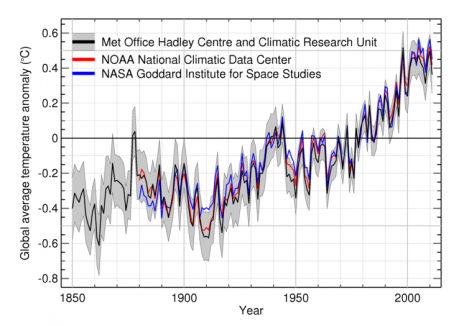
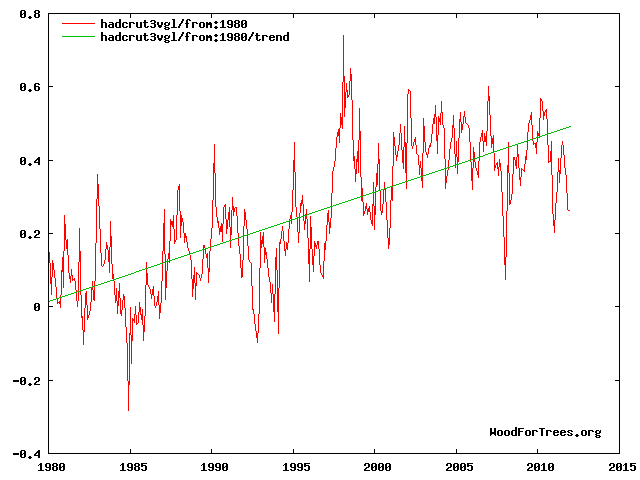
Watson, who was IPCC chair from 1997 to 2002, all but dismissed the possibility of keeping the rise in average global temperatures to 2 degrees Celsius above pre-industrial levels — a temperature rise that corresponds to an atmospheric concentration of CO2 of 450 parts per million. It now stands at about 390 ppm.

“Fundamentally, we are not on a path toward a 2 degree world,” Watson told a packed hall at Moscone Center for a talk entitled: “A World Where the Atmospheric Concentration of Carbon Dioxide Exceeds 450 ppm.”

If the international community wanted a world in which the rise in average global temperatures this century peaked at 2 degrees C above pre-Industrial levels, CO2 emissions in the developed world should have peaked in 2010, Watson said. Globally, they would need to peak by 2014.

Instead, CO2 emissions in 2010 were up 5.9 percent relative to 2009 — and that was in the midst of an economic downturn for most industrialized countries. Total carbon emissions as well as carbon intensity (often described as the amount of CO2 emitted per unit of a nation’s GDP) have gone up.

“It’s totally clear we’re changing the composition of the atmosphere …” [but] “politicians have not listened to the scientific message,” Watson said. [my emphasis]

Average global temperatures could rise 2 to 7 degrees C by the end of the century, driving a litany of environmental changes, Watson said. Already, the climate of the 2020s and 2030s is locked in, or as Watson put it, “pre-ordained.” “Therefore, we must adapt,” he said.

You can read the full report here.

As Isaac Newton is recorded as saying: “I can calculate the motion of heavenly bodies, but not the madness of people.