Jealous wags: Dogs show envy is ‘primordial’ emotion
By Matt McGrath – Environment correspondent, BBC News
These border collies inspired the study on jealousy in dogs.
Jealousy is not just a human condition according to researchers, as it appears to be hard wired into the brains of dogs as well.
Scientists in California found that canines succumbed to the green eyed monster when their owners showed affection to a stuffed dog in tests.
Some experts have argued that jealousy requires complex cognition and is unique to people.
But the authors say their work shows it may also come in a more basic form.
These findings probably won’t be a major surprise to anyone who’s ever owned a dog, but the team say this is the first experimental test of jealous behaviours in man’s best friend.
Human jealousy is a complicated emotion, requiring a “social triangle” and usually arising when an interloper threatens an important relationship.
It is said to be the third leading cause of non-accidental homicide across cultures.
Building on research that shows that six month old infants display jealousy, the scientists studied 36 dogs in their homes and video recorded their actions when their owners displayed affection to a realistic-looking stuffed canine.
Faux fido
Over three quarters of the dogs were likely to push or touch the owner when they interacted with the decoy.
The envious mutts were more than three times as likely to do this for interactions with the stuffed dog compared to when their owners gave their attention to other objects including a book.
Around a third tried to get between the owner and the faux fido, while a quarter of the put-upon pooches snapped at the dummy dog.
“Our study suggests not only that dogs do engage in what appear to be jealous behaviours but also that they were seeking to break up the connection between the owner and a seeming rival,” said Prof Christine Harris from University of California in San Diego.
“We can’t really speak to the dogs’ subjective experiences, of course, but it looks as though they were motivated to protect an important social relationship.”
The researchers believe that the dogs understood that the stuffed dog was real. The authors cite the fact that 86% of the dogs sniffed the toy’s rear end, during and after the experiment.
Jealousy, according to the authors, may have evolved in species that have multiple dependent young that concurrently compete for food and affection.
The argue that jealousy might give an advantage to a young animal that is not only alert to the interactions between its siblings and its parents but is motivated to intervene.
“Many people have assumed that jealousy is a social construction of human beings – or that it’s an emotion specifically tied to sexual and romantic relationships,” said Prof Harris.
“Our results challenge these ideas, showing that animals besides ourselves display strong distress whenever a rival usurps a loved one’s affection.”
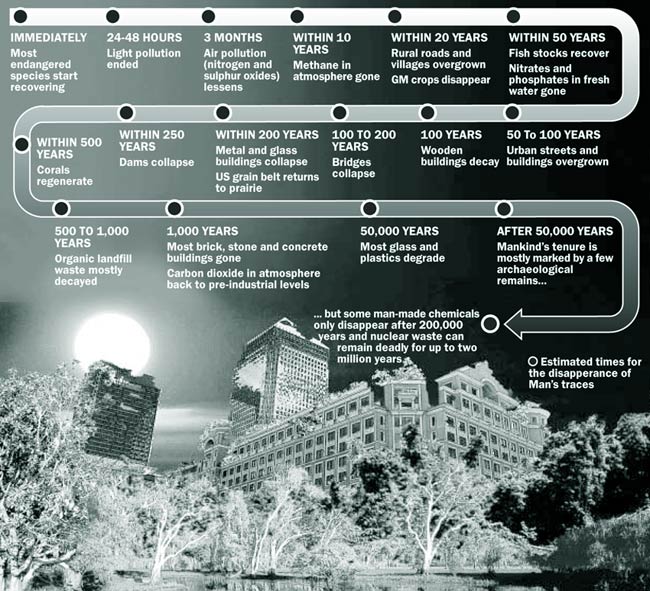
Yesterday, I published a post under the title of Just to focus our minds. It featured a chart that demonstrated how long Planet Earth would take to ‘recover’ if the human race disappeared today.
Why today’s post seemed a perfect companion was because it explores how we could think better. For if the human race doesn’t quickly find a way to think better, then that aforementioned chart may not be such an academic abstract after all.
The post is more or less a copy of what appeared on the Big Think blogsite, a site I have been following for some time now.
ooOOoo
Want to Make a Difference in the World? Think Small
Stephen Dubner
Ambition can work against you by leading you to set unrealistic and overwhelming goals. Want to make a difference in the world? Think small. It’s much less complicated, you’ll have easier access to the data that you’ll need. Most importantly, you will preserve one of your most precious resources: optimism.
Having the will to attack an issue at its root—from launching a socially conscious business to demanding more green spaces in your neighborhood—requires energy and enthusiasm to see the project through. By being less ambitious in your plans you’re more likely to stick with them and be successful.
Besides, when you first developed your problem-solving skills you were small—a child. Stephen Dubner, the co-author, with economist Steven Levitt, of Freakonomics and Think Like a Freak, wants you to go back to that way of thinking:
One of the most powerful pieces of thinking like a child that we argue is thinking small. So I realize that this runs exactly counter to the philosophy of the arena in which I’m appearing which is thinking big, Big Think, but our argument is this. Big problems are by their nature really hard to solve for a variety of reasons. One is they’re large and therefore they include a lot of people and therefore they include a lot of crossed and often mangled and perverse incentives. But also a big problem – when you think about a big problem like education reform. You’re dealing with an institution or set of institutions that have gotten to where they’ve gotten to this many, many years of calcification and also accidents of history. What I mean by that is things have gotten the way they’ve gotten because of a lot of things a few people did many, many years ago and traditions were carried on.
Want to break those traditions and build something new and forward-thinking? Then curb your ambition. Start to look at the world again with the eyes of a child.
Stephen Dubner talks about [that YouTube link reveals the transcript of the talk. PH] the importance of thinking small in order to tackle some of the world’s biggest problems piece by piece. Dubner is the co-author of Think Like a Freak
ooOOoo
Stephen Dubner and economist Steven Levitt co-authored the book Freakonomics. If you are interested, the Freakonomics website is here.
Just to put this into context, if you watched the George Monbiot speech that was the highlight of my post last Tuesday, The Goon Show, you might well have been forgiven for wondering if these are starting to feel like the end-times for species homo sapiens.
Almost perfectly on cue, on Monday, John Hurlburt down in Payson, AZ., sent me the following. It does make one think!
Time Required for the Earth to Heal if the Human Race Disappeared Today
Time Required for the Earth to Heal if the Human Race Disappeared Today.
(While John over the telephone read out the URL that was the source of this ‘chart’, I was unable to link to it. Thus apologies for not recognising the author.)
Then if you are up for more of the same theme, here’s a film that will ‘entertain’ you.
Published on Sep 2, 2012
What will happen when humans disappear from the face of the Earth? This movie will certain make you think about the impact we have made on this beautiful planet. But when humans are gone… Earth does continue.
Imagine if one minute from now, every single person on Earth disappeared. All 6.6 billion of us. What would happen to the world without humans?
How long would it be before our nuclear power plants erupted, skyscrapers crumbled and satellites dropped from the sky?
What would become of the household pets and farm animals? And could an ecosystem plagued with years of pollution ever recover?
Similar to the History Channel’s special Life After People (recommended), Aftermath features what scientists and others speculate the earth, animal life, and plant life might be like if humanity no longer existed, as well as the effect that humanity’s disappearance would have on the artefacts of civilisation.
FAIR USE NOTICE: The material on this channel is provided solely for educational and informational purposes. It may contain copyrighted material, the use of which has not been specifically authorized by the copyright owner. Infringement of copyright is not intended. The material is made available to help educate people about health related issues. It is believed that this constitutes a ‘FAIR USE’ of any such copyrighted material as provided for in Title 17, section 107 of the US Copyright Law. The material is distributed without profit to those who would like to use such material for research and educational purposes.
As I have been intimating previously, today is the start of my mother from London visiting us here in Oregon. Thus, as one would expect, time for blogging is going to be restricted. Then in a week’s time, we are also joined by my sister, Elizabeth, who lives in Tokyo. So, dear reader, you will understand if there is a deficit of creative writing, assuming you find some of it creative, why that is.
Thus today, I’m leaning heavily on a recent item I read on the EarthSky blogsite. It’s all about pronking! Yes, I hadn’t come across the word before.
ooOOoo
Does your dog pronk?
Among wild animals, pronking may be a way of avoiding predators. But when you see an animal pronk, you can’t but think it’s leaping for joy.
Alpacas, gazelles, some deer and baby lambs are all known to pronk. That is, they leap into the air as if leaping for joy, lifting all four feet off the ground at once. The fact that – in some species like sheep – young animals do it more than older ones does suggest playfulness. But, among wild animals, pronking may be a way of avoiding predators. It means something like, “Hey, I’m very fit so don’t bother chasing me.”
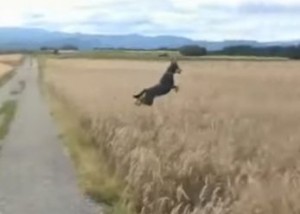
But how about dogs? I didn’t find much online discussion about true dog-pronking, although many of us, at one time or another, may have seen our dog leaping for joy. I recall my own dog Snoop (rest his soul) released from the car in a South Dakota meadow, leaping and running like crazy through the long grass for maybe 20 minutes, until we called him back. It was one of the most joyful things I’ve ever seen, and definitely one of my best memories of Snoop.
So enjoy the videos below. And, by the way, although it is a survival strategy for some, the very word pronk comes from an Afrikaans verb pronk-, which means show off or strut. It has the same linguistic derivation as our English verb prance.
“Pronking” seems to occur when an animal gets excited and jumps around his field, leaving the ground with all four feet simultaneousl, almost as though he had springs attached to his feet..Often these jumps can be high in the air.No-one really knows why llamas pronk. Certainly it is the response to some sort of excitement or disturbance. It is often infectious; sometimes my entire herd will take off. I am told that it isn’t only llamas but sheep and goats. Those of you old enough to remember BBC’s Magic Roundabout may well recall that Zebedee was a “pronker”. We never had a telly as kids, but I believe Zebedee was a dog (??).
Okay, well, maybe some sheep and wild animals like this young springbok – in Etosha National Park, Namibia – are the only true pronkers. Maybe true pronking has to have the downward-pointing head and stiff-leggedness. But if you ever see your dog do what the dogs in these videos do … you’ll feel happy. Image via Wikipedia.
Bottom line: Among wild animals, pronking seems to be a way of avoiding predators. But when you see an animal pronk, you can’t but think it’s leaping for joy.
ooOOoo
So there you go. Don’t say that Learning from Dogs doesn’t teach you some new words from time to time!
Thus it was rather fun to come across, more or less by chance, an essay from the Perimeter Institute for Theoretical Physics under the title of Is The Universe A Bubble? The essay describes how Perimeter Associate Faculty member Matthew Johnson and his colleagues are working to bring the multiverse hypothesis, which to some sounds like a fanciful tale, firmly into the realm of testable science. It opens:
Never mind the big bang; in the beginning was the vacuum. The vacuum simmered with energy (variously called dark energy, vacuum energy, the inflation field, or the Higgs field). Like water in a pot, this high energy began to evaporate – bubbles formed.
Each bubble contained another vacuum, whose energy was lower, but still not nothing. This energy drove the bubbles to expand. Inevitably, some bubbles bumped into each other. It’s possible some produced secondary bubbles. Maybe the bubbles were rare and far apart; maybe they were packed close as foam.
But here’s the thing: each of these bubbles was a universe. In this picture, our universe is one bubble in a frothy sea of bubble universes.
That’s the multiverse hypothesis in a bubbly nutshell.
It’s not a bad story. It is, as scientists say, physically motivated – not just made up, but rather arising from what we think we know about cosmic inflation.
Cosmic inflation isn’t universally accepted – most cyclical models of the universe reject the idea. Nevertheless, inflation is a leading theory of the universe’s very early development, and there is some observational evidence to support it.
It includes this interesting video:
and concludes, thus:
Meanwhile, the team is at work figuring out what other kinds of evidence a bubble collision might leave behind. It’s the first time, the team writes in their paper, that anyone has produced a direct quantitative set of predictions for the observable signatures of bubble collisions. And though none of those signatures has so far been found, some of them are possible to look for.
The real significance of this work is as a proof of principle: it shows that the multiverse can be testable. In other words, if we are living in a bubble universe, we might actually be able to tell.
– Erin Bow
So that’s blown the dust off your Saturday brains! You can go and hug your dog now! 🙂
The second, and last, episode of the BBC Clouds Lab programme offers an intriguing message.
On Monday, I published a post under the title of The clouds above us. The second episode demonstrated that even in atmospheric conditions of near vacuum, intense cold and very low humidity, conditions that would kill a human in seconds, there was microscopic bacteriological material to be found.
Exploring the troposphere
The troposphere is a turbulent layer of air that begins at the Earth’s surface and ranges from 23,000-65,000 feet above sea level, depending on the latitude, season and the time of day. Its name originates from the Greek word tropos, meaning change. It’s now known that bacteria actually exists in clouds and scientists believe that it plays a significant part in the creation of rain but little is known about life higher up. Microbiologist Dr Chris Van Tulleken has discovered that living bacteria can exist well above 10,000ft in a hostile environment with low pressure, increased UV radiation, freezing temperatures, high winds and no oxygen or water.
What I took away from watching the programme was that the minimum conditions necessary for living bacteria were far more harsh than one might expect. In other words, finding living bacteria in other solar systems might not be such a science-fiction idea.
With that in mind, I’m republishing an essay that Patrice Ayme wrote in 2013. I’m grateful for his permission to so do.
ooOOoo
40 Billion Earths? Yes & No.
Up to twenty years ago, a reasonable opinion among scientists was that there might be just one solar system. Ours. Scientists like to project gravitas; having little green men all over didn’t look serious.
However, studying delicately the lights of stars, how they vary, how they doppler-shift, more than 1,000 planets have been found. Solar systems seem ubiquitous. Astronomers reported in 2013 that there could be as many as 40 billion habitable Earth-size planets in the galaxy. However, consider this:
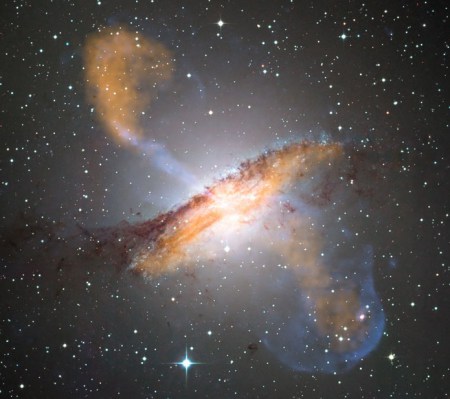
Centaurus A: Lobes Of Tremendous Black Hole Explosion Fully Visible.
Yes, that’s the center of a galaxy, and it has experienced a galactic size explosion from its central black hole.
One out of every five sun-like stars in our galaxy has a planet the size of Earth circling it in the Goldilocks zone, it seems — not too hot, not too cold — with surface temperatures compatible with liquid water. Yet, we have a monster black hole at the center of our giant galaxy, just like the one exploding above.
The Milky Way’s black hole is called Sagittarius A*. It exploded last two million years ago. Early Homo Erectus, down south, saw it. The furious lobes of the explosion are still spreading out, hundreds of thousands of light years away.
We are talking here about explosions potentially stronger than the strongest supernova by many orders of magnitude (depending upon the size of what’s falling into Sagittarius. By the way, a cloud is just heading that way).
Such galactic drama has a potential impact on the presence of advanced life. The richer the galaxy gets in various feature the situation looks, the harder it looks to compute the probability of advanced life.
The profusion of habitable planets is all the more remarkable, as the primitive methods used so far require the planet to pass between us and its star.
(The research, started on the ground in Europe, expanded with dedicated satellites, the French Corot and NASA’s Kepler spacecraft.). Sun-like stars are “yellow dwarves”. They live ten billion years.
From that, confusing “habitable” and “inhabitated”, the New York Times deduced: “The known odds of something — or someone — living far, far away from Earth improved beyond astronomers’ boldest dreams on Monday. “
However, it’s not that simple.
Primitive bacterial life is probably frequent. However advanced life (animals) is probably very rare, as many are the potential catastrophes. And one needs billions of years to go from primitive life to animals.
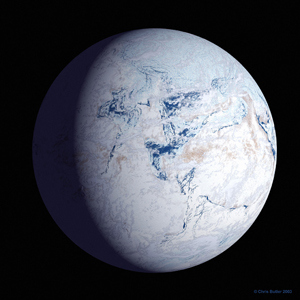
After life forms making oxygen on Earth appeared, the atmosphere went from reducing (full of strong greenhouse methane) to oxidizing (full of oxygen). As methane mostly disappeared, so did the greenhouse. Earth froze, all the way down to the equator:
When Snowball Earth Nearly Killed Life.
Yet volcanoes kept on belching CO2 through the ice. That CO2 built up above the ice, caused a strong greenhouse, and the ice melted. Life had survived. Mighty volcanism has saved the Earth, just in time.
That “snowball Earth” catastrophe repeated a few times before the Earth oxygen based system became stable. Catastrophe had been engaged, several times, but the disappearance of oxygen creating life forms had been avoided, just barely.
Many are the other catastrophes we have become aware of, that could wipe out advanced life: proximal supernovas or gamma ray explosions.
Cataclysmic eruption of the central galactic black hole happen frequently. The lobes from the last one are still visible, perpendicularly high off the galactic plane. The radiation is still making the Magellanic Stream simmer, 200,000 light years away. Such explosions have got to have sterilized a good part of the galaxy.
In 2014 when part of the huge gas cloud known as G2 falls into Sagittarius A*, we will learn better how inhospitable the central galaxy is for advanced life.
Many of the star systems revealed out there have surprising feature: heavy planets (“super Jupiters“) grazing their own stars. It’s unlikely those giants were formed where they are. They probably swept their entire systems, destroying all the rocky planets in their giant way. We don’t understand these cataclysmic dynamics, but they seem frequent.
Solar energy received on Earth fluctuated and changed a lot, maybe from one (long ago) to four (now). But, as it turned out just so that Earthly life could survive. Also the inner nuclear reactor with its convective magma and tectonic plates was able to keep the carbon dioxide up in the air, just so.
The Goldilocks zones astronomers presently consider seem to be all too large to allow life to evolve over billions of years. They have to be much narrower and not just with red dwarves (the most frequent and long living stars).
One of our Goldilocks, Mars, started well, but lost its CO2 and became too cold. The other Goldilocks, Venus, suffered the opposite major technical malfunction: a runaway CO2 greenhouse.
Mars’ axis of rotation tilts on the solar system’s plane enormously: by 60 degrees, over millions of years. So Mars experiences considerable climatic variations over the eons, as it goes through slow super winters and super summers (it’s imaginable that, as the poles melt, Mars is much more habitable during super summers; thus life underground, hibernating is also imaginable there).
Earth’s Moon prevents this sort of crazy hyper seasons. While, differently from Venus, Earth rotates at reasonable clip, homogenizing the temperatures. Venus takes 243 days to rotate.
It is startling that, of the four inner and only rocky planets, just one, Earth has a rotation compatible with the long term evolution of advanced life.
Earth has also two striking characteristics: it has a very large moon that store much of the angular momentum of the Earth-Moon system. Without Moon, the Earth would rotate on itself once every 8 hours (after 5 billion years of braking by Solar tides).
The Moon used to hover at least ten times closer than now, when earth’s days were at most 6 hours long.
The tidal force is the difference between gravitational attraction in two closely separated places, so it’s the differential of said attraction (which is proportional to 1/dd; d being the distance). Hence the tidal force is inversely proportional to the cube of the distance.
Thus on early Earth tides a kilometer high were common, washing back and forth every three hours. a hyper super tsunami every three hours, going deep inside the continents. Not exactly conditions you expect all over the universe.
Hence biological material fabricated on the continental margins in shallow pools would get mixed with the oceans readily. That would guarantee accelerated launch of life (and indeed we know life started on Earth very fast).
The theory of formation of the Moon is wobbly (recent detailed computations of the simplest impact theory do not work). All we know for sure, thanks to the Moon rocks from Apollo, is that the Moon is made of Earth mantle materials.
Somehow the two planets split in two. (Fission. Get it? It maybe a hint.)
Another thing we know for sure is that Earth has, at its core, a giant nuclear fission reactor, keeping Earth’s core hotter than the surface of the sun. An unimaginable liquid ocean of liquid iron deep down inside below our feet undergoes iron weather. Hell itself, the old fashion way, pales in comparison.
Could the Moon and the giant nuclear reactor have the same origin? This is my provocative question of the day. The Moon, our life giver, could well have formed from giant nuclear explosions, of another of our life givers, what became the nuke at the core. I can already hear herds of ecologists yelp in the distance. I present the facts, you pseudo-ecologists don’t decide upon them. It’s clear that nuclear fission is not in Drake equation: if nothing else, it’s too politically incorrect.
All the preceding makes this clear:
Many are the inhabitable planets, yet few will be inhabitated by serious denizens.
This means that the cosmos is all for our taking. The only question is how to get there. The closest stars in the Proxima, Beta and Alpha Centauri system are not attainable, for a human crew, with existing technology.
However, if we mastered clean colossal energy production, of the order of the entire present energy production of humanity, we could get a colony there (only presently imaginable technology would be fusion).
Giordano Bruno, professor, astronomer, and priest suggested that there were many other inhabitated systems around the stars. That insult against Islam meant Christianity was punished the hard way: the Vatican, the famous terrorist organization of god crazies, put a device in Giordano’s mouth that pierced his palate, and having made sure that way that he could not tell the truth, the terrorists then burned him alive. After seven years of torture.
The horror of truth was unbearable to theo-plutocrats.
Now we face something even worse: everywhere out there is very primitive life. It is likely gracing 40 billion worlds. But, if one has to duplicate the succession of miracles and improbabilities that made Earth, to earn advanced life, it may be just here that civilization ever rose to contemplate them.
Congratulations to India for launching yesterday a mission to Mars ostensibly to find out if there is life there (by finding CH4; while life is presently unlikely, Mars has much to teach, including whether it started there). That’s the spirit!
The spirit is to have minds go where even imagination itself did not go before.
If we sit back, and look at the universe we have now, from Dark Matter, to Dark Energy, to Sagittarius, to the nuclear reactor below, to billions of Earths, to a strange Higgs, to Non Aristotelian logic, we see a wealth, an opulence of possibilities inconceivable twenty years ago.
Progress is not just about doing better what was done yesterday. It’s also about previously inconceivable blossoms of entirely new mental universes.
The more that man tries to interfere the more that man screws up.
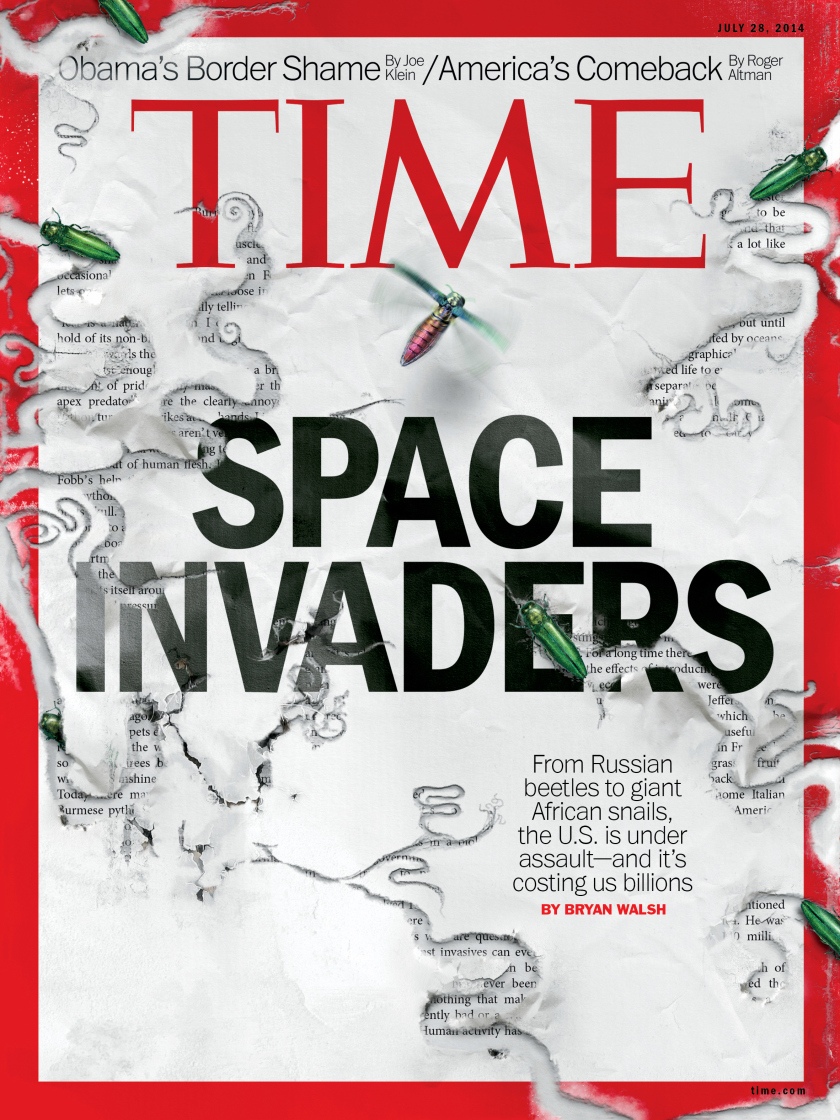
Jeannie and I subscribe to Time Magazine. This week’s edition had a pretty eye-catching cover that required a second look.
Illustration by Justin Metz for Time. Photo reference for emerald ash borer courtesy of PDCNR—Forestry Archive, Bugwood.org
That cover referred to the lead article concerning invasive species, “From giant snails to Asian carp, alien wildlife is on the move.“, written by Bryan Walsh. The essence of the article is that man’s global activities are responsible, albeit often unwittingly, for the movement of a wide range of species across national borders. My own reaction to the article was that it was typical of the many ‘scare’ stories the media present but that at the end of the day, nothing will change. However the last two paragraphs of the article did resonate with me.
Human beings have become the dominant force on the planet, so much so that many scientists believe we’ve entered an entirely new geological epoch: the Anthropocene. We have already been shaping the planet unintentionally, through greenhouse-gas emissions and global trade and every other facet of modern existence. The challenge now is to take responsibility for that power over the planet and use it for the right ends – all the while knowing that there is no single correct answer, no lost state of grace we can beat back toward.
How we respond to the thickening invasions that we ourselves loosed will be part of that answer – which is only just. There is one species that can claim to be the most dominant invasive of all time. From its origins in Africa, this species has spread to every corner of the world and every kind of climate. Everywhere it goes, it displaces natives, leaving extinction in its wake, altering habitat to suit its needs, with little regard for the ecological impact. Its numbers have grown nearly a millionfold, and its spread shows no sign of stopping. If that invasive species sounds familiar, it should. It’s us.
Thus with that article from Time in mind, it was very pertinent to see the latest essay from George Monbiot. It reinforces, in spades, the sentiment expressed by Bryan Walsh in those paragraphs above and is republished here on Learning from Dogs with the generous permission of George Monbiot.
ooOOoo
A One Way Street to Oblivion
As soon as an animal becomes extinct, a new bill proposes, it will be classified as “non-native”.
By George Monbiot, published on the Guardian’s website, 21st July 2014
Can any more destructive and regressive measures be crammed into one bill?
Already, the Infrastructure Bill, which, as time goes by, has ever less to do with infrastructure, looks like one of those US monstrosities into which a random collection of demands by corporate lobbyists are shoved, in the hope that no one notices.
So far it contains (or is due to contain) the following assaults on civilisation and the natural world:
– It exempts fracking companies from the trespass laws
– Brings in a legal requirement for the government to maximise the economic recovery of petroleum from the UK’s continental shelf. This is directly at odds with another legal requirement: to minimise the UK’s greenhouse gas emissions
– Introduces the possibility (through Clauses 21 and 22) of a backdoor route to selling off the public forest estate. When this was attempted before, it was thwarted by massive public protest.
– further deregulates the town and country planning system, making life even harder for those who wish to protect natural beauty and public amenities
Enough vandalism? Not at all. There’s yet another clause aimed at suppressing the natural world, which has, so far, scarcely been discussed outside parliament. If the Infrastructure Bill is passed in its current state, any animal species that “is not ordinarily resident in, or a regular visitor to, Great Britain in a wild state” will be classified as non-native and subject to potential “eradication or control”. What this is doing in an infrastructure bill is anyone’s guess.
At first wildlife groups believed it was just poor drafting, accidentally creating the impression that attempts to re-establish species which have become extinct here – such as short-haired bumblebees or red kites – would in future be stamped out. But the most recent Lords debate scotched that hope: it became clear that this a deliberate attempt to pre-empt democratic choice, in the face of rising public enthusiasm for the return of our lost and enchanting wildlife.
As Baroness Parminter, who argued unsuccessfully for changes to the bill, pointed out, it currently creates
“a one-way system for biodiversity loss, as once an animal ceases to appear in the wild, it ceases to be native.”
She also made the point that it’s not just extinct species which from now on will be treated as non-native, but, as the bill now stands, any species listed in Schedule 9 of the Wildlife and Countryside Act 1981.
Among those in Schedule 9 are six native species that have already been re-established in Britain (the capercaillie, the common crane, the red kite, the goshawk, the white-tailed eagle and the wild boar); two that are tentatively beginning to return (the night heron and the eagle owl); and four that have been here all along (the barn owl, the corncrake, the chough and the barnacle goose). All these, it seems, are now to be classified as non-native, and potentially subject to eradication or control.
After the usual orotund time-wasting by aristocratic layabouts (“my ancestor Sir Ewen Cameron of Lochiel, who was known as the great Sir Ewen … killed the last wolf in Scotland” etc), the minister promoting the bill, Baroness Kramer, made it clear that the drafting was no accident. All extinct species, it appears, are to be treated as non-native and potentially invasive. At no point did she mention any of the benefits their re-establishment might bring, such as restoring ecological function and bringing wonder and delight and enchantment back to this depleted land.
Here is a list, taken from Feral, of a few of the animals which have become extinct recently (in ecological terms) and which probably meet the bill’s new definition of non-native: “not ordinarily resident in, or a regular visitor to, Great Britain in a wild state”. Some would be widely welcomed; others not at all, but it’s clear that a debate about which species we might welcome back is one that many people in this country want to have, but that the government wants to terminate. There’s a longer list, with fuller explanations and a consideration of their suitability for re-establishment, in the book.
European Beaver: became extinct in Britain in the mid-18th Century, at the latest. Officially re-established in the Knapdale Forest, Argyll. Unofficially in the catchment of the River Tay and on the River Otter, in Devon.
Wolf: The last clear record is 1621 (not 1743 as commonly supposed). It was killed in Sutherland. As far as I can determine, neither Sir Ewen Cameron nor any of the other blood-soaked lairds and congenital twits from whom Lord Cameron of Dillington is descended were involved.
Lynx: The last known fossil remains date from the 6th Century AD, but possible cultural records extend into the 9th Century.
Wild Boar: The last truly wild boar on record were killed on the orders of Henry III in the Forest of Dean, in 1260. Four small populations in southern England, established after escapes and releases from farms and collections.
Elk or Moose (Alces alces): The youngest bones found in Britain are 3,900 years old. Temporarily released in 2008 into a 450-acre enclosure on the Alladale Estate, Sutherland.
Reindeer: The most recent fossil evidence is 8,300 years old. A free-ranging herd grazes on and around Cairn Gorm in the Scottish Highlands.
Wild horse: The most recent clearly-established fossil is 9,300 years old. Animals belonging to the last surviving subspecies of wild horse, Przewalski’s (Equus ferus przewalskii), graze Eelmoor Marsh in Hampshire.
Forest bison, or wisent: Likely to have become extinct here soon before the peak of glaciation, between 15,000 and 25,000 years ago. A herd was temporarily established at Alladale in 2011.
Brown bear: probably exterminated around 2000 years ago.
Wolverine: survived here until roughly 8,000 years ago.
Lion: the last record of a lion in the region is a bone from an animal that lived in the Netherlands – then still connected to Britain – 10,700 years ago.
Spotted hyaena: around 11,000 years ago.
Hippopotamus: it was driven out of Britain by the last glaciation, around 115,000 years ago, and hunted to extinction elsewhere in Europe about 30,000 years ago.
Grey whale: the most recent palaentological remains, from Devon, belonged to a whale that died around 1610 AD.
Walrus: late Bronze Age, in the Shetland Islands.
European Sturgeon: possibly as recently as the 19th Century.
Blue stag beetle: probably 19th Century.
Eagle owl: the last certain record is from the Mesolithic, 9,000-10,000 years old . But a possible Iron Age bone has been found at Meare in Somerset. Now breeding in some places, after escaping from collections.
Goshawk: wiped out in the 19th Century. Unofficially re-established in the 20th Century, through a combination of deliberate releases and escapes from falconers.
Common crane: last evidence of breeding in Britain was in 1542. Cranes re-established themselves through migration in the Norfolk Broads in 1979, and have bred there since then. Now breeding in two other places in eastern England. Re-introduced in 2010 to the Somerset Levels.
White Stork: last recorded nesting in Edinburgh in 1416. In 2004 a pair tried to breed on an electricity pole in Yorkshire. In 2012 a lone bird built a nest on top of a restaurant in Nottinghamshire.
Spoonbill: the last breeding records are 1602 in Pembrokeshire and 1650 in East Anglia. In 2010 a breeding colony established itself at Holkham in Norfolk.
Night Heron: last bred here in either the 16th or 17th Century, at Greenwich. Today it is a scarce visitor.
Dalmatian Pelican: remains have been found from the Bronze Age in the Cambridgeshire Fens and from the Iron Age in the Somerset levels, close to Glastonbury. A single mediaeval bone has been found in the same place.
These and many others are now to be classified as officially non-native, unless this nonsense can be stopped.
Incidentally, determining what is and isn’t a native species, let alone what “should” or “should not” be living here, is a much more complicated business than you might imagine, as Ken Thompson’s interesting book, Where Do Camels Belong?, makes clear. He also points out that some species which are initially greeted with horror and considered an ecological menace soon settle down as local wildlife learns to prey on them or to avoid them. Sometimes they perform a useful ecological role by filling the gaps created by extinction. He overstates his case, and glosses over some real horror stories, but his book is an important counterweight to attempts to create a rigid distinction between native and non-native wildlife.
Many species introduced to this country by human beings are now cherished as honorary members of our native wildlife. Here are just a few I’ve come across. How many of you knew that they were all brought here by people?:
Brown hare
Little owl
Field poppy
Corncockle
Crack willow
Greater burdock
Pheasant’s eye
Cornflower
Wormwood
Mayweed
White campion
Isn’t this an interesting subject? Unfortunately government ministers seem to know to know nothing about it and to care even less. They are crashing through the middle of delicate interactions between people and the natural world like bulldozers in a rainforest.
I will close today’s post with another, very recent, story in The Guardian, that opens, thus:
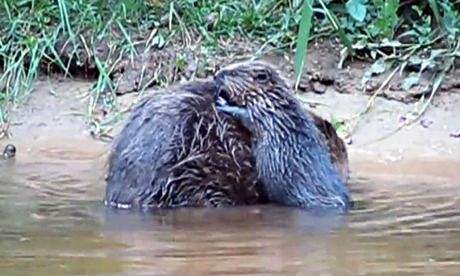
Wild beaver kits born in Devon
Thursday 17 July 2014
One of the first wild beavers to be seen in England in centuries and due to be taken into captivity has given birth to three young.
Local retired environmentalist Tom Buckley captured the three young beavers climbing all over their mother. Photograph: Tom Buckley/Apex
A wild beaver due to be taken into captivity has given birth to at least three young.
The young, known as kits, were born to the family of two adult and one juvenile European beavers (Castor fiber) that were spotted living on the river Otter in Devon earlier this year, in what was believed to be the first sighting of the species in the wild in England in 500 years.
All that is left for me to do is to quote a little from a recent letter from John Hurlburt.
Our future depends on the air we breathe. Our lives depend upon rivers of living water. Our health requires the blessings of organic agriculture. Our energy streams through us from the cosmos.
We are warrior animals. Peace must come from within. Non-violence is our best choice. We have the magnificent opportunity to wake up as an animal that is grateful and sings in harmony with the Earth.
The present is surrounded by the past and the future. We float on the wings of compassion and wisdom with a sacred responsibility for the Nature of all Creation.
A team of scientists take to the skies in one of the world’s largest airships, for a unique exploration of Earth’s most precious and mysterious environment – the atmosphere.
In an example of what might be called a massive change of topic from yesterday’s post on Integrity and democracy, today’s offering to you, dear reader, is about the magnificent atmosphere upon which we all depend.
Here’s a clue.
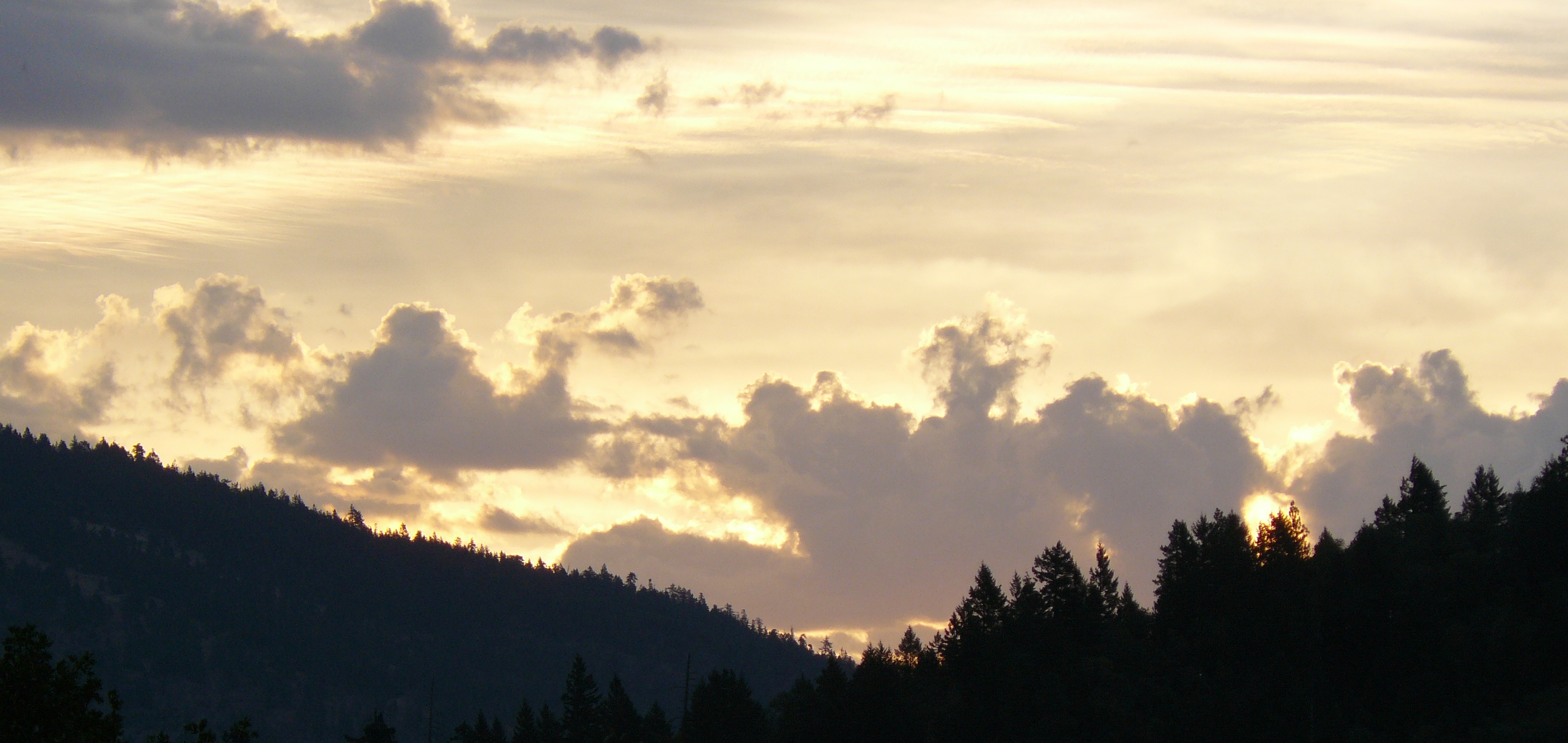
Sunrise to our North-East at a little after 7am on Sunday, 13th July, 2014.
Every Breath We Take: Understanding Our Atmosphere
The air around us is not just empty space; it is an integral part of the chemistry of life. Plants are made from carbon dioxide, nitrogen nourishes the soil and oxygen gives us the energy we need to keep our hearts pumping and our brains alive. But how did we come to understand what air is made of? How did we come to know that this invisible stuff around us contains anything at all?
Gabrielle Walker tells the remarkable story of the quest to understand the air. It’s a tale of heroes and underdogs, chance encounters and sheer blind luck that spans the entire history of science. It began as a simple desire to further our knowledge of the natural world, but it ended up uncovering raw materials that have shaped our modern world, unravelling the secrets of our own physiology and revealing why we are here at all.
There is much more to explore on the website, including this trailer to the programme.
Oh, here’s another ‘clue’ from Oregon.
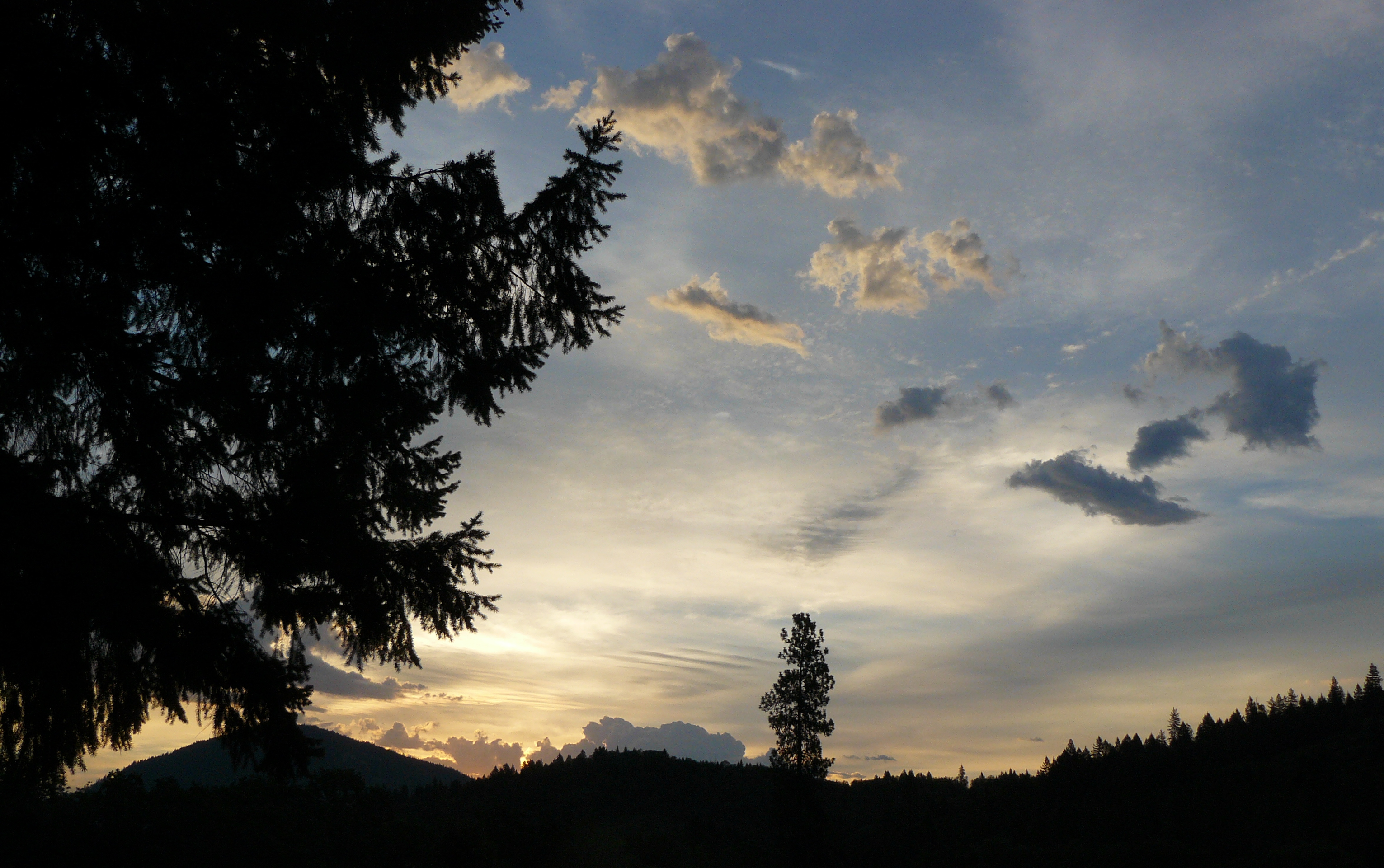
Same morning, same sunrise.
The presenter of the BBC series is Felicity Aston who writes on her BBC Blog:
I joined Operation Cloud Lab: Secrets Of The Skies as the expedition leader and also as a meteorologist.
The plan was to fly from Florida to California, looking at the science of the skies.
But as well as scientists, there were plenty of other people on the team including three pilots, a ground crew of 14 that followed the airship by road and a full production team including two camera crews. Not everyone could be on board at once – the airship would never have got off the ground!
But I was really fortunate to spend a lot of time on board and flew most of the way across the continent.
Exploring in three dimensions rather than being limited to making observations from the ground was a revelation to me.
The clouds in the tropics around the Gulf of Mexico are huge, and being in the sky with them really brought home the vast scale of the forces at work.
Towering cumulus cloud in Florida.
We were able to travel over, under and through these monsters, revealing that clouds are about as far from the popular image of light and fluffy floating puffs of cotton wool as you can get! They are dense and heavy and full of destructive energy.
I remember looking down at the cloud layer from a plane as a child, and daydreaming about exploring this new world of unknown places, so I was very excited the first time we flew straight through a cloud.
I leaned out of the airship as far as I dared into the heart of a cloud and found that it was a dark, damp mass of floating fog (of course!) – no mysterious worlds – my childhood fantasies were crushed!
There’s more to read on her blog as well as some stupendous photographs of clouds.
So if this gives you a thrill then don’t delay in watching the full-length Episode One on YouTube before it gets taken down. (Warning: if you watch the opening first few minutes you will be hooked for the full hour!)
Now to close with, yes you guessed it, my final ‘clue’ from Oregon.
A republication of an essay on the history of dogs.
Dr. George Johnson
For some time I have been aware of an essay authored by Dr. George Johnson under his On Scienceseries page umbrella. As that page explains:
ON SCIENCE is a weekly science column written by me (George Johnson), published initially in the St. Louis Post Dispatch, and now in the online newspaper St. Louis Beacon (stlbeacon.org). For over 30 years I taught biology to college students at Washington University. For the last decade of these years, I taught a freshman course that introduced nonscience majors to current issues where science plays a key role, issues such as AIDS, the environment, cloning, genetic engineering, and evolution.
The course was intended to give them the tools to think about these issues as citizens and voters. I write my column as a way of teaching the general public about these same issues.
Most people are very interested in science, but put off by the terminology. When you don’t know what the words mean, it’s easy to slip into thinking that the matter is difficult, when actually the ideas are simple, easy to grasp, and fun to consider. It’s the terms that get in the way, that stand as a wall between citizens and science.
It is the intent of my column to turn those walls into windows, so that readers can peer in and join the fun. Analogies are my tool. In each column I look for simple analogies that relate the matter at hand to things we all know. As science, analogies are not exact, but I do not count myself compromised. Analogies trade precision for clarity. If I do my job right, the key idea is not compromised by the analogy I use to explain it, but rather revealed.
Anyway, the particular essay that I was very interested in was, unsurprisingly, one about the history of the domestic dog.
I wrote Dr. Johnson asking for permission to publish his essay here on Learning from Dogs and promptly received such permission. Indeed, better than that, here is his reply email:
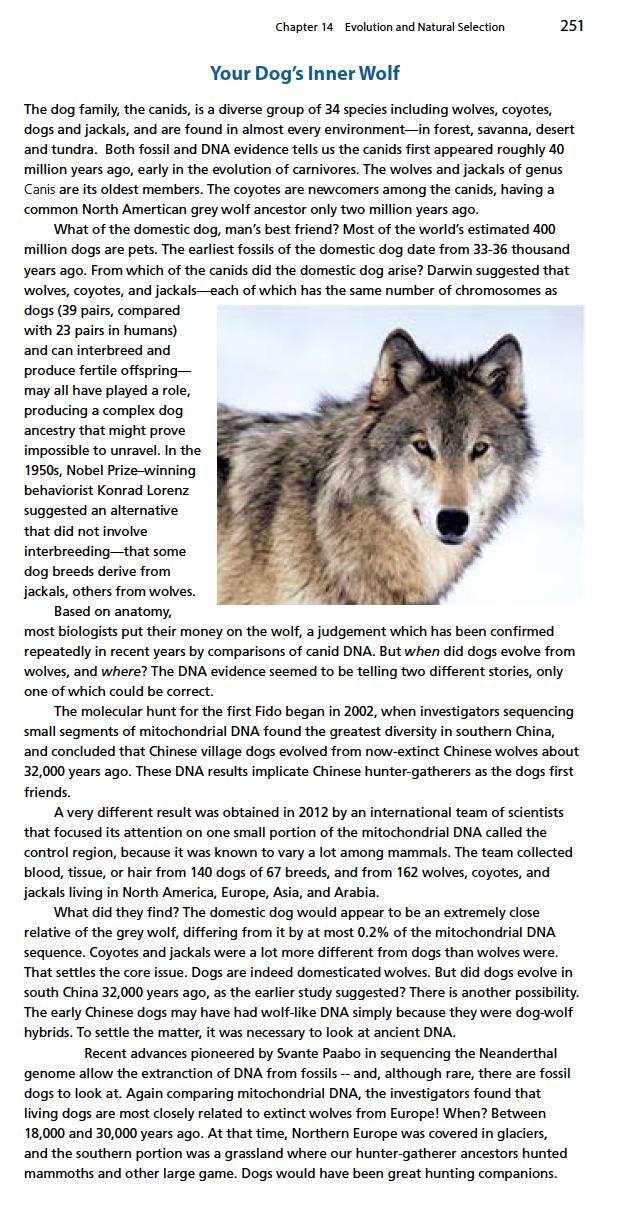
By all means, but please cite a revised version of the article (in ESSENTIALS OF THE LIVING WORLD, 5e, George B Johnson, McGraw Hill Publ., 2015). It is somewhat shorter, but more up-to-date. I enclose a copy of the relevant page below.
A personal viewpoint after reading Tom’s essay Is Climate Change a Crime Against Humanity?
Last Thursday, July 3rd, I republished a post, what Tom calls a Tomgram, from TomDispatch comparing the USA’s attitude to the very small risk of a country exploding a weapon of mass destruction, WMD, over American soil to the 95% risk of the USA being harmed from the effects of climate change. Here’s an extract from the central part of Tom’s essay:
So here’s a question I’d like any of you living in or visiting Wyoming to ask the former vice president, should you run into him in a state that’s notoriously thin on population: How would he feel about acting preventively, if instead of a 1% chance that some country with weapons of mass destruction might use them against us, there was at least a 95% — and likely as not a 100% — chance of them being set off on our soil? Let’s be conservative, since the question is being posed to a well-known neoconservative. Ask him whether he would be in favor of pursuing the 95% doctrine the way he was the 1% version.
After all, thanks to a grim report in 2013 from the Intergovernmental Panel on Climate Change, we know that there is now a 95% -100% likelihood that “human influence has been the dominant cause of the observed warming [of the planet] since the mid-20th century.” We know as well that the warming of the planet — thanks to the fossil fuel system we live by and the greenhouse gases it deposits in the atmosphere — is already doing real damage to our world and specifically to the United States, as a recent scientific report released by the White House made clear. We also know, with grimly reasonable certainty, what kinds of damage those 95% -100% odds are likely to translate into in the decades, and even centuries, to come if nothing changes radically: a temperature rise by century’s end that could exceed 10 degrees Fahrenheit, cascading species extinctions, staggeringly severe droughts across larger parts of the planet (as in the present long-term drought in the American West and Southwest), far more severe rainfall across other areas, more intense storms causing far greater damage, devastating heat waves on a scale no one in human history has ever experienced, masses of refugees, rising global food prices, and among other catastrophes on the human agenda, rising sea levels that will drown coastal areas of the planet.
Tom’s essays had many great links to background research papers and other supporting material. The penultimate link was embedded (my italics) in this sentence: “In the case of a major exchange of such weapons, we would be talking about “the sixth extinction” of planetary history.” That linked to the Amazon page describing the book, released earlier this year, of the same name written by Elizabeth Kolbert, as follows:
A major book about the future of the world, blending intellectual and natural history and field reporting into a powerful account of the mass extinction unfolding before our eyes
Over the last half a billion years, there have been five mass extinctions, when the diversity of life on earth suddenly and dramatically contracted. Scientists around the world are currently monitoring the sixth extinction, predicted to be the most devastating extinction event since the asteroid impact that wiped out the dinosaurs. This time around, the cataclysm is us. In The Sixth Extinction, two-time winner of the National Magazine Award and New Yorker writer Elizabeth Kolbert draws on the work of scores of researchers in half a dozen disciplines, accompanying many of them into the field: geologists who study deep ocean cores, botanists who follow the tree line as it climbs up the Andes, marine biologists who dive off the Great Barrier Reef. She introduces us to a dozen species, some already gone, others facing extinction, including the Panamian golden frog, staghorn coral, the great auk, and the Sumatran rhino. Through these stories, Kolbert provides a moving account of the disappearances occurring all around us and traces the evolution of extinction as concept, from its first articulation by Georges Cuvier in revolutionary Paris up through the present day. The sixth extinction is likely to be mankind’s most lasting legacy; as Kolbert observes, it compels us to rethink the fundamental question of what it means to be human.
Here’s an interview of Elizabeth Kolbert taken from the Democracy Now programme. It’s a tad under 20 minutes so easy to put aside a little of your time to watch it.
PLEASE DO!
Published on Feb 11, 2014
February 2014 on Democracy Now!
In the history of the planet, there have been five known mass extinction events. The last came 65 million years ago, when an asteroid about half the size of Manhattan collided with the Earth, wiping out the dinosaurs and bringing the Cretaceous period to an end. Scientists say we are now experiencing the sixth extinction, with up to 50 percent of all living species in danger of disappearing by the end of the century. But unlike previous extinctions, the direct cause this time is us — human-driven climate change. In “The Sixth Extinction: An Unnatural History,” journalist Elizabeth Kolbert visits four continents to document the massive “die-offs” that came millions of years ago and those now unfolding before our eyes. Kolbert explores how human activity — fossil fuel consumption, ocean acidification, pollution, deforestation, forced migration — threatens life forms of all kinds. “It is estimated that one-third of all reef-building corals, a third of all fresh-water mollusks, a third of sharks and rays, a quarter of all mammals, a fifth of all reptiles, and a sixth of all birds are headed toward oblivion,” Kolbert writes. “The losses are occurring all over: in the South Pacific and in the North Atlantic, in the Arctic and the Sahel, in lakes and on islands, on mountaintops and in valleys.”
Elizabeth Kolbert, is well known for her reporting on global warming as a staff writer at The New Yorker magazine, which led her to investigate climate species extinction. Her new book is The Sixth Extinction: An Unnatural History. In 2006, she wrote Field Notes from a Catastrophe: Man, Nature, and Climate Change.
Make no mistake, that short video interview doesn’t pull any punches. Just as Kolbert’s book. It is very tempting to want to hide, to close one’s ears and eyes and pretend it’s all a bad dream and, soon, we will awaken to a bright, new dawn.
(Now for something really lovely! It’s 1:40pm on Sunday, 6th)
I took a quick break to think about my next sentence. I was looking for some words that would encourage us all to do something! Because as John Hurlburt recently wrote: “Failure to act condemns us to death as a species of fools.”
In that short break I saw that someone else had signed up to follow Learning from Dogs. That person describes herself as Elsie Bowen-Dodoo. Her blog is called BowenDiaries. On her About page, Elsie writes:
Elsie Bowen-Dodoo. Living life with a purpose. Persevering to inspire all races.
I write to inspire people hoping that they reading my articles and stuff will be touched to do something positive in their lives.
We really can all make this world a better place to live in.
Talent should not be wasted.
This is the picture on Elsie’s home page.
Positive inspiration!
So here’s my take on where we, as in all mankind, are at.
We have to turn our backs on growth, greed and materialism.
Each of us must place caring for our planet our highest priority in life.
Each of us must be alive to making a positive difference.
Being true to what we know is right will set us free.
This will also create ripples of positive energy that will set others free.
That is the only sustainable way to go.
Let me close by returning to dogs. After all this blog is called Learning from Dogs! By recognising, of course, that these are challenging times. As we are incessantly reminded by the drumbeat of the doom-and-gloom news industry every hour, frequently every half-hour, throughout the day. A symphony of negative energy.
Yet right next to us is a world of positive energy. The world of dogs. A canine world full of love and trust, playfulness and relaxation. A way of living that is both clear and straightforward; albeit far from being simple. As anyone will know who has seen the way dogs interact with each other and with us humans.
In other words, dogs offer endless examples of positive behaviours. The wonderful power of compassion for self, and others, and of loving joy. The way to live that we humans crave for. A life full of hope and positive energy that keeps the power of negativity at bay.








 Learning from Dogs