Category: Science

Speaking dog!

An interesting article that appeared in the New Scientist.

Well I managed to write the 50,000 words required of me to be a ‘winner’ of NaNoWriMo14. I was validated in at 53,221 words, albeit the book is not yet completed. Together with my writings from 2013, I am within 10,000 words, give or take, of finishing the draft. Then the fun starts: the big edit!

Anyway, moving on!

The UK’s New Scientist magazine emailed me recently an article that they fathomed would be of interest. Presumably, hoping I would immediately sign up to be a subscriber. Well if that was there presumption, I will be disappointing them. But the article was certainly of interest and, as it was sent to me without my invitation, I don’t feel too bad about republishing it in full.

ooOOoo

Dog head-turning shows they do understand what you say

YOU’RE just so right-side. The left hemisphere of our brains seems to tune into the phonemes in speech that combine to form words, and the right hemisphere focuses on the rhythm and intonation of words, which can carry emotional information. Animals may do the same when processing sounds of their own species, and perhaps even when hearing humans speak.

To test whether domestic dogs have learned to process human speech as we do, Victoria Ratcliffe and David Reby at the University of Sussex in Falmer, UK, placed 25 dogs between two speakers. They played them snippets of speech, such as the command “come on then” (Current Biology article link). The assumption, based on previous research, was that an animal primarily using the left hemisphere to process a sound will turn its head to the right, and vice versa.

When a command was delivered in a flat emotionless tone, 80 per cent of the dogs turned their heads to the right, suggesting they were concentrating on the words, not the emotion. If the commands were said in an emotional tone but some consonants were removed to make the words unintelligible, most of the dogs turned to the left. This suggests that dogs, like us, process different components of human speech in different parts of the brain.

Ratcliffe and Reby’s work suggests that dogs have learned to recognise a handful of human words that carry meaning. So a dog really does listen to its master’s voice.

“It would be extremely exciting to see the neural background of these orienting asymmetries,” says Attila Andics of the Eötvös Loránd University in Budapest, Hungary, who is running functional MRI brain experiments in dogs to probe this further.

This article appeared in print under the headline “Dogs really do understand what you say”

ooOOoo

Don’t know about dogs recognising, “a handful of human words”, the dogs here in Oregon seem to know far more than ‘a handful’; way far more!

In fact, Jean and I have developed a sign language to communicate those intentions that our dogs need know verbal prompting for!  Years ago, the dogs got so excited at the mention of the word ‘walk’ that we changed to spelling it out: w-a-l-k. That worked for a couple of weeks; at most! Then we tried, “Shall we take the dogs for a wa?” No better!

So now it is a subtle sign between Jean and me, such sign hidden from the eyes of the dogs!

Seventy years – Just like that!

1944 to 2014 in what seems like the blink of an eye.

At 7:30am UTC on November 8th, 1944 in the antenatal ward of Hampstead Heath General Hospital,  North-West London, yours truly took his first lung-full of air.

It would be impossible to list all the memorable things that have happened in these last seventy years and, anyway, it would bore your pants off!

So all I want to reflect upon were those first six months, despite me not remembering any moment of them.

For on May 8th, 1945 World War II ended.

Here’s the historic announcement by Sir Winston Churchill.

The Allies accepted the unconditional surrender of the defeated Third Reich on May 8, 1945. This brought an end to the Second World War in Europe after 2074 days.

My mother, still very much alive at the age of 94, recalls that on hearing that announcement from Churchill she looked down at me and knew her young baby boy wasn’t going to be killed by a German bomb.

By no means was this a theoretical concern of hers. For in much of the preceding months the Germans had been hammering London with their V-1 “Buzz Bombs”. As this historic photograph shows.

A V-1, “buzz bomb”, plunging toward central London, 1945.


This bomb landed on a side road off Drury Lane blasted several buildings, including the office of the Daily Herald. Known as the Flying bomb, Buzz bomb or Doodlebug, V-1 was the first modern guided missile used in wartime and the forerunner of today’s cruise missile. The V-1 (and later V-2 ) added a new terror to an already terrible war – robot missiles. Once launched, these weapons flew without human intervention to strike distant targets.

Circumstances meant that my mother was living in North-West London when I was born and that’s where I was brought up for the first two years of my life.  Still remember the address: 17 Burnside Crescent, Alperton, North-West London.

Burnside Crescent was close to factories that were being targeted by the Germans.  That meant that at night my mother and I slept in what was called a Morrison shelter.

An indoor Morrison shelter.

As if to underscore the hazards of early-1945 London, the photograph below is of a young boy, Toni Frisell, the sole family survivor from a V-1 bombing in 1945.

Toni Frissell London bombing 1945 wonder where he is now?
Toni Frissell – wonder where he is now?

So here I am still a living being and still loving my life.

How to close?

By coming all the way forward to modern times and the incredible technology that enables so much. Not just the world of blogging but such things as NASA’s Scientific Visualization Studio from where this compelling video was taken.

I wrote about my first six months that were not remembered one jot!

This quote, therefore, seems an apt statement for the end of today’s post.

“Time moves in one direction, memory in another.”

Quote from the author William Gibson

The wonder of dogs.

An article from Mark Derr that is just beautiful.

Yesterday, on my blog post about the dog’s ancestor, the wolf, a kind reader commented, “So beautiful and such interesting information! Thanks so much for sharing your research! 🙂 ”

Mark Derr
Mark Derr

That was very motivational for me because Part Two of my book, being driven along by NaNoWriMo!, is much tougher and requires significant research.  Research to a much greater extent than I have been used to. Thus it was that my research wanderings  brought me to the magazine The Bark and thence to an article written by Mark Derr back in 2006.  I had previously heard of neither.

It was such a fantastic article, of such relevance to what I was writing about, that I took a deep breath and emailed Mark asking if I might have his permission to republish; both in the book and here on Learning from Dogs. Promptly, Mark replied in the affirmative. 🙂

I’m still deliberating how it will be included in the book but have no hesitation in publishing it here for your enjoyment.

ooOOoo

The Wolf Who Stayed

A domestication that went both ways

By Mark Derr

That the dog is descended from the wolf—or more precisely, the wolf who stayed—is by now an accepted fact of evolution and history. But that fact is about all that is agreed to among the people who attempt to answer fundamental questions about the origins of the dog—specifically, the who, where, when, how and why of domestication.

Dates range from the dog’s earliest appearance in the archaeological record around 14,000 years ago to the earliest estimated time for its genetic sidestep from wolves around 135,000 years ago. Did the dog emerge in Central Europe, as the archaeological record suggests, or in East Asia, where the genetic evidence points? Were they tame wolves whose offspring over time became homebodies, or scavenging wolves whose love of human waste made them increasingly tame and submissive enough to insinuate themselves into human hearts? Or did humans learn to follow, herd and hunt big game from wolves and in so doing, enter into a complex dance of co-evolution?

Despite the adamancy of adherents to specific positions, the data are too incomplete, too subject to wildly different interpretations; some of the theories themselves too vague; and the physical evidence too sparse to say with certainty what happened. Nonetheless, some models—and not necessarily the most popular and current ones—more clearly fit what is known about dogs and wolves and humans than others. It is a field in high flux, due in no small measure to the full sequencing of the dog genome. But were I a bettor, I would wager that the winning view, the more-or-less historically correct one, shows that the dog is the result of the interaction of wolves and ancient humans rather than a self-invention by wolves or a “conquest” by humans.

Our views of the dog are integrally bound to the answers to these questions, and, for better or worse, those views help shape the way we approach our own and other dogs. It is difficult, for example, to treat as a valued companion a “social parasite” or, literally, a “shit-eater.” To argue that different breeds or types of dogs represent arrested stages of wolf development both physically and behaviorally is not only to confuse, biologically, description with prescription but also to overlook the dog’s unique behavioral adaptations to life with humans. Thus, according to some studies, the dog has developed barking, a little-used wolf talent, into a fairly sophisticated form of communication, but a person who finds barking the noise of a neotenic wolf is unlikely to hear what is being conveyed. “The dog is everywhere what society makes him,” Charles Dudley Warner wrote in Harper’s New Monthly Magazine in 1896. His words still hold true.

Since the dog is both a cultural and a biological creation, it is worth noting here that these opposing views of the dog’s origin echo the old theory that the sniveling, slinking pariah dogs and their like—“southern breeds”—derived from jackals, while “northern breeds”—Spitz-like dogs and Huskies—descended directly from the wolf. Darwin thought as much, so did the pioneering ethologist Konrad Lorenz until late in his life, when he accepted that the wolf was the sole progenitor of the dog. In the theories of Raymond Coppinger and others—and I think this transference is unconscious—the scavenging jackal becomes a camp-following, offal-eating, self-domesticating weenie of a tame wolf. In turn, those wolves become the ur-dog, still manifest in the pariahs of India and Asia, from which the dog we know is said to have emerged. It’s a tidy, convenient, unprovable story that has an element of truth—dogs are accomplished scavengers—but beyond that, it is the jackal theory with a tattered new coat. In dropping humans from the process, the scavenging, self-domesticating wolf theory ignores the archaeological record and other crucial facts that undercut it.

Fossils found at Zhoukoudian, China, have suggested to archaeologists such as Stanley Olsen, author of Origins of the Domestic Dog, that wolves and Homo erectus were at least working the same terrain as early as 500,000 years ago. The remains of wolves and Homo erectus dating to around 300,000 years ago have also been found in association with each other at Boxgrove in Kent, England, and from 150,000 years ago at Lauzerte in the south of France. It seems more likely that this omnivorous biped, with its tools and weapons, lived and hunted in proximity to that consummate social hunter, the wolf, through much of Eurasia, than that their bones simply fell into select caves together. Who scavenged from whom, we cannot say.

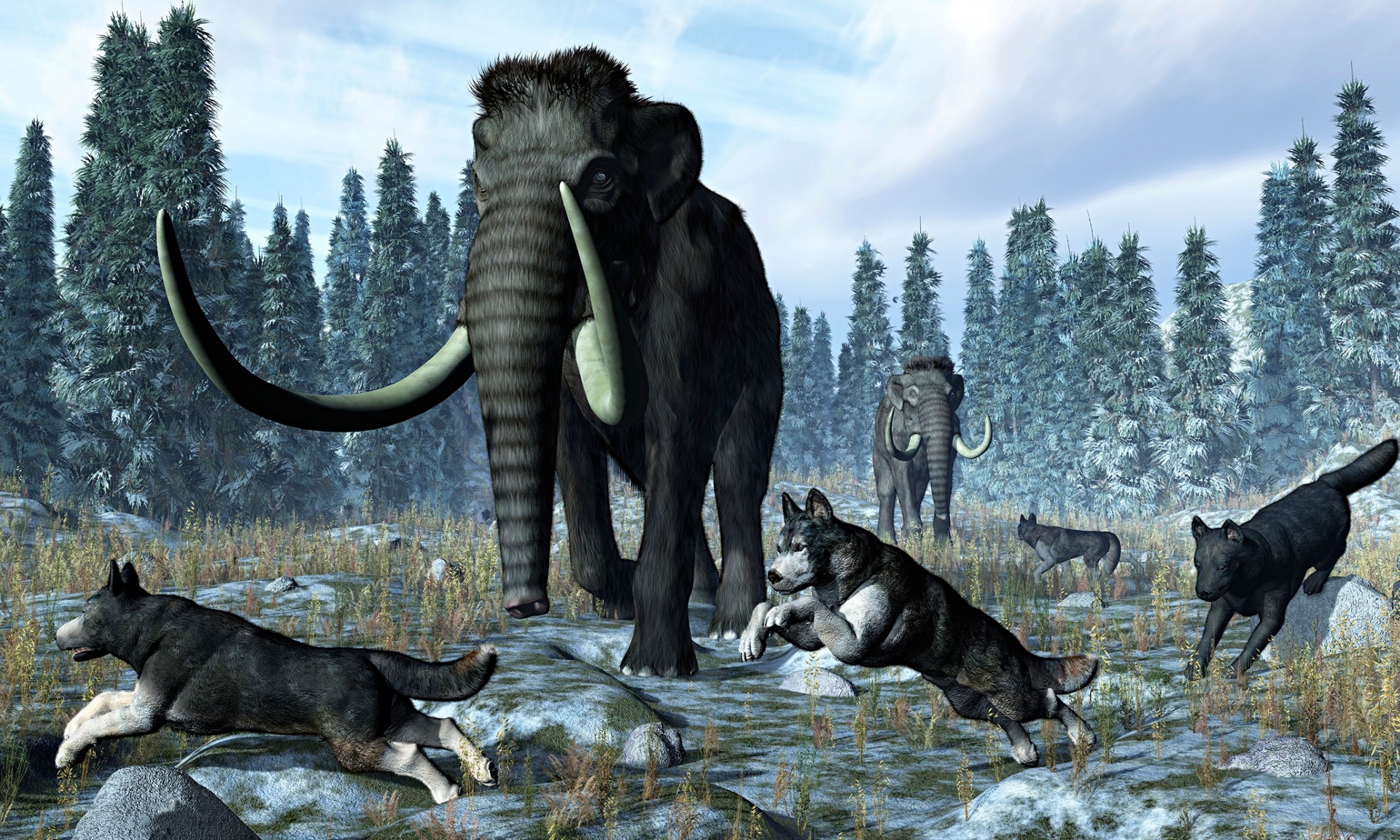
Wolves were far more numerous then than now, and they adapted to a wide range of habitats and prey. On the Eurasian steppes, wolves learned to follow herds of ungulates—in effect, to herd them. Meriwether Lewis observed the same behavior during his journey across North America in the opening years of the 19th century; he referred to wolves that watched over herds of bison on the Plains as the bisons’ “shepherds.” Of course, those “shepherds” liked it when human hunters attacked a herd because they killed many more animals than the wolves, and although the humans carried off the prime cuts, they left plenty behind.

Ethologists Wolfgang M. Schleidt and Michael D. Shalter refer to wolves as the first pastoralists in “Co-evolution of Humans and Canids,” their 2003 paper in the journal Cognition and Evolution. Early humans, they argue, learned to hunt and herd big game from those wolves; thus, the dog emerged from mutual cooperation between wolves and early humans, possibly including Neanderthal. There is no evidence yet of Neanderthal having tame wolves, much less dogs, but the larger point is that when modern humans arrived on the scene, they found wolves already tending their herds, and they immediately began to learn from them. That was long before humans began, in some parts of the world, to settle into more permanent villages, some 12,000 to 20,000 or 25,000 years ago.

Schleidt and Shalter based their model on wolf behavior and on genetic studies that have consistently shown that dogs and wolves diverged between 40,000 and 135,000 years ago. The first of those studies emerged from the lab of Robert K. Wayne, an evolutionary biologist at the University of California at Los Angeles who had already made headlines by showing definitively that the dog descended from the wolf alone. In a paper appearing in the June 13, 1997, issue of Science, Wayne and his collaborators said that dogs could have originated around 135,000 years ago in as many as four different places. They also argued that genetic exchanges between wolves and dogs continued—as they do to this day, albeit in an age during which dogs have become ubiquitous and wolves imperiled.

Since that paper appeared, the dog genome has been fully sequenced and provides a time frame for domestication of 9,000 generations, which the authors of a paper on the sequencing in the December 8, 2005, issue of Nature pegged at 27,000 years. But except for that, subsequent studies of mitochondrial DNA, which is most commonly used to date species divergence, have pointed to a time frame of 40,000 to 135,000, with 40,000 to 50,000 years ago looking like the consensus date.

Most of this work has been conducted in Wayne’s lab; in the Uppsala University lab of Carles Vilà, his former student and the lead researcher on the 1997 paper; and in the lab of Peter Savolainen of the Royal Institute of Technology, Stockholm, another collaborator on the original paper.

A signal problem with the early date is that it doesn’t appear to match the archaeological record. The dog is not only behaviorally but also morphologically different from the wolf, and such an animal first appears in the fossil record around 14,000 years ago in Bonn-Oberkassel, Germany. Archaeologists nearly universally peg the origin of the dog to that time.

Wayne, Vilà and their supporters have suggested from the start that behavioral change could predate morphological change, which would have occurred when humans began to create permanent settlements, thereby cutting—or at least reducing—their wolf-dogs’ contact with wild wolves. People might also have begun attempting to influence the appearance of their dogs at this point.

But those Germans get in the way again. Bonn-Oberkassel, site of the consensus first fossil dog, is not a permanent settlement.

Trying to square genetic and archaeological dates, Peter Savolainen resurveyed the mitochondrial DNA of dogs and wolves, recalibrated the molecular clock and proposed in a paper in Science, November 22, 2002, that the dog originated in East Asia 15,000 to 40,000 years ago. It was a good try, but now it appears that his “40,000 years ago” date was more accurate. Also, the earliest known dog appears in Germany, not East Asia, a region to which other genetic evidence points as well.

In many ways, the dispute over dates and places is just a precursor for the debate over how that happened. Archaeologists and evolutionary biologists who want the first dogs to look like dogs have tended to argue that the transition is a result of a biological phenomenon called “paedomorphosis.” That basically means that the animal’s physical development is delayed relative to its sexual maturation. It produces dogs with more domed heads; shorter, broader muzzles; and overall reduced size and slighter build than a wolf. Accelerated physical development relative to sexual maturation (hypermorphosis), on the other hand, produces dogs larger than the progenitor wolf.

When maturation is stopped early enough, the resulting animal is said to resemble a “neotenic,” or perpetually juvenilized, wolf. Coppinger and others have carried the argument further to argue that behaviorally, the dog resembles a neotenic wolf, with some breeds being more immature or less developed than others. There is general agreement that, beginning in the late 19th century when the dog began to move into the city as a pet, breeders sought to soften and humanize the appearance of some breeds to make them look like perpetual puppies. But beyond that, it is more correct to view the dog as an entity different from the wolf.

Currently, many researchers like to invoke an experiment in domestication launched in 1959 at the Institute of Cytology and Genetics in Novosibirsk, Siberia, by Dmitry Belyaev and continued after his death by Lyudmila Trut and her colleagues. Belyaev selectively bred foxes for “tameness” alone, defined as their level of friendliness toward people. He ended up with foxes that resembled dogs. A number of them had floppy ears, piebald coats, curly tails and a habit of submissively seeking attention from their human handlers with whines, whimpers and licks. (I wouldn’t want such a dog.)

Anthropologist Brian Hare tested the tame foxes in 2004 and found that they, like dogs, had the capacity to follow a human’s gaze, something wolves and wild foxes, not to mention chimpanzees, won’t do.

A number of researchers have embraced these tame foxes as a template for dog domestication. While they doubtless cast insight on the problem, I doubt that they will answer all questions. Arguments by analogy are suspect science and should be even more so in this case, since the selection criteria for these foxes were also against aggression—hardly the case for dogs—and foxes clearly are not wolves.

That said, the experiment does appear to confirm that selective breeding for behavior alone can also produce morphological changes similar to what the wolf experienced in becoming a dog.

Coppinger has invoked the fox experiment to support his theory that wolves that became dogs self-domesticated. As humans in some areas moved into permanent settlements, their refuse heaps became feeding grounds for wolves who were tame enough—or least-frightened enough—to feed near humans. Subsequent generations became more tame, and people began to allow them to wander their camps, eating feces, hunting rodents. From that group, people took some animals for food. Then, when the animals were thoroughly self-tamed, people began to train them to more wolfish behaviors, like hunting.

What he and others overlook in citing the fox experiment is that those animals were subjected to intense artificial selection by people. They also ignore the fact that the first dog appears in a seasonal camp, not a permanent settlement.

In their book, Dogs, Coppinger and his wife, Lorna, argue that these early protodogs would have resembled the ownerless dogs of Pemba Island, a remote part of the Zanzibar archipelago. As a model, Pemba suffers numerous problems, as does Coppinger’s theory. It is an Islamic island, and Islam has scarce place for dogs, believing them filthy, largely because they scavenge and eat excrement.

Beyond that, Pemba was a wealthy island in the 18th and 19th centuries due to its clove plantations, which were worked by African slaves and overseen by Arabs. The plantations have long since fallen into disrepair, on an island populated by the descendants of free slaves, where poverty is the rule. Attempting to read the past by looking at the present is a well recognized form of historical fallacy. It can’t be done, especially in a place where there is no strong cultural tradition.

Elsewhere in the developing world, free-ranging dogs are often more than scavengers or food. Some are fed; they protect territories or vendors’ carts. A few might be taken in, but, again, these dogs must be studied and understood in their current context and then placed in a broader historical context, if possible.

Moreover, Coppinger ignores the entire tradition of dogs and people in Europe, Japan and Korea—wherever dogs were employed from an apparently early date for a purpose, including companionship and ritual. Archaeologist Darcy F. Morey clearly demonstrated in the February 2006 issue of The Journal of Archaeological Science that people have been burying dogs and treating them with reverence and respect from the beginning, hardly the fate of scavengers.

People will argue, but I think the question of whether the dog is a juvenilized wolf is best answered with this observation: The dog follows human gaze, according to Hare, and is so attentive to people that it can imitate them, according to Vilmos Csányi, and it does so from an early age. No wolf of any age can replicate that basic behavior. It is far better to look at the dog as a differently developed wolf than as a developmentally retarded wolf.

Similarly, until shown otherwise, it seems more accurate to view domestication as a dynamic process involving wolves and people. At a time when the boundaries between human and wild were much more porous than now, people doubtless took in animals, especially young animals of all kinds, especially wolf pups, since in many places, they were hunting the same game and perhaps scavenging from each other.

As those pups matured, they returned to the wild to breed, with the naturally tamest among them denning close to the camp where they had been raised and, yes, could scavenge. Over the past year, researchers have shown that the area of the brain known as the amygdala is quite active when “fear of the other” begins to develop. In 2004, a team of researchers from Uppsala University, including Vilà, reported in the journal Molecular Brain Research on changes they had found in gene expression in the frontal lobe, hypothalamus and amygdala of wolves, coyotes and dogs. More than 40 years ago, J.P. Scott and John L. Fuller showed that the dog pup had a lengthened socialization period before fear of the other set in, compared with the wolf pup.

No one knows how fast the change happened, but in some places, tame wolves—dogs—resulted from this process. They provided territorial defense, helped with hunting (which they do well), scavenged, and were valued for companionship and utility. Some could be trained to carry packs. That early dog probably remained nearly indistinguishable from the wolf except in places where their gene pool became limited by virtue of some isolating event. The smaller gene pool forced inbreeding that, along with changing environmental conditions, somehow “destabilized” the genome.

Vilà and two colleagues suggested in an article published online on June 29, 2006, in Genome Research, that domestication relaxed “selective constraint” on the dog’s mitochondrial genome, and if that relaxation extended to the whole genome, as it appeared to, “it could have facilitated the generation of novel functional genetic diversity.”

European and North American breeders have taken full advantage of that or some other mechanism to create the most morphologically diverse mammal around. But other cultures did not follow that path.

There are other theories afloat in what is an exciting time for people who study dogs. But the one that succeeds will reflect the dynamic relationship between human and dog.

Copyright © 2006, 2014 Mark Derr

This article first appeared in The Bark, Issue 38: Sep/Oct 2006

Mark Derr is the author of A Dog’s History of America, Dog’s Best Friend, The Frontiersman: The Real Life and Many Legends of Davy Crockett, Some Kind of Paradise, and numerous articles on science, environment and transportation.

ooOOoo

Thank you, Mark.

Time and time again, I marvel at how this modern, wired world creates such beautiful connections.

Ambition; the film.

Striving to achieve what is humanly possible.

A day almost exclusively devoted to writing left me wondering what to post for today.

Then in my ‘blog’ folder was this recent item from the blog site EarthSky.

It is republished here as it was received by me.

ooOOoo

Exciting Rosetta space mission inspires a magical short film

A very good 7-minute film, called Ambition. It’s not like any film about space exploration you’ve ever seen. The Rosetta comet mission lies at its heart.

Everything about the European Space Agency’s Rosetta mission – which, in August, caught up to Comet 67P/Churyumov–Gerasimenko and began moving in tandem with it – has been fantastic so far. For us space buffs, this mission has gone a long way toward fulfilling our fantasies about what might be accomplished in outer space. It’s caused us to remember why we got so excited about space exploration in the first place. And now – just weeks before Rosetta will send a lander to the surface of its comet – ESA and Platige Image have released a very good short film, called Ambition. It’s not a space documentary, or like any film about space exploration you’ve ever seen. It doesn’t focus so much on the mission itself – although the Rosetta mission does lie at the heart of the film – as on why we need to go into space.

The film features an apprentice magician and her master, talking about the making of solar systems.

I won’t tell you more; you should watch the film. It might touch your heart in ways you’ve forgotten, as the Rosetta mission itself has touched mine.

Tomek Baginski directed the film Ambition, which stars Aiden Gillen – who played Littlefinger in Game of Thrones – and Aisling Franciosi. Its producers shot Ambition on location in Iceland and produced it primarily in Poland. Its first public screening was October 24, 2014 during the British Film Institute’s celebration of Sci-Fi: Days of Fear and Wonder, at the Southbank, London.

By the way, Tim Reyes at UniverseToday.com has written a very good essay about the film Ambition, and what it means in the context of U.S. and European space efforts, and in the larger context of our striving to meet challenges in the world today. He also says you should watch the film. Because it’s about what it means to want to know what’s possible.

In the film Ambition, a young magician tries to build a solar system … but fails.
Did you assume this was an artist’s concept? It’s not. It’s a real image. It’s the Rosetta spacecraft’s selfie with comet 67P/Churyumov–Gerasimenko, imaged Sunday, September 7, 2014. Image via ESA/Rosetta/Philae/CIVA

Bottom line: A very good 7-minute film, called Ambition. It’s not like any film about space exploration you’ve ever seen. The Rosetta comet mission lies at its heart.

ooOOoo

And here is that film.

Published on Oct 24, 2014
Ambition is a collaboration between Platige Image and ESA. Directed by Tomek Bagiński and starring Aidan Gillen and Aisling Franciosi, Ambition was shot on location in Iceland, and screened on 24 October 2014 during the British Film Institute’s celebration of Sci-Fi: Days of Fear and Wonder, at the Southbank, London.

Vested interests, perhaps.

I’m being very brave and stepping into the climate change cauldron!

Learning from Dogs has been posting a wide range of items for well over five years. Indeed, today’s post is number 2,238!

Over those five years, my position regarding climate change or global warming has been pretty clear: a belief in the proposition that man’s behaviours are changing the very climate of our planet.  For instance, a little over a year ago I posted under the title Sceptical about global warming?  It opened:

Learning from Dogs is not a blogsite about climate change!

Why, you may ask, do I start today’s post with that sub-heading?  Because, I am conscious that many of my posts do touch on this subject.  For example, just two days ago there was Breaking news.  Then there was the piece about the climate implications for Phoenix, Arizona.  Followed the next day by the changes in the flow of the jet stream across the North Atlantic with all the weather implications for North-West Europe.

Indeed, as the heading to today’s post makes clear, this is also about the changes going on to our planet.

Learning from Dogs is about a different way of living and behaving.  A campaign, if one wants to call it that, to show that the way that modern man is living is corrupt.  Not with a big ‘C’ but still in the sense of living a dishonest life.  Learning from Dogs attempts to show that our wonderful dogs, a source of so much love and pleasure for so many millions, offer us an example of a life in and of this planet.

If there was ever a time in the history of man when we needed being reminded of our frailty and vulnerability, it is now.  As the following so starkly illustrates.

Peter Sinclair of Climate Crocks recently republished an item from Skeptical Science that opened up as follows:

A new study of ocean warming has just been published in Geophysical Research Letters by Balmaseda, Trenberth, and Källén (2013).  There are several important conclusions which can be drawn from this paper.

  • Completely contrary to the popular contrarian myth, global warming has accelerated, with more overall global warming in the past 15 years than the prior 15 years.  This is because about 90% of overall global warming goes into heating the oceans, and the oceans have been warming dramatically.

Then last week-end, Dan Gomez, friend for over 40 years, sent me the following:

Weather Channel Founder: Global Warming Science ‘Not Valid’

Meteorologist John Coleman, who co-founded The Weather Channel, says the claim that human activity is leading to global warming is no longer scientifically credible.

Instead, the “little evidence” there is for rising global temperatures points to a “natural phenomenon,” Coleman asserts.

In an open letter to the United Nations’ Intergovernmental Panel on Climate Change (IPCC), he wrote: “There is no climate crisis. The ocean is not rising significantly. The polar ice is increasing, not melting away. Polar bears are increasing in number.

“Heat waves have actually diminished, not increased. There is not an uptick in the number or strength of storms.

“I have studied this topic seriously for years. It has become a political and environmental agenda item, but the science is not valid.”

Coleman says he based his views on the findings of the Nongovernmental International Panel on Climate Change (not to be confused with the U.N. panel), a body of scientists and scholars who assess the science of global warming.

“There is no significant man-made global warming at this time. There has been none in the past and there is no reason to fear any in the future,” says Coleman, who was the original meteorologist on “Good Morning America.”

“Efforts to prove the theory that carbon dioxide is a significant greenhouse gas and pollutant causing significant warming or weather effects have failed.

“There has been no warming over 18 years.”

The U.N.’s IPCC argues that their research shows man-made global warming will lead to extreme weather events becoming more frequent and unpredictable, the Express in Britain reported.

Climate expert William Happer, a professor at Princeton University, expressed support for Coleman’s claims.

“No chemical compound in the atmosphere has a worse reputation than CO2, thanks to the single-minded demonization of this natural and essential atmospheric gas by advocates of government control [of] energy production,” Happer said.

“The incredible list of supposed horrors that increasing carbon dioxide will bring the world is pure belief disguised as science.”

What Dan had seen was an article in the UK Daily Mail that, in turn, was echoed on the US WesternJournalism blogsite.  Here’s how that Daily Mail story opens:

Climate change has been proven to be a lie, according to a leading meteorologist.

John Coleman, who co-founded the Weather Channel, claims that the belief humans are causing climate change is not backed up by science.

In an open letter attacking the UN, the 80-year-old from San Diego, said that what ‘little evidence’ there is for global warming points to natural cycles in temperature.

‘There is no climate crisis,’ he wrote. ‘The ocean is not rising significantly. The polar ice is increasing, not melting away. Polar bears are increasing in number. ‘Heat waves have actually diminished, not increased. There is not an uptick in the number or strength of storms.

‘I have studied this topic seriously for years. It has become a political and environment agenda item, but the science is not valid.’

The WesternJournalism post runs with the story explaining (in part):

John Coleman, the original meteorologist for ABC’s Good Morning America and the founder of The Weather Channel, which launched in 1982, wrote an open letter to the UCLA’s Hammer Forum urging them “to re-examine their plan” for their forum, scheduled for this past Thursday, after they announced their experts, both of whom believe in climate change science.

Coleman has made his position against climate change science clear in the past.

“There is no significant man-made global warming at this time, there has been none in the past and there is no reason to fear any in the future. Efforts to prove the theory that carbon dioxide is a significant ‘greenhouse’ gas and pollutant causing significant warming or weather effects have failed. There has been no warming over 18 years.”

The Weather Channel founder cites professors from Princeton University, Massachusetts Institute of Technology (MIT), Harvard Smithsonian Observatory, and the University of Alabama, along with “9,000 Ph.D scientists” who agree with him.

“Yet at your October 23 Hammer Forum on Climate Change you have scheduled as your only speakers two people who continue to present failed science as though it is the final and complete story on global warming/climate change. This is a major mistake.”

Coleman urged the UCLA group to reconsider, noting he is not a “flat Earther,” or a “paid shill of the Koch Brothers.”

In a discussion yesterday with Dan, he was of the clear mind that, yes, the climate is changing, as it always has over eons of time, but that the degree of change that is directly attributed to man’s affairs is minute.  Then all around me I see sign after sign, read article after article, that we, as in mankind, are relentlessly ‘fouling our own nest’ and the time left for us to learn how to live sustainably on this planet is fast running out.

Can we get to the truth? The topic will be continued tomorrow!

Breathtaking beauty of our world.

The awe-inspiring pictures of the recent Aurora.

I stuck this in my drafts folder and then promptly forgot about it!

But despite the aurora taking place nearly two months ago, the pictures are stunning and I wanted still to share them with you.  They came to my attention thanks to the EarthSky blogsite.

From where today’s post is taken.

ooOOoo

August 19 aurora from space and Earth

One of the first auroras of the 2014 autumn season appeared last night at northerly latitudes. Astronaut Reid Wiseman caught it from space. Photographer Göran Strand caught it from Sweden.

aurora-space-Wiseman-tweet-1-e1408536767203

oooo

aurora-space-wiseman-tweet-2-e1408536756730

Astronaut Reid Wiseman captured these images from the window of the International Space Station last night (August 19, 2014). SpaceWeather.com says:

A moderate (G2-class) geomagnetic storm that erupted following a CME strike on August 19th is subsiding now. At its peak, the storm sparked auroras around both poles visible from the ground and from space.

Follow astronaut Reid Wiseman on Twitter – he’s our eyes from above!

More awesomeness from the International Space Station.

oooo

Downloaded from here.

Fotograf Göran Strand

The Aurora season is here

Last night I got to see my first Aurora for the season, two days earlier than last year but five days later than my personal record from 2011 (August 14th).

It was a faint aurora that lasted for several hours and as you can see it was quite cloudy. The orange/yellow clouds to the right are clouds that are lit up by the street lights from the city of Östersund and Frösön.

Finally the dark nights are here so we can enjoy the auroras ahead and let us hope that there will be lots of them during the coming season.

Don’t you think Göran Strand’s photograph is just wonderful!

Men, Women and Memory!

Are men’s brains the same as women’s?

The wonderful BBC science programme, BBC Horizon, recently showed a fascinating programme entitled: Is your Brain Male or Female?  The programme is introduced on the Horizon website:

Dr
Dr. Mosley and Prof. Roberts.

Dr Michael Mosley and Professor Alice Roberts investigate if male and female brains really are wired differently.

New research suggests that the connections in men and women’s brains follow different patterns, patterns which may explain typical forms of male and female behaviour. But are these patterns innate, or are they shaped by the world around us?

Using a team of human lab rats and a troop of barbary monkeys, Michael and Alice test the science and challenge old stereotypes. They ask whether this new scientific research will benefit both men and women – or whether it could drive the sexes even further apart.

Now I haven’t a clue as to how long this fascinating programme will remain on YouTube, but if you aren’t in the UK or don’t have access to the BBC iPlayer then don’t hesitate to watch it now.

Essentially, science shows that the ‘hard-wired’ differences are minute and the vast bulk of the preferences between the genders, trucks versus dolls, for example, is subtle conditioning from parents and the wider world; for instance, advertisements.

One thing that did jump ‘off the page’ at me was the evidence supporting how malleable or plastic is the brain.  In other words, we are never too old to learn.

As if to reinforce that aspect of the flexibility of our brain, just yesterday morning I read an item on the BBC News website about memory.

As someone whose memory is a long way from where it used to be, this item really caught my attention:

How to save your memory

By David Robson from Headsqueeze.

Are there ways to stop yourself losing your memory? The latest brain research suggests there’s hope for the forgetful…

Memory loss has to be one of our biggest fears. Names, words, facts and faces – nothing is spared.

As the latest video from the Head Squeeze team describes above, mental deterioration was once thought to be an inevitable consequence of ageing, thanks to the steady erosion of our brain matter: we lose about 0.5% of our brain volume every year. The hippocampus – the region responsible for memory and learning – was thought to weather particularly badly; by the time we are 90, many of us have lost around a third of its grey matter.

Fortunately, recent research has shown that the brain is not concrete, but certain regions can adapt and grow. In 2000, a study of London taxi drivers, for instance, showed that the 4-year training of London’s 25,000 streets showed a remarkable growth in the hippocampus compared to bus drivers who early learnt a fixed number of routes. The scientists think that, by memorising the maps of London, the brain had built many more of the “synaptic connections” that allow the brain cells to communicate with each other. In other words, it may be possible to train the brain to compensate for some of the neural decline that accompanies our expanding waistlines and receding hairlines.

Challenging your brain could be one way of preserving your recollections – though the value of commercial brain training apps is debatable; some experiments seem to show that while people may become a whizz at the games on their screen, the improvements fail to transfer to daily life. But other, more traditional activities – like learning a musical instrument or a second language – do seem to have some protective benefits, at least on short-term recall. Ideally, it is probably best to keep your brain active throughout your life, well before you begin to approach your dotage.

Exercise and a healthy diet are also thought to offer some protection against dementia. As can an active social life – since regular contact with other people is also thought to excite our neurons and preserve our synapses. Ensuring that you regularly get a good night’s sleep helps too.

Of course, nothing can guarantee health and vitality in old age. But these few simple measures might give you the best possible chances of preserving your wits against the ravages of time.

For more videos subscribe to the Head Squeeze channel on YouTube. This video is part of a series produced in partnership with the European Union’s Hello Brain project, which aims to provide easy-to-understand information about the brain and brain health.

If you would like to comment on this video or anything else you have seen on Future, head over to our Facebook page or message us on Twitter.

So it’s clear now.

All I need to do is to learn a new language while in between my training to be the oldest trainee cabbie in London and applying for second violin position at the Royal Philharmonic Orchestra and I’ll never forget anything else in my life.

Oh, anyone seen where I left my car keys?

Or perhaps, harking back to the opening question of the differences between our sexes, I should be closing, thus:

Anyone seen where I left my dolls?

Governments: Listen to your people!

Because you clearly are not listening to Nature!

Sunday: 10:30 PDT. Won’t rabbit on too long as we are due out with our guests in the next thirty minutes. Just dipped into the online BBC News headlines and, frankly, was more than disappointed to see that the Climate March in New York, and many other cities all around the world, was the third headline after Afghanistan and Yemen.

Oh well!

What I read earlier in the morning was the most fabulous essay over on the Transition Times blogsite written by Jennifer Browdy.  It is republished in full with her kind permission.

This should be read in full!

ooOOoo

The People’s Climate March: Taking the Evolutionary Leap of Radical Democracy

The People’s Climate March in New York City is just one manifestation of a huge sea-change sweeping through our culture. Or perhaps “seeping” would be a better verb—this shift in awareness is not happening with the tsunami force of a revolution, but more with the steady, determined drip-drip-drip of water undermining rock.

Humans are paradoxical. On the one hand, we love everything that’s new and innovative, we all want to be out ahead of the curve when it comes to technological breakthroughs and new ideas. On the other hand, we hold tight to the received wisdom of our forebears, living by enshrined writings thousands of years old (the Bible, the Koran, the Mahabharata, Confucius, etc.) or hundreds of years old (the Declaration of Independence, the Constitution, the Bill of Rights).

We have established elaborate educational, political and legal systems designed to hold us to a particular form of society, permitting free, innovative thinking only along narrow channels carefully defined by the interests of business and commerce.

The arts and humanities, traditionally the realm of creative, imaginative exploration, have been steadily starved in this brave new world, which can only imagine creativity in the service of profit.

What happens to a society that can only envision creative energy in an instrumental, utilitarian light?

We become a society of robots. We lose our connection to the soul of the world, the anima mundi that sustains us humans along with all other living beings on the planet.

TT1

The People’s Climate March, which is happening not only in New York City but worldwide, with 2,808 marches and events in 166 countries, bears welcome witness to the fact that the sparks of creative, independent thinking have not totally gone out.

There are many, many people worldwide who are aware, and aghast, at the failure of our political and business leaders to act in the best interests of the people and all the beautiful, innocent creatures who are slipping away into the night of extinction day by day due to the relentless human assault on our shared planet.

We are here, we are aware, and we are engaged. We are not going to stand by silently and let corporate greed and shortsightedness overwhelm us.

It is true that business and government have a stranglehold on official channels of communication, education and social change.

They control the curricula taught in our schools, what appears on our major media channels, and what projects and areas of creative exploration are funded. They keep us in line with the debt bondage of school loans, mortgages, car payments and the fear of not having enough money in the bank for a comfortable old age. We’re so busy running on the treadmills they’ve set up we have no time or energy to think about changing the system.

Or do we?

We saw it happen in the Arab Spring, where people used cell phones and texts to organize themselves to resist oppression.

We saw those people get beaten back, the promise of their revolution squashed by the entrenched power of men with guns and tear gas.

The rise of the Islamic State, like the rise of Al Quaeda and the Taliban, is all about conservative forces resisting change.

I am just as afraid of men with guns and tear gas as the next woman. I am happier making revolution on my laptop than in the streets. But at some point we have to come out from behind our screens, get off the treadmills of debt bondage, look around us at the beauty of the world, and say: this is what I want to live for, and this is what I’m willing to die for.

So far, the one social area that has not been overtaken by corporate/governmental control is the World Wide Web. It’s still a Wild West space, a place where you can find everything and everyone, from dangerous sadists to beneficent spiritual leaders. There’s room for every kind of idea out there to percolate through our collective consciousness. And make no mistake: the energy we’re seeing in the People’s Climate March is fueled in large part by the distribution power of the Web, the ability to get the word out and get people fired up to come together to take a stand.

Photo: Cheryl Himmelstein

Environmental activist and writer Terry Tempest Williams, in her book The Open Space of Democracy, says that the time has come to “move beyond what is comfortable” (81) in pursuit of what she calls a “spiritual democracy.”

“We have made the mistake of confusing democracy with capitalism and have mistaken political engagement with a political machinery we all understand to be corrupt,” she says.

“It is time to resist the simplistic, utilitarian view that what is good for business is good for humanity in all its complex web of relationships. A spiritual democracy is inspired by our own sense of what we can accomplish together, honoring an integrated society where the social, intellectual, physical and economic well-being of all is considered, not just the wealth and health of the corporate few” (87).

Williams calls for a radical recognition of the interdependence of all life on Earth. “The time has come to demand an end to the wholesale dismissal of the sacredness of life in all its variety and forms,” she says. “At what point do we finally lay our bodies down to say this blatant disregard for biology and wild lives is no longer acceptable?” (86)

If we humans could step into our destiny as the stewards of our planet, the loving gardeners and caretakers of all other living beings, we would harness our incredible intelligence and creativity to re-stabilize our climate and do what needs to be done to ensure the well-being of all.

Williams calls this “the next evolutionary leap” for humanity: “to recognize the restoration of democracy as the restoration of liberty and justice for all species, not just our own” (89).

If we are able to take this leap, we will not only avert climate-related disaster on a Biblical scale, we will also overcome many of the social problems that we currently struggle with. “To be in the service of something beyond ourselves—to be in the presence of something other than ourselves, together—this is where we can begin to craft a meaningful life where personal isolation and despair disappear through the shared engagement of a vibrant citizenry,” says Williams (89).

TT2

Williams’ small gem of a book grew out of a speech she gave at her alma mater, the University of Utah, in the spring of 2003, as America was rushing into its ill-conceived War on Terror in Iraq. She describes her heart pounding as she got up to make a speech advocating a different form of democracy than that embraced and espoused by all the conservative friends and family sitting in the audience before her.

Challenging one’s own friends and family, betraying one’s own tribe, is the hardest aspect of being a social revolutionary. You have to question the very people you love most, who have given you so much and made your whole life possible.

But if we become aware that the social systems that gave birth to us are the very social systems that are undermining the possibility of a livable future on this planet, can we continue to just go with the flow, to avoid asking the difficult questions?

Or will we become change agents who work slowly and steadily, drip by drip, to awaken those around us, those we love most, to the necessity of undertaking “the next evolutionary leap” in the human saga on the planet?

TT3

ooOOoo

From that BBC News website:

On Tuesday, the UN will host a climate summit at its headquarters in New York with 125 heads of state and government – the first such gathering since the unsuccessful climate conference in Copenhagen in 2009.

So world leaders, are you going to reflect the wishes of millions of your peoples across the world and step up to the mark?  We will see.

Think you know our Solar System – Think again!

An incredible discovery about the motion of the sun, and the planets.

Serendipity

I have turned on my computer. It’s 15:30 on Sunday. My creative juices re Monday’s blog post are not flowing. Why? Because, together with a young helper who comes over most Sunday mornings, this morning we have shifted 100 bales of hay from outside the garage, taken them down to the hay-loft and stacked them floor to ceiling: all two and a half tons of them!  To use an old English colloquial expression: I am fair knackered!

Then I am rescued!

Top of my email inbox is an email from Dan Gomez that is an item sent to him from his brother Chris.  It’s a truly incredible discovery. One that requires us all to tear up what we understand about the Solar System and start again.

Here is the essay in question.  It has been recently published on the Spirit, Science and Metaphysics website.

ooOOoo

Our Model Of The Solar System Has Been Wrong This Entire Time!

Written by Amateo Ra

solar-system1

If you walk into any classroom today, and likely ever since you were a kid yourself , there is one model being taught regarding the structure of our Solar System. It’s the model that looks like this:

SolarSysScope-1024x571

It’s the traditional orbiting model of the Solar System, or the Heliocentric Model, where our planets rotate around the sun.

While this isn’t entirely wrong, it’s omitting one very important fact. The sun isn’t stationary. The sun is actually travelling at extremely fast speeds, upward of 828,000 km/hr, or 514,000 miles an hour.
Our whole Solar System is orbiting the Milky Way Galaxy. In fact it takes 220-Million Years for the Sun to orbit our Galaxy.

milkyway

Knowing this to be true, our visual model of the Solar System needs to change, and has been inaccurate this whole time. In fact, our planets are barreling through space with the sun, and literally creating a giant Cosmic DNA Helix, and a vortex similar to our Milky Way Galaxy.

Like this but in space, creating a never ending Sine Wave.

SineWAves

This entails that our Sun & the Planets of our Solar System are never in the same place. When we make one rotation around the sun, we have already traveled millions of miles through space, meaning these Cosmic Cycles are far grander than we might have previously imagined.

Here are two video examples of the Helical Model of our Solar System:

This is one by Physicist Nassim Haramein, which clarifies the difference:

Here is a beautiful digital representation of how our solar system is actually a vortex.

Thanks & Spread the Word! Let’s get this changed in Classrooms all around the World.

About the author: Amateo Ra is the co-founder of Creator Course, an Online School for Conscious Living which is currently being built. For the last 4-years, he has been training with Global leaders in Spirituality, Channeling & Conscious Business.

ooOOoo

Don’t know about you but reading this for the first time and watching the two videos really invigorated me. What an amazing universe it is out there!

Thank you, Ben!

A thank you to all those that work so hard to stop fires from getting out of control.

I am drafting this post at a little after noon on the 4th., i.e. early afternoon yesterday.

It is yet another dry, hot day in a long run of hot, dry days. Our local online weather service, GrantsPassWeather.com, informs me that the temperature this afternoon (i.e. yesterday) is forecast to be a high of 93 deg F. or 34 deg C.  We last had monthly rain totals of more than an inch back in March.  At the top of the home page of Grants Pass Weather is a bold red banner proclaiming a Red Flag Warning for three counties: Jackson, Josephine and Eastern Curry.  We live in Josephine County and clicking that banner reveals:

Details:

…RED FLAG WARNING REMAINS IN EFFECT UNTIL 10 PM PDT THIS EVENING FOR COMBINATION OF STRONG WINDS AND LOW RELATIVE HUMIDITIES FOR FIRE WEATHER ZONES 280…281…617…619…620…621…622 AND 623…

* AFFECTED AREA: FIRE WEATHER ZONES 80…281…617…619…620…621…622 AND 623.

* HUMIDITY…MINIMUM RELATIVE HUMIDITY AT 10 TO 20 PERCENT FOLLOWED BY RECOVERIES TONIGHT AT 20 TO 40 PERCENT.

* WIND…NORTHEAST TO EAST WINDS 10 TO 20 MPH THROUGH THIS EVENING THEN 5 TO 15 MPH OVERNIGHT.

* IMPACTS…POSSIBLE PLUME DOMINATED BEHAVIOR ON ACTIVE FIRES AS STRONG WINDS AND LOW RELATIVE HUMIDITIES THROUGH THIS EVENING WILL CAUSE FIRES TO SPREAD VERY RAPIDLY.

* VIEW THE HAZARD AREA IN DETAIL AT HTTP://GO.USA.GOV/ZYV5

Information:

STRONG WINDS AND LOW RELATIVE HUMIDITIES WILL CAUSE FIRES TO SPREAD VERY RAPIDLY.

Little after 7am a few weeks ago - looking out to North-East.
Little after 7am a few weeks ago – looking out to North-East. Picture taken from the rear deck of our house near Merlin, Oregon.

Does this focus the mind?  You bet! The trees in the foreground of the above photograph are within our property. Our house is surrounded by tall oaks, pines and fir trees.

Now stay with me through what, at first, may seem like a disconnected change of topic.

Long, long time ago Jean met Ira Weisenfeld, a young vet making his way in the world.  Jean’s passion for rescuing feral street dogs meant that she was a more active user of a vet’s services than the average pet owner.  Jean and Ira became very good friends.

Earlier on this year, we had the pleasure of the company of Ira’s daughter, Amber, who came to see us with the man in her life, Ben Elkind.

Fast forward to the 1st September and Amber sent us the following email:

Hello Paul and Jean!

Hope you guys are doing well. Here is a BBC story about smokejumpers in Redding, CA where Ben works, he is interviewed too. Thought you might like it! Hope you had a wonderful summer. I just finished the boundary water canoe trip with Dad, it was very good.
Take care,
Amber

That BBC story explains:

Forest fires kept at bay in US by elite ‘smokejumpers’

26 August 2014 Last updated at 00:48 BST

The drought that has gripped much of the American West shows no sign of abating – yet despite the tinder-box conditions, so far less land in the region has been lost to wildfires in 2014 than in recent years.

That is partly due to an aggressive strategy to stop smaller forest fires before they become too big to handle.

At the frontline of this effort are the smokejumpers, airborne firefighters who parachute into the wilderness to get the blazes under control.

It’s a dangerous job for an elite group of highly-trained men and women. The BBC spoke to three smokejumpers – Ben Elkind, Gretchen Stumhofer and Luis Gomez – at their base in Redding, California.

Produced by the BBC’s Jack Garland.

Additional footage courtesy of Ben Elkind and Tye Erwin

Here is that film report.